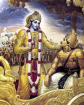
Hero Stories of the Ancient World
A hero, according to the American Heritage Dictionary, "in mythology and legend, ... is often born of one mortal and one divine parent, ... is endowed with great courage and strength, celebrated for ... bold exploits, and favored by the gods." Although the dictionary follows modern conventions and calls the hero "a man," in ancient and medieval literature, heroes may be either male or female. They are always favored by the gods and do great exploits, either by action, wise thoughts, or making symbolic journeys. This class will study the semi-divine heroes of early western tradition from the Sanskrit Mahabharata through Beowulf.
There will be short writing assignments (1-2 pages) on each block of the course (20%), an essay (40%), presented orally in class (10%), and a final exam (30%).
Required Texts
Mahabharata, ed. William Buck (U California
The Tale of an Anklet, tr. R. Parthasarathy (Columbia)
The Epic of Gilgamesh, tr. N. L. Sandars (Penguin)
Inanna, Queen of Heaven and Earth, ed. Diane Wolkenstein (Harper
Collins)
Beowulf, tr. Seamus Heaney (Norton)
Judith (course reader)
"The Martyrdom of Saints Perpetua and Felicitas" (course reader)
selections from the Kalevala (course reader)
Assignments
Wednesday, September 10 The Mahabharata, pp. 5-211
Wendesday, September 17 The Mahabharata, pp. 213-412
Wednesday, September 24 The Tale of an Anklet
Wednesday, October 1 Gilgamesh
Wednesday, October 8 Inanna
Wednesday, October 15 "The Martyrdom of Saints Perpetua and Felicitas"
and selections from the Kalevala; ancillary text Chaucer's "Second
Nun's Tale"
Wednesday. October 22 Beowulf
Wednesday, October 29 Judith; ancillary texts The Book
of Judith, "The Lay of Atli," and "The Waking of Angantyr"
Wednesday, November 5 Reports
Wednesday, November 12 Reports
Last revised May 28, 2003