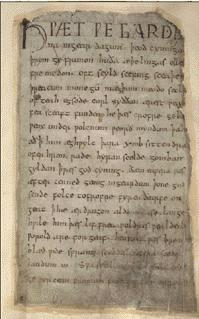
OLD ENGLISH
English 4125 provides an introduction to the Old English language and to literary works written in England before 1066 AD. Because Old English literature is, in the words of Stanley B. Greenfield, "to all effects in a foreign language," students will be asked to read aloud and translate in class. There will be weekly quizzes to test students' knowledge of Old English grammar and vocabulary as well as their ability to comprehend a text AND a final examination covering the work of the entire quarter. Because it is often difficult to master a new language quickly, the "examination grade" for a student who has done all the work will never be lower that her or his grade on the final. Thus a superior record on the weekly quizzes and on oral work will count in a student's favor, but a lower average will not count against him or her. The "examination grade" will count for 2/3 of the final grade and a brief paper will count for the remaining 1/3. (The topic will involve both translation and interpretation.)
The required texts are F. J. Cassidy and Richard Ringler, Bright's Old English Grammar and Reader, and Dorothy Whitelock, Sweet's Anglo-Saxon Reader. Cassidy and Ringler is currently out-of-print, but the sections of it used in this class are available as a coursepak in the bookstore. The coursepak also includes a number of translations to assist you in preparing your own translations. You should know about Labyrinth on the World-Wide Web, which is the main server for medieval studies, and you will need to know about Old English Aerobics. There are links to both on my home page. Students who are interested in more complete lexicographical information than is provided by the glossaries in Cassidy-Ringler and Sweet should be aware of the standard Old English dictionary, Bosworth-Toller's An Anglo-Saxon Dictionary, in the Reference section of the library: REF/PE279/B5.
Schedule of Assignments
Thursday, January 4 INTRODUCTION
Tuesday, January 9 Read Cassidy
and
Ringler chapters 1-8; study paradigms 6.2, 7.2, 7.6, and 7.7
Do exercises in each chapter
Thursday, January 11 Read Cassidy and
Ringler
chapters 9-11; study paradigms 9.2, 9.3, and 10.2; Prepare passages on
pp. 33-34 and 37-38
Tuesday, January 16 Read Cassidy and Ringler
chapters 12-13; study paradigms 12.3, 12.10, 13.1, and 13.4; prepare
passages on pp. 41, 44, 48, and 51
Quiz #1
Thursday, January 25 Read Cassidy and
Ringler
chapters 19-20; study paradigms 19.2, 19.4, 20.1, and 20.3; prepare passages on pp. 67 and 69
Tuesday, January 30 Read Cassidy and
Ringler
chapters 21-22; study paradigms 21.1, 21.3, 21.5, 22.1, and 22.2;
prepare passages on pp. 73 and 76-77
Quiz #3
Thursday, February 1 Read Cassidy and
Ringler
chapters 23-26; prepare passages on p. 80 and 84
Tuesday, February 6 First Hour: Review
Second Hour: Midterm
Thursday, February 8 Prepare lines
1-46 of "The Story of Cædmon," Whitelock, p. 45
Tuesday, February 13 Prepare "The
Chronicle:
Cynewulf and Cyneheard," Whitelock, p. 1, "Riddles" A, F, and G
(Whitelock,
p. 170 ), and Riddle 44 (coursepack)
Quiz #4
Thursday, February 15 Prepare "The Wife's
Lament" (coursepack)
Tuesday, February 20 Prepare lines 1-49 of
"The Dream of the Rood," Whitelock, p. 153
Quiz #5
Thursday, February 22 Prepare lines
50-100 of "Dream of the Rood"
Tuesday, February 27 Prepare lines 1-55a of
"The
Wanderer," Whitelock, p. 160
Quiz #6
Thursday, March 1 Prepare lines 55b-115
of
"The Wanderer"
Tuesday, March 6 Prepare lines 15-77a
of
Judith,
Whitelock, p. 137
Quiz #7
Thursday, March 8 Prepare
lines 77b-152a of Judith
Tuesday, March 13 First hour:
Prepare Judith 1ines 153a-175b
Second Hour: REVIEW
PAPER DUE
Last modified October 11, 2006