Interlocking in France
Contents
- Introduction
- The Bouré System
- The Barre Transversale
- Vignier Interlocking
- Saxby and Farmer Interlocking
- Junctions in France
- References
Introduction
This article only concerns mechanical interlocking, not what is called power interlocking involving electricity and other agents, such as compressed air or hydraulics.
Interlocking machines accompany the levers operating signals, points and facing point locks that have been collected in one location. They ensure that the levers cannot be set in unsafe ways. This is the more important since the devices operated are some distance from the signalman, and are operated by levers that look alike. To set up a route, the points are first set for the route. This can be done freely, since there are few restrictions on how the points must be set. The facing point locks are then engaged (the levers reversed), which locks the point levers. The signal governing the route is then cleared, which locks all points or their facing point locks, as well as signals governing conflicting routes. Finally, the distant signal for the route is cleared if it is a high-speed route.
In France, signals generally took the form of targets rotating about a vertical axis. The targets were given a characteristic colour and shape, and were used for day aspects only. A signal that was "on" (ouvert) displayed the target facing an approaching train. When "off" (fermé) the target was turned to display only its edge, and effectively disappeared. The lack of a positive "off" aspect was deprecated in Britain and the U.S., but was never abandoned in France. By night, coloured lights were displayed. Semaphore signals were used only for block signals that indicated whether a block was clear or occupied. The main signals only indicated whether a train could proceed or had to stop, and gave neither route nor speed indication, as was generally the case in British and U.S. practice. Route and speed were indicated by subsidiary signals. These principles were retained even for light signals.
Levers are identified by their numbers. Levers controlling similar functions are painted similarly (US and Britain--black: points; blue: facing-point locks; red: home signals; yellow: distant signals). A lever back in its frame is said to be Normal; when pulled forward, it is said to be Reversed. Levers are latched in these two positions by latches released by the latch handle. Unless the latch is released, the lever cannot be moved. A signal displays its most restrictive aspect when it is Normal. A facing-point lock (FPL) is disengaged when its lever is Normal. In a locking diagram, a lever number in a circle represents the lever reversed. In text, this can be represented by parentheses.
A few principles of interlocking are: (1) Clearing (reversing) a signal locks all points on its route; (2) Points not properly set for a route must lock the signal normal; (3) A cleared signal must lock the signals for conflicting routes normal; (4) A point lever is locked in both positions by its FPL; (5) A signal is locked normal when an FPL on its route is normal.
Certain relations between levers are a result of the interlocking. For example, if one position of a lever locks another in a certain position, then the inverse position of the second lever locks the first in its inverse position. This is called reciprocity. For example, if (1) 2 (1 reversed locks 2 normal) then 1 (2) (1 normal locks 2 reversed). If lever 1 normal frees lever 2 (lever 2 can be moved freely) then lever 1 reversed also frees lever 2. Lever 2 cannot be locked in both positions of lever 1 (or it could never be moved). If lever 1 locks lever 2, then lever 2 cannot also lock lever 1.
The reader is reminded that "in advance" means beyond the signal in the direction of motion, and "in rear" means on the side of approach. The French terms are "en aval" and "en amont".
The Bouré System
One of the least expensive forms of interlocking was patented by Paul Bouré of the PLM in 1894. It operated on the same principle as Annett's Lock, which had been used since 1875 in Britain, but was much more highly developed. The levers to operate signals and points were provided with locks that guaranteed that the levers were in certain positions, which only one key in each installation would fit. Originally, these locks were in two parts. One was fixed to a lever, the other to a chain secured to a fixed point. When assembled together, rotating the fixed key in one would release the removable key in the other, but preventing separation of the two parts. These levers could be collected at one point, or could be spread around the layout. The brass keys could be inserted in a central serrure Bouré, a metal cabinet with a number of keyholes. As in a normal lock, lands on the key ensured that only one key could be rotated in any keyhole. The key was up against a stop in one direction, but in the other could be removed when it was rotated by something less than a full revolution to align with the keyhole. The keys cammed against and moved sliding bars in the interior that were arranged so that only the proper keys could be removed. For example, if one key operated the points and the other the signal governing movement over the points, the point key could only be removed when the signal key was in the lock (and the signal was consequently at Stop). After lining the points, the key would have to be replaced before the signal key could be removed to unlock the signal to clear it. This is illustrated in the sketch below, taken from a Bouré patent application. The keyholes are actually in the cover, and the keys are withdrawn out of the page. In this state, the keys for the disque and carré can be withdrawn, and the signals cleared. Before keys for the taquets (wheel stops) and crossover can be withdrawn, both keys for the disque and carré must be replaced.
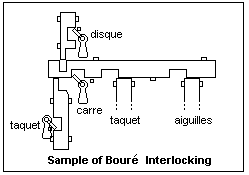 When the key for the carré was in, the carré was at Stop, and keys to operate crossovers could be removed. In this position, the disque key was also retained, so the disque could not be cleared. If the crossover keys were not removed, the carré key could be rotated so that the disque key could be removed. When it was, it prevented the key's being rotated to allow the crossover keys to be removed. In this position, both disque and carré could be cleared. This, of course, was only suitable for small stations which was the field of operations of the Bouré. This device is also known as a serrure central. There are devices that can electrically "transmit" a key remotely. The key is inserted in the local device and turned; then a key can be withdrawn at a distant point. After the key has been used and has been returned, the key at the local point can be removed and restored to the serrure centrale.
An interesting accessory is the key transmitter. This device releases a key at a remote point when an identical key is put into the transmitter and rotated, becoming trapped. These were operated by one or two wires at first, but later by electricity. By this means, an operator near the central cabinet can "send" a key to an agent at a remote point to be used there, saving a long walk.
Another kind of lock was more like Annett's in that rotating the key moved a bolt in and out. When the bolt was out, the key could be removed. Two of these could be used in connection with some associated devices to lock a lever either normal or reverse.
The Barre Transversale
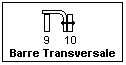 Some simple relations between levers could be enforced by the simple means of attaching a piece to one lever that prevented the other from being moved. This piece is called a barre transversale. In the diagram, 9 and 10 are levers that are pulled toward the bottom of the diagram. Suppose lever 9 operates a home signal and lever 10 a distant signal. It is easy to see that 10 cannot be reversed unless 9 is reversed first, and they must be restored in the inverse order. Interlocking of this sort was very commonly used with the serrure Bouré.
Vignier Interlocking
P.-A. Vignier (1811-1891) of the Chemin de Fer de l'Ouest devised an interlocking frame in 1855. This machine was simple and cheap. It was particularly attractive to the Ouest, since it was "invented here" and was French. This company eventually interlocked all of their junctions with it before 1880. There were at least an "old" and a "new" version, with different constructions but operating under the same principles. This machine was invented at the time the first efforts towards interlocking were being made in England, and survived in a modified form until recently. It deserves distinguished mention in the early history of interlocking. The term "Vignier" was generally applied to any form of lever locking as distinguished from the catch-handle locking typical of Saxby. These machines were used in smaller installations on account of their economy.
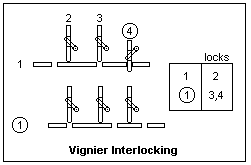 The Vignier machine locked the levers directly. The original version was too cumbersome to place indoors, but was soon improved. Remarkably, it was not patented, so it was widely adopted and modified. In the "new" version, the levers drove horizontal bars pierced with holes fitting the locking pins. The pins were moved vertically by arms fastened to locking arbors that were rotated by the levers through cranks. When a pin was inserted in a locking bar, the corresponding lever was firmly locked. In the earlier version, notched bars moved at right angles with the same effect. In the arrangement shown, lever 1 when normal (bar to the left) locks lever 2 when normal (up), but leaves levers 2 and 3 free. When lever 1 is reversed, levers 2 and 3 are locked normal. If lever 2 were reversed, then lever 1 would be locked reversed. These relations are shown in the small locking chart at the right. If conditional locking is not required, this simple mechanism can be applied to any case. Note how this illustrates the reciprocal relation: if 1 reversed locks 3 normal, then 3 reversed locks 1 normal.
The signalman can check if a lever is free by trying to move it slightly. If a lever is free, then moving it slightly locks all other levers temporarily. When it is near its full stroke, levers that do not conflict are freed in the last part of the motion. Therefore, the Vignier machine satisfies the requirement of early and late motion to operate the locking. Only a small motion is required to prevent pins from entering holes, and the pins and holes must be closely aligned if the motion is to be completed.
Saxby and Farmer Interlocking
The American or British reader interested in interlocking will already be familiar with the Saxby and Farmer machine. Therefore, only the salient points will be repeated here. The type of machine that first made its appearance in France around 1880 was the gridiron locking, that was also very popular in America and Britain. In these places it was superseded by the tappet locking machine in the 1890's, but in France the gridiron machine was retained. It still appears prominently in a railway engineering course in 1929. Gridiron locking was even used in the SNCF standard frame, the MU45. Saxby and Farmer opened a factory in Creil in 1878, which was managed by John Saxby (1821-1913) himself. In 1888, this became a purely French company with Saxby at its head. Its products used many Saxby and Farmer components, but gradually diverged from British designs. Saxby frames were generally used in all large installations in France. The wooden signalboxes retained a very English appearance. An interlocking frame was often called a "Saxby".
The most important feature of Saxby and Farmer interlocking was the use of catch handle or latch locking, which was operated by, and operated on, the catch handle. When the catch handle was depressed as the first step in moving a lever, the interlocking was moved half of its travel, locking all conflicting levers. While the lever was moved, the interlocking was not disturbed. When the catch handle was released, the interlocking was moved the remaining half of its travel, unlocking the levers that did not conflict. This movement was accomplished by the rocker (secteur oscillant), which guided a projection on the lower end of the catch rod. The rockers were linked to the interlocking, where they rotated the grid-shaped locking pieces and moved the transverse locking rods. Dogs moving on locking rods at right angles to the grids could prevent a grid from rotating (locking the latch, and hence the lever).
Since only the force on the catch handles, at most a squeeze of two hands, acted on the interlocking, it could be made small and light. When the levers are locked instead, the locking must resist a strong double-handed pull on a long lever, and so must be made heavy and rugged. It is clear when the catch handle is grasped whether a lever is locked or not, since the catch on a locked lever cannot be disengaged. With lever locking, one must actually pull on the lever to see if it will move. Saxby and Farmer latch locking can be accommodated in back of the levers on the operating floor, where it is kept warm and is easily lubricated and maintained. The idea of locking the latches rather than the levers is a very important mechanical principle of general application.
 In 1912, Saxby introduced the half-revolution or 180° lever that was typical of German practice. These levers were shorter, and rotated about an axis well above the floor. The longer path of the handle reduced the force required. The rotary motion was used directly in two-wire connections, or could be converted to linear motion by a pinion on the lever moving a rack. The figure explains how the latch handle motion could be converted to a continuous linear motion without the need of a rocker. When the latch handle is depressed, its end coincides with the lever axis. When the lever is moved to the reversed position, releasing the handle then moves the bell crank further, just as with the rocker. This arrangement is much easier to manufacture and maintain than a rocker. Nevertheless, some of these levers were used with a semicircular rocker, which allows any angle of rotation. Note that the angle of rotation in the usual arrangement is somewhat less than 180°.
The locking in these 1912 frames was the gridiron and dog type that appeared on the first Saxby and Farmer rocker frames in 1874. This mode of locking was not at all well-received in Britain and the U.S., where it was soon replaced by tappet locking based on the Stevens 1870 introduction. There was a form of locking used to a minor degree in France called "Stevens" that used interfering sliding dogs, but it was not the type familiar in Britain and the U.S.. Tappet locking appears not to have been used in France at all, except on frames reqiring conditional locking and perhaps on Westinghouse electropneumatic machines in miniaturized form. On the other hand, the survival of the gridiron shows that it was really quite serviceable. Conditional locking was generally avoided in France by providing multiple levers for operating a signal, one for each route.
German interlocking practice was considerably different from that in Britain, the U.S., and France. When the signal levers were normal, so that the signals were at Stop, the point levers could be moved in any way to establish a desired route. Then, when a route lever for this route was reversed, all the point levers involved in the route were locked, while the signal levers admitting a train to the route were released. This generally required considerably fewer levers, especially in complicated layouts.
This principle was adopted in the Saxby-Lebeau route interlocking ("postes Saxby á cylindres d'itinéraires") of 1925. Several references illustrate a large example of this machine that was first installed in Poste C at Vierzon, on the P-O, in 1929. The number of levers was reduced from 160 to 105 in this case. The 180° point levers were placed at the right of the frame, their catch handles driving long tappets that ran the length of the machine. At the left, signal levers alternated with route selection levers. Light signals were used, so the signal levers were short levers of small stroke. Up to 10 routes could be selected for each signal. When a signal lever was pulled, the route selection lever could not be moved, and the corresponding point levers could not be unlatched.
 The figure shows schematically how the frame operated. The route cylinders consist of a number of discs (only a few are shown here) and is divided into two parts. Pulling the signal lever moves the left cylinder down and the right cylinder up, provided that the interlocking teeth can pass by locking dogs riveted to the tappets. When this occurs, the tappets are locked in position. When a signal lever is normal, the route selection lever moves the rack, which selects one of 10 circumferential positions of the locking discs. It is not necessary to use the latch handle of a signal lever to move the route cylinders in this case, since the signal levers do not require any great force to operate them, and it is immediately clear whether a lever can be reversed at all.
 How the interlocking teeth work should be evident from the diagram at the left. A tooth can be formed to lock normal, reverse or in both positions, when it bears against the end of a locking dog on the tappet or locking bar. Conditional locking was not required, since there was effectively a signal lever for each route.
A route can be used in either direction, so it is necessary to protect against signals being cleared at both ends of the route. How this problem was solved in the Saxby-Lebeau frame is not mentioned in the references, but the easiest means is to interlock a direction lever along with the points. If certain routes will be used simultaneously in opposite directions, then more than one direction lever will be necessary.
Junctions in France
Heurteau's report (see References) gives an excellent and detailed account of how the individual companies handled junctions before the application of interlocking. The only hazard in a single-track junction is that of two trains approaching simultaneously on each of the branches. Double-track railways have an added hazard, since a crossing is involved in the usual junction layout, and certain combinations of trains may dispute the crossing. French railway authorities early recognized the hazard. Article 37 of the arrète of 15 November 1846 provided that at any such junction, the speed must be reduced so that a stop can be made at the crossing if necessary, and that direction indicators be provided. This was the basis of the very careful negotiation of junctions in France.
The Nord placed a carré 60 m from the points on all three approaches, reinforced with pétards. At 800 m from the carré was a green-and-white checquerboard called an indicateur de bifurcation. At 1200 m was a disque rouge to cover trains stopped at the junction. On a descending gradient of more than 4 mm per m, the distances were increased to 900 and 1300 m. Two trains were never allowed on the junction at the same time, even if they did not conflict, and the signals were normally at stop, except for the disques rouges. The pointsman had to hold the carré open after it was cleared when the train had approached to 100 to 150 m. Speed had to be reduced at the green and white checquerboard, and the carré approached prepared to stop. There were two poteaux 100 m apart approaching the carré. A passenger train had to take at least 18 s between them, a freight train 36s (20 km/h and 10 km/h). The pointsman protected the train with the disque rouge until it had departed.
This was typical operation. On the Est, there were no indicators of bifurcation, but the disque rouge was normally on. Trains stopped at the junction until signalled to proceed by hand. The P-O put a fixed ralentissement signal 500 m in rear of the junction, and the direction indicator was worked by the points. The maximum speed was 25 km/h or 1/2 the normal speed if lower. On the Midi, the three closed advanced signals did not require a stop. The train was to reduce speed, and when it had passed the limit of protection proceeded behind a flag until it received a hand signal from the pointsman. For the ligne principale the train could proceed without stopping, but it had to stop and proceed on hand signal on the embranchement On the PLM, semaphores were used as stop signals. At 1200 m was a fixed sign, illuminated at night, saying "bifurcation." The train stopped at a post with the label "Arrêt" 100 m from the semaphore. The general speed was a walking pace. The advanced disque was normally open.
Most of these companies were already installing interlocking. In fact, all junctions on the Ouest were already interlocked, and many on the Nord and PLM. At an interlocked junction on the PLM, there was a normally-closed carré 100 m from the points, a distance signal to protect trains stopped ahead, at both of which a stop was required if closed, a guard at the "bifurcation" sign with an electric signal, the Tyer-Jousselin apparatus that also described trains, to the pointsman and finally a semaphore direction indicator. If the signals were open, the speed allowed was 20 km/h.
These slow and cautious procedures may be compared to that at junctions in Britain at the time, when trains normally passed by on the main route at full speed, and on divergences without stopping at the permitted speed. This was a result of both interlocking and the block system, which provided complete security.
References
A. Moutier, Cours de Chemin de Fer, Voie et Exploitation (École Centrale des Arts et Manufactures, 1928-1929).
R. Lemon, An Introduction to French Signalling (Signalling Record Society Signalling Paper No. 13, 1995).
E. Heurteau, Rapport sur les divers systèmes de signaux en usage et l'application des appareils d'enclenchement pour la protection des bifurcations (Annales des Ponts et Chaussées, 5me serie, 1880).
Tableau de Leviers, Poste intermédiaire de block enchenché au km 172,930 entre les gares d'Agay et du Trayas (Chemins de fer de Paris à Lyon et à la Méditeranée, 1923).
D. Wurmser, Signaux Mécaniques, Tome 1 (Grenoble: Presses et Editions Ferroviaires, 2007). The Saxby-Lebeau frame is illustrated on p. 63.
A. Gernigon, Histoire de la Signalisation Ferroviaire Française (Paris: La Vie du Rail, 1998). The Saxby-Lebeau frame and Poste C are illustrated on p. 253.
Return to Railways Index
Composed by J. B. Calvert
Created 12 July 2004
Last revised 24 March 2008