Power Interlocking
Contents
- Introduction
- Burr Pneumatic Interlocking at the Centennial
- Westinghouse's Developments, 1876-1892
- Hydraulic Interlocking
- Westinghouse Electropneumatic Interlocking
- Low-Pressure Pneumatic Interlocking
- All-Electric Interlocking
- The GRS Model 2A Motor Semaphore
- Route Locking
- All-Relay Interlocking
- Centralized Traffic Control
- References
Introduction
When we say "power interlocking" we are talking of operating switches and signals by some force other than that of a man at a lever. The actual interlocking may well be mechanical, and usually was until the days of all-relay or solid-state plants. We'll also consider mainly plants in which each lever operated a single switch or signal, as in mechanical interlocking. These were called unit lever machines.
The force to operate a function may be applied mechanically by solid connections (rod or wire), by fluid pressure, or by electricity. The fluid may be an incompressible liquid or a compressible gas. The compressible gas may be a gas under pressure, or a vacuum working against atmospheric pressure. Electrical operation may exert its force by means of a small rotary motor, or a rotary or linear solenoid. In each case, the application of the force is controlled by some means, that may be separate from the force used to operate the function. All of these possibilities have been seen in practice, except perhaps for vacuum interlocking.
Elementary physics is involved in every case, and the operation of the devices cannot be fully understood unless the physics is appreciated. Besides, the physics is simple, interesting and generally useful.
When a function is operated mechanically, it is clear that if the connections do not fail, then when the lever has been operated, the function has been operated as well. Checks are always made on this, but the principle is generally valid. When a function is operated by other means, it cannot be assumed that the function has responded to the lever. Positive information that the function has responded as intended is called indication. Indication is a fundamental requirement of power interlocking. It is the equivalent of closing the loop in a feedback system. We'll have much to say about it in what follows. The distinction between actuation and indication should be kept in mind.
The Burr Pneumatic Interlocking at the Centennial
The first steps toward power interlocking used fluid pressure, which was at the time the only alternative. George Westinghouse invented the air brake in 1869, which generated great interest in the use of pneumatics. An obvious method was to compress air by a small steam-driven compressor, such as used for air brakes, into a reservoir, and to connect the reservoir with piston actuators at the switch or signal through a valve. A plant of this type was invented by D. A. Burr (U.S. Patent 183,487) and used at the 1876 Centennial Exposition in Philadelphia at Mantua Junction, where the exposition tracks joined the main line of the Pennsylvania. His partner in this installation was a Mr. Prall.
This plant controlled 5 home signals, 2 distant signals, and 4 switches. A Westinghouse air pump supplied air at 60 psi to the main reservoir, which was reduced to 20 psi for use. The signals were the Pennsylvania box banner signals as used with the manual block, and the control cabin was a standard two-story manual block tower. Air was supplied through rotary valves and 1/2" pipes to actuators moving the points and holding the signals at clear. Both switches and signals returned indications through a separate pipe that operated colored slides in view of the signalman. The interlocking was by rods that were moved by valve handle operation and interfered with the movement of conflicting valve handles. The indication did not affect the locking, but was only observed by the signalman. Signals indicated when clear, which was the wrong way around, since it is more important to know that the signals have returned to Stop. Points indicated both ways, however. The Burr actuator had a travel of 24", which was sufficient for all purposes.
When first tried, the plant did not work, but after a quick redesign of the faulty parts, served well from July to the end of the exposition. A switch 400 ft away was operated in 7 seconds, a signal 300 feet away in 5 seconds, some of which time was used in the return of the indication. A distant signal 1135 ft away required 42 seconds to clear, and 45 seconds to return to Stop, although the signal itself operated in 9 seconds. These times were rather slow, but were just acceptable. The plant was dismantled before the winter, so its performance under adverse weather was not observed. Nevertheless, the plant aroused the interest of George Westinghouse, who became interested in developing a practical pneumatic interlocking. The development leading to the successful electropneumatic interlocking required 16 years, until 1892. This development was by no means straightforward, and included many false starts and missteps.
Westinghouse's Developments, 1876-1892
Hindsight tells the modern engineer that the obvious solution to the problem of slow actuation would be to use hydraulic control, in which signals would propagate at the speed of sound in a liquid. In water, this speed is about 1500 m/s, which for interlocking purposes can be considered instantaneous. Some inventors did indeed go down this path, but not Westinghouse! In 1881, Westinghouse invented a double piston, with one piston twice the diameter of the other (U.S. Patent 237,149). When air was admitted to the large piston, the actuator moved one way. When the large side was connected to the atmosphere, the actuator moved the other way under the pressure on the small piston. Westinghouse intended this as a switch machine, but it was very unsuited to the purpose. If it had actuated points to set a diverging route, and by some mischance the air line was ruptured, the points would return to normal, and the train would split the switch. The patent cylinder was to be used to operate the signals in a block system controlled by treadles. The signals were conceived as clearing to 45° in the upper quadrant. No block system of this type was ever installed.
Shortly afterwards, Westinghouse patented the diaphragm box (U.S. Patent 240,628) by which air pressure acting on one side of a diaphragm could apply a force to a different fluid on the other side. Westinghouse still used pneumatic pressure as a control medium, but used the diaphragm box and pipes to convey a liquid that operated the distant switches and signals. The diaphragm box was superfluous, but Westinghouse liked it, as he did the double cylinder. Thus the Westinghouse hydropneumatic interlocking was created. The first installation was at Bound Brook, NJ, 6 levers. By 1884, the Grand Trunk used 8 levers, the Indianapolis Union and the Lehigh Valley 4 levers each, the LS&MS and the Michigan Central, 10 levers each, and 12 levers by the Union Stock Yards, Chicago. In 1885, the Central Pacific installed 24, 10 and 6 levers at Tower 1, Tower 2 and Tower 3 at Oakland (some sources say 36, 21 and 15 levers). The Pennsylvania installed pneumatic plants at Wilkinsburg and East Liberty, 24 levers each. It must be emphasized that these plants used compressed air for control, water under pressure for actuation, not the other way around, which would seem more reasonable at the present time. These plants were reported as "pneumatic". Their controls looked like brake handles, not interlocking levers.
 Westinghouse acquired patents for the Robinson track circuit, insulated and bonded joints, and the Gassett and Fisher clockwork signal with his purchase of the Union Signal Company of Boston in 1881. This brought the unfamiliar element of electricity into the Union Switch and Signal's mechanical and pneumatic world. The magnet valve made possible an electrically controlled, pneumatically operated semaphore signal, illustrated at the left. The signal arm is brought to Stop by gravity. Westinghouse arranged a cylinder that would push the signal to Clear when compressed air was admitted to it by the magnet valve. An experimental block system was installed on the Fitchburg Railroad on 12 miles of one track between South Ashburnham and Fitchburg in 1883. The New York, West Shore and Buffalo had 13 miles, and 45 electropneumatic signals south of Cornwall, and the New York, Ontario and Western 32 miles between Cornwall and Caldwell's. The Fitchburg installation did not last long, due to troubles with the pneumatic line, and the NYWS&B blocks were converted to manual by 1888. The NYWS&B track circuit detected a broken rail caused by a cannonball fired from West Point that struck the track.
Experience with track circuits was gained by the clockwork signals installed on the Pennsylvania between Altoona and Gallitzin in 1883. Electropneumatic block signals were installed on 53 miles of the west end of the Pittsburgh Division, with 72 blocks, about 1888.
The improved pneumatic interlocking of 1888 (U.S. Patent 357,109) used electropneumatic signals and switch actuators (U.S. Patent 358,713). This machine preserved the hydraulic control of switch actuators. The switch actuator had two cylinders driving in opposite directions. The air was controlled by fluid-operated valves. In the cabin, compressed air exerted pressure on the fluid as required. Indication was electrical, but interlocking was still performed by a cumbersome electromechanical scheme. By this time, the importance of indication was well understood. Levers rotating in a vertical plane replaced the brake-valve type levers. Switch levers were two-position, but signal levers were made three-position, for the operation of signals in opposite directions, which reduced the number of levers required. Signal and switch levers would not make their full stroke until the indication was returned. Only then could other levers be moved. This improved machine quickly replaced most of the earlier pneumatic plants, and the Pennsylvania put in two 24-lever plants at 14th Street and 17th Street, Pittsburgh.
Finally, the hydraulic operation of the switch actuators was replaced by electrical operation, as with the signal magnet valves. Jens G. Schreuder, an engineer from Norway who was very skilled with electrical circuits, cooperated with Westinghouse in the design of the 1892 electropneumatic interlocking (U.S. Patent 446,159). The interlocking was now performed by a half-size tappet bed, like those in mechanical interlockings of the time. This machine was excellent, though expensive, and was installed throughout the world. In the mid 90's, the Pennsylvania extended electropneumatic interlocking and automatic block over all its main lines.
In the switch actuator, the main D-valve was driven by a piston to which air was admitted by magnet valves. A third valve was added, the locking solenoid. This solenoid was de-energized when the actuator was not being operated, and the D-valve was locked by a dog under spring pressure. Air was still supplied, so pressure continued to act, for increased security. The points were driven by a motion plate, ensuring that the points were locked. The first of these new machines was installed on the Pennsylvania at Jersey City, and a large installation was made in 1892 at the Chicago Terminal of the Chicago and North Western. Penn Station and Washington Union Terminal both had Westinghouse electropneumatic machines. A notable installation was at South Station, Boston. In the 1980's, one was still working smoothly at Atocha Station in Madrid. The Westinghouse electropneumatic machine will be described in detail after we look at hydraulic interlocking.
Hydraulic Interlocking
Other engineers, not as wedded to pneumatics as Westinghouse was, saw that hydraulics alone could solve the problems of slow actuation. Riccardo Bianchi and Giovanni Servettaz invented a machine that used water at pressures of 700 to 900 psi. The first example was installed at Abbiategrasso in Italy in 1886. The machine was vigorously promoted in France, Britain and the United States. In France, the first machines were installed at Bourges in 1888 and at Nice in 1889. The French signalling firm of Trayvou under licence eventually furnished some 40 plants, of which 17 still survived in 1947. In the United States, Union Switch and Signal handled the machines, but made no sales. An inventor from St. Louis, a Mr. Wuerpel, invented a hydraulic interlocking around 1884, and founded the Wuerpel Switch and Signal Company, which was soon bought out by US&S. Wuerpel furnished three machines to St. Louis Bridge and Tunnel, with 106 levers in all, and one to the Cleveland, Columbus, Cincinnati and Indianapolis. The Wuerpel machines were very troublesome, especially in freezing weather. They probably spoiled the market for hydraulic interlocking.
The Bianchi and Servettaz machine had small levers that rotated toward the operator. These levers directly drove Stevens-type tappet locking arranged vertically on the front of the machine. They also drove D valves that admitted high pressure water to one side of the actuator, and a low pressure to the other. The functions indicated hydraulically, so that the lever stroke could not be completed until operation was proved. The actuation was rather violent, due to the high pressure, but was quite definite. To resist freezing, glycerine was dissolved in the water. This was a better antifreeze than calcium chloride or alcohol, since it was noncorrosive and nonvolatile.
Hydraulic actuation had a long history in France. Not only did the Bianchi-Servettaz machines survive, but so did the MDM-Aster machines, called hydropneumatic (MDM-HP), of which 30 were placed in service between 1910 and 1924. At least one survived until 1994. They were invented by Moutier in 1905, and first used at Cabin 11, Landy (Paris Nord A) in 1906. The operator manipulated a very unusual panel that was a rectangular array of rotary handles specifying routes rather than individual functions. Entrance tracks corresponded to horizontal rows, exit tracks to vertical columns. Both water at 700-900 psi and air at 60-90 psi were used, but no electricity.
Westinghouse Electropneumatic
A Westinghouse electropneumatic installation consisted on the ground of double-acting cylinders for switches and single-acting cylinders for signals, operated by compressed air under control of electrically-operted magnet valves. Dwarf signals were electrically operated by solenoids. Contacts were operated at the ends of piston travel for indication. Compressed air was supplied from a steam compressor (later, by a compressor driven by an electrical motor), usually on the ground floor of the signal cabin, through cooling coils to a main reservoir, from which it was distributed at 70 psi through buried pipes to small reservoirs at each switch actuator. Buried or trunked wires converged on the operating cabin. Storage batteries on the ground floor supplied 12 to 15 volts for the control circuits. These batteries were charged by the power line or a small generator operated by a steam engine.
The interlocking machine was a mattress-shaped box at waist height on legs, so the operator had a good view in all directions. Switches were operated by short handles pointing upwards at the top of the front panel, rotating right and left through 60°. Left was normal, right reversed. Signal levers pointed downwards, and had three positions. The centre position was normal, and the lever could be reversed either right or left, controlling routes in one direction or the other. This saved a signal lever. Every route through an interlocking has two directions, the signals for which are never simultaneously reversed. Lever numbers were shown on the handles.
Each handle rotated a long horizontal shaft in the machine. The shaft had three parts. The front third operated a horizontal tappet locking bed, like that in the new Duplex mechanical interlocking, but half the size. Any locking bar could be driven by a gear on the lever shaft mating with a rack in the locking bar, locking or releasing any other lever. Locking occurred with the first motion of the lever. The middle third was covered in insulating hard rubber with brass contact sectors, that made contact with spring fingers mounted on a hard-rubber plate below the shaft. These contacts controlled the magnet valves and the indication circuits. Magnet valve circuits were closed only when the operation was taking place.
The back third of the shaft had one or two indication segments that prevented rotation of the shaft until indication had occurred. When a projection in a segment encountered a locking dog, the indication circuit was closed by the middle third of the shaft. If the position of the function was proper, a current flowed that caused a solenoid to lift the dog and allow the lever to complete its stroke. This final part of the stroke unlocked the levers that were freed by the operation.
 Further improvements were made as they were suggested by experience. Switch indicating circuits were made polar, so that the mere presence of a current was not sufficient, but had to be the correct polarity for the position of the points. The circuits rendered more resistant to foreign currents, crosses, and other interference by this change. The lock solenoid on the switch actuators was modified so that air pressure was removed when operation was complete, reducing the chances of unwanted operation. Switch-and-lock mechanisms, such as the one shown in the figure (the frame is not shown), were introduced in place of the simple motion plate, which also controlled the indication circuits completely separately from the operation circuits. Note that the facing point lock distinguishes normal and reverse positions. The 5" cylinder provided a force of about 1374 lb for an air pressure of 70 psi. The first 2" of travel withdrew the facing point lock bolt, the next 4" moved the points, and the final 2" locked them again.
To reduce the width of the machine, the shafts were divided into a horizontal and a vertical part, connected by bevel gears at the rear of the machine. The vertical parts now contained the electrical contacts. Track circuits were introduced to provide section locking, replacing the detector bars previously moved by the switch-and-lock mechanisms, and approach locking, which prevented the signalman from taking away a route that had been granted and accepted. This made possible the modern illuminated track diagram, which showed the current location of trains. Signals now became semi-automatic, controlled jointly by the signalman and track circuits. To avoid switching movements having to pass signals at stop, a calling-on button was provided at the signal levers. Pressing this button caused a calling-on signal indication to appear if the signal was at stop only because of track circuits.
Where two interlockings were close to one another, check locking or traffic locking was provided on tracks between them, to prevent opposing movements on the same track. This usually took the form of a master lever that had to be reversed to gain control of the track. The communication between the interlockings was by means of electrical locks, of course. The reversal of a master lever in one cabin locked the lever normal in the other cabin.
Low-Pressure Pneumatic Interlocking
Shortly after the Westinghouse electropneumatic machine appeared, the British Pneumatic Railway Signal Company brought out the low-pressure system, in which electrical control was replaced by pneumatic control. The first plants were at Grateley (1901) and Salisbury (1902). Switch and signal actuators were operated by air at 15 psi supplied from a main. The cylinders had to be twice the diameter of Westinghouse electropneumatic cylinders. Diaphragm-operated relay valves were used instead of magnet valves. Control air expands as it is admitted, and it seems that the pressure pulse operated the functions, at about the speed of sound in air. Indication is performed by pressure pulses in the opposite direction, which permits the levers to complete their strokes.
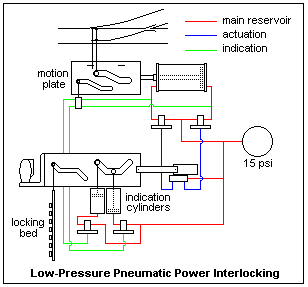 A diagram of the low-pressure interlocking is shown at the right. Slide levers were used, operating vertical tappet locking at the front of the machine by means of a cam slot. When a lever has been partially reversed, the indication cylinders supply sufficient force to complete the stroke of the lever after unlocking it. This was a very popular feature copied on other later machines. A switch or signal could be jockeyed back and forth, as with the Westinghouse machine, if necessary in freezing weather.
This machine was offered by the General Signal Company in the United States, which later became a part of the General Railway Signal Company. This was a very nice machine, attractive to many managers because it did not use electricity, but it was soon eclipsed by all-electric interlocking and was never widely used in the United States. It is interesting that it recalls the original Burr interlocking of 1876. In France, only two examples existed, at Ermont on the Nord, installed in 1902 and 1908, which lasted until 1930. The actuation was regarded as too slow, and the cylinders as inconveniently large.
All-Electric Interlocking
John D. Taylor of Chillicothe, Ohio installed his invention, the first all-electric interlocking, at East Norwood, Ohio on the B&O, in 1891. By "all-electric" is meant only that the switches and signals are operated electrically, not by fluid pressure. Until this time, electricity could not even operate proper semaphore signals, much less switches. In fact, even the rotary solenoid with the Z-armature was very new, and was just being applied to Hall enclosed disc signals. Taylor improved the method of indication in 1893, but progress was slow until the Taylor Signal Company was formed in May 1900 at Buffalo, and capital became available to make further installations. The Taylor Signal Company was an immediate success. With the inclusion of the Standard Railroad Signal Company and the Pneumatic Signal Company, the General Railway Signal Company was organized at Rochester NY, which became the main competitor of the Union Switch and Signal Company in later years.
 The power in a Taylor plant comes from storage batteries charged by a dynamo driven by an electric motor or a gasoline engine. These batteries supply direct current at 60 V (later 110 V) for all purposes. Switches and signals are operated by small direct-current motors. The method of indication is very ingenious. The circuits are shown at the left. The motors are supplied through separate wires for forward and reverse movement. When the operation is complete, the driving current is removed and the armature of the motor is connected to the other control wire by contacts. The remaining kinetic energy of the motor causes the armature to generate the indication current, which operates an indication solenoid in the machine. Note that the field is still connected in the same direction with respect to the generated current, and that the armature contactor operates only at the end of the movement. This arrangement is a great protection against stray currents and crosses. It is called dynamic indication. Safety coils below the indication coils held down the armature when there was a current in the operating wire that did not come from the indication. All current from the battery must pass through the safety coils.
A Taylor lever is a slide, as on the low-pressure pneumatic machine, which drives the vertical tappet locking on the front of the machine by a cam slot that provides first and last motion. A spring-loaded dog stops the slide after contacts have been made, but before the full stroke. The indication current in the indication solenoid lifts the dog and allows the stroke to be completed. A lever pushed in is normal, reversed if pulled out. Handles for switch levers pointed upwards, handles for signal levers pointed downwards. Signalmen usually operated all the switch levers first, not waiting for the indication, then came back and completed the motion. If an indication failed, the lever could be moved back to try for an indication at that end, after which the original movement could be repeated. Of course, the signalman could reach into the machine and manually lift the armature. The machine was locked to prevent this interference.
The first Taylor machine with dynamic indication was installed at Eau Claire, Wisconsin on the CStPM&O in 1901. The cheapness and flexibility of the Taylor machine led to its rapid introduction, almost completely excluding the Westinghouse electropneumatic system. By 1913, 440 plants with 21,370 levers had been sold by Taylor, by that time GRS, including the plant at the Grand Central Terminal in New York for the NYC&HR, with 225 levers, which replaced a low-pressure pneumatic machine installed only a short time before. Taylor plants were used at Lake Street and Clinton Street on the C&NW. By 1913, the C&NW had 35 GRS plants with 2100 levers. Only the Pennsylvania and the Central of New Jersey remained loyal to US&S. The PRR east of Pittsburgh had only 3 GRS machines, the CNJ only 1. The NYC&HR and the LS&MS had, between them, 60 plants. This was a remarkable success in a very short time, showing how well the all-electric interlocking satisfied conditions in America.
The US&S soon came out with the Type F all-electric interlocking, which was also excellent. The first was installed at Millbury Junction, on the LS&MS, in 1904. Indication was by alternating currents, so extraneous currents could be eliminated by putting a transformer in the circuit. This machine was based on the electropneumatic, and included automatic completion of the lever stroke by the indication. The Federal Railway Signal Company used an induction coil to generate the indication, providing enough voltage to jump an air gap, which certainly excluded your everyday foreign currents. Their first plant was installed in 1910 on the Boston and Albany at Allston, Massachusetts. The American Railway Signal Company machine was operated by twisting and then pulling the levers.
All-electric interlocking allowed the operation of switches and signals at large distances from the signal cabin, which had always been a problem. It also reduced the sheer physical strength to operate an interlocking. A rod-operated distant signal 800 yards away, or a crossover with detector bars, were very difficult for a woman to operate, though women made excellent signalpeople, more reliable than their male colleagues and willing to work for less. Railway executives always suspected that operators and signalmen had soft and cushy indoor jobs (like theirs) with time for mischief. The introduction of power interlocking would only confirm this. The use of electricity in signalling increased the chances for such mischief in attempting to defeat safety features.
Siemens and Halske developed their own electropneumatic machine after several Westinghouse plants had been erected in Germany. In 1894, they installed their first all-electric plant at Prerau, then in Austria. This was earlier than Taylor's Eau Claire plant, but later than the experimental plant on the B&O. The inventions were apparently independent, showing how ready the world was for all-electric interlocking. Its birth was delayed by the absence of a good small motor, not by the lack of an electricity supply. Early attempts, such as those by Ramsey and Weir in 1888, foundered on this point.
The GRS Model 2A Motor Semaphore
 The GRS Model 2A motor semaphore appeared in 1908, and was widely used for many years not only for all-electric interlocking, but for automatic block systems and other applications. In 2004 there were still Model 2A semaphores in service. The one shown in the illustration is on the ex-Monon at Crawfordsville, IN (Photo: John Ingham). Since they are a very good example of the motor semaphore, it is appropriate to give a brief description here. They were mounted top-of-mast, and the semaphore arm was directly connected to the operating shaft. They could be used for two- or three-position signals, in the upper or lower quadrant, but were most commonly found as upper-quadrant three-position signals.
As an interlocking signal, they were driven by a four-pole DC motor that also generated the indication current allowing the signal lever to be fully restored in the normal position. As an automatic block signal, which did not require indication, they could be driven by a series AC motor as well. In the normal 0° position, with the arm horizontal, they drew no current. The motor was used to move the arm to the 45° or 90° position and maintain it there. When the current was removed, the arm fell to horizontal by its own weight. A two-position signal had one operating wire, while a three-position signal had two, one to command the signal to the 45° position, and the other to further raise the arm to the 90° position.
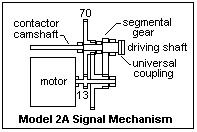 A sketch of the signal mechanism is shown at the right. The back of the hermetically sealed case could be removed for access to the contactor and the motor, and a door on the right side of the case gave access to the gears. The contactor cams were on an extension of the driving shaft, which was moved by a 90° segmental gear. Two gear and pinion assemblies, with 70 and 13 teeth, respectively, transmitted the motion from the motor shaft to the segmental gear, with a total reduction of about 170:1. The motor would make about 42.5 revolutions to raise the arm from 0° to 90°. There was a friction clutch at the motor output to avoid excessive stresses.
 The operating circuits for an interlocking 2-position signal are shown at the left. The lever (slide) is in the normal position, and no current is flowing. When the lever is reversed, power is applied through contacts to the operating series field and the armature, and the motor rotates. When it reaches the desired position (represented as 90° here) the high-resistance holding field is placed in series with the motor. This stops the motor and locks it in position, through the action of the holding field. When the lever is subsequentlyl moved toward the normal position, power is cut off and a circuit is established through the indication magnet and the polarized relay. The polarized relay is used to detect crosses in the operating wires. The falling arm causes the motor to rotate in the reverse direction, and act as a self-exciting generator. When the indication magnet picks up, the lever is freed to return fully to the normal position and release conflicting levers. It is not necessary to indicate the signal in the reverse position, since no unsafe condition can arise from the signal's failing to clear. The switch circuit controller is used to protect turnouts in the route governed by the signal. Should a switch be open, the signal will be prevented from clearing.
Many interlocking signals are semi-automatic; that is, they are controlled by a track circuit as well as by a signal lever. The operating wire is cut through the track relay, so that if it drops out, the signal goes to stop. It is clear that this introduces a difficulty with the indication. If the track circuit causes the arm to go to horizontal, then there will be no indication current when the lever is returned towards normal, since the arm can fall no further. This was overcome by introducing a fourth position, -40°, beyond horizontal. Of course, the arm did not assume this new position, but remained at horizontal. The motor did move, however, and this motion was used to produce the indication. Since the weight of the arm was no longer available to power this movement, coil springs were provided at the front of the case, and the operating shaft was driven by a member connected to the motor that was disengaged from -40° to 0°, then pressed on the operating shaft. The springs were extended as the motor moved from -40° to 0°, after which the operating shaft was moved directly as usual. When the arm returned to 0° by automatic operation, the movment was held there by the holding coils. Then, when the lever was returned to normal, the springs drove the motor, creating the indication current. This could not happen unless the arm was already in the 0° position.
Route Locking
In any interlocking plant, a route begins at a stop signal, the entrance, and extends to the next stop signal or to the limits of the interlocking, the exit. There are normally two or more routes available beginning at an entrance signal, so both the entrance and the exit must be specified to determine a route. With mechanical interlocking, each switch on the route must be lined individually before the signal can be cleared, because of the limits of human strength. Power interlocking, however, lifts this restriction, and as many switches as desired can be moved at one time. This brings up the possibility of the route lever, which, when reversed, will cause all the switches on a certain route to be lined for the route, and then will clear the signal governing the route. At the same time, it will lock out all conflicting routes.
The possibilities of route levers seem to have first been studied by Maurice Cossmann of the Nord in the years 1885-1890, before much could be done about it. The idea was put into practice by Gabriel Bleynie of the Midi, Théophile Ducousso of the Postel-Vinay company, Albert Moutier of the Nord and the Aster company, and Albert Descubes of the Est. Bleynie and Ducousso patented a route lever in 1901 (French Patent 315,724). The first route interlocking was installed at Bordeaux Saint Jean early in 1903. It was manufactured by Postel-Vinay under the patents of Ducousso, Bleynie and Rodary. Three further plants were installed in France, two at Narbonne and one at Mont-de-Marsan. Two were built for the MZA in Spain, at Madrid and Pueblo Nuevo.
Because of the multiplicity of routes available, one lever per route proved impractical. In 1903, Albert Descubes patented the idea of defining a route by two levers, an entrance lever and an exit lever. The first two plants of this type were installed at Nancy in 1909, lasting until 1936. They had mechanical locking beds and electrical actuation. 27 interlockings of this type were eventually built, some of which are probably still in service. Later models had all-relay interlocking.
The first route lever interlockings in Britain were at Newport East and West, installed in 1927. They were probably Thomson-Houston machines like those in use in France. The existing signals and switches were used, converted to electrical operation. The levers were checked at two points, first to prove the track circuits clear, the second for switch indication, after which the lever could be fully reversed to clear the signals. The Great Western used individual levers at all other power interlockings, as at Paddington, Bristol and Cardiff.
Route-relay interlocking was taken up by the LNER in the 1930's. Rotary thumbswitches were used, and the route set up was shown by white lights on a track diagram. Track circuits detected the presence of trains. This system became the O.C.S. (One Control Switch) system widely used on British Railways. The first installation was at Thirsk.
In Britain, the General Railway Signal Company was represented by Metropolitan-Vickers. This company developed the NX ("Entrance-Exit") route relay interlocking. The first panel was placed in service in 1939 on the Cheshire Lines Railways. The first NX panel in the United States was installed in 1949 at Kansas City, Missouri on the Missouri Pacific.
All-Relay Interlocking
Except for the later route-relay interlockings just mentioned, all the power interlockings discussed above retained mechanical locking beds, which were well understood and functioned reliably. Electrical locking, using relays in addition to mechanically-operated contacts, soon was applied where it was most convenient. In 1908, the Pennsylvania installed electric route switch locking at Broad Street, Philadelphia.
The protection of simple crossings at grade, and of gauntlet tracks, was an obvious opportunity for operation of interlockings by the presence of the trains themselves, rather than by a signalman, because no choice of routes was involved. The first automatic interlocking was installed at Chester, Virginia in 1907 at a crossing. These plants were obvious choices for relay interlocking, since there were no slides or levers to make and break contacts. In 1911, the Boston and Maine protected a gauntlet track through a tunnel, and in 1914, gauntlet tracks on bridges were protected at Hanover, Montana on the Great Northern, and at Canyon Diablo, Arizona on the Santa Fe by automatic interlockings. Automatic interlockings soon began to replace manned interlockings at crossings at all locations where a signalman was not otherwise required.
Relays can replace mechanical locking in any interlocking plant. The design of the circuits is not difficult, but will not be explained here because it requires familiarity with electrical circuits and is a very specialized skill. The basic idea is that open contacts in the circuit of the coil of a relay will prevent it from operating. The operation of a relay can open or close other circuits, enabling or preventing other changes. Relays can be made slow pick-up or slow drop-out, so it is possible to make relays operate in a desired order. Light signals can be controlled by electrical contacts alone. The presence of current in the lamp circuit is proof that the lamp is lighted, and serves to indicate the signal. Switch machines are controlled as in an all-electric plant, and indicate by opening and closing circuits. Much less skill and experience are required to maintain an all-relay interlocking than a mechanical interlocking, and they are cheaper to manufacture. The only mechanical elements in an all-relay interlocking are the relays and switches, which can be made very reliable, and easily exchanged when faulty. The relays can be replaced by solid-state integrated circuits for a truly all-electric interlocking. Solid-state circuits bring with them their own hazards, such as sensitivity to static electricity.
An excellent example of all-relay automatic interlocking, though not generally thought of as one, is the Absolute-Permissive automatic block system, known as APB. In this system, a train entering the section of track betweeen two sidings sets all opposing signals to stop up to the next siding, while allowing signals behind the train to clear for following movements. APB significantly increases line capacity over an overlap system. The ingenious circuit uses slow release relays and stick relays. A stick relay closes contacts supplying its own coil, so it remains actuated until the current is removed. In 1911, the American Railway Signal Co. installed the first APB system on the Nickel Plate between Dunfee and South Whitney, Indiana, soon followed by the General Railway Signal Co. on the Toronto, Hamilton and Buffalo between Kinnear and Vinemount, Ontario. Thereafter, APB was greatly preferred for single-track systems over the overlap system.
Centralized Traffic Control
A signalman has complete control of the trains within the limits of his interlocking. He can direct trains to stop or proceed, establish the routes followed, and protect the trains from collision, with the help of track circuits. With mechanical interlocking, the limits of a plant were restricted to distances of no more than 1000 yards at the most from the signal cabin. Power interlocking extended this distance indefinitely, limited only by the expense of laying wires and providing for power at remote points. With this came the possibility of controlling trains directly over a large geographic area from one point. The problems that had to be solved were mainly those of communication.
The movement of trains by signal indication alone, superseding time table and train order authority, was permitted by the ARA in manual block territory under rules adopted in 1896. In 1902, this was restricted to controlled manual block territory. The Boston and Maine operated trains over the single-track bridge No. 296 at Rotterdam, New York by signal indication after 1902. The dispatcher was in communication with operators at each end of the block, who unlocked each other's signals when required. Many companies used the train staff to control these isolated blocks.
The rule was later relaxed, and centralized traffic control operates under the revised rule (Rule 261), moving trains by signal indications on single track. In Britain, trains were always operated by signal indication after the introduction of the block system. Double track with automatic block signals, and perhaps automatic train stop, can very easily be operated with the current of traffic by signal indication (Rule 251), and this is one of the least expensive types of control, aside from the cost of the double track. Extra trains and sections can be authorized by clearance card, and it is not difficult for faster trains to pass slower ones without train orders. There is no danger of collision with opposing trains, and trains in the same direction are kept apart by the block signals. First class trains can be run by time table, with other trains keeping clear.
However, this is impossible with single track. To implement centralized control with operation by signal indications, control points or field locations along the line are identified, covering ends of two main tracks, sidings, crossovers, junctions and crossings at grade. Each one is a small, self-contained all-relay interlocking controlled remotely from a central office, where the dispatching machine is located. This is remote-control operation by signal indication. GRS registered "Centralized Traffic Control" as a trademark for its remote-control system. Many railways called it instead "Traffic Control System" or TCS to avoid trademark disputes. These days, however, CTC has become a generic term, like Keenex.
The first CTC board was installed by GRS on the NYC between Stanley and Berwick, Ohio in 1927. It had a row of miniature slide levers below a row of lights and the track diagram. This was also the first installation to have dual-control switches. The US&S installed CTC with coded transmission on the Pere Marquette from Mt. Morris to Bridgeport, Michigan (19.8 miles) in 1928. This was a single-track section with three sidings between double tracks at both ends. There were 10 control points, and only two line wires. This panel had the familiar two rows of rotary thumbswitches. A 12 control point US&S panel was installed by the CB&Q in the same year to control Waverly to Greenwood, Nebraska. It had 5 switch levers and 5 three-position signal levers. The first installation covering a whole division was the 1937 installation of a US&S board for Akron to Denver, Colorado, 105.3 miles. This board is preserved at Golden, Colorado.
In the first machines, which operated on one wire to each field point, when a train occupied the track circuit at an "OS point", a message was sent from the field that rang a bell and lighted a light on the corresponding point on a diagram. The dispatcher moved a peg, as in playing cribbage, to record the train's current position. A moving-chart recorder, if one was provided, had a pen for each OS point which made a momentary deflection. These ticks could be joined by straight lines to make a train diagram. When a switch lever was moved, the OS light blinked to show that the switch had operated properly. Switch commands were made by polarity. The indication was returned the usual way at the field point to control the interlocking on the spot. The OS signal over the control wire was for the information of the operator, though we call it indication as well. Lever switches could hold signals at stop or clear them, and others could cause the signals to stick at Stop behind a train, or clear automatically. It was important to operate the levers in the correct sequence to maintain a traffic direction. The signals were not independent of the switches, and signal aspects were not shown on the track diagram.
The two-wire system provided independent signal control and indication. When a signal at a field point was cleared, a light was shown on the track diagram. When a switch was not yet locked, an out-of-correspondence light was lighted. This was an improvement, but not a satisfactory solution. There was frequent derangement of these early systems. The safety of trains was not compromised, but the signals seemed permanently at red. The telephone was then used to sort matters out.
A small, limited CTC installation can be controlled by dedicated wires to each control point. Although the number of these wires was ingeniously minimized as we have seen, for any extensive system some way had to be found to transmit the commands and indications over a small number of wires, perhaps two or three only for all control points. This is done by assigning an address to each field location. Each command from the central office, or report from a field location, consists of the address followed by a data word. These addresses and data are, of course, sequential voltage levels impressed on a wire. This method of communication is now well known in the computer world, but was new and innovative when devised in the 1920's. A related example was already available in synchronous teletype transmitters and receivers. The control words were assembled and interpreted by means of relays working with different time delays. All main tracks covered by CTC were track-circuited, and all signals governing main tracks were semi-automatic. The operator only cleared a signal; whether it went to Proceed or Approach depended on the occupancy of the blocks in advance.
The code transmitting and receiving modules were the same at all points. The positions of switches and signals, and the locations of trains, could be reported to the dispatching machine as often as desired, and in any order. The first code CTC machines offered 35 addresses. If the automatic train recorder was installed, it could report the state of 40 track relays. A roll of paper lasted a month, and could be turned into a time table diagram by drawing straight lines between ticks, as described above. The operator turned a switch or signal lever, and then pressed a "transmit" button that sent the code. A short time later, the field location would return its new state and the track diagram would be updated. This was the familiar, classic CTC board of the 1950's. See the article on the CTC board on the website to see how these machines were operated.
Base-band code transmission, where the pulse levels are directly transmitted, worked very well. However, much more capacity and improved speed are available by using any of the advanced methods devised for telegraphy and data transmission. One is carrier transmission, where each channel occupies a certain frequency interval. Microwave links can be used to good advantage with carrier systems, as well as coaxial cable or optical fibre.
Each control point should be an independent interlocking that, in case of emergency, can be operated on the spot. This makes the complete CTC system much more robust and resistant to disruption from local difficulties, such as computer or power failures. Advanced communications facilities even make possible control from alternative centres.
CTC is expensive, but it seems to be cheaper than double track if the full traffic capacity of double track is not required. Earlier, it was used as an alternative to doubling to improve traffic flows. More recently, it has replaced double track in many places as traffic has been lost and become less diverse.
CTC rendered operators redundant, except at terminals where they might issue clearance cards and slow orders. A train that had to do work at an intermediate point would be issued a Time and Track Limit form that guaranteed that it would not be disturbed for a definite length of time and within defined track limits, while the switches in the area would be arranged for hand operation. A light at the telephone box would show when the dispatcher wished to communicate with the train crew. All this could be done without the use of radio.
References
Electric Interlocking Handbook (Rochester, NY: General Railway Signal Company, 1913).
B. B. Adams, The Block System of Signaling on American Railroads (New York: Railroad Gazette, 1901). The Westinghouse electropneumatic, the low-pressure pneumatic and the Taylor machines are described.
Return to Railways Index
Composed by J. B. Calvert
Created 16 August 2004
Last revised