ICT 4361 — Java Programming Exercise 2
Purpose:
This exercise is to provide you an opportunity to use some of the classes
we've learned, and to program with arrays and loops.
A number of our exercises this term will be concerned with games.
This exercise introduces dice.
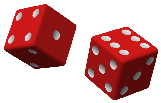
A die (plural dice) is a cube, with a different number on each face,
with the numbers ranging from one to six.
What to hand in:
Please hand in a listing for each program requested, formatted in an
easy-to-read style.
Ensure your name, and the name of the file is available in a comment at the
top of the file.
Also, ensure that you have a sample of the output from the program.
If your program fails to compile, hand in your error listing as your output.
For each question asked, provide one or two sentences summarizing your
answer. Please be both complete and succinct.
Problems:
-
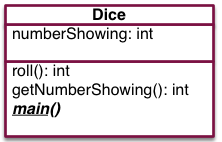
Create a class called Dice to represent a single cube. It
should have a method called roll() that randomly selects a
number from 1 to 6 for the value of the dice.
-
Create a test main method for the Dice class that
creates a Dice, and rolls it many times.
Each time the die is rolled, the Dice value should be stored in an array
representing how many times that value has come up.
After a large number of rolls (say, at least 1,000 -- but 1,000,000 should be no problem),
the number of times the die rolled 1, 2, 3, 4, 5, and 6 should be printed.
-
How would you describe the results, and why should that be expected?
-
What would happen if you ran the program many times?
-
Create a class called DiceStatistics to represent a pair of
dice and the totals of their rolls. It should have an array of two
Dice as a private data member (these are the Dice from Problem 1).
It should also have, as a data member, an array of integers to represent
the possible totals of rolling two dice.
The class should also have the following methods:
- initStats() to initialize all the totals to zero.
- rollOnce() to roll each die once, and add one to the
correct totals element
- printStatistics() to print the number of times each
total has come up over the number of runs
-
Create a test main method for the DiceStatistics class
that creates a DiceStatistics, initializes the statistics, then
rolls the dice many times (say, 10000 or so), and then prints the
statistics.
-
What is the most likely total, and how likely is it as a percentage?
Notes
-
For the Dice class, you will need a random number generator.
The way this is done in Java is to use the java.util.Random
class. After creating an instance, say randomNumber, you can
call randomNumber.nextInt(6) to return an integer, randomly
distributed from zero to five. You would then add one (since a die goes
from one to six, not zero to five) to get the value of the roll.
-
Your main test method will have the signature public static void
main(String[] args), as is usual, and the method will create a
Dice, and invoke roll() on it many times, adding one
to the appropriate value each time. Use a variable for the maximum
number of times you want to roll() the die, so you can see what
happens as you increase the number.
-
DiceStatistics has two arrays in it. One to hold references to
the Dice, and the other to hold the counts for the totals from
rolling the Dice.
Evaluation criteria
| Criteria | Weight |
|---|
| Dice class | 15 |
| Dice main method and output | 20 |
| Dice question 3 | 10 |
| Dice question 4 | 10 |
| DiceStatictics class | 15 |
| DiceStatistics main method and output | 15 |
| DiceStatistics question 7 | 10 |
