ICT-4361 Homework 3
Purpose
Extending our dice exercise will show how to
apply another layer of abstraction on top of our class. We will be
moving our dice class to handle configurable sides, and allowing
different dice to have different numbers of sides.
What to Hand In
Please hand in a listing for each program
requested, formatted in an easy-to-read style, and following our Java conventions.
Ensure your name, and the name of the file is
available in a comment at the top of each submitted file (excepting screenshots).
Also, ensure that you have a sample of the
output from the program.
If your program fails to compile, hand in your
error listing as your output.
For each question asked, provide one or two
sentences summarizing your answer. Please be both complete and
succinct.
Submit the files comprising your submission in a "zip" or similar archive through
the assignment's submission button.
Problems
-
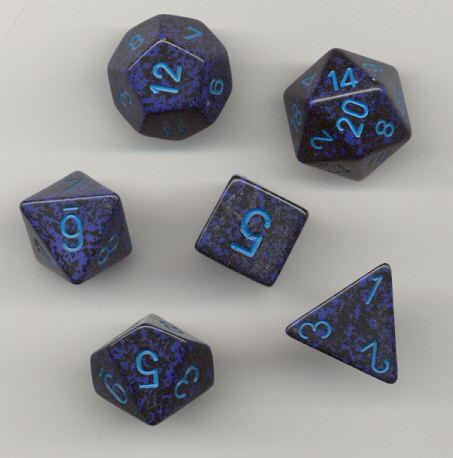
Create different kinds of dice
Note: You should not need to add any parameters to Dice roll(). This exercise makes only a small change to the Dice class we wrote last week.
-
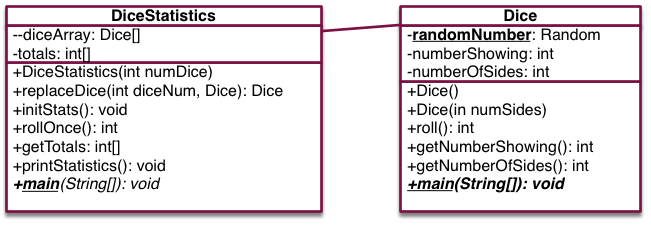
Modify your Diceclass to add a new private int field,numberOfSides. -
Create (or modify) a default constructor for the Dice class that sets the number of sides to 6. It should set the numberOfSides field for that instance of dice to 6. -
Add a new constructor that takes an integer argument that allows you to create a different number of sides for a dice. It should set the numberOfSides field for that instance of dice to the argument. -
Make the Randominstance a static attribute. That is, you will have one instance of theRandomclass that services all the Dice objects. -
Modify your roll()method to take into account thenumberOfSideson the Dice object. -
Modify the mainmethod of theDiceclass, ensuring you account for the new range of totals, and test the new constructor. -
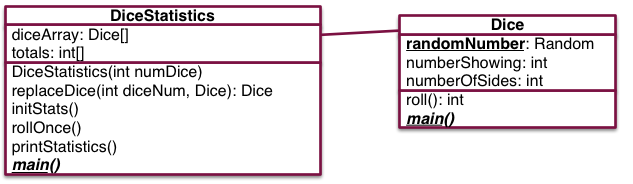
Create or modify the DiceStatistics class to allow the programmer to: - create a DiceStatistics object.
DiceStatistics(int numDice).
You may optionally create a zero parameter constructor for DiceStatistics (DiceStatistics()) which creates a DiceStatitics object with 2 (two) Dice. - create the number of dice from a constructor parameter.
DiceStatistics(int numDice) - store a provided Dice into a slot (index) in an array of Dice in the DiceStatistics
object.
replaceDice(int diceNum, Dice)
The method should return the previous Dice in the array slot (if any); if none, it will return null.
The method should ensure that the requested slot is legal (index greater than or equal to zero, and less than the length of the aray). - roll each of the Dice by invoking the roll method on each Dice in the array, and returning
the sum total of all the Dice.
rollOnce()
This method shows the power of delegation, used frequently in Java. - print the statistics to the standard output (
System.out).printStatistics() - reset the statistics (e.g., before making a separate run). This needs to set all the
totals to zero.
initStats() - Keep track of the number of times each totals (sum of all the Dice in the DiceStatistics array) in the same way we did last week using DiceStatistics.
- create a DiceStatistics object.
-
Create or modify the mainof theDiceStatisticsclass to:- create a DiceStatistics object
- create different kinds of dice (using the new
Diceconstructor in the process), and place them in theDiceStatisticsobject created in the previous step. - call
rollOnce()some large number of times to accumulate statistics. - print the statistics (
printStatistics()to show the results of the current run.
-
- What needed to change in order to modify your class this way? Were any of the changes unexpected?
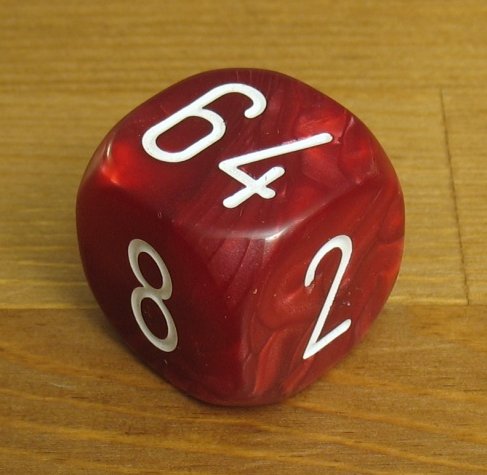
- Imagine that we wished to change the class for dice not numbered from one to the number of faces (say, a backgammon doubling cube)? What would need to change to support this approach?
Notes
-
The new attribute in Dice should have privatevisibility. -
Our DiceStatistics constructor will be invoked as follows in the DiceStatistics main: DiceStatistics myDiceStatistics = new DiceStatistics(2);.
-
To create an array of dice, use a statement like:
int diceCount = 2;
Dice[] diceArray = new Dice[diceCount];
Of course, this doesn't create the dice—just an array big enough to hold two (diceCount) of them. To create a "default" (6-sided) die, use a statement like:
diceArray[0] = new Dice();
Whereas, to create a 20-sided die, use a statement like:
diceArray[1] = new Dice(20); -
Keep track of the totals of the rolls of all the dice in your array, and print them at the end of the program (like DiceStatistics last week). The possible totals can be computed from the number of sides of each of the dice. -
Remember to initialize your instance of Random!
Evaluation
| Criteria | Weight |
|---|---|
| New instance attribute | 15 |
| Modified constructor | 15 |
| New constructor | 15 |
| New static attribute | 15 |
| Main program and output | 20 |
| Short textual answer to question II | 10 |
| Short textual answer to question III | 10 |