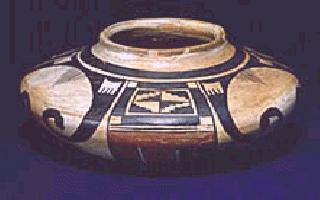
The Purchasers of Hopi pots: An Elite
A small group of socially elite persons began purchasing Hopi pots around
1899. They collected Hopi pots to re-affirm a social hierarchy that they
already controlled through possession of what Pierre Bourdieu calls "cultural
capital." They not only saw Hopi pots as cultural capital but also the
preservation of Hopi culture as part of a multicultural definition of America.
They were "cultural radicals" who associated with the "political radical
elite" of Greenwich Village the radical elite who championed the working
class; fought against the repression of Native American religion; and demonstrated
for womens rights. These cultural radicals believed that the continual
revival and revitalization of good things art, pagan religion, ancient
philosophy from the past was the hallmark of a true civilization.
This connection between the producers of ethnoart and avant-garde patrons
has been noted by others as well: W.
Jackson Rushing,
Kenneth Dauber, Molly
Mullin, Sally Price, Shelly
Errington, among others. But what we propose goes beyond their interpretations
by suggesting that this elite turned the making and marketing of Hopi pottery
into a social field in which culture conflict, opposing class interest,
the commodification of culture, and Hopi struggles with the transition
to a cash economy all came together.
This elite saw themselves, and to some extent were, the movers, shakers,
and shapers of American culture. At least, that is our supposition. Yet
they were losing control not to a working class that needed powerful allies
who used the working class as part of the process of self-legitimization,
but rather, to a growing middle class that emulated the standards of culture
that the elite established. In that emulation, this middle class of salaried
professionals, business people, and shop keepers rivaled the elite they
emulated.
We suggest that this middle class also bought Hopi pottery, but they
bought souvenirs, not pieces of art. I further suggest that the more geometric
the designs were, the less easily recognized as a distinct anthropomorphic,
zoomorphic, or floral form they were, the more likely a design on a piece
of pottery was to appeal to the elite. The more realistic a design was,
the more recognizable it was, the more it appealed to middle-class tourists.
This idea is similar to
Pierre Bourdieu's idea in DISTINCTION that the social elite, seeking
to define and accumulate cultural capital, will prefer the abstract, the
obtuse, metaphoric, the symbolic in art; in contrast, the middle class
will seek the more concrete, realistic, unambiguous representations.
But who were these elite and why did they collect Hopi pots? What was
in their heads that compelled them to collect Hopi pots? I suggest they
collected Hopi pots that had decorative motifs which subconsciously evoked
affinities with the standards of quality and the design principles of Greek
pottery of the Geometric Era.
One of us (Rudden) was educated in the Classics. The question which
most often runs through my mind is Why not? Is it not a universally known
concept that people educated in Classics would want to obtain artwork that
may/may not resemble Minoan? So if this was in fact the reasoning behind,
simple reasoning at that, then what was the motivation behind this "classical
elite" buying Hopi pottery? If there really are motif correlations, i.e.
meander,
crosshatching, etc, is this Avant-Garde buying them as nostagalia of
their childhood education?
Our suggestion is that the people buying these pots were doings so for
several reasons. One of which may have been nostalgia. But we suggest that
there is another more linear reason. Classical education by definition
defines civilizations in evolutionary stages. These evolutionary stages
fall from primitive to civilized depending upon your agenda. In any case
these categories produce a feeling of preservation. Classicists are not
just interested in learning about ancient cultures, they are by default
also interested in preserving them. If there are simliarities between Hopi
pottery and Greek pottery, the people buying the pottery would be doing
so because of an interest in preserving that culture. Even if there are
not apparent similarities there would still be an instinctual preservation
reaction to any pot with a geometric format, for a person educated in Classics
would automatically associate geometric with pre-civilized, or becoming
civilized, again depending upon your agenda. We propose another motivation
for the buying of these greek pots and that is the interest in Primitive
Art. The interest in Primitive Art and the ramifications of such an interest
are outlined later, and more thoroughly by Sally Price.
 Back to the Table of Contents
Nampeyo and the Hopi 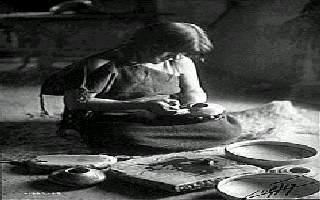
Hopi potters such as the famous Nampeyo had to confront the dilemma of
responding to two different market and to two different tastes: the elite
seeking art and the middle class seeking souvenirs. In confronting this
dilemma it is probably inevitable that Nampeyo and other potters opted
for producing either for one market or the other, but not for both simultaneously.
The art collectors would have something which, in Shelley Errington's words,
could be grafted onto the "sacred and useless" category, and the tourists
could have something that, in Susan Stewart's words, was "marked as arising
directly out of an immediate experience of its possessor".
Therefore people who wanted pots and would pay $5 for them contributed
substantially to Hopis cash income, even if they bought it from a trader
who paid the artist only $2.50. People who bought tourist pieces for 35,
50, or 75 cents consumed proportionately more of an artists labor for a
lower price, but were a market that could not be ignored.
And traders, such as Thomas
Keam, or Lorenzo
Hubbell, and Herbert
Schweizer of the Fred Harvey Company had to respond to these two markets
with two different demands and had to negotiate the purchasing of pottery
from Hopis and its resale to these two different markets.
Back
to the Table of Contents
The Theory: Testing it. But this is just a theory,
an idea, a hypothesis. How to test it? Interview the purchasers. But they're
dead. Did they leave diaries? How find them? Find the potters. But they're
dead too. Find the traders' records. Possible. But no guarantee: How do
we know the descriptions of the pots will be good? How do we know we will
be able to identify which pot was bought on which date from whom and for
how much? And can we track the progress of that pot to the end-purchaser?
The next best thing
Find and look at pots that were purchased and kept for a private collection
by a purchasing agent of The
Fred Harvey Company's Indian Department. This was Canon Charles Winifred
Douglas. Donated by private collectors who bought directly from the potters.
This describes the 540 Hopi pots in Denver Art Museum collection
This methodology is a tentative test of what the results of the behavior
that we think might have happened, did happen. Its similar to the question
Dave
Thomas asked twenty years ago when he tested
Julian
Steward's methodology of cultural ecology archaeologically: If people
behaved the way Steward said they did, how would the artifacts have fallen
on the ground? If there were two different markets for Hopi pottery, how
would the artifacts the pottery fall into a collection?
But before we search for an answer to that question, let us get to know
Nampeyo a little better. 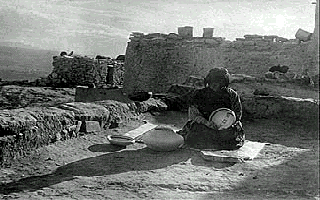
Nampeyo was born 1859 or 60, Walpi, she Married Lessou, who decorated
some pots.
She taught her granddaughters Nellie and Rachel and her daughters Annie
Healing, Daisy Nampeyo, and
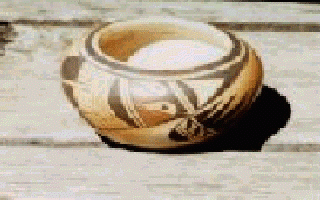 Fannie Nampeyo.
Nampeyo's work is called Sikyatki Revival style because she copied some
designs from 14th and 15th century Hopi pottery. But we prefer the term
"Nampeyo style" because she was selective about the designs she used; some
she did not use at all after about 1898. Some of the dominant motifs of
Nampeyo Style are Birds,
or bird forms, and Geometric,
which
includes design styles that have any geometric form on them and
Shalako
Maiden also known as the Kachina Maiden face. These design styles will
be refered to later, but first we need to understand a little about the
culture in which Nampeyo comes from.
Back to the Table of Contents
Who Are the Hopi
As a member and participant in Hopi village life in the late 18-early 1900s,
Nampeyo experienced the transition from a subsistence to a mixed economy.
Cash became an increasingly important motivation for Hopi labor. For Hopis,
the few thousand dollars a year from craft sales (for a total population
of 2,500) could mean the difference between buying a wood-burning cook
stove (cost $30 or $40) on credit over a 4 or 5 year period and continuing
to cook over a smoky, smelly coal-fired hearth. Hopis constituted an economic
strata that never figures in standard class analyses: subsistence horticulturalists
coming into the very bottom of the cash economy.
The Hopi are a
Puebloan people whose home is on the Colorado Plateau near the Grand Canyon
in northeastern Arizona. Their aboriginal territory stretches from the
San Francisco Peaks north of Flagstaff to the Colorado River in Grand Canyon,
eastward to Woodruff Butte and Zuni Salt Lake, near Chambers, Arizona.
The original Basketmaker population resident in the area seems to have
been joined by Uto-Aztekan-speakers and subsequently by Sinagua, Mogollon,
and Pueblo peoples who left ruins such as White House in Canyon de Chelly;
Cliff House and Balcony House at Mesa Verde; Homolovi near Winslow; Wupatki
and Wukoki near Sunset Crater; ruins in the Mogollon Rim; and probably
Pueblo Bonito, Hungopavi and other ruins in Chaco Canyon between 1100 and
1400 AD.
In the late 1600s they were joined by several groups of Tanoan-speaking
Puebloan groups from the Rio Grande area of New Mexico. These immigrants
established the town of Hano, now known as Tewa, next to the Hopi village
of Walpi. Its inhabitants are now known as the Hopi-Tewa. In 1850 there
were seven Hopi towns on three mesas, known as "First" or "East" Mesa "Second"
or "Middle" Mesa; and "Third" or "West" Mesa. By 1900 the number had increased
to nine. Currently there are thirteen Hopi towns, twelve of which have
status as "villages," plus a Hopi settlement at the Government Agency in
Keams Canyon. In the first half of the Twentieth Century, virtually all
Hopi potters were Hopi-Tewas from the First Mesa village of Tewa.
Now one problem is that Nampeyo was grown and married although quite
young by the time the first school opened in Hopiland in 1874. She never
went to school and never learned to read and write. Therefore, she never
signed her name to any pot she made. We are stuck, then, with taking the
word of Fredrick Douglas, curator at the Denver Art Museum, that certain
pots were indeed made by Nampeyo, on the basis of his father's memory,
since it was Canon Douglas who collected and donated most of the Denver
Art Museums Nampeyo pots. It is quite likely that other pieces, of the
quality and showing the designs that Nampeyo and her daughters and
granddaughters used, were indeed made by Nampeyo or her immediate
descendants. We therefore distinguish between "most likely made by
Nampeyo" and "Nampeyo style," but with the understanding that "Nampeyo
Style," were most probably made by Nampeyo or her daughters.
We know that other potters were active and that these other potters
were selling items and that some of these pieces they were very different
in shape and in some cases decorative motifs from those produced by Nampeyo.
(See
Graph.) A collection made in 1927 by the Melvilles, a family from Hartford,
Connecticut, contains many different kinds of Hopi pottery. Little of it
could be called "Nampeyo Style". We know who made it and none of it was
made by Nampeyo or members of her family. And although potters produced
hundreds upon hundreds of tiles many of which are in the Denver Art, Milwaukee
Public, and Berlin Ethnographic Museums. Nampeyo produced very few tiles.
We therefore suggest some tentative conclusions based on analysis of
the Hopi pottery in the DAMs collection. Bear in mind that this is a work
in progress utilizing a methodology that will lead to development of methodology.
A limited number of design motif categories is represented. This supports
the idea that there was a distinct market consisting of purchasers who
knew what they wanted: something recognizable from Hopi culture, or something
more generalizable, more universal but still distinctly Hopi, if not recognizable
specifically. This supports the theory.
Some designs occur only on tiles and not on pots.
(See Graph) Other design motifs occur much more frequently on tiles
than on pots. And some designs occur only on pots and not on tiles. (See
Graph) This tells us that, indeed, two different kinds of pottery were
being produced and marketed: cheap pieces tiles that had realistic designs
for the most part and pots with less realistic, more geometric designs.
There should be an association of highest value with the less realistic,
more geometric motifs. There is, but we have too little data to actually
suggest this even as a tentative conclusion. This part of the theory is
not supported.
There should be certain designs that show up only on Nampeyo and Nampeyo-style
pieces and not on others, and some designs that show up onthe pieces of
other potters and not on Nampeyo items. This is certainly true of floral
and Human figure motifs, but not of the others. For instance the Bird Motif
is very strong in the Nampeyo Style (See
Graph)
If there were indeed 2 markets, we should expect an equal number of
small, medium, and large pieces, also representing different pricing possibilities
for different markets, and there is. (See
Graphs) Large and even medium pots are not easy to pack and transport
for tourists on a 2-week trip on a Harveycar.
They are easy to transport for wealthy people who know how to make
such arrangements. And in fact, the data does support this part of the
theory.
We should expect also less complicated designs on cheaper items, i.e.,
tiles, than on pots, if Hopis were indeed aware of different tastes and
markets. And this is the case. One central design clearly characterizes
tiles; more complicated design layouts characterize higher-priced pots.
If the elite purchasers were seeking items with designs that subconsciously
evoked Greek geometric design principles,
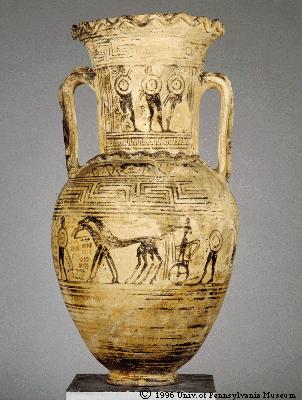 Like
this Corinthian Ware Vase Like
this Corinthian Ware Vase
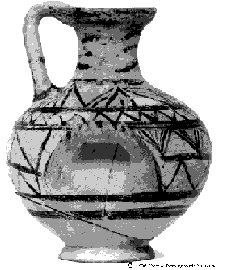 or
this Matte Painted Ware vase or
this Matte Painted Ware vase
Then a majority of pots should have a "Greek correspondence" factor.
About 30%, of the pieces that are decorated and for which we have design
data do, in fact, exhibit design motifs that could be called "Greek-like."
(Watch this web site for a fascinating footnote to this idea! Coming soon!!)
Tiles with human figure and face designs have no possibility for such correspondence
and if we were to subtract those from the total not represented by this
pie chart -- we get an even higher figure probably something like 65%,
not graphed. This is, of course, subjective. But nonetheless, results indicate
the idea is worth pursuing.
Back to the Table of Contents
The Next Step
Again the components of this theory: potters responding to two markets;
one tourist, the other art collectors; tourists wanting cheap, easily recognizable
motifs or shapes; art collectors wanting more abstract designs; art collectors
seeing pottery purchasing as part of the accumulation of cultural capital;
art collectors, the elite, coming out of a classical education; the art-collecting
elite subconsciously reacting to, or imposing, a Greek design principle
model on the standard of excellence they demanded in Hopi pottery. One
of the most valuable aspects of this phase of the project, then, was the
ability to bring two radically different educational backgrounds to it:
Where Do we Go From Here
ethnography of the elite
traders' records
Back to the Table of Contents
Conclusion
The 1920s were some of the darkest days for Hopi culture. Government agents
suppressed religious ceremonies. Influenza brought the population to an
all-time low. Land management and mineral leasing were placed directly
under jurisdiction of the Governments Navajo agency and Navajos increasingly
used more of Hopi land. At one Hopi village, 5 major ceremonies were abandoned.
Missionaries acquired a greater number of converts to Christianity than
in any other decade under pressure of forced acculturation and assimilation.
The making and selling of basketry, Katsina figures, and pottery constituted
an important affirmation of Hopi culture under a state of siege. It allowed
Hopis to remain in their villages and earn cash engaging in activity directly
rooted in Hopi society and history. The fact that Hopi culture was also
as the same time, being commodified by the marketers of these items made
pottery making part of the tension characterizing a social field in which
opposing class interests, the clash of cultures, and radically different
social, cultural, and political agendas came together. Material objects
and their decorative motifs met the expectations of various categories
of patrons and purchasers who had a narrative in their heads about why
they thought buying Hopi pottery was the right thing to do. Hopis read
that narrative and responded to it. Discovering what that narrative was
and what generated it is part of reconstructing the story of Hopi cultural
perseverance. How much of the story the objects themselves can tell us,
and whether or not we find the story itself in some collectors diaries
or personal papers or traders' records, remains the next challenge.
Today, one of the biggest problems in collecting Hopi pottery is the
illegal looting of burials. Pot-hunters search "public lands" -- BLM
lands and U.S. Forest lands -- for pre-historic and proto-historic
burials, hoping to find whole pots. These pot-hunters then sell their
finds either to unscrupulous collectors on the "black market" or at
auctions and antique shows to unsuspecting collectors, who do not know
that in purchasing such items, they are in receipt of stolen goods and
are in violation of the Native American Graves Protection and
Repatriation Act. Because much of the appeal of contemporary and historic
Nampeyo-style pottery can also be found in the ancient pottery styles
from which these Hopi artists drew inspiration, there is a growing market
for this contraband material. Collectors who suspect that they have
encountered such items should contact the Hopi Tribal Office of Cultural
Preservation.
Richard O. Clemmer and Mary Elizabeth Rudden, with the assistance of
Carrie Beauchamp
Back to the Table of Contents
REFERENCES
FOR SOME LINKS TO OTHER NAMPEYO SITES
So after reading all of this fascinating stuff we are sure you want to
look up as many things as possible. Visit your nearest library or museum!
You can also go to Beth Rudden's homepage http://www.du.edu/~mrudden/hopi.html
Back to the Table of Contents
"Fortuna est caeca"
|
 Life is Construction!!!