A primary node in the Epsilon Aurigae Eclipse Campaign
You can get the latest light curves by going to Jeff Hopkin's campaign website: Campaign newsletter link - which welcomes reports from all serious observers, and importantly CitizenSky where you also can report your visual and digital observations. For breaking news, any google/bing type searches will turn up stories from the Jan 2010 AAS meeting where several papers were presented, watch the Twitter and Facebook sites. Related images can be found at my additional webpage: http://portfolio.du.edu/rstencel - under the epsilon Aur tab.
LATEST NEWS - https://twitter.com/epsilon_Aurigae
2015 - With regrets, we announce the passing of Jeff Hopkins, a giant among not-so-amateur astronomers. Safe travels through the universe, Jeff.
More evidence accumulating that epsilon Aur is not as distant as some think, but closer to the 750 pc value established in Brian K's thesis.
Special issue of the Journal of the Amer. Assoc. Variable Star Observers (JAAVSO Vol.40, #2) includes many reports about epsilon Aurigae—including: An Overview of the 2009–2011 Eclipse Campaign Results = http://adsabs.harvard.edu/abs/2012JAVSO..40..618S .
Additional recent papers:
+Interferometry of ɛ Aurigae: Characterization of the Asymmetric Eclipsing Disk, Kloppenborg, Stencel, et al. -
http://adsabs.harvard.edu/abs/2015ApJS..220...14K
+Transient Carbon Monoxide (CO) Absorption and Persistent Brackett Alpha (Brα) Emission in the Spectrum of ɛ Aurigae, Stencel, Blatherwick & Geballe -
http://adsabs.harvard.edu/abs/2015AJ....149..109S
+Constraints from Asymmetric Heating: Investigating the Epsilon Aurigae Disk, Pearson & Stencel -
http://adsabs.harvard.edu/abs/2015ApJ...798...11P
+Time-series high-resolution spectroscopy and photometry of ɛ Aurigae from 2006-2013, Strassmeier, Schanne et al. -
http://adsabs.harvard.edu/abs/2014AN....335..904S
+Merging Recent and Historic Spectra of ɛ Aurigae: Properties of the System's Components, and Discovery of a Mass Transfer Stream, http://adsabs.harvard.edu/abs/2013PASP..125..775G
+A high angular and spectral resolution view into the hidden companion of ɛ Aurigae, http://adsabs.harvard.edu/abs/2012A%26A...544A..91M
Dec. 2011:
TEN THINGS WE'VE LEARNED AS A RESULT
OF THESE CAMPAIGNS - some of these were recognized last time around, and some
represent working hypotheses that serve as tools to design more clever
measurements and theory to finally resolve the masses and evolutionary status of
epsilon Aurigae components:
FACTS: the eclipsing object is a large, 550K disk [IR];
FACT/INTERPRETATION: neutral potassium monitoring shows disk substructure [LHIRES];
FACT: carbon monoxide re-appeared again after mid-eclipse [SpeX, GNIRS];
NEW FACT: He I 10830A absorption strengthened after mid-eclipse [SpeX];
FACT: the disk facing the F star is heated to 1100K [IR];
FACT: the Far-UV output is somewhat eclipsed [HST/COS];
FACT: no 10 micron silicates [BASS, MIRAC] - INTERPRETATION: large particles ( greater
than 1 micron size) dominate the disk;
FACT/INTERPRETATION: light curves feature 0.1 mag variations --> F star
oscillations, wind.
SUSPECTED: the disk may contain a B5V star;
SUSPECTED: the mass ratio favors the B star as the more massive object.
Some of these new and old facts lead me to the following considerations.
One can compute the equilibrium temperature of an object orbiting a star [see,
e.g. http://burro.cwru.edu/Academics/Astr221/SolarSys/equiltemp.html ]. In
a blackbody approximation, for a 30,000 solar luminosity primary star, we find
that the observed heated face of the disk, 1100K, is reached at a separation of
9 to 11AU, for a range of particle albedos, from 0.3 (somewhat reflecting) to zero
(fully absorbing). Given that the F star luminosity estimate increases
with larger distances, this separation result is not definitive, but these
thermal IR facts provide another constraint on binary separation (hence, total
mass). Another interesting constraint on the mass of the central
star inside the disk is derived from the velocity shift seen in Robin
Leadbeater's neutral potassium line data, approx +/- 35 km/sec rotation speed,
plus a current best guess for the radius of the disk itself, 3.8AU.
Kepler's third law then tells us the central mass is 3.85 solar masses - a bit
below the 6 solar mass B star proposed earlier. Watch this space for
developments in coming months.
Thus, although the recent eclipse is fading into memory, the bonanza of data is
providing researchers both ample constraints for checking the current model, and
inspiration for how to design observations that can confirm ideas without
waiting another 27 years for the next eclipse. Key among the goals in
these studies is pinpointing the disk’s age and evolutionary state, and
whether there might be high levels of activity such as the B star’s accretion
of disk matter. The F star itself is an important part of the study:
Does it have an active atmosphere or giant convective cells, flares, or even a
strong stellar wind? The next eclipse is forecast to start in 2036,
but you can enjoy out-of-eclipse variations of Epsilon Aurigae’s light the
very next time you see the star, along with Capella and the Kids riding across
the evening sky. Post-eclipse observations are still needed — this star
retains its capacity to surprise. Thanks again for your interest and
participation in this campaign, and keep in touch!
--Dr. Bob Stencel, University of Denver Astronomy, rstencel@du.edu
Recent papers: Infrared Studies of Epsilon Aurigae in Eclipse 2011 Nov Astronomical Journal, vol 142, pp.174-183.
http://adsabs.harvard.edu/abs/2011AJ....142..174S
plus an interesting olde analysis by Handbury & Williams, 1976:
http://adsabs.harvard.edu/abs/1976Ap%26SS..45..439H
2010 December:
The Seattle AAS meeting in January 2011 featured a set of contributed posters plus 6 invited talks, all highlighting developments associated with studies of the current eclipse of epsilon Aurigae. The posters submitted include:
257.01.
Campaign Photometry During The 2010 Eclipse Of Epsilon Aurigae -
Jeff Hopkins1, R. E. Stencel2
= 1HPO Soft, 2Denver University.
257.02.
Analysis of Epsilon Aurigae light curve from the Solar Mass Ejection Imager -
John Clover1, B. V.
Jackson1, A. Buffington1, P. P. Hick1, B.
Kloppenborg2, R. Stencel2 = 1University of
California, San Diego, 2University of Denver.
257.03.
Interferometric Images Of The Transiting Disk In The Epsilon Aurigae System -
Brian K. Kloppenborg1,
R. Stencel1, J. D. Monnier2, G. Schaefer3, M.
Zhao4, F. Baron2, H. McAlister5, T. ten
Brummelaar5, X. Che2, C. Farrington5, E.
Pedretti6, P. Sallave-Goldfinger5, J. Sturmann5,
L. Sturmann5, N. Thureau7, N. Turner5, S.
Carroll8 = 1University of Denver, 2University
of Michigan, 3Georgia State, 4Jet Propulsion Laboratory,
5Georgia State University, 6SUPA, University of St.
Andrews, United Kingdom, 7University of St. Andrews, United Kingdom,
8California Institute of Technology.
257.04.
Spectroscopic Wonders During The 2010 Eclipse Of Epsilon Aurigae -
Robin Leadbeater1, C. Buil2,
T. Garrell3, S. Gorodenski4, J. Hopkins5, B.
Mauclaire6, J. Ribeiro7, L. Schanne8, O. Thizy9,
R. Stencel10 = 1Three Hills Observatory, 2Castanet
Tolosan Observatory, France, 3Observatoire de Foncaude, France,
4Blue Hills Observatory, 5Hopkins Phoenix Observatory, 6Observatoire
du Val de l'Arc, France, 7Observatorio de Instituto Geografico de
Exercito, Portugal, 8Voelklingen Observatory, Germany, 9Shelyak
Instruments, France, 10University of Denver.
257.05.
Optical and NIR Spectroscopy of ε Aurigae at Apache Point Observatory, the
First Half of the Eclipse
William F. Ketzeback1, J.
Barentine2, R. Leadbeater3, R. McMillan1, J.
Dembicky1, G. Saurage1, J. Huehnerhoff1, S.
Schmidt4, S. Hawley4, G. Wallerstein4, J.
Coughlin5, D. York6 = 1Apache Point
Observatory, 2UT Austin, 3Brititsh Astronomical
Association, United Kingdom, 4University of Washington, 5New
Mexico State University, 6University of Chicago.
257.06.
Epsilon Aurigae - Intriguing Changes with Phase -
R. E. M. Griffin1 = 1Herzberg
Inst. of Astrophysics, Canada.
257.07.
Hubble Space Telescope Ultraviolet Observations of Epsilon Aurigae -
Steve B. Howell1, R. E.
Stencel2, D. W. Hoard3 = 1NOAO, 2University
of Denver, 3Spitzer Science Center.
257.08.
Ring-like Structures Around Epsilon Aurigae Companion -
Sally Seebode1, S. B. Howell2,
D. Drumheller3, D. Stanford3, D. W. Hoard4, R.
E. Stencel5 = 1San Mateo High School, 2NOAO,
3College of San Mateo, 4Spitzer Science Center, 5University
of Denver.
257.09.
Infrared Studies of Epsilon Aurigae in Eclipse 2010 -
Robert E. Stencel1, B. Kloppenborg1,
R. Wall1, S. Howell2, D. Hoard3, J. Rayner4,
S. Bus4, A. Tokunaga4, M. Sitko5, R. Russell6,
D. Lynch6, S. Brafford7, H. Hammel8, B. Whitney8,
G. Orton9, P. Yanamandra-Fisher9, J. Hora10, W.
Hoffman11, A. Skemer11 = 1Univ. of Denver,
2NOAO, 3IPAC, 4IRTF, 5Univ.
Cincinnati, 6The Aerospace Corp., 7Esq., 8Space
Science Institute, 9JPL, 10Harvard Univ., 11Univ.
Arizona.
* * * * * * * *
NEWS * 2010 May:
A summary of progress during the first half of eclipse can be found at these websites:
http://xxx.lanl.gov/ftp/arxiv/papers/1005/1005.3738.pdf - "Epsilon Aurigae in Total Eclipse, 2010 - Mid eclipse report" and
http://www.hposoft.com/EAur09/EAUR%20pdfs/SAS2010.PDF - "Epsilon Aurigae Eclipse 2009 - Ingress Photometry"
2010 April:
A trifecta of new reports are beginning to reveal unprecedented details about the nature of the epsilon Aurigae system:
Development #1 - The complete spectral energy distribution: http://arxiv.org/PS_cache/arxiv/pdf/1003/1003.3694v1.pdf
The observed spectral energy distribution can be reproduced using a three component model consisting of a 2.2+0.9/-0.8 Msun F type post-asymptotic giant branch star, and a 5.9+/-0.8 Msun B5+/-1 type main sequence star that is surrounded by a geometrically thick, but partially transparent, disk of gas and dust. At the nominal HIPPARCOS parallax distance of 625 pc, the model normalization yields a radius of 135+/-5 Rsun for the F star, consistent with published interferometric observations. The dusty disk is constrained to be viewed at an inclination of i > 87 deg, and has effective temperature of 550+/-50 K with an outer radius of 3.8 AU and a thickness of 0.95 AU.
Development #2 - Interferometric imaging of the disk during eclipse ingress: To appear in Nature, 8 April issue.
Synopsis: Interferometric images obtained during autumn 2009 show the opaque disk crossing the southern hemisphere of the F star. The measured change over the course of two observations a month apart indicate relative motion, which in combination with well-known orbit of the F star, argue for a mass ratio of 0.6 - which means the F star is lighter than the disk and its contents. Disk opacity can be used to estimate the dust mass of the disk, to be less than one earth mass. Details available on request from this author.
Development #3 - Substructure inside the disk: http://arxiv.org/ftp/arxiv/papers/1003/1003.3617.pdf
Variations in the equivalent width of the neutral potassium line at 7699A are reported, during ingress and into totality of the current eclipse of the enigmatic eclipsing binary epsilon Aurigae. The increase and plateaus of line strength are correlated with new system parameters and interferometric imaging constraints, plus ancillary data being reported contemporaneously. Together, these data reveal structural details of the transiting disc, never before measured.
2010 Jan: A great deal is being learned during this eclipse cycle (2009-2011) and almost too much to keep this humble webpage up-to-date. You can get the latest by going to Jeff Hopkin's campaign website: Campaign newsletter link - which welcomes reports from all serious observers. For breaking news, any google/bing type searches will turn up stories from the Jan 2010 AAS meeting where several papers were presented, watch the Twitter site, Facebook, and importantly CitizenSky where you can report your visual observations. Feel free to contact me directly for the latest as well.
Access to summaries of campaign newsletters: http://www.kloppenborg.net/research/epsilon-aurigae/newsletters-2009.html
See Sky&Telescope article: http://www.skyandtelescope.com/news/80730537.html
BACKGROUND:
An F supergiant star (or post-AGB star) with an enormous grey disk orbiting each 27 years... eclipses last nearly 2 years! Current one started 2009 mid-August and lasts til late spring 2011! Where to look!
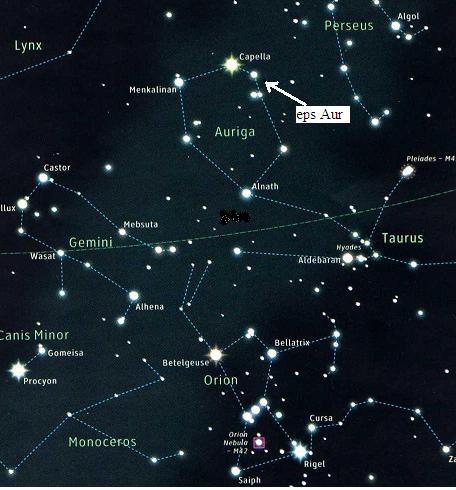
What are the science goals, and what
measurements are crucial? Partial phases of the eclipse have been getting
shorter during the 20th century, and the low amplitude out of eclipse
light variations have been getting faster during the past 50 years. In the
context of the prevailing model, where a massive disk eclipses the F supergiant
star, these changes can be interpreted as disk evolution, possibly due to planet
forming activity. Thus, testing this idea requires good photometric coverage,
ideally UBVRI and JHK. Also, the most sensitive indicators of the disk have
been the optical spectra (4000-4500AA and 7699AA). If the disk is changing,
then the blue region and the K I lines should differ from the past eclipse
behavior. Finally, modern interferometry has the chance to directly resolve the
disk transiting the supergiant star, and those observations are underway, with
an initial report recently published in the Dec. 20, 2008 ApJ Letters.
To join in the campaign effort, send email to phxjeff at hposoft
and/or rstencel at du.edu -- note added 2015: hposoft e-address no longer
available
Breaking news FAQ Campaign newsletter link Twitter
CALENDAR OF ECLIPSE EVENTS:
2009 Aug 6th - predicted start of eclipse, rising with sun as a morning star
2009 Nov/Dec - eps Aur transits at midnight --> evening star
2009 Dec 21 - predicted start of totality, evening star
2010 May - eps Aur setting with the sun, mid eclipse brightening?
2010 Aug 1st - predicted time of mid-eclipse, early morning star
2010 autumn - end of mid-eclipse brightening?
2010 Nov/Dec - eps Aur transits at midnight --> evening star
2011 March 12 - predicted end of totality, evening star
2011 May 15 - predicted end of eclipse, next one starts in 2036.
LATEST FINDINGS, 2009:
*CITIZEN SKY - clearing house for eps Aur obs.
*Interferometry
at PTI, ApJ Letter [pdf link].
* Latest photometry
report, Hopkins et al. 2008 [pdf].
** SAS interferometry
report, Mais et al. 2008 [pdf].
*** Link
to the latest Campaign Newsletters! [webpage]
*Join the IYA
Citizen Science effort [link].
TOPICS: Background; Goals; References; Links to News, and more!
BACKGROUND:
The modern, consensus �high mass� model for the eclipsing system epsilon
Aur includes an estimate of 15 solar masses for the F0 Ia primary star,
13.7 solar masses for the mysterious secondary, and a component separation
of 27.6 AU
(cf. Carroll et al. 1991, their Figure 1). Huang (1965) proposed a
massive dark disk as the secondary. The interval from first
to third contact implies a 10 AU length for the secondary, while the
interval from first to second contact implies 2.6 AU diameter of the F
star primary. During mid-eclipse, the primary star's light is dimmed by
48% (0.7 mag visually), without significant change to the optical spectral
lines or colors. While 'low mass' models have been proposed, and even a
central black hole in the secondary, these fail to address as many of the
observational constraints as successfully as the high mass model does
(Guinan, 2002). If the high mass model is correct, the secondary could be
the most massive circumstellar disk known, with an outer radius of ~9AU
and a central hole ~0.7AU. To stabilize this disk, an embedded binary has
been proposed (Lissauer and Backman 1984).

Schematic of dark disk model for secondary to account for the eclipse
profile in epsilon Aur (Huang, 1965).
GOALS:
The science goals for observing epsilon Aur are several:
[1] photometry: help determine whether the ~0.1 mag quasi-periodic, out of
eclipse light variation is due to the F supergiant star, or related to
excitation of disk material (UV and infrared spectra);
and, have that variation determined well enough to constrain whether the
mid-eclipse brightening seen previously is merely F supergiant variation
or could be a central clearing in an inclined disk;
[2] spectroscopy: a �disk trailing wake� appears to influence the light
curve and spectra only after mid-eclipse (Canavaggia 1980, Ferluga and
Mangiacapra, 1991), but pre-eclipse observations are needed to determine
whether material is symmetrically distributed about the disk along the
orbit;
[3] directly test the Huang disk model interferometrically, to witness
whether the single F supergiant stellar disk (2.1 milli-arcseconds
measured diameter) does bifurcate into a pseudo-binary during eclipse due
to the dark disk superpositioning;
[4] confirm the polarimetry results obtained during the previous 1984
eclipse (Kemp et al. 1986).
References below.

Viscosity-dependent model for twisted accretion disk surrounding putative
central binary in the secondary of epsilon Aur (Kumar, 1987).
NEW REPORTS:
A note on wide angle photometry: Jeff Hopkins reports in Campaign Newsletter #3 that--
At the Hopkins Phoenix Observatory we have been experimenting using a 50 mm camera lens with a DSI Pro CCD camera to do BVRI photometry of epsilon Aurigae. Even using the 50 mm lens requires the lens to be stopped down to F.4.0 to keep the R band data in the linear region of the detector. We found that using the 50 mm lens at F/4.0 with 5.7 second exposures for the BV and I bands and 2.0 second exposures for the R band worked well. Each image is a composite of 20 images stacked. Even at only 2.0 seconds the R band data peak ADU counts were over 36,000. Reduced data showed the data spread for 3 set of images for each filter to have a standard deviation of close to 0.01 magnitude. More data will be taken, but so far this looks like an excellent means to do CCD BVRI photometry of epsilon Aurigae.
IYA/US node adopts eps Aur for Citizen Science campaign
Epsilon Aur is AAVSO's variable star of the season!
Report on recent photometry [Hopkins et al. 2006]
Campaign plans for the 2009-2011 eclipse [Lucas, Hopkins, Stencel 2006]
Latest photometry from HPO
Jeff Hopkin's eps Aur compendium page!
List of campaign registrants
PDF of NASA conference publication #2384: The 1982-84 Eclipse of Epsilon Aurigae" (5Mb) HERE.
Visualizations of the 1985 Consensus Model:
Carroll et al. 1991 ApJ consensus model:

Interpretation and artwork by Daniel Weeks (c)2005:


[2] Artwork by D. Egge (c)1985, with permission. Shows yellow supergiant (upper right), hemisphere above plane of disk, with putative binary B stars and fictitious jets and asteroids.
See also Carroll, Guinan and McCook 1991 ApJ 367: 278.1965 Model (S.S.Huang)

Background
F supergiant plus ??? with disk in orbital period of 9885 days (27.1 yr)VizieR/SIMBAD list P=9892d and epoch (for MAX light?) JD=2,435,629
Distance = 578 +/- 51 pc, Mv = -6.74 +/-0.3
Eclipse durations: 1st-4th contacts 647 days, 2nd-3rd (total) 446 days.
PREDICTIONS for contacts: Julian Date
1st - partial phase begins 2455050 = 6 AUG 20092nd - totality begins 2455187 = 21 Dec '09
mid-eclipse - 2455410 = 01 AUG '10 (**2455394 = 16 Jul '10)
3rd - totality ends - 2455633 = 12 MAR '11
4th - partial phase - 2455697 = 15 MAY '11
OBSERVED contacts, 1982-84 eclipse event, per Paul Schmidtke(1985*); J.Hopkins (1990**):
1st - 1982 Jul 14 = JD 2445165
2nd - 1982 Nov 28 = JD 2445302
(mid - JD 2445525)
3rd - 1984 Feb 17 = JD 2445748
4th - 1984 Apr 21 = JD 2445812
*For a free copy of the NASA conference publication #2384, "The 1982-84 Eclipse of Epsilon Aurigae", please email rstencel@du.edu, and provide your complete airmail address. You can now obtain the same in PDF format HERE. Caution - it is a largish file (5Mb).
RECENT OBSERVATIONS:
Fortuntely the approach of the 2009 eclipse has begun to engender community interest in additional precursor observations, especially in the infrared. So far, these include mid IR spectra [Spitzer IRS/MIPS, autumn 2005 and spring 2006]; near infrared spectra [Mimir/Lowell, Dan Clemens Jan.2006]; mid-infrared photometry [IRTF/Mauna Kea, Glenn Orton March 2007] and optical interferometry [NPOI/Flagstaff, Chris Tycner, Mar.2007; PTI/Paolmar, Bob Stencel et al. Oct-Dec.2007]. The spectra and photometry are helping to confirm whether the second component in the system shows evidence of its characteristics, and the optical photometry directly measures an 0.002 arcsecond diameter for the F supergiant. Details of these results will be presented elsewhere.
Intrerferometry finally can provide a direct test of the Huang model for the eclipse - in that the 2.2 milliarcsec F star disk should be bisected by the dark disk and appear as a "double star" with similar separation.
"H-alpha spectra being regularly acquired by Lothar Schanne (reference IBVS 5747) provide a roadmap of the nebular emission from the binary system that enable another dimension to be added to the revelations of the UBVJH photometry reported by Hopkins. The line center velocity gives a Doppler measurement of the densest material, while the emission bump variation informs us of the movement of lower density clouds associated with one of the components. Once again, having this pre-eclipse record will help place in-eclipse variation into a useful context that largely was absent during the run up to the 1982 eclipse."
 Interestingly, the recent V band peak just prior to MJD 54100 does
seem to be flanked by shallow minima about 54050 and 54140... of course
the brightening overall is dramatic and changes are bigger toward the
blue/uv:
MJD      V band changes        B band changes       U band       H band
3000     min 3.12, max 3.04    mn 3.72, mx 3.60   3.85, 3.60     --
4000     min 3.05, max 3.00    mn 3.62, mx 3.55   3.75, 3.65     1.50
diffs         .07       .04        .10      .05    .10   .05     --
Spitzer observations obtained:
eps aur 5: 1:58.13 43:49:23.90 Stencel EPSAUR 20058 mipsphot 21.10 2005-09-25 15:00:11.3 13849088 epsaur-mips1
eps aur 5: 1:58.13 43:49:23.90 Stencel EPSAUR 20058 mipssed 32.80 2005-09-25 15:18:02.2 13849344 epsaur-mipsed1
eps aur 5: 1:58.13 43:49:23.90 Stencel EPSAUR 20058 irsstare 10.48 2005-10-19 07:40:03.7 13848832 epsaur-irs1
**Hopkins, J. 1990 3rd ed. "Zen and the art of photoelectric photometry" uses epoch 2,435,624 and P=9885 days (HPO, 7812 W. Clayton Dr. Phoenix, AZ 85033)
SOME RECENT PAPERS:
2007Stencel, R. 2007 http://adsabs.harvard.edu/abs/2007IAUS..240..202S .
2006
Recent UBVJH Photometry of Epsilon Aurigae
Authors: Jeffrey L. Hopkins, Robert E. Stencel
http://arxiv.org/abs/0706.0891
2005
http://www.aas.org/publications/baas/v37n2/aas206/403.htm
[note: The analogy with zeta Aur systems is compelling, but their UV spectrum is darn complicated]
[40.05] To B or not to B: The Companion of Epsilon Aurigae Unveiled P.D. Bennett (CASA, U.Colorado), T.B. Ake (JHU/CSC), G.M. Harper (CASA/ARL, U.Colorado)
Epsilon Aurigae, a bright third-magnitude star in the northern sky, has puzzled astronomers for most of the last century. The optical and ultraviolet spectrum longward of Lyman-\alpha is that of an F~supergiant. It is distinguished by having the longest known period, 27.1 years, of any eclipsing binary. The spectrum implies a massive primary (15--30 M\odot) and the orbital solution implies a comparably massive companion. Although the two-year long primary eclipse is flat-bottomed, which should mean the primary star is totally occulted, no secondary stellar spectrum is seen. Shortward of 1600~�\ and longward of 5~\mum, the eclipse is shallower. The most favored model for this system, which explains the optical light curve and excess infrared flux, is that the secondary object is a large, dark, cold disk (presumably with an optically-obscured star at its center), seen nearly edge-on, which partially occults the F~star during eclipse.
Recent FUSE observations of the far ultraviolet spectrum of \epsilon~Aur show an emission line spectrum and scaled surface flux quite unlike that of the comparable supergiant \alpha~Car, suggesting the presence of a hot component. The rich emission line spectrum is reminiscent of \zeta~Aurigae stars in eclipse. The \zeta~Aur binaries are supergiant stars that eclipse their main-sequence companions. In these binaries, the emission line spectrum seen during totality is produced by scattering of hot star continuum photons in the wind of the cool supergiant. For \epsilon~Aur, the anomalous FUV spectrum and flux suggest a similar formation: continuum photons from a hot companion embedded in the occulting disk are scattered by the wind of the F~supergiant. The presence of scattered photons down to 1050 �\ implies the companion has a spectral type earlier than B5. We use a variety of multi-wavelength observations to constrain the parameters of the newly unveiled B-star in \epsilon~ Aur.
==================
Far Ultraviolet Spectra of eps Aur: Epsilon Aurigae;
FUSE Program ID: P135; T. B. Ake
Proposal Abstract
FUSE will be used to study the nature of the unusual eclipsing
spectroscopic binary, epsilon Aurigae. The most favored model of this
system is that the secondary object is a large, cold disk seen nearly
edge-on. IUE and GHRS observations indicate the existence of a far-UV
excess compared to other A-F type supergiants, presumably from a hot
star in the center of the disk. The main difficulty in interpreting
the UV data is that the primary star still contributes significant
flux down to 1400-1500 Angstroms. FUSE observations will perform a
more direct examination of the secondary, free from contamination by
from the photosphere of the primary star. Measurements will be made to
determine the physical parameters of the central star, and study
variability and gas motions in the disk.
P1350101000 HD31964 05 01 58.13 +43 49 24.0 40 2001-01-07 13:46:00
47715.617 P135 LWRS
Data available
at: http://archive.stsci.edu/fuse/index.html
==================
Infrared Photometry of Five Long-Period Binaries, Taranova & Shenavrin
2001 Astron.Let. 27:338
"The 3.5- and 5-micrometer radiation from the eclipsing binary epsilon Aur
outside the eclipse exhibits excess (relative to the light from an F
supergiant) fluxes which correspond to the emission from a cool source with a
temperature of ~1000 K. For the eclipsing binary epsilon Aur, we present the
hitherto unpublished results of our optical and IR photometry during 1982-1985,
when a primary eclipse was observed in the system."
==================
Intereclipse Spectroscopic Snapshot of epsilon Aurigae with the Hubble Space
Telescope, Sheffer & Lambert, 1999 PASP 111:829.
"The spectrum as recorded between 1175 and 1461 A is rich with emission
and absorption lines which include stellar and interstellar components. The
emission-line profiles have the appearance of double-peaked emission with a
stronger red component at a radial velocity of +108 km s^-1, an overlying
unresolved absorption component at -20 km s^-1, and a weaker blue emission bump
at ~-92 km s^-1. "
==================
Is the eclipsing variable EE CEP a cousin of epsilon Aur?
Mikolajewski, M.; Graczyk, D.
1999 MNRAS 303: 521
We report the first five-colour Johnson UBVRI observations of the last
eclipse of the long-period (5.7 yr) eclipsing binary EE Cep. We propose
that the star is a member of the Cep OB1 association at a distance of 2.75
kpc. Using this assumption, we find that the primary is a B5 bright giant
of radius ~ 10 R_solar and luminosity M_v ~ -3.1. The observations show
that the obscuring body is not a star-like object. We suggest that the
invisible companion in EE Cep is a dark, thick disc around a
low-luminosity central star or binary, and that the system has a few
important similarities to the epsilon Aur system.
==================
MORE BIBLIOGRAPHYCarroll, S. et al. 1991 ApJ 367: 278 - interpreting eps Aur.
Guinan, E. and DeWarf, L. 2002 in Exotic Stars, ASP Conf. 279, p.121.
Ludendorff, H. 1903 Astron.Nachrichten 164: 81.
Stencel, R. 1985 NASA Conf. Publication 2384 - The 1982-84 eps Aur eclipse.
Wright, K.O. 1970 Vistas in Astron. 12: 147 - the zeta Aur stars.
HISTORICAL NOTES:
At 14:29 -0700 5/3/05, Lucas, Gene wrote:
Hi Jeff,

I just came upon two historic articles on Epsilon Aurigae which I
believe may be of some interest.  These were both published in 1904,
and give visual magnitudes over a span of years back to 1842!!  The
first article, by Col. E.E. Marckwick in the Monthly Notices of the
Royal Astronomical Society (MNRAS) goes over some of the history, and
summarizes his observations back to 1888 (mostly out of eclipse; he
missed the actual eclipse in 1902). Marckwick in turn refers to a
longer 1904 article by Prof. Lundendorff in the Astronomische
Nachrichten (AN)  which summarizes known observations back to 1842!
Marckwick gives his data (with comparison stars and graphs), and
makes the following comment in closing:

"There is a moral in all this for variable star observers.  Do not
tire in watching a variable such as the one now in question, or ?..
One may observe for years without any change, and when one least
expects it an important and marked change may occur.  Although,
according to Lundendorff's result, no further change is due for
twenty-five years [written in 1904; the previous eclipse was in
1901-2 -- GAL], yet I would urge observers to keep a watch on
(epsilon) Aurigae with a view to confirming the remarkable result
already announced."

Here are the citations.  These are available on the web at the
NASA-ADS web pages, and I have printed out both articles and have
copies for you.  Also, I could send you the files electronically or
provide them on a disk.  The MNRAS article (PDF file) is about 450
kB, and the Ludendorff article is approx. 2.9 Mb.

Marckwick, E.E., "Note on the Variation of (epsilon) Aurigae."  MNRAS
1904, Vol. 65, pp. 83-88.


Lundendorff, H. Von, "Untersuchungen uber den Lictwechsel von
(epsilon) Aurigae."  AN 1904, Vol. 164, No. 3918-19-20, pp.81/82 to
113/114.  (Note that the pages are double numbered, formatted in two
columns; this article is in German language, but with some references
given in English.)

Here is the NASA-ADS web pages, where you can do searches and
download PDF copies of many journal articles.
http://cdsads.u-strasbg.fr/bib_abs.html
Keywords: epsilon Aurigae, disks, double stars, infrared, jets, mystery