|
Contents –– Frederick Debell Bennett 1806-1859 –– Notes –– Source |
The Plough Boy JournalsThe Journals and Associated Documents The Plough Boy AnthologyImage Gallery from the Plough Boy Anthology of 19th Century American Whaling. The Collected Works of William Hussey Macy Dictionaries & Glossaries |
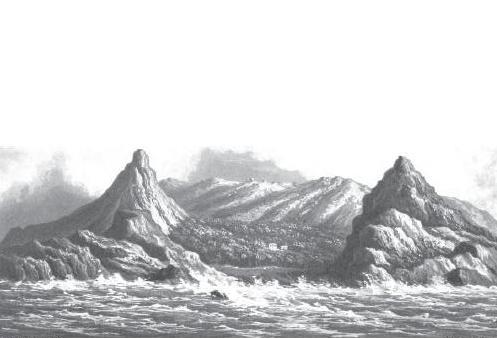
Pitcairn's Island
|
LONDON:J. B. NICHOLS AND SON, 25, PARLIAMENT STREET. |
CONTENTS OF VOL. II.
| |||||||
| ||||||||||||
| ||||||||||||||||||||||||||||||
| |||||||||||||||||||||||||||||||||||||||||||||||||||||||||||||||||||||||||||||||||||||||||||
30°40 to 30°60, which last was the highest it marked during the entire voyage. Dec. 10. – In latitude 24° N., long. 115 1/2° W., numerous shoals of bonita, albacore, and skipjacks, (Saltatrix, Catesby,) came around us; several turtle also made their appearance; and the sea was covered with a large quantity of the sea-weed named porra by the olden Spanish navigators, who were accustomed to regard its presence as an indication of their vicinity to the coast of Mexico. At daylight on the morning of the 12th, land was unexpectedly seen from the deck of the ship, bearing N.N.E., distant thirty miles. It proved to be a group of three islands, extending in an east and west direction, of moderate size, elevated, rocky, and apparently barren. By our observations, this group lies in lat. 24° 9' N., long. 112° 39' W. – a spot where no land is laid down in any of our charts. An ordinary map of North America, of 1814, places islands in the vicinity under the name of Celisos;* but it is more than probable that this group is the Lobos (or Seal) Islands, laid down in Krusenstern's and in Arrowsmith's charts 150 miles to the N.N.W. of the position above assigned. * Probably a corruption of A lejos, signifying "in the offing" or "afar off." |
These islands are so perilously placed for shipping making Cape St. Lucas from the northward, (a route annually followed by numerous South-Seamen,) that it is surprising they should have remained so long unnoticed, or their position undetermined.* That we failed to observe them during our passage of the preceding year, arose from our having then hauled up for the American continent much more to the southward than on the present occasion. On the following day the dark and elevated land of the N. American continent was seen from the mast-head, bearing E. by S.; and on the morning of the 15th we approached that coast within eight miles, and hove to between Cape St. Lucas and Cape Palmo, (the southern extremity of the peninsula of California,†) off the mouth of * Upon our subsequent arrival at Cape St. Lucas we were informed, that the existence of this group had been reported there by a brig, trading on the coast, and that some small vessels in quest of fur-skins had attempted to visit it, but without success. Judging from the appearance of the island, it is very probable that the fur-seal abounds on their shores. † Discovered by Cortez, the conqueror of Mexico, in honour of whom the gulf or strait was formerly named. In the year 1578, Sir F. Drake visited this peninsula, and (with the sanction of the sovereign chief of the whole country) took possession of it for the British crown. But |
a bay, corresponding to a small grazing settlement. Upon landing here we were kindly received by the inhabitants, and hospitably entertained by them during the two days we were engaged in receiving beef on board the ship, and salting it for sea-stock. This bay is situated on the N.E. side of Cape St. Lucas, and is extensive; but affords anchorage only on its eastern side, in about seventeen fathoms water close to the shore, and lies exposed to S. E. gales, which occasionally (and chiefly in the tempestuous summer months) invade its shores with great severity: the sea inundating the lowlands and leaving permanent traces of its inroads. Its beach is sandy, and washed by a long surf; but landing from boats may be safely effected. The tide on the coast is regular, with a rise and fall of six feet. The level plain that opens upon the bay is about thirty miles in length by ten in breadth, and entirely composed of a fine silicious sand, covered with a dense jungle. The mountains that enclose it are of white and red granite, and clothed with a cheerful verdure. The entire plain is one estate, which was originally possessed this claim was never vindicated by Great Britain; and, until the late war of independence, California, with the annexed coast of Mexico, remained a possession of Spain, by the right of discovery and conquest. |
by a Spaniard, who obtained it from the Mexican government by the payment of twenty dollars, and held it at a rent, or tenure, of one dollar per annum. He applied it to the purpose of an estancia, or grazing-farm, for supplying bullocks to the numerous South-Seamen frequenting this coast. Since his death, the management of the estate has devolved upon his son-in-law, an American, named Fisher. The village or settlement consists of about eight dwellings, erected at a distance from the sea, beneath the shade of some mimosa trees. They are small, built of adobes, (or unburnt bricks,) and thatched with flags, obtained from the neighbouring town of St. Jose. Each hut usually contains one or never more than two apartments; and is faced with a portico, which affords a favourite lounge for the resident family. Their furniture is scanty, and rather more useful than ornamental. The hairy surface of a dried bullock's hide, spread on the hard earthen floor, is the usual bed; and the tables and benches are very rudely constructed. Beneath the portico are deposited dried or tanned hides; the horse-furniture of the farmers, including the cumbrous but luxurious saddles, saddle-bags, (capable in themselves of containing a horse-load,) and spurs of murderous length; whilst on lines passing across |
the roof, are suspended cows udders or tongues, and large pieces of beef undergoing the process of jerking. Some sheds, distinct from the dwellings, are used for cooking, or preparing cheese; and an extensive range of corrals, or cattle-pens, contain at night the milch-kine and goats. The residents consist of about thirty persons, who, together with the occupants of other and similar farms scattered on the contiguous coast, form a motley population of "old country" and creole Spaniards; Spanish half-castes, or cholos; and native Indians. Nor does this small community furnish any exception to the rule, that there are but few habitable parts of the world which do not contain a subject of Great Britain or of the United States of America. The creole Spaniards (or those born of parents from the mother-country) do not differ in appearance from their European progenitors: the women, who seldom expose themselves to the sun, have fair and even ruddy complexions. The cholos, also, (when but slightly tinged with Indian blood,) are sufficiently fair; while their features are rendered mare softened, pensive, and pleasing, by an admixture of native traits. The costume of the women is neat, and as light as the climate demands. It is comprised in a chemise garment of white cotton, and a |
short striped-cotton petticoat. Their hair is simply parted on the forehead, and descends over the shoulders, braided in an elaborate and becoming manner. The men wear a cotton shirt, open at the neck, breeches loose at the knees, (to facilitate equestrian exercises,) a broad-brimmed straw hat, and shoes and buskins of rudely-tanned leather, well adapted to protect their legs from the thorny plants of the country. Some of the men wear their hair short; while others have it braided into a queue and pendant over the shoulders, after the manner of the women. A large woollen rug, white striped with blue, worn over the shoulders or enveloping the entire person, they more capriciously assume, and chiefly when on their journeys. Since the character of the soil offers no inducement to agricultural pursuits, these people confine their attention to rearing cattle, which, together with the cheese they prepare from the milk of their herds, form the staple commodities of the settlement. As we had been accustomed among the Polynesian islands, to notice a race of people living almost solely on a vegetable diet, so here we found another subsisting as entirely upon animal food: the only vegetables they consume being maize, (which they procure from a distant part of the country,) and |
a few small and indifferent sweet-potatoes, which they rack their own soil to produce. No rivers are to be found on this spot, nor any natural supply of fresh water, beyond a few ponds filled by the periodical rains. The inhabitants draw their supply of this essential from wells sunk in the sands, which produce good water at a very inconsiderable depth. The sale and use of ardent spirits is interdicted by their social laws; but they nevertheless indulge occasionally in a kind of rum or aquadiente, distilled from sugar-cane, grown in the inland parts of the country. Notwithstanding their monotonous, and highly animalized diet, these people are healthy, active, and robust: their only endemic diseases are agues, which they contract from the malaria arising from the jungle, soon after the termination of the rainy season. They live contented, and consequently happy; and their conduct towards each other, as well as to ouselves, was equally courteous and hospitable. The women are notable and modest. The men are expert equestrians, and excel in the use of the lasso.* It is a curious fact, that the * A strong and flexible rope of neatly-twisted hide, with a noose at one extremity, to cast over and entangle wild animals, while the other end is fastened to the saddle of the horse. The more correct orthography is lazo, a Spanish word, signifying a slip-knot or noose. |
women, whether creole Spaniards or half-caste, cannot be prevailed upon to eat with the men: a prejudice which must be regarded as of native or Indian origin, and one which coincides in a remarkable manner with the primitive custom of the Polynesian tribes. We noticed here also, an interesting Indian boy, about seven years old, whose only clothing was a girdle of cloth, whilst his features, complexion, and figure, accorded so closely with the Polynesian characteristics, that it would have been impossible to have detected him as an alien amidst an assemblage of Society Island youth of the same age. The Spanish language is universally employed by this people. They profess the Roman Catholic religion; and receive occasional pastoral visits from the padre of the neighbouring town of St. Jose; but of any literary acquirements they are ignorant to the extent of perfect bliss. At a very early period after its discovery, a Spanish Jesuit mission was established on the peninsula of California, and supported by supplies from the parent society at Manilla: the richly-freighted galleons, passing annually between the latter country and Acapulco, being instructed to touch at Cape St. Lucas on their way, to learn from the residents if their further |
progress was free from the danger of enemies' ships. The Jesuit missionaries would appear to have performed their duty with assiduity and success; the native Indians, with the exception of a very few tribes, having adopted in a great measure the language, religion, and habits of their civilized teachers. The objects of this mission having been considered as effected, the establishment has ceased to exist, and the spiritual charge of the mixed population is now entrusted to ordinary priests, as amongst the Roman Catholic nations of Europe. The commerce of the residents at the Cape is nearly confined to the English and American South-Seamen, that call there for supplies, and from which they procure the foreign manufactures they require, in exchange for the produce of their farm. The nominal price of a bullock is from three to ten dollars; cheese two dollars the 20 lbs.; turkeys a dollar and a half each; and other provisions in proportion; but the difficulty they find in procuring foreign merchandise, excepting at the exorbitant prices of the Spanish-American market, as well as the profit they derive from vending contraband goods at the town of St. Jose, or annual fair at La Paz, makes them anxious to trade in kind with the vessels they supply. When foreign |
ships are known to be hovering on the coast, an officer from the custom-house of St. Jose is stationed at this grazing settlement to prevent the contraband introduction of foreign goods; but this Cerberus is always greedy for a sop, and is himself seldom averse to doing a little in the way of free trade. To ships in want of essentials this port offers some advantages; but is not remarkable for the abundance or variety of the supplies it affords. Wood and water may be obtained by purchase, conveniently, and in sufficient quantity; and when a ready market is promised, the residents bring from the interior of the country an abundance of musk- and water-melons, oranges, bananas, pumpkins, and other fruits which their own sterile soil denies. The excellent beef also that can be obtained here, proves invaluable to South-Seamen when their stock of salt provisions is exhausted, and often enables them to make a much more protracted stay in the Pacific than they would otherwise be enabled to do. The oxen found here do not differ essentially from the European breed. Their average size is perhaps less; and their prevailing colour black, or black and white; they all, except the milch kine, rove unrestrained through the jungle of the plain, or browse on the declivities of the |
mountains, as the temptations of pasture may induce them. When any are required for slaughter, the owner, or his herdsman, (gaucho,) rides in pursuit of them, and casting his lasso over their horns, brings them captive to the settlement. Their meat is exceedingly well flavoured; and this may in some measure be attributed to the quality of their food, which is chiefly a herb, a species of Chenopodium, bearing tall, plumy, and fragrant flowers, and which covers the soil in sufficient abundance to supply the place of a grass pasturage. When the residents have more beef than they can immediately consume, they cut it into broad slices, and expose it to the sun until it becomes dry and hard; in this form, or, as it is usually termed, jerked, (a corruption of the Spanish word charqui,) it remains unchanged for a long time, and if well packed is very eligible as a seastore. The other domestic animals are horses, of a breed more remarkable for bone than blood, but which are tall, active, and docile; goats, which are numerous, and sold at low prices and swine, which are but few, and, from their foul-feeding, held in little esteem. Amongst the more remarkable quadrupeds, ferae naturae, that obtain on this coast, we find the puma, or American lion; the only large |
feline animal the New World affords. It is seldom this creature visits the settlement at Cape St. Lucas, though he holds his lair in its immediate neighbourhood, amidst the bush of the plains, or, more commonly, on the surrounding heights. The residents relate many instances of his attacking man, and even human dwellings. But a short time before our visit to this place, a woman, residing in the settlement, had left her house at night to draw water from a well,, when, finding in her path a deer, which had been recently killed by a puma, she imprudently took possession of the carcase and drew it into her hut. The puma returned soon after to his prey, and scenting the spot to which it had been conveyed, broke through the thatch roof of the dwelling, and before he could be put to flight destroyed two children and lacerated the woman severely. An Indian, also, employed on a farm, distant about fifteen miles from the bay-settlement, had recently been attacked by a puma while he was at work in the jungle. The man defended himself courageously with a knife, and succeeded in destroying the savage beast, but subsequently fell a victim to the injuries he received in the conflict. Notwithstanding these accidents, the people have but little dread of this creature; and pursue their journeys through |
the country both by day and night, often sleeping in the bush in the wildest districts, without any apprehension of its attacks: they describe it, indeed, as pusillanimous – more prone to shun than attack mankind – and ascribe its occasional attacks to a state allied to madness. The strong dogs of the country attack the puma with much animosity, and when the latter animal finds his affairs in an unfavourable condition, he ascends a tree, and from its height watches his yelling foes beneath. While his attention is thus directed, an Indian will sometimes contrive to cast a lasso round his neck, and, fastening an end of the thong to the tree, twitch him from the bough, and leave him hanging, strangled by the noose. Several kinds of deer frequent the dense and more sequestered thickets. One of these, which we encountered in the depth of the jungle, was a beautiful creature; in size rather larger than the fallow deer; the livery a pale iron-gray; the face marked with black spots on a pale ground the head adorned with a noble pair of tall and spreading antlers. Many young fawns, also, which had been captured, were running about the houses of the settlement, perfectly tame. The hares we noticed here were much larger than those of England; their ears are of |
extraordinary length and breadth, and their livery gray, like that of our common wild rabbit. The skunk, (Viverra putorius,) is commonly found in the vicinity of the settlement; squirrels frolic in the highest trees; and many bats, of small size, flit in the evening twilight. The birds most conspicuous near the settlement are vultures, or "turkey-buzzards." One of the two most common species has the general plumage brown-black; the under surface of the wings silver-gray; the head and upper half of the neck are naked, and of a bright scarlet colour; the head bears a resemblance to that of the domestic turkey, and the legs and feet (which are white) approach nearer in appearance to those of the gallinaceous than predaceous tribes of birds. The other, and more numerous species of vulture, is much larger than the last-described. Its plumage is brown and white, and with the exception of a naked and scarlet space on each cheek, its head and neck are entirely clothed with feathers. These birds are usually perched on commanding heights, watching for prey; and during the butchering of an ox attend in vast flocks to devour the offal: their utility as scavengers (in which duty they are assisted by some carrion-crows) amply compensating for their foul habits and disgusting |
familiarity. Wild pigeons, of the ordinary blue colour, are also abundant. At certain seasons of the year they resort to the sea-side in large flights to drink the salt water, and at any time a little grain, sprinkled on the soil, brings them together in sufficient numbers to afford the sportsman a massacre upon an extensive scale. The amphibia of the jungle are lizards, and many kinds of snakes, some of which are innocuous, and others highly venomous; of the latter, rattle-snakes are particularly numerous. The most valuable fish in the waters around the coast is the rock-cod, which at particular seasons arrives in large shoals. From amongst the turtle that float to these shores, the residents occasionally capture the hawk's-bill species, (testudo caretta,) from which they procure some good tortoise-shell. On the rocks in the vicinity of the Cape we find a great abundance of those elegant univalves, the California- or ear-shells, (haliotis.) The fish they contain have the habits of a limpet, (patella,) and are a very palatable food. Although the soil of this bay-settlement bears from the sea a desolate and barren aspect, and is, in an agricultural point of view, literally sterile, yet in none of the more luxuriantly wooded lands we had before visited had we |
found a spot which for variety and beauty of vegetation could compete with this. Foliage is certainly not profuse; and the style of vegetation is nearly allied to that which obtains at the Cape of Good Hope; but the abundance and beauty of its flowering plants, the novel forms of growth they often assume, and above all, the active juices and rich aroma possessed by almost every herb and tree, present a perfect picture of tropical botany. I could not but ask, if such was the desert – the mere land's end – the beach of the country – what must be the botanical productions of the inland and more fertile districts? Truly we might say to this spot – "Thy very weeds are beautiful, thy waste That any vegetation should exist on a plain of parched and dusty sand is remarkable; yet not only do trees of respectable height and girth, and often of luxuriant foliage, flourish on this tract, and a dense brushwood occupy the intervening space, but even the lowly and moisture-loving mushroom occurs in more than one spot, rearing its head, in full and juicy flesh, above the arid soil. On the whole it was evident that, notwithstanding the dryness of their surface, the sands had absorbed a great |
quantity of water during the annual rains, and which they return by evaporation from their depths, in the drier seasons of the year – scantily, it is true, but yet in sufficient quantity to support vegetation; while the succulent character of the leaves, and bulbous form of the roots of the greater number of the plants, tend much to economise their supply of moisture. To the botanist this spot alone offers a rich field for useful exertion: amongst more than seventy plants collected during our short stay, the majority prove to be new species, and several must be regarded as new genera. The more abundant, or conspicuous vegetation includes some splendid examples of the Cactus family. One of these is peculiarly conspicuous on the plains, rising in an erect and columnar form to the height of fifteen or twenty feet; its sides deeply fluted, (the angles armed with clusters of black thorns,) and its summit ramifying scantily. Some of the more aged examples have a bole four feet in circumference, destitute of thorns, and covered with a smooth white bark – the leaf in this stage of growth assuming the decided character of a caulis, or trunk. We observed neither flower nor fruit in this species. A vegetable column of this description, rising isolated in the midst of the |
plain, with a vulture perched motionless on its summit, had much the appearance of a highly-wrought zoophoric. A second many-sided cactus resembles that last described, in the form of its stem or leaf, but has a procumbent and diffused growth, and bears a profusion of flowers with broad and elegant rays of white petals, succeeded by fruit, the size and shape of a large orange, green when immature, and when ripe of a bright crimson colour. Within the rind, (which is dense and leathery,) is contained a red, juicy, and farinaceous pulp, studded with small black seeds. This berry is called by Europeans the "prickly plum." It is produced in great abundance, and its pulp (which has a cool, sweet, and subacid taste, not unlike that of a raspberry preserve) is an exceedingly wholesome and delicious food. A third species, resembling Cactus tuna, is the most common in the jungle, where its long and rigid thorns prove very troublesome to the traveller, penetrating his flesh, and resisting extraction by the barbed structure of their points. The species with broad and spinous leaves, (the "prickly pear" of other tropical lands,) we noticed but rarely here and never with either flower or fruit. Amongst the sea-weeds floating close in with the land, we found several examples of the |
Sargasso or gulf-weed, usually noticed in such extensive banks in the Atlantic Ocean. I regretted that we had not an opportunity of examining minutely the weeds growing on the rocks around the Cape, as it was probable that we should have found this species in its rooted state. But the fact of its appearance here in any form is interesting, inasmuch as it proves that this mysterious fucus inhabits the waters of the western, as well as the eastern side of the American continent. |
CHAPTER II.
On the 17th of December we made sail from Cape St. Lucas and steered to the S.E., with |
winds from N.W., and a strong current setting to the eastward. On the afternoon of the 23rd, when we were far distant from any land, a strong sensation was produced amongst our ship's company by the watch at the mast-head reporting the approach of a solitary boat, filled with human beings. On closer investigation, however, the object seen proved to be a log of drift wood, with several boobies perched upon it: the timber, undulating with the waves, and the actions of the birds to preserve their balance, presenting, in the distance, a very deceptive resemblance to a boat, with her crew pulling hard at their oars. On the 17th of January, 1836, we crossed the equator in long. 112° W., and dropped to the westward with the line current. The Cachalots we found here were chiefly small parties of half-grown males, journeying to the eastward. They were so active and shy that our average success amongst them was much less than we had experienced in the previous year. Early in the month of February we shaped a course for the Marquesas group. In lat. 6° S., long. 134° W., the easterly winds began to freshen every night, in the manner of a "land turn;" small white noddies came about the ship; and frequent squalls, with thunder, light- |
ning, and rain, denoted our approach to an insular mountain-land. On the 19th of February, La Dominica and Santa Christina were in sight. We sailed through the narrow channel which separates these two islands, and on the following morning cast anchor in Resolution Bay, Santa Christina. The ship was scarcely moored, before Eutiti, and several other principal chiefs of the island visited us in their canoes; whilst crowds of inferior natives flocked on board, and continued to be our daily visitors. They informed us that seven sail, British and American, had touched at this port since our last visit. We found our missionary friends zealously occupied; but no alteration had taken place in their professional prospects. The natives continued to behave towards them with propriety, and to a certain extent with kindness, but had not as yet manifested any disposition to receive instruction, or to abolish any further their heathen prejudices. A congregation of fifteen or twenty persons, including Eutiti and his family, assembled in the valley of Vaitahu for Christian worship on the Sabbath morning; but their attendance was capricious, and more the result of persuasion, or intended as a compliment to the missionaries, (who addressed them in the Mar- |
quesan tongue,) than from any desire to profit by the good counsel offered to them. Eutiti expressed much anxiety to retain the missionaries in his territory, and was at little pains to conceal the selfish policy that influenced him. He persists in regarding their interests as identical with those of the shipping frequenting the surrounding seas, and in some measure with the British government; from which last he entertains great hopes of receiving a valuable present of cannon and ammunition. The entire island continued to be in a state of profound peace, and since our last visit its tranquillity had been interrupted only on one occasion, when a woman from the weather valley, Mutabu, having hung her cloth upon a sacred edifice at Vaitahu, the people of the latter village armed themselves to avenge the sacrilege by the slaughter of the offending tribe. Their angry feelings were calmed, however, by the remonstrances of the missionaries; and the feud was at length amicably settled, by the inhabitants of Mutabu paying the offended party a number of hogs, as an atonement for the offence of their countrywoman. The only advance these islanders had made in civilized arts was an attempt to distil an ardent spirit from fermented bananas, under the tuition of some Society and Sandwich |
Islanders resident among them. The liquor they produced was but little better than vinegar. Nevertheless, several of the natives had indulged in it, to the extent of intoxication, and had proved riotous and quarrelsome. We observed with regret this growing desire for ardent spirits, since, should it become as great here as at the Society Islands, the disunited form of the government will tend to perpetuate the vice, and foster its most destructive effects. Of the pair of Moscovy-ducks we had left on this island, the drake only remained, his mate having been stolen and eaten by the natives, who had previously taken the same liberty with her eggs. Captain Stavers kindly repaired this loss to the missionaries by presenting them with another duck of the same breed; and at the same time gave some admonitory hints to Eutiti on the propriety of encouraging the propagation of the bird, as a mean of increasing his commerce with shipping – the only topic on which his sensibility could be excited. After remaining five days in Resolution Bay we continued our cruise to the westward and S. of W. until the 11th of March, when we made the Society Islands, and hove to off the harbour of Fare, Huahine. Upon landing at the settlement we were re- |
ceived by a crowd of stout, orderly, and well-attired natives, who, at our request, conducted us to the residence of their worthy missionary, Mr. Barff, from whom we received many polite attentions. This island, (which is the easternmost of the Society group,) is composed of two insular mountain lands, closely approximated to each other. The northern and largest section is called Huahine nue; the southern and smallest, Huahine iti. Both are nearly surrounded by a common barrier-reef; and the tranquil water it encloses is studded with numerous verdant motus. The bay of Fare (Owharre of Cook) is in the N.W. side of Huahine nue. It is protected from the ocean by a barrier coral-reef, which has a broad and deep aperture that permits shipping an easy access to the Bay, unless the trade winds should blow strongly from S.E., when ingress would of course be denied. Notwithstanding some defects in its anchorage, and a natural impediment to ships obtaining a convenient supply of fresh water on its shores, this harbour has been more commonly the resort of South-Seamen than any other of the leeward cluster: supplies of live-stock and vegetables being abundant, and the natives friendly and anxious for traffic. |
The settlement at Fare occupies a tract of level land, of crescentic form, and about two miles in length – its southern extremity bounded by a bluff cliff; its northern, stretching into the sea in the form of a low and extensive tract of sandy soil, picturesquely clothed with dense groves of cocoa-nut trees. The lowlands are well watered and exceedingly fertile: in no other spot of similar extent had I seen so profuse a display of cocoa-nut, orange, and lime trees, as was here exhibited. The dwellings of the residents are scattered far asunder, but respectably built. Convenient paths intersect the land in every direction, and conduct to the adjoining districts; some excellent causeways, constructed of block-coral, shorten the road where creeks or inlets of the sea intervene; and several small rustic bridges facilitate the passage over as many narrow but deep rivers. The Christian church of this settlement is a large and handsome edifice, erected close to the sea-side. The residence of the missionary is situated more remote from the coast. It presents traces of former value, but is at present sufficiently dilapidated and modestly furnished to acquit its apostolic occupant of any overweening attention to his personal comfort. There are, indeed, but few missionaries in Polynesia |
more respected by natives and foreigners than Mr. Barff; and there are also but few, who, from the even tenour of their course in active and useful benevolence, have better deserved that tribute. He has resided for more than twenty years amongst these islands; has been indefatigable in labouring for the cause he advocates; and though himself little prone to display, his patient and intelligent researches have proved a valuable fund to his many more literary colleagues. The population of Huahine amounts to about 2000 persons, of which the greatest proportion resides at Huahine nue, and chiefly at Fare, or the adjacent districts. The supreme authority of the government is vested in the person of the royal chiefess Ariipaea, sister to Tamatoa. king of Raiatea. Oxen, ducks, and pigeons are the most useful exotic animals introduced to this island. Amongst the indigenous fruit-trees, the mountain-plantain (fei) obtains on the elevated lands, but is so scarce that its fruit is eaten only by the chiefs. In the garden attached to the missionary's house at Fare, we noticed a plantation of tall and vigorous coffee-shrubs, at this season covered with a profusion of ripe and scarlet fruit. Mr. Barfff kindly presented |
to us several pounds of their recent berries, which, when prepared for the table, afforded a strong and well-flavoured beverage. It was only at Oahu that we had hitherto seen any attempt to introduce the coffee-plant into Polynesia; though Mr. Barff informed me, that he had planted it on several islands; and, where proper attention had been paid to its culture, the result had been always satisfactory. Near the northern extremity of the settlement I remarked a tall and venerable Shaddock-tree, (Citrus decumana,) loaded with large and ripe fruit. This is the only tree of its kind that exists on any of the Society Islands, and it bears the reputation of having been planted by Captain Cook, when he visited this island to restore Omai, the Society Islander, who, on a former voyage, had accompanied him to England. The spot on which the tree flourishes is a portion of the land obtained for Omai by Captain Cook, and hence named Beritani, or Britain, by the natives. Ever anxious to compare foreign productions with those indigenous to their own soil, the Huahine people name this tree (from a similarity in its fruit and growth) uru papa, or the white man's bread-fruit tree. They do not eat the fruit, but betray a partiality for its odour by wearing fragments of the rind and |
pulp as necklaces. Every effort to propagate this Shaddock-tree by its seed has failed and I am not aware that any other method has been tried. It certainly affords as interesting and authentic a relic of our great navigator as any Polynesian island can produce. Quitting Huahine, we made sail for Raiatea, and, on the 12th of March, brought up at our former anchorage off Utumaoro, The state of this settlement had very materially improved since our last visit. Its inhabitants were more numerous and cheerful, more orderly and better clothed, than we had seen them at any former period. Their dwellings, also, though still dirty, had a somewhat more comfortable and respectable appearance. The royal chief, Tamatoa, whom we had last seen so lost to all sense of propriety, and plunged in degrading debauch, was now an altered man, healthy and robust, correct in his conduct, and. residing in a neat hut, until a wooden house, now building in the best style of architecture in these islands, should be completed for his use. The pleasing improvement a few months had wrought in this community was chiefly to be attributed to a voluntary and rigorous abolition of the use of ardent spirits, as well as to the reestablishment of a missionary authority on the |
island: Mr. Platt having relinquished the cure of Borabora, (where the natives are reported as "too bad,") and fixed his residence at Utumaoro. Mr. Platt was at this time absent on a visit to the Navigator Islands; yet the presence of his family alone, at Raiatea, appeared sufficient to keep the natives in their line of duty. It required as many visits as we had paid to this island to enable us to form any correct estimate of the character of a people so versatile in their conduct. From what I observed, it is evident that they hold any one moral character upon a very frail tenure; and as they are influenced by good or bad example, and controlled by wholesome authority or left to the sway of their passions, they are ever ready to pass rapidly to the extremes of good and bad; and afford at short intervals, and often in the same persons, striking examples of saintly virtues, or of the most degrading vices. A circumstance occurred, during our present visit, which reflected great credit upon the state of the laws at this island. A few hours after our arrival at the port, a knife was missed from one of the boats; and as no natives excepting the pilot and his boat's crew had been on board the ship, suspicion naturally fell upon that |
party; but as the loss was trifling, the fact was casually mentioned to one of the chiefs and we thought no more about it. On the following morning, however, one of the native judges came off to the ship in his canoe, bringing with him the stolen knife and a hog. He informed us, that the thief had been detected in one of the pilot's crew, as had been suspected, and that having been tried by the judges and convicted, he had been sentenced to restore the knife and give a large hog as an atonement for his offence. The local defects in the settlement remained unremedied – swamps were as numerous, and bridges and clear runs of water as scarce as heretofore. Disease also, (and perhaps as a consequence,) had in no degree diminished, and the number and distressing character of the maladies of the people, unpitied and unaided, were truly appalling to humanity. On the 15th of March we made sail for the windward, or Georgian Islands. The winds were at first favourable to our progress, but ultimately returned to the trade quarter and compelled us to beat the greater part of the passage. At noon on the 17th we were detained by a calm, about eight miles due east of Sir Charles |
Saunders' Island, Tabuaemanu, or Maiaoiti, (one of the Georgian cluster, and discovered by Captain Wallis, in 1767;) the islands Eimeo and Tahiti being at the same time visible to us, distant forty or fifty miles to the S.E. When approached from the S.W., and while yet distant, Tabuaemanu appears elevated, circumscribed, and not unlike a distant sail. It is a small, though fertile island, of moderate elevation, and wooded to its topmost heights. Its longest diameter extends in a N.E. and S.W. direction, its each extremity stretching into the ocean as a long and low spit, or promontory, covered with cocoa-nut trees. It was formerly celebrated for the excellence and abundance of its yams. It is now employed as a penal settlement from Tahiti. No European missionary resides on its shores: the pastoral charge of the people being included in the duties of the missionary at Huahine, who pays an occasional visit to this spot to superintend the labours of native teachers. On the 19th of March we approached closely the shores of Eimeo, or Mooréa;* and on * An island situated to the westward of Tahiti, from which last it is separated by a navigable strait, fourteen miles in breadth. It is encircled by a distinct coral reef, is nearly thirty miles in circumference, elevated, pecu- |
the following day cast anchor in the harbour of Taone, Tahiti. The moral improvement, so evident in the Raiateans, we found equally great amongst the Tahitians, – by whom indeed the example had been set. Missionary influence now preponderated in this island; and the laws inculcating temperance, soberness, and chastity, were consequently strictly enforced. The distillation and importation of ardent spirits were prohibited, and intoxication severely punished. It is true that this, like all other legal enactments of the same government, was carried to an oppressive extreme; since every private residence in the settlement was liable to an occasional search by the native authorities, when all the prohibited liquor they contained (above a certain quantity, warranted for medicinal purposes) was seized, and the owner subjected to a pecuniary fine; — the odour of the breath of a native, who had indulged in private, was alone considered evi- liarly wild, mountainous, and rugged in aspect; but exceedingly fertile, and abounding in picturesque scenery. The missionary settlement on its shores is chiefly remarkable for a public school, established for the education of the missionaries' children of both sexes; and also for a stone church, (a rare edifice in these islands,) constructed with the coral blocks of ancient morais. |
dence sufficient to convict him before his judges. Nevertheless, it is unquestionable, that feeble measures, or any indulgence. to individuals, would open a path for evasion, and destroy the effect of what has been, for this people, a very salutary and requisite law. The shores of Tahiti now no longer exhibited the revolting scenes of debauchery that disgraced them during our visit in the year 1834. The practice, so prevalent with Asiatic and other semi-civilized governments, of pandering to the indolence and cupidity of the higher classes by oppressing the inferior and more industrious grades of society, was but too evident here. The farmers complained loudly of the heavy duties the chiefs had imposed upon the sale of their produce, and which compelled them either to increase their price, and hence diminish the demand for their commodities, or to relinquish a just remuneration for their toil. We found upwards of twelve sail, chiefly American South-Seamen, at anchor in Papeete harbour; and during our stay, a schooner, belonging to an English resident here, reached the same port, with a cargo consisting of twentyfour tons of pearl-shell and many valuable pearls, the result of four months fishing amongst the islands of the Dangerous Archipelago. |
Some other small vessels, belonging to this island, were absent on distant voyages – a schooner was on the stocks – a fine brig had been recently added, by purchase, to the merchant-navy of the foreign residents – and, upon the whole, the commercial state of Tahiti offered a fair prospect of improvement. A party of natives of the Palliser Islands* had lately arrived here in three large sailing canoes, bearing a customary present, or tribute, of pearls, mats, and cinnet, for the queen of Tahiti. They resided in temporary huts erected upon the beach at Papeete, where their canoes were drawn up, and presented an interesting gipsy-like group of men, women, and children. In personal appearance they resemble the Tahitians; though their complexion is some shades darker, and their features harsher and less agreeable. Their canoes are superior in size and construction to those in general use amongst the Society Islands, and the paddle with which they are steered has the part corresponding to the blade shaped as a vertical crescent, or tailfin of a fish; from which last, it is more than probable the idea of its form was originally derived. * Situated to the eastward of Tahiti, and now included amongst the Paumotu, or Pearl Islands. |
On the 27th of March I accompanied Mr. S. Henry (the son of the worthy and venerable missionary of that name) to his estate near Mairipéhe,* with the intention of proceeding from thence to visit the celebrated mountain-lake at Vaihiria. From Papeete we journeyed on horseback along the west coast, by a road which was good for a short distance beyond Bunaauia, but which ultimately became rocky, or encumbered by brushwood, and occasionally lost on the sands of the sea-shore. Its winding course, however, unfolding to our view a constant succession of opening valleys, or towering and verdant heights, afforded scenes of extreme beauty; while many of the spots we passed possessed a local interest which the kindness and intelligence of my companion did not permit me to disregard. A short distance beyond Bunaauia, we crossed a plain, memorable, in the history of the civil wars of this island, as having been the scene of the decisive battle, fought in the year 1815, between the idolatrous and Christian Tahitians; when the latter, under the command of Pomare II., drove their adversaries from the field with great slaughter, and the loss of their leader Upu- * A district on the S.E. side of Tahiti, and distant about thirty miles from the settlement at Papeete. |
fara, the chief of Papara, and brother to Tati, the present chief of that district. In the vicinity of the battle-field, on a spot named Paea, in the district Teoropaa, there stands, close to the sea, an ancient morai, – a colossal pile of coral blocks, originally of square form, but now ruinous, and almost concealed by the spontaneous vegetation that clothes its surface. On the S.W. side of the island, I noticed, with interest, the numerous caverns which perforate the precipitous cliffs that form this portion of the coast. One of the most remarkable of these, opened at the base of a mural cliff, about two hundred feet in height, and its face covered with ferns and other elegant verdure. The cavern, (which at its mouth formed a very large and perfect arch,) diminished in size as it receded into the cliff; but to what extent it penetrated we could not ascertain, as its floor was occupied by a sheet of fresh water of considerable depth, produced by infiltration through the rocks above. The land intervening between the sea and this capacious cave, rises gradually as an amphitheatre, enlivened by rills of water, and mantled with a profuse vegetation, including some splendid varieties of the fern tribe; and were it cleared from brushwood, would display, together with the verdant cliff and cavern entrance in the back- |
ground, a magnificent view from the lagoon-sea that bathes its shores. But two causes can be assigned for the existence of these mysterious caves; namely, lava-currents, or the inroads of a turbulent sea, previous to the growth of a protecting reef; and of these, the latter appears the more probable cause, since we find on the exposed coast of Matavai Bay some similar caverns, filled with sea-water, and invaded by a heavy surf. We also noticed on this coast many subterranean streams, rising as springs of fresh water from the midst of the sea, at various distances from the shore. Their situation is marked by small eddies, or whirls, on the smooth sea over the coral reef; and upon some of these the natives have placed bamboos, with apertures in their sides, through which the fresh water flows as from a pump. When fishing on the coast, in their canoes, it is not unusual for the natives to dive beneath the surface of the sea and quench their thirst at these fresh-water springs. In the afternoon we entered Papara; a large and fertile district, containing a missionary residence, and a Christian church of vast dimensions. The missionary at this station is Mr. Davies, whose pastoral charge (including the population of Papara and some adjoining dis- |
trict) cannot be estimated at less than two thousand souls. Tati, the governor of this district, is a member of the royal family of Tahiti; and, owing to his rank and possessions, bears considerable sway in the politics of the island. In passing, we paid a visit to this chief at his residence, – a large and very superior wooden building, newly erected, and provided with an unusual quantity of European furniture. He received us cordially, and produced a bottle of wine for our refreshment. He is an elderly man, of tall stature, and very corpulent. His features, which are coarse, heavy, and by no means prepossessing, bear some resemblance to the extant portraits of °Pomare II., to whom he is nearly related. In his youth, Tati had been "educated for the church;" or, in other words, initiated in the mysteries of heathen rites, to qualify him to act as a priest amongst his idolatrous countrymen though, in his maturer years, he has proved himself a warm advocate for the Christian cause, and a tried friend to the European missionaries. A short distance further on our journey, we passed a dense plantation of venerable trees – one of the sacred groves of ancient idolatry – and without deviating greatly from our route, approached the sea-side to visit the celebrated |
"Great Morai of Papara," so ably described and delineated by Captain Cook, when it was in the zenith of its popularity. This morai is not, correctly speaking, in the district of Papara; but on a spot named Mahiatea, in the district of Tevauta. It is now much ruined and diminished in height; and vast quantities of the coral-blocks of which it is composed, are scattered on the surrounding soil, and occasionally carried away by the natives for other and more useful purposes. Nevertheless, what remains of the edifice is strongly expressive of its original gigantic and not unornamental structure; and while it excites our wonder, as a monument of the almost incredible energy a naturally-indolent people can display when stimulated by superstitious zeal, it equally claims our regret that so interesting an antiquity should suffer from other devastations than those of time. Its height, though abridged, is yet above forty feet; the base retains its original size and form, and the summit its pyramidal character; the compartments between the terraces are alternately composed of square, and apparently hewn, blocks of coral, and parallel horizontal rows of globular stones, resembling cannon-balls. Unlike the impressive grove of Tamanu and Casuarina trees that surrounds the great morai |
at Opoa, the ancient thicket around this edifice is chiefly composed of Purau and tangled brushwood, and contains but few of the more funereal trees. In the evening we reached Mr. Henry's residence at Atinua, where the kindest hospitality obliterated the fatigues, and enhanced the pleasures, of the past day. At day-break on the following morning I quitted Atinua, in company with a native guide, and rode four miles further along the coast, to Mairipéhe, whence we proceeded on foot, inland and to the northward, for the lake of Vaihiría. For a short distance, our route lay over an extensive tract of fertile land, in some parts thinly strewn with the cultivated plots and modest huts of the natives, though more generally overrun by a rank vegetation and intersected by streams, which compelled us to take to the water and practise those aquatic exercises which we had afterwards so frequently to repeat. As we advanced inland the country assumed a wilder and more romantic character. An occasional hut, erected as a temporary shelter for the fruit-gatherer, was the only trace of human occupation; and a river of respectable size, arising inland, near Vaihiria, flowed through the land with a winding and impetuous course, to |
empty itself into the sea on the coast of Mairipéhe. The road to the lake follows closely the channel of this river, or only departs from it to evade circuitous bends, rapids, or unfordable depths. In our journey to Vaihiría and back we crossed this stream one hundred and eighteen times. It was often both broad and deep at the fords, and its current so strong as to require some exertion to stem it. The dry and detached paths, trodden by former visitors, were narrow, often concealed by vegetation, and covered with loose and rugged stones that rendered travelling painfully laborious. Midway between the coast and Vaihiria, a solitary cocoa-nut tree, serving as an index to this distance, was the last of its family we passed. The Guava-shrub, also, became more scarce, and gradually disappeared, although it is making vigorous and promising efforts to accompany man to the borders of the lake. The ordinary vegetation of the coast was now exchanged for groves of the mountain-plantain, covering the neighbouring heights with their palmy foliage, crowned with erect clusters of scarlet fruit; elegant arborescent ferns and many varieties of club-mosses clothed the banks of the river; and several continuous acres of land were |
covered solely with thickets of a species of Amomum, called Obuhi by the natives, its pinnated leaves rising to the height of eight feet above the soil, and emitting, when crushed, a powerful and agreeable odour, not unlike that of pimento. The towering heights on either side of our route frequently presented the deceptive appearance of closing upon our path, and as often led me to anticipate the task of ascending them. We continued, however, along the torrent, without surmounting any abrupt eminence, until in the vicinity of the lake, when a steep and rugged hill rose before us, covered with vegetation, and bounded on our left by a lofty cliff, from the summit of which a broad cascade sprung majestically over a verdant precipice, with a fall of more than two hundred feet, and contributed its waters to the river we had tracked. On the summit of this hill, the valley and lake of Vaihiria burst impressively upon our view, spreading at our feet an enchanting scene of placid and picturesque beauty, for which no description had prepared me, since none could do justice to its merits. A short and abrupt descent conducted us into a level valley, bounded on all sides by rocky heights, luxuriantly wooded, and inaccessible, except at the spot where we entered, or over a similar hill on the opposite side. |
The lake occupies one extremity, and a great portion of the valley. It is nearly circular in form, and about one mile in circumference; its surface tranquil, or ruffled but for a moment by the passing breeze; its waters fresh, and of a dull-green colour. Its greatest depth, as ascertained by sounding, does not exceed fourteen fathoms. Two spiry cliffs, conspicuous for their majestic height and uniform appearance, bound the lake on opposite sides, many small and silvery waterfalls pouring from their crests, and stealing silently over the short and bright verdure of their precipitous faces into the basin beneath. Its shores are formed in part by the bases of these cliffs; but chiefly by a beach of soft black sand, strewn with cellular boulders, and by low ledges of breccia, or volcanic rock of a very friable character. Some black and rugged rocks, also, rear their heads above the smooth surface of the lake, presenting a gloomy but powerful contrast to the mild and reposing character of the surrounding landscape. An extensive plain, stretching from the border of the lake to the foot of the more remote hills, is almost entirely covered with a species of Polygonum, very closely resembling the land variety of P. amphibium. Eels are the only fish known to inhabit the lake, and the privilege of |
capturing them is the hereditary right of a native family residing at Mairipéhe. A flight of wild-ducks rose from the water on our approach; and the plaintive note of a bird, not unlike the cooing of a dove, was the only sound that interrupted the death-like tranquillity of this secluded spot. A few rafts, made with the stalks of the mountain-plantain, lying on the borders of the lake, and some temporary huts, covered with the leaves of the same tree, betrayed that other visiters than ourselves had recently intruded upon this scene. They might, probably, have been a native party which, a few weeks before, had escorted the queen, Aimata, on her first visit to Vaihiria; or the officers of H.B.M.S. Challenger, 28, who had made an excursion to this spot in the previous year. The Tahitians, ever fond of the marvellous, assert that the waters of the lake are unfathomable; but a circumstance which occurred to the Challenger's party, and which was related to me by Mr. Henry, proves, how much easier it is to find the bottom of the lake than to fathom the duplicity of the Tahitian character. One of the officers, when crossing the lake on a raft, for the purpose of shooting wild-ducks, found his frail craft in danger of upsetting, and, in order to save him- |
self, allowed a valuable double-barreled fowling piece to fall from his hands into the depths below. A native attendant was set to dive for the lost property, which he did, and declared it was not to be found; and it was not until he had been urged to repeated attempts by Mr. Henry, that he at length produced it. This man afterwards confessed, that he had found the gun when he first dived, and had concealed it in a spot, under water, where he could readily obtain it for himself, at another and more favourable opportunity; and that he had no intention whatever of restoring it to the rightful owner, if Mr. Henry had not been so angry and peremptory on the subject. The geological character of the surrounding land strengthens the opinion that this lake is the crater of an extinct volcano, filled with water by cascades and rivulets, as well as by subterranean streams, that open perceptibly on many parts of its surface. That there may be some exit for its waters is probable, though at present destitute of proof. The height of the spot it occupies is estimated, by Captain Beechey, at 1,500 feet above the level of the sea. The ascent from the coast, however, is made by a circuitous route, and is so gradual as to be almost imperceptible: the direct dis- |
tance from Mairipéhe to the lake does not exceed eight miles. It was noon when we reached Vaihiría. The sky was clouded, the temperature low, and every thing around us saturated with moisture. The morning dew on the thickets, the river-fords, and subsequently, some heavy showers of rain, had wetted us thoroughly; but this was only a temporary inconvenience to my native companion, who, on starting, had taken the precaution to roll his body-cloth into a small and compact form, and now invested himself in its dry folds, with something, I thought, like satirical satisfaction. But I had my revenge; for the dampness of the spot defied all his efforts to produce fire by rubbing two pieces of wood together, in the usual Polynesian manner, and enabled me to display the superiority of civilized over savage expedients, by immediately producing the desired element with a Lucifer-match. Returning by the same route, we reached Mairipéhe* by six o'clock in the evening. This district includes a wide extent of fertile plain, * A name compounded of two Tahitian words, signifying "to finish a song;" the minstrels, who formerly strolled round the island, having been in the habit of commencing their performances at Papara, and finishing them at this place. |
and its population presents a healthy rustic appearance, which we look for in vain amongst the dissipated natives of the more commercial ports. Its coast is well protected by the barrier coral reef; and the tranquil water within the latter, affords good anchorage for shipping, off a native village where every essential supply can be obtained. Previous to my return to Papeete, on the morning of the 29th, I devoted a few leisure hours to viewing the beauties of Atinua. The principal building on this spot is Mr. Henry's residence, a neat and convenient dwelling, erected at the foot of some pastured hills, and surrounded by cultivated lands, which include the largest sugar plantation on the island. Native huts, grouped around, were mingled with superior habitations occupied by foreigners, (English and Americans,) pursuing employments as respectable mechanics. The refreshing coolness of the morning air, passing through a dense foliage; the appearance of cattle, swine, and poultry, strolling about, orderly and domesticated; together with the general aspect of rural comfort this estate presented, would have induced me to fancy myself in a respectable English farm, had not the plumy cocoa-nut palms and broad-leaved bananas destroyed the illusion. |
CHAPTER III.
On the morning of the 31st of March, we took advantage of the land breeze to sail from Tahiti, on a cruise to the northward. On the following day we passed close to Tetuaroa, a low and extensive coral-island, belonging to the crown of Tahiti, and much frequented by the Tahitians for purposes of health or pleasure. Its structure is analogous to that of Caroline Island, which I have already described. On the 4th of April we again visited Maurua, for the purpose of renewing our stock of yams; |
and in the following evening sailed from that island, with winds from N.W. and very boisterous weather. The same contrary winds opposed our progress to the northward for several days; and we had not proceeded beyond the sixteenth degree of south latitude, when it was discovered that a leak in the bow of the ship, two feet below water-mark, * and which had for some time required a frequent use of the pumps, was now so much increased as to require our immediate return to Tahiti for its repair. We consequently tacked to the S.E., and the wind being favourable to our reversed course, reached Tahiti on Saturday, the 22d of April, and cast anchor in the tranquil harbour of Papeete Bay. The day of our arrival being the Sabbath at this island, I landed in time to attend divine service at Papeete Church, where Mr. G. Pritchard, the indefatigable missionary of this district, officiated to a large congregation of natives, including the queen, Aimata, and her husband. The conduct of the two latter personages was not, on this occasion, calculated to set a good example to their subjects. The queen was * The precise situation of this leak was detected by the use of a long bamboo, applied in the manner, and on the principles, of the stethescope. |
playful and inattentive; and her husband did not even enter the church, but, seated on the threshold, amused himself during the time of service with cutting sticks, playing with children, or in the enjoyment of passing events in the road without – pastimes for which he was occasionally rebuked by an elderly chief who stood near him. It was pleasing, however, to notice the manner in which this day was preserved by the mass of the population. No canoes were to be seen on the water, nor any natives occupied with traffic or manual labour; their food, procured and cooked on the previous day, is of better quality and more abundant than ordinary; the floors of their huts are usually strewn with a fresh layer of grass; and natives of every grade, attired in their best apparel, may be seen hastening to church at the sound of the summoning bell, and returning an orderly, if not an edified, train. To the stranger, these public demonstrations of piety convey an opinion highly flattering to the native character, and lead him to infer, that if the Tahitians do not possess a true religious sentiment, they at least contrive to ape that virtue exceedingly well, and deserve to be praised for their docile obedience to the wholesome laws enacted for them. |
I availed myself of our return to this island, to visit the Ofai marama (moon-stone) of the natives; a natural curiosity, second only to the lake of Vaihiria. It is situated on a spot named Puna-ru, about two miles and a half inland from the west coast. The road to it, as pursued by my native guide, penetrated the country immediately behind the village of Bunaauia, and traversed a valley, covered with luxuriant herbage, and enlivened by a broad stream, winding through its centre; whilst oxen and horses, grazing on the rich pasturage, and occasional groupes of native huts, helped to form a very pretty rural landscape. At the head of this valley, in a narrow rocky defile, bounded on either side by precipices, we found the object of our curiosity – a prostrate basaltic column, half-imbedded in the soil, and lying in a cave, excavated as it were for its reception, at the base of a mural cliff of considerable height. Its position is horizontal, and nearly parallel to the sides of the cave; its length about seven feet, its height three and a half, and its breadth nearly six feet; its surface is dark and polished, and marked with a few vertical fissures, so regularly disposed as to convey an impression that the column is composed of several blocks, united by human ingenuity. It is connected in |
some parts with the rock of the cliff, and its extremity, that presents at the mouth of the cave, has a smooth surface, resembling the half-risen moon in shape, whence its native name. It offers, on the whole, an interesting example of a basaltic column, which originally formed a portion of the surrounding cliff; but whose more compact structure has retained its integrity, while the rock around has separated in slaty exfoliations. 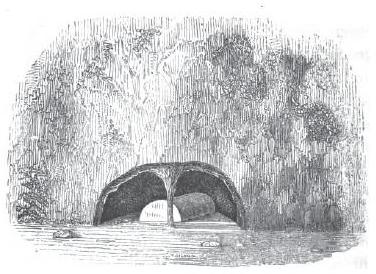
The British man-of-war brig Zebra, which now lay at anchor in Papeete harbour, was the only ship-of-war we met with during the voyage. Her trim and well-disciplined appearance recalled many agreeable thoughts |
of our native land, and from her commander and officers we received many polite and valuable attentions. The presence of a man-of-war in their port, seemed to produce any thing but a joyous effect on the natives; since they derive but little amusement or profit from a ship of this character, and the rigour of her discipline is not at all adapted to their taste. There was at this time, however, an unusual degree of bustle and activity amongst the natives on the coast, the greater number being employed in gathering bark for the manufacture of native cloth; while, in a large shed at Papeete, more than fifty young females, their heads bedecked with flowers, assembled daily to make the welkin ring with the sound of their cloth mallets. They all told me that they were working for the queen; and I imagined they were preparing some customary tribute, until I was informed by the European residents, that such display invariably attends the presence of a foreign ship-of-war in the port, and is intended to impress the naval officers with a favourable opinion of native industry. Previous to taking leave of this island, which must be deemed the head-quarters of British |
missionaries in Polynesia, I may with propriety hazard a few remarks upon the apparent extent and effects of missionary exertions; although, from the conflicting opinions existing on this topic, the task becomes one of extreme delicacy. I have been led by personal observation to believe, that while the missionaries at these islands have been libelled by one party, they have been too highly lauded by another; and that the strictures of Kotzebue are not more unworthy of implicit belief than the flowery and exaggerated tone of description adopted by the missionary party. From the statement of the one, we should judge that missionaries were tyrannical, ignorant, bigotted, avaricious, and almost the cause of every vice perceptible in the native character, and that the natives themselves are in a more degraded state than at the period of their most barbarous idolatry. From the other, we are to believe, that the missionaries are universally beloved; that the natives are saints, martyrs, and primitive apostles; that their churches are cathedrals, and their grouped huts cities. But with whichsoever of these party impressions the voyager visits the debatable land, he will find himself disappointed; and by observing calmly and unprejudiced, will doubt- |
less determine, that the truth rests in the medium. It cannot be denied, that from the landing of the first party of British missionaries, in 1797, to the present time, a constant tendency to a fixed point of improvement has been evident in the more favoured Polynesian nations. – I say a fixed point, because I believe, that after idolatry has been supplanted by the Christian religion, and the elements of education introduced, the work will remain stationary for a time; and that a nobler superstructure can only be raised by the maturing influence of many years' intercourse with civilized nations. The first steps have been successfully attained by the missionaries, at both the Society and Sandwich groups, after many years of anxious toil and dangerous re-action; and their chief duty at present consists in retaining the ground they have gained, and in giving such intellectual improvement to the rising generation of natives as circumstances may permit. And it will be noticed, in the accounts I have given of distinct islands, how soon the absence, or loss of influence, on the part of their missionary instructors, causes the capricious natives to revert to their former excesses, and indifference to |
moral laws. A missionary, resident amongst these newly-converted people, has almost a regal influence; for however passive he may be, his presence alone has the effect of stimulating the chiefs and church party to enforce the observance of religious law amongst the people; whilst the latter, from a feeling of decorum, and a love of approbation, (peculiar to their character,) act with much show of propriety; since no native, however depraved in principle, will act in open violation of morality under the eye of his missionary, whom he always regards with a kind of innate respect, although professing, to his party, that he holds both the man and his precepts in contempt. It may be asked, how far has commercial intercourse alone, with civilized nations, tended to the improvement of these islanders? I would answer, that the effect of commercial intercourse can extend but little farther than to make the natives acquainted with civilized habits, (and bad habits they too frequently are,) and by the introduction of foreign manufactures, to increase their comforts, and afford them the means of imitation. But it would be absurd to assume, that the transient visits of shipping, or even the residence amongst them of foreign merchants, |
with minds engrossed by mercantile speculations, and destitute of all responsibility, would go far to correct or educate these people. The press, also, (that mighty engine for the development of the human intellect,) as well as the reduction of the Polynesian languages to a standard rule, would have long remained absent from these nations, had their introduction depended solely upon commercial relations with their protecting countries. Since some few errors and abuses are inseparable from human nature, we may admit that the missionaries perform their duties with great moderation and purity. The principal faults laid to their charge, are too great an interference in the political and domestic affairs of the natives, and too keen a participation in commercial transactions. Nor are these charges altogether groundless; although more frequently applicable to individuals than to the collective body. The missionaries shield themselves from the blame of political interference, by attributing all legal enactments, at their stations, to the will of the principal natives; but the influence they exercise over the minds of the chiefs, and the frequency with which the latter consult them upon all important affairs, are too well known, |
to permit the administration of the one party to be unassociated with the wish of the other. Commercial dealings, although irrelevant, may not, perhaps, be deemed strictly opposed to their spiritual profession, unless permitted to interfere with the due performance of their pastoral duties; and, when conducted in a liberal and upright manner, may afford useful instruction to the natives; but it is not considered just, that, as salaried officers for the performance of a distinct duty, they should present themselves as competitors with the increasing number of merchants, resident on the islands, and dependent for their support solely upon their commercial success; and hence embroilments ensue, which should with propriety be avoided. If shipping experience any inconvenience from missionary supremacy in these islands, it is in some measure repaid to them, by the comparative security with which they may approach the shores of a land where they see the dwelling of the missionary erected as a beacon of peace; and this the more especially, as the missionary is usually the first to quit the spot, when the natives are insensible to control, or involved in the turmoil of war. On the whole, we have much reason to be satisfied with the conduct of |
our Polynesian missionaries, and to admit that they have done all in their power to improve the natives, and to implant in their minds respect and esteem for the British character. Leaving Tahiti on the 2nd of May, on our return to England by the way of the Cape of Good Hope, we steered to the N.W., until near the equator, in long. 166° W.; and then shaped a westerly course between the parallels of 2° and 3° S. lat,, with winds chiefly from N.E., and a current setting to the westward at the rate of one mile an hour. Crossing the meridian of 180°, on the 22nd of May, we commenced reckoning east longitude, and noted the following day as the 24th of the month, (thus reducing our current week to six days,) in order to reconcile our time with the apparent loss we should sustain of twenty-four hours, upon our return to the meridian of Greenwich by this, the western circuit of the globe. May 26, 1836. – In lat. 2° 30' S., long. 175° 10' E., discovered a low and extensive island, covered with trees, and surrounded by a sandy beach, with moderate surf; some smoke seen rising from the land, led us to believe that it was inhabited. Allowing for a difference of one degree in longitude, this would appear to be |
Rotch Island, discovered by Capt. Clerk, of the John Palmer, in 1826, and laid down by Krusenstern, in lat. 2° 30' S., long. 176° 10' E. A current, setting strongly to the N.W., caused us to pass its shores with a rapidity, by no means consistent with the light airs, approaching to a calm, which prevailed at the time. In lat. 2° 53'S., long. 174°'55' E., a remarkable white line was observed on the surface of the ocean, about two miles a-head of the ship, and bearing the appearance of a low surf, breaking on a sand-bank, or reef. The ship's course was altered, until a boat, lowered to ascertain the true character of the water, displayed a signal that no danger was to be apprehended, when we resumed our course, and soon after passed through the object of alarm. It proved to be an undulated line of froth, or scum, several yards in width, extending on either side as far as was visible with the naked eye, and accompanied by a heterogeneous assemblage of floating mollusks, small fish, crabs, and other marine animals, drift-wood, and oceanic birds. The birds formed the most mysterious feature of the phenomenon: they were chiefly of the noddy and petrel families; and whilst some of them appeared but recently dead, others lay in a torpid and helpless state on the surface |
of the sea. A black petrel, (Procellaria fuliginosa,) in this latter condition, was taken by our boat's crew and brought to the ship. It was sufficiently lively when on board; and the state in which it was found could scarcely be attributed to repletion, for, on dissection, I found its stomach perfectly empty. Janthinae, or sea-snails, were the most abundant of the floating mollusks. Their number was immense; and their floats contributed greatly to the white appearance of the froth-line. One species of this family, which I obtained here, was new to me; and is certainly very rare: its shell was yellow; rather smaller and more elongated than J. communis; and the whirl more prominent and spiral. The contained animal was also of a yellow colour; but in the form of its float, and other respects, it closely resembled the ordinary blue-shelled species. This line of miscellanies on the ocean, denoted the termination of a current,* which, in its * Immediately after passing this spot, we lost the strong N.W. current that had hitherto accompanied us; and it is worthy of remark, as associated with the limits of currents, (which are often capricious,) that some of our older navigators have recorded the existence of a current-ripple, and others that of a froth, in nearly this precise place. |
progress, had swept the surrounding waters of their passive, or feeble denizens, and had borne them thus far in a dense and confused mass. Rising and falling with the swell, and its white hue conspicuous above the blue surface of a calm sea, it had much the appearance of surf, and if it had been seen only in the distance by a passing ship, might have added a "suspected shoal" to our charts. On the same day we noticed many kinds of cetaceans, including a school of Sperm Whales, which our boats pursued with success. As we sailed to the westward, also, in the parallel of 3° S. lat., Cachalots were frequently observed; and the produce of several was added to our cargo. They were for the most part shy and mischievous, and were seldom destroyed without some injury to the boats. From a school, attacked by our boats in long. 158° E., four whales were obtained; three of these were adult females, whilst the fourth, a male calf, the offspring of one of the former, did not exceed sixteen feet in length, and produced but three barrels of oil. June 13. – Tench's Island bore S.W., distant seven miles. This is a low and small island, (not exceeding three miles in circumference,) margined by a sandy beach, well wooded, and indeed |
chiefly conspicuous from its tall trees, rising as it were from the surface of the sea. It is situated in lat. 1 ° 39' S., long. 151° 31' E., and was discovered in 1790, by Lieut. Ball, who states that it is inhabited by a stout and healthy race of people. On the evening of the same day, (Tench's Island being still visible,) Kerue's Island, and Mathias, or Prince William Henry's, Island, were seen in the N.W. The latter, which is the westernmost of the two islands, is large, elevated, and covered with verdure; its western extremity terminating as a long, low, and well-wooded point. The three islands last mentioned, appear to have been laid down with extreme accuracy by Lieut. Ball. On the 16th, we saw the Anchorite Islands, bearing S.W., distant fifteen miles; and found in their vicinity a current, setting to the S.W. During a calm, in lat. 0° 56' S., long. 140° E., several logs of drift-wood were seen floating within a short distance of the ship. We went in a boat to the largest, and found it an entire tree, more than sixty feet in length, covered with weeds, barnacles, Unicae, and crabs, and much perforated by the ship-borer (Teredo navalis.) In the water around was assembled a vast number of fish, chiefly yellow-tails, (Elaga- |
tis,) rudder-fish, (Caranx antilliarum,) filefish, (Balistes,) some albacore, brown sharks, and many other kinds, of grotesque forms and gaudy hues, for which even the sailors had no names; the whole presenting a marine spectacle of a highly novel and animated character. The timber was towed to the ship, and a part of it taken on board for fire-wood, and upon making sail, a large proportion of the fish accompanied the ship, and continued to do so for several weeks. After crossing the equator in long. 137° E.,* we renewed a course to the westward, within the parallel of 1° N. lat., and nearly in Bougainville's track of 1768. On the 27th of June, the elevated land of New Guinea was in sight; and on the following day we entered a strait, twenty-four miles in breadth, bounded on the one side by the mountainous island of Wageeoo, and on the opposite, by the Yoel group – a cluster of small islands, the greater number but little raised above the level of the sea, and richly vegetated. One of * On the evening of the day we crossed the line, a frigate-bird alighted on the spanker-gaff, and permitted itself to be captured by hand – an occurrence so unusual at sea, as to be almost unprecedented. |
them, remarkable for its more limited circumference but greater elevation, is shaped like a gunner's quoin, and rises as an amphitheatre, luxuriantly wooded to the water's edge. The surface of the sea in this strait, was covered with vast quantities of pumice-stone, floating in small pieces, rounded by attrition. Some of them were black, others of an olive-gray colour; and it is remarkable, that the specific gravity of many of them was so nicely balanced, that although they floated in the sea, they sank when placed in fresh water. Their origin is due to the volcanic islands of this Archipelago: the volcanic mountain of Ternate is often in action; and as late as the year 1836, South-Seamen cruising in the straits of Timor, were compelled to keep their decks wet, on account of the showers of hot ashes thrown upon them during a volcanic eruption on the Island of Flores.* Such collections of pumice-stone on the surface of these seas are not uncommon; and are occasionally so great, that ships have had their copper brightly polished by passing through them. * To the same cause may be attributed, the origin of those large porous stones occasionally found floating on the sea, to the great surprise of navigators. |
While we were yet engaged in this strait, my tow-net captured a water-snake. (Hydrophis bicolor.)* It was two feet in length; the upper surface of the body uniformly black; the inferior of a bright-yellow colour; the tail vandyked with black and white. It had the ordinary form of a land snake, with the exception that the belly was keel-shaped, and the tail compressed, (to facilitate swimming,) and blunt at the extremity. The teeth were similar to those of innocuous land snakes.† It did not appear much inconvenienced by being removed from its natural element, and when taken on board the ship, resembled the terrestrial snakes in its modes of rearing the head, gazing fixedly, and rapidly protruding and retracting a cloven tongue. It did not appear, however, to possess any power of progressing on land; since, when placed on the deck of the ship, it made the lateral motions usual with land snakes, but could not advance. It uttered no sound, nor did it make any attempt to bite. On dissection after death, I found several small fish in its stomach. * Delineated in Russell's India Serpents, Vol. II., Plate XLII. † It should be remembered, that some sea-snakes have tubular or poisonous teeth mingled with the true teeth. |
Upon entering the Gilolo passage,* the view commanded from the deck of the ship included, in addition to some of those we had passed, the islands Een, Rab, Wihang, Sihang, Hi, and Gaby. Indeed, the sea we were now sailing upon presented a perfect garden of islands; some of them lofty and mountainous; others, as Sihang, low, and resembling the coral formations of the Pacific; whilst all were clothed with a dense and brilliant verdure, and afforded a picturesque scene, heightened in beauty by the serenity of the sky, and by the wide expanse of blue ocean that surrounds their shores, and bathes the feet of their wooded amphitheatres. An anchor was now got over the bows, as a precaution against the calms and currents, so much to be dreaded amongst these islands, and which here began to beset us with greater frequency – the currents often approaching as a long line of rolling surf, breaking against the ship with a loud, confused, rippling sound, and bearing large quantities of vegetable refuse of the land, shoals of fish, marine mollusks, and a great number of the elegant shells (formerly named Croziers) contained in the body * A strait, between the islands of Gilolo and Wageeoo. |
of that curious nondescript animal, the Spirula Australis.* When in the longitude of about 130° E., we recrossed the equator during a severe gale, and steered south and west courses, in sight of the islands Otah, Gagie, Pulo† Moar, and Joyie; the sea occasionally assuming a green hue, with turbulent currents setting to both the east and west. In the morning of the 3d of July we passed close to an extensive chain of small and beautiful islands, formed by the Weeda group, Pulo Roa, Lapar-dammar, Little-dammar, Lookisong, three others, whose names were unknown, or not noted on our charts, and Pulo Pisang. The last-named island is small though lofty, and in the aspect we viewed it, appeared wholly composed of two high mammillary-shaped mountains. In the afternoon of the same day we passed close to Maccluer's rock, or "dangerstone," (a naked vigia, resembling the hull of a ship,) and entered Gasses-straits, a channel * The nearest approach we made to the possession of this rare animal, was by taking, in a towing-net, the inferior portion of the body, with. the camerated shell in situ, and protruding through the soft parts in the normal manner. This fragment was of a bright orange-colour. † Pulo, in the Malay language, signifies an island. |
eighteen miles in breadth, bounded on either side by the islands Fulo Pisang, Lawn, the Button, Kekik, and Pulo Gasses. When in Pitt's Passage, with the islands Gomona and Oby-major in sight, a large body of Sperm Whales was seen moving quickly. Our boats pursued them, and, when close in with the shores of Oby-major, succeeded in killing a male Cachalot, of the largest size. The first boat that fastened had its entire line taken out; the second was more successful; and by the united efforts of all the boats, the whale was at length despatched and brought to the ship. When in his "flurry," the creature descended, and died beneath the surface of the sea, so that it required the combined exertions of all the boats' crews to raise the carcase from the depth of forty fathoms; but when this was effected, it floated buoyantly. Some extraordinary effects of refraction had been often visible to us since we entered this Archipelago, but were never so strongly marked as on the present occasion: the boats, floating on a calm sea, at a distance from the ship, were magnified to a great size; the crew, standing up in them, appeared as masts or trees, and their arms, in motion, as the wings of windmills; while the surrounding islands (especially at their low and tapered extremities,) seemed |
to be suspended in the air, some feet above the ocean's level.* A continued course to the southward of west brought us in sight of the islands Oby Latta and Ceram, and close to the low but picturesque island of Gomona. At night, the breeze from off the land wafted to us a sweet odour, like that of flowers; and the surrounding waters contained such vast numbers of that curious fish, the Leptocephalus, or "small-head,"† that my tow-net was constantly filled with them. On the following day, when in sight of the islands Booro, Xully Bissy, and Lassamatula, a bark was seen standing towards us, with English colours flying. Extraordinary as it may appear, although the strange sail was steering due west, and the Tuscan due east, both ships approached with the wind "dead aft" and studding sails set, until within two miles of each other, when they were alike baffled by calms and light airs. The stranger proved to be the Bombay bark Soubrou, Captain Smith, bound to Lombock and Bally, for a cargo of rice for the China market. * On a previous occasion, and owing to the same cause, we had seen the setting sun assume the form of the hull of a ship, and change, in a few moments, to a perfectly square shape. † See Illustrations of Natural History, – Fish. |
Entering the Banda sea by Pitt's Passage, on the 16th July, we got sight of the Wetter, Ombay, Dog, and Cambing (Goat) islands; and on the following morning were engaged in the straits of Timor, or Ombay Passage.* Current ripples were here as numerous and forcible as we had experienced them in any part of the Archipelago. On one occasion, the ship was turned completely round by the sudden eddy of waves they produced. The island of Timor, as seen from this channel, has not a very inviting aspect. Its general features are mountainous, wild, and arid; the lofty hills, rising from the coast, are thinly strewn with trees, and covered with a coarse and seared pasturage; whilst occasionally, herds of buffalo may be seen grazing on their acclivities. On many parts of the coast, extensive valleys, occupied by native villages, open upon the sea; and here, thickets of spontaneous vegetation, and groves of palm-trees, surrounding the dwellings, present a much more verdant and pleasing appearance. * A broad channel, lying in a direction nearly N.E. and S.W., and bounded on either side by the weathered and lofty coasts of the islands Ombay and Timor. Its waters are deep and its shores so abrupt that soundings can be obtained in but few spots, however close to the land. |
CHAPTER IV.
At noon, on the 18th of July, we entered Soutranha Bay, on the western side of Timor, and cast anchor off a Malay settlement, where the Dutch flag was hoisted in front of the principal residence. Soon after our arrival we received a visit from Don Simon De Cruz, the son of the rajah of this district, and his friend Mr. Brown, (a half-caste, between Dutch and Malay,) who had arrived here from Coupang, to collect sandal-wood. The latter was an intelligent young man, and, as he spoke the English and Malay languages fluently, |
proved a valuable associate to us in our intercourse with this people. On landing for the purpose of paying our respects to the rajah, Don Domingos Santa Cruz, we were conducted to the residence of that personage, a large wooden edifice, erected close to the beach, enclosed by lofty palisades, and embowered in a plantation of cocoa-nut trees. After waiting in a kind of guard-room for a time which, although tedious to us, was considered by the native party as consistent with etiquette, we ascended by a ladder to an elevated apartment, where we found the rajah seated on a mat, surrounded by pillows and cushions. He was indisposed, but rose to receive us, and invited us to be seated on some chairs, that formed a part of the furniture of the room. He is an elderly man, of short stature, and by no means well-formed. His features, broad, harsh, and truly Malay, were not improved by a pair of bright ferocious eyes, and a mouth broad to deformity, and stained with the sanguineous hue of the betel-nut. His countenance expressed an austere dignity, which, combined with a manner peculiarly his own, was repulsive of any approach to familiarity. He spoke with a shrill, querulous voice, but slowly, with much emphasis, and with very impressive |
gesticulation; his remarks were shrewd, and gave us a favourable opinion of his intellectual powers. We acquitted his toilet of having occasioned any delay in our reception; for his only vesture was a scanty cloth, covering the hips, and a cotton handkerchief, folded as a turban on the head. In one corner of the apartment, a tall and delicately-formed female was engaged in bruising betel-nut in a small silver mortar, and in preparing relays of this luxury for the rajah, whom she occasionally approached, to present her offering, with a timid supplicating look, and a crouching attitude, highly expressive of slavish awe. After a short conversation on general topics, during which arrack and cocoa-nut milk were offered for our refreshment, we took our leave of the rajah, and were conducted by Don Simon to his own residence, a very modest dwelling, surrounded by a garden, neatly planted with European and other exotic vegetables. Tea, turtle-eggs, honey, and fruits, were here spread for our evening meal; and a ramble through the village concluded the day. On the 21st, the rajah and his grandson dined on board the Tuscan, by invitation. They came attended by a large suite of slaves and followers, bearing umbrellas, betel-nut, the apparatus for |
preparing the latter, and many minor comforts, which denoted that the Rajah was no practised traveller. The old gentleman had added little to his ordinary costume, beyond a larger and more gaudy cloth, a silk waistcoat, made in the ancient Dutch fashion, and a profusion of cotton handkerchiefs distributed about his person. His grand-child, an interesting little boy about five years old, was more completely clothed, in a dress partly Asiatic and partly European, and was sufficiently bedizened with tinsel to do credit to a stage at Bartholomew Fair. Don Simon was also of the party, but proved un de trop: etiquette forbade him to be seated in the presence of his father, or to partake of food in the same apartment, unless expressly invited to do so by the rajah – a condescension which, unfortunately, was not extended to him on this occasion. Timor, one of the Sunda Isles, is about 240 miles in length, (from N.E. to S.W.,) and sixty miles broad. Lying within the limits of the monsoons, it is subject to the seasonable vicissitudes of climate they produce; the S.E. monsoon, of the winter months, bringing fair and dry weather; while the N.W. is the harbinger of rain, tempests, and an unwholesome atmosphere. Local peculiarities, rather than the climate, (which is also common to many salubrious lands,) render |
this island injurious, and often destructive, to European constitutions. The native population consists of Malays, occupying the lowlands or coast, (and who must be regarded as ancient colonists,) and Harraforas, or tribes inhabiting the interior and mountainous parts of the island, a people distinct from the Malays in person, language, and customs, and who are, in fact, the aborigines of the soil. The native government is feudal: many chiefs, of various grades of rank and power, holding territories independent of each other, with the liabilities to frequent aggressions and wars dependent on such a system. They are all, however, subservient to either the Dutch or Portuguese, who have divided the dominion of the country between them; the greater share being retained by the Dutch. The principal European settlement is Coupang, (on the S.W. extremity of the island,) possessed and fortified by the Dutch. On the western coast there are several bays, off Malay villages, as Baraca, Delhi, Antecoupar, Coushay, and Soutranha, which offer anchorage, and abundant supplies for shipping. The most valuable exports Timor is capable of affording, are sandalwood, bees-wax, horses, and cotton. Its commercial intercourse is chiefly with China, Java, |
Macassar, and other islands of the Indian Archipelago, and occasionally with vessels from the Isle of France, calling here for horses. The bay of Soutranha is capacious, but affords anchorage only on one bank, or shoal, of limited extent. From its waters, a view is commanded of the island of Pantar, on the opposite side of the strait; as well as of a small, elevated, and picturesque islet, named Pulo Batta, or "Batta rock," distant about nine miles to the S.W. The Malay village on its shores occupies a level plain, some miles in extent, covered with jungle from the sea to the foot of the enclosing hills, and abounding, near the coast, in swamps, overgrown with lofty mangroves, and retaining, not only the waters of the land, but much also of those from the sea, forming brackish marshes, which are of all others the most pernicious to the health of man. Many chasms, or gulches, torn through the soil, strewn with rolled boulders, and resembling broad and deep roads, intersect the coast, marking the progress of torrents during the rainy season; but rivers, or any permanent streams of pure water, are rare. The dwellings of the natives are scattered over the plain in detached groups, surrounded by cultivated enclosures, or embowered in groves of the Palmyra, cocoa-nut, and Areka palms. They |
vary much in material, size, and form. The residence of the rajah (which is the largest building in the settlement, and the most characteristic of native architecture,) is constructed with wood, and thatched with the leaves of the Screw-pine. Its only two habitable apartments are raised by posts to the height of eight feet above the ground, and are surrounded by a covered balcony, to which we ascend by a broad ladder. The outer or largest apartment is open on three sides, to admit the breeze, or may be closed, at will, by blinds composed of light mats; its floor is formed of split bamboos, arranged as an open or trellis-work, exceedingly cool and neat in appearance, as well as strong and durable, but which gives, to the unaccustomed tread of the stranger, a sensation of elasticity and frailty, by no means agreeable or easily overcome. The ground-floor is enclosed with boards, and used only as a store-room. The inferior huts are mostly erected in the same elevated manner as the royal-lodge, though but few have their apartments raised to a greater height than four feet above the ground. Some of them are so densely covered with leaves as to be impervious to light or air, except at the entrance; whilst others are simply wattled with bamboo. They have each but two apartments, which, as they con- |
tain but few auxiliaries to domestic comfort, present a naked and gloomy appearance. The population is a very unprepossessing Malay race, with a dingy soot-black complexion. The men are short in stature, small-boned, and meagre; their countenances, naturally haggard and ferocious, being rendered yet more unsightly by long and tangled locks of coarse black hair, and mouths stained red with the betel-nut. We found them reserved and apathetic, and, although avaricious, honest and punctual in their dealings. The women are but little superior to the men in personal attractions, and, preserving the usual inferiority in size which characterises the female sex, are almost infantine in stature, and remarkably slender-limbed. They are laborious, very subservient to the men, decorous and retiring in their behaviour to strangers, and maintain a proper moral distinction between the virtuous and profligate of their sex. The ordinary male dress seldom exceeds a piece of cloth worn round the loins, and a handkerchief covering the head. On ceremonial occasions, however, the higher ranks assume an attire composed of a kind of petticoat, (sarong,) fastened by a girdle or sash; a tight vest (budju); and a scarf (lipa); the whole constructed of a strong, neatly-woven cloth, varie- |
gated with black, red, blue, and white. The rajah and his sons wear their hair short; the lowest class of men permit it to flow wildly over their shoulders; but the most national, or characteristic mode, and that adopted by the more punctilious natives, (and especially by the military attendants on the rajah,) is to have the hair of great length, and secured at the crown of the head, where it towers, as an immense bush, to a considerable height. The ornamental combs, occasionally worn in this toupet, are made with the ribs of the cocoa-nut leaf, and bear a striking resemblance to those in common use amongst the natives of the Tonga Isles. Silver, or ivory rings, (the bangles of Asiatics,) encircling the arms, as well as necklaces and bracelets, composed of coloured beads, or of small, fragrant, black-and-yellow seeds, indigenous to the island, are the favourite ornaments of both sexes; parrots' feathers, tied to a slip of bamboo, are occasionally worn in the ears, and bangles of long white hair around the ancles. A long European knife, contained in a sheath, is the more common substitute for the kris, or native dagger. Tatooing the person is but little practised, and seldom extends beyond a few small devices on the arms. The most remarkable mode of decorating the |
person we observed here, was that of covering the front teeth with plates of silver; when the gleam of the polished metal, displayed within the parted lips, added to the natural ferocity of the Malayan features, produced an extraordinary and almost diabolical effect. We noticed that but few of the natives, and those only men, assumed this decoration; and I was informed, that it is an order of military merit, conferred by the rajah upon those of his warriors who had distinguished themselves in the field. The diet of this race is exceedingly frugal. Maize and rice, together with some coarser vegetables, constitute their ordinary sustenance; and spring-water, or toddy, obtained from the Palmyra and cocoa-nut palms, are almost their only drink. Although they have easy access to arrack, the vice of intoxication is scarcely known to exist amongst them. Notwithstanding, however, the extreme simplicity of their own meals, we found them accomplished cooks, when catering for Europeans. On several occasions, when we were entertained at the residence of Don Simou [sic], the ceremonies of European etiquette which were preserved, the complete, and even refined style in which the table was laid, the excellence and profusion of the dishes and liquors, together with the se- |
dulous attendance of numerous servants, were sources of considerable surprise to us, when contrasted with the half-naked, unsophisticated appearance of our host, and the shed-like aspect of the dwelling in which these entertainments were spread. The practice of chewing the betel, so prevalent throughout the continent of India, is here adopted by both sexes, and by every individual above the age of puberty. The ingredients of this favourite masticatory are the leaves and fruit of the betel-pepper, the nut of the Areka-palm, (commonly called betel-nut,) and chunam, or quick-lime, produced by burning sea-shells and coral. The whole are placed in the mouth and chewed together for some minutes. The betel-leaf has a pungent aromatic taste, and excites a very copious flow of saliva. It ranks with the narcotic inebrients, and is, in fact, nearly allied both in family and effects to the Kava-pepper of Polynesia. The fruit is preferred to the leaves, and is mostly reserved for the use of the highest rank of natives. The areka-nut is astringent and slightly bitter, and stains the saliva of a brown colour, which is changed to bright-red by the alkaline quality of the lime. The betel-leaf and nuts, (the latter cut into thin slices,) are carried by the natives |
in cases, neatly manufactured from the split leaves of the fan-palm, and stained with many bright colours; while the chunam is contained in small gourds, or bamboo boxes, elaborately carved. Nutmegs are highly esteemed as an addition to the betel masticatory, but are rare and expensive, even on this, their chosen soil, where the jealous policy of the Dutch will neither permit them to grow wild nor to be cultivated. Both sexes almost invariably carry a quid of tobacco-leaf beneath the upper lip, where it is retained by a groove, filed through the surface of the front teeth. They also smoke the same weed in the form of cigars, (rocos,) prepared by enclosing the cut leaf in the delicate husk of the Indian-corn, or in the leaf of the fan-palm; both agreeably scented. Opium, in the form of an extract, is also smoked for its sedative and intoxicating effects, but is a luxury in which but few indulge, as it is not only expensive but prohibited by the laws. Don Domingos Santa Cruz, the present rajah of Soutranha, holds his territory under the Dutch, as he formerly did under the Portuguese flag. He possesses a perfect knowledge of the elements of European education, and speaks the Portuguese, as well as the aboriginal and Malayan languages. He has also acquired repu- |
tation as a warrior, and bears on his person the scars of many wounds. He governs his people with absolute sway, and requires the most prompt and abject obedience: none of his subjects, including his own children, presume to sit, eat, or chew the betel in his presence; nor do any approach to address him without first bowing low and kissing his hand. Similar marks of respect are paid by the inferior people to the rajah's sons, and by the latter to each other, in proportion to their seniority; so that a foreigner finds it difficult to reconcile this formal and aristocratic state of society, with the equality in dress and habits which appears to prevail throughout all classes of the community. The impetuous despotism of the old rajah, the "sic volo, sic jubeo, stet pro ratione voluntas" of his rule, has the effect of keeping his people in a state of strict discipline, the slightest deviation from which, exposes the offending party to the punishments of heavy pecuniary fines – flogging, (from which even the ladies are not exempt,) and protracted durance in the stocks.* * The place where criminals are confined and punished is an enclosed court, adjoining the rajah's residence. Here we noticed several natives, of either sex, seated on mats in the open air, some of them with their legs in the stocks, and their heads shaved, and all encumbered with |
The entire adult male population are soldiers, by necessity; but the "standing army" consists of only a few picked men, employed as attendants on the rajah, or as guards to his residence. They are distinguished from the civilians by possessing a musket, and wearing, in front of their girdle, a cartouche-box, highly carved, decorated with silver, and containing musket-balls and rows of bamboo cartridges. Although Soutranha was in a state of profound peace at the time of our visit, wars with neighbouring independent states, and more especially with the inhabitants of the hills, are not unfrequent; but the result of these conflicts has been usually in favour of the Soutranha people, owing, probably, to the superiority in the munitions of war their coast position affords a heavy log of wood, from five to eight feet long, its one extremity resting on the ground, while the opposite received the neck of the criminal through a groove in its centre, and rested on his shoulders. A system of "prison discipline" which renders every movement of the prisoner difficult, and escape impossible. One roguish looking fellow thus situated, and who spoke a little English, (which, by the way, went far to prove that he deserved his post,) told us that he had been "at anchor" for ten days, and expected to remain so ten days longer. We had no reason to doubt the correctness of his reckoning, as he evidently kept a very steady log. |
them. A young shrub of Jatropha curcas, planted within the precincts of the royal-lodge, marks the spot where the rajah had buried the head of a rival chief, who, while invading Soutranha with his tribe, had been defeated and slain. A second hostile rajah, subdued by Don Domingos, was for some time kept as a state-prisoner on Batta rock, in humble imitation of a similar line of policy adopted by the potentates of Europe. A low stone wall, pierced for cannon, protects the rear of the village, but its guns were now removed to the sea-side, as a precaution against some threatened piratical descents by the natives of the islands Pantar and Ombay, who had already plundered much of the adjacent coast, and even carried away a proa from Soutranha Bay. The professed religion of this people is the Roman Catholic, which they have received from Portuguese missionaries, formerly resident amongst them. A large hut, at the north extremity of the settlement, was originally intended for a chapel; but the people at large are without education, have no priest, preserve neither the Sabbath nor any of the sacraments of the church, and, with the exception of the cross that usually decorates their person, have nothing to indicate their religion. They |
appear, however, to have retrograded from a very fair state of missionary training, are anxious for education and a pastoral adviser, and, were an opportunity offered them, would doubtless do credit to their teachers. The Malayan language, as spoken here, is certainly so exceedingly harmonious, that to call it "the Italian of the East" would be a compliment to the European tongue. It is less in single words than in sentences, that the liquid melody of the language is heard; and when recited by a good, and especially by a female voice, it is perfect music to the ear. I could glean from its vocabulary but few words that bore any resemblance to those in use amongst the Polynesian islands we had visited. In euphony there was a general similitude; as also in the reduplication of words; and some few words were actually the same; but on the whole, the alliance between the languages did not appear to be very close. The Harraforas, or mountaineers, speak a language distinct from the Malayan; and it would appear, that the aboriginal tribes of the Indian Archipelago possess languages not only differing from the Malayan, but also essentially distinct from each other. We found amongst the inhabitants of Soutranha, a slave, obtained by |
purchase from a neighbouring island, whose language was unintelligible to all the residents on Timor. His history was unknown; but he was evidently a native of one of the islands of this Archipelago. A large proportion of the commerce of this port is derived from the visits of English South-Seamen, which call here during the "Timor-season" to procure refreshments. No pilotage or harbour-dues are demanded, permission to take wood and water is freely bestowed, and every essential supply may be readily obtained. Provisions are dear, if purchased with specie, but as the natives prefer barter, and chiefly require European manufactures, such as muskets, ammunition, and cutlery, in exchange for their commodities, the balance of trade is much in favour of shipping. The current coins are principally dollars, and the rupees of India. The price of a buffalo (without regard to size) is five dollars, or two may be purchased for a musket; sheep are sold at one dollar a-head; a hog at two dollars, and fowls at one dollar the couple. Vegetables are sold by weight, (by the picul, or 136 lbs.,) as in China. Teeth of the Sperm Whale, when solid and of large size, are eagerly purchased by the natives, both for home consumption, (in the manufacture of ivory |
ornaments, sheaths for krises, &c.,) and for exportation to other of the Malay islands, and China. The teeth of the largest male Cachalots bear an average value of two dollars each, those of adult females, three dollars the dozen. The surplus European commodities, received by the natives on the coast, are rapidly absorbed by the inland tribes, or by exportation to other islands, not frequented by shipping. In return for such exportations, the Soutranha people receive slaves, and some kinds of cotton cloth, superior in texture and pattern to any they can themselves construct. Their domestic manufactures are chiefly cotton-cloth, mats, and fancy works, executed with the split leaves of the fan-palm, and prettily stained. Weaving cloth (the occupation only of the women) is performed with the most primitive simplicity. The loom is a mere wooden frame, fastened at one extremity to the ground, and at the opposite to the person of the operative; the woof being passed across the warp by hand, and beaten close with a thin lath, or "sword," like the method employed in ships, to make what is termed a "sword-mat." It is a tedious labour; for a scarf, or lipa, cannot be completed with less than a week's diligent work. The cloth, consequently, bears a proportionate |
value. Its texture is strong and neat; its colours are fast, and usually red, blue, white, and yellow, blended with tasteful effect.* The finer kinds possess qualities which recommend them strongly to Europeans. I am informed, that English weavers have endeavoured in vain to imitate them – nor is this improbable – the patient toil and care which the Malay woman devotes to her web can be but badly represented by the rapid evolutions of machinery, or by the manual labour of the busy workman of highly civilized lands, whose time is so precious, that he too often depends for his daily bread, less upon the excellence than upon the quick dispatch of his work. There were no foreign residents at this place, except a few Chinamen, employed in collecting sandal-wood, bees-wax, or any commodities which would turn to profitable account in their commerce with China and Java. It is true, that there are but few countries which have not Chinese amongst their residents. From the thrifty, and (notwithstanding the opposition of their national laws) the migratory disposition of * The red yarn is stained with the bark of the mangrove-tree (Rhizophora mangle); the blue, with the berries of a species of Phyllanthus; the yellow, with the root of the Morinda umbellata. |
these people, they have been designated "the Scotsmen of the East," and between the tropics, at least, they verify the voyager's axiom, that "a Chinaman, an English musket, and a Spanish dollar, are to be found in every land." The entire navy of Soutranha was comprised in two or three small proas, drawn up on the beach, and one similar vessel on the stocks. The canoes, in common use, differ much in form. Some are sharp at either end, without outriggers, and in shape and construction intermediate to a boat and canoe; others have an outrigger, and resemble the Polynesian canoe. A third variety which we noticed, with an outrigger on either side, had a complicated and very awkward appearance. Notwithstanding the insalubrious character of this soil, its population, although an attenuated, appeared a very healthy race, not a single instance of serious disease being evident amongst them.* Our crew also enjoyed perfect health, as regards any influence of the land. The unhealthy season of the "wet monsoon" would no doubt produce a very different scene, but during our stay, the S.E. winds of the winter months prevailed, the land was comparatively dry, the * Small-pox is endemic on this island, and many of the natives are much disfigured by its eruption. |
weather delightfully serene, no rain fell, and the barometer seldom varied from 30.0, or the thermometer from 82° in the shade. It is evident, (and commanders of ships are well aware of the fact,) that a large proportion of the fatal maladies which attack the crews of shipping, employed on the unhealthy coasts of India or the Oriental isles, find an active auxiliary in the potent, and almost poisonous spirit of those countries – a kind of whiskey, distilled from rice, and sold at a cheap price under the name of arrack. This liquor our sailors obtain with facility, use with imprudence, and often, when under its influence, expose themselves to the unwholesome breeze and heavy dews of the night, in direct violation of physical laws, whose penalty is suffering and death. The rajah of Soutranha, with a policy worthy of imitation, forbids his people to supply this ardent spirit to the crew of a vessel at anchor in his port, if such prohibition is desired by the commander. The natural history of Soutranha is interesting in some points, and especially so when compared with the natural productions of the Asiatic continent and Polynesia. The horses, so numerous on this, as well as on other parts of the coast of Timor, are stout, |
docile, and active; though not remarkable for symmetry or other beauty. They are used for riding and burden, and great numbers of fine colts are reared for exportation. The natives seldom go any distance from home but on horseback, and nothing can exceed the simplicity with which some of these people ride: without any gear on the head or body of their steed, and seated on its bare back, they guide the animal in any required direction, by merely applying to its head a pole, which they carry in their hands. This is not, however, an elegant mode of riding; since the unfurnished condition of both horse and rider exhibits neither to advantage. The superior equestrian equipment consists of a rude bridle, and a broad band, or girth, encircling the body of the horse, and to which wooden stirrups are attached. As an aristocratic distinction, the bridles used by the rajah and his sons are decorated with a light fabric, rising, in branches, high above the horse's head, and profusely covered with tufts of white and crimson hair, parrots' feathers, and small bells. The buffalo found here is a very pure breed of this elder branch of the ox family. It is distinguished by a short and rotund body, a full front, armed with strong and very divergent horns of a dark colour, and by short clumsy |
legs. Its hide is like that of a hog, a red and chapped skin appearing through a thin covering of rigid hairs, of a dark-gray colour. The cry this animal makes is peculiarly shrill, resembling that of an infant in distress; and is altogether different from the lowing of the ordinary European ox. The flesh is well developed, and of good flavour; but it is a curious fact, that however well conditioned it may be, the carcase never affords tallow, and but little fat of any description. A few buffaloes, chiefly cows with their calves, are domesticated in the settlement; while vast herds roam over the country, grazing on the coarse pasturage that clothes the declivities of the hills. In this state of freedom they are often so mischievous, that the natives seldom visit their more secluded haunts without the protection of a musket. When captured for the use of shipping, they are brought to the coast in a very excited state, and taken on board by swimming; and it is remarkable, that however savage the buffalo may be when on land, he is no sooner placed on the novel or insecure footing of a ship's deck, than he becomes quiet and docile, and may be approached and handled with impunity. The stalk of the plantain-tree is the best provision that can be made for their support at sea, since they eat it with |
avidity, and the quantity of fluid it contains obviates the necessity of supplying the animal with water. The sheep are of that gaunt, hairy, and goat-like species (Ovis aries Africana) common to the continents of India and Africa. Goats are also denizens of the soil; as well as swine, which are of the ordinary mixed breed. Dogs, of mongrel race, and cats conclude the list of domestic quadrupeds. The only mammalia, ferae naturae, that came under our notice, were monkeys and bats. The former are of a dull-yellow colour, and in size and appearance bear a close resemblance to the common Barbary, or Gibraltar-monkey, of itinerant notoriety. An infant example of the species, which we obtained, was covered with down of a glossy-black colour. During the day they may be seen in the jungle, playing their antics upon the boughs of trees, and as night advances they approach the settlement, and fill the air with their querulous cries, as they arrange their roosts on the surrounding palms, or quarrel for the inside places. Some of these grotesque creatures, tamed by the natives, were sold to our crew at the rate of a rupee each. The bats are of that large kind which sailors call "flying-foxes." When our wood-cutters |
commenced their labours in the forests, the first blow of the axe caused a large flock of these creatures to mount in the air, and wing their way to a less precarious retreat. They flew in a body to the distance of more than two hundred yards, then returned as simultaneously to the vicinity of the spot they had quitted, and ultimately settled in the depths of the jungle. Considering how little their vision is adapted for day-duty, it was interesting to notice the systematic manner in which they directed their flight; one, which arose some time after the others, taking immediately the right direction to follow and join the plain body of fugitives. Sperm Whales frequent the abrupt coast of this, in common with other of the Malay Islands, probably attracted by the animated currents that prevail in their vicinity. Many English South-Seamen cruise, during the winter months, in the Straits of Ombay and adjacent seas, and usually with success. It is somewhat remarkable, that American whalers, though seldom behind the English in enterprise, have not as yet ventured their barks in these waters. The domestic fowls are of the Malay breed, so superior to every other for size and courage — qualities which the natives devote much at- |
tention to improve; since cock-fighting,* and the gambling it implies, is here as enthusiastically enjoyed as amongst other of the Malay people. The steel spurs, with which they arm the heels of their game-cocks for the combat, are murderous weapons, nearly four inches in length, broad, flat, and both pointed and edged. Only one leg of the bird is thus artificially armed, and the spur is fixed under the sole of the foot, in a very complicated manner. The rajah has many of these fighting birds, which he keeps fastened by the leg to the balcony of his house. It is the sole duty of one slave to attend upon them, and certainly, in size, plumage, and noble bearing, they afford the finest models of game-cocks it is possible to conceive. For the table, however, they do not maintain the same superiority over * The Malays, throughout Asia, pursue this barbarous amusement with extreme ardour. Their fowls are bred, selected, and trained with great care. A losing cock is not allowed to live; and an amateur will often stake the liberty of himself, his wife, and children, upon the success of his favourite bird. The punctilio of the game is, consequently, somewhat great. Should one of the two conflicting cocks be slain, the victory is not given to the survivor, unless he exhibits sufficient vigour to peck his dead foe, plucked and otherwise disfigured, a stated number of times, before a cocoa-nut shell, perforated with holes and floating on water, has time to fill and sink. |
the domestic fowls of other lands. We thought them, indeed, inferior in this respect to any we had obtained amongst the islands of the Pacific. Domestic ducks have been but recently introduced, and are not as yet numerous. Wild pigeons abound in the jungle. Those we shot had the plumage of the back, and outer surface of the wings, of a light-olive colour, transversely barred with a darker shade; the throat and breast white, elegantly barred with black; the interior of the wings bright-cinnamon; the beak and legs blue; and a yellow circle of naked skin around each eye. The only species of the parrot tribe we noticed on this coast, was the "Lesser Sulphur-crested Cockatoo." (Plyctolophus sulphureus.) Some examples of this bird have the eyes entirely black, whilst others have a black pupil and red iris. I have reason to believe, that the latter colour is characteristic of the female. Those we obtained from the natives talked well, and were apt at their learning, but when newly purchased, their communications were made only in the Malayan tongue; hence, with the exception of the word "cockatoa," the pith of their discourse was lost to their European possessors. The fishing-eagle, called, in India, the Brahmin Kite, is seen hovering over the waters of this |
coast, and frequently descending to seize, with a sudden dipping-action of its claws, any offal floating on the surface of the sea. It utters a whistling cry when engaged with food, and in habits and diet is closer allied to the vulture than to the falcon family. A harmless snake, four feet long, and elegantly variegated with black and white, was the only land reptile we noticed. Turtle are numerous in the surrounding waters, and from Pulo Batta, which is their principal breeding resort, the natives of Soutranha obtain an abundant supply of their eggs. Sea and river fish are also numerous. A species of frog-fish, (probably Lophius histrio,) its colour yellow, with brown spots and stripes, floats in great numbers on the surface of the straits; and a second species, not exceeding two inches in length, its colour gray spotted with black, and remarkable for very prominent black eyes, swarms in incredible numbers on the muddy banks at the mouth of a Soutranha river. Supporting themselves upon their brachiated pectoral fins, they hop about the land with much activity, and on the slightest alarm, hasten to the water; so that it is with the utmost difficulty any of them can be captured. Prawns, the size of small lobsters, are also |
found on this coast; as well as many shell-fish, common to both the Indian and Pacific Ocean. Empty shells of the giant-clam (Tridacne gigas) are usually seen amongst the refuse of dwellings: the bulky animals they contained having been eaten by the natives. The sandy beach of the bay is strewn with dead shells, occupied by hermit-crabs; bunches of an elegant jointed coralline, (Flabellaria,) the organ-pipe coralline. (Tubipora musica,) sponges, sea-pens, and incredible quantities of croziers, or shells of the Spirula cephalopod. Ship-borers (Teredo navalis)* infest the waters of the bay to a very troublesome extent. * While in this port, we took on board part of a mangrove tree, which was found lying inland, but in a marshy soil to which salt water had access, either by infiltration or by occasional encroachments of the sea. Upon the log being chopped for fire-wood, eleven days after we left Soutranha, it was found to contain several ship-borers, either alive or but very recently dead. The largest of these worms was 10 1/2 inches long by 2 1/2 in circumference. In all the examples, the tail, armed with the auger or boring-shells, presented towards the heart of the log; whilst the head protruded its two delicate double-penniform shelly appendages (resembling plumy corallines) through a minute orifice in the surface of the timber. The body of the worm was, as usual, white, soft, and elastic; and contained a muddy fluid. |
Wild bees are the most valuable insects this island possesses. The natives keep no hives, but collect vast quantities of honey and wax from the hollow trees in the jungle. Some winged insects, which I found enclosed in the fruit of a wild fig-tree, bore a very close resemblance, both in appearance and habitat, to the Cynips Pscenes, (or Cynips ficus caricae,) of the Mediterranean islands. Large locusts, brilliantly coloured, ants, domestic flies, and many kinds of cockroach, were common; but strange, though agreeable, to say, no mosquitoes made their appearance. Our wooding party brought me the larva of a gigantic beetle — which had been found in the trunk of a tree. It was of that kind usually eaten by the Malays, and which, when preserved in sugar, is also esteemed a delicacy by the Chinese. Its body is soft, of a delicate whiteness, and, in addition to the normal members, has on the back a series of false feet, similar to those that obtain in the Cerambyx family of beetles. Lepidoptera, chiefly gaudy butterflies, were numerous and accessible; and, on the whole, it appeared that a large and valuable entomological collection might be made on this spot. Vegetation does not here assume that luxuriant character which we had been accustomed |
to behold in fertile Polynesia; and is, generally speaking, more remarkable for variety than profusion. The higher lands are but thinly timbered, and pastured with a tall coarse grass. The lowlands possess some tall well-grown trees, very eligible for ships' spars; and, in addition to a wild jungle, are covered for many continuous acres, with dense thickets of wild mint. The more valuable vegetable productions, (chiefly cultivated,) are cocoa-nuts, bread-fruit, bananas, jacca, or "jack-fruit," oranges,* limes, pomegranates, tamarinds, papaws, guavas, custard-apples, areka-nuts, betel-leaf, sandal-wood, cotton, candle-nuts, castor-oil nuts, maize, rice, yams, pumpkins, sweet-potatoes, tomatos, capsicums, and gourds; together with some of the more common esculents of Europe, as onions, radishes, and cabbages. In more particularly noticing the botany of this island, it will be interesting to observe, how closely its prominent features (especially as regards littoral vegetation,) accord with those visible in the more remote Polynesian islands. * One variety of this fruit, common here, is the "hermaphrodite orange," which resembles the ordinary orange in colour and flavour, but the lemon in form. A second variety, equally common, is the "Mandarin orange," of very diminutive size, and lusciously sweet. |
It is impossible to follow the route we had taken, from the American, to the vicinity of the Asiatic continent, and to view the many insular lands scattered on the way, like as many links of communication between the two most extensive portions of the habitable globe, without indulging in some reflections upon the correspondence which exists between the Asiatic and Polynesian countries, in regard to geological character, population, and natural productions. Both the Indian and Polynesian islands bear indubitable traces of being the offspring of volcanic action. Some of them may be fairly supposed to derive their volcanic origin and commotions from their vicinity to their respective continents; but there are others, so remote from continents, and apparently so independent in their existence, which still exhibit similar phenomena, (as the earthquakes at Tahiti, the active volcanoes at the Sandwich Isles and New Hebrides, and the many extinct craters on several other islands of the Pacific,) that we are called upon to admit the existence of a distinct Plutonic action in the centre, and at the bottom, of a vast and fathomless ocean. Facts are in favour of the opinion, that the current of population has flowed to Polynesia from the westward; or, in other words, that |
the South-Sea Islanders have chiefly emanated from Asiatic nations. The strongest argument advanced against this opinion is, that the S.E. perennial, or trade winds, would ever be opposed to the nautical progress of the human species to the eastward, within the tropics. The seasonable accessions of the N.W. monsoon, however, do not permit this objection to apply to the space intervening between intertropical Asia and the 145th degree of east longitude, and I have already had occasion to remark, that westerly winds, (probably an extension of the N.W. monsoon,) will often prevail from that longitude to the easternmost of the Polynesian islands, for a very protracted period. Such winds are the better calculated, also, to extend population in the direction to which they propel, from the circumstance of their usually blowing in sudden and violent gales, and from their being diametrically opposed to the normal trade-winds, on which Polynesian natives are accustomed to depend for their safe conduct, in canoes, from one to another, and more leewardly, island. These unsophisticated voyagers, upon encountering a contrary and boisterous wind, are unable to make their intended haven; become confused in their local knowledge; and may thus be driven, in distress, to any remote land to which chance may direct them. |
The occasional occurrence of such accidents, during a lapse of centuries, together with an adventurous spirit and other causes, which often actuate these islanders, of both sexes, to proceed in quest of uncertain lands, may be deemed sufficient to account for a gradual advance of population to the easternmost islands of the Pacific, or even to the shores of America. The Papuan races, inhabiting the New Hebrides, New Caledonia, &c., may be cited as conclusive evidence, that a portion, at least, of the Polynesian islanders can claim an origin from lands more westerly than those they now inhabit. As regards an identity in language between the Oriental and Polynesian nations, I can assert but little from personal knowledge. At Timor, as I have elsewhere noticed, we found the Malayan dialect accord but little with that we had been accustomed to hear spoken amongst the natives of the Pacific. Nevertheless, there are many facts on record, proving that such identity does exist;* and, perhaps, the strongest of these * Mr. Marsden states, that the Tahitian words wai, water; and mata, the eyes; are employed by the Lampoons, a native tribe on the southern extremity of Sumatra. The words which we found commonly used by the Malays at Soutranha, and by the South-Sea Islanders, were mate, to die; niu, a cocoa-nut; manu, a fowl; and, (as a near approach,) tana, a man. |
is that advanced by M. de la Perouse, namely, that the Malayan language, as spoken by a native of the province of Tagayan, island of Luconia, whom he had on board his ship, and the language spoken by the people of the Navigators Islands, (and which is a dialect of the Tahitian,) were mutually intelligible to the respective parties. The people, also, of Freewill's Islands (placed but little to the eastward of Gilolo Island,) speak a language which is perfectly intelligible to the natives of the Sandwich group. Although the majority of Polynesian nations exhibit the prominent characteristics of the Malayan variety of man, they are, on the whole, a taller and handsomer race than the Malays of the Asiatic Islands. This may partly depend upon the greater luxuries they enjoy, in climate, food, and habits; but here, as well as with regard to language, a wide vista of speculation is before us; since the Malays cannot be regarded as a type of the aborigines of the Eastern Archipelago, of whom, comparatively speaking, we as yet know little or nothing. Some manners and customs common to the Indian and Pacific Islanders, afford strong proofs in favour of an identity of people. Amongst these, we may briefly notice the practice of ta- |
tooing the skin, (so prevalent amongst the natives of the Indian island, Pulo Pogy, in particular); the manufacture of cloth from the bark of trees, and the use of wooden pillows, by the people of Sumatra; circumcision, the use of the rumé, the employment of oil-nuts, skewered on a stick, for the purpose of illumination, and the outriggers and general form of the primitive canoes, which we noticed at Soutranha. The use of bangles of hair around the ancles; the length to which the nails of the hands are allowed to grow, as a symbol of rank; and the peculiar form of some edifices; which we noticed at Santa Christina, Marquesas, accord strictly, also, with similar facts noticeable amongst the islanders of the Eastern Archipelago. The natural productions, and more especially the aboriginal domestic quadrupeds, of a newly-discovered insular land, should afford us a good, if not the best clue to the probable origin of its population. The swine, dogs, and domestic fowls, found on all the Polynesian groups, and apparently coeval with man in their existence on those lands, betray much of an Asiatic origin. Domestic swine, in particular, were unknown to the natives of America until their intercourse with Europeans; hence, if the Polynesian islands drew their supply of those ani- |
mals from the American continent, it must have been at a period subsequent to that when the American coasts on the Pacific were first visited by the Spaniards. Vegetation, also, (and we may notice in proof, the bread-fruit, candle-nut, sandal-wood, iron-wood, (Casuarina,) arrow-root, (Tacca,) and turmeric,) offers much that is common only to Polynesian and Asiatic lands. The fan-palms of Santa Christina, Marquesas, give to that island a peculiarly oriental aspect. Arguments in support of the eastern side of this question, must be gleaned from the histories of American nations on the verge of the Pacific — the only other quarter whence the population of Polynesia can have sprung, unless we are to entertain the startling theory, that the islands of the Pacific Ocean are but the scattered ruins of a former vast continent. |
CHAPTER V.
On the morning of the 23d of July we sailed from Soutranha with the land-breeze, and steered to the S.W., along the coast of Timor. On the 25th we passed the island of Savu, (at the S.W. extremity of Timor Straits,) and, entering the Indian Ocean, continued on the same course, crossing the ordinary track of outward-bound ships from Europe to India. When in lat. 26° S., long. 50° E., the occasional appearance of pintado-petrels and albatross, and gales from N.W., with long and heavy seas, denoted our approach to the Cape of Good Hope, and made us feel the necessity |
of preparing for the boisterous weather we might soon encounter. Hitherto, the mast-heads had been regularly manned, and the boats kept in readiness for immediate service; but as the idea of adding any further to our cargo was now relinquished, the look-out for whales was discontinued, the platform on the deck, and "fenders" on the side of the ship, were removed, the heavy masonry of the "try-works" was broken up and thrown over-board, the whaling gear stowed away, and the routine of duties of the crew, and the appearance of the ship, reduced to those of an ordinary merchantman, bearing a cargo to her destined port. Upon nearing the Cape, the weather became as turbulent and treacherous as is proverbial to this region; the gales we experienced being chiefly from the north or south of west, but the most severe from N.E. During changes of wind from north to south, the barometer almost appeared to talk, and often put us on our guard against very distressing weather. In lat. 34° S., long. 27° E., we entered the green, or discoloured, water which marks the extent of L'Agulhas Bank; sighted for a short time the South African coast, bearing N. by W., 35 miles; and experienced a powerful current |
setting to the S.W., attended by many ripples, or lines of broken water. At night, when the wind blew off the shore, the odour of land was very perceptible, and a large quantity of fine sand was deposited on our sails. While yet on this Bank, we obtained soundings in fifty-four and forty fathoms water. A hook and line, lowered to the latter depth, brought up a large fish, a species of Sparus, or gilt-head, (the "snapper," of sailors.) Its colour was red; the back elegantly marked with longitudinal lines of gold and purple. We rounded the Cape of Good Hope on the 12th of September; but it was not until the 15th that the winds permitted us to shape a direct course for St. Helena — a time when the voyager hails with delight, the certainty of exchanging the comfortless weather, as well as the toil and anxiety of Cape navigation, for a warmer climate, and uninterrupted fair winds to the equator. September 22, 1836. – Crossed the meridian of Greenwich, in lat. 20° S., (thus completing the circuit of the Globe by a westward route,) and again entered the western hemisphere. On the evening of the 25th September, St. Helena was in sight, bearing N.W. by N., distant twenty-five miles. We approached this island early on the following morning, and sailed |
close to its majestic, gloomy, barren, and inaccessible cliffs, washed at their base by a fathomless ocean. The entire coast, indeed, presents a rampart of weathered and iron-bound cliffs, of a sombre, burned hue — scarce a trace of vegetation is visible — a line of low surf frets at the foot of the steeps — a few sea-fowl skim the water, or fly from the hollows of the rocks — while some solitary signal-houses, perched on the topmost heights, or a conspicuous magazine and battery, on the summit of a mountain called High Knoll, are the only indications of human occupants. The scene it offers is novel and grand, even "sublime in barrenness," — but melancholy in the extreme, — and well adapted to elicit the remark made by Napoleon, when he gained the first view of the land of his exile: "Is this the Promethean rock to which I am to be chained for life?" To him it was indeed a Promethean rock, where the vulture of Disappointment never ceased to prey upon his heart. We had felt some surprise, when approaching this island, at receiving none of the usual interrogatory signals from the look-out houses; and not less, when a boat, despatched (in conformity with ancient custom) to a powerful battery on Sugar-loaf Point, to report the ship, and request permission to proceed to the anchorage, returned |
with the intelligence that the fort was unoccupied; one of the boat's crew having scaled the rock, and looked over the walls, to satisfy his officer of the fact. Towards noon we opened the more lively scenery of James' Valley, and cast anchor in St. Helena Roads; when the appearance of the union jack, floating on the batteries, and the uniforms of the 91st regiment and Royal Artillery corps, informed us that this island had recently passed from the possession of the Honourable East India Company, and was now in the custody of the British crown. On landing at James' Town, the English aspect which everywhere prevailed, seemed to unite us once more to civilized life, and to the national attractions of our native land; whilst the extreme kindness we experienced from the inhabitants, and more especially in the domestic circle of——Carrol, Esquire, the American Consul at this port, rendered our stay agreeable, and to be remembered only with the most grateful and pleasurable emotions. Rising from the bosom of the broad Atlantic, to a sudden elevation of 2,697 feet, with a circumference not exceeding thirty miles, and far remote from any other land, St. Helena forms a conspicuous and interesting island on our charts. In a commercial point of view, it offers some ad- |
vantages to fleets returning from the eastern hemisphere, as a spot for rendezvous, supplies, or departure; although, in apolitical light, the necessity for preserving this speck of land, at no inconsiderable expense, as an important key to our eastern territories, should cause the British to regret that it had ever emerged from the ocean. To call this island a "rock," is libellous, and by no means descriptive; for notwithstanding the desolate and repulsive appearance of its coast, the interior of the country is sufficiently well vegetated and watered, possesses extensive valleys of verdant and arable soil, and offers numberless scenes of the most picturesque and romantic beauty. With due allowance, also, for the demands of an over-grown population, and of many shipping, the fertility of the soil is not to be despised: more than 8000 acres of land are now successfully cultivated; and of potatoes alone, upwards of 6,000 bushels are annually produced. All accessible parts of the coast are very strongly fortified, but more especially the entrance to James' Valley, and the cliffs that command the anchorage. Many of the inland mountains, also, whose pinnacled heights appear inaccessible, are defended by pieces of ord- |
nance, slung in chains, or carriaged on their rocky summits. Telegraphs, communicating from hill to hill, convey intelligence over the island with extreme rapidity. One strong fort, peculiarly commanding the offing, is erected on the crest of "Ladder-hill," an eminence bounding one side of the mouth of James' Valley, and terminating as a bluff at the sea-side. A steep and circuitous path conducts from the town to the summit of this hill; but the more direct communication is by a broad ladder, erected against the face of a precipice, with a railway on either side of it, on which small carriages, for the conveyance of stores, are lowered and drawn up by machinery. The ladder is built of wood, strongly secured by iron bolts, and has three hundred and sixty-five steps. It is safe to ascend; but, notwithstanding the conveniences of balustrades and many seats for repose, its top cannot be gained without considerable fatigue. James' Town, (the only settlement and port this island can boast,) occupies a long narrow valley, or ravine, opening upon the roadstead, and bounded on three sides by rocky and arid hills. It consists of one principal and several smaller streets, built in the English style, and containing many respectable shops, as well as large and elegant private dwellings. The chief |
public buildings are "the Castle," or governor's town residence, with a garden or public promenade attached; an excellent church; a barrack, and military hospital; officers' mess-house; post-office; and infant-school; together with a few good boarding-houses and taverns. A theatre formerly existed, but it is now in ruins. A small plot of ground, near the centre of the valley, is devoted to the purpose of a Botanic-garden. When viewed from its surrounding heights, and its size reduced by vertical distance, the town has a novel appearance; not unlike that of a deep channel of a mountain torrent, densely covered with pigmy dwellings; while the light construction of many of the houses, and the diversity of colours, as red, yellow, blue, or white, with which they are painted, convey the gaudy and fantastic effect of a toy-village. Rows of shady trees, chiefly of the Banian family, planted on the esplanade, as well as in the principal streets, tend to relieve the sterile appearance of the soil near the coast, and to communicate an air of verdure which it does not naturally possess. Some scattered ornamental villas, more remote from the sea, are surrounded by gardens, tastefully disposed, and containing a few plantain, cocoa-nut, date, and other orien- |
tal palms, which flourish in native vigour, and afford the only vegetation that brings to mind the intertropical situation of this island; unless we except the extensive hedge-rows of Agaves, and Cactus, (the former bearing tall wooden stapes, covered with scarlet blossoms; and the latter a small but edible fruit,) which surround the more elevated plantations and cultivated lands. A rivulet of pure water, crossed by some neat bridges, flows through the town; and derives its origin from a cascade of great beauty, falling over a verdant steep at the top of the valley. I could not again visit St. Helena, although for the third time, without paying yet another visit to its greatest popular attractions, namely, the tomb, and former residence of Napoleon Buonaparte; respectively situated at the distance of four and six miles from the coast at James' Valley. And to this I was actuated, not more by the intense interest such objects must ever excite, than by the opportunity the excursion affords, of enjoying the delightful scenery so abundantly commanded from the elevated centre of the island. A carriage-road winding over the western, and a second, commencing on the eastern hill that bounds James' Valley, equally conduct to Longwood. The latter is the more direct route, |
but the former includes the greatest proportion of impressive scenery; while the one being chosen for departure, and the other for return, a visit to Longwood and the Tomb may be made to comprise a tour of nearly half the island, and a distinct prospect of the whole. The western road passes close to the well-timbered and ornamental grounds of Plantation House, (the country residence of the governor of the island,) and from one point, commands a view of "Lot's Wife," a remarkable column of basaltic rock, based on the summit of an isolated hill, picturesquely placed in the midst of a deep glen, covered with flowering gorse and abounding with game. On every side, dark ravines, naked columnar rocks, and broken mountains, (their summits capped with clouds,) contrast forcibly with thick plantations of Pine and Acacia trees, mantling the declivities of distant hills; amphitheatres covered with pasturage, and watered by rivulets or small cascades; and smiling valleys, sprinkled with cottages, specks of cultivated land, and grazing cattle; the whole presenting a landscape which at every turn of the road unfolds some new and beautiful feature — characteristically wild, it is true, yet such as cannot be viewed without pleasurable and almost enthusiastic emotions. Approached from this direction, the vicinity of |
Longwood has a rocky, convulsed appearance. Heavy clouds or mists, floating beneath, and casting their shadows on the face of gloomy mountains, together with a profound silence, but occasionally interrupted by startling gusts of eddying wind, rushing through the chasms of the hills, give a peculiar character to the scene, too well in keeping, to be unassociated, with the memory of the Master-Spirit of his age, whose fate is so closely identified with the spot. Longwood estate is situated on an extensive and level range of mountain land, which although lofty, is not so elevated but that it is commanded by other, and more distant heights. A broad and excellent carriage-road conducts to a lodge, or entrance to the grounds, from whence a long and level drive through a verdant lawn, planted with an avenue of aged gum-wood trees, is continued to the dwelling last occupied by Napoleon. The house in which the chosen Emperor of the French lived and breathed his last, is now in the possession of a St. Helena farmer, who treats the building with respect, in an inverse proportion to the extent of his agricultural improvements. When I visited this venerated edifice in the early part of the year 1833, it bore the appearance of a respectable cottage. A small |
plot of garden-ground, enclosed by a wooden fence, and a few steps, conducting to a portico covered by a light veranda, occupied the front of the dwelling; while the interior consisted of a billiard-room and drawing-room, consecutively disposed, and a third, and more interior apartment, communicating on either side with a small closet, one of which had served as Napoleon's study, the other as his bed-room. The sacra auri fames had then spared the first apartment, or billiard-room, which, furnished with a table and chairs, was employed as a refreshment-room for visitors; the drawing-room, in which Napoleon expired, was more dilapidated, and contained a threshing and winnowing machine, profusely pencilled and chalked with names of persons. Now, alas! the floors of all the rooms were broken, decayed, and scarce safe to tread; the drawing-room was filled with manure; and the rest of the building devoted to stabling, or something worse; — the whole presenting a scene of filth and ruin that would scarcely bear investigation. Many rustic impediments, also, cast in the way of easy access to the building, sufficiently evinced that visitors to the spot were rather tolerated than desired. But few relics of the garden behind the house now remained, beyond a portion of the quick-turf enclosure, a |
tank or fish-pond, and a solitary peach-tree; which last was at this time covered with its delicate blossoms, as if in mockery of the surrounding desolation. The "new-house," erected for Napoleon, but which he did not live to occupy, is a large and handsome building, placed but a short distance from the old residence, and so sunk in a vale, as to leave little more than its roof visible from the approaches. It was, until recently, the governor's country residence; but is now occupied by a chaplain, and partly employed as a church. Although the situation of Longwood is bleak, and exposed to melancholy mists or profuse rains, the temperate, and even cold climate which belongs to its elevation of nearly 2000 feet above the sea, will not permit its intertropical position to be included in the charges brought against its salubrity. The mountain-soil it occupies is highly fertile, well covered with timber, (chiefly indigenous trees,) and is now converted into a valuable farm, abounding with pasture-lands, vegetable gardens, and fields of oats. About a mile and a half from Longwood, as we return to James' Town, the high road overlooks the tomb of Napoleon, placed conspicuously in the bosom of Sane Valley, or, as it |
is now called, Napoleon Vale; — a lovely spot, luxuriantly vegetated, and bounded on every side by hills, clad with a cheerful verdure. A steep and winding path, branching from the road at Huyt's gate, conducts to the immediate vicinity of the spot, where the mortal remains of
"The last single captive to millions in war"
occupy but a scanty space of soil. The tomb is of square form; raised, by masonry, a few inches above the ground; and covered by three stone slabs, placed transversely, and destitute of any inscription or sculptural embellishment. A square iron railing immediately protects the tomb, and around this again, there is an extensive enclosure of verdant sward, encircled by low wooden palings. Some flowers, planted by Madame Bertrand, bloom at the head of the grave; and close to the iron rails, but without them, stand Napoleon's favourite willows.* The latter have an ancient appearance and are hastening to decay: of five, the original number, only three now remain; but it is pleasing to observe, that on the opposite side of the sepulchre, many young willows, scions of the original stock, have been planted; together * A cutting from this stock is now flourishing as a tree in the Royal Gardens at Kew. In leaf and flower it is distinct from every European species, and has been named Salix Napoleonensis. |
with some ornamental shrubs of a species of China-cypress. At the base of a hill, and but a few feet from the tomb enclosure, is Napoleon's spring, — a small basin, over-arched by the bank above, and overgrown by luxuriant herbage. The water it supplies exudes from a compact red rock, at the rate of two gallons per minute; the superfluous quantity running off, through narrow channels, to water the valley. It is exceedingly transparent and cool, and is supposed to be identical with the water at Sandy Bay. By Napoleon's express desire, all the water he drank was obtained from this source. The guardian and cicerone of the tomb is an old English sergeant, with a fine rubicund face, and who carries a stick of ample dimensions, to assist a limping gait. He goes through his evolutions as showman with great precision. After entertaining the visitor with "a taste of his quality," by recounting some of the more remarkable events of his own life, he will, as a subject of secondary importance, undertake to say something of Napoleon, and informs us, that this was "the General's" favourite resort, where, seated beneath the shade of the willows, he read, while Madam Bertrand's children played around him, — that after his decease, the body lay in state at |
Longwood — the funeral procession from Longwood to Sane Valley, when winding over the road on the brow of the mountain, was received by the military of the island, "with all reversed;" — the body, clothed in a field-marshal's uniform, and enclosed in four coffins, rests in the tomb with the head to the west and the feet to the east. The veteran concludes his statement of facts, by expressing his admiration of the departed hero, as "the bravest man that ever drew a sword." Nor will he refuse some twigs from the willows, (although he declares that to give them is contrary to orders,) if, by "backing his friend," he does not see them gathered; thus adhering to the letter, but departing sadly from the spirit of his instructions. An album is deposited in a sentry-box, near the tomb enclosure, to receive the names and sentiments of visitors. It contains amongst others, many grandiloquent effusions in the French language, a few of which are in poetry, others in prose, and a great number in "prose run mad;" but all of them abounding in bitter tirades against the British government, and the line of policy adopted towards the illustrious exile of the Great Nation. Constant rumours are afloat in St. Helena, of an intention to remove the remains of Buo- |
naparte to Europe. Should such an event ever occur, it must prove a source of deep regret to all lovers of the poetry of history, if not a decided act of injustice to the memory of the deceased Emperor. Setting aside Napoleon's dying request that he should be entombed in this favourite and sequestered spot, as being secondary to a wish to be interred on the banks of the Seine, I cannot believe but that the situation his mortal remains now occupy, is precisely that which an ambitious man would desire. An entire island is his monument, rising from the bosom of the Atlantic, a solitary, majestic, and imperishable mausoleum. Here crowds of visitors from all nations, endure a fatiguing pilgrimage to do homage to his remains; while the spot of his sepulture is distinguished by a simple and natural beauty, an air of melancholy repose, but too well calculated to extract the tear of sympathy, even from those who have the least cause to regret his fate. It is a spot indeed, so complete and characteristic in itself, that the addition of any sculptured pile, or effigy, would appear but intrusive. Nor do the masterly fortifications by which this island is girt, and the military precautions preserved on its shores, accord ill with the resting-place of a warrior, so terrible |
in life, and, politically speaking, even in death to be feared. If removed to France, what would be the fate of his remains? To-day, probably, adored by an admiring but capricious multitude, and to-morrow outraged by an opposing and triumphant faction; or, at best, shrouded in a marble mausoleum, (that divides honours between the deceased it celebrates and the artist who decorates,) to be lost in an overadorned city. It is better as it is: —
"He joy'd in battles, and the breath The population of St. Helena, (including the military,) was, in the year 1834, estimated at 6000 souls. It contains, in addition to Europeans, people of many Asiatic nations; but Mulattoes, of many grades from the negro, and called in this country "yam-stalks," form by far the most numerous and conspicuous class. Negro-slaves have been hitherto possessed by the white residents, but their manumission is now secured by an economical and effective arrangement. |
The British, born and bred on this island, have a robust, healthy appearance, and are generally well-educated. The ladies may compete for the palm of beauty with those of their mother-land, and are accomplished to a degree, far beyond that which might be expected from their secluded position, but which is chiefly attributable to a spirit of emulation that is strong amongst them. Diseases are rare amongst every class of the population. There are none strictly endemic; and although epidemics, as influenza, measles, hooping-cough, and small-pox have prevailed here, in spite of a very rigorous enforcement of quarantine laws, they were blown off the island, (to use an expression apparently metaphorical, but probably literally correct,) very soon after their invasion, and have never again appeared. Both the soil and climate are peculiarly salubrious. The sterile and rocky lowlands, as at James' Valley, attract the sun's rays and are oppressively sultry, unless refreshed by the perennial S.E. breeze, blowing in gusts from the mountains; but the ascent of the higher lands conducts to many lower grades of temperature, and even to those which are unpleasantly cold when the sun is absent or obscured. Transient rains are frequent, though there is, |
fortunately, an immunity from the periodic intertropical deluges, which would be attended with the worst effects in a land so mountainous as this. But a short time before our arrival, a heavy cloud, which some believed to be a waterspout, burst over a mountain in the vicinity of James' Town, and occasioned considerable injury to person and property. Rupert's Valley, and Sandy-Bay, are the two principal outlets for the waters cast on this island by heavy rains. The change of government which St. Helena had recently experienced, had not, as might be anticipated, given very general satisfaction to the residents, or improved their interests. The employment of signal-houses, to telegraph the arrival of shipping, was abolished, or only retained at the expense of the resident merchants; the formidable batteries were for the most part deserted, or left in charge of an invalid, residing on the spot with his family; the St. Helena corps, the former guardians of the land, were disbanded; the resident Honourable Company's officers, their "occupation gone," had mostly retired to England, the Cape, or elsewhere. Commerce was in a depressed state: the poorer classes of people suffered much from the scarcity and dearness of provi- |
sions; while the novel and strict enforcement of a custom-house duty, of five per cent. upon British, (or "home,") and ten per cent. on foreign importations, adds greatly to the poverty of a people who depend almost solely on exotic produce for the most common necessaries of life. The garrison was at this time composed of the 91st Regiment of Foot, and a detachment of one hundred of the Royal Artillery corps. A transport at anchor in the harbour, however, was about to convey a large proportion of the infantry to the Cape of Good Hope; and it was anticipated, that St. Helena would be shortly held upon the same lax tenure as the Island of Ascension. Amongst the former defensive precautions, yet preserved, a large proportion of the European male population are trained as soldiers, and serve in a volunteer corps; no shore-boat is permitted to go off to a ship after sunset, unless by express permission from the island authorities; and the draw-bridge, communicating between the landing-quay and the town, is raised at 9 1/2 p.m., and neither ingress nor egress permitted, except upon emergencies, which must be duly represented to the officer of the guard. |
The most prominent features in the geological structure * of St. Helena, as well as the presence of some extinct craters, offer indubitable evidence that this island is of volcanic origin. The prevailing form of the land, especially as regards an alternate arrangement of its valleys and hills, radiating from the interior and descending to the coast, reminded me forcibly of the similar construction that obtains in the principal volcanic islands of the Pacific Ocean. The arable soil is chiefly composed of a red argillaceous earth. The composition of the mountains is for the most part a blue or darkgray basaltic rock, occasionally, exhibiting sulphur in its fissures. In some parts of the island, as at Stone Top, there are cliffs which present a vertical arrangement of basaltic columns, equally elegant and interesting with those of the Giant's Causeway; although they are on a much less gigantic scale. Some of the naked hills, * Robert Seale, Esq. F.R.S., resident at St. Helena, has published some beautiful drawings, illustrative of the geology of this island; and has, after many years patient labour, perfected a most complete model of the country in plaster of Paris, and which is now in the possession of the Honourable East India Company. |
rising from the interior, near Longwood, obtain a lively and variegated hue from an almost alternate deposition of chalk and red-clay strata on their exposed surfaces. Rocks of breccia also obtain; and the more arid hills on the coast are covered with so much small cinders, clinkers, lavas, &c., as renders the ascent of their acclivities not only difficult and fatiguing, but often somewhat dangerous. On these rocky heights I have frequently found large boulders of basalt, which, on their exterior, present tokens of having been exposed to an intense heat; while their interior contains vast numbers of small cells, each containing a spherical, colourless, and transparent spar, apparently vitreous felspar. Amongst the most curious geological phenomena this island affords, we may notice the existence of the fossil shells of Helix dextra, on the summit of a hill, and at the height of 1,900 feet above the level of the sea; and the presence of salt-water pools, and salt contained in caves, at an elevation of more than seven hundred feet above the ocean's level. The more valuable mineral productions are several kinds of jasper, capable of being applied to ornamental uses; excellent gypsum, or plaster of Paris; rock-crystal; and limestone; which last abounds in many parts, but chiefly at Sandy Bay. |
No kind of human food is indigenous to this soil; and the greater number of its natural productions are exotics. The only wild quadrupeds are hares, rabbits, and numerous rats and mice, which dwell in the crevices of the rocks. Horses, oxen, sheep, and poultry, are chiefly imported from the Cape; but a deficiency of pasturage and grain keeps their number within small limits. The wild-birds are pheasants and partridges, the latter of the red-legged East Indian species; (Tetrao rufus;) and a small but elegant species of wax-bill, or amaduvade, about the size of a wren; the beak rose-colour; the plumage barred with gray and brown; a dash of red over the throat and abdomen, and a line of scarlet extending across each eye. It is a kind common also to the Cape of Good Hope. They are taken in great numbers by the islanders, and are sold at the rate of about two shillings the dozen; they do not sing, and badly bear removal to a colder climate. A small bird, of melodious song, and known to the residents as the "Canary-bird," is also abundant in the inland thickets, although less so than the former species. Crows were at one time introduced, to clear the land of worms, but they disappeared very soon after their importation. The most remarkable insects that came under |
my observation here, were some centipedes, adorned with brilliant hues, and two butterflies, too closely resembling the Venessa cardui and V. urticae, of England, to be easily separated from those species. The fish around this coast are somewhat numerous, and form the chief dependence of the bulk of the population. The principal varieties are coal-fish, which bear a high price in the market; cavalloes; bonita; albacore; (called St. Helena beef, by sailors;) mackarel, (Scomber scomber,) very abundant, and constantly in the anchorage; and conger-eels. A great number of boats are daily employed in fishing, either with hook and line, or by a process termed "jigging," and which consists in sprinkling some bait on the sea to attract the fish to the surface, when they are swept out of the water by a stick, armed with many hooks. Flying-fish, of very large size, are often driven on the beach in front of the town; but, although their flavour is very delicious, the islanders have an inveterate prejudice against using them as food. The porcupine-fish, (Diodon hystrix,) or "lanthorn-fish" of the residents, is also common on the coast. Until very recently, a Horticultural Society existed on this island; and many private individuals still continue to exert themselves in a |
highly praiseworthy manner, to encourage the culture of the soil to its most complete and useful extent. The principal Oriental and European fruits now cultivated here, are plantains, guavas, pomegranates, the China loquats, (Eryobotrya Japonica,) an agreeable subacid fruit, the size and form of a plum, of a yellow colour, and the pulp enclosing three oblong seeds; the Cape-mulberry, rose-apples, peaches, pears, apples, figs, and grapes. It is worthy of remark, that the cherry-tree and gooseberry-bush, introduced to this island from Europe, become evergreens, and do not produce fruit. The cocoa-nut, date, and sago-palms, though they grow with vigour, are not prolific on this soil. The list of culinary vegetables includes many of the most valuable European kinds. Those most abundant, and serviceable to the island, are potatoes and yams. Flowers and ornamental plants are also cultivated with much success, and give a lively, and, to the European, a very homely, effect to the gardens of the inhabitants. The grains are chiefly maize, barley, oats, and wheat. Many hardy trees, as oaks, firs, willows, acacias, and coral-trees, have been planted on exposed hills, and are now of sufficient size to furnish valuable shelter to the more tender vegetation; while it is the opinion of the inha- |
bitants, that they have caused a greater quantity of rain to fall, upon the land. Mr. Pritchard, an English resident here, has published a detailed catalogue of the wild and cultivated plants of the island, distinguishing the truly indigenous from the naturalized exotic: an example worthy of imitation in all, and especially in our more extensive colonies. After a stay of ten days in this port, two of which were spent in a futile attempt to recover a lost anchor by sweeping, we sailed for England with a moderate trade-wind; * sighted Ascension; and on the 14th of October entered the N. Atlantic Ocean — crossing our outward-bound track of 1833. On the equator, the sea was covered with vast quantities of Velella mutica; nor did the number of these mollusks materially diminish until we reached the latitude of 3° N.; – a space in which we suspected the existence of a N.W. current. * A few pintado-petrels, or Cape-pigeons, had accompanied the Tuscan from the Cape of Good Hope to St. Helena roads; and as we left the latter anchorage, several of these birds were visible in the offing. They are seduced by ships thus far beyond their natural climate, but do not remain long in so low a latitude. We lost every appearance of the albatross after passing the twenty-first degree of S. latitude, west of the Cape. |
Within the limits of a current setting to the S.W., between the latitudes of 12° and 14° N., the sea was strewn with much vegetable refuse of the land, probably derived from the Cape de Verd group. A Sperm Whale was also noticed, spouting and moving leisurely at a short distance from the ship, and our crew, in conformity with an inveterate habit, could not avoid shouting after it; although, under existing circumstances, the whale had nothing to dread from their clamour. It was not until we were in lat. 33° N., long. 37° W., that we noticed any of the gulf-weed, (Sargassum vulgare,*) so abundantly spread * A sea-weed too well known, even on the western coasts of England, to need much description here. It will be sufficient, therefore, to observe, that on this ocean it occurs in floating banks, or fields, of very great extent; and usually in large bunches, irregularly branched. It has a green-yellow or lemon-colour, (changed to red by drying,) a strong healthy texture, a recent odour, and invariably presents a broken and decayed stalk; but never any trace of a root. Its leaves are narrow, and toothed at the margins; its vesicles, or "berries," are numerous, small, globular, supported on short foot-stalks, and have often a leaf-like appendage at their summit. A delicate parasitic conferva usually encircles the stalks of this fucus, and ramifies so minutely over its leaves as scarcely to be detected, except by the many erect, bright-yellow, and |
over a wide extent of the Atlantic. The polar limits, commonly assigned to this weed, are 22° N., (noted as its southern boundary in 1790,) and 40° N. Its eastern limit is uncertain, but probably about 34° W.; and a ship meets with it sooner, and in larger quantities, as she sails most to the eastward, within those prescribed boundaries. During a voyage from Bengal to England, in the year 1832, I had this fucus in sight from lat. 19° N., long. 38° W., to lat. 38° N. The vast collections of Sargasso-weed, seen on the Atlantic, are supposed to be borne by a circuitous current from the Gulf of Florida, or the Bahama Isles. I have already noticed the existence of the same species on the coast of California. M. Bonnet believes, that it grows at the bottom of the ocean it covers, and asserts, jointed tufts its fructification affords. But few examples, also, are free from a coralline incrustation, which mostly covers the vesicles, and which, when the latter are dried and shrunk, continues to surround them with a minute and elegant lace- or basket-work. Pelagic crabs, shrimps, scilloea;, and barnacles, adhere to the weed in great numbers; and amongst its fields we have occasionally taken pipe-fish, (Syngnathus acus,) frog-fish, (Lophius histrio,) dolphin, (Coryphoena,) sepiae of many kinds, and most of the marine mollusks that infest the currents of tropical seas. |
in proof, that he has seen recent portions of it rise to the surface of the sea! The vesicular floats or berries the plant bears, cannot be regarded as a proof of its pelagic origin; since many fuci, as F. vesiculosus, F. gigantea, &c., are equally provided to attain the surface of the sea, although they are firmly rooted to rocks. But if there is reason to believe that the gulf-weed has been originally rent from some terrestrial attachment, we must yet admit that, it has the power of maintaining a vigorous vitality while it floats free on the ocean; as very few examples, thus circumstanced, exhibit traces of decay, though all bear tokens of having been long the sport of the currents. On the 11th of November we saw Flores, one of the Western Isles; on the 20th, entered the green water that denotes the commencement of soundings at the mouth of the British Channel, and got sight of the Lizard; but it was not until we perceived the white cliffs of Dover, which to the wearied voyager, "Bring all the comforts of that home to mind, that we felt the reality of being again restored to our native land. On the morning of the 27th of November, 1836, we arrived at Gravesend; and were truly |
thankful to an Almighty Providence, which had permitted us thus happily to complete a voyage of three years and twenty-four days, without the loss of one of our crew either by disease or accident.
END OF THE NARRATIVE.
|
|
|
APPENDIX. |
|
|
ILLUSTRATIONSOF THENATURAL HISTORYOF THETUSCAN'S VOYAGE.ZOOLOGY.CHAPTER I.
|
together; consistently with the short and fixed condition of this part in all the whale tribe. The remainder of the spinal column is strongly and perfectly formed, flexible, and continued as a tail through the centre of the terminal fin, or "flukes." The ribs and breastbone are as perfect as in quadrupeds; but collar-bones are wanting; as occurs also in a large proportion of land mammals, where the presence of these bones is not essential to the functions of the anterior extremities. The bones of the arms coincide with those of digitated quadrupeds: they have, however, no movement on each other, excepting at the shoulder-joint, and their form is compressed, and concealed beneath a continuous surface of dense skin, which gives them the appearance of fins, and admirably adapts them for their function as paddles, or swimming-paws. It is in the posterior part of the skeleton that the most remarkable deficiency is perceptible; for not a vestige exists of posterior extremities; nor more than small and rudimental bones of the firm bony fabric, or pelvis, to which they should be attached. The vital organs and their functions, in cetacea, bear a close analogy to those of quadrupeds; or depart from the resemblance, only in such points as may distinguish one from another order of mammiferous animals. The organs of the senses are so little developed in this family, as to lead to the belief that, their functions are feeble. The nerves of smell are absent in all the known kinds, excepting the true Whales, or Rorquals; and in these latter genera they are of diminutive size. The eyes, though well constructed for aquatic vision, are invariably small, deeply planted in the head, and can command but little oblique vision. The ear opens externally as a very minute orifice, and has no external |
appendage to collect or concentrate sound. Nor have the researches of comparative anatomists tended to prove, that whales possess the sense of taste in any perfection. To this apparent obtuseness of the senses, touch may perhaps be made an exception; as I shall have occasion to notice more particularly, when on the subject of the structure and function of the skin in the Cachalot, or Sperm Whale. Buoyancy in the element they inhabit, is secured to whales by the dense layer of lard, or blubber, deposited in the skin of every species; as well as by deposits of oil in other parts of their frame, wherever it can be of use to increase surface, and (by its low specific gravity) to diminish proportionate weight; thus enabling the creature to rise in the water with facility, and to float on the surface without any expenditure of muscular power.* A second use, very rationally assigned to the fatty envelope of the whale, is that of protecting the animal from the coldness of the medium it inhabits; but we must feel satisfied that this is not its only, or its principal use, when we contemplate the large quantity of oily matter which pervades the skeleton of every species of cetacean; (and which is often deposited in cells, in the heavier or larger bones;) the internal reservoirs of the same light material in the head of the Sperm Whale and Dolphin; and the solid bulk of fat which forms so large a portion of the head of the firstnamed cetacean, as well as the lips of the Greenland * An economy very similar to this, obtains also in birds. The greater number have air diffused within their bones and soft parts, in sufficient quantity to enable them to support themselves, with but little muscular effort, in the light element through which they soar; whilst others, as penguins, of aquatic habits, and which do not fly, have their bones solid, or loaded with oil. |
right-Whale; and which should convince us, that there is a design in these fatty accumulations, far beyond that of merely preserving an equal temperature.* The principal locomotive organ of whales is a broad and powerful tail-fin, which expands horizontally, and has a vertical action; in contradistinction to the corresponding member in fish, which has a vertical position, and a lateral motion. The anterior "fins," or swimming-paws, are diminutive, and have a very secondary use in progression; probably little exceeding that of preserving the equipoise of the body, or to assist in the slighter deviations from a straight course. In some herbivorous whales, these anterior members are employed as legs, to assist their progress on the bottom of shallow waters. The pseudo-fin on the back of many species of whale, and which tends so much to increase their resemblance to fish, has no motive power, — is merely composed of an indurated fatty structure, — and is in no way connected with either the bony or muscular system. There is a peculiarity in the respiration of cetaceans which alone distinguishes them from all inferior inhabitants of the deep. It is true that fish, like terrestrial animals, require a certain quantity of atmospheric air, to support their existence by oxygenating their blood; and this they obtain from the proportion of air at all times combined with the waters they inhabit, and which they appropriate by means of gills, corresponding to the lungs of mammals. But, since whales are not fish,† * From observations made upon living dolphins, (Delphinus delphis,) and cachalots recently dead, I am inclined to believe that the natural standard of animal heat in the whale-tribe exceeds that of most land animals, and is probably never less than 100°. † A few years ago, there was a trial at New York, upon this subject: |
but rank with a higher grade of the animal kingdom, they are, as it were by a penalty, compelled to respire atmospheric air in its free state, and to conduct it to their lungs through nostrils, or spiracles, provided them for this purpose. They are, consequently, obliged to ascend to the surface of the water for the purpose of respiration; and it is curious to reflect, how greatly such necessity tends to their destruction, by exposing them to the attacks of their chief, and perhaps only enemy, man. Without this high pulmonary organization, the visits of whales to the surface of the sea would not be compulsory, or indicated by the treacherous spout; nor could human arts then, as now, avail for their destruction. This part of the economy of cetaceans, therefore, accords well with many other provisions of a wise Providence, by which the animal is indirectly applied to the use of man, through an organization directly essential to its own existence. By a peculiar modification of the air-passages, in whales, the larynx, (or aperture of the wind-pipe,) instead of opening behind the tongue, as in land mammals, is continued to the spouting-canal, and deeply inserted, and closely embraced, within its tube. Hence, the payment of duty upon whale-oil being resisted, on the ground that the words of the law were confined to oils produced from fish, and as whale was not fish, the oil from that animal, it was contended, did not come within the letter of the law. To support the allegation, naturalists of ability and professors of the university gave it in evidence that whales were not fish; but the jury would not be convinced by the learned distinctions of science, and gave a verdict according to what they conceived to be the meaning, though it was not the letter, of the law. "The church of Rome regards coot as fish, and why should seal-oil not be the produce of fish in a legal view, since whale is classed with them?" – Note to Griffiths' Translation of Cuvier's Animal Kingdom." |
respiration cannot be performed through the mouth, but only through the spiracles, or nostrils; nor can any tones, approaching to a voice, be emitted, excepting through the spiracles, which are encumbered with valves, and evidently badly adapted for the transmission of sound. Scoresby assures us that the Greenland Whale has no voice; and I have frequently noticed the Sperm Whale, Black-fish, and many kinds of Dolphin, suffering from extreme alarm and injury, (and when it might reasonably be expected they would utter cries if they had the power to do so,) but have never heard any sound proceed from their lungs, beyond that attending on ordinary respiration. It is yet an unsettled point, whether the spiracles of spouting-whales have an office solely respiratory, or if they are also of use to eject the water received into the mouth together with food. In favour of the opinion that the spout is nothing more than the vapour of the breath, we may advance, the uniform appearance of the jets, and regularity of their repetition, corresponding with the ordinary rhyme of respiration; — their being always present, and successively continued, as long as the whale remains on the surface of the water; although the animal may be at this time unoccupied with food, or even swimming with velocity, its head raised above the surface of a calm sea, and its mouth shut; — the character of the spout, which resembles a cloud, or mist, and can in no way be compared to a volume of water; — the fact, that seals, and other aquatic mammalia, as well as the herbivorous cetaceans, seize and devour their food in the water, and rise to the surface to breathe; yet do not spout, and have no peculiar provision for freeing their mouth from water, if any water be received. In the case, also, of many spouting- |
whales, a necessity for casting water from their spiracles should rather exist in the profound depths, where they feed, than on the surface, where their business is chiefly to respire. In support of the opinion that water is ejected from the spiracles, it may be suggested, that although in size, capacity of lungs, and in habits, herbivorous cetacea, and some seals, accord with many spouting-whales, they do not, nevertheless, exhibit the phenomenon of visible respiration; (if spouting be such;) and also, that the complex arrangement of muscles, valves, cavities, and tubes, in the spiracular canals of spouting-whales, would imply that their function exceeds that of simply receiving and emitting air. Although from this we may reserve, how far such complex organization may be essential to expand the spiracles for the reception of air, or to obstruct and eject any quantity of water which may be accidentally received into the nostrils during the act of inspiration. The entire question is involved in much perplexity; but it is probable, that the spouting-canal may perform both the offices attributed to it, at distinct times, and in a distinct manner — a conclusion to which I have been led by observing the common Dolphin (Delphinus delphis). It is very usual to hear these small whales blow with a short puffing sound, without any attendant spout being perceptible; whilst, at other times, I have seen them cast distinct but irregular jets of water from their spiracle. One of this species, moreover, which was harpooned from the bows of the Tuscan, and taken on board alive, expanded its spout-hole, and produced a sucking sound on inspiration, and emitted a low explosive sound on expiration; but no exhalation of vapour was visible. |
The essential points in which cetaceans differ from quadrupeds, may be thus briefly enumerated: — an absence of cylindrical and hollow bones — a rudimental and anchylosed state of the bones of the neck — a modification of the anterior extremities and tail, by which these members are adapted to the office of fins — deficiency in posterior extremities and perfect pelvis — inability to respire through the mouth, or utter vocal sounds — copulation more humano — and, probably, a higher standard of animal heat. Cetaceans are naturally divided into three distinct tribes, or families. The first of these is composed of whales which feed on the vegetable productions of the sea or rivers, and which are provided with teeth adapted to the nature of their food. They may be regarded as representing the herbivorous class of quadrupeds. They include in their number, the Lamantins and Dugongs. These whales do not blow or spout. The second family is formed by spouting-whales, of predatory habits. They subsist chiefly on fish and sepiae; have teeth adapted only for the prehension, or coarse division, of their food; and may be said to represent the carnivorous quadrupeds of the land. They are exemplified in the Cachalots, Porpoises, and Dolphins. The third division comprises the Whalebone Whales, as the Rorquals and Mysticetes (true or right Whales). In the place of teeth, their jaws are provided with plates and filaments of whalebone, (baleen,) which are moveable, extensile, and adapted to retain, as in a net, the medusae, or small marine animals which form the only food of this colossal family. In habits they will bear comparison with the insectivorous class of terrestrial quadrupeds. |
CHAPTER II.
|
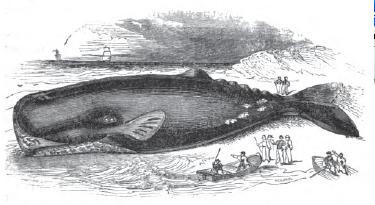
(Physeter catodon,) cylindrical cachalot, (Physalus cylindricus,) sharp-nosed cachalot, (Physeter microps,) and high-finned cachalot, (Physeter tursio,) none but the last, (which is said to be an inhabitant of the North Seas, having a tall dorsal fin, and attaining the length of 100 feet,) differ, in the descriptions given of them by authors, from the ordinary Sperm Whale of the South Seas; their specific distinctions having, apparently, been drawn from peculiarities, which are commonly observed to attend upon age or sex in the latter species, and which I shall have occasion to notice more particularly. In size, the Sperm Whale equals, and occasionally surpasses the Greenland Whale, (Balaena mysticetus,) with which it is most open to comparison. The experience of Captain Scoresby does not enable him to assign to the Greenland Whale a greater magnitude than sixty feet in length, and forty in circumference; nor have we any evidence that this species ever exceeds the length of seventy feet. The largest size authentically recorded of the Sperm Whale is seventy-six feet in length, by thirty-eight in girth; but whalers are well contented to consider sixty feet the average length of the largest examples they commonly obtain.* A mature foetal Cachalot, which I examined, was fourteen feet in length by six in girth, which must be * It has been asserted, that cetacea were formerly of much greater magnitude than at present; that their being now more frequently destroyed, precludes the possibility of their reaching a full growth. This opinion is probably fallacious; or suggested by the exaggerations in natural history with which the ancients have so liberally supplied us. The Sperm Whale, when much inferior to its maximum size, often bears an appearance of great age. The largest cetacean, with which modern naturalists are acquainted, is the Razor-back Whale, (Rorqualis Borealis, Cuv.,) which acquires the length of 100 or 110 feet. |
regarded as the minimum dimensions of the breathing whale. It is the male animal only which attains to the full magnitude of his species: the adult female does not exceed the length of thirty, or at most thirty-five feet – a greater disproportion existing between the sexes in this, than in any other known species of cetacean.* Whalers technically express the size of a Cachalot by the number of barrels of oil it is calculated to produce. A large male has occasionally produced one hundred barrels of oil, and a female fifty; but both these quantities are deemed extraordinary; and from seventy to ninety barrels from the adult male, and twenty to thirty from the female, is the usual average. The form of this whale is colossal, without symmetry, and, from the general absence of other prominent organs than the tail and pectoral fins, can be compared to little else than a dark rock, or the bole of some giant tree. The prevailing colour of the skin is a dull-black. In some parts, and especially on the abdomen and tail, it is occasionally marked with white; and this as frequently obtains in the youngest as in the most aged examples. Some individuals have their sides covered with short and rounded elevations, or ridges, chiefly arranged longitudinally, and passing into each other like the convolutions on the surface of a brain – an appearance which is not retained in the integuments when they are removed from the carcase. The enormous head, which has obtained for this whale its specific name, constitutes full one-third of the entire animal, in magnitude, and much exceeds that proportion in weight. It approaches to a square form; * If any disparity in size exists between the sexes of the Greenland Whale, it is found to be rather in favour of the female. |
the snout being remarkably blunt, and either perpendicular, or more or less convex in different individuals. The body is nearly cylindrical, protrudes on either side of the abdomen, and tapers finely at the tail. The summit of the head and trunk presents a plane surface, until about the posterior third of the back, whence arises a hump, or spurious fin, of pyramidal form, and entirely composed of fat. From this embossed appendage, an undulating series of six or eight similar but smaller elevations occupies the upper margin, or ridge of the tail, to the commencement of the caudal fin. The pectoral fins, or paddles, are placed but a short distance behind the head. They are triangular in shape, and diminutive as compared with the size of the whale: in a Cachalot sixty feet long, I did not find them exceed three feet in length by two in breadth. The integuments covering their upper surface are frequently marked with longitudinal embossed ridges, corresponding in number and situation to the bony fingers within. Being connected to the trunk by a ball and socket joint, these members possess a free movement, which can be exercised either in a vertical or horizontal direction. The tail-fin, or "flukes," is both the principal organ of progression and a powerful weapon of defence. Its average horizontal spread, in the adult female, is twelve feet: in a male, sixty feet long, it measured nineteen feet across. Each segment of its posterior, or free border is thin and convexly crescentic; (not waved, as in the dolphin and porpoise families;) and each half overlaps the other at the central notch, or "crutch." Owing to the flexibility of the tail, the movements of this fin are exceedingly extensive; whilst its power may be estimated by the gigantic bundles of round tendons which pass on either side the loins to be inserted into |
its base. Whether it be wielded in sportive mood or in anger, its action is marked by rapidity and ease; and when struck forcibly on the surface of the ocean, it produces a report which may be heard at a considerable distance. In progression, the action of this organ is precisely the reverse of that of the tail of the lobster; for, whilst the latter animal swims backward, by striking the water with its tail from behind forwards, the Cachalot, and other cetaceans, swim forward, by striking with their flukes in the contrary direction; the fin being brought beneath the body by an oblique and unresisting movement, while the act of springing it back, and straightening the tail, propels the animal ahead, with an undulating or leaping gait. When employed offensively, as in striking at a boat, the tail is curved in a direction contrary to that of the object aimed at; and the blow is inflicted by the force of the recoil. The eyes are placed far back in the head, above and between the pectoral fin and angle of the mouth: their situation being chiefly denoted by a prominence of the surrounding integuments. The aperture for vision is not larger than two inches in its longitudinal, and one in its vertical, diameter. The eyelids have neither eyelashes nor tarsal cartilages, but are otherwise complete in the structures which adapt them for their office, and are quite unencumbered by oil or fat. In the dead whale they are usually closed; and in the living animal they exhibit the phenomenon of winking. At the inner angle of the eye, the conjunctiva forms a thick duplicature, or rudimental third eyelid, of semilunar form, and in appearance closely resembling the "haw" in the eye of a horse. The eyeball is not a perfect sphere: its anterior and posterior surfaces being much flattened. It is deeply set within the lids, and chiefly |
lodged in the soft parts; but little if any of its substance occupying the bony orbit. In size it does not much exceed the eye of an ox.* The nerve of vision is long, but not thicker than a crow's quill. It is closely enveloped by a dense fibrous sheath, four inches in perimeter, and which terminates on the posterior surface of the globe. That portion of the conjunctiva which immediately surrounds the cornea, and corresponds to the aperture of the lids, has an intense black hue. It is possible, however, that this dark membrane may be one distinct from the conjunctiva; as it can be detached from the latter tunic, and then resembles a layer of cuticle, with a black pigment deposited beneath it.† The structure of the eye-ball is chiefly adapted for aquatic vision. The cornea is dense and flattened; the anterior chamber of the eye is small, and contains but little fluid; the iris is a very coarse membrane, of the dull-brown colour so general, if not invariable, in the whale tribe, with a narrow zone of a lighter hue surrounding its outer margin; the crystalline lens is certainly not larger than the same part of the human eye – its form is nearly a perfect sphere; the vitreous humour is relatively abundant; the retina is spread with beautifully-arborescent blood-vessels, and presents a circular bright spot at the insertion of the optic nerve. Immediately beneath the retina, we find a dense mem- * In the adult female, the size of the globe, at its greatest circumference, is seven and a half inches, its longitudinal and vertical diameters two inches and a half. The interior, or cavity, is one inch and a half in each of the last named directions, whilst its depth does not exceed two-thirds of an inch. The transparent cornea, at its transverse and broadest diameter, measures one inch; and at its vertical or narrowest, three-quarters of an inch. † A similar, but slighter dark tint around the cornea is not uncommon amongst the dark-skinned varieties of the human race. |
brane, or tapetum, of a bright-green colour. The sclerotic coat, at its posterior third, is excessively thick, fibrous, and resisting, while its anterior third is thin and flexible.* No lachrymal organs exist; but the surface of the eye is lubricated by a secretion from mucous ducts, which open abundantly on the lining membrane of the lids. The external orifice of the ear is a longitudinal fissure, situated a little below, and about one foot behind the eye. Its structure is valvular, and its tube not larger than will admit the first joint of the finger. A single spiracle, or spout-hole, opens upon the upper and front part of the snout, near the median line, but with a decided bias to the left side of the head. It is but little raised above the surrounding surface, and affords a longitudinal fissure, eight or ten inches in length, and shaped like the orifice in the sounding-board of a violin. The margins are thick, rounded, and so closely approximated in the dead whale as to require the exercise of some force to introduce the hand between them. The tube of the spiracle (which is also single) is capacious, of cylindrical form, and lined by a smooth black membrane. Powerful muscles encircle both the external nostril and the canal of the spiracle, to aid in their functions; and it is sufficiently obvious, that the * This conformation of the sclerotic may in some measure adapt the eye of the whale for amphibious vision: the powerful muscles surrounding the eye-ball being thus enabled to act upon the thin anterior margin of the sclerotica and shorten the axis of vision, by pressing the lens towards the posterior part of the globe; in this manner reconciling the function of vision to the changes from a denser to a thinner medium, or from water to air. |
closed and valvular state of the spout-hole, so well calculated to oppose the entrance of water, must necessarily be overcome by muscular power, and the orifice of the nostril be expanded, to admit a full volume of air at each inspiration: in fact, the Cachalot, when gasping in the agony of death, will occasionally expand the orifice of its spiracle to a great size. As compared with the huge bulk of the entire head, the lower jaw of this whale appears diminutive, slender, and not unlike the lower mandible of a bird. When the mouth is closed, it is received within the soft parts pendent from the border of the upper jaw, and is nearly concealed by them. It is covered externally with a smooth and firm skin, mottled black and white; but has no vestige of a lip. Its length averages eight feet in the female, and from fourteen to sixteen in the male. The tongue is small, and shaped much like that of the ox; it is of a grey-white or clay-colour on the surface, and is composed, internally, of many fleshy bundles, imbedded in a soft fat. It is incapable of protrusion, and occupies so small a space in the back of the mouth as to appear little more than a rudimental organ. The capacity of the gullet, and expansive power of the jaws, are both fully proportionate to the size of the animal. A very large proportion of the head of the Sperm Whale is composed of soft parts, situated in front of the cranium, and named by whalers the "junk" and "case." The junk is a solid mass of soft, yellow, and oily fat, based on the upper jaw, and forming the front and lower part of the snout: in a whale of large size this part weighs between two and three tons. The "case" and its boundaries constitute the upper and anterior portion of the head. The cavity |
to which the term "case" is more immediately applied, is situated beneath, and to the right of, the spouting canal, and corresponds to nearly the entire length of that tube. It is filled with a very delicate web of cellular tissue, containing, in large cells, a limpid and oily fluid, which is liberated by the slightest force. The quantity of fluid (which is chiefly spermaceti) contained in this singular receptacle is often very considerable: fourteen barrels, or nearly five hundred gallons, have been obtained from the case of one whale. A Cachalot, taken by the Tuscan, in 1835, produced upwards of twelve barrels, or three hundred and seventy-eight gallons, of fluid from the same reservoir. The walls of the case are chiefly formed by a white, spongy, and fibrous structure, loaded with a slimy fluid; and which forms, also, a layer of separation between this receptacle and the bulk of fat, or junk, on which it rests. So vast an accumulation of relatively light structures in the head of the Cachalot, is obviously intended to render this part of the animal peculiarly buoyant – to ensure its correct position in swimming – to facilitate the elevation of the spiracle above the surface of the sea – and to counteract the weight of the bony and other ponderous textures of the head — objects which, in the Greenland Whale, are sufficiently attained by similar accumulations of fat in the lips and tongue, and by the more elevated situation of the spout-holes. The bones of the head approach nearly, in form, to those of the Dolphin and Porpoise families: the cranium is equally round as in those cetaceans, and proportionately well provided with brain. The forehead is elevated; and presents a deep crescentic excavation, which gives the entire cranium a form, not unaptly compared |
to that of a Roman war-chariot. The upper jaw projects as a broad and plane surface, tapering slightly as it advances. It accords very closely with the lower-jaw in size, notwithstanding the disparity between the two which the aspect of the entire head would lead us to expect. The skeleton of the lower-jaw bears somewhat the shape of a plough. It is composed of two long and heavy bones, rounded and closely united for the anterior half of their length, whilst posteriorly they diverge, and increasing in depth at the expense of density, expand each into a broad and thin plate, on which the muscles are implanted. The two bones taper so considerably from behind forwards, that, in a jaw fifteen feet in length, the distance between the articulating surfaces measures five feet, while the breadth of the anterior extremity does not exceed seven inches. The interior of the thickest portions of each bone is divided, by bony partitions, into large cells, filled with a light oily fluid, or spermaceti; – an organization which tends much to lessen the specific gravity of their ponderous structure. The true and serviceable teeth of this whale are situated only in the lower jaw; and, when the mouth is closed, are received into corresponding sockets in the soft parts, covering the margin of the upper jaw. When in their most characteristic stage of growth, they are raised about two inches above the gum; are acutely pointed; and curved in a direction backward and slightly inward. They are imbedded for a great portion of their length in the bony sockets of the jaw, as well as in the dense white substance, or gum, which rises as an embossed ring around the base of each tooth. The central teeth are of greater length, and thicker, than |
those occupying the extremities of the series. Many of them, placed most posteriorly, are in fact very small, and but little raised above the gum, (to which they are alone attached,) even in large and aged whales. Their number varies greatly in different individuals, and does not appear to be influenced by either age, sex, or size. Amongst many Cachalots, I found their variations in number to be as follows: – 21 on one side of the jaw, 20 on the opposite, 23-21, 22-22, 24-25, 22-23, 24-26, 23-24, 22-24, 19-20; or from thirty-nine to fifty. The upper jaw is not altogether toothless, as usually described. On the contrary, it has on either side a short row of teeth, which, for the most part, are placed more interior than the depressions which receive the teeth of the lower jaw; though they sometimes, also, occupy the bottom of those cavities. Their entire length is three inches; they are curved backwards, and elevated about half an inch above the soft parts, in which they are deeply imbedded, having only a slight attachment to the maxillary bone. In two instances, I found their number to be eight on each side. They exist in both sexes of the Sperm Whale; and although visible externally only in the adult, they may be seen in the young animal upon removing the soft parts from the interior of the jaw. Although these palatine teeth are perfect in their structure, their relatively small size will not permit us to regard them as more than rudimental.* In a half-grown male, about thirty-five feet in length, the teeth of the lower jaw are not larger than in the adult female; but are much more symmetrical and * Some of these teeth, from the upper-jaw of an adult female Cachalot, I have deposited in the museum of the Royal College of Surgeons in London. |
characteristic in their form. In aged males they are of great size and solidity, and attain the weight of from two to four pounds each; but their crowns are never proportionately raised above the jaw, and always present a broad, obtuse, and much-worn appearance. The entire structure of the tooth of this whale is ivory. The exposed crown has a yellow and polished appearance; while the fang, concealed in the jaw, is dull-white, and grooved on its surface. Like the ivory teeth of other animals, they have no covering of enamel. In the young and growing whale, the base of each tooth is cylindrical, and perforated by a conical cavity, filled with a vascular pulp, intermediate in structure to fat and glandular substance. As the tooth becomes perfected by age, this cavity is gradually obliterated from above downward, and the fang assumes a more flattened or compressed form, and becomes converted into a solid mass of ivory. It is not unusual to find in the sockets, and around the roots, of the teeth, superfluous deposits of ivory, in the form of large and irregularly-shaped plates. The skin of this whale emits a peculiar half-fishy odour, which, although but slight, is perceptibly communicated to the pure sea-air. It is smooth and naked, (or entirely destitute of hair,) and secretes from its surface an unctuous fluid, which resists the action of water. It has almost invariably a very clean appearance; which may partly be attributed to the rapid and distant journeys these animals are constantly performing, in quest of their food, and partly to the clearness of the deep waters they frequent; since the True-Whale of the South, (B. Australis,) which affects the more shallow seas, and which is much more sluggish in its movements, has its body encrusted with barnacles and other |
parasites, often to the extent of resembling a rugged rock.* The essential parts which compose the integuments are the same as in quadrupeds. The epidermis, or scarf-skin, is exceedingly delicate; being no thicker than the membrane known as a "gold-beaters'-skin." It is transparent, of a pale-brown colour, and, after the death of the whale, is readily and easily detached from the body. Beneath this covering is a thick layer of colouring matter, or rete mucosum, (the "black-skin" of whalers,) of firm, elastic, or doughy consistence, and dull, or gray-black colour. When exposed to the air, its surface hardens, becomes polished, and may be repeatedly peeled off in sheets, which are sometimes preserved by sailors and exhibited as the "skin of the whale." I scarcely need observe, that upon this structure the colour of the Cachalot depends; but it is worthy of remark, that in those parts where the body of the animal is white, this substance is not absent, but resembles curds of milk, or flour-paste. The black-skin possesses a powerful alkaline property, both in its recent state and when burned to ashes. In the latter form it resembles powdered charcoal, and communicates to water all the qualities of a caustic alkali. Chemical analysis proves, that it derives this power from a large proportion of free soda which enters into its composition.† * It is the opinion of whalers, that both the Sperm and True-Whales occasionally frequent heavy surfs, and roll in the billows, to free their skin from extraneous matters. † A similar alkaline principle resides in the same structure in other cetaceans; although the fact would appear to have escaped the notice of chemists and naturalists. It proves of very essential convenience to the whaler, by enabling him readily to cleanse his ship and clothes from oil, with which it combines perfectly, forming an extemporaneous soap. |
Filaments, or nervous papillea, arise from every part of the skin, as a thick mat, and stand erect, imbedded in the layer of colouring matter. When separated from the latter substance they are flaccid and colourless, and may be smoothed in different directions, like the pile of velvet or hair, whence they are sometimes described by sailors as "the hair of the Sperm Whale." Their size, abundance, and general distribution, would lead to the opinion that this whale is endowed with an acute sense of touch, which may, under some circumstances, compensate for a defective condition of other senses; and this supposition is farther sanctioned, by the rapidity with which the animal responds to the contact of an extraneous body; and the reliance it appears to place, when suspicious of danger, upon the sensitive power of its flukes. In the eyelids and some few other parts, which are without fat, the thickness of the true skin does not exceed the eighth of an inch; in every other portion of the animal its density is the same as that of the blubber, with which its structure is identified. The envelope of lard, or blubber, is of compact texture, perfectly white, and without odour. It varies in thickness, (according to the size of the whale, or the part of the body whence it is removed,) from four or six inches to eight or fourteen. The breast, dorsal hump, and upper margin of the tail, afford the thickest blubber on the body. The muscles, although not remarkable for extraordinary development, or size of their fibres, are well proportioned to the bulk of the animal. They have no odour, beyond that which is perceptible in the raw flesh of cattle; and, when stale, do not emit any phosphorescent light, like fish. A fleshy layer, or panniculus |
carnosus, lines the integuments; and this whale, when harpooned, has been noticed to shake its skin, "like a wet dog," to rid itself of the irritating weapon. The muscles of the trunk are firmly girded by a very beautiful expanse of fascia, composed of coarse fibres, strongly and perceptibly interlaced, and glistening with a bright silvery lustre. The sexual organs are formed as in other species of cetaceans; hence, there is little external appearance, beyond the size of the individual, or the development of its teeth, to distinguish the male from the female. Whalers are inclined to believe, that the convex, or "hatchet-shaped," snout is characteristic of the male Cachalot; but I do not think that there is sufficient ground for this conclusion. The mammillary gland of the female bears a close resemblance to that of the cow. It secretes a large quantity of thick milk, which has a very rich taste, and is peculiarly greasy to the touch. In January, 1835, I was enabled, through the kindness of Captain Stavers, to make an anatomical examination of a foetal Cachalot, which was removed from the abdomen of its mother, and taken on board the ship. Without entering into minute particulars, I may mention the following, as the principal peculiarities noticed in this young example, which was a male, and sufficiently mature to be within a few hours of its birth.* It was fourteen feet long, and six in circumference; of a deep black colour, prettily mottled with a few white spots; and in form, as perfect as the adult whale, with the single exception that the tail-fin was crumpled on its free border, and had the corner of each * This opinion was corroborated by some peculiarities which were observed in the behaviour of the mother, previous to her being attacked by the boats of the Tuscan. |
fluke folded inwards. Its position in the womb was that of a bent bow – the head and tail being approximated, and the back arched. The umbilical cord (which was inserted at the posterior part of the abdomen) was five feet long, nine inches in circumference, and chiefly composed of five capacious bloodvessels. Of the bones of the neck, only the first, or Atlas, was adapted for motion. The ribs were ten on each side; namely, five true ribs, and five false. The sternum was composed of three pieces. The stomach was complex, and composed of four cavities, or chambers. The intestines were very voluminous, destitute of a coecum, and, when extended, measured 208 feet, or nearly fifteen times, the entire length of the whale. The trachea was broad and flattened, and, soon after entering the chest, sent off three branches, or bronchiae, the third or accessory tube (which was the smallest) entering the upper part of the right lung, and the other two dividing, each into two branches, previous to perforating their respective lungs. The spouting canal opened from the mouth by a single orifice, which receives the larynx. After a short course, in a vertical direction, it terminated in an ample cavity, lined on its posterior wall by a dark membrane, studded with flattened papillae, whilst its anterior boundary was smooth, and perforated by a circular aperture. At this aperture the canal recommenced, and was continued to the superior extremity of the snout, where it terminated in a second but smaller cavity, immediately beneath the external nostril. Between this last dilatation and the main tube, was interposed a rigid valve, of crescentic form; and well calculated to obstruct the passage between the cavity, |
beneath the spiracle, and the interior canal; and as this valve contains in its centre a layer of muscular fibres, it is more than probable that its function is voluntary. I could not detect any trace of rudimental teats in this male foetus. The thin and compact blubber which invested its body, as well as the other fatty structures, yielded both oil and spermaceti on the application of heat. The mother Cachalot was of the ordinary adult female size, and produced twenty barrels of oil. Some departures from the natural condition are occasionally noticed in the structure of the Cachalot, as an abridged or distorted lower jaw, or the absence of one or both of the pectoral fins; although this last defect has not been observed to occasion any material impediment to the animal's progress through the water. The flukes and paddles are often found perforated by circular holes, which are unaccountable in their origin; since they bear no appearance of being the result of either violence or disease. A few individuals are met with in a lean and enfeebled state, and expressing by their actions a want of buoyancy, especially in the head. When such whales are captured their blubber proves to be indurated or fibrous, and peculiarly deficient in oil. Ulcerous cavities in the mouth, and on the skin of this species, are not unfrequent. The parasitic animals, which chiefly infest the skin of the Sperm Whale, are small whale-lice; (Larunda ceti;) that elegant species of barnacle, the Otion Cuvieri, which usually adheres in clusters to the integuments around the jaws; and some species of Gymnolepas; but none of these are numerous; and it is rarely that all of them are to be noticed on the same whale. The blubber of the body has frequently a measly |
appearance, its substance being occupied by numerous cells, each about the size of a pea, and containing a species of hydatid, or cysticercus. The presence of these "maggots" is regarded by whalers as a token that the blubber is of a rich and profitable quality. Vast numbers of large entozoic round-worms, resembling lumbricus, infest the stomach of this, in common with every other species of cetacean I have had an opportunity of examining; they are very commonly found imbedded in the food rejected from the stomach of the Cachalot, and which they have very profusely perforated. |
CHAPTER III.Natural history and habits of the Cachalot – Geographical distribution of the species – Natural indications of its places of resort. The Sperm Whale is gregarious; and usually occurs in parties, which are termed by whalers "schools "and "pods:" the former name expressing the greater, and the latter the less number of individuals congregated together. A school may contain from twenty to fifty or more Cachalots, and is composed of females, or "cows," attended by their young, and associated with at least one adult male, or "bull," of the largest size, who acts as the guardian of the herd, and who, with a devotion highly creditable to his gallantry, generally takes a defensive position in the rear, when the school is flying from danger. The smaller associations, or "pods," consist of young or half-grown males, which have been driven from their maternal schools, but yet retain a social disposition; and sometimes of large and adult males; although these last more commonly roam the ocean singly, or in association with the herds of females. When a solitary, or "lone" Cachalot is observed, it almost invariably proves to be an old bull; and there is some reason to believe that, in correspondence with a similar habit amongst gregarious quadrupeds, the aged male frequently retires from a social, to a secluded, state of existence. Two or more schools occasionally coalesce, and form a very large assemblage, technically distinguished as a |
"body of Whales." On some tracts of ocean, peculiarly favoured as their haunts, the number of Sperm Whales, seen in one large body or in many distinct schools, is beyond all reasonable conception; and could it be accurately named, would appear incredible to persons who alone consider the vast size of this animal, or who may have traversed the main for many months without noticing more than a single whale spouting in the distance. At particular times and places, however, we have seen the ocean, for several miles around the ship, strewn with a constant succession of spouts, denoting a greater number of Cachalots than, could they all have been secured, would have afforded a full cargo of oil for three or four ships. These large assemblies sometimes proceed at a rapid pace in one determinate direction, and are said to be "making a passage; when, although the whales evince no appearance of alarm, their speed renders them difficult to approach, unless the boats are favourably placed to intercept them in their route. At other times they are observed to be scattered on the surface of the sea, basking or sleeping, spouting leisurely, and exhibiting every indication of being "at home," or on their feeding-ground. Notwithstanding its unwieldy bulk, this whale is not deficient in activity. When first pierced by the harpoon, it will tow the attached boat at the rate of more than fifteen miles an hour; but this velocity of motion is the effect of extreme excitement, and does not continue long. Under ordinary circumstances of alarm, as when conscious of being pursued by enemies, its speed averages about eight or ten miles an hour: Whale-boats, propelled by both sails and oars, and a ship, having the advantage of a strong breeze, will |
often succeed in overtaking the whales they pursue, or, by their near approach, compel them to seek refuge in the deep. When swimming rapidly, the Cachalot moves with an easy, regular, and majestic pace; the head being much raised above the surface of the sea, and a portion of the back being occasionally exhibited, in the action of leaping. The individuals composing a retreating party will sometimes move in lines, like a troop of horse, and exert their peculiar leaping movements, descend, rise, and often even spout, simultaneously. A large party of Cachalots, gamboling on the surface of the ocean, is one of the most curious and imposing spectacles a whaling voyage affords: the huge size and uncouth agility of the monsters, exhibiting a strange combination of the grand and ridiculous. On such occasions, it is not unusual to observe a whale of the largest size leap from the water with the activity of a salmon, display the entire of its gigantic frame, suspended at the height of several feet in the air, and again plunge into the sea with a helpless and tremendous fall, which causes the surrounding waters to shoot up in broad and lofty columns, capped with foam; whilst others of the school leap, or "breach," in a less degree; sportively brandish their broad and fan-shaped flukes in the air; or protrude their heads perpendicularly above the waves, like columns of black rock. As long as the Cachalot continues on the surface of the sea, it casts from its nostril a constant succession of spouts; each jet following the other after an interval of ten or fifteen seconds, with a regularity highly characteristic of this kind of whale. The respiratory jet, or spout, has the appearance of a thick and white mist, composed of numerous small drops of condensed |
vapour. It ascends obliquely upwards and forward; seldom rises to a greater height than six or eight feet; remains suspended in the air but a short time; and is sent forth from the spiracle by one continued effort, accompanied by a rushing sound, resembling that of a moderate surf upon a smooth beach; the superior extremity of the snout being raised high above the level of the sea at each explosive effort. It is neither abruptly terminated, nor succeeded by any perceptible sound of inspiration, or "drawback," as is the case in the spouting of many of the less valued kinds of cetacea; in fact, its sound is, on the whole, so peculiar, that the practised ear of the whaler can detect by it the close vicinity of the Cachalot, although the darkness of night should conceal the animal from his view. During a close encounter with this whale, the latter often spouts into the boats and amongst the crew, when the exhaled fluid has been observed to be foetid in odour, and to produce an acrid effect upon the skin. When about to descend, the Cachalot assumes a vertical posture, raising its flukes perpendicularly in the air, an evolution which is performed leisurely, and which is regarded by whalers as a principal point for distinguishing this from most other kinds of cetacea. It is one, however, which is not invariably exhibited; for, when desirous of a sudden and temporary descent, the whale will occasionally sink in the horizontal position, or, as it is technically expressed, "settle down." A necessity for respiring atmospheric air does not permit the Sperm Whale to continue below the surface of the water beyond a limited period: one hour is perhaps the average time for an individual of the largest size. On three occasions, when large and solitary |
whales were noticed, under circumstances favourable for observations in this point, I found that one Cachalot continued below the surface fifty-five minutes; a second, forty-five minutes; and the third, one hour and a half; but whatever time the whale may remain under water, after making a formal descent, it subsequently adheres to the same period with so much regularity, that its "risings" may be timed by a watch with considerable accuracy. School Whales are less open to investigation in this respect; for, while some are rising to spout, others are descending, and it is difficult to identify individuals. A young male, harpooned by our boats, continued under water, and with the line attached to it, half an hour. The time they spend in communication with the air is very variable; when making a rapid passage, or when pursued, they swim for a long time on the surface of the water, where their progress is less impeded. Their ordinary food is the cuttle-fish, or "squid," (Sepia,) many kinds of which are rejected from the stomach of the whale when the latter is attacked by the boats, as well as after death, and during the process of removing the blubber. Amongst the examples thus rejected we find solid masses of enormous size and weight, though evidently but mere fragments of the body of some vast cuttle-fish, and probably of that kind termed the "gigantic squid" – an animal with which naturalists are but little acquainted; but which has been known to attain such huge dimensions, that, when spread out beneath the surface of the sea, it has alarmed navigators by its resemblance to a reef, or shoal. We cannot fail to be impressed with a truly magnificent idea of the profusion of animal life which must necessarily exist in the ocean's depths, though |
invisible to man, when we thus behold creatures of such stupendous magnitude as the Sperm Whale, roaming the seas in very large assemblies, and all replete with food and of unwieldy corpulence. It is probable that the Cachalot occasionally indulges in other food than the nutritious and helpless Sepia. While we were cruising in the North Pacific, in the year 1835, a School Whale, upon being attacked by the boats, rejected from her stomach a bony fish, which was secured and put into my possession. It was rather more than a foot long, of deep and compressed form, and covered with rough and silvery scales. It was uninjured, beyond some slight ravages of digestion, which had impaired the surface of the body and removed the membranes of the fins. In its stomach were small fragments of cuttle-fish. As it was not easy to conceive, that the Cachalot could take a fish of this size and structure by direct pursuit, I felt inclined to the opinion, that it had been accidentally received within the mouth of the whale, and swallowed together with the large portions of cuttle-fish with which it was also rejected. Some whalers assert, that they have seen Cachalots throw up rock-cod, and even sharks. Owing to the great projection of the snout beyond the lower jaw, it may be requisite for this whale to turn on its side or back to seize its more bulky prey – a supposition which is strengthened by the fact, that when the animal attacks a boat with its mouth, it invariably assumes a reversed posture, carrying the lower jaw above the object it is attempting to bite. In common with most terrestrial animals which herd together in great numbers, Sperm Whales are naturally timid, and disposed to fly from the remotest appearance of danger: and although many instances occur amongst |
them of a bold and mischievous disposition, which leads them, when molested, to attack and destroy both boats and men, yet such traits rather belong to the individual, than to the general character, and may be compared to the aberrations from a mild to a vicious temper, occasionally displayed amongst oxen, horses, deer, and other herbivora. A shoal of Dolphins, leaping in their vicinity, is sufficient to put to flight a large party of Cachalots; and when on a well-beaten cruising ground, where the whales are exceedingly watchful, the whaler finds it necessary to be constantly on his guard, not to excite or confirm their suspicions, until he has made sure of his prizes. The signs they exhibit of a suspicion of danger, are occasionally ceasing to spout; lying motionless on the water; (evidently listening;) sweeping their flukes slowly from side to side, in search of some invisible but dreaded object; and turning upon the side, or rearing the head perpendicularly above the waves, to bring surrounding objects upon the axis of vision. When pursued, they may be considered to exhibit two degrees of alarm; namely, that which puts them to the top of their speed, and which often enables them to escape the boats; or a more powerful and overwhelming impression, produced by the near approach of their enemies, or by one of their number being injured; when they will occasionally crowd together, stationary and trembling, or make but confused and irresolute efforts to escape. The females, when attacked, will often endeavour to assist each other, and those that are uninjured will remain for a long time around their harpooned companions; while the males, in which the social disposition is less strong, as commonly make a |
rapid retreat, without any concern for the fate of their comrades. It is a confirmed fact, and one often noticed with surprise by southern whalers, that upon a Cachalot being struck from a boat, others, many miles distant from the spot, will almost instantaneously express by their actions, an apparent consciousness of what has occurred, or at least of some untoward event, and either make off in alarm, or come down to the assistance of their injured companion. But, without attributing to the Cachalot an extraordinary acuteness of sight or hearing, or any more mysterious sensibility, we may perhaps find, that the violent agitation of the sea, produced by the plunges of the harpooned whale, and the more rapid and distinct conveyance of sound in water than in air,* are sufficient to account for the above phenomenon. From the abundance of calves, accompanying the schools, and the great number of Sperm Whales yet visible, notwithstanding the incessant slaughter to which they have been exposed for nearly a century and a half, we are justified in believing that this species is peculiarly prolific. Like other cetaceans, they couple more hominum: in one instance, which came under my notice, the position of the parties was vertical; their heads being raised above the surface of the sea. Nothing satisfactory is known about the duration of pregnancy in this whale. We observed them copulating in August, but it is probable that no particular * Chladni estimates the velocity of sound in water to be four or five times greater than in air. The experiments of Dr. Franklin tend to prove, that sound, after travelling above a mile through water, loses but little of its intensity. |
breeding season obtains, as we observed sucking calves during the entire eight months in the year we were engaged in cruising. The female produces one at a birth, but occasionally twins, as is usual with uniparous animals. She brings forth her young in the open ocean, and indiscriminately, on whatever spot the school may chance to be at the time of her parturition. The calf accompanies the school as soon as it is born. During a chase, it was often exceedingly interesting to observe sucklings, apparently but a few days old, leaping actively and spouting high by the side of their dams, and keeping up wonderfully well with the rapid pace of the retreating party. Intelligent whalers, who have occasionally seen the female Cachalot in the act of suckling her young, agree very closely in their descriptions of this process. They state, that the mother reposes upon her side, with the pectoral fin raised above the surface of the sea, while the calf, which is thus enabled to retain its spiracle in the air, receives the protruded nipple within the angle of the mouth – a part where it is reasonable to suppose that the tongue would also be found of some assistance. The male Cachalot takes no part in the care of his offspring; and I have reason to believe, that the female is less remarkable for maternal affection than the Greenland whale is represented to be. When pursued by boats, the mother whale will keep in the rear of the school, retarding her pace to accommodate the calf which leaps by her side, and thus far expose herself to some danger for its sake; but other facts which I observed, are rather opposed to the opinion that she will make any strenuous or romantic efforts in defence of her young, or sacrifice her life for its safety. The whaler |
does not consider that a mother Cachalot is more troublesome or dangerous to destroy than one without charge; and although he will harpoon a calf, in the hope of arresting the flight of the school, or of securing the mother, the measure often fails in its object. I believe that we have seen the female purchase her own safety by the desertion of her young. On several occasions our boats destroyed a sucking calf, in the midst of a school, without sufficient interference on the part of the mother to lead to her being identified by the harpooner. In one instance, the boats, while pursuing a school, killed a calf with a single lance-wound; the body of the little whale remained floating on the water – but none of the adults discontinued their flight. On another occasion we noticed a herd of females make off with great rapidity, and leave a small calf, swimming in an anxious and bewildered manner, in the vicinity of the ship; it continued thus deserted for some time; but was ultimately rejoined by the mother, when they both set off to overtake the main body of fugitives. The senses of the Sperm Whale are not despised by the whaler, nor disregarded in his tactics. He considers that, in this animal, the power of vision is greater than that of hearing; and although he is ever anxious to approach his prey quietly, his principal attention is directed to avoid bringing his boat within the range of vision, or, as he expresses it, "upon the eye" of the whale. To approach in a direct line with the snout or the tail is not difficult. It is true that the splashing of oars, and the rush of a boat through the water, appear calculated to excite alarm in any animal endowed with the most ordinary power of audition, but, independent of the valvular conformation of the ear, it is probable that while the whale pursues its course through the sea, |
the breaking of the waves, and the noise of its own respiration, tend much to disguise other sounds. The habitat of the Sperm Whale is more peculiarly the central and fathomless waters of oceans, or the vicinity of the most abrupt coasts. Occasionally, though very rarely, they frequent the shallower seas, so commonly the resort of the True Whale.* The geographical range of the species must be regarded as very extensive; since no part of the aqueous globe, excepting the Polar Seas, would appear to be altogether inimical to their habits or free from their visits. In the southern hemisphere, their excursions are known to extend as high as between the sixtieth and seventieth parallels of latitude, or off the shores of the South Shetland Islands. In the northern, their boundary can be fixed, with more accuracy, at about the sixtieth degree of latitude, for, although the species has been observed on the south coast of Greenland, and as high as the corresponding latitude off the American and Asiatic continents, it is unknown to the whaler in the Arctic Ocean. In all the intermediate climates Sperm Whales have been found more or less abundant. They have been noticed in the Mediterranean Sea, and have been occasionally cast ashore upon many parts of the coast of continental Europe, and Great Britain.† Living examples have been captured in the British Channel, and one individual in the river Thames. It is, however, in the warmer seas, within, or upon the verge of, the tropics, * So great is the difference in habitat between the two cetaceans, that during the entire period we were cruising in quest of the Cachalot, we in no single instance saw an example of the True-Whale. (B. mysticetus.) † Captain T. Stavers informs me, that he has lowered his boats in pursuit of a school of Cachalots when but forty-eight hours' sail from Portsmouth harbour. |
that the Cachalot is sought with the greatest success; as in those corresponding to the intertropical coasts of Africa, America, Asia, and New Holland, or surrounding the Indian and Polynesian Islands; but more especially and uniformly in the "line currents," which extend from the equator to about the seventh degree of north and south latitude, both in the western and eastern hemisphere. Large parties of these whales have been remarked to affect particular spots at distinct times; though it has not been ascertained that their visits to any one tract of water are sufficiently regular to be considered as seasonable; and it should be observed, that when seasons are spoken of in this fishery, the term applies less to the periodic presence of whales in the regions referred to, than to the convenience of whale ships, in regard to weather, &c. Thus the "Japan cruise," in the Pacific, extending from 20° to 40° north latitude, commences with the spring months, April and May, and concludes with the autumnal months, September and October, or when the accession of inclement weather may be expected in that region; although there is no reason to doubt, that whales continue in its waters during the entire year. While driven by winter weather from the north, the whaler occupies his time in the more genial climates of Southern America and the Equator, or "takes the off-shore season." The same remark applies, also, to the Sperm Fishery in the Indian seas; where its seasons are equally influenced by the variations of the monsoons. Nevertheless, the natives of the Society Islands expect to see the Cachalot around their shores only during the months of April and May, or, as they express the time, "when the Vis (Hog-plums) are ripe;" and whalers consider, that from September to December |
are the most profitable months for cruising on the Equator. Vast tracts of ocean may be cruised over without the slightest trace of the Sperm Whale being perceived, whilst other, and often very limited, extents of water will exhibit the species in great abundance. Much of this apparent caprice, however, depends upon natural causes. Powerful currents, or the space intervening between two currents setting in opposite directions, are the favourite resorts of this whale, and, doubtless, where its food is found in greatest abundance, amidst the inhabitants of the deep swept together by these local streams. Hence, wheresoever currents are denoted by their concomitant marine animals, as the floating shellfish Janthina, Hyalaea, and Cleodora; or other mollusks, as Sea Lizards (Glaucus), Velellae, Porpitae, &c., with myriads of medusae, forming what whalers term "thick water," Cachalots may reasonably be expected; and their appearance often coincides in a remarkable manner with the presence of such natural indications. Nor is it difficult to conceive, that since the inhabitants of the ocean, like those of the land, prey each upon the other – the smaller and less organized being the food of the larger and more perfect animals – so the base of this column is formed by the mollusks, simple in their structure, and much the sport of the element they inhabit, and the capital by the cetacea, and the largest or most rapacious fish. |
CHAPTER IV.Historical notice of the Sperm Whale Fishery – Its commencement by the Americans – Rise and Progress in Great Britain and her colonies – First carried into the Pacific Ocean by the British, in 1788 – Commercial details – South-Seamen – Their equipment, crew, economy, and destinations – Boats, lines, weapons and other implements. The history of this fishery may he carried back to a very early date, if we regard the desultory manner in which the Sperm Whale was formerly captured by the nations of continental Europe, when the species occurred to them in the waters around their coasts, or during their voyages in search of the Greenland Whale. But the earliest period at which we find the pursuit conducted upon a systematic plan, and prominently employing the energies of a civilized people, maybe referred to about the year 1690, when the Sperm Fishery was commenced by our American colonists; those hardy people having the greater inducement to embark in the enterprise, from their adopted shores being at that time the frequent resort of the Cachalot, as well as situated in the close vicinity of other and more prolific whaling grounds, which have retained their reputation to the present day. For many subsequent years, the Americans continued to engross this branch of commerce; and England was well contented to receive from them, as a colonial importation, such products of the fishery as she required. When, however, the war of independence virtually separated the interests of the two countries, and when the result of that conflict gave to the world a new and |
powerful nation, it became essential that England, should, as far as possible, provide from her own resources, those commodities for which she had hitherto depended upon her revolted colony. Consequently, it was in 1775, that ships were first sent out from the ports of Great Britain for the Sperm Whale Fishery. In that year they were ten in number, equipped by the unaided efforts of our merchants, and chiefly by the enterprising and highly-respected firm of Messrs. Enderby. In 1776, this infant trade was encouraged by a government bounty, graduated from 500l. to 100l., and the number of ships engaged in the fishery, progressively increased until the year 1791, when it attained its maximum. The commencement of the Sperm Fishery by England found our seamen but indifferently acquainted with this peculiar mode of whaling; and for some years it was necessary to appoint an American commander and harpooner to each ship, until competent officers could be reared from our own service. At the same early date, the fishing was chiefly prosecuted on the coasts of South Greenland and Ireland, off the Western Islands, on the coast of Africa, on the Brazil Bank, off the Falkland Islands, and in Strait le Maire. In the year 1788, Messrs. Enderby's ship, the Emilia, rounded Cape Horn, and first carried the Sperm Whale Fishery into the Pacific Ocean. She made a short and successful voyage, and opened a wide and fruitful field for future exertions. As our whalers became better acquainted with the Pacific Ocean, many valuable resorts of the Cachalot were discovered by their enterprising researches. In the year 1819, the British whale-ship Syren first occupied, as a cruising ground the more distant and un- |
explored tract of ocean, in the western parts of the North Pacific, and since so familiarly known to whalers as the "coast of Japan;" and which, for a long series of years, has proved so prolific a resort of the Sperm Whale, that, at a comparatively recent period, when its value was diminished by the frequent visits of ships, 40,000 barrels of oil are recorded to have been taken from thence in one season, by the fleets which annually frequent its waters. The Indian Ocean, coast of New Holland, and Indian Archipelago, were subsequently occupied as cruising grounds; and now but few seas are entirely free from the visits of ships occupied in this venturous service, under the flag of Great Britain, or of the United States – other nations having made but feeble and transient efforts to partake in the fishery. Of late years, the number of British ships engaged in this trade has materially decreased, and at the present time, cannot be estimated at more than between thirty and forty sail. The cause of this recent diminution in the number of British South-Seamen is to be found in the slow and precarious return the fishery affords to the heavy investment of capital required for its prosecution, and in the abundant importation of sperm-oil from our colony of New South Wales, (where the fishery is conducted with much less expenditure of time and capital,) which does not permit the British owner to receive an adequate remuneration. The amount of capital, involved in the outfit of a South-Seaman, from the port of London, is from £8,000 to £12,000. The time occupied by the voyage is now seldom less than two-and-a-half or three years, and the latter period is occasionally exceeded, with an unsuccessful result. The value of a South-Seaman, on her return to the port of London, with a full cargo, may |
be estimated at £23,000 – £3,000 being allowed for the value of the ship and stores, and £20,000 for that of her cargo, of 250 tuns of oil,* at £80 per tun. The British and colonial sperm oil imported into this country, is subject to a duty of one shilling per tun – a sum which suffices to bring a ship, thus freighted, under the control of the customs, without materially enhancing the price of her cargo. To the importation of foreign oil, a duty attaches of £26. 12s. per tun. The subjoined account of the relative importations of sperm oil by the British, colonial, (Australian,) and foreign fisheries, during thirteen years, from 1820 to 1832, is extracted from a return delivered, in 1833, to a committee of the House of Commons.
* One hundred and sixty tuns of oil is deemed an average cargo. The largest quantity ever brought to this country, as one cargo, was 330 tuns, by the Rochester, Captain Smith, in 1830. – The largest cargo of sperm oil ever taken to the United States, is said to have been 4,050 barrels, or rather more than 500 tuns. The result of the voyage of the Tuscan, from 1833 to –36, was a cargo of 1,953 barrels, or 244 tuns of oil. Sperm Whales were seen, during the voyage, on ninety distinct days, and seventy-eight whales were killed and secured to the ship. | |||||||||||||||||||||||||||||||||||||||||||||||||||||||||||||||||||||||||||||||
The extent to which the importation of sperm oil into England, by our colonies of New South Wales and Halifax, has increased, during ten years, from 1827 to 1836, is exhibited in the following account; for which, as well as for all the more important commercial details of this fishery, I am indebted to the kindness of –– Enderby, Esq.
The consumption of sperm oil in this country, (where its use is limited to burning in patent lamps and lubricating machinery,) although influenced by high and low prices, has gradually increased, and is now greater than at any former period. The very general adoption of gas for the purpose of illumination, and which might reasonably be expected to lessen the demand for oil, has not had that effect – on the contrary, it would appear that the increased light of the shops and streets rather induces persons to add to their domestic illumination in a proportionate degree. The great and progressive extent, also, to which steam-machinery is employed, must ever ensure a corresponding demand for this valuable commodity. The following is a statement of the prices of sperm oil in the London market, at specified periods of the fishery: – | |||||||||||||||||||||||||||||
The Americans, who commenced the Southern Whale Fishery with so much ardour and success, have continued zealous in its prosecution. The number of whaleships they at present possess, is estimated at about three hundred and fifty, a large proportion of which is engaged exclusively in the pursuit of the Sperm Whale. With this nation, also, the whale-trade is more generally diffused amongst the commercial classes than in England, and instead of one merchant possessing many South-Seamen, as with us, it is more usual to find one whaleship the property of several owners – an interest in her being held by many men of small capital, and not unfrequently by the commander and officers who prosecute the voyage. Sperm oil is so much cheaper in the United States than in England, that its exportation to this country would be a source of considerable revenue to the Americans, did not our heavy duty on foreign oil prohibit the introduction of their produce to the British market at a lower price than £90 per tun.
––––
The ships engaged in the Sperm Fishery, (and which are for the most part vessels of from 250 to 400 tons burden,) derive a peculiar interest from the roving and enterprising nature of the service to which they are | |||||||||||||||||||||||||||||||||||||||||
devoted. Not only has the South-Seaman, in common with the merchant-vessel, to bear her cargo from distant quarters of the globe, but also the additional task of procuring that cargo, as it swims on the ocean, uncertain in quantity and place, and as yet identical with living, gigantic, and often dangerous animals. To the Northern or Greenland whale-ship the same observation applies. South-Seamen, however, advance a step beyond their prototypes of the North, inasmuch as while they collect, they may also be said to manufacture their cargo, by the practice they pursue of separating the useful from the more cumbrous and unimportant parts of the whales they capture; and thus, (in the place of the putrefied mass which composes the lading of a Greenland ship,) bringing their freight to port in a state but little less pure than when it passes into the hands of the consumer – a distinction which is secured to these vessels by the unlimited time allowed them to prosecute their labours in genial climates – the necessity, entailed by their long and distant voyages, that they should condense their cargo, and thus increase its value – as well as by the detriment which would accrue to the quality of the oil they supply, did they adopt the same summary plan as the northern whale-ship. In external appearance, the South-Seaman is principally distinguished from the ordinary merchant-ship by the number and form of her boats; by the presence of some short spars, affixed to one of her sides, to protect the hull when the blubber is being removed from the whale to the deck; and, when cruising, by her lofty spars being down, her sail shortened, and her mastheads manned. Interiorly, one side of the deck, at the waist of the ship, has a platform, or covering of planks, to receive the more bulky parts of the whale, taken on |
board: an extent of ten feet of the corresponding bulwark being adapted for temporary removal, to facilitate that object. To the head of the mainmast are attached the powerful pulleys ("cutting-blocks and falls") which communicate with the windlass, and which are employed to raise the blubber, during the flinching of a whale. But the most conspicuous and peculiar object on the deck, is the edifice called the "try-works," and used for boiling the oil. This is a square building, ten feet in length by five in height, extending across the deck, a short distance behind the foremast, and constructed of firmly cemented bricks, and strengthened with iron. Its summit is flat, and excavated for chimneys, as well as for the reception of two iron cauldrons, or "trypots," beneath each of which there are corresponding furnaces. The entire fabric is based upon a cistern of water; and an additional sheathing yet further protects the deck from the effects of intense heat. Each boiler, or "try-pot," is large enough to contain one hundred and thirty-six gallons of oil, and communicates, by a spout, with a large copper cooler, placed on the corresponding side of the works. This building, which is erected on the deck previous to the ship leaving her port, is retained only until the cargo is complete, or whaling relinquished, when the whole is broken up. As a provision for taking care of the oil she may obtain, each vessel is furnished with an ample supply of casks, which, for the convenience of stowage, are of various sizes, from barracas to those containing 345 gallons, and which are the largest in use. Some of these are kept in a disjointed state, or in "packs," ready to be put together as occasion demands; while others are filled with fresh water, and serve as ballast to the ship, and are the source of an unlimited supply of the pure beverage, so essential to the crew during their |
labours within the tropics. In addition to the complement of casks, four iron tanks are usually fixed between the decks, each tank being adapted to contain sixteen barrels, or two tuns, of oil. The average number of the crew of a South-Seaman is about thirty officers and men, comprising a master, surgeon, mates, boat-steerers or harpooners, boatswain, carpenter, cooper, armourer, steward, &c. The boat-steerers hold a rank between the mates and able seamen. Their duty is to attend to the equipment of their respective boats, and to steer the latter, or harpoon the whale. With very few exceptions, the Captain and crew depend entirely for their pay upon the profits of the voyage, or are, as it is expressed, "upon the lay," or under compact to receive, as wages, a share of the value of the cargo, when the latter is brought to its market. The entire amount divided amongst the crew of a South-Seaman, from the port of London, is estimated at between one-third and one-fourth of the whole value of the cargo; the residue being carried to the expenses of the voyage, and to the remuneration of the owners. The highest lay, or that given to the commander, is from one-eleventh to one-fifteenth, the lowest from one hundred and tenth to one two hundredth; the one hundred and sixtieth being the more usual share of an able seaman. Each ship, on sailing from England, is fully provisioned for three years: all her supplies being of the very best description; as upon their preservation depends, in a material degree, the success of the voyage. Both the owners and masters display a very laudable attention to the health and comfort of the seamen they employ; while the effects of their liberal and judicious arrangements are sufficiently evinced in the generally |
healthy condition of their crews: scurvy, so long the bane of distant voyagers, is now of exceedingly rare occurrence amongst them; and it is common for these ships to return to their port, after a voyage of three years, with an entire and healthy crew – an object which, little more than half a century ago, could only be effected by the talent and anxious exertion of Captain Cook, aided by every appliance it was in the power of the British government to afford. It is a prevalent, but very erroneous idea, entertained by persons unacquainted with the economy of South-Seamen, that these vessels are constantly in a state of dirt and disorder. That there might formerly have existed just grounds for such an opinion is not improbable: the systematic observance of rules, tending to maintain health and comfort amongst seamen, has been of comparatively recent adoption in any department of our naval service. To our great navigator, Cook, we are chiefly indebted for having led the way to the attainment of so desirable an object. The better construction of ships – a greater attention to the quality and mode of preserving provisions* – the daily and unremitted routine of measures tending to the cleanliness of ship and crew – as well as the encouragement of a proper pride amongst seamen, in regard to decent apparel, and a disposition to enforce amongst themselves that social order over which their officers can have but little control – afford prominent * From the remarkably early period at which the crews of some ships are attacked by scurvy, and the protracted absence from port which others will endure without exhibiting any trace of this malady, there is good reason to suspect, that scorbutic disease arises less from a long continued diet of salt provisions than from the bad quality of the latter, or from a general defect in the selection, or mode of preserving, both food and water. |
features in the improved condition of our merchant-navy; and in none of these respects are well conducted South-Seamen deficient. Though the peculiar duties of their service necessarily involves them in occasional confusion, but a few hours after the required operations are completed, both ship and men are restored to their former clean and orderly state, and scarce a trace remains to recall to mind the labour which has been so recently performed.* The destination of these ships is appointed in a very cursory manner by their owners; their movements, most essential to obtain a cargo, being left chiefly to the discretion of their commanders. Some take an eastern, and others a western route. The former class make their outward voyage round the Cape of Good Hope, and hold their cruising grounds in the Indian seas, on the coast of the Asiatic continent, as far as 40° North latitude, and around most of the western Polynesian islands. Those taking the western route, make a passage round Cape Horn, cruise down the coast of South America, proceed to the westward in the vicinity of the equator, take the "Japan-season," on the western waters of the North Pacific, and, returning to the southward and eastward, search the Californian and Mexican coasts, and the ocean around the more easterly islands of the South Pacific. There is probably no class of ships that more frequently circum- * In proof of this I may advance the fact, that when two vessels accidently meet on a cruising ground, it is equally an object of interest with each to know if the other has recently taken whales. The shrewd visiter is aware that he cannot obtain the information he seeks by verbal inquiries, nor from the general appearance of the ship, which is probably as clean as when she left her port; he therefore first directs his attention to the "cutting falls," to ascertain if any particles of the skin of a recent whale remain entangled in their strands, and thus draws his conclusions. |
navigates the globe. A few small vessels, fitted out from the ports of the United States, limit their search for the Sperm Whale to the North Atlantic, and chiefly to the coast of Africa, Western Isles, and the Equator. They often prove highly successful. The log-book, or journal, of a South-Seaman has some peculiarities which distinguish it from the same document of a merchant-ship; these are chiefly a more copious detail of the natural objects noticed in the sea or air from day to day, and notes of the principal events occurring in the pursuit of whales. Should Sperm Whales have been seen, but not secured to the ship, the entry of the day's work is preceded by the figure of a whale's head. Should whales have been captured, the same space is occupied by the representation of as many erect flukes as there were whales obtained. When a dead whale is accidentally found floating on the water, and is taken to the ship, the distinguishing mark in the journal is the same as the last, with the exception that the flukes are reversed. The boats used in this fishery are from twenty-seven to thirty feet in length, by four or five in breadth. The plank of which they are built does not exceed half an inch in thickness; consequently, their strength is in a great measure sacrificed to the more essential qualities of speed and buoyancy. They have an elegant and symmetrical form, the stern being equally sharp with the bow, to enable the boat to recede rapidly when the action of the oars is reversed, without the delay of turning. In the place of a rudder, an oar projects from the left side of the stern, to which it is secured by a loop, or "grummet." This "steer oar" is of considerable length, and from its size and leverage requires some |
power and tact to manage it, especially during rapid motion through a heavy sea. The other oars are five in number; they are fifteen feet in length, and distinguished by appropriate names, as harpooner, bow, midship, tub, and after oar. The thowels and row-locks, on which they play, are muffled with mats; and as it is often necessary, during the attack on a whale, to put the oars out of hand, but at the same time to have them ready for instant use, small sockets are built on the floor of the boat, one corresponding to each oar, to receive its handle when depressed. Thus fixed, the oars bristle forth at an acute angle with the gunwale, and are said to be "apeak." Many boats are, in addition, supplied with the short paddles, used by the Polynesian islanders to propel their canoes, and which are found of great service when employed to approach a watchful or timid whale. "Life-lines," attached to the sides of the boat, serve to secure the oars across the gunwales, when the boat is shattered and filled with water; the oars thus arranged, the steer-oar being lashed in the centre, will enable a boat to sustain her crew, though she may be sunk to the level of the sea. There are some other peculiarities in the economy of a whale-boat, and which equally result from the exigences of the service in which she is employed. At the stern, a plane boarded surface, raised to the level of the gunwale, supports, near its centre, a stout and cylindrical wooden pillar, or "logger-head," which is employed to restrain the line, when the latter is attached to a whale. At the bow, a boarded surface, similar to that at the stern, but somewhat sunk beneath the gunwale, is named the "box," and has fixed to its border a stout piece of wood, or "thigh-board," excavated to receive and steady the lower extremities of the harpooner, |
when he stands up to dart his harpoon or lance. The crest of the stem has a deep groove, lined with lead, through which the line is transmitted. At either extremity of the boat, mats are spread to secure a firmer footing to the steersman and harpooner; and at the same stations, axes and knives are conveniently placed for cutting the line upon any sudden emergency. Two harpoons and as many lances, fitted for immediate use, are neatly disposed at the interior of the bow; and several of the same weapons are also kept as a reserve, or "side-irons," in other parts of the boat; the tubs, containing the line, occupying the floor of the boat, between the seats. Each boat is also supplied with a mast and sail; kegs of fresh water; apparatus for procuring a light; square and cumbrous pieces of wood, or "drogues," which are sometimes fastened to the harpoon-line to impede the progress of the whale through the water; and "whifts," or small coloured flags, secured to long rods, and used as signals, or to fix in the dead and floating whale to indicate its situation. Four of these boats is the usual complement of a South-Seaman. They are suspended over the sides of the vessel, their keels resting upon iron cranes; whilst planks, or "slides," projecting from the sides of the ship, and presenting a convex surface to the bow and stern of each boat, serve to guide and protect them during their rapid descent to the water. They are named from the stations they occupy on the quarter, waist, or bow of the ship, and are commanded by the captain and three mates. When engaged with whales, the station of the commanding officer, or "Headsman," is at the steer-oar, and that of the harpooner at the foremost oar; but |
during the attack on a whale those officers usually exchange stations. In case of accident, one boat is capable of receiving the crew of a second, and thus encumbered with a party of twelve, and her oars "doublebanked," will continue to attack the harpooned whale. A whale-boat, manned with a sturdy and experienced crew, is a swift and handsome craft; buoyant and graceful in her movements, she leaps from billow to billow, and appears rather to dance over the sea than to plough its bosom with her keel. It may be considered that such a boat is dangerous as a vehicle, and perhaps when under sail, in squally weather, she really is so; but when skilfully managed, few boats are better adapted to encounter a turbulent sea, or to pass with security through a heavy surf. The whale-line, provided for British South-Seamen, combines so completely the best qualities of cordage, that it may be regarded as the height of perfection in our rope manufacture. It is constructed of the best hemp, slightly but uniformly imbued by the vapour of tar; is two inches in circumference; and composed of three strands; each strand containing seventeen yarns, each of which is calculated to sustain the weight of one hundred and twelve pounds. Of this line, 220 fathoms is the ordinary complement of each boat. It is coiled, continuously, in two tubs, and in neat and compact horizontal layers, or "sheaves," each extremity of the line being kept exposed, the one for attachment to the harpoons, the other (which is provided with a loop, or "splice,") for connecting it to the line of a second boat, should any probability arise that its entire length would be taken out by the whale. When ready for running, the commencement of the |
line is passed over the logger-head at the stern, and thence forward, over the oars, to be fastened to the harpoons in the bow; about fifteen fathoms, termed "box-line," being kept coiled in the head, or box, of the boat, to accompany the harpoon when it is first darted. At the spot where the box-line commences, a mark, commonly a piece of red cloth, is attached, to enable the whaler to judge at what distance the boat may be from the harpoon, and consequently from the whale, when the sea is turbid with blood. The line is connected with two harpoons. To the one first employed it is fastened in a firm and permanent manner; while to the second, which may be optionally used, it is connected by a provisional knot, which leaves it free from the harpoon, unless the weapon is darted, and the tye completed by the strain then brought upon it; hence, great danger is incurred by darting the second harpoon before the first, as the other must inevitably follow, and is always taken out in a rapid and irregular manner, at the risk of seriously injuring the crew. When the line is taken out rapidly, the friction will sometimes produce a deep and charred groove on the logger-head; but ignition is generally guarded against by pouring water into the line-tubs. Whale-lines manufactured from cotton, Manilla hemp, and New Zealand flax, have been experimented upon in this fishery; but, with the exception of those prepared from Manilla hemp, none have been found eligible as substitutes for the line in common use. The harpoon used by South-Seamen, is three feet in length, of the ordinary arrow form, and made of the finest wrought iron. It is fixed by its socket to a rough and heavy pole, (usually a branch of oak or iron- |
wood tree,) about five feet in length. Thus fitted, the weapon is cumbrous, but sufficiently manageable to be wielded by a man of ordinary strength, and darted with force and precision to the distance of several yards. While the boat is in chase of whales, the harpoons, with the line attached, are kept in readiness, projecting obliquely over the bow, and supported upon a forked wooden implement, or "crutch." When planted in a whale, the weapon is buried to its socket in the body of the animal, and holds tenaciously against the tremendous strain produced between the boat and crew on the one hand, and the efforts of the agonized whale on the other; and, in consequence, the harpoon, when removed from the dead Cachalot, presents a remarkably contorted appearance, sometimes to the extent of a spiral twist, passing through the entire substance of the metal. Immediately after the whale is dead, the poles and lines are removed from the harpoons; but the latter are not extracted until the blubber in which they are imbedded is removed to the deck of the ship, when they are cut out, straightened, and, if found without defect, refitted for use. The lance, employed to destroy the harpooned whale, is a slender, cylindrical, and polished shaft of metal, furnished at one extremity with a broad and thin head, of oval form, and keenly sharpened at its margins, and at the opposite with a toothed spike, by which it is fixed in a handle, or pole. The length of the lance is between four and five feet; its composition, iron, combined with a small proportion of steel. The pole in which it is set is long, but much lighter and more neatly finished than the harpoon stock: the one being permanently fitted, and adapted for constant handling, the other but for a single successful dart. |
For its intended purpose, the whale-lance is a neat, portable, and very powerful weapon. When in use, it is secured to the head of the boat by a line, or "lance-warp," seven fathoms in length; the boat approaching the whale within a short distance, the weapon is darted into the body of the animal, and withdrawn by the "warp," with a rapidity and frequency proportioned to the opportunities offered. When strongly darted, the lance penetrates its entire length into the whale, and, piercing a vital part, will sometimes kill the creature by a single wound. The instrument with which the blubber is separated from the whale, and subsequently cut into convenient portions, is called a spade. It is a triangular plate of steel, set to a very keen edge, and fixed, by a short shank and socket, to a cylindrical handle. The length of the spade does not exceed one foot, and that of the pole to which it is attached, is either five or twelve feet, according as it is adapted to be used on deck, or over the ship's side. The spade has occasionally been employed in the boats, to dart against the harpooned Cachalot and divide the sinews of its tail, and thus to cripple the animal, as in ham-stringing quadrupeds; but the whale, by sometimes returning the weapon amongst a boat's crew, by the action of its flukes, has given no great encouragement to this practice. |
CHAPTER V.
|
As soon as it is ascertained that the whales noticed are of the required kind, and placed favourably for attack, the order is given to commence the pursuit; when less than two minutes suffices to place the boats simultaneously in the water, manned with their respective crews, and pulling energetically, if the whales are to windward, or sailing as well as pulling if the school should be to leeward; the ship, in the meantime, attending them at a convenient distance, to direct their proceedings by observations made from the masthead, and communicated by an established code of signals. When a boat has approached a whale within a reasonable distance, the harpooner quits his oar and stands in the bow, with the harpoon in his hand, until the exertions of the rest of the crew have advanced the boat sufficiently close, and in a favourable position to strike. The first harpoon is then darted, and pierces the body of the whale–the second almost instantaneously follows, with equal success, and the effects become visible at a great distance, as the wounded monster plunges convulsively, casting its flukes high in the air, and raising clouds of foam and lofty columns of water, which obscure, and threaten to overwhelm, the attacking party. After this first display of surprise and agony, the whale sets off with great swiftness along the surface of the water, drawing after it the attached boat; the line being secured around the logger-head, her oars apeak and bristling from either side, and her bow raised high above the level of the sea and enveloped in spray; whilst the water, displaced by the velocity of her motion, rises on each side of the depressed stern, considerably above the level of the |
gun-wale, threatening an inundation which she appears only to evade by her speed. About this time, the officer in command resigns the steer-oar to the harpooner, and takes his station in the bow of the boat, where, armed with the lance, he avails himself of every opportunity to haul up close to the whale and dart his weapon into its body. Finding flight in the horizontal direction insufficient for escape, the whale endeavours to elude his pursuers by "sounding," or descending perpendicularly to a great depth; but this attempt is equally ineffectual with the first, and after a short interval he reappears on the surface, the boat again approaches, and the attack with the lance is renewed, until exhausted by loss of blood, and his strenuous endeavours to escape, the animal becomes perceptibly more feeble in his movements, the sea for some distance around is crimsoned with his blood, and the spout, (also mingled with blood,) as it rises at each aspiration, is scattered conspicuously in the air, like shreds of scarlet cloth. After the slow pace of the whale, and his general air of languor, as well as the jets of dark blood, cast from his spiracle scarce higher than the crests of the waves, would lead to the idea that his efforts are at an end, he again draws the attached boat rapidly over the water and the contest appears to be renewed; but this is merely the last struggle of the dying Cachalot, or, as it is termed, "the flurry," and hurrying about, beating the waves with his tail, the creature takes a circuitous rather than a direct course–then turns on his side–his lower jaw falls–and the "monarch of the flood" floats a lifeless mass, over which the waves beat with a low and confused surf. |
Such is the routine in capturing a whale under favourable circumstances. Many events, however, occur, which defeat the best-laid plans of the whaler, and render his pursuit vexatious and unprofitable. Should the whales be alarmed, or "gallied," and make off to windward, the boats seldom pursue with success; but should they proceed to leeward, it then becomes a fair trial of speed; and the boats, with the aid of both sails and oars, will often succeed in overtaking the school, and by harpooning one whale, may cause the others to stop, or "heave to." On these occasions the boats rush into the midst of the school with their sails set; nor do they furl their canvass until after they have harpooned their whales. The ardour of the chase frequently carries the boats out of sight of the ship for some hours; but the whales often escape, either by superior speed, or by a cunning habit they have of descending upon the approach of a boat, and rising to the surface at a distance, and in a direction contrary to their former course. The harpooned whale will sometimes continue to accompany the school, or carry the attached boat into the midst of her alarmed companions, when, it not only becomes difficult to discriminate the individual to which the boat is fast, but it also frequently happens that the line is bitten asunder, and the whale lost. This may occur from a portion of the line accidentally entering the mouth of a whale; but it is generally believed, by whalers, that Cachalots will bite a line intentionally, and for the purpose of liberating their companion. On one occasion, during our voyage, the line thus detached from a harpooned whale had become so firmly entangled around the jaw of another individual of the school, that the exchanged victim was retained and destroyed by the lance, without the officer |
in command of the boat being aware that the whale he was killing was not that which had been harpooned. A female Cachalot (or a young male) seldom takes out more than a tub and a half of line, or at most an entire boat's line; but an adult male will sound much deeper; and has been known to carry down three continuous lines. When the whale descends to any considerable depth, a sound, which may be compared to the creaking of new leather, is conducted from its body along the line: this fact has not been accounted for, but may probably depend upon the pressure to which the animal must be subjected at so great a depth beneath the surface of the sea. The time occupied in destroying a whale depends upon so many fortuitous circumstances in the attack, that it may not exceed ten minutes, or may be protracted to six or seven hours. When first pierced with the harpoon, the Cachalot is alarmed and bewildered, and, if promptly attacked with the lance, may be destroyed in a short time; but should it be allowed time to rally, it often becomes a wary and mischievous adversary. An old female, and a half-grown male, are considered the most troublesome to encounter, from their active and combative temper. It occasionally happens that a whale is killed by the harpoons alone, or by a single lance-wound. The Russell, South-Seaman, when cruising off the Japan coast, struck a seventy-barrel whale with two harpoons, but at so late a period of the day as to be obliged to cut the line, and let the animal escape without further injury: on the following morning, however, the same whale was found floating dead on the water, and secured by a ship in company; but was subsequently re- |
stored to the crew of the Russell, upon their establishing their claim. The number of Cachalots obtained at one lowering seldom exceeds five: the greatest number recorded is seven, but this is justly deemed extraordinary. When opportunities offer for harpooning a greater number than can be immediately secured, it is a frequent, but cruel practice, to pierce several individuals of a school with a "drogued iron," or harpoon unattached to a boat's line, but to which a square piece of timber, or "drogue" is fastened, to impede the whale's flight, and thus afford a better chance to any disengaged boat. As may be supposed, the majority of drogued whales escape, though but to experience much and protracted suffering. In some cases the practice is necessary and excusable, as when a boat is compelled to cut her line and liberate a whale which is enfeebled and dying: a "flag drogue," (or one so loaded with lead as to retain an elevated flag, to indicate the situation of the whale when it expires and floats on the sea,) may then be a mean of preserving to the whaler a valuable prize. It occurred to Captain T. Stavers, of the Tuscan, to lose a large whale under circumstances that exemplified the power of the Cachalot in carrying off encumbrances of this kind. The whale in question, at the time he escaped from the boat, had attached to his body seven harpoons, three entire boat's lines, (or 1320 yards of cordage,) a line-tub, and numerous drogues; and, with all these powerfully resisting bodies impeding his progress, ultimately escaped by superior speed. Two days after, the same whale was encountered, and killed with difficulty, by the ship John Palmer, which, at a subsequent meeting in port, re- |
stored to the Tuscan her harpoons and lines, found on the dead whale. The dead Cachalot usually floats buoyantly, with its side raised high above the surface of the sea; but some few examples display an unaccountable tendency to sink after death, and can only be kept afloat by the assistance of the boats or ship. They will occasionally sink after they have been secured to the ship's side, breaking by their weight "fluke-ropes" of great strength: it has been found requisite to chop asunder an iron chain, which held a large and sinking whale, to save a ship from the destructive effects of so ponderous a body. When the dead Cachalot is made fast to the ship, and floating parallel to her side, the next proceeding of the whaler is to "cut in," or remove the blubber, and other parts most valuable in commerce. For this purpose, a plank or stage, corresponding to each extremity of the whale, is suspended over the side of the vessel, and occupied by the principal officers, whose duty it is to remove with judgment the more important structures of the animal. The moveable portion of the bulwark, on the same side of the ship, is taken away; the pulley-ropes, or "cutting-falls," attached to the mainmast head, are uncoiled; and while the boatsteerers take their station on the platform, the rest of the crew man the windlass. The surface of lard between the eye and pectoral fin, or "rising piece," is first cut through with the spade, and detached sufficiently to allow a large hook to be passed through a circular hole in its centre. To fix this hook, and connect it to the pulleys, requires that one of the crew should descend upon the whale; but no other part of the process demands a similar ex- |
posure, which must be regarded as dangerous, from the number of sharks which swarm in the sea on these occasions. The windlass being put in motion, the blubber is raised and put on the stretch, when its separation from the carcase being assisted by the spades, and the whale at the same time revolving slowly in the water, it is peeled off in a spiral direction, or as the rind from an apple, and in one continuous sheet about four feet in breadth; but as the elevation of the cutting-falls does not permit a "blanket-piece" higher than the mainmast to be received on board at one time, the sheet, when it has attained that height, is divided, and lowered down the main-hatchway into a room set apart for its reception, whilst a second set of pulleys raises a piece of similar size. Meanwhile, the important parts of the head are secured, either by unsocketing the skull at its junction with the spine, and taking the whole on deck, if a small whale, or by separating, in one piece, the bulk of soft parts in front of the skull, and which has already been mentioned as being composed of the valuable oily structures termed the junk and case. When the blubber has been removed, the flinched carcase is disjointed near the tail, and allowed to sink or float away, according to its specific gravity; and subsequently, the flukes are cast off, unless the ship is compelled to economise for her cargo, when it is found that saving this member is an addition of about one barrel of oil to the produce of a large whale. The lower jaw is sometimes also reserved, not more for the sake of the oily matters attached to it, than for its ivory teeth and colossal bones, from which the crew, during their leisure hours, manufacture many useful and ornamental articles. |
When the head of a small whale is taken on deck, the junk is separated from the case by following with the spade an oblique furrow, or natural line of demarcation, which exists on the surface of the integuments. The oily fat of the junk is then cut into convenient portions for boiling, whilst the case is laid open at its floor, and its soft and liquid contents removed. Should the Cachalot, however, be of the largest size, the junk and case are separated as they float by the side of the ship, and the former is the only part of the head received on deck: since it alone affords as heavy a purchase as the main-mast can safely bear, or as the crew at the windlass can raise. The case of so large a whale is merely suspended to the side of the ship, in a vertical position, and its contents removed by a bucket, propelled into its cavity by a pole, and raised by a pulley, until the well is emptied. While these operations continue, the ship is hove to; the surrounding sea is red with blood; and crowds of brown and blue sharks prowl about, eagerly seizing upon every drifting portion of the fat, but daintily refusing to devour the flesh of the whale. Many of these voracious fish are killed by the spade of the whaler; and for some time after, it is common to have the ship attended by numerous pilot-fish and remorae, whose predatory associates have been thus destroyed. In the higher latitudes, also, some interesting spectacles are presented by vast flocks of sea-birds, of the albatross and petrel families, which assemble on these occasions, swimming tamely around the ship, and devouring the floating offal with greedy clamour. From three to five hours are required to "cut in" an ordinary school whale, and from ten to fourteen for a whale of the largest size. |
Previous to being boiled, or "tryed-out," the blubber is cleared from adhering flesh, and cut with spades into slips, or "horse-pieces," which, (after they have been "minced," or scored by a broad and thin knife, upon an elevated block of wood, termed the "horse,") are consigned to the boilers of the try-works. The "head" is first boiled, and its produce kept as distinct as possible from the "body;" since the one is considered as Spermaceti, or "head-matter," and the other as Sperm-oil. It must be regarded as a curious circumstance, and as one highly essential to the economy of these ships, that the process of boiling the oil supplies also the fuel required for that purpose; the "scraps," or refuse from which the oil has been extracted, burning, when placed in the furnace, with a fierce and clear flame and intense heat, and being sufficient in quantity to render any other fuel unnecessary; the scraps remaining from one affair of oil being reserved to commence a second. In a dark night, the process of "trying out" in the open ocean presents a spectacle partaking much of the grand and terrific. The dense volumes of smoke that roll before the wind and over the side of the vessel, as she pursues her course through the water–the roaring of the flames, bursting in lofty columns from the works, and illuminating the ship and surrounding expanse of sea–and the uncouth garb and implements of the crew, assembled around the fires–produce a peculiarly imposing effect; though one that is not altogether to be reconciled with the ordinary character of marine scenery.* * There is a story current amongst whalers, that on one occasion a South-Seaman was thus employed in sight of a British ship-of-war, |
The chief danger to be apprehended in this operation is the sudden access of water to the highly heated oil; as may occur from the hasty introduction of wet blubber, or the sudden approach of heavy rain: the powerful ebullition thus excited in the oil causing it to escape from the boilers and communicate with the fires beneath, when the whole may become ignited, and the ship be placed in imminent peril. On this account, the produce of many whales is liable to be lost by a long continuance of rains; and heavy, though transient, showers often render it necessary to extinguish the fires and cease boiling. From the coolers, adjoining the try-works, the boiled oil is transferred to casks, and permitted to remain on deck until sufficiently cool to be added to the cargo, when it is pumped out of the first casks, and conducted through a hose, either into the tanks, or into other casks, already deposited and well secured in the hold. Seventy barrels of oil have been boiled in thirty hours, which is perhaps the shortest time in which that labour could be performed. Three days is about the average time occupied in "cutting in" and obtaining the clear oil of a whale of the largest size. when the latter, alarmed at her flaming appearance, approached within hail, and demanded of the crew what they were about. The master of the whale-ship replied that they were trying: "Trying!" repeated the commander of the man-of-war, somewhat puzzled at the explanation, "trying what, sir? – to set your ship on fire?" |
CHAPTER VI.
|
Although the Cachalot, when first harpooned, strikes violently with its tail, plunges convulsively, and would appear to threaten destruction to every object in its vicinity, yet these actions are unpremeditated, and awkward, and can only be regarded as instinctive expressions of pain and alarm, which the whaler expects to observe, and which he is well prepared to meet; consequently, with ordinary precautions, the boats are seldom injured at this stage of their proceedings; although it is commonly believed to be the most critical and hazardous. But should the animal be allowed time to rally, it often becomes truly mischievous. Actuated by a feeling of revenge, by anxiety to escape its pursuers, or goaded to desperation by the weapons rankling in its body, it then acts with a deliberate design to do mischief; and but too frequently succeeds, either through the inevitable nature of its attacks, or through the temerity of the whaler. Some of these whales, when attacked, will retreat but little from the spot on which they are harpooned; but rather lie, and fight with their jaws and tail until life is extinct. Others, without being themselves injured, will aid an attacked companion, and from the circumstance of their actions being less watched, often succeed in doing serious injury to the boats; whilst some few individuals make wilful, deliberate, and even judicious attempts to crush a boat with their jaws, and, unless avoided or killed, will repeat their efforts until they succeed in their object. An "under-clip," or blow received from a whale's flukes near the surface of the water, may shatter and overturn a boat, or injure the crew by the force of the concussion alone; but human life is chiefly endangered when the tail of the animal is swept rapidly through |
the air, and either descends upon the boat, cutting it down to the water's edge, or encounters in its trajet some of the crew standing up, as the headsman, or harpooner, who are destroyed and carried away by the blow; and this last is the most common, as well as the most sudden and awful calamity recorded in the fishery. It was by a melancholy accident of this kind that an experienced and enterprising whaler, the father of our commander, lost his life, when in command of the ship Perseverance, and outward bound on a voyage to the Pacific Ocean. He was engaged in destroying a Cachalot, on the Brazil Bank, when a rapid and inevitable blow from the flukes of the animal struck him out of the boat; his body floated on the water, and was immediately rescued and conveyed to the ship; but, although no external marks of injury were any where visible, all attempts to restore animation were of no avail, for life was totally extinct. One of the crew, pulling an oar in the same boat, was also killed by the same blow. The whale, after thus dealing destruction amongst its pursuers, effected an escape; but there is reason to suppose, from the clue of marked harpoons left in its body, that it was subsequently destroyed by an American whale-ship. Captain T. Stavers, of the Tuscan, when cruising in the North Pacific, during the season of 1831, had the misfortune to lose his chief mate, Mr. Young, under circumstances very similar to the preceding. On the morning of the 30th of August, a small party, or "pod," of Sperm Whales was noticed from the ship, and the commander and second-mate, lowered their boats in pursuit, leaving Mr. Young on board, in charge of the vessel. While engaged in destroying a large whale, |
the boat of the second-mate was so severely shattered, that the consort boat was compelled to receive both the wrecked crew and the harpoon-line. The chief-mate, on observing this dilemma, lowered his boat and came to their assistance. The harpooned whale was then spouting blood and much exhausted; while a loose Cachalot, of equal size, remained in its vicinity, striking at the boats with his flukes, with the evident intention of assisting his wounded comrade. The boats were close together, and Captain Stavers had but just remarked to his mate, that as the whale was nearly dead he would leave him to complete its destruction whilst he harpooned the loose Cachalot, when the tail of the latter passed, with the rapidity of lightning, over, and in front of his boat, and simultaneously, Mr. Young, though a large and strong man, was seen flying through the air at a considerable height, and to the distance of nearly forty yards from the boat, ere he fell into the water, where he remained floating motionless on the surface for a few moments, then sank, and was seen no more. There can he no doubt that his death was instantaneous. A native of the Society Islands plunged into the water immediately the accident occurred, and endeavoured to save the body of his unfortunate officer, but it had sunk before he could swim to the spot where it fell. No injury was sustained by any other person in the boat; nor was the boat itself injured, beyond a portion of the bow being broken off, and the thigh-board, which was torn from its place and accompanied the body of the unfortunate mate, so powerful was the impulse it had received. As is customary in cases of serious accident, the line was cut from the whale, that the boats might he at liberty to render every assistance; but when it was found that no |
human aid could avail in this instance, the boats renewed their attack on the harpooned whale, which was soon after killed and taken to the ship, whilst the mischievous Cachalot made off, after he had been pierced with many lance-wounds. The chief mate of the British South-Seaman Lyra,* when in the cruising ground of Japan, in 1832, was also swept from his boat and destroyed by a blow from a whale; and similar casualties are too numerous, and uniform in their results, to permit a more particular notice. Some Sperm Whales appear reluctant to employ their tail when attacked, but prove active and dangerous with their jaws. Such individuals often rather seek than avoid the attacking boats, and, rushing upon them with open mouth, employ every possible art to crush them with their teeth, and, if successful, will sometimes continue in the neighbourhood, biting the wreck and oars into small fragments. When thus threatening a boat, the whale usually turns, and swims upon its back, and will sometimes act in a very sluggish and unaccountable manner, keeping its formidable lower jaw suspended for some moments over the boat, in a threatening attitude, but ultimately rolling to one side, and closing its mouth harmlessly; nor is it rare to observe this whale, when pursued and attacked, retain its mouth in an expanded state for some minutes together. Such threatening demonstrations of the jaw, as well as some others with the flukes, occasionally compel a boat's crew to leap into the water, and support themselves by swimming or clinging to oars until the danger has passed.† * Formerly a man-of-war, and consort of the Alceste. † Upon speaking the American ship Augusta, in the South Pacific, in 1836, we found on her deck a boat, which had shortly before been nipped completely asunder by the jaws of a harpooned whale. Fortunately, |
In the year 1835, the ship Pusie Hall encountered a fighting whale, which after injuring and driving off her four boats, pursued them to the ship, and withstood for some time the lances hurled at it, by the crew, from the bows of the vessel, before it could be induced to retire: in this affair a youth in one of the boats was destroyed by a blow from the whale, and one of the officers was severely lacerated by coming in contact with the animal's jaw. A highly tragical instance of the power and ferocity occasionally displayed by the Sperm Whale, is recorded in the fate of the American South-Seaman Essex, Captain G. Pollard. This vessel, when cruising in the Pacific Ocean, in the year 1820, was wrecked by a whale under the following extraordinary circumstances. The boats had been lowered in pursuit of a school of whales, and the ship was attending them to windward. The master and second-mate were engaged with whales they had harpooned, in the midst of the school, and the chief mate had returned on board to equip a spare boat, in lieu of his own, which had been broken and rendered unserviceable. While the crew were thus occupied, the look-out at the mast-head reported that a large whale was coming rapidly down upon the ship, and the mate hastened his task, in the hope that he might be ready in time to attack it. The Cachalot, which was of the largest size, consequently a male, and probably the guardian of the school, in the meanwhile approached the ship so closely, that although the helm was put up to avoid the contact, he struck her a severe blow, which broke off a portion of her keel. The enraged animal was then ob- none of the crew were injured; and the whale, which was spouting blood at the time it did the mischief, was soon after dispatched by the other boats. |
served to retire to some distance, and again rush upon the ship with extreme velocity. His enormous head struck the starboard bow, beating in a corresponding portion of the planks, and the people on board had barely time to take to their boat, before the ship filled with water and fell over on her side. She did not sink, however, for some hours; and the crew in the boats continued near the wreck until they had obtained a small supply of provisions, when they shaped a course for land; but here, it is to be regretted, they made a fatal error. At the time the accident happened they were cruising on the Equator, in the longitude of about 118° West, with the Marquesan and Society Islands on their lee, and might have sailed in their boats to either of those groups in a comparatively short time. Under an erroneous impression, however, that all those lands were inhabited by an inhospitable race of people, they preferred pulling to windward for the coast of Peru, and in the attempt were exposed for a lengthened period to extreme privations. The few of the crew who survived their complicated disasters first made the land at Elizabeth, or Henderson's Island, a small and uninhabited spot in the South Pacific, and which until then had never been visited by Europeans. After a short continuance here, part of the survivors again put to sea in search of inhabited land, and ultimately reached the coast of South America; when an English South-Seaman sailed from Valparaiso, and rescued those of the sufferers who had been left to support a precarious existence on Elizabeth Island. By a strange fatality, Captain Pollard, who was amongst the number of survivors, had the misfortune to lose the ship he next commanded, by running her upon a coral reef (then but little known) in the North Pacific. He |
returned to the United States, dispirited by his ill fortune, and, engaging in agricultural pursuits, ceased to tempt any further the perils of the deep. A few Cachalots have been noted individually as animals dangerous to attack. One was thus distinguished on the cruising ground off the coast of New Zealand, and was long known to whalers by the name of "New Zealand Tom." He is said to have been of great size; conspicuously distinguished by a white hump; and famous for the havoc he had made amongst the boats and gear of ships attempting his destruction. A second example, of similar celebrity, was known to whalers in the Straits of Timor. He had so often succeeded in repelling the attacks of his foes as to be considered invincible, but was at length dispatched by a whaler, who, forewarned of his combative temper, adopted the expedient of floating a cask on the sea, to withdraw his attention from the boats; but notwithstanding this ruse, the animal was not destroyed without much hard fighting, nor until the bow of one of the boats had been nipped off by his jaws. By the line becoming entangled, or impacted, when the harpooned whale is descending rapidly, the boat may be instantaneously drawn under water, and before any measures can be used to free it. The axe, provided for the purpose of cutting the line, is, by some prudent officers, held in the hand while the line is running; and under some circumstances, nothing short of such precaution can save the boat's crew from a watery grave. Several distressing instances have occurred of the sudden and total disappearance of a boat, which had last been seen attached to a whale; much probability existing, that its loss was attributable to this accident. |
Some minor mischances with the line endanger individuals, though not the entire boat's crew. A few years ago, Mr. Wilson, the third-mate of the Melantho, met his death in the Eastern Archipelago, by the harpoon-line getting suddenly displaced and carrying him out of the boat. The line was instantly cut from the whale, and for some moments the unfortunate man was seen floating, free from entanglement, at a little distance beneath the surface of the sea, but, while endeavours were making to reach him, he sunk. A large shark which accompanied the boat was observed to follow him in his descent, and he was not again seen. The ship Seringapatam, while cruising in Timor Straits, in the season of 1836, lost a man under the following circumstances. A boat, occupied in killing a whale, received a severe blow from the flukes of the animal, which passed so close to a boy pulling the after-oar as to graze his breast slightly; while the man at the tub-oar was either cast out of the boat by the same contact or carried away by the harpoon-line. His body was found entangled in the line, when the latter was hauled into the boat, but life was extinct. It was noticed at the time, that the concussion the boat received from the whale had cast some coils of line over the shoulders of the deceased, and it is probable that he was hurried from the boat when the whale again took the line; but his disappearance was so instantaneous that, in the confusion of the moment, neither his absence nor the events connected with it were immediately noticed by his companions. A boat may be much injured, and even destroyed, by a Sperm Whale, as the result of pure accident. This occurred to the South-Seaman Arabella, when cruising off the Society Islands, in 1836. A whale "milled," |
or turned suddenly round, upon receiving the harpoons, and, in his efforts to escape, struck the boat with his head, broke it into two portions, and literally swam through it. The crew escaped any serious injury, but the boat was shattered beyond repair. In the same manner a whale, rising suddenly to the surface of the water, may encounter a boat with its head or hump, and do considerable mischief without any vicious design. It is a somewhat curious fact, that notwithstanding the myriads of sharks which assemble during the pursuit and cutting in of a Sperm Whale, it but seldom if ever occurs that whalers receive any personal injury from their attacks, although their disasters so frequently plunge them into the sea, and at times when these dangerous fish are not only numerous around them, but also display a most active and ferocious disposition. It would almost appear that "a fellow feeling makes them wondrous kind," and that they possess a distinct perception of the object the whaler has in view, and join with him in seeking to make a common prey of the persecuted Cachalot. That the prospect of a more inviting food will lead these fish to disregard man, is evinced in the well known fact, that the negroes of the Bahama Islands will, when employed in cutting up a stranded whale, enter the water and work amidst a crowd of sharks, which, eager to obtain a share of the whale, will pay no attention to the men, who they would otherwise attack and devour. |
CHAPTER VII.
|
from this species alone. It is very generally diffused through the blubber, but obtains in largest quantity, and in the greatest state of purity, in the fatty structures of the head of the whale, whence its technical name "head-matter:" the only part of the body possessing it in a similarly concentrated state, being the dorsal hump. The quantity of Spermaceti obtained from each Cachalot may be estimated at one sixth of the entire produce of the whale, but is liable to variation. It is remarked by whalers, that the Cachalots they capture during the Japan cruise, or in the North Pacific, afford, on an average, less of this material than those they take in the vicinity of the Equator. Crude Spermaceti, as newly obtained from the case of the whale, is fluid, transparent, nearly colourless, without odour, and has a bland and creamy taste, not unlike that of very fresh butter. It does not concrete at the ordinary temperature of the tropics, at sea, (or from 77° to 80° of thermometer in the shade,) but in low temperatures, or when cast into cold water, it assumes a dull-white hue and the consistence of lard. In no part of the whale do we find Spermaceti without a greater or less admixture of Sperm-oil, and to separate the one from the other is the business of the manufacturer who prepares either commodity for the market. The "head-matter," as received from the whaler, is first submitted to strong pressure in hair bags, to rid it of a principal portion of the oil it contains; and is subsequently melted, and boiled in a weak solution of potash, and in alcohol. It is then cast into moulds, when it assumes the crystallized, or flaky form, and silvery lustre, which characterises the Spermaceti, or Cetaceum, of the shops. In this state its |
specific gravity, according to Professor Brande, is 940, and its point of fusion about 110°. At the temperature of 500° it evaporates and may be sublimed. It is named cetine by Chevreul; and that chemist has detected in its composition a peculiar acid, to which he has applied the name of Cetic. In the therapeutics of the olden time, Spermaceti was held in high esteem for many medicinal virtues; we have, indeed, the authority of Shakspeare for the ancient popular opinion, that " the sovereign'st thing on earth At present its use in pharmacy is limited to the composition of cerates and ointments, and in medicine is almost obsolete. Its principal commercial value is derived from the extent to which it is employed as a substitute for wax, in the manufacture of candles. Ambergris is the most rare and costly product of the Sperm Whale, and one peculiar to this species of cetacean. For many years after the civilized world became acquainted with this drug, its origin and composition remained involved in great obscurity. It was usually found floating on the seas of warm climates, and was generally considered to be of a resinous or bituminous nature;* and when subsequently detected in the intestines of the Cachalot, a doubt was still entertained of its true character, and whether it had not been swallowed by the animal, rather than produced within its body.† Of late years, chemical investigations, and a * The gothic name yet retained for this commodity is derived from the French words ambre, the bituminous substance, amber, and gris, gray. † Pomet, a French author, who wrote on drugs about the middle of the eighteenth century, gravely asserts that ambergris is identical with |
more extended prosecution of the Sperm Fishery, have satisfactorily solved this problem, and determined that Ambergris is a morbid concretion in the intestines of the Cachalot, deriving its origin either from the stomach or biliary ducts,* and allied in its nature to gall-stones, or to the bezoars of herbivorous animals; while the masses found floating on the sea are those that have been voided by the whale, or liberated from the dead animal by the process of putrefaction. It is not common for the whaler to find Ambergris in the Cachalots he destroys; nor does he, indeed, make a very rigid scrutiny of the intestines in search of it, unless a suspicion of its presence be excited by some marked peculiarity in the whale, as a torpid and sickly appearance, and the animal failing to void liquid excrement, as is usual with healthy whales, when alarmed by the sudden approach of the boats or struck by the harpoon. Some years ago the whale-ship Mary, of London, discovered a dead Cachalot floating on the ocean, and as there were no injuries on its body to account for death, that event was attributed to disease; consequently, the whale was strictly searched for Ambergris, and the captors were gratified by finding a very large quantity of that valuable drug impacted in its bowels. Concretions of Ambergris are either black, gray, yellow, or ash-colour mottled with yellow and black. They occur of various sizes, and their maximum weight would appear to be thirty or forty pounds; but it is recorded bees' wax, and is formed from the honey-combs that fall into the sea from the rocks where the bees had formed their nests. In support of this extraordinary hypothesis he advances many very specious proofs. * The fact, that ambergris has almost invariably the beaks of cuttlefish,imbedded in its substance, sanctions the opinion that the chief increase, if not the origin, of this concretion occurs in the alimentary canal. |
that a mass of prodigious size, weighing 182 lbs., was carried to Ireland in the year 1694. An entire concretion, which had been recently taken from a Cachalot destroyed by the South-Seaman Hoffly, and which was shown to me by her commander, when we spoke that vessel in 1835, did not exceed four ounces in weight. It was in the state as removed from the whale; of an oval form, and pointed at each extremity; of a dull-black colour; smooth on the surface; resembled soap in texture and consistence; and was similarly unctuous to the touch. Its odour was slight and peculiar; but not decidedly fragrant, unless heat was applied. The analysis of Bouillon la Grange gives, as the chemical composition of 3,820 parts of Ambergris, adipocire 2,016, a resinous substance 1,167, benzoic acid 425, and coal 212. Pelletier and Caventou consider the chief constituent of Ambergris to be a substance analogous to cholesterine, (the basis of biliary concretions in the human system,) and to which those excellent chemists have given the name of Ambreine. According to Dr. Ure, the specific gravity of Ambergris is from 780 to 926; and its point of fusion 144°. At the temperature of 212° it volatilises, producing a white vapour. The only use made of Ambergris in this country is as a perfume, and for this purpose it is chiefly prepared in the form of an alcoholic solution, or essence. It possesses a peculiar property of increasing the power of other perfumes to which it may be added, and when combined with musk, has a remarkable effect in softening the odour of that drug and rendering it more agreeable. The retail price it bears in London is about one guinea the ounce–a value which invites to its frequent adulteration. The best tests of its purity |
are the oily appearance it assumes, and the odour it emits, upon the application of heat; and its perfect solubility in hot alcohol. Some medical virtues have been attributed to this odoriferous substance, but they are all doubtful and unimportant. It is said to be tonic, aphrodisiac, and antispasmodic; it is certainly an aperient. The Ivory of which the tooth of the Sperm Whale is composed, is hard, heavy, elegantly marked, and capable of a good polish; but is somewhat variable in its quality, and often deficient in purity of colour. It is received into the English market, though deemed inferior in value to the ivory of the Elephant or Hippopotamus. |
CHAPTER VIII.
|
molluscks[sic] that furnish its food are most abundant. It is a species that is not known in the central parts of the Pacific Ocean, where the depth of water is for the most part incalculable. The Cape Whale differs essentially from the Sperm Whale, and most other marine cetaceans, in a habit it has of repairing to the shallow and sheltered waters in the vicinity of land to bring forth its young. In the bays on the South coast of Africa, the visits of pregnant females for the latter purpose, occur chiefly in the winter months, June and July; the mothers returning to sea with their calves in September. From this we should infer, that the period of gestation, with this species, does not exceed twelve months. The British colonists at the Cape of Good Hope are engaged to some extent in the capture of the Right Whale. They carry on the fishery from the shore, where an observatory is erected on a commanding height. Upon whales being seen, the boats are launched to attack them; and the dead whales are brought to the land, where the operations of flensing and boiling the oil are also performed. Table Bay was formerly a favourite resort of the Cape Whale: in the year 1832, I noticed fragments of these monsters strewn profusely on the beach at Cape Town. Latterly, however, their visits to this spot have become rare, and whalers find it more profitable to pursue their occupation in other bays, on the same coast. It is to be regretted, that this method of fishing from the shore involves almost solely the destruction of female whales and their calves, and must tend greatly to diminish the number of the species, without any compensating advantage to the whaler. Ships engaged in the Southern Right Whale Fishery |
are for the most part equipped from ports in the United States of America, New Holland,* and France. They cruise (consistently with the habits of the animal they seek) in the vicinity of the southern coasts of Africa and America – occasionally extending their researches on the latter coast to the western side of Cape Horn – and off the shores of New South Wales and New Zealand. The method they adopt of capturing the whale, and obtaining its oil "clear," is the same as that practised in the Sperm Whale Fishery.
BALAENOPTERA SP.
(Balaena gibbosa, Gmel.? The Humpback of Southern Whalers.)
This whale (which is a Rorqual, between thirty and forty feet in length,) derives its trivial name from an embossed appendage, or hump, on the posterior part of the back. It has two spiracles, or nostrils, on, the summit of the head; and its mouth is furnished with plates of short whalebone. When seen on the surface of the water, it bears a close resemblance to the Sperm Whale in colour and the appearance of its hump, as well as in a habit it has of casting its tail vertically in the air when about to dive. Experienced whalers, however, readily distin- * The British fishery for southern black-oil was formerly considerable, but has, within the last few years, declined, almost to nonentity; whilst, on the part of the British colonies, the same fishery has proportionately advanced; thus, in the year 1820, 5,061 tuns of southern black-oil were imported to this country by the British fishery, and none by the colonial. In 1832, 402 tuns only of the same oil were imported by the British, and 1,785 tuns by the colonial fisheries. In 1835, the colony of New South Wales, alone, exported 1,477 tuns of black-oil, valued at £19,357. In 1836, but one ship was despatched from Britain, exclusively for the capture of the Southern Right Whale. |
guish the two species by the spout, which, in the Humpback, is less regular in its repetition; arises farther back on the head; and, ascending more perpendicularly, hangs longer in the air than that of the Cachalot. The hump, also, of the Rorqual slopes towards the tail in a more oblique manner than does the similar appendage of the Sperm Whale. It is a species frequently seen in the Atlantic and Pacific Oceans, where it occurs in small herds, and seldom at any very considerable distance from land, although the vicinity of the most abrupt coasts would appear to be its favourite resort. Examples are occasionally seen in the neighbourhood of the islands of the Pacific; and very frequently in the deep waters around the Island of St. Helena, where their visits are far from pleasing to the fishermen, who believe that they destroy the fish, or frighten them from the coast. The highest south latitude in which we noticed the species was 49° – the highest north latitude, 40°, on the western side of the continent of America. In no part of the Tuscan's voyage did we find examples more abundant than off the bold coast of Cape St. Lucas, California. The Humpback is seldom molested by whalers, and is never the chief object of their pursuit; although the oil it produces is superior to that obtained from the Right Whale, and but little inferior to Sperm-oil. The flesh of the infant animal is a delicate food, not to be distinguished from veal. I am informed by Captain Stavers, that upon the occasion of his killing a calf of this species, whilst his ship was at anchor in St. Helena Roads, the flesh was sought as a delicacy by every class of residents on that island, from the governor's suite to the slave. |
PHOCAENA SP.
(The Black Fish of South-Sea Whalers.)
This whale was very frequently noticed during the voyage of the Tuscan, and many examples were harpooned and taken on board. The largest we obtained measured twenty feet in length; but the average length of other examples did not exceed sixteen. Its form is clumsy; the carcase being disproportionately round and broad, the back somewhat arched, and the termination of the trunk in the tail-fin rather abrupt. Its head is thick, square, and short; the snout blunt, and but little 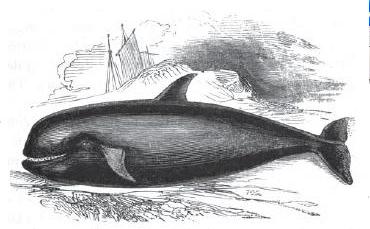
prominent. The angles of the lips are curved upwards, giving the physiognomy of the animal an innocent, smiling expression. The entire surface of the body is of an uniform black colour, and when moist has a polished appearance, like that of japanned leather. On the head, and chiefly around the lips, the skin is marked with many scattered circles, each the size of a sixpence, and composed of a single row of small depressed dots, which would appear to mark a disposition to the formation of vibrisse, or whiskers. |
The swimming-paws are small, and resemble those of the common Dolphin; an erect triangular fin occupies the centre of the back; the tail-fin is four feet broad, and shaped like that of the common Dolphin. A single spiracle, of crescentic form, opens upon the upper and back part of the head. The teeth are straight, conical, and set widely apart. In the examples from which I describe they numbered 6.7, 6-8. There were no teeth in front of the upper jaw; but, in their place, sockets in the gum, to receive the corresponding teeth of the lower jaw. The tongue is round, thick, and fleshy. A few Whale-lice (Larunda ceti) adhere to the skin of this cetacean; and the cavities of the spoutingcanal, as well as the stomach, are infested by clusters of worms, resembling the entozoic round-worm, Lumbricus teres. In all the specimens I examined, the contents of the stomach were chiefly cuttle-fish. Black-Fish usually roam the ocean in very large troops; although a solitary individual of the species is occasionally noticed. They are active and watchful when alarmed, but often betray little concern at the presence of a ship or boats: I have seen a school of these whales approach the ship, dive under her keel, and, rising to the surface on the opposite side, continue their course without any appearance of alarm. They appear to inhabit the greater portion of the aqueous globe, uninfluenced by the remoteness or vicinity of land. We observed examples in many parallels of latitude, between the Equator and 50° N. and 35° S., in the central parts of the Atlantic and Pacific Oceans; as well as off the coast of California, and in the Indian Archipelago. Sperm-whalers often attack this species with their |
boats, in order to obtain a supply of oil for ship consumption. Some risk, however, attends their capture; for, when harpooned, they will sometimes leap into a boat, and instances have occurred of whalers losing their lives by this accident. A Black-Fish, of average size, will produce from thirty to thirty-five gallons of an oil which, in its most recent state, has a dark colour and an unpleasant odour. 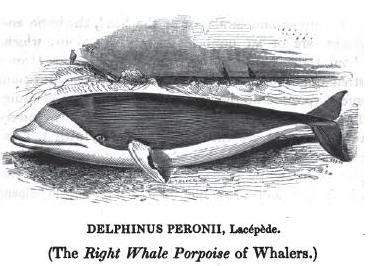
DELPHINUS PERONII, Lacapede.
(The Right Whale Porpoise of Whalers.) This rare and elegant species of Dolphin came under my notice only in the higher south latitudes, and during the Tuscan's passage round Cape Horn. It is chiefly distinguished from the common Dolphin (Delphinus delphis) by the peculiarity of its colour, and the total absence of any appendage, or dorsal fin, on the back; from which latter circumstance it derives the trivial name applied to it by whalers. Judging from the examples we obtained, the average length of this cetacean is six feet.* Its form is *One specimen measured six feet four inches. |
elongated and symmetrical; the snout is short; the lower jaw advances a little beyond the upper; and the forehead rises abruptly. The lips are undulated, and depressed at their angles. In one example, the number of teeth was 39-39, 39-39; in a second, 40-41, 40-41; they are regularly and closely disposed, much curved inwards, and sharp-pointed. In form and situation, the spiracle, swimming-paws, and flukes, accord with those of the common dolphin. The upper and hind-part of the head, the back, and flukes, are of an uniform deep-black colour, which, about the lower third of the body, terminates by a straight and abrupt line; leaving the entire abdomen, and inferior portion of the sides, of a pure and dead white. The snout, and anterior third of the head, are entirely white; as also are the swimming-paws, with the exception of a broad black spot on the upper surface and posterior margin of each. The eyes are small, the iris hazel; and the pupil derives an emerald gleam from the reflection from a bright-green tapetum. In every individual I examined, the stomach was distended by a vast number of Calmars, or Flying-squid. (Loligo.) We first noticed this Dolphin when on the green water denoting the extent of the Brazil Bank, in lat. 40° S., long. 50° W. They were afterwards frequently seen during our passage round the Horn, and as high as 54 S.; but we did. not observe them in a lower latitude than 40° S.,* on the western side of Cape * The French naturalist, Peron, who was the first to describe this Dolphin, did so from specimens he met with in the seas off Cape D'Entrecasteaux, the southern point of Leeuwin's Land, during Baudin's voyage, in 1802. The same species was also observed by M. Lesson, off Cape Pillar, at the entrance of Magallan Straits. We might hence conclude that the species is peculiar to high south latitudes, were we not |
Horn, nor during any subsequent part of the voyage. They came to us in large shoals, darting actively through the water, and sporting around the bows of the ship; and were frequently accompanied by distinct shoals of common Dolphin. Our crew never lost an opportunity of harpooning them, as we esteemed their flesh a delicacy.
DELPHINUS DELPHIS,.
(The Common Dolphin, or Porpoise of Sailors.)
Whales, differing in no appreciable respect from the common Dolphin of the British coasts, came around us in the high seas of every region of the globe we visited during this voyage. It is widely open to question whether the Dolphin of so many distinct climates are not also distinct species;* but, as long as we are to be guided by general resemblance, and are deficient in opportunities of comparing individuals, we must be content to regard them as identical. These small whales came around the bows of the ship in extensive shoals, and many were harpooned by our crew. We held them in much esteem for the table.† When the informed that it has been seen by MM. Quoy and Gaimard near New Guinea, (on the Equator,) during the voyage of the Uranie. * Some abnormal appearances in the form and situation of the fins in many of the Dolphin which came under our notice, and which were called " common porpoises" by the sailors, strengthen the belief that much labour for zoologists yet remains with this family of whales. One individual we harpooned, and which was considered by the crew to be an aged "Porpoise," was superior in size to the common Dolphin; while the intervals between the teeth, both in the upper and lower jaw, being occupied by sockets to receive the opposing teeth, sufficiently denoted that it was a distinct species. Its skin was much mottled with white; some onisci adhered to the body; and a cluster of the elegant soft-barnacle, Otion Cuvieri, was pendant from the lower jaw. † Formerly, and when animal food was less abundant in this country |
external covering of lard, or blubber, is stripped off, the flesh beneath is found entirely free from fat or oil, and, when cooked as steaks, bears a close resemblance to tender beef. It is certainly superior to the flesh of the turtle, cooked in the same form. The liver is also palatable and, wholesome, and resembles in flavour the same part of a pig. In all the individuals we obtained, the contents of the stomach were either fish, cuttle-fish, or shrimps. The food contained in the first compartment of the stomach * had seldom undergone any change; in the second its digestion had advanced; while in the third and fourth cavities it was reduced to a well-assimilated pulp. Each chamber of the stomach (but more especially the second) had large clusters of round-worms adhering to its interior; and where these entozoa had been fixed, the mucous membrane was in a deeply eroded or ulcerated state.
THE GRAMPUS.
This name is applied, by South-Sea whalers, to a species of cetacean which we very frequently noticed in the Pacific Ocean, from the Equator to 44° N. and 10° S. latitude. They occur in herds; and their appearance is supposed to indicate the resorts of the Cachalot. Whether this whale is identical with the Grampus than it is now, the English were accustomed to regard the flesh of the "Porpoise," or common Dolphin, as a voluptuous and aristocratic food. The flesh of the same whale was also anciently employed as food by the French, and being deemed fish, was eaten by all ranks of society on fast-days, and at the season of Lent. * This organ in Dolphin (as in other cetaceans) is complex, or divided into several compartments, each communicating with the other by a small orifice. In this respect it bears a close resemblance to the stomach of ruminant quadrupeds. |
(Phocaena orca) of the North Seas may be fairly questioned; but should it prove to be so, the geographical range of the latter species must be indeed extensive.
FIN-BACKS, COW-FISH, AND KILLERS.
These are cetaceans known to South-Sea whalers by, their respective names, and which came under our notice frequently in the course of the Tuscan's voyage. They are too little profitable to be made objects of pursuit; and are, consequently, in a great measure lost to investigation. Whalers, however, are shrewd and accurate observers; hence we must believe, that the trivial names they employ express as many distinct, and probably new, species of whales, the habits of which may long remain unknown to naturalists. The Killer is, as its name implies, the reputed destroyer of other, and the largest kinds of whales — in fact, the cannibal of its race. Whales thus designated appeared to us in small bands, and chiefly in the vicinity of the Equator. They are of moderate size, spout much like the Cachalot, and are distinguished by a tall and erect dorsal-fin; in this latter respect they resemble the Grampus, (P. orca,) or Killer of the North Seas. I have been unable to glean any facts confirmatory of the prevailing opinion respecting the sanguinary habits of this species. The same traditionary records of its ferocious disposition* are preserved in the Southern, as in the Northern Whale-fishery; but are equally unsupported by personal observation. * The strongest proof that a cannibal propensity ever exists amongst whales, is supplied to us by the fact, that the tail of a Porpoise was found by Mr. John Hunter in the stomach of a Grampus he examined. But this circumstance, when duly considered, will be found to be more mysterious than conclusive. |
Whatever may be the fate of the whale-bone whales, it is scarcely possible that the Cachalot can suffer from the attacks of these assassins; for our present knowledge of the whale tribe will not permit us to believe that any species is better provided with strength and weapons than the Sperm Whale, or is more disposed to employ them when molested.
BONE-SHARKS.
While cruising in the South Pacific, we occasionally observed large animals which bore a great resemblance to whales, (excepting that their tail-fin was perpendicular, and they did not spout,) swimming near the surface of the sea. They appeared to be nearly twenty feet in length, and were called by the whalers "Bonesharks:" — a name which implies little more than the very vague idea entertained of their true character. They are said to have whalebone in the mouth, yet do not spout; but partake of the nature of a shark, or other fish, and, like fish, can maintain a submarine existence for an indefinite time. They have been occasionally mistaken for whales, and harpooned by inexperienced whalers, when, taking away the line with irresistible impetuosity, they have disappeared in the ocean's depths, and left their assailants to watch in vain for their return to the surface. Since whalers religiously avoid an encounter with these troublesome creatures, it follows that their real form and structure are but little, if at all known. If we admit that an error exists on the subject of there being whale-bone in its mouth, it appears probable that the Bone-shark is allied to, or identical with, the Basking-shark, (Squalus maximus,) a fish, measuring from fifteen to thirty feet in length, and which was |
formerly regarded as a species of whale. It frequents the western coasts of Great Britain and Ireland, where, during the summer months, it often lies basking on the surface of the sea, and is harpooned by fishermen for its liver, which yields a large quantity of oil. It is, however, a fish very troublesome to kill, and has been known to carry away two harpoons and two hundred fathoms of line. |
BIRDS.THE FRIGATE-BIRD.
|
sequently it can neither swim nor dive, and is seldom seen at any very considerable distance from land; although its lightness of frame and extraordinary power of wing enable it to hover over the ocean with unwearied assiduity. Neither does it alight on the rigging of ships, like many other amphibious species, as terns and boobies. It is true, that when on the Equator, in long. 137° E., we captured one example, which alighted on the spanker-gaff and permitted itself to be taken by hand; but this was regarded by our crew as an unprecedented occurrence, and as the individual, although of adult size, was evidently young, youthful indiscretion was pleaded as its excuse. Sailors believe that the sea-hawk sleeps on the wing; though I am not aware that there are any recorded facts in favour of this notion. When the nearest land is remote, they will continue fishing around a ship for many successive days and nights, and continue unremittedly on the wing; but when in the immediate vicinity of land, they invariably return to the shore at sunset. Their flight is exceedingly easy and graceful, and has also the charm of variety: sometimes the bird may be seen balanced in mid-air, its wings spread but apparently motionless, its long forked tail expanding and closing with a quick alternate action, and its head turned inquisitively from side to side to inspect the ocean beneath; sometimes it wheels rapidly, or darts to the surface of the water in pursuit of prey; and at others, soars to so great a height that it is lost to vision, or becomes a mere speck in the sky — an elevation of flight which is alone sufficient to distinguish this from all other sea-birds. They apparently take a delight in soaring over the mast-head of a ship, from which they usually tear |
away the pieces of coloured cloth fixed in the vane. One individual, thus occupied over the Tuscan, was taken by hand by the man at the mast-head. The lookout at the time was kept by a landsman, remarkably tall and slender, and his mess-mates would never believe but that the poor bird, accustomed to the figure of a sailor, had mistaken him for a spare spar, and thus fallen a victim to a want of discernment. Unable to seek their prey in the water, the sea hawks limit their depredations to fishes that leap, or flying-fish, when, disturbed by the passage of a ship, or pursued by albacore and bonita, they rise in the air to seek that security which the water denies them. The larger predaceous fish are in this manner of essential service to the frigate-bird; the latter usually taking the prey which the former have startled but failed to secure. When the ocean is turbulent these birds fare sumptuously every day. We have seen one individual take three flying-fish in the course of a few minutes; and more than that number was rejected from the stomach of another example, which we captured. When the sea is calm their fishing is less successful, and it is then that they resort to that peculiar system of plunder for which the species is so remarkable, namely, attacking other seafowl, as boobies or tropic-birds, (whose power of diving enables them to obtain food at all times,) and compelling them, by repeated blows, to disgorge the fish they have swallowed, and which when ejected, the frigate-bird seizes with great dexterity before it falls into the sea. In the course of their own fishing, also, should the fish they have seized be placed awkwardly in their beak, they do not scruple to drop it, trusting to their power of again pouncing upon it, and grasping it in a more favourable position, before it reaches the water. |
On volcanic and other abrupt coasts, the frigate-bird builds its nest in the crevices of high cliffs; but where these do not exist, as on the low coral islands of the Pacific Ocean, it selects the loftiest trees, both for roosting and nidification. THE PINTADO PETREL.
|
During a calm, a vast number of these birds alight on the surface of the sea, and swim round a ship in search of offal; or should the vessel be lying-to in a gale, they are equally familiar, and ride composedly over the most gigantic billows. At these times they will readily take a hook, baited with pork; and having been once thus captured does not deter them from taking the bait a second time, or even oftener, if opportunities are afforded them. Many may also be taken by allowing a slender line to tow astern of the ship: they usually get their wings entangled in the string, as they fly carelessly across the wake of the vessel; and it is remarkable, that when thus shackled they make but few efforts to liberate themselves, and may be hauled on board with scarce a struggle. Like most other oceanic birds, they are unable to rise from a level surface, as the deck of a ship, owing to the shortness of their legs, as compared with the extreme length of their wings. It might be supposed that the same cause would impede their rising from the plane surface of a calm sea; but here they have the advantages of space and an elastic tread, and by running on the surface of the water for some distance, aided by a flapping motion of the wings, they at length gain sufficient way and elevation to be able to mount in the air. The ordinary food of this species is small fish, sepiae, and pelagic crustacea; but they do not refuse any animal offal floating on the sea. They give a decided preference to fat, and the carcase of a whale often affords them a sumptuous feast. When captured, they invariably disgorge the food they have recently swallowed, and often a large quantity of oil. It has been said that this fluid is secreted by the petrel; but I believe that it is never ejected from the mouth of the bird unless |
the food previously taken has been of an unctuous nature: in some instances, indeed, its odour was too identical with that of train-oil to admit of any doubt as regards its origin. I have made many attempts to accustom these birds to captivity, but could never succeed. They were tranquil in confinement, showed a propensity to attain an elevated station by climbing, and uttered a low chirping note, very unlike their natural harsh scream, but invariably refused food, and died in a few days. The two wings of the pintado, when cut off from the body, expanded, and placed together at their bases, are employed and sold by the Chinese as an ornamental fan. It is, when completed, of semicircular form, and the black and white markings of both wings correspond so well, that it has a very uniform and neat appearance. THE BRIDLED PETREL.
|
With the considerable exception of the white markings on its head, this bird approaches closely to P. fuliginosa, of which species it may probably be a variety. I am the more inclined to think that it is so, on account of my having taking two examples of a female petrel (the one off the Cape of Good Hope, and the other near Cape Horn,) which were only to be distinguished from P. fuliginosa by the plumage of their chin being white. THE WHALE-BIRD.
|
feathers of each wing, and two of the tail-feathers, dullbrown; a narrow line of black, and a second of white plumage on the upper eye-lid. Beak and legs black. Entire length ten inches; spread of wings eighteen. Flutters in its flight, and seeks a resting-place after sunset, usually alighting on a ship's rigging when at sea. Feeds on crabs and small fish. The presence of this bird is regarded by sailors as a sure indication of land. Habitat. Christmas Island, and other low coral formations of the Pacific. THE BOOBY.
|
Plumage uniformly gray-brown; beak blue; legs light-yellow or lemon-colour. Stomach contained eight flying-fish, and the beaks of cuttle-fish. Example C. – In lat. 14° N., Pacific Ocean. Resembles the preceding, with the exception that the abdomen is white and the legs blue. Example D. – In lat. 3° N., Pacific Ocean. Back, wings, and tail blue-gray or ash-colour; head, neck, and abdomen white. Naked integuments of the head blue. Legs red. Example E. – In lat. 13 1/2° N., Pacific Ocean. Back, wings, and tail sooty-black; head and neck gray; abdomen white; a black band across the neck, at its junction with the shoulders. Beak and exposed skin of the face slate-colour. Legs pea-green. Iris, a narrow silvery zone. All the above correspond in size and habits with the common Booby (P. sula). They are heavy in flight, and seldom seen far from land. When on the wing, watching for fish, they turn their head about in a very ludicrous manner, and occasionally dive to the surface of the water and seize their prey with great dexterity. They are stupidly tame, frequently alighting on the rigging or bulwarks of ships, and permitting themselves to be handled; and this when neither distance from land, repletion, nor the approach of night, can be assigned as an excuse for their familiarity. Berkenhout (Synopsis of Nat. Hist.) makes it a part of the generic character of Pelicans, that they are without external nostrils; while Blumenbach (Manual of Comparative Anatomy) asserts that all birds have external nostrils, more or less conspicuous. Although it is true that most of the Pelican family have small but complete nostrils on the outer surface of the upper |
mandible, yet the Booby offers an exception, in favour of Berkenhout's remark, and opposed to the assertion of Blumenbach. After a most patient examination of the beak of all the kinds of Booby enumerated above, I am compelled to declare that there is not the slightest appearance of an external nostril; although the palatine opening of the nasal cavity, or inner nostril, is well developed. There is a small slit, or notch, on the inferior margin of the upper mandible, and which I supposed might he a nasal aperture; but upon removing the horny sheath of the beak, it appeared confined to that structure, and the exposed bone was impervious. As a provision for swallowing fish entire, the mouth and gullet are capable of great expansion, and the upper mandible of the beak moves freely at its junction with the cranium. The tongue, though large in many sea-fowl, is in this bird rudimental, and remarkably small. The skeleton of the Booby differs also from the more normal structure of birds, in possessing a perfect bony patella, or knee-pan, independent of the elevated process of the tibia, which usually supplies its place in aquatic birds. But this is not uncommon with oceanic tribes, and equally obtains in the frigatebird and petrels. NOTES ON THE ALBATROSS FAMILY.
|
The Wandering Albatross, (Diomedia exulans,) so commonly seen off the Capes Horn and Good Hope,* has a white plumage, beautifully pencilled on the back and scapulars, and the wings marked with black and white.† In size and form of body it is intermediate to the goose and the swan. The average length of the species is five feet, and its spread of wing ten and a half; amongst a multitude of specimens, I have seen none in which the spread of wing measured more than eleven feet. There are two other birds which may be regarded as varieties of the above. The one, and which I have seen only in the neighbourhood of Cape Horn, differs from the kind last mentioned, in possessing a vertical line of rose-coloured plumage on each side the neck. The other offers a more marked distinction; its plumage being light-brown speckled with white. The principal anatomical peculiarities I have noticed in this species are, the existence of an epiglottis, partly closing the aperture of the larynx; and a supplemental bone, or spurious wing, articulating with the humerus, at its junction with the radius and ulna. I have been unable to detect the function of the large and peculiar superciliary glands which are found on the cranium of both the Albatross and Petrel tribes. They have no very distinct deferential ducts; but that which most resembles one, passes into the nasal cavity, along the roof of the upper mandible. The second well-determined species is D. Chlororynchus, the Molly-maux.‡ It is smaller than the Wan- * We have met with this bird in so low a latitude as 21° S. † The plumage of the young bird is uniformly gray. ‡ The lowest latitudes in which we have seen this species, are 28° N. and 35° S. |
dering Albatross. The back is uniformly black, and a black mark extends across each eye, the rest of the plumage being white. The beak is yellow; the legs white. The third species, D. Fuliginosa, Pio or Quakerbird, is as large as the preceding, but of a more slender form. Its entire plumage is sooty-black, with the exception of a narrow zone of short white feathers encircling each eye. The beak is black, with a narrow white line on the margin of the upper mandible. The legs are white. A peculiarity in the form of the tail of this bird, has obtained for it, amongst sailors, the name of Cape Hen. The lowest latitudes in which we noticed the Pio, were 42° S. and 28° N. The habits and habitat of these species are for the most part the same. The kind I have more particularly to mention, differs from all the above; and it will be seen how far it is entitled to be considered a new species, or as a variety, dependent upon youth. Its size is that of the Molly-maux, which bird it also resembles in habits and flight. The form of its beak and legs is that which obtains in the Albatross family generally. The prevailing hue of the plumage is dull-brown, shaded lighter on the crown of the head, (which in some examples is nearly white,) and darker across the eyes, over the neck, and on the wing-coverts. Beak light-brown. Legs black. The species was first seen by us on the eastern side of Cape Horn, from lat. 40° to 49° S. We did not again notice any examples until in the Pacific Ocean, in lat. 40° N., where they were exceedingly numerous. During a subsequent cruise on the same ocean, in the month of June, we had several of these birds about the ship in lat. 27° N., but this was regarded as extraor- |
dinary; for it is evidently the habit of the species to migrate to an extreme climate during the summer season. Neither did those few individuals remain long with us, as we continued to cruise on nearly the same spot, and in July none were seen thus far to the southward; although in September they again appeared in increasing numbers. They alighted on the sea in large flocks, and swam round the ship, feeding greedily on the offal of whales. When tranquil or satisfied they uttered an agreeable low whistling note, but when quarrelling screamed discordantly. They were very familiar, and many were taken by hook and line, baited with salt pork. |
FISHES.ORDER, CHONDROPTERYGII.THE LUMINOUS SHARK.
|
tribe. The number of gill-apertures is five on each side. The fins are short, and, for the most part, disposed to a round form: the dorsal are two in number, small, and placed far back; the tail-fin is unequally divided, the upper being the longest and largest lobe. The head is flat. The snout prominent, rather pointed, and has two nostrils at its extremity. There is, also, on each side of the upper and back part of the head, a large oval orifice, like a spiracle or nostril, provided with a valve, and communicating with a corresponding aperture in the roof of the mouth. The mouth is capacious, and the dark skin around it is incised on, each side, to some extent beyond the commissure of the lips, exposing a white elastic membrane beneath. The upper jaw is armed with many rows of small sharp teeth, while the lower has only a single row of perpendicular teeth, or rather, an elevated plate of bone, sharply toothed on its summit, and bearing a close resemblance to a segment of the surgical circular saw called a trephine. The eyes are much more prominent and dilated than is usual with sharks; the iris is black; the pupil transparent, and of a greenish colour. The example I dissected was a female. The abdomen contained six round membranous eggs, each the size of a pigeon's egg, and containing a colourless glairy fluid. The two uteri were empty and collapsed. The principal peculiarity in the anatomy of this shark is the existence of what must be regarded as a sternum, or breast-bone, (which is by no means common, even in bony fishes.) It is a small bone, shaped like a horse's hoof, and has two processes projecting laterally, by which it is articulated to the bones supporting the pectoral fins. The hollow of the hoof (to pursue the comparison) is closed in- |
feriorly by membrane, and the heart, invested in pericardium, is lodged within it, as in a box or cell. When the larger specimen, taken at night, was removed into a dark apartment, it afforded a very extraordinary spectacle. The entire inferior surface of the body and head emitted a vivid and greenish phosphorescent gleam, imparting to the creature, by its own light, a truly ghastly and terrific appearance. The luminous effect was constant, and not perceptibly increased by agitation or friction. I thought, at one time, that it shone, brighter when the fish struggled, but I was not satisfied that such was the fact. When the shark expired, (which was not until it had been out of the water more than three hours,) the luminous appearance faded entirely from the abdomen, and more gradually from other parts; lingering the longest around the jaws and on the fins. The only part of the under surface of the animal which was free from luminosity was the black collar around the throat; and while the inferior surface of the pectoral, anal, and caudal fins shone with splendour, their superior surface (including the upper lobe of the tail-fin) was in darkness, as also were the dorsal fins, back, and summit of the head. I am inclined to believe that the luminous power of this shark resides in a peculiar secretion from the skin. It was my first impression, that the fish had accidentally contracted some phosphorescent matter from the sea, or from the net in which it was captured; but the most rigid investigation did not confirm this suspicion; while the uniformity with which the luminous gleam occupied certain portions of the body and fins, its permanence during life, and decline and cessation upon the approach and occurrence of death, did not leave a |
doubt in my mind but that it was a vital principle, essential to the economy of the animal. The small size of the fins would appear to denote that this fish is not active in swimming; and since it is highly predaceous, and evidently of nocturnal habits, we may perhaps indulge in the hypothesis, that the phosphorescent power it possesses is of use to attract its prey, upon the same principle as the Polynesian Islanders, and others, employ torches in night fishing. THE HAWAIIAN FROG-FISH.
|
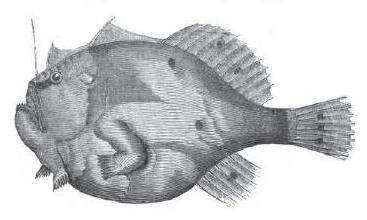
The fins on the upper surface of the body are peculiarly arranged. The first, (which I dare not call a dorsal,) is composed of one stout spinous ray, with a membrane attached, and is placed in front of the summit of the head — the second is similarly formed, and situated immediately behind the head — the third occupies the posterior two-thirds of the back, and is composed of twelve branched rays. Rays of the anal fin 7. Caudal 9. The pectoral fins bear a very close resemblance to the anterior extremities of a frog or lizard, and the ten distinct rays, at the termination of each, complete the comparison by their resemblance to toes. A long membranous air-tube, communicating with the gills, passes beneath the integuments of this fin, and opens as a circular orifice at its joint, or elbow. The solitary example of this species, which we obtained from the shores of Oahu, Sandwich Islands,* continued alive for many hours after it had been removed from the water. During this time its abdomen and throat remained distended to a great size; but previous to death, both air and water were evacuated from the mouth, and the body collapsed. Dissection proved, that the cavity of the stomach was the part thus distended. This fish has no ribs, though it has a very distinct sternum. Its swim-bladder is small and of ovoid form. THE FILE-FISH OR LEATHER-JACKET.
|
bone of the belly (balista) short, but little developed. Teeth, eight in each jaw. Rays of the first dorsal fin 2; second 24. Pectoral 14. Anal 21. Caudal 12. This may be the B. Maculatus, (Linn. and Gmel.,) or Spotted File-fish, although it differs from that species, as described by authors, in its colours, as well as in having no prickles in the place of the ventral fin. We met with many examples of this fish in the Pacific Ocean, in lat. 16° N., long. 106° W. They were attending a log of drift-wood, and came around the ship in large shoals. The greater number were taken by hook and line, and eaten by our crew. Their flesh, though of coarse quality, proved to be wholesome; notwithstanding the assertion of ichthyologists, that fish of this genus are mostly poisonous. When first taken from the water, this species, in common with its congeners, produces a loud grinding or gnashing sound with its teeth. There is a remarkable peculiarity in the construction of the anterior dorsal fin of the genus Balistes, and which has obtained for this family the trivial name of "Trigger-fish." When this fin is elevated, its first spinous ray, which is exceedingly thick, remains fixed, and cannot be depressed, with any degree of force short of that which would fracture it, unless the second ray is depressed, when the first immediately follows. The animal mechanism which effects this is curious. A strong trough-shaped bone, its concavity placed uppermost, corresponds to the base of the anterior dorsal fin, and gives it support. The inferior edge of its anterior or broadest extremity is fixed to the head of the fish by a bony peg, or condyle, received into a corresponding circular orifice, and by its superior edge being continuous with the summit of the cranium; while its |
posterior or narrow extremity is supported by an effective bony prop, fixed to the dorsal vertebrae. The first spinous ray of the dorsal fin is attached to this osseous platform by a broad hinge-like joint, which permits motion only in the directions backward and forward. The base of the second ray, which is also thick, but flattened laterally, curves forward, and its convexity, which is very rough, is opposed to a deep groove on the back of the first. The root of the second ray is furcated, and strides across the convexity of a semilunar process, rising from the hollowed surface of the bony platform, and on which it moves only in directions parallel to the axis of the fin. The function of this apparatus is as follows. When the first spinous ray of the fin is erected, (either artificially or by the muscular power of the fish,) the second follows, and the rough convex process of its base is inserted within and beneath the grooved surface of the first; so that the latter rests upon it, and is supported by it, with an obstinacy proportionate to the depressing force applied; while the direction in which the first ray presses upon the base of the second is at the same time well calculated to retain the second ray in its firm and erect position. If the second ray be gradually depressed, the first falls with it; but both are as firmly fixed upon each other at every stage of their descent as when they are erect, and upon the same principles. Some species of Balistes have three spinous rays in the anterior dorsal fin; but the third ray takes no part in the economy I have just described. Unlike most other fish, the Balistes employ their tail but little in swimming — a rapid lateral action of their long dorsal and anal fins being their principal mode of progression. |
THE LONG-HEADED FILE-FISH.
|
scales, and composed of a very dense cartilage, which, in some parts, is nearly two inches in depth. The pectoral fins are short and broad, and their position denotes that they have a vertical action. The dorsal and anal fins are long, pyramidal, and placed opposite to each other; while the tail-fin joins the two last, and constitutes a large segment of the circle formed by the entire body of the fish. A peculiar soft structure, or hinge, intervenes between the fins and the dense texture of the skin, and serves to facilitate their motions. The gill-aperture has a semilunar form, and is placed immediately in front of the pectoral fin. The skeleton of this fish is chiefly composed of a white cartilage, but the jaws are furnished with two strong bony plates or teeth, each of which is continuous, and consequently denotes that the fish is of the genus Diodon; although some authors have placed it amongst the Tetrodons, which have their jaw-plates, or teeth, divided by a fissure in their centre. The contents of the stomach, in the examples we examined, were small red cuttle-fish. The eye of the Sun Fish is large, and possesses the following remarkable peculiarity: the conjunctiva, or outer membranous coat, of this organ is white, thick, but loosely attached to the parts beneath, and lies in small circular folds; while behind it, and around the eye-ball, there is a sack of gelatinous fluid, occupying the back part of a capacious orbit. When the fish is alarmed for the safety of its eye, as by the approach or contact of a foreign body, it displays a power of retracting the eye-ball within the orbit; when the gelatinous fluid behind it is displaced, starts forward, distends the loose folds of conjunctiva, and covers and protects the eye more effectually than the eye-lids of |
quadrupeds. In the living examples we captured, this mode of defending the eyes was exercised as often as these organs were touched, or the parts in their vicinity pressed upon. It may probably be a provision for a state allied to sleeping, as this fish is often seen floating on the surface of the water, apparently in a state of perfect somnolency. Two parasites were attached to these fish — the one was a Lernaea, rooted in the conjunctiva of the eye; the other was a large Oniscus, adhering to the gullet. The liver of the Sun Fish has a bright-yellow colour, and yields a large quantity of oil, which is much valued by sailors as an external application for sprains, bruises, and rheumatic pains. The flesh of this species is delicately white, and affords a wholesome and palatable food: in flavour and texture it bears some resemblance to skate. THE ROUND DIODON, OR TOAD-FISH.
|
inflated its body, erected its spines, gnashed its teeth, and produced sounds by an emission of air through its mouth. It inflated its body by pumping air into the gullet, by frequent gulps or gasps. The contents of the stomach were fragments of the shells of Hyalaea tridentata, and a sucking-fish, the head of which was detached from the body and much mutilated. The sailor who brought me the specimen, reported that it had also thrown up a sucking-fish at the time it was captured. The spines which cover the body of this species are curiously constructed: each spine has a bony root, branched in this manner – : its longest branch extending horizontally and longitudinally beneath the skin, and the base of the spine being fixed on the angles formed by the two shorter and transverse branches. The long arm of one bony fulcrum invariably overlaps the short branch of another, and thus the entire series forms a very flexible, but at the same time a very complete armour. The resemblance which these spines bear to the similar erectile weapons of the porcupine and hedge-hog, amongst quadrupeds, is much increased by the existence of a thick layer of muscle, (or panniculus carnosus,) lining the entire skin of the fish, and firmly attached to the roots of the spines. From the extent of surface this muscle occupies, its power is evidently great; and its use is discovered by handling the inflated fish: the spines are then necessarily protruded, and press forcibly against any object with which they are in contact; but their action does not cease here, for the hand holding the inflated animal, feels a constant boring motion of the spines, which is extremely painful, and very different from that produced by the passive contact of a thorny body. Immediately beneath the muscular lining of the skin, |
there is a thick opaque membrane, covering the belly of the fish; and this, when distended with air, produces the inflated appearance of the body. It can he distended or emptied at the option of the animal, and is evidently supplied with air through the mouth and throat; although I was unable to detect the precise point of communication.* I noticed, however, that by blowing into the mouth of the dead fish, I could inflate this membrane, and by passing a finger into the throat could as readily empty it. To produce the inflation of the body, (which must be regarded as a mode of defence,) it would appear that the fish should have access to atmospheric air. Two nostrils, provided with broad fleshy margins, at the extremity of the snout, may supply this want when the fish is on the surface of the sea, and it is questionable whether water may not be employed as a substitute for air in the ocean's depths. THE FIVE-SPINED TRUNK-FISH.
|
THE SEA-DRAGON.
|
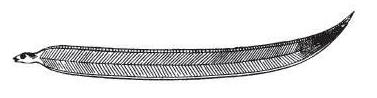
pupil black; the body is long and very compressed; it widens abruptly immediately behind the head, and remains nearly the same size until it approaches the tail, when it tapers to a fine point. It is smooth, consists of a firm gelatinous structure, enveloped in a tough tunic, is colourless,* and in all parts so perfectly transparent, that when laid on the page of a book it does not obscure the smallest letter. No traces of viscera interrupt its uniform transparency. A white thread-like line passes within the entire length of the body, near its upper third, and is intersected by similar slender lines, arranged obliquely and at equal distances. They resemble the rudiments of a skeleton; but are, more probably, portions of a nervous system. There are no pectoral, ventral, nor caudal fins; the dorsal is merely a thin narrow membrane, occupying the entire length of the back; and the anal, which reaches nearly to the tail, is equally insignificant. Examples of this fish, when first taken from the water, did not exhibit the slightest movement, or other sign of life, and their body retained the curve which I have given to it in the above sketch; but when they were put into a vessel of sea-water, immediately they were taken from the net, they swam actively, with a twirling or eel-like motion. All the specimens we obtained were taken near the surface of the sea. They varied much in size. The average length of the species appeared to be from seven to ten inches; though one individual we captured, measured one foot three inches in length, and an inch and a half across the broadest part of the body; its head was, as usual, small, and bore no proportion to the increased size of the body. * In some specimens, I noticed that the body had a delicate pink hue, with a row of black dots on the margin of the dorsal fin. |
In the Pacific Ocean and Indian Archipelago, the species occurred to us from lat. 3° to 29° N., and from the Equator to 9° S.; and no where in such great abundance as in the Straits of Timor. In the Atlantic we captured one individual, in lat. 24° N. The only species of Leptocephalus, hitherto known, is L. Morrisii, found on the coast of Anglesea. The description and figure given of it, leads me to think that it accords very closely with the exotic species we obtained. Size, geographical distribution, and some few other peculiarities noticeable in the tropical specimens, as above described, may induce us to suspect a difference, although it is difficult to detect sufficient specific distinctions in animals of so anomalous a structure. It is impossible to preserve specimens of this fish in any kind of spirit; for, when thus prepared, they invariably become opaque, swell to an unnatural size, and ultimately burst and fall into a flaccid state. I succeeded in bringing several examples to England, in a very complete state of preservation, by putting them into a saturated solution of sea-salt, alum, and nitre — a solution which answers well, also, for the preservation of pellucid and delicate molluscs. HEMIRAMPHUS ARGENTEUS.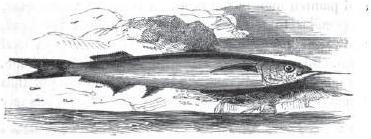
This fish is chiefly remarkable for possessing a prolongation of the lower jaw, in the form of a slender, |
black, and pointed bone, similar in form, and apparently in office, to the beak, or rostrum, continued from the upper jaw of the sword-fish. Average length of the species 4 inches. Body long and compressed. Colour, uniformly silver-white; iris silvery. Pectoral fins long and slender; dorsal and anal placed far back and opposite to each other. Taken near the surface of the sea, in lats. 3° S. and 5° N., Pacific Ocean. ORDER, THORACICI.THE SUCKING-FISH.
|
backwards, and each armed at its free border with numerous small spines. The average length of this species is from six to eight inches. It has no swim-bladder, or sound. Its skeleton is strongly and perfectly formed. The ribs are double, the inner and stronger series being eleven on each side, the outer and more slender, nineteen or twenty. The female is oviparous. The contents of the stomach, in the specimens we examined, were small marine insects, shrimps, and fragments of delicate shells. As this fish has no swim-bladder, and as its fins are feeble, and possess only a horizontal action, it is not improbable, that a power of adhering to floating bodies is given to it as a compensation for these physical defects, and that the sucker is only of use as a locomotive organ, or as an agent by which the fish reposes after the laborious exercise of swimming. The slow and prowling movements of the shark render it particularly eligible either as a resting-place or as a conveyance for the sucking fish, hence it is usually attended by many of these half-parasitic companions. Any convenient floating object is, however, also acceptable: we have seen them adhering to turtle, albacore, whales, and the bottom of ships. It is not true that the Remora receives any nutriment through its sucker, or that it in any way injures the animals to which it may adhere: its capacious and well-armed mouth, and the food contained in its stomach, denote that this fish is as capable of catering for itself as any other species, of more independent habits. The use it makes of its sucker is, indeed, much less than may be supposed: it often merely swims around the body it attends, and only fixes upon it occasionally, and for a very short time. |
The adhesion of the buckler is chiefly effected by the smooth membrane that margins it; and apparently upon the same principle as that which applies to the leather sucker with which boys amuse themselves. After the death of the fish, and even after the head has been severed from the body, the moist membranous border of this organ adheres to a plane surface with undiminished power: proving, satisfactorily, that its adhesion is partly mechanical, and not altogether dependent upon muscular action, or any vital function. The striae on the surface of the buckler are under the control of a complex set of muscles. One can be raised and depressed by the fish, independent of the others, or all can be moved simultaneously and rapidly. Their uses are, to fix the sucker more firmly, to offer resistance in one determinate direction, and, probably, to liberate the sucker from its attachment, by relieving the vacuum. Their resisting power is so strong, that it is impossible to slide the fish off the object to which it adheres, in the direction to which these plates are opposed, although in the contrary direction this may he easily done; and it is remarkable, that the Remora usually fixes itself with its head presenting towards the anterior extremity of a body moving through the water; thus availing itself of the resistance the striae offer to any impulse directed from the head towards the tail. When swimming, the sucking-fish propels itself by rapid lateral movements of the tail, attended with an awkward twirling motion. The species is not altogether free from enemies, although it is evidently secure from the ferocity of the shark. I have already noticed, that two of these fish had been devoured by a Round-Diodon, and we took a third dead example from the maw of an albacore. |
Some perfectly white Remora; which we noticed, both adhering to a shark and swimming by its side, in company with others of the normal black hue, would sanction the belief that this species is liable to an albino variety. It often happened, after whales or sharks had been destroyed, that the Tuscan was attended by Sucking-fish for several successive weeks. Great numbers of them were taken by hook and line, baited with flesh. They take a "still bait" readily; but some tact is required to draw them out of the water, as the instant they are hooked, they will sometimes fix themselves by their sucker to the keel of the ship, and defy every attempt to complete their capture. AUSTRALASIAN REMORA.
|
THE SOCIAL-DORADO, OR BLUE-FISH.
|
the iris hazle, outer gold-yellow. A single row of teeth in each jaw. Three short spines in front of the dorsal fin, and two in front of the anal. Lateral line is oblique, and terminates posteriorly in a semi-cartilaginous ridge, projecting from either side of the tail. The female is oviparous. 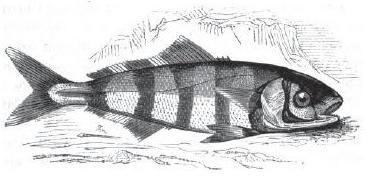
Pilot-fish are almost invariably found in attendance upon the shark, though the nature of their connexion with that ferocious fish is somewhat mysterious. They will accompany ships for a considerable time after their patron-shark has been destroyed; but I am not aware that they have ever been seen, like the Remora, attending upon other large fish, whales, or miscellaneous floating bodies. The structure of their mouth and the contents of their stomach, which are usually small fish, denote that they are accustomed to seek their food in a very independent manner: we captured many of them also by hook and line, baited with flesh, nor did they refuse the bait even when they were in company with a shark. The reputation this fish has obtained of being the shark's pilot or provider (and which has sanctioned its trivial name) would appear to be groundless, were we guided only by the want of similar precedents in the |
animal kingdom. A fact, however, which came under my notice during a voyage from India, in the year 1832, led me to believe that there is some just foundation for this popular opinion. While we were becalmed in the Atlantic Ocean, a shark was seen close to the ship, and attended by two Pilot-fish, which generally swam one above and the other below him, and occasionally went off to some distance, as if to explore the surrounding sea; although it was seldom long before they returned, and resumed their former positions — the shark, in the meantime, by its unwieldy form, slow movements, and lethargic aspect, offering a strong contrast to the sprightliness and activity of his scouts. A baited hook was lowered from the bow of the ship; but the shark, when alone, passed it several times without notice, and apparently without seeing it. One of the foraging Pilot-fish then approached the bait, and immediately swam off to where the Shark was headed in a contrary direction; when the monster instantly turned, and followed his informant, which now swam ahead of him, in a direct line towards the suspended bait. He did not then hesitate a moment, but seized it, and was captured. While the Shark was being hauled on board, the Pilot-fish expressed the greatest concern, almost leaping out of the water in their endeavours to follow him, and swimming near the surface with every demonstration of anxiety. These faithful little fish were observed to attach themselves to the ship, but attracted little attention until some weeks afterwards, when we spoke the Thomas Grenville, East-Indiaman, and lowered a boat to communicate with her. One of the fish was then seen to accompany the boat to and from the stranger-ship; and so devotedly did it attend upon what it might have believed to be its |
lost shark, as to lead the officers of the Thomas Grenville to remark that we had a Pilot-fish painted on the rudder of the boat. Their attendance upon sharks is somewhat capricious: we have seen more than five associated with one shark, while many others of the latter tribe, and assembled in the water at the same time, have not been accompanied by one of these fishes. They have evidently nothing to dread from the voracious companion they select, but swim around, and often a few inches ahead of him, as either their convenience or caprice may dictate. THE TRANSPARENT SOLE.
|
27° N., long. 170° WI; the other about a day's sail from the Marquesas Group. THE SMALL-SPINED DOCTOR-FISH.
|
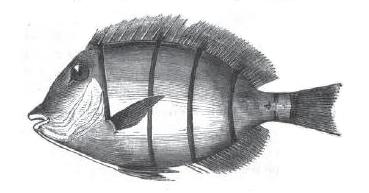
Scomber Thynnus, the Tunny; but has some peculiarities which distinguish it from that species, and bring it nearer to S. Germo, of Commercon. The average length of the examples we captured from the ship was four feet; though some others, which we saw on the coasts of the Polynesian Islands, measured nearly six feet. Their body is bulky, but, like that of all the Mackerel family, very elegantly formed. The colour of the back is bright-blue or azure, with a golden tint; the belly silvery-white and. beautifully iridescent; the spurious fins of the tail bright-yellow, the iris silvery. The pectoral fin is long and sickle-shaped. The first dorsal, composed of fourteen rays, is received and completely concealed, when depressed, within a deep groove on the back. Rays of the ventral fin, seven. Anal, twelve. Caudal, thirty. The spurious fins, (nine above the tail and eight below,) are triangular, and move freely in a lateral direction. An elastic semi-cartilaginous ridge projects from each side of the tail. It is only on the upper and anterior parts of the body, and chiefly around the pectoral fins, that there is any collection of scales; the rest of the fish being smooth, and apparently destitute of this covering. The eyes are very large, and provided with a bony sclerotica. It is chiefly remarkable of this fish, that amongst the vast numbers of them we captured for the table, or other purposes, not one possessed a milt or roe: nor had any of our crew, even the oldest voyagers in the Pacific, ever noticed these organs in the albacore, or any distinct traces of their mode of propagation. Dissection seemed to demonstrate that the species is viviparous;* but it is equally strange that no examples * The anatomical peculiarities which lead to this inference are as |
thus impregnated came at any time under our observation. The Mackerel and Bonita, congeners of the Albacore, are decidedly oviparous; and the Albacore, or Tunny (S. Thynnus) of Europe, is well known to frequent the shores of the Mediterranean to exclude its eggs or spawn. Ships, when cruising slowly in the Pacific Ocean, are usually attended by myriads of this fish, for many successive months. A few days rapid sailing is, nevertheless, sufficient to get rid of them, however numerous they may be; for they seldom pay more than very transient visits to vessels making a quick passage. When the ship is sailing with a fresh breeze, they swim pertinaciously by her side and take the hook greedily; but should she be lying motionless or becalmed, they go off to some distance in search of prey, and cannot be prevailed upon to take the most tempting bait the sailor can devise. follow. The two organs which may be considered as uteri, in the female fish, are situated close to the spine, one being placed on each side of the swim-bladder. They are about four inches in length, red, and of fleshy texture. Their anterior extremity is rounded and impervious, and attached to a broad membrane, which in consistence and colour bears some resemblance to the parenchyma of the lungs of amphibia; their posterior extremity is narrower, and terminates in a slender tube. The interior of each uteroid body is a cavity or bag, but its sides are in contact, and lined with longitudinal folds of the same structure as the rest of the organ. The terminal tubes of both uteri conjoin to form a more capacious canal, which is separated from the vesical tube, or urethra, by a thin membranous septum; while the rectum opens by a distinct channel thus, although but one common orifice or cloaca exists, there are, immediately within it, three distinct orifices. What would appear to be sexual organs in the male fish, are narrow flattened bodies, similar in situation, length, and colour, to those of the female; but their structure is glandular and solid, and they are only perforated by a minute tube or duct, passing through the centre of their entire length. |
It is, probably, as a protection from their chief enemy, the sword-fish, that they seek the society of a ship. I am not aware that the shark is also their enemy; but they seemed to have an instinctive dread of this large fish, and when it approached the ship, would follow it in shoals, and annoy it in the same manner as the smaller birds may be seen to annoy those of a larger and predaceous kind, as the hawk or owl. They are very voracious and miscellaneous feeders. Flying-fish, calmars, and small shoal-fish, are their more natural food; though they do not refuse the animal offal from a ship. Amongst the other food contained in their maw, we have found small ostracions, file-fish, sucking-fish, janthina shells, and pelagic crabs — in one instance a small bonita, and in a second a dolphin, eight inches long, and a paper-nautilus shell, containing its sepia tenant. It was often amusing to watch an albacore pursuing a flying-fish, and to mark the precision with which it swam beneath the feeble aeronaut, keeping him steadily in view, and preparing to seize him at the moment of his descent. But this the flying-fish would often elude, by instantaneously renewing his leap, and not unfrequently escaped by extreme agility. THE BONITA,* OR BROAD MACKEREL.
|
distinguished from its congener last described, by possessing four or five longitudinal black lines on each side the body. In all the pelagic examples we obtained, the sexes were very plainly denoted, by the existence of either a milt or an impregnated roe. Their flesh has the colour of raw beef, and is very good eating, although rather inferior to albacore. Bonita do not accompany ships with the same constancy as albacore; and, unlike the latter species, their visits are more frequent and protracted when the vessel is making a rapid passage. I have occasionally found in the stomach of this fish several living examples of the parasitic worm, Distoma clavatum. THE RUDDER-FISH.
|
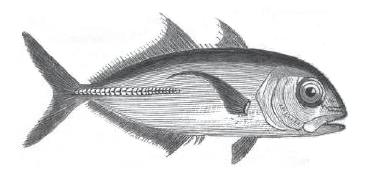
The natural colour of this species is silver-white and blue; the iris silvery, with yellow stains; but, when taken from the water, or soon after death, the entire surface of the fish assumes a gilded or brassy hue. When hooked, they make a loud chattering noise, apparently produced by the passage of air through the gills. We captured many examples on the rocky coast of Juan Fernandez; and also on the Equator, in long. 139° E., where they were attending a log of drift-wood. Their flesh is wholesome but coarse. They obtain from sailors their trivial name, Rudder-fish, from a habit they have of swimming astern of ships. THE YELLOW-TAIL.
|
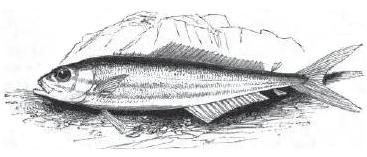
The genus Elagatis is nearly allied to Caranx, and this species bears some resemblance to C. Chrysurus, La Cepede. Examples came under our notice in the Pacific Ocean and Indian Archipelago, from lat. 6° N. to 8° S. They were very numerous around a log of drift-wood, on the Equator, in long. 140° E., as well as in the Straits of Timor. The average length of the specimens we obtained was one foot and a half; though one individual measured in its whole length three feet. They are shy of the hook, — but their flesh is a delicate and delicious food ORDER, ABDOMINALES.THE FLYING-FISH.
|
in no other evident respect from the former, had their jaws well provided with these organs. Bloch admits that E. Evolans, or the Spanish flying-fish, has no teeth, and suspects it to be the Volitans of Linnaeus; since it differs from that species only in the abdomen not being carinated. The toothless species which I have seen has, however, a carinated abdomen, according with the description of Linnaeus. One kind of Exocaetus which I have met with, but have not seen described, has the ventral fins of great length, pointed, and placed far back. The colour of its back is inclined to green; and there is a black patch on the posterior third of the dorsal fin, and a second on the base of the ventral. In other respects this fish resembles E. Volitans. Its entire length is ten inches, and it has teeth in both jaws. The entire family of flying-fish would appear to have the same habits. They frequent only the warmer seas within or on the verge of the tropics,* where they congregate in large shoals. When disturbed by the passage of a ship, or pursued by predaceous fish, they rise from the water in dense flocks, and present a beautiful spectacle as they glide through the air, their broad silvery "wings" and blue bodies glittering beneath the rays of a tropical sun. Their tour through the air must be regarded rather as a leap than a flight; their expanded pectoral fins, or wings, being projected horizontally, but having very little movement during this evolution. The principal external agents employed in this mode of locomotion are, the larger lobe of the tail fin, * We have seen none of these fish in a more extreme latitude than 36° N. |
and the broad transparent pectoral fins, which, on this occasion, serve at least as a parachute, and which, being situated close to the back, place the centre of suspension higher than the centre of gravity. It is also curious to notice, how well the specific gravity of the fish can be regulated, in correspondence with the element through which it may move: the swim-bladder, when perfectly distended, occupies nearly the entire cavity of the abdomen, and contains a large volume of air; and, in addition to this, there is a membrane in the mouth which can be inflated through the gills; these two reservoirs of air affording good substitutes for the air-cells so freely distributed within the bones of birds; and having the additional, advantage of being voluntary in their function. The pectoral. fins, though so large when expanded, can be folded into an exceedingly slender, neat, and compact form; but whether they are employed, in swimming, in the closed or expanded state, I have been unable to determine. Under some circumstances of excitement, these fish will leap over the bulwarks of a ship, and be killed by the violence with which they strike against the deck or spars. This usually occurs at night, or early in the morning; and a light, displayed from the chains of a vessel on a dark night, will bring many of them on board in the same manner. Their flesh is the bonne bouche of voyagers: it bears some resemblance to that of the herring. Although the flying-fish excites so much commiseration for its persecuted state, it is itself predaceous, feeding chiefly on smaller fishes. |
(Exocaetus Nigricans, N. Sp.)
Pectoral fins as long as the body; their rays muricated, or studded above and beneath with small tubercles. Ventral fins placed near the middle of the belly, very long, tapered and slender when collapsed, broad when expanded, and very conspicuous during the flight of the fish; jaws provided with small teeth; branchiostegous rays, eleven; dorsal, fifteen; pectoral, fifteen; ventral, six; anal, ten. Head and upper portion of the body black; abdomen silver-white; iris silvery with purple stains; pectoral fins black, a broad transverse white band extending across their centre; a black mark on the posterior third of the dorsal, and on the base of the ventral fin. The proximal half of the caudal fin is also black. Entire length of the fish, fourteen inches and a half. Taken both in the Atlantic and Pacific Oceans, in lat. 5° N. A parasitic worm, Lernaea exocaeti, is sometimes attached to the body of this species. It is about one inch in length, uniformly black, and of this form 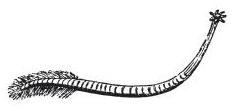
Its head, or tubular peduncle, penetrates the abdomen of the fish and becomes rooted amongst the intestines, while the body protrudes externally, pendant from beneath the pectoral fin. |
THE LUMINOUS SCOPELUS.
|
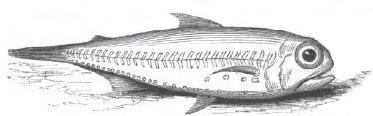
depressions, resembling the marks on dice, each silvered within and surrounded by a narrow black zone, occupies the margin of the abdomen and side of the tail; and similar depressions are also more irregularly scattered over other parts of the under surface of the body. The head is covered with large scales, or plates. These last, as well as the scales covering the body, and more especially the depressions on the abdomen and tail, (and which appeared like stars,) shone with a brilliant phosphorescent light while the fish was alive, but lost this power immediately after death. The examples we captured had their stomach distended with pelagic shrimps. As well as for much other valuable assistance, I am indebted to that erudite naturalist, Lieutenant-Colonel C. H. Smith, for a knowledge of the family of fishes to which this species is allied. by the pencil. Rays of the dorsal fin, about twenty-three; ventral, thirteen. |
MOLLUSCA.THE FLYING SQUID.
|
from casks. This elastic structure, and the membranous expansion on each side the tail, are apparently the two principal agents employed by the animal in its protracted leaps through the air. Whether the fin-like appendage is also employed in swimming is very questionable. One kind of Loligo, which we captured in the Pacific Ocean, in lat. 34° N., measured six inches in its entire length. The upper surface of the body is gray, freckled with purple, the under white; iris silvery, pupil jet-black and prominent. It has eight arms and two tentacles. Each arm is furnished with a double row of suckers on its entire length, and all, with the exception of the first or dorsal pair, have a loose membrane floating from their posterior surface. The two tentacles are round, slender, and twice the length of the arms, and have at their extremity a broad sickle-shaped membrane, covered with two rows of yellow hooks of different sizes. This individual leaped from the sea over the high bulwarks of the ship and alighted on the deck, at a time when vast flocks of the same species were seen leaping around and often striking with violence against the bows of the vessel-the sea being comparatively smooth. The creature was much injured by the violence with which it had struck the deck, and showed little animation: it did not attempt to leap or swim when put into a bucket of sea-water, though it emitted a quantity of inky fluid* through a canal in the body, opening by a large orifice immediately below the neck. The prehensile power of the suckers on the arms was retained for a considerable time after the death of the animal; * This secretion is contained in a narrow oblong bag, of silvery hue, and placed immediately below the stomach. |
from which I should judge that, like the buckler of the sucking-fish, their function in a great measure depends upon solely mechanical causes. A second species, which we also obtained in the Pacific, resembled the above in size and form, but its two long tentacles were furnished at their extremities with rows of suckers, (acetabula,) instead of horny hooked appendages. The prevailing colours of this species are silver-white and steel-blue, spread with red spots and tints of violet and purple, a brilliant and very beautiful spot of emerald-green being placed immediately above each eye. We noticed examples of this family of Cephalopods from the Equator to lats. 34° N. and 16° S., Pacific Ocean. ARGONAUTA RUFA, Owen.
|
suckers on a level with the margin. Most of the examples we obtained were resting upon clusters of eggs, loosely deposited at the bottom of their shell. Each egg is round, colourless, and about the size of a millet seed. I noticed that some of the animals had escaped from their shells while the net in which they were taken was towing through the sea, and also that there were sometimes more empty shells than corresponded with the number of uncovered Argonauts. Those that remained in their shells would not easily quit them; but, when handled, retracted their body and resisted any moderate force that was employed to withdraw them. When put into a pan of sea-water, their first action was to eject clouds of black fluid, which were diffused but slowly through the water. These were cast with great force and rapidity from near the arms, and when the inky fluid was exhausted, its place was supplied by what appeared to be forcible currents of water. They sometimes moved in a sliding manner, and in a retrograde direction, as they rested on the side or convex back of their shell; andd sometimes adhered to the sides of the pan by their suckers, and advanced by walking, bearing their shell on their back, like a snail. None of them, while thus circumstanced, made the slightest attempt to quit their shell. The remarkable number of empty shells of Hyalcea tridentata which I found adhering to the suckers on the arms of these Argonauts, led me to suspect that the animals they had contained were devoured by the cephalopod. Modern naturalists have been anxious to ascertain if the Ocythoe is a parasite, or whether it has the power necessary to construct the shell it occupies. That the cephalopod is well adapted in size to the dwelling it inhabits is by no means an argument against |
its parasitic habits, as the same remark would apply to most Hermit-lobsters (Paguri) and the marine shells they borrow. The absence of any muscular attachment between the Ocythoe and its shell, and the ease with which the animal can liberate itself from its tenement and exist uncovered, are also in favour of its being a parasite. Nevertheless, if we reason by analogy, and regard the uniform resemblance in figure that obtains amongst the shells of all the known species of the Nautilus family, and how nearly the shell of Ocythoe accords in this respect with those of other testaceous cephalopods which are admitted to be the architects of their dwelling, we shall be better prepared to believe that this creature is not less independent than other testacea of its class; and this the more readily, since no inferior shell-fish has hitherto been recognised as even a remote claimant for the covering of this species. The investigations of Professor Owen, aided by the enthusiastic researches of Madame Power, (who has availed herself of unusually favourable opportunities for experimenting on living specimens of Ocythoe, on the coast of Sicily,) establish the following more material facts, which may be considered as decisive of this interesting question. First. "The cephalopod of the Argonaut constantly maintains the same relative position in its shell." Second. The expanded membranes on the dorsal pair of arms of this cephalopod resemble the mantle of other shell-fish, and have a like power of secreting materials for the erection or repair of its shell. Third. Experiments upon an extensive series of specimens prove, that the weight and measurements of the shell correspond very nearly with those of the contained animal, in all stages of its growth. Fourth. "The cephalopod inhabiting the Argonaut |
repairs the fracture of its shell with a material having the same chemical composition as the original shell, and differing in mechanical properties only in being a little more opake." Fifth. " The repairing material is laid on from without the shell, as it should be according to the theory of the function of the membranous arms as calcifying organs." The sixth, and perhaps the strongest fact is, that some young Argonaut cephalopods, bred in confinement, were noticed by Madame Power to 1.ave formed their little shell in ten or twelve days after their exclusion from the egg. THE SEA SNAIL.
|
that of a a "sail." Should this inflated membrane be removed or materially injured, the shell sinks. In its natural element, the shell rests upon its convex surface, or keel, and is immersed; the aeriferous float being alone visible above the surface. The contained animal (a trachelipod) has a muscular attachment to its shell only by a small portion of its back. There is a short bifurcated tentacle on each side the head; and the mouth is a vertical fissure, its margins beset with a row of rigid hairs which are sometimes inverted and concealed, and at others projected forwards, the opposite rows crossing or interlacing one with the other. A broad membrane (a foot or branchia) arises from the under part of the neck, and to this the float is attached by a slender base. The stomach is a very distinct and perfect organ; in some examples we examined, its contents were minute brown shells. The body of this mollusc contains a very blue liquid, which, when the animal is punctured, exudes to the amount of three or four large drops. It is readily diffused through water or colourless spirit-to the former it communicates a faint tinge of its own peculiar hue, and to the latter a pink colour with a purple shade. It communicates its colour to paper, and may be conveniently used as a blue ink: several memoranda and pages of my journal, written with this fluid, have, after a lapse of more than five years, retained their original appearance, both in colour and intenseness. For this use, however, it must be employed from the recent animal, as it will not keep in any quantity, but becomes thin and discoloured. It is believed that this fluid is analogous, in use, to the black secretion which the cuttle-fish pours forth to obscure the water and elude the pursuit of its enemies; but this opinion must be |
received with some qualification. The living examples of Janthina which I have irritated when they have been confined in a vessel containing sea-water have not emitted any of this coloured fluid; when taken in the hand they would sometimes allow a little to exude; but the entire quantity obtained from one animal by artificial means was never sufficient to cloud or obscure, although it would stain, about half a pint of pure water. The spawn of Janthina is attached to the under surface of the float, in the form of numerous small oval sacks, each suspended by a short slender thread. Some of the ova have a delicate pink or flesh-colour, while others are dark-brown-a difference that depends, probably, upon their state of maturity. Over same extensive tracts of ocean, especially in lats. 7° and 29° N., we found vast quantities of the floats, all all of them loaded with ova, scattered on the surface of the water, and not attached to either animal or shell. It is difficult to account for this fact upon the supposition that any accident could have destroyed the fish and shell but left the floats entire; we are therefore compelled to admit, that these spawn-bearing appendages are cast off by the Janthina as a mode of propagating its species; which necessarily implies that the parent animal must, for some time, sacrifice its essential buoyancy and sink to some depth beneath the surface of the sea, until a second float is formed by the foot. In common with other molluscs floating passively on the ocean, the Sea-Snail is exposed to the caprice of currents, on which, indeed, it must chiefly depend for any material migration. Hence, we often find great numbers assembled in very limited tracts of water, where they serve to indicate the previous or present existence of a current. The highest latitudes in which |
we have detected the species in the Pacific, are 30° N. and 32° S. Between the Equator and the parallels of 5° N. and S. lat. they were particularly abundant. They obtain in the Mediterranean; and are occasionally driven, by heavy gales, across. the warmer seas, even to the western shores of Great Britain. I have on numerous occasions captured this shell-fish at night, and am satisfied that they are not phosphoric; although the Rev.Wm. Kirby, in his a Seventh Bridgewater Treatise," asserts that they possess this quality in a very high degree. Neither have they the power of collapsing their float and sinking at will, as is stated by the same author. When the mollusc is captured, and confined in a pan of sea water, the float undergoes no change; and the shell, consequently, is maintained buoyantly on the surface; the animal frequently protrudes its head from the shell, in an inquiring manner, and, when handled, retires, like a snail, within the deeper recesses of its dwelling, retracting at the same time its aeriferous float, which fills the aperture of the shell. When the entire mollusc is immersed in spirit or dried in the sun, the float remains inflated, and attached to the body for several weeks; although it ultimately becomes detached, collapses, and can be but seldom exhibited in a preparation. Janthina Globosa occurred to us very rarely, and is, perhaps, never found assembled in such large quantities as the species fragilis. It differs from the latter, not only in the shape and more delicate pink hue of its shell, but also in the markings of its float. In the course of the Narrative I have had occasion to mention a yellow and very rare species of this genus; and for which. I should propose the name Janthina lutea. |
HYALAEA TRIDENTATA.This mollusc, both in its own structure and that of its shell, furnishes us with a link between univalve and bivalve shell-fish. The shell is small and inclined to a globular shape; and, although it has a broad and permanent aperture in front, its sides betray a disposition to form two valves. It may be compared to a bivalve shell without a hinge; its posterior part being consolidated, and armed with three short spines, while its sides present a narrow fissure, through which a membrane protrudes. The upper surface or valve is longer than the lower, and projects forward, as a hollowed ledge, or beak, tipped with gelatinous matter. The entire structure of the shell is vitreous and semitransparent, and has a yellow-brown tint. The contained animal (a Pteropod) has no tentacula, and its head is a mere rudiment; its body is black, and of soft consistence. A broad white membrane (branchia, or " wing") is attached to each side of the neck, and protrudes through the aperture of the shell. We have frequently seen the Hyalwa moving rapidly over the surface of a calm sea by the aid of these wings, which they employ as oars. Although they float passively in their natural condition, when captured and put into a basin of sea-water they invariably sunk to the bottom; and this they appeared to do by filling their shells .with water, which they could doubtless expel when they wished to rise to the surface. We found this species very abundant. on the surface of. the Pacific, from the Equator to 40° N. and 39° S.; as well as in the Indian Archipelago. |
CLEODORA CUSPIDATUM.This is a vitreous shell of extreme delicacy and beauty. It is colourless and transparent, elegantly grooved on the surface, and so fragile as scarcely to bear the slightest touch. It is pyramidal and nearly triangular in form: its anterior and broader extremity having a broad aperture, while its apex is an acute and slightly-curved point. A long slender spine, or vitreous needle, projects from the margin of the aperture; and a similar spine is placed on each side of the shell, near its centre. The animal it contains is furnished with two simple branchiae, or wings, like Hyalaea. On that part of its body which is lodged in the apex of the shell, there is a small globular pellucid body, resembling a vesicle, and which at night emits a luminous gleam, sufficiently vivid to be visible even when it is opposed to the strong light of a lamp. It is the only instance of a luminous shell-fish I have ever met with;* nor would the luminosity of this species be of any avail, did not the shell possess a structure so vitreous and transparent. Examples were chiefly captured at night or in the evening. They were obtained in great abundance near the surface of the Pacific, between the Equator and lats. 16° S. and 30° N. C. Balantium was more rarely noticed; and I have not observed that its animal possesses any luminous quality. In structure and general appearance the shell resembles that last described, but is larger and more pyramidal. It has a short curved spine at its apex, and its sides are toothed, or serrated; but it has no long spines. * A second shell-fish, the Pholas dactylue, or Piddock, a British species, is said to shine by night; but I am not aware that we have any competent authority for its luminous power being a vital attribute, or for the precise manner in which it is displayed. |
CARINARIA VITREA.Our first acquaintance with this extraordinary Heteropod (which would appear to hold a station intermediate to testaceous and naked molluscs) occurred off Pitcairn's Island, by the capture of two living examples near the surface of the deep blue water which surrounds that coast. We subsequently met with specimens in other parts of the Pacific, from lat. 3° to 39° N., and from 2° to 26° S.; and also in the Straits of Timor. The average length of the species is two inches. Its structure is gelatinous, sufficiently firm, (being invested in a stout membrane,) and semi-pellucid. The body is smooth, cylindrical,' arched, and tapers to a point at 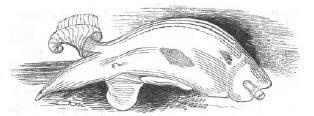
the tail. It has, in its interior, an opaque oval viscus of an amber-colour. The head is chiefly to be distinguished by a circular mouth, and a black speck, planted on each of its sides, and which would appear to perform the office of an eye. The mouth has projecting lips, and contains a long, hard, and cylindrical tube, or tongue, provided on its inner margin with short rigid hooks, which are alternately projected and returned. by a rapid rotatory motion: the protrusion and retraction of the hooks being attended by similar changes in the tube itself. An erect cylindrical fin arises from the posterior third of the back, and a broader fin occupies the corresponding surface of the abdomen. The dorsal fin is covered by an exceedingly delicate and beautiful |
vitreous shell, of small size, perfectly transparent, and shaped like a cornucopia. Some few examples of the same species, which we obtained, were destitute of this shell; and their naked dorsal fin bore no appearance of its having been recently present. I have also found the shell alone, floating empty on the surface of the sea. When the shell is present, the portion of dorsal fin contained within it has a black hue; * and is covered with a continuation of the same membrane that invests the entire body of the animal; while the shell is so, firmly attached to its surface that it cannot be re-, moved without injury to its structure. But it is remarkable, that in those instances where the shell did not exist, the dorsal fin, though perfect, was as colourless, and of the same consistence, as the body and anal fin. I was at first inclined to believe that this shell was a parasite; but its uniform shape in the same species of Carinaria, and the circumstance of its being invariably attached to the same part of the body, induced me to fall into the opinion of naturalists,-that it is identical with the perfect structure of this mollusc. Some living specimens which we obtained, and put into a pan of sea-water, swam horizontally, with a quick lateral motion of the dorsal and anal fins, and rose to. the surface or descended with great ease. (Carinaria Depressa, Cuvier.)This species is about the size of the former; but its body is broad and flat, and tuberculated on its dorsal * This black structure is said, by Cuvier, to consist of a nucleus, formed by the heart, liver, and genital organs. |
surface. The shell on its back is also delicate and vitreous, but very small, procumbent, of an oval form, -and. resembles a single valve of a bivalved shell. In common with the former species, I have noticed some examples of this to be destitute of a dorsal shell; although the fin to which it should have been attached was perfect. It inhabits the same waters as C. vitrea. 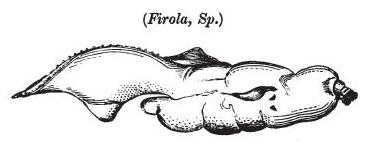
(Firola, Sp.)We obtained a solitary specimen of this Firola, (or Carinaria without a shell,) in lat. 40° N., Pacific Ocean. It is five inches in length, and composed of the same gelatinous semi-pellucid structure as the Carinarite above described. The anterior two-thirds of the body is somewhat cylindrical; the posterior third is flattened, and tapers to a point at the tail. The dorsal fin occupies the centre of the back; while the anal is placed very near the tail. On the posterior portion of the abdomen there is a deep fissure, conducting, apparently, to an anal orifice. The surface of the body is covered, on some parts, with small tubercles; and a row of soft spines occupies the posterior part, or ridge of the back. The oval tube, or tongue, (which is formed like the same organ in Carinaria,) and the fins, were the only parts of the animal that displayed any motive power. |
THE BLUE BARNACLE.
|
When the floating body is large, and well capable of supporting the clustered barnacles, the latter have no aeriferous float; but this organ appears to be formed gradually, and as a precautionary measure, when the object to which the animals are attached is small and fragile, or when no extraneous body can be obtained. When detached from their float, they sink in seawater. Some examples we captured possessed clusters of small round eggs, deposited between the animal and the back of its shell. Some of the eggs had the blue-green colour of the parents' shell, whilst others were orangecolour. In other shells we found, together with the barnacle-fish, more than six small worms, of dark colour, annulose, and furnished with tufts of hair on their sides, like aphrodites. They had numerous feet, arranged in two lateral rows on the abdomen, and with these they moved actively, like caterpillars. 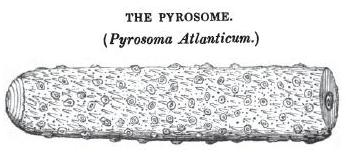
THE PYROSOME.
|
a-half to two inches in circumference. The body is cylindrical, and rounded and impervious at one extremity, while the opposite is flat, and perforated in its centre by a circular orifice, conducting to a capacious straight tube that occupies the interior of the body. It is colourless, and its surface is studded with pearly tubercles, perforated at their apices, and spread with many papillous appendages. The structure of the body is gelatinous, and contains myriads of small brown specks, in which the phosphorescent power, for which this mollusc is so remarkable, would appear to reside. When assembled in the sea, and, as is usually the case, near the surface, these creatures present a gorgeous spectacle; their vivid phosphoric light being sufficient to illuminate, not only the extent of ocean they occupy, but also the air above, rendering all surrounding objects visible during the darkest night, and permitting a book to be read on the deck, or near the sterncabin windows of a ship. They are occasionally collected together in incredible numbers: on two occasions, at midnight, in lats. 2° and 4° N., Atlantic Ocean, (when I had the good fortune to see these molluscs in their zenith of splendour,) the ship sailed over many miles of water which they had illuminated, and in which they were so densely crowded*- as to be taken to any amount by buckets or nets. When captured they exhibited no signs of animation, and emitted a peculiar half-fishy odour. When kept in a vessel of sea-water, and allowed to be tranquil, their light was withheld, or only sparingly displayed; but when they were handled, or the water in which they were con- * We have also seen examples of Pyrosoma, though less numerous, in the Pacific Ocean, on the Equator, and in 3° S.. A solitary specimen was captured in so high a latitude as 28° N. |
tained was agitated, their body instantly became one blaze of phosphoric light, which, upon close examination, could be observed to proceed from myriads of luminous dots, occupying the situations of the small brown specks noticeable in the fleshy structure of the mollusc. Upon the irritating cause * being removed, the phosphoric light gradually expired, and the Pyrosome remained in darkness until again disturbed, when it once more illuminated surrounding objects with its vivid gleam; and this was repeated until after the death of the animal, when no luminous effect could be reproduced. When living specimens were immersed in fresh water, they not only existed for some -hours but emitted a constant light: even after they had been so much enfeebled as to cease to give light in seawater, or after they had been seriously mutilated, their phosphorescence invariably reappeared when they were put into fresh water, which appears to act as a peculiar stimulus in. reproducing the phosphoric light of these, as well as of most other marine luminous animals. The Pyrosome does not communicate its luminosity to water, nor to any object in contact with it, (like many luminous medusa,) its body being enveloped in a membrane that has no luminous secretion. But when the mollusc is cut open in water, some of the brown specks, before-mentioned, will escape, and diffusing themselves through the fluid, shine independent of the animal: in this respect, as well as in their structure and colour, bearing some resemblance to the luminous scale on the abdomen of the small fire-fly of Bengal. When this mollusc is first removed from the sea, the orifice, or mouth, at one extremity of its body is nearly as wide * Friction is not the only cause of the Pyrosome emitting its light; for the slightest touch on one part -of its body is sufficient to illuminate the whole. |
as the tube within; but should the body be much handled, and kept long in water, this orifice closes by the contraction of a smooth membrane that surrounds it like a sphincter-water being at the same time retained within the cavity of the body. This contraction of the sphincter membrane is the only movement I have seen the Pyrosome effect; although it is said that the creature has also the power of contracting and dilating its entire body. THE SEA-NETTLE, OR PORTUGUESE MAN-OF-WAR.
|
upon a calm sea and beneath the rays of a tropical sun, are ,surpassingly brilliant and imposing. The pointed extremity of its inflated body is dark indigo-blue at its apex, fading to a lighter shade towards the base; the procumbent crest on the back is pink or flesh-colour; while the remainder of the vesicle exhibits a play of iridescent colours, amongst which a pale straw-colour and aqua-marine predominate. The colours of the tentacular fringe on the lower margin of the body are vivid and strongly contrasted: the outer layer of filaments being crimson, the inner purple. Each long tentacle or cable is transparent, excepting where it is coloured by two slender longitudinal lines, passing through its entire length, and connected by transverse equidistant bars of the same hue, which give it a jointed appearance. The inflated membrane of the body is composed of more than one layer; and, when closely examined, is found to possess longitudinal fibres, which have probably the function of muscles. The chemical character of the air it contains has not been. determined; but, judging by analogy, we may suppose it to resemble the air contained in the swim-bladder of marine fishes. When floating on the ocean, the body of the Physalis has the form of an inverted crescent, both its extremities being depressed, and the back convex. The crest can be raised or depressed at will; and is as often seen under the one as the other condition. It is, when erect, a tall inflated membrane, grooved vertically, transparent, and of a delicate pink colour. The animal, when removed from the water, writhes its body into many contorted shapes, and retracts its cables, but displays no power of moving the short tentacles. The cables are viscid, and adhere tenaciously to any foreign body. It is in these appendages alone that the |
stinging property of the Physalis resides: every other part of the mollusc may be touched with impunity, but the slightest contact of the hand with the cables produces a sensation as painful and protracted as the stinging of nettles; while, like the effect of that vegetable poison, the skin of the injured part often presents a white elevation or wheal. Nor is the inconvenience confined to the hand: a dull aching pain usually proceeds up the arm and shoulder, and even extends to the muscles of the chest, producing an unpleasant feeling of anxiety and difficulty in respiration. Washing the injured part with water rather aggravates than relieves the pain, which is best remedied by friction with olive oil. The cables retain their urent property long after they have been detached from the animal; and their viscid secretion, when received on a cloth, retains the same virulent principle for many days, and communicates it to other objects-facts which tend to prove, that this offensive power of the Physalis resides in a peculiar secretion from the cables, and does not depend upon a vital principle in the animal, allied to the pseudo-electric power of some fishes, as suggested by Carus. During a voyage to the East Indies, in 1832, and when becalmed near. the coast of Africa, between Cape Verd and Goree, I noticed around the ship a great number of this species, of the largest size and most gaudy colours. Two out of four of the examples we then captured had small fishes, about the size of a minnow, entangled in their short tentacles, and partly decomposed; while several other Sea Nettles, floating buoyantly on the calm and transparent sea, were surrounded by shoals of small fish, swimming and playing about them, as around a bait. What I then witnessed left |
me in doubt, whether the fishes preyed upon the Physalis, and had become accidentally entangled in its filaments, or whether the mollusc had the power of attracting small fry by its brilliant colours, and of capturing them as food. It-is reasonable to suppose, that the cables of Physalis are offensive as well as defensive organs; and that, when spread on the water, they serve to capture and disable prey by their viscid and virulent secretion, and, by their retractile power, to convey food to the fringe of short tentacles; where it is retained, as in a net, until it is consumed by the animal. The short tentacles are tubular, which is not the case with the cables; and from appearances within the tubes of the former appendages, I am inclined to believe that the mollusc takes its food by absorption through these root-like filaments, like medusce of the genus Rhizostoma, and not altogether by an aperture in the lower margin of the body, and which is said to be a mouth. In some few specimens of this species, I have detected several oblong transparent vesicles, of a green or pink colour, lodged amongst the short tentacles. These may probably be their young, in the form of offsets or buds (gemmce), a suspicion which would also attach to similar appendages on the acute extremity of a species of Physalis which I believe to be the tuberculosa of Lamarck; and of which we obtained many examples in the Pacific. No facts have come under my own observation, nor am I aware that any have been authentically recorded, in favour of the opinion that the Physalis can rapidly absorb and reproduce the air contained in its vesicle, so as to sink or rise in the water at will; as is confidently asserted by the best modern authors. On the |
contrary, these molluscs, when floating on the surface of the sea, may be approached, captured by hand, or permitted to die on shore, without any change in their inflated state;* and although it is true that a placid sea is best calculated to display the beauty of the animal, and cause it to attract the attention of navigators, yet we have often seen them riding easily over the most turbulent waves, without any probability that their buoyant and elastic structure would suffer from the exercise. Equally common and questionable is the assertion, that the long tentacula of this mollusc are literally cables, and serve to moor the animal to rocks, &c., during violent agitations of the sea. Were not this opinion advanced by some very high authorities, it would be unnecessary to say, that unerring Nature has not left the Physalis so bad a navigator, as willingly to place itself in a condition which would require that it should oppose such a feeble hold to a raging surf: not to mention that the true habitat of the creature being the deep and clear ocean, but little necessity can exist, under natural circumstances, for any provision of this kind. THE SALLY-MAN.
|
ternal cartilage or fulcrum. This structure is white and semi-pellucid, and consists of a broad base, surmounted by a crest or sail. The base is oval, and marked with numerous and very regular concentric strive; it is thick, and contains between its layers, some fluid, and a quantity of air. The crest, a thin transparent cartilage of an arched form, stands erect, and passes obliquely across the base, in a longitudinal direction-it is admirably adapted (or, to use a nautical term, " braced up") to catch the wind from whatever quarter it may blow, its position being not unlike that of a lateen sail. The entire fulcrum, or skeleton, is invested in soft parts of a purple-green colour. The upper surface of the base is covered with a smooth membrane, which also overlaps the margin, but in a denser and more floating form, and is continued over the entire surface of the crest; the centre of its inferior surface, which is concave, is occupied by a brown mass of viscera, covered with a thick mat of colourless tubular papillce; whilst its circumference is furnished with slender blue tentacles, or cilia, which, though short, are sufficiently long to project beyond the loose marginal membrane. A narrow alimentary canal, placed in the midst of the papillous appendages, extends the entire length of the body, and has several lateral tributary ducts. It has an orifice in its centre, which in some specimens of this species I have observed to be merely a small slit, while in others it projects in the form of a membranous tube. When on the ocean, the Velella floats passively upon the broad base of its fulcrum, with its crest raised above the surface. - It gives no sign of animation when captured; nor has it a stinging, or any luminous |
property. The recent animal emits a peculiar odour, which may be compared to that of rotten apples. I have found small pelagic shrimps in the alimentary canal of some examples, and many minute brown crustaceous insects both on the papilke and in the alimentary canal of others. Where currents prevail, these creatures are often found collected together in such surprising numbers as to cover a great extent of ocean; and it is not unusual to observe only their bare internal cartilages, or skeletons, strewn over other tracts of water in great abundance. Sailors account for this latter appearance, on the supposition that the Velellea have been destroyed by the heat of the sun; but some observations made by my brother, Mr. George Bennett, and published in the "Proceedings of the Zoological Society," prove that the Sea Lizard (Glaucus) feeds on Velella, and that the cleaned skeletons are the result of the depredations of that extraordinary little mollusc. We obtained specimens of V. Mutica in the Atlantic and Pacific Oceans, from lat. 40° N. to 26° S. Another species of Velella, of which we obtained specimens in the Pacific and Indian Oceans, from the Equator to the thirty-sixth degree of south latitude, is smaller than that last described; and is chiefly remarkable for its internal cartilage possessing a pyramidal or triangular crest, and a more conical base. In other respects its structure is the same as that of V. Mutica. PORPITA, SP.The genus Porpita is very closely allied to Velella. The internal cartilage is flat and circular, and has no erect crest or sail. Its upper surface is enveloped in a |
smooth blue membrane, whilst its lower is provided with a mat of blue tubular papillce and some marginal cilia, and has a central alimentary tube. One species we observed is about the size of a six-pence; the upper surface of its fulcrum is uniformly marked with concentric circles, and has a projecting tubercle in its centre, from which numerous raised lines radiate to the circumference-the whole bearing some resemblance to a "worked" shirt-button. A second species (P. Gigantea ?) is the size of a half-crown, and has the upper surface of its fulcrum muricated, or studded with rough tubercles. The papillous appendages on the lower surface of this, as well as of the former species, appear to possess a strong sucking power; for, when placed on the finger, they adhere so firmly to it, as to separate from the animal by the force required to detach them. Like Velella, they do not move when captured-the layers of their fulcrum contain fixed air-and their bare skeletons are often found floating on the sea. Specimens of both the above species were taken in the Pacific, from lat. 30° N. to 9° S. THE SEA LIZARD.
|
which has been applied to it: the body is stout, broad, oblong and flattened, (but is capable of being voluntarily shortened, and converted into a nearly globular form,) and terminates in a slender caudal appendage, which bears a very close resemblance to the tail of a lizard. Each side of the body is furnished with three stout branchial members, or fins, placed equidistant from each other, palmated at their extremities, and supplied with numerous short and tapered tentacles, resembling toes. The head is round and conspicuous, and provided on each side with two papillae or tubercles, one superior and one inferior, which can be extended in the form of short slender tentacles, like the horns of a snail. The mouth is small, orbicular, and margined with a strong horny structure. An elevated fleshy fold on the neck forms a partial hood over the head. The colour of the entire upper surface of the body is dark-blue, with the exception of a broad silvery streak, extending from the head to the extremity of the tail; the inferior surface of the body and fins is pearl-white. The head also is white, but has a vertical blue_ line on its centre. The entire animal is enclosed in a tough, but smooth and delicate integument. These creatures obtain in greatest number where currents most prevail; they are active and very predatory in their habits, and would appear, from the observations of my brother, which I have already mentioned and confirmed, to subsist chiefly upon the soft parts of the defenceless genera, Velella and Porpita. The specimens we captured and kept in sea-water, contorted their bodies into many convulsive attitudes, but seldom employed their branchial fins, and floated buoyantly while passive. When immersed in fresh water they |
contracted themselves into a very small compass, assumed a globular form, cast the tentacles from off their branchial fins, lost their colour, and expired in a very few moments. When handled, the white colouring matter of the body is very easily detached, and leaves the corresponding portions of the integument transparent; when a considerable accumulation of air, in the form of small bubbles, is visible amongst the viscera, and fully accounts for the hydrostatic power the animal possesses. Immediately behind the left most anterior branchial fin there is a circular orifice or foramen on the side of the body, and serving as a cloaca, through which I have noticed, in some examples, the male organ protrude in the form of a slender, white and contorted thread; and it may be questioned, whether the air contained in the body of the mollusc be not received or expelled through this orifice, as it is through a similar opening existing in the water-snails. THE SEA LEECH.
|
leech; (Hirudo medicinalis;) but differ from that species in having a broad circular sucker at each extremity of their body. The surface of the body is muricated or covered with tubercles, which are arranged in transverse rows. The prevailing colour of the worm is black; some of the tubercles on the skin are white, others yellow, black, or spotted; the summit of the narrower extremity of the body, or bead, is marked with two spots of a red-lead colour. These creatures adhered, by both their suckers, to the tongue, palate, and gill-bones of the shark. When removed they twirled actively in the hand, like fresh water leeches, and travelled quickly over a dry surface like the latter animals. Their bodies contained a large quantity of red blood. The species must be regarded as a parasite; for I am not aware that it has been seen in any other situation than adhering to cartilaginous fishes, as the shark or ray; from infesting which last it has obtained the name of a Skate-sucker." |
MARINE PHOSPHORESCENCE.AND ITSDEPENDENCE ON ANIMAL LIFE.Although we find many curious phenomena, attributable to phosphorescence, displayed in the lower grades of the creation on land, it is only in the wider expanse of the aqueous globe that we see this property acting to its most surprising and mysterious extent, and with a constancy that invites to a free investigation of its origin and use. Many opinions have been at different times entertained upon the cause of a luminous state of the ocean: some have supposed it to depend upon a peculiar electrical condition of the atmosphere, or the presence of decomposed animal matter, which we may reasonably suppose is plentifully diffused in sea-water; whilst others have attributed this effect to the luminous power possessed by living marine animals. And of these, the last appears the more just opinion, and one which has been so well supported by many conclusive facts, recently discovered and submitted to the notice of British naturalists, as to be the best entitled to general adoption. It is a belief to which I have always been inclined, and which my researches in foreign seas have materially tended to confirm. It would, nevertheless, be rash to assert, that the decomposition of animal matter is never the cause of a luminous sea; for, on the contrary, we have reason to believe that it may often be so, although much more rarely than living organized beings, or the luminous secretion detached from them. Abortive ova or spawn may prove an extensive source of marine phospho- |
rescence; and it is probably to the presence of either dead animal matter, or numerous microscopical creatures that rapidly die, we must attribute the paradoxical tendency to putrefaction which is so remarkable in seawater. It might naturally be supposed that, from its chemical composition, this fluid would long remain unchanged when it was removed from the ocean; but the reverse is the fact, and a vessel of sea-water, kept but for a few hours in the climate of the tropics, becomes highly offensive, while the same quantity of perfectly fresh water, under the same circumstances, does not undergo the slightest alteration. The same fact may also inform us, why marshes which receive a portion of their waters from the sea, are invariably more injurious to the health of man than those which are supplied by fresh water alone. It is essential that the nautical naturalist should not be misled by the phosphorescent appearance of a dead marine animal, nor consider that any sea-creature is naturally luminous, unless tokens of its vitality are indisputably present: for it is remarkable of the vital phosphoric quality existing in fishes and molluscs, that it fades and ceases as the animal becomes more feeble and dies–a peculiarity which widely distinguishes the true luminous property, from that cadaverous phosphorescent light which attends upon incipient decay. The evident existence of a phosphoric principle in marine animals, whether as a vital or cadaverous attribute, would appear to commence with fishes; for we do not find that living seals, whales, sea-snakes and turtle, or the decaying structures of those ocean animals, exhibit any phosphorescent light. On one occasion, it is true, I observed the blubber removed from a Cachalot shine for two successive nights, with |
a phosphorescent gleam, which brightly illuminated the otherwise dark apartment in which it was deposited; but this was looked upon with surprise by all the ship's company, for the oldest whalers on board had never before witnessed such a phenomenon. And as, on examination, we found that this property was confined to the exposed surface of the lard, it was in all probability owing to some luminous matter which bad been contracted by the structure in question when dipping in the sea. It is customary to speak of a luminous sea as being "all on fire," but this expression gives a very inadequate idea of the true appearance it presents: the light it emits being rather the pale-yellow or greenish, sickly, and almost supernatural gleam so peculiar to the salts of phosphorus. The surface of the water will often exhibit extensive and distinct patches of luminous fluid, seen at a considerable distance from the ship, and which the latter passes through, but does not create by her passage; or, the luminosity being less local and permanent, the wake of the passing vessel presents a broad and lengthened stream of vivid light; while, midst the darkness of the night, a splendid spectacle is offered by the brilliant ridges of light, raised by the agitation of the billows whose crests they illuminate. We often searched the surrounding waters when the ocean has been thus luminous, but without being enabled to detect any sufficient cause for its appearance: the sea-water, when examined in small quantities, was found to emit no light while quiescent, but sparkled brightly on the slightest agitation; and when thrown on the deck of the ship, sparkled, and again became dark, a luminous speck reappearing occasionally. One of these revived luminous specks |
would adhere to the finger, but when brought to the light and closely examined with the aid of a lens, it betrayed no visible substance; although the same particle, when rubbed in the dark, could be divided into many smaller luminous portions. In the great majority of cases, however, a phosphorescent sea would betray its history, by affording to the tow-net numerous examples of luminous animals; sometimes fishes or shell-fish, but more commonly molluscs or medusee. The fishes, shell-fish, and tunicated molluscs have their luminous matter deposited beneath a dense integument, and consequently do not communicate it to the waters they infest; but this does not apply to all the medusas, as some of them are indebted for their phosphorescent quality to a peculiar secretion, that covers their body in the form of a slime, which is easily washed off, and, diffusing itself through water, communicates to that fluid a luminous appearance, which may be entirely independent of the actual presence of the animals from which it is derived and this, as I have elsewhere observed, may in a great measure account for the occasional existence of a luminous sea in which no tangible luminous bodies can be detected. The greater number of the luminous marine animals we noticed during this voyage have been described in their proper places; but there were some others, medusae, captured under circumstances when cause and effect were satisfactorily displayed, which I shall now mention. The one species, which we captured in vast numbers in the North Pacific, is circular, gelatinous and transparent, and about the size of a dollar; its upper surface convex, and marked with radiating grooved lines. The centre of its inferior aspect is concave, while the circumference is a comparatively |
broad, flat margin, which, when viewed at night, and in the living animal, is seen to be studded with a row of luminous dots, placed equidistant from each other, and shining with a delicate blue light. When the creature is allowed to be quiet, the luminous display is confined to this series of dots; but when irritated by handling, (or, we will suppose, by the agitation of the waves,) the entire body emits a powerful light; which is. not, however, so clear and fixed as that of the Pyrosome, but has rather a rough or powdered appearance. A slimy secretion, which is easily removed from the body of this medusa, also shines brightly when rubbed, and appears like many twinkling stars, vanishing and again lighting up, and seeming to run from spot to spot. When these creatures are assembled in their natural element, they present as many circular patches of light, gleaming brightly, and the more vividly where the sea most breaks: their lights undulating with the waves, alternately appearing and vanishing, and passing as it were suddenly to different parts of the ocean, otherwise in obscurity, giving the effect of many torches moved quickly through the depths of a dense and darkened forest. A second species is a very curious medusa, (independent of its luminous economy,) and was also commonly captured in many parts of the North Pacific. It is about three inches in length by two in circumference; of a somewhat cylindrical form, slightly tapered at one extremity; is perfectly transparent and colourless; and has the crystallized appearance of cut-glass. The entire animal is composed of an aggregation of numerous smaller crystal-like parts, each closely resembling the other in its shape, which is that of the slice of an orange, cut vertically. These individual parts are but |
slightly united to each other, but are more firmly attached to a soft white cord that passes through the centre and entire length of the perfect animal. When removed from the water, this medusa displays spontaneously, and from its whole surface, a vivid phosphoric light, little inferior to that of Pyrosoma; and when agitated in fresh water, it communicates to that fluid a multitude of scintillating particles, which emit a very white gleam. We found many distinct varieties or species of this medusa. They differ in size and form some being eight inches in circumference by three in length, and nearly cylindrical in form; while their aggregate portions, all uniform in shape, are pyramidal, and present four facets. Others are globular, and resemble a mulberry. But they all agree in possessing a curious resemblance to crystals, both in their entire form and in the shape of their component parts, and have the same highly luminous properties. A third luminous medusa, which we obtained in lat. 40° N., long. 142° W., is about one inch in length, and shaped like an open bag, or landing-net, its one extremity being a wide circular orifice, while the opposite is rounded and closed; its gelatinous structure is enveloped in a smooth membrane or tunic. The interior of the body is one capacious cavity, or sack; its bottom occupied by a fringed structure, of a pink colour; numerous short slender tentacles are attached to the border of the circular orifice; and the upper surface of the same border, which is somewhat broad and thick, is provided with a single row of small red tubercles, which, as well as the entire body of the creature, emit in the dark a very bright phosphorescent gleam. This species does not communicate any luminous matter to either fluids or lids in contact with it. Upon more |
than one occasion, I have taken from the ocean a small amorphous, transparent, and gelatinous medusa, which when irritated, emitted a vivid rich-green light, and at the same time a very strong odour, which resembled that produced by the fumes of muriatic acid. There can be no doubt that many interesting and important facts, relative to the history of luminous marine animals, are lost to zoology, from the circumstance of illustrative specimens being captured in broad daylight, (when their characteristic gleam is invisible,) and when the test of a darkened apartment has not been employed in their examination; and this the more particularly, as there is seldom any other external sign than their refulgence, to denote what living creatures possess the peculiar property of emitting phosphorescent light. It is difficult to say in what manner this luminous quality may be of use to marine animals; or rather, so many uses may be assigned, that it is hard to fix upon the one which is most satisfactory. I cannot believe with Mr. Kirby, that it serves as a mode of defence; because, from what we know of the nature of fishes, this refulgence would be one of the surest means of bringing their probable enemies upon them; and if we are to regard the economy in a destructive point of view, we might rather suppose that it is intended to direct the nocturnal predaceous fishes more surely to their food; for it is well known that they are easily attracted by strong lights, and that there is no better bait for capturing oceanic cuttle-fish than a circular piece of glittering tin, armed with hooks, and lowered into the sea at midnight. But it would be unjust to accuse Nature of thus wantonly investing her creatures with a charm that can only tend to their |
destruction. In some land insects, a nocturnal light is supposed to be an amorous incentive; but this will scarcely apply to the lowly organized medusae–nor is it altogether probable that their light is given them to attract their minute prey; although such hypothesis will apply well to the luminous species of Shark and Scopelus, which I have had occasion to describe. On the whole we are compelled to admit, that no very prominent or indisputable purpose can at present be attributed to this wonderful display. |
BOTANY.A DESCRIPTIVE CATALOGUE OF THE PLANTS COLLECTED
|
self of this fluid to allay thirst; and although my native guides always disapproved of the practice, I have consumed at one time, the liquid contents of a great number of flower-spikes, without experiencing any but the most agreeable and wholesome effects. Habitat. — Plains and low hills, Society Isles, native name area; Marquesas, anavahu; Sandwich Isles, ava pue. A. Obuhi. — Leaves pinnated; rise from the soil to the height of eight feet; petioles red. The flower-spike, with its scape, emerges from the root at the base of the leaves, and resembles that of A. zerumbet, but is altogether smaller. The entire plant emits, when crushed, a powerful odour, not unlike that of allspice. I noticed this species only at Tahiti, where it is called by the natives obuhi. It is extremely rare on the coast, but forms extensive and dense thickets on the elevated inland soil, especially on the mountain-land of Vaihiria. Boerhavia hirsuta. — Caroline Island, Christmas Island, Marquesas. Lopezia hirsuta. — California. DIANDRIA. — MONOGYNIA.Cyrtandra Lessoniana. — This is an umbrageous tree of respectable stature. Its flowers are white, monopetalous, and very fragrant; some of the blossoms are supported on peduncles which emerge at once from the trunk or bare boughs of the tree. The fruit is an oval white berry, of waxen appearance; it is fleshy, and contains many small seeds, lodged in two distinct cells. Sandwich Isles. Native name öawai. |
C. cordifolia. — An under-shrub. Entire plant covered with a brown pubescence. Flowers white. Inhabits moist and sheltered plains; Oahu, Sandwich Isles. C. triflora. — Sandwich Isles. Justicia Sp. — This is a tall and elegant herb, usually seen entwined around the cactus. Its flowers are red, and grow in terminal clusters. Cape St. Lucas, California. DIANDRIA. TRIGYNIA.Piper methysticum. — This is the kava or ava of most Polynesian nations. It grows in dense thickets, and attains the height of ten or twelve feet. Its character of growth is similar to that of the bamboo: many naked, jointed, and rather distorted stalks arising from a common root, and terminating in branches thickly covered with leaves; the joints of the stalk marking the progressive ascent of the foliaceous branches. The leaves are alternate, and have rather long petioles; they are broad, heart- shaped, and smooth, are much veined, and have a sombre-green colour. The fructification is a cylindrical spadix, of light-yellow colour, and placed opposite to the insertion of a leaf. The entire plant has, when chewed, a pungent taste, and deadens the sensations of the tongue. It is only the root that is employed by the South Sea Islanders to prepare the intoxicating drink which they call ava, and for this purpose they prefer the recent root to that which is dried, as they believe that when in the latter state its qualities are impaired. Drinking rather less than |
half-a-pint of an infusion of the root produces a happy listlessness, similar to some of the narcotic effects, of the poppy or lettuce, the mind retaining a dreamy consciousness, although the muscular power appears to be no longer under the control of the will — a state which is not preceded by any excitement either of mind or body. The long and excessive use of this drink produces mental debility, emaciation, and a peculiar scaly or leprous eruption on the skin; for the abuse of natural laws, by whatever means attained, is seldom permitted to pass unpunished. At the Society and Sandwich groups, where the use of this drink has been abolished or superseded by ardent spirits, the kava-plant is almost extinct. At the first-named group, where it grew so abundantly in the time of Captain Cook, I was unable to procure a single specimen; and at the Sandwich group I noticed but one plant, growing on the island of Maui. The Marquesans continue the aboriginal use of the root, and the chiefs of Santa Christina cultivate it largely. P. latifolium. — Bastard Kava. - This species resembles the true kava, but is shorter and more bushy in its growth. It is a diaecious plant, the male specimen bearing a yellow spadix, and the female a red or purple. The Marquesan natives call the plant bakavatua. They are aware of the affinity it bears to the true kava, though they do not apply its root to the same use. I have more rarely noticed this species on the lowlands of the Society Islands, where it is called by the natives avavahai. P. betel. — Betel Pepper. — This is a climbing plant, or "vine," with a slender, jointed, and crooked stalk. |
The leaves (supported on long petioles) are broad, cordo-ovate-lanceolate, smooth, bright-green, and six-nerved. The fructification is an amentiform spadix, about three inches in length, and resembling the "long pepper;" its peduncle is fixed opposite to the insertion of a leaf. The species was noticed only at the island of Timor, where it is cultivated for its use as a masticatory. The natives sometimes train the plant upon a trellis, as is done in Bengal, though they more frequently allow it to climb over the trunks of palms and other tall trees. TRIANDRIA. MONOGYNIA.Kyllingia monocephala. — Society Isles. Scirpus lacustris. — Rush Grass. - The culms or stalks of this species grow to the height of four feet, and are employed by the natives for the manufacture of their finest mats. Habitat. — Swamps and taro-patches, Oahu, Sandwich Islands; native name atatai. S. carinatus. | Cyperus Sp.-This plant grows in great abundance, both on the sea-shore and on the banks of rivers. Its tall slender stalk, supporting a broad umbel, is used by the natives to secure the small fish they capture on the reefs: the culm being passed through the gills of the fish, they slide down it until arrested by the umbel, and thus a great number may he strung, or, more correctly speaking, filed together with little trouble. The fibres of the stalk, drawn out into a coarse kind of |
hemp, are used for straining arrow-root and cocoanut oil, and also as an application to incised wounds. Society Isles; native name mou-haari. Cenchrus, two species. — One of these two species of Hedge-hog Grass bears a globular flower at the extremity of a procumbent stalk; the other carries its flower on an erect spike. Both kinds are equally annoying, from the tenacity with which the barbed spines of their fruit adhere to the clothing and skin of travellers. — California. TRIANDRIA. DIGYNIA.Arundo bambos. — Bamboo. — Society Isles, native name hoe; Marquesas, koe. Saccharum officinarum. — Sugar-cane. — Society Isles, native name to; Marquesas; Sandwich Group. S. spontaneum. — This is a very wild species of Sugarcane, which I have seen only on the hills of Maurua, Society Group, and at Santa Christina, Marquesas. It grows in dense thickets, and attains the height of four or five feet. In stalk, foliage, and flower, it resembles the officinal cane, but is much smaller. Panicum paradoxum. | Digitaria composita. — Marquesas. D. ciliaris. — Sandwich Isles. Festuca bromoides. | Pasture-grasses. |
S. verticillata. — The aristee of the glumes of this grass, being sharp-pointed and barbed, penetrate clothing, and remain pertinaciously fixed; hence the species is very annoying to pedestrians, and is alone sufficient, to prevent the successful growth of sheep's wool on the lands it infests. Society Isles; Marquesas; native name tutai piri. — Sandwich Group. TRIANDRIA. TRIGYNIA.Polycarpon tetraphyllum.-St. Helena. TETRANDRIA. MONOGYNIA.Santalum paniculatum. — Sandal-wood Tree. — It was only at Santa Christina, Marquesas, that we found the Sandal-wood growing in any abundance, and here, as at most other Polynesian islands, all the trees of mature growth had been sacrificed to the demands of commerce. The examples that remained were young shrubs, six or eight feet high, vigorous, and in full bloom. The trunk of this species is smooth and straight, and, as well as the branches, covered with a red-brown bark. The leaves are set in pairs, opposite, ovate-lanceolate and entire; their colour is deep-green, and each leaf is disposed to fold inwards, longitudinally. The flowers are small, and supported in clusters upon a common peduncle, which arises either at the insertion of a leaf or from the extremity of a branch; the corolla is composed of four petals, placed in a stellate form; they are usually white, though some have a red exterior; the entire flower emits a peculiar and rather fetid odour. The Marquesan name for the tree is bua áhi. |
Procris Sp. — Bears clusters of minute green flowers in the axillae of the leaves. Is thickly spread over the banks and rocks of rivers, and is often inundated. Society Isles. Spermacoce Sp. — Herbaceous. Flowers monopetalous; their colour a dull-purple; emit an odour like that of the hyacinth. Maui, Sandwich Isles. Plantago quelusiana. — Leaves procumbent; bear in their centre a scape, supporting a spike of green flowers. Sandwich Isles. Terminalia Sp. — This is a littoral tree of low but umbrageous growth. The flowers (which are disposed in double racemes) are small, yellow, and have a fetid odour. Each double raceme of flowers is usually succeeded by two oblong drupes. Society Isles; native name hautera. TETRANDRIA. DIGYNIA.Cuscuta Americana. — This species of Dodder has the same general appearance and parasitic habits as its congeners of Europe; its slender stalks (which are destitute of roots, and consequently unconnected with the soil) being without leaves, and entwined around other herbs. The flowers are small, white, and have a delicate waxen appearance. Cape St Lucas, California. TETRANDRIA. TRIGYNIA.Potamogeton gramineum. — Habitat. Beds of rivers, Sandwich Isles. |
P. (near natans.) — Inhabits taro-ponds, Sandwich Isles. PENTANDRIA. MONOGYNIA.Cordia Sebestena. — Sebesten Plum. — This is a lofty and elegant tree, with foliage like that of our common poplar. The flowers are large, monopetalous, and of a bright-yellow colour, which, together with the profusion in which they are borne, gives the tree a very imposing appearance. The wood is fine-grained, and well adapted for joiners' work. The species inhabits the lowlands, near the sea-side. Society Isles, native name tou; Sandwich group, kou; Marquesas, ko. C. Sp. — A littoral tree. Flowers small and borne in clusters, but not expanded in the examples obtained. Tahiti; native name pea-tea. Morinda citrifolia. — Indian Mulberry. — The leaves of this shrub are broad, entire, and of a light-green colour. The flowers are small, white, monopetalous, and without odour. The fruit is the size of a hen's egg, conical, and composed of an aggregation of drupes; it is, when ripe, of a pale-yellow colour, the pulp is white and juicy, and the seeds black; notwithstanding that it has an astringent and acrid taste, it is sometimes eaten in the raw state by the natives of the Society Islands. The root, infused in water, yields a bright-yellow dye, which is used by the natives to stain their bark-cloth. Habitat. — Plains and low hills, Society Isles; native name nono or aari; Sandwich Isles, noni; Marquesas. M. umbellata. — This is a tree of respectable size. The Malays employ the root as a yellow dye for their cotton-yarn. Island of Timor: |
Tournefortia Sp. — This is a littoral shrub. Leaves ovate-lanceolate, entire, and clothed with a silvery pubescence. The flowers are small, white, grow in large clusters, and have an agreeable odour. Society Isles; native name taheinu. — Christmas Island. — Caroline Island. Coffea Sp. — Wild Coffee. — A tall and delicate shrub, bearing berries of an oval form, and dark-red colour. Society Isles. Chiococca barbata. — Society group; native name torea. Alyxia stellata. — This shrub is peculiar to the South-Sea Islands. Its leaves are verticillate, entire, lanceolate, and possess a fragrant odour. The flowers are small, white, and monopetalous. The fruit is subglobular, and, as Forster observes, frequently abortive, the contained nut being often without seed. Society Isles; native name maidi-rehau. A. olivaeformis. — Oahu, Sandwich Isles. Ceanothus capsularis. — Society and Marquesan Isles; native name tutu. Gardenia Florida. — Cape Jessamine. — This delightful shrub, so well known in our conservatories, grows in great abundance on the coast of the Society and Marquesan Islands. The native females are passionately fond of its white and fragrant blossom, which they usually wear as an ornament in the hair, or in the lobe of the ear. Its Tahitian name is tiiri. All the Polynesian examples of this flower which I |
obtained, varied in the number of stamens they possessed, from five to eight inclusive; and it is worthy of remark, that in every instance the number of divisions of the petal coincided accurately with the numerical vagaries of the stamens. Lobelia Sp. — The only spot where we noticed this plant was on the summit of a lofty mountain in the interior of Raiatea, Society group. It there grew as a low sturdy bush, with long lanceolate leaves, and covered with a profusion of large monopetalous flowers which are white on their upper surface, green beneath, and without odour. In size and general appearance they bear a close resemblance to the blossoms of the Gardenia Florida, and the natives name the plant tiiri-upatai. These flowers are more highly valued as ornaments by the native females than the scented tiiri; owing probably to their rarity, and the difficulty in procuring them. Solanum Sandvicense. — A tall bush. Flowers white; berries, when mature, black. Sandwich group; native name pua poro. S. Sp. — A bushy plant, bearing small white flowers, which are followed by berries the size and shape of an olive, and of a yellow-red colour. The natives are accustomed to suspend these berries over hunches of green plantains, believing that the ripening of the latter fruit may be thus accelerated. Society Isles. Native name oporo, (a name which is also applied to the exotic, capsicum, a plant which this species of Solanum very closely resembles.) S. sodomeum. — St. Helena. |
S. rapandum. — The leaves of this species are large, and undulated at their margins, and, as well as the entire plant, are covered with a soft and thick wool. The flowers are white, and mostly borne in clusters at the insertion of the leaves. The fruit is a globular berry which, when ripe, is soft, yellow, has the flavour of an apricot, and is a wholesome and pleasant food. Society Isles. — Marquesas; native name uku. S. nigrum — St. Helena. Physalis edulis. — Cape Gooseberry or Winter Cherry. — This plant, which is so often kept in the English green-house, grows wild and in great abundance at Oahu, Sandwich Isles, (where it is called oroa,) as well as at St. Helena; its fruit is eaten by both European and native residents. P. parviflora. — This, and several other dwarf species of the same family, (and one of which bears the native name pomanini,) inhabit the Society and Marquesan Isles, but the berries they produce are small and not edible. Convolvulus Batatus. — Sweet Potatoe: A procumbent and trailing herb. Flowers pale-pink and inodorous. The cultivated root of this species is red externally, and contains a viscid milky fluid; in size and form it resembles the common, or Irish, potatoe, is equally wholesome as food, and can scarcely be distinguished from that vegetable but by its very sweet taste. It is very tenacious of life, and may be preserved for a long time at sea: when taken on board a ship as sea-stock, it casts forth many vigorous shoots, and often adorns the cabin in which it is suspended with elegant festoons of its trailing and verdant foliage. |
Pitcairn Island. Society Isles; native name umara. — Sandwich group, uwara. — Marquesas. — Timor. C. Brasiliensis. — Sands of the sea-shore, Society Isles; native name pohue. Island of Timor. C. purpureus. C. tuberculatus. — Pasture-lands, Sandwich Islands. C. (near sepium.) C. (near arvensis.) — Society Isles and Timor. C. ovalifolius. — Salt-pond, Oahu, Sandwich Isles. Psychotria herbacea. — A very pretty repent plant, growing in great abundance on moist and wooded lands. The leaves are reniform; the flowers white and monopetalous; the fruit is a globular scarlet berry, containing two hemispherical seeds. Raiatea, Society Isles; native name tuatupo. Plumbago Zeylanica. — Lead-wort. — The root of this plant is powerfully irritating when applied to the human skin, and is used as a vesicatory by the Society Islanders. I have seen it thus employed, with much judgment, as a native remedy for a diseased spine; the application producing all the good effects of the more refined blister and issue of European surgery. It possesses this acrid property in common with some other species of the same family, (as P. Europeus, which is used by continental mendicants for the purpose of producing artificial sores to excite pity,) but has also a remarkable power of staining the cuticle of a permanent black colour, like lunar-caustick; a property of which the |
Sandwich Islanders avail themselves, to stain their face in a manner which they consider to be ornamental. I found, by experiments upon my own person, that the peeled root, applied to the skin for but a few minutes, produced a burning sensation, and left a dark stain, which was only removed by desquamation of the cuticle; when the root was allowed to remain on the skin for six hours, it raised a blister, which was succeeded by a deep ulcer, rather troublesome to heal. The active or irritating principle (which is allied, probably, to that contained in the mustard and some other siliquose plants) would appear to reside in the inner bark; for I observed that neither the epidemic nor ligneous structures produced any effect when applied separately. The dried root, when sliced and moistened, is as energetic in its action as that employed in the recent state. The Malays of Timor place a flower-spike of this plant in the hair of their children's heads, as a remedy for involuntary micturition. Society Isles; Sandwich group; native name idihee. — Timor. Cerbera manghas. — A tree, growing on mountainland; bears large, white, and fragrant flowers; and oval berries, growing in pairs. All parts of the tree yield, by incision, a milky fluid, which, the Marquesans say, is a deadly poison to man. Society Isles; native name reva; Marquesas, eva. C. parviflora. — Sandwich Isles; native name tokorau. Achyranthes aspera. — Sandwich Isles; native name opíta. |
Sceavola Chamissoniana. — An under-shrub. Leaves ovate-lanceolate, serrated. Flowers white, monopetalous; filaments of the stamens slender and tortuous; pistil longer than the stamens. It is a remarkable peculiarity in the expanded flower of this plant, that the tube of the corolla is always slit vertically, on one side, permitting the protrusion of the stamens and pistil. Sandwich Isles; native name naupaka. S. Kaenigii. — Timor. Erithalis polygama. — Society Isles; native name aturi. — Christmas Island. Ipomoea pubescens. — This is a delicate climbing herb, its gyrations proceeding from left to right; leaves and stalk covered with long yellow hairs. Flowers white. Sandwich group; native name kahulu or mohihi. Datura tatula. — California. Zizyphus aenoplia. — Jujube Tree. — A slender tree, growing to the height of about fifteen feet. Leaves ovate; their upper surface green and polished, their under covered with a brown wool. Fruit, a globular red drupe, the size of a small cherry; it is edible, and was used by the Portuguese missionaries for making a domestic wine. Timor. Rhamnus Sp. — A shrub. Flowers small, yellow, and in clusters. Berries orange-colour. Cape St. Lucas, California. Celosia virgata. — California. |
C. argentea. — Timor. Heliotropium curassavicum. — Sandwich group, Caroline and Christmas Islands. Anagallis Indica. — St. Helena. Kadua acuminata. — This is a tall and elegant shrub. Its leaves are light-green, polished, entire and lanceolate. The flowers are pale-yellow, have a waxen appearance, and are very fragrant; they are highly prized as ornaments by the natives, and were formerly tabooed, or reserved solely for the use of the royal chiefs, no individuals of inferior rank being permitted to wear them. Oahu, Sandwich Isles; native name kamakarala. Cyathodes Tameiamiae. — This plant, in its general character, bears some resemblance to the common juniper; it bears small green flowers, and pulpy berries of a red colour, each berry inclosing a single hard seed. Sandwich Isles; native name kara eva. Cyanea Grimesiana. — This is a tall prickly herb, with long pinnated leaves radiating from the summit of a succulent stem. The flowers issue in clusters from the axillae of the leaves; they are large and monopetalous; their colour white, elegantly striped with lilac; they have no odour, but are much valued for ornamental purposes by the natives. Oahu, Sandwich Isles. Triaridium Indicum. Deeringia celosioides. — Island of Timor. |
PENTANDRIA DIGYNIA.Hydrocotyle Sp. — Water Navel-wort. — Inhabits the stony embankments of taro-patches. Maui, Sandwich Isles; native name apoe. Atriplex portulacoides. — California. Chenopodium ambrosioides. Caucalis infesta. — St. Helena. HEXANDRIA. MONOGYNIA.Dracaena terminalis. — This plant is most commonly seen of no greater height than four or five feet, and bearing erect and bushy foliage on a very short stalk; but it sometimes attains the altitude of ten or twelve feet, and carries its foliage on the summit of a slender naked trunk. The leaves are long, smooth, and lanceolate; they are at first of a dark-green, but soon change to a uniform yellow colour, when they are much admired by the natives as an ornament for the head or waist. The flower bears some resemblance to that of the male Pandanus. The root has the form and colour of a parsnip, but is very large, and of a dense woody texture; when baked or roasted it becomes soft, brown, and fibrous, and contains a large quantity of saccharine fluid, which has the appearance of molasses, and is equally sweet. This syrup concretes, by boiling, into a coarse candy, like jagery, though all attempts to granulate it and produce a perfect sugar have failed. The Sandwich Islanders use the baked root to prepare a wash for the distillation of a kind of whisky. Foreign residents at Oahu find the plant serviceable as quick-set fences for their cultivated lands; and |
the recent leaves afford the most valuable sea-stock of fodder for cattle that the South Sea Islands can supply. Pitcairn Island. Society, Marquesas, and Sandwich Groups. Native name ti. D. Sandvicensis. — Leaves erect, ensiform, emerging from the root. Flowers small, white, and borne as a panicle on the summit of the stalk. Fruit, three-celled berries of a dark-olive colour. Oahu, Sandwich Isles. D. Sp. — Herbaceous. — Leaves erect and swordshaped. Flowers supported by a scape. Berries large, of a rich-purple colour. Sandwich group; native name uki. Loranthus Sp. — This plant grows on the branches of the Californian Plum Tree, and so closely does the stem of the parasite resemble the branch to which it is fixed, and so completely are they incorporated, that it is almost impossible to say where the one commences or the other terminates. The leaves are slender, cylindrical, and succulent. The flowers are scarlet, fleshy, and borne in superb clusters; the filaments of the stamens and the style of the pistil are also scarlet; of the six stamens four are invariably shorter than the other two. Cape St. Lucas, California. Achras sapota. — Timor, Tacca pinnatifida* — South Sea Arrow-root. — Leaves * Forster (Characteres Generum Plantarum Marie Australis) assigns to this plant the class and order Dodecandria Trigynia; (giving two |
broad, pinnatifid, supported on long erect foot-stalks, emerging from the soil. Flowers and fruit borne in clusters on the summit of a tall fluted scape. Average height of the plant, two feet. The flowers are small, green, and interspersed with long filamentous appendages and ovoid bracteae. The fruit is a green berry, elegantly fluted on its surface; it contains many yellow striated seeds, lodged in three cells. The root is large, and in colour and form bears a close resemblance to a "new potatoe;" the Society Islanders obtain from it a large quantity of very pure starch, or arrow-root, which is not only one of their most valuable staple commodities for exportation, but is also their favourite food. The same people manufacture very neat hats and bonnets from the straw of the scape of this plant. The scraped root applied to the diseased skin, is a native remedy for elephantiasis. Society Isles; native name pia. — Sandwich Group, Marquesas, Timor. Corypha umbraculifera. — Fan Palm. — This palm, so truly oriental in its appearance, does not obtain at any of the Polynesian islands we visited, excepting Santa Christina, Marquesas; where there are several topes or groves of the species growing in the interior of the valleys. The natives call it vahana. It resembles the common Fan Palm, or Palmyra, of the East Indies, and attains the height of thirty-five feet. The trunk is slender, has a white bark, and bears at its summit a tuft of broad fan-shaped leaves, from the base of which hang clusters of small globular nuts. The dried leaves have uniformly a yellow colour; they are applied by stamens to each petal;) but all the examples I obtained had flowers with only six stamens and one pistil. |
the Marquesans only to aristocratic purposes, as coverings for the huts or burial places of their chiefs; although they do not refuse to sell them to European sailors, who value them, under the name of "brab," for the manufacture of hats. The kernel of the nuts is eaten as a native delicacy. At Timor, where this palm grows in great abundance, the Malays extract from it a large quantity of sap or toddy, whence it obtains from Europeans the somewhat indefinite name of toddy-tree. From the saccharine fluid thus procured, they prepare a dark syrup, called gulah, which they use as sugar, and with which they often adulterate their wild honey; with the dried leaves they construct kris-sheaths, baskets that will hold water, and ornamental cases for their betel-leaf and areka-nut. Bromelia ananas. — Pine Apple. — This exotic plant has been introduced to many Polynesian islands, where it grows plentifully, and in a half-wild state; but, like all the indigenous and neglected examples of the same species, so commonly met with in the East Indies, and often growing in extensive fields, the fruit is very inferior to the pine-apples of England; which, on account of their rarity and consequent value, are invariably well-selected and carefully cultivated by our gardeners. The Society Islanders are very partial to the odour and taste of the pine-apple. They call the plant farapapa, or "white-man's Pandanus," from a striking resemblance that exists between its foliage and mature fruit, and those of the indigenous Pandanus-tree. |
HEXANDRIA. DIGYNIA.Gahnia Schoenoides. — Society Isles; native name, mau-epo. HEXANDRIA. TRIGYNIA.Rumex acetosella. — St. Helena. R. Sp. — Sandwich Isles; native name tikiri ua. OCTANDRIA. MONOGYNIA.Memecylon Sp. — This is a very elegant shrub, bearing edible drupes, which in size, form, and colour. resemble a cherry. Marquesas Group; native name, ko fenua, (signfying to dig the ground, the wood of the species being used to make implements for that purpose.) Melicope ternata. — Marquesas Group. Porliera Sp. — A tree nearly twenty feet high. Leaves pinnated, (with a terminal leaflet,) and arranged in whirls at the extremity of short stems sent off from the branches. The base of each whirl of leaves is surrounded by globular purple berries, loaded with an essential oil of very powerful odour. The trunk of the tree yields, by incision, a large quantity of fragrant terebinthinous fluid, which, in its sensible qualities, resembles the balsam of Copaiba, and which is employed by the residents as an application to wounds. Cape St. Lucas, California. OCTANDRIA. TRIGYNIA.Cardiospermum halicacabum. Sandwich Isles; native name éoule. Society Isles; Timor. |
Polygonum (NEAR amphibium.) — Society Isles; native name tamori or titorea. — Sandwich Isles. Sapindus saponaria. — Soap-berry Tree. — We saw this species only at Santa Christina, Marquesas, where it is called koku. Its leaves are large and pinnated; flowers small, inconspicuous, and borne in large clusters or panicles. The blossoms are succeeded by globular berries, about the size of a large cherry; brown-yellow when ripe; wrinkled and veined on their surface; and containing, within a thick pulp, a single hard, round and black seed. The juice of the fruit is viscid, and has a saccharine odour, but an intensely bitter taste. It is employed by the natives as an ingredient in the turmeric cosmetic they smear over their persons, and it causes that dye to adhere to the skin. The timber the tree affords is heavy but coarse-grained; it is white until exposed to the air, when it assumes a fine yellow colour, which cannot be imparted to water. It is a lofty tree, and so abundant that it is usually supplied to ships for fire-wood. Sapindus Sp. — An under-shrub; leaves woolly, abruptly pinnated; flowers white. Island of Timor. ENNEANDRIA. MONOGYNIA.Cassyta filiformis. — This is a parasitic creeper, thickly entwined around bushes or ferns. Its stalks are slender, and destitute of leaves; the flowers are small, of a green-yellow colour, and produce globular green berries. The economy of this plant is like that of the dodder, (cuscuta,) the root and radical stems decaying and |
ceasing their function when the plant has established itself upon the system of another vegetable. Society Isles; native name tainoa. C. Sp. — Resembles the preceding, but has its stalks provided with rows of cup-shaped suckers, by which it adheres tenaciously to the boughs of the plant it infests. Christmas Island. DECANDRIA. MONOGYNIA.Inocarpus edulis. — South Sea Chesnut. — This tree, which is so abundant at the Society and Marquesan Isles, does not obtain at the Sandwich Group. Its Tahitian names are mape, rata, and marara; of these, mape, (which signifies a kidney, and is derived from the form of the fruit) is most commonly used; the Marquesan name for the species is ihi. The Inocarpus forms extensive groves, and even forests, on the lands it affects, and is a prominent feature in their woodland scenery. Its stature is lofty; its foliage sombre-green, and umbrageous; and its racemes of small yellow flowers emit a mild odour, which, when many flowering trees are assembled together, perfumes the air for some distance around. The ripe fruit is a yellow reniform drupe, composed of a fibrous pulp, enclosing a flat nut, which contains a large white kernel; the pulp has a fragrant odour, like that of a ripe apple, and a sweet spicy flavour; the kernel of the nut, (which is roasted and eaten by the natives) has the consistence and flavour of the European edible chestnut. This fruit will keep good for a long time after it has been gathered, and is very eligible for sea-stock, especially for small vessels manned by native crews. |
The trunk of the aged tree is large in circumference, and is remarkable for casting forth vertical buttresses of solid timber, which have a considerable projection — these growths occurring with a uniformity that does not permit us to regard them as monstrous, although it is not easy to determine their use; unless we may suppose them to give additional support to the tree, on the loose and sloping soil it usually selects. The timber of the mape is soft, coarse-grained, and only fit for the most temporary purposes; which is much to be regretted, on account of the number of fine trees of this kind which the islands afford, and the small value attached to their fruit. Melastoma malabathrica. — Society Isles; native name motu. Sophora tomentosa. — Society Isles. Guilandina Bonduc. — Sandwich Isles; native name kakalioa. — Timor. — (The seeds of this plant are used medicinally by the Sandwich Islanders; they have an emetic and aperient effect.) Cassia Gaudichaudii. — Sandwich Group. C. Sp. — Sandwich group; native name hui hui. Kleinhovia hospita. — Timor. Gaultheria penduliforum. — This is a species which I have never seen on these islands at a lower elevation than one thousand feet above the level of the sea. It is a low rigid bush; its leaves alternate and serrated; its flowers pendulous, bell-shaped, and red; the fruit it bears is a red juicy berry, the size and form of a whortle- |
berry; it is edible, and possesses a slight acidity, but is on the whole insipid. Sandwich Isles; native name ohelo. Tribulus cistoides. — Herbaceous and procumbent. Leaves pinnated and silky. The flowers are yellow, and have an agreeable odour. The fruit is a globular capsule, armed with long diverging spines, which prove a great annoyance to the bare-footed natives. I have seen this plant growing only on the plains of Oahu, Sandwich Islands, and, from its very local situation, should suppose it to be an exotic, were not the species mentioned by Captain Cook, as being amongst the indigenous vegetation he noticed at this island upon his first discovery of the group. The native name for the plant is nohu. T. terrestris? — Flowers dark-yellow; pericarp without spines. — Sands of the sea-shore, California. Conostegia Glabra. — Society Isles. Bronnia spinosa. — This is a crooked under-shrub; its branches armed with thorns, but scantily clothed with leaves, and bearing at their extremities clusters of handsome crimson flowers. Cape St. Lucas, California. DECANDRIA. PENTAGYNIA.Spondias dulcis. — Brazilian- or Hog-plum. — This tree came under our notice only at the Society Islands, where it is called vi; but the same native name being applied by the Marquesans to the exotic Papaw, (Carica papaya,) would lead to the belief that they have some knowledge of the Spondias, although we could find no traces of its existence at the island of Santa Christina. |
It affects low and fertile soils, and as the bread-fruit is the most useful and ornamental, so this is decidedly the most noble and picturesque of Polynesian trees: a full-grown and rather aged example, with its white sturdy bole and spreading branches, clothed with a light-green pinnated foliage, and loaded with a profusion of golden fruit, presenting an admirable study for the pencil of an artist. It is one of the very few Polynesian trees that are deciduous, or shed their foliage at a season of the year corresponding to our winter, which is a strange anomaly; and one that is the more remarkable, as many of the deciduous trees of Europe obtain a perennial foliage at the expense of their fruit, when they are removed to a tropical climate. The fruit of the vi is a large yellow drupe, resembling the "egg-plum" of England; it has a delicious sub-acid taste, which is sometimes impaired, however, by a turpentine flavour; as is often the case also with the luscious mango-fruit of India: indeed every part of the tree has, when broken, a terebinthinous odour. At Tahiti, the vi matures its fruit about the month of May, when the crop is so immense, that, notwithstanding the large quantity consumed by the natives and their numerous herds of swine, a profusion of fine fruit remains strewn upon the ground in every grove. Oxalis repens. — Society Isles. O. corniculata. — St. Helena. DODECANDRIA. MONOGYNIA.Portulaca lutea. — Inhabits rocks on the sea-shore. Marquesas; native name pua-kea, (pua a flower, kea a stone.) Christmas Island. Rhizophora mangle. — Timor. |
Pemphis acidula. — Society Isles; native name haranua. ICOSANDRIA. MONOGYNIA.Eugenia malacensis. — Pomey rose, or South-Sea Apple. — This is a tall umbrageous tree, with heavy dark green foliage; it bears, annually, elegant clusters of scarlet blossoms, and a globular edible fruit, the size of an orange, and of a crimson colour externally, whilst its pulp is white, very sweet and juicy, and about the consistence of an apple. The leaves of this species are usually much blistered, apparently by the punctures of some insect of the genus cynips. Society Isles; native name ahia. Sandwich Isles, ohia ai. Marquesas. E. Sp. — A shrub, infesting mountain-lands; its young and tender leaves are crimson, and present a beautiful appearance. The bark of this species is employed as a brown dye for native cloth. Oahu, Sandwich Isles; native name ohia ha. Psidium pyriferum. — Guava or Bay Plum. — This is a fruit-tree well known in the East and West Indies, where a very palatable jelly is prepared from the pulp of its berries. I have already had occasion to mention, in my Narrative, the surprising extent to which the species has established itself as a naturalized exotic on the shores of Tahiti; as well as on many other of the well-watered islands of the Society group; and the alteration that its presence has effected in the vegetation of their lowlands. |
It is a tree of low stature and very diffused growth. The flower is large, white, and not unlike that of the pear-tree. The fruit is produced while the tree is yet very young; it is oval, has a smooth pale-yellow exterior, and often attains the size of a goose-egg; its thin rind invests a very dense pulp, within which there is a cavity containing a globular mass of small hard seeds, agglutinated together. The pulp has a pink colour, and the odour of a strawberry; its flavour is agreeable, and the entire fruit may be eaten in very large quantities without producing the slightest ill-effect on the health. The Guava-pears produced on these islands are decidedly superior, both in size and flavour, to those grown in the vicinity of Madras and Calcutta, East Indies. The natives call the plant tuava, a slight corruption of its European name. Metrosideros Sp. — Society Isles; native name buaa mape. M. polymorpha. — Sandwich Isles; native name ohia leua. Rubus pinnatus. — This bramble produces a profusion of fine fruit, which is used for making an excellent domestic wine. — St. Helena. POLYANDRIA. MONOGYNIA.Calophyllum inophyllum. — This tree is the tamanu or ati of the Society Islanders. It is more sturdy than lofty in its growth, and is rendered conspicuous by its heavy and sombre foliage. The flowers are borne in large clusters, and have a pleasing appearance, their white cup-shaped corolla being prettily contrasted with |
the bright-yellow hue of their stamens; their odour is sweet and powerful. The fruit is a smooth globular drupe,* containing a hard wooden nut, which encloses an oily kernel. The timber of the tamanu may compete with the elm of Europe in useful qualities: it is close-grained, red, prettily marked, and, when well selected and polished, is little inferior to mahogany in beauty, although it does not possess the extreme hardness of that wood. The Society Islanders employ it in shipbuilding, and for the erection of their more substantial dwellings or public edifices. A peculiar resinous matter exudes from the trunk of this tree, both spontaneously and by incision. It is of a gray colour, and exceedingly viscid, but possesses no sensible quality beyond a mild agreeabie odour. It is chiefly employed as an application to the hair by Tahitian females. The Society Islanders generally, have appreciated the sombre character of this tree, and have made it the companion of the Casuarina in forming their sacred groves. The fruit is employed by the same people as a yellow dye for cloth. The Malays, at Timor, uie the oily kernel of the nut for purposes of illumination. Society Isles. Marquesas. Sandwich Isles (rare). Timor. Argemone Mexicana. — California. St. Helena. ––––, Var. Resembles the last named species, with the exception that the flower is not yellow, * This seed-vessel floats buoyantly on the ocean, which, together with its dense imperishable structure, accounts for the extensive geographical distribution of tha tree, its very litoral habitat, and its early appearance amongst the vegetation of low coral formations. |
but white. This is one of the plants particularly noticed by Captain Cook, upon his discovery of the Sandwich group. Oahu, Sandwich Isles; native name pua kala, (or flower of thorns.) Corchorus olitorius. — Timor. Talinum reflexum. — The leaves of this herb are fleshy; the stalks red; the flowers buff-colour. The pericarp is a globular capsule, containing many small black seeds, prettily conglomerated; on being compressed it produces a sharp sound, which the natives compare to that of crushing lice. Society Isles; native name aoru papaiina. DIDYNAMIA. GYMNOSPERMIA.Plectranthus Australis. Phyllostegia grandiflora. P. parviflora. — Sandwich Isles. Bystropogon Sp. — Flowers bright-blue, their calyces covered with a white flocculent wool. Cape St. Lucas, California. Ocymum Sp. — Sweet Basil. — Flowers white. The entire plant has a delightful spicy odour.-Timor. Stachys arvensis. — St. Helena. Verbena Sp. — This herb bears a blue, flower, and in its growth and foliage bears a close resemblance to the common vervain (verbena officinalis) of the British Flora. It grows luxuriantly on the pasture-lands of Oahu, Sandwich Isles. |
DIDYNAMIA. ANGIOSPERMIA.Myoporum tenuifolium. — Bastard Sandal-wood. — Sandwich Isles; native name naiho. Premna Sp. — Bears clusters of light-green flowers, succeeded by globular purple berries, from which the natives of Raiatea prepare a blue dye for their bark cloth. Society Isles; native name vevao. Vitex trifolia. — Timor. Besleria laurifolia. — This is a lofty tree, affecting elevated lands. In the month of January, it bears flowers which are much esteemed by the natives for their agreeable odour. Society Isles; native name pua. Buddleia Madagascariensis. — St. Helena. Limnophila gratioloides. — This is a low and trailing herb, inhabiting the moist soil near mountain rivulets. The flowers are small and pale. The leaves, when crushed, emit a powerful smell of camphor. Society Isles; native name buaa uru. Herpestis Monnieria. — Herbaceous and trailing; bears a small light-blue flower; grows abundantly on the sea-shore. Marquesas. — Sandwich Isles. TETRADYNAMIA. SILICULOSA.Lepidium Owhyeense. — Sandwich Isles. Senebiera pinnatifada. — Sandwich Isles. |
TETRADYNAMIA. SILICULOSA.Cardamine antiscorbutica. — Scurvy Grass. — Pitcairn Island. Society Group. Sisymbrium nasturtium. — St. Helena. MONADELPHIA. TRIANDRIA.Tamirindus Indica. — Tamarind tree. — This is a very ornamental tree, which, from its stately and umbrageous growth, as well as from the vivid light-green colour and elegantly pinnated character of its foliage, always forms a refreshing feature in an Oriental landscape. The flowers it bears are small; their colour light-yellow, streaked with red. The fruit (which is produced in great abundance) is a long brown loment, with a hard and brittle rind; the pulp it contains is firm and green, and is intensely acid when unripe, but gradually assumes the soft, brown, and more saccharine state in which it invests the mature seeds. The wood, foliage, and indeed all parts of the tree have a very acid taste. In the East Indies, the acid of the fruit is used to preserve fish, which, under the name of "tamarind-fish," is eaten as a condiment with boiled rice. Island of Timor; Malayan name keu. MONADELPHIA. PENTANDRIA.Waltheria Americana. - A watery infusion of the recent root of this plant is used by the native physicians as a drastic purgative. Sandwich isles; native name weroa. MONADELPHIA. POLYANDRIA.Barringtonia speciosa. — This is a sturdy umbrageous tree, often growing on the sea-shore, at the water's edge. Its leaves are large, entire, and obovate. Its |
flowers are borne in great profusion, and have a very imposing appearance; their petals are uniformly white, the filaments of the anthers pink. The fruit is a large fibrous drupe, containing a four-seeded nut; when bruised and mingled with an appropriate bait, and thrown into the sea, it intoxicates fish, and thus facilitates their capture. Society Isles; native name hutu. — Timor. Hibiscus tiliaceus. — This is a low distorted tree, which forms a large proportion of the jungle, or "bush," of Polynesian islands. Its leaves are like those of the lime-tree, (Tilia,) and its flowers resemble those of the hollyhock. The timber it affords is soft and light, and is employed by the natives for many useful purposes, as house and ship-building, and for paddles and outriggers for canoes. The bark is employed for the manufacture of cordage, and a superior kind of mat worn by the chiefs. Society Isles; native name purau or fau. — Sandwich Isles, hau. — Timor. (There is, at the Society Islands, a second and rarer species of tree-hibiscus, which the natives call purau-teraidi; it resembles the species last-described, with the exceptions, that its leaves are downy and deeply incised, and its flower has the margin of the corolla jagged.) H. Rosa Sinensis. — The brilliant scarlet flowers of this plant are the largest and most ornamental these islands afford, and are much used by the native females to decorate their hair. It is not uncommon for this species to produce a monstrous flower: a tuft of large petals |
sprouting forth from the summit of the stameniferous column, and presenting the appearance of a second blossom arising from the centre of the first. Society Isles; native name haute. H. Sp. — Herbaceous; leaves lobed; flowers bright-yellow and large. Society Isles; native name hautia. H. Youngiensis. — This is a tall herb, very abundant on the plains of Oahu. The stem is armed with sharp prickles: the flowers are large, of a delicate pink colour, and have no odour. Sandwich Isles; native name pua nui. H. armatus. — Rock Rose, — St. Helena. Thespesia populnea. — In foliage and flower this tree resembles the purau. The fruit is a globular brown capsule, containing angular black seeds; when unripe, it yields by incision a yellow fluid, resembling liquid camboge, and which is equally useful as a water-colour. The wood is red, and possesses a mild fragrance; it is used by the natives to scent their cocoa-nut oil, and is also a valuable timber. Society Isles; native name mairo. — Marquesas; Sandwich Group. (Rare.) Bombax pentandrum. — Silk-cotton Tree. — Timor. Gossypium vitifolium. — Cotton Tree. — This, as well as several other species of the same elegant and useful shrub, is now largely disseminated over the |
Polynesian islands, and grows wild in the greatest vigour and perfection at the Marquesan and Society groups. In the wild state, on the stony soil of the former, and when cultivated on the latter group, it affords a large crop of cotton-wool, which, although of fine staple, and consequently less valuable than some coarser kinds, is considered by an eminent London broker, to be of a good and useful quality, for which there is always a steady demand in this country; and that its importation price in the English market would be about eight-pence the pound. Pitcairn Island. Society and Sandwich groups; native name puru (soft.) — Marquesas, bako. Sida rotundifolia. — Sandwich Isles; native name rima. — Christmas Island. Malva rotundifolia. — Oahu, Sandwich Isles. DIADELPHIA. DECANDRIA.Erythrina corallodendrum. — Coral Tree. — This is one of the deciduous trees of Polynesia: it casts its leaves on the approach of the winter months, but retains on its boughs large clusters of scarlet papilionaceous flowers, and pods enclosing beans of a coral-red colour. One Tree Hill, at Tahiti, obtained its name from a solitary example of this species which formerly grew on its summit. Society Isles; native name atai. — Sandwich Isles, viri viri (CROOKED.) — Timor. E. monosperma. — A climbing plant, affecting mountain-land. It attains the height of eight feet, and bears |
splendid clusters of scarlet papilionaceous flowers. — Oahu, Sandwich Isles (rare); native name, mohii. Dolichos pruriens. — Marquesas. Hedysarum strobiliferum. — Timor. Abrus precatorius. — Marquesas. — Society Isles; native name bidi-bidi-o. Glycine Sp. — A trailing herb, common on pasture-lands. Leaves and stalks rough and tenacious of their hold; flowers white. Legumes hirsute. Society Isles; native name apepe. Tephrosia litoralis. — A low, erect, and branching herb, common on arid and exposed plains. Leaves pinnated; flowers white and papilionaceous. The natives regard the species as poisonous to man; and they cast the entire plant into the sea to intoxicate fish. nbsp; Sandwich Isles; native name ahohu pii. POLYADELPHIA. ICOSANDRIA.Citrus aurantium. — Orange Tree. — This tree, so well known in the four principal regions of the globe, was introduced to Polynesia by the earlier European navigators, and now, especially at the Society group, forms a conspicuous feature in the wild vegetation of those islands: its spontaneous increase being so great, that if the species ever demanded the particular care of the natives it now does so no longer, and is indeed scarcely regarded as private property, so freely does it inhabit the jungle of the coast, in common with the wildest indigenous fruit-trees; its boughs covered with long spines, indicative of its neglected and ungrafted state, |
but bearing at the same time a profusion of large and delicious fruit, which is often permitted to fall and decay on the ground, the supply is so much greater than the demand. The orange-tree, as grown in our conservatories, can give but an inadequate idea of the same species when flourishing in a soil and climate congenial to its habits; where, growing as a tall and elegant tree, it adorns and perfumes the groves with its chaste and fragrant blossoms, reproduced almost without intermission; or, loaded with golden fruit, presents, where many trees are collected together, a very perfect and pleasing picture of tropical luxuriance. It may be supposed, that the yellow colour of the fruit is an indication of its being ripe and eatable, but this is not precisely the fact; for when of mature growth, and in every way fit for the table, it is only the pulp that is yellow, while the rind retains its deepgreen colour; unless it should be hanging on the bough "dead-ripe," or have been gathered for but a few days, when it assumes its true yellow or orange-colour. The rind of the newly-plucked fruit is thick and crisp, and is loaded with so large a quantity of acrid essential oil, that it is necessary the peel should be entirely removed before the orange is eaten, to avoid an unpleasant irritation, or even excoriation of the lips. At Tahiti and Raiatea, of the Society group, the number of wild orange-trees is almost incredible; and from the report of the residents, has increased greatly within the last twenty years. The natives of Raiatea chewed us an aged example of this tree, which they say was planted by Tooti, or Captain Cook, when that celebrated navigator last visited the island. The Tahitian name for both the plant and its fruit is anani. By prudent management, the oranges these islands afford may be rendered valuable to shipping engaged |
in long cruises; for if carefully selected, while they are yet green in colour, of moderate size, and dry and unbruised, and separately enveloped in paper, and kept in a dry airy spot, a large proportion of the original stock may be preserved at sea for three or four months. This simple and effectual mode of securing a sea-stock of fruit so valuable as the orange, cannot be too earnestly recommended to commanders of ships touching at the above islands, where the abundance and cheapness of this fruit offer every facility for a large supply and very careful selection; while the advantages of possessing so agreeable an antiscorbutic are rendered more important, by the general deficiency in yams that obtains at most of the Society Islands, and the very perishable nature of their indigenous esculent vegetables. C. medica, var. — Lime Tree. — This species or variety is usually smaller than the orange-tree, which it resembles in its style of growth, as well as in its flower. The fruit has the appearance of a small lemon, and contains a large proportion of acid juice, which, when applied to the purposes of shipping, is a less agreeable, but at the same time a much less perishable antiscorbutic than the orange, and can also be obtained at the Society Islands in great abundance, and at a very trifling cost. The method pursued by Captain Stavers, to supply the Tuscan with this essential part of her sea-stock, scarcely admits of any improvement. The recent fruit was obtained in large quantities from the natives, and the juice expressed on board the ship and by native children, by which its purity was insured; for if the natives are allowed to perform this office on shore, they invariably add a quantity of water to the expressed |
juice, in order to economise their labour and time. To the collected juice, a small portion of chalk is added; when, by the effervescence thus excited, the excess of mucilage in the fluid, entangled with the carbonic acid gas, is thrown to the surface in the form of a thick scum, which is carefully removed. The liquid is then strained, and allowed to stand and deposit its sediment; and when racked off, and before it is set aside for use, a proportion of spirit is added to each cask. When thus prepared, lime-juice will keep good at sea for an indefinite time, and proves a powerful auxiliary to the means employed for preserving the health of a ship's company. There is no difficulty in getting the men to drink it; for when added to molasses and water (the beverage called "switchel" by the Americans) it is their favourite drink within the Tropics. The Tahitian name of this tree and its fruit is taporo. SYNGENESIA. POLYGAMIA. AEQUALIS.Adenostemna viscosa. Ethulia conyzoides. — Society Isles. Ageratum conyzoides. — Sandwich and Society groups. — St. Helena. Bidens Sp. — Society Isles; native name taria opu. B. arborea. — St. Helena. Sonchus oleraceus. — Oahu, Sandwich Isles; native name pua eri. Hypochaeris radicata. — St. Helena. |
SYNGENESIA. POLYGAMIA. SUPERFLUA.Sigesbeckia orientalis. — Herbaceous; flowers bright-yellow. This species, on account of the fragrance of its foliage, ranks amongst the raau noa noa, or sweet-scented herbs of the natives. Society Isles; native name amea. Erigeron Canadense. — Society Isles; native name tetania. — Sandwich Isles. Verbesina Sp. — A tall bushy herb. Leaves connate, scabrous, and serrated; flowers compound, bright-yellow. — Sandwich Isles; native name nehe. V. Sp. — Sandwich Isles; native name kokohorau. Gnaphalium luteo-album. — Sandwich Isles; native name ilihau. — St. Helena. Cotula coronopifolia. Senecio Jacoboea. — St. Helena. Diplopappus ericoides. — Flowers yellow, compound. The entire plant possesses a very powerful and disagreeable odour. — Cape St. Lucas, California. SYNGENESIA. POLYGAMIA. SEGREGATA.Elephantopus scaber. Elephant's Foot. — Timor. GYNANDRIA. MONANDRIA.Epidendrum umbellatum. — Grows on the branches of trees. Its leaves are broad, oblong, and entire. Each leaf arises from a bulbous appendage, covered with ligneous fibres, and which may be regarded as a reversed stem, the roots growing from one of its sides, and the leaf emerging from the opposite, and |
standing erect. The plant is very succulent and tenacious of life. Habitat. — Mountain groves, Society Isles. E. equitans. — This is a very elegant succulent herb, adhering, by fibrous roots, to the trunk or branches of aged trees. The leaves are fleshy, of a vivid green colour, and prettily arranged in an equitant form. A profusion of minute yellow flowers, supported on a tall slender spike, emerge from the summit of the plant. The juice that exudes from a recent specimen imparts a deep-yellow colour to cloth or paper. Society Isles; native name fe. Isochilus graminifolius. — This is a slender reed-like plant, usually seen rooted to the branches of trees on elevated lands. Society Isles; native name hau tera. Liparis Sp. — In growth, and the general appearance of its flower and foliage, this plant bears a resemblance to the genus orchis. The flowers are light purple, and arranged as a spike at the summit of a tall scape. Society Isles; native name tupu-tupu. GYNANDRIA. POLYANDRIA.Pothos Sp. — This species of Scunk-weed is usually seen entwined around the trunk of the Bread-fruit Tree. Its foliage displays two distinct forms on the same plant, the lower series of leaves being narrow, lanceolate, and entire, whilst the upper are broad, more or less divided or deeply incised, and have a polished bright-green colour, presenting in the whole a very elegant appearance. Society Isles; native name rima rima. |
MONAECIA. MONANDRIA.Artocarpus incisa. — The Bread-fruit Tree. — European botanists recognise but one species of bread-fruit tree, notwithstanding that the Tahitians have distinct names for more than twenty-four different kinds or varieties. It is, without exception, the most ornamental of Polynesian plants, and is one which tends equally to characterize and adorn a Tahitian landscape. Its average height is about fifteen or twenty feet; although some examples are distinguished by a more stately stature, and by a peculiar whiteness of their bark. The leaves are large, rigid, somewhat scabrous, deeply and uniformly incised, and of a dark-green colour, bearing a general resemblance to the foliage of the common fig tree. The male and female flowers are borne distinct on the same tree (Monaecious). The male fructification is a long cylindrical spadix, of bright-yellow colour, and covered with minute sessile flowers, which have no petals; when its function is performed, it turns brown and falls from the branch. The female fructification is a green ovate spadix, covered with prominent hexagonal germens, each of which is surmounted by a single small stigma; the germen and stigma constitute an entire flower, since neither corolla nor style of the pistil are ever present. The complete female spadix bears a miniature resemblance to the perfect fruit: the latter being, in fact, but an enlargement of the former. The edible fruit hangs to the branch by a short stalk, scattered with long silvery hairs; it is globular,* about the size of a melon, and marked on its surface with raised hexagonal figures, which give it an elegantly-reticulated appearance. * One variety of this fruit, called by the Tahitians paea, has an oval form, and is rather larger than the ordinary kind. |
While unripe, its surface is green, its texture firm, and a viscid milky fluid exudes from its rind, both spontaneously and by incision. When ripe it is soft, and has a pale-yellow colour. The interior of the fruit is a white farinaceous pulp, having in its centre a cellular receptacle, or "core," from whence there radiate numerous oblong abortive seeds, each crowned with a long hair or pilus. At all the Polynesian islands we visited, the Breadfruit Tree produces none but abortive seeds; hence it can only be propagated by solens, or "suckers," sent off from its roots — the mere act of removing the soil from a portion of root, being sufficient to produce a scion, or off-set, from the part thus exposed. It affects rich, moist and sheltered soils, and avoids extreme elevations. The islanders who depend upon its fruit for their subsistence, plant the tree around their dwellings, but obtain their chief supply from more interior lands, where the species abounds in a wild or partly neglected state. The several varieties have different seasons for bearing their fruit; consequently there is a greater or less supply of this valuable esculent during the entire year: the intervals of comparative scarcity, or a bad general crop being provided against, by the fruit being kept in a state of acetous fermentation, or as it is prepared by the Tahitians under the name of mahi or tioo. It is only when the fruit has attained its full growth but is yet unripe that it is generally used as food. When it is cooked by roasting, in the Polynesian manner, and the charred rind removed, the pulp within is perfectly white, has a soft and elastic consistence, and a bland agreeable taste. Like our bread, potatoe, and other farinaceous foods, man can subsist upon it for an |
indefinite time without loathing; for its pleasant insipidity does not excite, and cannot therefore offend, the palate. The ripe fruit, when similarly cooked, has a very sweet taste, and on that account, perhaps, is not much admired as a common food, either by Polynesians or Europeans. The bread-fruit is almost the only vegetable used by the Society Islanders to prepare a wash for the distillation of their modern ardent spirit, or ava, resembling a strong whisky; the inner bark of the branches is the most common material used for the manufacture of the native-cloth or tapa; and a viscid fluid obtained by tapping the trunk, is now employed as a substitute for pitch, in calking the sides of small vessels built at these islands. The timber it affords is applicable to many useful purposes; when carefully selected from the heart of a good tree, and kept well oiled and polished, it assumes a sombre-brown colour, and supplies a neat and durable wainscotting. It is sometimes used for making canoes; and in the opinion of European navigators in these seas, is particularly eligible for the bottoms of vessels trading between the tropics; since they believe that it has a power of escaping the attacks of the "worm," or ship-borer, (Teredo,) in a very remarkable degree. Pitcairn Island (RARE). Society Isles; native name maiore. Marquesas, mei. Sandwich group (RARE), uru. Island of Timor, Indian Archipelago (RARE). A. integrifolia. — Jack or Jaca Tree. — This species ranks among the timber-trees of the Society Isles, and is usually selected for making the keels of vessels. The leaves are broad and entire; the fruit is globular, and when young, has a purple-red colour; it is edible, but |
has a peculiar disagreeable smell, which may be removed by soaking the cut fruit in salt and water. I am not aware that it is ever eaten by the Society Islanders, although it is often used at dessert by European residents in the East Indies. Tahiti; native name mara. — Timor. Casuarina equisetifolia. — Iron-wood Tree. — All the examples of this tree which came under my notice in the islands of the Pacific, were monoecious, whilst those I obtained in the Indian Archipelago were as invariably diaecious. The fact, that this plant is dioecious in the islands of the China Sea, has been noticed by Finlayson,* who was consequently led to believe that other botanists, who had described the species as monoecious, (probably from Polynesian specimens,) had given it an incorrect class. The foliage of the tree bears a close resemblance to that of the fir family: it is exceedingly elegant; and its sombre-green colour and drooping attitude give it a truly funereal character. The primitive Polynesian nations have done ample justice to its solemn appearance, by making it a conspicuous feature in their sacred groves. The male fructification is a slender cylindrical spadix, covered with minute flowers; the female is a catkin. The fruit is a short wooden strobile, or cone, containing, between its scales, small black seeds, with membranous margins. The species chiefly affects the lowlands, near the seashore, and the brow of the more arid and weathered hills. The timber it affords is one of the numerous "iron-woods" of Europeans; and is, as this term de- * "Mission to China." |
notes, remarkable for hardness and durability: it takes a good polish, and may be buried for many years in a marshy soil, without presenting the slightest token of decay. When recent, it has a red tint; but by wear and exposure to the atmosphere it becomes almost as black as ebony. Its specific gravity being greater than that of sea-water, it offers an eligible material for making wooden anchors, when ships are compelled to resort to this expedient. It is the wood most prized by the Polynesians for making implements requiring weight or durability, as spears, clubs, cloth-mallets, and poe-mortars. The bark of the tree has a powerful astringent taste, and communicates a red colour to water. It is largely used by the Tahitians as a brown dye for their bark-cloth; and, in the progress of civilized improvements, has been successfully employed in tanning; while the ashes of the burned tree have been preferred to all others for obtaining lye for the manufacture of soap. Pitcairn Island. — Society Isles; native name aito* or toa. — Timor. — Marquesas. Euphorbia Sp.; native name ko-ko. — E. multiformis. — E. hirta. — E. Sp.; native name nahu. — Sandwich Isles. E. helioscopia. E. peplis. E. rosea. — St. Helena. * This word is employed in common language by the Society Islanders, to express strength or durability; and is often thus applied to persons who though aged, are active and robust. The natives of India use the word teak in the same metaphorical sense. |
MONOECIA. TETRANDRIA.Urtica argentea, vel Bochmeria albida. — The leaves of this shrub are rough with fine hairs, and dark green on their upper surface and silvery beneath. The flowers are of distinct sexes on the same plant, (monoecious,) and are borne, in a sessile conglomerate form, in the axillae of the leaves; the colour of the male flower is red-brown, while the female has a white and waxen appearance. The bark of this plant is used by the Sandwich Islanders for making their primitive cloth, or kapa. The Society Islanders do not apply it to the same purpose, but prepare from its fibres a superior kind of cordage. Society Isles; native name romeha. — Sandwich group, mamaki. — Marquesas. U. aestuans. — This species resembles the sting-nettle (U. dioica) of Europe, but is much more delicate in its growth; its leaves are supported on long slender petioles. I could detect but very little stinging property in the leaves; although the natives considered them unsafe to handle. Society and Marquesan Islands. MONOECIA. PENTANDRIA.Musa sapientum. — Plantain or Banana. — In its geographical distribution, this plant follows the cocoanut palm very closely. It grows rapidly, and attains the height of about fifteen feet. Its stalk is smooth and succulent, and bears at its summit a tuft of long drooping leaves, which are very entire, and of a polished lively-green colour. A stout wooden foot-stalk, arising from the centre of the leaves and reclining over one side of the trunk, supports nu- |
merous clusters of flowers, and subsequently, a great weight of fruit. The flowers are pale-yellow, and arranged on short pedicles in a palmated form, each cluster being partly concealed within a purple red spathe; the corolla is composed of two petals, the one erect and toothed, the other short, and bearing a nectary in the shape of a membranous scale, which contains a sweet and gelatinous nectar. Of the six stamens, one is usually rudimental, and often deficient. The fruit succeeds to the flowers very gradually: it is usual to notice large fruit on the base of the spike, while the spathes and flowers on the apex are as yet unexpanded. The ripe fruit is six inches long by three or four in circumference, is slightly curved, and its sides present three angles; its rind is smooth, tough, of a pale-yellow colour, and has an astringent quality which blackens steel; the pulp within is soft and yellow, has a sweet farinaceous taste, not unlike that of a mellow pear, and is an exceedingly wholesome and nutritious food. The centre of the pulp exhibits rudiments of three vertical divisions, or valves, each containing several small black bodies or abortive seeds. A single bunch of the ripe fruit will weigh from thirty to forty pounds. I found at Raiatea, Society Isles, a species or variety of this fruit which was new to me: it was longer, and more slender and curved than the common banana, and, when perfectly ripe, its rind retained a grass-green colour, while the pulp within was yellow, crisp, and of admirable flavour. This fruit is so rare and good, that the natives do not often sell it to foreign shipping. Society and Sandwich Isles; native name meia. — Marquesas, mëika. — Timor. — St. Helena. |
M. Féi. — Mountain Plantain. — We met with this species only at some few of the Society Islands, and at Santa Christina, Marquesas. Its Tahitian name is fei, its Marquesan huitu. It is never cultivated, but grows in great abundance in the moist and sheltered ravines of mountain-lands, forming extensive groves, that are elegantly contrasted with the wild character of the surrounding highland vegetation. In growth and size it resembles the cultivated species of the lowlands. The herbaceous stalk has, externally, a dark marbled appearance, and its internal pithy structure is loaded with a pink fluid, of very astringent taste. The leaves do not differ materially from those of the common Plantain, excepting in the arrangement of their nervures. The most remarkable peculiarity in this tree, is the position of its flower-spike, which, instead of nodding over the trunk, as in the plantain of the plains, stands erect in the centre of the crowning tuft of leaves, and has a footstalk of sufficient size and strength to support the weighty cluster of fruit in this less convenient position. Each tree bears but one bunch of fruit, of which the average weight is the same as that of the cultivated kinds, although each individual fruit is larger, more obtuse and, when ripe, of a bright-orange colour; the pulp is very yellow, and notwithstanding its uncultivated state, contains no fertile seeds.* This fruit, when only just ripe, is acrid and unpalatable in the raw state, and when cooked, is not very agreeable to Europeans; but when "dead-ripe," it may be enjoyed even in the raw state, and when roasted is a very wholesome and luscious food. These differences lead European navigators in the Pacific, to entertain as many different * The wild plantain of the eastern hemisphere has been found to produce large and fertile seeds. |
opinions respecting the merits of the species, as an esculent. It is the daily food of the natives of Raiatea, and, together with the bread-fruit, affords their principal vegetable sustenance. The Society Islanders distinguish several varieties of the tree, but two only came under my own observation: the one named potia, bearing a very large globular fruit; the other producing a berry which, when ripe, has the same pale colour as the banana. When the Fei tree has perfected its fruit it perishes, and is succeeded by a scion from its own roots; its increase over the land it inhabits is also effected by solens, or offsets. MONOECIA. HEXANDRIA.Cocos nucifera. — Cocoa-nut Tree. — This tall and plumy palm, equally useful to mankind and ornamental to the soil it covers, exists on all the inter-tropical lands we visited: on the Society and Marquesan Islands it is peculiarly abundant, both on the sea-shore and on the more interior and fertile soil. The average height of the species is between fifty and seventy feet; the flowers are pale-yellow, and very diminutive, compared with the large and ponderous fruit they produce. The nuts are gathered for eating while they are yet young, when the dense husk that envelopes them is green and juicy, the shell thin and soft, and when the contained fluid is in the greatest quantity, which averages about one pint. In this young state, the kernel affords an agreeable spoon-meat, which may be compared to blanc-mange; while the fluid it surrounds, furnishes a cool, pleasant, and wholesome beverage, whose every excellence can only be appreciated by those who have enjoyed the refreshing draught, when suffering from |
fatigue and thirst under a tropical sun. One of the three depressions, or hila, that occupy one extremity of the nut, is always softer than the others, and can be easily perforated, to obtain access to the fluid within. The Society Islanders call this palm haari;* but have several names for the fruit, to express its different stages of maturity. The nut is called opaa when it is sufficiently ripe to possess a hard oily kernel, and when the investing husk is brown, dry, and composed of the short rigid fibres known to commerce by the name of koya. In this stage of growth it is chiefly used to make cocoa-nut oil: the scraped kernel being heaped up in a wooden trough, and subjected to putrefactive fermentation until the oil exudes. None of the Polynesian nations we visited, have any notion of preparing toddy, arrack, vinegar, or toddy-sugar, (jagery), from the sap of the tree, as is practised in the East Indies. They use the leaves for the manufacture of shades, to protect their face from the sun, baskets to carry provisions, and fences for the sides of their huts, the leaflets being platted neatly and closely while they remain attached to the stipe. The strong fibrous sheath, or permanent stipule, which supports each ponderous leaf at its attachment to the trunk, is called aa by the Society Islanders, and is used for making bags, sails for canoes, and a kind of sea-clothing for the fishermen. It is a broad elastic structure, composed of tough brown fibres, crossing, and partly interlacing each other, presenting so much the appearance of a coarse woven cloth, that if man were not the unaided inventor of weaving, we might suppose him to be the imitator of this natural fabric. A section of the young nut-shell, * The ancient Tahitian, and present Hawaiian name for the species is nihu. |
(called by the Tahitians ivi haari, or bone of the cocoanut,) scraped until it is smooth and almost transparent, serves as the natives' drinking cup; while the entire shell of an old nut, highly polished, perforated at one extremity, and bound with cinnet, is his water-bottle. The wood of the cocoa-nut tree is hard but brittle; it has a red-yellow colour; and is marked with short, irregular, and vertical black lines, of very dense texture; it has, when polished, a handsome appearance, and is sometimes used in England for ornamental purposes, under the name of "porcupine wood." MONOECIA. HEPTANDRIA.Dracontium polyphyllum. — The Society Islanders regard this as the most poisonous of their indigenous plants. Society Isles; native name teve. — Marquesas. MONOECIA. ENNEANDRIA.Areca catechu. — Areka-nut Palm. — This palm bears a close resemblance to the cocoa-nut tree; but its leaves are shorter, of a livelier green colour, and, being more delicately divided into leaflets, have a more plumy appearance. The trunk is straight and slender, rises to the height of about forty feet, and is marked with rings, denoting the former insertion of leaves. The nuts hang in clusters from the base of the leaves, as well as from some lower portions of the bare trunk; they are about the size of a walnut, globular, smooth, and, when ripe, of a yellow-red colour. Each seed-vessel retains a calyx composed of six scaly leaves, and encloses within its thick husk, a single solid brown seed, (the Betel-nut of commerce,) of rounded or conical form, and its interior mottled red and white. It is the favourite masti- |
catory of the Malayan, and other Asiatic nations; its taste is very astringent, and it stains the saliva red. Timor, Malayan name pena. MONOECIA. POLYANDRIA.Caladium esculentum. (Arumesculentum,Forster). — The Cocos. — This aquatic vegetable is most largely cultivated at the Sandwich Islands, where the natives subsist almost entirely upon its nutritious esculent root. Society and Sandwich Isles; native name taro. — Marquesas, (rare,) ta'o. C. costatum. — Mountain Cocos. — This species resembles the preceding in its general appearance, as well as in the esculent qualities of its root; but differs from it in regard to its habitat, preferring a dry and elevated soil. Pitcairn Island was the only spot where we observed the species cultivated for food, although the plant also obtains, in a wild state, both at the Society and Marquesan Islands, where it is called ape. Calla Oethiopica. — St. Helena. MONOECIA. MONADELPHIA.Aleurites triloba. — Candle-nut Tree. — This is an umbrageous tree, growing on the sea-coast, near the water's edge, as well as on the more interior and fertile soil; while the profusion with which it covers the declivities of mountains, gives a hoary and very marked character to the highland scenery. The leaves are broad and lobed; their under surface and footstalks covered with a brown pubescence. The floral leaves are narrow and entire. The flowers (which are of distinct sexes on the same tree) are borne in erect clusters; |
they are white, and have an agreeable odour. The berry is globular, and incloses two nuts, of stony hardness, and each containing an oily kernel. A dark gum exudes from the trunk of this tree in large masses; it appears to possess no active properties, and may be applied to all the uses of gum-arabic; when spread, in the form of mucilage, over the interior of boxes, it protects their contents from the ravages of insects. It was formerly a custom with the Society Islanders, to skewer the kernels of the nuts, and burn them for artificial illumination; and the same practice is still pursued by the Sandwich Islanders, with whom cocoa-nut oil is scarce. A manufactory has been established at Oahu for the preparation of Candle-nut oil, which is found admirably adapted for a paint-oil; it has been long employed by the natives of that island as a mordant for their vegetable dyes, and is applied to the same purpose by the Malays of Timor. The root of the tree affords the Pitcairn Islanders a brown dye for their bark-cloth; and most Polynesian nations use the gum that exudes from the trunk, to give a gloss to their stained tapa. Pitcairn and Society Isles; native name tu' tui. — Sandwich and Marquesan Groups, ku' kui. — Timor. Ricinus mappa. — A low and crooked tree, common on the sea-shore. Society Isles; native name tuinina. — Timor. R. inermis. — Castor-oil Plant — This species is an under-shrub, and very abundant on the plains of Oahu. The young branches, as well as the foot-stalks of the leaves, are bright-red. The seeds or "nuts" are large, and yield a good medicinal oil. |
Sandwich Isles. — Marquesas; native name toi. — Cape St. Lucas, California. Croton Sp. — A shrub, bearing clusters of small green flowers, and red berries. It is used medicinally by the Tahitians. Its berries are said to be a poison for fish. Society Isles; native name avau. Jatropha curcas. — Physic-nut. — Although this shrub is a denizen of a tropical climate, it is deciduous, casting its leaves about the month of June. The trunk and branches are distorted, succulent, and covered with a yellow epidermis. The leaves are broad and lobed. The fruit is a three-celled capsule, containing oily nuts, which are used by the Malays both medicinally and for illumination; when taken internally they are emetic and purgative. The natives of Timor employ the shrub as a quick-set fence for their cultivated lands. J. urens. — The leaves of this species are variegated, and, as well as the stalks, are armed with long silvery hairs which, when they are lightly touched, produce a transient stinging effect. Cape St. Lucas, California. Phyllanthus distichus. — Sandwich Isles; native name ahii. P. Sp. — A dwarf mountain-herb, producing small green flowers, which are succeeded by globular capsules. Sandwich Isles; native name pukioo. P. Sp. — Bears small green flowers, which are succeeded by purple berries containing a blue juice. Island of Timor. |
MONOECIA. SYNGENESIA.Cucurbita lagenaria. — Bottle Gourd. — Procumbent and trailing. Flowers pale-yellow or white. Fruit oval or globular, and of large size; it has, when mature, a yellow and very hard rind, which is used by the Sandwich Islanders for poe dishes and water vessels. When applied to the latter use, the "calabash" retains the form in which it is grown, (although this is often influenced by artificial means,) and its polished surface is ingeniously carved with black devices. — Society and Sandwich groups. C. multiflora. — Marquesas; native name kateu. Sicynos, two species. — The one species is a delicate vine, provided with tendrils, and bearing a spinous pericarp; the other is a very abundant and beautiful herb, usually seen entwined around stronger vegetation, which it covers and surmounts, whilst the jungle is bright with the profusion of its scarlet blossoms. The species sometimes grows on open plains, where, for want of extraneous support, it trails over a great extent of soil. The flower is destitute of odour, and is indebted for its brilliant colour to a very ample calyx. Coast of California. DIOECIA. MONANDRIA.Pandanus tectorius et odoratissimus. — Screw Pines. — These are palms which seldom grow higher than fifteen feet. The leaves of the one species are long, rigid, and sword-shaped, and armed with spines on their margins: they are sessile, and as they grow in a spiral direction, and their bases continue attached after the lower foliage has fallen, they give the trunk of |
the young tree a twisted appearance, whence its trivial name. The leaves of the second species are similar in shape to those last described; but have a more delicate texture; are more inclined to a drooping position, and have no spines on their margins. The flowers of both kinds are dioescious, each sex being borne on a distinct tree. The male fructification is a spadix, about one foot in length, and alternately branched, each branch being covered with yellow stamens, loaded with a mealy pollen, which is scattered in the air by the slightest agitation. One stamen forms the perfect male flower, there being no corolla. A long membranous sheath invests each cluster of stamens, and, as well as the latter, emits a powerful fragrant odour. The female fructification is a globular spadix, covered with prominent germens, each of which bears a short pistil on its summit. The perfect fruit has the form of the female spadix, and is composed of an aggregation of one-seeded drupes; it has, when ripe, a red-yellow colour, and a faint but agreeable odour. It is worthy of remark, that the aged Screw Pine sends down ligneous props, or fulcra, from the under surface of its branches, like the Banian-tree. These vicarious growths do not, however, issue in the form of fibrous roots, (as they do from the Banian,) but invariably as solid conical stems, which descend to the ground in this form and root themselves in the soil. Some similar growths emerge also from the trunk of the tree, several feet above the earth; and whether they ultimately supersede the function of the original |
roots, or whether the latter may become peculiarly elevated, I have been unable to determine; but it is very usual to see this palm supported upon elevated root-like props, as upon a pedestal of many feet, with a vacant space of considerable height between the ground and the base of its trunk. These trees obtained in all the Polynesian islands we visited, and also in Timor, Indian Archipelago. Their Tahitian name is fara, their Hawaiian hala. They are exceedingly hardy, affecting alike the low coral formations of the Pacific, and lands raised two thousand feet above the level of the ocean — the arid and saline sands of the sea shore, and the most interior and fertile soils. Their dried leaves are used by most Polynesian nations to thatch their huts, or for the manufacture of mats, fans, and hats; the yellow and polished drupes are employed for necklaces; and the fragrant spathes of the male flowers as wreaths for the head; the interior and soft extremity of the drupe is chewed for the sweet farinaceous matter it contains; and the kernel inclosed in the nut, and which has the flavour of a walnut, is a favourite native food. The wood of the mature palm is hard and ornamental, and is applied by the Sandwich Islanders to several mechanical uses. P. Sp. — The leaves of this species are long, flexible, and sword-shaped, and have spines on their margins; they are arranged as a crown at the summit of a slender stem, and bear in their centre a long cylindrical spadix, covered with small odoriferous flowers. The plant sometimes grows erect, independently of extraneous |
support, but more commonly reclines on the ground, or twines its flexible stem around the trunk and branches of large trees. Oahu, Sandwich Isles; native name ie. DIOECIA. DIANDRIA.Vallisneria spiralis. — Grows on the branches of trees. — Society Isles. DIOECIA. TETRANDIA.Broussonetia papyrifera. — Paper Mulberry Tree. — This species seldom exceeds the size of a shrub; its foliage is dark green, has a very handsome appearance, and is composed of two forms of leaf; the first or principal series being broad and deeply incised, the second narrow, entire, and lanceolate. The inner bark of the tree is one of the materials used by the Sandwich Islanders for the manufacture of their primitive cloth; the Japanese prepare from it a similar fabric, which they apply to the uses of paper, whence the trivial name of the plant. The species has been largely cultivated in France, as food for the silk-worm, and, has been found to grow with greater rapidity than the common edible mulberry-trees, and to bear a low temperature without injury: the experiments of M. Loiseleur Deslonchamps prove, however, that the leaves of this tree are prejudicial to silk-worms. Pitcairn Island. — Society Isles; native name auti. — Sandwich Group, wauti. — Marquesas. DIOECIA. HEXANDRIA.Dioscorea sativa and aculeata. — The Yam. — These plants are herbaceous and disposed to climb, but |
when cultivated, they trail on the ground as long entangled vines. Their esculent roots are very large and shapeless, have a rough brown exterior, and are white and solid within; they furnish a good vegetable supply for sea-stock, and are the best substitute for the potatoe. Pitcairn Island. — Society and Sandwich Isles; native name uhi. — Marquesas. — Timor. — St. Helena. (Two other species of Dioscorea obtain at the Society Islands: the one, called patara, infests the thickets of both low and elevated lands, and is usually entwined around the trunks of trees. It has ternate leaves, and bears bulbs on its stalk; the root resembles a potatoe, and is eaten by the natives when other vegetable food is scarce. The second species is called hoi. It resembles the preceding in growth and habitat, and is alike viviparous, bearing in the axillae of its leaves, muricated bulbs, the size and shape of an Aleppo gallnut, and of a fawn-colour. The root of this plant is also eaten by the natives, in times of scarcity.) DIOECIA. DECANDRIA.Carica papaya. — The Papaw. — This fruit-tree, although a common denizen of most tropical lands, is not indigenous to Polynesia, but has been introduced to many of the islands by European navigators. We noticed the species chiefly at the Marquesan and Society groups, where it grows on the coast with indigenous vigour. The Papaw usually attains the height of about fifteen feet, and has an elegant style of growth, the trunk being slender, straight, and unbranched till near its summit. The leaves are large but light, supported on very long foot-stalks, and have nearly the form of the common |
fig-leaf. The flowers grow in clusters; are pale-yellow, small and bell-shaped, and have a pleasant but feeble odour. The fruit is smooth, rather more oval than globular, and about the size of a small melon; it also resembles the latter fruit in its colour and structure, and its central cavity is filled with many small oval and gray seeds, enveloped in a slimy fluid. It has a sweet taste; but is not generally admired by Europeans, and is seldom eaten by the natives. The Marquesan name for the plant is vi; and the Raiateans sometimes call it vi papa, or white-man's vi, from a resemblance they detect. between the fruit it bears, and that of the indigenous vi-tree; (Spondias dulcis;) though their more usual name for the species is ninita; and they recognise its dioecious character, by calling the male tree ninita tane, and the female ninita vahine, or husband and wife Papaw. All parts of the tree are considered efficacious as an external application for the cure of ring-worm. DIOECIA. OCTANDRIA.Dodonaea viscosa. — We noticed this under-shrub only at the Society Islands, where it is called apiri. The leaves are lanceolate, and covered with a viscid matter of agreeable balsamic odour. The flowers are arranged in panicles at the extremity of the branches; they were invariably dioecious in the examples we obtained at these islands, although Forster remarks, that the species is hermaphrodite in New Zealand. This plant is the laurel of the Tahitian warriors: its branches being selected to adorn the brows of those who return victorious from war. |
POLYGAMIA. MONOECIA.Acacia falcata. (Mimosa heterophylla, Freycinet.) — This tree was observed only at the Sandwich Islands, where its native name is koa. It is an elegant species, and often attains a considerable height. Its foliage is remarkable: the leaves, when first produced, have the pinnated form usual with the Acacia family, but subsequently, their stipules become preternaturally developed, and, assuming the form of curved ligulate leaves, mingle with, and ultimately supersede the place and function of, the true pinnated foliage. In some aged trees, these monstrous growths constitute the entire foliage, with the exception of a few recent sprouts from the root or trunk, where the normal pinnated leaves again appear. The timber this tree affords is much valued by the natives, for architectural purposes; it is also well adapted for cabinet-maker's work; and, when polished, has a neat appearance, not inferior to that of the "bastard-mahogany" of South America. A. glandulosa. — This is a tall littoral tree. Its foliage, although lightly pinnated, has a depth of green which gives it a dark and sombre appearance. The pods or loments it bears are long and constricted, and none that I collected contained any fertile seeds. This species is one of the timber trees of the natives. Society Isles; native name torodi. Andropogon Sp. — Every part of this grass emits an agreeable perfume, like the kuskus grass of India. It is used by the natives to scent their hair-oil, and is often mingled with the thatch of their dwellings. Society Isles; native name aretú. |
A. aciculatum. — Sandwich Isles. POLYGAMIA. TRIOECIA.Ficus religiosa et Indica. — Banian Tree. — The leaf of the Polynesian Banian Tree is small, narrow, and lanceolate, and has a smooth or polished surface; while that of the common Banian Tree of Bengal is broad, ovate, and rough, and green on the upper surface and downy beneath; in other respects the two kinds resemble each other. The fruit is globular, about the size of a small cherry, and of a scarlet colour when ripe; it is wholesome to eat, and is often used as food by the natives of the East Indies; it is borne in great profusion; and grows in clusters, supported upon a stout footstalk. The tree seldom attains a very lofty stature, but shows a great disposition to extend itself in a horizontal direction. The inferior surface of its branches sends down a vast number of fibrous roots, which sometimes become fixed in the ground, and assume the form of stout cylindrical props, or vicarious trunks. It has been supposed that this economy is a mode of propagation, and that the roots thus sent down from the branches produce an endless succession of trees; but such is not the precise fact: they must rather he considered as a provision for the adequate support (both mechanical and nutrimental,) of the otherwise too heavy and extensive branches of the parent tree. When the branch-roots are implanted in the soil and assume the function they are destined to perform, they resemble the straight and smooth trunk of a young tree, and are incorporated above with the parent-bough they support; but in no instance that has come under my observation, have they ever produced branches or foli- |
age of their own. I have seen the gigantic Banian Tree growing in the botanick garden at Calcutta, and have been amazed at the perfect forest formed by its spreading branches; but in that splendid example, I particularly noticed, that none of the vicarious trunks which gave support to its horizontal branches, produced a single branch or leaf, but were merely serving as props to the parent tree; while the necessity for this provision was shown, by the gardener having applied the artificial support of bamboos to many of the branches which were not sufficiently supplied with natural props. Either as a specific distinction, or from some peculiarity in their growth, some Banian Trees extend their branches in horizontal direction, and perfect their vicarious trunks at a very early period; while others, with less horizontal spread, attain a more lofty stature, and, however aged, have never more than a fringe of roots, pendent from their lower boughs and ready to be perfected by necessity. Pitcairn Island. Society Isles; native names ore, ora, aoa. — Timor. F. prolixa. — This is a low tree, bearing in the axillae of its leaves numerous clusters of small globular fruit, of a bright-red colour. The milk that exudes from the ripe fruit is collected by the Society Island natives, and mixed with an infusion of the leaves of the tou, (Cordia Sebestena,) when the combined liquids, although colourless in themselves, produce that beautiful crimson dye which is used to stain bark-cloth. The fibres of the bark of the tree are used for making a kind of small cordage, which is highly valued for the manufacture of native fishing-lines and nets. Society Islands; native name máte. |
POLYGAMIA. DIOECIA.Ficus Sp. — Wild Fig-tree. — Attains the height of twelve feet. Leaves scabrous, ovate-lanceolate and entire. The fruit is borne in great abundance, and on the trunk, as well as on the branches of the tree; it is globular, about the size of a billiard-ball, rough on its exterior, and pale-yellow when ripe; it has a rich creamy taste, but its flavour, on the whole, is not to be admired. The species grows abundantly on the jungled lands near the coast, and its fruit, which is eaten by the natives, would doubtless be much improved by cultivation. Soutranha, Island of Timor. CRYPTOGAMIA. FILICES.Lycopodium arbuscula. — This is the most elegant species of Club-moss with which I am acquainted. It seldom exceeds eight inches in height, has a lively verdure, grows erect; and branches elegantly, like a tree in miniature, and covers a great extent of soil in the vicinity of mountain rivers and cascades. Sandwich Isles; native name kupu kupu. — Society Isles, (rare.) L. cernuum. — Society Isles; native name arore. L. phlegmaria. — Society Isles; native name britau. — Sandwich Group, pamoo. L. setaceum. — Society Isles. L. phyllanthum. — Sandwich Isles. |
Psilotum triquetrum. — An infusion of this Club-moss is taken medicinally by the natives, as a remedy for visceral diseases. Sandwich Group; native name moa. P. complanatum. — Society Isles. P. Forsteri. (Tmesipteris tannensis, Forst.) Ophioglossum Lusitanicum. — Adder's Tongue. — St. Helena. FERNS.Acrostichum grandifolium — The fronds of this species are often more than six feet high; the posterior surface of the upper leaflets, only, is covered with a yellow fructification. Inhabits swamps. Society Isles; native name piato. Pteris pedata. — Society and Sandwich Isles. P. excelsa. — This is a gigantic and ornamental species. The tops of the fronds are eaten as a salad by the natives. Oahu, Sandwich Isles. P. argula. — St. Helena. P. alata. — Sandwich Group. Blechnum orientale. — Society Isles; native name momea. Hemionitis reticulata. — Society Isles. |
Lonchitis tenuifolia. — An elegant tree-fern. — Marquesas. Asplenium nidus. The fronds of this fern are three feet long, and resemble those of the common hartstongue (Scolopendrium vulgare) of Europe; they grow on moist soil and on the trunks of trees. Society Isles. A. falcatum. — Society Isles; native name ane. A. resectum. — Sandwich Isles. Polypodium phymatodes. — Society Isles. Caroline Island. P. Aureum. — Society Isles; native name atu'a buaa (or god of the pigs, a frond of this fern being usually spread before parturient sows, to aid them in bringing forth their litter.) — Marquesas, omoho. P. Gramitidis. — Grows on the branches of aged trees. — Society Isles. P. Serpens. — P. Sp.; native name fare rupe. — Society Isles. P. Grammitis. — P. Atro-punctatum. — P. Pseudo-grammitis. — Sandwich Group. P. Viscidum. — St. Helena. P. Sp. — The tall handsome fronds of this fern have, when faded, a fragrant odour, and are much used by |
the natives as wreaths for the head. In the days of idolatry, a frond of the same species was offered at the sacred morais, by females who intended to procure abortion or murder their offspring. — Society Isles; native name mairi. Schizoea dichotoma. — Society Isles; native name diti. Angiopteris evecta. — This is a very lofty species, its unbranched fronds attaining the height of twelve feet. The leaflets are smooth and light-green, and their dorsal surface is margined with a continuous line of fructification. The root of this fern is of gigantic size, solid, and farinaceous; it is roasted and eaten by the natives, when other and more palatable food is scarce. Society Isles; native name enai. Gleichenia Hermanni. — This tree-fern may be regarded as the common "brake" of these islands, it covers so profusely the arid and unwooded lands. Society Isles. — Sandwich Isles. G. polypodioides. — Marquesas; native name mona mona ena. Lygodium reticulatum. — Society Isles. Davallia remota; native name eremu. — D. pectinata. — D. tubulosa; native name atete. — Society Isles. D. tenuifolia. — D. flaccida. — Sandwich Isles. Cibotium Chamissonis. — This bushy and handsome tree-fern is common at the Sandwich Islands, where it |
is called apu. A thick silken down, of bright-auburn colour, which invests the stem and bases of the stipes, is called pule apu (or apu-cotton) by the natives, and is largely employed in stuffing pillows and matrasses. C. Sp. — Sandwich Group; native name ohío. The fronds of this species contain a great quantity of mucilaginous fluid, which the native females smear over their hair, to impart to it an agreeable moisture and gloss. Adiantum capillus Veneris. — The natives of Maui, Sandwich Islands, construct curious ornamental baskets from the slender, black, and polished stipes of this fern. Lindsaea Sp. — This is a very delicate and elegant plant: the leaflets of its fronds are pellucid, light-green, and in form (as well as in their spangled fructification) resemble a butterfly's wing. — Sandwich Isles. Doodia Kunthiana. — Vittaria rigida. — Nephrodium exaltatum. — Adenophorus tripinnatifidus. — Dicksonia flaccida. — Hymenophyllum recurvum. — Sandwich Isles. Aspidium microsarum. — Marquesas. Cheilanthes tenuifolia. — St. Helena.
FINIS.
|
Frederick Debell Bennett
|
Notes.Footnotes in the transcription follow the paragraph to which they refer. Some tables from the original work have been reformatted. The Table of Contents has been expanded to include chapters in the Appendix. |
Source.
Last updated by Tom Tyler, Denver, CO, USA, September 18, 2018.
|