|
Contents –– Thomas Beale, 1807-1849 –– Source |
The Plough Boy JournalsThe Journals and Associated Documents The Plough Boy AnthologyImage Gallery from the Plough Boy Anthology of 19th Century American Whaling. The Collected Works of William Hussey Macy Dictionaries & Glossaries |
NATURAL HISTORYOFTHE SPERM WHALE |
|
"The animals which inhabit the sea are much less known to us than those found upon land, and the economy of those with which we are best acquainted is much less understood; we are therefore too often obliged to reason from analogy where information fails, which must probably ever continue to be the case, from our unfitness to pursue our researches in the unfathomable waters." John Hunter.
"What an impenetrable veil covers our knowledge of cetacea! groping in the dark, we advance in a field strewn with thorns." Lesson.
"No branch of zoology is so much involved as that which is entitled cetology." Scoresby.
"Toutes ces indications incompletes ne servent qu'a mettre les naturalists a la torture." Cuvier.
|
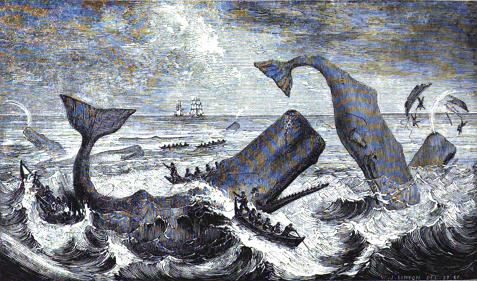
BOATS ATTACKING WHALES. |
THENATURAL HISTORYOFTHE SPERM WHALEITS ANATOMY AND PHYSIOLOGY – FOOD – SPERMACETI – AMBERGRIS – RISE AND PROGRESS OF THE FISHERY –CHASE AND CAPTURE – "CUTTING IN" AND "TRYING OUT" – DESCRIPTION OF THE SHIPS, BOATS, MEN, AND INSTRUMENTS USED IN THE ATTACK; WITH AN ACCOUNT OF ITS FAVOURITE PLACES OF RESORTTO WHICH IS ADDED, A SKETCHOF ASOUTH-SEA WHALING VOYAGE:EMBRACING A DESCRIPTION OF THE EXTENT, AS WELL AS THE ADVENTURES AND ACCIDENTS THAT OCCURRED DURING THE VOYAGE IN WHICH THE AUTHOR WAS PERSONALLY ENGAGED.By THOMAS BEALE, SurgeonDEMONSTRATOR OF ANATOMY TO THE ECLECTIC SOCIETY OF LONDON, ETC., AND LATE SURGEON TO THE "KENT" AND "SARAH AND ELIZABETH," SOUTH SEAMENLONDON:
|
|
LONDON :
PRINTED BY MANNING AND MASON, IVY-LANE, PATERNOSTER-ROW. |
|
The first edition of this work having been attended with a success which far exceeded my expectation, I have been induced to commit this second edition to the press, with a view of rendering the book more perfect, and more worthy of public attention, by the addition of various new subjects; the principal of which forms the second part of the present volume. I have spared neither time, trouble, nor expense, in endeavouring to render it worthy the patronage of my friends; and although I have not the slightest pretension to literary tact, I do hope that my present attempt may be found somewhat interesting, and even useful, until some person better qualified for the task shall arise, and fill, with a more solid production, the "chasm" which has existed so long in this department of Natural and Commercial History. If this new effort should be attended, as my first unexpectedly was, with the approbation of such naturalists as Owen, Cuvier, and Bell, I shall indeed feel myself amply repaid for these labours, which have been pursued in hours that I have wrested from other and more toilsome avocations.
Thomas Beale.
Bedford Square East, |
TO
|
liberate the Negro from the condition of the slave, – efforts which were commenced many years since, and at a time too, when to attempt to break his chains was considered the index of a weak or flighty intellect. As the trusty friend of Macaulay, you fought the battle of the Negro, while others were standing aloof watching the issue of the conflict, and it was not until the enemies of the dark human race began their precipitate retreat, that the wavering friends of the cause flocked around the banner you had helped to raise to share the honours of your victory. And now that the Negro is free, and you behold the hallowed consummation of your just, yet tedious and incessant exertions, I have no doubt (though to such conduct a public tribute is due), that your greatest reward is in your own feelings, independently of worldly praise. That you may live long, to enjoy the happiness surely emanating from such generous acts, is the wish of your
Very humble Servant,
THOMAS BEALE |
| |||||||||||||||||||||||||||||||||||||||||||||||||||||||||
| |||||||||||||||||||
| |||||||||||||||||||
DIRECTIONS FOR PLATES.
|
THE NATURAL HISTORYOFTHE SPERM WHALEPART I.INTRODUCTORY REMARKS.It is the principal object of this work to describe, probably, the largest inhabitant of the globe, known commonly under the name of the spermaceti whale, – by the French, as the cachalot, – and by systematic naturalists, as the Physeter macrocephalus, and which as yet has not assumed the station to which it is entitled in the history of animated nature. Since the earliest days of natural history down to the present time, the sperm whale has been subjected to constant misrepresentation, referable to the contracted information of those who have undertaken its description, and who have consequently been obliged to compile their accounts from sources inaccurate and false, on which they ought not to have depended, and they should have left a blank in the page, than to have filled it with the results, as Cuvier has observed, |
"of that heated imagination which leads some enthusiasts to see nothing in nature, but miracles and monsters. In fact, till the appearance of Mr. Huggins' admirable print, few, with the exception of those immediately engaged in the fishery, had the most distant idea even of the external form of this animal; and of its manners and habits, people in general seem to know as little as if its capture had never given employment to British capital, or encouragement to the daring courage of our hardy seamen. While the very term, whale-fishery, seems associated with the coast of Greenland or icebound Spitzbergen, and the stern magnificance of arctic scenery, few connect the pursuit of this "sea beast" with the smiling latitudes of the South Pacific, and the coral islands of the torrid zone; and fewer still have more distinct conception of the object of this pursuit, than that it is a whale, producing the substance called spermaceti, and the animal oil best adapted to the purpose of illumination. The Greenland whale, or Balaena mysticetus, has so frequently been described in a popular manner, that the public voice has long enthroned him as monarch of the deep, and perhaps the dread of disturbing such weighty matters as a settled sovereignty and public opinion, may have deterred those best acquainted with the merits of the case from supporting the more legitimate claims of his southern rival to this pre-eminence. Since the year 1775, in which we date the origin of the sperm-whale fishery from this country, although |
many thousands of persons have been from time to time engaged in the pursuit, and must have possessed the best opportunities of observing the habits and manners of this immense animal, yet not one has stepped forward to vindicate its history from the absurd and fabulous accounts with which it has been loaded, and of which many instances will be found in the following pages. For notwithstanding that the sperm whale is one of the most noisless of marine animals, yet the Abbe Lecoz, in his account of it, gives it the power of emitting terrible groans when in distress, and which he states are so loud and deep, that it is possible to hear them from a great distance; and Anderson asserts, that a cachalot, which was frightened at the approach of his ship, uttered a cry so loud and violent, like the sound of a bell, that it caused even the vessel to shake; and yet all those which have been destroyed by the harpoon and lance, and which have been terribly frightened, and have made the most violent efforts to escape, never were heard to emit the slightest sound, and it is well known among the most experienced whalers, that they never produce any nasal or vocal sounds whatever, except a trifling hissing at the time of the expiration of the spout. But even the Baron Cuvier follows the account of these old historians, and asserts, that "in the combat, fear, fury, or pain draw from them such profound groans, or piercing cries, that their congeners are attracted in crowds from all sides, continue the fight with fresh ardour and audacity, and stain the water with blood to the distance of many leagues." |
From these accounts it is evident, that both Anderson and the Abbe Lecoz, have been mistaken in the kind of whale which they saw, and which they heard emit the sounds of which they have written. Having no doubt mistook the sperm whale for the balaena mysticetus, or common Greenland whale, which I have heard myself produce loud sounds, but which have more resembled the roaring of an enraged bull, than the vehement sound of a bell, as Anderson has asserted. While the sperm whale has been quietly searching the ocean depths for his food, and avoiding with the greatest care and timidity the slightest danger or rencontre of any kind, he has been represented by Olassen and Povelsen as the most savage and ferocious of all marine animals; for not only, according to their accounts, does the cachalot constantly thirst for the blood of every fish in the sea, but actually possesses a relish for human flesh, which we are led to suppose they wished to satiate, when these historians assert that they seized, and upset with their jaws, a boat which contained some seamen, whom they speedily devoured. If these huge but timid animals happen to see or hear the approach of a ship or boat, their fear is all cases is excessive, and they either dive into the depths of the ocean, or skim along its surface with the utmost precipitation, to avoid the danger of a concussion, or the blow of the harpoon, which, when inflicted, often paralyses the largest and strongest of them with affright, in which state they will often remain for a short period on the surface of the sea, lying as it were in a fainting con- |
dition; from which however they recover (if the dextrous whaler profiting by the circumstance, has not mortally wounded his prey), and shew extreme activity in avoiding their foes; but they rarely turn upon their cruel adversaries, for although men and boats are frequently destroyed in these rencontres, they are more the effect of accident during violent contortions and struggles to escape, than from any wilful attack. Yet the Baron Cuvier, in the compilation of its natural history, which he has obtained from many incorrect sources, states: – "the terrible arms, the powerful and numerous teeth with which nature has provided the cachalot, render it a terrific adversary to all the inhabitants of the deep, even to those which are most dangerous to others; such as the phocae, the balaenopterae, the dolphin, and the shark. So terrified are all these animals at the sight of the cachalot, that they hurry to conceal themselves from him in the sands or mud, and often in the precipitancy of their flight, dash themselves against the rocks with such violence as to cause instantaneous death. It is not therefore surprising," says Cuvier, "if the myriads of fishes on which this tyrant preys, are struck with the most lively terror at his presence. So powerful is this feeling, that the multitudes of fish which seek with avidity the dead carcasses of the other cetacea, dare not approach the body of the cachalot when he is floating lifeless on the surface of the ocean." From such accounts as these, we might be led to believe that there is no animal in the creation more mon- |
strously ferocious than the sperm whale; not only is his true character of being a quiet and inoffensive animal taken from him, but he is represented on the same page, as the greedy and cruel pursuer of all kinds of marine animals, on which of course we are suppose that he feeds. "There are some, however," obsrves the Baron Cuvier, "among the cachalots that pursue seals, and some are sufficiently audacious to attack many species of the balaenae (whales), especially such individuals as are not adults;" which certainbly represents him as a formidable opponent to all the marine tribes, and we infer, a voluptuous devourer of every animal which is so unfortunate as to wander within its reach. But after all these relations, it requires but a little observation and reflection to convince ourselves, now that we are more acquainted with the real habits of the sperm whale, that the authorities of which previous writers have availed themselves in the compilation of their histories of it, have all either wilfully misrepresented the natural habits of this animal, or have mistaken the cachalot for some other whale which possesses these voracious and combative dispositions. For not only does the sperm whale in reality happen to be a most timid and inoffensive animal as I have before stated, readily endeavouring to escape from the slightest thing which bears an unusual appearance, but he is also quite incapable of being guilty of the acts of which he is so strongly accused. The formation of his teeth, and size of his gullet are quite sufficient in themselves to prove that he is incapable of devouring |
the balaenopterae (back-finned whales), and balaenae (common black whales); for it would be quite impossible for him to swallow such monstrous victims, as his throat is scarcely sufficiently capacious to admit the body of a man, and also from the fact of his teeth not possessing the power of separating, or of masticating his food, but merely possessing a prehensile or holding power; for being provided only with a row of widely separated, short-pointed, conical teeth in the lower jaw, and none in the upper, except in a few instances, in which they appear wholly rudimentary, scarcely projecting beyond the gums, he is totally unable to wound seriously, much more to tear to pieces and devour, the body of such an enormous animal as a balaena, even if it were not an adult, or one of the balaenopterae, in which is included the giant fin-back. As for the dolphins, seals, and sharks which he is made to chase with ravenous voracity, until they hide themselves in mud, or dash themselves against rocks in attempting to escape; I can only observe with regard to such tales, that the sperm whale is never, or very rearely seen near sand, mud, or rocks, and therefore would not be likely to run his victim so hard; nor can I comprehend the latter's suicidal attempts to rid themselves of the constant harassing which they are represented as receiving from the cachalot. For although the sperm whale at times approaches the shores of islands and other places searching for their food, I never saw them nearer than a mile or two, and these were rare instances; and it is well known to whalers that they |
are never seen on soundings, that is, where the bottom of the sea can be touched with the "lead," except they happen to be driven over a bank or shoal, as is sometimes the case in the "Seychelle" fishery, and when the boats are in hot pursuit, or by some uncommon occurances, and where shoals and banks are divided by unfathomable depths of ocean. Besides it is not very probable that a sperm whale of eighty feet in length, and proportionable bulk could possess any chance of chasing and overtaking any of the dolphin tribe, seals, or sharks, which move with such dodging velocity as to place at utter defiance the movements of so immense an animal. Moreover this whale has never been seen to eject from his stomach, when mortally wounded, any other animal but squid, which is known to naturalists as the "sepia octopus," which is its natural food; except when near the shore as in "Volcano Bay," on the coast of Japan, or in the "Straits of Corea," which join the north Pacific with the Japanese Sea, they are sometimes known to eject fish about the size of a small cod, which inhabit these localities in great plenty, and which, like the squid, in my opinion are attracted into the whale's mouth while he is lying still for the purpose, from the white and glistening appearance of it, rather than by any power which the spermaceti whale possesses of capturing such little nimble animals by the chase; but for further considerations on this subject, I beg leave to refer the reader to the article entitled "Feeding," which will be found in another part of this work. |
And that part of Cuvier's history which states, "that the multitudes of fish which seek with avidity the dead carcasses of the other cetacea, dare not approach the body of the cachalot, when he is floating lifeless on the surface of the ocean," is just as incorrect as any of the foregoing; for sometimes whalers have experienced considerable losses in having had young sperm whales half eaten up in one night by large numbers of voracious sharks, as the whales have been lying secured by the ship's side, ready for cutting in on the morrow. Great contradictions and dissensions have also at various times originated among naturalists, relative to the number of the species of this whale; yet notwithstanding the ingenious reasoning of some, and the bold and truthlike observatons of others, with the close attention to the subject of such men as Green, Aldrovandus, Willoughby, Rondelet, Artedi, Ray, Sibbald, Linnaeus, Brisson, Marten, and a crowd of other distinguished naturalists, from the impossibility of any of these great men making continuous observations upon this interesting animal, the subject was still doomed to remain an apparently impenetrable mystery. And although Lacapede appears to be the first naturalist who endeavoured to introduce order into this department of zoology, yet even he has entirely failed in giving a correct account of this cetacean, when he states that there are eight species of this whale, some of which, he states, may be known by their dorsal fins. To convince the reader of the utter confusion which |
exists among the historians of this animal, it will only be necessary to state here, a few of their published opinions, on the supposed different species of the spermaceti whale. Brisson made no less than seven species of the cachalot, depending upon their dorsal fins, spout-holes, and form of their teeth. Linnaeus followed, and reduced them to four physeters, which he characterised by the form of the teeth of the lower jaw. Bonnaterre increased them again to six species, depending upon the peculiar modifications of the dorsal fins, or protuberances, and some small modifications in the form of their teeth. Lacapede next came, increasing the number over all his predecessors, making eight species, which he divided into three groups; viz. the cachalots proper, which have one, or several dorsal eminences, and whose nostrils are placed at the extremity of the muzzle; the physales, which only differ from the cachalots, in having a small, dorsal hump, and having the nostril situated at a little distance from the end of the snout; and lastly, the physeters, which have a dorsal fin, and whose nostrils are placed at the end, or near the end of the muzzle. The first of these groups (the cachalots) are subdivided. Desmarest, however thought proper to add another to those of Lacapede, the characters of which he obtained from some Chinese drawing, upon the fidelity of which no dependence can of course be placed. So that it is quite evident to my mind, that Lacapede |
must be in error, if he classes the spermaceti whale with those which have dorsal fins, without going into reflections upon the other species, which he causes to depend on differences which do not exist; because in the first place the sperm whale has no dorsal fin whatever, merely having in its place a hump, or rounded ridge of fat, in form not unlike that of a camel, and which is stripped off with the blubber, having in its structure no bones or cartilages, by which we might even suppose it to be the rudiment of a fin; while several other kinds of whales possess real dorsal fins, as the finback, which belongs to the balaenae, and is entirely different in its form and habits, having the head invested with the "baleen," or screening apparatus, by which it feeds, like the common black, or Greenland whale, on an entirely different food to that of the sperm whale, who has in blace of the baleen, a jaw furnished with teeth, "the two branches of which, are joined in the greater part of its length in a cylindrical symphasis," and who spouts from the anterior angle of the head, while the finback, like the common whale of Greenland, spouts from the middle of the top of the same part. Others of the whale tribe have dorsal fins, while they possess the cylindrical jaw, as the black fish, but yet spout from the forehead, or top of the head, and do not produce spermaceti. While some, as the Greenland whale, spout from the middle of the top of the head, have their jaws furnished with baleen, but have neither dorsal fins nor hump. Another kind, which is well known to whalers, as the humpbacked whale, possesses, like the Greenland |
whale, the baleen, and spouts from the top of the head yet has a hump not very dissimilar to that of the sperm whale. So that they resemble each other in some respects, and differ so widely in other parts of their formation, and also in their habits, that they each necessarily belong to distinct classes of beings, and convince me, that they cannot properly be arranged in families, from the form or situation of their fins, humps, teeth, or baleen. However, it is not my intention, were it in my power, to enter into the inquiry as to the true method of dividing the cetacea into groups, families, genera, or species; but this I can assert in contradiction to Lacapede, and others of the foregoing authorities, that there is no more than one species of sperm whale, and this I say from having particularly noticed their external form, and also their manner and habits, in various parts of the world very distant from each other, yet I was never led to suppose for an instant, from their observance, that more than one species of this kind of whale exists. The large full-grown male, appeared the same in every part, from New Guinea to Japan, from Japan to the coast of Peru, from Peru to our own island; while their females coincided in every particular, having their young ones among them in the same order, and appearing similar to all others which I had seen in every respect, merely differing a little in colour or fatness, according to the climate in which they were captured, as we had many opportunities of observing, as they were |
lying dead by the side of the ship. Frederick Cuvier, the brother of the illustrious Baron, in the most interesting and learned work that ever appeared, on the history of whales in general, entitled "de l'Histoire Naturelle des Cetaces," and which was published so late as 1836, after stating the difficulty of procuring a correct drawing of the sperm whale, on account of those which have been stranded on various parts of Europe becoming so much misshapen from their own weight, while lying in the mud, and moreover from their being surrounded by great numbers of eager spectators, remarks, that "figures drawn from whales when floating freely, would be in a condition to inspire more confidence, but if such figures are possible, we believe that science, as yet, does not possess any." A paragraph, in the truth of which every person musts agree, so far as its first part extends, but when the outline of the one given by Captain Colnett, which we suppose was taken from nature, with the faithful and excellent plate by Huggins, from a drawing made in the South Seas over the dead animal, and also the sketch, which was given in the former edition of this work, taken as it was, very carefully under the same circumstances, are considered, coinciding as they all do in every particular, the deficiency complained of by F. Cuvier would seem to have been amply supplied. To prove the great discrepancy that exists between the imaginary figure of F. Cuvier, and that taken from actual observaton, it will only be necessary for the satisfaction of those personally unacquainted with the |
subject, to subjoin a comparative outline sketch of the two. 
Some of the errors with which naturalists have been involved, may have arisen from the great disproportion in size which exists between the male and female of these animals, and which is very great, the adult female bearing a proportion of only about one-fifth to the size of the large adult male; but this is not altogeher to be understood in regard of length, but of their general bulk, for females are longer in proportion to their circumference than the males, being altogether more slenderly formed, which gives them that appearance of lightness and comparative weakness, which the females |
of most animals possess; and on this account the female heretofore may have been taken for a different species of the cachalot, when her size has been compared with that of the large male, particularly when it is known that the female of the common Greenland whale is in most instances the larger. The Baron Cuvier, in his remarks upon the sperm whale, states, "that he is another of those giants of the main, whose colossal structure and tyrannical dominion render them truly formidable; this cachalot is more lively and active than the generality of the cetacea, and is only less bulky than the common whale, of which he is a most dangerous rival, though less powerful than that first of the marine mammalia." This assertion is another instance, showing how correctness and its opposite may be placed together; for although some of these remarks are true, as far as relates to the superior activity of the sperm whale, yet, when it is observed that he is "less powerful" and "less bulky" than "his dangerous rival," we are led to suppose that the learned author has depended too much on the mistaken evidence of others; for Scoresby, in his account of the size and length of the Greenland whale, states that about seventy or seventy-two feet, would measure the longest that he saw; while a male spermaceti whale, which we captured at the Japan fishery, measured the enormous length of eighty-four feet, and it circumference, in this instance, was not less than that of a Greenland whale of the largest size; so that, if size is to be taken into consideration to entitle either of them to claim the dominion |
of the ocean, the sperm whale, at present, can certainly demand the place; and if his size is so superior, posessing also much greater activity, we can scarcely deem him the second of the marine mammalia, or "less powerful" than his northern rival. But, if naturalists have erred respecting the disposition, the food, species, form, and size of this leviathan, they have not been less deceived in regard to his breathing, during which they have represented him as throwing up water with the spout; this has been reiterated, not only by naturalists, but also by poet and painters, from the earliest periods – from Pliny's down to the present time, the notion has existed that he constantly ejects water with his breath, which has caused F. Cuvier to indulge also in this belief, because, as he states, "so many persons have been witnesses of it, that he cannot for a moment doubt the recital." I can only say, when I find myself again in opposition to those old and received notions, that, out of the thousands of sperm whales which I have seen during my wanderings in the south and north Pacific Oceans, I have never observed any of them to eject a column of water from the nostril. I have seen them at a distance, and I have been within a few yards of several hundreds of them, and I never saw water pass from the spout-hole. But the column of thick and dense vapour which is certainly ejected, is exceedingly likely to mislead the judgment of the casual observer in these matters; and this column does indeed appear very much like a jet of water, when seen at the distance of one or two miles on |
a clear day, because of the condensation of the vapour, which takes place the moment it escapes from the nostril, and its consequent opacity, which makes it appear of a white colour, and which is not observed when the whale is close to the spectator, and it then appears only like a jet of white steam; the only water in addition is the small quantity that may be lodged in the external fissure of the spout-hole, when the animal raises it above the surface to breathe, and which is blown up into the air with the spout, and may probably assist in condensing the vapour of which it is formed. It has, however, been stated by some naturalists that it is only at times that this whale projects water from the nostril, and that is at the time, they say, of his feeding. How far such an observation can apply to the Greenland whale, which feeds near the surface, will be noticed in the conclusion of these remarks; but I can state here, that such an observation cannot hold good with regard to the sperm whale, for that creature feeds far below the surface, and, in so doing, the large male continues in the depths of the ocean from an hour to an hour and twenty minutes, without once shewing himself above; so that, if he wishes to eject water from the mouth thorugh the nostril, to avoid swallowing it (if, indeed, he has any anatomical arrangement for so doing), it must be performed in the depths of his native element, into which he descends to feed, and therefore the operation is remote from observation. This general opinion, like that of the sperm whale's voice, is not only entertained by F. Cuvier, but among |
other recent writers on these subjects: Mr. T. Bell, in his valuable and beautiful work on British quadrupeds and marine mammalia, favours the opinions of the others who have preceded him. This misconception is also disseminated in the volume upon cetacea in the Naturalist's Library, conducted by Sir William Jardine, who has also fallen into great errors with regard to the sperm whale's feeding, and the size of the female. And although that gentleman has thought proper to fill his chapter on the natural history of the sperm whale entirely from the first little edition of this work, he does not appear to be convinced of its veracity, and at the same time (I am compelled to observe) to display a considerable want of accurate information on the subject, when he supposes that the food of the sperm whale is similar to that of the Greenland whale; a supposition manifestly untenable, when we regard the very different apparatus for the prehension and retention of food in the mouths of the two animals. The one provided with a complex and wonderfully arranged screen or sieve, for the purpose of separating minute animals from the water that passes through its mouth; and the other furnished with short but pointed teeth, evidently intended for the seizure of larger objects and totally unfitted for the function performed by the former. Moreover, the fact of the loligo affording the principal food of the sperm whale, is a well and long known fact, and an instance of this creature being found in the stomach of a sperm whale stranded on the coast of Nor- |
folk, is recorded by Sir Thomas Brown, so long ago as 1686. Mr. Bennett, in a paper which he read, not long since, before the Zoological Society, also stated that the sperm whale has the power of throwing up water with the expired air at particular times; but from what I have heard, I believe the observations which he made were not deemed conclusive of the fact, and I have not yet been able to peruse his paper myself. In the conclusion of this subject I may be allowed to state: – that I have been also very close to the balaena mysticetus when it has been feeding and breathing, and yet I never saw even that animal differ in the latter respect from the sperm whale in the nature of the spout; and even in porpoises, which I have seen in hundreds of instances playing or gamboling about the bows of our ship as she has been sailing along, yet in not a solitary instance did I ever observe anything but vapour dart from their nostrils, and which is but the work of an instant, for they are not on the surface more than that time, when they not only perform their expiration but inspiration, and again disappear in the twinkling of an eye. Again, it has been observed by the same naturalist, who has been so frequently noticed in these remarks because he has been the most prominent historian on the subject with which we are engaged, that the spring is the time when the intercourse of the sexes takes place, which if true would certainly lead us to expect only at particular seasons a certain increase of these valuable animals – but this is not the case, as we find young sperm |
whales, at all seasons of the year, accompanying the groups, or "schools" of females, wherever or at whatever time they may be fallen in with: for an instance – if a ship on the Japan fishery or Bonin Islands, falls in with a "school" of female whales in May, which is the first commencement of the fishing season, they are sure to see young sucking whales among them; and if they also fall in with others of the same sex in the following August, September, or October, the young are also certainly met with – thus demonstrating, that there is no particular time set apart by nature for the sexual intercourse of these animals, but that they meet at all seasons of the year: the same ovservations hold good at the New Guinea fishery, and from all the information that I can obtain, also at the "Seychelle" and "Timor" fisheries. The groups, herds, or "schools," which are formed by the sperm whale, are of two kinds: – firstly, by the females, which are accompanied by their young and one or two adult males; and secondly, by the young and half-grown males, but the large and fully grown males always go singly in search of food: but M. F. Cuvier has conjectured, that when they are seen alone, that it is "merely accidental, and not natural." His brother has also stated, that the left eye of the cachalot is much smaller than the other, so that fishermen attack him on that side, on which his vision is less perfect, in order to more readily elude his observation. Of the first of these remarks, I feel myself incompetent either to contradict, or confirm it positively; but I can assert that I never saw a whaler prefer either side of the whale, but that |
which was nearest or most convenient to him at the moment of attack – neither have I ever heard them make use of a single observation to confirm such an assertion. But if the great Baron Cuvier and his no less learned brother, have both been so much misled in the histories which they have given of the manners and habits of the sperm whale, it has arisen from the many difficulties they have had to deal with, in endeavouring to unravel the inextricable veil in which the true history of this animal has been wrapped by a multitude of writers, who have themselves either wilfully misrepresented the nature of this creature, with which they have pretended to be acquainted or who have depended upon the accounts of old voyagers, who have delighted in mixing fiction with truth, that miracles and wonders of all kinds might appear to have been their constant companions. Yet long ago, the powerful and scrutinizing mind of the Baron began to perforate the mist which hung over this branch of natural history; for we find him throwing out the following suspicions, which serve to shew the nature of his real opinion, upon the various accounts which surrounded him on the number of species of the cachalot. "Are there," he inquires, "any cachalots with an elevated dorsal fin? Are there any with the spiracles pierced on the forehead, on the middle of the head? Are there any in which the branches of the lower jaw are not joined for most of their length in a cylindrical symphysis?" We are proud in being enabled, thus far, to confirm the suspicions of Cuvier, and to finish these humble |
remarks by observing, that as far as our own researches on this whale have extended, and we have visited him in his own unfathomable and vast domain, for the purpose of observing his habits and form, we have never had reason to suppose that more than once species of spermaceti whale exists. And not until the queries instituted by Cuvier are answered in the affirmative, and proved, "and to be proved otherwise than by figures drawn by common sailors – not until such beings have been carefully observed by enlightened men – not until their osseous parts have been deposited in collections, where they can be verified by naturalists, shall we be justified in admitting more than one kind of sperm whale into the catalogue of animals." |
CHAPTER I.EXTERNAL FORM AND PECULIARITIES OF THE SPERM WHALEBefore proceeding to the account of the habits of the sperm whale, I have thought that it might be interesting to prefix a short description of its external form, and some anatomical points in its conformation. By reference to the prefixed engravings, the following description will be much more readily understood: 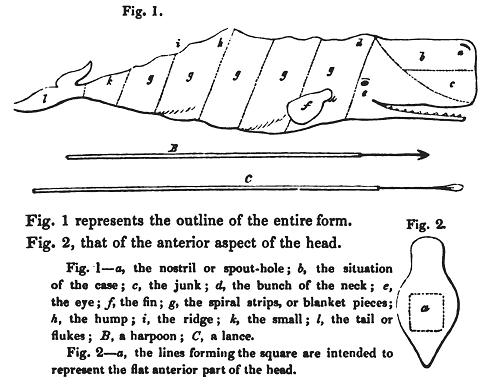
|
The head of the sperm whale presents in front a very thick blunt extremity, called the snout or nose, and constitutes about one-third of the whole length of the animal – at its junction with the body is a large protuberance on the back, called by the whalers the "bunch of the neck;" immediately behind this, or at what might be termed the shoulder, is the thickest part of the body, which from this point gradually tapers off to the tail, but it does not become much smaller for about another third of the whole length, when the "small," as it is called, or tail, commences; and at this point also, on the back, is a large prominence of a pyramidal form, called the "hump," from which a series of smaller processes run half way down the "small," or tail, constituting what is called by whalers the "ridge." The body then contracts so much, as to become finally not thicker than the body of a man, and terminates by becoming expanded on the sides into the "flukes," or tail properly speaking. The two flukes constitute a large triangular fin, resembling in some respects the tail of fishes, but differing in being placed horizontally; there is a slight notch, or depression between the flukes, posteriorly – they are about six or eight feet in length, and from twelve to fourteen in breadth in the largest males. The chest and belly are narrower than the broadest part of the back, and taper off evenly and beautifully towards the tail, giving what by sailors is termed a "clear run," – the depth of the head and body is in all parts except the tail greater than the width. The head viewed in front, as in fig.2, presents a broad, somewhat flattened surface, |
rounded, and contracted above, considerably expanded on the sides, and gradually contracted below, so as in some degree to attain a resemblance to the cutwater of a ship. At the angle formed by the anterior and superior surfaces on the left side, is placed the single blowing-hole, or nostril, which in the dead animal presents the appearance of a slit or fissure, in form resembling as S, extending longitudinally, and about twelve inches in length. This nostril, however, is surrounded by several muscles, which in the living state are for the purpose of modifying its shape and dimensions, according to the necessities of respiration, similar to those which act upon the nostrils of land animals. In the right side of the nose, and upper surface of the head, is a large, almost triangular-shaped cavity, called by whalers the "case," which is lined with a beautiful glistening membrane, and covered by a thick layer of muscular fibres and small tendons, running in various directions, and finally united by common integuments. This cavity is for the purpose of secreting and containing an oily fluid, which, after death, concretes into a granulated substance of a yellowish colour, the spermaceti. The size of the case may be estimated, when it is stated that in a large whale it not unfrequently contains a ton, or more than ten large barrels of spermaceti! Beneath the case and nostril, and projecting beyond the lower jaw, is a thick mass of elastic substance called the "junk:" it is formed of a dense cellular tissue, |
strenthened by numerous strong tendinous fibres, and infiltrated with very fine sperm oil and spermaceti. The mouth extends nearly the whole length of the head. Both the jaws, but especially the lower, are in front contracted to a very narrow point, and when the mouth is closed, the lower jaw is received within a sort of cartilaginous lip, or projection of the upper one; but principally in front, for further back, at the sides, and towards the angle of the mouth, both jaws are furnished with tolerably well developed lips: in the lower jaw are forty-two teeth, of a formidable size, but conical shape; there are none, however, in the upper, which instead presents depressions corresponding to, and for the reception of, the points of those in the lower jaw, – sometimes, however, a few rudimentary teeth may be found situated in the upper jaw, but never projecting beyond the gums, and upon which those in the lower jaw strike when the mouth is closed. The tongue is small, of a white colour, and does not appear to possess the power of very extended motion. The throat is capacious enough to give passage to the body of a man; in this respect presenting a strong contrast with the contracted gullet of the Greenland whale. The mouth is lined throughout with a pearly white membrane, which becomes continuous at the lips, and borders with the common integument, where it becomes of a dark-brown or black colour. The eyes are small, in comparison with the size of the animal, and are furnished with eyelids, the lower of which is the more moveable: they are placed a little |
above, and behind the angle of the mouth, at the widest part of the head. At a short distance behind the eyes, are the external openings of the ears, of size sufficient to admit a small quill, and unprovided with any external auricular appendage. Behind, and not far from the posterior angle of the mouth, are placed the swimming paws, or fins, which are analogous in their formation to the anterior extremities of other animals, or the arms of man; they are not much used as instruments of progression, but probably in giving a direction to that motion in balancing the body in sinking suddenly, and occasionally in supporting their young. In a full-grown male sperm whale, of the largest size, or about eighty-four feet in length, the dimensions may be given as follow: – depth of head from eight to nine feet, – breadth, from five to six feet, – depth of body seldom exceeds twelve or fourteen feet, so that the circumference of the largest sperm whale of eighty or eighty-four feet will seldom exceed thirty-six feet, – the swimming paws or fins, are about six feet long and three broad; the dimensions of the flukes or tail have been previously mentioned. In reviewing this description of the external form, and some of the organs of the sperm whale, it will perhaps not be uninteresting if some comparison is instituted between them and the corresponding points of the Greenland whale. In doing this, the remarkable adapation of form and parts to different habits, situation, and food, will not fail to strike every one with admiration. |
One of the peculiarities of the sperm whale, which strikes at first sight every beholder, is the apparently disproportionate and unwieldly bulk of the head; but this peculiarity, instead of being, as might be supposed, an impediment to the freedom of the animal's motion in his native element, is in fact, on the contrary in some respects very conducive to his lightness and agility, if such a term can with propriety be applied to such an enormous creature; for a great part of the bulk of the head is made up of a large thin membranous case, containing, during life, a thin oil of much less specific gravity than water; below which again is the junk, which, although heavier than the spermaceti, is still lighter than the element in which the whale moves; consequently the head taken as a whole, is lighter specifically than any other part of the body and will always have a tendency to rise at least so far above the surface as to elevate the nostril or "blow-hole" sufficiently for all purposes of respiration, and more than this, a very slight effort on the part of the fish would only be necessary to raise the whole of the anterior flat surface of the nose out of the water; in case the animal should wish to increase his speed to the utmost, the narrow inferior surface, which has been before stated to bear some resemblance to the cutwater of a ship, and which would in fact answer the same purpose to the whale, would be the only part exposed to the pressure of the water in front, enabling him thus to pass with the greatest celerity and ease through the boundless track of his wide domain. It is in this shape of the head that the sperm whale |
differs in the most remarkable degree from the Greenland whale, the shape of whose head more resembles that of the porpoise, and in it the nostril is situated much farther back, rendering it seldom or ever necessary for the nose to be elevated above the surface of the water; and when swimming even at the greatest speed, the Greenland whale keeps nearly the whole of the head under it, but as his head tapers off evenly in front, this circumstance does not much impede his motion, the rate of which is, however, never equal to that of the greatest rate of the sperm whale. It seems, indeed, in point of fact, that this purpose of rendering the head of light specific gravity, is the only use of this mass of oil and spermaceti, although some have supposed, and not without some degree of probability, that the "junk" especially may be serviceable in obviating the injurious effects of concussion, should the whale happen to meet with any obstacle when in full career. This supposition, however, would appear hardly tenable, when we consider the Greenland whale, although living among the rock-like icebergs of the arctic seas, has no such convenient provision, and with senses probably in all, and certainly in one respect less acute that those of the sperm whale, on which account it would seem requisite for him to possess this defence rather than the sperm whale, whose habitation is for the most part in the smiling latitudes of the southern seas. Considering the habits and mode of feeding, and the superior activity and apparent intelligence of the sperm whale, we shall be prepared to expect that he must possess a corresponding |
superiority in his external senses; and we accordingly find, that he enjoys a more perfect organ of hearing, in having an external opening of considerable size for the purpose of conveying sounds to the internal ear more readily and acutely than could be done through the dense and thick integument, which is continued over the auricular opening in the northern whale. Although the eyes in both animals are very small in comparison with their bulk, yet it is remarked that they are tolerably quick-sighted. I am not aware that the sperm whale possesses in this respect any superiority. Passing to the mouth, we again observe a very remarkable difference in the conformation of the two animals; as in place of the enormous plates of whalebone which are found attached to the upper jaw of the Greenland whale, we in the sperm whale only find depressions for the reception of the teeth of the lower jaw; organs which again are totally wanting in the other. Corresponding with these distinctions, which plainly point out that the food of the two whales must be very different, we find a remarkable difference in the size of the gullet. The several humps, or ridges, on the back of the sperm whale constitute another difference in their exterenal aspect; these prominences are however not altogether peculiar to the sperm whale, as that which is called by whalers the "humpback" possesses a prominence on the back not very dissimilar to that of the sperm whale, which has been noticed before in the introductory remarks, and which induced Lacapede to divide the genus Balaena into those with a hump, and those without; |
employing the name Balaena for the latter, and styling the others Balaenoptera. I have before adverted to the sharp cutwater-like conformation of the under part of the head in the sperm whale, and it is worthy of remark that the same part of the Greenland whale is nearly, if not altogether, flat. The skin of the sperm whale, as of all other cetaceous animals, is without scales, smooth, but occasionally, in old whales, wrinkled, and frequently marked on the sides by linear impressions, appearing as if rubbed against some angular body. The colour of the skin, over the greatest part of its extent, is very dark, most so on the upper part of the head, the back, and on the flukes, in which situation it is in fact sometimes black, on the sides it gradually assumes a lighter tint, till on the breast it becomes silvery grey. In different individuals there is, however, considerable variety of shade, and some are even piebald. Old "bulls," as full-grown males are called by whalers, have generally a portion of grey on the nose immediately above the fore-part of the upper-jaw, and they are then said to be "grey-headed." In young whales the "black skin," as it is called, is about three-eighths of an inch thick, but in old ones it is not more than one-eighth. Immediately beneath the black-skin is the blubber or fat, which is contained in a cellular membrane, and which is much strengthened by numerous interlacements of ligamentous fibres, which has induced Professor Jacob to consider the whole thickness of blubber to be the cutis |
vera, or true skin, infiltrated with oil, or fatty matters. Its thickness on the breast of a large whale is about fourteen inches, and on most other parts of the body it measures from eight to eleven inches. The head is not, however, supplied with this covering, having only the black skin, or cutis, which lies close to a layer of very dense cellular tissue, under which is seen a considerable thickness of numerous small tendons, intermixed with muscular fibres. This is more especially observed on the top and upper third of the head, surrounding the case, as lower down we find the black skin lying close to the peculiar structure of the junk. This thick covering of skin, blubber, or fat, is called by the South Sea whalers the "blanket." It is of a light yellowish colour, and, when melted down, furnishes the sperm oil. It also serves two excellent purposes to the whale, in rendering it buoyant, and in furnishing it with a warm protection from the coldness of the surrounding element; in this last respect answering well to the name bestowed upon it by the sailors. |
CHAPTER II.HABITS OF THE SPERM WHALE.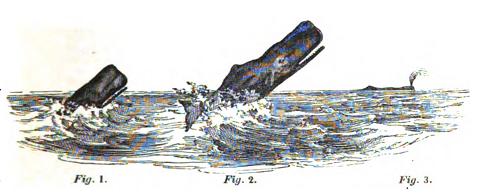
It is a matter of great astonishment that the consideration of the habits of so inteeresting, and in a commercial point of view of so important an animal, should have been so entirely neglected, or should have excited so little curiosity among the numerous, and many of them competent observers, that of late years must have possessed the most abundant and the most convenient opportunities of witnessing their habitudes. I am not vain enough to pretend that the few following pages include a perfect sketch of this subject, as regards the sperm whale; but I flatter myself that somewhat of novelty and originality will be found justly ascribable to the observations I have put together; they are at all events the fruit of long and attentive consideration. – For convenience of description, the habits of this animal are given under the heads of feeding, swimming, breathing, etc. |
FEEDINGThe food of the sperm whale consists almost wholly of an animal of the cuttle-fish kind, called by sailors the "squid," and by naturalists the "sepia octopus," the form and natural history of which will be fully noticed under the head of "Nature of the Sperm Whale's Food." See Chapter vii. This squid, or sepia, at least forms the principal part of his sustenance when at a distance from shore, or what is termed "off-shore ground;" but when met with nearer land, he has been known, when mortally or severly wounded,to eject from his stomach quantities of small fish, which are met with in great abundance in the bays and somewhat near the shore, especially in Volcano Bay on the coast of Japan, and in the Straits of Corea, which joins the Pacific Ocean with the sea of Japan; he sometimes, however, throws up fish as large as a moderate sized salmon. It would be difficult to believe that so large and unwieldly an animal as this whale could ever catch a sufficient quantity of such smnall animals, if he had to pursue them individually for his food; and I am not aware that either the fish he sometimes lives upon, or the squid, are ever found in shoals, or closely congregated, except in one solitary instance recorded by Captain Colnett, regarding the "squid," in which he states that, while off the Galapago's Islands "neither himself nor any of the oldest whalers had ever seen the squid in shoals before." It remains, then to be inquired in what way the sperm whale usually does supply his enormous frame with sufficient food. |
It appears from all I can learn among the oldest and most experienced whalers, and from the observations I have been enabled to make myself upon this interesting subject, that when this whale is inclined to feed, he descends a certain depth below the surface of the ocean, and there remains in as quiet a state as possible, opening his narrow elongated mouth until the lower jaw hangs down perpendicularly, or at right angles with the body. The roof of his mouth, the tongue, and especially the teeth, being of a bright glistening white colour, must of course present a remarkable appearance, which seems to be the incitement by which his prey are attracted, and when a sufficient number, I am strongly led to suppose, are within the mouth, he rapidly closes his jaw and swallows the contents; which is not the only instance of animals obtaining their prey by such means, when the form of their bodies, from unwieldiness or some other cause, prevents them from securing their prey in any other manner, or by the common method of the chase. The crocodile frequently employs strategems of the like nature: covering himself in mud, and lying still on the bank of some stream, or pond, he opens his enormous jaws, when hundreds of small reptiles, attracted by the mucus, or slime, which covers their interior, become the easy prey of the artful machinations of their scaly deceiver. The great American ant-eater also puts into action a practice which is very similar, for thrusting out his long tongue, which is warm, slimy, and steaming, over some ant-hill, it soon becomes covered with hundreds of those insects, who endeavour to make a similar property of the very organ by which they are entrapped. When covered, |
the tongue is suddenly drawn into the mouth, and the many little animals which crowded upon it are disposed of "in one fell swoop." That the mode mentioned above, by which the sperm whale acquires and secures its prey, is correct, I am led to believe also, from the following considerations. The sperm whale is subject to several diseases, one of which is a perfect, or imperfect, loss of sight. A whale perfectly blind, was taken by Captain William Swain, of the Sarah and Elizabeth whaler of London, both eyes of which were completely disorganized, the orbits being occupied by fungous masses, protruding considerably, rendering it certain that the whale must have been deprived of vision for a long space of time; yet, notwithstanding this, the animal was quite as fat, and produced as much oil, as any other captured of the same size. Besides blindness, this whale is frequently subject to deformity of the lower jaw: two instances of which I have seen myuself, in which the deformity was so great as to render it impossible for the animal to find the jaws useful in catching small fish, or even, one might have supposed, in deglutition; yet these whales possessed as much blubber and were as rich in oil as any of a similar size I have seen before or since. In both these instances of crooked jaws, the nutrition of the animal appeared to be equally perfect; but the deformities were different in one case, the jaw being bent to the right side and rolled as it were like a scroll, in the other it was bent downwards, but also curved upon itself. It would be interesting here to inquire into the |
causes of this deformity, but whether it is the effect of disease, or the consequences of accident, I am unable to determine. Old whalers affirm that it is caused by fighting; they state that the sperm whale fights by rushing head first, one upon the other, their mouths at the same time wide open, their object appearing to be the seizing of their opponent by the lower jaw, for which purpose they frequently turn themselves on the side; in this manner they strive vehemently for the mastery. I have never had the good fortune to witness one of these combats; but if it be the fact that such take place, we need not wonder at seeing so many deformed jaws in this kind of whale, for we can easily suppose the enormous force exerted on these occasions, taking into consideration at the same time the comparative slenderness of the jaw-bone in this animal. Some corroboration of the above statements arises from the fact as far as my knowledge extends, that the female is never seen affected with this deformity. From these facts it may almost be deduced, or at least surmised with a great degree of probability, that the mode of procuring food as above stated, as that pursued by the sperm whale, is the true one, for without eyes, and with a jaw (his only instrument of prehension) so much deformed, the animal would seem incapable of pursuing his prey, and would consequently gain but a very precarious subsistence, if its food did not actually throng about the mouth and throat, invited by their appearance, and attracted also in some degree as I suppose, |
by the peculiar and very strong odour of the sperm whale. Besides, it is well known, that many kinds of fish are attracted by substances possessing a white dazzling appearance, for not only the hungry shark, but the cautious and active dolphin both occasionally fall victims to this partiality, as I have had many opportunities of observing. When the Kent, south-seaman, was fishing on the "off-shore ground" of Peru, the crew caught a great number of the sepia octopus, or squid (the peculiar food of the sperm whale), in one night, by merely lowering a piece of polished lead armed with fish-hooks a certain depth into the sea; the sepiae gathered around it instantly, so that by giving a slight jerk to the line, the hooks were easily driven into their bodies. The teeth of the sperm whale are merely organs of prehension, they can be of no use for mastication, and consequently the fish, etc. which he occasionally vomits, present no marks of having undergone that process. The manner of the young ones sucking is a matter involved in some obscurity. It is impossible from the curious conformation of the mouth, that the young one could seize the nipple of the mother with the fore-part of it, for there are no soft lips at this part, but instead, the jaws are edged with a smooth and very hard cartilaginous substance, but about two feet from the angle of the mouth, they begin to be furnished with something like lips, which form at the angle some loose folds, soft and elastic; and it is commonly believed by the most experienced whalers, that it is by this part the young whale seizes the nipple and performs the act of sucking, and which is doubtless the mode of its doing so. |
CHAPTER III.SWIMMINGNotwithstanding his enormous size, we find that the sperm whale has the power of moving through the water with the greatest ease, and with considerable velocity. When undisturbed, he passes tranquilly along just below the surface of the water, at the rate of about three or four miles an hour, which progress he effects by a gentle oblique motion from side to side of the "flukes," precisely in the same manner as a boat is skulled by means of an oar over the stern. When proceeding at this his common rate, his body lies horizontally, his "hump" projecting above the surface ( see cut, p.33, fig.3), with the water a little disturbed around it, and more or less according to his velocity. This disturbed water is called by whalers "white water," and from the greater or less quantity of it, an experienced whaler can judge very accurately of the rate at which the whale is going, from a distance even of four or five miles. In this mode of swimming, the whale is able to attain a velocity of about seven miles an hour; but when desirous of proceeding at a greater rate, the action of the tail is materially altered, – instead of being moved |
laterally and obliquely, it strikes the water with the broad flat surface of the flukes in a direct manner, upwards and downwards, and each time the blow is made with the inferior surface, the head of the whale sinks down to the depth of eight or ten feet, but when the blow is reversed, it rises out of the water, presenting then to it only the sharp cutwater-like inferior portion. The blow with the upper surface of the flukes appears to be by far the most powerful, and as at the same time the resistance of the broad anterior surface of the head is removed, appears to be the principal means of progression. This mode of swimming, with the head alternately in and out of the water, is called by whalers "going head out," ( see cut, p.33, fig.1). And in this way the whale can attain a speed of ten or twelve miles an hour, and this latter, I believe to be his greatest velocity. The tail is thus seen to be the great means of progression, and the fins are not much used for that purpose; but occasionally when suddenly disturbed, the whale has the power of sinking quickly and directly downwards in the horizontal position, which he effects by strking upwards with the fins and tail. |
CHAPTER IV.BREATHINGAll the cetacea, as is well known, are warm-blooded animals, and possess lungs, and a corresponding respiratory apparatus resembling those of terrestrial animals, and require consequently a frequent intercourse with atmospheric air, and for this purpose it is of course necessary that they should rise to the surface of the water at certain intervals. The majority of this class of animals do not appear to perform this function with any regularity, and it is in this respect that the sperm whale is remarkably distinguished among his congeners, and it is from his peculiar mode of "blowing" that he is recognised even from a great distance by the most inexperienced whaler. When at the surface for the purpose of respiration, the whale generally remains still, but occasionally continues making a gentle progress during the whole of his breathing time. If the water is moderately smooth, the first part of the whale observable is a dark-coloured pyramidal mass, projecting about two or three feet out of the water, which is the "hump." At very regular intervals of time, the nose, or snout, emerges at a distance of from forty to fifty feet from the hump, in the full-grown male. From the extremity of |
the nose the spout is thrown up, which, when seen from a distance, appears thick, low, and bushy ( see cut, p.33, fig.3), and of a white colour: it is formed of the expired air, which is forcibly ejected by the animal through the blow-hole, acquiring its white colour from minute particles of water, previously lodged in the chink, or fissure of the nostril, and also from the condensation of the aqueous vapour thrown off by the lungs. The spout is projected from the blow-hole, at an angle of 135 degrees in a slow and continuous manner, for the space of about three seconds of time; – if the weather is fine and clear, and there is a gentle breeze at the time, it may be seen from the mast-head of a moderate-sized vessel, at the distance of four or five miles. The spout of the sperm whale differs much from that of other large cetacea, in which it is mostly double, and projected thin, and like a sudden jet, and as in these animals the blow-holes are situated nearly on the top of the head, it is thrown up to a considerable height, in almost a perpendicular direction. When, however, a sperm whale is alarmed or "gallied," the spout is thrown up much higher and with great rapidity, and consequently differs much from its usual appearance. The regularity with which every action connected with its breathing is performed by the sperm whale, is very remarkable. The length of time he remains at the surface, the number of spouts or expirations made at one time, the intervals between the spouts, the time he remains invisible in the "depths of the ocean buried," are all, when the animal is undisturbed, as regular in succession and duration as it is possible to imagine. |
In different individuals, the times consumed in performing these several acts vary, but in each they are minutely regular; and this well-known regularity is of considerable use to the fishers – for when a whaler has once noticed the periods of any particular sperm whale, which is not alarmed, he knows to a minute when to expect it again at the surface, and how long it will remain there. Immediately after each spout, the nose sinks beneath the water, scarecly a second intervening for the act of inspiration, which must consequently be performed very quickly, the air rushing into the chest with an astonishing velocity; there is however no sound caused by the inspiration, and very little by the expiration, or spout; in this respect also differing from other whales, for the "finback" whale, and some others, have their inspirations accompanied by a loud sound, as of air forcibly drawn into a small orifice, – this sound is called by whalers, the "drawback," and when heard at night near the ship, convinces the listening watch of the species to which it belongs. In a large "bull" sperm whale, the time consumed in making one inspiration and one expiration, or the space from the termination of one spout to that of another, is ten seconds; during six of which, the nostril is beneath the surface of the water, the inspiration occupying one, and the expiration three seconds, and at each breathing time the whale makes from sixty to seventy expirations, and remains, therefore, at the surface ten or eleven minutes. At the termination of this breathing time, or as whalers say, |
when he has had his "spoutings out," the head sinks slowly, the "small," or the part between the "hump" and "flukes," appears above the water, curved, with the convexity upwards, the flukes are then lifted high into the air, and the animal, having assumed a straight position, descends perpendicularly to an unknown depth, – this act is performed with regularity and slowness, and is called by whalers, "peaking the flukes," an act too, which is always noticed by those who are employed in the look-out, who call loudly, when they disappear below the surface, "there goes flukes." The whale continues thus hidden beneath the surface for an hour and ten minutes; some will remain an hour and ten minutes; some will remain an hour and twenty minutes, and others for only one hour, but these are rare exceptions. If we then take into consideration the quantity of time that the full-grown sperm whale consumes in respiration, and also the time he takes in searching for food, and performing other acts, below the surface of the ocean, we shall find, by a trifling calculation, that the former bears proportion to the latter, as one to seven, or in other words, that a seventh of the time of this huge animal is consumed in the function of respiration. The females being found generally in large numbers and in close company, it is difficult to fix the attention upon one individual, so as to ascertain precisely the time consumed below the surface; however, as all in one flock generally rise at the same time, it may be observed, that they remain below the water about twenty minutes, they make about thirty-five or forty |
expirations during the period they are at the surface, which is about four minutes, and they thus consume about a fifth of their time in respiration, a proportion considerably greater than that of the adult males. The same circumstances of accelerated respiration are observable also in "young bulls," and the acceleration seems to bear a certain definite proportion to their respective ages and size. When disturbed or alarmed, this regularity in breathing appears to be no longer observed; for instance, when a "bull," which when undisturbed remains at the surface until he has made sixty expirations, is alarmed by the approach of a boat, he immediately plunges beneath the waves, although it may probably have performed half its usual number, but will soon rise again not far distant, and finish his full number of respirations; and in this case, generally also, he sinks without having assumed the perpendicular position before described, on the contrary, he sinks suddenly in the horizontal position, and with remarkable rapidity, leaving a sort of vortex, or whirlpool, in the place where his huge body lately floated, – this curious movement is effected, as has been before stated, by some powerful upward strokes of the swimming paws and flukes. When urging his rapid course through the ocean, in that mode of swimming which is called "going head out," the spout is thrown up every time the head is raised above the surface, and under these circumstances of violent muscular exertion, as would be expected, the respiration is altogether much more hurried than usual. |
CHAPTER V.OTHER ACTIONS OF THE SPERM WHALE.When in a state of alarm, or gambolling in sport on the surface of the ocean, the sperm whale has many curious modes of acting; with the reason of some, I am at present unacquainted. It is difficult to conceive any object in nature calculated to cause alarm to this leviathan; he appears however to be remarkably timid, and is readily alarmed by the approach of a whale boat. When seriously alarmed, the whale is said by sailors to be "gallied," or probably more properly, galled, and in this state he performs many actions very differently from his usual mode, as has been mentioned in speaking of his swimming and breathing, and many also which he is never observed to perform under any other circumstances. One of them is what is called "sweeping," which consists in moving the tail slowly from side to side on the surface of the water, as if feeling for the boat or any other object that may be in the neighbourhood. The whale has also an extraordinary manner of rolling over and over on the surface, and this he does when "fastened to," which means, when a harpoon with a line attached is fixed in his body; and in this case |
they will sometimes coil an amazing length of line around them. They sometimes also place themselves in a perpendicular posture, with the head only above the water, presenting in this position a most extraordinary appearance when seen from a distance, resembling large black rocks in the midst of the ocean; this posture they seem to assume for the purpose of surveying more perfectly, or more easily, the surrounding expanse. A species of whale called by whalers "black fish," is most frequently in the habit of assuming this position. The eyes of the sperm whale being placed in the widest part of the head, of course afford the animal an extensive field of vision, and he appars to view objects very readily that are placed laterally in a direct line with the eye, and when they are placed at some distance before him. His common manner of looking at a boat or ship is to turn over on his side, so as to cause the rays from the object to strike directly upon the retina. Now when alarmed, and consequently anxious to take as rapid a glance as possible on all sides, he can much more readily do so when in the above-described perpendicular posture, and this consequently appears to be the reason of his assuming it. Occasionally, when lying at the surface, the whale appears to amuse itself by violently beating the water with its tail; this act is called "lob-tailing," and the water lashed in this way into foam, is termed "white water" by the whaler, and by it the whale is recognized from a great distance. |
But one of the most curious and surprising of the actions of the sperm whale, is that of leaping completely out of the water, or of "breaching," as it is called by whalers ( see cut, p.33, fig.2). The way in which he performs this extraordinary motion, appears to be by descending to a certain depth below the surface, and then making some powerful strokes with his tail, which are frequently and rapidly repeated, and thus convey a great degree of velocity to his body before it reaches the surface, when he darts completely out. When just emerged and at its greatest elevation, his body forms with the surface of the water an angle of about 45 degrees, the flukes lying parallel with the surface; in falling, the animal rolls his body slightly, so that he always falls on his side: he seldom breaches more than twice or thrice at a time, or in quick succession. The breach of a whale may be seen from the mast-head on a clear day at a distance of six miles. It is probable that the sperm whale often resorts to this action of breaching for the purpose of ridding itself of various animals which infest its skin, such as large "sucking fish," and other animals which resemble small crabs. Of the former of these parasites, some fix themselves so closely to their convenient carrier, that they sometimes adhere to the skin of the whale for several hours aftere its death, and then suffer themselves to be forced off by the hands of the whaler. It is not improbable also, that some of these actions may be resorted to in the whale endeavouring to avoid the assaults of the sword-fish, by which they are not un- |
frequently attacked, and this is supported by the fact of a portion of the sword of one of these animals having been found imbedded in the side of a whale stranded on the coast of Yorkshire, and which was probably broken off by the violent struggles between them. There is also an animal called a "thresher," which is described by whalers, but which I have never seen, although I have observed hundreds of sword-fish while off the coast of Peru, and also in other parts of the world. It is said by whalers, that the "thresher" and the sword-fish attack the whale in conjunction, the latter of which goad him from below, while the first leaps out of the water, and falls upon him from above – the attack thus intimidating the whale, and giving an opportunity to the sword-fish to inflict his wounds; but for what purpose I am at a loss to conjecture, for I am not aware that the latter has any power of devouring the whale after his death, were he even able to cause it. Nevertheless, a gentleman in whose veracity I have great confidence, informed me that he once witnessed an attack of this kind, which took place while he was sailing along the coast of Peru. He stated, that he had been observing a sperm whale during the time it had remained at the surface to breathe, which after it had performed went through the evolution of "peaking" its flukes in the usual manner and disappeared. As it was a large whale, and as he knew it was likely to remain under water for a considerable time, he scarcely expected to see it again. However, in this he was mistaken; for after it had disappeared only for a few |
minutes it again rose, apparently in great trepidation, and as it reared with great velocity, half of its huge body projected out of the water. Gaining, however, in a few seconds the horizontal position, it went off at its utmost speed, "going head out" – the moment after which he saw a fish, somewhat resembling a conger-eel in figure but rather more bulky, and to all appearance about six or eight feet in length, fling itself high out of the water after the whale, and fall clumsily on its back, which caused still more alarm to the immense but timid animal, so that it beat the water with its tail, and reared its enormous head so violently, that sounds from the former could be heard at a great distance: it still however continued its rapid career, receiving every few minutes the unwelcome visits of its galling adversary. My informant also stated, that he had good reason to believe that some other animal was at the same time attacking it from below; for he, on more than one occasion, saw some animal dart at times to the surface with amazing quickness, as if engaged with great fury in the contest; and which, he supposed, prevented the whale from descending, in which he had the power no doubt,if he had not been thus prevented, of leaving his antagonists far behind. The attack was continued for a considerable time, during which the whale had got a great distance from the ship, when it twice threw itself completely out of its native element, no doubt endeavouring to escape from its tormenting adversaries by this act of "breaching," and which I have myself seen him do, after having been unsuccessfully chased by the boats. |
CHAPTER VI.HERDING, AND OTHER PARTICULARS, OF THE SPERM WHALEThe sperm whale is a gregarious animal, and the herds formed by it are of two kinds – the one consisting of females, the other of young males not fully grown. These herds are called by whalers "schools," and occasionally consist of great numbers: I have seen in one school as man as five or six hundred. With each herd or school of females are always from one to three large "bulls" – the lords of the herd, or as they are called, the "schoolmasters." The males are said to be extremely jealous of intrusion by strangers, and to fight fiercely to maintain their rights. The full-grown males, or "large whales," almost always go alone in search of food; and when they are seen in company they are supposed to be making passages, or migrating from one "feeding ground" to another. The large whale is generally very incautious, and if alone he is without difficulty attacked, and by expert whalers generally very easily killed; as he frequently, after receiving the first blow or plunge of the harpoon, appears hardly to feel it, but continues lying like a "log of wood" in the water, before he rallies or makes any attempt to escape from his enemies. "Large whales" are however sometimes, but rarely, |
met with remarkably cunning and full of courage, when they will commit dreadful havoc with their jaws and tail; the jaw and head however appear to be their principal offensive weapons. The female breeds at all seasons, producing but one at a time, except in a few instances, in which two are produced, as the case of the one stranded on the coast of D'Audierne fully proves: her time of gestation is unknown; F. Cuvier supposes it to be about ten months. Their young, when first born, are according to Mr. Bennett, about fourteen feet in length and six feet in girth – he also states that they lie in the uterus in the form of a bow. M. F. Cuvier states that those which were brought forth at D'Audierne were ten or eleven feet in length; while Captain Colnett observes, that the young sperm whales, which he saw in great numbers off the Galapago's Islands, were not larger than a "small porpoise." Of these authorities I am inclined to depend most upon the accounts given by Mr. Bennett, because they coincide with instances which have come under my own observation. The female is much smaller than the male; her size, when generally considered, being not more than one-fifth that of the adult "large whale."* The females * This fact has been much doubted by Sir William Jardine, on whales, in vol. iii. of the "Naturalist's Library," p.167, where, in using the information contained in the first edition of this work, he states, "according to Beale she is much smaller than the male, in the proportion of nearly one to four or five. This appears a novel and, we presume to think, a somewhat doubtful assertion;" yet I can still assure Sir Silliam that it is not far from the truth! |
are very remarkable for attachment to their young, which they may be frequently seen urging and assisting to escape from danger with the most unceasing care and fondness. They are also not less remarkable for their strong feeling of sociality or attachment to one another; and this is carried to so great an extent, as that one female of a herd being attacked and wounded, her faithful companions will remain around her to the last moment, or until they are wounded themselves. This act of remaining by a wounded companion is called by whalers "heaving-to," and whole "schools" have been destroyed by dexterous management, when several ships have been in company, wholly from these whales possessing this remarkable disposition. The attachment appears to be reciprocal on the part of the young whales, which have been seen about the ship for hours after their parents have been killed. The young males, or "young bulls," go in large schools, but differ remarkably from the females in disposition, inasmuch as they make an immediate and rapid retreat upon one of their number being struck, who is left to take the best care he can of himself. I never but once saw them "heave-to," and in that case it was only for a short time, and which seemed rather to arise from their confusion than affecton for their wounded companion. They are also very cunning and cautious, keeping at all times a good look-out for danger; it is consequently necessary for the whaler to be extremely cautious in his mode of approaching them, so as, if possible, to escape being heard or seen, for they have some mode of com- |
munication one to another, through a whole school, in an incredebily short space of time. "Young bulls" are consequently much more troublesome to attack, and more difficult and dangerous to kill, great dexterity and despatch being necessary to give them no time to recover from the pain and fright caused by the first blow. When about three-fourths grown, or sometimes only half, they separate from each other, and go singly in search of food. All sperm whales, both large and small, have some method of communicating by signals to each other, by which they become apprised of the approach of danger, and this they do, although the distance may be very considerable between them, sometimes amounting to four, five, or even seven miles. The mode by which this is effected, remains a curious secret. |
CHAPTER VII.NATURE OF THE SPERM WHALE'S FOOD.It has been stated before (see Chapter ii.) that the food of the sperm whale consists almost wholly of an animal of the cuttle-fish kind, called by whalers "squid," and by naturalists, "sepia octopus," and at times, when he is near the shore, as in Volcano Bay, or on the straits of Corea, it also consists of small fish which are denominated "rock cod" by sailors, and which sometimes, however, approach the size of a moderate salmon. But the instances in which fish of this description have been ejected from the stomach of the sperm whale are but rare, while every day's experience proves that its common food consists of that division of molluscous animals which naturalists have denominated cephalopoda, and of which the "sepia octopus," or "sea squid," appears to be the most common. A few words on the natural history of this highly organized and remarkable animal, cannot fail to be interesting to the reader, as it has excited the attention of the naturalist for many ages, from the remarkable nature of its formation and very peculiar habits. Endowed with hearing, seeing, touch, smell, and taste, it is second to no inhabitant of the waters in the |
complex elaboration of its organs, which has constantly rendered it a great object of attention to the anatomist and physiologist. Dr. Roget, in his Bridgewater Treatise under the head of Cephalopoda, states "that we now arrive at a highly interesting family of mollusca, denominated cephalopoda, and distinguished above all the preceeding orders, by being endowed with a much more elaborate organization, and a far wider range of faculties. The cephalopoda have been so named from the position of certain organs of progressive motion which are situated on the head, and like the tentacula of the polypus, surround the opening of the mouth. These feet or arms, or tentacula, if we choose to call them so, are long, slender, and flexible processes, exceedingly irritable and contractile in every part, and provided with numerous muscles, which are capable of moving and twisting them in all directions with extraordinary quickness and precision; they are thus capable of being employed as instruments not only of progresive motion, but also of prehension. For this latter purpose they are in many species peculiarly well adapted, because, being perfectly flexible as well as highly muscular, they twine with ease round an object of any shape, and grasp it with prodigious force. In addition to these properties, they derive a remarkable power of adhesion to the surfaces of bodies from their being furnished with numerous suckers all along their inner sides. Each of these suckers is usually supported on a narrow neck or pedicle, and strengthened at its circumference by a ring of cartilage. Their internal |
mechanism is more artificial than the simple construction already described, for when the surface of the disk is fully expanded, we find that it is formed of a great number of small slender pieces, resembling teeth, closely set together, and extending from the inner margin of the cartilaginous rings in the form of converging radii, to within a short distance of the centre, where they leave a circular aperture. "In the flattened state of the sucker, this aperture is filled by the projecting part of a softer substance, which forms an interior portion capable of being detached from the flat circle of the teeth when the sucker is in action, and of leaving an intervening cavity. It is evident that by this mechanism, which combines the properties of an accurate valve with an extensive cavity for producing rarefaction or the tendency to vacuum, the power of adhesion is considerably augmented. So great is the force with which the tentacula of the cuttle-fish adhere to bodies by means of this apparatus, that while their muscular fibres continue contracted, it is easier to tear away the substance of the limb than to release it from its attachment. Even in the dead animal, I have found that the suckers retain considerable power of adhesion to any smooth surface to which they may be applied. "The octopus, which was the animal denominated polypus by Aristotle, has eight arms of equal length, and contains in its interior two very small rudimentary shells, formed by the inner surface of the mantle. This shell becomes much more distinct in the loligo, where it is cartilaginous, and shaped like the blade of a sword. |
The internal shell of the common sepia is large and broad, and composed wholly of the carbonate of lime, it is well known by the name of cuttle-fish bone. Its structure is extremely curious, and deserves particular attention, as establishing the universality of the principle which regulates the formation of shells, whether external or internal, and from which structures differing much in their outward appearance may result. It is composed of an immense number of thin calcereous plates, arranged parallel to one another, and connected by thousands of minute hollow pillars of the same calcareous material, passing perpendicularly between the adjacent surfaces. This shell is not adherent to any internal part of the animal which has produced it, but is enclosed in a capsule, and appears like a foreign body impacted in the midst of organs with which at first sight it appears to have no relation. It no doubt is of use in giving mechanical support to the soft substance of the body, and especially to the surrounding muscular flesh, and thus probably contributes to the high energy which the animal displays in all its movements. It has been regarded as an internal skeleton, but it certainly has no pretensions to such a designation, for, although enveloped by the mantle, it is still formed by that organ, and the material of which it is composed, still carbonate of lime. On both these accounts it must be considered as a true shell, and classed among the productions of the integuments. It differs indeed altogether from bony structures, which are composed of a different kind of material, and formed on principles of growth |
totally dissimilar. Besides tentacula, the sepia is also provided with a pair of fleshy fins extending along the two sides of the body. The loligo has similar organs of a smaller size, and situated only at the extremity of the body which is opposite to the head. They have been regarded as the rudiments of true fins, which are organs developed in fishes, and which are supported by slender bones called rays, but no structure of this kind exists in the fins of the cephalopoda. In swimming, the organs principally employed by cuttle-fish for giving an effective impulse to the water are the tentacula. These they employ as oars, striking with them from behind forwards, so that their effort is to propel the hinder part of the body, which is thus made to advance foremost, the head following in the rear. They also use these organs as feet for moving along the bottom of the sea. In their progress under these circumstances, the head is always turned downwards, and the body upwards, so that the animal may be considered as litereally walking on its head! "The necessity of this position for the feet arises probably from the close investment of the mantle over the body; for although the mantle leaves an aperture in the neck for the entrance of water to the respiratory organs, yet in other respects it forms a sack, closed in every part, except where the head, neck and accompanying tentacula protude. In the calamary, as well as in the common sepia, two of the arms are much longer than the rest, and terminate in a thick cylindrical portion, covered with |
numerous suckers, which may not unaptly be compared to a hand. These processes are employed by cuttle-fish as anchors, for the purpose of fixing themselves firmly to rocks during violent agitations of the sea; and accordingly we find, that it is only the extremities of these long tentacula that are provided with suckers, while the short ones have them also along their whole length. The other genera of cephalopodous mollusca are like the sepia, provided with tentacula attached to the head. They comprehend animals differing exceedingly in size, some being very large, but a great number very minute and even microscopic." – See M. D'Orbigny, in the 'Annales des Sciences Naturelles,' vii. 96. "Other animals of this kind inhabit shells, one of which is the argonaut, or paper-nautilus, which possesses a shell, says Roget, "exceedingly thin, and almost pellucid, probably for the sake of lightness, for it is intended to be used as a boat. For the purpose of enabling the animal to avail itself of the impulses of the air while it is thus floating on the water, nature has furnished it with a thin membrane, which she has attached to two of the tentacula, so that it can be spread out like a sail, to catch the light winds which waft the animal forward on its course. While its diminuive bark is thus scudding over the surface of the deep, the assiduous navigator does not neglect to apply its tentacula as oars on either side, to direct as well as to accelerate its motion. No sooner does the breeze freshen, and the sea becomes ruffled, than the animal hastens to take down its sail, |
and quickly withdrawing its tentacula within its shell, renders itself specifically heavier than the water, and sinks immediately into more tranquil regions beneath the surface." Sir William Jardine on whales, in the 'Naturalist's Library,' vol. vi. p.162, regarding the food of the spermaceti whale, "ventures to suggest to those who may have frequent opportunities of observing, whether this whale may not also frequently resort to the medusae and minute fish, which in so remarkable a manner supply food to some of the smaller as well as the other genera of the gigantic whales. That there is an abundant supply of this sustenance, both in the antarctic ocean, and the more smiling latitudes of the southern seas, can easily be proved by a reference to 'Lesson's Statements,' and also to those of Captain Colnett, who, when near the southern point of America observes, 'during this forenoon we passed several fields of spawn, which caused the water to bear the appearance of barley covering the surface of a bank.'" Orbigny also remarks, that there are immense tracts off the coast of Brazil, filled with small creatures so numerous as to impart a red colour to the sea; large portons are thus highly coloured, and receive from the whalers the name of Banc du Bresil. He also states that another similar bank occurs near Cape Horn, in 57° south latitude. "Statements of this sort," observes Sir William, "could easily be multiplied, and hence we cannot but suppose that this kind of food, which is ascertained to afford such rich nourishment to the other great cetacea, may, very pos- |
sibly be appropriated by the sperm whale to the same purpose." This is an unaccountable error on the part of the compiler of the Naturalist's Library. The apparent banks above mentioned, and which I have myself frequently seen in various parts of the ocean, are certainly formed by myriads of medusae, and other small animals which form the sustenance of the balaena mysticetus' or Greenland whale's food; which consists of animals of the shrimp tribe, and other minute creatures which are closely congregated, and swarm in those animated "banks," but of which the sperm whale never partakes, as it is not "very possible," but quite impossible that he could do so, however inclined he might be, on account of the organization of his feeding apparatus, which may be readily seen when its form is referred to. By what means could the sperm whale separate the minute animals which he might enclose within his jaws from the sea water in which they are contained? If the sperm whale had the means of doing so, of what use is the baleen plates or screens to the balaenae, or black whales, which are known to feed in the banks before adverted to? The sepia octopus, or "sea squid" as it is termed by whalers, sometimes reaches an enormous size. Mr. Henry Baker, F.R.S., in the Philosoophical Transactions for 1758, p.777, after having given an interesting description of a specimen, sent to him for examination by the Earl of Macclesfield, states that "it can, by spreading its arms abroad like a net, so fetter and entangle the |
prey they enclose when they are drawn together, as to render it incapable of exerting its strength; for, however feeble these branches or arms may be singly, their power united becomes surprising; and, we are assured, nature is so kind to these animals, that if in their struggles any of their arms are broken off, after some time they will grow again, of which a specimen at the British Museum is an undoubted proof, for a little new arm is there seen sprouting forth in the room of a large one which had been lost. "It is evident," he continues, "from what has been said, that the sea polypus, or octopus, must be terrible to the inhabitants of the waters in proportion to its size (and Pliny mentions one whose arms were thirty feet in length), for the close embraces of its arms and adhesion of its suckers must render the efforts of its prey ineffectual, either for resistance or escape, unless it be endued with an extraordinary degree of strength." Of the smaller genera of these animals the reader will find some interesting details, by referring to the appendix to Tuckey's Voyage to the Congo, vol.iii. There is also an account of a newly-discovered Cephalopod in the appendix to Sir J. Ross' Voyage to the Antarctic Regions. A gigantic cephalopod was discovered by Drs. Bank and Solander, in Captain Cook's first voyage, floating dead upon the sea, surrounded by birds, who were feeding on its remains. From the parts of this specimen which are still preserved in the Hunterian Collection, and which have always strongly excited the attention of naturalists, it must have measured at least six feet from the end of the tail to the end of the tentacles. |
But this last we must imagine a mere pigmy, when we consider the enormous dimensions of the one spoken of by Dr. Schewediawer, in the Phil. Trans. vol. lxxiii, p.226, whose tentaculum or limb measured twenty-seven feet in length; but let the Doctor speak for himself. "One of the gentlemen," says he, "who was so kind as to communicate to me his observations on this subject (ambergris) also, ten years ago, hooked a spermaceti whale that had in its mouth a tentaculum of the sepia octopodia nearly twenty-seven feet long! This did not appear its whole length, for one end was corroded by digestion, so that, in its natural state, it must have been a great deal longer. When we consider," says the Doctor, "the enormous bulk of the tentaculum here spoken of, we shall cease to wonder at the common saying of the fishermen, that the cuttle-fish is the largest fish of the ocean." In Todd's Cyclopaedia of Anatomy, p.529, treating of cephalopoda, in an admirable paper by Mr. Owen, it states, that "the natives of the Polynesian Islands, who dive for shell-fish, have a well-founded dread and abhorence of these formidable cephalopods, and one cannot feel surprised that their fears should have perhaps exagerated their dimensions and destructive attributes." The same learned writer, after having beautifully described another animal of this order, observes – "Let the reader picture to himself the projecting margin of the horny hook developed into a long-curved, sharp-pointed claw, and these weapons clustered at the expanded terminations of the tentacles and arranged in a double |
alternate series, along the whole internal surface of the eight muscular feet, and he will have some idea of the formidable nature of the carnivorous onychoteuthis." This species of cephalopod is thus armed with those kind of teeth at the termination of the tentacles, in order to secure the "agile, slippery, and mucous-clad fishes" on which it preys. And there is an instance recorded in Sir Grenville Temple's Excursions in the Mediterranean by which we perceive that these terrible creatures sometimes prey upon men! "In those shallow waters," says Sir Grenville, "are caught great quantities of fish, by forming curved lines or palisades some way out to sea with palm branches, by which the fish that come up with the high water are retained when it recedes. The horrid polypus, which is, however, greedily eaten, abounds, and some are of enormous size. They prove at times highly dangerous to bathers. "An instance of this occurred two years since: a Sardinian captain, bathing at Jerbeh, felt one of his feet in the grasp of one of these animals; on this, with his other foot he tried to disengage himself, but this limb was immediately seized by another of the monster's arms; he then, with his hands, endeavoured to free himself, but these also, in succession, were firmly grasped by the polypus, and the poor man was shortly after found drowned, with all his limbs strongly bound together by the arms and legs of the fish; and it is extraordinary, that where this happened, the water was scarcely four feet in depth." Other species of these surprising animals, as the |
calamaries, or "flying squid," as they are termed by whalers, have the power of propelling themselves through the atmosphere. "There is good reason for believing," says Mr. Owen, "that some of the small, slender-bodied subulate species of this genus are enabled to strike the water with such force as to raise themselves above the surface, and dart, like the flying fish, for a short distance through the air." I have myself seen, very frequently, while in the north and south Pacific, tens of thousands of these animals dart simultaneously out of the water when pursued by albacore, or dolphins, and propel themselves head first, in a horizontal direction, for eighty or a hundred yards, assisting their progression, probably, by a rotary or screwing motion of their arms or tentacles, and which they have the power of thus moving with singlular velocity. This species also, as well as the large onychoteuthis, I am led to believe, often serves the sperm whale for food. I have seen, on several occasions, very large limbs of the latter species of squid floating on the surface of the ocean, appearing as if bitten off by some animal, most probably by the sperm whale, for when these remains have been seen, I have always looked most anxiously for those animals, and have never been disappointed in seeing them within a few hours afterwards. One day, being on the coast of Peru, off Paita-Head as it is called, which lies in about the latitude of five degrees south, I was startled at seeing a remarkable looking animal raising itself quickly to the surface of the sea by means of a number of very long flexible |
arms, which it threw about with great precision, in a rotatory or screwing-like motion, so that it appeared to move itself through the water with the same kind of acton than an eight-pronged corkscrew would maintain in passing through any penetrable substance. This curious animal, however, quickly disappearred; and it was not until I had explained its appearance to the captain, that I knew it to be a squid. On another occasion, and while upon the Bonin Islands, searching for shells on the rocks, which had just been left by the receding sea-tide, I was much astonished at seeing at my feet a most extraordinary looking animal, crawling towards the surf, which had only just left it. I had never seen one like it under such circumstances before; it therefore appeared the more remarkable. It was creeping on its eight legs, which, from their soft and flexible nature, bent considerably under the weight of its body, so that it was lifted by the efforts of its tentacula only, a small distance from the rocks. It appeared much alarmed at seeing me, and made every effort to escape, while I was not much in the humour to endeavour to capture so ugly a customer, whose appearance excited a feeling of disgust, not unmixed with fear. I however endeavoured to prevent its career, by pressing on one of its legs with my foot, but although I made use of considerable force for that purpose, its strength was so great that it several times quickly liberated its member, in spite of all the efforts I could employ in this way on wet slippery rocks. I now laid hold of one of the |
tentacles with my hand, and held it firmly, so that the limb appeared as if it would be torn asunder by our united strength. I soon gave it a powerful jerk, wishing to disengage it from the rocks to which it clung so forcibly by its suckers, which it effectually resisted; but the moment after, the apparently enraged animal lifted its head with its large eyes projecting from the middle of its body, and letting go its hold of the rocks, suddenly sprang upon my arm, which I had previously bared to my shoulder, for the purpose of thrusting it into holes in the rocks to discover shells, and clung with its suckers to it with great power, endeavouring to get its beak, which I could now see, between the roots of its arms, in a position to bite! A sensation of horror pervaded my whole frame when I found this monstrous animal had affixed itself to firmly upon my arm. Its cold slimy grasp was extremely sickening, and I immediately called aloud to the captain, who was also searching for shells at some distance, to come and release me from my disguting assailant – he quickly arrived, and taking me down to the boat, during which time I was employed in keeping the beak away from my hand, quickly released me by destroying the tormentor with the boat knife, when I disengaged it by portions at a time. This animal must have measured across its expanded arms, about four feet, while its body was not larger than a large clenched hand. It was that species of sepia, which is called by whalers "rock-squid." Thus are these remarkable creatures, from the different adaption of their tentacles, |
and slight modifications of their bodies, capable of sailing, flying, swimming, and creeping on the shore, while their senses, if we may judge from the elaborate mechanism of their organs, must possess corresponding acuteness and perfection. But for the description of the anatomy of these animals, I must refer the reader to Mr. Owen's masterly paper on that subject, in Todd's Cyclopaedia of Anatomy, above quoted. |
CHAPTER VIII.ANATOMY AND PHYSIOLOGY OF THE SPERM WHALE.It will be seen, in the following compilation of the anatomy and physiology of the sperm whale, which I have gleaned from the various naturalists who have from time to time written upon these interesting subjects, that I have largely availed myself of the inimitable paper, originally presented to the Royal Society by the great John Hunter, which treats of the structure and economy of whales. I have thought proper to reprint nearly the whole of this paper, because of the exceedingly interesting nature of its contents, –not because it does not treat solely of the anatomy of the sperm whale, but because it contains passages so highly original and profound, not only of whales in general, and of the sperm whale in particular, that to have left this article without it, a mere barren chapter would have presented itself, wholly without interest. Fore although the structural and functional developements of several kinds of whales are considered in that learned papers, the peculiarities of which are exposed with amazing judgment by our great naturalist, still |
the reader will observe that there is a strong analogy among them in the internal arrangement of their organs; as in the stomach, liver, parts of generation in both sexes, and also in the kidney, lungs, and brain; and where they differ in organic development, the gifted author beautifully describes the alteration and its object. In fact, as far as I have examined, and I believe that I have perused every writer of note on these subjects, there is not a paper, or any work on record, equal in any degree to that which was produced by Hunter; for although much, very much, remains to be known of the structure and economy of the sperm and other whales, yet Hunter threw more light upon those difficult subjects during the few years of his observation, than all his predecessors or followers, (notwithstanding that a host of naturalists have exerted themselves to increase the quantity which he left behind him), which will prove a never failing monument to his fame, and which some of his continental neighbours have found too magnificent to publicly perceive. I have also availed myself of an original paper by Dr. Alderson, read in April 1825, before the Cambridge Philosophical Society, on the external form of a sperm whale which was thrown ashore at Turnstall in Yorkshire, in the same year, and which also contains descriptions of some of the internal organs, which I shall insert under their proper heads; and I have added a few observations made by Mr. Bennett, before the Zoological Society of London, as late as 1837, relative to the eye, and some of the teeth of this interesting cetacean. |
This part of the book will likewise contain a short description of the skeleton of the sperm whale preserved at Burton-Constable, which I have been enabled to give through the kind permission of Sir Clifford Constable, Bart. to whom the skeleton belongs. I have also availed myself of an extract from Professor Jacobs, on the structure of the skin. These, I believe, will pretty nearly comprise all that is at present known on these subjects; but I have good reason to hope, that before long I shall be enabled, with the assistance of a celebrated naturalist, to produce from this interesting animal its entire and minute anatomy. OF THE SKELETON"The bones alone (says Hunter) in many animals, when properly articulated into what is called the skeleton, give the general shape and character of the animal. Thus a quadruped is distinguished from a bird, and even one quadruped from another, it only requiring a skin to be thrown over the skeleton to make the species known; but this is not so decidedly the case with this order of animals, for the skeleton in them does not give us the true shape. An immense head, a small neck, few ribs, and in many a short sternum, and no pelvis, with a long spine terminating in a point, require more than a skin to be laid over them to give the regular and characteristic form of the animal. The bones of the anterior extremity give no idea of the shape of a fin, the form of which wholly depends upon its covering. The different |
parts of the skeleton are so enclosed, and the spaces between the projecting parts are so filled up as to be altogether concealed, giving the animal externally a uniform and elegant form, resembling an insect enveloped in its chrysalis coat. The bones of the head are in general so large as to render the cavity which contains the brain but a small part of the whole, while in the human species and in birds this cavity constitutes the principle bulk of the head. This is perhaps most remarkable in the spermaceti whale, for on a general view of the bones of the head it is impossible to determine where the cavity of the skull lies, till led to it by the foramen magnum occipitale. "Some of the bones in one genus differ from those of another; the lower jaw is an instance of this. In the spermaceti and bottle-nose whales, the grampus and the porpoise, the lower jaws, especially at the posterior ends, resemble each other, but in the large and small whalebone whales the shape differs considerably. The number of some particular bones varies likewise very much. The structure of the bones is similar to that of quadrupeds; they are composed of an animal substance and an earth which is not animal. These seem only to be mechanically mixed, or rather the earth thrown into the interstices of the animal part. In the bones of fishes this does not seem to be the case, the earth in many fish being so united with the animal part as to render them transparent, which is not the case when the animal part is removed by steeping the bones in caustic |
alkali; nor is the animal part so transparent when deprived of the earth. "The bones are less compact than those of quadrupeds that are similar to them. Their form somewhat resembles what takes place in the quadruped, at least in those whose uses are similar; as the vertebrae, ribs, and bones of the anterior extremities, have their articulation alike, though not in all of them. The articulations of the lower jaw of the carpus, metacarpus, and fingers, are exceptions. The articulation of the lower jaw is not by simple contact, either single or double, joined by a capsular ligament, as in the quadruped, but by a very thick intermediate substance of the ligamentous kind, so interwoven that its parts move on each other, in the interstices of which is an oil. This thick matted substance may answer the same purpose as the double joint in the quadruped. "The two fins are analogous to the anterior extremities of the quadruped, and are also similar in construction. A fin is composed of a scapula, os humeri, ulna, radius, carpus and metacarpus, in which last may be included the fingers, because the number of bones are those which might be called fingers, although they are not separated, but included in one general covering with the metacarpus. They have nothing analogous to the thumb, and the number of bones in each is different; in the forefinger there are five bones, in the middle and ring fingers seven, and in the little finger four. The articulations of the carpus, metacarpus, and fingers, are different to those of the quadruped, not |
being by capsular ligament, but by intermediate cartilages connected to each bone. These cartilages between the different bones of the fingers are of considerable length, being nearly equal to one half of that of the bone, and this construction of the parts gives firmness, with some degree of pliability to the whole. As this order of animals cannot be said to have a pelvis, they of course have no os sacrum, and therefore the vertebrae are continued on to the end of the tail, but with no distinction between those of the loins and tail. But, as these vertebrae alone would not have had sufficient surface to give rise to the muscles requisite to give motion to the tail, there are bones added to the fore part of some of the first vertebrae of the tail, similar to the spinal processes on the posterior surface." Having discovered, through the kindness of Mr. Pearsall, of Hull, that the skeleton of an adult male sperm whale had been preserved at the seat of Sir Clifford Constable, Bart., at Burton-Constable in Yorkshire, about nine miles north of Hull, I embraced an opportunity which offered itself to visit it, for the purpose of gaining permission of Sir Clifford to inspect this enormous and magnificent specimen of osseous framework which adorns his domain. The whale to which this skeleton belonged was cast on the shore of Yorkshire, at a place called Turnstall, in the Holderness, in 1825, and which was claimed by Sir Clifford, he being lord of the seigniories of Holderness. Its skeleton was preserved, and was articulated only about two years since, I believe principally under the superintendence of Mr. Wallis, of |
Hull, surgeon, who was singularly capable of undertaking its erection, from the great attention he had paid to the anatomy of some other whales, especially to that of the finner and balaena mysticetus. This gentleman also possesses much valuable information on the anatomy of the junction of the upper part of the trachea with the lower portion of the blow-hole in these latter creatures, which I was much gratified to find fully confirms the statements I have made relative to the non-ejection of water from the blow-hole, and with which Mr. Wallis fully coincides. I cannot close these few observations without embracing the opportunity, now presenting itself, of thanking Sir Clifford and Lady Constable for the kind assistance which they rendered me, in procuring the information I required; indeed a pleasant rivalry was manifested among the scientific gentlemen of Hull, in showing and explaining to me all that they knew respecting the leviathans of the deep, of which the Museum of Natural History at Hull can boast of several fine skeletons, particularly of that of a finback of gigantic dimensions, and which was prepared by Mr. Wallis. They have also the skeletons of a bottle-nosed whale, and that of a porpoise, besides one of the two-toothed whale, and the stuffed integuments of the foetus of a balaena mysticetus, or Greenland whale. The description of the skeleton of the sperm whale at Burton-Constable, which I shall presently give, interests me exceedingly, principally on account of its being the only specimen of the kind in Europe or in the world, and also because it will tend to set at rest the various |
opinions which have been hazarded upon the number of bones which the skeleton of this kind of whale possesses. It will be seen, if M. F. Cuvier's account be referred to, published in his work on whales in 1836, that we are again destined to differ very much, particularly with respect to the number of the cervical and dorsal vertebrae, and consequently in the number of the ribs also. It is proper to mention here, that although the whale from which this skeleton has been procured was a fine full-grown male, and somewhat aged, as the ossified parts of its fins and general appearance of the bones indicate, still it was not one of the largest of this kind of whale, as the author had an opportunity of measuring one which was captured at the Japan fishery, that measured eighty-four feet in length! while the individual to which the skeleton under consideration belonged, measured, shortly after death, only fifty-eight feet six inches, according to Dr. Alderson. General Description of the Skeleton of an adult male Sperm Whale in the possession of Sir Clifford Constable, Bart., at Burton-Constable, near Hull.GENERAL CHARACTERS.Chest somewhat circular in form; neck very short; the cranium forming rather more than a third of the whole length of the skeleton; great length of the terminal vertebrae. Extreme length of the skeleton, 49 feet 7 inches; extreme breadth of the chest, 8 feet 8½ inches; extreme |
height of the chest, from the spinous processes of the dorsal vertebrae to the lower portion of the sternum, 8 feet 2 inches; extreme length of the chest from the first to the last rib, 7 feet 4 inches; depth of the interior of the chest, posteriorly from the inferior portion of the body of the last dorsal vertebra to the posterior and superior portion of the sternum, 5 feet 8 inches; depth of chest, anteriorly from the inferior portion of the atlas to the superior and anterior portion of the sternum, 2 feet 9 inches. OF THE CRANIUM.The gigantic skull of this animal forms more than a third of the whole length of the skeleton; it is wedge-shaped, and begins with a very thin edge anteriorly, and rises gradually in height, forming an angle on its upper surface, until it arrives at the posterior fourth; it then rises suddenly and forms a thin outward wall, which encloses a large crater-looking cavity, fitted for the reception of an immense mass of the junk, which, with the case, forms the whole upper portion of the head in the living animal. The extreme length of the cranium in this specimen is 18 feet and ½ an inch, and its extreme breadth at its mala portions, 8 feet 4 inches; extreme width at the centere of its wedge-shaped portion, 5 feet 10 inches; extreme height at its occipital portion, 5 feet 6½ inches; the width of its condyloid occipital process is 2 feet 1½ inches; depth of the same, 1 foot 3¼ inches. Under the floor of the crater-like cavity, the thin walls |
of which form the large posterior portion of the skull, is situated the cavity in which the brain is lodged in the living animal: it is continuous with the spinal canal of the vertebrae, and measures only in width about 14 inches, in length 10 inches, and in depth 9 inches. On the left side of the base of the skull, near the root of what may be termed the vomer, there is a foramen for the transmission of the blowing-tube. It perforates the floor of the crater-like cavity, which is only about three inches in thickness, and in the recent animal the spiracle passes through the soft parts of the junk and case, and terminates at the anterior upper angle of the head. This foramen is nearly round, and is 8¼ inches in diameter. The bones of the cranium, although very strong, are still porous and light. OF THE LOWER JAW.The lower jaw is 16 feet 10 inches long, and forms, in its whole length, a slight arch, with the convexity downwards; it is armed with forty-eight formidable teeth, twenty-four on each side. The lower jaw is formed of two lateral pieces, which form a cylindrical symphasis anteriorly, for 10 feet 5 inches of its whole length, which is at its posterior junction 11½ inches in diameter, and at its anterior and smallest end 7¼ inches in diameter, the whole of which is formed of a dense and very small kind of osseous structure. At 10 feet 5 inches from its anterior extremity, it divides and forms two lateral branches, which rapidly expand in width, and go |
to form its articulating portions with the base of the cranium. These branches become thin, but broad; they are rounded on their outsides, but are hollowed like a shell on their internal aspects, like the same parts in the porpoise. These branches are 1 foot 11 inches in their widest or perpendicular parts, and are 6 feet 5 inches in length from the posterior formation of the symphasis. Their articulating surfaces, or condyles, stand in a perpendicular direction, and are 11 inches long and 7½ inches wide. OF THE SPINAL COLUMN.The spinal column, consisting of forty-four vertebrae, forms nearly a straight line throughout the whole of its extent, except a slight concavity in the dorsal region for the reception of the viscera of the chest. The bones are articulated by their bodies only; they have no posterior articulating surfaces, – in this specimen they are separate, and not anchylosed. OF THE CERVICAL VERTEBRAE.These are only two in number, the atlas and dentata: they resemble the human very much in form, except that the second has no odontoid process. The atlas is in width 3 feet 4 inches; in depth, 1 foot 7½ inches; in thickness, 6½ inches. The dentata is in width 2 feet 10½ inches; in height, 1 foot 11½ inches; in thickness, 9½ inches. This bone has a thick but short spinous process. |
OF THE DORSAL VERTEBRAE.These are ten in number, whose bodies gradually increase in thickness and size generally as they become posterior; the first being only 4½ inches in thickness between the articulating surfaces of the body; 1 foot 7¾ inches in width, including lateral spines, and 1 foot 11½ inches in depth, that is, from the superior part of the spinous process to the inferior portion of its body, the body of the first dorsal vertebra itself being 12½ inches in depth, namely, from the floor of the spinal canal to the inferior portion of its body, while the tenth, or last, is in thickness, between the articulating surfaces of its body, 8½ inches; in its width 2 feet 4 inches, including lateral spines, and in its depth, including spinous process, 2 feet 7½ inches; the depth of its body, from the floor of the spinal canal to the lower surface, is the same as the first, 12½ inches, being an exception to its general increase of size over the first. OF THE TERMINAL VERTEBRAE.These are in number thirty-two: the first of which is in height, 2 feet 8 inches; in width, 2 feet 6 inches, including spinous processes; and in thickness, between intervertebral substance, 8¼ inches. The height of the body of this vertebra alone is 1 foot 1½ inches, and the width of the same, without lateral spines, 1 foot 3 inches. The bodies of these terminal vertebrae gradually increase from the first in height, width, and thickness, until the |
fifteenth, while their superior spines, from being thin and narrow, and forming an angle of forty-five degrees, slanting posteriorly, as in most other animals, become more perpendicular, shorter and thicker. Their anterior double spines (rudiments of the articulating surfaces for the ribs) become more elevated, or nearer to the top of the superior spines. When at the fifteenth, these double spines disappear, and one short spine is left. The fifteenth terminal vertebra is in height, 1 foot 11 inches; in width, 1 foot 6 inches; in thickness, between the intervertebral substance, 11½ inches; while the height of its body, without the superior spine, is 1 foot 3 inches. This fifteenth terminal vertebra has only very slight rudiments of the lateral spines remaining, while the first terminal has them in length 8¼ inches, and in breadth 5¼ inches. From the fifteenth to the twentieth terminal vertebra there is a gradual decrease in size, losing also their upper spines, and becoming nearly round in figure. From the twentieth to the thirty-second they taper off rapidly, and become somewhat quadrilateral in form, with flat indented sides. The last bone of the vertebrae is nearly round, and is about 1½ inches in diameter. OF THE SPINAL CANAL.In passing through the atlas and dentata, the spinal chord is accommodated with a canal of a triangular figure, having the base downwards; it is 8 inches in depth, and 10 inches in width at the base. At the |
seventh dorsal vertebra, the canal is 6½ inches in depth, and 7 inches wide, – at the sixth terminal vertebra it still continues of a triangular figure, but is only 4½ inches in depth, and 3 inches in width, – at the twentieth, the canal becomes of an oval form, making a foramen through the root of a short and thick spinous process large enough to admit one's finger, which terminates the spinal canal, – the other terminal vertebrae have depressions in their superior surfaces, as if a cauda equina was distributed upon them. At the inferior surfaces of the eleventh terminal vertebra, a range of what may be termed inferior spines commences; they are articulated to the under surfaces of the bodies of the vertebrae by a bifid portion of the superior end of the process; the first piece thus attached to the under part of the body of the eleventh terminal vertebra, and hanging perpendicularly from it, is 1 foot 6 inches long, 7 inches in width, and 2 inches in thickness; its width being on a line with the length of the vertebral column: these pieces are in number the same as the ribs (ten). The second is longer and wider than the first, being 2 feet long, 8 inches wide, and 2 inches thick; the third is rather shorter, but a little wider than the second; but the fourth is smaller altogether, and the others gradually decrease in length and width, but not in thickness, until the last, which measures 5 inches in length, and 5½ inches in breadth, and is still attached to its vertebra by a double, or bifid articulation. |
OF THE PELVIS.The rudimentary pelvis is merely formed of two broad flat bones, which in this specimen are ossified at their symphysis; they are wholly supported by the soft parts in the living animal, and appear like the os pubis of a gigantic pelvis, being rounded anteriorly and hollowed posteriorly; standing in an oblique position, on a line with the abdomen, each bone forms an irregular quadrilateral piece, about 1 foot 5 inches broad, each way, and is in thickness 3 inches. OF THE RIBS.These are ten in number, which with the spine and sternum form a somewhat circular looking chest – which on account of the shortness of the neck, is situated close to the posterior part of the head. The ribs are in structure exceedingly hard and compact, and appear of small diameter when the size of the animal is compared, – they are nearly circular in form, having no hollow for the intercostal vessels, – they are slightly flattened at their sternal extremities. The first has but one articulating surface, that is to the transverse process of the first dorsal vertebra, – the second, third, and fourth have two; that is, the posterior articulating surface of the second rib is articulated to the transverse process of the second dorsal vertebra, while its anterior articulating surface is articulated to the body of the first vertebra, and this same kind of articulation follows to the third and fourth ribs; but |
the fifth rib is articulated by its posterior articulating surface to the transverse process of the fifth vertebra, and by its two anterior articulating surfaces between and to the bodies of the fourth and fifth dorsal vertebra; – the same kind of artuculation is followed to the eighth rib, the ninth being merely attached to one surface on the transverse process of the tenth dorsal vertebra. The first rib is in span 4 feet 4½ inches, and forms an arch of 1 foot 8½ inches in height, – the second rib is in span 5 feet 6½ inches, and forms an arch of 2 feet 4½ inches in height, – the third rib is in span 6 feet, and forms an arch of 2 feet 9¼ inches, – the fourth rib is in span 6 feet 4¼ inches, and forms an arch of 2 feet 9¾ inches in height, – the fifth rib is in span 6 feet½ inch, and forms an arch of 2 feet 10½ inches, – the sixth rib is in span 5 feet 11 inches, and forms an arch of 2 feet 8 inches in height. The rest of the ribs become rapidly shorter and straighter, until we find the tenth and last having a span of 4 feet 3 inches, and forming an arch of 1 foot and½ an inch only in height. The fist rib is an exception to the general form of the others, it being flat and broad like the human, the rest of the ribs being nearly round; it is in width 6½ inches, and in thickness 3 inches, the fourth measures 3½ inches by 4 in diameter. The length of the cartilage of the fifth rib must have been about three feet. |
OF THE STERNUM.The sternum is formed of three bones and a small ensiform portion; the anterior piece is of a broad irregular figure, is much the largest of the three, is placed in an oblique direction, and is hollowed out like a bird's interiorly; it is 3 feet 7½ inches in width, and in length 2 feet 10½ inches – this anterior piece is perforated in its middle by an oblong opening 1 foot 2 inches in length, and 4¼ inches in width; the second piece is much smaller that the first, it is flat and irrgular in form, and is in length 1 foot 1 inch, and in breadth 11 inches; the third piece expands very much, is more hollowed interiorly that the first, and measures in width 1 foot 3½ inches, and is in length 1 foot 5½ inches, and is in form something like the breast of a turtle. The ensiform portion is 12 inches in length, and 9 inches in breadth at its widest part, making the whole length of the sternum to consist of 6 feet 5 inches, and in breadth at its widest part 3 feet 7½ inches. OF THE SCAPULA.There are no clavicles. The scapula forms a flat triangular piece, with the apex downwards; it has no spines, but there are two projecting corocoid-like processes, situated at the lower part of its anterior angle, near to where it is articulated with the humerus: the scapula is 2 feet 9 inches in width at its upper edge, and its neck is 10 inches in width at its narrowest |
part, and it is 3 inches thick at its upper edge, – its glenoid cavity is in length 9 inches, and in width 8 inches. OF THE BONES WHICH FORM THE FINS.The bones which form the fins are together 4 feet four inches in length, and 1 foot 10 inches at their widest part. Of the Humerus. – The humerus is 1 foot 7½ inches in length, its diameter at the head is 9½ inches. The diameter of its shaft is 6½ inches. It expands and softens at its carpal end, which is articulated with a radius and ulna, which are both ossified in this specimen to the humerus. The radius and ulna are 1 foot 1 inch in length. The radius is 7 inches broad at the middle of its shaft, while the ulna is 5½ inches broad at the middle of its shaft, while the ulna is 5½ inches broad at the same part, and both are 3½ inches in thickness; they expand a little at their carpal extremities. Of the Carpus. – There are seven loose square bones of the carpus, which are arranged in a straight line across the ends of the radius and ulna; they are each about 3 inches square, except that to which the little finger is attached; that is long and narrow, being 5 inches long and 2½ inches wide. Of the Phalanges. – There are five phalanges; the three middle ones having four bones each, and the two outer ones having only three each. |
There is a long cylindrical bone that is not articulated, which is slightly curved, and is in length 2 feet 3 inches, and 5¼ inches in diameter; it appears to have been tipped with cartilage at both ends, and has probably belonged to the root of the genital organ. OF THE MUSCLES."The flesh or muscles of this order of animals," says Hunter, "is red, resembling that of most quadrupeds, perhaps more like that of the bull, or horse, than any other animal; some of it is very firm, and about the breast and belly it is mixed with tendon. Two portions of muscles of the same shape, one from thepsoas muscle of the whale, the other of an ox, when weighed in air, were both exactly five hundred and two grains, but weighed in water, the portion of the whale was four grains heavier than the other. It is probable therefore that the necessary equilibrium between the water and the animal is produced by the oil. Although the body and tail are composed of a series of bones connected together, and moved as in fish, yet their movements are produced by long muscles, with long tendons, which render the body thicker, while the tail at its stem is smaller than that of any other swimmer whose principal motion is the same. Why this mode of applying the moving powers should not have been used in fish, is probably not so easily answered; but in fish the muscles of the body are of nearly the same length as the vertebrae. The depressor muscles of |
the tail, which are similar in situation to the psoae, make two very large ridges on the lower part of the cavity of the belly, rising much higher than the spine, and the lower part of the aorta passes between them. These two large muscles, instead of being inserted into two extremities, as in quadrupeds, go to the tail, which may be considered in this order of animals as the two posterior extremities united into one. Their muscles a very short time after death lose their fibrous structure, become as uniform in texture as clay or dough, and even softer! This change is not from putrefaction, as they continue to be free from any unpleasant smell, and is most remarkable in the psoae muscles and those of the back. OF THE CONSTRUCTION OF THE TAIL.The mode in which the tail is constructed is perhaps as beautiful, as to the mechanism, as any part of the animal. It is wholly composed of three layers of tendinous fibres, covered by the common cutis and cuticle; two of these layers are external, the other internal. The direction of the fibres of the external layers is the same as in the tail, forming a stratum about one-third of an inch thick, but varying in this respect as the tail is thicker or thinner. The middle layer is composed entirely of tendinous fibres passing directly across between the two external ones above described, their length being in proportion to the thickness of the tail; a structure which gives |
amazing strength to this part. The substance of the tail is so firm and compact that the vessels retain their dilated state even when cut across, and this section consists of a large vessel surrounded by as many small ones as can come in contact with its external surface; which of these are arteries and which veins, I do not know. The fins are merely covered with a strong condensed adipose membrane. OF THE SKIN.The covering in this order of animals consists of a cuticle and cutis; the cuticle is somewhat similar to that on the sole of the foot in the human species, and appears to be made up of a number of layers which separate by slight putrefaction, but this I suspect arises in some degree from there being a succession of cuticles formed. It has no degree of elasticity or toughness, but tears easily, nor do its fibres appear to have any particular direction. The internal stratum is tough and thick, and in the spermaceti whale its internal surface when separated from the cutis is just like velvet, each pile standing firm in its place, but this is not so distinguished in some of the others. It is the cuticle which gives the colour to the animal; and in parts that are dark, I think I have seen a dirty coloured substance washed away in the separation of the cuticle from the cutis, which must be a kind of rete mucosum. The cutis in this tribe is extremely villous on its |
external surface, answering to the rough surface of the cuticle, and forming in some parts small ridges, similar to those on the human fingers and toes. The villi arre soft and pliable, they float in watere, and each is longer or shorter according to the size of the animal. In the spermaceti whale, they were about a quarter of an inch long; in the grampus, bottle-nose, and piked whales much shorter; in all they are extremely vascular. The cutis seems to be the termination of the cellular membrane of the body more closely united, having smaller interstices, and becoming more compact. This alteration in the texture is so sudden as to make an evident distinction between what is solely connecting membrane and skin, and is not evident in lean animals, for, in the change from fat to lean, the skin does not undergo an alteration equal to what takes place in the adipose membrane, although it may be observed that the skin itself is diminished in thickness. In fat animals the distinction between skin and cellular membrane is much less, the gradations from one to the other seeming to be slower, for the cells of both membrane and skin being loaded with fat, the whole has more the appearance of one uniform substance. This uniformity of the adipose membrane is most observable in the whale, seal, hog, and the human species; and is not only visible in the raw, but in the dressed hides, for in dressed skins the external is much more compact in texture than the inner surface, and is in common very tough. Professor Jacob, of Dublin, regarding the skin of these animals, states, "that structure in which the oil is |
deposited, denominated blubber, is the true skin of the animal, modified certainly for the purpose of holding this fluid oil, but still being the true skin. Upon close examination it is found to consist of an interlacement of fibres crossing each other in every direction, as in common skin, but more open in texture, to make room for the oil. Taking the hog as an example of an animal covered with an external layer of fat, we find that we can raise the true skin without any difficulty, leaving a thick layer of cellular membrane loaded with fat of the same nature as that in the other parts of the body; on the contrary, in the whale it is altogether impossible to raise any layer of skin distinct from the rest of the blubber, however thick it may be; and in flensing a whale the operator removes this blubber, or skin, from the muscular parts beneath, merely dividing with his spade the connecting cellular membrane." – Dublin Phil. Journal, vol.i. p.356. This construction of the skin appears to be useful in obviating the effects of pressure when the animal is situated in the depths of the ocean, and which "operates," says Sir William Jardine, "like so much caoutchouc, possessing a density and resistance which the more it is pressed it resists the more." OF THE TEETH."There is a very great variety," says Hunter, "in the formation of the mouths of this tribe of animals. Some catch their food by means of teeth, which are in both |
jaws, as the porpoise and grampus; in others they are only in one jaw, as the spermaceti whale; and in the large bottle-nose, described by Dale, there are only two small teeth in the anterior part of the lower jaw. In the nar-whale only two tusks in the forepart of the upper jaw, while in some others there are none at all. The teeth are not divisible into different classes, as in quadrupeds, but are all pointed teeth, and are commonly a good deal similar. Each tooth is a double cone, one point being fastened in the gum, the other projecting; they are, however, not all exactly of this shape. In some species of porpoise the fang is flattened, and thin at its extremity. In the spermaceti whale, the body of the tooth is a little curved towards the back part of the mouth – this is also the case with some others. The teeth are composed of animal substance and earth, similar to the bony part of the teeth in quadrupeds. The upper teeth are commonly worn down upon the inside – the lower, on the outside; this arises from the upper jaw being in general the largest. The situation of the teeth when first formed, and their progress afterwards, as far as I have been able to observe, is very different in common from those of the quadruped. In the quadruped the teeth are formed in the jaw, almost surrounded by the alveoli or sockets, and rise in the jaw as they increase in length, the covering of the alveoli being absorbed, – they afterwards rise with the teeth, covering the whole fang; but in this tribe the teeth appear to form in the gum upon the edge of the jaw, and they either sink in the jaw as they lengthen, or the alveoli rise to enclose them; this last |
is most probable, since the depth of the jaw is also increased, so that the teeth appear to sink deeper and deeper in the jaw. This formation is readily discovered in jaws not full grown, for the teeth increase in number as the jaw lengthens, as in other animals. The posterior part of the jaw becoming longer, the number of teeth in that part increases, the sockets becoming shallower and shallower, and at last being only a slight depression. It would appear that they do not shed their teeth, nor have they new ones formed similar to the old, as is the case with most quadrupeds, and also with the alligator. I have never been able to detect young teeth under the roots of the old ones; and indeed, the situation in which they are first formed makes it in some degree impossible, if the young teeth follow the same rule in growing with the original ones, as they probably do in most animals. If it is true that the whale tribe do not shed their teeth, in what way are they supplied with new ones, corresponding in size with the increased size of the jaw? It would appear that the jaw, as it increases posteriorly, decays at the symphysis; and while the growth is going on there is a constant succession of new teeth, by which means the new formed teeth are proportioned to the jaw. The same mode of growth is evident in the elephant, and in some degree in many fish, but in these last the absorption of the jaw is from the whole of the outside along where the teeth are placed. The depth of the alveoli seem to prove this, being shallow at the back part of the jaw, and becoming deeper towards the middle, where they are deepest, the teeth there having come to |
the full size. From this forwards they are again becoming shallower – the teeth being small, the sockets wasting, and at the symphysis there are hardly any sockets at all. This will make the exact number of teeth in any species uncertain. Dr. Alderson, in a paper read before the Cambridge Philosophical Society, May 16, 1825, states that the number of teeth which he found in the sperm whale that was cast on the coast of Yorkshire, and which measured 58½ feet, amounted to 47 (visible); "two more," he states, "were found on cuttng down upon the gums on the right side. In the skeleton, therefore, there will be 49 teeth. I should hence infer the animal to be young, though, as they that were uncut were the most posterior of the teeth, it is possible it had reached its full growth. There is a remarkable difference in the posterior teeth compared with the others; they were much smaller and rather hooked, particularly the last but one and last but two on the left side, and the last but two and last but three on the right side. The two teeth at the symphysis were much smaller than those near them – they were front teeth, and were only three inches asunder. The distance between the second pair of teeth nearest the symphysis (measured within the teeth at the gums) is 5½ inches, the distance between the teeth at the bifurcation 13 inches. The upper jaw presented no teeth, but cavities, lined with the mucous membranes of the mouth, and very firm; into these cavities the teeth of the lower jaw fitted when the mouth was closed." Mr. F. D. Bennett, in a paper read before the Zoolo- |
gical Society, December 10, 1836, states, "When the young cachalot (sperm whale) has attained the length of 34 feet, its teeth are perfectly formed, though not visible until it exceeds 28." Mr. B. found eight rudimentary teeth on each side of the upper jaw in two instances, which, "though not visible externally in the young cachalots, may be seen upon the removal of the soft parts from the interior of the jaw." The entire length of these teeth was about three inches. In the lower jaw of the skeleton of the sperm whale at Burton-Constable, there were 48 teeth – 24 on each side; but there were no indications of sockets in the upper jaw. OF THE OESOPHAGUS, STOMACH, AND INTESTINES."The oesophagus or gullet, as in other animals, begins at the fauces or posterior part of the mouth, and although circular at this part is soon divided into two passages by the epiglottis passing across it, as will be described hereafter. Below its attachment to the trachea it passes down in the posterior mediastinum, at some distance from the spine, to which it is attached by a broad part of the same membrane, and its anterior surface makes the posterior part of a cavity behind the pericardium. Passing through the diaphragm it enters the stomach, and is lined with a very thick, soft, and white cuticle, which is continued into the first cavity of the stomach. The stomach, as in other animals, lies on the left side of the body, and terminates in the pylorus towards the right. |
Those parts which respect the nourishment of this tribe do not all so exactly correspond as in land animals, for in these one in some degree leads to the other. Thus the teeth in the ruminating tribe point out the kind of stomach, coecum, and colon, while in others, as the horse, hare, lion, etc., the appearances of the teeth only give us the kind of colon and coecum; but in this tribe, whether teeth or no teeth, the stomachs do not vary much, nor does the circumstance of coecum seem to depend on either teeth or stomach. The circumstances by which from the form of one part we judge what others are, fail us here, but this may arise from not knowing all the circumstances. The stomach, in all that I have examined, consists of several bags, continued from the first on the left towards the right, where the last terminates in duodenum. The number is not the same in all; for in the porpoise, grampus, and piked whale, there are five – in the bottlenose, seven. Their size respecting one another differs very considerably, so that the largest in one species may, in another, be only the second. The two first, in the porpoise, bottle-nose, and piked whale, are by much the largest – the others are smaller, though irregularly so. The first stomach has, I believe, in all very much the shape of an egg with the small end downwards. It is lined everywhere with a continuation of the cuticle from the oesophagus. In the porpoise the oesophagus enters the superior end of the stomach. In the piked whale its entrance is a little way on the posterior part of the upper end, and is oblique. The second stomach of the piked |
whale is very large, and rather longer than the first. It is of the shape of the italic S, passing out from the upper end of the first, on its right side, by nearly as large a beginning as the body of the bag – where the second stomach begins, the cuticle of the first ends. The whole of the inside of this stomach is thrown into unequal rugae, appearing like a large irregular honeycomb. This stomach opens into the third by a round contracted orifice, which does not seem to be valvular: the third stomach is by much the smallest, and appears to be only a passage between the second and fourth. It has no peculiar structure on the inside, but terminates in the fourth by nearly as large an opening as its beginining. The fourth stomach is of a considerable size, but a good deal less than either the first or second. The internal surface is regular but villous, and opens on its right side into the fifth by a round opening smaller than the entrance from the third. The fifth stomach is in the piked whale round, and in the porpoise oval; it is small, and terminates in the pylorus, which has little of a valvular appearance; its coats are thinner than those of the fourth, having an even inner surface, which is commonly tinged with bile. The duodenum passes down on the right side very much as in the human subject, excepting that it is more exposed, from the colon not crossing it. It lies on the right kidney, and then passes to the left side, behind the ascending part of the colon and root of the mesentery, comes out on the left side, and getting on the edge of the mesentery becomes a loose intestine forming the |
jejunum. In this course, behind the mesentery, it is exposed as in most quadrupeds, not being covered by it as in the human. The jejunum and ilium pass along the edge of the mesentery downwards to the lower part of the abdomen. The ilium, near the lower end, makes a turn towards the right side, and then mounting upwards round the edge of the mesentery passes a little way on the right, as high as the kidney, and there enters the colon or coecum. The coecum lies on the lower end of the kidney considerably higher than in the human body, which renders the ascending part of the colon short. The coecum is about seven inches long, and more like that of the lion or seal that of an other I know. The colon passes obliquely up to the right side, a little towards the middle of the abdomen, and when as high as the stomach crosses to the left, and acquires a broad mesocolon. At this part, it lies upon the left kidney and in its passage down gets more and more to th emiddle line of the body. When it has reached the lower part of the abdomen, it passes behind the uterus and along with the vagina in the female; between the two testicles, and behind the bladder and root of the penis, in the male; bending down to open on what is called the belly of the animal, and in its whole course it is gently convoluted. In those which have no coecum, and therefore can hardly be said to have a colon, the intestine before it terminates in the rectum makes the same kind of sweep round the other intestines as the colon does where there is a coecum. The intestines are not large for the size of the animal, not being larger in those |
of eighteen or twenty-four feet long than in the horse; the colon not much more capacious than the jejunum and ilium, and very short, a circumstance common to carnivorous animals. The structure of the inner surface of the intestines is in some very singular, and different from that of the others. The inner surface of the duodenum in the piked whale is thrown into longitudinal rugae or valves, which are at some distance from each other, and these receive lateral folds. The duodenum of the bottle-nose swells out into a large cavity, and might almost be reckoned an eighth stomach, but as the gall ducts enter it, I shall call it duodenum. The inner coat of the jejunum and ilium appears in irregular folds, which may vary according as the muscular coat of the intestine acts, yet I do not believe that their form depends entirely on that circumstance, as they run longitudinally, and take a serpentine course, when the gut is shortened by the contraction of the longitudinal muscular fibres. These folds in the bottle-nose act almost like valves when anything is attempted to be passed in a contrary direction. They begin faintly in the duodenum, before it makes its quick turn and terminates in the anus. The colon and rectum have the rugae very flat, which seems to depend entirely on the contraction of the gut. The rectum, near the anus, appears for four or five inches much contracted, is glandular, covered by a soft cuticle, and the anus small. I never found any air in the intestines of this tribe, or indeed in any of the aquatic animals. The mesenteric artery anastomoses by large branches. |
Although this tribe cannot be said to ruminate, yet in the number of stomachs they come nearest to that order, but here I suspect the order of digestion is in some degree inverted. In both the ruminants and this tribe, I think it must be allowed that the first stomach must be a reservoir. In the ruminants, the precise use of the second and third stomachs is perhaps not known, but digestion is certainly carried on in the fourth, while, in this tribe, I imagine that digestion is performed in the second, and the use of the third and fourth is not exactly known. The coecum and colon do not assist in pointing out the nature of the food and mode of digestion in this tribe. The porpoise, which has teeth, and four cavities in the stomach, has no coecum similar to some land animals, as the bear, badger, racoon, ferret, polecat, etc.; neither has the bottle-nose a coecum, which has only two small teeth in the lower jaw; and the piked whale, which has no teeth, has a coecum almost exactly like the lion, which has teeth and a very different kind of stomach. In the stomach of the large bottle-nose I found the beaks of some hundreds of cuttle-fish; in the grampus I found the tail of a porpoise; in the stomach of the piked whale I found the bones of different fish, but particularly those of the dog-fish. From the size of the oesophagus we may conclude that they do not swallow fish so large in proportion to their size as many fish do that we have reason to believe take their food in the same way, for fish often attempt to swallow what is larger than their stomachs can at one time contain, and |
part remains in the oesophagus till the rest is digested. The epiploon, on the whole, is a thin membrane; on the right side it is rather a thin net-work, though on the left it is a complete membrane, and near to the stomach of the same side becomes of a considerable thickness, especially between the two first bags of the stomach. It has little or no fat, except what slightly covers the vessels in particular. parts." OF THE LIVER, PANCREAS, AND SPLEEN."There is a considerable degree of uniformity in the liver of this tribe of animals. In shape it nearly resembles the human, but is not so thick at the base nor so sharp at the lower edge, and is probably not so firm in its texture. The liver, towards the left, is very much attached to the stomach, the little epiploon being a thick substance. There is no gall bladder; the hepatic duct is large, and enters the duodenum about seven inches beyond the pylorus. The pancreas is a very long flat body, having its left end attached to the right side of the first cavity of the stomach. It passes across the spine at the root of the mesentery and near to the pylorus, joins the hollow curve of the duodenum, along which it is continued, and adheres to that intestine, its duct entering that of the liver near the termination in the gut. The spleen is involved in the epiploon, and is very small for the size of the animal. |
OF THE KIDNEYS, BLADDER, AND RENAL CAPSULES."The kidneys, in the whole of this tribe, are conglomerated, being made up of small parts, which are only connected by cellular membrane, blood-vessels, and ducts, or infundibula, but not partially connected by continuity of substance, as in the human body, the ox, etc. The whole kidney is an oblong flat body, broader and thicker at the upper end than the lower. The ureter comes out at the lower end and passes along to the bladder which it enters very near the urethra. The bladder is oblong, and small for the size of the animal. In the female the urethra passes along to the external sulcus or vulva, and opens just under the clitoris, much as in the human subject. The capsulae renales are small for the size of the animal when compared to the human, as indeed they are in most animals; they are flat, and of an oval figures." OF THE BLOOD."The blood of animals of this order is, I believe, similar to that of quadrupeds, but I have no idea that the red globules are in larger proportion. I will not pretend how far this may assist in keeping up animal heat, but as these animals may be said to live in a very cold climate, or atmosphere, and such as readily carries off heat from the body, they may want some help of this kind. It is certain that the quantity of blood in this tribe, and in the seal, is comparatively larger than in the |
quadruped, and therefore probably amounts to more than that of any known animal." The temperature of the blood in this order of animals, according to M. Desmoulins, rises as high as 104°. – Dict. Class. d'Hist. Nat. OF THE HEART AND ARTERIES."In our examination of particular parts, the size of which is generally regulated by that of the whole animal, if we have only been accustomed to see them in those which are small or middle-sized, we behold them with astonishment in animals so far exceeding the common bulk as the whale. Thus the heart and aorta of the spermaceti whale appeared prodigious, being too large to be contained in a wide tub, the aorta measuring a foot in diameter. When we consider these as applied to the circulation, and figure to ourselves that probably ten or fifteen gallons of blood are thrown out at one stroke, and moved with an immense velocity through a tube of a foot in diameter, the whole idea fills the mind with wonder." "The diameter of the aorta" of the sperm whale, that was thrown on the coast of Yorkshire, says Alderson, "was 12 1/6 inches; thickness of the coat of the artery 7/16 of an inch. In the sinus behind the valves the thickness was not greater than that of the pulmonary artery. Length of the heart, from the apex to the valves of the aorta, 3 feet 10 inches. The columnae carneae were very large, and one of the cordae tendinae, in the tricuspid valve, measured 7 inches in length. Near the middle of |
the left ventricle the wall of the ventricle measured about 5 inches. The diameter of the coronary artery was 1 2/3 inches. On the left ventricle being laid open, it capacity was guessed by some farming gentleman present to contain from eight to ten gallons! The heart was destitute of fat." – Camb. Philosoph. Trans. "The general structure of the arteries," says Hunter, "resembles that of other animals – and where parts are nearly similar, the distribution is likewise similar. The aorta forms its usual curve, and sends off the carotid and subclavian arteries, – animals of this tribe, as has been observed, have a greater proportion of blood than any other known, and there are many arteries apparently intended as reservoirs, where a larger quantity of arterial blood seemed to be required in a part, and vascularity could not be the only object. Thus we find that the intercostal arteries divide into a vast number of branches, which run in a serpentine course between the pleurae ribs and their muscles, making a thick substance somewhat similar to that formed by the spermatic artery in the bull. These vessels, everywhere lining the sides of the thorax, pass in between the ribs near their articulation, and also behind the ligamentous attachments of the ribs, and anastomose with each other. The medulla spinalis is surrounded with a net-work of arteries in the same manner, more especially where it comes out from the brain, where a thick substance is formed by their ramifications and convolutions, and these vessels most probably anastomose with those of the thorax." |
This rete mirabile, as it has been termed by Mr. Owen, has, since the time of Hunter, been noticed by Drs. Barclay and Knox, and by Desmoulins and Breschet, in France; but the use of this remarkable structure has not yet been clearly ascertained, although Sir William Jardine, in the Nat. Lib. vol. vi. p. 50, has with "considerable hesitation" attempted the explanation of this "extraordinary phenomenon." "No circumstance," he remarks, "connected with the economy of whales, is more extraordinary than the long period during which they can suspend the vital function of respiration." "Respiration is in a great degree subservient to the circulation of the blood; the stimulus to inspiration is the accumulation of this fluid in the lungs, which when purified proceeds to the heart, whence it is propelled through the frame for the purposes of secretion, etc.; after which it is again received into the veins, where it assumes its venous aspect, and is deprived of its arterial character. The circle thus described in man and the mammalia generally, is, so to speak, continuous and simple. In the cetacea, however, it is not so; for in them the arterial portion, instead of geing a simple and direct course to the venous, is complicated by the addition of a structure which we believe is peculiar to this order, and which is nothing less than a grand reservoir for the reception of a great quantity of arterial blood, which, as occasion requires, is emptied into the general circulation, and thus for a time at least supersedes the necessity of respiration." |
OF THE LARYNX."The larynx in most animals living on land is a compound organ, adapted both for respiration, deglutition, and sound, which last is produced in the action of respiration; but in this tribe, the larynx I suppose is only adapted to respiration, as we do not know that they have any mode of producing sound. It is composed of os hyoides, thyroid, cricoid, and two arytaenoid cartilages, with the epiglottis. It varies much in structure and size, when compared in animals of different genera. Those cartilages were much smaller in the bottle-nose of twenty-four feet long, than in the piked whale of seventeen feet; while the os hyoides was much larger – I could not observe anything like a thyroid gland." OF THE LUNGS."The lungs are two oblong bodies, one on each side of the chest, and are not divided into smaller lobes as in the human subject. They are of considerable length, but not so deep between the fore and back part as in the quadruped, from the heart being broad, flat, and of itself filling up the fore part of the chest. They pass further down on the back part than in the quadruped, by which their size is increased, and rise higher up in the chest than the entrance of the vessels, coming to a point at the upper end. From the entrance of the vessels, they are connected downwards along their whole inner edge by a strong |
attachment (in which there are some lymphatic glands) to the posterior mediastinum. The lungs are extremely elastic in their substance, even so much as to squeeze out any air that may be thrown into them, and to become almost at once a solid mass, having a good deal the appearance, consistence, and feel of an ox's spleen. The branches of the bronchiae, which ramify into the lungs, have not the cartilages flat, but rather rounded; a constuction which admits of greater motion between them. The pulmonary cells are smaller than in quadrupeds, which make less air necessary, and they communicate with each other, which those of the quadruped do not, for by blowing into one branch of the trachea, not only the part to which it immediately goes but the whole lungs are filled. As the ribs in this tribe do not completely make the cavity of the thorax, the diaphragm has not the same attachments as in the quadruped; but is connected forwards to the abdominal muscles, which are very strong, being a mixture of muscular and tendinous fibres. The position of the diaphragm is less transverse than in the quadruped, passing more obliquely backwards, and coming very low on the spine, and higher up before, which makes the chest largest in the direction of the animal at the back, and gives room for the lungs to be continued along the spine. The parts immediately concerned in inspiration are extrtemely strong, the diaphragm remarkably so. The reason of this must at once appear, it necessarily requiring great force to expand the chest in a dense mediium like water, especially too when the vacuity is to be filled up with |
one that is rarer, and is to water a species of vacuum, the pressure being much greater on the external surface than the counter pressure from within. But expiration on the other hand must be much more easily performed." OF THE BLOW-HOLE OR PASSAGE FOR THE AIR."As the nose in every animal that breathes air is a common passage for the air, and is also the organ of smelling, I shall describe it in this tribe as instrumental to these purposes. The membranous portion of the posterior nostril is one canal, but when in the bony part, in most of them it is divided into two. The spermaceti whale, however, is an exception. At its beginning in the fauces it is a roundish hole, surrounded by a strong sphincter muscle, for grasping the epiglottis. In the spermaceti whale, which has a single canal, it is thrown a little to the left side. This opening forms a passage for the air to and from the lungs, for it would be impossible for these animals to breathe through the mouth; indeed, I believe the human species alone breathe by the mouth, and in them it appears mostly from habit, for in quadrupeds the epiglottis conducts the air through the nose. In the whole of this tribe the situation of the opening on the upper surface of the head is well adapted for this purpose, being the first part that comes to the surface of the water; in the natural progressive motion of the animal, therefore, it is to be considered principally as |
a respiratory organ, and when it contains the organ of smell (as in the whalebone whales), that is only secondary. As the animals of this order do not live in the medium which they inspire, the organs conducting the air to the lungs are, in some sort, particularly constructed, that the water in which they live may not interfere with the air they breathe. The beginning of the posterior nostril, which answers to the palatum molle in the quadruped, having a sphincter, the glottis is grasped by it, which renders its situation still more secure, and the passages through the head, across the fauces, and along the trachea, are rendered one continued canal. This union of glottis and epiglottis with the posterior nostril, making only a kind of joint, admits of motion and of dilatation and contraction of the fauces in deglutition, from the epiglottis moving in or out of the posterior nostril. This construction of parts answers a purpose similar to that of the epiglottis in the quadruped; it may be considered as the epiglottis and the arytaenoid cartilages joining to make a tubular or cylindrical epiglottis, instad of a valvular one. The reason why where shuld be so peculiar a constrction of parts does not at first appear, but we certainly see by it an absolute guard placed upon the lungs, that no water should get into them." OF THE BRAIN."The size of the brain differs much in different genera of this tribe, and likewise in the proportion it bears to |
the bulk of the animal. In the porpoise I believe it is the largest, and, perhaps, in that respect comes nearer to the human. The size of the cerebellum in proportion to that of the cerebrum, is smaller in the human subject than in any animal with which I am acquainted. In many quadrupeds, as the horse, cow, etc., the disproportion in size between the cerebellum and cerebrum is not great, and in this tribe it is still less, yet not so small as in the bird, etc. The whole brain in this tribe is compact, the anterior part of the cerebrum not projecting so far forward as in either the quadruped or human subject, neither is the medulla oblongata so prominent, but flat, lying in a kind of hollow, made by the two lobes of the cerebellum. The brain is composed of cortical and medullary substances very distinctly marked, the cortical being in colour like the tabular substance of a kidney, the medullary very white. These substances are nearly in the same proportion as in the human brain. The two lateral ventricles are large, and in those that have olfactory nerves are not continued into them as in many quadrupeds, nor do they wind so much outwards as in the human subject, but pass close round the posterior ends of the thalami nervorum opticorum. The thalami themselves are large. The corpora stiata small, the crurae of the fornix are continued along the winding of the ventricles much as in the human subject. The plexus choroides is attached to a strong membrane, which covers the thalami nervorum opticorum, and passes through the whole course of the ventricle, much as in the human subject. |
The substances of the brain is more visibly fibrous than I ever saw it in any other animal, the fibres passing from the ventricles as from a centre to the circumference, which fibrous texture is also continued through the cortical substance. The nerves going out from the brain I believe are similar to those of the quadruped, except in those which want the olfactory nerves. The medulla spinalis is much smaller in proportion to the size of the body than in the human species, but still bears some proportion to the quantity of brain, for in the porpoise where the brain is largest, the medulla spinalis is largest, yet this did not hold good in the spermaceti whale, the size of the medulla spinalis appearing to be proportionally larger than the brain, which was small when compared to the size of the animal. It has a cortical part in the centre, and terminates about the twenty-fifth vertebra, beyond which is the cauda equina, the dura-mater going no lower. The nerves which go off from the medulla spinalis, are more uniform in size than in the quadruped, there being no such inequality of parts, nor any extremities to be supplied except the fins. The medulla spinalis is more fibrous in its structure than in any other animal, and when an attempt is made to break it longitudinally, it tears with a fibrous appearance, but transversely it breaks irregularly. The dura-mater lines the skull, and forms in some the three processes, answerable to the division of the brain as in the human subject, but in others this is bone. Where it covers the medulla spinalis, it differs from all the quadrupeds I am acquainted with, enclosing |
the medulla closely, and the nerves immediately passing out through it at the lower part as they do at the upper, so that the cauda equina as it forms is on the outside of the dura-mater. "It would appear," says Sir W. Jardine, "that the larger varieties have very small brains in proportion to the size of their bodies, whilst the smaller kinds again have very large and well-developed brains." This observation, strengthened as it is by the statements of many celebrated naturalists, merely serves to corroborate the faithful and original descriptions of Hunter. Mr. Scoresby states that in a young specimen of the Greenland whale which measured eighteen feet in length, and weighed 11,200 pounds, the brain weighed only three pounds twelve ounces, which is only a three-thousandth part of the weight of the animal, whilst in man it weighs a thirty-fifth part. In a young rostrata seventeen feet long, Mr. Hunter found that the brain weighed only four pounds eight ounces. And Delalande states that in a rorqual eighty feet in length, the cranial cavity only measured thirteen inches by nine; whilst Cuvier, in five examinations of the smaller genera of this order of animals, states that in the dolphin and porpoise, the brain weighed one thirty-sixth of the whole. The cranial cavity for the brain in the large male spermaceti whale which I examined myself at Burton-Constable, only measured in width about fourteen inches, in length ten inches, and in depth nine inches. The spinal canal for the reception of the medulla spinalis was, however, very large in proportion to the |
brain, the particulars of which are given with the description of the skeleton. OF THE SENSE OF TOUCH."The cutis in this tribe," says Hunter, "appears in general particularly well calculated for sensation, the whole surface being covered with villi, which are so many vessels, and we must suppose nerves. Whether this structure is only necessary for acute sensation, or whether it is necessary for common sensaton where the cuticle is thick and consisting of many layers, I do not know. We may observe that where it is necessary the sense of touch should be accurate, the villi are usually thick and long, which probably is necessary, because in most parts of the body where the more acute sensations of touch are required, such parts are covered by a thick cuticle, of this the ends of our fingers, toes, and the foot of the hoofed animals are remarkable examples. Whether this sense is more acute in water, I am not certain, but should imagine it is." OF THE EAR."This organ consists of the same parts as in the quadruped, an external opening, with membrani tympani, an Eustachian tube, a tympanum with its processes, and the small bones. There is no external projection forming a funnel; we can easily assign a reason why there should be no projecting ear, as it would interfere with progressive motion, but the reason why it is not formed as in birds is not so evident. The external opening |
begins by a small hole scarcely perceptible, situated on the side of the head a little behind the eye; it is much longer than in other animals, in consequence of the size of the head being so much increased beyond the cavity which contains the brain. The Eustachian tube opens on the outside of the upper part of the fauces. The bony part of the organ is very hard and brittle, rendering it difficult to be cut with a saw without its chipping into pieces, and there is on the whole more solid bone than in the corresponding parts in quadrupeds, it being thick and massy." "I am not aware, however, that any other beside the sperm whale has any external auricular opening. For in the beluga, examined by Dr. Barclay (according to the Naturalist's Library, vol. vi. p.71), no external opening could be discovered, nor was any discovered by Blainville in the toothless whale of Havre, nor in any of the seventy globiceps which were stranded in Brittany in 1812, nor in a rorqual, fifty-eight feet long, examined by M. Souty; and the same may be said of a narwhal and dolphin we have had an opportunity of examining." Dr. Alderson has remarked of the sperm whale, that "there was no external ear, but simply a small circular opening, about nine inches, posteriorly to the posterior canthus of the eye, which just admitted the finger." – Camb. Philos. Trans. OF THE EYE.The eye in this tribe of animals is constructed upon nearly the same principle as that of quadrupeds, differing |
however in some circumstances, by which it is probably better adapted to see in the medium through which the light is to pass. It is upon the whole small for the size of the animal, which would lead to the supposition that their locomotion is not great; for I believe animals that swim are in this respect similar to those that fly; and as this tribe come to the surface of the medium in which they live, they may be considered in the same view with birds which soar, and we find birds that fly to great heights and move through a considerable space in search of food, have their eyes larger in proportion to their size. The eyelids have but little motion, and do not consist of loose cellular membrane as in quadrupeds, but rather of the common adipose membrane of the body. The tunica conjunctiva, where it is reflected from the eyelid to the eyeball, is perforated all round by small orifices of the ducts of a circle of glandular bodies lying behind it, and the secretion from them all I believe to be a mucus similar to what is found in the turtle and crocodile: there are neither puncta nor lachrymal ducts, so that the secretion, whatever it be, is washed off in the water. the muscles which open the eyelids are very strong; they take their origin from the head, round the optic nerve, which in some requires their being very long, and are so broad as almost to make a circular mass round the whole of the interior straight muscle of the eye itself. They may be divided into four: a superior, an inferior, and one at each angle; as they pass outwards to the eyelids they diverge and become broader, and are inserted into the inside of the eyelids almost equally all |
round. They may be termed the dilatores of the eyelids, and before they reach their insertion give off the external straight muscles, which are small and inserted into the sclerotic coat before the transverse axis of the eye; these may be named the elevator, depressor, adductor, ande abductor, and they may be dissected away from the others as distinct muscles. Besides these four, going from the muscles of the eyelids to the eye itself, there are two which are larger and enclose the optic nerve with the plexus. As these pass outwards they become broad – may in some be divided into four – and are inserted into the sclerotic coat almost all round the eye, rather behind its transverse axis. The two oblique muscles are very long; they pass through the muscles of the eyelids, are continued on to the globe of the eye between the two sets of straight muscles, and at their insertion are very broad, a circumstance which gives great variation to the motion of the eye. The sclerotic coat gives shape to the eye both externally and internally as in other animals; but the external shape and that of the internal cavity are very dissimilar, arising from the great difference in the thickness of this coat in different parts. The external figure is round, except that it is a little flattened forwards; but that of the cavity is far otherwise, being made up of sections of various circles, being a little lengthened from the inner side to the outer – a transverse section making a short ellipsis. In the piked whale the long axis is two inches and three quarters – the short axis is two inches and one eighth. The sclerotic coat becomes thinner as it approaches to |
its union with the cornea, where it is thin and soft. It is extremely firm in its texture where thick, and from a transverse section would seem to be composed of tendinous fibres, intermixed with something like cartilage; in this section four passages for vessels remain open. This firmness of texture precludes all effect of the straight muscles on the globe of the eye by altering its shape and adapting its focus to different distances of objects, as has been supposed to be in the case in the human eye. The cornea makes rather a longer ellipsis than the ball of the eye, the sides of which are not equally curved, the upper being most considerably so. It is a segment of a circle somewhat smaller than that of the eyeball – is soft and very flaccid. The tunica choroides resembles that of the quadruped, and its inner surface is of a silver hue, without any nigrum pigmentum. The nigrum pigmentum only covers the ciliary processes, and lines the inside of the iris. The retina appears to be nearly similar to that of the quadruped. The arteries going to the coats of the eye form a plexus passing round the optic nerve, resembling in its appearance that of the spermatic artery in the bull and some other animals. The crystalline humour resembles that of the quadruped, but whether it is very convex or flattened I cannot determine, those I have examined having been kept too long to preserve their exact shape and size. The vitreous humour adhered to the retina at the entrance of the optic nerve. The optic nerve is very long in some species, owing to the vast width of the head." In the sperm whale examined by Dr. Alderson "the |
eye was placed at nearly the greatest lateral projection, a little inferiorly; the eyelids were formed of duplicature of the outer covering, about an inch in thickness, the upper lid projecting like a flap, and the opening was about seven inches in length." Mr. F. D. Bennett, in a paper read before the Zoological Society, December 13, 1836, gave the following account of the eye of the sperm whale: "The eye of the cachalot," said he, "is small and placed far back on the head, above and between the pectoral fin and angle of the lower jaw. Its situation is chiefly marked by a raised portion of integument around it. The aperture for vision does not exceed two inches in the longitudinal and one inch in the vertical direction. The eyelids are without cilia and tarsal cartilages; they are composed of two horizontal bands of integument, each (in the example from which I describe – viz. a half-grown male) two inches in depth, and connected with each other at the inner and outer canthus. Between each of the eyelids and the blubber exists a distinct line of separation, marked by a somewhat deep groove, having a duplicature of thin membrane, serving as a surface or hinge on which the lids move. At these lines of demarcation all integument partaking of the nature of fat ceases, and the texture of the tarsi thus insulated is composed solely of common skin and cellular and other membranes, together with a dense layer of muscular fibres deposited in its centre. The conjunctiva of the lids is highly vascular, injected with blood, and covered with orifices of mucous ducts. At the inner canthus of |
the eye it forms a thick duplicature, of crescentic form, constitution a rudimental third eyelid, not unlike the haw of the horse. The globe of the eye is chiefly lodged in the soft parts, but little if any of its substance entering the bony orbit. It is deeply set within the lids, and does not in size much exceed that of an ox. Its size in an adult female was 2½ inches in the longitudinal, and the same in the vertical direction. The interior, or cavity, was 1½ inch in each of the last-named directions, and its depth two-thirds of an inch only. "The globe at its greatest circumference was 7½ inches: the transparent cornea, at its transverse or broadest diameter, measured 1 inch, and in its vertical or narrowest, three-fourths of an inch. The muscles of the globe formed a dense mass surrounding the sheath of the optic nerve, and were inserted in one continuous line over the circumference of the globe at its greatest convexity. "The optic nerve before penetrating the sclerotic is continued to some length. It does not exceed the circumference of a crow's quill, but is surrounded by a dense fibrous sheath nearly 4 inches in diameter, and which, where the nerve perforates the globe, terminates on the posterior surface of the latter. Around the globe and its muscles much cellular tissue and true fat are deposited. The eyeball in shape is not a perfect sphere; its anterior and posterior surfaces are flattened: that portion of the conjunctiva of the globe immediately surrounding the cornea, and the only portion exposed between the aperture of the lids, is of an intense black hue. It is possible this dark portion may be a membrane dis- |
tinct from the conjunctiva, since around the extent it occupies it terminates by an irregular margin, and is capable of being detached from the conjunctiva, when it presents the form of a delicate layer of cuticle, with a black pigment deposited beneath its surface.* "The cornea of the cachalot is dense, and composed of many layers; when divided, a small quantity of limpid aqueous humour flows forth: the anterior chamber of the eye is very limited, and the crystalline lens projects into it through the pupillary aperture. The iris is a coarse membrane of a dull-brown colour, with a narrow zone of lighter hue surrounding its outer margin. Its inner and free margin is very thin, and embraces the protruding convexity of the lens. "The lens is small, certainly not exceeding in size that of the human eye: it forms nearly a perfect sphere: the vitreous humour tolerably abundant. The retina was spread with beautifully delicate arborescent vessels, and afforded a small bright spot at the insertion of the optic nerve. Beneath the retina was spread a tapetum of dense membranous texture and yellow-green or erugo-green colour. The sclerotic at its posterior third is thick, fibrous, and resisting, whilst its anterior third is thin and flexible; no lachrymal apparatus exists." * A slight dark tint around the cornea is not uncommon amongst the dark-skinned natives of warm countries. |
OF THE SEXUAL ORGANS."The sexual organs in both sexes of this order of animals come nearer in form to those of the ruminating than of any others, and this similarity is perhaps more remarkable in the female than in the male, for their situation in the male must vary on account of external form, as was before observed. The testicles retain the situation in which they were formed, as in those quadrupeds in which they never come down into the scrotum. They are situated near the lower part of the abdomen, one on each side, upon the two great depressors of the tail. At this part of the abdomen the testicles come in contact with the abdominal muscles anteriorly. The vasa defferentia pass directly from the epididymus behind the bladder, or between it and the rectum, into the urethra, and there are no bags similar to those called vesiculae seminales in certain other animals. The structure of the penis is nearly the same in them all, and formed much upon the principle of the quadruped. It is made up of two crura, uniting into one corpus cavernosum, and the corpus spongiosum seems first to enter the corpus cavernosum. The glans does not spread out as in many quadrupeds, but seems to be merely a plexus of veins covering the anteior end of the penis, yet is extended a good way further on, and is in some not more than one vein deep. The crus penis are attached to two bones, which are nearly in the same situation, and in the same part of the pelvis as those to which the penis is attached in quadrupeds; but these bones are |
only for the insertion of the crura, and not for the support of any other part, like the pelvis of those animals which have posterior extremities; neither do they meet at the forepart or join the vertebrae of the back. The erectores penis are very strong muscles, having an origin and insertion similar to those of the human subject. The acceleratore muscles are likewise very strong; and there is a long and strong muscle, arising from the anus, and passing forwards to the bulb of the penis, that runs along the under surface of the urethra, and is at last lost or inserted in the corpus spongiosum. This muscle draws the penis into the prepuce, and throws that part of the penis that is behind its insertion into a serpentine form. It is common to most animals that draw back the penis into what is called its sheath, and may be called the retractor penis. In all the females which I have examined, the parts of generation are very uniformly the same, consisting of the external opening, the vagina, the two horns of the uterus, fallopian tubes, fimbriae, and ovaria. The external opening is a longitudinal or oblong fissure, whose edges meet in two opposite points, and the sides are rounded off so as to form a kind of sulcus. The skin and parts on each side of this sulcus are of a looser texture than on the common surface of the animal, not being loaded with oil, and allowing of such motion of one part and another as admits of dilation and contraction. The vagina passes upwards and backwards towards the loins, so that its direction is diagonal respecting the cavity of the abdomen, and then divides |
into the two horns, one on each side of the loins, these afterwards terminating in the fallopian tubes to which the ovaria arre attached. From each ovarium there is a small fold of the peritoneum, which passes up towards the kidney of the same side, as in most quadrupeds. The inside of the vagina is smooth for about one half of its length, and then begins to form something like valves projecting towards the mouth of the vagina, each like an os tincae; these are about seven, eight, or nine in number. Where they begin to form they hardly go quite round, but the last are complete circles. At this part too, the vagina becomes smaller, and gradually decreases in width to its termination. From the last projecting part the passage is continued up to the opening of the two horns, and the inner surface of this last part is thrown into longitudinal rugae, I am inclined to think it is uterus; this structure appearing to be intended for distinction. The horns are an equal division of this part; they make a gentle turn outwards, and are of considerable length; their inner surface is thrown into longitudinal rugae without any small protuberences for the colytodons to form upon, as in those of ruminating animals, and where they terminate the fallopian tubes begin. The fallopian tubes, at their termination in the uterus, are remarkably small, and then begin to dilate rather |
suddenly; and the nearer to the mouth the more this dilation increases, like the mouth of a French horn, the termination of which is five or six inches in diameter. They are very full of longitudinal rugae through their whole length. The ovaria are oblong bodies, abut five inches in length, one end attached to the mouth of the fallopian tube, and the other to the horn of the uterus. They are irregular in their external surface, resembling a capsula renalis, or pancreas. They have no capsulae but what is formed by the long fallopian tube. How the male and female copulate I do not know, but is is alleged that their position in the water at that time is erect, which I can readily suppose to be true. As in the sexual formation they most resemble those of the ruminating kind, it is possible they may likewise resemble them in the duration of the act, for I believe all the ruminants are quick. Of their uterine gestation I as yet know nothing; but it is very probable that they have only a single young one at a time. The glands for the secretion of milk are two, one on each side of the middle line of the belly at its lower part. The posterior ends from which go out the nipples, are on each side of the opening of the vagina in small sulci. They are flat bodies, lying between the external layer of fat and abdominal muscles, and are of considerable length, but only one-fourth of that in breadth. They are thin, that they may not vary the external shape of the animal, and have a principal duct running in the middle through the whole length of the gland, and collecting the smaller lateral ducts, which are made up of those still smaller. |
Some of these lateral branches enter the common trunk in the direction of the milk passage – others in the contrary direction, especially those nearest to the termination of the trunk, in the middle. The trunk is large, and appears to serve as a reservoir for the milk, and terminates externally in a projection, which is the nipple. The lateral portion of the sulcus which encloses the nipple is composed of parts looser in texture than the common adipose membranes, which is probably to admit of the elongation or projection of the nipple. On the outside of this there is another small fissure, which I imagine is likewise intended to give greater facilities to the movements of all these parts. The milk is probably very rich, for in that caught near Berkley, with its young one, the milk, which was tasted by Messrs. Jenner and Ludlow, surgeons at Sudbury, was rich like cow's milk to which cream had been added." The whales which Mr. J. Hunter had opportunities of examining, were of seven kinds, viz.:
| |||||||||||||||
CHAPTER IX.SPERMACETI."What spermaceti is," (says Sir Thomas Brown, in his work published in 1686, third book, chap. xxv. p.139,) "men might justly doubt, since the learned Hofmannus, in his work of thirty years, saith plainly nescio quid sit, and therefore need not wonder at the variety of opinions, while some conceived it to be flos maries, and many a 'bituminous substance floating upon the sea.' That it was not the spawn of the whale, according to vulger conceit or nominal appellation, philosophers have always doubted, not easily conceiving the seminal humour of animals should be inflammable, or of a floating nature. That it proceedeth from the whale, besides the relation of Clusius, and other learned observers, was indubitably determined, not many years since, by a spermaceti whale cast on our coast of Norfolk;" – which plainly informs us that the source of spermaceti was not commonly known in the year 1686, nor was its use in medicine much better understood, although Dr. Thomas Brown informs us that the "combers of wool made use hereof, and country people, for cuts, aches, and hard tumours. It may prove of good medical use," says he, "and serve for a ground in compounded oyls and balsams." How- |
ever, during the seventeenth century it appears to have been largely used as a medicine for both internal and external complaints. "The virtues of this concrete," says an old writer, "are those of a mild emollient; it is of considerable use in pains and erosions of the intestines, in coughs proceeding from thin sharp defluxions, and in general in all cases where the solids require to be relaxed, or acrimonious humours to be obtunded." In 1787, Mr. Hunter gave the first scientific account of spermaceti, before the Royal Society, since which time it has been gradually losing ground in the public estimation as an internal medical remedy, but is still used largely in the composition of the unguentum cetacei, and has within the last few years formed the principal ingredient in the composition of candles, which are found little inferior to those which are made of wax. In Brande's Manual of Chemistry we find the following remarks upon sperm oil and spermaceti. "The oil of the spermaceti whale is more pure, and burns more perfectly and more brilliantly in lamps than common whale oil; it deposits, as it cools after the death of the animal, a crystalline, fatty substance, called spermaceti, which is purified by pressure and boiling in weak solutions of potassa; it is then washed, fused in boiling water, and cast into blocks and cakes, which exhibit a beautiful lamellarly-crystalline texture, especially when the interior liquid part is suffered to run out of the exterior concrete case. It has a greasy feel; its specific gravity is about 0.94; it fuses at 112°; 100 parts of boiling alcohol of 08.21 dissolves 3.5 parts, of which |
0.9 fall in cooling; its solution in hot ether congeals on cooling; it dissolves in the hot oils. When common spermaceti is triturated with alcohol, a little oily matter is abstracted, and, when the whole is removed, the residuary pure spermaceti has been termed by Chevreul cetin. Cetin fuses at 120°; 100 parts of boiling absolute alcohol dissolves 15.8 of cetin, but alcohol of 831 only 3 parts; the greater part separates, on cooling, in pearly scales; acids act upon it as on other fats; it is difficulty saponifiable by the hydrated alkalies; digested for several days, between 120° and 190°, with a solution of caustic potassa in twice its weight of water; it is at length converted into a peculiar soap, containing margarate and oleate of potassa, together with an unsaponifiable fat, which Chevreul terms ethal. On decomposing this soap by an acide, ethal and oleic and margaric acids separate, amounting together to 101.6 parts from 100 of cetin; of this 60.96 parts consist of fat acids and 40.64 of ethal. No glycerine is produced, but 0.9 of a yellowish extractive matter; nor is any volatile acid formed. Chevreul, Saussure, and Berard have analysed cetin and ordinary spermaceti, and Dr. Ure spermaceti oil, with the following results;
|
CHAPTER X.AMBERGRIS.Although ambergris, even during the sixteenth century, appeared to be much valued as a mercantile commodity by the English, it is curious that we knew nothing of its source, and very little of the use which was made of it in other countries. In the year 1672, we find the Hon. Robert Boyle claiming the honour of having discovered its source from a manuscript which was found on board a Dutch East Indiaman which had fallen into our hands by the chance of war. This precious document stated, that "ambergreese is not the scum or excrement of the whale, but issues out of the root of a tree, which tree, howsoever it stands on the land, alwaies shoots forth its roots towards the sea, seeking the warmth of it, thereby to deliver the fattest gum that comes out of it, which tree otherwise by its copious fatness might be burnt and destroyed: wherever that fat gum is shot into the sea, it is so tough that it is not easily broken from the root, unless its own weight and the working of the warm sea doth it, and so it floats on the sea; there was found by a souldier 7/8ths of a pound, and by the chief two pieces, weighing five pounds. If you plant the trees where the |
stream sets to the shore, then the stream will cast it up to great advantage! March 1st, 1672, in Batavia." – Phil. Trans., vol. viii. p.6113. But notwithstanding the above statement, Dr. Thomas Brown, in his work published a few years afterwards (1686), in his description of a sperm whale which was thrown on the coast of Norfolk, states that "in vain it was to rake for ambergriese in the paunch of this leviathan, as Greenland discoverers, and attests of experience dictate, that they sometimes swallow great lumps thereof in the sea – insufferable fetor denying that inquiry; and yet if, as Paracelsus encourageth, ordure makes the best musk, and from the most feted substances may be drawn the most odoriferous essences, all that had not Vespasian's nose might boldly swear here was a substance for such extractions;" which proves that the Dr. still suspected that the ambergris was found in the sperm whale although it was found by this animal floating in the sea, and swallowed by it in "great lumps!" But it was reserved for Dr. Boylston, of Boston, to enlighten mankind on this important subject, and he therefore claims the discovery of its source in the following manner: "The most learned part of mankind are still at a loss about many things even in medical use, and particularly were so, in what is called ambergris, until our whale fishermen of Nantucket, in New England, some three or four years past made the discovery. Their account to me is this: – cutting up a spermaceti bull-whale, they found accidentally in him about twenty pounds' weight, more or less, of that drug; after which, |
they and other such fishermen became very curious in searching all such whales they killed, and it has been since found in lesser quantities in several male whales of that kind, and in no other, and that scarcely in one of a hundred of them. They add further, that it is contained in a syst or bag, without any inlet or outlet to it, and that they have sometimes found the bag empty and yet entire; the bag is nowhere to be found but near the genital parts of the fish. The ambergris is when first taken out moist, and of an exceedingly strong and offensive smell." This letter was written to the Royal Society in 1724. – Phil. Trans. vol.xxxiii. p.193. In the same year, however, we have another leter from America, written to the Royal Society by the Hon. Paul Dudley, F.R.S., who, after telling us that the old sperm whales carry their young ones "on the flukes of their tails, who with their fins clasp about the small, and hold themselves on," also says "one of our country doctors tells me that the tooth of this fish (sperm whale) shaved or powdered, and so infused in liquor, equals the hartshorn, and has been used in the small-pox, and given to lying-in women in case of sickness, with success! – the quantity is a much as will lie upon an English shilling." Further on in the same letter he states, "I meddle not here with the precious ambergris found in this whale, because I design to close the whole with that discovery." And here is his conclusion: "But truth," says he, "is the daughter of time; it is now at length found out, that occultum naturae is an animal production, and bred in the body of the sperma- |
ceti whale. I doubt not," he continue, "but in process of time some further particulars may be procured with respect to ambergris, and I shall be proud to transmit them; in the mean time I hope the Society will accept of this first essay, and allow my poor country the honour of discovering, or at least ascertaining, the origin and nature of ambergris." – Phil. Trans. vol. xxxiii. In a paper which was read before the Royal Society by Dr. Schwediawer, in 1783, respecting the medical properties of ambergris, he remarks, that "if we wish to see any medicinal effects from this substance, we must certainly not expect them from two or three grains, but give rather as many scruples of it for a dose; though even then I should not expect much from it, as I have taken of pure unadulterated ambergris in powder thirty grains at once, without observing the least sensible effect from it. A sailor, however, who had the curiosity to try the effects of some recent ambergris upon himself, took half an ounce of it melted upon the fire, and found it a good purgative, which proves that it is not quite intert." – Phil. Trans. vol. lxxiii. p.226. In 1791, the attention of government was drawn to this subject, in order to discover if it could be more frequently found. When Captain Coffin was examined at the bar of the House of Commons on the subject, and stated that he had lately brought home 362 ounces, troy, of this costly substance, which he had found in the anus of a female sperm whale that he had captured off the coast of Guinea, and which he stated was very bony and sickly. At the time he brought this quantity to |
England, the ambergris was selling for 25s. an ounce, but he stated that he had sold his for 19s. 6d. per ounce, to a broker who exported it to Turkey, Germany, and France, among the natives of which it appears to have been long celebrated for its aphrodisiacal properties. "The use of ambergris," says Brande, "in Europe is now nearly confined to perfumery, though it has formerly been used in medicine by many eminent physicians. In Asia and parts of Africa, ambergris is not only used as a medicine and perfume, but considerable use is also made of it in cooking, by adding it to several dishes as a spice. A great quantity of it is also constantly bought by the pilgrims who travel to Mecca, probably to offer it there, and make use of it in fumigations, in the same manner as frankincense is used in Catholic countries. The Turks make use of it as an aphrodisiac. Our perfumers add it to scented pastiles, candles, balls, bottles, gloves, and hair powder; and its essence is mixed with pomatum for the face and hands, either alone or united with musk, though its smell is to some persons extremely offensive. Ambergris may be known to be genuine by its fragrant scent when a hot needle or pin is thrust into it, and it melting like fat of a uniform consistence, whereas the counterfeit will not yield such a smell, nor prove of such a fat texture. One thing, however, is very remarkable, that a resemblance to the smell of this drug, which is the most agreeable of all the perfumes, should be produced by a preparation of one of the most odious of all substances. Mr. Homberg found that a vessel in which he had made a long diges- |
tion of human faeces, acquired a very strong and perfect smell of ambergris, inasmuch that any one would have thought that a great quantity of essence of ambergris had been made in it, the perfume was so strong and offensive that the vessel had to be removed from the laboratory! Brande's Manual of Chemistry, p.594. Ambergris appears to be nothing but the hardened faeces of the spermaceti whale, which is pretty well proved from its being mixed so intimately with the refuse of its food (the squids' beaks). Mr. Enderby has in his possession a fine specimen of this substance, about six or seven inches long, and which bears very evident marks of having been moulded by the lower portion of the rectum of the whale. On one occasion, while in the North Pacific, I had the curiosity to collect some of the semi-fluid faeces which floated from the carcass of a whale while our men were cutting it in, and which on being dried in the sun bore all the properties of ambergris. |
CHAPTER XI.RISE AND PROGRESS OF THE SPERM WHALE FISHERYThe origin of the sperm whale fishery – that is, before it became organized as a branch of commerce – like the origin of other fisheries of the same nature, is involved in such deep mystery as almost altogether to defy the searching acumen of the historian. Without looking into the ancient, romancing, and classical histories, with which most of the countries of Europe abound, and which contain wonderful stories of the appearance, death, or capture of the sperm whale, or other creatures of the same order, it may be sufficient for some of us to know, that during the early part of the last century a few daring individuals who inhabited the shores of the American continent, fitted out their little crafts, furnished with weak and almost impotent weapons, to attack and destroy in its own element the mighty monarch of the ocean, in order to rob his immense carcass of the valuable commodity with which it is surrounded. But even as far back as the year 1667, we find a letter, published in the second volume of the Philosophical Transactions, from Mr. Richard Norwood, who resided at the Bermudas, which states that the whale fishery had been carried on in the bays of those islands for "two or three years," evidently meaning the |
black whale fishery; for in another part he says, "I hear not that they have found any sperma ceti in any of those whales;" but subsequently he states in the same letter, "I have heard from credible persons that there is a kind of whale having great teeth, as have the sperma ceti at Eleutheria, and others of the Bermuda Islands. One of this place," he continues, "John Perinchief, found one there dead driven upon an island, and though I think ignorant in the business, yet got a great quantity of sperma ceti out of it." He says again, "It seems they have not so much oil as ours (meaning the black whale), but the oil, I hear, is at first like sperma ceti, but they clarifie it, I think, by the fire." But in vol.iii. Phil. Trans., in a letter from the same place, written a year or two afterwards, we find something like a beginning of the sperm whale fishery threatened by a Mr. Richard Stafford, who informs us that he as killed several black whales himself, and who is represented as a very intelligent gentleman. He says, "great stores of whales make use of our coast;" but in another part he states – "but here have been seen sperma ceti whales driven upon the shore – these have divers teeth, about the bigness of a man's wrist. I have been," says he, "at the Bahama islands, and there have seen of this same sort of whale, dead on the shore, with sperma all over their bodies. Myself, and about twenty others, have agreed to try whether we can master and kill them, for I could never hear of any of that sort that was killed by any man, such is their fierceness and swiftness." He concludes by remarking, that "one such whale would |
be worth many hundred pounds!" A weighty reason for the establishment of the fishery no doubt. The same writer in another part of his lettere states, "there is one island among the Bahamas, which some of our people are settled upon, and more are going thither. It is called New Providence, where many rare things might be discovered, if the people were but encouraged." This same New Providence afterwards became so famous as a whale fishing station, by the exertions of our American descendants. But even before these needy adventurers commenced their career of spermaceti hunting, we have had it proved to us that the Indians who inhabited the shores of America used to voyage out to sea and attack this animal from their canoes, and pierce him with their lances of wood, or other instruments of the same material, which were barbed, and which before they were plunged into his flesh were fastened by a short warp, or pieces of rope, to a large block of light wood, which was thrown overboard the moment the barbed instrument was thrust into its body, which – being repeated at every rising of the whale, or when they were so fortunate as to get near enough to do so – in a few instances, by a sort of worrying-to-death system, rewarded the enterprising savage with the lifeless body of his victim, but which in most cases was that of a very young one; and even this, when towed to the shore, it was impossible for them to turn over, so that they were obliged to content themselves with flinching the fat from one side of the body only. Few, indeed, must these instances have been, when we consider the means that |
were employed in the capture of so immense an animal, possessing such enormous strength, by which their barbed spears or lances of wood must have been frequently shivered to atoms, or drawn from the flesh of the whale by the resistance the blocks of wood to which they were attached must have occassioned, when the animal became frightened into its utmost speed; and when we know at the present time, that by their powerful actions and convulsive movements the best-tempered iron, of which our harpoons and lances are made, frequently becomes twisted to pieces, while the boats which are used in the chase are often thrown high into the air with the head, or broken to fragments by one blow of the tail, of this enormous creature. But although, as has been before stated, Mr. Richard Stafford had threatened to commence the sperm whale fishery at the Bahama islands, it appears rather doubtful whether he did so or not, when we come to peruse the letter of the Hon. Paul Dudley, F.R.S., published in 1724, Phil. Trans. vol.xxxiii., an extract of which states, "I very lately received from one Mr. Atkins, an inhabitant of Boston, in New England, who used the whale fishery for ten or twelve years (black whales), and was one of the first that went out a-fishing for the sperma ceti whales about the year 1720." It also appears in this account, that the fishery even then was very little understood, for Mr. Atkins himself says, "he never saw, nor certainly heard of a sperma ceti female taken in his life," for he states, "the cows of that species of whale, being much more timorous than the males, and almost impos- |
sible to come at, unless when haply found asleep upon the water, or detained by their calves." In another part of his letter, the Hon. Paul Dudley states, "Our people formerly used to kill the whale near the shore, but now they go off to sea in sloops and whaleboats." Sometimes," he says, "the whale is killed by a single stroke, and yet at other times she will hold the whalemen in play near half a day together with their lances, and sometimes they will get away after they have been lanced, and spouted thick blood, with irons in them, and drugs (drouges) fastened to them, which are thick boards about fourteen inches square." But, even after the capture of the sperm whale had occasionally been carried on in ships by the descendants of the European settlers upon the American shores, who struck the whales with the harpoon, having a log of wood attached after the Indian fashion, it was a considerable time before any great improvement manifested itself in their mode of fishing. Presumptuous indeed was he deemed who first proposed to chase and capture such huge beings in small boats, and by the aid of lines at the end of which was attached the harpoon, by which they could draw themselves to the harpooned whale whenever they wished to destroy it with the lance. An American whaler, who had been bred from his boyhood in the service, informed me that his grandfather had been employed on a whaling expedition in a small vessel off the coast of America, and that, having experienced a great deal of ill success in consequence of their being unable to capture any whales by means of the log- |
harpoon, the captain of their little bark wished them to make trial of the method of which they had just heard, by the boat and line; but to his irresolute seamen the idea appeared monstrous, – the mere thought of having the boat they were in attached to an infuriated leviathan by a strong rope, struck terror among the whole crew. "What," said they, "shall we be dragged to the bottom of the sea? shall we be towed with the velocity of lightning to the other side of the world? shall we be torn to pieces by the jaws of the monstrous fish that we may be fastened to?" In vain did their captain explain to them the various means they could employ to avoid those anticipated dangers; he urged their reason to note the excellence of the plan, but his eloquence proved of no avail; so fearful were they of this dangerous innovation on their old method, that the very rope which the captain had prepared for the service was pointed through the ship's stern, during the night, and allowed to run overboard. But nevertheless, others more daring undertook the trial soon afterwards, in which they frequently came off victorious, so that the new method was established among them, and has since been much improved. – (See Chapters xi. and xii.) The fishery was thus carried on a first by a few individuals in America from their own shore, but as their numbers increased the quantity of whales diminished, so that, in a few years, they had not only destroyed great numbers of these useful animals, but had driven the remainder to find more secure retreats, in which they could follow their natural inclinations, without being harassed by the chase or wounded by the harpoon. |
But, about the year 1771, we find that the American navigators were engaged with extraordinary ardour in the whale fisheries which were carried on in the north and south Atlantic oceans. From the year 1771 to 1775 Massachusets alone employed annually 183 vessels, carrying 13,820 tons in the former, and 121 vessels carrying 14,026 tons in the latter, Mr. Burke, in is famous speech on American affairs in 1774, adverted to this wonderful display of daring enterprise in the following eloquent words: "As to the wealth," said he, "which the colonists have drawn from the sea by their fisheries, you had all that matter fully opened at your bar. You surely thought these acquisitions of value, for they seemed to excite your envy, and yet the spirit by which that enterprising employment has been exercised ought rather, in my opinion, to have raised your esteem and admiration. And pray, sir, what in the world is equal to it? Pass by the other parts, and look at the manner in which the New England people carry on the whale fishery. While we follow them among the trembling mountains of ice, and behold them penetrating into the deepest frozen recesses of Hudson's and Davis's Straits, while we are looking for them beneath the arctic circle, we hear that they have pierced into the opposite region of polar cold – that they are at the antipodes, and engaged under the frozen serpent of the south. Falkland Island, which seems too remote for the grasp of national ambition, is but a stage and resting place for their victorious industry. Nor is the equinoctial heat more discouraging to them than the |
accumulated winter of both poles. We learn, that while some of them draw the line or strike the harpoon on the coast of Africa, others run the longitude, and pursue their gigantic game along the coast of Brazil. No sea, but what is vexed with their fisheries – no climnate that is not witness of their toils. Neither the perseverance of Holland, nor the activity of France, nor the dexterous and firm sagacity of English enterprise, ever carried this most perilous mode of hardy industry to the extent to which it has been pursued by this recent people, – a people who are still in the gristle, and not hardened into manhood." Whether this eloquent address had any effect nor not upon the minds of our own merchants and ship-owners in stimulating them to fit out ships for the sperm and other whale fisheries, I am not aware, but it is certain that in the following year (1775) the first attempt was made to establish the sperm whale fishery from Britain; and we accordingly find, from private statements on which I can securely rely, that ships of from 100 to 109 tons burthen were sent to South Greenland, coast of Brazil, Falkland Islands, and the Gulf of Guinea, for the purpose of procuring sperm and other oils. The names of the ships which were thus employed in these distinct expeditions were the "Union," "Neptune," "Rockingham," "America," "Abigail," "Hanover," "Industry," "Dennis," "Beaver," and "Sparrow;" but the principal places of resort of the spermaceti whale not having been yet discovered, these vessels met with very trifling success. |
In the following year, 1776, the government, with a view to stimulate all persons engaged in these fisheries, established a principle of reward for those ships which were most successful in their endeavours; in accordance with which, five different bounties or premiums were offered, forming a scale of prizes for those who were so fortunate as to prove the five gradations of success, – the sum of five hundred pounds being the maximum, and that of one hundred being the minimum prize. In 1781, four ships were fitted out for the river St. Lawrence, but after they had been out a considerable time they returned with the discouraging announcement of having only procured six gallons of sperm oil among them during the whole time of their absence. In 1784, France, which it appears had preceded the other nations of Europe in the whale fishery, but had for many years past for some cause or other hardly had any share in it, now endeavoured to revive it, and with this view Louis XVI. fitted out six ships from Dunkirk on his own account, which were furnished at a great expense with a number of experienced harpooners and able seamen from Nantucket. The adventure was more successful than could have been reasonably expected considering the auspices under which it was carried on. Several private individuals followed the example of his majesty, according to Mr. M'Culloch, "and in 1790, France had about forty ships employed in the fishery. The revolutionary war destroyed every vestige of this rising trade. Since the peace the government has made great efforts for its |
renewal, but hitherto without success; and it is singular, that with the exception of an American house at Dunkirk hardly any one has thought of sending out a ship from France. In the year 1785, the English ship "Masters" began to discover the haunts of the sperm whale, the principal object of pursuit, for we find that after they had been out about twelve months, many vessels returned with from twenty to eighty tons of sperm oil each, so that in the year 1786, we find three hundred and twenty-seven tons of sperm oil was brought to this country, and which sold for 43l. per ton. And the success which attended our whaling expeditions at this time was quite equal to that with which the American whalers met with. In 1786, the bounties were increased to 700l. maximum and 300l. minimum, which had the effect of increasing the perseverance and activity of our whalers, for we now discover them staying out eighteen and even twenty-eight months, and bringing home much larger quantities of sperm oil. During the year, 1788, the ships that were sent out were much increased in size, so that they were frequently of from 150 to 300 tons burden; and they still continued, like the Americans, to fish on this side Cape Horn, taking the common black, as well as the sperm whale at such places as the Gulf of Guinea, coast of Brazil, Falkland Islands, and for sperm whales in particular, about the equinoctial line. But if the Americans had been the first to establish the fishery on their own shores, and even throughout the |
North and South Atlantic oceans, it was the destiny of the mother country to enjoy the honour of opening the invaluable sperm fisheries of the two Pacifics, the discovery of which formed an era in the commercial history of this country. For not only was the sperm whale fishery by this discovery prodigiously increased, but other commercial advantages rapidly accrued from the whalers who resorted to these seas opening a tarde with the people who inhabited the extensive shores which bound the enormous ocean. "The importance of the southern whale fishery," says a gentleman who is deeply conversant with the whole subject, "has never been duly appreciated; it is not generally known," says he, "that it is to this important branch of trade, and nursery for seamen, that we owe the opening of commerce with South America, and which even caused the separation of the Spanish colonies in the Pacific Ocean from the parent state. So meanly jealous was Spain of the interference of foreigners with the trade of her American colonies, that it was with the greatest difficulty, on the opening of the sperm whale fishery in the Pacific, that we could obtain permission for our ships to cruise within a hundred Italian miles of their coasts – and it was only through a few of our ships at first claiming the right of wooding and watering in a friendly port that a trade was first established, which spread in all directions the moment the great mutual advantages were felt. The enterprise of the ship-owners," he continues, "engaged in the whale fishery knew no bounds. They sent ships to all parts of the world – to places at |
which no merchant vessel would have had cause to venture, so that lands were visited upon which important colonies have been formed: – what merchant vessel would have visited Van Diemen's Land, or even Australia? Having no object or prospect of gain, and lying as they both did, out of the track of our merchantmen, it is not to be believed that they could have been much visited by them. But our whaling vessels, cruising for whales, examined their shores and brought home information respecting their value, and what was still more important, they carried out people to reside upon them, and established a regular communication between them and our own country – by which the wants of the primitive settlers could be supplied and their persons protected, and which could not have been done by other ships except at a frightful expense – at a time too, when the settlement of the above now valuable and flourishing colonies was a mere experiment, with many sneering at the project as an igni fatuus; – evidence inclines us to believe that these colonies would never have existed had it not been for whaling vessels approaching their shores. It is a fact, that the original settlers at Botany Bay were more than once saved from starvation by the timely arrival of some whaling vessels. "But if our commerce has received benefit from our southern whaling expeditions, our intimate knowledge of the Polynesian islanders has also arisen from the same means; and if missionaries have gone to reside among these people with the view of spreading among them a belief in the Christian faith, these messengers |
have been preceded by the whaler, who has opened a barter with the savage, and brought about a friendly regard towards us, by which he has secured as ready welcome to the missionaries; and they are doing so at the present hour at New Guinea, New Ireland, New Britain, and at hundreds of islands in the south Pacific; New Zealand has been succeeded with in the same way, and if it was not for these preliminary meetings, not a missionary would dare to step upon their shores." In 1788, the grand mercantile speculation of sending ships around Cape Horn into the Pacific, in order to extend the sperm whale fishery was reserved for the bold and enterprising mind of Mr. Enderby, a London merchant and ship-owner, who fitted out, at a vast expense, the ship "Amelia," Captain Shields, which sailed from England on the 1st of September 1788, and returned on the 12th of March 1790, making an absence of one year and seven months, but bringing home the enormous cargo of 139 tons of sperm oil! and likewise having the good fortune to receive 800l. more by way of an increased bounty in consequence of the peculiar nature of the expedition. The "Amelia" having been the first ship of any country which had entered the Pacific in search of whales, her success gave an amazing impulse to all persons engaged in the fisheries, so that several ships both from this country and America immediately followed in her track, for on her return in 1790, many vessels were directly sent off, the crews of which continued the fishery along the coast of Chili and Peru with great advantage; so that in 1791, we had a great |
addition in the importation of sperm oil, amounting this year to 1258 tons; making an increase over the importation in the year 1786, of 931 tons. In 1791, the bounties were again altered; but the alteration merely related to the time the ships shuld remain out. The ships which were at this time engaged in the fishery carried from twenty-two to thirty men each. This enterprising branch of commerce was carried on year after year with considerable success, subject to but slight variation in the annual and gradual increase in the importation of oil, giving employment to a vast number of persons, many of whom were enriched to an immense amount by the success which attended their exertions in this now profitable pursuit. In the year 1802, ships were sent to whale off the island of New Zealand, where they freuently met with considerable success. In 1803, many vessels were ploughing the China Seas about the Molucca Islands in search of the sperm whale, and with the same encouraging results. In passing over a lapse of sixteen years, we have nothing to remark except that there was still a gradual increase in the importation of sperm oil, from a greater number of ships being employed in this adventurous trade, to which every year added fresh experience, by which they became better fitted and manned, and therefore the more qualified to war with and capture the "giant of the main." In 1819, another great impulse was given to the fishery, by the indefatigable and enterprising Mr. Enderby, who had not only joined the government in |
1793 in the expense of fitting out a ship, commanded by Captain James Colnett, to undertake a voyage to the South Seas, with a view to extend the sperm whale fishery there; but in this year, 1819, formed the scheme, and actually fitted out at his own expense a large ship of 500 tons burthen, called the "Syren," commanded by Captain Coffin, with a crew of thirty-six seamen, for the purpose of sending her on an experimental voyage to the far distant sea of Japan, to prosecute the sperm whale fishery in that remote part of the world. The "Syren" sailed from England on the 3d of August 1819, and arrived off the coast of Japan on the 5th of April 1820, where she fell in with immense numbers of the spermaceti whale, which her crew gave chase to with excellent success; for they returned to their native land, on the 21st of April 1822, after an absence of about two years and eight months, during which time they had by their industry, courage, and perseverance gathered from the confines of the North Pacific Ocean no less than the enormous quantity of three hundred and forty-six tons of sperm oil, which was brought into the port of London in safety and triumph, shewing a success unprecedented in the annals of whaling, and which astonished and stimulated to exertion all those engaged in the trade throughout Europe and America. The success which attended this expedition not only rewarded the seamen and others who composed her crew, but the spirited owner who had sent them out also must have felt the solid and weighty considerations which he no doubt received in return, for the great and successful enterprise to which he had given origin. |
After the return of the "Syren" the Japan fishery was speedily established, and remains to this day the principal one of both Pacifics; and although it has been so much resorted to by ships of different nations ever since, which have carried off immense quantities of sperm oil, yet such is the boundless space of ocean throughout which it exists, that the whales scarcely appear to be reduced in number. But they are much more difficult to get near than they were some years back, on account of the frequent harassing they have met with from boats and ships; so that they have now become well aware of the reckless nature of their pursuers, and they evince great caution and instinctive cunning in avoiding them. Notwithstanding the great success which had attended the single-handed yet important efforts of Mr. Enderby, in having been the means of establishing two great fisheries, by which numbers of persons were employed on shore, as well as those who were engaged on shipboard, his enterprising mind still continued to be prompted by the laudable ambition of discovering others in a far different portion of the globe to either of the preceding. With this view he fitted out the "Swan," of 150 tons burthen, commanded by Captain M'Clain, which sailed on the 3d of June, 1823, to underake a voyage to the "Seychelle Islands," for the purpose of searching for the sperm whale; directing the captain at the same time to prosecute the fishery if possible at the entrance of the "Red Sea" and "Persian Gulf;" but although this third experimental expedition did not prove so beneficial to the crew and owner as the |
two former had done, still the voyage of the "Swan" to those places had the effect of opening the new fishery of the "Seychelles" to the great advantage of the commercial interests of this country, which was manifested by the number of ships which soon resorted to it for the purpose of whaling. For although the "Swan" did not return until the 27th of April 1825, and had only procured forty tons of sperm oil during all the time of her absence, yet her want of entire success was not owing to the absence of whales at the places to which they were sent, for the crew saw immense numbers, but from a series of misfortunes which befel them, and which rendered them incapable of prosecuting the fishery with all the energy and entire devotion which it requires to bring about a successful termination. The ship which resorted to the "Seychelles" after the return of the "Swan," had good reason to be well satisfied with the success which attended their efforts, not only from the number of whales which they found there, but from its being so much nearer home than the Japan fishery, by which much time was saved in the outward and homeward passages. During the year 1821, the government finding that the sperm whale fishery was fully established, thought proper to discontinue the system of the bounties – so that the crews of the various ships which resorted to the fisheries were made to depend altogether upon the success of their own exertions. In 1823, the first introduction of sperm oil from the colonies took place, the principal part of which was |
brought from Sidney; and when in 1836 the imperial measure was introduced, we find the enormous quantity of sperm oil altogether imported into London during that year, amounted to 6083 tons! while the ships that were employed in the fishery were of from 300 to 400 tons. In 1827, 5552 tons were imported; in 1828 there was a great decrease in the supply, as only 3731 tons arrived; but in 1829 the importation again increased to 5558 tons. In the year 1830, from some cause the supply was again greatly reduced, as only 4792 tons were imported; but in the following year of 1831, the importation arose suddenly to its maximum height, as the enormous quantity of 7605 imperial tons were introduced. In 1832 a slight decrease to 7165 tons took place, and in 1833 a still further reduction to 6057 tons; but in 1834 it rallied again slightly, and 6731 tons was the importation. The ships engaged at this time in the fishery from this country, were about ninety in number, and from 300 to 400 tons burthen, the average duration of their voyages being three years and three months. In the year 1836, 7001 tons were imported, by which we perceive scarcely any or no diminution in the proceeds of the fishery, although it was not so great as in the successful maximum year of 1831, when the importation amounted to 7601 imperial tons, – a success which still stimulates the adventurer in this "most perilous mode of hardy industry." |
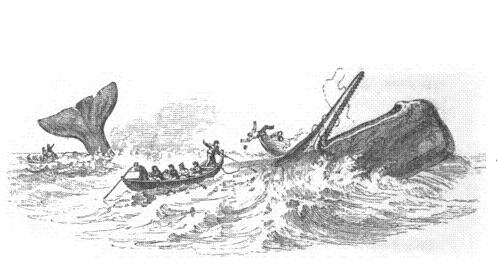
CHAPTER XII.DESCRIPTION OF THE BOATS, WITH THE VARIOUS INSTRUMENTS, EMPLOYED IN THE CAPTURE OF THE SPERM WHALEThe ships which are employed in the sperm whale fishery, are generally from 300 to 400 tons burthen, having crews to the number of from twenty-eight to thirty-three men and officers, and in which the surgeon is included. They sail on their voyage from London at all times of the year, fully provisioned for three years. Each vessel carries six whale boats, which being the principal means used in the pursuit and capture, it will be necessary to describe fully. They are of a construction admirably adapted to the purposes for which they are intended, combining great sharpness |
of form for swiftness of motion, and at the same time considerable buoyancy and stability, to enable them to resist the effects of a sometimes rough and boisterous sea. They are about twenty-seven feet long, by four in breadth; sharp at both ends for motion in either direction without the necessity of turning; near that end which is considered the stern of the boat, is placed a strong upright rounded piece of wood, not exactly in the centre, called the "loggerhead," at the other end which is called the head, is a groove exactly in the centre, through which the harpoon line runs out. To each boat are allotted two lines of apeculiar construction, of 200 fathoms in length, with their tubs, into which they are carefully coiled ready for use, – three or four harpoons, two or three lances, a keg containing a lantern, tinder-box, and other small articles, to procure light in case of being benighted, – two or three small flags, called "whifts," which are inserted in the dead whale, in case the boats should leave it in chase of others, so that they may be afterwards more readily found; and one or two "drougues," which are quadrilateral pieces of board, with a central handle or upright by which they are attached occasionally to the harpoon line, for the purpose of checking in some degree the speed of the whale in sounding, or running. Each boat has a crew of six men, two of whom are called the "headsman" and "boatsteerer," (see cut, p.154). Four of these boats are generally used in the chase, and are under the command of the captain and the mates respectively. From the commencement of |
the voyage, men are placed at each mast-head, who are relieved every two hours, an officer is also placed on the fore-top-gallant-yard, consequently there are four persons constantly on the look-out during the day, from the most elevated parts of the ship. From the commencement of the voyage also, all utensils and instruments are got ready, although the ships are frequently out six months without taking or even seeing a sperm whale, while on the other hand ships have sometimes, though rarely, fallen in with them close to the mouth of the British Channel. When a whale is seen by any of the look-outs, he calls in a slow and peculiar manneer "there she spouts," and as often as it spouts afterwards, "there again." It is impossible to describe the excitement and agitation produced by this welcome intelligence; the listlessness produced by the previous monotony of a long, and perhaps hitherto profitless voyage, is shaken off among all on board from the highest to the lowest, – all is bustle and animation, some rushing up the shrouds and rigging to observe the number, distance, and position of the whale, or whales; and if near hand, eagerly leap into the boats, and pull with ardent emulation towards their intended victim. If the whales should be some distance to leeward, endeavour is made to run the ship within a quarter of a mile of them, – but if to windward, the boats are sent in chase; an arduous task. From hour to hour, for several successive risings of the whale, and sometimes from sunrise to sunset, under the direct rays of a tropical sun, do these hardy men endure the utmost |
suffering and fatigue unheeded and almost unfelt, under the eager excitement of the chase, for hope supports their minds. The crew of the boat, as has beenb mentioned, consists of the headsman, boatsteerer, and four hands; of these, the headsman, who has the command of the boat, steers it until the whale is reached and struck with the harpoon. The boatsteerer also, at this time pulls the "bow oar," but when near the whale he ceases rowing, quits the oar and strikes the harpoon into the animal, the line attached to which runs between the men to the after part of the boat, and after passing two or three times round the loggerhead, is continuous with the coils lying in the tubs at the bottom of the boat. The boatsteerer now comes aft, and steers the boat by means of an oar passed through a ring attached to the stern called a "grummet," he also attends the line through all the subsequent operations; the headsman at the same time passes forwards, and takes the station at the head of the boat, prepared to plunge his lance into the body of the whale at the first opportunity, and it requires considerable tact and experience to do this in the most effectual manner, which will be more fully described in the following chapter. |
CHAPTER XIII.CHASE AND CAPTURE OF THE SPERM WHALEMore exciting and magnificent enterprise cannot be conceived than
South-Sea fishing – Monthly Review on the first Edition. Although ancient and modern histories may abound in descriptions of man's daring by "flood and field," and of the accidents and escapes which accompany his voluntary exposure to a multitude of dangers, surely the recital of his doings in the chase and capture of the leviathan of the deep – the great sperm whale – can be second to none in the interest it must excite in every contemplative mind. It is not in the field, jungle, or thick forest, that these hardy adventurers seed their prey, upon man's natural element, – and where, should any untoward accident occur, assistance of some kind can be readily obtained, – but on the vast ocean, at times thousands of miles distant from any habitable land, where he is not only exposed to the dangers which beset him in his adventures with the monster of the deep, but to others still more terrible, in which the ruthless tempest of the China and Japanese seas form no inconsiderable share; or when near lands, distant and barbarous, as far as the antipodes, dangerous reefs, sunken |
rocks, and relentless savages may beset him on every side, requiring all the moral and physical energy of which our nature is possessed, to escape the manifold dangers which surround them, but which the whale fisherman looks upon without dread, passing among them in his gallant bark, and carrying off in triumph the rich giant of the ocean. When in pursuit of the whale with the boats, it occasionally happens that just at the moment the harpoon is about to be plunged into its body, the whale suddenly descends, leaving nothing but a vortex to mark the spot where but a moment before it was seen floating; but its course, however, has been observed, and the boats are placed in a position to be as near as possible to it when it again rises to breathe; the time, as has been before stated, when he will do this is known to a minute. If they should be more fortunate in the next rising of the whale, and they succeed in darting the harpoon into its body, then immediately after the first struggles of the wounded animal and when he is lying exhausted from his enormous exertions to escape, or free himself from the harpoon, the boat's head is placed close to its side, and the headsman begins to destroy it by thrusting his lance into its most vital parts, which lie near the fin, or darting at it from a distance; at the moment of lancing, he cries "stern all;" the oars are then immediately backed and the boat's stern becoming its cutwater, it is thus removed from danger without the loss of time and trouble in turning. Again, when feeling the lance, the whale plunges and throws itself in all directions, lashing the water with |
its tail, or rearing its enormous head, and threatening destruction with its formidable jaw, (see cut, p.154). After being struck with the harpoon or lance, females and young bulls make the most violent efforts to escape, and being remarkably quick in their actions they frequently afford considerable danger and trouble. Those young bulls which yield about forty barrels of oil, and are consequently called forty-barrel bulls, are perhaps the most difficult to destroy, and sometimes make great havoc among the men and boats. The large whales, such as make eighty or more barrels, not being nearly so active, and probably not feeling so acutely, are generally, by expert whalers, easily killed, and with less damage to those employed than the smaller ones. But these enormous creatures are sometimes known to turn upon their persecutors with unbounded fury, destroying everything that meets them in their course – sometimes by the powerful blows of their flukes, and sometimes attacking with the jaw and head. Accidents frequently occur from the violent convulsive movements of a wounded whale, when suffering the last pangs of his numerous and deep wounds. When the lance has been used effectively, so as to wound some important vital organ, the unfortunate animal frequently throws up blood in large quantities from the blow-hole – becomes convulsed – lashing the waves violently with its tail – passing very rapidly along – tinging the water with his blood as he swims; and it is a curious fact, that under these circumstances he always describes the segment of a circle: in this state the whale |
is said to be in his flurry, and some whalers state he always dies with his head towards the sun, but of this I have never been convinced. When dead, the body always turns on its side, probably from the greater weight of the spine and dorsal muscles. In calm weather, great difficulty is sometimes experienced in approaching the whale, on account of the quickness of his sight and hearing – under these circumstances the fishers have recourse to paddles instead of oars, and by this means they with great caution sometimes get near enough to dart the harpoon with success. When first struck, the whale frequently "sounds," or descends to an amazing depth, taking out perhaps the lines belonging to the four boats, 800 fathoms! but afterwards, when weakened by loss of blod and fatigue, he becomes unable to sound to any great depth, and he then passes rapidly along the surface of the ocean, towing after him perhaps three or four boats. If he does not turn, the people in the boats draw in the line, by which they are attached to the whale, and thus easily come up with him even when going with great velocity, they then make use of the lance either by darting or thrusting, and so destroying their unoffending victim. ––––––––
The scenes which sometimes occur during the chase and capture of this whale defy description. Let the reader suppose himself on the deck of a South-seaman, cruising in the North Pacific Ocean at its Japanese confine – he may be musing over some past event, the |
ship may be sailing gently along over the smooth ocean, every thing around solemnly still, with the sun pouring its intense rays with dazzling brightness; suddenly, the monotonous quietude is broken by an animated voice from the mast-head, exclaiming "there she spouts." The captain starts on deck in an instant, and inquires "where away!" but perhaps the next moment every one aloft and on deck can perceive an enormous whale lying about a quarter of a mile from the ship, on the surface of the sea, having just come up to breathe – his large "hump" projecting three feet out of the water, when at the end of every ten seconds the spout is seen rushing from the fore-part of his enormous head, followed by the cry of every one on board, who join heart and soul in the chorus of "there again!" keeping time with the duration of the spout. But while they have been looking, a few seconds have expired – they rush into the boats, which are directly lowered to receive them – and in two minutes from the time of first observing the whale, three or four boats are down, and are darting through the water with their utmost speed towards their intended victim, perhaps accompanied with a song from the headsman, who urges the quick and powerful plying of the oar, with the common whaling chant, of "Away my boys, away my boys, 'tis time for us to go."
But while they are rushing along, the whale is breathing, they have yet perhaps some distance to pull before they can get a chance of striking him with the harpoon. His "spountings are nearly out," he is about |
to descend, or he hears the boats approaching. The few people left on board, and who are anxiously watching the whale and the gradual approach of the boats, exclaim, "ah, he is going down!" yet he spouts again, but slowly, the water is again seen agitated around him, the spectators on board with breathless anxiety think they perceive his "small" rising in preparation for his descent; "he will be lost," they exclaim, for the boats are not yeat near enough to strike him – and the men are still bending their oars in each boat with all their strength, to claim the honour of the first blow with their harpoon. The bow-boat has the advantage of being the nearest to the whale; the others, for fear of disturbing the unconscious monster, are now doomed to drop astern. One more spout is seen slowly curling forth, – it is his last, this rising, – his "small" is bent, his enormous tail is expected to appear every instant, but the boat shoots rapidly alongside of the gigantic creature. "Peak your oars," exclaims the mate, and directly they flourish in the air; the glistening harpoon is seen above the head of the harpooneer, in an instant it is darted with unerring force and aim, and is buried deeply in the side of the huge animal. It is "socket up;" that is, it is buried in his flesh up to the socket which admits the handle or "pole" of the harpoon. A cheer from those in the boats, and from the seamen on board, reverberates along the still deep at the same moment. The sea, which a moment before was unruffled, now becomes lashed into foam by the immense strength of the wounded whale, who with his vast tail strikes in |
all directions at his enemies. Now his enormous head rises high into the air, then his flukes are seen lashing everywhere, his huge body writes in violent contortions from the agony the "iron" has inflicted. The water all around him is a mass of foam, some of it darts to a considerable height – the sounds of the blows from his tail on the surface of the sea, can be heard for miles! (see frontispiece). "Stern all," cries the headsman; but the whale suddenly disappears; he has "sounded;" the line is running through the groove at the head of the boat, with lightning-like velocity; it smokes – it ignites, from the heat produced by the friction, but the headsman, cool and collected, pours water upon it as it passes. But an oar is now held up in their boat; it signifies that their line is rapidly running out; two hundred fathoms are nearly exhausted; up flies one of the other boats, and "bends on" another line, just in time to save that which was nearly lost. But still the monster descends; he is seeking to rid himself of his enemies by descending deeply into the dark and unknown depths of the fast ocean. They next bend on the "drougues," to retard his career, – but he does not turn; another and another have but slight influence in checking the force of his descent; two more lines are exhausted, – he is six hundred fathoms deep! "Stand ready to bend on," cries the mate to the fourth boat (for sometimes, though not often, they take the whole four lines away with them – 800 fathoms!!); but it is not required, he is rising, "Haul in the slack," observes the headsman, while the boatsteerer coils it |
again carefully into the tubs as it is drawn up. The whale is now seen approaching the surface; the gurgling and bubbling water which rises before also proclaims that he is near; his nose starts from the sea; the rushing spout is projected high and suddenly, from his agitation. The "slack" of the line is now coiled in the tubs, and those in the "fast" boat haul themselves gently towards the whale; the boatsteerer places the headsman close to the fin of the trembling animal, who immediately buries his long lance in the vitals of the leviathan, while, at the same moment, those in one of the other boats dart another harpoon into his opposite side, when "stern all" is again vociferated, and the boats shoot rapidly away from the danger, (see frontispiece). Mad with the agony which he endures from these fresh attacks, the infuriated "sea beast" rolls over and over, and coils an amazing length of line around him; he rears his enormous head, and, with wide expanded jaw, snaps at everything around; he rushes at the boats with his head, – they are propelled before him with vast swiftness, and sometimes utterly destroyed. He is lanced again, when his pain appears more than he can bear; he throws himself, in his agony, completely out of his element; the boats are violently jerked, by which one of the lines is snapped asunder; at the same time the other boat is upset, and its crew are swimming for their lives. The whale is now free! he passes along the surface with remarkable swiftness, "going head out;" but the two boats that have not yet "fastened," and are fresh and free, now give chase; the whale becomes ex- |
hausted, from the blood which flows from his deep and dangerous wounds, and the 200 fathoms of line belonging to the overturned boat, which he is dragging after him through the water, checks him in his course; his pursuers again overtake him, and another harpoon is darted and buried deeply in his flesh. The men who were upset, now right their own boat without assistance from the others, by merely clinging on one side of her, by which she is turned over, while one of them gets inside and bales out the water rapidly with his hat, by which their boat is freed, and she is soon again seen in the chase. The fatal lance is at length given, – the blood gushes from the nostril of the unfortunate animal in a thick black stream, which stains the clear blue water of the ocean to a considerable distance around the scene of the affray. In its struggles the blood from the nostril is frequently thrown upon the men in the boats, who glory in its show! The immense creature may now again endeavour to "sound" to escape from his unrelenting pursuers; but it is powerless, – it soon rises to the surface, and passes slowly along until the death pang seizes it, when its appearance is awful in the extreme. Suffering from suffocation, or some other stoppage of some important organ, the whole strenth of its enormous frame is set in motion for a few seconds, when his convulsions throw him into a hundred different contortions of the most violent description, by which the sea is beaten into foam, and boats are sometimes crushed to atoms, with their crews, (see frontispiece). |
But this violent action being soon over, the now unconscious animal passes rapidly along, describing in his rapid course a segment of a circle, this is his "flurry," which ends in his sudden dissolution. And the mighty rencontre is finished by the gigantic animal rolling over on its side, and floating an inanimate mass on the surface of the crystal deep, – a victim to the tyranny and selfishness, as well as a wonderful proof of the great power of the mind of man. ––––––––
In the afternoon of a day which had been rather stormy, while we were fishing in the North Pacific, a "school" of young bull-whales made their appearance close to the ship, and as the weather had cleared up a little, the captain immediately ordered the mate to lower his boat, while he did the same with his own, in order to go in pursuit of them. The two boats were instantly lowered, for we were unable to send more, having had two others "stove" the day before; they soon got near the whales, but were unfortunately seen by them before they could get near enough to dart the harpoon with any chance of success, and the consequence was that the "pod" of whales separated, and went off with great swiftness in different directions. One however, after making several turns, came at length right towards the captain's boat, which he observing, waited in silence for his approach without moving an oar, so that the "young bull" came close by the boat, and received the blow of the harpoon some distance behind his "hump," which I saw enter |
his flesh myself, as it occurred close to the ship. The whale appeared quite terror-struck for a few seconds, and then suddently recovering itself, darted off like the wind, and spun the boat so quickly round when the tug came upon the line, that she was within a miracle of being upset. But away they went, "dead to windward," at the rate of twelve or fifteen miles an hour, right against a "head sea," which flew against and over the bows of the boat with uncommon force, so that she at times appeared ploughing through it, making a high bank of surf on each side. The second mate, having observed the course of the whale and boat, managed to waylay them, and when they came near to him, which they speedily did, a "short warp" was thrown, and both boats were soon towed at nearly the same rate as the captain's boat had been before. I now saw the captain darting the lance at the whale as it almost flew along, but he did not seem to do so with any kind of effect, as the speed of the whale did not appear in the least diminished, and in a very short time they all disappeared together, being at too great a distance to be seen with the naked eye from the deck. I now ran aloft, and with the aid of a telescope could just discern from the mast-head the three objects, like specks upon the surface of the ocean, at an alarming distance. I could just observe the two boats, with the whale's head occasionally darting out before them, with a good dal of "white water" or foam about them, which convinced me that the whale was still running. |
I watched them with the glass until I could no longer trace them, even in the most indistinct manner, and I then called to those on deck, that they might take the bearing by compass, of the direction in which I had lost sight of them, that we might continue to "beat" the ship up to that quarter. It was now within half-an-hour of sunset, and there was every appearance of the coming on of an "ugly night," as a seaman would say; indeed the wind began to freshen every moment, and an "awkward bubble" of a sea soon began to make. I remained aloft until I saw the sun dip, angry and red, below the troubled horizon, and was just about to descend when I was dreadfully shocked at hearing the loud cry of "a man overboard" from all upon deck. I immediately looked astern, and saw on of our men, of the name of Berry, grappling with the waves and calling loudly for help. The ship was soon brought round; but in doing so she unavoidably passed a long way from the poor fellow, who still supported himself by beating the water with his hands, although he was quite unacquainted with the proper art of swimming. Several oars were thrown overboard the moment after he fell, but he could not reach them, though they were near to him; and directly the ship was brought up, a Sandwich islander, who formed one of the crew, leaped overboard and swam towards him, while at the same time the people on the deck were lowering a spare boat, which is always kept for such emergencies. I could be of no service, except to urge their expedition by my calls, for it was all only the work of a few |
minutes. The good Sandwich islander struck out most bravely at first; but in a short time, finding that he was some distance from the ship, and being unable to see Berry, on account of the agitated surface of the sea, actually turned back through fear – finding, as he said, that the "sea caps" went over his head. The men in the boat now plied their oars with all their strength, and were making rapidly towards the drowning young man, who now and then disappeared entirely from view under the heavy seas which were beginning to roll; a sickening anxiety pervaded me, as my thoughts appeared to press the boat onwards to the spot where the poor fellow still grappled, but convulsively, with the yielding waters. The boat, urged by man's utmost strength, sprang over the boisterous waves with considerable speed; but they arrived half a minute too late to save our poor shipmate from his watery grave. I saw him struggle with the waves until the last, when the foam of a broken sea roared over him, and caused him to disappear for ever! The boat was rowed round and round the fatal spot, again and again, until night fell, and then she was slowly and reluctantly pulled to the ship by her melancholy crew. As they returned, the turbulent waves tossed them about, as if in sport, dashing its spray at times completely over them, making the boat resound from the beating of the dashing waters which flew against her bow. The moment the unfortunate seaman disappeared, a large bird of the albatros kind came careering along, and alighted on the water at the very spot in which the |
poor fellow was last seen. It was a curious circumstance, and only served to heighten our horror, when we saw this carnivorous bird seat itself proudly over the head of our companion, and which also served to remind us of the number of sharks that we had so frequently seen of late, of the horrible propensities of which we could not dare to think. By the time we had hoisted in the boat it was quite dark; the winds too had increased to half a gale, with heavy squalls at times, so that we were obliged to double-reef our topsails. Our painful situation now bore most heavily upon us. We had lost one of our men, who had sailed with us from England – the bare thought of which in our circumstances aroused a crowd of heart-rendering ideas. Our captain and second mate, with ten of the crew, had also disappeared, and were by this time all lost, or were likely to be so in the stormy night which had now set in; being too several hundred miles away from any land. We however, kept beating the ship to windward constantly, carrying all the sail that she could bear, making "short boards" or putting the ship about every twenty minutes. We had also, since nightfall, continued to burn blue lights, and we had likewise a large vessel containing oil and unravelled rope, burning over the sternrail of the ship as a beacon for them, which threw out a great light. But although all eyes were employed in every direction searching for the boats, no vestige of them could be seen; and therefore when half-past nine P.M. came, we made up our minds that they were all lost; and as the wind howled hoarsely through the rigging, and the waves beat |
savagely against our ship, some of us thought we could hear the shrieks of poor Berry above the roaring of the storm; others imagined in their melancholy, that they could occasionally hear the captain's voice, ordering the ship to "bear up," while the boats had been seen more than fifty times by anxious spirits, who had strained their eyes through the gloom until fancy robbed them of their true speculation and left her phantasmagoria in exchange. There were not many on board who did not think of home on that dreadful night – there were not many among us who did not curse the sea, and all sea-going avocations; while, with the same breath, they blessed the safe and cheerful fireside of their parents and friends who resided at home, and which at that moment they would have given all they possessed but to see. But at the moment despair was firmly settling upon us, a man from aloft called out that he could see a light right a head of the ship, just as we were "going about," by which we should have gone from it. We all looked in that direction, and in a few minutes we could plainly perceive it; in a short time we were close up with it, when, to our great joy, we found the captain and all the men in the boats, lying to leeward of the dead whale, which had in some measure saved them from the violence of the sea. They had only just been able to procure a light, having unfortunately upset all their tinder through the violent motion of the boats, by which it became wet – but which they succeeded in igniting after immense application of the flint and steel – or their lantern would have been suspended from an oar directly |
after sunset, which is the usual practice when boats are placed under such circumstances. After having secured the whale alongside, and which we expected to lose during the night from the roughness of the weather, they all came on board, when the misfortune of poor Berry was spoken of with sorrow from all hands, while the joy of their own deliverance served to throw a ray of light amidst the gloom. 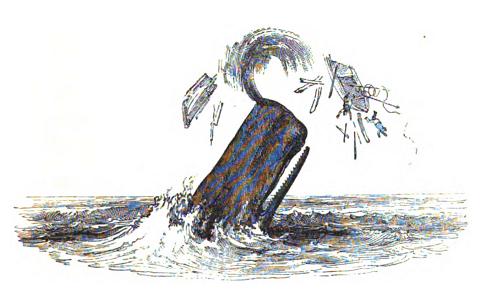
On the morning of the 18th June, 1832, while we were still fishing in the "off-shore ground" of Japan, we fell in with an immense sperm whale, which happened to be just the sort of one we required to complete our cargo. Three boats were immediately lowered to give him chase; but the whale, from some cause or other, appeared wild in its actions long before it had seen any of our boats, although it might have been chased the |
day before by some other ship. It was greatly different in its actions to most other large whales, because it never went steadily upon one course. If he "peaked his flukes," or went down going to the southward, we expected he would continue that course under water, but when he again rose perhaps he was two or three miles away from the boats to the northward; in this sort of manner he dodged us about until near four P.M., at which time the men were dreadfully exhausted from their exertions in the chase, which had been conducted under a broiling sun, with the thermometer standing in the shade at 93°. About half-past four, however, Captain Swain contrived, by the most subtle management and great physical exertions, to get near to the monsteer, when he immediately struck him with the harpoon with his own hands; and, before he had time to recover from the blow, he managed with his usual dexterity to give him two fatal wounds with the lance, which caused the blood to flow from the blow-hole in abundance. The whale, after the last lance, immediately descended below the surface, and the captain felt certain that he was going to "sound," but in this he was much mistaken – for a few minutes after his descent he again rose to the surface with great velocity, and striking the boat with the front part of his head threw it high into the air with the men and everything contained therein, fracturing it to atoms and scattering its crew widely about. While the men were endeavouring to save themselves from drowning by clinging to their oars and pieces of the wreck of the boat, the enormous animal was seen swimming round |
and round them, appearing as if meditating an attack with his flukes, which if he had thought proper to do, in return for the grievous wounds that he had himself received, a few strokes of his ponderous tail would soon have destroyed his enemies; but this was not attempted. They had now nothing to hope for but the arrival of the other boats to relieve them from their dangereous situation, rendered more so by the appearance of several large sharks, attracted by the blood which flowed from the whale, which were sometimes only a few feet from them; and also from the inability of one of the boats' crew to swim, by which three or four of his mates were much exhausted in their efforts to save him, which they succeeded in doing after having lashed two or three oars across the stern of the boat, which happened to be not much fractured, on which they placed their helpless fellow-adventurer. After they had remained in the water about three quarters of an hour, assisting themselves by clinging to pieces of the wreck, one of the other boats arrived and took them in, no doubt greatly to their relief and satisfaction. But although these brave whale fishermen had been so defeated, they were not subdued: the moment they entered the boat which took them from the ocean, their immediate determination was for another attack upon the immense creature, which remained close by, while the other boat, which was pulling towards them with all the strength of its rowers, would still be a quarter of an hour before it could arrive. Captain Swain, with twelve men in one boat, therefore made another attack upon the whale with the lance |
which caused it to throw up blood from the blow-hole in increased quantities. We, who were on board the ship, and had observed from a great distance, by means of the telescope, the whole of the occurrence, were employed in beating the ship towards them, but they were far to windward, and the wind being rather light, we had even our royal sails set. Soon after the arrival of the third boat, the whale went into its flurry and soon died, when, to the dismay of the boats' crews, who had endured so much danger and hardship in its capture, it sunk, and never rose again, – an occurrence which is not very unfrequent, owing of course to the greater specific gravity of the individual, perhaps from a greater development of bony and muscular structures. Such were the adventures of that day, in the evening of which the crews returned to the ship, worn out and dispirited, having lost a favourite boat, with the whole of her instruments, besides the last whale wanted to complete the cargo, and worth at least 500£! (see cut, p.173) ––––––––
At day-break, one fine morning in August, as our first mate was going aloft, to look out for whales, he discovered no less than three ships within a mile of us; but they were situated in various directons. We soon discovered them to be whalers, who like ourselves were cruising after the spermaceti whale, and therefore their appearance only had the effect of redoubling our vigilance in the "look-out," so that we might if possible be the first, to obtain the best chance if one of those creatures "hove in sight." And it was not long before |
a very large whale made his appearance right in among the ships. The water was smooth at the time, for we had but a light air of wind stirring, so that our boats were instantly lowered without the loss of time of bringing the "ship to." But although we managed matters as quietly and secretly as possible, we found the moment our boats cleared the ship's side, that all the others had been as vigilant as ourserlves, and had also lowered their boats after the whale. The whole of them immediately began the chase, – nine boats in all, being three from each ship. They all exerted themselves to their utmost, and as we expected, in vain; for before any of the boats had got even near him, the enormous animal lifted his widely expanded flukes, and descended perpendicularly into the depths of the ocean to feed. Those in the boats, however, having noticed his course, proceeded onwards, thinking the whale would continue to pursue the same direction under water; but as he was going slowly at the time he was up, they did not proceed more than a mile from the place at which he descended before they separated about a hundred yards from each other, and then "peaking" their oars, all the men in each boat stood up, looking in different directions, so as to catch the first appearance of the spout when the whale again rose to breathe: when an hour after his descent had expired, the excitement among us who were on board the ship, became wound up to its highest pitch. The captain, who had remained on board, ascended to the fore-top-gallant-yard to watch the manoeuvres of the boats, and for the purpose of the |
better ordering the signals to them, or working of the ship. All those who were down after the whale, appeared as feverish with anxiety as ourselves, for every now and then they were to be seen shifting their positions a little, thinking to do so with advantage; then they would cease rowing, and stand upon the seats of the boats, and look all round over the smooth surface of the ocean with ardent gaze. But one hour and ten minutes expired before the monster of the deep thought proper to break cover, and when he did, then a rattling chase commenced with the whole of the boats, and they really flew along in fine style, some of them actually appearing to be lifted quite on the surface of the water from the great power of the rowers; and we had the satisfaction of observing, that our boats were quite equal to the others in the speed with which they were propelled. But it was again a useless task, as the old "schoolmaster" had outwitted those in the boats, by having gone – while under water – much further than any of his pursuers had anticipated, and they again had the mortification of witnessing the turning of his flukes as he once more descended into the depths of his vast domain. We now knew to a minute the time that he would remain below, while the people in the boats continued to row slowly onwards the whole time. A fine breeze now sprang up, so that we were enabled to keep company with the boats, keeping a little to windward of them, as the whale was going "on a wind," as a seaman would say, meaning that it was blowing across him. |
When the hour and ten minutes had again nearly past, the nine boats were nearly abreast of each other, and not much separated, so that the success of first striking the whale depended very much upon the swiftest boat, especially if the whale came up a-head. We had now all the boats on our "lee beam," while the ships were all astern of us, and the most distant not being more than half a mile, so that we enjoyed an excellent view of this most exciting and animated scene. True to his time, the leviathan at length arose right a-head of the boats, and at not more than a quarter of a mile distant from them. The excitement among the crews of the various boats when they saw his first spout was tremendous; they did not shout, but we could hear an agitated murmur from their united voices reverberating along the surface of the deep. They flew over the limpid waves at a rapid rate; the mates of the various boats cheered their respective crews by various urgent exclamations, "Swing on your oars my boys, for the honour of the Henrietta," cried one; "Spring away, hearties," shouted another, and yet scarcely able to breathe from anxiety and exertion. "It's our fish," vociferated a third, as he passed the rest of his opponents but a trifling distance. "Lay on my boys," cried young Clark, our first mate, as he steered the boat with one hand, and pressed down the after oar with the other. "She'll be ours yet; let's have a strong pull, a long pull, and a pull altogether," he exclaimed, as he panted from his exertions at the after oar, which soon brought up his boat quite abreast of the foremost. But the giant of the ocean, who was only a short dis- |
tance before them, now appeared rather "gallied,"or frightened, having probably seen or heard the boats, and as he puffed up his spout to a great height, and reared his enormous head, he increased his speed, and went along quite as fast as the boats, – but for only two or three minutes, when he appeared to get perfectly quiet again, while the boats gained rapidly upon him, and were soon close in his "wake." "Stand up," cried young Clark to the harpooneer, who is also the bow-oarsman, while the same order was instantly given by his opponent, whose boat was abreast of our mate's, with the rest close to their sterns. The orders were instantly obeyed, for in a second of time both boatsteerers stood in the bows of their respective boats, with their harpoons held above their heads ready for the dart; but they both panted to be a few yards nearer to the whale, to do so with success. The monster ploughed through the main quickly, but the boats gained upon him every moment, when the agitation of all parties became intense, and a general cry of "dart! dart!" broke from the hindermost boats, who each urged their friends, fearful of delay. The uproar became excessive, and while the tumult of voices, and the working and splashing of the oars, rolled along the surface of the deep, both the harpooneers darted their weapons together, which, if they had both struck the whale, would have originated a contention between them regarding their claims, But, as it happened, neither of them had that good fortune; for at the moment of their darting the harpoons, the whale descended like a shot, and avoided their infliction, leaving nothing but a white- |
and-green-looking vortex in the disturbed blue ocean, to mark the spot where his monstrous form so lately floated. A general huzza burst from the sternmost boats when they saw the issue of this chase, thinking now that another chance awaited them on the next rising of the whale, and they soon began to separate themselves a little, and to row onwards again in the course which they thought he had taken. Our captain, feeling irritated at the ill-success of the mate, now ordered his own boat to be lowered, intending to make one in the chase himself; but, just as he had parted from the ship, going down a little to leeward, a tremendous shout arose from their people in our own boats, joined with a loud murmuring from the rest of the boats' crews; for the whale, not having had all its "spoutings out," had now risen again to finish them, and was coming to windward at a quick rate, right towards our ship. The captain saw his favourable situation in a moment, and passing quickly to the bows of the boat, he stood to waylay him as he came careering along, throwing his enormous head completely out of the water, for he was not quite "gallied." He soon came, and caught a sight of the boat just as he got within dart; the vast animal rolled itself over in an agony of fear, to alter its course; but it was too late, the harpoon was hurled with excellent aim, and was plunged deeply into his side near the fin. As the immense creature almost flew out of the water from the blow, throwing tons of spray high into the air, shewing that he was "fast," a triumphant cheering arose from those in our own boats, as well as from those |
in the ship, accompanied by exclamations loud and deep, and not of the most favourable kind to us, from all the rest. But onwards they all came, and soon cheerfully rendered assistance to complete its destruction; but which was not done, however, without considerable difficulty, the whale continuing to descend the moment either of the boats got nearly within dart of him. But after an hour's exertion in this way, six out of the ten boats which were now engaged got fast to him by their harpoons, but not one of them could get near enough to give him a fatal lance; he towed them all in various directions for some time, taking care to descend below the surface the moment a boat drew up over his flukes, or otherwise drew near, which rendered it almost impossible to strike him in the body, even when the lance was darted, although the after part of his "small" was perforated in a hundred places: from these wounds the blood gushed in considerable quantities, and as the poor animal moved along, towing the boats, he left a long ensanguined stain in the ocean. At last, becoming weak from his numerous and deep wounds, he became less capable of avoiding his foes, which gave an opportunity for one of them to pierce him to the life! – dreadful was that moment the acute pain which the leviathan experienced, and which roused the dormant energies of his gigantic frame. As the life's blood gurgled thick through the nostril, the immense creature went into his "flurry" with excessive fury, the boats were speedily sterned off, while he beat the water in his dying convulsions with a force that appeared to shake the firm foundation of the ocean! |
Numberless stories are told of fighting whales, many of which however, are probably much exaggerated accounts of the real occurrences. A large whale, called "Timor Jack" is the hero of many strange stories, such as of his destroying every boat which was sent out against him, until a contrivance was made by lashing a barrel to the end of the harpoon with which he was struck, and whilst his attention was directed and divided amongst several boats, means were found of giving him his death wound. In the year 1804, the ship "Adonis," being in company with several others, struck a large whale off the coast of New Zealand, which "stove" or destroyed nine boats before breakfast, and the chase consequently was necessarily giving up. After destroying boats belonging to many ships, this whale was at last captured, and many harpoons of the various ships that had from time to time been sent out against him were found sticking in his body. This whale was called "New Zealand Tom," and the tradition is carefully preserved by whalers. Accidents of the most fearful nature have frequently occurred in this hazardous pursuit, which to enumerate would fill the space of volumes; – for not only boats, but sometimes even ships have been destroyed by these powerful creatures. It is a well authenticated fact, that an American whale-ship called the "Essex" was destroyed in the South Pacific Ocean by an enormous sperm whale. While the greater part of the crew were away in the boats, pursuing whales, the few people remaining on board saw an immense sperm whale come |
up close to the ship, and when very near he appeared to go down for the purpose of avoiding the vessel, and in doing so he struck his body against some part of the keel, which was broken off by the force of the blow and floated to the surface; the whale was then observed to rise a short distance from the ship, and come with apparently great fury towards it, striking against one of the bows with his head, and completely "staving" it in. The ship of course immediately filled, and fell over on her side, in which dreadful position the poor fellows in the boats soon espied their only home, being distant from the nearest land many hundred miles; on returning to the wreck they found the few who had been left on board hastily congregated in a remaining whale boat, into which they had scarcely time to take refuge before the vessel capsized. They with much difficulty obtained a scanty supply of provisions from the wreck, their only support on the long and dreary passage before them to the coast of Peru, to which they endeavored to make the best of their way. One boat was fortunately found by a vessel not far from the coast; in it were the only survivors of the unfortunate crew, three in number, the remainder having perished under unheard-of suffering and privation. These three men were in a state of stupefaction, allowing their boat to drift about where the winds and waves listed; one of the survivors was the master; by kind and careful attention on the part of their deliverers, they were eventually rescued from the jaws of death to relate the melancholy tale. |
CHAPTER XIV.OF THE "CUTTING IN" AND "TRYING OUT."After the death of the whale, the next steps are to remove the fat and spermaceti, and to extract the oil, the reward of so much exertion and dangerous enterprise. This process, which is called "cutting in," is divided into two stages, the cutting in and trying out – in these operations the utmost cleanliness is observed. As soon as possible after the whale has been killed, it is brought alongside the ship to be cut in, by means of instruments which are called "spades." A man descends upon the floating carcass, after a hole has been cut near the junction of the body with the head by a person stationed on a stage by the side of the ship, into which a large blunt hook is inserted by the man who descends upon the body of the whale for that purpose, and which is called "hooking on;" a troublesome and even dangerous operation in a turbulent sea, from which I have often seen men drawn up by the rope which is always fixed around them, in a completely exhausted state, from having been frequently submersed by the waves as they have rolled over the body of the whale during the time they have been endeavouring to "hook on." After the |
hook is inserted it is drawn upon by the pullies to which it is attached, and a tension being exerted upon the fat, or blubber as it is termed, it is then cut by the spade in a strip about two or three feet broad, in a spiral direction around the body of the whale, which being drawn up by means of the windlass acting upon pullies which are fixed to the "main-top," it is removed much in the same way that a spiral roller or bandage might be; of course as the "blanket pieces" ascend, the body of the whale performs a rotatory motion, until the whole is stripped off to the tail or flukes. The head is cut off in the beginning of the process, and is allowed to float astern of the ship, but strongly secured, until the body has undergone its flaying process, when it is hoisted upon end by the pullies, and the end of the case being opened, the fluid spermaceti is drawn from it by means of a bucket and pole, which is used to force the bucket down into the "case," so as to become filled with its valuable contents. The "junk," which forms, when it is cut from the head, a large wedge-shaped mass of cellular substance, having strong ligamentous bands intersecting and strengthening its structure, is hoisted on board, and quickly cut up into square oblong pieces, while the head – after the case has been emptied – is let go, and allowed to sink, which it does rapidly when its buoyant property, the spermaceti is removed. The lean and shapeless trunk, after the fat has been taken from it, is allowed to float away just before the operations on the head commence. The "blanket pieces" which are cut from the long |
strips of fat or blubber, as it is drawn up, with the junk and spermaceti from the case, then pass through different processes in the "trying out;" the two former, being cut up into thin pieces upon blocks called "horses," are thrown into the "try-pots," into which the oil is extracted from them by heat. The crisp membranous parts after the oil is extracted, and which are called by whalers "scraps," serving for fuel; while the spermaceti from the case is carefully boiled alone, and placed in separate casks, when it is called "head-matter." These operations are not attended with any unpleasant smell, and are very quickly performed, as eighty barrels of oil may be stowed away in the hold of the ship in less than three days after the destruction of the animal. |
CHAPTER XV.OF THE FAVOURITE PLACES OF RESORT OF THE SPERM WHALE.Although the spermaceti whale has been seen, and even captured, in almost every part of the ocean between the latitude of 60° south and 60° north, I am not aware that it has ever been seen in the Mediterranean sea, and seldom, or never, at Greenland by modern navigators; although several ancient authors agree in stating that it has been frequently seen there; for Cuvier has stated from some authority, that the Greenlanders are remarkably fond of its flesh, which they consider a delicate viand, when it is dried in smoke; they "also feed," says Cuvier, "upon the fat, entrails, and skin." And Sir Thomas Brown, in his work published in 1686, after stating that "many conceive the sperm whale to have been the fish which swallowed Jonas," also says, that "Greenland inquirers seldom meet with a whale of this kind." Whether this has been the case in former times, or not, I will not presume to determine; I can only say, that I have now made many inquiries among several captains of ships who have been engaged in the Greenland fisheries, and not one of them ever saw a sperm |
whale so far north as Greenland. They are also seldom or never seen on "soundings," that is where the bottom of the sea can be touched by the deepest sea-line, or in the "banks," as they are termed by whalers, that exist in various parts of the ocean, as the "Brazil banks," which are only discolorations of the water caused by myriads of animalculae which perhaps form the sustenance of the common black whale's food, that consists of "squillae" and other small animals. But the sperm whale has been sometimes taken near the borders of these "submarine pastures," particularly near those of Brazil. The favourite places of his resort at the present day appear in the following list: – New Guinea and Parts Adjacent. – On the north coast of New Guinea, from 140° to 146°, east longitude. New Ireland, from Cape St. George to Cape St. Mary; from Squally Island to the northward; from St. George's Channel to the southward; on the east coast of New Britain; about the islands of Bougainville and Bourka Bay, particularly off the northern shore of Bougainville, as far as the Green, or Bentley's Islands; Solomon's Archipelago, as far to the northward as Howe's Group; Malanta, along the north-east and south-west parts, and in the straits, as far to the north as Gower's Island; and off the west points of New Hanover. King's Mill Group. – Off any part of these islands, but more particularly off the south-west parts of Roach's Island, distant from the land thirty or forty miles; and off the south-west portion of Byron's Island |
Equinoctial Line. – From the longitude of 168° to 175° east. Ellis's Group. – Off the south side, distant from the land three or four miles. Mitchell's Group. – Off the south side, distant from the land three or four miles. Rotumah. – Off the south-east side, distant from the land fifteen to thirty miles. New Holland. – Off the eastern coast, from the latitude of 25° to 34°, and along the north-west coast. New Zealand. – From the east cape to north cape, the land dipping, and off the shore to the north-eastward, as far as Curtis's Island. Tongataboo. – Off Middleburgh Island and isles adjacent. Navigator Islands. – South-west side of Tootooillah. From Fenning's to Christmas Island – situated on the line. AMERICAN CONTINENT. Peru. – Off the shore, from longitude west 90° to 130°, in the latitude 5° south to the line. Coast of Peru, from the line to 16° south, off Paita Head, used to be very famous. Galapago's Islands. – Off the south head of Albemarle Island, Weather and Lee Bays, or Elizabeth's and Banks' Bays. Middleground. – Between the continent and the Galapago's Islands. Malluca Islands. – Off the north point of Moratay, and off the east and west sides of Gillalo, and also off the adjacent isles. |
Bouton. – Off the east side, and in the straits. Timor. – In the straits of Timor; off the south side of Omby; off the south side of Panton, and off the south side of the adjacent islands as far as Sandle-wood Island, to Java Head; and off the shore in latitude 12° to 16°, and longitude from 112° to 120°. Mahee Island. – Off the eastern side; off Johanna Island, in the Mozambique Channel; off the Island of Aldabra; on the line from 55° to 60°; off the Cape St. Mary's, Madagascar. Chili. – Off the island of Chiloe, to the northward, along the coast of Chili, and as far south as 37°, the land dipping. Calafornia. – Off Cape St. Lucas, and off the Tres Maria Islands. Japan. – Along the coast; Volcano Bay; Loo Choo Islands; off-shore ground of Japan, from the latitude of 28° to 40°. Bonin Islands. – All round them, within forty miles. China Sea. Red Sea. Persian Gulf. They are also not unfrequently seen about the equinoctial line in the Atlantic Ocean.
END OF PART I.
|
SKETCH OFA SOUTH-SEA WHALING VOYAGE.PART II.INTRODUCTORY REMARKS.Having given all the information in my power upon the various subjects embraced by the preceding portion of this work, I could not consider the volume complete if left without an account of the various parts of the world to which whalers resort for the purpose of best carrying their designs into execution, and of the adventures and accidents which oftentimes befal them in their arduous exertions to obtain a useful termination to their voyage. If any apology for the insertion of this sketch could be thought necessary, I would only remind the reader of the many thousands who are directly or indirectly dependent on the produce of the spermaceti whale fishery for their support, and of the many anxious persons who are constantly stretching their imaginations into the distant regions of the South Seas in search of |
the scenes in which their relatives and friends may be engaged, and who so often search in vain for even a glimpse of information on the subject: for having no written accounts to refer to, at the best they could only meet with some persons who may nave himself visited the sperm whale fisheries, but who might not always be found in the state of mind or leisure best adapted to describe all that might be required by the fond mother or the affectionate friend. Besides, I sincerely hope that the present hasty sketch of the scenes of these labours may be found serviceable to another class of persons, who heretofore have found great difficulty in obtaining information on these matters, – I refer to those who may be about embarking in this service; so that they may, before they commence the voyage, make themselves acquainted with the pleasures and also with the dangers to which they may be subjected during their long journeyings in so many various and distant parts of the world. I must beg leave also to remark here, that all may depend upon the correctness of the information they may find scattered throughout the following sketch of a voyage in which I was personally engaged, – for although I may be an enthusiastic admirer of the works of nature, and may sometimes warmly enter into descriptions of her beauties, yet I never shall be found straying beyond the boundary of truth. That something of the kind which I have perhaps now presumed to present was required, may, I think be justly inferred from the fact, that the generality of people |
are not even aware that a South Sea voyage embraces so large an extent of the world as it really does, nor do they suppose that the southern whaler so often explores parts of the creation which Europeans have never before seen; – those portions of the globe which have been so seldom visited even by the most renowned travellers, are to the sperm whaler thrown entirely open. In search of his prey he leaves no sea untroubled; those dangers which deter the merchantmen from approaching the unexplored shores which abound in the North and South Pacific oceans, are to him "trifles light as air." Even the intrepid character of our navy cannot be compared with that of the whaler, who, bred from his boyhood in this arduous service, knows no fear among the dangerous coral shoals and sunken rocks with which the seas he so often traverses abound, and views without dismay the billows breaking on the shores of lands unknown, and but too often inhabited by the barbarous savage. We trace him as the apprentice, the boatsteerer, and through the gradations of mates, before we see him entitled to the enviable berth of captain; and then we perceive him of the middle age, weather-worn, and thoroughly acquainted with the knowledge requisite to take command of the ship which may be entrusted to his care. Ever watchful and wary when near land, his repose is of short duration; at any sudden sound or unusual occurrence he is instantly on deck, in the middle of the dark tempestuous night, and he sleeps not until his charge – the ship – is free from every danger. Amid |
tempests and unexplored regions, even at the antipodes, he guides his bark with safety and triumph; all dangers he defies, confident of his skill in seamanship, and avoiding them by his watchfulness and care; – to-day Cape Horn with its rugged front rises to his view, anon the burning zone reminds him of his course; in his passage the most remote lands are laid open for his observation, – the most rugged and barbarous, the most beautiful and friendly, are in turn presented to him, and seem to provoke his admiration or dislikes. At times he is amused by the capture of the agile albacore, the hungry shark, or impetuous dolphin; anon the Indian typhoon, with its dreadful power, severely proves the strength of his wandering habitation; and then he is seen, proudly stemming with a flowing sheet the smooth and beautiful ocean, with only the sea-bird for his companion or the sportive dolphin for his follower. At other times, during his long absence, his zeal is redoubled for the success of the voyage by a growing desire to return to his native land, and his bosom heaves with anguish when he suddenly thinks of the vast distance which separates him from his beloved wife, his children, his parent, or his friend; but his reflections may be suddenly interrupted – as the next moment, with his feeble arm he is engaged in deadly strife with the monarch of the sea: one moment he conquers, the next he has nearly fallen a sacrifice to the convulsions of his dying victim, whose blood pouring in fountains from his mortal wounds or panting nostril, incarnadines the deep with purple stain. He returns to the ship a conqueror; |
the slain monster lies floating on the vast bosom of the ocean, and rewards him for the dangers he has undergone in its capture by the greatness of its value. In short, if we survey, even with a hasty glance, the strange vicissitudes of a South Sea voyage, we shall perfectly coincide with those who believe that "truth is stranger than fiction." |
CHAPTER I.We left England on the 16th of October 1830; but I shall not tire the reader with the description of anything which I saw before our arrival in the South Pacific Ocean, because the same has been done so often by other travellers that I have thought it quite necessary to omit any description in this sketch, although I saw multitudes of objects which divided my attention; and as I had never attempted the ways of the pathless deep before, they found me in abundant food for reflection and admiration. We saw no land, after we had left our own white cliffs, until off Cape Horn, of which it was our good fortune to have a full and ample view. As a place renowned among travellers, Cape Horn has always stood foremost in their tales of wonder; from Lord Anson's to our own times, it has remained the scene of many a mariner's tale. Whether we regard the dangerous Straits of Magellan – the "Terra del Fuego," or land of fire of the Spaniards – the giant Patagonians themselves, who reside in its vicinity – the beautiful and interesting constellations of the Magellan clouds, or that of "la Crus," which are to be seen in its locality – or Wager Island, which is not far distant; the scene of the wreck of the "Wager" man-of-war, in which our poet's "grand-dad" |
(Commodore Byron) figured. If we regard it with wonder for these associations, or for the awful sublimity of its own aspect – its extreme barrenness, ruggedness, and stormy locality – for one of these things, or altogether, it must always continue to be a place of great interest to the traveller; and its being the southernmost point of the great American continent, stretching into the constantly troubled ocean, and dividing the mighty Pacific and Atlantic, entitle it to the consideration of the wanderer. We passed its southernmost point on the 5th of January 1831, within a musket shot of the shore. I can only say that it is a mass of as rugged and inhospitable looking land as any person could wish to see, although we passed it in its mid-summer. It appeared most cheerless and melancholy. By what means the poor human inhabitants of this dreary place survive the long and intense winters, I am at a loss to know; for its very midsummer appeared to us an English winter of the worst kind. The population appears to consist but of a few, and these are probably rapidly on the wane; for Weddle, in his account of these regions, represents them as a wretched race of beings, who are miserably clad, and subsist principally upon shell-fish, which they gather from the rocks which bound the tempestuous ocean; he calls them the Terra del Fuegians, because they inhabit the land of that name, which forms Cape Horn itself, and is separated from the great continent by the Straits of Magellan. Weddle observes that, although they appear so much |
in want of the common necessaries of life, they seem to possess spirits of considerable buoyancy, as the few which he had the good fortune to meet with (for they are but rarely seen) in one of his excursions along the coast evinced much sensible and lively good-nature; he also states that, although their language, as we naturally anticipate, is totally different to our own, still they possess a remarkable capability of imitating our sounds, of which he gives a ludicrous example; for, he continues, "like most other persons in their condition, they are not very hones; and one of them, having taken a fancy to a culinary vessel belonging t one of the sailors, endeavoured to secrete it, but not without being observed by the seaman, who soon demanded it in a very peremptory manner, by ejaculating, 'you copper-colored rascal, give me back my tin pot.' The Fuegian smiled in the sailor's face, and imitated his words so accurately that every one present was astonished, and at first thought him well acquainted with our language; but they had many indubitable proofs that these were the first Europeans they had ever met with." With all their wants, not knowing that which is really within their intellectual or physical reach, those Fuegians, in their wretched condition, when compared with our own, seem to possess a considerable share of that inestimable blessing – happiness; although the dark damp atmosphere robs them of genial light and warmth – although the howling tempest rages over their uncovered heads with awful violence, and the rolling billows of the Western main shake their native land to its foundation, while the iron hand of winter re- |
fuses the earth's accustomed bounty; still in these dreary regions man finds considerable happiness, for "God tempereth the wind to the shorn lamb;" and these poor Fuegians may be as happy with their scanty meal as the greatest emperor over his coronation feast. We saw the small islands which are called the Ildefonzas, and which are situated in a south-west direction from Cape Horn, and at a small distance from it. These rocky isles offer nothing worthy of remark, except that at the time I saw them they were surrounded with thousands of sea-fowl of various kinds, which were amusing themselves in the air above and around their shores. We now ran with a fair wind, along the coast of Patagonia, which is rocky, uneven and barren. Although we had a good view of the coast, we had not the good fortune to see any of the inhabitants thereof, the celebrated Patagonians; but I was so fortunate as to meet with Captain Minors, whose ship we fell in with off these parts, and who had on a former voyage actually traded with those Brobdignagians, – but then he had passed through the Straits of Magellan, and had met with them there, on its shores. He did not go so far as Gonzalo Fernandez Oviedo, a Spanish writer, who was imposed upon by the clergyman Arizega, in stating that the Patagonians were so gigantic a race that a tall man could not reach the girdle of one of them, or that they were in the habit of consuming a couple of pounds of raw flesh at a mouthful, or that they swallowed eighteen or twenty gallons of water at a draught. Nor did his |
account agree with that of the Dutch writer Sebaldus Veert, who, among other extraordinary accounts of the same people, goes so far as to say that they were of a height to fill men with horror, and that such was their enormous strength, that they could pluck up whole trees by the roots! Nor did he agree with our own countryman Cavendish, who stated that their feet were eighteen inches long; nor with Mr. C. Clark, an officer in Commodore Byron's ship, who in a letter, published in the "Philosophical Transactions," vol. lvii., described them as men of nine feet in height, and even exceeding this stature. But Captain Minors, of the Honourable Hudson's Bay Company, agreed with Captain Wallis, who also visited the Patagonians in 1766, and measured these people; and he too coincided with the accounts given of them by Captain Carteret, M. Bougainville, and also with Don Ibagnez Barnardo de Echavarri; in stating that they were very frequently seen of seven feet in height, and many of those with whom he traded for trifling articles, were within an inch or so of seven feet, and they were commonly seen of six feet six and seven inches. He described them to me as a very kind and peaceable set of beings, who traded with him for some of their articles of dress or ornament with the greatest good-will and confidence. Commodore Byron, who entered the Straits of Magellan in 1764, represented them as a gigantic race. He states that one of them, who appeared to be a chief, had the skin of a wild beast thrown over his shoulders, and was painted so as to exhibit a hideous appearance; |
round one eye was a circle of black, a circle of white surrounded the other, and the rest of the "human face divine" was streaked with paint of various colours; they were all painted and clothed in nearly the same manner, their teeth were as white as ivory, remarkably even and well set; but, except the skin which they wore, with the hair inwards, most of them were naked, some few only having on their feet a kind of boot, with a sharp pointed stick fastened to each heel, which served as a spur. When they were prevailed upon to sit down, they accepted with pleasure, a quantity of yellow and white beads, which were distributed among them; they did not appear to be wholly strangers to European ornaments, for one woman among them, of enormous size, and having her face frightfully painted, had bracelets either of brass or very pale gold upon her arms, and some beads of blue grass strung upon two plaits of her hair, – they had a great number of dogs with them, with which it was supposed they chased wild animals for their food; they also had horses with them which they managed with great dexterity; the women rode astride, and both men and women without stirrups, and yet they galloped without fear over the sprit on the shore, the stones of which were large, loose and slippery; – they are of a copper colour, with long black hair. Leaving this land of giants and marvelous tales, which has served as a prolific quarry to the romancer, we wended our way along the coast of Chili. I could almost digress again when I think of the town of Con- |
ception which we passed, the scene of the dreadful earthquake that occurred in 1751, in which the town was swallowed up by the sea. The fruit trees at this place are obliged to be thinned of their produce, lest the overloaded state of the branches should weigh them to the ground. We touched at Valparaiso, as we sailed along the coast; but I shall not detain the reader with remarks upon that place, except that I was much disappointed with its appearance; the houses are meanly built, and placed in a very irregular manner. I was much surprised at the great number of dogs which I saw here, and also at the great number of idle persons which were lounging about it, but who, nevertheless, appeared to amuse themselves by devouring delicious water melons in considerable quantities, the shells or rinds of which were scattered all over the place. We obtained a small quantity of fruit here, consisting of the anana or pine-apple, with some water melons of extreme delicacy of flavour; we also purchased some grapes in the fruit market which is here established, – but we were rather too early in the season to obtain them at a cheap rate. We soon continued our progress for Coquimbo, a town which stands upon the borders of a very beautiful bay, and which is situated at about three degrees distant from Valparaiso. When we arrived, and had entered the bay, we let go our anchor for the first time since leaving our own native land, for the purpose of refitting the ship and refreshing the crew, for which we remained about fourteen days, during which I managed to pass my |
time very agreeably, either in collecting shells from along the sea shore, of which a few may be gathered, – in visiting the town, and mixing with its inhabitants, – watching the flight of the great condor, which sometimes measures thirty feet from the tip of each wing, – or in examining the curious beach which surrounds the bay, parts of which are formed of vast masses of agglutinated shells, even reaching in some places to thirty or forty feet above the level of the sea, rendering it an interesting spot for the resort of the geologist. It was at this place, too, that I first felt the shock of an earthquake, which indeed is terrible enough. It is said, at Peru, that the oftener the natives of the place feel those vibrations of the earth, instead of becoming habituated to them, as persons do who are constantly exposed to other dangers, they become more filled with dismay every time the shock is repeated, so that aged people often find the terror a slight shock will produce almost insupportable. I had been to the town of Coquimbo, and had returned to the port about ten in the evening, and, when I arrived at the edge of the bay, I was alarmed, and indeed all who happened to be present, at the sudden alteration of the appearance of the water in the harbour; there was a "dead calm," as sailors say, – not a breath of wind stirring; but it was a most delightful night, "holy in silence, and in splendour bright," when suddenly the water became much agitated, and being full of phosphorent animalculae, the bay resembled a vast cauldron of molten lead; and while we all stood in amazement, watching the fiery agitated waters, |
we felt a motion of the ground that I shall never be able accurately to describe. It appeared to me, from the sensation I received, as if the earth was suddenly crushed by its own weight. It resembled very nearly the sensation a person experiences when he takes a mass of snow in his hands, and endeavours to compress it; it is that feeling, as if the snow was suddenly crushed within itself, that I am endeavouring to describe, – a crushing of the fibres, – a sudden contraction of the atoms, which every person must be familiar with. Such were my ideas the moment after I had experienced the shock. The water was so exceedingly luminous that, while we were rowing on board, it appeared, as it dripped from the oars which the men were plying, exactly like red-hot fluid metal. When I went on shore the following morning, I found that the inhabitants considered the earthquake of the preceding evening rather a violent one, it being sufficiently so as to cause a considerable rent in the wall of a Mr. Richardson's house, an Englishman, who has resided here for some time, and who stated to me that shocks of the kind I have mentioned were far from uncommon. From a few English gentlemen who had taken up their abode at this place, from motives of business, I received many tokens of British hospitality. A hundred and fifty degrees of longitude may separate a man from his native country, but the distance does not wean him from the feelings of his youth, which he has imbibed in the land of his birth; the scorching rays of a tropical sun may blaze around him, and change the colour of |
his complexion, – the frozen regions of the southern or northern pole may retard the rapid current of his blood, but they can neither change nor retard the warm and generous feelings of an Englishman, wherever he may happen to reside. One day, on going up to the town of Coquimbo, – the best way to get to it from the port, as it is called, is on the back of a mule, – I found the inhabitants merrymaking, and celebrating the feast of the "Cheya;" in this commemoration they have a very remarkable usage of throwing water at each other, or at any person they may meet or see in the street; the poorer perons carry it about in bladders, which have a small hole made in some part of them, which allows the fluid to escape at the will of the projector. By merely employing a little pressure upon it, a long stream of water rushes out, and bespatters the face of any luckless perambulator who does not quickly take to his heels or otherwise escape the ablution; but those who are higher in the scale of Croesus employ other means of enjoying their recreation. The ladies, for instance, amuse themselves by sprinkling rose or other scented waters upon the pedestrian from a balcony or window, and great is their delight when they succeed in surprising the unwary traveller with their odoriferous shower-baths. Such was my fate one fine evening, just before sunset: as I was passing through a quiet and lonely street, I was attracted to a certain spot, on perceiving a few very beautiful flowers lying scattered on the pavement, which happened to be directly under a balcony, and which had no doubt been purposely placed |
there by the hands of some fair freebooter; for, no sooner had I secured the floral prizes, than I found myself freely sprinkled with the rosy perfume. I looked up immediately, but the being or beings had vanished who had emptied the phial of their gaiety upon me, but I heard sundry "still small voices" enjoying the delightful mischief with amazing satisfaction. The following incident I hope may serve to show how cautious it is necessary for every person to be who is in the habit of visiting strange countries, so that they may not rely with a blind confidence at any time upon persons on whose manners and circumstances they may know but little. Having been induced to accompany a Captain Chase to the town one day, on the promise that he would return with me to the port the same evening, we spent the day agreeably; but, when the evening arrived, I received a note from the captain, stating that it would be impossible for him to return to the port until the following morning, as business of a peculiar nature had interrupted his determination. I, therefore, who had determined to return at the time I intended in the morning when I set out, took measures accordingly, even against the advice of several English residents of the place; for I had urgent business at the ship, and I felt myself compelled to go; but it was near sunset before I mounted my mule for the purpose. I had not gone far before the darkness became intense, and I in some way or other unfortunately mistook my road, and after wandering to and fro for upwards of two hours, I found myself involved in |
such a Cretan labyrinth, that I could neither find my way to the place of my destination nor to that which I had left, and which to have unravelled in such a night would have required the clue of Ariadne, with all the love she bore to Theseus. I had made some inquiries at the outskirts of the town, having entered several houses for that purpose; but now I was surrounded with trees and fields, and I had not seen a house for upwards of an hour, but hearing at last the sound of a guitar and of several voices indulging in shouts of mirth, I directed my mule to the spot; and when I arrived I perceived a number of people engaged in the court-yard of a house, merry-making; some were dancing, others were singing, while a few thrummed upon the "light guitar." I soon entered the festive throng, and endeavoured to make myself understood in inquiring my way to the port of Coquimbo, but they either could not or would not understand my questions, which certainly were put in wretchedly bad Spanish, and at last, after many fruitless attempts to procure the information I required, they induced me to sit on a wooden bench at the root of a wide-spreading fruit tree, to observe their rejoicings. I shall never forget the tune they thrummed upon the guitars, or the agile and graceful movements of the dancers, or the merry volubility of their songs, nor shall I ever cease to remember the condescension of the ladies who formed a part of the assembly. After they had finished one of their dances, one of the young women came from the group, and offered me a small quantity of a liqueur which she called in Spanish "aqua- |
dente;" I accepted a little, – I accepted it from the hands of smiling beauty as the proffered cup of friendship and hospitality, – as the cup of welcome to the lost stranter; but it was a draught drugged with some powerful narcotic, which soon darkened mymind; – it was the draught taken from Lethe's spring, which soon worked its unhallowed spell, for I must have fallen asleep almost immediately, as I recollect nothing which occurred afterwards, until I awoke the following morning at daybreak, after lying exposed to the open air all night, bitten, too, all over by the fleas, which inhabit the sands of this place in countless myriads; and, in rising from the ground, dreary and benumbed as I was, the first thing which struck me with surprose was my purse, which had been well filled, lying on the ground in an empty state. I instinctively looked for the spurs a friend had lent me to expedite my journey, and which were of chased massive silver, exceedingly valuable, being worked in the costly old Spanish style; much to my delight I found that booty had escaped the robbers. I then immediately went to the door of the house which was near me, and with which I did not deal very gently; and, although I thundered at it with unceasing application, it was several minutes before any one attended to my calls; it then was opened by two very old women, who, after hearing my complaints and being shown my empty purse, shook their hypocritical heads, and uttered with great sanctity, "Mucho malo picaroon." Finding my mule had been secured to a post, I thought it would be the best way to mount him, and proceed on my |
journey to the port, seeing no other persons about, and knowing that I was not likely to obtain redress without great trouble and expense; therefore, after having abused the old woman in English, which they did not understand, I sallied forth on my journey, finding my way easily enough, it being light. When I arrived at the port I recounted my night's adventure to the persons I found there, which excited the commiseration of some, the laughter of others, and the blame of many. After having remained at this place for about fourteen days, we, on the 16th of February 1831, weighed anchor, and spread our sails to catch the gentle winds which constantly blow here, to waft us from Coquimbo and from our newly-made friends, all of whom had behaved so kindly that we felt on our departure as if we were leaving a second home. But we were soon outside the land, and on the great and beautiful Pacific Ocean, where our newly-made woes were soon scattered to the winds amidst the variety of interesting scenes with which we now became surrounded. At day-break the vast Cordilleras were in sight, appearing to reach to "high heaven;" – below, the irregular and desert shore hemmed in the great ocean, which now swarmed with living creatures. The humpbacked whale sported in the smooth water, his polished skin glistening in the rays of the scorching sun; seals also, at a small distance from the shore, were lying as if asleep upon the surface, basking in the heat. Hundreds of large albacore and bonito now crowded about our vessel, and gave emnployment to those who could be spared from the duties of the ship, in |
catching them with the hook. The ugly sun-fish now and then came floating by, and gave the young harpooneer a chance of shewing his newly-acquired dexterity, by plunging the barbed iron into their grisly bodies. The ferocious sword-fish frequently shewed himself, much to the terror of the bonito and albacore, which shot through the fluid element with wonderful velocity, to escape from their voracious pursuers. The varieties of polypi and medusae which abound here are immense, and would find the naturalist with employment for a century, were he to particularise the whole of their curious peculiarities. While on the shore, the tall flamingo, the dingy shag, the golden-breasted penguin, the large grey pelican, the scissors-bill and diver, gave us sufficient objects for reflecting on the wisdom and greatness of Him who had formed them, and had placed them there, to enliven the barren and inanimate rocks with their presence – to inhabit the dreary solitude – to animate the wilderness. At night-fall lines of pelicans, returning from their day's fishing, could be seen flying towards the land, and in the morning at sun-rise they could be seen leaving it for the sea in the same order, going out to their daily labour. I have seen some of those lines, which are formed by each bird flying immediately after the other, for half a mile in length, and I have seen four or five such lines at the same moment. Now and then the great condor might be observed at an immense distance, floating in ethereal space, and with its powerful and wonderful eye scanning the surface of the vast plains or uneven beach |
for some object of attack. So that wheresoever our observance fell we could enjoy rare and beautiful scenes, and as we still continued to steer pretty close to the shore, we had an opportunity of witnessing a greater variety of views than if we had been farther out at sea. Five or six days after we had left Coquimbo, and not being more than forty or fifty miles from the main land of Peru, at about six A.M., sailing with a pleasant breeze, we found ourselves close abreast of a mass of rugged-looking rocks, which rise suddenly out of the sea; they are near the small island which is called "Isla de la Plata" by the Spaniards; and we soon discovered from the roaring noise we heard, that great numbers of the common hair seals were upon them, the male of which is a large as an African lion, with much of the same form of head, mane, and body as that noble animal possesses; only having in the place of legs a kind of fins, with which they swim with great power and velocity. Their roaring, joined with a kind of yelping or barking from a great number of cubs which attended their dams, was heard far above the roaring of the surf, which is in itself was remarkably loud. We soon got very near to them; and our captain immediately determined to send off three boats with their full complement of crews, for the purpose of killing as many of them as possible for the sake of their skins, which were known to be exceedingly useful on ship-board for various purposes. To send three boats with their crews was but the work of a few minutes; but for the boats to approach the rugged rocks in a prodigious surf, and land their |
crews with safety upon them, was a different affair, and which required great care and practical knowledge to manage with success; for we could very soon see that the rollers or breakers were setting upon the island with awful force. The rocks formed inclined planes nearly on all sides, ascending to a blunt peak in the centre, but the surface was full of ravines; and allaround the greater mass, when the sea recoiled, small points of rocks or jutting crags, could be seen in great numbers surrouding it. To pass through these dangers was necessary, of course, before the crew culd land upon the central rocks that formed the resting place of the seals, which had taken up, as they generally do, a place naturally well fortified from the incursions of marauders such as we were; but our captain was a man who thought such things mere trifles, – he gave the command, and away they all went, while I thought proper to accompany them, as I generally did all boat excursions, to observe their doings for my own gratification. But when we arrived within a cable's length of the rocks, the dangerous nature of the surf was rendered more manifest, so that we were obliged to make a circuit of the whole group, to discover some spot of the least dangerous kind on which to make our descent; we quickly made our choice, and the boats' heads were placed in its direction; we soon got very near the shore, and soon we rose upon the top of a mountainous sea, which set in with dangerous swiftness to the rocks; in a few seconds we were close up with them, and all but two in each boat were |
ready to leap upon their craggy eminences; the proper time arrived, and we did so, and the three boats receded immediately with the falling wave, with their diminished crews to take care of them, but not until they had received some crackling concussions against the unyielding stone. We soon found ourselves in a most dangerous situation: we had leaped upon the rocks reklessly, for we had but a moment, while on the top of the ascending roller, to do so; we had landed with hundreds of sea lions in our front, with the roaring ocean behind us, and with slippery craggy points and chasms on each side. The moment before we left the boats we observed a strange tumult commencing on the shore, all the seals observing our approach, and all of them speedily beginning to make for the water, so that we had the instant we landed about forty or fifty of them coming down directly upon us, roaring frightfully, and exposing their enormous fangs with dreadful fierceness, while some were making for the sea in various other directions. It was impossible for us to retreat one step, for the foaming water every moment appeared endeavouring to snatch us from our natural element, and enwrap us in its merciless folds. The monsters came sliding and rolling down the rocky precipices with considerable celerity, using their fins against the craggy points, and forcing themselves down the slippery way with great power and impetuosity, roaring all the time, and not attempting in the least to avoid us in their awkward flight, their sole object being evidently to gain the water. Before we had time for |
reflection we found ourselves in close contact with them, and their glistening fangs were within a few feet of us, while their growling was awfully fierce and loud. Still nearer they came; no stop was made, although they saw us directly in their front. But just as the monsters were about to drive us into the sea, just as their snapping jaws were in the act of seizing one of our companions, Jack Palmer, who was in our van, commenced a furious attack upon them with a club, a weapon with which we were all supplied, and the New Zealander, to whom the above name was given by our crew, dealt his blows around both thick and heavy, which proved the signal for a general attack; we all followed his example, and in a few minutes twenty of these marine beasts, which only just before had threatened to destroy the whole of us, were to be seen rolling and sliding down the rocks in a stunned or half insensible state. But although we had succeeded in rendering them harmlesws with respect to their jaws, they still continued to descend upon us in consequence of the confulsive movements of their fins continuing to act upon the craggy points in such a manner as to favour the weight of their bodies slipping down an inclined beach, which was exceedingly slippery from their constant passage to and fro over it. We were obliged to climb over the bodies of the conquered as they came rolling upon us, to finish the victory which we had commenced so gloriously, and as the upper ones descended they met with the same fate as their companions. But while we were congratulating ourselves upon the nature of our escape, |
and little danger appearing to us from any object upon the land, one of the largest and most furious male seals I had yet seen was observed to be coming down the rocks with great impetuosity, – his glossy mane shaking in the wind, defiance depicted in his eye, his extended jaws exposing an immense cavity, armed with well-set rows of polished teeth, – but our New Zealander resolutely advanced to meet him, and with his usual courage, dexterity and strength, inflicted a heavy blow upon the forehead of his antagonist, but it had not the effect of much retarding his career, while another of our party, who had obtained possession of a harpoon, plunged it into the monster's side, and endeavoured to restrain his progress by fastening a line to which the harpoon was attached round some of the jutting points of rock, but the wounded animal became exceedingly furious – foaming and gnashing his teeth with intense rage and vigour, and, dashing into the midst of us, carried off one of our companions who became entangled in a coil of the harpoon rope, and still continuing his course, the gushing and rolling waves ascended and carried them both away in their wild and cold embrace! We were all ready, when we saw the miserable fate of our companion, to plunge headlong into the agitated waters to rescue him from his terrible situation, but in the next instant we saw him struggling on the top of an enormous wave, at too great a distance to have been of the slightest service even if we had done so; he then again disappearred, and our last ray of hope sank within us – we heard "the bubbling cry of the strong |
swimmer in his agony;" but another enormous roller appeared; again he is seen struggling on its snowy bosom – he approaches the shore – he is borne in rapidly – we spontaneously clasp each other's hands and from a living chain – the breakers roll over the heads of those nearest to him – a desperate effort is made, and he is snatched from the watery grave! the receding waves leave him again in our possession, amid cheers and heartfelt thanksgivings; the poor fellow was dreadfully bruised against the rocks, and his exhaustion was extreme, but a few days' rest, with a little proper attention, soon restored him to his wonted health and spirits. I now left my companions, and ascended the rugged rocks to their highest elevation, where, on looking round at the various objects which were presented to my view, I was forcibly struck with the many rare beauties which they possessed. Looking to the west, which was even beyond the "far west" of Hoffman, there was the vast ocean lazily rolling, agitated by some distant wind, for at this spot naught but gentle zephyrs play during the whole year. The sea-bird could be seen, sometimes soaring high in the air, and sometimes suddenly dashing into the sea to secure its prey, the moment afterwards emerging from it, uttering its wild shriek, and retreating from the scene to devour its writhing victim. Around the island on which I stood, the ocean was dashing itself into a thousand fantastic shapes; while on one side of the rock, which was nearly perpendicular, a large arch-like opening was seen, which formed the way from the sea into an immense and partly unroofed |
cavern, which embraced a large portion of the centre of the island; the waves every half minute rushed through this opening with exceeding force and quantity, filling the cave with foam, and causing a considerable vibration of the whole island. As I stood observing the broken seas which every now and then rushed into the cavern, I saw the sea lion, which had been struck with the harpoon, forced by the waves through the opening I have mentioned in company with another of the same size. Near the centre of the cavern they came in close contact, and then commenced between them one of the most savage encounters that it was ever my fortune to witness: whether the wounded one took the other for hs destroyer, or from what cause it arose it is impossible for me to conjecture, but the harpooned one immediately seized the other by the throat with the most savage fierceness, while the victim of his ferocity returned the act by seizing his antagonist by the side of the head. In this struggle they were joined by the broken and roaring billows, that dashed them to and fro with great velocity. In their vehement struggles for the mastery, sometimes they could be seen on the top of the snow-white surf, which became tinged with their blood; they would then totally disappear, and in a few minutes they would again be seen close to the craggy sharp pointed rocks, and apparently escape being dashed to pieces against them by mere miracle. But after I had witnessed this wild conflict for about four or five minutes, a vast wave came rushing foaming through the archway from the sea; an extraordinary agitation was caused in |
the cavern by its force, forming a circuit, a wild whirling eddy, which carried both the infuriated beasts into the sea, and I saw them no more. I now returned to the people I had left, crossing in my route a small descending plain, upon which were huddled together thousands of young birds, called by mariners "shags." It was their breeding time; a few were lying together in each nest, which was a mere shallow hollow, scooped out of the ordure which covered the island, in places to a considerable depth; they were so unaccustomed to danger of any kind, that I had a great deal of difficulty in passing through their numbers without walking over them. I also saw here several beautiful king penguins, and a few wild turkeys. I found our sailors busily engaged with the skins of the seals they had killed, fifty-two in number, with which we soon after returned to the ship, experiencing the same difficulty in embarking as we had done before in disembarking, but which we accomplished in perfect safety. As we were going on board the ship, the boat in which I happened to be, came in contact with a large grey pelican, which seemed to know so little of the reckless cruelty of man, that it suffered itself to be quietly taken with a common boat-hook, which was placed round its neck, and with which it was hauled alongside. |
CHAPTER II.We now continued our course, still keeping the land in sight – the land of Peru, the land of gold, and of the sun-worshippers; of terrific earthquakes, of the volcanic Andes, or Cordilleras, of the vast and verdant Pampas; the land of the people who were basely conquered by Pizarro, himself a mere bastard and swine-feeder, who, with his compeers, Diego de Almagro and Hernando Lugue, the former a foundling and the latter a priest and schoolmaster, who found money for the expedition, managed, by their wily schemes, revolting cruelties, base ingratitude, and horrible treachery, to conquer a harmless, virtuous, and industrious people; destroyed their liberty, robbed them of their homes, their wealth, and the land of their birth, caused them to obey the most obnoxious and tyrannical laws, and at last crowning the direful catalogue of crimes which stain the annals of that conquest, by the murder of "Tupac Amaru," the last king of the Children of the Sun. An instance of their conduct to Atabalipa, one of their incas or kings, will plainly shew the nature of the arts which the Spaniards employed to conquer the unfortunate Peruvians. The Inca Atabalipa having been taken prisoner in an engagement which he and his subjects had with Pizarro and his band, quickly discovered that the ruling passion of the Spaniards was |
avarice, and therefore to regain his liberty he offered them an enormous ransom. He was confined in an apartment twenty-two feet long and sixteen feet broad, and such were the riches of the inca, that he offered to fill this room with vessels of gold as high as he could reach, if Pizarro would restore him to liberty, and lines were drawn upon the walls of his prison to mark the height to which the treasure was to rise. Atabalipa performed his promise, and the immense mass of precious metal amounted to the value of 400,000£.! When the conquerors assembled to share the spoils of this innocent people, their chaplain, Vincent Valverde, commenced with an invocation to heaven, as if they expected the guidance of God in distributing the wages of their iniquity – thus mixing with their other infamous acts, that of impiety itself. They divided the spoils according to the dignity of their ranks; about 8000 pesos, or 10,000£. sterling, falling to the share of a common horse soldier. But their infamous proceedings did not end here: when the injured Atabalipa insisted on their fulfilling the promise they had made of setting him at liberty, his just demand was met with scorn and derision. Pizarro, by a breach of faith which can scarcely be equalled in history, not only refused to give him his liberty, but, immediately after dividing his immense treasures among the freebooters of his band, actually instituted a mock trial against his defenceless captive – one of the charges in which was, that he had excited his subjects to take up arms against the Spaniards – the |
invaders of his country; the other charges against him comprised acts which were, and had been, the common usage of the kings of Peru for ages. But as his corrupt judges had predetermined, he was found guilty, and condemned to be burned alive! While the wicked Valverde, the friar to the banditti, prostituted his sacred calling by signing with his own hand the warrant for his execution, and with sanctified hypocrisy attended the injured Atabalipa at the place of execution, and there conjured the wretched inca to abjure the worship of the sun, and turn to that faith which had for its apparent followers men who were capable of committing acts at which the true Christian turns away with horror. The most cruel measures were constantly resorted to in order to keep the Peruvians in subjection. Tupac Amaru, the heir of their last king, retreated to the mountains, where he continued to live for some time in privacy and peace; but even here he was discovered, and being soon surrounded by troops which were sent out against him by the destroyers of his country, he was obliged to surrender, and was conveyed to a dungeon, when the viceroy, Francis de Toledo, caused him to be accused of crimes which he had never committed. But notwithstanding that his very accusers were well aware of his entire innocence of the charges they had instituted against him, he was beheaded in the year 1571, while all the other descendants of the inca shared the same fate; but such was the veneration in which Tupac Amaru was held by the Peruvians, that while his cruel conquerors were leading him to execu- |
tion, they prostrated themselves in the streets while the air was rent with piercing shrieks and wild exclamations, mixed with curses against his destroyers; amidst which the last king of the children of the sun was torn in pieces by his executioners. But although Pizarro and his companions succeeded for a time in their career of blood and rapine, the punishment of retribution was awarded them with dreadful severity. Pizarro, after having caused his old friend and fellow adventurer Diego de Almagro to be strangled in prison, for the sake of more effectually carrying his ambitious schemes into execution, was assassinated in his own palace, by the friends of Almagro, whose son was also beheaded for assuming supreme command, – while of the two brothers of Pizarro, Ferdinand and Gonzalo, we find one suffering death as a traitor, and the other enduring confinement for twenty-three years in a prison, both having followed the same career of crime as their brother the discoverer had done. While Carjaval, an able, but most ferocious warrior, a great prompter of the actions of Gonzalo Pizarro, and with whom he was executed, as a climax to this scene of carnage and ruthless war, actually boasted at the place of execution that he had massacred with his own hand 1400 Spaniards, and 20,000 Indians!! Such was the beginining and end of those men, who plunged a peaceable and virtuous peoople into wretchedness and despair for their own private ambition and inordinate love of gain. No act, however cruel, – no crime however ghastly – neither the tie of friendship nor |
the knot of love, – neither parental affection, nor filial endearment, the sanctity of the altar, or the fear of eternal punishment, could restrain those men from following their detestable pursuits. Possessing invincible spirits, worthy of a better cause, they followed the dictates of their uncontrolled passions; until justice, with her "leaden feet" but "iron hands," grasped them with a relentless hold, and hurried them all into that oblivious shade, in which their career of guilt was finally concluded. Such have been a few of the scenes which have been enacted in Peru, a country which at one time filled the Spanish coffers to an overflow. And when the traveller finds himself situated under its enormous mountains, when he mixes with its people, or when he glides on its own ocean, past its rocky shores, those reminiscences of its history may serve to occupy his leisure hours in reflecting upon the ways of man, the tumults he can raise, and the crimes he can commit. |
CHAPTER IIIStill continuing our course along the coast of Peru, we, on the 6th of March 1831, arrived at Paita, at which we cast anchor for a short time. As a town it is scarcely worthy of remark; a few straggling houses, or more properly huts, are built upon an arid sand and such is the dearth of water at this place, that the inhabitants are obliged to have it brought from a place which is six leagues, or eighteen miles distant; besides which, they never have any rain, or very rarely, for some of the people informed me that they had not seen any for three years. The place, in consequence, appears an arid desert; everything around is as dry as tinder, and the bright glare of the sun at mid-day is intense, with the atmosphere as clear as crystal. Not a shrub nor a tree, nor even a morsel of herbage, can be seen in any direction – everything appears burnt up by the intolerable heat of the sun. From some masses of broken rock which projected into the bay, I saw a few persons angling, while the fish they were endeavouring to catch could easily be seen gliding in and out of the various crannies of the rock, appearing to know their enemies exceedingly well, from the cautious manner with which they observed the bait, and the few victims which immolated themselves at the |
shrine of gluttony. A number of Creole Spaniards came on board the ship, lounging about, and endeavouring to bargain with the sailors. All of them possessed large bags, in which they carried their articles of traffic, which principally consisted of a peculiar kind of hat, which being extremely light is exceedingly well adapted for wear in hot climates; they are made of a kind of grass, which is plaited into broad-brimmed hats of neat appearance. They appeared extremely anxious to trade, but appeared averse to an erect position; lying on a hen-coop or leaning over a rail, they would urge their business with great assiduity, all their muscles lying idle except those of the tongue, which were put into play and amazing volubility. After having left this place, and continued our course farther north for about five degrees, we came to Monta Christa, a town of that name, which stands upon a mountain which suddenly rises from low lands that are situated all around. It rears its lofty head only thirty miles south of the equinoctial line, and bears the same name as that of the town (which is formed upon its waist), to which it no doubt gave origin. It is wonderful that only five degrees of latitude should make such a difference with regard to vegetation. We had only just left perfect aridity and barrenness; and now, in a few days' sailing along the same coast, we came to perfect irrigation and fertility: a place not only abounding in vegetable life, but also in a multitude of various living creatures, but more particularly birds; and great varieties of beautiful insects, among which |
those that are commonly called butterflies of the golden kind, were exceedingly large and beautiful, and beyond description in their richness of colours – while the leaves of various plants were covered by caterpillars of great beauty, some of them being nearly as large as one's finger; numerous creeping insects of the beetle kind here sparkled in the sun's rays, exposing their metallic-looking coverings of various hues – large wasps, which built their swallow-like nests in great numbers upon the branches of trees, cautioned you not to approach too near to their well-watched and protected habitations, for on any sudden sound or disturbance, a thousand well-armed sentinels, with poisoned spears and wings of swiftest speed, rushed forth and inflicted such wounds upon the intruders as would cause the most brave to fly. Some of our wood-choppers found this to their cost, for, on going on shore one day to fell some trees, they began to amuse themselves with throwing stones at their nests, which were situated in considerable numbers on the branches of one large tree. They had not enjoyed their destructive amusement for more than a few minutes when they found themselves surrounded by great numbers of large wasps, which flew about their heads with lightning-like velocity, striking against their faces with great force, attempting to sting. For once our jack-tars instantly saw their danger, and we all scampered at our greatest speed down a moderately steep hill, which fortunately increased our rate considerably, or I do not know what the end would have been. Although it was amusing enough to see about a |
dozen brawny men running away with all their might down a hill, flinging their arms about to keep off their little assailants, and screaming out at the top of their voices from fear of their pigmy stilettos, – we found it necessary to keep up our retreat for upwards of a quarter of a mile before our determined pursuers gave up the chase, who no doubt much enjoyed their victory. As it was, we found several of our crew wounded; one in a very dangerous place, the sting having passed through the upper eye-lid, and which confined him several days. When I commenced my first journey to the town, which is situated about eight miles from the port of Manta, the road being nearly all the way through a thick wood, which is formed of the beautiful cotton tree, that on our visit appeared in full bloom, and the gigantic cactus, which grows to thirty feet in height and of great thickness, and other beautiful trees and elegant shrubs, I was astonished at the great variety of rare and exquisite birds which here careered in their own native air, and warbled in the quiet shades of their own wild woods. Although I have visited so many various places and climes, I never saw half the number of beautiful birds during the whole tiime of my wandering as I had here suddenly presented to me during my short journey to the town. The woods were actually thronged with them – from the great silvery buzzard to the busy humming-bird appeared one vast chain of many-coloured links. One moment, a flight of lovely azure ones provoked your admiration, and, on their journey ending, the next, in some shady grove or thickset jungle, your eye rested |
on another, with plumage of a golden yellow, mutely fixed on some green bough, lengthy and taper-streaking with its beauteous form the gloomy shade. Others, of the purest white, animated the forest scene, like the chaste snow-drop emerging from the dusky earth; while strutted not far distant, proudly disdaining to exert its flight, the golden pheasant, his neck bespangled with a thousand hues. Every step that was taken aroused some drowsy lizard, basking in the sun's rays, which shot suddenly and with remarkable swiftness into its subterranean abode in the dry bank or stony cleft; – now and then the buz of the busy humming-bird fell faintly upon the ear, and other winged music, shrill and sudden, melancholy, slow, or that of richest melody, delighted the traveller through the forest way; and when the shades of evening enwrapped those beauties in its sable folds, then, amidst the ambrosial airs which rose from the scented shrubs or flowerly fields, the fire-fly could be seen flitting in the darkened space, lighting itself along its gloomy road, or, with its flickering light searching for dainty sips of the rich nectar which various flowers distilled. When I arrived at the town I was immediately beset by numbers of people who were labouring under various diseases, all greeting me with great warmth. It was "come esta" from some, and "bon physico" from others; and all of them exerted themselves to return by any means in their power the favours they received from me, and I did the best I could for all of them while I remained among them. The house at which I lodged |
was surrounded early and late with candidatets for advice and medicines, in return for which some presented me with a small quantity of fresh butter, others with a few eggs, while some of the richer sort brought fowls, or hats of curious workmanship. Here indeed I witnessed dreadful scenes of sickness and lingering deaths, and not a single medical man of any kind resided among them to relieve their pains, and therefore stern disease, of which there existed a great variety, took its painful course unchecked. The liver disease appeared to be the most common complaint among them, and which was of a most active and painful kind; but opthalmia, consumption, and various active inflammatory affections were common. In my opinion they were all caused by the inhabitants of this place foolishly exposing themselves to what they termed the evening sea-breeze, which began to blow in from the sea a little before sunset, which was certainly cool and refreshing enough after the intense heat and sultriness of mid-day, but I soon discovered danger lurking in the luxury and avoided it. Shocking cases every day met my view: in one house the mother of a fine family lay suffering from the effects of an inflammation of the lungs, and no hope remained of her ultimate recovery; but the most distressing part of her unfortunate condition was, that there was not a soul in the whole country around that knew how to sooth her declining hours by medical aid. There she lay; her fond children tendered her the cup of nourishment, made with the greatest care, but the parched lip and furred tongue tasted not, while |
the groan of anguish proclaimed the aching side and burning head. An old woman one day urgently requested me to accompany her to her son's house to witness his sufferings and try to relieve him. I found him stretched upon his low bed, his once fine frame wasted from long continued disease. I shall never forget the poor woman's affecting conduct as I administered some medicine to her suffering son; with what intense fervour the fond mother blessed the medicine and the hand that gave it, – how hope sprang uppermost in her imagination, – how powerfully maternal love evinced itself, – what fervent pleading to heaven was made use of by the distracted mother as she gazed with the purest affection upon her unfortunate child. All that I could do to relieve their sufferings I did with that kind of pleasure which evinces itself when we feel that we have been doing good. And when the time arrived for taking our departure from this scene of romance – this garden of the tropics – this grand natural aviary – I received many sincere thanks from the people who dwelt within its shades. |
CHAPTER IV.On the 28th of March 1831, our sails were again unfurled, and refreshing breezes soon wafted us from Monta Christa. Our friends, and among them many a dark-eyed maid, watched the gradually dissolving form of our ship as she ploughed and glided over the blue waters that every moment widened the distance which intervened between us, while we sailed along the equinoctial line and ran down our longitude to the west. Thousands of flying squid, medusae, and polipi now crowded the limpid waves, and about four days' sail from Monta Christa we fell in with a school of female sperm whales, which were the first we had yet seen, although we had now been absent from England about six months, and a good "look out" had been kept for them the whole of that time. The three mates were put upon their first trial of skill this voyage, and the bustle of the chase commenced; and in a short time they were fortunate enough to prove their prowess by bringing alongside the ship four slain monsters of the deep, amid the well-merited cheers and congratulations of their fellow-adventurers. On the sixth day from our departure from the shore we again saw whales, but we did not succeed in taking any of them, and all sail was crowded upon our gallant bark for the Sandwich Islands, on our way |
to the Japan fishery. We passed very near to the Galapagos Islands, so long renowned among marine travellers for their "Terepin" rocks and Guanoes, but no sail was taken in, no stop was made on their account – the captain wishing to be on the Japan fishing-ground in June. On the evening of the 4th of May 1831, our black cook declared that he could see land ahead; but as the captain had taken his observations the same day, we calculated that we were upwards of ninety miles from Owhyhee, one of the Sandwich Islands; and as no one else in the ship could perceive anything of the kind, we could scarcely believe our culinary shipmate, or give him credit for his lengthy sight; but the next morning everything was set at rest by the full appearance of that magnificent island. I arose at day-break, even before the mistiness of night had passed away, and as the sun's rays gradually dispelled the gloom, I strained my eyes with eager excitement in search of that interesting land; and when the sun rose fully out of the abyss of night, how shall I describe the beauties of the scene which presented itself! The air was beautifully clear – the ship was straining under a press of sail – the grand mountain before us piercing the clouds which congregated around its peak – the glorious sun cast its golden morning rays upon everything around, – all combined to render the first view of Owhyhee one of the most magnificent I had yet witnessed. We had been on our |
voyage from Monta Christa and straining every sail for about five weeks; we had seen no land during that time – not even the Galapagos, to which we passed so near, but in the night, – and the land which we were now approaching presented features to us entirely new. People of somewhat our own complexion had as yet been our welcomers wherever we had touched, and clothed somewhat like ourselves; but now we were about to land among savages, dark and different in feature, and as dissimilar in dress and manners, – we were about visiting the bay of Karakakoa, the borders of which are stained with the blood of the immortal Cook. If I could feel so great an excitement in beholding the exceedingly beautiful scenery of this place, what must the discoverers have felt when they first found these islands? Lying in the midst of the vast North Pacific Ocean, after having cruised in search of land week after week, month after month, at length almost despairing, all on board dull and melancholy – nothing new, nothing seen to disturb the monotony on board – all at once rises to their astonished and delighted sight a chain of romantic and magnificent islands, with a new people, having a new language to any yet known, new manners and customs for their observation; no one can describe the feelings which they must have enjoyed on that great occasion. |
CHAPTER V.When we arrived near the land of Owhyhee, we ran round it sourthernmost part, and then hauling our wind, we "lay to" off its south-western portion, and a boat was sent on shore. When we arrived within a cable's length of the rocks, we perceived a very heavy surf breaking upon them, and we also saw a great many people running down to the beach, and we observed one of them holding up towards us a piece of white cloth as a signal of peace and good-will. Our second mate, who had visited these people before, was acquainted with their manners, and felt confident; but as I had never seen anything of the kind, I could not help feeling astonished at their wild appearance, and rather alarmed for our safety in the event of our landing, – for the natives on the beach were entirely naked, except a small piece of "taipa" or native cloth, worn around their loins; they were all making violent gesticulationos with their arms and legs, and all of them were shouting at the top of their voices, the sound of which bore a wild, and to me a fearful character; for to this part of Owhyhee the missionaries had not paid much attention, and consequently the inhabitants enjoyed their own wild ways unmolested, and they appeared before us in their natural state. Our mate, who had received instructions to open a trade with them if he found it |
possible, busied himself in finding some place on the shore fit for landing, and it was not long before we discovered a narrow creek, into which the boat was steered; but when we arrived at about twenty yards from the beach, several of the most powerful of the islanders plunged headlong from the rocks into the surf, dived through its turbulence, and were quickly by the side of our boat, to which they held, – their large features variously contorted, and uttering a language with great velocity, of which I knew nothing. I was several times apprehensive that they would upset the boat with their violence; but of this the mate informed me there was no fear, for they are so dexterous in the water that they can do almost as they please in it. With the greatest possible ease and precision we were soon propelled by these men savely through the surf into the creek, and then a general scramble ensued among the people on the shore to lay hold of the boat, – men, women, and young girls, all pressing forward to assist, – as it was, they seized the boat, and lifted her completely out of the water, with all of us still remaining in her, and carried us a considerable distance up the beach and placed us upon the grass in the centre of a great number of peoople, who nearly suffocated us with their "aroyahs" or greetings. Never shall I forget the curious scene! they pressed so abruptly upon us that it was considerable time before we could get out of the boat; but at length we did so, and looked round on the remarkable scene – the mate soon commenced a brisk trade with them, giving them knives and scissars, for pigs, |
goats, fowls, and potatos. A great concourse of naked men and women soon surrounded him, all of them eager to bargain; while a few who could not get near him, surrounded me and the sailors, entreating me by various curious grimaces to do the same as the mate, which I was not long in commencing. Not only the animals I have mentioned above were here offered for sale, but other creatures of a more alluring and captivating kind presented themselves in a row, and were offered at an exceedingly low price by a hoary headed chief. A yard of cloth caused powerful emotions to arise within their delicate bosoms, while the vision of a white shirt enraptured the whole throng, their eyes sparkling upon the object with much animation and with such "fine frenzy rolling," that could not be unobserved by the dullest person present. We returned to the ship by sunset, with a large cargo of the articles first mentioned, promising to return the following day; the boat was loaded at the place they had stationed us in when they carried us up to the beach, and now on our return, they caused us all to get into the boat again, and then commenced another wild scene, – all the young men who could get near us lifted her completely from the ground, and carried us altogether to the sea, into which they carefully launched us amidst such hideous yelling that to the sound the very rocks reverberated. Some of them swimming out with us, and piloting the boat until whe was free from the surf, when they returned to the shore, springing through the water with great power and quickness, uttering exulting shouts, which |
could be heard at a great distance. The next morning we again commenced our trade with these free and simple-hearted people, and everything was conducted in the same manner as on the preceding day; we obtained altogether about eighty full-grown goats, several pigs, a few fowls, and a great many potatos, with about a dozen fine water-melons. As the sun was setting we bade adieu to our new friends, but not without some pain; for even here we had received many warm-hearted attentions from several of the natives, who signalized themselves by attending to our comforts and accommodations in such a manner that could not prevent the inestimable feeling of gratitude from springing up in our own bosoms. We stood along the shore all night under very easy sail and very light wind, while a volcano which was burning on the island shot its red gleams around, and made "darkness visible" everywhere except in its own immediate neighbourhood. But when the grey morn peeped from the brightening east, when the dark shadows of night had been chased away, then indeed a grand picture appeared, which enwrapped the admirer of nature in its labyrinth of beauties. If the wanderer loves to contemplate the majestic mountain, here he may gaze until the eye, carried into the clouds along its ascending form, can reach no further, and he is left to imagine the extent above. If he enjoys the scenes of rocky glens or vast precipices, he can find them here. If he delights in verdant plains or woody dells, this would be his retreat; and if the extensive ocean in it turbulence pleases his |
imagination, let him look to the eastward and he will find satisfaction. If the quiet shade of cocoa, banana, or tamana, have their enjoyments for him, with a gentle air and smooth unruffled sea, let him repair to Karakakoa's bay, which lies to leeward of the gigantic Owhyhee: there, in some wild cavern, rocky glen, or shady grove, screened from the ardent sun, he can rest, and contemplate those scenes visited but by a few; he can recline upon the beach, under the small tree where Cook breathed his last, slain by the hands of the ignorant barbarians who in the blind fury of the moment destroyed their best of friends. He brought them light, and illuminated the dark recesses of their minds with European knowledge, and was rewarded with a grave! But now that reason is assuming in their dark intellects the progressive form, the name of that hero is heard only with regret, and even anguish for the deadly act which stains their history. The following day was Sunday, and as we had only had light airs of wind in the night, we had made but little progress. Finding ourselves only a few miles from the land, the captain sent a boat on shore to inquire if any yams could be obtained at this part of Owhyhee; and after a long passage in the boat under a broiling sun, we at length landed on the beach, but we were astonished to find everything totally different with regard to our reception; scarcely a soul came out to meet us – I believe only one little boy; in fact, from its being Sunday, everything had been "tabooed" by the missionaries; even the very tongues of the natives |
were restained or tabooed, for scarcely a word could we extract from them – obedient though discontented. Some of our men asked for water, but "taboo" was the slow and sullen reply. In this part the missionaries held supreme sway, to which the natives had been unwillingly subjected by a few of their chiefs. We soon gladly returned to our ship, after having been much disgusted with the various scenes which demonstrated so large a share of religious intolerance. Many acts of extreme oppression, I might with propriety say tyranny, could I unfold, if the limits of this sketch did not preclude me from so doing; but far be it from me to entertain a sentiment or express a word in disparagement of our holy religion; I only wish to see the beauties of that faith displayed to the rude islander by enlightened and moral men, who would strengthen precept by example. Will it be believed, that when a missionary and his family returned to Owhyhee from a general meeting of his brethren, which had been held at another island of the same group, and called Oahoo, that when the natives of the place saw him coming into the bay in his little sloop, every one of them actually fled from their homes to avoid the trouble that would have been inflicted upon them, in removing him, his baggage, and family, a short distance into the country. Can it be said that this man had obtained any power over the minds of this generous people by the kindness of his acts, or by the influence of his Christian deportment? – as the Sandwich Islanders are really an exceedingly kind and generous people. All that I saw here |
at two different visits completely proved to me the truth of this estimation. An instance of their tyranny occurred just before our arrival in their confiscating the humble goods of a poor and very aged woman, because she had been detected smoking tobacco; an indulgence of which the natives are passionately fond. They had also seized a poor woman's pig, perhaps all the property she possessed, because on going to church one Sunday, when she had arrived near its porch, happening to see her grandchild at a short distance from the path, she left the road to the church to go and kiss her little favourite, which being seen by a missionary, it was reported of her that she had shewn contempt of the church, and the punishment was awarded that I have mentioned above; and these are instances on the truth of which the reader may depend. I obtained the information from a gentleman who had resided in those islands for some years, and whose veracity no one could doubt. In fact, from my own personal knowledge, I could state many other instances in accordance with the foregoing, but in doing so should digress too far from my object in this sketch of a South Sea voyage. And in closing these remarks for the present, I am sorry to have to say, that out of the many missionaries whom I had the opportunity of seeing, or of whom I heard, only one possessed the goodwill and love of the natives among whom they resided; and he obtained his popularity with these people in the same manner as a really good and religious man would among us; his name was Platt, and I had the honour |
of his acquaintance at Bolabola, one of the Society Islands. He had accomplished some good; and although the natives of this island had not much improved by the coercive measures of the present missionary principles, still they could not help admiring the honesty of the man who exemplified by his actions the nature of his creed, and shewed by his good works the practice of true piety; as was declared to me in frequent conversations with the natives among whom he lived, and acknowledged by them with fervent expressions of gratitude. They stated in a most emphatic manner that he was beloved by all; their own words being, "O Miki Platt very good man." Alas! how different from all that I had ever heard before from other natives, who invariably state to all new-comers, "O Mikanary no good." We gradually proceeded from under the lee of Owhyhee, and then catching the strong north-east trade winds, which almost constantly blow in these regions, we dashed along at a rapid rate for Oahoo, an island not far distant, belonging to the same group, and at which the king and most of the principal chiefs reside. The next day we proceeded, with gentle winds, between the two islands of Ranai and Tahoorawa, and about mid-day we came to Mowee, where we let go our anchor for a few hours. I went on shore here also, but nothing occured worthy of notice. Mowee is a very majestic-looking island, of considerable size, and possessing some charming and picturesque views, which I shall attempt to describe in another part of this sketch. In a few hours our anchor was again weighed, all sail |
crowded, and we were once more on our voyage to the seat of government, passing between the islands of Ranai and Morotoi with a strong wind, which blew at times with great fury through the gorges formed by the various islands I have mentioned, but on a sea rendered smooth by the proximity of the land. We arrived at Oahoo, after a furious passage, in which we had sailed at times at the rate of twelve knots an hour. Nothing remarkable occurred in this short passage, except that we saw some very fine flying-fish; they were about the size of a mackerel, being the largest I had yet seen. We also saw a water-spout, at the western end of Morotoi, which appeared to be acting with great fury, sometimes whirling over the borders of the sea, and sometimes breaking and forming a whirlwind upon the edge of the land. After we had arrived in the roads of Oahoo, and let go our anchor, the captain and myself were soon in the town, and although it was so late, being past ten P.M., I was quickly introduced to comfortable quarters, under the hospitable roof of Dr. Rooke, who had, and I believe still has the principal practice among the upper class of its population, including the natives and white residents of the place. I need only say that he is a gentleman who is well known and respected at the island on which he resides. Clever in his profession, and with a mind stored with useful information, it is no wonder that he is so much valued by the whole population of the place, which he certainly much honours with his residence, and I embrace this opportunity of thankfully acknowledging |
the many kindnesses which I received at his hands during my stay at the island of Oahoo. On the morning after our arrival I commenced journeying about in sarch of adventures, and I found many objects of great interest to engage my attention; and wishing the short description which I shall now give of these islands to be as interesting to the general reader as it is possible for me to make it, I have ventured to include in the following tale a description of the natural scenery of some parts of Oahoo, of the manners and customs of its people, their mode of expressing their ideas, the proper names of persons who are now living at that place, and the way in which many of their bad customs were abolished. KINAU AND TUANOA;A TALE OF THE SANDWICH ISLANDSA heavy gloom was upon the minds of the people of Oahoo, in consequence of the recent death of their king Hoapili; melancholy filled their hearts, wailings and lamentations of various kinds were heard over all parts of the island, – every grade mourned for the regal victim of death; and men, women, and children were seen tearing their hair, wounding themselves with sharp-pointed weapons, tearing their flesh with sharks' teeth, and breaking their own front teeth with stones, to convince each other of the acuteness of their sorrows; and, above all, they prepared, as was their usual custom on such events, to offer up to the Great Spirit five human beings |
as a sacrifice! Many a loving maiden, when she heard of the king's death, felt a pang rush through her heart, and a whirling through her brain, when she thought of the youth who had won her affections. On such occasions it was usual for the Erie, or chief of each district, to select a young man from that part of the country over which he had control, and to send him to the proper place as one of the victims to be immolated at the shrine of the deceased king, so that there was a dreadful uncertainty in the minds of the whole people, until the unfortunates were chosen; and there was no appeal against the will of the chief, so that, when the summons was made, there remained no hope for the unhappy chosen one. In the village of Waikukii, of which Nahi was the chieftan or erie, lived Tuanoa, a young man, and Kinau, his betrothed bride. They had resided near each other from their infancy, and even in that early dawning of the mind and the affections they were observed constantly together, and no doubt at that time there was interwoven with their young heart-strings the tender passion of love, that "grew with their growth and strenthened with their strength." Tuanoa was a fine young man, much beloved by his neighbours; he was active and brave in the extreme, and he had performed many acts of prowess, which gave him a standing place within the circle of conquerors at a feast, or "houra houra," and he was withal of a most kind and affectionate disposition, of which his friends and neighbours were well aware. Kinau, his beloved maiden, was the most beautiful girl in the village, and of good famiily and estate, |
besides which she was the most esteemed taipa-maker in the whole island; none of her competitors could approach her genius, which was so frequently displayed in designing figures and ornaments to adorn her productions, so that her taipas (native clothes) were preferred much beyond all others, and they were worn by the king and queen. Her disposition was of that rare and delightful description which finds pleasure in searching after the sorrows of others in order to relieve them, and blessing itself that it had the power to do so; with such a person, disposition, and possessions, we cannot wonder that Kinau was much beloved, and that Tuanoa was so much envied by the spirited young men of the place; but they enjoyed no hope of gaining the object of their admiration, for she took every opportunity of expressing to every one her undying love for Tuanoa, and he to her. But there had been an eye fixed long and ardently upon Kinau, and she was well aware of the fact, much to her sorrow, and many a burning tear as it rolled o'er her beautiful cheek awakened in Tuanoa's breast a powerful feeling of regret, mingled with surprise at the unhappy change which had come over the mind of his beloved. How often did he entreat in tenderest words for the avowal of the cause, which never was fully given: Kinau knew full well, had Tuanoa been made aware of the cause, that he would have committed some rash act that would most probably have hurled them both to destruction, and therefore she left the whole to chance, and hoped that some day or other the dark cloud of anticipated misfortune would be dis- |
pelled by some bright and fortunate rays, that would pierce its blackness, and scatter it abroad. It was the eye of the powerful chief Nahi which had fallen on Kinau, and he had even sought a private interview with her, and declared his passion; but she resolutely refused to listen to his advances for a moment, "What!" said the haughty erie, "do you refuse to listen to the voice of Nahi your chief? Daughter of my neighbour, tremble! – let tears, as salt as the waters of the ocean, fall quick and fast from thy earth-bound eye! refuse to listen to the voice of Nahi, and the volcano of Waikukii shall consume the blood of Tuanoa, as the shark of the ocean devours the newly-hatched turtle!" "O great Nahi," answered Kinau, "suffer your neighbour's daughter to return the love of Tuanoa, whose life, like mine, burns as the fire of the volcano, which the waters of the ocean cannot quench." "Tremble," exclaimed the erie, "daughter of Kuakini, and the beloved of Tuanoa! go from the presence of Nahi, and let there be no more said!" Kinau went from his presence with trembling limbs and palpitating heart; she knew the disposition of Nahi; cruel and vindictive in the extreme, he spared nothing to obtain the object of his wishes. He had committed many crimes for which he had often been reproved by the late king, and several of the chiefs. The people were also disgusted with his tyrannical behaviour; and these things combined, caused him to be more careful of his conduct than he had been in the earlier part of his government. Kinau was also well aware of the same, |
and she therefore trusted that he would cease his importunities, but she dreaded his revenge, as she knew that if any opportunity should ever arise whereby he could injure her or Tuanoa, and escape the observation of the people from the apparent justice of the act, he would seize it with avidity, and this was the cause of her dejection. The king, Hoapili, had been dangerously ill for some days, and the active mind of Kinau saw the dreadful chasm which might be opened to receive her in the event of the king's death; – she knew that Nahi the chief had the power of naming one of the victims for the sacrifice, and the thought almost bereft her of her senses – she well knew that Tuanoa, the brave and beloved Tuanoa, would be sacrificed to his revenge; and under these trying circumstances, the constitution of Kinau began evidently to decline, much to the grief of her lover, who perceived his lovely companion, like a beautiful flower, beset by the night-working canker-worm, which silently robbed it of some of its beauties; he saw the devastation it committed, but he could not discover its retreat, – Kinau still kept the secret within her own breast. One evening as, to their minds, the sun was once more going to rest in the dark bosom of the ocean, the lovers reclined on the shelving and moss-covered rocks, which are near to her house, in the beautiful valley of Menoa – as the broad-leaved banana waved around them, and fanned them with the sweet-scented evening air, when, just as the Pele of Nuanu cast its |
deep shadow across the valley of their fathers, a distant cry of sorrow fell upon the ears of the unhappy pair, – to Kinau's mind the cause was revealed in an instant, "the king is gone!" shrieked the unhappy maid. "O Tuanoa, let us fly, let us bury ourselves in the depths of the ocean, for death is for us also." The extreme agitation of her mind robbed her of her senses, and as she lay, apparently without life, in the arms of her beloved and thunder-striken Tuanoa, a numbeer of their neighbours quickly approached the scene, to render assistance, and to inquire into the cause of the outcry. "Neighbours," exclaimed the bewildered Tuanoa, "my peace is broken, my beloved is no longer herself, the spirit of darkness has been, and has stolen the light of her soul!" While they were endeavouring to recover Kinau, and soothe the mental anguish of Tuanoa, a band of persons approached, and proclaimed amidst loud wailings, that Hoapili the Good had given his lasts breath to the winds, and from out of this frenzied mass of human beings rushed three men, having their dress disordered and hair dishevelled, with blood gushing from wounds which they had invlicted upon themselves, and approached Tuanoa. At the moment, they produced from under their torn taipas the fatal summons from the chief Nahi; they were merely three dark-coloured poisonous nuts, carved with a few figures to denote their use, and their appearance quickly explained to Tuanoa and the shuddering crowd the purport of their visit; they presented them to Tuanoa with particular forms, which was enough, – in an instant he was bound |
and carried away by the multitude; but his neighbours stood around Kinau, with their hearts ready to burst with grief, and with their minds filled with astonishment at the choice of Nahi, which had fallen on the best person in the village instead of the worst, which was the usual custom – for there was even a bye-word among them, which was made use of to persons of bad repute, "Ah, you will serve for the fire, you will serve dor the fire!" meaning that the person so addressed, would serve for the purpose for which Tuanoa had been taken. When the sounds of the frenzied multitude had passed away, and had left the valley of Menoa again to its solemn quietude, nad there was only heard at intervals from out of the group which still surrounded the bereft and senseless maid, the low murmur, or the sorrowful exclamation for the departed king, and the sorrows of the divided lovers; Kinau opened her discoloured eyes, and shot them around the group, but saw not Tuanoa. "Ah!" she exclaimed, "half of my soul has expired; friends and neighbours, go – stay not with Kinau – the sun no longer shines upon her tarro-patches*, the water of the mountain has also turned from their roots, and has fallen into the lands of Nahi!" Her kind neighbours did all they could to comfort her in her great affliction, and then left her under the care of her aged parents. Nature soon overcame the inform pair with sleep, and Kinau left her home, never more to return except with her beloved Tuanoa. * Shallow ponds of water, in which the tarro is cultivated with great care, similar to those in which rice is grown. |
She was quite an altered being now to what she was a few months before: her features were shrunk and distorted, her hair torn and loose, her dark eyes rolling and flashing, betokened the storm within, her heaving bosom gave proof of the agitated heart; but her step was firm, and she stood erect, as if with the last effort of a shattered frame she had determined to devote all her remaining strength to one great purpose. She was convinced that there remained no hope from human means for the restoration of her Tuanoa, and she therefore determined to visit the enchanter Kelkuewa, a thing seldom or indeed scarcely ever attempted before, even by the bravest of their chiefs. But Kinau, feeling strong in her virtuous cause, feared not, and dared destruction in its wildest forms. Kelkuewa, the enchanter, resided in a glen at the bottom of the Pele of Nuanu, and near the entrance of which the enchanted waterfall of two thousand feet in descent finished its perpendicular career, – here was the supposed habitation of a lizard as large as a man, which the tradition of the islanders holds out has having resided there ever since the time of the Deluge. Kinau with firm determination commenced her task. Passing alone, away from her friends and neighbours, over the dark plains in the valley of Menoa, she soon began to ascend the steep and rugged mountain of Nuanu, and after excessive exertion reached its summit. She cast her wild eyes around, and saw the dark ocean which encompasses Oahoo; she could hear its distant roar, as it broke with violence on the weather side of |
KINAU DESCENDING THE PELE OF NUANU. |
the island; the chilly and unruly blast of the night wind almost forced her slender figure from the pointed rock on which she for a moment rested, her loose hair lashed her burning forehead with its violence; behind her was the valley of Menoa, in which she met the last look of her beloved Tuanoa, before here was the deep valley of Nuanu, four thousand feet in depth, – midway dashing its white foam,she could just observe the enchanted stream gushing out of a small division in the rocks, and falling two thousand feet into the valley of Nuanu, at the bottom of which the enchanter resided. Still determined to visit him or die in the attempt, she began to descend the perpendicular and dangerous Pele of Nuanu, and after much difficulty, now clinging to the branches of some friendly tree, and now sliding in various positions, she succeeded in reaching the source of the waterfall; here she rested, almost overcome, a torrent of tears relieved her overpressed spirits, and she commenced again the arduous task of descending by the side of the foaming stream, over slippery rocks, and sharp craggy points; her feet all torn, her heart almost broken, and her frame almost exhausted, her disordered vision distorted with tears, saw visions of darkness and despair springing from every rock, the murmuring of the trees as they were moved by the wind, appeared like the voices of her foes imploring for her destruction. But still Kinau wended her way – yes, the tender yet powerful passion of love supported her, the passion of love in woman – invincible love! which has caused, as a great writer has observed, "the change of empires, and |
the loss of worlds," has "inspired heroim and subdued avarice," – she succeeded in reaching the glen, she bathed her bleeding feet for a moment in the waters of the cascade; the moon, which had before been hidden behind dark clouds, now peeped through an opening in them, as if anxious to look upon the devoted girl, and admire her fortitude; the large grey owl, which inhabits the valleys, flapped his broad wings over her head, as he moused among the rocks, and the quick flying bat darted in and out of its caves, as if disturbed by the intruder. Lifting up her eyes, Kinau beheld a tall old man descending the Pele; quickly he took advantage of each jutting pint of rock to secure his footsteps, and he descended with apparent ease to the spot where Kinau rested – long grey hair fell over his shoulders in considerable quantities, and he addressed himself to Kinau in these words: "Daughter of Kuakini, and the beloved of Tuanoa, I am he whom you seek. I have followed you from the valley of Menoa. I have watched and feel astonished at your strength, fortitude, and love. I know the spirit of darkness has flown from Menoa with the gladness of your heart. Your love for the brave Tuanoa is like the mountain of Nuanu, fixed for ever, and can never change; it is clar and bright as the water that falls from the Pele – it is like the fire of the volcano of Waikukii which is unquenchable! daughter of Kuakini arise, go to the valley of thy fathers, and rest in the bosom of thy neighbours, for I have seen a great spirit, who, before to-morrow's sun reacheth the valley of Nuanu, shall come, and save thy Tuanoa |
from the blood-consuming fire!" – "O,great Kelkuewa," said Kinau, "your words are like water to the parched tarro, they are like the waters of the ocean to the expiring fish which the fisherman returns to its element. I feel my heart lightened, the cold hand of the spirit of darkness has moved from my heart! O, Kelkuewa," continued the enraptured girl, "they say you have no daughter, I will be your daughter, I will make your taipas, I will water your tarro-patches, though I fetch the water from the other side of the mountain of Nuanu." The enchanter seized the hand of Kinau, assisted her over the Pele, and saw her descend to the valley of her fathers. The morn of the day in which the tragedy was to be ended appeared. Before the sun had risen, thousands of the islanders were moving towards the plains of Whyteetee, on which the immolation of the victims was to take place. Lamentations were heard over the whole island – the plains of Whyteetee were soon covered with countless multitudes – five immense fires were lighted. As the sun rose, the odour from the sandal-wood which they contained perfumed the whole of Oahoo. In an enclosure (about one hundred feet long, and fifty from front to back, the front wall of which was about six feet high, and the back one about twelve, formed of loose stones or masses of lava piled upon each other, and situated upon a rising ground at the end of the plains facing the sea) the five victims were placed. On a mass of rocks about one hundred feet high, which rise abruptly out of the plains and command a |
view for a considerable distance around, sat the princes and chiefs with all the great people of the island; among them Nahi was observed, in a conspicuous situation, watching the proceedings with great earnestness; for he had heard that Kinau had visited the enchanted glen, and he had heard also of the prophecy of Kelkuewa – indeed it was upon every one's lips; and many hoped that the prophecy would be fulfilled, for many of the best-informed chiefs, and numbers of the people began to feel disgusted with these cruel exhibitions; but the custom was an ancient one; their fathers had followed the same ceremonies with scrupulous exactness, and it therefore was the more difficult to abolish, as national customs, whether good or bad, generally are; for independent of the horrible nature of the practice, it was liable to great abuse, as the conduct of Nahi fully exemplifies. The proceedings of the assembly soon commenced. The first victim, who happened to be an abandoned wretch, was led out of the enclosure by the priests, and thrust among the multitude. There were plenty of the wild and infuriated to commence the attack, by hurling stones and beating the unfortunate beings with any weapon which they might have provided themselves with for the occasion, and he was hunted to and fro like a wild beast, until the spark of life was nearly extinct; then he was hurled upon the funeral pile, amid the wild exclamations of the savage throng, while "liquid fire curled around his limbs, and to his hissing bones and marrow clung." |
Kinau, surrounded by her kindred, was seen in an agitated state, frequently looking towards the Pele of Nuanu, as if she depended upon the words of the enchanter, and wondering how the great spirit would interpose to save her beloved Tuanoa. Sometimes full of hope, her countenance brightened up a little, and she appeared to possess new life; then she would doubt the enchanter's successful interference; and then her gentle bosom was torn with a thousand conflicting passions – despair, for a moment, shadowed her invincible spirit with his dark and death-hovering wings, and the beloved Kinau felt ready to sacrifice her beautiful form by any violent means. Tuanoa observed his adored girl with those acute feelings which the pencil cannot paint, nor the pen justly describe. He was bound to the insensate stake, which heard not the heart's flutter or the despairing sigh – which felt not the tremulous shake of the confined but powerful limb that strove in vain to break from its moveless grasp; at last, despairing, he hung from his confinement apparently a lifeless being. Another unfortunate but criminal victim was now given to the multitude and sacrificed; and the next was to be Tuanoa,the beloved and innocent Tuanoa, who was insensible now from the mental anguish he had suffered, and moved not – the loss of his Kinau was more than he could bear – while the brave girl could no longer endure with inaction the uncertainty. She rushed through the crowd of her kindred – scaled the walls of the enclosure – glided between the guards with a supernatural quickness – and encircled with her devoted arms |
her beloved; but the guards and the priests quickly proceeded to divide them; and they unbound, and were about to thrust the bewildered Tuanoa among the savage group, who thirsted for his blood. The gate of the enclosure was thrown open – already the savage hand was raised to smite with deadly violence – already the maddened and frenzied eyes of fanatic men were gleaming with murderous excitement to grace the royal death; the impatient loyal crowd, heap upon heap, bent to and fro in eagerness to slay one of themselves. But the enchanter at this moment appearred among the people; he pointed to an object which appeared upon the ocean at a great distance; all eyes were instantly directed towards it. During the confusion, a stone was hurled by an unseen hand, which struck Nahi, and killed him in an instant, but the event scarcely received attention. The object to which the enchanger still pointed approached the island rapidly – it appeared larger every moment, in a short time its colour was distinguishable; fear and curiosity increased, for never had the people witinessed such a sight before; at times it appeared of an immense breadth, with wide spreading wings, and then in a moment or two it would appear quite narrow but of great height; occasionally its apparent wings shook, then anon the whole mass appeared to stoop to the surface of the ocean. The princes, chiefs, and the people went down to the edge of the sea, the victims surrounded by their kindred followed, the prophecy was fulfilled; they were liberated by common consent. Never can poet or painter describe or represent the two |
enraptured lovers as they appeared walking together on the beach, having but "one soul in a divided body." Reader! the great spirit which sorapidly approached, and was bringing to those islanders light to disperse their darkness, humanity and religion to abolish their cruelties, the arts and sciences to banish their ignorance – was the great spirit of our immortal navigator, Cook, who had just discovered those fertile islands, and whose ship had been observed by the enchanger on the previous evening, from the heights of the Pele of Nuanu. Several English and American merchants have within these last few years taken up their residence at Oahoo; for, being placed midway between the north-west coast of America and India, it offers many conveniences to those who are engaged in trading from those shores. Great numbers of ships touch at those islands during the year; besides English and American, others from all parts of Europe and from other parts of the world pay them visits, but from their near proximity to the Japan whale fishery, the greater number of them are whalers, who resort to these islands for the purposes of refitting their ships and refreshing their crews. It was at this place that I first saw that ignis fatuus of the land, which is called by some, "the water of the desert." It is an optical illusion, which decoys the traveller from his proper road to taste of the imaginary lake which appears in the distance, caused by a refraction of the sun's rays through a peculiar atmosphere; he may stride |
over the arid plains with increased energy, to bathe his parched tongue and lips in apparent water – he luxuriates in the thought, and when he imagines he is approaching its border, and is almost in the act of laving his burning limbs in the cooling element, it vanishes "like the baseless fabric of a vision, and leaves not a wreck behind," to satisfy his ardent desires. During my stay among the kind-hearted people of Oahoo, I was one evening through the kindness of Dr. Rooke introduced to the Queen-regent; and when I entered her house, I found her with the family at supper. She sat in the centre of the floor, upon a pile of large mats, with her husband and several of her relations about her; around those also another circle was formed at a little distance, chiefly by her domestics, most of whom were engaged in attendance every now and then upon the queen or her relations. When I entered with my friend, she kindly desired me to sit upon the mats not far distant from herself, and readily, and in the most friendly manner, desired her domestics to wait upon me, and offer me some of the repast. I found them engaged with good appetites upon their favourite "poie," which is a kind of thick paste, made from the farina of a root which is called "tarro," and which they cultivate with great care, in artifical beds of water, called "tarro patches;" they had also various kinds of fish, some salted and dried, and some raw and alive, which they devoured with great gusto; small quantities of sea-weed, of a most rank and iodinic taste and smell, were also handed round, while portions were picked out and care- |
fully masticated with great relish. The beche de mer, or worm of the sea, which is found upon their sandy sea-shores, and which is almost as tough as caout-chouc, was bitten through by these people with ease and comfort, while one which has been sent to me escaped from my impotent jaws with a whole skin. Having at my first attack discovered its great love of continuity, I would have placed it aside, but observing a few of the company noticing my exertions, I essayed a second and a third attempt – "thrice I returned to the dreadful attack, and thrice by the force" of its hide "was beat back," when Dr. Rooke, observing the confusion of my defeat, made some observation which drew most eyes another way, while I quickly relinquished the battle with my tough adversary. I then tried a little of their salted fish, which was far from being unpleasant, with a taste of their sea-weed, of which I shall say nothing, finishing my dainty meal with a delicious draught of mountain water, the calabash which contained it being lined with the fresh leaves of the wild ginger plant, which gave it an agreeable warmth. The next morning, at the house of Captain Hinckley, I had the pleasure of meeting with Madame Poki, as she is now called since her visit to England, when she accompanied the king and queen of these islands, who, it will be recollected, unfortunately died while on their visit. I also met with "Old Thunder," as he is termed by the English residents; he is a great favourite among them, being also a great chief of the island – the word great signifying greatness of body as well as of position, |
– indeed he appeared the largest man I had ever seen, and, like "Parkee," another chief, but much younger than he was, as much beloved for the goodness of his disposition as the greatness of his frame, – a great proof of the nutritive qualities of their sour paste and raw fish. I also enjoyed the opportunity of waiting upon the present young king, who has been named after his father "Tameehama." I found his Majesty amusing himself in a truly English manner with the boxing gloves, and I was informed that at times he also essayed fencing and other such exercises. He was dressed in the English mode, and his manners were extremely free and affable, possessing a sufficiency of good sense to make him aware of his real situation, and to cause him to act in a manner becoming it. It was stated of him at the time I visited these islands that he was studious, and that he had acquired considerable information, particularly in the art of navigation; and, in fact, the natives of Oahoo altogether have made great progress in civilization within these last few years, owing in a great measure to the free intercourse which they enjoy with the respectable white residents of the place. Many of the young chiefs write excellent hands; an alphabet, and even a grammar, have been formed of their language, for which they have to thank the missionaries. Subjoined is a copy of an apologetic letter, with its translation, from a young chief to Dr. Rooke:
Hido, Oko 31st,1830.
Na Ruka, A loha nui oe e kau ai kane aloha mai manao oe ua |
hana ino aku au ia oe, e kou hoa launa ke, aloha aku hei no au ia oe, Pau ia. Eia keia nanao ou ia oe eia mai kuu wahi komo, e hana iho oe i kuu, komo i mea kala, ahoi aku au uku aku au ia oe. Aloha ino oe, e kau ai kane a me kou hoa launa. E hai aku oe i kuu aloha ia mi ka peka.
Timothy Haalilio.
The following is the translation:
Hido, October 31st,1830.
To Rooke, Great love to you, my friend – love to you. Do not you think that I have wronged you – O, my neighbor, I send love to you. Let there be no more said. Here is this thought of mine of you. I have sent you my ring; get it studded with silver, and when I return I will pay you. Kind love to you, my friend and neighbour, and convey my regards to Mr. Peck.
Timothy Haalilio.
The Sandwich islanders appear to possess a natural wish for progressing in knowledge. Possessing a delighful climate, they have every opportunity of becoming a happy, as they have every capacity for becoming an intellectual, race. The climate appears to agree with English constitutions remarkably well, although situated within the tropics; the north-east trade winds, which almost constantly blow here, cooling the land, and making the atmosphere exceedingly congenial and pleasant; and moreover, from the position |
of these islands, in the centre of the great North Pacific Ocean, the temperature of the air is exceedingly regular, the variations in the thermometer not exceeding five degrees for weeks, and during the whole year the range does not exceed twenty-five degrees. In fact, Oahoo is an exceedingly pleasant place, and it possesses everything necessary for an Englishman's enjoyment, which is well demonstrated by the appearance of those who reside here; for they look as jolly and rosy as if they were residing in their own country with all the enjoyments of life, so very different to that sickly hue which European countenances obtain in almost all other tropical climates. If the traveller should ever touch at Oahoo, he will find the society excellent; he can enjoy himself at the major's table-d'hote for a trifling consideration, with various delicacies, among which our favourite roast beef is always to be found. He may occupy several days, I might with propriety say weeks, with journeying about the island, observing its natural peculiarties. Close behind the town, he may observe a large tree, which resembles our walnut, the trunk of which is driven full of human teeth – for it is, or was the custom of those islanders, on the death of a king, queen, or great chief, to knock some of their front teeth out with stones, which they afterwards thought proper to drive into the bark of the tree I have mentioned. I saw several in it myself, which were nearly grown over by the bark, as if it was anxious to hide the momento of so barbarous and ridiculous a custom. But, above all, the voyager must |
not forget to visit the Pele of Nuanu, which I have attempted to descibe in "Kinau and Tuanoa." The magnificent view that appears to him when on its summit richly repays him for the toil of the ascent: he can look down a perpendicular precipice of four thousand feet, at the bottom of which is a flat valley appearing one mass of foliage; he can enjoy a most enchanting view of the great ocean, which appears all around. When on its summit, he must not forget to observe the spot over which the conquerors used to drive the unfortunate vanquished in battle headlong into the valley. He will also observe some steps which have been cut in a bank at the very peak, which is only separated from the precipice by a few feet. The natives of the place evince their courage and dexterity by rushing up this perpendicular bank with a bound, while, if the foot of the adventurer slips, or any accident occurs, he is sure of being hurried headlong down the yawning gulf which exists behind him; the bare thought of which caused me to shudder. Ascending the Pele from the town we may enjoy a beautiful view of the enchanted waterfall, which descends, Dr. Rooke informed me, about two thousand feet. At a distance it appears without motion, and resembles much a long icicle. The visitor to those distant regions must not omit to visit the plains of Owhyteete, and the alter of human sacrifice, which has been described before – nor neglect to call at Fleming's by the way. Beyond the plains and near the borders of the sea, he may observe several |
craters of extinct volcanoes, and many other natural curiosities, which, to mention properly in this sketch, would too much extend this volume; and although I feel so tempted at this point, the consideration of our vast journeyings yet to be described, and the many adventures yet to be exposed, command me reluctantly to yield, and refrain from further mention of those interesting scenes. |
CHAPTER VI.After a short visit to Atooi, where we procured a few yams and several Muscovy ducks, we bid adieu to the Sandwich Islands, and the beginning of June found us under all sail for the "off-shore" Japan fishery, which embraces that part of the Pacific Ocean lying between the longitude of 140° to 160° east, and the latitude of 28° to 32° north. Ships which visit this fishery continue to cruise somewhere within this space from the beginning of June to the latter end of September; during this period, if well conducted, they will take from 800 to 1400, and even as much as 2000 barrels of sperm oil. Nothing remarkable occurred to us during this cruise, except that we were so unfortunate as to lose one of our apprentices, who slipped overboard and was drowned before our boat could be lowered to rescue him from his melancholy fate; the poor fellow was totally unable to swim, and he therefore remained at the surface but a very short time, when he sank to rise no more; and what made his fate the more distressing to most of us was, that at the time of the accident we were surrounded with large numbers of ravenous sharks, who no doubt soon mangled his remains, – they had been seen about the vessel for several days, as if anticipating the catastrophe. |
From the beginning of June to about the middle of September we fell in with great numbers of large whales, which we saw sometimes every day for weeks, so that we were kept in constant excitement with chasing and capturing them; for the details of which operations I beg to refer the reader to the account contained in the "Chase and Capture of the Sperm Whale," in the first part of this work, chapters xii. and xiii. About the middle of September we found the weather becoming tempestuous; the whales also became very scarce, or seldom seen; they appeared going off to the southward, no doubt in search of more abundant food; for now the sea, which during the two former months had teemed with polypi, medusae, flying-fish, and squid, was getting quite deserted. They had, towards the latter end of September, nearly all disappeared; and no doubt the squid, upon which the sperm whale feeds, had taken its departure also, for during the two previous months we frequently had seen detached portions of them floating on the surface, upon which the whales had been feeding, and which no doubt had escaped from their jaws; but now nothing of the kind could be seen, and we therefore prepared for our departure also, and, steering about south-west, on the 5th of October 1831, made the Bonins, which form a small group of islands not far from the coast of Japan, in the longitude of 141° 30' east, and in the latitude of 26° 30' north. They were, at the time of our visit, all uninhabited except North Island, upon which two or three Europeans and a few Sandwich Islanders were endeavouring to form a settle- |
ment. We saw numbers of whales surrounding those islands, and we had the good fortune to capture several; they were mostly females accompanied by their young ones, although we saw some large males occasionally, and once in considerable numbers; I then imagined from seeing so many together, and all of them going fast in one direction towards the south-west, that they were migrating. But we had not been long off those islands before we experienced one of the most dreadful typhoons, or Indian hurricanes, that the world ever produced, and which astonished some of our oldest seamen. We had had nothing but calms and light airs of wind for several days, when our attention was drawn to an increasing swell of the sea which came from the north-east, soon after which the atmosphere assumed a very sombre and melancholy appearance, having a peculiar light, from the sun's rays piercing remarkable clouds of a dull ochreous red colour, which tinged the ship, the sea, and everything round. All of us expected some convulsion of nature was about to ensue, which caused us to feel both sad and uncomfortable, and even the sea-caps that broke upon the enormous waves, which had now frightfully increased, seemed to us to make a melancholy moan. The birds which before had attended us in considerable numbers, now left us to our lonely fate, and had betaken themselves to some safe retreat at a distance, or had resorted to the hollow rock, the thick forest, or shady glen. Our captain, not behind in care for the safety of the ship, ordered all sail to be taken in |
except a new main-topsail and a storm-trysail, which we were obliged to have bent to keep the ship somewhat steady in the prodigious swell which still continued to increase. In the second night after the rolling of the waters had commenced, the wind suddenly sprung up, and increased during the night to a hard gale, which however died away at sun-rise, and we again found ourselves without wind, the ship being left entirely to the mercy of the waves, which caused her to roll most frightfully, her chain-plates striking the water occasionally with terrific force, and the waves striking against the stern, so that the violent shocks thus caused at times jerked us off our seats. Some of our sailors thought the gale of the preceding night had finished the convulsion; but in this they were much mistaken, for about three p.m. the wind again suddenly arose, and in about half an hour blew a complete gale, which continued to increase in violence until about two a.m. the following morning, when a sudden howling blast of wind of extreme violence laid the ship entirely on her beam ends, carrying the storm-trysail away, with all our trifling movables from the decks. The uproar which was set up at this time from the howling of the wind, the beating and dashing of the waves, the working of the ship, the creaking of the masts and clashing of the back-stays, intermixed with the hoarse calling of the sailors, made "night hideous," and rendered the scene altogether indescribable. That was a dreadful night to me, and to all on board; we met each other with melancholy looks, at the same time |
clinging to anything which was within reach, to prevent ourselves from being thrown down. The blustering bully of fine weather now looked pale with affright; shivering and shrunk, his mind had forsaken him, and not a word escaped his lips; the dashing spray, which at times flew over the decks, caused his craven soul to cower in pitiable plight: but those who might have been thought, from their gentleness and civility, men wanting nerve and courage were now seen facing the danger with unaverted heads, quiet – yet bold, unassuming – yet proud; they feared not the raging of the elements, because, knowing their own hearts, they trusted to Him who "rides in the whirlwind and governs the storm." All of us longed for morning, and when it broke, an awful sight presented itself. The typhoon was still howling in all its fury, and it was so powerful that it appeared to strike the ship like something solid, or similar to a rush of water; a lull for a few seconds would ensue, and then heavy and sudden blasts would come on in quick succession, striking the ship with such amazing force that made every plank to shake in her well-constructed frame. The ship now plunging headlong into an immense hollow amid the waves, and now rising rapidly on the top of one, while another the next moment threatened to overwhelm us, and finish the catastrophe, – all conspired to render our situation an awful one. At about eight a.m., I accompanied the captain to the top of the companion-ladder, and we both sustained ourselves in the erect position, although with great |
difficulty, by firmly holding the capstan with both hands while we were anxiously watching the ship wrestling with the enormous waves; every time that she plunged her head into them the masts bending to such an extent that we every moment expected them to go by the board, –the carpenter's axe slung to windward ready to cut them away if necessary. A prodigious wave came careering and roaring along towards the weather-bow of our ship – she struggled to avoid it, but she pitched almost perpendicularly headlong into a deep hollow, which came immediately before her, – the monstrous wave lifted its gigantic head nearly as high as the foretop, and then fell completely over her decks, even to the main hatchway – it was a dreadful moment! The sudden cries of our brave mariners were heard above the storm, as they gave command or uttered their concern. The ship remained as if she was fixed in the wave for a few seconds, she was unable to rise from the water which held her under its weight, but she recovered herself with a jerk, and the massive bowsprit was broken like a reed; she rose upon the next wave, another struck her, and threw the wreck of the bowsprit across the forecastle; there was an immediate rush made forwards by the crew, who secured it with lashings; immediate attention was also paid to the foremast, which was now likely to go, but it was properly secured in time to prevent the calamity. The ship now rode more easily, not pitching so much, and we endured the hurricane till near sunset before it began to decline; but by sunrise the following morning the sea had fallen, the face of |
nature wore its accustomed brightness, the air was serene and sweet, and the hurricane had passed. A few days after we had experienced the typhoon, we ran in under the lee of South Island to repair our damage, and two boats were sent on shore to obtain some fish, plenty of which surround these islands. When we got on shore we saw the devastation the storm had committed on some parts of the island. Large tamana trees, which are a kind of mahogany, had been blown down, while the smaller trees were damaged in various ways to a frightful extent; large masses of coral had been detached from the rocks by the fury of the waves, and were driven and left high upon the beach. Winding along the indented and rocky shore in the boats, we suddenly came to the mouth of a marine cave of considerable extent, and the boats were headed in, to explore the beauties of this solitary place, situated so far from the common haunts of man. When we had ventured within a short distance of this ocean grotto, we were all greatly delighted at the natural beauties which adorned it in every part; we could not form any idea of its extent inwards, for all was darkness in that direction, although we must have been at one time fifty yards within its mouth, and where the sea still formed its floor. About twenty yards within its entrance was the spot which nature had fixed upon to bestow her beauties with the most liberal hand. If the eye ascended, then its high and vaulted roof was seen, fretted and time-worn into a thousand fantastic forms, – the long stalactites hung down midway, and pierced the |
dingy light with stems of various shape, with glistening aqueous points, – while stretched beneath us a scene presented itself which words cannot describe; the sea-water which entered this cavern was of a beautiful crystal clearness, as pellucid as the air, the rays of a powerful sun penetrated its depths, and illumined every object beneath its glassy surface. The bottom of the cave was formed of many masses of broken rock, all lying in chaotic confusion, forming points and clumps, arches and apertures of all sizes and forms, these were tufted, lined, and embroider ed with oceanic ornaments. On a mass of red coral grew a feathery tuft of marine vegetable, shooting delicately tall through the crystal space, while others of various forms enchained some rocky points, and close beside the ocean-fan expanded. Entwined around a rocky column was reared the tender sea-green stem of fucus, and at its feet a coarser kind matted the uneven floor; another ocean plant extended its broad leaves across a rocky arch, while others, composed of hair-like fibres, drooped from a shelfving rock, and fringed the fairy scene; and some knotted and woven, in various forms arrayed, finished this Neptune's bower, growing from the oosy sand or from the stony clumps. Around corallines of various colours – red, white, blue, and yellow, constrasted their various shapes and hues, and offered with tempting hand the rarest beauties from great nature's store. Roaming through these wild scenes, hundreds of fish appeared, of curious forms and brilliant hues. The teira, the aruanus, and vespertilio, shewed their beauteous shapes, while two |
of those chetodons came close to the boat, and stayed to view us for a considerable time – these remarkable fish are of an oval form and flat, of a rich silvery colour delicately striped downwards with azure bands, swimming in a perpendicular position, and with two long and slender fins, one curving upwards from the back a considerable length, and another curving downwards from the opposite side. These beautiful inhabitants of the ocean remained for some time observing our boat, sometimes gently reclining themselves as if to catch a more extended view; others, of curious forms and various colours, were darting and gliding in and out of different crannies or openings in the rocks in search of prey, or impelled by fear, – several large cray-fish moved their antennae from under projecting points or rocky shelves, while the beche-de-mer, star-fish, and sea urchin, filled the rich scene, – the dark and wandering corie moved slowly along the wet and slimy rock, and the prickly clam, with its extended valves to catch its straying food, remained fixed in the deepest cleft, while pointed limpets studded the rough walls, completing the objects in this ocean cave. As we were looking at an object close to an abyss which appeared among the disjointed rocks, of small extent in width, but from appearance of almost interminable depth, there arose suddenly from out of it, gurgling and opening his enormous jaws, with his eyes glaring around, an immense shark, – he was only a few feet from us, and although we all shuddered at the sight, we felt thankful that we were in the boat, and safe from |
his lacerating teeth. The formidable monster laid his whole length close alongside of us, and did not attempt to stir until I endeavoured to pierce him with the point of the boat-hook, which I thrust at him with all my strength, and he then only moved slowly away to a short distance from us. As we were passing away from this romantic spot, which I have vainly endeavoured to describe, several sharks assailed the blades of our oars with great fury with their teeth, and it was quite a common occurrence for them to dart at a hooked fish at the moment we were hauling it on board the boat. Oftentimes when I have been fishing off these islands, have I observed them slowly moving towards my bait, and when they have just been in the act of seizing it I have jerked it from them, and at times have been obliged to do so frequently before I could get rid of my troublesome and disgusting assailants. Of course if they succeeded in getting the bait within their merciless jaws, away went your tackle in an instant with extreme force, and such an event when it happened always filled me with sensations of the greatest disgust, and even horror. Whalers, whenever they happen to be near the shore, are much in the habit of visiting it, whether it be inhabited or not, with a view of obtaining fish or turtle; and if it should be inhabited, they then visit it to trade with the natives, either for food of various kinds, which they may possess, or for curiosities, such as shells, clubs, spears, and other things of the like nature. They are therefore frequently meeting with accidents when in their boats pursuing such avocations, either from surf or sud- |
den storms, which sometimes arise in a few minutes, allowing them no time to get on board the ship, or to a place of safety on the shore. I need not say, that in consequence many, very many, fatal accidents have occurred to boats' crews while engaged in such excursions, and as I was concerned in one of a terrible nature myself, I have thought the following description of it might prove interesting to the reader, and that its insertion may not be deemed irrelevant to the plan and object of this sketch. A BOAT ADVENTURE OFF THE BONIN ISLANDSWe had been cruising after the spermaceti whale for several months, and had been very successful, yet we found ourselves getting tired of the chase in consequence of having been without fresh provisions for several weeks, and all of us were longing for a fresh mess, and a little relief to our minds in looking upon the land, – for if we could only gaze upon its verdant surface, be near to it and inhale its exciting odours, we though ourselves exceedingly happy, – for it is a vast relief to look upon one's natural element, after having been absent from it several months, with naught but sky and water for our constant view. The captain, in consequence of our wants, now determined to run in under the lee of South Island, which is one of an uninhabited group, called the Bonins, that lie a few degrees to the eastward of the coast of Japan. |
We had a fair wind, and about three p.m. we were within two miles of the lee side of that island in smooth water. The foresail was soon hauled up, and the main-topsail lying aback, when a boat was lowered, and quickly filled with its crew and fishing apparatus, for the purpose of paying a visit to the edge of the rocks, and to procure as many fish as possible before sunset. I, as was usual on most boat excursions, accompanied them to partake of the exciting sport. We got close in with the land at about four p.m. and ran inside a group of rocks, which lie off South Island to the westward; we here in consequence lost sight of the ship; and seeing numbers of fish in this place, five or six of us soon had our lines in readiness for the sport, having despatched a New Zealander through the surf to catch some small crabs which inhabit the rocks, and form excellent bait for the fish which are found in those seas. He soon returned with a considerable quantity; and immediately the fish saw the enticing upper part of a crab's leg suspended, they darted upon it as if even death was a trifle when put in competition with the excessive pleasure they experienced in tasting the delicious morsel; for although crabs are such dainty fare to those finny cormorants, still they are sly fellows, and know how to make themselves scarce. We were soon in full operation, taking fine large fish almost as fast as we could cause the hook to descend deep enough; and we were only fishing in two fathoms and a half water, just outside the surf, so that we could perceive all our fish take the bait. |
But what a delightful scene was here! We were looking into the beautiful ocean – it was as clear as crystal; the bottom was composed of masses of broken rock, crowned with tufts of many-coloured coral, having the appearance of the ruins of empires covered with time-telling verdure; – and, what an immense multitude of fishes enlivened the scene! Some darting – some moving slowly and cautiously – some gamboling through the briny waters, and appearing to do so without an effort, – and now, to describe their various beautiful colours, what a task is there! Like the vegetable productions of those sunny climes, there appears to be no termination to the blending of the splendid colours of the rainbow in producing so many rich and exquisite tints; and as it is with the beautiful tropical flowers, so it is with the living beings which inhabit the Indian seas, that constant good-giving luminary the sun no doubt acting the same on both, as regards the brilliancy of their colours. They were of all sizes and shapes; and now and then a huge shark would make his unwelcome appearance, rising out of some abyss or ocean cave, like a wolf from his glen, prowling in search of innocent victims; or like a vulture coming from its secret nest, in the ruins of some ancient temple, to fatten upon the innocent in the sunshine of their happiness. An involuntary feeling of horror pervaded our frames; as the lines now and then touched these monsters' sides, they were drawn up with a convulsive twitch, for fear that they should engulf the bait within their merciless jaws. It is difficult to describe the whole of this feeling |
or the cause of it; but it most probably arises from the naturally uninviting, disgusting appearance of this wolf of the waters, combined with a sudden reflection upon its well known blood-thirsty, cruel, and utterly merciless character. The sun was now very near the horizon, and of course the light of the day was subsiding, when I reminded the third mate, who had the care of the boat, that it was time we should be thinking of taking our departure, and advised him to weigh our boat's anchor. He accordingly gave orders for the line to be coiled up, and the anchor weighed, for we had caught enough fish to serve the whole ship's crew for two or three meals; but the anchor had unfortunately become fouled, or fixed in between two large masses of detached rock, and it was a long time, and with a great deal of difficulty, before we succeeded in getting it clear. We did this at last, but not till it was nearly dusk; the men immediately sat to their oars, and did their best to get outside the land in time to get a sight of the ship before dark; but what was our surprise and chagrin when we could not discover her in the direction we expected. The oars were fixed apeak, and we all stood up in the boat anxiously looking for our only home. In a minute or two our New Zealander called out in an exulting tone, that he could see the ship: it could not escape his eagle eye. We all looked in the direction in which he pointed – we all became convinced it was the ship. We could make out her three masts like black streaks in the gloom, but she was in quite a different direction from that in which we |
left her – for things had entirely altered – the face of nature had changed – the wind had shifted, and blew much stronger; instead of being now on the lee side of the land, the wind was blowing along the shore. The ship had been driven to leeward in consequence of the change in the wind and the strong current that sets to the westward. Not a moment was lost in putting the boat's head in the direction of the ship, and we kept that course as well as we could by the aid of a star, which now appeared in the dark firmament. The boat was steered by the mate, as is usual on such occasions, he being considered, and with propriety, the most proper person to do so. It now became quite dark, and we had continued our course for some time, and nothing further had been seen of the ship – nothing heard except the breaking of the "seacaps" and the distant roaring of the surf, with now and then an ejaculation from the mate to the New Zealander to "look out," when in a moment three or four of us saw a light quite on our beam, but at a very great distance; it appeared even with the surface of the ocean. We soon discovered it to be a blue light, which the captain had no doubt ordered to be burnt to apprize us of the situation of the ship, but from that moment a feeling of hopelessness ran through us of reaching her. The wind was freshening every moment; it was blowing a stiff breeze – the ship was too far off for us to see a lantern suspended in her rigging, and we knew that there were only one or two more blue lights on board. The sea began to run higher and hither every moment; |
and there was every appearance, on looking around us, of the coming of a bad night. Every now and then the foam of the waves broke over us in a merciless manner, and two or three of the crew were employed in baling very frequently. Under these unfortunate circumstances I proposed to get near the land, in the event of very bad weather coming on, so that we might still possess a slight chance of saving our lives, by endeavouring to run the boat into some creek. This was opposed by the mate and several of the crew in a positive manner. They stated that there could be no hope of landing even if we could get near the shore, for they knew of no inlet in this part of the coast in which a boat could find shelter from the storm. I told them I had noticed several places in the surf, through which I thought a boat might venture, but more particularly one which I had observed while fishing, – although it was a dreadful place even to look upon, much more to venture into; but it was a forlorn hope in case the wind should increase much more, of which I had little doubt, and so they thought also, as I could observe in their melancholy looks. All this time the boat's head had been kept in the direction in which the blue light was observed, but now the men began to flag at their oars; there was a general murmuring among them, – they were cold, wet, and much fatigues, and they knew there was no hope of reaching the ship. We now saw in the horizon, but faintly, a glimmering bluish light spring up suddenly; it was in a direction from the beam of our boat, at an |
immense distance, but we could not distinguish the flaming body from which the rays of light proceeded; it appeared hidden in the ocean; – there appeared light springing out of darkness, but in it there was no help for us. We all concluded that the captain had fired another blue light, which had only the effect of increasing our hopelessness; for the crew exclaimed, "She is hull down," meaning that the height of the convexity of the sea between us and the ship was greater that the height of the body of the vessel, and consequently we could not observe the flame of the blue lght which was burnt from her deck, but only the rays of light which diverged from it. Our situation was becoming more and more alarming every moment; there was at this time a terrible sea running; astern appeared the gloomy form of the land – above a dark and frowning firmament, looking angry and inclined to mischief, – below, the vast ocean, getting up also into a terrible mood; like unto a giant snake were its undulations; its sea-caps performed its hissing, and its wide jaws were formed of two huge seas ready to engulf us. We were now obliged to keep the boat's head to windward, so that she might be "head to sea," to prevent our being swamped, when, looking towards the same quarter, we observed a small bright speck in the heavens, which was slowly expanding into an arch. I was sitting by the side of the mate, – I saw him observe it with dismay; in a moment there was a strong feeling |
to gain the shore manifested by the whole crew; they would rather be dashed to pieces against the rocks than founder silently on the bosom of the ocean without a chance of escape. They understood the sign which the Almighty in his goodness is pleased to hold out to his creatures, that they may escape into some protective glen or cave from the violence He is about to inflict on nature for some wise purpose; – they knew that in a very short time there would be a convulsion of nature, – that there would be an Indian hurricane, which is more violent than any other in the world, – that aged trees would be torn out by the roots, – that the sea would be like an agitated cluster of mountains, striking against each other with awful force and impetuosity, – raising clouds of mist, which would be swept away with almost the rapidity of lightning. The boat's head was put about three points off the wind, taking the sea upon her bow, and she was headed in as much as possible for the shore. Enormous exertions were not made by the men to gain the rocks, trusting to Providence for a landing-place; I was asked by the crew almost in one voice, if I could recollect the spot where I had noticed the opening in the surf. I replied I thought the boat's head was directed towards it, – I formed this idea from the appearance of the high land, the figure of which I had noticed, its black upper edge could just be observed raised in the clouds: the rowers increased their exertions, they cheered, they were answered by the roaring surf, which we heard louder and louder every moment, in a short time we could |
observe its wild forms dancing in the air to its own wild sounds – but there was destruction to us in it, death was in its foaming embrace! Around its base horrible sharks were prowling for the unfortunate victims of the troubled waters. We could just observe a breach of continuity in the "rollers," – it was the passage I had seen and had spoken of; we appeared to be approaching it rapidly, more so than the strength of our oars could impel us; there appeared to be a rapid current setting in through the opening – the crisis approached! The men simultaneously ceased rowing forward, and backed their oars to prevent themselves and boat from being whirled to destruction; the passage was narrow, in its centre there was no surf that we could perceive in the darkness, – but on each side there were tremendous pillars of raging foam. We all remained in doubt what to do, the darkness was still extreme, it appeared impossible to pass through without getting into contact with the sides of the channel, which looked like a marble sepulchre, opening its jaws to receive us. A few bright flashes of lightning, succeeded by terrific peals of thunder, and which were followed by a howling blast of wind, left us no choice; the boat was now drawn by the current and impelled by the furious wind and waves into the pass. In an instant we were surrounded by the foaming waters, far above our heads – they appeared about to overwhelm us – there was a death-like stillness amongst us, each grasping in an agony of mind some part of the boat. At this moment a light was held out by an invisible hand, we could perceive our situation more |
critically, the mate with one powerful stroke of the steering oar saved us! We escaped from the mighty power of the water, and were driven along with great velocity into a beautiful smooth bay, away from the foaming billows (see cut); the storm rolled over our heads; we could hear its violence behind us, but we were protected from its rage, and heeded it not, – everlasting thanks to the invisible hand of Him who held thee out, pale Cynthia! To Him who drew the dark curtain from before thy bright face in the moment of need, when the demon of darkness and death was hovering over us. We soon reached the termination of the bay, and landed upon a small sandy beach that was situated between two immense masses of broken rocks, which reared their uncouth forms high into the air. At a small distance from the edge of the water and at the back of the beach, an extensive forest of tamana trees commenced, some of them being of gigantic size, whose wide spreading branches shut out the few rays of light which shot at times from the silvery moon – forming dark arbours for the retreat of the night bird, and where the flying fox (with which this island abounds), and the night-loving bat, might revel unreached by the light of day, whose unseemly forms are hidden in the shades of evening, as if nature felt herself disgusted with the sight of beings so different in form to those inhabitants of the air which rise with the glorious sun, whose beauty of shape enchant us, whose brilliancy of colour delight us; but nature, all wise, animates with those shady beings the stillness of the evening for some great purpose who |
BONIN ISLAND – BOAT PASSING THROUGH THE BREAKERS. |
join with the unseen spirits of darkness, which are said to "walk the night" while the rest of nature lies in profound repose. A fire now became the first object of our attention: what was our sorrow when we found that we had left the ship without the necessary apparatus for obtaining one, – but our genius of good fortune had not yet forsaken us. In the person of the New Zealander we found a fortunate assistant, who by the friction of rubbing two pieces of wood together produced to our eager eyes a flame, which soon ignited a pile of wood that we had gathered for the purpose, and we began to prepare a repast from the fish we had been so fortunate as to capture. Our New Zealand friend, by a process peculiar to the tribe to which he belonged, quickly removed by the aid of his thumb nail the strong and large scales of a very fine fish, then thrusting a long stick into its mouth, he stood to windward of the blazing fire, and by turning the stick frequently round, soon cooked in a masterly manner the unfortunate inhabitants of the ocean. In two old shells he found upon the beach, in one of which he placed a portion of the fish, while the other contained a little salt water for sauce, did our useful companion serve up to myself and the mate this humble meal. This plan was quickly followed by our companions, and in a short time all but myself might have been seen in the arms of Morpheus; they were much fatigued or they could not have slept, for now the storm had increased to tenfold violence. Standing alone upon the beach, I observed with awe this convulsion of nature, |
the very ground trembling under my feet from the forcible beating of the surf – the wind groaning and howling through the forest, and against the rocks, with terrible strength; now and then might be heard the cracking of some huge tree, which could no longer withstand the ruthless fury of the blast; and now a stream of fire darting its zig-zag course with wonderful velocity buries itself in the briny and troubled bosom of the ocean, lighting up all nature with its lurid flame, shewing the agitated waters hissing and foaming in the distance, followed by horrid sounds of thunder, terrible in the extreme, causing a sickening of the very soul. I felt desolate, as if the whole world had become a chaos, except the spot on which I stood, – I and my companions, like the family of Noah, were the only saved! With what agonized feelings did I think of my beloved one, and my dear kindred; – could she but have cast a look across the world of waters, and have seen my melancholy standing-place – could I but have seen her beloved form, what joy would have filled my heart! – but we were divided by the diameter of this immense globe – we were antipodes; but although the cold ocean, the snow-clad mountain, and a thousand dangers separated up, still we were as "one soul in a divided body;" there was a never-failing powerful attraction between up, superior to that power which attracts the mariner's compass; for although it exerts its subtle influence at an immeasurable distance, and with undeviating truth, yet when closely approaching the supposed object of its distant choice, vacillates, acts with uncertainty – its |
secret influence is lost, when we should have supposed it would have evinced redoubled power. I at length followed the example of my companions, rolling a detached mass of coral from the edge of the sea to the side of the fire, on which to rest my head. I reclined upon the sand, and notwithstanding the roar of the elements soon fell asleep, but during which dreams of a disagreeable nature continually harassed me, and I was in a shot time entirely aroused by the voices of several persons near me, which I soon discovered to be my fellow adventurers, who had risen from their uncomfortable resting places, and were discussing the incidents of this adventure. The fate of the ship of course now formed the principal topic of their conversation; one supposed she had been driven a long way from the island while another stated that the typhoon had blown gradually round the compass, and therefore she could not at present be at any very great distance; still a heart-rending and melancholy foreboding hung upon us all, that she was lost! The last time we saw her she was drifting in the direction of North Island; we knew that great numbers of detached and sunken rocks lie about there, which cause the navigation to be extremely dangerous, and more particularly in a hurricane, when nearly all command of the ship is lost. The eastern part of the heavens now became slowly illuminated, betokening the coming day, the cheering sight of which lessened our melancholy and increased our hope. The violence of the storm had somewhat abated; the glorious sun was rising to light the mariner |
on his dangerous path, to dispel the darkness which adds much to his discomfiture, and to cheer him from his gloomy imaginativeness of being near dangers which he cannot perceive. The sun rose, appearing to spring out of the ocean, of a crimson hue; wild and tattered seemed the clouds which hung around him, gilded from his effulgence: he looked like a stern warrior rising from the fight, with his mantle torn and bloody, his enemies lying prostate and conquered, and encompassed with the darkness of night. Surrounded with glory, he rose from out of the dark roar of the elements with heaven-born majesty, securing by his presence harmonious peace, and giving to oblivion the horrors of the past night. The cheering light of day being once more fully established, myself and the mate commenced to climb up one of the rocky eminences which overlooked the sea, for the purpose of gaining, if possible, a view of the ship. After some labour, danger, and difficulty, we succeeded in gaining the uppermost pinnacle of the rocks, and casting our eyes around, beheld one of the finest scenes in nature. Below, the fluid element, uneven and broken, but losing rapidly the quickness of its motion – the giant waves slowly and lazily tumbling against each other, on account of the lessening of the wind, but the surf still rolling in enormous masses over the rocks, darting its snow-white foam in some places to a considerable height. In an opposite direction stood the tamana forest, imitating in its waving motion a gently troubled sea. But while we were both silent, and observing the different natural objects which quickly pre- |
sented themselves to our notice, with inexpressible joy we perceived the ship coming from behind some high land which stood upon our right, and she was soon fully in our view. A shout of exultation rent the air as we motioned to some of our companions who remained upon the beach, that the ship could be seen, and was near. They answered us with cheers, and rushing up the craggy rocks with dangerous velocity to the spot on which we stood, they feasted their eyes upon the object of our late solicitude with heartfelt satisfaction – some having deemed her lost, and others that she would not have made the island for several days. But our poor ship looked quite weather-beaten and dejected; here three top-gallant masts were struck; she was lying with only a close-reefed maintopsail to the wind, and as she lay tumbling and rolling, now on the top of an enormous wave, and now between two of them, appearing to be half engulphed, and ever and anon the sea washing over her decks, gave us a plain representation of the toilings and sufferings of the tars who had remained on board. The wind and waves continued to abate, and we employed ourselves in carrying the boat over a small neck of land, which divided the bay from another, and into which the ship appeared to be drifting. That glorious sun which gave us hope in the morning was now falling rapidly again into the abyss of night, but left us his evening rays to light us on our journey to the ship; and while we were climbing her side, amidst the congratulations of our companions, the magnificent orb was once more lost behind the dark and swelling bosom of the ocean. |
CHAPTER VII.On the 10th December, 1831, we set sail from the Bonins, steering through groups of wild and romantic islands for the burning regions of Papua or New Guinea, to prosecute the fishery there; and we now found it was high time to take our departure, for not only did the wind shew its turbulence, but torrents of rain frequently fell, which were often preceded by heavy fogs, we therefore at the time I have mentioned crowded all sail, and were soon rid of those unwelcome combinations, finding ourselves in a few days in very pleasant weather. We had a long passage to make and no time to spare, and therefore we made no stoppages before arriving at our place of destination,passing in our course to windward of the Ladrone Islands, and falling in with the Carolines on the 24th of December; a range of large islands scarcely known, and not even placed correctly on the charts; those which we fell in with were situated in the longitude of 153° 25" east, and in the latitude of 7° 25" north. At these islands we traded with the natives for a few hours, who came off in their excellent canoes in great numbers, and beset the ship on all sides, although they were extremely cautious in approaching us at first. They are a very fine race of people, of a |
light olive colour, and possessing pleasant features. They have a curious method of forming a ring of flesh from the lower part of their ears, through which in one individual, I could thrust one of my hands; in this they place a banana leaf, rolled up to the size necessary to fill it; it is sometimes also ornamented with a flower. These islands are seldom visited by Europeans, and I am afraid that the natives are not of a very friendly disposition; for I saw many of their acts, although we only traded with them for a short time, which convinced me that they "were sudden and quick in quarrel;" and since our visit I am sorry to have to record that those very people have massacred nearly the whole of the crew of a South-seaman, called the "Falcon," although I am unable to state what circumstances led to that catastrophe; still, as I have before stated, my opinion is that a very trifling cause would be sufficient, especially with their advantage of overwhelming numbers. We obtained from these people a few shells, some of their dresses, and other curiosities, for pieces of old iron hoop, which they were very anxious to obtain. While we were trading with them, a very heavy squall arose, which being fair for us, we ran direcly before it, and soon lost sight of those wild beings, leaving them in the greatest confusion. In consequence of the squall several of the natives who were on board, finding that we were leaving their little craft, jumped overboard and regained them in that way, and we soon perceived the crowd of canoes, which were close together when the wind came, running in all directions against each other, all evidently in great confusion |
from the violence of the storm, which however did not continue long. Near sunset, the same evening, we saw a large reef extending across our intended course, and as the captain had made up his mind to run all night, it was a most providential occurrence for us that we came up with it before sunset, for half an hour later would inevitably have brought the ship upon it, as the nights at this time were extremely dark, and the reef was so low that the sea washed completely over it in every part; so that we should have had very little chance of seeing it, and much blame could not have been attributed to any one, as it was not even marked on the charts. On finding ourselves in such a perilous situation, we soon hauled our wind, and remained all night with our head-yards aback waiting for the morning; when the dangers we had escaped were rendered more manifest, and we found the reef of much greater extent than we had anticipated on the previous evening, – and we could also perceive some very high land at a distance in an easterly direction from us. This was the second escape of the kind we had experienced during the voyage, for we very nearly ran ashore on the coast of Chili, during a thick fog, and so near were we to the rocks at that time, that we should have been wrecked had the ship but once have "missed stays" when she was "put about" to avoid the danger. We now became exceedingly cautious, keeping an excellent "look-out" when we sailed during the night, which became the most necessary as we were now navigating in very dangerous seas. |
On the 1st of January 1832, we crossed the equinoctial line for the third time since we left England – a few days after which, we fell iin with some small islands, which are called "Fead's Group;" we had also a distant view of St. John's Island, as it is called, of which I shall make particular mention farther on. We found our longtude this day 155° 35' 14" east, and our latitude 3° 41' south. Fead's Group, which we saw at daybreak, were covered with verdure to the water's edge, of a most luxuriant kind, and as we passed along the shores we observed several of the natives, who uttered loud shouts, and seemed desirous that we should land; but we did not stay to communicate with any of them, until we arrived at New Ireland, which we made on the 6th of January, having passed St. John's and the "Oraison" Islands on the 5th, and on the 7th we found ourselves in the north-eastern part of St. George's Channel, which separates New Ireland from New Britain. We found the weather at this time excessively hot, so that blisters arose upon any part of the skin on which the sun's rays happened to fall. The land on each side of the channel is high and bold, being also covered with verdure to the water's edge. The sea continues deep close up to the land, so that a ship can approach very near to it in most places. Every evening we saw a great deal of lightning playing about the tops of the hills, which rise to a considerable elevation. We continued to sail up mid-channel for several days with very light airs of wind, but we did not see any inhabitants, although we could perceive smoke issuing |
from the woods in several places, so that we supposed that they either did not see us or that they were not willing to shew themselves. On the fifth morning after we had first entered the channel the third mate informed the captain, that he had on a former voyage traded with some natives at a place much higher up the channel than we then were, and had procured from them some pigs, fowls, and a kind of potato, so that the captain was induced to send off two boats in search of them, it not being likely we could reach the place of their residence with the ship, on account of the lightness of the wind. The captain at starting gave us strong injunctions that, in case we found the natives, not to engage in barter with them if we found them in the slightest degree troublesome or quarrelsome. We started at about eight A.M., rowing along the shore of New Ireland, leaving the ship very nearly becalmed. As we passed along the coast in our boats we had an excellent opportunity of witnessing the beauties of this distant region, which I would fain attempt to describe, but for brevity's sake must refrain. We saw numbers of curious fish lying on the surface of the water, the most common of which was a small kind of saw-fish, which rested near the surface, with the saw or horny instrument at the end of the nose projecting out of the water; we saw great numbers of these, apparently basking in the sun, but the moment the noise of the boat was discovered, they darted away with extreme velocity. We also saw a number of beautiful birds, flying to and fro among the large trees which grew |
along the shore; they appeared of the parrot kind, such as lories, large parrots, and cockatoos. The land was in some places covered with a thick underwood, out of which projected the tall bamboo or the wide-spreading tamana. After we had continued our course upwards of four hours, not only along the coast but past several creeks and wide inlets and between small islands which stood off the main one of New Ireland, our mate appeared all at once to have lost the thread of his journey, for he declared that he could not recollect any of the objects which now met his view. This announcement somewhat damped the men's ardour who were rowing, and not having seen any natives as yet, and having passed about fourteen or fifteen miles up the channel, we all determined to land, which we in a short tiime did in several places. On the fifth time of our landing we discovered an old canoe lying on the shore, which had the appearance of having lain there for some time. At this place, having walked a small distance into the woods, we all shouted together at the top of our voices; but not a soul appeared, although, as we were all standing together under some stately trees, we expected every moment to see a savage thrust his dark form from the bush or jungle which surrounded us, and the sensations which arose from those ideas were not of the most pleasant kind, at least to me. We all shouted again and again, making the forest resound, but the reverberation soon lost itself in those deserted wilds; but no living creature presented itself to wonder at our ap- |
proach. We essayed the same performance at another place about a mile distant, and although we saw some dilapidated huts, nothing, except a few birds, started at our appearance. The country seemed untimely bereft of its inhabitants, as it were by plague or by famine: here were the remains of the handicraft of the savage, but the agent had vanished, leaving the marks of his rude ingenuity. There was a silence too, and solemnity here which naturally inspired us all with the reflection, that a handful of men, thousands of miles from their own country, had ventured into this almost unknown region, and boldly sought, without arms or protection, the habitation of the savage, and actually endeavoured to surprise him in his haunts, by probably unwelcome and intrusive sounds. But, after having visited various places, we did not meet with any during the whole day, and I have often thought since that it was a most fortunate circumstance that we did not, for who could have calculated safely on their conduct to us when they found that we were but few in number, without even the sight of the ship for a protection, which was so far off that her masts could not be seen? But this only forms another instance of the adventurous spirit of the whale fihermen, who know no fear among the remote parts of the world, which they visit in their hardy industry. But, alas! how many brave men have at various times fallen a sacrifice to this kind of daring. Finding our search fruitless, we resolved upon returning to the ship, and we began rating and gibing the mate on the unsuccessful chase he had |
led us; and many of us, from various circumstances, doubted his information altogether; and as we were rowing along the borders of the surf, which was rolling on the shore, – now indulging in the loud laugh, and now listening to the vehement assertions of the mate in vindication of his conduct, – we were suddenly impelled into the surf, which we were rowing too near. In a moment we found ourselves on the top of its foaming crest; and, as we were "broadside on," we escaped being dashed to pieces in a most miraculous manner by a fortunate twirl of the boat and the excessive exertions of the rowers, who were strong enough to force the boat against the next roller as it came running upon us, – but we suffered nothing except a good ducking from the spray, which flew over and half-filled one of the boats. This affair sobered our merriment for some time; and such is the elasticity of good-humour which pervades sailors, that they appeared to have forgotten the event altogether long before we arrived near the ship. But we had not yet surmounted all the dangers and disagreeables fated to pertain to this trip, for after we had "made out" the ship for some time in the distance, and had approached within four miles of her, the sun began to dip into the horizon, and darkness came on with great rapidity, and above all, a storm suddenly arose, accompanied with vivid lightning, and torrents of rain fell in such quantities as to render a view of any object a quarter of a mile off impossible. The wind blew with such violence, that had it not been most fortunately fair for us we must have run before it in our |
boats until we could have found shelter under the land, or in some creek or inlet, which in the darkness of the night would have been extremely difficult to find; but as it was, we scudded before it with great velocity with only a small portion of our sails exposed to its violence, our only fear being now, on account of the rain and darkness, that we should overshoot our mark, and pass the ship, and so enjoy a night's sojourn in the boats, exposed to the horrid war of the elements, which now raged with great fury. We still continued to steer in the direction we had last seen the ship, and some of us began to think that we had already passed her, having by this time been running before the wind for about twenty minutes, but shortly afterwards we had the satisfaction of seeing the ship right ahead of us, and lying to; we speedily ran our boats round to the lee side of her, and I was the first to clutch her chains and climb on board, amid such a torrent of rain, such vivid lightning and loud thunder, with violent wind and roaring of the waters, that we thought the elements were combining together to destroy us. Such are the particulars of another of our escapes, in which the reader will probably observe, that we were more fortunate than wise. The storm raged with great violence for about two hours, when the weather became suddenly calm, and the next morning was as serene as the preceding one, when we had commenced our journey in the boats. As a proof of the intense heat of the sun at this place, one of our men foolishly rolled up the lower part of his |
trousers, thinking that he could row more comfortably; his legs were in consequence exposed to the direct influence of the sun, which actually burnt them so much that they appeared just as if scalding water had been thrown over them, and such was their state that they were nearly a fortnight in getting well. The morning after our escape in the boats we found that the ship had drifted during the night, and had approached the opposite shore of New Britain, having been much nearer to the shore of New Ireland on the preceding day; and a very different scene presented itself in consequence. That part of the coast which we were nearest to, actually thronged with natives, who appeared busily employed in various ways, – some were launching canoes, others ranging the beach in different directions, the woods and rocks resounded with their cries, the shingly shore swarmed with men, women, and children. The dull monotony of the scene which we had viewed for five successive days now became animated with vivacious beings,– the solemnity and silence which had prevailed so long were now broken by the events which every moment occurred, and the quick and sharp cries which were now heard from the shore. A number of canoes filled with the sable inhabitants of these burning regions were seen to put off, but when they came within a hundred yards of the ship they all ceased paddling, and nothing could induce them to approach nearer to us; the captain then ordered two boats to be manned and sent to them. When we began to get close to them, the various emotions which sprang |
up in their bosoms were indicated by the expressions of their dark countenances, and the motions of their limbs; they did not attempt to move their canoes, but they scarcely knew how to proceed, – some appeared ready to leap overboard, while others, bolder than the rest, beckoned us to approach with winning and disarming smiles, and some were evidently much excited both by fear and curiosity. We happened to open our proceeding in a manner which quickly convinced them that our visit to their dominions was a friendly one. I wore at the time a small white calico riding-cap, and when we got close to one of their canoes I reached across, and placed in on the head of one of the men who appeared to be a chief; – the effect was instantaneous; a yell of satisfaction from the assembled multitude arose which I shall never totally forget, then such a chattering and gibbering broke from the preceding yell, that we in the boats were scarcely able to hear each other speak, and when the "tumult dwindled to a calm," we set about endeavouring to make them understand that we wanted either fresh animal or vegetable provision, but we were not destined to make the slightest impression in that respect, although some of our men crowed like a cock to make them know that we wanted fowls, others squeaked and grunted like a pig, but all our talent and ingenuity in these ventriloquisms were thrown away upon these people, who stared in vacant astonishment at our curious gesticulations and sounds. We succeeded a little better with regard to other matters; for when we shewed a young man a portion of |
a yam which we had brought from the ship, the poor fellow paid the greatest possible attention to our signs in order to understand our wants; his mental struggles for that purpose were vehement, and when he thought he had obtained the much-desired information he dashed off in his little canoe, in which he was alone, with such remarkable energy of manner and desire to please, that his acts formed one of the most interesting features of the scene: he stood in the centre of his pigmy canoe, and dashed his paddle into the water on either side, alternating with such quickness and power as to make his little bark rush over the yielding fluid with amazing speed; he very quickly returned, using all his strength in the same manner as he went, and when he came alongside our boat he was almost breathless, and was in a most agitated state, – he had brought a small plant in his hand, which was not the kind we wanted, nor did it appear of any service whatever to us; and when he found all his exertions had been entirely fruitless, he put on a visage that surpassed all woe-begones that I had ever seen before; however, we did not allow him to go unrewarded for his trouble and good-will, which quickly brought back the agreeable aspect that he had for short time lost. We now saw a very large canoe, completely filled with people, putting off from the shore, and as it came slowly towards us we had doubts arise in our minds as to their intentions, which caused us to look round for the ship, when to our great surprise we found we had drifted from her about two miles; this discovery did |
not decrease our uneasiness, particulary as we now found that we were surrounded with canoes which were filled with men and boys. We, however, determined to lie to our oars, and propel the boats as quickly towards them as possible, and the men laid upon them with all their strength, and our two whale-boats dashed along with the greatest rapidity. When the people in the canoes which lay in our course saw us approach with such velocity and animation, our men hallooing with all their might at the same time, with the oars alternately swinging in the air, and then dashing into the water with great force and quickness, wonder and fear took possession of their minds, so that they scarcely knew how to move their canoes out of our way; we quickly shot alongside the large canoe and looked into it, to discover whether they had brought any arms with them from the shore, and soon finding that they had not, our mistrust of these people now entirely gave way to confidence, and we again commenced our telegraphic communications. In the stern of the canoe, seated in great apparent majesty, was an intelligent-looking lad, who seemed to observe with much interest our various proceedings. It is worthy of remark, that among these people the mental power declines very soon, and it is only among the young that any signs of it are manifest, indicated by the brightness of intelligence beaming from the eyes of the youth of both sexes, compared with the dull and vacant expression in those but little advanced beyond the middle age. We saw no women or girls except upon the shore; |
but besides the persons I have mentioned before, others were seen of a much more advanced age, having grey hair, and other signs of decay; there was "no speculation" in their eyes, and they were almost inanimate in their motions, but still curiosity held possession of their minds, although it shewed itself in a feeble manner. The middle-aged men appeared to possess the greatest muscular strength, but the drowsy visage betokened premature mental decay, while the boys appeared remarkably healthy both in body and mind, possessing great apparent shrewdness, and desire to learn, which was plainly demonstrated by the manner in which they examined our boat, and compared its make with that of their own canoes, the fastenings of the planks, the manner in which they were laid, the form of our oars, and the manner of using them, – all were closely scrutinised by these intelligent little fellows. Our boat's keg, which contained water for the crew, came in for a considerable share of their attention, and when they found anything very surprising, as some of our clothing, they gave a sudden hiss, or a sharp whistle, and smacked their fingers together with a sudden jerk, as some people do after taking a pinch of snuff. I found one of them, while I was turned slightly from him, very busy in comparing the colour of our complexions, and as my hands and face were brown from the action of the sun upon them during the many months' exposure in the different regions I had passed, I thought it would be more surprising to him if I shewed him the real colour of the skin, and I therefore stripped the sleeve of my |
shirt over my elbow, and compared my arm with his, which was nearly black; – when his fellow-countrymen saw the great difference of our colour, they set up another shout, resembling that which was heard when the cap scene was enacted. After this they pressed us very much to go on shore, making signs for that purpose in which their pantomime was quite equal to our ventriloquism, laying their heads upon their hands and shutting their eyes to denote that we might sleep there, also motioning with their hands and mouths as if they were eating, to convince us that they could also give us something for that purpose. They appeared well fed, and all of them seemed happy; we saw no misery depicted in their countenances, for although some of their faces lacked animation, yet they did not droop in melancholy. Such were the manners and appearances of these primitive men, these uneducated mortals, the plain tablets of whose minds were as yet unwritten on; they knew naught of the thousand arts, of which we boast, – the proud steam-boat had never ploughed their deeps, spurning wind and waves; the spinning-jenny had not performed its wonders in their happy land; gas did not illumine the dark circuitous forest, or beachy way of their night wanderings; railroads had not perforated the rocky mountain, or crossed the ravined valley with a wondrous stretch; their air was not navigated, their sea was not traversed, their earth was not perforated by man; they had neither rum nor missionaries, – but still they were happy! When we found that no refreshment of any kind |
could be obtained, we set about returning to the ship, and being at that time pretty close to the shore, we observed a large concourse of people standing all along it, at the edge of the sea, numbers of women and children being among them. We now determined, before we took our departure, to shew these also at what rate we could propel the boats, and when we were within twenty yards of the beach, we steered along it; great excitement was now shewn by these people, by some of them running to and fro, calling others from the woods to come and view us. The men now sprang with all their power upon their oars, which propelled the boats with great velocity – then the whole mass of people ran along the beach after us, although it was very rocky, and full of sharp points. All the canoes which were outside of us, also got in motion to follow us, and a very animated scene commenced – they all began their yelling again, and great was the noise they made. I can never forget one middle-aged woman who ran along the beach with a child in her arms, with her very elongated breasts swinging about like long leathern pouches, she appeared frantic with joy, or excitement of some kind at seeing us – she headed the crowd and followed us a long way, making various motions and cries, until she and all the rest were stopped by an inlet of the sea which ran into the shore – at the angle of which they all congregated, and remained, still uttering loud cries, and making various motions to induce us to land; but we did not wish to trust ourselves entirely within their power, not knowing how their conduct might then have |
changed. The young man who was so active in going on shore to procure the vegetable we wanted, and whom I have mentioned in a former part of this account, still followed us in his little canoe, leaving all the rest behind; but he also gradually fell astern, and when he found that we were getting so far ahead that there was no chance of his coming up with us, we saw him reluctantly give up paddling, and crouch down in his canoe and observe our approach to the ship. When we arrived on board we found the captain had determined to steer immediately to the southward, and a fresh breeze springing up, we soon lost sight of our new acquaintenances, leaving them to wonder at the purport of our visit, and enjoy their strange fancies, caused by our appearance, and the things which we possessed. Since our arrival at this place, we had not yet seen a single sperm whale, and therefore we still continued our course to the southward, in the hope that we should meet with more success, shaping our course towards the north-eastern part of New Holland, or Australia; but before we arrived there, we were doomed to endure the inactivity and listlessness of a calm of no ordinary duration, and which was the most trying occurrence that we had suffered during the whole voyage, because of its long continuance, and our impatience, which was much heightened from our ill success in not seeing whales, and also because our time was of great consequence; and moreover we stood in need of refreshment for the crew, some of whom began to shew symptoms of great debility. |
On the 15th of January 1832, we were not far distant from "Lucansay's Islands" and reefs, which lie in the longitude of 149° 30' east, and in the latitude of 8° 20' south. They are very low, being scarcely above the level of the sea, but they are covered with trees and verdure. For several days before we arrived near these islands we had experienced light and variable winds, but on the day mentioned above we found ourselves totally becalmed, and the motion of the sea gradually ceased until it became entirely motionless, and appeared like an immense sheet of polished glass. When the calm had continued for three days and nights, and we still found not a breath of wind stirring, impatient uneasiness became depicted in every face; the ship had been repaired in her rigging, the casks in her hold had been re-stowed, and everything connected with the business of the ship requiring smooth water haad been done, and we now only waited for a pleasant breeze to waft us along. But it came not, and nights and days passed away, and not even a "flaw" ruffled the blue surface of the even deep; the sails hung motionless from the yards, the ship lay perfectly still, a dead silence reigned around. Many of our sailors lay below, drowning their sorrows in oblivious sleep, while of those who were on deck to keep the formal watch, some leaned drowsily upon the rail, others sat musing over their past fate, while a few beguiled the dull time by working the "cinnit" hat, carving the whalebone stick, or fashioning the tortoise-shell ring for those who were far, very far, away. The |
sun threw its scorching rays upon the whitened deck, and by reflection redoubled the insufferable light and heat. Not a fish enlivened the barren waters; a solitary bird now and then passed along, struggling with lazy flight, but nothing arose to rouse us from the dreary stillness which prevailed. At night no sound of rushing water passed outside the plank, no hissing spray disturbed the sailor's sleep, – naught but the solitary sound of the watch's footstep could be heard above, with now and then the impatient whistle, with "blow Saint Antonio" breaking from their lips, invoking the wind in the old Spanish style. And then, when all was hushed again, the thought of home would rise! the long continued absence from the girls they loved, – the mighty distance that between them lies, – the thought of faithlessness of those to whom betrothed, – the favoured rival carrying off the prize, – the dangers they have passed and which are yet to come, – all fell upon the inactive and melancholy mind. Eight days and nights had now passed in almost a "dead calm" during which our mental sufferings were such as to defy description, and nothing but being placed in the same situation could convince those who have not the power to imagine its monotonous dreariness; but on the ninth morning a gradual swell of the sea arose, which to our unspeakable delight was followed by a gentle wind. Away dull melancholoy fled, and buoyant hope again sprang up with jocund bound, and cheered the sailor's heart. We now sailed onwards to the "Lousiade Islands," |
which are not far distant from the north-eastern part of New Holland. When we arrived we sailed about them for two or three days, but we saw no whales. On the third after making them, two boats were sent on shore for the purpose of procuring a few cocoa-nuts, and we started for that purpose rather early in the day. In our passage we found the sun intolerably hot, and we passed among several small islands before we arrived at that upon which we wished to land. The scenery all around was remarkably wild and beautiful; the islands which we threaded were surrounded with coral reefs, some nearly level with the surface of the sea, and some we could perceive several feet below it, which were inhabited by great numbers of fish of various kinds. All the islands were covered with a rich foliage down to the water's edge, the various tints of which added to the rare beauty of the scente. Several large trees grew here and there, upon which we saw some enormous birds of the vulture kind. As we passed along we landed on one of the small islands, which was not entirely covered with verdure, a few bare patches of white sand existing in a few places, and reflecting the rays of the sun in a very powerful degree. When we landed, we found the heat upon it perfectly insufferable, and we were very soon glad to get into the boats again, and lave our hands and feet in the cool ocean. But although the heat was so unendurable to us, we saw huddled together on the sand hundreds of black birds, which are about the size of a pigeon, called "noddies" by the sailors; they actually appeared quite chilly, and they |
crowded together as if loath to part with an atom of the heat, which we were very glad to get rid of. We again continued our course between various small islands, which appeared like an immense garden, intersected with beautiful lakes of a crystal clearness, exposing their sub-marine curiosities. As we continued our course, we were very nearly came in contact with a beautiful paper-nautilus as it was sailing and rowing along, but we were not fortunate enough to get sufficiently near to catch it before it descended, being disturbed by the approach of the boats. We now made a sudden turn round one of the islands, and much to our surprise we came in contact with a canoe containing two men, who immediately jumped overboard, and dived to a considerable distance before they again appeared; – wishing to convince them that we were not unfriendly, we gave them chase, and in a short time we succeeded in getting them both into one of our boats. The poor fellows were dreadfully alarmed, and we could not succeed in quieting their uneasiness until we placed them again in their canoe, and motioned to them to go away, which they readily did, going slowly and fearfully at first, but when they got a sufficient distance, and knew that they could gain the shore before we could overtake them, even if we had wished to do so, they began using a kind of oar which they had with great energy, and seemed suddenly to possess new life. We found, on looking into their canoe, that they were fishermen, and had come out, no doubt, to pursue their avocations. We now once more commenced our |
journey towards the island upon which we wished to land to procure some cocoa nuts, and we were not long before we arrived there, from near the edge of which a few cocoa-nut trees reared their heads to an extraordinary height, – they were above eighty feet in altitude, and they were the only trees of the kind that we could perceive within a mile. Directly we landed we saw an animal dart through the foliage having the form of a lizard, which appeared upwards of three feet in length, but its flight was so sudden that we had no time to observe its entire form. We now set two of our Sandwich islanders to climb the cocoa-nut trees, which they speedily did by the use of a band, which embraced them and the trees likewise, it being placed a little below the climbers' arms, when by means of their knees and hands they ascended those tall trees with ease and celerity, and they soon began to throw down the cocoa nuts which they found at their tops in great numbers. They were the largest and finest I ever saw, and such was their weight and richness that they burst into pieces when they came in contact with the sand, and we lost all their milk, or nearly so; our sailors however, not choosing to lose their long-expected treat, caught them up as they fell, and drank as much of the delicious juice as they could save, but unfortunately, one of them in falling came in contact with the hip of one of our men, and felled him to the earth with such violence, that after he fell he continued to lie apparrently lifeless upon the sand. We called to the islanders to cease throwing down any more, and we ran towards Steward, |
(for so he was called) to render him assistance. But at this moment we heard the men who were up the trees calling out with great earnestness that they could perceive a large number of canoes filled with people approaching the island upon which we were, and on looking up we saw them descending the trees with the greatest precipitation and alarm. We lost no time in gathering the nuts, and placing them in the boats, not forgetting our wounded companion, whose hip was fractured, and who appeared in the arms of death. We crowded to our boats as fast as possible, and pushed from the shore, when on turning a point of land we saw several large canoes filled with natives coming towards us, uttering loud cries, and appearing much excited; we were not more than a quarter of a mile from them, and we expected to receive a shower of arrows every moment. We had among us three muskets loaded with slugs, and prepared to fire had the attack been made; but we fortunately had no occasion for their employment, for our men, seeing their danger, strained at their oars with all their strength, and before we had much time for thought, we found ourselves beyond the reach of their arrows, making the best of our way to the ship, which we soon reached. In this affair we had doubtless trespassed on the property of these people, and destroyed part of their expected harvest, and should have suffered severely for our temerity but for the timely warning of those who had ascended the trees. Our captain, soon after our arrival on board, ordered all sail to be set, and the ship's |
head was placed to the northward, for since our arrival at this place we had not seen a single whale; and, moreover, we found strong currents frequently setting in among the islands, to which we were often so near that we were afraid of being drawn in among them in the night, when calms prevailed, and all command of the ship lost. On the 20th of January, 1832, we arrived off Bougainville, another large island, consisting of very high land, covered with verdure to the water's edge, and situated about the longitude of 149° east, and in the latitude of about 6° south. As we sailed along its coast we saw smoke ascending from it in several places, and in a short time a few miserable-looking natives paid us a visit in their canoes, but who appeared to feel no excitement whatever at seeing us, having no doubt seen several ships before. When they came alongside, one of them held up about a dozen small fish of the size of sprats, strung upon a twig, – he offered them to us, calling out at the same time, "irum, irum," meaning that he wished for iron in exchange for them. One of his companions also wished for the same, offering in exchange a curious fish, which is known to naturalists as the prickly chetodon, while others wished to bargain for their bows and arrows, which are deemed the most powerful and the best that are brought from the South Seas; the former are remarkably strong, about six feet in length, while the latter are beautifully and most ingeniously barbed. The few natives of this place which I had an opportunity of observing, had the most sullen |
and forbidding aspect of any I had yet seen during the voyage, – not a ray of good-nature could be observed in their countenances, – the dreary mind appeared in the dingy face, – there was no merry fancy in the eye, – the dark and corrugated brow betokened the sullen soul, – no friendly laugh enlivened the gloomy crew, but a dull savage apect appeared on all. Whalers when in chase off this island always carry loaded muskets in their boats, to protect themselves from the attacks which these savages often make upon them when they are led by their ardour in the chase too near the shore. Dreadful conflicts have from time to time taken place between them, in which many of the natives and some Europeans have lost their lives. It was off this island too, that we miraculously escaped being wrecked, which made our third escape during the voyage. We were sailing along the coast, at the distance from it of about ten or twelve miles, when our second mate, who was at the main-mast head looking out for whales, called out in a loud voice for the helmsman to "up helm" and allow the ship to fall off her course. Our captain, who was on deck at the time, hearing him call so vehemently, imagined that whales had come up close to the ship, when instead of allowing the helm to be put up, he ran round the ship looking for whales, – a great deal of confusion ensued, during which, to our astonishment the ship passed over a coral reef, which was just deep enough to allow her to pass over without touching it, although some of our people who were below at the time stated they felt the |
ship grate over the crumbling rocks. The moment I found what was going on, I ran to the waist of the ship, and looking down saw the coral and rocky banks under us, with several projecting clumps, which the ship was so fortunate as to pass between. The sensation I experienced at so suddenly finding ourselves in so dreadful a situation may be more easily felt than describe, for while the ship was passing over the reef, seeing that there was nothing to be done but to continue our course. I stood fixed by the rail, expecting every moment a horrible crash to ensue, that would have tumbled all our sails and masts overboard; for as the ship was sailing quickly at the time, the concussion must have been most violent had she met with any sudden resistance. We were so near the top of the reef, as we passed over it, that I could even see some small shlls which lay upon its surface. We became dreadfully alarmed at this new and unexpected danger, for the charts gave us no information or warning of anyting of the kind. We sincerely thanked the Disposer of all things for again preserving us from so horrible a calamity; as in the event of our shipwreck in this part of the world we should have been surrounded by savages whose sordid souls know naught of kindness to the stranger. There, no helping hand would have been stretched forth to snatch us from the ocean grave – no compassionate heart would have thrilled at witnessing our misfortunes – no hospitable roof was there, to shade us from the scorching sun, or under which we could have rested our wearied, or perhaps wounded limbs. The noise of the cracking |
timbers would have been joined with the savage exulting shouts of barbarians – thirsting for blood and gain – the spear of the savage would have quivered above, and the jaws of the cold ocean would have waited for us below. Shortly after we had escaped this reef, we found the the centre of the high land of Bougainville to bear east-north-east, and we were distant from the shore about ten or twelve miles. While off this island on the 22d of January 1832, we killed a female whale, which produced us sixteen barrels of oil, being the only one we had captured since our departure from Japan. |
CHAPTER VIII.As it was our captain's determination to go off to the "Ladrone Islands" to refresh, we still continued our course to the northward, so that on the 29th of January 1832, New Ireland was again in sight, bearing N.N.W., and at sunrise on the morning of the 31st, we found ourselves under the lee of Saint John's Island, the centre of which also bore from the ship about north, and which is situated in the longitude of 150° 50' east, and in the latitude of 3° 5' south. The islands which are marked on the charts, and named "Hardy's" and "Hunter's" Islands, cannot be in real existence: we passed over their sites, as they are laid down on the charts, and could see nothing of them. At ten A.M., two boats were sent on shore on the south side of Saint John's Island, to endeavour to procure some yams from its inhabitants, – and we had no sooner got within half a ship's length of the shore than we saw one of the natives wading towards us with a small basket containing about ten or a dozen bulbous roots, somewhat resembling a potato, and which we afterwards found was not much inferior in taste. When he arrived near the boat, we gave him a piece of old iron hoop about four inches long for them, with which |
he appeared delighted, and scampering off to the shore, he soon spread wide his great success among his fellow countrymen, who immediately followed his example, and in about two hours we had half filled our boats with these roots, and having consumed our stock of old iron, were obliged to return to the ship for a further supply, making signs as we left them that we should quickly return. Our people on board were also in turn delighted with our success, and after we had supplied ourselves with the much coveted iron, we speedily returned to our newly found market. When we again drew near to the shore, we pereceived that a very great number of people had congregated upon it, most of whom were waiting with their baskets of potatoes ready for exchange, and when we arrived near to them we placed our boats' sterns close to the shore, with the men lying constantly on their oars ready for a start in case our new acquaintances should become unruly, seeing that a scuffling arose among them upon the shore, about who should be foremost in the throng. They soon made a rush towards our boats, and the commodities were exchanged on both sides with great celerity; wading up to their waists, they offered their little baskets made of the branches of the cocoa-nut tree containing the roots, with a cheerful face, which was rendered more so when they received the morsel of rusty old iron-hoop which we handed to them. We soon found them a bold warlike people, remarkably quick in their manners, with large frames and great strength, holding themselves upright, shewing a |
bold, elevated front, with face erect and cheerful, but still appearing as if they could be easily excited to quarrel. These people are of a dark-brown colour, approaching to black, with stout and well-proportioned limbs, many of them being above six feet in height. They had hair, which they wore in considerable quantities, all frizzled out, forming an immense mass or bush, coloured either with white or red powder. A small piece of wood, about the thickness of a crow-quill, was thrust completely through the whole thickness of the nose at its lower part, in a transverse direction, the aperture through which it was passed being in most of them much inflamed and ulcerated. Some of them had their nostrils distended by placing small props of wood inside of them crosswise. They were quite large enough naturally, to my taste, without any artificial increase of the dimensions of those nasal caverns; and, when we consider the pain and inconvenience which they must have endured from these props and crossbars, nothing but an idea of their personal beauty being prodigiously increased by their use, could have reconciled them to their adoption. They were entirely naked, merely having their bodies coloured with various devices, but they were not tattooed. After we had nearly filled our boats with their produce, we found the evening was fast approaching, and pointing to the glorious sun, which was once more disappearing below the fluid horizon, we made signs to them that we would return when it rose again, which they soon perfectly understood, and we took our depar- |
ture; when the sun once more gilded the eastern sky with his presence, his first rays illumined our passage to the shore, and we found on our arrival many of the natives anxiously waiting for our approach. We soon commenced our bartering again, but we found that many of our friends had been very industrious during the night, for they appeared with their faces and parts of their bodies freshly and curiously painted, some of them having an oblique line drawn across the face, with one side of it painted red and the other white. Some of them had the line of division drawn directly across, having the upper part of the face red and the lower white. Their hair also was filled with a fine powder of either of these colours, which was also newly frizzled out into an enormous mass, its area being at least two feet across. Some of them had the holes in their noses filled with the stem of a flower, the flower resting on the cheek, while others employed for the same purpose a sprig of some sweet scented shrub. They wore bracelets of shells, which formed hoops, fitted on the upper arm in such numbers as to reach from the elbow to near the shoulder. Some of them also wore rings or hoops on the same part, that were formed of tortoise-shell, which had been made from its flat pieces. These being placed close together on the arm, a considerable number was required "to make up a show," and I counted on some of the above twenty pieces. They wore no kind of clothing whatsoever, and they traded with great good-will and fairness. All of them were |
armed, either with spears, bows and arrows, or clubs, some of the latter being of large dimensions. Their spears were pointed at one end with hard wood, while the other was tastefully ornamented with the bone of a human leg or arm, according to the whim of the owner. They appeared to be capable of using all these instruments of war with the greatest dexterity. One laughing fellow came close to me in the boat, balancing his spear on the palm of his hand by the middle of its shaft, at times shaking it in a fearful manner, and pointed it to my breast; but although it was evidently done in a playful manner, I could not help observing a wildness in his eyes, and as I did not exactly admire my position, I took the liberty of gently placing it aside. Several tall and warlike-looking fellows, armed with enormous clubs and long spears, took possession of the beach from the first of the morning, and watched all our proceedings with rather a jealous eye, not seeming to wish us to land. Some of our traders appeared with a small calabash of slaked lime slung on their left arms, while in their right hands they held the stem of the bread-fruit, or something very similar in appearance, which they used for rubbing their teeth, after they had dipped it in the lime contained in the calabash. This, with their chewing of the betel nut, which they appeared much to enjoy, made their teeth quite black, an effect they seemed to desire exceedingly, as they exhibited it to all of us to whom they could get near enough, with great apparent vanity. Such is the difference of human ideas of beauty! |
and how great will be the contrast, if it is made between the ideas of these people and our own! Compare the much-sought, gentle, and well finished aquiline of European taste, with the Saint John's Islander's enormous, cavernous, perforated Thames-tunnel nose, and it may well be said that comparisons are odious. Compare the beautiful, oval, and pearly white teeth of one of our London belles, with the short, broad, and jet-black ones of the Saint John's damsels, and the two extremes will meet. But we are both equal in delight, when we behold that which appears most perfect after our own taste; – the St. John's Island lover observes the elaborately finished nasal organ of her beloved with feelings of admiration, the wider its base the more vehement becomes her love; she gazes with pleasure upon the jet-black teeth, which are at times teazingly hidden from her searching and fondest look by the motions of the thick and protruding dull red lip. She reclines on his shoulder, she is dazzled with the transcendent beauty of the "human face divine!" and his enormous mass of frizzled and red hair forms a canopy for them both, and her real enjoyment of these things is not surpassed by the most fastidious Parisian lady of taste, who adores features of other form and colour. We observed that some of them were slovenly in their appearance, their hair had not been frizzled out for some time, their faces had not been painted, or their noses newly ornamented; besides, their teeth were beginning to shew the white enamel through the artificial coat of jet, which was beginning to wear off from the friction of the lips, affording a proof |
that the natural enamel was not injured by the preparation they made use of for coating it with jet. In consequence of their shabby appearance, they seemed correspondingly unassuming in their demeanour, and readily gave way to the well-prepared dandy gentlemen, who bodly appeared in all the ornaments I have mentioned before – with his bracelets of shells, and armlets of tortoise-shell; his extended nose, his frizzled and powdered hair, his jetted teeth, his painted face, with his small neat calabash of lime hanging from his left forearm, and green bread-fruit stems, with which "ever and anon" he chafed his teeth, chewing also his betel nut, big with importance, presenting himself in studied attitude, and and courting our notice with unceasing avidity. After we had been on board to dine, and had again returned to the shore, we observed great numbers of people coming along the winding and sandy beach, apparently from all parts of the island; some of them were carrying potatoes, and some were not. We had not seen any of their women, but this time we observed a few congregated closely together behind some trees, where they could not be well seen by the people on the shore, who were near the boats. We had observed them for some time before we could make out distinctly whether they were women or men; but some of them altering their positions, soon convinced us what they were; and all of us wishing to look upon the charms of those tropical strangers, we moved our boats a little distance towards them, which had the effect of causing them to disappear entirely – not doing so in our opinion from their own |
will, but from the sterner mandates of their lords and masters, who now noticed them, and who probably did not at all relish our moving towards their better halves. They all lost their cheerful faces in an instant; fearing, perhaps, that we were inclined to be mischievous or insulting. As it was, we soon placed our boats in their old situations, and again commenced our trading, which now began rapidly to decline, our good friends having by this time exhausted their stores, or as much as they could spare. We were now about to leave for ever our newly-found friends; and when they perceived our intention they appeared to look upon it with regret, yet not one of them invited us to land. But just as we were about to start, the women again made their appearance, a little nearer to us than they were before. I now took from my pocket a row of large blue glass beads, which I held up towards them. The temptation proved too much for one of those frail beings to resist; she immediately broke through all restraint – dashed through the water – and came close to our boat, wading to her waist. She wore no clothes whatever, but she appeared exceedingly coy, and much agitated, no doubt from the novelty of her situation. She was young, and her features, though not beautiful, were exceedingly interesting; and altogether, she was said by all of us to be a pretty girl. As she came close to our boat, a buzz of dissatisfaction arose among the men on shore, and perhaps their clubs and spears were held with a firmer grasp, but they contented themselves with watching our proceedings, which altogether |
only consumed a few minutes. As she came nearer to us, stretching out her hand impatient of the prize, I took an opportunity of securing them around her neck, when the moment she found them so, and that she was free, she darted through the water with the velocity of one of its most lively inhabitants, and was soon seen again among her former companions, who uttered sharp, shrill, and piercing sounds of joy, while some of them slapped her upon the back in a playful manner, and seemed to say, "You slut, how came you to venture among those strangers in that imprudent manner!" at the same time they could not help admiring her successful boldness, and the beauty of the necklace she had thus obtained. We now immediatelly pushed off from the beach, followed by some longing eyes from the female group. They were the only row of beads I possessed, or I should have found means of sending some to the other women, who were left to envy the success of their bold companion. The moment after we had pushed off from shore, an elderly man, who had been standing in the water by the side of our boat for some time, suddenly jumped into it, when our sailors endeavoured to push him overboard again, not knowning what his intentions were; but he clung to the boat with such pertinacity that we could not readily get rid of him without employing more force, which we were unwilling to do, at the same time he made us understand by his actions that he wihed to go on board the ship; we at length consented, and the moment he took his seat on the gunwale of the boat |
another of those men, but much less than himself, swam out after us, and while swimming by our side implored us to take him on board also; and finding that our first passenger was anxious that he should accompany us, we again consented, but in consequence of our boat being so deeply loaded, we were obliged to set our sail, and with a fine breze we ran along at a quick rate. But before we had got far a sudden squall came on, accompanied with rain, so that we were obliged to take in parts of our sail from fear of being upset. When the native who had first entered our boat saw our anxiety, he began in a low murmur an invocation to the wind. At times he was scarcely audible, but then muttering gradually louder, he at last broke out into a frantic wildness almost choking himself with his violence – his countenance being suffused, his lips covered with froth, and his face directed upwards and towards the quarter from whence the wind came, the rain all the time bespattering his dark visage without mercy. At times he hissed with considerable force, and then soon after he commenced a kind of chattering, alternating with the hissing, which was followed by a jabbering of his native tongue, with such amazing velocity and passion that his conduct became at last fearfully impressive. He appeared at times like an infuriated maniac – while at others the wild energy and extraordinary passion into which he worked himself gave him a truly awful appearance. Suddenly he would cease this wildness, and then gently and smilingly implore his deity to relieve us from the violence of the wind, which still |
being unavailing caused him to make use of intimidation, for which all his most violent gesticulations were brought into play – so that he appeaared at first to gently and persuasively implore, and then admonish with a kind of brotherly wrath; which being also unsuccessful, was followed by an apparent determination to inflict summary chastisement upon the obdurate deity which he invoked, and this being unminded, caused him to pour out the whole phial of his vindictive anger in a bitterness of manner that I find myself unable to describe. The short man who accompanied him heard and saw it all with great apparent respect, and even awe, crouching down behind his countryman in the stern of the boat. The squall soon passed over, and the necromancer appearred to apply the "flattering unction to his soul" of his being the principal cause of its subsidence. We soon arrived on board; and our two wild companions feasted their eyes upon the various things around until they were tired. The captain then gave the magician a shirt and an old pair of trousers, which he caused him to put on, and we then rowed our two wild visitors towards the land; but before they got near to the shore, we saw our enchanter friend take off his shirt and trousers, and rolling them up place them under his arm. Arrived within a ship's length of the beach, he leaped overboard followed by his companion; they quickly made their way through the yielding water, and penetrating the thick woods which grew upon the borders of the sea, disappeared from our view. We now again crowded all sail for the Ladrone |
Islands, and bid adieu to those remote scenes but seldom visited by Europeans, except the daring and wandering whale fisherman, or some enterprising spirit searching for unknown lands. We bid adieu, as it were, to a primitive world, existing in all its rude, uncultivated state. We could not avoid reflecting, when beholding the scenery of this remote region and the strange manners of its inhabitants, upon the varied nature of mankind, and the vast difference between the cultivated refinement and advance in the arts distinguishing our own distant home, and the manners of the aboriginal savages around us, who, although possessed of lands and climate far superior to the steril regions of the north, were but little advanced beyond the brute creation; while the European, from a similar condition, had in a few centuries raised himself, by his imborn energy, high in the scale of intellectual cultivation. Where are we to seek the cause of this vast difference? I know not; and who would dare assert that all the advantages of intellectual power shall be for ever confined to the the white portion of the human race, and that the swarthy inhabitants of these remote islands will not at some distant period reflect a portion of the image of the Divine mind, that formed and governs them as well as us. As we still continued to sail along the shore, wildly ornamented as it was, with its tall forests, its luxuriant herbage, its romantic, its picturesque beauties, – we thought of the solitary being whose hut appeared alone, situated in some shady nook or rocky glen. Surrounded |
with those scenes, we might have for a moment considered him a forlorn being exposed to a thousand wants – an outcast, a savage; but if we examine his appearance, if we look at the boldness of his frame, if we notice the animation in his eye, – the cheerful smile upon his face – the courageous bearing of his form – the loud, the free, and careless laugh, – then must we spontaneously think of the meaning of the poet's words, which doubtingly inquire, and state – "if ignorance is bliss, 'tis folly to be wise." Happiness, that immortal boon which all our arts and boasted sciences can scarce confer, is to be found within those burning zones. Under the tall and wide-spreading foliage of some majestic tree, the rude and uneducated mortal carves his war-spear, or forms the massive club or barbed arrow. His daughter, his wife, or devoted lover, prepares the rude head-dress, the bracelets of shells, or twists the fishing-line from the fibres of the cocoa-nut husk. If the call of hunger invade them, the clear ocean spontaneously presents it living fare, or the generous land offers without cultivation the tempting banana, the cocoa, or mealy yam. The cool mountain water flows at his feet, and gives him unasked its reviving draught, while the thick foliage forms the shady bower, free from the scorching sun. With these bounteous gifts of nature, the inhabitants of those intertropical climes must enjoy years of real repose and unalloyed delight. War, disease, and famine, may, as with us, make their unwelcome visits; but they are, no doubt, in these regions "few and far between." During the night of the 8th of February 1832, we |
again crossed the equinoctial line, being the fourth time of doing so since we left England. On the following day we found our longitude east of Greenwich to be 159° 40'. We made but little progress, on account of the prevalence of calms and light winds, until we arrived in the latitude of four degrees north of the equator, when we fell in with the regular north-east trade winds, which propelled us at a gallant rate. On the 13th, just before sunset, we saw a large reef, which extended before us to the distance of several miles, and which was not marked upon the chart. We found our latitude to be this day 6° 55' north, and our longitude by reckoning 154° 16' east. On the following day at sunrise we made sail, and ran along its edge, in a south-west direction, for about twenty miles. At noon, we made a small island, which bore at that time N.E. by east, the end of the reef bearing east, and both distant about twelve miles. At four P.M. we had no land in sight, and the ship again headed north-west. |
CHAPTER IX.On the 21st of February 1832, we made the island of Rota, one of the Ladrones, which lies in the longitude of about 154° east, and in about the latitude of 13° 39' north. Steering S.S.W. all night, at daybreak we found ourselves near the island of Guam, which is the principal one of the group, and at which it was our determination to cast anchor, in the harbour of Port Apra, as it is called. These majestic-looking islands were discovered by the great Portuguese navigator, D. Fernando Magallanez, in 1520, and invaded by the Spaniards in 1564, but their conquest was not completed until the year 1592; although the Spaniards had during the different years of their invasion resorted to their usual sanguinary means, and it was not until they had destroyed an immense number of the inhabitants that they could bring the warlike Ladrones to a state of subjection. When the conquest was finished, they obliged the conquered people to leave all the other islands which form this group, and go to reide on only two of them – Guam and Rota, which placed them completely under the observaton of their jealous invaders, who have managed ever since to keep them in a state of subjugation, although the spirit |
of revolt still lies dormant in their breasts every ready to burst forth. The following day, after having cast anchor, we began to refit the ship, and refresh the crew, half of whom were allowed to be absent from the ship alternately; so that they could enjoy themselves upon the shore, and carouse upon their own proper element, breathe its refreshing airs, and taste of its delicious produce, to repair their exhausted strength and rest their weary minds, so as to enable them to undertake with renewed ardour the labours of the fishery, which we intended to commence again in the beginning of May around the Bonin Islands, or on the "off-shore ground" of Japan. Our sailors, the moment they stepped on shore, commenced their enjoyment with the bottle, if enjoyment it may be called, for some of them had not touched the land more than a quarter of an hour before they were observed sprawling on the sand in a happy state of unconsciousness, exposed to a broiling sun, for which they had to thank the "aquadente," the "strong water" of the Spaniards, which they so speedily called for and obtained the moment their feet touched the tempting shore, and which soon buried their past dangers, their anxious thoughts, their anticipated joys, in its oblivious shade. Some of us managed to pass our time in a very pleasant manner, wandering to and fro in search of interesting or profitable information, which in those countries is sure readily to be obtained. The inhabitants of these islands, who are a kind of Malay-looking race, are very much mixed with the |
Spanish, by whom, as I have before stated, they are governed. They behave in a moderate, or rather kindly manner to strangers; but if offended they are revengeful to a sanguinary degree. They all carry long, broad, and thick swords, or more properly choppers, by their sides, which they use for clearing the small farms that most of them possess, and where they principally cultivate the yam and sweet potato, these are both of very large size and of very fine quality. With their swords or choppers, they frequently commit horrible outrages, inflicting in the heat of quarrel terrible wounds upon each other, or upon any one who may chance to give them cause of quarrel, which at times may amount to a mere trifle. I saw one poor fellow, who had received in one of these affrays no less than nineteen deep and dangerous gashes in different parts of his body from one of these weapons – but he had still been fortunate enough to recover from them all, because none of the blows happened to wound any important part. But the punishment which was awarded to the miscreant who inflicted them, by his judges, appeared to me to be exceedingly wise – they doomed him to work for his victim for three days out of every week for the space of six years, which was certainly far better that incarcerating the wretch within the walls of a dungeon, which would not have repaid his victim in the smallest degree for the injuries he had received. It was at this island that the sanguinary and cowardly murder of Captain Stavers was committed, even in the centre of |
the town, and opposite the governor's palace, as it is called; which affair was certainly the most blood-thirsty and barbarous that stains the annals of any people. Captain Stavers was the master of a whaler, and had put into the harbour of Guam to refit his ship and refresh his crew, – and had, a few days' previous to the transaction which cost him his life, held some dealings with the governor, who it appears acted in a very sinister manner with some of Stavers' property, and had afterwards refused to admit him into his house, or give him any kind of redress whatever. This conduct of the governor irritated the mind of the captain to an ungovernable extent, and he left his ship for the purpose of going up to the town, observing at the same time that he would also go to the palace, and oblige the governor to give him some kind of satisfaction for the injuries and insults he had repeatedly received from him. In the afternoon of the same day, the captain, who was a most bold and resolute man, and who was also unfortunately addicted to habits of intemperance, but still possessed of many excellent and amiable traits, was observed opposite the palace in a state of intoxication, armed with a brace of pistols, with which he challenged the governor out to fight. Many of the people who knew him – for he had often visited this island before – were well acquainted with his boisterous though harmless nature – they well knew that his words were "full of sound and fury, signifying nothing," they therefore smiled at him as they passed, and thought of his con- |
duct no more than that it was a mere petty brawl between him and the governor; every generous mind would have felt the same towards him, when all the circumstances are considered, but in this island there are wretches who require blood for an angry word, – and so it happened with Stavers, who continued to call upon his cowardly acquaintance until near sunset, but no one up to that time molested him in the least, although there was a Spanish guard near the palace – or more properly, white-wahed barn – of eight or ten men, whom I believe he also challenged. The captain however, having called for a long time in vain, became quite exhausted from the heat of the sun and other causes, and he therefore retired at last into the house of an Englishman who resided near the palace; when he had retired thither, he placed his pistols upon a table, and seating himself began to relate the particulars of the transaction which had occurred between himself and the governor. But while in the act of so doing, it being at the time quite dark, a man entered the house under the pretence of speaking to Stavers, when approaching close to the table, he suddenly seized the pistols, and retreated from the house immediately, followed by the captain, who was not the kind of person to brook conduct such as that without explanation. But the poor fellow by his precipitation only fell into an ambush which had been cunningly contrived and laid for him – for the moment he passed over the threshold of the house, in chase of the man who had taken the pistols, he was assailed by nine or |
ten hired assassins, armed with various kinds of deadly weapons. But the captain, as I have stated before, being a man of most resolute mind, defended himself in the most courageous manner against their united arms – he struggled against them, unarmed as he was, with amazing strength and resolution, until he fell, covered with wounds; between forty and fifty mortal injuries being found afterwards in various parts of his body. He defended himself with his clenched hands against their bayonets, swords, and choppers, for his hands and arms were found shockingly mutilated, his left arm being cut to the bone in many places, while his chest and abdomen exhibited frightful and numberless wounds – and it is even stated, that several of these were infliced upon him, by the sanguinary, but still cowardly fiends, as he lay expiring upon the ground. Thus was the life of a brave Englishman wantonly sacrificed by a gang of hired wretches, who so unworthily bore the name of men; – may this recital act as a warning to the intemperate. I have heard that the governor, who was a Spaniard, was punished, in some way or other, by his own government at home, for the part which he took in exciting his guard to commit the horrid act, and it is even said at Guam to this day, that he was himself among them at the time, and prompted them on the spot; for which, if he did not receive any punishment on his arrival in Spain, certain it is that he was deprived of the government of the island. I have related the particulars of this atrocious case |
because I am aware that every whaler will feel excited by its recital, more particularly those who have heard it spoken of, but who have not had an opportunity of witnessing the scene of the massacre; and I have related the particulars as they were related to me in the house in which the captain sat, where the pistols were seized, and at a short distance from the spot where the tragedy was consummated, and by an Englishman who lived close by at the time of its enactment. While I remained in this island, I saw quite enough to convince me that it was not a place for an Englishman to commit any act of insult or imprudence; the passions of the inhabitants were raised to a deadly height in an instant, – when "their hands were readier for the knife than their tongues for words of anger." The oranges which grow at this place in vast abundance, are of the finest kind I ever saw, their flavour is exquisite, while they are also of large size and filled with juice. They have also growing here in large quantities, lemons, tamarinds, citrons, papaw apples, with cocoa-nuts, all of them of the finest quality. Persons, who are called by the English sailors "toddy-cutters," are employed by the inhabitants of this place for obtaining the juice of the cocoa-nut tree, which is drank in large quantities by our seamen, who find it a very agreeable and wholesome beverage, and which is, I have no doubt, one of the very best restorative drinks that can be made use of, when the system has become injured by long abstinence from vegetables during a sea-voyage, and by the use of salted meat. |
The "toddy-cutter" journeys to the cocoa-nut grove in the shade of the evening, and after having ascended to the top of one of the trees, by notches which are cut in its bark, forming steps, with a sharp knife he cuts off the end of the fructifying bud that projects from the head of the tree, and which, if left uninjured, produces the flower and the fruit of the cocoa-nut. He then places under the wounded part a long empty bamboo, which being left until the dawn of the morning, the toddy-cutter agains pays his visit and carries off his bamboo, well filled with the delicious juice which exudes from the wounded bud. It is then sold to any one who chooses to purchase; and it is much used by the inhabitants themselves, who obtain from it the ardent spirit, called by them aquadente, which they procure by distillation, after the juice has been fermented. The toddy-cutter is much sought after by the English sailor, who watches his whereabout with unceasing care, while the toddy-man, after having freed his juice from the musquitos, which, having sipped the intoxicating liquor from the bamboo during the night, falling into it in considerable numbers, find a premature and intemperate death, offers his cocoa-nut shell well filled to Jack, who, like the intemperate musquito, quaffs draught after draught, until he finds his understanding giving way, and if it were possible would fall into the same snare. The inhabitants of this island, as with all others who are brutal, ungenerous, and cowardly, delight in the cruel exhibition of cock-fighting, and to which they are |
attached with remarkable partiality. They are not satisfied with seeing the stupidly courageous animals which they provoke to combat tear each other with the weapons with which nature has presented them for self-defence, but they actually fasten to their spurs, sharpened blades of penknives, curved with the points upwards, the cutting edge also being in that direction. Armed with these destructive instruments, of course the combats of the unfortunate birds are not of long duration, both being frequently killed at the first onset, or, at most, rarely making more than three or four flies before one or the other is destroyed. This exhibition takes place too on every Sunday, when, at a particular time, the arena which is situated nearly in the centre of the town, is filled and surrounded by the inhabitants, who enter into the sport with great animation, betting to a considerable amount among themselves upon the relative merits of the large and powerful Malay fowls which may be pitted against each other. The table upon which the bets are deposited is situated within the arena, under the care and control of a person who is employed for that purpose, and this table is frequently covered with Spanish money. Before the combat commences, every person who can muster a rial manages to procure a rival, and the birds being placed, the issue of the combat, as I have stated, is speedily told: an immediate rush of the fortunate gamesters then takes place towards the table, to accept their ill-gotten gains from the hands of the person qualified to distribute the cash, who apportions the proper sums to those who have a right to re- |
ceive them, and the same routine of business or pleasure occurs again in a few minutes, and is thus continued for hours. The moment the birds are produced, every person who wishes to bet calls aloud for any one to accept his offer, – some running round the arena, others thrusting themselves through the crowd to obtain a more favourable view of the combatants before he stakes his money, shewing as much anxiety in his countenance as if the fate of nations depended on the issue of the combat. At the same time, in some other part of the arena, another may be seen who has staked largely, livid with agitation, watching each movement of the birds when they are about to make the onset with the greatest possible perturbation; and when on the first rush the secret is discovered, by his favourite combatant becoming deeply and mortally wounded with the curved knife of his more fortunate adversary, he is seen almost to sink to the earth, – his dark eyes at the same time glaring around with a despairing motion; the next moment he is observed close by the side of his wounded favourite, and he seizes the unfortunate bird, and vainly endeavours to support it for another attack, which might in turn be fatal to his antagonist, but the sanguinary monster with increased emotion perceives its life-blood trickling upon the sand, its valiant neck gradually loses its arch-like form, and it falls dead from the hands of its supporter, who with agitated breast, with muttering and faltering voice, trembling limbs, and subdued spirit, slowly withdraws from the brutal scene cowardly and conquered. |
We had managed to spend our time agreeably enough during the few days we had as yet remained at this place, and I have no doubt we should have continued to do so, had not a most unfortunate and serious accident befallen our second mate, which threw us all into the greatest discomfiture and melancholy: it occurred to him while discharging a cannon by the captain's orders, for the purpose of foolishing saluting an American ship, which was about leaving the harbour. The poor fellow had discharged it several times, but the reports were not sufficiently loud to please the captain, who ordered it to be again loaded and fired, which the mate thought he would do this time with effect, and therefore not only did he cram into its mouth a seaman's capful of powder, but commenced ramming down the wadding with a handspike, which, as he was doing, a spark that had remained in the breech of the gun from the previous firing ignited the charge, and the explosion which took place shattered his right arm to atoms. Of course the constarnation which occurred among us all, from this melancholy affair, was not of a trifling description and when the captain saw the mischief his imprudence had occasioned, he wrung his hands, and shed tears like a child. It was my painful duty to amputate the wounded member, which I am proud to have to state was accomplished with celerity, and without giving unnecessary pangs to my unfortunate shipmate, who soon recovered, and still lives to tell the melancholy tale. By this unfortunate catastrophe our mate lost his best friend, his right arm, and we lost a valuable officer in a |
distant part of the world, at which his equal was not to be found, just at the time too when we were about to commence our Japan season. But other affairs of a more serious nature to the success of the voyage now began to manifest themselves. The crew were becoming much dissatisfied with the continued tyrannical conduct of our captain, who appeared to think that abuse and ill-usage were the best return he could make for their toil and excellent conduct. Our first mate also determined to leave the ship at this place, disgusted by the abuse and insults he had so frequently received from the same quarter during the voyage. And while I was remaining at the town, in close attendance upon the second mate, who had been removed from the ship after the accident, an order arrived at midnight, requesting my immediate attention on board, in consequence of the captain having received a severe wound on his head, in an affray in which he had been engaged with a party of men who had requested permission to go on board his ship to see some of their old messmates. But although this request of theirs was usual and moderate enough, it being in the evening and after working hours, the men also who requested permission of him being employed by the same owner, two of whose ships happening to lie in the harbour of Guam at the same time, – still our obdurae and tyrannical captain would not allow them to come on board, and a few angry words having ensued between them, he made an attack upon them with a stick, as they stood outside |
the bulwark of the ship, which provoked them to such an extent that they all jumped over upon the deck, and returned the attack with compound interest, leaving him prostrate, calling aloud for help and mercy. The next morning, the six men who had been engaged in the attack upon the captain, were taken out of the ship to which they belonged, and sent to the town as prisoners, escorted by a guard of soldiers, by order of the Spanish Governor, who also a day or two afterwards caused them to be severely flogged, giving them thirty lashes each; and had it not been through my urgent interposition with him, these unfortunate men would have been tortured with sixty lashes each, – infliced too by the hands of one of those half Spanish, half Malay wretches, who enjoy the employment of lacerating the backs of these, I may say, innocent Englishmen; who after they had received their degrading punishment, were allowed to return to the ship from which they had been taken. But when they arrived on board, their old shipmates could scarcely believe them to be the same men who only a few days before had been taken away by the guard, so depressed were they in spirit, and so dissatisfied were they with everything around, feeling as they said, "for ever disgraced;" and to such an extent did the punishment which they had received work upon their minds, that not only were they almost useless during the remainder of the voyage, but the other portion of the crew became dissatisfied in consequence of the disgraceful punishment which their shipmates had received; charging their captain with neglect in not refusing to |
give them up to the guard, or in suffering them to be flogged at all, particularly in a foreign country, where their cause was not likely to be fairly heard. The consequences of these things were, that the crew neglected, or became careless of the best interests of the voyage, so that the ship, after having been out her full time, returned to England with scarcely two-thirds of a cargo, which unfortunate event may be mainly attributed to the misconduct and tyranny of one man, the captain of our ship, who first abused, and then assailed, and even caused to be flogged, six of his own countrymen, whose nly crime ws that they desired to see their old friends whom they had so accidentally met in that distant part of the world, as I have before stated. Affairs were also getting into a very disturbed stte on board our own ship, in consequence of the captain's violent and intemperate conduct to the men. Our first mate had left the ship, our second mate had lost his arm, and by this time several of our best seamen had also deserted, so that we who remained had but a poor prospect of success in our forthcoming Japan whaling season; the hope, however, of better things in some degree sustained our spirits. On the 6th of April 1832, having procured a quantity of yams and other refreshments from the shore, and also having shipped the best seaman we could find to fill the berth of our first mate, we set sail from this place at which we had been so unfortunate; and, as we passed to the northward, we enjoyed a fine view of all the other islands, which form the group of the Ladrones. On the 7th, we were off |
Rota, whence we procured a few fowls, some eggs, and a large quantity of oranges; and leaving it on the 8th, on the 9th, at day-break, we had Sypang, Tinian and Aquigan in sight, all of them consisting of high, rocky, and bold-looking land: Tinian and Rota being the lowest, the two last with Guam also being the best for cultivation of the whole group. At sunset on the same day we saw Farallon bearing east, distant about fifteen miles. On the following morning we fouind ourselves abreast of Anatagan and Sarignan; and at about an hour before sunset we had Alamagan and Gugnan in sight, all appearing very high and conical in shape. |
CHAPTER X.Having taken our farewell view of the Ladrone Islands, we still continued our course to the northward without anything remarkable occurring, except that on the evening of the 15th of April, being in the latitude of 24° 17' north, and near the Sulphur Islands, sailing at the same time nearly before the wind, we were overtaken by a violent squall, which carried away every sail that we had bent. In fact, it was the blast of a terrific hurricane to which this part of the world is very subject, but which only continued for about half an hour; and it was a fortunate thing for us that it was not of longer duration, as it is impossible to say where we might have run to; for we scudded before it at a frightful rate under bare poles, with our masts creaking as if going by the board every moment, and with a few fragments of the sails flapping about the rigging with awful force, which it was impossible to secure until the violence of the wind had subsided. And moreover, the thought which alarmed us more than any other was, that we were running directly towards land, which was not far distant, for we were certain that we had passed the Sulphur Islands, although we were well aware that we were near them; and even if we had passed them, we knew that the Bonins were directly in our front, so that we were |
all afraid of running upon them in the utter darkness which prevailed during the violence of the storm. But even if it had been light, and we had been so situated, with land in our front, I doubt very much whether we could have escaped the imminent danger of shipwreck, as it was impossible to steer the ship in any other course than directly before the wind. For even if the ship "yawed" in the steering one or two points against it, it appeared to increase with tenfold violence, and such was the horrid howling of the wind, the roaring of the waters, the clashing of the "backstays," creaking of the masts, and flapping of the torn fragments of the sails, that it appeared as if the demon of the storm was about to overwhelm and utterly demolish us with all his wrath. On the 21st of April, we again made the Bonin Islands, and on my first visit to the shore I busied myself in clearing a small space of land on the left of the large bay, which is situated on the south-west portion of South Island, for the purpose of planting some cocoa-nuts, yams, and bananas, which we had brought with us from Guam. I afterwards engraved my name in the bark of a large tamana tree which grew by the side of my plantation, as a frail memento of my visit. On our first arrival at the termination of this bay, we saw no less than upwards of a hundred large green turtle of the finest quality, lying upon the white sandy shore basking in the sun. Approaching the beach upon which they were lying, in the most cautious manner, we began turning them over upon their backs with |
the utmost promptitude, some of them requiring three of us to do so, and at the same time exhausting all our strength, their weight exceeding two hundred pounds. When we had succeeded in turning about twenty of the largest, the others became alarmed, and a scrambling race took place among the whole of them to gain the water; in doing so they threw up the sand upon which they lay with their fins with great force, and when they got to the edge of the bay in shallow water, those we captured in that situation gave us some trouble. This was especially the case with the last that we endeavoured to obtain, one of exceeding large size; for as it had gained a sufficient depth of water nearly to cover its shell, it was just on the point of darting off with great velocity, when at that moment one of our men endeavoured to stop its career, but was directly thrown down by the violence of its action; however, three more of us immediately ran to the spot and assisted in the capture, when a ludicrous scene presented itself. The turtle having got into deeper water, was exerting itself with all its strength to escape from our grasp, and in doing so two of us were thrown backward into the water, with our antagonist on the top of us; our friends, on the other side, exerted themselves to their utmost to relieve us from our unpleasant situation, with just our heads appearing above the surface of the sea, and during this time our obstinate adversary kept moving its four fins with the greatest velocity and force, dashing the salt water in our faces, almost blinding us, and at the |
same time affording every now and then some very awkward thumps with its flippers. We could not forbear, when we thought of our strange rencontre, breaking out into an immoderate fit of laughter, which had the effect of decreasing our strength and destroying our vigilance, so that the turtle at this moment making another violent struggle, broke from our hold and escaped, leaving us covered with sand and drenched with water. However, when we returned to the shore, we found that we had secured above forty of the finest, so that we had no reason to regret the loss of the one that had escaped. After having placed two of the largest in our boat, we set about returning to the ship, leaving the others secure on the beach. But while we were passing through the bay, we observed an immense number of large sharks and dog-fish, with enormous sting-rays, or "devil fish" which last are formed very similarly to the common fish known by the name of skate, only much larger, being from five to six feet across, the posterior angle of their flat bodies ending in a long tail, which gives them a remarkable appearance. These curious fish were very shy, for the moment they saw the boat they set off in a great flurry out to sea, using their immense flaps through the shallow water, as a bird uses its wings, leaving a "wake" after them like a steam-boat. But as for "Master John Shark," as the sailors sometimes term them, they were not to be intimidated in the least by our appearance, in fact they frequently came close to our boat without evincing the slightest concern. The dog- |
fish also expressed the same unwillingness to be disturbed or alarmed, appearing to be quite occupied by their anticipation of the rich harvest which awaited them in the feast of young turtle to which they were hourly looking. For we found on the beach I have before mentioned, several large holes dug n the sand, which had been prepared by some of the turtle to deposit their eggs in; after having done so, the sand is again removed, and carefully placed over them, they are then left to be hatched by the heat of the sun. As it was the hatching season at the time of our arrival here, all these sharks, sting-rays, and dog-fish, were waiting at the edge of the bay, to devour the newly-hatched turtle as they made their first entrance into the water, which they do as soon as they can relieve themselves from the sand with which they are covered; so that, considering the number of sharks, devil-fish, and dog-fish, which we saw in the bay, and knowing well their gluttonous propensities, it was astonishing to me how it was possible for a single young turtle to escape. All the next day we were well employed in getting on board the remaining turtle we had left on the beach on the preceding day, and by night-fall we had finished our task. For the space of four or five weeks afterwards we lived in excellent style, our dinners surpassing a civic banquet in the quantity and quality of our turtle-soup, our black cook thinking very little of fifty or sixty pounds of their flesh, with its "green fat" and "calapee," for the preparation of his dinner – which daintly fare con- |
tinuing so long, we became quite aldermanic in our appearance, and even our dogs and cats, which fed upon their waste morsels, soon became remarkably corpulent, seeming also to get quite idle, and excessively stupid, verifying the words of our great poet, who states that "fat paunches make lean pates, and dainty bits serve to banter out the wits." Having touched at North Island, we visited the grave of Captain Younger, who was killed by the falling of a tree while on this island, which misfortune was quickly followed by the total wreck of his ship, on the rocks not far distant from the spot at which, only a few days before, he had been interred. While there, three of us entered into the spirit of wild-pig hunt, which was amusing and romantic enough in these desolate regions: many daring and curious feats were performed on that day, the particulars of which would fill a chapter, but I can only state that we captured three fine boars. We now began cruising about these islands for whales, but met with very trifling success, and finding that it was not likely to be improved on account of having lost our two best whalers, and also finding that the captain still continued his ill-treatment of the crew, which had been the principal cause of our misfortunes, I could not help turning from the scene with disgust, and a strong desire to return home sprang suddenly up in my mind, which I could not control, and which I certainly had no inducement to repress, for the captain had by this time estranged from him every soul in the ship, by his cruel and tyrannical conduct. This being the first and last voyage I had ever under- |
taken, the very enjoyments of the sailors at times appeared to me to be sufferings, when I compared London associations with things which take place upon the great sea. But when I saw thirty-two good, industrious, and harmless, though brave men, abused and browbeaten to a most shameful extent, by a mean and contemptible tyrant, while at the same time they were exerting themselves to their utmost for the success of the voyage, which he had himself frequently neglected to do, I turned from the scene with horror, and plainly intimated that I could no longer endure the sight. Can we wonder at some of our men deserting us? I have heard of seamen escaping from ships which have been tyrannically governed, although they have been twenty miles from land, merely using a piece of bamboo to assist them to swim on shore; others in their despair have thrown themselves among savages. They have precipitated themselves into the sea! they have at times turned against their inhuman task-masters – they have mutinied – they have destroyed their oppressor in some instances, in consequence of the ill-treatment they have received and endured, until the passions in their vehement reaction could no longer be shackled or kept down. Such was the captain's conduct that I now made up my mind to seize the first opportunity of leaving him to his fate the moment I could find it convenient, whether advantageous or not to myself, and on the first of June 1832, being still off the Bonin Islands, we had the good fortune to fall in with the Sarah and Elizabeth |
of London, Captain Swain, which belonged to the same owner as the ship I was then in. When I informed Captain Swain of my desire to return home, he in the most handsome manner offered me a passage in his ship, for which kind offer, under all the circumstances with which we were then surrounded, I shall never cease to feel grateful. On the same day that I have just mentioned, I exchanged berths with Mr. Hildyard, who happened to be surgeon of the Sarah and Elizabeth, and with whom I had been acquainted in London, he having studied at the same medical school in which I was also engaged. He entered the berth I had left by his own urgent desire, but much against my wishes and best advice, and which afterwards he had much reason to regret. But fate appeared to order the exchange, which was greatly to my advantage, and at midnight, it being calm and convenient, I was conveyed to the Sarah and Elizabeth with the whale-boat that I was in so completely filled with curiosities and shells that the oars could not be used, so that the men were obliged to make use of paddles instead. On the dark ocean, at midnight, I took my last farewell look of the noble but ill-fated ship, which had carried me safely through a thousand dangers. We had weathered them together, we had travelled together at least twenty-five thousand miles! And now in my separation from her, the tear that bedimmed my eye made me think that she was almost a thing of life. The brave seamen who had sailed with me from London, and who were still doomed to remain on board, saw me |
leave them with regret; all of them would have followed me, but it was impossible: such is the effect of tyranny that they would have abandoned the captain to his fate, but they had no door by which to escape. After I had left them, they commenced the Japan fishery, but obtained only a small quantity of oil; they then went to the coast of California, and there they met with the same ill success; the ship then sailed towards the equinoctial line, and there they lost the source of all their misfortunes – the captain died, and his corse [sic]was committed to the great deep, "without a mark, without a bound." The people who remained on board obtained but little oil afterwards, because they had by this time been out so long that the provisions were getting scant, their rigging and the ship also were getting in a dilapidated state. The men who were left on board, for by this time many had forsaken her, were completely dispirited, their conjoined cry was for home! To which they endeavoured to get as fast as the condition of their sails and cordage would allow them. And after they had put the owner to an enormous expense, touching at one place and another as they sailed along, finding it necessary to do so, they at length were fortunate enough to arrive at the port whence they sailed, after an absence of three long years and a half, during which time they had only procured one-half of an average cargo. |
CHAPTER XI.When I arrived on board the Sarah and Elizabeth, I was at once struck with the different scene that presented itself to that which I had so recently left. The men were elastic; and merry, smiling faces appeared everywhere. The captain firm, but yet humane, was strict in discipline, but kind in heart. When the busy scenes of the day were over, the men enjoyed the merry dance and song, to the tune of some amateur upon the fiddle - sounds which were never heard in the ship I had just left, except once or twice at the commencement of the voyage, when a similar instrument was used, and a few dances were produced - but such was the discord, and unharmonious sounds which sprung up from tyranny, that the poor instrument itself broke down from sheer melancholy, and never uttered another note afterwards. But although the men in the Sarah and Elizabeth enjoyed full freedom, still none of them ever attempted to go beyond the boundary of discretion. They were as one family, toiling for one common end; having laws which they obeyed and liberties which they enjoyed, with a president they revered, because they knew he was just! The natural consequences were, that success followed in the wake |
of their united efforts, and still more strengthened the buoyancy of their minds. And indeed good fortune attended us with an unsparing hand, for in about six weeks we obtained above six hundred barrels of sperm oil, which completed our cargo. Never shall I forget the pleasurable excitement that prevailed among all around, when the last slain whale measured it huge length along the limpid waves - cheer after cheer ascended, and made the decks resound with their recoil. The exciting grog was quaffed to dearest wife or maid, or nearest friend, with joyous heart and generous throb of warmest hope. And when the rich amber-coloured store was placed below in the sure hold, then up ran the busy mariners, and stretched upon the yards with willing hands the whitened sails, and heaved with urgent hope for kindly gales to waft them to their homes. We now steered to the north-east, being bound again to the Sandwich Islands, it being necessary to refit the ship and refresh the crew, before we attempted to pass through the distant regions, or witness the uncommon scenes that might present themselves. We soon found ourselves in the latitude of forty degrees north of the equator; it being necessary to make so much northing in order to get to windward of the Sandwich Islands during our passage - because of the north-east trade winds which prevail all around them, so that if a ship attempted to make the straight course, she would soon find herself far to the leeward of the islands. From the time of completing our cargo up to our arrival in forty north, we had passed through an immense |
number of large sperm whales, indeed we had seen them almost every day. They appeared migrating, or going off in herds or "schools" to the southward. At this time we were only about three days sail from the islands which lie to the southward of the sea of Kamschatka, which is the longest passage a ship can possibly make from England; and the reader will find, if a chart or map is consulted, that the distance which then existed between us and our native land was enormous. If the fact of whale fishermen wandering so far in search of their prey was not fully proved from various authentic records, would not Europeans in general deem the first narration of such journeyings, as an account too improbable for them to believe? are works of romance beyond the apparent fiction of their doings in those distant regions; where, trusting to their frail bark, they brave the Indian typhoon, sail along the shores of unfriendly and savage tribes, and at times carry off the rich produce of their seas in sight of their very habitations? On Monday the 6th of August 1832, at about three P.M., we again crossed the meridian of longitude, making ourselves 180 degrees of longitude distant from the pleasant town of Greenwich, finding our latitude also to be 38° 39' north of the equator. On the 14th, being in the longitude of 168° 37' 30" west, and latitude 35° 32' north, we fell in with the regular north-east trade winds. During this day we passed through large quantities of medusae, intermixed with great numbers of the ianthina fragilis, a purple shell which generally floats on the surface of the ocean, about the size of a walnut; |
the blood of the animal that inhabits this shell is of a deep blue colour, and could be used as ink. On the following day we again saw some large sperm whales, which appeared to be from their motions upon their feeding ground, or located for a short time. At 10 A.M. on the 30th, we had the island of Morotoi in sight, one of the Sandwich Islands. By three P.M. we were close in with the west end of Mowee; and running close under its shore, we passed through the channel which lies between it and Morotoi, enjoying during our passage through it a beautiful view of the picturesque island of Mowee, which gently rises from the ocean on this side, forming a regular ascent of even land, until the waist of the mountain is reached, when a series of gullies or ravines present themselves in its surface, but the same angular ascent is kept until the peak loses itself in the clouds. Along the whole of its western margin we observed every now and then a few small houses, to which were added small plantations of beautiful trees, of a most refreshing and lovely green, that stood in tufts here and there, altogether presenting a most interesting diversity of views. The grass that covered the greater part of the slope, and which was burnt of different hues by the intense heat of the sun, formed a pleasing contrast, when compared with the luxuriant and rich green verdure of the trees. At six P.M. we cast anchor opposite the town of Mowee, which can now boast of a very creditable church, in which the Christian religion is taught. They have also a fort standing upon the edge of the sea, which mounts |
four guns for the protection of the town. A few days before our arrival, this island had been visited by the American frigate Potomac; we were also informed of the death of the queen-regent of these islands, which occurred since our last visit. At seven P.M., Captain Swain paid a visit to the shore, but very speedily returned, having found, as he said, every thing so restrained by religious tyranny that he had made up his mind to weigh anchor, and make sail for Oahoo. At daybreak the following morning all hands began to "heave short," so that at six A.M. we were under weigh, and after being a few hours becalmed under the lee of the land, we proceeded between the islands of Ranai and Morotoi, with violent winds from E.N.E.; at four P.M. we had Oahoo plainly in sight, and at six we were at Diamond-point, which is remarkable for its rugged appearance, it being formed of various craters of extinct volcanoes. At eight P.M. we cast anchor in nineteen fathoms, nearly opposite the town, having found our way along the coast in the dark by frequently sounding with the lead. Immediately casting anchor, I accompanied the captain to the shore, and soon placed myself under the hospitable roof of Dr. Rooke, who received me as he had done before, with the greatest kindness and cordiality, for which I shall ever be unable to repay him. I had the pleasure of being introduced to several English gentlemen who were remaining here on business, among whom I must beg leave to mention D. Finlayson, esq. the governor of a settlement formed by the Hon. |
Hudson's Bay Company on the banks of the Columbia River, on the north-west coast of America. While the governor remained at this place he had the gratification of obtaining the entire respect of all classes of persons, owing to the kind and gentlemanly demeanour which distinguished him on all occasions. It was also while our vessel remained at Oahoo, that I had an opportunity of enjoying the society of Mr. Douglas, that well-known, bold, and industrious traveler, who, after having passed through regions which had never before been explored except by the reckless, savage, – after having escaped the scalping-knife of the dog-ribbed Indian in his explorations through the wilds of north-west America, and a thousand other dangers, was doomed to suffer one of the most unfortunate and dreadful deaths that ever befell man; – and even too, at one of these islands, at which I saw him in the full enjoyment of his mental and corporeal faculties, congratulating himself upon the fact, that he had passed through the wildest regions of the earth without injury, and that he was now making his rapid way towards his native country, having but a few more duties to perform, and with but a few dangers to apprehend, compared to those which he had already surmounted. He informed me with his own lips that he intended in a short time to commence his journey homewards through Siberia and Russia, wishing, as he stated, to inspect the platina mines, which had just then been discovered in some parts of Siberia. He also stated that he had gathered, in his wanderings, a great number of botani- |
cal, anatomical, and other specimens, principally from the wilds of California and other places that are situated in the north-west portion of America; and he seemed yearning for the time when, on his arrival in his native land, he could have poured out the treasures of his experienced mind, of the worth and abundance of which no one could doubt. When we imagine that we have reached the highest pinnacle of happiness, the last step appearing under our feet, a yawning gulf sometimes opens itself, and encloses us in its dark recesses for ever. So it happened to the unfortunate Douglas, who, having determined to visit Owhyhee – already too well distinguished as the grave of the immortal Cook – before leaving the Sandwich group, and while exploring the beauties of nature which abound in that romantic island, unfortunately fell into a pit, which the natives had dug and covered over with branches of trees for the purpose of entrapping wild bulls, herds of which roam their forests, and whose progenitors, I believe, were first landed by Cook. But that which forms the most frightful part of the catastrophe is the fact, that one of these animals had been precipitated into the same pit but a short time before the unfortunate Douglas fell in, upon whom the enraged beast immediately made a most furious attack, and gored him to death, – an event that filled the minds of his friends with horror, and caused the world of science a severe loss. |
CHAPTER XII.On the 11th of September 1832, we sailed out of the harbour of Oahoo, and proceeded to the southward, sometimes enjoying fine winds and pleasant weather, and at others doomed to face the contrary winds or pelting rain. We crossed the equinox for the fifth time, on Sunday September 30th, in the longitude 149° 54' 15" west of Greenwich, carrying all sail for the Society Islands. The captain wishing to touch at them for the purpose of obtaining some refreshments, to supply us during our homeward voyage, which we had still before us, with the dangerous passage of Cape Horn to encounter, the anticipation of which conveyed unpleasant associations to most of us. Being on the 8th of October in the latitude of 15° 58' south, and in the longitude of 150° 28" west, we sailed directly over the spot on which an island called "Fugitives Island" is marked upon the chart. We had therefore good reason for supposing that such an island did not exist. On the following day, "Otaha," one of the Friendly, or Society Islands was in sight; soon after which we saw "Bolabola," and at ten P.M. we were close under the lee of "Ulitea," where we lay all night with our headyards aback. But it was not until the 11th that we |
cast anchor in the harbour of "Riatea," in twenty-two fathoms water, into which we were conducted by a native pilot, through a very narrow channel formed by nature in the reef. This harbour is one of the finest in the world, and capable of containing above a thousand sail, which may be all moored in perfect safety; it is principally formed by a reef which surrounds a portion of the island, having two openings in it by which ships enter and leave it, the foremost being open to windward, and the latter to leeward. Directly we cast anchor, I made my way to the shore, and commenced purchasing shells of all that I could meet who happened to have any to dispose of, for which I gave in return small pieces of calico. While at the same time the crew had an opportunity of regaling themselves on board with pine-apples, delicious bread-fruit, and young cocoa-nuts, with which they had good reason to be well satisfied. The natives of these islands, like those of most others of the South Seas, possess a great fondness for rum, and indeed for ardent spirits of every kind. But many of them being under the control of the missionaries, they endeavour, and with much success, to disguise their passions for things of such a nature from the observation of these stern monitors, the attempt at which often leads them to make use of a great deal of artful dissimulation, which the following anecdote will exemplify. After I had been on shore but a very short time, an elderly, but fine-looking chief called me aside, and inquired in a gentle whisper, in broken English, if we had any rum on board, as he wished to obtain a bottle |
of it for another person, who had deputed him to apply. He stated that he was a missionary himself, and consequently could not be suspected of selfish motives in making this request, but he had made the application to oblige a particular friend who had such a vehement longing for a little, that he had felt it impossible to refuse the request. Perceiving a certain air of secresy and whimsical slyness about the old man, I could not suppress my curiosity to know who it was that desired so urgently to taste the forbidden; but it was a considerable time before I could learn the truth, and not until I had positively refused to grant the supply on other terms, that the old chief reluctantly informed me that it was his sister who so longed for some of our old Jamaica, and who, as I was afterwards informed was no less than the queen herself, or some principal chieftainess. Wishing to clear up the mystery still further,I inquired what she was inclined to give me in exchange were I to procure for her the much coveted rum: he answered immediately, that his sister possessed some very fine mats, which she would present me with in exchange; but just as the old gentleman was chuckling with delight in thinking that he had succeeded in his mission, I suddenly turned upon him and told him that I could not deal with any one but the principal in such an important matter, and I therefore desired him to go and inform his sister of my determination, being well awarer that had he obtained possession of the spirit, very little in its genuine state would have reached its destination, and suspecting his duplicity, I withed to torment the old fellow a little. |
In a short time I was again beset by the same old chief, whose sister had determined to open the negotiation in a new way; and she therefore sent her brother with the mats under his arm, thinking the sight of them, for they were really very neat and pretty, would tempt me immediately to send the rum to her; but I still refused, and it was not until I had coaxed the old man into a good humour that I succeeded in getting him to shew me the house in which his sister and himself resided. When I had obtained all the information I desired, I went on board the ship, and informed the captain of the bargain, and as I possessed no rum of my own, I induced him to accompany me to the shore, wishing him to purchase the mats for himself. When the evening arrived we went to the beach, and found the brother awaiting our arrival, who soon conducted us to the house of his sister, which when we had entered he slyly pointed to an elderly woman who was reclining on a sort of bedstead covered with mats, – and making some ludicrous grimaces, he intimated that it was a sly affair altogether, and that he wished her to bear the blame as well as himself, at the same time appearing full of good humour, half pleased and half ashamed of his sister's secret passion. When we mentioned the affair to her, to our great surprise she with great energy denied any knowledge of such a request, and emphatically stated that she had never employed her brother upon such a disgraceful mission, and the old lady appeared quite angry that such an idea should be entertained by us; |
taking care at the same time, to say very little to her brother, fearing lest he might explain the whole business. Having noticed this, and having observed a certain cunning twinkling about the old man's eye, we still felt that she was only "paltering with us in a double sense," and so we determined to place the queen upon the severest trial we could devise, – when seating ourselves and lighting our cigars, and calling her brother to bring us a little fresh water, we mixed some grog, and entered into conversation with each other, watching the motions of the queen everytime we drank her health from the cocoa-nut shell, in which we had mixed our refreshment. We had not been seated more than a few minutes before the queen's brother thought proper to come and sit also, which he did close by the side of the captain, every now and then throwing a most searching look at our two bottles which contained the rum. It was not long before the captain invited him to drink, when suddenly laying hold of the cocoa-nut shell, which contained the liquour, as if human endurance could exist no longer, he applied the vessel to his mouth, drank off in one draught the whole of its contents, and then turning to his sister and looking her full in the face, with an animated expression of countenance, he broke out into one of the most immoderate fits of laughter that I ever recollect to have heard, to which a chorus was formed by the queen and ourselves. Her majesty was not long in following the example of her brother, when the same laugh and chorus were indulged in until our two bottles were emptied. By the time that her |
majesty and her royal brother had finished the two bottles of rum, they began to wax a little warm, and thinking that it was then our best time to request possession of the mats, we did so, but it was not without considerable solicitation that we obtained them. When soon afterwards we bid them adieu, and took our departure for the ship, not a little interested with our adventure, which demonstrated to us the love they bore for rum, and the cunning faculties they possessed of concealing their strong desires, at least in ordinary instances. On the following morning I again visited the shore and saw the queen, who, directly she perceived me entering her house, began with uplifted eyes and hands to pray most vociferously, although at the same time another bottle of rum would have been most welcome to her, which she at one time appeared so religiously to despise. I however speedily bade this specimen of a savage religious hypocrite farewell, for the captain having found that but a few sweet potatos could be obtained here, determined to pay a visit to Bolabola, an island of the same group, which was in sight, and at which we expected to be more fortunate. At eleven A.M. we weighed anchor, and sailed half round the island, through the magnificent harbour I have before mentioned, during which time we were delighted with the richly picturesque views that every moment prsented themselves. At one time we were close under the high and overhanging land, which appeared to be oppressed with the thick wood and rich and entangled foliage with which it is covered. In a |
few minutes a wide and beautiful plain would open itself, enriched with various tints of verdure, from the "sear and yellow leaf," to the bright green of emerald. The clear ocean exposed its submarine beauties of shells and many-coloured corallines, while a small island, which sprung up midway in our passage, appeared nothing but a combination of terrestrial beauties: the leafy interwoven arbour – the tangled dell – the over-hanging cliff – the rocky glen – the chequered plain – all appeared to vie in offering to the lover and observer of nature their choisest forms, illuminated by the vivid light of a tropical sun. After having passed through the leeward opening in the reef, we crowded all sail for the remarkable island of Bolabola, which appears in the direction from which we saw it similar in form to the head of a huge sperm whale, projecting at an angle of forty-five degrees from the water: its centre is formed of an oblong square, standing on its end, in an oblique direction, at the angle I have mentioned, and appears like the tower of Pisa, in the act of falling. Before sunset we had anchored in its small harbour, when on proceeding to the shore soon afterwards, I accompanied the captain to the king's house, where we were quickly surrounded by a number of men, many of whom were chiefs. We were greatly surprised at their enormous size, for not only were they of great bulk, but many of them where [sic], at least, six feet four or six inches in height. Most of these giants were intoxicated, and they entered the king's house with the utmost freedom, |
some, with boisterous mirth, reeling towards us to welcome us to the island. The captain not liking the unruly appearance of things soon went on board the ship, while I remained at the king's house, which in a short time became filled with the natives of the place, nearly all of whom were much excited from drinking a spirit that they have been taught to procure from the "Ti" root, which grows spontaneously in Bolabola. While I was sitting near the king, upon a kind of three-legged stool, cut out of a solid block of wood resembling mahogany, and the top of it being hollowed out to form the seat, an old but enormous chief came reeling towards me, hiccoughing and making so many grotesque faces at the time of his approach, that I could not forbear laughing full in his face. He however did not appear to notice my laughter, but taking another of the seats I have described, placed himself directly before me, squatting his huge frame, which was nearly naked, upon the low seat, with his elbows resting on his knees and his head upon his hands; in this situation he set his eyes directly upon me, much to the amusement of the company, who seemed to enjoy his drunken frolickings. After he had well observed every feature in my face, I soon changed the gay motions of his huge features by making him understand that we would not live long, now that he had commenced to drink spirit in such excess. I told him that I was going to "Brigatana," (England) and that if I returned again to Bolabola, I should not find him alive; he would be in the "rapo," |
(earth), which, as he knew I was a "cowka" (doctor), disconcerted him very much. Although our conversation was carried on in a mixture of languages, we managed to understand each other pretty well, for the words used above belong more to the Sandwich Island than the Bolabola English. By this time I found myself encircled by as grim-looking a set of beings as I had ever yet seen; those who could get the three-legged seats to make use of, did so, while those who could not, squatted down upon the ground. I appeared a mere pigmy to them; even while we were sitting, their ponderous heads rose above mine considerably, while their broad chests and shoulders denoted enormous strength. The old chief, whith whom I had commenced the conversation, and who at his first entrance into the king's house appearred so jovial, and whose huge and somewhat rosy face was glistening with perspiration, now lost all his animation; his countenance, which only a short time before was full of "quips and cranks and wanton wiles," had now assumed an amazing length, and he appeared overshadowed with gloom; when, rising with that melancholy appearance which is sometimes seen in particular states of intoxication, he staggered slowly from the house, until his giant frame was lost to view in the darkness of the night. The others, one by one, took their departure soon after, as it was growing late, when I had a better opportunity of holding a little conversation with his majesty, during which he frequently urged me to leave the ship and stay with him; saying that he would give me a very |
fine house with provisions, and plenty of people to attend upon me; but the offers and the eloquence of the poor king were entirely thrown away, and when he found the "cowka" wanted a good salary in dollars, which he knew he had not to give, he gave a deep sigh, a shake of the head, and a shrug of the shoulders, and said little more afterwards. In a short time he inquired if I wished to go to rest, when answeering in the affirmative, he shewed me to a corner of his house where a few mats had been placed upon the ground that were to serve me for my bed, when looking round through the darkness, which was only broken by a small light that burnt in a cocoa-nut shell containing oil, I saw a number of people lying about in different quarters asleep. I soon threw myself upon the humble resting-place that had been prepared for me; which the king seeing, he took his departure for his, situated at a little distance from mine, having a "taipa" or native cloth hung around it, encompassing also the queen or lady of his choice. As I had heard previous to our arrival, that the natives of these islands were in a very improved condition when compared to what they formerly were before the arrival of the missionaries among them, I was much disappointed when I perceived so many of them intoxicated, and all of them in such an unruly or ungovernable state; and although I could scarecly believe for an instant that they would attempt to injure me in the slightest degree, still sleep did not relieve me from the various cogitations which continued to press upon my mind until near the morning, when I was awoke by finding the house full of |
people, who had come to beg for my advice, and the remedies for the "various ills" to which their "flesh is heir." But on examination of their complaints, I found that many of them had arisen from wounds that had been inflicted with musquet-balls; and, to my astonishment, I found that these islanders, which I had been led to suppose from accounts both written and verbal, were in a state of considerable religious civilization, were at war! having had three engagements within the last eighteen months with the natives of an island called Otaya, one of the same group, and in sight of Bolabola; in the last engagement with whom the Bolabola men, having invaded Otaya, were driven off with the loss of between twenty and thirty killed and many wounded; the inhabitants of the last-mentioned island having been assisted in their defence by the people of Huahine, and also by those of Ulitea. But this had not deterred them from the preparation of another expedition against Otaya, upon which they were all businly employed on our arrival, and which in some measure accounted for their disorderly and wild appearance, and also for the king's anxiety to retain me among them, thinking no doubt that I should be very useful, to dress the wounds which his people were likely to receive in battle. One fine-looking fellow complained of the effects of a musket-ball, which had passed completely through his chest; he had a scar in front marking the place of its entrance, and another behind, immediately under he lowest angle of the scapula or blade-bone, where it had |
made its exit, both of which, however, had entirely healed. He complained of difficulty of breathing, and prostration of strength, with frequent hermorrhage from the mouth – a proof that the lungs had been perforated, an injury that he probably did not long survive. Others appeared with bullets embedded in various parts of their bodies, the external wounds which had been made on their entrance having healed, so that they produced but little inconvenience to their possessors. Numbers of fine-looking men presented themselves in turn, and complained of the various injuries that they had received during the war, which I should have thought would have cooled down their ardour a little, and have caused them to be less eager for another affray; nevertheless they appeared full of animation when their next expedition was spoken of. But if Mars had afflicted them so sorely, Venus herself had been much less kind than her consort; their intercourse with foreigners had left them diseases that were depopulating the islands; – men, women, and even little children in arms were suffering from this worst of Pandora's gifts, for the cure or alleviation of which they possessed neither knowledge nor means. Besides these, which they had brought upon themselves from their own imprudence, nature had also afflicted them herself with various maladies which appear among them spontaneously; of which I noticed more particularly the elephantiasis, or elephant leg, which is an enormously diseased growth of one of the legs, and which is supposed by some physiologists to arise from a peculiar state of the absorbents of the |
affected part; they are also naturally subject to a kind of nervous consumption, and hydrocele, the part affected in which, in the case I saw, was of an immense size, being at least twenty-five inches in its circumference; they were also affected with other diseases of the same organs, which consist of a stony hardening of the internal part, but which is attended with a very slow growth. I also saw several persons who were affected with posterior curvature of the spine, familiarly known as hunchbacks. When I started from the king's house in the morning, I was surrounded by about two hundred persons, many of whom implored me to visit their sick relations or friends; and as I had before done at Monte Christa, I did here; I set about doing all the good I could for those wretched people, who were suffering torments of various kinds without a prospect of relief, and the unfortunate creatures, writhing from their pangs, looked upon me as an angel sent from heaven, to administer to their wants, and relieve the poignancy of their pains. How is it that proper persons are not sent out by the Missionary Society for this purpose? If a small portion of the immense sums that are annually expended upon missionaries were devoted to such real usefulness, the poor natives would indeed feel grateful for such practical blessings, and their minds would be rendered more susceptible of being impressed with a belief in the Christian faith. I first accompanied a little boy, who claimed my attention from the urgency of his request to visit his |
mother, and when the little fellow found I had given him the preference over all the rest, he bounded before me like a deer, shewing me the way to his mother's house. As we went, all the rest of the people followed us, and as I walked along the beach against a strong wind, at a quick pace, with my light-coloured flowing clothes flying back, with my broad-brimmed Peruvian hat bent back over my head, leading a crowd of dingy-looking natives, the sailors on board wondered what I was about, viewing me with their telescope; they imagined some disturbance had broken out, with their doctor at its head. When we arrived at the house of the boy's mother, I found the unfortunate women suffering from the effects of disease, which had reached amost deplorable height. I did all that was in my power to relieve her sufferings, and I continued to act in the same manner to all that I saw during the day who required my aid, and they were not a few. One young man who was suffering from violent fnflammation, I found it necessary to bleed, which excited a good deal of curiosity among his neighbors, who filled the house on the occasion, and who became quite troublesome with their officiousness. On the afternoon of the same day, I had the pleasure of meeting with Mr. Platt, the English missionary, who was residing here, with Mrs. Platt and his family of two sons, and I have much pleasure in bearing testimony a second time in this sketch to the excellent character which he bore among the people with whom he was sojourning. Far from his own country and friends, he |
was labouring in these distant regions to establish their belief in that faith which, had they properly accepted, would have placed them in that social state and happy association with each other, that would have made them "beings progressive," and not "retrograde," – beings of light, of peace, of happiness; by which their brutish idols would have been broken, the horrors of their sanguinary wars mitigated, and some limit placed to their shocking depravities, many of which have greatly increased since their first connexion with Europeans. But to give them those blessings, Mr. Platt had struggled with the hydra of the darkest ignorance; not only had he inculcated the precept, but he had demonstrated the virtue of his creed by the example of his own acts, and yet he had only succeeded with a few, whom he thought he could claim as faithful followers. This wnat of success cannot, however, be atributed altogether to want of capacity to receive instruction in the natives among whom these endeavours have been made. But the goodly example and virtuous teaching of one man, can hardly countervail the evil effects produced in the minds of these people by the opposite sights of many pretenders to the character of Christian apostles; but who pursue rather the manner of gain, and self-indulgence, than the worthier objects of their mission. It is indeed grievous, that the well-meaning intentions of charitable and religious persons in this country should be in so many instances frustrated by the cupidity, and sometimes criminality, of the agents they have employed; and although I am far, vary far |
from an intention of casting any reflections on the general character of perhaps as ardent and devoted a body of Christian missionaries as have ever assisted in spreading the voice of the gospel in distant lands, among dangers and privations of every kind; yet, from what I have myself witnessed and deplored, I fervently hope that the eyes of the public may be widely opened to the necessity of some more strict supervision into the character and conduct of many of the missionaries, who now disgrace their country and their creed in some of the islands of the South Sea, and thus throw discredit on the exertions of their really well-disposed colabourers. And, moreover, a religious tyranny of the most irksome character has been resorted to in many places, where the people, long before they have been sufficiently educated to perceive the beauties of the Christian faith, have been compelled to attend churches and prayer-meetings, two or three times a-day, by the orders of their kings or chiefs, whose interest may have been bought by the missionary, and who causes the unhappy people to be goaded with the most obnoxious laws, for the purpose of forcing them to believe in a religion which in their present state of ignorance they are totally unable to appreciate – they therefore naturally feel the tyranny of such proceedings, and they revolt against that which, if gentle persuasion had been used, or other means more fitted and congenial to their present state of barbarism, they would no doubt have accepted with willing thankfulness. At the Sandwich Islands a system of religious intole- |
rance had grown up among the traders in religion there, that I am quite sure cannot much more longer be endured. For I was informed by one of their chiefs who had been partly educated in America, that the land of the Sandwich Islands had not been nearly so well cultivated since the arrival of the missionaries among them – nor had the people been so industrious; and he explained the cause in this way: that the land was heavily taxed by the chiefs, who were the proprietors. The common people, who cultivated it for their support, were obliged to work upon it early and late to sustain themselves and families comfortably out of the produce, even before the arrival of the missionaries. But when thesse came, and allied themselves with the chiefs who held the land, and who also were the rulers of the people, their solicitations and bribes induced the chiefs to frame laws by which the common people are obliged to attend churches and prayer-meetings two or three times a day, and in some places I believe every two or three hours, so that the time which was formerly allotted to labour in digging their tarro-patches, or cultivating their tarro, and other food, is interfered with to such an extent, that numbers of them are unable any longer to cope with the loss which they thus sustain, and in the end, finding their land become a burthen to them, they throw it off their shoulders, and either lead a miserable, outcast, wandering life, subsisting upon a scanty allowance, where before they enjoyed an abundance, or they go down to Oahoo as servants of the white residents, which they are willing to become for little more than their food. |
But not only is this the case, but they are obliged also, in many instances, to act as slaves to the missionaries. If the Christian white man moves from one district to another, he or his family and baggage must be carried about in a sort of "palanquin," or "settee," of course greatly to the delight of the poor native, who frequently gets nothing for his trouble; for when his shoulder aches from the weight he has sustained in a hot climate, or perhaps over uneven or broken ground, or through an entangled forest, he is repaid with a prayer or goodly blessing for his pains, and which is considered as a full equivalent for his labour, –and of this I will give an instance. In 1832, after the missionary of the district of Waimea, Owhyhee, had returned from an expedition, he obtained, although with some trouble, a few of the natives to carry his baggage about twelve or fourteen miles into the country to the place where he resided, and after they had done it, they were handsomely repaid by their Christain pastor with a "p, a, –pa," as it is termed, being the native alphabet; at a time too of a great scarcity of food. The natives in that instance treated the affair with disdain, although it was termed by the holy man, who presented it to them as a payment for their severe toils, the "bread of life." I have before mentioned, in Chapter V. the puritanical bigotry which prevented the natives of Owhyhee affording a draught of water to our famishing men who landed there after a long pull in the boats, exposed to a broiling sun, because it was Sunday – faugh! |
When these doings of the missionaries are taken into consideration – when we consider the uncultivated, although cunning mind of the Polynesian islander, – when we look to the false spirits which have gone among them from Europe and taught them hypocrisy – when we consider the tyranny that has been made use of to press a religion into their minds which it is impossible for them to appreciate, can we wonder that farther progress has not been made among these people? can we wonder at one man failing when he is surrounded with difficulties, such as I have mentioned? can we wonder at seeing the Society Islanders at the present time in a worse state than they ever were before? although missionaries and missionary expeditions have been sent out of number, and to the Society Islands in particular for these last forty years!! At the time of our visit to these islands, the mass of the people were in the utmost state of demoralization, and had been in that condition for some time; every thing had gone into disorder. Mr. Williams, who had resided among them for many years, had left in disgust, and had abandoned the missionary house to its fate. A Mr. Smith, a missionary, whom I saw at Riatea, informed me that the people were in such an outrageous state that it was dangerous to live among them. He stated that they got so intoxicated with the spirit they had learned to distil from the "Ti" root, and became so maddened from its effect, that they scarcely knew what they were doing; drinking it, as they do, in enormous quantities, thinking nothing, in one of their drunken |
paroxysms, of swallowing a quart in two or three draughts. When they came on board our ship, they stole every thing that they could lay their hands on, and if it had not been for our vigilance we should have been considerable losers from their visit. Prostitution is also carried on without limit, wives and daughters are compelled to abandon themselves for very trifling considerations. In fact, we found them the very worst people we had met with during our travels, although forty years' expense and trouble had been devoted to them. They were indeed vastly inferior to the St. John's Islanders, who had not a single European residing among them. So bad indeed had they become, that they had actually formed the plan of seizing our ship, of which we were informed by Mr. Platt and the two kings, who were father and son, and we thus succeeded in frustrating their designs. If expeditions, having for their object the moral or religious eduation and improvement of these islanders, are still to be sent out, at the expense of our liberal and well-meaning fellow-countrymen, is it not high time that a different system should be pursued, by which we should have a better chance of promoting the extension of the above objects, finding that the old system, after having been persevered in with great obstinacy for forty years, has entirely failed? The old king of Bolabola, who had formerly been very pious, had, like the rest of his countrymen, much degenerated, and seemed to possess but little real power among his people; for when the native pilot, who had |
directed our ship into the harbour, had received his usual fee of four dollars from the captain, he came into the king's house while I happened to be there, to give his majesty his share of the revenue which he had received. A warm discussion, however, soon arose between them about the division of the spoil, in which I could perceive that the king had a strong desire to obtain possession of the whole four dollars, and it was very plainly to be seen also, that the pilot had no wish to relinquish them, for he seemed remarkably unwilling to give his majesty any part of the dues. The king, however, having asked him, in a very unaffected manner, to look at the dollars hich he held in his hand, his majesty having watched his oppotunity while he was allowing him to do so, snatched the whole of them from the palm of the astonished and mortified pilot, who now raised his voice to an alarming height at this unregal conduct, and did not appear to study in the least what sort of language he should make use of towards his royal master, who, "smoothing his haughty front, was seen to grin a smile of happiness." But the pilot was not to be subdued by the smiles of royalty, for, watching his opportunity like the king, he pounced with the velocity of an eagle upon the half-open hand of the monarch which contained the dollars, and in a determined, but still somewhat gentle manner, extracted three of them, which the king appeared rather to suffer than greatly to resist, but when he found that only one had been left behind by the avaricious pilot, a divulsion of feeling again shewed itself, and which was not allayed until the |
much-coveted dues were equally divided by the reluctant navigator, when this curious exchequer scene terminated seemingly to their mutual satisfaction. When I saw at this place, the father of two very young, but pretty and interesting girls, with the Bible on his knees, apparently devoted to its truth, lifting his eyes to heaven with his features seemingly filled with sincere sanctity, I could scarcely doubt the purity of his intentions; but when I saw the base hypocrite the next moment, in the most cunning manner, offering his two little innocent-looking daughters at the shrine of the voluptuary, and for the most miserable pittance, I could not help reflecting how little practical morality he had acquired during the course of his religious studies. The women of Bolabola, like the men, are far from being disagreeable in their appearance, many of them being very good looking, their features being of that form in most instances, which coincides with our own ideas of beauty. They are of a light olive complexion, but they disfigure their skin nearly all over the body with tattooing, which is done nevertheless in a very ingenious manner, displaying some degree of elegance in the scrolls and circles that appear in every part; their hair is constantly kept cut very close to the head, except a circle of it in the form of a coronet, which surrounds the crown of the head, and which is allowrd to grow to about an inch and a half in length. They are much less in stature than the men, and they possess the proper slenderness and proportions which belong to the true feminine figure. If they are not really handsome, they |
enjoy that kind of pleasant countenance which is always the companion of good temper, and which is so important an auxiliary of female loveliness; they smile with such an innocent sweetness that it is impossible to suppose for an instant that the coarser passions ever ruffle their breasts, while their eyes are generally large, and very expressive. One especially I remember, and until I had seen hers, I never imagined that human eyes could possess such amazing beauty, – they were large and full, yet much animated; the iris was of a dark brown colour, and the adnata or white, as it is termed, resembled the bluish whiteness of mother-o'-pearl; but it was the lustre of those beautiful orbs which caused them to be so much noticed, – they appeared as if they were large drops of fluid crystal, held in form by something magical, and when they moved they glistened with a most surpassing effect – not with the brightness of a glassy hardness, but with the softness of the reflected light of a rich diamond; the eyelids were beautifully carved, and exquisitely finished, having long dark lashes sweetly turned and regularly placed, making the whole appear of such wonderful perfection that language falls short in the description. When I beheld them I could scarcely believe them to be human, they were so much superior in their beauty to all previous fancy of mine. The owner of them, too, was a very pretty, and she appeared an innocent, girl. In the dusk of the evening, previous to the day on which we took our departure from Bolabola, I was standing on the quarter-deck of our vessel, in conversa- |
tion with one of the officers who was on watch, when we saw all at once arise a considerable degree of agitation in a part of the sea that was situated between us and the shore, and examining more intently we could perceive a number of dark-looking objects upon its surface, which were moving about with great velocity. We directly supposed them to be a "school," or drove of porpoises which appeared to be coming towards us. But it was not long before we heard human voices, and discovered the figures to be human beings who were swimming towards us, and as they came nearer, we could perceive that they were racing against each other with great animation; but what was our surprise when we saw them come close to the ship, and seizing her chains, leap on board with the greatest alacrity and ease, and before we could scarcely find time to look around us, we found upwards of thirty women on board, who in a few minutes were scattered all over the ship, bargaining with the sailors for the various things which they had brought on board with them for sale. On the 16th of October 1832, we bade adieu to the Friendly Islands, and soon meeting with strong north-east winds, we made way at a rapid rate towards our native land; the sailors saying, in consequence of our speed, that their wives and sweethearts had now got hold of the ship, and were giving "a long pull, a strong pull, and a pull altogether." The 26th found us in the latitude of 41° 5' south, and in the longitude of 152° 46' west, being not very far from New Zealand, where we fell in with the regular |
north-west winds, which almost constantly blow in that part of the world. All sail was now crowded upon the ship, including studding-sails, low and aloft, and the ship's head was placed directly towards Cape Horn. As we increased our distance from New Zealand, so we found the regular waves, which now rolled after us, increasing in size, and by the time we had passed over about two-thirds of the enormous stretch of ocean that lies between New Zealand and Cape Horn, the prodigious seas had attained their maximum height, which was about thirty feet, while the masses of water which formed them were of vast magnitude. The weather, too, became exceedingly disagreeable, from the coldness, dampness, and darkness which now prevailed, all tending to rob us of our natural warmth to a most inconvenient extent; for not only were our frames most miserably susceptible of cold, from our long sojourn in hot countries, but what rendered our stormy passage still more distressing to the sailors was the want of warm clothing which many of them experienced, many of them having worn it out during the voyage; while others had imprudently parted with their winter clothing for the most trifling considerations, at the various places we had touched during the voyage. Our bedding, and almost everything in the ship, during our passage round the "Horn," became saturated with sea-water; for the ship as she passed along, now on the top of a giant wave, and now appearing like a mere cock-boat between two of them, took in a great deal of water, not only on account of the heavy press of sail that was almost constantly kept upon her, but also |
from the depth which she lay in the water, owing to the weight of her cargo, which allowed the spray and the top of the waves to wash over her in frequent succession. In our vast passage from near New Zealand, until we arrived at Cape Horn, we had nothing to do with contrary winds. Heavy gales and enormous waves constantly chased us – the blast of the hail-squall howled loudly among the masts – the mountainous seas rolling after us in awful grandeur; lifting their swelling bosoms high above our decks, they came careering along with furious majesty, until the ship, floating on their summits, allowed the dashing and hissing sea-cap to pass and lash with its snowy foam her moss-grown and weather-beaten sides, or wash her whitened deck. Onward it flies, until the sound heard dying in the distance ahead is again renewed by others, which are constantly rising astern. At night, in those boisterous regions, everything around appears dismal in the extreme. The dark ocean, the murky sky, the howling wind, the hissing spray, the rolling ship, slowly ascending and descending the enormous waves, with her decks covered with water, dashing to and fro according to her motion, all conspire in this lonely passage to "render night hideous." Sometimes, amid the howling blast and the clattering of the pitiless hail-storm, the sailor's voice could be heard from aloft, upon the "high and giddy mast," giving instruction to those upon the deck, while from the rolling of the ship he is every moment suspended over the raging deep – at |
the same fearful moment also the force of the tempest strains his firmest grasp, and threatens to bury him in the dark abyss. When the ship that we sailed in from England was engaged on a previous voyage doubling the Cape, being outward bound, the captain ordered three of his best men to go out upon the bowsprit and stow the jib-sail, although the ship was every few minutes plunging head foremost into the enormous waves that opposed her progress, and which sometimes submersed her decks as far as the windlass. The poor fellows immediately saw the imminent danger to which they were about to be exposed, but a murmur was not heard to escape their lips. Quickly they handed the wet and heavy sail, but while they were so doing another mountainous wave is seen approaching – the ship "pitches" headlong into it – their piercing cry of horror is heard above the roaring of the storm – in a moment they are engulphed, the relentless waves buries them deeply within its cold embrace; but the ship again rises, trembling from the concussion, the bowsprit is again seen above the roaring ocean – but where are the poor fellows who were upon it but a moment before! A cry of horror runs through the ship, that they are washed away – but they are neither seen nor heard; their cries are speedily hushed by the gurgling waters which roll above their heads – their outstretched arms and grasping hands are mocked by the yielding fluid which they embrace, their heaving chests vehemently struggle for their natural expanse – their thoughts are a whirlwind of frightful despair – their hearts are choking and bursting from the pent-up blood |
which they contain – their eyes start, their teeth grind, their brains are on fire, the death-pang is soon upon them – another dreadful struggle is concluded – they gasp, and gulph down the briny fluid – they become inanimate; their limbs relax, a slow gurgling sound escapes their collapsing chests, and the scene is ended; the ship passes over and away from them, and leaves them the sport of the unruly ocean, or a prey to the hungry shark. Arriving near the scene of this melancholy event, we could not prevent our thoughts from arising upon other instances, somewhat of the same nature, which have occurred at this place but too frequently. But even these misfortunes do not damp the ardour of the true British sailor, who scorning the slightest symptom of fear dashes the compassionate tear from his eyelid, and thinks of fairer scenes. For although the winds howl, they are propelling him to the home of his beloved; although the ocean rages, it is carrying him to his humble cot. He feels that the being whom he loves is anxiously waiting his arrival, so that his hope becomes as buoyant as the moment before it was depressed, and the howling winds and dashing waves are thought of no more than as a chorus to his song. On Sunday the 18th of November 1832 we again came in sight of Cape Horn, and we also passed close to the islands that are known as the "Diego Ramarez," which leaving with a fair wend, we soon doubled the Cape, and pursued our course homewards through the South Atlantic; until, on the 19th of December, we |
touched at Pernambuca on the coast of Brazil, where we witnessed many curious scenes, which, from fear of being too tedious I must omit to describe. Pressing still homewards, we crossed the equinox for the sixth time on the 26th of December; and on the 23d of January 1833, we passed close to the shores of some of the Azores, or Western Islands. When, to our great delight, on the 3d of February following, we had the good fortune to make Beachy Head, although it was enveloped in a thick fog, having encountered horrible weather in the Channel, in which we were all nearly lost on our own shores, and after an absence of the "Sarah and Elizabeth" of thirty-two months, and of my own of two years and four months; during which time I had passed over the surface of the ocean to the extent of fifty thousand miles! But, when we had escaped all our marine dangers, and began to feast our eyes upon our own native land, a thousand distressing ideas started from their hidden recesses in our minds, that had only been obscured by the passing events with which we had been surrounded. Stern disease had been ragin during our absence, thousands had been swept off in its uncommon and devastating course. Transversing the ocean, we knew little of the affairs that were progresing in our own homes, and among our dearest friends. We therefore, as we drew near our kindred hearths, felt doubts spring up in our minds of a most painful nature. What was the land to us, which we now so ardently gazed upon, if it had swallowed up during our absence those whom |
we most loved? We therefore passed homeward with faltering steps, uncertain as to what fate had befallen those we though most of, feeling with the poet that – 'Tis sweet to hear the honest watch-dog's bark And we could scarcely sustain ourselves when we thought of returning to a desolate home. When I approached the old house which I had left, and saw it possessing the same precise appearance as it had done on my departure, I felt my nerves strengthened – I approached the door, but not without misgivings – I knocked, it was immediately opened, – the smiling face and beaming eye, which I had often seen in my dreams, stood in firm health before me – I embraced, I quickly inquired if all was well. With the affirmative, I sunk on the old sofa, and with heartfelt gratitude humbly thanked Him who had preserved me through the various strange vicissitudes of a South-Sea Voyage. LONDON:PRINTED BY MANNING AND MASON,
|
Thomas Beale, 1807-1849Thomas Beale, an Englishman, was born in 1807. In 1830, at the age of 22 or 23, he sailed for the South Seas as a physician on the London whaling ship, the Kent (William Lawton, captain). On June 1, 1832, Beale exchanged berths with a Doctor Hildyard while both vessels were near the Bonin Islands. He then returned to England on board the Sarah and Elizabeth (William Swain, captain) in February, 1833. In 1835 Beale published for subscribers a fifty-eight page booklet with a long title: A Few Observations on the Natural History of the Sperm Whale, with an account of the Rise and Progress of the Fishery, and of the Modes of Pursuing, Killing, and "Cutting In" that Animal, with a List of its Favourite Places of Resort (London, Effingham Wilson, 1835). The apparent success of this fifty-eight page publication, led Beale to revise and expand it in the more substantial The Natural History of the Sperm Whale: its Anatomy and Physiology – Food – Spermaceti – Ambergris – Rise and progress of the Fishery – Chase and Capture – "Cutting In" and "Trying Out" – Description of the Ships, Boats, Men, and with an Account of its Favourite Places of Resort. To which is added, a sketch of a South-Sea Whaling Voyage; Embracing a Description of the Extent, as well as the Adventures and Accidents that Occurred During the Voyage in which th Author was Personally Engaged. (London, John van Voorst, 1839) which was published in 1839. Joan Druett, in Rough Medicine: Surgeons at Sea in the Age of Sail (Routledge, New York, 2001) writes of Beale:
Beale's Natural History was used by Herman Melville as a fundamental source in the writing of Moby Dick which was first published in 1851.
Tom Tyler, Denver, September 27, 2002
Rev. Feb 11, 20175 |
SourceThomas Beale.
Last updated by Tom Tyler, Denver, CO, USA, September 18, 2018.
|