|
Contents –– Frederick Debell Bennett 1806-1859 –– Source |
The Plough Boy JournalsThe Journals and Associated Documents The Plough Boy AnthologyImage Gallery from the Plough Boy Anthology of 19th Century American Whaling. The Collected Works of William Hussey Macy Dictionaries & Glossaries |
NARRATIVEOF AWHALING VOYAGEROUND THE GLOBE, |
LONDON:J. B. NICHOLS AND SON, 25, PARLIAMENT STREET. |
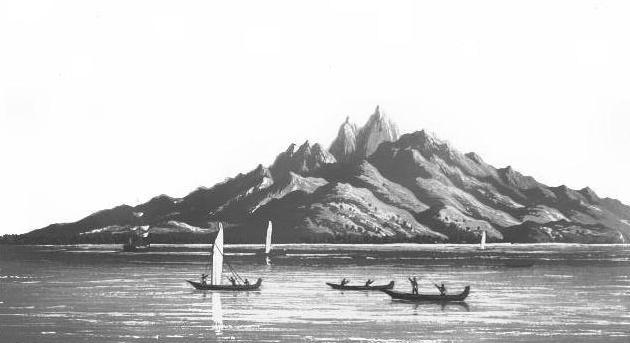
TahitiNorth-West Coast |
LONDON:J. B. NICHOLS AND SON, 25, PARLIAMENT STREET. |
actuate his countrymen to depute many of their number to reside with this people of a new world, and pave the way for raising them to the rank of civilized nations. The gleanings I have brought from Polynesia may not, therefore, be unacceptable, although many more able labourers have been busy on the same field. Changes are yearly occurring in that region of the globe, which cannot but prove interesting to the philanthropist; and Nature has endowed those islands with gifts which will long demand our closest scrutiny. Should the appended description of the Sperm Whale Fishery appear too minute, the apology I must offer for it is, that while I wished to make that description thorough, I have felt that some such tribute is due to the Whaler, that he might appear to the world in his true position. By the uninitiated, he is too often regarded as ignorant, and of a degraded caste; whereas, in fact, his occupation is one of extreme anxiety and trial, requires considerable talent and energy for its proper performance, and is, without exception, the noblest branch of our merchant-navy; since, in the absence of war, it is the best adapted to display the courage, perseverance, and enterprising spirit of British sea- |
men, in their truest and brightest colours. The national importance of the service, in a commercial point of view, none can be bold enough to question. The collection of objects in Natural History brought to this country by the Tuscan, consisted of 743 dried specimens of plants, illustrating the vegetation of the lands visited, and 233 preparations of animals, most of which are rare, and many of them unique. The principal part of the botanical collection is now in the possession of A. B. Lambert, Esq. and Professor Don. The zoological I have deposited in the Hunterian Museum of the Royal College of Surgeons in London. To Captain Stavers and the officers of the Tuscan, I feel a pleasure in acknowledging deep obligations for their extreme kindness towards me during the ordeal of so long a voyage, as well as for their voluntary, valuable, and indispensable aid in furthering my inquiries. F. D. BENNETT.
KENT ROAD. April 14, 1840. |
CONTENTS OF VOL. I.
| |||||||
| |||||||||||||
| |||||||||||
| ||||||||||
| ||||||||||||
| |||||||||
| |||||||

A CHARTShewing the Tracks of
[Click on image to view in larger format in a new window.]
|
NARRATIVEOFA WHALING VOYAGEROUND THE GLOBE.CHAPTER I.
October 17, 1833. The ship Tuscan, of 300 tons burden, T. R. Stavers, commander, (in which I was embarked,) sailed from the port of London on a whaling expedition to the Pacific Ocean. It is not very usual for ships engaged in |
this service to take charge of passengers; but, on the present occasion, our party was agreeably increased by three ministers of the London Missionary Society, Messrs. Loxton., Rodgerson, and Stolworthy, who, together with the wives of the two first-named gentlemen, were destined for the islands of the Marquesa and Society groups. Adverse winds, occasioning a detention of six days at Portsmouth, did not permit us to clear the British Channel until the 29th, when we launched into blue water,* and continued an undeviating course to the southward and westward. * Few Englishmen, who have not extended their nautical excursions to more than a hundred miles beyond the mouth of the British Channel, can form any correct idea of the appearance the sea presents throughout the greatest portion of the globe; or how little applicable is the term "sea-green," when the shallow and troubled waters of our own coasts are exchanged for the clear and deep-blue bosom of fathomless oceans. In the latter, the vast expanse of fluid presents one uninterrupted field of a lapis lazuli tint; (the ultra-marine of painters;) and its lifting waves, crested with foam, bear a close resemblance to robes of the richest purple, edged with swansdown or fine lace. This intense blueness of the ocean has been ascribed to the salts of iodine contained in sea-water; but it is more probable that the blue of our atmosphere, or sky, and that of the deep sea, have both the same origin; namely, the clearness and vast accumulation of their respective elements. |
A few hours after we had lost sight of the British coast, a flock of goldfinches, (Fringella carduelis,) driven off the land by some previous heavy gales, took refuge on the ship, and continued with us for two or three days. As every unusual appearance must have its meaning, this was regarded as a good omen by our crew. At noon on the 6th of November, the mountain land of Madeira bore from us S. S. E., distant twelve miles. We passed sufficiently close to its coast to observe the general aspect of the country, its houses, and cultivated lands; but at the same time incurred the penalty of a calm, which delayed us until the following morning. While thus detained, we noticed the phenomenon named by nautical men a "wind-gall," (query, "wind-gale?") or "sun-dog;" – a broad and perpendicular streak of iridescent colours, placed opposite the sun, and extending from a dark cloud to the verge of the horizon. It may be considered to be a fragment of a rainbow; though its colours are much less delicate and diversified than those of the ordinary meteor of that name, and chiefly consist of a lurid-red, or copper-colour, and a bright olive-green, dividing |
the column vertically and in nearly equal proportions. Sailors consider its appearance a precursor of foul weather; nor had we, in this instance, any reason to doubt the correctness of their conclusion; since the succeeding night brought a heavy gale of wind, attended with thunder, lightning, and torrents of rain; and the presence of an ignis fatuus* on the summit of each mast-head, gleaming with its peculiar sickly and supernatural light. Upon entering the northern tropic, the monotony of a voyage across the Atlantic was somewhat relieved by the appearance of a school of small whales, or Blackfish, (Phocaena Sp.,) spouting and gamboling on the surface of the * These mysterious meteors, so frequently observed during a thunder-storm at sea, have invariably a globular form, are about the size of a tennis-ball, and emit a pale blue light. They occasionally appear to pass rapidly from one part of the ship to another, or to drop from the mast-head to the yards beneath, remaining stationary on each for a few moments. Many names have been given to them. When one only is visible it is called Corpo Santo, or St. Helena; when two, Castor and Pollux; and more, Tyndaridh, or St. Elmo's fire. It is probable that their origin is to be found in the effects of evaporation; for, however much the atmosphere may have been surcharged with electricity, during tempests at sea, I have never observed them but as attendants upon rain. |
sea. They were very numerous, and easily approached by the boats lowered in pursuit of them. Three were harpooned. One, however, escaped by the harpoon drawing; the second sunk immediately after death; but the third, which was secured without misadventure, was brought to the ship and taken upon deck entire. It measured sixteen feet in length; and produced about thirty gallons of oil for the use of the ship's company. On the 14th of November we felt the first influence of the N. E. trade-wind, in lat. 21° N.; and at noon on the 16th came in sight of the island of St. Antonio, of the Cape de Verd group, passing it to the eastward, at the distance of twenty-six miles. In lat. 9° N., long. 23° W., (where the accession of calms and light airs denoted that we had exceeded the limits of the N. E. trade-wind,) a school of sperm whales was first observed, and announced by the usual exclamations. A strong excitement instantly pervaded the entire crew; an animating scene of bustle and activity ensued;* and in a few minutes the boats were low- * On these occasions, something like the following expressions are heard from the look-out at the mast-head and the commander and others on deck. There she spouts! – There she blow-o-os! – Where away? – Two points on |
ered and spread over the ocean in pursuit of their prey, leaving the ship almost tenantless and deserted. The whales had been alarmed at the approach of the ship, and proved particularly watchful and timid. One individual, however, was approached by a boat as it lay motionless on the water, in the act of listening, and before it could take the alarm received two harpoons in its body, and was subsequently despatched by the lance in little more than ten minutes. The dead cachalot (which was a female of adult size) was brought to the ship, when the operation of "cutting in" was immediately commenced, and completed in three hours. To obtain oil at so early a period of the voyage greatly exhilirated the spirits of the crew, and naturally led them to anticipate a short and prosperous voyage. Nor had our the lee-bow, sir, a school of whales. – Bring up the glass, boy. – Aye, aye, sir. – How far off do you see them? – About four miles, sir. – Back the main-yard; brail up the trysail. – There she blow-o-s! – Th-e-r-e again! – Flukes! – (An expectant pause ensues, and all are intent to discover the next rising.) – There she breaches! – There she blow-o-s! – Th-e-r-e a-gain! – on the lee-quarter. – Get your boats ready for lowering. – Th-e-r-e a-gain! – Lower away! I see there is a large whale amongst them that wants a passage to London. |
missionary passengers any reason to be otherwise than pleased with the result, since it relieved them from the suspicion of being "unlucky people;" an odium a sailor is always inclined to attach to religious professors, of whatever persuasion. A continuance of calms or light and variable airs detained us a few degrees north of the equator for ten days, during which the weather was oppressively sultry, and rain of very frequent occurrence. Of all the minor inconveniences attending a journey by sea, a protracted calm is certainly the most annoying both to sailors and landsmen. Whatever length of time a passage may occupy, if the motion of the ship is rapid, it is endured with patience whilst, on the other hand, but a few successive days of perfect calm appear as a tedious century, and destroy the equanimity of the most resigned voyager. On those who have not the inclination to resort to intellectual pursuits to beguile their time, the affliction falls with greater force. With them the ship becomes at once a floating illustration of the Castle of Indolence, where "Labour only was to pass the time; This usually indolent period, however, was not entirely so with our small community. The |
boats were frequently lowered to exercise their respective crews; and the decks daily exhibited the busy occupations of many artisans. The sea, also, at this time, presented a very animated appearance, owing to the currents which prevailed thus near the line, as well as to the calm that lay on the surface of the deep and rendered all natural marine objects more distinctly visible. Sharks, attracted probably by the late effusion of blood, were numerous around us; and many examples of the albacore or tunny, (Scomber Thynnus,) and dorado, or " dolphin " of sailors, (Coryphcena hippuris,) were taken by hook and line, or by the barbed spikes of the "granes." The changes of hue displayed by the dying "dolphin" are peculiar; but have been much exaggerated by the poetical descriptions of travellers. Soon after the fish has been removed from the water, the bright yellow with rich blue spots, which constitutes the normal colour of the animal, is exchanged for a brilliant silver, which, a short time after death, passes into a dull-gray, or lead-colour. The original golden hue occasionally revives in a partial manner, and appears above the silver field, producing a very interesting play of colours; but the diversity of tints is not greater than I have described. |
When off the east coast of Brazil, in lat. 22° S., long. 35° W., we experienced a gale from the N. W., which had the effect of bringing about the ship many land birds and lepidopterous insects. Among those we captured was a small heron, (Ardeola, or "paddy-bird" of Bengal,) with cinnamon-coloured plumage; and a large moth, the Hydaspus Jatrophae of Fabricius. December 24. – In lat. 38° S., long. 51° W., a party of sperm whales was seen from the mast head, and the boats lowered in pursuit. One of the school, moving slowly through the water, and conspicuous for his large size, was selected as the object of attack, and successfully harpooned. The creature plunged violently upon being pierced with the weapon, and, setting off swiftly with the attached boat, was not destroyed until after a conflict of nearly five hours' duration. The barometer having fallen in twenty-four hours from 30.10 to 29.60, and other indications of an approaching storm being observed, some anxiety was felt to preserve the valuable prize that had been obtained with so much labour. The body of the cachalot was disposed of the same evening; but the approach of night did not permit the same care to be taken of the head, which was, consequently, left floating |
astern, secured by a strong hawser to the capstan. The night brought a furious gale from the S. W., with a sea running so high that it became necessary to cast off the head of the whale, both to ease the ship, and to avoid the danger which might result from the waves setting such a weighty mass against her stern. On the 26th the wind moderated; but the sea remained turbulent, and presented the green hue of soundings, marking the extent to which the "Brazil bank" stretches forth in an easterly direction from the American continent. The temperature of this tract of discoloured water was much higher than that of the surrounding atmosphere; and communicated to the hands immersed in it a very agreeable sensation of warmth. Many ocean birds of the high south latitudes were now visible around us, as nellies (Procellaria gigantea); blue-petrels, or sperm-birds (Prion pachyptila); pintados, or cape-pigeons; and pios, or cape-hens (Diomedia fuliginosa); with several other species of the albatross family. Among the number of these birds we captured by hook and line, baited with fat meat, was a kind of petrel, which has not been de- |
scribed by our ornithologists. In size* and blackness of plumage, beak, and legs, it bears a close resemblance to the sooty-petrel (Procellaria fuliginosa); but it is distinguished from that species by white bands encircling the head and throat in the form of a bridle. The wandering albatross (Diomedia exulans), often appeared to us in the very gray garment that characterises the young bird; while most of the adult specimens we obtained displayed a vertical line of delicate rose-coloured plumage on each side of the neck; a peculiarity which I had never observed in the many examples of this bird I had in former voyages procured off the Cape of Good Hope. We witnessed an amusing instance of the voracity of this species. A slip of porpoise blubber, that could not have weighed less than three or four pounds, had been thrown overboard and was floating on the sea, when it was pounced upon by a large albatross, and although, as we watched the result, it appeared impossible that the bird could manage such a bulky morsel, with a few moments' strenuous exertion he contrived to swallow it entire. Although * Length twenty-three inches; expanse of wing four feet seven inches. |
unable to rise from the water after the undertaking, he continued to swim pertinaciously in pursuit of a hook and line, baited with the same tempting food, and only escaped being captured by the hook breaking in his beak. Stormy-petrels were frequently about the ship, skimming over the waves in their peculiar rapid flitting manner; every moment dipping to the sea and raising a slight splash on its surface, then rebounding to renew their mazy flight through the air. There is something very interesting in these little birds – they appear too diminutive and feeble to brave the vicissitudes of the open ocean, and yet are always so active and merry on the wing, both in rough weather and in calm; they are, however, more inclined to take shelter from a very severe tempest than other sea-fowl, and are as commonly met with on the equator as in the cold climates of high north and south latitudes. The opinion that their appearance is indicative of a storm is not correct; and has probably arisen from the circumstance of their occasionally approaching a ship for shelter during the violence of a gale. Sailors seldom injure the stormy-petrel. It is true they have not often an opportunity afforded them of doing so; for these birds are not easily shot at sea, and it is yet more difficult to entrap |
them. I have met with a veteran tar who once in his life had killed a "Mother Carey's chicken," as it fluttered for refuge from the tempest under the lee of his vessel, and he always spoke of the event with unaffected contrition. Large shoals of that rare dolphin, Delphinus Peronii, were seen sporting in the ocean as we advanced to the southward. It is a species peculiar to this region; and differs essentially from the common dolphin in being coloured black and white in nearly equal proportions, and in being totally destitute of any appendage, or fin, on the back: from this last peculiarity it is named by seamen the "right whale porpoise." On the 4th of January, 1834, the ship passed within six miles of an iceberg floating on the sea, in lat. 47° S., long. 57 1/2° W. It was of square form, and had a small conical hummock attached to its base. The summit was level; but in some points of view the effects of refraction caused it to appear as an inclined plane. It had a dazzling whiteness, and seemed to be covered with snow. The circumference of the berg was estimated at between three and four hundred feet, and its height at fifty; but, to judge from its shape, it is probable that little more than a sixth of its actual bulk was visible above the surface of the ocean. |
Floating ice-islands are not unfrequently seen in this latitude, and the uncertainty of their situation requires that ships should keep a strict night-watch to avoid them. During the winter season they remain consolidated with the frozen lands whence they originate; and it is not until the summer of the south that they drift into the lower latitudes, and intrude upon the ordinary tracks of shipping. Many penguins, and divers, were at the same time observed swimming on the water; their home being either the iceberg, or, with more probability, the Falkland Islands, from which we were now distant about a day's sail. January 14. – Attained our highest south latitude, namely, 58° 33' in long. 69° W.; when, being to the S. W. of Cape Horn,* and in the Pacific Ocean, the ship's course was altered to the N. W. Although the season was midsummer, we found the temperature of this region unpleasantly low; – showers of snow and sleet * The island at the southernmost extremity of the American continent, and known as "Cape Horn," is placed in lat, 55° 58' 30" S., long. 67° 21' 14" W. Its name is derived from the Dutch galliot Horne, commanded by Wilhelm Schouten, and engaged in an expedition under the direction of Jacob le Maire, in the Eendracht; when the latter vessel rounded this cape, and gave to it the name of her consort – the Horne having been previously burned in Port Desire, December 19, 1615. |
were frequent; and winds from the southward brought with them the piercing coldness of a frosty day in the winter of England; a state of atmosphere which was strangely contrasted with the extreme length of the days. The barometer, also, maintained a very low grade, on no occasion marking 30, and often falling to 29.20, without any accession of foul weather. Towards sunset, the sky to the southward occasionally presented the white and luminous reflection termed "ice-sky," or "ice-blink." On the evening of the 17th, the sun, setting behind a dark cloud-bank, cast a lovely vermilion tint over numerous small and higher nebulae; while immediately over the spot of its descent was pictured a very perfect parhelion, or "mock-sun," at the height of about four degrees above the horizon. It presented the appearance of a small orb of deep red colour; and continued visible, with various gradations of brightness, for fifteen minutes. January 19. – We rounded Cape Horn, or attained to the northward and westward of its promontory; and continued our route to the northward, off the coast of Patagonia. In lat. 48° S., long. 80° W., the surface of the ocean presented extensive fields of a red colour, which proved to be formed by myriads of me- |
dusae, of the genus Salpa. As we passed through the coloured water we captured vast quantities of these creatures. They were one inch in length, of broad and flattened form, transparent, and had a violet tint, resembling glass delicately stained with the oxide of manganese. When placed in a vessel of sea water, they moved actively, with a darting or jirking motion; and upon being held in the hand, exhibited, incessantly, the peculiar pulsating action of the sides of the body by which they propel themselves through the ocean. A very large flock of small sea-birds, resembling stormy-petrels, hovered over this tract of animated water, and occasionally alighted on its surface. In the vicinity of this spot we spoke the French ship Mississipi, of Havre, cruising in search of the southern true-whale. It was looked upon as an unusual circumstance that her master was a Frenchman; the few whaleships sent out from the ports of France being mostly commanded by Americans. Her crew, with the tact peculiar to their nation, were busily occupied in preparing complicated messes from the legs of the albatross, which they had captured in great numbers. We had ourselves, indeed, attempted a similar dish, prepared after the receipt of Captain Cook; but, although the |
flesh of this bird is not decidedly objectionable in flavour, we found it somewhat tough, and not altogether so good as to induce to a repetition of the experiment. In the afternoon of the same day, the sea, for some distance astern of the ship, was literally covered with aquatic birds, chiefly of the albatross family. Their number could not be estimated at less than some thousands. They had apparently been attracted to the spot by some oily matters floating on the water; while the rapidity with which they had been assembled by that cause would indicate that they possess great acuteness either of sight or smell. Among them was a bird I had never before, nor have since, seen. It was the size of a pintado-petrel; the beak yellow; the plumage black, with a white band passing across the upper and under surfaces of the wings. It flew rapidly, and with a short flapping action of the wings, unlike the flight of ordinary sea fowl; occasionally alighted on the sea; and when in the air attacked the albatrosses, who to escape its assaults invariably betook themselves to the water. During a dark and calm night, with transient squalls of rain, in lat. 43° S., long. 79° W., the sea presented an unusually luminous appearance. While undisturbed, the ocean emitted a faint |
gleam from its bosom, and when agitated by the passage of the ship, flashed forth streams of light, which illuminated the sails and shone in the wake with great intensity. A net, towing alongside, had the appearance of a ball of fire followed by a long and sparkling train; and large fish, as they darted through the water, could be traced by the scintillating lines they left upon its surface. The principal cause of this phosphorescent appearance was ascertained by the capture of numerous medusae, of flat and circular form, light-pink colour, and eight inches in circumference; the body undulated at the margin, spread with small tubercles on its upper surface, and bordered with a row of slender tentacles, each five feet long, and stinging sharply when handled. The centre of the under surface was occupied by a circular orifice, or mouth, communicating with an ample interior cavity, and surrounded by four short and tubular appendages, which, when conjoined, resembled the stalk of a mushroom – a plant to which the entire animal bore much resemblance in form. When captive, the creature displayed a power of folding the margin of the body inwards; but its natural posture in the water was with, the body spread out, and the tentacles pendent. |
When disturbed, this medusa emitted from every part of its body a brilliant greenish light, which shone without intermission as long as the irritating cause persisted, but when that was withdrawn the luminosity gradually subsided. The luminous power evidently resided in a slimy secretion which enveloped the animal, and which was freely communicated to water, as well as to any solid object. When thus detached, it could be made to exhibit the same phosphoric phenomena as the medusa itself; hence, it is reasonable to suppose, that the gleam of the ocean arose no less from the luminous matter detached from these creatures than from that which adhered to them; and I was further satisfied on this point, when I found that immersing the medusa in perfectly clear and fresh water communicated to that fluid all the scintillating properties of a luminous sea. Though the discovery of these medusae was a satisfactory explanation of the phosphorescent appearance of the water, I had yet to learn that the latter effect was partly produced by living, bony, and perfectly-organized fish: such fish were numerous in the sea this night; and a tow-net captured ten of them in the space of a few hours. They were a species of Scopelus, three inches in |
length, covered with scales of a steel-gray colour, and the fins spotted with gray. Each side of the margin of the abdomen was occupied by a single row of small and circular depressions, of the same metallick-gray hue as the scales; a few similar depressions being also scattered on the sides, but with less regularity. The examples we obtained were alive when taken from the net, and swam actively upon being placed in a vessel of sea-water. When handled, or swimming, they emitted a vivid phosphorescent light from the scales, or plates, covering the body and head, as well as from the circular depressions on the abdomen and sides, and which presented the appearance of as many small stars, spangling the surface of the skin. The luminous gleam (which had sometimes an intermittent or twinkling character, and at others shone steadily for several minutes together,) entirely disappeared after the death of the fish. In two specimens we examined the contents of the stomach were small shrimps. As we proceeded to the N. W., and the weather became more settled and agreeable, the ship was re-equipped for sailing in fair latitudes, and the mast-heads were again manned; a duty which had been omitted during our cold and boisterous passage round the Cape. |
On the 10th of February, a large and solitary sperm whale was seen moving leisurely through the water, at a short distance from the ship. The approach of night did not allow of the boats being lowered; but the clouds of vapour cast in the air as the cachalot exposed its dark form above the surface of the sea, the crew covering the rigging, and hailing each spout as it arose with "There again!" prolonged with a solemn and not inharmonious tone, and the moodv silence, so expressive of disappointment, with which they dispersed when the coveted animal was no longer visible, had a novel effect during a serene evening about the period of sunset. On the following day Juan Fernandez was in sight from the mast head, bearing N. N. W., and distant about sixty miles. As we approached it closely, this island presented a series of elevated and mostly conical mountains, extending east and west, and bearing a desolate, arid, and highly volcanic aspect, but little in accordance with the rich fertility for which the interior of the country is so remarkable. When at the distance of six miles from the coast we lowered two boats, and entered a channel, about three miles broad, which separates Juan Fernandez from a small insular spot named "Goat Island." This latter islet does not exceed four or five |
miles in circumference, and has a mountainous, burned, and barren appearance. Its height may be estimated at about four hundred feet. Its coast is precipitous, and composed of a brown volcanic stone, which presents, on the exposed surfaces of many of the cliffs, tortuous and columnar projections, resembling the branches and trunks of trees half imbedded in its structure. On the north side, and western extremity, a stream of fresh water empties itself into the sea over the face of the cliffs. With much impediment from a heavy surf, we effected a landing upon this island. Its soil afforded no vegetation higher than a stunted shrub and a few patches of verdure served rather to heighten by contrast, than to relieve, the general sterility of its appearance. Neither goats (which are said to have formerly abounded on this spot) or any other quadrupeds were visible during our stay. The birds we noticed were terns, boobies, and other of the amphibious tribes peculiar to such coasts; bluepigeons, resembling our stock-dove, (Columba oenas,) nestling in the precipices; flocks of small birds, the size of a wren; and one species of falcon. Vast numbers of violet-coloured crabs occupied the rocks, and, by the threatening attitudes they assumed, appeared to dispute with us the pos- |
session of the coast. Fish were plentiful in the waters around, and took the hook so readily that in less than two hours the boats were enabled to obtain an ample supply for our ship's company. They were chiefly of the kinds known as "rockcod," "snappers," or gilt-heads, (Sparus,) "sweeps, " (Glyphisodon,) and "rudder-fish," or scad. (Caranx.) Large eels were also numerous, but proved so tenacious of life, hideous in aspect, and prone to bite, that we were glad to dismiss them from the boat as soon as they were captured. Juan Fernandez is about twenty-four miles in circumference, and has an elevation of 3000 feet above the level of the sea. It was formerly employed as a penal settlement from South America; but of late years a disposition has been shewn to colonize its shores from the republic of Chili. The harbour of Cumberland Bay, on its N. E. side, affords good anchorage, and some supplies for shipping; although the ill discipline displayed by the convict residents has deterred many vessels from availing themselves of its advantages. On the evening of the 12th, we made sail from this island, and steered to the northward and westward, until in lat. 25° S., long. 87° W.; when we commenced a due West course. Mo- |
derate winds from S. E., and fine weather, now attended our progress; but, owing to the sudden transition from the coldness of high latitudes to the mild climate on the verge of the tropics, catarrh attacked our ships company with a prevalence and severity that gave it some claim to the title of epidemic influenza. |
CHAPTER II.
At daylight on the 7th of March, the dark and elevated form of Pitcairn Island was seen from the mast-head, bearing W. 1/2 S. by compass, and distant about thirty-five miles. Calms, or light airs, did not permit us to approach the land closely until after sun-set; when the ship was hove-to for the night, and a gun fired and a blue light burned, in answer to the signal-fire kindled by the inhabitants on the hills. On the succeeding morning we made sail to within five miles of the northern coast, (where some houses on the heights denoted the situa- |
tion of the settlement,) and lowered a boat, in which Mr. Stolworthy and myself accompanied Captain Stavers to the shore. Guided by the gestures of a native, who stood upon an eminence waving a cloth, we proceeded for an indentation of the coast, where several of the islanders were collected on the rocks; but here so heavy a surf broke upon every visible part of the shore that some reluctance was felt to expose the boat to its fury. While we were considering the best mode of effecting a landing, one of the islanders plunged into the sea and swam towards us. He approached with the salutation, "Good morning, brethren," and, entering the boat, commenced a familiar conversation in very good English. Upon his volunteering to pilot us to the landing-place, and, in his own words, "to be responsible for the safety of the boat," the crew again took to their oars; when passing through a line of heavy rollers, and doubling a projecting ledge of rocks, we almost immediately entered comparatively tranquil water, and ran the boat's bow upon the small beach of "Bounty Bay," where some pigs of iron ballast, and shreds of corroded copper, yet remain as mementos of the fate of the vessel which has given her name to the spot. The principal |
male inhabitants received us on the beach with a cordial and English welcome to their shores, and conducted us by a steep and winding path to the settlement. Several of the heads of families we had not before seen, and groups of women and children, met us on our way, their countenances beaming with pleasure at the appearance of their visitors, and all of them desirous to shake hands with their "countrymen," as they term the British. They had seen the ship since the previous morning, and had been anxiously awaiting our arrival. This island is lofty, though of limited extent; its circumference does not exceed seven miles; while its extreme height, as determined by Captain Beechey, is 1046 feet above the sea. The coast is abrupt and rocky, beaten by a heavy surf, and closely surrounded by blue water of unfathomable depth. No harbour obtains; but small vessels may find anchorage in twenty-five, and twelve fathoms water, with sandy bottom, close to the western shore. A difficult, but practicable landingplace, corresponding to this anchorage; a second at Bounty Bay; and one (more questionable) on the S. E. coast, are the only points where the island is accessible from the sea. Coral grows on the coast, and its debris are found |
on the coves; but there are no distinct reefs of this material. The northern side of the island, or that occupied by the settlement, offers a very picturesque appearance; rising from the sea as a steep amphitheatre, luxuriantly wooded to its summit, and bounded on either side by precipitous cliffs, and naked and rugged rocks, of many fantastic forms. The simple habitations of the people are scattered over this verdant declivity, and are half concealed by its abundant vegetation. They are neatly constructed of plank, thatched with leaves of the screw-pine, (Pandanus fascicularis,) and provided with windows, to which shutters are affixed. The greater number have but a single apartment, occupying the entire interior of the building, and floored with boards; while some few (called double-cottages) possess an upper-room, which communicates by a ladder with the one beneath. The furniture they contain is scanty and of the rudest description; nevertheless, every thing about them denotes great attention to cleanliness and order. The dwelling formerly occupied by old John Adams is a neat cottage, containing two apartments, both of which are on the ground. It is situated in a pleasant and elevated part of the |
village, and opens with pretty effect upon a smooth and verdant lawn. The largest and best building the settlement can boast is that named the school-house, and applied to the purposes of a church, school, and teacher's residence. To each cottage is attached a plot of garden-ground, fenced round with roughly-hewn stakes, and planted with water-melons, sweet potatoes, and gourds; while cattle-sheds, pigsties, and other outhouses, herds of swine and goats, and many European implements of agriculture, (including some wheelbarrows,) afford a rural picture that forcibly reminds the Englishman of similar scenes in his native land. Many good paths, conducting to the habitations and cultivated lands of the natives, intersect the settlement, and often pass through dense and solemn groves of majestic banian trees. (Ficus indica.) The fabric of this island is chiefly a dark volcanic stone, but on the northern coast I observed some cliffs of a yellow and friable sandstone. The whole of the fertile soil (which is rich, and composed of a red clay mingled with sand) was originally shared, in nearly equal proportions, by the settlers from the Bounty, and is now retained in like manner |
by their descendants; each family possessing a small estate and subsisting upon its produce. A comparative scarcity of water exists, since there are no natural streams, and the volcanic structure of the land precludes the formation of wells; but rain-water is largely received in ponds or tanks, and it is not until rain has been absent seven or eight successive months that the residents experience any material inconvenience from this cause. The greatest supply of water is still obtained from a natural excavation which was discovered by William Brown, the assistant botanist of the Bounty, and thence named "Brown's Pond." It is supposed to possess a spring. At this time the population consisted of eighty persons,* of which the majority were * One of the females, Jane Quintal, had left the island, in company with an English sailor, some years previous to our visit. Her paramour left her at the island of Rurutu, or Oetiroa, where she married a native, and continued to reside. My brother, Mr. G. Bennett, thus describes an interview he had with this female during his stay at Rurutu, in September, 1829: "On the beach I was accosted by a tall, fine, half-caste woman, dressed in neat European clothing. Her manner was artless, and she spoke the English language with correctness. She informed me that her name was Jane Quintal, of Pitcairn's Island. |
children, and the proportion of females greater than that of males. The entire race, with the exception of the offspring of three English men, resident on the island and married to native women, are the issue of the mutineers of the Bounty, whose surnames they bear, and from whom they have not as yet descended beyond the third generation. So strong a personal resemblance obtains between the members of a family that it is no difficult task to distinguish brothers and sisters. I was particu- 'You have heard of Matthew Quintal?' she said: 'I am his daughter.' The following conversation then took place between us: – 'How long is it since you left Pitcairn's Island?' – A few years ago, in a whale-ship.' – Why did you leave?' – 'There are no husbands there; and besides,' she continued, 'the island is too small for us. It is, sir, but a very small island; quite a rock.' – 'You are married now, I suppose?' seeing a little chubby dark urchin in her arms. – 'Yes,' she replied; 'I married a native of this island (Rurutu). I was obliged soon to get married, they are so very particular; all missionaries. I could not talk to any male creature when single, so I got married.' – 'Do you wish to return to Pitcairn's Island?' 'No, I am very comfortable here.' Having ascertained that I was in the medical profession, she made me promise to send her 'stuff to raise a blister,' sticking-plaster, &c. as she intended to practise the profession herself on the island." |
larly led to notice a predominance of Irish features in many among them, and more especially in the fair and expressive countenances of some of the children; nor had I any reason to be dissatisfied with my skill in national physiognomy, when I was afterwards informed that these individuals bore the name of M`Coy, and were the issue of one of the Bounty's crew who was an Irishman.* The only survivors of the first settlers are two aged Tahitian females, who possess some interest, in association with the history of these islanders. The eldest, Isabella, is the widow of the notorious Fletcher Christian, and the mother of the first-born on the island. Her hair is very white, and she bears, generally, an appearance of extreme age, but her mental and bodily powers are yet active. She appeared to have some knowledge of Capt. Cook, and relates, with the tenacious retrospect of age, many minute particulars connected with the * I subsequently noticed a similar fact at Tahiti; where an intelligent half-caste woman, the offspring of a female of Borabora and an Irishman, was principally to be distinguished from the ordinary natives by her strongly-marked Hibernian features. Upon my mentioning this peculiarity in her countenance to a friend residing on the island he informed me of her origin. |
visits of that great navigator to Tahiti. The second, Susan Christian, is some years younger than her countrywoman Isabella. She is short and stout, of a very cheerful disposition, and proved particularly kind to us; indeed, I flattered myself that I had found favour in the sight of "old Susan," as she not only presented to me a native cloth of brilliant colours, which she had herself manufactured, but, bringing a pair of scissors, insisted upon my taking a lock of her dark and curling hair, flowing profusely over her shoulders, and as yet but little frosted by the winter of life. This woman arrived on the island as the wife of one of the Tahitian settlers, and bears the reputation of having played a conspicuous part when the latter were massacred by their own countrywomen. She subsequently married Thursday October, the eldest son of Fletcher Christian, and who died at Tahiti in 1831. Her daughter, Mary, a young and interesting female, is the only spinster on the island; she perseveres in refusing the offers of her countrymen, to whom she expresses great aversion, but, unfortunately, her antipathy has not extended to Europeans, and a very fair infant claims her maternal attentions. In person, intellect, and habits, these islanders form an interesting link between the civilized |
European, and unsophisticated Polynesian, nations. They are a tall and robust people, and their features, though far from handsome, display many European traits. With the exception of George Adams, who is much fairer than any of his countrymen, the complexion of the adults does not differ, in shade, from that of the Society Islanders. Their hair, also, is invariably black and glossy, and either straight or gracefully waved, as with the last-named people. Their disposition is frank, honest, and hospitable to an extreme; and, as is common to races claiming a mixture of European with Asiatic blood, they possess a proud and susceptible tone of mind. In conducting the most trivial affairs they are guided by the Scriptures, which they have read diligently, and from which they quote with a freedom and frequency that rather impair the effect. A modest demeanour, a large share of good humour, and an artless and retiring grace, render the females peculiarly prepossessing. Some of the younger women have also pleasing countenances; but, on the whole, little can be said in favour of their beauty. They bear an influential sway both in domestic and public politics; and this they are the better calculated to do, since they are intelligent, active, and |
robust, partake in the labours of their husbands with cheerfulness, and, with but few and recent exceptions, live virtuous in all stations of life. Their children are stout and shrewd little urchins, familiar and confident, but at the same time well behaved. They are early inured to aquatic exercises; and it amused us not a little to see small creatures, two or three years old, sprawling in the surf which broke upon the beach; their mothers sitting upon the rocks, watching their anticks, and coolly telling them to "come out, or they would be drowned;" whilst the older children, amusing themselves with their surf-boards, would dive out beneath the lofty breakers, and, availing themselves of a succeeding series, approach the coast, borne on the crest of a wave, with a velocity which threatened their instant destruction against the rocks; but, skilfully evading any contact with the shore, they again dived forth to meet and mount another of their foaming steeds. The ordinary clothing of the men is little more than the maro, or girdle of cloth, worn by the most primitive Polynesian islanders. On occasions of ceremony, as to attend at church, or receive the visits of strangers, they assume a complete English costume; their hats being constructed of pandanus-leaf cinnet, and de- |
corated with coloured ribbons, which give them a pretty rustic-holyday effect. The females commonly employ for their dress the native material they prepare from the bark of the paper-mulberry tree, stained with vegetable dyes; but, as opportunities offer, they substitute for this rude cloth the handkerchiefs and cotton prints of Europe. They wear the petticoat and scarf in the Tahitian style, and complete their toilette after the manner of the same nation, by passing a girdle of the seared and yellow leaves of the Ti plant around their waist; placing flowers in their ears; and encircling their tresses with a floral wreath. Some few wear their hair short; but the majority permit it to flow over their shoulders in luxuriant ringlets. These people subsist chiefly on vegetable food. Yams, which are abundant and of excellent quality, form their principal dependence; and next to these the roots of the mountain-taro (Arum costatum), for the cultivation of which the dry and elevated character of the land is so well adapted. Cocoa-nuts, bananas, sweet-potatoes, pumpkins, and water-melons, are also included among their edible vegetables; but of bread-fruit they obtain only a scanty crop, of very indifferent quality. They prepare a com- |
mon and favourite food with grated cocoa-nuts and yams, pounded, with bananas, to a thick paste; which, when enveloped in leaves and baked, furnishes a very nutritious and palatable cake, called pilai. On two days in the week they permit themselves the indulgence of animal food, either goat's flesh, pork, or poultry; while the waters around the coast afford them a sufficient supply of fish. They cook in the Tahitian manner, by baking in excavations in the earth, filled with heated stones; the fuel they employ is usually the dried husks of the cocoa-nut. The elder members of the Pitcairn Island family are but indifferently educated; scarcely any of them being able to write their own name, though most can read. For some years past, an Englishman, named George Nobbs, has resided on the island, and officiated as schoolmaster to the children, who, in consequence, exhibit a proficiency in the elements of education highly creditable both to their own intelligence and to the exertions of their teacher. George Adams had commenced instructing himself in writing but a few months before our arrival, and a journal which he had kept for that length of time, and which he put into my possession, displays much progress in the art. |
The few books they possess have been obtained from sailors visiting their shores, and are chiefly of a religious tenor. Some volumes, also, which were removed from the Bounty are still preserved in the house formerly occupied by the patriarch John Adams. The English and Tahitian languages are spoken with equal fluency by all the islanders, excepting the two Tahitian females, who speak little else than their native dialect, and are, perhaps, in the sad predicament of having partly forgotten that. They converse in English with some of the imperfections peculiar to foreigners; and this may be partly attributed to their usually discoursing in Tahitian with one another; as well as to a practice among their British visitors of addressing them in broken English, the better to be understood – a delusion into which most fall upon their first intercourse with this people. They, nevertheless, -pride themselves upon an accurate knowledge of the language of their fathers; and not only aim at its niceties, but also indulge in the more common French interpolations, as faux pas, fracas, sang froid, &c. They were early and well instructed in the pure doctrine of the Christian religion by their revered forefather John Adams; and it is to be sincerely hoped that no fanaticism may ever |
intrude upon their present simple and sensible worship of the Creator, nor the intemperate zeal of enthusiasts give them a bane in exchange for that religion, "Whose function is to heal and to restore, Their sabbath is now observed upon the correct day, or that according with the meridian of the island; which was not the case in 1814, when Sir T. Staines visited the spot, and found John Adams and his small community preserving Saturday as the day of rest; an error which had arisen from the circumstance of the Bounty having made the passage from England to Tahiti by the eastern route, without any correction of time having been made to allow for the day apparently gained by this course. The canoes the natives possess are but few, and of very simple construction. They are hollowed out from one piece of wood, and each is adapted to carry two persons. When afloat, they appear as mere wooden troughs, or little better than butcher's trays; nevertheless they can brave a very rough sea, or go safely through a heavy surf, and, when managed by their island owners, cleave the water with incredible velocity. The young men of the island are excellent divers. They occasionally engage themselves |
to pearling vessels, to dive for pearl-shell among the adjacent islands; with an understanding that they are to be restored to their home at the expiration of their engagement. At the period of our visit the climate of Pitcairn was serene and delightful, and, though the thermometer marked 82° in the shade, the sensible temperature was kept agreeably low by the moderate and refreshing trade-winds, which almost incessantly blow over the land. Winds from N. W., with wet and squally weather, are occasionally experienced; but no season is considered remarkable for rains. The land has generally a very salubrious aspect, and the inhabitants a very healthy appearance; nor are there, apparently, any diseases endemic amongst them. Elephantiasis, or fefe, so prevalent in many of the islands of the Pacific, is here unknown. The natural productions are principally those common also to the Society Islands. The quadrupeds we noticed were all exotic, as goats and swine, which were brought hither by the first settlers from the Bounty; and a bull and cow, a donkey, a dog, and several cats, which the people had recently brought with them from Tahiti; but, as the island affords but little pasturage, the oxen had destroyed some fruit-trees, |
and it was determined that they should be killed. The domestic fowls are of the breed introduced here by the Bounty. Some Moscovy ducks had been lately left on the island by the Hon. Capt. Waldegrave, of H. B. M. S. Seringapatam. The only wild birds we observed, beyond the amphibious denizens of the coast, was a small and noisy species inhabiting the woodlands; in size and plumage it resembles our common sparrow, and it bears the same name amongst the islanders. Small and active lizards, of many gaudy hues, are numerous on the vegetated lands. Among the insects, mosquitoes have but lately made their appearance, and are supposed to have accompanied the islanders upon their return from Tahiti. The breadfruit, it is said, was found on this island by the Bounty's people, who also introduced many plants of it from Tahiti; it was formerly plentiful, but the trees are now few in number and bear but a small and annual crop of fruit. This degeneracy is believed by the natives to attend upon the clearance of the land; and such may probably be the fact; but, at the same time, the dry, elevated, and exposed character of the soil, is so opposed to the natural habitude of this tree in other parts of Polynesia |
that I am only surprised to find it ranking with the indigenous vegetation. The candle-nut tree, and Indian mulberry, are conspicuous in the wooded lands. The roots of the former are used by the people to give a brown, and those of the latter a yellow stain to their bark cloth. The lime tree (Citrus medica) has been introduced, but is not prolific; nor has the mountain-plantain, (Musa fei,) recently imported from Tahiti, as yet succeeded. The cotton shrub, (Gossypium vitifolium,) loaded with large and globular pods containing much excellent wool; capsicum, or bird-pepper, (Capsicum frutescens,) sugar cane, tobacco, and turmeric, grow wild in great abundance, but are applied to no useful purpose. The residents say that the cultivation of the sugar-cane is opposed by rats, which infest the soil in great numbers, and destroy the young plantations. Yams (Dioscorea sativa and aculeata) are indigenous to the island, and cultivated with much care. They are grown in fields, or "yam patches," on the exposed and sunny declivities of the hills, their vines wandering procumbent over a great extent of ground. They produce an annual crop of roots; the season for planting |
them commencing in October, and that for digging between July and August. One large root, when cut for seed, is estimated to produce twenty plants. The labours of hoeing and preparing the earth, sowing the seed, transplanting the seedlings, and digging for the mature roots, are the greatest these islanders have to contend with, and furnish as many data for the events of their lives. The mountain taro (Arum costatum) is also indigenous, and is very generally cultivated on the dry and elevated lands, where it occurs as verdant plots of tall, erect, and arrow-shaped leaves, bearing in their centre the flowers peculiar to the "wake robin" family. Unlike its aquatic congener, A. esculentum, or common taro, this species prefers a dry and mountain soil, or is, at least, conveniently amphibious. The cultivated root attains a large size and bears some resemblance to the yam, and, although when in the raw state it is so acrid as to excoriate the skin, when cooked it affords a very agreeable and nutritious food. The Irish potatoe is occasionally grown; but the natives give the preference to the cultivation and use of the sweet potatoe (Convolvulus batatas). Amongst the miscellaneous vegetation, we observed the scurvy-grass of navigators (Carda- |
mine antiscorbutica); and the ferns Asplenium obtusatum, Acrostichum aureum, an undescribed species of Hymenophyllum, and a species of Cyathea, a tree-fern attaining the height of from twelve to fourteen feet. The most abundant pasture-grass is a species of Eleusine. It is probable, that Pitcairn Island was seen as early as January, 1606, by the Spanish commander, Louis Paz de Torres; although the date of its discovery may with more certainty be referred to 1767, when its existence was ascertained by Captain Philip Carteret, of the British discovery-sloop Swallow. Captain Carteret did not land upon its shores, (which he had reason to believe were uninhabited,) and named the island after a young gentleman on board his ship, by whom it was first seen. In the year 1773, Captain Cook, then engaged on his second voyage, cruised in diligent search of this land, but failed to find it; Captain Carteret having laid it down more than three degrees to the westward of its true position.* The second recorded visit to Pitcairn Island is * Sir T. Staines determined the position of this island to be lat. 25° S., long. 130° 25' W. Capt. Beechey, R. N. has fixed the position of its village in lat. 25° 3' 37" S., long. 130° 8' 23" W. |
that of the British armed-ship Bounty and her mutinous crew, in 1790. The events which occurred on board this vessel, while under the command of Lieut. Bligh, and employed in conveying plants of the breadfruit from Tahiti to our West India colonies, are well known; nevertheless, I maybe permitted to relate, briefly, the ultimate fate of both the vessel and her crew, in connexion with some facts that came under our notice, and with others communicated to me by the Pitcairn islanders, or by the English residents who had for many years lived in social intercourse with John Adams, the late patriarch of the colony. Upon leaving Tahiti for the last time, in September, 1789, taking with them several natives of that island, the mutineers in the Bounty are known to have steered to the N. W.; but their route must have been long and devious, since it was not until January 1790, that they reached Pitcairn Island, a distance of little more than four hundred leagues from Tahiti, in a S. E. direction. Whether Christian, who had the command of the ship, made this small and sequestered isle by accident or design I have been unable to ascertain; but if from a previous knowledge of its existence, it is evident he could have reached it only upon a parallel of latitude, |
as its correct longitude was at that time unknown. When off this land, the ship was nearly lost to Christian by a counter conspiracy. He had landed with some Tahitians to inspect the country, when Mills, the gunner's mate, proposed to those who remained on board to make sail for Tahiti, and leave their companions on shore to their fate; but some unexplained circumstances did not permit this plan to be carried into execution. Finding the island adapted to their purpose, (and certainly few spots in the Pacific could have been better so,) the mutineers kept the ship lying close off the coast, while they removed, in casks and on rafts, the stores they wished to preserve.* This had been but partially effected when one of the crew, named Matthew Quintal, set fire to the vessel, without the sanction of his shipmates, and contrary to the wish of Christian. The ship, while in flames, drifted to the shore, and her destruction was completed in Bounty Bay. What portions of her wreck remained, or were subsequently cast up by the sea, were carefully collected and destroyed, to remove from the * Tradition amongst the islanders yet records the delight of the Tahitian females when they received the sails of the Bounty, to make their clothing from the canvass. |
ocean every trace of her fate.* For some time after they had landed, the mutineers were tormented by the fear of detection, and kept a constant watch on the summit of a lofty cliff, which immediately strikes the observer as being admirably adapted for that purpose, and which is, indeed, still employed as a look-out station by the inhabitants. From this commanding height they observed, soon after their arrival, a sail approach the land; but did not believe that she neared it sufficiently to communicate by boat. They subsequently ascertained, however, that some persons had landed from her, and returned, probably under the impression that the island was uninhabited. The fate of this small band of colonists (which consisted of fifteen men and twelve women) was retributive and melancholy in the extreme. All of their number met with violent deaths, except- * The present race of people speak of the bark of their fathers with much interest. They showed us many of her relicks, and from among them we obtained a blank log book, of antiquated appearance. On the interior of its cover was a card, engraved with fanciful devices, a coat of arms, with the motto "Pro Deo patria et amicis," and a scroll, bearing the name of Fran. Hayward, which would declare the owner of the book to have been one of the midshipmen of the Bounty who accompanied Lieutenant Bligh in the launch. |
ing Adams, Young, and some of the Tahitian females. Fletcher Christian and John Mills were shot on the same day, by the Tahitians; the grave of the former was pointed out to me: it is situated a short distance up a mountain, and in the vicinity of a pond. Isaac Martin ..... Williams, and William Brown, shared a similar fate. Several of the Tahitian men fell also in these conflicts; and the survivors, when in a fair way to exterminate their British rivals, were themselves slaughtered, "at one fell swoop," by their own wives and countrywomen. Matthew Quintal, whose temper was uniformly tyrannical and quarrelsome, was shot by his comrades, who, it is charitable to believe, were compelled to resort to that measure in self-defence. William M'Coy became delirious (partly, it was thought, through remorse for the part he had taken in the destruction of Quintal,) and drowned himself in the sea, with a stone tied round his neck. Brown, Martin, and Williams died without issue. Mills had an only son, who was killed by a fall from a cliff, and one daughter, who is married into the family of the Youngs: the other mutineers have perpetuated their names through a numerous Anglo-Tahitian progeny. After the lapse of a few years, John Adams was left the only survivor of the British settlers, |
and the father of a young and happy community. He had served as an able seaman on board the Bounty, under the name of Alexander Smith, but his real name is Adams, Alexander Smith being a fictitious, or "purser's" name, assumed upon shipping, a practice very usual with British seamen. He was an Englishman by birth, and the son of a waterman, an occupation until very recently, if not at present, followed by his brother on the river Thames. He was accustomed to say, that a proposal to join in the mutiny was made to him as he lay in his hammock, and to this he acceded, but took no very active part in the atrocity. He was thrice married to Tahitian females. By his first wife, who accompanied him from Tahiti to Pitcairn's Island, he had no family. Upon her death he lived with, but did not marry, a female whom he took from her Tahitian husband; and this act (which has always been incorrectly ascribed to Fletcher Christian) led to the sanguinary dissensions between the mutineers and the men of Tahiti. His second wife was the widow of Mills; the fruits of this union were three daughters, now living in the island, namely, Dinah, married to Edward Quintal; Rachel, the wife of an Englishman named John Evans; and Hannah, the widow |
of George Young, who perished during the late residence of this people at Tahiti. Adams's second wife died of an injury she received from a goat while enceinte; and the widow of M'Coy became his third. By her he has an only son, George, who is married to Polly Young, the finest and most intelligent woman on the island. In March, 1829, John Adams expired, in the sixty-eighth year of his age, and after a residence of thirty-nine years on Pitcairn's Island. His remains, as well as those of his last wife (who had been for many years blind and bedridden, and who did not survive him more than six weeks) are deposited in separate graves, within an enclosure but a few yards distant from their former residence. Poplar-leaved hibiscus trees, covered with large yellow flowers, and a shrub of Poinciana pulcherrima, bearing clusters of crimson blossoms, shade the spot, and a rough head-stone distinguishes the grave of the patriarch from that of his wife. The particulars of the discovery of the Pitcairn colony, through visits accidentally paid to the island, in 1808, by the American ship Topaz, Captain Folger, and in 1814, by the British frigates Briton and Tagus, are sufficiently well known. John Adams, a short time before his death, |
had expressed apprehensions that the supply of water on his island would be inadequate to the wants of an increasing population; and that it might become necessary, hereafter, to request the aid of the British government to remove the colony to some other spot better adapted for its maintenance. In February, 1831, H. M. sloop Comet, Captain Sandilands, arrived at Pitcairn's Island, accompanied by the Lucy Anne transport, for the purpose of removing the residents to Tahiti, if such should prove to be their wish. The islanders, being partly actuated by a desire to visit the land which their mothers had depicted to them in glowing colours, but more by the fear that they should offend did they not accede to what they considered was the desire of the English government, consented to the proposed emigration. In four days they were all embarked, to the number of eighty-seven, on board the transport, and, escorted by the Comet, proceeded to Tahiti. Their arrival. at their destined port occurred at a peculiarly unfortunate period – the Tahitians were then on the eve of a civil war; and, in addition to the scenes of strife and confusion this distracted state of the island displayed, the hitherto immaculate Pitcairnians |
were compelled to witness the gross and unbounded licentiousness habitual to the place, and at this period unrestrained even by the broad meshes of the local laws. This Land of Promise, also, offered the colonists but little that could compensate for the loss of their own fertile and picturesque isle, which, though small, was more than sufficiently large,* and, in a word – their home. Nevertheless, the commercial bustle of Tahiti had its charms; to the habits of the people they became but too well inured; and it is probable that the Pitcairnians would soon have become reconciled to their new abode, had not disease assailed them soon after their arrival, and relentlessly thinned their numbers. Dispirited by this unusual affliction, they became anxious to return to their native land, and applied to Captain Sandilands for a passage thither; but the Captain had no instructions to that effect, and soon after put to sea with the Comet; having first obtained from the Tahitian government a liberal grant of land, and the promise of six months' supply of provisions for the Pitcairn colony. With the aid of a sum * It is estimated, that Pitcairn Island can well support 1000 inhabitants. |
of money raised by subscription amongst the benevolent European residents at Tahiti, and by a part-payment of the copper bolts of the Bounty, the unfortunate emigrants were at length enabled to obtain a passage, in an American vessel, to their own shores, which they regained after an absence of little more than five months. Upon the occasion of this disastrous expedition, fourteen of their number perished by disease; twelve having died at Tahiti, and two others immediately after their return to Pitcairn Island. At the time of our visit nearly two years had elapsed since the return of this people: their lands were again in a high state of cultivation, and their former simple habits were in a great measure resumed. But the injurious effects of a more extensive intercourse with the world were but too evident in the restless and dissatisfied state of many amongst them, as well as in a licentiousness of discourse, which I cannot believe belonged to their former condition. Events had also occurred, shortly before our arrival, which had roused the worst passions of this hitherto peaceful race, and had divided the island into two factions, opposed to each other with a rancour little short of open warfare. The origin of this calamity was attributed to |
the recent arrival on the spot of an elderly Englishman, named Joshua Hill, who, uninvited, and without authority, had assumed, under the title of teacher, the government of the people. To strengthen his authority, he had allotted a subordinate share of it to a few of the most ambitious and athletic amongst the men, who, as "elders" and "privy council," were to enforce his regulations among their countrymen. The fraternal equality that had hitherto existed in their society was thus destroyed; while new laws, enforced under the equally new penalties of imprisonment and flogging, as well as by espionnage, and the seizure of fire-arms from the disaffected – measures at all times deemed more military than civil – naturally tended to irritate those of the natives who were not of the upper party, and many of them were anxious to accompany us to Tahiti, that they might escape such unpleasantries. George Adams, in particular, appeared much distressed at the state of his country, and urgently desired the presence of a British ship of war, to settle their disputes and "take old Hill and the muskets off the island." In this, as in many similar dissensions, it was difficult to determine to which party the greater share of blame should attach; for though no |
excuse can be offered for Mr. Hill's unauthorised intrusion upon the affairs of the island, or for his despotic measures, yet, previous to his arrival, the state of the island was confessedly bad, and the people much in need of a prudent governor. Immediately after their return from Tahiti, the pernicious practice of distilling an ardent spirit from the Ti root had become frequent – drunkenness and disease were amongst them – their morals had sunk to a low ebb and vices of a very deep dye were hinted at in their mutual recriminations. But all these errors might doubtless be eradicated by mild and judicious measures; and probably by the fortiter in re of Mr. Hill; though it is much to be feared that the social compact which formerly bound this people has been broken by the rude contact of the world, and that virtue and tranquillity have fled the spot, never more to return. I thought it, indeed, a remarkable proof of the mutability of human affairs, that these islanders, whom I had ever been accustomed to regard in the light of a curious phenomenon in the moral history of man – as a large and united family, occupying a sweet little isle of its own, remote from the contentious world, and rich in every Christian virtue, should prove, when seen on their own shores, the only |
one, of the many races of people we visited during the voyage, with whom discord prevailed. Notwithstanding these political disputes, and the part we were necessarily called upon to take in their discussion, the reputation for hospitality which has ever been attached to these islanders was not lost. Their best houses, their choicest food, and all that they possessed and deemed acceptable, were freely offered for our use; while fruits, vegetables, hogs, and fowls, were abundantly supplied to the ship. Some of the inhabitants accompanied us over the island, pointing out every object worthy of notice, and communicating information readily and with intelligence; while others went off in their canoes to the ship, that they might be presented to the English ladies, who they were informed we had on board. In return for their ample supplies and many acts of kindness, we presented them with such European manufactures as they required, and, after a friendly parting, embarked to continue our voyage, taking with us three Englishmen, who had intermarried with the natives, and resided amongst them for many years, but who had suffered so much persecution during the late unhappy discords that they were glad to |
avail themselves of a passage to Tahiti, until they could return to their wives and families under competent protection.* There is every reason to believe that Pitcairn Island has had inhabitants previous to its occupation by the crew of the Bounty; since, in addition to the ruins of morais, images, &c. found on its soil, the islanders informed me that they had recently discovered two human skeletons, lying in the earth side by side, and the head of each resting on a pearl-shell. This last circumstance involves the history of the aborigines in yet greater obscurity; as the pearlshell, although found in the adjacent islands, has never been seen in the waters around Pitcairn Island. Stone adzes, supposed to have belonged to this ancient race, are not unfrequently found by the present inhabitants, whilst cultivating the ground. Two of these were given to me by Hannah Young, the third daughter of John Adams. They are rudely fashioned, in the ordinary Polynesian form of such instruments; are composed of a black * From the report of a visit to Pitcairn Island, by the Acteon, Lord Edward Russell, in 1836, we learn that Nobbs had returned, and resumed his office of schoolmaster; and that Joshua Hill had been recommended by his lordship to quit the island. |
basalt, highly polished; and bear an appearance of great antiquity. It is certainly difficult to account for the extinction of an original race upon a spot so replete with every essential for the support of human existence; and we are led to the hypothesis, that either one of the epidemic diseases, which occasionally scourge the islands of the Pacific, had destroyed the primitive inhabitants to the "last man," or that the island was but occasionally frequented, for religious or other purposes, by the people of some distant shore, who subsequently discontinued the custom. |
CHAPTER III.
From Pitcairn Island we continued our route to the N. W.; the winds holding chiefly from the northward, with wet and tempestuous weather – as is not unusual in this region during the autumn season. On the night of the 21st of March, the small but elevated and uninhabited island of Maitea, of the Georgian group, was seen, by moonlight, bearing N. N. E., distant ten miles; and early on the following morning Tahiti was observed from the mast-head, at the distance of about forty miles to the westward. As we approached the latter island, and sailed along its N. E. coast, the two lofty and elongated peninsulas of which it is composed had the appearance of as |
many distinct islands – the low isthmus, about two miles broad, which connects them, being invisible from the sea until very closely approached. The scenery commanded from this point of view fully justified the encomiums that voyagers have so liberally lavished upon it. The dark and cloud-capped mountains of the interior send to the coast a graduated series of undulating hills, their declivities, lightly timbered and covered with pasturage, exhibiting, as the sun plays upon them, many of the most beantiful variations of light and shade. Extensive vallies and plains, luxuriantly vegetated, intersect the mountain lands, and receive the waters of many glittering cascades, gliding majestically over the faces of the more precipitous heights; while in those spots where the huts and plantations of the natives can be detected amidst the foliage of the coast, relieving the natural wildness of the landscape, the effect is more enchanting than it is possible to describe. The day being far advanced when we reached the N. W. side of this island, the ship was kept lying off the coast until the following morning, when we received the native pilot on board, and, passing through the great reef, cast anchor in the harbour of Taonoa. |
Tahiti (Otaheite, Cook) is, correctly speaking, the largest of the six Georgian Islands, which are situated about seventy miles to the S. E. of a second group, discovered by Captain Cook, and named by him the Society Islands. It is now, however, very customary with voyagers, and others, to designate both the above clusters by the latter name; the Georgian being distinguished as the Windward, and the Society as the Leeward, islands. Of the two peninsulas which form the land of Tahiti, the northern and largest is named Opoureonu, or Tahiti-nue; the southern, Taiarabu, or Tahiti-iti. The entire island is estimated at 108 miles in circumference; and its population at 7000. It is separated from the rugged and mountainous island of Eimeo by a channel nearly eighteen miles across, and which permits free navigation between the reefs encircling the two islands. Notwithstanding the very mountainous character of Tahiti, extensive and fertile vales open upon the sea on all sides of its coast, giving passage to many broad and rapid rivers, abounding with fish. A broad belt of level alluvial soil, margined by a beach of fine sand or broken coral, encircles the greater portion of its shores and the entire land is clothed from |
the water's edge to its topmost heights with a perennial verdure, which for luxuriance and picturesque effect is certainly unparalleled. The highest mountain in this island is situated near its north extremity. It has never been ascended by an European, nor has any exact measurement of its height been given, but its estimated elevation above the sea is 7000 feet. Some Tahitians, who have gained its summit, report that they found there a lake of yellow water, (probably an extinct crater, with an ochreous sediment in the water it contains,) and some wild ducks, differing in plumage from the ordinary species indigenous to the coast. The principal settlements, and all those most frequented by shipping, are placed on the N. W. side of the island, on a tract of land about eighteen miles in extent, bounded to the eastward by the conspicuous promontory, Point Venus, and to the westward by Burder's Point. This space is divided into several districts, of which the principal spots and villages (as we proceed westward from Point Venus) are Matavai, Papaoa, Taone, Taonoa, Papeete, and Bunaauia. Matavai forms a distinct bay. Much of its soil is sandy and arid, the lofty mountains of the interior on the one hand, and a broad surf- |
beaten beach of black sand on the other, reducing its fertile and habitable land to a comparatively small space. Its southern boundary is formed by cavernous cliffs, at the base of Onetree hill,* its northern by the promontory on which Captain Cook observed the last transit of Venus across the sun's disk, in June, 1769, and hence named Point Venus. It is a long and sandy spit of land, divided through its entire length by a broad stream. On one side it is barren, or covered only with a profusion of the Convolvulus Braziliensis, while on the other it is adorned by a dense grove of cocoa-nut palms, presenting to the sea a very conspicuous landmark. The outer reef, which protects most other parts of the coast, is deficient at Matavai, or does not rise to the level of the sea by several feet; consequently the bay is exposed to a heavy swell during S. W. gales, and is not altogether an eligible anchorage. The coast between Matavai and Papeete is thinly inhabited; but affords extensive tracts of level and fertile soil, penetrating inland to the foot of the hills, covered with the wild fruittrees of the country, and enlivened by occasional herds of grazing cattle, and native huts embo- * The solitary Erythrina, or coral-tree, which formerly grew on the brow of this hill, and gave it a name, no longer exists. |
somed in the depths of the foliage. Papeete is the principal settlement and port of the island, as well as the seat of government. Dwellings of every grade, from the mere shed of the native to the more finished cottages of the European residents, are numerously arranged on its shores, and with a nearer approach to uniformity than is elsewhere observed; while the presence of shipping gives the place an air of commercial importance, strongly contrasted with the aspect of uncontrolled Nature which pervades other parts of this coast. In common with every other village, it possesses a commodious native church, built of plank and thatched with Pandanus leaves; and, in addition, a small sacred edifice, neatly fitted up, and devoted to the use of foreign residents and visitors, at whose expense it was erected. The road continued along the coast to the western village at Bunaania (a distance of about eight miles) presents but few human habitations. It passes through a constant succession of fertile lands, bearing groves of guava, orange, breadfruit, and cocoa-nut trees; the trunks of many of the two last being encircled with fillets of dried leaves, to denote that the fruit on their boughs is tabooed, or reserved as the exclusive property of some particular individuals. Several mountain streams, crossed by rude bridges, in- |
tersect this route; and an occasional hill commands from its height a lovely prospect of the richly vegetated lowlands beneath; the wide expanse of blue ocean, relieved by the towering mountains of Eimeo in the distance; and the small and verdant coral islets scattered over the tranquil water enclosed by the great reef. Bunaauia, in the district of Atehuru, is in itself an interesting spot; abounding in well watered and richly pastured plains, and mountain scenery of the wildest and most varied description. Its village contains the printing establishment through which useful publications, in the Tahitian tongue, are diffused among the Windward Islands. The press is under the charge of Mr. Darling, the intelligent missionary of this district, whose residence, and adjoining lands, display a combination of simplicity with elegance not very usual in the estates of Europeans in Polynesia. A good horse-road communicates between all the districts on this side of the island. It is known to both natives and foreigners by the name of "Broom-road; "the task of sweeping it, and keeping it in repair, being the more common punishment inflicted upon offenders against the laws. The principal harbour on this coast corresponds to the village at Papeete. It is a ca- |
pacious sheet of smooth water, of nearly circular form, closely land-locked, and capable of containing a large fleet; it affords anchorage close to the beach, and facilities for "heaving down" ships to repair. It is, in short, the beau ideal of a safe and convenient port; since it rather resembles a capacious dock-basin than a natural harbour. Matavai Bay, or Port Royal Harbour, so commonly the resort of early navigators, is now seldom if ever frequented by shipping, for reasons that I have already stated; the two other anchorages, corresponding to the coast of Taonoa and Taone, though less objectionable and more employed, are exposed to S. W. gales, and are considered less secure than Papeete Bay, or Wilks' Harbour. A pilot boards an arrived vessel outside the reef, conducts her to an anchorage, and again takes charge of her upon sailing; for this service a demand is made of fifteen Spanish dollars, eight of which belong to the queen of the island, and seven to the pilot. The present occupant of the pilot's office is an eccentric native, named Jim; he is a travelled man, speaks English fluently, and has some little knowledge of seamanship; but the only duty for which he is responsible, or with which it would be altogether safe to entrust him, is that of pointing |
out the reef entrances and the different anchorages. Near the entrance to Papeete harbour there is a low coral islet, covered with cocoa-nut and other litoral trees, and named by the natives motu uta, or the islet near the shore. It is surrounded by a platform built of coral blocks, on which are mounted eight cannon, commanding the village and harbour of Papeete. On particular occasions, and always as the signal for a strange sail being seen in the offing, the Tahitian flag (three stripes, red, white, red, horizontally disposed) is displayed on its shores. Several native dwellings are erected upon it; including one belonging to the Queen of Tahiti, with whom this, her citadel, is a very favourite residence. The lowlands of Tahiti have lately undergone a considerable change in their appearance, from the extent to which the guava shrub flourishes on their soil. Scarce twenty years have elapsed since this fruit-tree was first introduced here from Norfolk Island, and it now claims all the moist and fertile soil, in spite of every attempt to check its increase. The woodlands and bush, for miles in extent, are composed almost solely of this shrub, bearing during the entire year a constant succession of delicious fruit, |
and not unfrequently both mature berries and clusters of large white blossoms on the same bough. The natives are very partial to the fruit, and consume a large quantity of it; but during the months of March and April, when the crop is most abundant, no ordinary consumption can equal the supply, and vast numbers lie on the soil, unnoticed even by the surfeited hogs, which will touch none but the sweetest or most inviting in appearance. The stony hardness of its seeds, resisting the digestive power of animals, tends to disseminate the plant in every available direction. On dry soil, however, it is neither prolific nor luxuriant in growth; it chiefly affects the moist and sheltered lands; and is no where so abundant, or bears such excellent fruit, as near the banks of rivers. No pasturage will grow on the plains it covers; but the leaves of the guava itself afford a good provender for cattle, and both horses and oxen eat its fruit with avidity, and thrive well upon it. The Tahitian villages invariably occupy the level land in the close vicinity of the sea-shore. The scattered dwellings, of which they are composed, are much as described by the earliest European visitors; the walls are constructed of bamboo or hibiscus rods, optionally covered with |
leaf mats, or with leaves sufficiently thinly spread to be pervious to light and air; the roof (the only part of the building on which much care is expended) is double inclined, and thatched with leaves of the screw-pine. The interior is one capacious apartment, with a floor of condensed earth, covered with a thick layer of grass, and spread with mats for repose. One large hut is often occupied by several families, who live in common, and usually in the society of swine, dogs, and poultry, which prove of essential service in removing the refuse food that the residents leave about the floor in a very slovenly manner. The only furniture they possess, in imitation of European, is a bedstead covered with mats, and a rude kind of sofa. A few habitations, approaching nearer to the European style in being built of plank, and divided into apartments with boarded floors, can scarcely be considered improvements, either in comfort or appearance: they soon become dilapidated, and long remain so, owing to the trouble that attends repairing or rebuilding them; while their apartments are always in a very disorderly and filthy condition, whatever may be the rank of the occupants. Nor does the costume of the islanders evince that advance in civilisation which might be ex- |
pected from their long intercourse with Europeans. On ordinary occasions, the lower class of men are yet content with the scanty maro, or cloth girdle; and the best attire of the chiefs consists of a cotton shirt and neckerchief, a few yards of calico folded round the waist and legs, and a beaver or straw hat. The females, with a propensity common to their sex, indulge more largely in foreign modes. They patronise to a great extent the importation of cotton prints, and even silks, which they make into loose gowns, in distant imitation of the English dress. Thus clothed, with the addition of a handkerchief or shawl, and a becoming bonnet trimmed with ribbons, the Tahitian belle presents a respectable and modernized appearance: she cannot, however, forget the pareu, or native petticoat; consequently this is represented by a piece of calico, folded round the waist and descending over the gown. The principal improvements the natives have made are in religious observances, and in the acquirement of the rudiments of education: the greater number can read the Scriptures in the Tahitian tongue; many can write a legible hand, and some few possess a good knowledge of arithmetic. The women have been instructed in platting straw-cinnet, in manufacturing hats |
and bonnets, in the use of the needle, and in the duties of domestic servants. The men are, to a limited extent, capable of working as shipwrights, blacksmiths, carpenters, and joiners; many also engage themselves to ships frequenting their island, when they speedily perform the duties of ordinary seamen with steadiness and ability. The commerce of Tahiti consists in the exportation of pearl-shell and pearls, sugar, cocoanut oil, and arrow-root; and in the importation of some few European manufactures, chiefly hardware and cloth. It is altogether conducted by foreigners; as the natives have not the exclusive possession of any vessel larger than a double canoe. A few schooners and sloops, built on the island by the missionaries and other European residents, are employed in traffic between the principal Polynesian islands; and their voyages are occasionally extended to South America and New South Wales. The numerous English and American whale-ships, calling at the island, yield the natives much emolument in the form of port dues, and by large demands for supplies, and render Tahiti, of all the islands in the Pacific, second only to Oahu, of the Sandwich group, in commercial importance. Trade in kind has now given place to the circulation |
of specie; but the currency is limited to dollars, and other silver coins, as the natives cannot yet appreciate the value of copper or gold. The prospect of Tahiti proving equal to Oahu in commercial prosperity is yet very distant. Not only are the Georgian less favourably situated as an emporium for foreign trade than the Sandwich Islands, but a much more important difference also exists in the domestic condition of their respective inhabitants. The Tahitians, unfortunate, it may be said, in the possession of a land too luxuriously fertile, have scarce any incentives to industry or commercial enterprise; they have occasion to exert themselves but optionally, or at most for the supply of their few exotic wants, and do not know what it is to subsist upon the fruits of their labour – a lesson often too hardly learned by the less pampered, and more aristocratically-oppressed Sandwich Islander. To this cause, as well as to the abundant production of sandal-wood, which early distinguished the Sandwich Islands, bringing foreign ships to their shores, wealth to their chiefs, and giving the people a stimulus to commerce, we must mainly attribute the fact, that, notwithstanding its priority of intercourse with civilized nations, Tahiti remains at least half |
a century behind Oahu in civilized improvements.* A consul from the United States of America has lately been appointed to this island, so much the resort of American shipping. The British consul, R. Charlton, Esq. whose charge includes the Society and Sandwich groups, resides at the more important island of Oahu, a distance of five weeks sail from Tahiti, and the communication uncertain; his duties at this port are, consequently, performed by deputy.† The Tahitians, in common with other Polynesian nations under the British or American influence, possess a code of laws framed in the purest spirit of justice. The judges and magistrates, selected from amongst the principal chiefs and landholders, are implicitly obeyed by the people; and punishments, though usually le- * It is a fact, not altogether unconnected with the commercial merits of the respective islands, and the proverbial shrewdness of the American character, that the majority of foreign residents at the Sandwich group are subjects of the United States; while those at the Georgian and Society Islands are almost exclusively British. † In 1837, Mr. Pritchard, the late excellent missionary at this island,and who had for several years efficiently performed the duties of consular agent, was appointed Her Majesty's Consul for the Society and Friendly Islands, to reside at Tahiti. |
nient, are comparatively rarely required. Minor offences are visited by fines (pecuniary or in kind) and compulsory labour; the more serious, by banishment or death. The penalty of death is opposed to the feelings of the native legislators, and is very rarely awarded; but the spectacle of a public execution, by hanging, has been exhibited among this people as the punishment for murder, rape, and treason. The present form of government is a limited monarchy, or a combination of the monarchical and aristocratic: a supreme head is acknowledged; but it is evident that the power of the superior chiefs, supported by their numerous retainers, is greater than that of the sovereign, whom they rather tolerate than implicitly obey. When Captain Cook visited this island, the succession of the royal chiefs would appear to have been unsettled; but for many years past it has continued hereditary in one family. The present sovereign, Aimata, or Pomare Vahine, the only daughter of Pomare II.* succeeded to this dignity in 1827, upon the death of her infant brother, Pomare, the third of that name. At the age of fourteen, Aimata married Tapoa, or Pomare, * The son and successor of Pomare I. who was the royal chief Otoo, of Captain Cook. |
the son of the royal chief of Tahaa; but the connexion proved neither happy nor of long continuance; a divorce ensued, and the Queen contracted a second marriage with a young chief to whom she has borne two children. Both the latter perished by dysentery; and the intense grief of the mother, upon the death of her last infant, has gained for her, amongst the natives, the somewhat poetical sobriquet of Arii aue, or the Queen of Lamentations. In person, Aimata is below the mid stature and inclined to corpulence; her age, at the time we last saw her, was about seven-and-twenty, when Tahitian women begin to look elderly; her features are not handsome, and have a pensive expression, with some traits of a wayward and petulant disposition. As is usual, however, with most Tahitian females, her smile is peculiarly sweet, and casts at once a gleam of beauty over otherwise but ordinary features. In the upper part of her countenance, and especially in a somewhat vacant stare with large eyes, she bears a strong resemblance to the extant portraits of her parent Pomare. Her long and black hair is usually permitted to flow wildly over her shoulders; but ondress occalions it is worn curled over the forehead and covered by a bonnet. During the early period of her career, as sove- |
reign of Tahiti, the character this lady supported was not calculated to inspire respect. Casting aside all restraints, she shared unblushingly in the licentiousness for which this island is so notorious; nor was it until the year 1831, that she was recalled to a sense of duty. At that time she was implicated with a large portion of the population, acting in direct opposition to the existing laws of the island, and anxious to abolish the trammels they imposed, and to reinstate the vicious usages of former days. Many of the principal chiefs being opposed to these proceedings, a quarrel ensued between the adverse parties, which, although not carried beyond the assemblage of armed forces on either side, and much wordy warfare, sufficiently proved that the advocates for the improved ordering of society surpassed their opponents no less in number than in professions of moral rectitude. Nothing therefore remained for the mortified Queen but to submit to her powerful rebellious chieftains, and, relinquishing the "tuta auri"* party she had hitherto espoused, to promise obedience to the established laws. Since this severe penance, Aimata has continued to live a new life, and preserves, under the surveillance of chiefs and * Literally rusty iron – foul and worthless. |
missionaries, a staidness of deportment which almost defies slander. In her domestic habits the queen differs but little from native women in a very inferior grade of life. It is, indeed, remarkable, both of the sovereigns and principal chiefs of this island, that, notwithstanding the wealth they derive from the commercial advantages of their country, the attentions shown them by the powerful governments of Europe and America, and the deference to their authority displayed by the people they govern, they should have so long refrained from assuming any token of superior rank in their persons or habits. They are not insensible to their privileges, or even to the respect due to their station; nor are they backward in demanding the tribute and services of their dependents; but nothing can induce them to relinquish the primitive customs in which they have been reared, or to make any alteration in their mode of life which would lead the population to satirize them as fahie, or proud. Hence, it is usual to see the queen Aimata, clad in a loose cotton gown, bare-headed, and bare-footed, mingling familiarly with natives of every class. Her meals, also, are equally unostentatious; the breadfruit, poe, cocoa nuts, and baked pig, intended for |
her food, being placed on a layer of fresh leaves, spread on the ground, while the partaking party display, by the use of their fingers, a thorough contempt for the modern innovation of knives and forks, in the use of which, however, they are perfectly well versed. There are six residences belonging to the queen on the N.W. side of the island alone. The two principal of these, at Papeete and Papaoa, are built of plank, and divided into apartments with boarded floors. In size and style they resemble the lowest class of English cottages. The others are neatly-constructed huts, which have a more national and comfortable appearance than the former. The furniture contained in all is of the most portable and indispensable description. Several young and interesting females, or "maids of honour," are devoted to the domestic service of Aimata, and (unless in attendance upon her person elsewhere) reside upon the secluded mote at the mouth of Papeete harbour. The most interesting spectacle, connected with royalty, we noticed at Tahiti, was ten of these young females in a large double-canoe, conveying the queen from her islet-residence to attend at church. They were uniformly clothed in pink gowns, with blue pareus; their hair dressed |
a l'Europe, and adorned with large tortoise-shell combs; (the prevailing fashion of the day;) while their light laugh and merry gossip, as they plyed their paddles, enlivened the calm waters of the bay, and gave a new charm to the bright but reposing scenery around. The Tahitians are now a Christian nation. They worship in the Presbyterian form, and are under the pastoral care of eight British missionaries, who reside in the principal districts round the island, and have charge of the whole; although in some of the more remote villages native teachers perform the clerical duties. No opinion is more questionable than that hazarded upon the amount of religious feeling possessed by any large community; but we are justified in believing that these islanders are good average Christians, if we compare their spiritual state with that of the Christian world. at large. Many of them appear to be sincerely devout, and steadfast both in faith and works; others are induced by hypocrisy and interested motives, or influenced only by the prevailing opinions of the day; while a third, and by far the most numerous class, pass through the routine of devotional forms from a sense of propriety, or by the coercion of the laws, but view religious matters with indifference and |
would be glad to escape from their restraints. The strictness, however, with which the island laws enforce the observance of religious forms leaves the native but little latitude to gratify his inclination in this respect; consequently, on the Sabbath* the churches are filled with the entire population, clothed in decent attire, and presenting an orderly and contented appearance which makes a very favourable.impression upon the foreign visitor. That a large proportion of the natives are well instructed, and impressed with the importance of their new religion, may be inferred from the many of their number that have emigrated as teachers to the idolatrous islands, where, by their precept and example, they have done much to disseminate improved habits and the pure doctrine of the Christian faith. It is also * Although the day of our arrival at Tahiti was Saturday, both by our reckoning and by the meridian of the island, we found that the inhabitants regarded it as Sunday; and were, consequently, occupied in the observance of their Sabbath. This error arose from the first band of British missionaries, in the ship Duff, having made their voyage to Tahiti by the eastern route, without correcting their time for the day they had apparently gained. The present missionaries are well aware of the nature of the mistake, but, instead of rectifying, have rather propagated it through the Society and other islands. |
but justice to admit, that crimes of magnitude are now of rare occurrence amongst them; and that the dishonesty they so prominently displayed upon their early intimacy with Europeans is now greatly diminished, or merged into the more ambiguous form of mercantile shrewdness. Notwithstanding these points of improvement, the resident missionaries speak of the native character in terms of severe reprobation; describing it as strongly marked by ingratitude and deceit. Nor had we at this visit any reason to admire the conduct of the people, as displayed on the coast: the abundance and indiscriminate sale of ardent spirits, as well as the laxity of the laws which permitted the sensuality of a sea-port to be carried to a boundless extent, caused scenes of riot and debauchery to be nightly exhibited at Papeete that would have disgraced the most profligate purlieus of London. By partaking in these, the natives had degraded their physical no less than their moral state, and in the slovenly, haggard, and diseased inhabitants of the port, it was vain to attempt to recognise the prepossessing figure of the Tahitian, as pictured by Cook, and as yet seen among the purer races in the less commercial parts of the island. The present state of the missionaries at Ta- |
hiti is far from being one of privation or toil. Each possesses at his station a neat and modest, but often tastefully furnished cottage, with enclosed lands under pasturage or cultivation; and a large supply of horses, oxen, and other live stock. They own several boats, and a schooner is always at their command to facilitate their communication with other islands of the Pacific. Their children (of which each family usually contains many) receive a good education at the South Sea Academy, established for that purpose at the island of Eimeo. They receive no remuneration from the natives, beyond the lands on which they reside, and are ostensibly dependent upon the stipend they receive from their Society in England. Some cocoa-nut oil was formerly contributed by these islanders in aid of the funds of the London Missionary Society, but this practice has been lately discontinued, probably upon some principle of church reform. It is supposed that the interior and mountainous parts of Tahiti are inhabited by a timid and secluded race of people. This supposition is partly grounded upon the reports of natives, that they have, during their inland explorations, occasionally seen such strange people; but chiefly upon the fact, that a few years since one of this |
wild race was secured whilst sleeping and brought to the coast, where he was detained for some time by the missionaries, but ultimately effected his escape, and was not again seen. This individual is described as being a well-formed man, with long and flowing hair; he was timid and unsocial, and no conversation could be held with him. It is the general opinion that these are natives of the coast, who have sought in the more inaccessible parts of the land a refuge from the wars and human sacrifices of the idolatrous times. They are called in the native language taata taehae, or wild men. It may be fairly questioned if they are not maniacs, whose mental delusions have led them to seek this secluded mode of life. The climate of this island is usually serene and agreeable. Rain falls in capricious and refreshing showers at all periods of the year, but is most abundant and continuous during the summer months. In the months of March and April we found the average height of the thermometer, in the shade, to be 83°; on one occasion it marked as high as 90°; but this degree of heat is rare, and only obtains during a perfect calm. Thunder is of remarkably frequent occurrence; and the phenomena of water- |
spouts are commonly exhibited in the ocean around this and the neighbouring islands. The quadrupeds of Tahiti are limited to swine, dogs, and rats, indigenous; and horses, oxen, goats, asses, mules, and cats, imported, or bred on the island. Rabbits have been introduced upon the coral islets; but they have not increased, and it is suspected that the rats destroy their young. The oxen are a fine breed, resembling the English in size and general appearance; the original stock having been chiefly imported from New South Wales. They are prolific, and thrive well upon the pasturage the hills and plains afford them. Some few run wild; but the majority are kept in a domestic state both by natives and foreign residents, who conjointly possess between 300 and 400 head of these useful animals. They afford an abundance of rich milk; and beef, scarce anything inferior to that of England, is supplied to shipping in the port at about 2d. per pound. The natives are fast losing the prejudice they at first entertained against the use of this animal as food, and many will now partake freely both of milk and beef when opportunity offers. The horses are imported from South America; they are never shod, are employed only |
for the saddle, and are in very general use both with natives and European residents. The native females partake equally with the men in equestrian exercises. They ride a la fourchette, in the manner of the South American ladies, (the lower part of the person being enveloped in an ample pareu,) and are very bold horsewomen. Goats are numerous; but the natives have an insuperable objection to them on account of their odour, and will on no account partake of their flesh. The attempts which have been made to breed sheep on this island have been generally unsuccessful; both the climate and pasturage are opposed to the habits of these animals, and little hope can be entertained that their wool will ever prove of any commercial value. The swine are excellent; but in the present mixed breed it is impossible to detect any trace of the aboriginal hog of Polynesia. The pricked ears of the latter animal have in almost every instance given place to the broad and pendent ears, the "badge of slavery." They are permitted by their owners to roam at large, and subsist upon the superfluous productions of the fruit-groves. When tired of a vegetable diet, they wander to the sea shore and indulge in shell-fish. When they are taken to sea, as live |
stock, it is necessary to provide a supply of ripe cocoa-nuts for their support; as they will long refuse to touch grain, or the ordinary food of more domesticated swine. Thus provided, however, they make excellent voyagers, and seldom die at sea from natural causes. The aboriginal dog has also merged into a mongrel breed. The Tahitians formerly considered a dog, fed on vegetable food, a delicate dish; and although the impairment of the purity of the breed, and the prejudices of Europeans, have done much to abolish this taste, it is still not unfrequently indulged. To all their exotic quadrupeds the Tahitians apply the generic names of their indigenous kinds; giving to the larger the name of buaa, or pig, and to the smaller that of uri, the dog, or iore, the rat. The ox they name buaa-toro, or pig with a long neck; the horse, buaa-horo-fenua, or pig that runs quickly over the ground; the goat, buaa-niho, pig with teeth (horns) on its head; and the sheep, buaa-mamoe. The monkey, of which some examples have been taken to their shores, they call uri-taata, the man-dog; and the cat, iore pii-fare, the rat that climbs the house. Domestic fowls are the only poultry indigenous to this island. Moscovy ducks and |
pigeons have been introduced, but are not as yet abundant. Of the indigenous vegetation, we will only, in this place, notice the sugar cane, or to, which is now so largely cultivated in the savannahs of Tahiti. The plant grows spontaneously on the plains and sheltered hills; but is then very inferior in size and quality to the cultivated kind, which attains the height of eight feet, with a stalk five or six inches in circumference. The natives recognise many varieties of this plant, to which they apply appropriate names. We learn, from the statements of Mr. Porter, that the sugar-cane of Tahiti, introduced into our West India colonies, maintains some superiority over the cane commonly grown in those islands; since it withstands excessive drought in a remarkable degree, comes to maturity in ten months, (four or six months earlier than the ordinary kind,) and its juice contains a less proportion of colouring matter. The principal sugar plantations at Tahiti are those belonging to Messrs. Bicknell, Henry, and Pritchard. The raw sugar produced from them (and which is not inferior to that of the West Indies), is sold on the island at six cents, or three pence, the pound; and molasses at three rials, or eighteen pence, the gallon. This branch |
of commerce was at one time abolished here through the jealous apprehensions of the natives, who are yet very averse to seeing foreigners derive any profit from their land, in which they do not themselves partake. To obviate this last objection, some of the resident merchants adopt the laudable plan of allowing the natives to grow the cane, and purchasing from them the ripe crop; a plan which, considering the uncertainty and extravagant price of native labour, is preferable in both a political and economical point of view. |
CHAPTER IV.
Our stay at Tahiti was protracted but a few days beyond the time required to land our missionary passengers, whose arrangements led them to make a short sojourn here, previous to separating for their respective stations. Early on the morning of the 26th of March we availed ourselves of the land wind, and, leaving this island, steered to the N.W. At noon on the following day, (when the islands Huahine, Raiatea, Tahaa, and Borabora, of the Society group, were in sight,) we encountered a severe gale from the westward, |
attended with much thunder and lightning, and which compelled us to take shelter under the lee of Huahine until daylight on the 28th, when, the weather being more moderate, we again made sail for the island of Raiatea, now distant about twenty miles. Upon approaching the latter island, and passing through the eastern aperture in the reef which encircles its coast, a scene of great beauty was unfolded to our view: the lofty and well-vegetated mountains of the interior of the land arose before us in sombre majesty, and at less than a stone's-throw on either side of our route a coral islet, covered with vegetation, and set as an emerald in the bosom of the lagoon water, communicated a refreshing odour to the serene morning air; the whole offering charms which scarcely permitted us to notice the narrow and dangerous channel we were threading, with a raging surf beating violently upon the reef within a short distance on either side of the ship. A few minutes sufficed to carry us through this passage, when we experienced a sudden transition from the sea in its most raging and destructive form, to the same water under its most isolated and reposing aspect. As we glided slowly along the coast, groups of natives assembled on the beach, gazing at our |
approach, and welcoming, with their wild cries, the arrival of a ship to whose almost annual visits they had been for many years accustomed; and we had scarcely cast anchor in the harbour of Utumaoro before the decks were crowded with the same people, attired in holyday costume, their heads adorned with chaplets of wild flowers, or green and fragrant leaves, and all bearing in their hands baskets of fruit and shells, either for barter, or as presents for their European friends. Raiatea (formerly called Ulitea)* is situated about 130 miles to the N.W. of Tahiti. Although it is the largest island of the Society group its circumference does not exceed forty miles. It is encircled by a reef, which also includes Tahaa – a strait, three miles across, alone separating the two islands. Though limited in its extent, it has a bold and mountainous appearance, and is no less picturesque than Tahiti. A dense garment of foliage clothes its surface, from the vallies to the mountain heights; and although occasional naked cliffs, and crags of black rock, start from the verdure to arrest the eye by their powerful relief, they can scarcely be said to intrude unpleasantly upon the general air of * This name signifies a white rat; and should, according to the present written language of the people, be spelled Ioretea. |
unbounded fertility that pervades the soil. The land attains its greatest elevation at its south extremity, where a group of rugged and pinnacled mountains, their faces thickly timbered, tower to the height of between 3,000 and 4,000 feet above the level of the sea. The extent of perfectly level land is not great, and seldom extends farther than a few hundred yards from the sea-shore, but some broad and fertile vallies rise from the coast to the interior with a gentle acclivity, and deep and gloomy ravines occupy the intervals between the abrupt faces of the mountains. The entire island is but too well watered, mountain-streams, cascades, and swamps, abounding in every direction. The soil is exceedingly fertile, and repays generously the slightest labour bestowed on its cultivation. Exotic fruit-trees thrive vigorously upon it, and particularly the fruit of the lime, which, while it proves so invaluable to foreign shipping, affords a striking example of the important advantages that accrue from the general dissemination of useful fruits and vegetables. Few natural objects are so well calculated to excite wonder in the human mind as the coral constructions, in all their Protean forms, that surround the greater number of Polynesian islands, and which demonstrate so perfectly the power of nature to effect her vast designs |
through apparently feeble and inefficient agents. It requires, indeed, an intimate acquaintance with the habits of the lithophites, and ocular proof of their labours, to credit what stupendous submarine reefs, and islands many miles in compass, are indebted for at least their entire visible structure, to the secretory economy of these tiny architects. In such examples Raiatea, is not deficient. On the contrary, she is indebted for a large share of her natural beauties, as well as commercial advantages, to the coral fabrics which surround her shores. These chiefly obtain in the form of reefs; of which the nature and use may be best understood by considering them under their natural divisions of a barrier- and a shore-reef. The former encircles the island, as a breakwater or sea-wall, at the distance of one and a half or two miles from the land; presenting a precipitous face to the ocean, to receive the assault of its billows, but encroaching in a superficial and capricious manner upon the lagoon water it encloses. The shore-reef is continuous with the land around the entire coast, and stretches into the sea to a variable, but usually to a very considerable, distance. Its greater portion is covered with shallow water, which in many parts does not exceed, and is often |
less than a foot in depth; its outer margin shelves irregularly, and terminates abruptly in a deep channel of blue water. This channel (which is also continued round the island) furnishes a natural division between the two principal reefs, as well as a convenient passage for navigation. Coral islets, shoals, or whatever other form the madreporic rock may assume, can be distinctly traced to one or the other of these apparently distinct reefs, but never occur as the productions of both conjointly. The outer or barrier-reef resembles a wall no less in its structure than in its office: unlike the friable and arborescent material we commonly associate with the name of coral, the rock of which it is composed is hard, compact, and amorphous, bearing much resemblance to a very firm cement; and it is only on its shoals, extending towards the land, that we notice the elegant form of the tree-coral, contrasting so strongly with the rocky and unornamental structure on which it is planted, as to justify a doubt if both are constructed by the same animals. The summit of this reef is flat; several yards in breadth; but little raised above the level of the sea; and washed by a heavy surf, which breaks against its sea-aspect, courses over its level surface, and falls gently, and as it |
were by a line of cascades, into the placid basin on the opposite side. At ebb tide, when the surf is less in amount, this reef is partly dry and accessible; but when the tide is high, or the weather tempestuous, the sea, raised into lofty and magnificent arches, beats over the rocky barrier with terrific grandeur, and with a rolling or thundering sound which may be heard, on a tranquil night, at the distance of several miles. To persons unaccustomed to such scenes, nothing is more deeply and agreeably impressive than the view of a majestic surf thus lashing the coast of an island opposed to the play of a mighty ocean; although it is incomprehensible or revolting to a sailor, to hear beauty associated with a scene which only conveys to his mind anxious and unpleasant reflections. A curious and mysterious feature in the construction of the barrier-reef, is presented in the occasional apertures that exist in its fabric, and which are of sufficient breadth and depth of water to permit ships to sail through them with facility. The presence of these apertures has been variously accounted for. Some authors have asserted, that they arise from interruptions the coral-worms experience in their labours by an efflux of fresh water from the large rivers opening upon the coast; but this is not a sufficient |
reason – for, although there is often a very striking coincidence in the situation of the mouths of rivers and reef-apertures in the large islands, such is not invariably the case; while in the low coral, and some other islands,* where no rivers exist, we find very distinct openings in the reefs. Neither is it easy to conceive, that the fresh water of a river, mingled with nearly two miles of sea, and diverted by a tide, should retain a power to affect the small portion of reef immediately opposite its exit; and this the more particularly, since the shore-reef is not checked by its influence, but, on the contrary, occupies the entrance to rivers in common with other parts of the coast. I am more inclined to believe, with Amoureux, that these apertures form a part of the architectural design of the coral-worm; and are intended not only to permit, but, (as they evidently do,) to increase the circulation of the tides through the enclosed waters; thus securing to the lithopites a constant communication with the ocean, in the place of an impervious and stagnant lagoon. The shore-reef is chiefly composed of amorphous rock, or block-coral; though tree-coral is also abundant upon it, as well as extensive * Christmas Island, Caroline Island, and Maurua, amongst those we visited. |
beds of sand. In many parts, where the water is deep, it presents a submarine picture of extreme beauty: extensive coral groves, planted in beds of smooth and white sand, and mingling hues of pink, blue, white, and yellow, appear through the transparent sea; numerous small fish, of brilliant colours, glide over the sands, thread the labyrinths of the coral branches, or, when alarmed, dart rapidly for shelter into the recesses of the stony thickets; the whole affording a peculiarly pleasing, and almost kaleidescopic effect. There is, however, no feature in the scenery of this coast that strikes the European observer as more novel and lovely than the verdant islets, or motus, which strew the expanse of smooth sea between the barrier reef and the main land. They are composed entirely of coral; are raised scarcely three feet above the level of the surrounding water; and appear to be peculiar to the barrier reef. They are most usually based upon the shoals which constitute the lateral boundaries of the reef apertures. It is probable that they are formed from mature coral shoals, which, after they had been raised to the surface of the sea, had caused the water to recede from their centre by the increase and elevation of their circumference – the near approach to a |
circular form they invariably present being in favour of this supposition. A motu may occasionally be seen in an incipient state: a shoal with little depth of water, projecting but a few superficial feet of its centre above the sea, rocky, and covered with two or three stunted bushes struggling for existence – affording a structure intermediate to an inundated shoal and a complete islet. The more extensive and ornamental motus possess some rich vegetable mould, covered with brushwood, or with cocoa-nut, and other litoral trees. They are destitute of fresh water; and none of them are inhabited, excepting by occasional visitors from the main land, who repair hither for the benefit of the purer sea air when suffering from sickness. A tide of some power runs through the channel between the great reef and the shore. Its rise and fall is inconsiderable, (seldom exceeding a few inches,) but its changes occur with remarkable regularity; the water being invariably highest at noon and midnight, and lowest at six in the morning and at the same hour in the evening. Seven good anchorages exist on the lee and weather sides of this island, accessible at all times, and egress easy except with a due south |
wind. They are capable of containing a large fleet of ships, and in combined advantages are surpassed by none in the Pacific. With the prevailing trade winds, ships usually pass to their anchorage through one of the two reef-apertures placed adjacent to each other off the Eastern coast, and named Te Avapite, or double entrance; and on their departure, sail through the reef-opening corresponding to the N. W. coast, which was formerly employed by Captain Cook as a passage to and from his favourite anchorage at Hamaniino. Of the two coral islets noticed by Cook at this last reef entrance, one has disappeared, and the other, though yet of respectable size, is visibly decreasing. The missionary station, and principal port of Raiatea, is the village of Utumaoro, on the N. E. side of the land. Its site has been badly chosen. The entire district is flat, swampy, and insalubrious; while the hills limit the arable soil to a very small space, and throw the dwellings of the natives close to the sea side. In every respect, Utumaoro is very inferior to the village of Vaoaara, on the N. W. side of the land, and which was formerly employed as the missionary station under the title of the "City of David." The whole island is arbitrarily divided into |
districts and spots; to each of which the natives give an appropriate name, however small, barren, or inaccessible the tract may be.* Cultivated lands are not numerous, and are chiefly planted with sweet-potatoes, sugar-cane, or arrow-root. The natives' dwellings are constructed with a primitive simplicity which speaks more in favour of the serenity of the climate than of the domestic disposition of the occupants. Their interior contains sleeping mats spread on the floor, and provided with small pillows filled with cotton; (which have greatly superseded, but not altogether exploded, the use of the tuaurua, or ancient wooden pillow); low wooden stools, nohoraa, in the ancient fashion; an umete and penu, or trough and stone pestle, used in preparing their favourite vegetable paste the poe; scraped cocoa nut shells, used as cups; a mallet and plank for the manufacture of bark cloth; a fishing spear * Both the Georgian and Society Islanders have a strong prejudice against selling any portion of their lands. They have no precedent, they say, for such a practice, and are unwilling to commence it; consequently, no instance has yet occurred of foreigners obtaining land at any of these islands, on other terms than by the purchase of a long lease, or by a grant, which the government can at any time retract. |
or net; and a musket. Bunches of edible fruits are suspended from the walls; and occasionally a matronly sow, with a numerous litter, occupies a corner of the common apartment fenced off for her accommodation. A separate shed is employed for cooking; and a plot of enclosed land, planted with useful vegetables or favourite flowers, surrounds many of the huts. Some dwellings with boarded floors, and supported on piles, are erected over the shallow waters of the shore-reef at some distance from the land. The native, residing in this eccentric situation, may be often seen seated on his haunches fishing with rod and line from the threshold of his door, and tossing the small fry he captures upon the embers of a fire within, where his wife attends to their cooking. Strenuous exertions have been made by well intentioned missionaries to prevail upon these islanders to construct their habitations in the neat and substantial style of English cottages, and to substitute ornamental towns for groups of huts. Laws were framed for this purpose; and the recusants had their old fashioned tenements destroyed over their heads, that they might have every incentive to commence the new and improved system. The plan was attended with no useful or permanent result; the |
people soon wearied in the labour of erecting more complicated buildings, while their simple huts answered every desirable purpose, and have now reverted to their former abodes; leaving some ruinous wattled and plastered cottages, as mementos of the attempt to make them more comfortable than they wished to be. The principal building in Utumaoro is the church, recently erected there by a voluntary contribution of labour and materials by the native population. It is a large edifice, placed close to the sea side, and based upon a platform of coral blocks raised about two feet from the ground. In form, it resembles the ordinary native hut; its sides are of plank; and its roof covered with the leaves of the thatch-palm. The interior is 120 feet in length by forty in breadth, and proportionately lofty; the floor is neatly laid with planks of the bread-fruit tree; and the rafters are covered with cocoa-nut cinnet and stained tapa, which produce at once a novel and pleasing effect. Each extremity of the edifice has a door neatly painted and moulded, and many windows, provided with wooden bars in rude imitation of venetian blinds, which admit a sufficient supply of light and air. A handsome pulpit, of European workmanship, occupies its appropriate place; and uniform |
benches are arranged throughout the body of the building. With a singular display of taste, the exterior of the walls is painted black with a white "ribbon," like the hull of a ship; the "knees," also, which strengthen the inside of the walls, yet further betray the nautical imitation of the architects. The natives commenced and completed this church during the long interval which has elapsed since any missionary has been resident among them, and its execution is certainly creditable to them in every respect. At the period of our visit it had been finished but a few months, and had not been opened for divine service. The only native dwelling built in the improved, or cottage, style is the residence of Tamatoa, the royal chief of the island. It is wattled and plastered, provided with doors and glazed windows, and contains several commodious rooms with boarded floors. Two broad and convenient jetties, constructed of blocks of coral by criminal labour, extend from the beach of the settlement to beyond the shallows of the shore reef, and facilitate landing from boats. The largest of these, named Tamatoa's wharf, displays on an elevated staff the flag of Tahiti, which is common to both the Georgian and Society Islands. |
The number of inhabitants this island contains does not exceed 1700, though the soil, if properly applied, is capable of maintaining a population of more than treble that amount. In personal appearance the natives are not to be distinguished from Tahitians. They are a well-formed race, in average stature superior to Europeans, and their frames proportionately muscular. They have all that plumpness and smoothness of skin peculiar to Asiatics who enjoy a comfortable mode of life; but corpulence is comparatively rare amongst them, and by no means peculiar to the chiefs, who are often slender, while some of the inferior people are extremely stout. The clear brown complexion they possess is many shades darker in some individuals than in others, and in a few instances almost amounts to blackness, without any apparent cause (as extraordinary exposure to the sun) to account for the difference. Their hair, also, which is generally black and glossy, assumes in a few instances a light or reddish colour in the adults and a flaxen hue in the children. Their features are pleasing, occasionally handsome, and express much contentment and good humour; in some individuals (perhaps more particularly among the higher ranks) they present a regularity of outline, a thinness of the lips, and a prominence |
of nose (approaching to the aquiline) which brings them nearer to the European cast. A flat or perpendicular occiput is very remarkable in the heads of this people, and, as well as a confluent nose, is esteemed a trait of beauty. Both these valued peculiarities are therefore encouraged in childhood; the former, the nurse endeavours to improve, by supporting the infant only by the feet and the back of the head; and the latter, by occasionally retouching the original model of the nose by firm pressure with the palm of the hand.* The women of Raiatea are, for the most part, disproportionately shorter than the men. The pleasing expression, rather than the regularity of their features, entitles many of them to be termed pretty, if not handsome. Their eyes are sparkling and expressive; their teeth are conspicuous for size, regularity, and whiteness; and their smile is peculiarly captivating. I have * Natural personal peculiarities often form the basis on which the national idea of beauty is founded. The natives of Bengal consider long ears a great personal attraction, and raise their children from the ground by these appendages in order to increase their line of beauty. European mothers, in that country, find it difficult to prevent the same practice being pursued towards their offspring by the native nurses. |
looked in vain, however, for the grace, or elegance of figure, so much praised in these, and other Polynesian females: although well proportioned, their figures are too developed and masculine to be graceful. They stand awkwardly, with their feet set widely apart, and their toes turned in almost to deformity; while their general carriage is careless, and indicative of the crouching sedentary posture in which they commonly indulge. Neither sex is remarkable for an agreeable voice; and although the dialect they employ is melodious, and capable of much softness in pronunciation, their mode of speaking it is clamorous and discordant. It is difficult to define the disposition of this people, since its most prominent feature is caprice. They are, however, shrewd and intelligent observers; strongly disposed to mirth; mild and peaceable unless excited by any act of injustice; and familiar and hospitable towards foreigners. They are naturally indolent, but are capable of bearing a fair proportion of labour, and when trained to the habits of Europeans are not deficient in mental or physical power.* * A Society Islander can, upon an emergency, undergo much more fatigue than an European; and although, during an ordinary journey, he will often sit down to rest |
They are certainly covetous; but the feeling assumes in them that childish and inconsistent character that leads them to obtain some desired property, which, its value diminishing with possession, is soon after as freely bestowed as it was anxiously acquired. In their conduct toward each other they are generous; and no reproach is so hurtful to their feelings as that of avarice. Vanity, with its concomitant, the dread of ridicule and censure, is a prominent feature in their character: we were often amused by observing the tact with which one native would play upon this weak point in another, and by dint of flattery obtain the grant of some desired favour. They betray much inclination to indulge in false statements; though the latter are usually of the character which some moralists have bleached, as being unattended by the wish or power to injure. This habit chiefly prevails with the young ladies who sit down to a paraparou or gossiping party, and, who, when their stock of facts is exhausted, amuse each other with many tales of their own invention. Should any when his white companion thinks such relaxation unnecessary, this indolence arises rather from a habit he has contracted of making himself comfortable than from any inability to endure exertion. |
foreigner be present, and remark upon the falsity of their statements, they express neither surprise nor confusion, but coolly reply, "was it not so? – you know best – perhaps it was not so;" but should any one of the gossips take the same liberty, the narrator bridles up with an indignant look, and vents a petulant expression that defies orthography, but which is highly expressive of disgust at the ill-manners of her companion. Their language has no word beyond maitai, good, to acknowledge the receipt of a kindness; nor has it any equivalent to "gratitude;" and there is reason to believe that the feeling itself is rather more deficient in these people than in Europeans. Neither sex is at all social in domestic life. The treatment of the women is now in no way objectionable: the wife shares with the husband the duties of their station, the more laborious being assigned to the man. The majority of the married women have a potential voice in domestic arrangements, and in traffic it is often difficult to get a man to conclude a bargain until his wife has been consulted. The removal of some ancient prejudices has raised the native woman to her proper grade in society; but while her physical condition is thus im- |
proved, the same advance is not perceptible in her moral character. Chastity is not esteemed a virtue either in the single or married state; on the contrary, licentiousness is so interwoven with the national habits that a virtuous female is here a rare exception to her sex, is held in no esteem, and is seldom to be met with even in name – a remark which does not except the blood royal, nor even the most devout members of the church. The missionaries have been naturally anxious to suppress so prominent a vice; but in no part of their task have they been less successful. The strict laws enacted on this subject have tended but to restrain the more open profligacy; and unless delinquents can be made liable to the same moral punishments as in well ordered nations, no radical amendment can be expected. These people found their ideas of great men upon the most literal basis: they invariably associate a lofty mind with a corresponding altitude of person; and entertain but little respect for short men, or, as they are apt to term them, boys. A missionary, sent amongst them some years ago, occasioned much disappointment by the lowness of his stature, and many impatient inquiries, of slighted consequence, "if there were no taller men in Beritani, that a teacher so |
small as this should be allotted them?" A somewhat paradoxical taste is also evinced for a fair complexion, or the nearest approach to one; taata ere ere, or blackman, they regard as a term of reproach; each, probably, thinking himself less dark than his neighbour. When travelling over this island we found the natives active and trustworthy guides. The care they displayed in pointing out the most practicable paths over the rugged hills, in conducting, unasked, to the limpid streams in the vicinity of our route, climbing for cocoa nuts, or offering the wild sugar cane they had gathered in the thickets, and, above all, a practice they have, when passing through dense brushwood, of breaking the elastic boughs they displace, that they might not recoil upon their companions following in their trail, were attentions it was impossible not to appreciate. As Goldsmith observes, "ceremonies are different in every country, but true politeness is every where the same;" there is, perhaps, no situation in which a Raiatean appears to greater advantage than when thus performing the office of a guide through his native wilds. The European dress is adopted here as at Tahiti, though to a less extent. On ordinary occasions, the greater number of the male po- |
pulation wear nothing but the maro, an undress, to which the practice of tatooing chiefly applies, the figures imprinted on the skin serving as a substitute for clothing, at least as far as a desire for ornament may induce to the use of apparel. The full-dress costume of ancient days is yet frequently worn without any variation in style or material. It is nearly the same in both sexes; and consists of an ample fold of bark-cloth, secured round the waist, and enveloping the lower part of the person as a petticoat, or pareu; while a second garment is either the tiputa (a piece of cloth perforated in its centre to admit the head, and worn suspended over the breast and back in the manner of the South American poncho,) or the ahufara, cast loosely over the shoulders as a scarf, or enwrapping the entire person as a cloak. Fine purau mats, prepared from the bark of the Hibiscus tree, and used both for pareus and tiputas, are esteemed by many of the chiefs as their most valuable articles of clothing, and are often worn by them on occasions of ceremony in preference to European cloth. No covering for the head or feet obtains in the ancient costume, unless we except the taumata, a shade of platted cocoa-nut leaves extemporaneously prepared to protect the face from the fervour of |
the sun, and secured over the forehead by a fillet encircling the head. These islanders have not improved their appearance by the partial extent to which they have assumed the English dress. They have, in this point, lost their national character, without having attained any half so respectable or well adapted to their habits and climate. We have frequently seen, amongst the congregation assembled at church, a native clothed in nothing but a shirt; another with a beaver hat surmounting a person, naked, except the scanty maro; and a third, whose whole attire was a black coat, white neckerchief, and a shirt – the grotesque effect may be imagined. Both sexes usually wear their hair cropped, and often shorn at the crown of the head. This custom (which is one of their own adoption) diminishes the personal attractions of the females as much as long hair and the use of a bonnet increases them. They anoint their hair with scented cocoa-nut oil, or smear it over with a viscid gum-resin. obtained from the trunk of the tamanu tree, (Callophyllum Inophyllum,) and which causes it to remain in any desired form, while it imparts to it a moist and glossy appearance. The white and fragrant flowers of the tiiri, or Cape-jasmine, are worn in the ears, and gar- |
lands around the head. These last are composed of the more agreeable vegetable productions, as many kinds of fern, selected either for their elegant plumy growth or for a pleasant odour they emit when withering, as the enai, (Angiopteris evecta,) or the mairi; (Polypodium Sp.; ) club-mosses of ornamental growth, as Lycopodium phlegmaria, and L. cernuum; the aged and yellow leaves of the ti; mosses from the trunks of trees; the divided drupes of the fara, or Pandanus fruit; and portions of the pine apple, emitting their luscious odour; are all, in turn, employed for chaplets; as well as many wild flowers, amongst which none are more highly valued, or bloom so bright, as the hauti, or china-rose. (Hibiscus Rosa Sinensis.) The very young stipe of the cocoa-nut palm affords the females one of the most delicate and beautiful ornaments they possess: when peeled into long strips and dried, it is thin, transparent, pure white, and glossy, and when worn as rosettes in the hair, bears a close similitude to white satin ribbon. Bonnets are seldom worn but on holidays. They have been introduced by the example, or tuition, of the missionary ladies, and are manufactured either from the pia, or arrow-root plant, or from the sugar-cane. Of the former herb, the flower stalk is the part |
put to this use; the epidermis and pith being separated, by scraping, from the fibrous layer, when the latter is bleached and split into strips of convenient size for making cinnet. It is a light and ornamental material, but is not very durable. The stalk or midrib of the leaf is the part of the sugar-cane applied to the same purpose, and is prepared in a similar manner. The dried leaves of the Pandanus, or the long culms of a grass, named nanimu, fastened together in long and slender bundles, are the materials chiefly used in manufacturing the hats worn by the men. Tapa, or cloth prepared from the bark of trees, is still very generally made and worn at this island, notwithstanding the increasing use of European manufactures. Its preparation is exclusively the work of the women; the men assisting no further than to obtain the crude materials. The barks employed for the purpose are those of the banian, paper-mulberry, and bread-fruit tree. They are usually collected from branches not exceeding four inches in circumference. The liber, or inner bark, (which is the only part used,) is separated by the rapid and simple process of bending forcibly a strip of bark so as to rupture the rind, when the liber is drawn through it as a sword from its scabbard. |
Several pieces of this bark, macerated and placed together, forming a mass about two feet long and one broad, is then placed upon an elastic plank supported at each extremity, and is beaten with square wooden mallets until it acquires a proper extent and tenuity. It is surprising to observe how small a piece of bark will, by the extension and agglutination of its fibres, produce a very large sheet of thin, but strong and perfect tapa. A solitary female, or two or three of the same family, will engage in this labour; but when the work is of a public nature, or the owner has a large circle of friends, fifteen or twenty females may be seen kneeling on each side the cloth-board, beating with their mallets in regular time, and often to a native tune; but always with stunning effect. Well prepared tapa is tough, and flexible, and in texture is somewhat intermediate to paper and calico. It is pleasant to wear on the person, and maybe washed, with care; but is badly calculated to withstand continued moisture, or any force applied to it while wet. A very general and valued kind of this cloth is bleached to a snowy whiteness, and has its surface crossed with the impressions of the grooves in the cloth mallet; bearing some resemblance to the warp |
and woof of woven cloth. A second variety is stained dark-brown with the bark of the casuarina, or with that of the tu' tui, or candle-nut tree. The cloth prepared from banian bark has naturally a light-brown colour, approaching to a nankin. The more ornamental tapas are stained bright-yellow with turmeric-root, tamanu-fruit, or, (as is most usual,) with the roots of the Indian-mulberry. (Morinda citrifolia.) Upon this yellow ground are often impressed, in brilliant pink, the figures of ferns, flowers, lichens, or sea-weeds, tastefully arranged. The dye used for this latter purpose is obtained by adding an infusion of the leaves of the tou, (Cordia sebestina,) to the milky fluid contained in the small fruit of the mati; (Ficus prolixa;) and since both these ingredients are colourless, the beautiful red fluid obtained by their combination offers a phenomenon in vegetable chemistry not easily to be explained. The mode of employing this dye is pleasing from its simplicity: a recent example of the plant to be represented is immersed in the coloured liquid and impressed upon the cloth, where it leaves its figure correctly delineated. Blue, though a favourite colour with these islanders, does not obtain in their tapas: there are, nevertheless, several indigenous vegetables |
to which they attribute the power of communicating this stain to cloth, the principal of them being the berries of a bush named avaro, the fruit of Melastoma malabathrica, and the juice of the mountain-plantain stalk. As the natives employ no mordants, they find it difficult to avail themselves of many of the vegetable dyes they possess. The ancient practice of tatooing the skin is gradually declining amongst the Society Islanders generally. The missionaries have been much opposed to the custom, and among the laws framed for these islands was one which made tatooing criminal; but this has been since repealed, or continues in force only in the islands of Huahine, Raiatea, and Tahaa. When viewed in connexion with the habits of the natives, tatooing is not, certainly, so innocent a display of savage finery as most Europeans imagine it to be; nevertheless, we felt much regret, not unmingled with indignation, when we beheld, in the house of the royal chief of Raiatea, a native woman, of naturally agreeable features, disfigured by an extensive patch of charcoal imbedded in her cheek – a punishment inflicted upon her by the judges for having slightly tatooed herself. While we were regarding this spectacle, a second female |
showed us her hand, which afforded a similar instance of judicial severity: we could only cling to the hope that British missionaries had not given their sanction to such barbarities. The older natives of both sexes are very handsomely and profusely tatooed from the waist to the toes; the back of the hand and fingers are similarly adorned; but the face is either untouched, or marked with only a few punctures. But few of the natives excel in the art of tatooing. Those who are deformed with hump-backs bear the greatest share of reputation amongst their countrymen; probably from the circumstance of their devoting themselves more exclusively to this less laborious employment. While at this island, I gratified a wish to observe the process and effects of the tatoo by having a figure thus impressed upon myself. The artist I engaged was a Tahitian; and from the numerous patterns displayed on his person we selected a circular figure, named pote; the spot I preferred devoting to the impression was the upper arm. The operation commenced by bending the elastic rib of a cocoa-nut leaf into a circular form, and smearing its edge with a black fluid composed of the lamp black of burned candle-nuts diluted to |
the consistence of printers' ink. This placed on the skin marked the outer circle; to execute which by the eye alone would have proved a difficult task; the remainder of the design, however, was completed without any similar guide. The tatooing instrument, (a thin plate of boar's tusk, about half an inch in breadth, sharply toothed at its margin, and fixed, at an angle, to the extremity of a slender handle), was then imbued with the black fluid, and made to penetrate the skin by striking short and quick strokes on its handle with a second and heavier piece of wood, of conical form; the artist desisting after every few taps, to wipe away the ink and oozing blood, that he might observe better the effect produced and the line to follow. In less than an hour the design was completed. The pain produced by the operation was rather annoying than severe. It was only felt during the application of the toothed instrument, when the sensation was of a dull pricking nature, hard to endure when long protracted and felt much more sensitively in some parts of the skin than in others. The bleeding from the punctures was trifling at first; but as the work proceeded, and the stimulus determined the blood more freely to the surface, each application of the instrument was attended with a greater |
flow. The arm continued inflamed, and a red serum oozed from the punctures for several hours;. but on the following day the part was merely tender, and the redness of the skin had given place to a bruised appearance, (from extravasated blood,) extending to the elbow; (an effect of course not perceptible in the dark skin of the native;) while the effused serum gave the tatooed figure a varnished appearance. In four days the arm was perfectly well; and the scarf skin peeling off, left the tatooed marks beneath of a bright-blue colour and slightly elevated. The operation of tatooing is not always followed by these mild results: in some robust Europeans, whose curiosity has induced them to submit to the process, I have witnessed very severe effects ensue; the inflamed skin passing into a state of suppuration; though it is curious to notice how far the latter effect, and even ulceration will extend, without the integrity of the tatooed figure being materially impaired. Bread-fruit, mountain-plantains, bananas, cocoa-nuts, and South Sea chesnuts, (Inocwpus edulis,) spontaneously produced on the soil, form the daily food of these islanders. Sweet potatoes, taro-roots, and yams, are less generally used, in proportion to the labour requisite for their cultivation. Hogs and domestic fowls, |
though numerous, are rarely consumed by their owners, who prefer reserving them for traffic with foreign shipping. Fish is much valued; but as the larger and better kinds are rare on the coast and troublesome to obtain, the natives commonly substitute, as an addition to their vegetable diet, the small fishes, crabs, and shell-fish, they daily procure on the reefs. They eat the soft parts of the emehama, (Velella mutica,) when the ocean throws that mollusc within their reach; and the large sea-urchin, Echinis cidaris, they esteem a good food, vast quantities of its shells and spines, piled on different parts of the sea shore, denoting where the people have enjoyed a feast of this kind. They cook in the ancient mode. When a large bulk of food is to be dressed, a deep excavation in the ground is lined with stones and filled with ignited fuel; the pit being sufficiently heated, the embers are removed, and the stones swept clean, and covered with leaves, on which the provisions are laid; the whole is then covered over with leaves, heated stones and earth. An entire hog, of any required size, its abdomen filled with leaves and heated stones, is thus thoroughly and quickly cooked. Its skin is not changed in colour, the animal juices are well retained, and the flavour of the meat is excel- |
lent. The term baking is not strictly descriptive of this process, which is one intermediate to baking and cooking by steam. In preparing a family meal, the provisions are cooked in a more summary manner by roasting them over a surface of stones and ignited fuel, placed in a shallow circular excavation in the earth, and resembling a small lime-kiln. The vegetable paste, or poe, so peculiar to the diet of Polynesian nations, is here prepared either from the bread-fruit or mountain-plantain; the cooked fruit being put into a trough, and beaten with a stone pestle to the state of a uniform and plastic pulp. The poe fei, or mountain-plantain poe, is the pride of the natives, and is almost peculiar to this island and Tahiti. From the arrow-root, or pia, combined with the pulp of young cocoa-nuts, they prepare small compact puddings, of rich but agreeable taste. They also prepare some good jellies from the same flour, mingled with bananas or other native fruits, and cooked in bamboos. At the height of the bread-fruit season, the superfluous supply of this valuable fruit is buried, in bulk, in large pits; where, covered over by the earth, it undergoes a pure acetic fermentation, and becomes converted into a doughy substance of yellow colour and sour |
taste. This food is eaten by the natives when recent bread-fruit is scarce. It is now named teoo; but was formerly called mahi. Bananas, when abundant, are also preserved in the form of peere. This is done by divesting the fruit of their rind, splitting them longitudinally, and partially drying them in the sun; they are then placed together in a solid mass, enveloped in cocoa-nut leaves, and bound closely round with cord, so as to form a package in the shape of a double cone and about a foot and a half in length. In this state the fruit retains much of its natural appearance and tastes like preserved figs. Teoo and peere, as well as mape, or South-Sea chesnuts, remain unchanged during long sea voyages; and are, consequently, valuable provisions for vessels trading amongst these islands and manned with native crews. With their animal food the Raiateans employ sea-water as a substitute for salt; each morsel of flesh being dipped in a cocoa-nut shell of that fluid placed by their side at the meal. As a condiment to the bread-fruit they use mitiaro, or grated cocoa-nut kernels, sprinkled with salt water and carefully fermented. It possesses a rich and sharp taste, which may be compared to |
that of cheese. The latter European food, however, is compared by the natives to their fermented bread-fruit, and named by them teoo papa, or white man's teoo. The pure element from the mountain stream, or the fluid contained in the young cocoa-nut, is the more usual beverage of these islanders though many of them will indulge to excess in the ardent spirits which they obtain by barter from foreign vessels – a traffic much to be deprecated, and one in which it is to be hoped no master of a ship would engage, unless compelled by the sternest necessity.* They procure, also, from the neighbouring island of Borabora a large quantity of a colourless liquor distilled from the bread-fruit. This spirit is sufficiently * I feel reluctant to attach blame to the shipping of the United States of America, lest it should be construed into the pettiness of national prejudice; but it would, on the other hand, be unjust to conceal the fact, that the "temperate ships," so numerously sent forth from American ports, are actually the principal purveyors of ardent spirits to the natives of these islands. Their crews, (themselves conscientiously abstaining from spirits,) are usually provided with a large quantity of rum, for the sole purpose of conducting a lucrative traffic with the Polynesians; while the latter are but too eager to make sacrifices to obtain this inviting but pernicious luxury. |
strong, and bears some resemblance to whisky. The natives name it ava,* after the intoxicating drink they formerly prepared from the roots of the Piper methisticum, the use of which is now obsolete, and the plant itself almost extinct on these islands. The systematic manner in which the natives intoxicate themselves is not the least curious feature in their character. They will refrain long from spirits, or very abruptly relinquish their use, but when inclined to indulge, nothing short of the most complete inebriety will satisfy them. Many amongst them consider that a moderate use of ardent spirits is tantalizing and disagreeable, and will often refuse to partake of any, unless they can obtain enough to produce the "happiest" effects. During our present visit to Raiatea the vice of intoxication was not so prevalent as we found it at a subsequent period; yet, on every fresh importation of liquor from Borabora, it was common to see the more debauched islanders parading the settlement in a state of riotous intoxication, linked arm-in-arm for mutual * A second, and more figurative name, occasionally applied to this liquor, is pape pepe, or the water that flogs. |
support, and with bottles of spirits slung round their bodies and cocoa-nut shells in their hands, occasionally pausing to drink, then renewing their route, yelling like demons, until, incapable of further advance, they expended their last gleam of reason in seeking the nearest shed for a swinish repose. The labours of the missionaries are in no way rendered so nugatory as by the abuse of spirits amongst the natives; while it is equally evident, that unless effective, and above all permanent, measures are not adopted to check this increasing evil, the extermination of the aboriginal tribes will be as rapid as inevitable. The practice of smoking tobacco is common to both sexes, and commenced at a very early age; but is not carried to excess. An entire and solitary pipe they never expend; but as the short wooden pipe, or papuhi, is passed round a party, each individual takes a few whiffs, retaining the smoke in his mouth, and emitting it through his nostrils, with evident tokens of luxuriating in its highest flavour. Procuring their mountain-plantains is the greatest labour in which these people engage. They have for this purpose to travel many miles over an upland and rugged country, bearing on their return, burdens of considerable weight. |
Those who are most assiduous in this duty, acquire on their shoulders large, elastic, and insensible swellings, produced by the pressure of the pole on which they convey the fruit. Such tumours have an unsightly appearance, but appear to be simply modifications of the natural parts, answering the purpose of callosities, and similar structures of necessity, to enable the shoulder the better to bear the pressure to which it is subjected. The natives do not complain of any inconvenience from their presence, but rather regard them with pride, as being tokens of industry; those who do not possess them they call "idle men." The implements they most usually employ to take fish are barbed spears, (some of which resemble the wasters used to strike salmon in the lakes of Scotland,) and hook and line. The spear is chiefly used at night; when the torches, borne to attract the fish, illuminate the entire line of coast and present a very imposing spectacle. When fishing with hook and line in deep water, one extremity of the canoe is provided with a projecting plume of feathers – a ruse which would appear to indicate, that predaceous fish direct their attention to the air, as well as to the water, when in search of food; and that, |
upon observing oceanic birds assembled over the smaller marine animals, there they will also resort to partake in the spoil. The fishing lines, as well as some large nets and seines, more rarely employed, are manufactured from twine prepared from the bark of trees, as the bread fruit, mati, purau, or romaha; (Urtica argentea;) the fibres of the inner bark being "laid up" by rolling them between the hand and the thigh. Notwithstanding the simplicity of the materials and mode of manufacture, the line thus made is exceedingly strong and neat. The primitive fish-hooks, still in use, are composed of the iridescent mother-of-pearl, barbed with bone. The nacrous lustre of the shell, with the additional attraction of a bunch of bristles attached to it, is eminently successful as a lure for deep-sea fish, and when appended to a stout metal hook is much valued by European sailors. The small fish of the reefs are captured in the following manner. A large quantity of leaves, reeds, and fibrous bark, being fastened to a cord, as a long fringe, the fishing party convey this substitute for a net to a distance from the land by wading over the reef, and return drawing it after them in the manner of a seine. |
Upon reaching the verge of the beach, the apparatus is brought to a circular form and the enclosed fish secured. This plan is often adopted to obtain bait, preparatory to fishing with hook and line. A public fishing day occasionally occurs; when the entire population assemble, and the head fisherman of the island (who by virtue of his office holds certain privileges) directs the drawing of a large net. The fish thus obtained is divided among the natives at large; the head fisherman being entitled to levy a contribution in kind from each of his countrymen, in return for his services. The exclusive employments of the men are erecting and repairing their dwellings, making canoes, and cultivating the soil. They use in these labours none but European implements – the clumsy tools of their ancestors, having been long disused, now rank with the antiquities of the island, and can only be obtained when they are occasionally dug out of the soil. The women occupy themselves in the manufacture of cloth, cinnet, and mats. They work at their needle with much skill; and should their stock of thread be exhausted, the strong (fibres of the plantain stalk, capable of being split to any degree of fineness, afford them a convenient |
substitute. The preparation of cocoa-nut oil and arrow-root are labours common to both sexes, though most commonly performed by the women, who are, generally speaking, much more industrious than the men. |
CHAPTER V.
The commerce of the island of Raiatea is as yet but trifling. Small vessels from South America, and New South Wales, occasionally calling here, afford the natives a ready market for their staple commodities, cocoa-nut oil. and arrow-root. Between thirty and forty tons of the latter have been exported in one year; yet the demand for it continues to be much greater than the supply. Attempts have been made to grow tobacco, and to manufacture ships' cordage |
from Hibiscus bark, for the Sydney market; and to prepare beche de mer, for that of China; but although the island is capable of affording all these, and many additional exports, opposing circumstances have caused the early abandonment of every effort to establish a permanent commerce. Since the Raiateans have been instructed in ship building they have possessed seven vessels, schooners and sloops. One of these, of 8O tons burden, was armed with six cannon during the late war with Borabora, and succeeded in capturing the enemy's armed vessel of nearly the same size. Raiatea has usually one resident missionary. At the period of our visit a long interval had elapsed between the departure of Mr. Williams, who had formerly held that post, and the arrival of Mr. Loxton, who accompanied us from England as his successor. Native teachers had, in the mean time, attended to the pastoral duties; and church service was regularly performed, though not numerously attended. On the Sabbath succeeding our arrival the church contained a congregation of about fifty natives. They were all attired in some description of European cloth; and this appeared to be a sine qua non of their attendance; since many |
who possessed only a costume of native material, assigned this as a sufficient reason for their absence. Two native teachers officiated – they read loud and distinct, but with a peculiar abrupt termination of the sentences, and an incessant change in the intonation of the voice, resembling dialogue. Grace before meals is a usual practice with the better class of people. The ceremonies of baptism and marriage are performed by both the missionaries and native teachers. The burial of the dead is unattended by any religious form, nor is consecrated ground considered essential: the corpse, enveloped in cloth, is placed in a rude coffin hewn from the trunk of a tree, and interred in the nearest convenient spot. The sepulchre, or fare no to tia papau, of Tamatoa I., the late monarch of Raiatea, is a small wooden building, thatched, and closed with a barricadoed door. It is erected immediately behind the house he last occupied, and which is now the residence of the present royal chief; but it is generally believed that, the royal remains were removed from this spot to some remote part of the island, at the time when a threatened invasion of the Borabora people led to an apprehension that they might fall into the hands of the enemy and be treated with indignity. Among the few mementos of idolatry which |
yet exist on this island, is the ruin of the great morai at Opoa; situated on the S. E. side of the land, and distant about eight miles from the settlement at Utumaoro. It is an object well calculated to interest the European visiter, both from the scenic beauties of the spot it occupies and the high veneration in which the edifice itself was formerly held by the natives of all the Society Islands. But little more than the foundation now remains. It is placed at a short distance from the sea side; is imbedded in a dense and gloomy foliage; and has the appearance of a long wall, six feet high and several yards in breadth, running parallel to the coast. It is built of rough blocks of coral, piled together without any cement, and many of them are of a size which sufficiently attests the persevering labour of the idolatrous architects. Human bones, as skulls, &c., the remains of human sacrifices, or of warriors slain in battle, are profusely scattered amidst the ruins, and, as well as the coral, bear traces of great antiquity. In the vicinity, are several erect stone pedestals, that formerly supported idols or offerings, and some gnarled and aged trees, which the native who attended us to the spot identified with idolatrous rites more absurd and disgusting than any that have been hitherto recorded of this people. |
The grove that surrounds the morai is the most beautiful I have seen in the Polynesian Islands. It is principally composed of fullgrown and elegant tamanu trees placed, with some uniformity, at a moderate distance from each other – a refreshing coolness reigns beneath their shade; and an imperfect light, struggling through their dense and deep-green foliage, imparts a sombre air well suited to the character of the place. The canopy these trees spread over the land checks the growth of brushwood; hence the level and clear soil beneath affords an agreeable walk, and adds much to the artificial appearance of the grove. The islanders fully appreciate the beauties of this spot; and content with leaving the morai and timber deities "to the bats and to the moles," will seldom allow the axe to touch its stately trees. The Raiateans have made the same advance in education as the Tahitians: almost the entire population can read and write. European writing apparatus being scarce, they employ some ingenious substitutes derived from indigenous materials. For slate-pencils, they use the calcareous spines of the sea-urchin, or a red ochre obtained from the hills; and in the place of pen and paper, they write with a pointed instru- |
ment upon a slip of plantain-leaf, when the characters present a bruised appearance, conspicuous in hue and texture above the general polished and light-green surface of the leaf. Proposals of marriage are now conveyed by letter, and the reply of the lady is made in the same delicate manner. The present royal chief of this island, Tamatoa II., is the son of the late monarch of that name; the maternal uncle of Aimata, the queen of Tahiti; and brother to Ariipaea, the queen of Huahine. He is between thirty and forty years of age, tall, slender, and well proportioned; his features are prominent and regular, and his complexion much lighter than is usual with these natives. He is sensual and indolent, and appears to possess but little influence in the political affairs of his nation. His available wealth, derived from landed possessions or other indigenous sources, is, under the existing form of government, scarce greater than that of many of his subjects; but some emoluments of modern origin, such as a share in the fines levied upon offenders, and port-dues received from foreign shipping, attach an uncertain, but increased revenue to his office. An intelligent native attends upon his person as "prime minister," or |
speaker, whose strict and ancient office is to express the royal sentiments on state occasions. The queen-consort, Tamatoa Vahine, is a vulgar-looking woman, of short stature and active habits. She has a great partiality to ardent spirits, and when opportunity offers will keep herself in a state of inebriety for several days together: we have known her, when on a visit to an American ship where no stronger drink could be procured than a weak and ill-flavoured wine, dispatch an extraordinary quantity of this liquor, until she obtained its intoxicating effect; although to a less persevering Bacchante the attempt would have appeared a mere waste of time. By this female Tamatoa has no family; but by a former and repudiated wife he has several fine children. In an ordinary native hut, at a little distance from the "palace," resides the queen-dowager of Raiatea, the widow of Tamatoa I. She was originally a woman of low rank, and since the death of her husband has reverted to her former station; while her marriage name, Tamatoa Vahine, has been exchanged for Mahama, which signifies gaping, that having been the last act of Tamatoa previous to his decease. The facilities offered for procuring European weapons have altogether exploded the use of the |
ancient spears and clubs by the modern Raiateans. They now possess a large stock of muskets and ammunition, as well as a few cannon; though these last, at the time of our visit, were lying on the sea shore in a very neglected state. For some years past this nation has been free from foreign or domestic wars. The last conflict in which it was engaged was with the Borabora people, a wild, restless, and warlike race, who have ever been the natural enemies of the Raiateans. The subject of dispute was the possession of the island of Tahaa, which Raiatea claimed by right of conquest: Tamatoa I. having defeated in war Fanuapeho, the late royal chief of that island, and made him prisoner; but ultimately restored to him his territory, conditionally. Upon the death of Fenuapeho, (who was drowned at sea,) an attempt, made by his successor, to unite the kingdom of Tahaa to that of Borabora induced the Raiateans to assert their claim to the former land. This was resisted by the Borabora natives, as well as by a party at Tahaa, and after many fruitless endeavours to terminate the dispute by negotiation, a decisive battle was fought on the island of Tahaa, in April, 1831. Many were slain on both sides, but the victory remained |
with the army of Raiatea. The survivors of the Boraborians retreated to their canoes, and did not deem themselves secure until they had attained their mountain fastnesses. The Raiateans did not, however, pursue their advantage beyond their own territory; but, returning to their island, celebrated the victory by a debauch with ardent spirits – a spirit, by the way, very different from that with which they had set out on the expedition; when the interesting spectacle was presented of the king and his band of warriors prostrate on the beach, offering up their prayers for the success of their arms. Previous to this time their missionary had quitted the island; had he been present, it is probable that a mode of rejoicing so humiliating to the native character would not have been adopted. Tara, the royal chief of Tubuai, was taken prisoner by Tamatoa at the battle of Tahaa, and although at liberty to depart, was residing at Raiatea with his wife and child at the period of our visit. He is a remarkably fine young man, with a mild and noble expression of countenance, and bears on his person the scars of many wounds. He had warred against Raiatea at the instigation of his wife, Butoe, a daughter of the late king of Tahaa, and who (as is usual |
with the Society Island wives,) accompanied her husband to the battle and fought with great courage. Her weapon on the occasion was a short blunderbuss, presented to her by Captain P. Dillon, and which occupied a conspicuous station in her residence at Raiatea. Although their public performance is suppressed, many of the ancient songs and dances of this nation are yet extant, and there are but few of the rising generation who are not tolerably well versed in both those recreations of their ancestors. The primitive mode of singing resembles that of the natives of Bengal, and is equally discordant to a musical ear from its monotonous and nasal character. Many of the Raiateans, however, who have learned to sing in the European manner, do so with great sweetness, power, and compass of voice, and remember or imitate foreign tunes with great facility. They are invariably good timeists – an excellence prominently displayed in their dances, as well as in their music. The young females possess the most agreeable voices; and singing, as they usually do, first and second, or with many voices combined, the effect is exceedingly melodious and delightful, especially when it emanates from a party seated beneath the foliage embosoming the huts, on a moonlight |
night – the place and time usually selected for this amusement. Their songs are sometimes simple native airs, to which they adapt extemporary words referring to some recent or passing event; at others, the lively songs sung by seamen when heaving at the capstan; or, passing "from gay to grave from grave to gay by turns," they occasionally sing a psalm in a very sweet and plaintive style. The men sing but seldom, and usually in the discordant aboriginal manner. Their favourite music is the hoe, or reed, played with the mouth and fingers, like our flageolet, and producing a tone similar to the drone of the bagpipe. The upper extremity, or embouchure, of this instrument is split on one side, and encircled by a ring of tow or other soft material, by raising or depressing which the aperture is enlarged or diminished, with the effect of producing a graver or more acute tone at the option of the performer. The hoe is usually played in concert, or as an accompaniment to the native dances; the reeds being tuned with extreme accuracy previous to each performance. The musicians sit in a circle, huddled closely together, with their heads depressed to their knees, and thus play native tunes with much precision and great regard to time. A few of the more exquisite musicians embellish their performance |
with a flourish of the fingers, rivalling in grace that of Paganini's bow. Jews'-harps, of European make, are the great favourites, and almost constant companions of both sexes, and are employed with much skill. European music and musical instruments are generally admired; of the former, they give the preference to the slow and plaintive, rather than to the more noisy and brilliant pieces. The performers in the native dances display much agility; but their attitudes are opposed to our ideas of the "poetry of motion," nor do they always convey the most delicate allusions: in short, the desire of the missionaries and steady natives to suppress this amusement is equally in accordance with good taste and good morals. The Tahitian language, (which may be regarded as a type of most of the Polynesian dialects,) is common both to the Georgian and Society Islands. It has an abundance of vowels and a paucity of consonants (especially those of the harsher sounds) which render it peculiarly soft and harmonious. Its alphabet comprises but sixteen letters; c, g, j, k, l, q, s, x, y, and z, being deficient. P and b, t and d, and u and v, are commutable letters. Although the letter l is not allowed to form a part of the alphabet, it is, nevertheless, very often employed in conver- |
sation as a substitute for r, – a custom which might be considered a modern innovation derived from the Sandwich Islands, (where the same practice so generally obtains,) did we not find traces of its existence at the Society group recorded by our earlier navigators: thus Cook, guided in his orthography by the pronunciation of the natives, gives Ulitea, and Bolabola, as the names of islands now written Ioretea and Borabora; as well as Taloo, to the harbour of Eimeo, now written Tareu; and many similar instances of the l being used as a substitute for the r (probably euphoniae gratia) are now audible in the spoken language. No Tahitian word, unless it be a compound, has more than three syllables; nor has any syllable more than three letters. There are no silent letters or double consonants, and each syllable and word invariably ends with a vowel. The definite articles o, and te, are sometimes used as a sign of the nominative case, with the same effect as the French la or le. We have examples of this in the misnomers Otaheite and Otahaa, applied, by Cook, to islands which the natives named to their foreign visiters as the Tahiti, and the Tahaa. But this is a nicety in the dialect very optionally used, and one which is not, sufficiently general to be regarded as a rule. The adjective follows the substantive, as fare rahi, a |
house large. The pronouns follow the verb, substantive, or adjective, to which they belong; as, haere o vau, go I; paari o oa, wise you; vaa maitai tana, canoe good his. The vocabulary is simple but expressive, and sufficiently copious. Many words, however, formerly employed, and inserted in the vocabularies furnished by our early voyagers, are now obsolete; caprice, or some peculiar prejudices, well known to have existed in the ancient time, having caused their place to be supplied by other words of similar signification. A Sandwich Island origin may, with probability, be attributed to some words now in use amongst the Society Islanders; but we must not, at the same time, lose sight of the fact, that many of the ancient, and now obsolete Tahitian words accord with those in present use at the Sandwich group, and may occasionally be revived. Pai, or bai, is a word very commonly used by this people; though its meaning is not well understood by foreigners: it would appear to assert positively, or give additional strength to an expression, as the vulgar "sure," of some English provincial dialects. Thus, the salutation iaorana, is often answered by iaorana pai; or if a native is asked the name of an orange, |
he will reply anani; but should the question be repeated, the answer is usually anani pai, an orange, certainly, surely, without doubt. In conversation, the affirmative is frequently expressed by elevating the eye-brows, and a negative by partially protruding the tongue; hence, it is requisite to keep an eye on the native addressed, or a stranger, unaccustomed to this mode of expression, may imagine his question is received with sullen silence, when, in fact, it has been already thus noticed and answered. The English language is so little adapted to the articulation or taste of these islanders that but few of them make any proficiency in its acquirement. Some English words, abounding in hard consonants, they cannot pronounce; and others they disfigure by the abundant interpolation of vowels. They have no difficulty in commanding the literal combination th, or sibilants; but as these sounds do not occur in their own tongue they commonly evade them. To the initial S they always prefix the vowel e, as e-small, e-speak; a practice common, also, to the natives of the Indian continent, and one which facilitates the pronunciation of the sibilant to those unaccustomed to its employment. The British missionaries, resident at these islands, have made it their business to acquire a |
perfect knowledge of the Tahitian tongue, and to reduce it to a written, and, as far as possible, to a grammatical form; and in this they have succeeded to an extent highly creditable to their talents and assiduity. They have adopted the Roman character in writing the language, and have determined that the consonants retain the same sounds as in English, while of the vowels, a has always the sound of a in bath; e that of a in bane; i the sound of e in me; o retaining the sound usually given to it in English; while u has the sound of eu, or u in rude. The broad sound of i, which occurs so prominently in this dialect, is represented by the diphthongs ai or ei; but the following few examples will, probably, give the clearest idea of the orthography and orthoepy of native words, as at present established.
|
The days of the week are now chiefly distinguished by numerals attached to the word mahana or day, as, mahana atahi, Monday, or first day; mahana apiti, Tuesday, or second day, &c.. Though some of them are also named from the duties allotted to them, as, tabati, Sunday, or the Sabbath; mahana bure, Wednesday, or prayerday; mahana maa, Saturday, or food day. (From its being devoted to procuring and cooking food for the succeeding Sabbath.) Proper names of persons among this people are often very eccentric. They are sometimes derived from any unusual incident which has occurred, to the individual or his relatives, but would appear to be more frequently the offspring of a whimsical fancy; thus we find included in their names, Rau Pia, the leaf of the arrowroot plant, Manu, a bird, Pahi, a ship, or large canoe; Tamaidi Haute, a troublesome youth; Mai, a disease; Fara, the screw pine; &c. The wife, in accordance with the ancient custom, assumes her husband's name, with the title Vahine, or wife, suffixed. The population of uncivilized countries is seldom great, compared to the extent of territory it occupies; since many causes, either natural, |
or dependent upon the habits or prejudices of the people, are always acting to retain it within the narrow limits adapted to its means of support. The Polynesian Islands generally, and the Georgian and Society groups in particular, offer no exceptions to this rule; on the contrary, the European visiter is at once impressed with the disparity that exists between the few and scattered inhabitants and the great extent of fertile soil, capable, under judicious management, of affording subsistence for a very dense mass of people. Amongst the causes tending to limit or diminish the population of the Society Islands, we find that the natives are not prolific: the females have seldom large families, and sterility is not unusual amongst them – the practice of foeticide, substituted for the ancient and more glaring vice of infanticide, though scarcely differing from it even in name, while in effect it often involves the life both of parent and offspring – and a high rate of mortality amongst children, chiefly arising from an injudicious custom of feeding young infants with crude vegetable food which encourages the dysenteric diseases of which the majority perish. As additional causes, we may assign the severe epidemic disorders which occasionally attack, and almost depopulate, the smaller islands; the |
total absence of efficient medicines and physicians; and the increasing abuse of ardent spirits. It is a curious fact in the statistics of the Society Islands, that half-castes (the offspring of Europeans and natives) are exceedingly few. From the few instances that came under our notice, however, it would appear, that the Tahitian peculiarities of complexion and features merge rapidly into the European; usually the second, but at most the third, remove from the native stock assuming the fairness of complexion and symmetry of features characteristic of the Caucasian variety of mankind. We must either no longer regard the natives of Raiatea as an uncivilized people, or admit that unsophisticated man is as liable to disease as the most refined of his species for I know of no one spot, except within the precincts of an hospital, where I have seen so much severe disease, accumulated amongst comparatively few individuals, as upon this small island. A damp and low soil, ill-constructed dwellings, and a diet almost solely vegetable, produce or foster amongst these islanders a scrofulous constitution which is strongly marked in their maladies. Ague and other fevers, as well as dysentery, are very prevalent amongst the residents in the |
villages; especially at the seasons when bright and sultry weather, succeeding the rains, produces an exhalation of malaria from the surrounding swamps. Bucnemia, or Elephantiasis, called by the natives fe fe, though not a fatal, is a troublesome and deforming distemper to which the Society Islanders are particularly subject. Europeans, also, resident in these islands, are equally liable to its attacks; but I have never observed it to be present in any individual under the age of puberty. The extremities, which are the parts of the person chiefly affected by the disease, assume under its influence a rugged and hardened texture, and a colossal, shapeless appearance, not unaptly compared to the limbs of the quadruped whence one name for the complaint is derived. Its slow but certain progress is attended with little suffering, beyond that occasioned by the deformity, or by occasional attacks of inflammation of the skin and subjacent parts, accompanied by paroxysms of fever closely resembling ague; and under these circumstances life and the disease advance together, since no native or foreign remedy has been found competent to its cure. The progress of the disease is not always proportionate to the time that has elapsed since its develope- |
ment, but is rather influenced by the constitution of the individual attacked: in some instances it makes a very rapid advance in a short time, while in others, after many years' duration, the deformity is still very inconsiderable. It is a malady which has a wide range of chiefly intertropical country. Its causes are obscure, and those commonly assigned are vague and insufficient. Diet, and general habits of a nation, must be set apart from the question; for we find that people according in these respects do not alike participate in the disease; whilst others, differing essentially on such points, are all equally liable to Bucnemic attacks. Peculiarity of soil offers a fairer field for enquiry. Many facts tend to prove that Elephantiasis chiefly obtains on lands too abundantly watered, (on all such soils, indeed, as are best adapted for the cultivation of rice,) and where the inhabitants reside in the low, jungly, and moist districts. I have already stated that at Pitcairn's Island, which is destitute of fresh water almost to an inconvenient degree, this disease is unknown. At St. Christina, Marquesa Islands, where rivers are few and well confined to their channels, and the soil generally dry and stony, we did not observe a single instance of fe fe amongst the natives, although in food and habits |
they differ in no material manner from the Society Islanders. The Sandwich group, which offers a third Polynesian nation exempt from this complaint, has on many of its islands large streams and plenty of taro patches, but the effects of moisture are not evident beyond the banks of the rivers or the roots of the taro; while the general face of the land, and the principal residence of the people, is a sandy and arid soil, often sterile from a defective supply of water. The only fact I noticed that militated against this mode of accounting for the origin of Elephantiasis, was at the small island of Maurua, of the Society group. On that spot, although water is as scarce as at Pitcairn's Island, we witnessed several cases of fe fe amongst the inhabitants. So constant, however, is the interchange of population between Maurua and other islands of the group, that it was difficult to ascertain whether the people thus afflicted were natives of the island, and much more if they had resided only on this soil. Pulmonary consumption is not common amongst the Society Islanders; though a sufficient number of cases came under our observation to prove that the serenity of their climate did not altogether exempt them from this af- |
fliction. The children are liable to an affection of the air passages resembling the croup of Europe. It is said to occur epidemically, and to prove very fatal. I saw but one case of this kind, which occurred in a fine native infant; it was severe, but yielded to the ordinary English remedies. The more robust people are very subject to attacks of phlegmonous erysipelas, which occasion indolent abscesses of immense size. Scrofulous disease of the joints, and of the mesenteric and other glands, is of frequent occurrence. Many of the men had complete paralysis of the lower extremities without any evident cause, their health being in other respects perfect. Large wens, chiefly on the head and face, are common with the elderly natives, and are often numerous on one individual. Personal deformities, though unfrequent, are not absent. We noticed some individuals with bowed legs; and others with club-feet; but the most common deformity is an angular distortion of the spine, produced by scrofulous disease, and called tuabu. The history the natives give of this last disease is interesting, inasmuch as it accords perfectly with facts concerning it which are well known to European pathologists. |
They say, that when first attacked, the patient is very ill and has much pain and fever; that should deformity ensue he recovers, but in default of this he dies. The tuition of experience has here brought the native observer to the same conclusion as the European surgeon, who is aware that the distortion attends upon a natural cure, and that the diseased portion of the spine being removed by ulceration, the upper and under healthy surfaces of the bony column approximate and "knit together," obliterating, not only the disease, but the space it had occupied – thus completing a cure at the expense of stature and symmetry of form – while should this process not occur, the sufferer dies exhausted by the long continuance and extension of the malady. Syphilis, in all its forms, is now firmly established among this people, and, from the few and feeble measures adopted to arrest its progress, may be considered as yearly increasing. It is not true that this complaint has lost any of its virulence by exportation to Polynesia, whether in the persons of Europeans or natives. A very general and itching eruption, common both to children and adults, produces, in its aggravated form, numerous ulcers on the skin. It is called by the natives tona, (a name which |
they also apply to syphilis,) but it is an ancient disease, and was observed amongst the Tahitians, by Captain Wallis, long before the introduction of lues by the French discovery-ships. The sight of these islanders is usually very perfect. Diseases of the eye, however, occur, in the forms of strumous and purulent opthalmia, cataract, psoropthalmia, and pterigium, with some few instances of blindness. Parturition, with the native women, is usually easy, and attended with but little anxiety or preparation. The bush and the sea are now no longer resorted to on this occasion; some portion of the hut being usually prepared as a puerperal chamber. We found that accidents in childbirth were of much more frequent occurrence than the natural habits of the people would lead us to anticipate. Infants, when sufficiently old, are carried astride on the nurses' hip, in the same manner as with the natives of the Indian continent. It is a very usual practice for mothers to relinquish the charge of their offspring to female friends, who perform towards them the duties of medua amu, or foster parent. The Society Islanders are stanch ultra-contagionists: they consider that all diseases are infectious, and should they so far overcome their prejudice as to attend upon a sick relative, they |
will on no account use domestic utensils in common with him. Upon the same principle, also, they find an exotic origin for nearly all their disorders, leaving us in doubt, (if their traditions of imputed diseases are to be believed,) how the aborigines terminated their existence, unless by violent death or extreme old age. The apathy they display when in ill health, and the little aid they can command, cause many of their milder maladies to assume a very aggravated form. I have often, upon entering a hut, found it occupied by several natives in such a deplorable state of disease, so utterly destitute of all necessary comforts, and at the same time so negligent of themselves, that I could only exclaim in the words of Terence, – –– "Ipsa si cupiat salus The few domestic remedies they employ are entirely derived from indigenous herbs, and are either drastic purgatives and emetics, or are inert, and merely tend to relieve by force of imagination. One medicine we observed them employ was composed of grated sandal wood * "If health herself desired to aid this family, she could not." |
and a kind of fern, steeped in cocoa-nut milk. It was used for a painful affection of the stomach, part of it being swallowed and the rest rubbed on the skin over the affected part. The more usual practice is to put a heated stone into an infusion of recent herbs, and with the liquid, thus rendered tepid, to bathe the person of the patient – a kind of endermic system it is to be presumed. To obtain relief from pain in the abdomen or back, the patient lies on his face, while a friend, ascending upon him, treads up and down his back with a gentle and equal pace. To stop the bleeding from a cut, they beat the wound with a smooth and heavy instrument as pertinaciously as if they were aware that a bruised blood-vessel will not bleed. For hydrocele they perform a rough, but often successful operation; and some of them maintain a reputation amongst their countrymen by their skill in the use of the lancet. Several of the Raiatea men had musket-balls quietly encysted beneath the skin in different parts of their persons, and, feeling proud of such warrior honours, would not allow them to be extracted. An albino variety occasionally (though very rarely) occurs amongst the Polynesian natives. Two examples of this departure from the normal colour of the race came under our notice at |
Tahiti. The one was a female child, about five years of age, and residing with her parents, who were both dark complexioned natives. Her skin was fairer than that of, ordinary Europeans, had a pink tinge, was perfectly smooth and healthy, and, although exposed to the sun, was not at all bronzed. Her hair was long, silky, and flaxen; her eyes blue,* and intolerant of light. She appeared active, and was usually in the open air taking the recreations adapted to her age. The second instance we saw was a native man about thirty years of age. His complexion was fair, and had a reddish hue, similar to that which obtains in Europeans with red hair. His hair was flaxen, and his eyes grey. His features were distorted by intolerance of light, and he employed a stick to guide his steps. The natives name these albinos pupure. They entertain no prejudice against them, nor do they express any dislike to their appearance. * The pink eyes, so usual with European albinos, do not appear to prevail in the albinos of the dark-skinned races of man. A similar difference exists also in the albino varieties of animals. The albino of the mouse, rabbit, and some other species of quadrupeds, have red eyes, while the same variety in the cat and some monkeys has the eye blue or dusky. |
CHAPTER VI.
Although, from their geographical situation, the Society Islands are under the full influence of the S. E. perennial winds, both N. W. and S. W. winds occasionally prevail, especially during the months of February and March, when the natives calculate upon their arrival to make voyages to islands bearing S. E. of their own. There is reason to believe that the N. W. monsoon of the eastern hemisphere, south of the equator, extends at times to the more eastern of |
the Polynesian islands, enabling ships to sail in a direction opposed to the ordinary trade winds without the delay of attaining an extra-tropical latitude for this purpose. Captain T. Stavers, of the Tuscan, possesses on his charts a remarkable track made by that ship from the equator in 174° W. long. to the Society Islands, by an uninterrupted south easterly course of 2,500 miles, the winds holding chiefly from N. E. and N. W., with occasional gales from the westward. The American ship, Charles Carroll, which we met in the port of Raiatea, had also made a similar direct course to that island from the coast of New Guinea. The N. W. winds usually bring to these shores very foul weather, attended by powerful electrical effects. During a terrific storm, with rain and thunder, which occurred to us at night in the harbour at Raiatea, a discharge of electric fluid took place immediately over the spot where we lay at anchor. The crushing sound it produced was so awful that all on board were impressed with the belief that the ship was going to pieces; while, at the same time with the report, a large ignited body, scattering corruscations on every side, fell into the sea within a few feet of the bows of the vessel. The quadrupeds of Raiatea are the same as those at Tahiti. Among the cetaceans that fre- |
quent the coast we find the Sperm Whale, Tahora of the natives, which sometimes approaches the land so closely as to be killed by whale-ships within a short distance of the reef. Shoals of Dolphin (Delphinus) also enter the reef-apertures, and frolic in the deeper waters of the harbour. Some of the land birds which inhabit the more interior and elevated woods have a varied and gaudy plumage; while others, with a more sombre garment, possess a melodious voice, not unlike that of our thrush or blackbird; but neither kind is sufficiently numerous to repay the exertions of the sportsman or ornithologist. Aquatic birds are more abundant, and include in their number wild ducks; (which frequent the lakes, both inland and on the coast;) gulls; boobies with slate-coloured plumage and red legs; the sooty-petrel; (procellaria fuliginosa;) the pied-kingfisher; (alcedo rudis;) a species of Totonus, the size of a snipe, the plumage ash-colour, the throat and abdomen speckled with gray; and terns or noddies, (sterna stolida,) about the size of a dove, the plumage sooty-black, with silver-gray capistrum; the last-named birds are very familiar with man, and are often tamed by the natives, who permit them |
to run about their huts and feed them upon small fish. The Blue-Heron (Ardea cerulea,) and a more common species of the same family, with white plumage, are occasionally seen on the barrier reef, standing in their peculiar fixed and statue-like attitude, watching their finny prey, or taking short flights to other and more promising fishing grounds. Frigate-birds, taha, breed on the cliffs of the coast and fish in the surrounding waters; when attracted by any favourite food they assemble in vast numbers, hovering over the sea with an incessant clamour, resembling the noise of a rope-winch. The natives capture this bird by scaling the cliffs in which it breeds or roosts. Its plumage (especially the long and sable feathers of the tail) was formerly employed in constructing the feather ornaments of the chiefs among the natives; most of the black feathers in the Polynesian attire contained in our museums being the plumage of this species. The Tropic bird, (Phaeton aetherius,) with long white feathers in its tail, and the more elegant species, (P. phaenicurus,) with scarlet feathers in the same part, are both found on this coast. Their habits, however, are thoroughly oceanic, and they only frequent the land to incubate. They fly high in the air, uttering a peculiar |
whistling cry, whence they derive their nautical name of "boatswain," and which is heard at night as well as in the day. The aetherius is the more common species; but both kinds are rare compared to most other oceanic birds, and it is unusual to observe more than three or four examples at one time. The Society Islanders formerly attached a very high value to the tail feathers of these birds; especially to the red rectrices of the phaenicurus. To obtain them, they were in the habit of visiting the small and uninhabited islands of the group at the season when the phaeton incubates, and when it permits the most familiar approach. The birds were then taken off their nests, and their tail feathers drawn; after which they were set at liberty to prepare a future supply. The islets most prolific in this source of wealth, as Tubai and others, were at one time monopolised as preserves by the royal chiefs of Tahiti, and considered as the hereditary, or entailed, lands of their family. The domestic fowl, moa, still continues to be the most useful bird in these islands. They rove unrestrained about the villages, and require no care from their owners. They are principally reared to sell to shipping, and their eggs are collected for the same purpose. Those hens which |
have a circular blue caruncle near the ear are called by the natives moa tiiri, or fowls with the ear-ornament, and are more valued than others, being considered better breeders. At most of these islands domestic fowls can be obtained at so cheap a rate that whale-ships take to sea, for live stock, as many of them as they can conveniently carry. The only food they require on board a ship is the scraped kernel of the cocoanut; and on this they thrive and improve rapidly, while mortality from disease is obviated by occasionally adding a little raw flesh to their diet. The natives adopt a strange mode of killing a fowl by pithing, or piercing the spinal marrow near the head; the instrument they employ for the purpose being a quill taken from the wing of the same bird. Turkeys, Moscovy ducks, and pigeons, have been introduced at Raiatea, but have not as yet multiplied sufficiently to be profitable to the residents. Amongst the fish that frequent the coast, we noticed sharks, sword-fish, occasional shoals of albacore and bonita, porcupine-fish, (Diodon,) anglers, (Lophius,) trunk-fish, (Ostracion, including the species cornutus, named by the natives momoa teria, from its ear-like spinous appendages,) cavalloes, parrot-fish, (Scarus,) and several species of file-fish, (Balistes,) and doc- |
tors, (Chaetodons,) many of the latter being of large size and excellent as food. Sucking-fish, (Remora australis,) upwards of a foot in length, are not uncommonly seen swimming in the sea outside the reefs. Gar fish infest the harbours in large shoals, often darting through the air in a horizontal direction, and with a force which has caused their long and slender jaws to penetrate the planks of a boat. The sharks seen here are chiefly of the brown species, (Squalus carcharias,) which frequents the ocean generally. They display all the voracity of their kind, but seldom exceed the length of eight feet. The islanders take every opportunity of capturing them, and employ their flesh as food: the liver, which is the part of the fish they most esteem, they suspend in the sun upon the branch of a tree, until it is sufficiently dried and drained of oil, when it is enveloped in leaves and reserved as a delicacy. A gigantic species of ray also obtains on this coast. Its skin is dense, and covered with tubercles, or plates, of stony hardness; its tail, which is more than five feet in length and covered with spines, was used as a file by the natives before their acquaintance with European implements. Myriads of small fish, of brilliant colours and often very peculiar in form, frequent the shallow |
waters on the reefs, and offer a boundless field for the exertions of ichthyologists: one of those the most conspicuous in appearance and habits is the Scorpaena antennata of Bloch. It bears a close resemblance to S. volitans. Its average length is about eight inches; its prevailing colour brick-red with vertical black bands, the membrane of the pectoral fins being marked with circular black spots; the head is large and obtuse, and covered with spines and cirri; one cirrus, resembling an antenna, being placed above each orbit. On account of the number of long and unconnected spinous rays its fins possess, this Scorpaena, when in the water, has a very curious appearance, and rather resembles a large echinus than a fish. It swims in a leisurely manner, and is so insensible to danger that it may be lifted out of the sea by the hand when alarmed, however, the creature darts with rapidity to take refuge in the crevices of the coral rocks. The natives call this fish tataraihou. Eels of large size inhabit the reefs, and others of more delicate flavour, as well as some fine mullet, are found in the rivers. Though turtle do not breed on these shores, they are often found floating on the surrounding waters and frequently enter the harbours. While we remained at Raiatea, a turtle of large |
size was taken on the barrier-reef where it had been thrown by the surf. The islanders who made the capture bore the prize to their homes and devoured it, without any regard to an ancient law that entitles the royal chief of the island to the possession of all the turtle taken on his territory. It was rumoured that the offenders would be deprived of their lands for this breach of privilege; but, I believe, the time is now passed for such offences to be very rigorously visited. No serpents are found on the Society Islands, though water-snakes are not uncommonly seen on their coasts. Small lizards (Lacerta aqilis, var.) abound on the wooded lands; and a larger species, handsomely marked with yellow, frequents the houses, where they dwell in the thatch, climb the walls actively, and subsist upon insects, which they discern and secure with surprising rapidity. Moo is the name the natives apply to all the lizard tribe. The crustacea, or crab kind, are numerous, though there are none of large size. The largest example that came under our notice was the Scyllarus antarcticus, which is about the size of a small lobster, and of a yellow-gray colour marked with irregular purple blotches. A remarkable crab that frequents the shallowest |
waters of the shore -reef, at Raiatea, has not been described, but is probably a species of Hyas. The most interesting feature in its economy is an attempt it makes at disguise by investing its body with a covering of decayed vegetable substances, mud, and coral-sand, the better to ensnare its prey. The example we obtained measured six inches in the circumference of the shell, and was of a dull brown colour; the entire surface of the body and legs is covered with rigid and incurved bristles, calculated to retain the extraneous substances used for disguise, while short and well-concealed forceps-claws, and ophthalmic peduncles curving upward, to raise the eyes above the pile of materials on the back, are also well in accordance with the secretive habits of this animal. Although active when captured, its movements in the water were sluggish and cautious – my attention, indeed, was drawn to the creature only by the strange phenomenon of what appeared to be a lump of rubbish moving slowly from one spot to another.* The Calappa tuber- * The ruse employed by this crab is not without its parallel amongst crustacea and insects. The crab, Macropodia phalangium, envelopes itself in fucus-leaves as a disguise to ensnare its prey; and the larva of the fly-bug, Redavius personatus, covers itself with dust, for the same purpose. |
culata is a crab rather common on this coast. It is of a dull-drab or fawn-colour; the shell (carapace) is heart-shaped, tuberculated, and has a very projecting margin. When alarmed, the creature retracts its legs beneath the shelter of its broad carapace, places its broad and flat forceps-claws across the head as a further protection, and remains perfectly motionless, however much annoyed. One of our crew, who found an example of this crab on the beach, put it into his pocket as a "curious stone," and was not a little surprised, after a lapse of time, to find the apparently inanimate body making its escape. Many kinds of hermit-crab inhabit the reefwaters. The largest of these is a species of Pagurus, four inches long, which chiefly occupies the vacant shells of the maava, (Turbo setosus,) each shell being so well selected by its parasitic occupant that the retracted claws of the latter most accurately close its aperture. The anterior half of this Pagurus is densely crustaceous, and of a red colour marked with yellow; the body is soft, membranous, of a buff colour, and protected by five or six horny plates on its upper surface, each plate having a row of hairs on its posterior margin. The antennae are short, slender, and black; the ophthalmic peduncles (or |
eye-stalks) are placed parallel to each other, and project horizontally forwards; the forceps-claws are obtuse and of equal size, beset with tubercles, and furnished with parallel rows of yellowbrown hairs. The two first pairs of legs are longer than the forceps-claws and composed of annular plates. They are compressed laterally to adapt them to lie closely together when retracted within the maava shell. The third and fourth pairs of legs are diminutive, or rudimental, and only adapted to give the animal a firm hold upon the pillar of the shell it occupies. They are provided with oval plates of a brown colour, and which are rough in the direction most favourable to resist the abstraction of the crab from its borrowed tenement. The tail, also, is, for the same purpose, supplied with three claw-like appendages with similar rough and oval plates attached to two of them. This hermit-crab affects the deeper waters of the reefs, and is almost entirely aquatic in its habits; though, it is capable of supporting a long existence on land, where it crawls actively, drawing about its cumbrous shell like a snail. In the rivers there are vast numbers of crayfish, called opape by the natives. They are rather larger than the prawn of England, and are of a |
dull-olive colour, changed to red by boiling their antennee and forceps-claws are remarkably long, and the latter are unequal in length, the right claw being usually the longest. They are eaten by Europeans as well as by the natives, but, like most fresh water crustacea, they have little flavour. The moist and black soil of the coast is perforated in every direction by circular holes inhabited by a small land-crab, (Gelasimus Duperreyi,) of a uniform black colour, excepting the left forceps-claws, which are transparent and red. The right forceps-claw is very diminutive, while the left is of a size comparatively gigantic. This crab is very difficult to capture, as it seldom wanders far from its burrow and takes shelter upon the slightest alarm. Some land-crabs of large size inhabit the inland plains, where they burrow in the earth and do much injury to cultivation, especially to the sugar-cane plantations. They have a transparent, or watery, appearance, and a dull-red, approaching to a violet, colour; they are sometimes eaten by the natives. Amongst the many kinds of echini, or sea-urchins, that infest the reefs, are some remarkable for possessing spines which are both offensive and defensive weapons. On one occasion, when searching for a fish in the crevice of |
a coral rock, I felt a severe pain in my hand, and upon withdrawing it, found my fingers covered with slender spines, evidently those of an echinus, and of a gray colour elegantly banded with black. They projected from my fingers like well-planted arrows from a target, and their points,being barbed, could not be removed, but remained for some weeks imbedded, as black specks, in the skin. Its concealed situation did not permit me to examine this particular echinus; but I subsequently noticed some others of a similar nature fixed to the hollows in the rocks: they were equal in size to the E. cidaris, and the body was similarly depressed; but the spines were long, slender, and more vertically arranged, and their points finely serrated. Their colour was jet-black. These animals adhered so firmly to the rocks that they could not be detached without difficulty. When closely approached they gave an irritable shrug to their spines, similar to that displayed by the porcupine or hedge-hog. It was difficult to say if the hand had been brought in perfect contact with this echinus before it was wounded by its weapons; in some experiments, I approached the spines with so much caution that had they been the finest-pointed needles in a fixed state no injury could have been received from them; yet their |
points were always struck into my hand, rapidly and severely. The natives are well aware of the offensive character of these animals and caution the stranger against handling them. That elegant star-fish, Ophiura echinata, Lam. is very abundant in the shallow waters around the coast; and some species of Spatangus are also common in the same habitat. At none of the Society Islands are shell-fish so abundant as on the coast of Raiatea. Those most commonly noticed, lying on the reefs, include the genera cypraea, tenebra, purpura mitra, cerithium, conus, unio, murex, pterocera, cardium, mya, chama, and turbo: of the last named family the species setosus, maava of the natives, is by far the most plentiful. A stony operculum, known separately by the name of "umbilicus veneris," which closes the entrance to this shell, is flattened and of a brown colour on its inner surface, (or that attached to the fish,) and convex, white, and resembling glazed porcelain, on its outer. It is small, when compared to the external aperture of the shell, but is well adapted to close the narrower part of the channel into which it is drawn by the retracting fish. It is rare to find an example of turbo setosus free from a dense coating of extraneous matters; but when clean, its surface |
is prettily marked with black and white, and when the outer calcareous layer is removed, the exposed nacre has a pure, brilliant, and highly ornamental appearance. The most remarkable shell on this coast is the Spondylus varius, or water-clam. It is a large bivalve, indebted for its trivial name to a collection of fluid contained within partitioned chambers in the interior of its valves, and which, when the shell is shaken, is visible through the semi-transparent layer of nacre that forms the floor of the lower valve, and gives a very audible splashing sound. The upper valve is comparatively small and flat; the lower is thick and convex; and while the latter projects beyond the hinge, with a heel, or umbo, the former is abruptly truncated at its posterior extremity, which presents so completely the appearance of having been sawn off to facilitate the opening of the valves as almost invariably to lead persons to that opinion who are unacquainted with the natural structure of the shell. As in the Spondylus family generally, the hinge of this species is formed by thick processes of shell so firmly interlocked as to resist the entire separation of the valves after all the soft parts have been removed. The water-clam is not common at Raiatea, and can only be ob- |
tained from the natives, who are most expert at diving for them in the deep water. Two kinds of beche de mer, trepang, or seaslug, (Holothuria tremula,) are abundant on the reefs at Raiatea. One of them is uniformly black; the other is speckled brown-and-white, and has small circular and perforated tubercles on its back. The average length of each kind is about six or eight inches, the breadth from two to four. The body is thick in the centre and tapers gradually at either extremity; is convex and rugous above, flattened and covered with short tubular papillae beneath. Their dense fleshy texture, and naked and slimy surface, justify the comparison that has been made between these moluscs and the land-slug. The head is distinguished by a series of hard shelly plates, encircling the orifice of the mouth, and is surrounded by many long and elegantly-branched tentacles, which are retractile, and can either be concealed or spread out loose and floating. In its habits the beche de mer is very indolent; when handled, it contracts its body in the longitudinal direction, and should its tentacles be expanded they are instantly concealed; but no noise or agitation of the surrounding water will excite these symptoms of alarm, or cause any attempt to escape. They |
usually lie exposed in the shallow waters; though we have very often seen them buried in beds of coral-sand; their plumy tentacles being alone exposed, and floating in the water above, apparently as a lure for prey. Some may also be observed lying on the rocks, their bodies completely incrusted with coral-sand, which may either have been accumulated by a previous burrowing, or thus used as a disguise. It would appear to be partly the instinct of the animal to take its prey in ambush; but what that prey is, as well as the entire economy of these moluscs, remains a perplexing mystery. Their intestines invariably contain many hard and solid masses of madreporic rock or tree-coral, some of them more than an inch in length, and all moulded, as pellets, to the caliber of the intestinal canal. It is difficult to say how these stony bodies have been obtained by the trepang, though it is easy to conceive that they may be rendered serviceable as nutriment by the assimilation of the animal matter they contain. It is this animal which the Malays of the Oriental Isles seek so diligently, for the supply of the China market, where it obtains a good price when well preserved. It is employed by the Chinese in the preparation of nutritious |
soups, in common with an esculent sea-weed, sharks' fins, edible birds' nests, and other materials affording much jelly. The only part of Polynesia in which beche de mer is employed for commercial purposes is the low coral formation, Fenning's Island, in the North Pacific, where a settlement of Sandwich Islanders is formed for the express purpose of collecting and preparing this commodity for traffic with China. A second species of Holothuria (closely resembling Sipunculus) affects the same localities as the above. Its average length is three feet; its body is cylindrical and usually distended by muddy water; its skin is rough with minute spines and of a clouded-olive colour; its mouth is surrounded by tentacles and bony plates, similar to those of the beche de mer. It lies passive upon the coral shoals close to the land, its body placed in a waved form, and often attached by its posterior extremity to a rock. The elegant flower-animal, Diazona, is found on the barrier-reef, expanding its numerous tentacles of pink-and-white hue as a disk of great circumference placed at the summit of a round and fleshy stem. When alarmed, it rapidly folds its tentacles inwards, and, sinking to the rock, contracts to a very diminutive size. |
Some sea-anemones, (Actinea Zoanthi, Cuv.) are also beautifully displayed on the same reef, which they cover as fields or mats of great extent. When expanded, they present a series of squares with elevated margins, their interior bright-green, their exterior of a fawn-colour. Upon the slightest touch these polypi contract suddenly; and thus entire fields of them are, as by the touch of a magic wand, instantly changed from a brilliant green to a dull-brown colour, which, as the animals recover from their alarm and again expand, gives place to the original verdant hue. To judge from the records of early voyagers, we should suppose that insects (although now but few in number,) must have greatly increased upon these islands within a comparatively recent period, and, most probably, by the addition of several exotic genera. Amongst those we obtained were a few examples of lepidoptera, of which the largest and most elegant is a species of Venessa, with a spread of wing of about three inches. Its colour is a rich purple, and the under wings are ocellated. Its larva is black, with yellow spines and head, and feeds on a species of Commersonia. The most conspicuous moth is a Sphinx, or Hawk-moth, closely resembling the S. convolvuli of Europe. |
The coleoptera, or beetle tribe, include species of Cerambyx, Curculio, and Forficula. The hemiptera are a species of Cimex, coloured black and red, and common on the shrub Dodonaea viscosa, and several kinds of cockroach, as Blatta orientalis, B. gigantea, and one closely resembling, if not identical with, B. Siamensis. This last is named, by voyagers, "the Society Island cockroach;" but it is evidently exotic to these islands, and obtains at most of the Polynesian lands visited by shipping. It is as large as B. gigantea; is of a dull brown colour, marked with gray; and bears, on the upper surface of the thorax, a figure which has a rude resemblance to the head of a mastiff dog the female differs from the male in possessing merely rudimental wings and elytrae. The odour this Blatta emits is less disagreeable and powerful than that of B. gigantea; but the principal respect in which the species differs from its congeners is in a power it has of squeaking when handled. A Phasma, or spectre-insect, (allied to Mantis,) found in the woods, is of a green colour, and four inches long; its body slender, cylindrical, and jointed, and the legs disproportionately long and slender. It bears a close resemblance to the tribe commonly known as the "tree- |
or twig-mantis." Grasshoppers infest the herbage in incredible numbers; their chirping song, commenced towards evening, producing almost a deafening effect. Some of them are small and black, like our field-crickets; others, in size and colour resemble Locusta viridissima: but the majority do not differ in appearance from the ordinary grasshopper (Gryllus verrucivorus) of the meadows of Europe. Of the order neuroptera, we find here the genera Hemerobius, and Libellula; of hymenoptera, Tentredo, Cynips, Ichneumon, and many kinds of ants, infesting the woods and dwellings. The dipterous insects are Tipulae, myriads of domestic flies, and mosquitoes, (Culex Sp.) of a gray colour, and elegantly marked with black spots and bars. The latter insects abound in the jungle, and wage sanguinary war against the man who invades their territories, though they are seldom troublesome in the villages. Amongst the apterous order are spiders, a small kind of scorpion, and some centipedes. (Scolopendra and Julus.) The botanist will be surprised to find how few of the plants indigenous to these islands are remarkable either for the beauty or odour of their flowers, or for any sensible medicinal virtues. The excessive fertility of the soil gives |
a rank or over-luxurious character to its vegetation, and causes herbs to expand their energies in the development of foliage rather than in the production of the active juices or highlycoloured and aromatic blossoms, so peculiar to the vegetation of more arid and, in other respects, less favoured lands. To the same cause, also, we may probably attribute the fact, that many of the fruits spontaneously produced at the Society Islands, as the bread-fruit, mountain-plantain, wild banana, &c., are perfected in a manner that usually attends the highest cultivation, and do not produce fertile seeds this being well in accordance with a natural rule which obtains throughout all classes of organized beings; namely, that the principal vital functions are performed with an energy and rapidity proportionate to the necessity; hardship being more favourable to their development than luxury. Hence we find that plants growing on the hot and sandy soils of the Indian, African, and American continents have their flowers, seeds and active juices, much better perfected than those indigenous to the super-nutritious islands of the Pacific. Every plant, however trivial, growing on these islands has its appropriate native name. With the names of those growing within their |
common observation, all the islanders, even the younger children, are intimately acquainted; but when my excursions have been extended to the loftier mountains, and the rarer plants obtained, I have occasionally found it difficult to get them named by the residents in the villages; though, after some consultation, and passing them from one to another, each plant has been at length recognised, and its proper name applied.* Much curiosity was excited amongst the natives by my diligence in collecting plants. Knowing, as they did, my profession, and all their own medicines being vegetables, it was natural that they should imagine them intended for medicinal uses: their ideas were much more commercial; and when questioned touching their knowledge of the object I had in view, they invariably expressed it as their opinion that the dried specimens were to be taken to Beretani to furnish new patterns for the printed calicos. No native can be entrusted with the task of collecting botanical examples. A flower of one species, the fruit of another, or * The prevalence of this natural education amongst the people is highly advantageous to botanical collectors in the Society Islands, since it enables them to identify plants under all their altered forms dependent upon age or local peculiarities. |
a bunch of leaves from a third may be brought, but never sufficient of a plant to express its natural character. All the Society Islands agree in possessing the heterogeneous geological character common to volcanic lands, (for that they came under the latter denomination does not admit of a doubt.) The cinder-island of Ascension, in the South Atlantic, is not more truly volcanic in its structure than the lovely island of Raiatea: both equally betray a Plutonic origin; though in the one Nature has done nothing, while in the other she has worked wonders, to conceal the horrors of volcanic effects under a veil of bountiful vegetation. It is true that extinct craters are less perceptible at the Georgian and Society Islands than at some other Polynesian groups; but no attempts have yet been made to ascend the loftiest mountains, where such remains are most likely to exist; nor are we denied the hypothesis, that lands may be produced by volcanic agency without any igneous display from their own surface. The mountain lake at Tahiti, however, as well as some appearances (which I shall have to describe) at the summit of a mountain at Raiatea, are sufficient examples of extinct craters to afford every advantage that can be derived from such evidence. Earth- |
quakes (those parental threatenings) have also been experienced at Tahiti, at comparatively recent periods. The rocks of the coast, and bare cliffs of the inland mountains, are composed of a dark volcanic stone; (trap and basalt;) while scoriae, or tufa, clinkers, and lava, are profusely strewn over both the lowlands and hills. The soil of the plains and fertile declivities of the hills is either a red argillaceous earth, or a black vegetable mould, both of considerable depth. The less fertile soil of the mountains is a light clay, mingled with much rocky debris. Masses of compact carbonate of lime are strewn over the highest lands; and some of the lower hills are apparently composed entirely of this substance, in a soft and friable state, and resembling a very calcareous marl. The hills on the N. W. coast of Raiatea produce a fossil which I have noticed at none other of the Polynesian islands. It is a bole, or argillaceous earth, of a delicate cornelian-colour; compact, but friable, breaking with a conchoidal fracture; is very adhesive to the tongue, and unctuous to the touch, and marks with an orange stain. It bears some resemblance to the bole found on the island of Stalimene, (Lemnos,) and hence named Terra Lemnia. It chiefly occurs in the |
form of debris, where the hills have been torn by heavy rains; but in some places it can be traced as narrow and distinct veins, ramifying with much regularity through a matrix of carbonate of lime. |
CHAPTER VII.
While we remained at Raiatea uninterrupted harmony existed between the natives and our crew, and a desire for an interchange of kindly feelings appeared to actuate both parties. The Raiateans, indeed, have a pleasing custom which we observed at no other Polynesian island we visited: upon the arrival of a ship every islander is anxious to obtain, from amongst the officers or crew, a friend, ahoa, to whom, during the stay of the vessel in port, he brings |
the general produce of the island, and a daily supply of cooked bread-fruit and other provisions, in the manner of presents; but for which it is tacitly understood, that the entertained will either occasionally, or upon quitting the island, make a suitable return with such European commodities as his native host may most value or require. A trifling kindness conferred upon a grateful native will sometimes thus attach him to his European visiter, and cause him to be unremitting in his attentions, without any demand for remuneration, or apparently interested motive. Children in arms are frequently made to assume the character of friends to foreign visiters; to myself, a little girl four or five years old was deputed by her parents to perform this hospitable duty; the abundant supplies sent to me by the father or mother being always borne or accompanied by the child, in whose name they were presented, and to whom all returns were to be made. This is the relic of an ancient custom; and although we should deceive ourselves if we regarded it at all times as true hospitality, yet it imitates that virtue so well as to lead us to hope that it will not soon be abolished. April 17, 1834, we got under way from our anchorage at Utumaoro, the ship presenting a |
scene little inferior to that which Noah's ark might have afforded. Pigs and poultry were crowded into every spot capable of supporting animal existence; cocoa nuts, feis, and bananas, hung in rich festoons from the stern and rigging; oranges, sweet potatoes, and pumpkins, occupied nets stretched across the quarter deck; and, in addition to the more perishable prophylactics against scorbutic troubles, a large supply of lime juice had not been omitted by our provident Commander. Passing through the lee reef-aperture, we made sail to the N. W.; nor was it without regret that we left an island where we had passed so many happy days and experienced so much kindness from the inhabitants. On the succeeding day no land was in sight, and our crew, now strengthened by the addition of two Raiatea islanders who had been engaged for the approaching cruise, had returned to the steady routine of their sea duties. April 21, as we passed between Caroline and Stavers' Islands the former land was seen dimly in the distance, and many amphibious birds came around the ship. On the same day an event occurred which is worthy of mention, although it may appear scarcely credible to persons unacquainted with the peculiarities of sailors: |
this was the receipt of a petition from our crew to their captain praying that they might be allowed to return to the use of salt provisions, and relinquish fresh meat, of which they were now tired. Since leaving Pitcairn Island, a period of little more than seven weeks, our ship's company had lived entirely upon fresh pork, beef, poultry, vegetables, and fruits, the produce of the ports at which we had touched; and the ample supplies we had taken to sea promised a longer continuance of the same fare. A desire, however, was thus early expressed by the crew to return to their more stimulating diet; and whatever hardships may be associated with the idea of subsisting upon salt beef and pork, it must be admitted that when those provisions are of good quality, seamen can maintain their health and strength, and live more contentedly upon them, than upon any two kinds of fresh meat.* * Most commanders of ships relate amusing anecdotes of the caprice shown by their crew when opportunities have offered of indulging without restraint in some kind of food which would be deemed luxurious if seasoned by variety, as turtle, poultry, fish, or any one kind of fresh meat. The result has been invariably disgust after a very limited use of the unvaried diet, and a return, with pleasure, to the "salt horse," which no one is more ready |
On the 2nd of May, when we were but thirty-three miles south of the Equator, in long. 151° W., an unusually sultry day was succeeded by a squall as sudden as violent. A few moments before its approach a death-like stillness prevailed in the atmosphere, but little in accordance with the threatening and lurid aspect of the sky. Presently the storm burst upon us with tremendous violence, pressing the lee side of the vessel to the water, and giving her a rapid and impetuous progress though but little sail was set. Torrents of rain descended at the same time, and through the intense darkness of the night several balls of electric fire were seen adhering to the masts. Neither thunder or lightning attended this tempest; but it was not until after the expiration of six hours that it subsided, when the weather became delightfully serene. Owing to the activity with which sail was taken in, the ship sustained no injury beyond the splitting of a fore-top-sail; but a squall of this violence and duration was considered a very unusual occurrence in a part of the globe so near the Equator, and which is generally so tranquil as to be justly named the to abuse than an old sailor, but none more loath to desert for any thing short of the variety a well-supplied market can alone afford. |
"true Pacific." As was anticipated, it proved to be the precursor of a change of the winds from the S. E. to the N. E. trades. The barometer had fallen during the two preceding days from steady 30, to 29.85; on the day succeeding the squall it regained its ordinary intertropical grade of 30. We crossed the Equator, and, entering the North Pacific Ocean, continued our course to the N. E. Calms, or light baffling winds, which, on the evening of the 13th, suddenly took the place of the strong trade winds we had before enjoyed, denoted that we were under the lee of the island of Hawaii, Sandwich group, and which was considered to be distant ninety miles to our eastward. An assemblage of heavy clouds in the latter direction appeared to indicate the precise situation of this island, which, although one of unrivalled height, is seldom visible from the sea at any considerable distance, on account of the veil of mist or clouds that commonly conceals it. On the 15th of April, the island of Oahu, of the same group, was distinctly visible as an elevated mountainous land, estimated at fifty miles distant; and on the following day we cast anchor on its lee side, outside the barrier-reef which protects the harbour of Honoruru. We |
were received, on landing, with much polite and hospitable attention by R. Charlton, Esq. H.B.M.'s Consul for these islands; as well as by several respectable British and American residents, whose society rendered our stay in this country both agreeable and instructive. The archipelago known as the Sandwich Islands lies chiefly between 19° and 22° N. lat., and 155° and 160° W. long. It is principally composed of the eleven islands, Hawaii, (Owhyhee, Cook). Maui, (Mowee,) Ranai, Morokai, Tahaurawe, Oahu, (Woahoo,) Tauai, (Atooi,) Nihau, Oreehoua, Morokini, and Taura. It was the latest, and has hitherto proved to be the most valuable, of the many discoveries made by our countryman, Cook, by whom it was made known to the world in 1778, and named in honour of the Earl of Sandwich, then first lord of the Admiralty. The group bears an additional, though melancholy interest, as being that at which our immortal navigator closed his earthly career, in a conflict with the natives of Hawaii, in 1779. Subsequent to the visits of the ships Resolution and Discovery, commanded by Captains Cook and Clarke, and a later visit paid to Maui by the ill-fated La Perouse, the Sandwich Isles remained unnoticed, (except by a few merchant ships trading to the N.W. coast |
of America, or engaged in collecting sandalwood,) until Vancouver's visits to Hawaii, in 1792-93, when Tamehameha, the royal chief, formally ceded that island to Great Britain – a cession which was afterwards repeated by his son, the late king Riho-riho, with the addition of all the other islands of the group of which Tamehameha had become possessed, by conquest, subsequent to his treaty with Vancouver. The probable value of this group was not disregarded by so intelligent an observer as Captain Cook, who has consequently expressed, in his latest records, a high sense of the importance attached to its discovery; and this in something like a prophetic spirit, for there was then but little to indicate the commercial advantages that would result. The Sperm Whale Fishery, which has since conducted numerous fleets to the shores of this Archipelago, with equal advantage to the natives and their foreign visiters, was at that time in its infancy, and offered no prospect of being carried into the North Pacific the fur trade with the N. W. coast of America, and a lucrative traffic with China and the Spanish Main, as well as the influx of foreign resident merchants to establish and conduct these and other commercial speculations, could only have |
been seen in dim perspective; nor does it appear that our great navigator was aware of the abundant supply of valuable sandal-wood the islands were capable of affording, and which, for some years, has given a powerful stimulus to the commercial spirit of the people. Recent years have indeed fully justified the most sanguine expectations, and exhibit these islands far surpassing all other Polynesian countries in commercial prosperity, and their inhabitants rapidly advancing to the perfect acquirement of civilized habits. The entire population of the group is about 150,000. Oahu, though not the largest, is the most important of these islands; since it is the seat of government, the emporium of commerce, and in natural advantages is surpassed by none other. Its size may be estimated at fifty miles in circumference by thirty in breadth. When first approached from the sea, its appearance is not very inviting – its principal mountains (extending in a S. E. and N. W. direction through the centre of the land,) though lofty, are generally very equal in height, and, consequently, are not remarkable for boldness or grandeur; their more exposed surface is destitute of lofty vegetation, and their entire aspect, as well as that of the coast, would convey to the observer, ac- |
customed to the excessive verdure of the Society Islands, an impression that the land was barren, were not this idea removed, almost as soon as formed, by a view of the many smiling valleys which intersect the hills, and which, in common with the sheltered declivities of the latter, are clothed with a garment of luxuriant foliage. Honoruru, the principal settlement of Oahu, is situated on the southern side of the land, corresponding to a wide expanse of smooth sea which is protected at the distance of about a mile and a half from the shore by a barrier-reef of coral, through which a single narrow but convenient aperture permits the passage of shipping. Its harbour affords every convenience as a port, and is capable of containing a very large fleet of ships not exceeding 500 tons burden, or eighteen feet draught of water. The barrier-reef differs remarkably from most similar structures at the islands of the South Pacific, in sending towards the ocean a shoal of sufficient extent and depth of water to afford convenient anchorage in the roadstead – a situation which many vessels occupy until they can procure a pilot to enter the harbour. This roadstead, or "outer harbour," is well protected from the trade-winds by the mountain-land of Diamond Point, but is exposed |
to a heavy swell, and becomes extremely hazardous during the gales from S. W., which are not infrequent in the autumn and winter months of this climate. Waititi Bay, situated a short distance to the eastward of Honoruru and formerly the resort of our voyagers, is now no longer frequented by foreign shipping. The coral-reefs around this and other of the Sandwich Islands are neither numerous nor uniformly arranged, and are deficient in those elegant low islets or motus which so greatly embellish the Society group. The coral-worms are, nevertheless, very busy on the coast, though some, and probably a geological, cause does not permit their labours to be so apparent as at the last-named islands. No regular diurnal tide obtains on the shores of Oahu. The fluctuations of the surrounding waters are chiefly influenced by the prevailing winds, excepting at the full and change of the moon, when it is high water at half-past two P. M. – the tide having a rise and fall of two and a half feet. The town of Honoruru is placed close to the sea-side. The extensive plain on which it stands has an arid and dreary appearance, but the inland country offers some very romantic and diversified scenery. Two lofty hills particularly attract attention by their wild and sterile aspect, |
and by the character of extinct volcanic craters* which is so strongly pourtrayed in their form and structure. One of these, named by foreigners Punch-bowl, or Fort-hill, rises behind the town as a solitary mount, the shape of a truncated cone, of burned, rugged, and sterile appearance, and its summit crested with rocky eminences, and excavated in its centre by a deep circular hollow, covered with stunted herbage. The natural advantages this hill affords as a point of defence have induced the islanders to fortify its brow with eight cannon, commanding the town and harbour beneath. Diamond Hill (which the natives call Erihi) is similar in form to Fort Hill; though larger in size, and more impressive in its character. It is situated about four miles to the eastward of Honoruru, on a point of land that bounds Waititi Bay to the east and south. Its sea aspect is abrupt, inaccessible, and surmounted by pinnacles of white rock;† its summit is encircled by a broad parapet, bounding a central hollow, or * The geological character of the Sandwich group is highly volcanic, and extinct craters are numerous; though no active volcanoes exist in any of the islands, except Hawaii. † When viewed from the plains of Waititi, these elevated rocks assume a lozenge, or diamond, form; whence, probably, the foreign name for the hill has been derived. |
bowl, of great circumference, and which, after heavy rains, is usually filled with water. Flights of wild-ducks seek their food in the marshy soil of the crater; straggling goats browse amidst the rocks; and some pigeons (truants from the dove-cotes of the town) build their nests in the cliffs. The sides of the hill are arid and covered with tufa, and resound beneath the tread like a subterranean vault. An extraordinary proportion of carbonate of lime exists on its summit, either in such masses as would result from burning calcareous bodies, or coating superficially the volcanic rocks; while the plains around its base are strewn with vast quantities of black and porous stones, and circular patches of lava, evidently the products of a volcanic emission. The scenic attractions of this island are chiefly found in its valleys, which, on the lee coast in particular, penetrate between the hills with much uniformity, and afford a considerable extent of vegetated land, equally pleasing to the eye and applicable to the purposes of cultivation. The principal valleys to the westward of Honoruru are Pauwoa, Anuana, and Kalihi. They all open upon the coast as broad and fertile plains and, contracting in breadth as they retire inland, terminate in dense thickets at the |
foot of the lofty range of mountain that divides the island. Pauwoa, though small and thinly inhabited, teems with cultivation, and opens upon the coast with a very picturesque effect. The more extensive vale of Anuana proceeds inland, bounded on either side by a majestic range of mountains, well wooded on their declivities and for the most part inaccessible at their summits. Its bosom is covered with spontaneous herbage, mingled with a few traces of cultivation, and is watered by several broad and rapid rivers. At the distance of six or eight miles from the coast, the gentle acclivity of this valley is succeeded by a narrow and steep ascent, terminating at a rocky pass which conducts, by a precipitous descent, to the opposite, or northern side of the island. The verge of this precipice, or pari of the natives, commands a prospect of extreme beauty. The lovely vale of Kolau, extending ten miles across from the northern shore whence it ascends by graceful undulations of hill and dell, is here spread out beneath the eye in one diminished and panoramic view; some of the hills rising from its bosom, though now clad with a peaceful mantle of verdure, betraying by their conical form and turreted crest that they had formerly taken an active part in the |
Plutonic disturbances of the country. In the extreme distance is seen the boundless ocean, ruffled by the trade-winds which occasionally rush with irresistible force through the narrow chasm at the summit of the pari; while the projecting declivities of the central mountains supply all that is required of wild and wooded scenery to complete the picture. It demands no extraordinary love of the picturesque to be delighted with the scene this eminence commands. Nature has here unfolded a spectacle too beautiful and perfect to permit the exercise of caprice; and should the observer prove insensible to its charms, he would betray less a deficiency of taste than a want of natural feeling. This pass offers the most direct communication between the north and south parts of the island, and is, consequently, much frequented by the natives. The height of its summit is estimated at 1800 feet above the sea; and although it is approached by so easy an ascent from the south, its northern face presents several hundred feet of precipitous rock, interrupted at intervals by declivities of earth and loose stones. Viewed from the vale of Kolau, its heights have a verdant, towering, and majestic appearance, enlivened by the figures of many islanders scattered over its ascent in every atti- |
tude of cautious progression. The difficulty I experienced in crossing the pari caused me to view with astonishment the activity the natives displayed in conveying heavy loads over its steep, and these not merely individual burdens, but often such as required the united exertions of two persons to carry them by a pole borne on the shoulders. This spot is also memorable amongst the islanders as having been the scene of a disastrous retreat of the Oahu people after their defeat in a decisive battle fought in the valley of Anuana, and which gave to their invader, Tamehameha, the sovereignty of the island. In their hurried attempt to escape by this precipice, it is believed that a greater number of the defeated party lost their lives by falling from its heights than were slain in the previous conflict; and this it is the easier to believe, as it requires but a glance at the rugged descent to perceive how well it is adapted to complete the overthrow of a retreating army. Midway between the mouth of this valley and the pari, a waterfall of great beauty descends from the eastern mountains, glittering in the midst of the surrounding foliage, and flowing, with the smoothness of a mirror, over a perpendicular cliff 200 feet in height, covered with ferns, mosses, and a large proportion of that elegant |
club-moss, the Lycopodium arbuscula. A native tradition informs us, that previous to the appearance of this cascade a loud noise frequently issued from the summit of the mountain whence it now falls, and which was ascribed by the superstition of the islanders to a god in the form of a lizard who resided there. Since the descent of the water these mysterious sounds have not been repeated. The valley of Kalihi succeeds to that of Anuana, but is less bold and diversified in its scenery. Human dwellings and cultivated lands are here very few, or scattered thinly over a great extent of, probably, the finest soil in the world. The commencement of the valley is a broad pasture-plain – the tall grass waving on every side, and intersected by a footpath, reminding one forcibly of the rural scenes which precede the hay-harvest in England. Kalihi has a pass to the vale of Kolau similar to the pari of Anuana, though more precipitous, and only employed by a few of the islanders who convey fish from Kolau to Honoruru. I descended it in company with a native guide, but found the task difficult, and scarcely practicable without the aid afforded by the boughs of trees. The valleys lying to the eastward of Honoruru are Parero and Manoa the former of inconsi- |
derable size, and not remarkably picturesque; the latter of great extent and unrivalled in beauty. Though richer in natural and artificial graces, Manoa displays much the same general character as the valleys already mentioned. On three sides it is bounded by continuous mountains, luxuriantly wooded to their summits, while the fourth opens to a view of the wide and distant ocean. Its plains, covered with pasturage and resembling the richest meadows, are chequered with taro patches, conspicuous for their symmetrical form and the brightness of their verdure; footpaths, crossing in many directions, conduct to scattered native huts; and herds of cattle graze tranquilly on the herbage; while gigantic boulders of black volcanic stone, resting on the declivities of the hills or on the bosom of the vale, contrast powerfully with the prevailing softness of the scene. The view of this valley as commanded from the surrounding hills is at all times impressive, but some of the effects produced upon its landscape by the lights and shades caused by the capricious atmosphere of a mountainous region are often such as to elicit from the observer an expression of rapture. It is impossible to convey an idea of the scenic beauties displayed, when a cloud passes its shadow slowly across the vale, ob- |
scuring, but for a moment, the brightness of a meridian sun; or when a local shower spans the plains with a gaudy rainbow; or when a gray mist descends upon the lowlands and veils them in obscurity, until again raised by the breeze it rolls over the hills, gradually unfolding the beauty of the lands beneath and restoring them to their brightness; but the sublime effects produced upon a spot like Manoa by these simple and natural causes must be seen to be duly appreciated. Notwithstanding the capabilities of this island, a very small proportion of its arable land is under cultivation. Its prevailing soil is argillaceous, and calculated to yield ample compensation for agricultural labour. The plains on the coast are of a less productive character, being, for the most part, stony, arid, and covered with the plants tribulus, sida, and argemone. Excepting at points corresponding to the valleys, and which partake in the nourishing streams that flow through the latter to the sea, their cultivation is rarely practicable. The town of Honoruru is large, and contains the greater part of the population of the island. Its buildings are irregularly disposed, and vary in size, material, and architecture, from the primitive hut to large and substantial houses |
built of hewn coral and finished in the neatest European style. The native population continue to occupy their primitive dwellings; and even the principal chiefs, who possess, or can command, houses in the European fashion, yet give the preference to this mode of residence as being better adapted to their comfort. The superior kind of native hut is large and neatly built, although from its form, and the circumstance of its being entirely covered with dried grass, its appearance is that of a hay-stack. Its interior, however, is a lofty and capacious apartment, neatly spread with the mats of the country, and possessing a cool temperature which amply compensates for the rough appearance of the exterior. The late residence of the royal chief of these islands is a grass hut, standing within an enclosed plain behind the town. It differs from the better kind of native huts only in its larger size, glazed windows, and in the ridges of the roof and sides being adorned with dried ferns, which latter ornament has a much more pleasing effect than the simple character of the material would lead us to expect. The present royal lodge, (which occupies the same enclosure as the last,) is a wooden house, raised to the height of a single story and painted yellow. Its architecture |
is perfectly European; but it has a diminutive, toy-like appearance that detracts from its merit as a "palace." Two forts protect the town, one at the summit of Punch-bowl hill, and a second erected close to the sea at the eastern extremity of the settlement. The latter fort was commenced by some Russian settlers, who were expelled the island for so suspicious a demonstration, and was subsequently completed by the natives themselves. It occupies a large space of ground, is built of hewn coral, and mounts sixty guns, some of them of large caliber. In the interior (which is kept in a very neglected state) there are two respectable buildings – the one a house occupied by the commandant, the other a strongly-built and stuccoed edifice, employed as a magazine. Both forts are jealously guarded by the natives – little less than an order from the king enabling foreigners to inspect them. Each battery hoists the Hawaiian flag – horizontal stripes, blue, white, red, with the British union in the upper corner, next the staff. The principal public building in Honoruru, as regards the utility of its object and the excellence of its architecture, is one recently erected under the title of the "English School," and ap- |
plied to the education of the numerous half-caste and white offspring of British and American residents. The expense of the erection is estimated at 2000 dollars. It is built of stone, a square tower of the same material being raised on its roof, while the interior is commodious and judiciously fitted up. This institution was founded at the suggestion of the British Consul for these islands, and is supported by voluntary contribution. The duties of tuition have been assigned to the able management of Mr. and Mrs. Johnson, of the American mission, and, upon an average, more than forty children of each sex derive, from this source, daily instruction in the ordinary branches of English education. The foreigners' church has also some architectural pretensions. It is built partly with coral wall, partly with wood, and has a tower at one extremity., The upper part of the building is that applied to the service of the church, and is furnished in a neat and appropriate manner; while several apartments beneath, provided with a library and periodical publications, are open to the public as reading rooms. The native church is a long building in the form of a hut, its sides covered with pandanus leaves, and its roof thatched with grass; its interior is furnished like that of similar edifices at the Society Islands. |
At the time of our visit it had a very mean and dilapidated appearance, not at all in accordance with the advance to even the luxury of architecture which is displayed in the dwellings of the foreign residents, missionaries, and principal chiefs. A plot of ground at the sea-side is used as a market, where the natives bring for sale the produce of their lands. Owing to the number of foreigners now settled on this island, exercising various trades and keeping well-stocked shops, supplies of almost every description can be obtained at Honoruru with the same facility as at a second-rate sea port in England; while several hotels, or boarding houses of different grades, a well-equipped billiard-room, bowling-alleys, lotteries, auctions, and amateur theatricals, afford much accommodation and amusement to the foreign resident. The inhabitants of the town obtain their chief supply of water from wells sunk in the vicinity of their dwellings. All the natives residing on the coast are so pertinacious in retaining possession of the few streams which pass over their grounds, and which are so essential to their taro cultivation, that it requires no trifling exertion of interest with the highest authorities to obtain permission to detach a small |
stream from a larger, and to conduct it over a tract of arid land. The natives of Oahu may be taken as an example of the Sandwich Islanders generally. In complexion and figure they differ in no material degree from the people of the Society Islands, but their features are coarser and have a less agreeable expression. They are robust and active, and corpulence is rare, excepting amongst the highest ranks, whose indolent or gluttonous habits tend to promote this desirable distinction. The females cannot, collectively, bear the palm for dark beauty; on the contrary, they are in personal appearance less favoured than the men, and are very inferior to the women of the Society Islands. In their intercourse with each other, as well as with foreigners, these islanders are gloomy or reserved, and display none of that almost-infantine playfulness and kindness so conspicuous in the Tahitians. In the demeanour of the different ranks of society, also, they offer a strong contrast to the latter people, the Sandwich Island chiefs bearing themselves with much aristocratic pride, and exercising a despotic power over their inferiors, who submit patiently to their authority and never venture upon the slightest approach to familiarity. Since this country produces no spontaneous |
edible fruits, the poorer classes of the population are compelled to labour, as well for the necessaries as for the conveniences of life; and, however prone to Asiatic indolence, are obliged to assume, and hence acquire, habits of industry unknown to the inhabitants of the more luxurious islands of the South Pacific. Nor are the labours of the peasantry limited to the supply of their own wants; the exorbitant exactions of the chiefs leave them but little of the fruits of their industry, and often deprive them of the profit they might derive from the sale of the surplus produce of their lands. Their moral condition is much the same as that of the Society Islanders. The women are not "dragons of virtue," but when permitted by the laws, flock on board foreign ships in considerable numbers. The entire population shows a great disposition to adopt the European costume, even to the extent of shoes and stockings, which is always the last innovation in dress admitted by the uncivilized people of warm climates, and but few of the natives are now seen scantily attired in bark-cloth, excepting the poorest class of peasantry. The chiefs invariably wear a complete and respectable English dress; and those among them who hold offices of authority assume a neat uniform of blue broadcloth, resembling the undress of the British military and naval officers. |
Their wives, also, envelope their colossal persons in European manufactures of a very superior description, and upon every fresh importation of novelties in dress are usually purchasers to a large amount. It sometimes occurs that a chiefess will engross an entire investment of a favourite silk or riband rather than that any portion of it should be worn by a female of inferior rank. As blue calico, or dungaree, is most valued by the Society Islanders for female attire, so here black silk is the fashionable material for the same purpose. In adorning their heads the Oahu ladies display much taste. Bonnets, which were at one time considered a test of decorum and religious reformation, are nearly exploded amongst the younger fashionists, who now wear their hair uncovered, curled, arranged in the English mode, and surmounted by a tortoise-shell comb – the size and quality of the latter ornament being the criterions of wealth and fashion. The primitive lais is also worn encircling the head. With the females of high rank this last is an ornament of great value, and consists of a thick roll of feathers, presenting on its surface the appearance of plush or velvet, and bright with the hues of yellow, green, and red, natural to the plumage of the birds. Feathers |
artificially coloured are never used for this purpose, but, on the contrary, are easily discriminated by the natives and rejected with contempt. Young girls of inferior rank decorate their tresses with lais of flowers; and the effect produced by either the feather or floral chaplet is highly becoming to the native complexion and style of features. The golden, and often double corolla of the rima, (Sida,) the flowers of the ohia, (Eugenia mallaccensis,) those of the kau, (Sebestina,) as well as transverse slices of the drupes of the Pandanus, are largely employed for lais and necklaces by both sexes, but neither the men or women wear ear-ornaments. The custom of tatooing the skin was never very general amongst these islanders and is now almost obsolete. The primitive tatooed marks, as displayed on the persons of the older natives, are less elegant than those exhibited by the Society Islanders, and are chiefly representations of cocoa-nut trees, birds, sharks, fans, and anomalous dots and lines, thinly scattered over the trunk and extremities; the face being seldom marked. A remarkable method of staining the skin is adopted by both sexes, and appears to be peculiar to this people. It consists in applying to the surface of the body the recent root of the plant |
idiee, (Plumbago Zeylanica,) when a temporary irritation is produced on the skin, and the latter becomes stained of a dark hue, similar to that produced by lunar caustic, and equally permanent. The taste of the native is chiefly shown in arranging on his skin portions of this root in the form of stars, crosses, circles, or other devices, which subsequently remain conspicuous for their blackness above the natural hue of the native complexion. A practice also obtains with the females of staining their cheeks and hands with the red juice from the berries of the herb Phytolacca dodecandria, or as a substitute for this vegetable dye, which is rather difficult to obtain, they will now sometimes employ the pink fluid contained in the flowers of the exotic Marvel of Peru. (Mirabilis Jalapa.) When thus rouged they appear to possess florid complexions, struggling through the natural bronze of the skin, and in a female with good features the effect is pleasing, not to say imposing. These islanders subsist almost entirely upon taro roots, sweet potatoes, and fish. Taro is their chief dependence – it is to them as the breadfruit to the Tahitians, and its cultivation is their most important agricultural employment. They eat it in the form of a paste, or poe, which they prefer when it is in a fermented and acid state. The vast quantity of this food which an ordinary |
native, but more especially a chief, will devour at one meal is a subject of perfect astonishment to the European. When intended to be kept for some length of time, the baked taro roots are pounded into a dry and compact mass, which is enveloped in leaves, and named by the natives ai paa, or hard food. Yams, bananas, and bread-fruit, are very rarely consumed by the generality of natives. The first named vegetable is chiefly grown for the supply of shipping, and the two last are far from being abundant. Swine and fowls are also much less numerous here than at the Society Islands, and are mostly reared for traffic with foreign vessels. As adjuncts to their vegetable food, the poorer natives collect wild herbs from the pasturelands, chiefly a kind of wood-sorrel, or a species of Euphorbia, and even an ulva which forms "the green mantle of the standing pool;" while crowds of the same people may be seen swimming and diving outside the great reef at Honoruru, to obtain shell-fish, crabs, sea-weed, and other marine esculents, which they deposit in floating calabashes, and convey to the shore for their day's meal. There is no animal food which a Sandwich Islander esteems so much as fish; whether recent, salted, or even in a state of putrefaction, |
it always proves acceptable to some class of the population. Many canoes are employed day and night in fishing off the shores of Oahu, yet the supply of fish is not equal to the demand, and large quantities, (often including sharks and other coarse kinds,) dried or salted, are imported into Honoruru from the neighbouring islands. The chiefs, whose diet is less restricted, keep live fish in tanks, or reservoirs of sea water dug in the vicinity of the coast, and have some of the smaller kinds, taken in the bays, conveyed alive to the interior of the island in calabashes of seawater. The fe, or cuttle-fish, is considered a luxury by all classes: when fresh and well cooked it is certainly an excellent food, and in consistence and flavour is not unlike the flesh of a lobster's claw. A palatable native dish is prepared, by stewing in an oven an assemblage of fowls or other meat, young taro-leaves, and sweet-potatoes, the whole contained in a calabash. Thus cooked, the taro-leaves afford a wholesome and agreeable food. The entire dish is called luau, a name which is also applied by the foreign residents to any public or jovial feast. Since the preparation of taro poe is a tedious task, and many of the natives in Honoruru are transient visiters, or, actively occupied as servants to foreigners, a market is established in |
the town, where that popular food can be purchased in a state fit for immediate consumption. A hut, called by foreigners the "native hotel," has also been opened as an eating house for the same class of people; and here, it is not uncommon to see a skinned dog suspended invitingly at the door, to denote what dainties may be had within, in the same manner as a turtle or a haunch of venison is occasionally exhibited at restaurateur establishments in London. From the roasted and saccharine root of the Ti shrub the islanders distil a spirituous liquor called kava, and which is similar to the ava prepared from the bread fruit at the Society Islands. Though no restriction is placed upon its preparation or use, and some of the natives will indulge immoderately in this, as well as in foreign spirits, drunkenness is not a popular vice. Amongst the manufactures of Oahu are mats, fabricated by hand from a tall rush, (Scirpus lacustris, atatai of the natives,) and which in texture and size are very superior to the mats, manufactured at most of the southern islands. They are chiefly used to cover the floors of the more respectable huts, as well as for sleeping, upon. When employed for the latter purpose they are often raised as a pile three feet in height, and are graduated in the fineness of their texture from below upwards. The pri- |
mitive cloth, kapa, is yet very commonly manufactured at this island. It is here prepared from the bark of the mamaki, (Bochmeria albida,) and from that of the wauti, or paper mulberry tree. It is generally inferior to that prepared at the Society Islands, but no Polynesian nation surpasses the Sandwich Islanders in the gaudy colours and complicated patterns they communicate to this fabric. The colours they chiefly employ are red, derived from vegetables, as well as from an ochrous earth; yellow, from the root of the Indian-mulberry, and from a second vegetable dye which gives a peculiarly bright amber-colour; black, from the carbonaceous residue of burned candle-nuts; and a delicate green-yellow, from an infusion of the flowers of the cotton-plant; a peculiar dull-gray, or slate-colour, is also produced, by immersing the cloth in the black mud of the taro fields. The mordants they use to fix these colours are the oil of the candle-nut, and the astringent water of the taro patches. The more intricate patterns are impressed upon the cloth with carved bamboos, in a manner analogous to that in which European wood-cuts are executed. The people have been deprived of their ancient dances through the influence of the missionaries, and their taste and appliances for music are not of a superior order. Their idea |
of song is beyond every thing extraordinary. It was long before I could rightly comprehend that the droll concatenation of sounds proceeding from a cheerful native were intended for vocal harmony – the loud, whining, and monotonous tone of a school-boy spelling a long word affords the best comparison for their very peculiar mode of singing. In musical talent they are decidedly inferior to the Society Islanders; some young females, trained by the missionaries to sing at the church of Honoruru, though they have powerful and good voices, are constantly getting astray in time and tune. The primitive musical instruments, yet in use, are drums, made from a calabash and covered with shark's skin; flutes; large and empty calabashes, beaten upon with the hands and allowed to fall on bales of cloth with a dull booming sound, which is accompanied by a wild chant from the performer; and two sticks, beaten together as an accompaniment to a song called hura ke raau. The only aboriginal games we noticed among them was one resembling quoits; a second played with black and white stones on a checquer-board, in a manner approaching to chess or draughts; and the pahe, or darting rods along the smooth ground to, or beyond, a determined mark. Horsemanship is now a favourite exercise with both sexes – the females riding |
a la fourchette. They invariably ride at full gallop; and a native peasant, attired in primitive costume, and mounted on the bare back of a steed, bears, in his attitude, his naked and well-proportioned limbs, and his cloth flowing wildly about him, no slight resemblance to an equestrian figure from the antique, executed in bronze. Saturday afternoon is the weekly period when the town of Honoruru teems with life and gaiety; when native belles and beaux, decked in their best attire, either promenade the roads to gaze at equestrians, or, if fortune has been favourable, are themselves raised to their second heaven – the back of a horse. To be on foot at this particular time is considered by the natives to express a sad deficiency either in taste or dollars, for should the latter be but sparingly possessed, a donkey (of which animal the island affords a plentiful breed) would be procured as a dernier ressort. Christianity, which is now the religion of the state, was first introduced among this people by a party of missionaries from the United States of America, about the year 1820. Since that time, religious and general education has advanced so rapidly over all the islands, that idolatrous ceremonies are totally obliterated, and the rising generation now regard a ruined morai, or a wooden |
deity, with the same traditionary interest that the British attach to their druidical remains. The natives are sufficiently attentive to their religious duties, and the Sabbath (which at these islands is kept on the correct day) is strictly observed. The American missionaries on this group are strong in number, as well as in influence with the native chiefs, who usually consult them upon all their more important political or commercial affairs. They appear to be, for the most part, well-informed men, and zealous in the discharge of their duties. In worldly matters they are particularly well favoured; few of the foreign residents possess better dwellings; or more available comforts; their supplies from their native land are liberal and regular; a schooner packet runs between the islands at their command; and a physician, resident on each island, has the charge of their health. A few years ago a party of Roman Catholic missionaries, from California, arrived at Oahu, and proceeded to make converts among the natives. This being far from agreeable to the Protestant mission, the native authorities, acting ostensibly upon their own opinions, put a speedy termination to the duties of the strangers by sending them off the island in a summary manner; while those of the islanders who had listened to the voice of the scarlet lady were made |
to recant by the exercise of some severity. It was, confessedly, ill advised on the part of popish teachers to intrude thus upon an arena already occupied by a protestant party; but however much we may dislike to see conflicts of faith which have too often deluged the world with blood, and made religion a cloak for the gratification of the worst passions of man, it is yet to be lamented that the American missionaries should have been stained, even by implication, with an act of intolerance. The ceremonies of baptism and marriage are generally submitted to by the natives, and monogamy is enforced, but the civil laws of the country so little aid the religious that divorce is as easy as it is common. The custom of wailing over the dead (so similarly pursued by unsophisticated nations far remote from each other,) is yet practised by these islanders to its primitive extent. While we remained at Honoruru, Kamaneli, the favourite mistress of the king, and daughter of Kuakini, the governor of Hawaii, expired after a short and painful illness. The event was notified by a discharge of minute guns from the forts, and by the national flag being hoisted at half-mast – a mark of respect also paid by the foreign shipping in the harbour. Passing through the town on the same day, my attention was drawn by a |
loud wailing, proceeding from dense groups of native females seated around the dwelling in which the deceased chiefess reposed. Upon entering the house of mourning I found a capacious apartment filled with natives of both sexes, but principally females, all dressed in full English costume, and waited upon by attendants bearing feather fans; one elderly woman, seated crosslegged on a mat in the centre of the assembly, being sufficiently conspicuous to mark her as a mourner of no inferior rank. A curtain, stretched across one extremity of the apartment, was raised on my entrance, and the persons within beckoned me to approach, when, accepting their invitation, I entered a smaller room, in the centre of which, on a pile of mats, was laid the corpse of Kamaneli, an interesting female, apparently about eighteen years of age. Her face was exposed, but the rest of the body was covered with a white cloth. A corpulent chief was seated at the head of the corpse, fanning it with a bunch of feathers; while several females, assembled around, joined in the loud wail which continued almost without intermission. It consisted in a constant repetition of the word aue! (alas!) the last letter being prolonged for a considerable time with a sound which, rushing upon the ear from a multitude of voices, and always in the same monotonous and mournful tone, produced a peculiar |
effect on the mind. From whatever cause it arose, whether from mere accordance with etiquette, or from genuine feeling, there were certainly but few tearless eyes amongst the natives assembled around the dwelling; nor did the slightest levity betray even a momentary forgetfulness of the object for which they had met together. The funeral was delayed until after our departure from the island; but I was informed, that at the command of the king the ancient ceremonies were revived on the occasion, and that it was conducted with all the feathered splendour which formerly attended the interment of royal chiefs. The practice of mutilating the person upon the decease of a chief of high rank is now abolished; many of the present generation, however, exhibit a sad deficiency of front teeth, owing to their personal tributes of sorrow or respect upon the demise of their last heathen monarch, Tamehameha II. It has been recently ascertained, that it was an ancient custom with these islanders to deposit their dead in the large caverns formed by lava currents. Those selected for the purpose were usually situated in the most retired places, and their situation preserved as a secret which was retained and handed down only in one privileged family. C. B. Rooke, Esq., an intelligent |
English surgeon, resident at Oahu, informed me that he had visited several of these sepulchral caves on different islands of the group. The bodies they contained were numerous, mostly in a mummy state, and placed in a sitting posture, with their limbs flexed; they were enveloped in bark-cloth, and some of them had portions of sugar-cane in their hands, and calabashes, which had contained poe, by their sides. The language spoken at these islands is now called the Hawaiian. Its alphabet contains seventeen letters; k and l being added to those that belong to the Tahitian dialect, while the letter f, so prominently employed in the latter tongue, is in this deficient: l, n, and r, as well as t and k, are commutable letters; and as such are very capriciously employed. In words common to both dialects, the letter h is usually substituted in Hawaiian for the f of the Tahitian; the l for the r; and the k for the t: thus, the Tahitian words fara, the pandanus tree; motu, an islet; tai, the sea; and rau, a leaf; are pronounced in the Hawaiian as hala, moku, kai, and lau. A free use of vowels and of the liquid l, compensating for the frequent occurrence of the sharp consonant k, renders this dialect, on the whole, harmonious; the natives speak it also with a peculiar singing tone which has a novel |
and pleasing effect. Some of its words are the same as in the Tahitian tongue, others vary only in the substitution of letters, (as above instanced,) but the majority are totally different; and although Society and Sandwich Islanders readily acquire each others' language, it is not without difficulty that a conversation can be satisfactorily carried on between the two people upon their first communication. It is believed by intelligent European residents, that the natives of high rank possess a distinct language, or a modification of the normal, in which they can converse together in a manner unintelligible to those who are only acquainted with the vulgar tongue. In reducing the Hawaiian dialect to a written form, the same system has been adopted as with the Tahitian; both languages are consequently amenable to the same rules of orthography and pronunciation. The Sandwich Islanders are on the whole better educated than the Tahitians. Their missionaries are active in encouraging amongst them a taste for general knowledge, and in affording them the means of gratifying it. While we remained at Oahu, a weekly periodical in the native language was regularly issued from the Missionary Press; it is entitled "Ka Kumu Hawaii," or" The Hawaiian Teacher," and |
consists of a single sheet, containing subjects for moral and general instruction, local intelligence, and traditional songs of the islands; and is embellished with wood-cuts, illustrative of public buildings in Europe, foreign animals, and other objects calculated to excite curiosity in the native mind. The Missionaries had made considerable progress in the compilation of a complete Hawaiian dictionary; while schoolbooks and religious publications, also printed in the native tongue, were so numerous and well-diffused as to be seen in almost every peasant's hut. |
CHAPTER VIII.
When the Sandwich Archipelago was discovered by Captain Cook, each island was under the dominion of many feudal chiefs, one of whom usually exceeded the others in power and had the authority of a monarch. Taraiopu |
was at that time the royal chief of Hawaii; and it will be remembered, that a rash attempt on the part of the English to obtain possession of his person, with a view to enforce the restitution of property stolen from the discovery-ships, was the primary cause of that conflict with the islanders in which our lamented navigator perished. Upon the demise of Taraiopu, about the year 1780, his nephew Tamehameha (an enterprising chief who had much influence with his countrymen) usurped the sovereign power, and established his claim after a sanguinary civil war, in which the son and rightful successor of Taraiopu was slain. Subsequently to Vancouver's visit to Hawaii, in 1793, Tamehameha invaded most of the other islands of this group with success, and, cancelling their independence, added them to his possessions. He was remarkable for his attachment to the ancient customs of his country, and died an idolator about the year 1819.* * A portrait of Tamehameha, taken by a Russian artist and representing him attired in his favourite costume, a striped shirt, and the scarlet waistcoat presented to him by Vancouver, was shown to some natives who had formerly been the associates of the warrior-monarch, and their opinion of it asked. They admitted that the likeness was very correct; but when questioned as to |
His eldest son, Riho-riho, or Tamehameha II., succeeded to the royal authority; and soon after removed the seat of government from Kearakekua Bay, in Hawaii, to the port it now occupies at Oahu. The earliest and most important measure of the new monarch, and one equally remarkable for the vastness of its design and the intrepidity of its execution, was the abrupt abolition of idol-worship and all the savage customs connected with it. A civil war in Hawaii was the immediate result of this bold proceeding, but the uniform success that attended the arms of Riho-riho, in suppressing the idolatrous faction, served but to increase his power and to diffuse his enlightened opinions. When we reflect, that this energetic measure was spontaneous on the part of Riho-riho – that no Christian teachers had then found their way to the Sandwich Islands – and consequently, that all enlightened sentiments entertained by the royal chief must have been either intuitive or derived from a few lay Europeans – we are compelled to admit that it affords an instance of precocity in civilized ideas, or an originality the particular points of resemblance, unanimously declared them to be the shirt and scarlet waistcoat. |
of thought, almost unparalleled in the history of barbarous nations. Under the reign of this chief, the large and fertile island of Tauai, with its neighbour Nihau, and which had hitherto remained independent, was added to the territories of the Hawaiian dynasty; thus rendering the entire group a united kingdom. The particulars of the visit to England paid by Riho-riho and his queen, Kamehamara – the liberal attentions the royal party received from the British government – the audience they had of his Majesty George IV, – the death of the two principal personages during their stay in London – and the conveyance of their remains, together with the surviving members of their suite, to Oahu, by the Blonde frigate, in 1825 – must be yet fresh in the memory of the British public. Riho-riho left no offspring; and Kauikeaouli, his younger brother,* being a minor, the government of these islands was for some years conducted by a regency, and principally by the queen-dowager Kinau. At the period of our visit, * Although born of one of Tamehameha's queens, and recognised as the son of that monarch, Kauikeaouli has his paternity popularly assigned to the present Governor of Maui; a chief who formerly held a no less influential post in the court of Tamehameha than that of keeper of the harem. |
Kauikeaouli, or Tamehameha III., had assumed the regal office. He was about two-and-twenty years of age, robustly framed, and of average stature; his features strongly national, and neither handsome nor intelligent. He wore a respectable English dress, and his manners were easy and courteous, though too much tinctured by the affectation forcibly denominated "swagger," to be altogether graceful or dignified. Billiards, horsemanship, and cards, appeared to be his favourite recreations. European residents, best acquainted with the character of the young monarch, describe him as being possessed of many amiable qualities and of some natural and acquired talents, but consider that the society he selects tends to suppress his better and to foster his less favourable feelings. Several fine young men, half-caste natives, act in the combined capacity of companions and body-guard to their sovereign. They are designated huru manu, or birds' feathers, – a term metaphorical, it is to be presumed, of their being at once an ornament and a protection to their employer. The princess Tabu Nahiennaena, a daughter of Tamehameha I., resides at her brother's court, and her movements abroad are attended by a large retinue of females, as those of the king |
are by males. She is older than Kauikeaouli, and though not handsome, is tall and graceful in her person. At an early period of their lives, a marriage was pending between the present king and his sister Nahiennaena, but this was set aside through the influence of the missionaries: it is so generally admitted, however, by all classes of people at Oahu, that this princess ranks among the number of her brother's mistresses, or native wives," as not to allow of a doubt that such is really the case, notwithstanding the fact has been so warmly denied by Mr. Stewart, in his published account of these islands. Marriage between brothers and sisters has been a custom with the Sandwich Islanders, as it was with the ancient Egyptians. Amongst the former nation, however, the practice did not extend to the mass of the population, but was more especially a privilege of the blood-royal; and appears to have been founded upon political, or exclusive motives, not unknown in more civilized courts. Riho-riho and his queen, who accompanied him to England, were brother and sister, claiming a common parent in Tamehameha, though born of different mothers. In the existing state of the Hawaiian government, the prerogatives of the crown are not numerous, and can seldom effect any important |
political measure without the concurrence of the aristocracy. It is probable, however, that the degree of absolute power vested in the throne. depends much upon the talent and disposition of the monarch. Tamehameha I. and Riho-riho reigned with very despotic sway; while the comparative inefficiency of the present king, the effects of a protracted regency, and the increasing influence of a powerful church-party, have now tended greatly to throw the reins of government into the hands of the principal chiefs. Each of the larger islands of this Archipelago is under the control of a resident governor or viceroy. Kinau (formerly queen-regent) now holds that office at Oahu, and Kauikeaouli being as yet without issue, her children may be regarded as next in succession to the royal title. We found these islands in a state of profound peace. Their actual military force is the entire adult male population. European munitions of war are abundant, and have entirely superseded the use of ancient weapons. A small standing army is maintained at Oahu; a regiment composed of rather more than a hundred men being mustered every morning, by beat of drum, in the enclosure around the royal lodge, where the troops, armed with firelocks, are exercised in |
European military evolutions. The officers hold commissions corresponding in name and rank to those used in the British service, and give the word of command in English. Their appearance, on parade, is uniform and respectable; but the privates have little more of the appearance of soldiers than the musket gives them. A military band, on a modest scale, is also attached to this establishment of the "King's-own." The tranquillity of the town of Honoruru is preserved by an efficient native police. At night a bell declares the hour, and a patrol traverses the roads, expressing watchfulness by a loud exclamation of aroha! * Both natives and foreigners offending against the island laws are immediately apprehended by the police, and committed to the town fort, (which serves also as the public prison,) where they are confined until their offence is adjudged by the chiefs, who act as magistrates. Important criminal cases are decided by a jury, impanneled upon the same impartial principles as in English legislature. Pecuniary fine is the penalty attached to almost every offence – a punishment * The native salutation. It may be translated love, or friendship. |
which, while it bears an aspect of lenity, afflicts offenders in their most vulnerable point, and brings at the same time a great increase of revenue to the government. One instance of a formal and public punishment came under our notice while we remained at Honoruru. A native who had attempted the life of another, by stabbing him with a knife, was sentenced to pay a pecuniary fine, and to be publicly flogged. The last part of this sentence was carried into execution in an open space in the town. The assembled functionaries were dressed in full uniform; a statement of the offence and the sentence of the court were read on the spot; and forty lashes were severely inflicted, but elicited from the culprit no expression of suffering. The Sandwich Islanders were early conspicuous for the excellence of their navy, after the European style, and in this respect they continue to surpass every other Polynesian nation. Their vessels belong usually to the king and principal chiefs; and have, for the most part, been obtained from the British or Americans by purchase, or by barter with sandal-wood. In the year 1822, (when the British government sent a schooner as a present to Tamehameha,) the Hawaiians possessed ten ships, each of more than 100 tons burden, besides several small schooners |
and sloops; but since that time their number has rather diminished than increased, and the chiefs appear less anxious than formerly to assume the precarious position of ship-owners. Some years ago, the Tamehameha, a fine brig belonging to the Sandwich Islands, and equipped as a man of war, sailed from Oahu to obtain sandal-wood at a distant island. She never returned; and the chief Boki, so well known as the companion of Riho-riho upon his visit to London, was among the number of those who are supposed to have perished in that ill-fated expedition. The primitive canoes, yet employed for the purposes of fishing and coasting, are very superior to those in use at the Society Islands; the largest and most valuable kind is made from the wood of the koa. (Acacia falcata.) They are very neatly formed, and, although of great length, are light and swift on the water. The commerce of this group is almost entirely engrossed by the island of Oahu. It principally consists in a traffic with the N.W. coast of America, China, the Spanish Main, and the United States of America; from which last country these islands are chiefly supplied with foreign manufactures. Numerous South-Seamen, also, annually visiting the different islands of the |
group, bring a great influx of specie, and a powerful demand upon the agricultural industry of the inhabitants. Traffic is now conducted entirely with specie, the currency being chiefly the coins of the American republics. The staple commodities of the group are at present very few. Sandal-wood is the principal of these, but the demands for it have been so urgent, and so much beyond the resources of the country, that nearly all the large trees have been destroyed, and for some time past the government has very prudently prohibited the cutting of young wood. The fossil salt of Oahu, and some hides, chiefly afforded by the wild cattle of Hawaii, are therefore the only available exports that remain; but the cultivation of sugar has been lately commenced under favourable auspices, and promises well for the commercial interests of the people. Foreign vessels, entering the port of Honoruru, are boarded by a pilot outside the great reef, and are served with a copy of Port Regulations, printed in the English and Hawaiian languages. The expenses of harbour-dues and pilotage for a vessel of 250 tons burden, anchoring in the "inner harbour," amount to about sixty dollars. The pilot is a fine old English sailor, named Adams. He was second officer of the brig Ka- |
humanu at the time she was purchased from the English by Tamehameha, and he subsequently accepted the command of the same vessel under the Hawaiian flag. He has been long resident at these islands, and has held his present post with credit for many years – it is true that he is rather partial to cordials; but this has ever been the failing of sailors since the days of Noah, and will in all probability remain so, until Temperance Societies have realized their fullest expectations. Americans, led hither by commercial or religious objects, form by far the largest and most influential party among the foreign residents. The natives appear to view the increasing number of foreign settlers with some jealousy, and endeavour to restrain their influence by legal enactments, which are sufficiently indicative of a cautious policy: permission to reside on the island is not denied them, but the government sturdily refuses, and strictly prohibits, the grant or sale of freehold land to aliens; and will offer no guarantee that the settler shall retain his improved lands, or against his being sent abruptly out of the country at the option of the chiefs. Until recently, the oldest foreign resident at the Sandwich Islands was Mr. John Young, the Patriarch of Hawaii, who died in December, 1835, at the age of 92 years, 48 of which had |
been spent at these islands. He was an Englishman by birth, and in early life a sailor. His residence here was at first compulsory, and arose from an attempt made by the natives to seize his ship, the Eleanor, while he was on shore at Hawaii. The islanders did not succeed in capturing the vessel; but they detained Young, and compelled him to remain amongst them. They treated him kindly, and he was subsequently high in favour with Tamehameha, who appointed him to several responsible offices. He espoused a chiefess, by whom he has had several children, who are now of adult age and respectably settled on the different islands. The usual residence of Mr. Young was at Waiakea Bay, Hawaii, where he held, under the king, the government of a district; but when we visited Oahu he was residing at that island with some members of his family. Though suffering from the infirmities of age, he was cheerful and communicative, and had a venerable but healthful appearance. The intelligence and good offices of this worthy old man had ever caused him to be mentioned with respect and esteem by modern voyagers to these islands. By the death of Mr. Young, a Spaniard, named Minini, has gained the title of "Father of the Foreigners." He has resided at Oahu for many years, and is now in a green old age, |
robust, healthy, and in comfortable circumstances. He has been indefatigable in introducing horticultural and pastoral improvements to the island; and whilst his industry has been beneficial to himself, it has also tended to acquaint the world with what the soil of this country can produce. He possesses the only spot of land deserving the name of a garden upon the island. Neither has Minini failed to cultivate the population of Oahu; by four successive native wives he boasts the paternity of thirty-seven children. One of his sons, a fine, enterprising young man, perished, together with a party of Sandwich Islanders, in a rash attempt to subject the natives of Wallis Island, or "Island of Handsome People" – an event which is supposed to have occasioned the subsequent massacre of the crew of the South-Seaman Oldham by the natives of the latter island. Frequent intermarriages of the white residents with native females have given to this Archipelago a numerous class of half-caste inhabitants, which may be expected to take hereafter a prominent position amongst the natives. They are a fine race of people, possessing more than their share of European features and disposition. Some few of them are the descendants of Isaac Davies, a Welchman, who died in this country, where he had resided for a great number of years. |
His arrival was nearly cotemporary with that of Mr. Young, but was attended with a more tragic event. The schooner Fair American, of which Davies was the mate, while lying becalmed off the island of Hawaii, was boarded and plundered by the natives, and all her crew massacred, with the exception of this man, who was preserved and treated with kindness by the islanders. Tamehameha denied any participation in these several acts of outrage against foreign vessels; although the object in plundering the ships, namely, to obtain munitions of war, when viewed in connection with the thirst for conquest that monarch ever evinced, leaves his perfect innocence somewhat questionable.* We found a few Japanese staying at Oahu they had formed the crew of a Japanese junk * It is well known that Tamehameha was not a very conscientious monarch, and did not hesitate to employ his chiefs to steal from foreign vessels those valuables he could not otherwise obtain. One of his emissaries was detected in the act of stealing a telescope from a ship, on board of which Tamehameha was dining. The captain readily obtained permission from his royal guest to flog the culprit, when the latter, finding the discharge of his duty likely to be attended by unpleasant consequences, confessed that he had been employed by his sovereign to commit the offence for which he was to be punished. Tamehameha, nothing abashed at this exposure, remarked |
which, a few weeks before our arrival, had been seen in distress off the island and brought into port. They were, when discovered, much exhausted by privations; and from the account they gave, it would appear that they had been for more than nine months drifting on the ocean as the sport of the winds, and for part of the period had suffered much from cold. In all probability, they had been driven off the coast of Japan by strong westerly gales, and carried to the N. E., until they met with northerly winds which drove their vessel to the Sandwich Islands. South-Seamen, when cruising in the North Pacific, have occasionally fallen in with Japanese junks, driving about the ocean in this distressed state. Captain Cook also mentions having seen a junk of the same nation on shore on the N. W. coast of America. The Japanese thus cast upon Oahu were hospitably entertained, and ultimately put on board a whale-ship, which would restore them to their native land. The Sandwich Islanders appear, on the whole, to be a very healthy race. Their indigenous diseases are few, and much less severe than those that afflict the natives of the Society group. to his victim, with the philosophy of a Lycurgus, "it is true that I ordered you to steal the glass, but I did not tell you to be discovered, and expose yourself to punishment;" and with this confirmed the previous sentence. |
Diseases of the skin are rather prevalent amongst them; especially one form, named pupu by the natives, and considered as a variety of the itch by Europeans – its contagious character, however, may be very fairly questioned. It occurs as a vesicular and very prurient eruption; and, in its worst form, is followed by ulcers which are very difficult to heal. It is analogous to the tona of the Society, and other Polynesian islands, and may be regarded as a kind of Eczema, and probably the E. solare of Rayer, aggravated by constitutional causes. Syphilitic are the only exotic diseases. Locked jaw, and other forms of tetanus occasionally occur; but notwithstanding the number of dogs infesting the villages, no instance of hydrophobia has yet been afforded at these, or at any other of the Polynesian islands we visited. Some few of the natives, professing a knowledge of the healing art, practise as physicians to their countrymen, with whom they are often in high repute. The medicines they employ are derived from indigenous plants, as the roots of the waroa; (Waltheria Americana;) flowers of the Argemone Mexicana, var.; seeds of the Dolichos galeatus, &c. For diseases of the viscera they employ an infusion of the herb moa, (Psilotum triquetrum,) six or eight ounces |
of the aqueous infusion being administered as a dose. As a remedy for some cutaneous complaints, they give an infusion of the root of the kava, (Piper methisticum,) persevering in its use (the quantity being gradually increased) until the drug produces its own peculiar scaly eruption on the skin; when the dose of the infusion being diminished as gradually as it was before augmented, the kava eruption fades, and with it the original disease, which the new action thus set up in the skin has tended to cure. As an application to unhealthy ulcers they use the milky juice expressed from the atoto, a species of Euphorbia. Rheumatism and some other painful affections are treated by the rume, or rubbing and kneading the affected part in a manner similar to shampooing. When dexterously performed this operation is agreeable; and is so often enjoyed as a luxury by the chiefs (especially when they are oppressed by their gluttonous meals,) that expertness in its performance is an indispensable qualification in their personal attendants. The internal remedies used by the native physicians are violent in their effects, and are administered in such intrepid doses as not uncommonly to endanger life. The same decisive measures, however, often lead to favourable results, and enable the native to cure diseases |
which baffle the skill of the European practitioner. About the year 1822, the population of Oahu was determined at 20,000; but a recent census proves, that at this, as at other islands of the group, the number of native inhabitants lamentably decreases – an effect that is commonly attributed to the advance of civilization, but which may, with some justice, be assigned to other causes, and amongst them to that covert mode of practising infanticide which I have already noticed as occurring amongst the Society Island females; and which here obtains to a much greater, and almost fashionable, extent. A second cause, also, which applies to the island of Oahu, is a novel and anomalous epidemic disease, of a very fatal character, that attacks breeding women, both native and half-caste, and strikes at the root of population by destroying both parent and offspring. Objections raised against civilization, as impairing the physical condition of this people, can only apply to the adoption of foreign vices. The ordinary and steady habits of Europeans are evidently in favour of the health of Polynesian natives; particularly as regards comfort in dwellings and clothing, as well as in the adoption of a more animalized diet. Few of the South Sea Islanders have a more healthy or robust appearance than |
those employed as sailors in foreign ships, or as servants to European residents; while the most formidable diseases, of a scrophulous type, or arising from trivial abuses, prevail chiefly among the people living in the primitive mode, in damp districts, and subsisting almost entirely on vegetables. The climate of the Sandwich Islands is as agreeable as can well be imagined, and appears highly congenial to European constitutions. Situated within the limits of the N. E. perennial winds, a luxurious breeze passes incessantly over the soil, imparting an agreeable temperature little to be expected in a country exposed twice annually to a vertical sun. While we remained at Oahu, in the months of May and October, the thermometer in the shade ranged from 79° to 83°. Some meteorological observations made at these islands by the American missionaries inform us, that, during one year, the thermometer in the shade marked from 60° to 88° – the mean temperature being 75°. The indigenous andexotic quadrupeds resemble those at the Society group. The aboriginal, or poe dog, characterised by its small size, brown colour, foxy head, long back, crooked or bandy fore-legs, and sluggish disposition, is now a rare, and will probably be soon an extinct species – lost amidst a mongrel race of dogs partaking |
of every foreign variety. All classes of canines are favourites with the natives, who never kill them wantonly or treat them cruelly. They subsist, like their owners, chiefly on vegetables.* The aboriginal dog is still considered a delicate food, even by the chiefs highest in rank and most civilized in their habits. Europeans who have sufficiently overcome their prejudice to indulge in this native luxury, assured me that the flesh of the poe dog, cooked in the primitive manner, bears a close resemblance to lamb, and is consequently a dish that few who have tasted would despise. The oxen originally introduced at Hawaii by Captain Vancouver were at first rather tolerated than encouraged by the natives; and to the present time have been permitted to run wild in the vast uncultivated plains of that island. The example of Europeans, however, has since caused this useful animal to be distributed over * Instances of this extraordinary adaptation of domesticated animals to the antipodes of their natural food are afforded us by many remarkable facts. Horses, in Canada, are fed largely upon fish; and goats, when kept on board ships, early acquire carnivorous, and indeed omnivorous appetites. In Bengal, the natives, who live chiefly on vegetables, accustom the most carnivorous animals they tame to a diet of rice and bananas. |
most of the islands of the group, where they are kept in a state of domestication, and their breed improved by occasional importations from South America. They multiply rapidly and demand very little care. The cows are quiet at the pail, and yield an abundance of milk, applicable to all the purposes of the dairy. We were no less surprised than delighted to find on the table of the British Consul, at Oahu, not only excellent butter but also clotted cream, prepared from the milk of his herds, and equal in quality to that produced from the richest pastures in Devonshire. A few of the oxen are trained to the yoke, and employed in drawing carts on the roads of Honoruru; but the majority, branded with their owner's mark, range the country in a half-wild state until required for slaughter, when they are pursued by the bullock-catcher, mounted on his active well-trained horse, and secured by the lasso, or noose and thong cast over their horns, in the South American mode. Beef may be obtained at Honoruru at nearly the same price, and of much the same quality, as at the port of Tahiti. Sheep, of the brown-wooled Californian breed, introduced at Oahu, are neither numerous nor in a thriving condition: the pasturage of the soil, though well adapted for horses and oxen, affords |
none of that short sweet herbage so essential to the welfare of flocks. Goats, introduced to these islands by early European navigators, are now numerous, and their flesh, which is fat and well-flavoured, is commonly employed by foreigners in this country as a substitute for mutton. A milch goat and kid may be purchased at Honoruru for a dollar-and-a-half. Swine are less numerous, and are consequently dearer, than at the Society Islands, owing to the deficiency of spontaneous food, as well as to the greater demands of shipping – a remark which also applies to the indigenous domestic fowl. Moscovy ducks, and turkeys, though but recently introduced, have multiplied rapidly, and are now commonly sold in the market at a reasonable, but not a cheap price. Wild land birds are seldom seen in the vicinity of the coast; but are more numerous in the inland and sequestered woods, whither they have been driven by the persecution of the natives. Those most conspicuous for beauty are the Certhia sanguinea, or crimson creeper, with scarlet plumage and black feathers in the tail and wings; and C. peregrina, the olive-green creeper;* a small and mountain species of pa- * It is probable that these two birds are of the same species; since it often occurs that when a male bird has a scarlet, the female has a green garment. |
roquet, of a rich purple colour; and a bird named moho by the natives, its plumage black, with long yellow feathers beneath the wings and on the vent. The feathers of these birds, and more particularly the yellow plumage of the kind last mentioned, continue to be highly esteemed by the natives for personal ornaments. Their real value has also led to their employment as a currency in the domestic traffic of this people, the feathers being fastened together in small bunches, the marketable value of which is determined by the number or worth of the plumes they contain. The taxes levied by the chiefs upon their people are often paid in this form. When a native has, by any means, collected a sufficient amount of such feathers, he prepares from them a lais, or head-dress, for some female member of his family. When of superior size or beauty, a feather ornament of this description will bear amongst the islanders a modern value of from sixty to a hundred dollars. One species of owl, and a rail, (Rallus ecaudatus,) are found here; as well as wild ducks and plovers, which arrive at this island during the month of October or November, and in due season migrate to other, and probably very distant lands. In size and plumage these wild ducks resemble the common teal of |
Europe. Many of them are shot by the native peasantry and sold in the town at about one shilling the couple. The plovers are the charadrius hiaticula, and a species apparently identical with the golden plover of England. The Sandwich Island goose (Bernicla Sandvicensis, Vigors.) is a large and rather handsome bird, peculiar to this group, where it inhabits the inland and mountainous parts of the larger islands. The species has been recently described from a living pair of these birds sent to England by the late enterprising traveller, Mr. D. Douglas, and presented, by Lady Glengall, to the London Zoological Society. The only reptiles on this archipelago are lizards. The fishes on the coast, and which we did not notice at the Society Islands, are a gar-fish, with bones of the same green hue which obtains in the skeleton of the gar-pike (Esox belone) of the British seas; large and hideous eels, (Gymnothorax,) spotted black and white; and some species of Trigla, of eccentric forms. The crab tribes are numerous on the reefs, but usually afford only small examples. One kind, however, is a large and edible cray-fish, adorned with very brilliant colours, amongst which red, white, and blue, predominate. The Teredo navalis, or ship-borer, called, par excellence, "the |
worm," by sailors, infests the coast of Oahu in sufficient numbers to do serious injury to a boat left but for a single night exposed to their attacks. On board a ship at anchor in Honoruru harbour, it is usual to hear, during a tranquil night, a constant succession of sounds resembling the scratching of a pin on paper, and resulting from the endeavours of these worms to perforate the planks of the vessel, though their attempt be opposed by a sheathing of copper. Insects are not more numerous here than at the Society Islands; they present, also, nearly the same genera, and are equally remarkable for the apparent addition of many exotic kinds* to those few which were found on the soil by our navigators when this archipelago was first discovered. Together with some smaller butterflies, we find at Oahu a Venessa, closely resembling the V. atalanta of Europe; as well as a second species, differing in no appreciable respect from * Ships are, doubtless, the active, though involuntary agents in disseminating insects over remote regions of the globe. After we had been at sea for several weeks, or even months, it was not uncommon to find on board the Tuscan many kinds of land-insects in a living state, from the hardy beetle to the delicate and more ephemeral butterfly, whose germs had probably been received on board together with supplies of fruit and vegetables. |
V. cardui; and as the habitat of the latter insect is the thistle in the northern parts of the globe, so here the analogous species resorts to the prickly foliage of the Argemone Mexicana. A hawk-moth, (Sphinx pungens.) similar to that inhabiting the Society Islands, is very common on the pastures in the vicinity of the coast. Its larva is large, of a green colour with longitudinal and oblique lilac bands on the sides, and has the characteristic horn on the back. The habits of the perfect insect are similar to those of the humming-bird hawk-moth, Sphinx macroglossum. It flies by day, and appears to seek the warmth and brightness of the noontide sun; and flitting from flower to flower, on which it seldom alights, it drains the nectar from the blossoms with its proboscis as it floats in the air with a rapid, vibratory motion of the wings. On one occasion, when I was endeavouring to capture this coqueting insect, a native came to my assistance and undertook the task in his own way gathering two of the elegant blue convolvulus flowers around which the moth had been fluttering, and holding one in each hand in an inviting position, he cautiously approached or followed the insect to tempt it within his reach. The active but stealthy movements of the young and scantily-clad islander, as he pursued his shy |
game over the plains; the seducing attitudes he assumed, and the insinuating manner in which he presented the flowers to the moth when opportunities offered, afforded a very ludicrous scene. Although the exertions of my entomological friend were at this time fruitless, I have often seen the plan he adopted successfully employed by other natives; the hawk-moth, approaching the proffered blossoms, protrudes its long proboscis, which is seized with the fingers and the creature secured. The insects we noticed here, though not at any of the other Polynesian Islands we visited, were large tarantula spiders, (Lycosa Sp.) the millipede or wood-louse, (Oniscus asellus,) and centipedes, eight or ten inches long, their colour brown-yellow, the sides and abdomen blue. The luminous centipede (Scolopendra electrica) is also found in the houses at Honoruru, emitting its characteristic phosphorescent light, and leaving behind it a trail of luminous matter. The indigenous vegetation of the Sandwich Islands presents but little of an intertropical character: plantations of bananas and sugarcane are not numerous, and cocoa-nut palms, so abundant in the islands of the South Pacific, axe here limited to a few groves in the close vicinity of the sea; their fruit, also, is small, and |
sold at a very high price. The exotic vegetables, now cultivated at Oahu, are most of those common in English kitchen-gardens, as well as tomatas, garavances, chillies, American squash, (Cucurbita melopepo,) musk-melons, watermelons, and pumpkins. Oranges are scarce, and chiefly imported from the island of Tauai, where that fruit is produced in greater abundance. The guava-shrub thrives well on this soil, but is not inclined to propagate with the same celerity as at the Society group. Its fruit is never eaten by these islanders, as they have a great aversion to its odour. Pine-apples grow wild on the soil. The eatable berries of the passion-flower, (Passiflora edulis,) papaws, citrons, custard-apples, cocao, (Theobroma cacao,) grapes, figs, and prickly pears, are produced in the gardens of foreign residents. Tobacco has been grown by the natives in great perfection, and exported by them to the N. W. coast of America; but its cultivation has been checked, if not suppressed, by the ill-judged opposition of the missionaries. Several exotic kinds of the cotton-shrub (pulu, or soft, of the natives,) grow wild on the plains, and include that rare species, the yellow, or nankin-cotton, (Gossypium religiosum,) called by the natives marou: with a little cultivation, the wool of |
their pods might be rendered very valuable to commerce, but is at present totally neglected. Attempts have been recently made to cultivate coffee, indigo, and opium; we were shown some samples of coffee, grown in the valleys above Honoruru, which would justify the opinion that coffee plantations would succeed well on this island, if requisite attention was paid to them. Wheat, barley, and rice, have been grown, by way of experiment, and proved satisfactory; but the only grain at all generally cultivated is the maize, or Indian corn, some of which has been exported to our settlement at Columbia River. Foreign ornamental plants have been hitherto but scantily introduced. Those the most generally diffused are Poinciana pulcherrima, Mimosa glomerata, and Mirabilis Jalapa, or marvel of Peru. Here also, as at Tahiti, Cleome spinosa grows abundantly on waste lands, as a naturalized exotic. |
CHAPTER IX.
We left the Sandwich Islands on the 22nd of May, and continued our cruise to the N. E. As early as in lat. 28° N. although the weather was temperate, mollymaux, pios, and other birds |
of the inclement latitudes came about the ship; but the wandering albatross did not make its appearance until we had attained the latitude of 40° N. Beyond the latter parallel, squalls, bearing dense fogs, became extremely numerous and troublesome, and showers of small rain fell with much regularity as each evening approached. In lat. 40° N., long. 142° W., calms or light airs prevailed, whilst a current, setting strongly to the southward, covered the sea with extensive fields of the Sally-man; (Velella mutica, Lam.;) with a species of medusa, of pink colour and shaped as a bag, its orifice surrounded by a row of small circular spots which were highly luminous; and with vast quantities of the brown feathers of some sea-bird. The greater number of the latter were coated with barnacles in every stage of growth, from the speckled and jellylike surface of ova to the mature shell-fish. Sperm Whales were also seen at the same time, journeying slowly to the S. W.; and our boats succeeded in killing two individuals, each of which afforded fifty barrels of oil. The remainder of the herd (which was small, and entirely composed of young males,) took to flight when their companions were harpooned, and baffled all further pursuit, although their spouting |
was visible in the horizon until the close of day. Both the Cachalots brought to the ship differed from the usual appearance of that cetacean in having their skin covered with a yellow or brass-coloured incrustation, which was soon washed off, however, by the beating of the sea, and which was considered an indication that these individuals had lately lived indolent lives, or had roamed but little through the ocean. While the head (junk and case) of one of the whales was being received on board, it suddenly fell, owing to some defect in the suspending tackle, and at each lurch of the ship traversed the deck in a terrific manner, until, settling for a moment at the lee bulwark, it was secured, without having done further mischief than crushing a strong bucket as if it had been a nut shell, and destroying a luckless pig, en passant. While thus engaged, the ship was surrounded by myriads of oceanic birds; some of which were mollymaux, but the majority was composed of a kind not described by our ornithologists: it is rather larger than the mollymaux; its plumage dull-brown; (the crown of the head being whiter than other parts;) the beak and legs yellow-white. They swam close to the ship, uttering a whistling note, or screaming as they |
quarreled for the offal of the whales, and permitted themselves to be taken in great numbers, by hook and line. Another bird, which we noticed at the same time, is a nondescript, but nearest allied to the albatross family. It is the size of the lesser albatross; its plumage uniformly deep black; its beak and legs white. The example we obtained was shot in the wing and brought on board alive, fighting savagely with its beak and feet. With a view to preserving its plumage uninjured, I endeavoured to destroy the bird by compressing its windpipe, but found that, as the breathing became laborious, a loud whistling sound was emitted from some part of the body, and upon close investigation traced it to the bone (humerus) of the wing, which was fractured across, projected through the skin, and admitted within its tube a forcible current of air, whenever the lungs made an effort at respiration: the bird was in fact breathing through its broken wing; and so sufficient was the supply of air the lungs received through this novel channel that I was wearied by my attempts to suffocate my prize, and was compelled to destroy it in another manner. The free communication which exists between the air-cells of the lungs and the cavities of the bones, in birds, offers an easy elucidation of this phenomenon, although |
such an application of the economy must be regarded as singular. On the night of the 24th of June, a strange sail was seen in the N. E. Her deck, illuminated by the flames of her "try-works," denoted a South-Seaman which had lately been successful, and was engaged in preparing her oil. The next day we spoke the Thomas Williams, American whaler, when the usual interchange of visits passed between the crews of the respective ships. Fortune sent us as a guest the chief mate of the stranger, a rough, athletic son of Columbia, who informed us at once that he was a Nantucket man, and one of the nautical family of Swains; that his captain and he had made many dollars on the Spanish Main, "by selling, scraping together, calculating, and one thing or another." It was his opinion, that sperm whales were "as scarce as hen's teeth," and that the charge of killing them should not be entrusted to young hands; but, for his part, if he could not "murder a whale" in an incredibly short time, he would "eat a goat with the hair on." He had suffered much from sickness, and should have certainly died, had he not been "as tough as a pitch-pine knot while "slim," "spry," "right away," "I swear," and other little nationalities, gave a pleasant piquancy to |
his plain but shrewd discourse. As night approached, the visiters returned to their respective ships, which then parted company on opposite courses, our route being continued to the northward. July 7. – We were off Cape St. James, Queen Charlotte's Islands, in lat 50° N., long. 133° W., the sea presenting a green appearance, with much drift wood. The instructions of the owners (which directed us to cruise as far as 55° N. lat.) had been thus far fulfilled; and we had advanced sufficiently to the north to experience its disadvantages, without any compensating appearances of the object of our pursuit, though the smaller cetaceans were observed in great numbers. The sentiments of the crew, also, being averse to converting a southern into a northern whale fishery – the inclemency of the weather leading to the conclusion that the peculiar operations of southern whaling could scarcely be conducted in a more northern latitude, being barely practicable in this – Captain Stavers determined upon returning to a more eligible region, and the ship was accordingly headed to the southward. The abrupt transition from an intertropical, to a high north latitude, had produced a marked effect upon the health of our crew, the number |
of sick being greater than at any former period of the voyage. The sudden check to a free perspiration, (and, probably, the indulgence of an inordinate appetite, which ever attends the stimulus of a cold temperature, but more especially so at sea,) occasioned a plethoric state of the system, which seized every trivial cause to expend itself in inflammation and its consequences. Chronic or mild diseases became acute or aggravated; inflammatory sores were quick in forming and slow to heal; and glandular affections were numerous. But the most general and salutary complaint was a profuse eruption on the skin of minute vesicles, attended with intense tingling or itching upon exposing the person to cold, as in the "prickly heat;" (Lichen tropicus;) and so closely do extremes meet, that the latter eruption, so annoying to Europeans suddenly entering a tropical climate, is often, as on this occasion, experienced in a more severe and intractable form when the same persons pass abruptly from a sultry to a cold temperature. July 23.-In lat. 31 ° N., long. 153° W., flying fish (those trusty harbingers of a warm climate) were again visible; and the sea was covered with a profusion of the Velella, or Sallyman. On the same day, a solitary Sperm Whale |
was seen and pursued by our boats, but without success. On the 25th many Cachalots were observed; but they were moving so rapidly to windward that the boats were unable to approach them; and on the succeeding day our whaling affairs assumed a yet more vexatious aspect. Two whales were then harpooned in the midst of a school. One of the "fast" boats, while engaged in securing its victim, was struck so severely by the flukes of a loose whale, that the officer who headed the boat, and his harpooner, were cast into the sea. The rest of the crew had the presence of mind to cut the line, that they might assist their swimming companions, and the harpooned cachalot escaped; while the boat, too much injured to be any longer serviceable, was brought to the ship. The second harpooned whale, after "sounding" to the depth of a tub-and-a-half of line, again rose to the surface of the water, and set off wildly to windward, turning frequently in her course; and although three boats were ultimately fast to her, lancing whenever an opportunity offered, she was not subdued on the approach of night, when the boats were compelled to cut their lines and return to the ship. |
These whales were observed to be peculiarly alive to the movements of their pursuers; and were occasionally seen at a considerable distance beneath the surface of the water, turned on their side, and gazing up at the boats, in a manner which expressed an equal share of curiosity and suspicion. Early in the morning of the 28th, we had Sperm Whales again in sight, and several large schools were noticed during the day. They were, however, equally wary with those we had before seen, and it was not until late in the afternoon that they could be favourably approached, when each boat harpooned a whale. Three of the boats secured their prizes speedily and without accident; but the fourth had encountered a mischievous, or "fighting" whale of the most dangerous character. This Cachalot, which was a young male, had been pierced with two well-planted harpoons; but instead of flying from his enemies he rather sought to attack them, whenever they approached him for the purpose of lancing. His first effort was to rush against the boat with his head. Baffled in this, by the crew steering clear of the contact, he next attempted to crush it with his jaws; when, failing through the unaccommodating position of his mouth, he remedied this |
defect, with much sagacity, in his last and more successful assault: approaching impetuously from a distance of about forty yards, he turned upon his back, raising his lower jaw to grasp the boat from above; a lance-wound, however, caused him to close his mouth and resume a natural posture before he had attained his object; but, continuing to advance, he struck the boat with a force that nearly overturned it, and concluded by again turning on his back, and thrusting his lower jaw through the planks. The boat filled with water almost immediately, sunk with its gunnel to the level of the sea, and was rendered capable of retaining its crew, only by the expedient of lashing the oars across its sides. The harpoon-line was cut, and the whale made off without doing further mischief. The wrecked boat, scarce perceptible above the waves, crowded with a half-immersed crew, and with two whifts flying as a signal of distress, presented a truly forlorn appearance. The ship, and disengaged boats, bore down to its assistance; and after rescuing the crew and stores, took it on board to repair. The three Cachalots secured to the ship were cows, or " schoolwhales; " and produced upwards of seventyseven barrels of oil. On the 3d of August, Sperm Whales were |
again seen and pursued. Three of the boats harpooned each a school-whale; while the fourth fastened to an adult bull, which, in his flight, crossed the line fast to another whale, and drawing the attached boat towards him, struck it a blow with his flukes, and turned it keel uppermost, casting the crew into the sea, to swim for their lives or trust to the support the oars afforded them. The boat engaged with the large whale cut its harpoon-line to render assistance; but as the overturned boat had sustained no serious injury, it was quickly righted and emptied of water, when a very animated chase of the large whale ensued, and which, for some time, carried the boats out of sight from the ship. By dint of superior speed, the boats gained upon the retreating Cachalot, secured the cut line which trailed behind him, and making fast to this, were enabled to approach, and ultimately secured their prize. It was not until 10 p. m. that all the dead Cachalots were brought to the ship; thus concluding a day of thorough hard whaling. Of the whales obtained, one was of the largest class, namely, a bull sixty feet in length, and estimated at eighty barrels. The whole affair afforded us 116 barrels of oil. During the remainder of the season, we were |
occupied in cruising over this tract of ocean, so favoured as a resort of the cachalot, and principally between the latitudes 28° and 31° N., and the longitudes 154° and 160° W. – a space which appeared to form an angle between two currents, the one setting to the N.W.,* the other to the S.E. The sea within these limits was peculiarly animated. Albacore, of large size, constantly attended us in such vast numbers that, when swimming, as is their custom, on the surface of the water, they could be seen as a dense shoal extending several hundred yards on every side of the ship. Any required number could be immediately taken by hook and line; and for several months they supplied a daily and luxurious addition to the diet of our crew. Swordfish (Xiphias) came frequently about the ship, making destructive onslaughts upon the shoals of albacore. More rarely, we noticed the Barracuda pike, and transient shoals of bonita. Flying-fish, and (nearly allied to these in their movements) flying-squid, (Loligo,) were also numerous. During a calm, in lat. 30° N., the * The effects of this current were perceptible until 160° W. long. Upon our passing further to the westward its influence was lost, and the ship held her ground with ease. |
flying-squid appeared in larger flights than we had ever before witnessed: persecuted, probably, by the albacore, (which select this tranquil time to descend deep in the water, and to rove far from the ship in quest of food,) they rose from the sea in large flocks; leaping over its smooth surface, much in the same manner, and to the same height and distance, as the flyingfish. Many of them were captured by birds during their leaps; and one individual, in making a desperate effort to escape some aquatic pursuer, sprang to a considerable height above the bulwarks of the ship, and fell with violence upon the deck. Floating oceanic shells, as Janthina, (fragilis and globosa species – the latter, however, rare,) with much spawn adhering to their aeriferous floats; the elegant vitreous shell Cleodora, containing its luminous animal; and Hyalea tridentata; as well as other molluscs, such as Velella, Porpita, Glaucus, (or sea-lizard,) Carinaria, of two species, and some small kinds of Physalis, were numerous. Nor were transparent gelatinous medusae less abundant; especially that circular and very phosphorescent tribe, known to whalers by the name of "bright-eyes." Aug. 26, we spoke the American South-Seaman Pocahontas, homeward bound by way of |
Cape Horn. Three years and two months had elapsed since this vessel left her port of Falmouth, United States, and her appearance betrayed the length of her voyage: the greatest part of her copper was gone; she was encumbered by barnacles; and long fringes of green weed streamed from her bends. After an interchange of civilities, and supplying her with some few necessaries she required, we parted company. On the following day, the albacore around the ship afforded us an extraordinary spectacle they were collected close to the keel of the vessel in one dense mass of extraordinary depth and breadth, and swam with an appearance of trepidation and watchfulness. The cause of this unusual commotion was visible in a swordfish,* lurking astern, awaiting a favourable op- * Xiphius platypterus (Indian sword-fish?) This fish (which we often noticed in the tropical regions of the Pacific) is about six feet in length. Its back is brown, and the abdomen silver; but when excited by the pursuit of prey it displays a great variety, or play of tints, amongst which a fine blue, or striped colours predominate. The dorsal and tail fins are conspicuous for size, and the former usually betrays the presence of the fish by projecting above the surface of the sea. The sword-fish moves in the prowling manner of the shark, but is much more active, swims swiftly, and subsists by making rapid darts |
portunity to rush upon his prey when they should be unconscious of danger or away from the protection of the ship. The assembled albacore continued, in the mean time, to pass under the keel of the vessel from one side to the other, often turning simultaneously on their side to look for the enemy; their abdomens glittering in the sun as a wide expanse of dazzling silver. It was evident that the sword-fish desired but a clear field for his exertions; and in the course of the day we observed him make several dashes amongst the shoal, with a velocity which produced a loud rushing sound in the sea; his body, which when tranquil was of a dull brown colour, assuming, at these times, an azure hue. It is, probably, as a precaution against the attacks of this monster, that albacore, and some other tropical shoal-fish, attach themselves to ships and large whales: the close vicinity of a large body, being sufficient to deter the sword-fish from making his usual impetuous thrusts amidst the shoal; the which, when amongst a shoal of small fish, and after transfixing as many as possible on the beak, or sword, that projects from its snout, shaking them off by a retrograde movement, or by moving the sword violently from side to side, and devouring them. I have seen a sword-fish thus strike and devour three bonita, in a very dexterous and rapid manner. |
rashly attempted, have given rise to the appearance of the broken rostra of these fish impacted in the planks of ships,* or carcases of whales, as is not unfrequently noticed. * A circumstance of this kind occurred to the South-Seaman Foxhound, about the year 1817. Mr. Watson, our first officer, who was serving on board that ship at the time she was pierced, favoured me with the following particulars. At the time the accident happened no suspicion was entertained of its nature: most of the crew were below at their dinner, when a New Zealander, who was on deck, heard a loud splashing in the water, and upon looking over the ship's side, and seeing a large body sinking, spread the alarm of a man overboard. On enquiry none of the crew were missed, and the alarm subsided. Soon after, one of the men, while ascending the rigging, saw a rugged mass projecting from the ship's side, and reported it to his offcer. It proved, on examination, to be the beak of a sword-fish, broken off from the animal's head. It had penetrated completely through the copper and solid timbers on the larboard bow of the ship, and was visible for eight or ten inches of its length within the hold, amongst some coals. The broken extremity, exterior to the ship, was sawn off, and a plate of lead nailed over the spot. The Foxhound touched, a few months after, at Sydney, New South Wales, where the impacted weapon excited much curiosity. All attempts to remove it were vain, and the ship continued to cruise without inconvenience until the completion of her voyage. On her return to England, and when in dock, the sword was cut out, together with the copper and wood around it, and is at present in the possession of Mr. Birnie, the owner of the ship. |
Towards the end of September, the weather of this region (which had hitherto been delightfully serene) began to display indications of the boisterous character it assumes during the winter months; and about the same time we brought our "Japan season" to a close, and made sail for the Sandwich Islands. At daybreak on the 2d of October, the island of Maui was seen in the distance; and in the course of the day we sailed down its N. E. side, within twelve miles of the shore. From this point of view, the largest diameter of the island (namely, from N.E. to S.W., 48 miles,) was visible in its entire extent, rising from the ocean as two peninsulas of unequal size, connected by an isthmus, eight or ten miles across, but which is so low as to be scarcely perceptible from the deck of a ship at the distance we preserved* – peculiarity that gives Maui a close resemblance, in form, to the island of Tahiti. Sailing through a channel which separates this island from Morokai, and through a second, * The obscurity of this neck of land may easily lead a confused commander to mistake it for the narrow channel between the islands Morokai and Maui – an error which, in fact, occasioned the loss of the Lyra, a fine American South-Seaman. |
scarcely ten miles broad, which separates it from Ranai, we entered Maui Bay, and cast anchor off the settlement of Lahaina. This harbour is an extensive, and usually tranquil sheet of water. Two projecting points of land give it some title to the name of a bay, but it can be regarded as little better than a roadstead. It is exposed to westerly gales, that blow dead on the land, and the anchorage it affords is rocky and treacherous. A barrier coral reef (limited to this point of the coast) is raised at a short distance from the shore; but the single aperture it offers is not broader than will admit a boat, and the water it protects is shallow. This, the western side of Maui has a fertile and picturesque appearance. Its back ground is formed by majestic mountains, cleft from summit to base into mural cliffs, clothed with an abundant verdure. Within a short distance from the sea-shore the land teems with vegetation; plantations of bananas and sugar-cane almost conceal the low dwellings of the natives; while tracts planted with musk- and watermelons, sweet potatoes, or the arrow-leaved taro, are watered by a few streams rushing impetuously from the highlands. Groves of cocoa-nut palms and bread-fruit (here few in number, and confined to the vicinity of the settlement) are |
only rivalled by the umbrageous ko tree,* planted commonly around the natives' huts, and bearing a profusion of bright-yellow blossoms. Immediately behind the settlement and its fertile lands, the scene changes to an arid moor, some miles in extent, strewn with boulders of black rock, and covered with a rank and parched grass. The toil of crossing this dreary tract is amply repaid, however, by the wild and beautiful scenery found amidst the mountains of the interior, as at Tauhaura, or the Pari. Here broad and rocky ravines, well timbered, and deeply excavated by the beds of occasional torrents, intersect the loftier hills, and terminate in a narrow space divided between the jungle and the stream. The viri viri tree, (Erythrina corallodendrum,) which at this season had shed its deciduous leaves, affords a conspicuous feature in the landscape, stretching its crooked limbs over the verge of the precipices. Nor could the coral hue of its seeds, nor the large clusters of crimson flowers which now loaded its branches, give beauty to its leafless state; but rather conveyed an appearance of gaudy decay, or the abortive attempt of age to assume, by artifice, the attractions of youth. Groups of small huts occur amidst these wild aeries, * Cordia Sebestena. |
wherever the soil can afford the residents a crop of sweet potatoes, taro, or maize; some of these habitations, perched on elevated ledges of rock, producing a very picturesque effect. Several paths, also, conduct over the more accessible mountains to villages largely populated and of great scenic beauty. The town of Lahaina is the only port of Maui, and in civilized improvements, as well as in commercial importance, ranks second to Honoruru, at Oahu. It contains several houses built of stone, and in the English style; a fort, constructed of block coral, and possessing twenty embrasures; (but few of them occupied by cannon, excepting on the side commanding the harbour;) a neat Christian church; a reading-room for the convenience of the masters of foreign vessels; (at whose expense it was erected;) and a market, where the natives bring daily the produce of their lands for traffic with shipping. The population of this island is estimated by the resident missionaries at 28,000; of which but a very small proportion resides at Lahaina. The natives are healthy, industrious, and contented, to an extent we had not witnessed amongst any other Polynesian islanders; they possess every essential comfort of life, and, |
on the whole, present the pleasing picture of a happy and prosperous people. The missionaries have not been idle in educating these islanders – on the contrary, they have endeavoured to instruct them in the Greek language, and in navigation. It was explained to me, that the first-named acquirement was intended to enable the people to study the roots of the Scriptures: I ventured to propose the Hebrew tongue as a preparatory training; but at the same time had my doubts, whether the natives would not discuss many roots ere they sought for those of their new faith; while I regretted that an ultra spirit should so frequently intrude upon the laudable tasks of utilitarians. Several small publications, in the Hawaiian tongue, emanate from the Missionary Press at Lahaina; amongst others, a newspaper, and a periodical in imitation of the Penny Magazine of London. Many South-Seamen visit this port to obtain refreshments. Traffic with the islanders may be conducted either in kind or with specie. Supplies are abundant, with the exception of water, which shipping cannot conveniently procure here, nor without an exorbitant charge from the island authorities – an exception which leads many commanders to give the preference to the port of Oahu. |
At noon on the 6th of October we left Maui, and steered to the N.W. Early on the following morning we were close to the South extremity of Oahu; and soon after cast anchor in ten fathoms water outside the reef at Honoruru. At daybreak on the 8th, Mr. Adams, the pilot, came on board, to conduct the ship into the harbour; and at the same time, the wind being light, several boats belonging to vessels in the port came out to assist in towing us to the anchorage. The morning was serene; and the tranquillity which reigned over land and sea was alone interrupted by the splashing of the oars of the boats towing ahead, the songs of their crews, and the lashing of the surf on either side of the ship, as she passed through the reef aperture, and glided over smooth water, beneath which extensive beds of coral were visible at the depth of but a few fathoms. The aspect of this port was but little altered since our last visit; and the same licence prevailed amongst its inhabitants, owing to the continued suspension of certain taboos. A short time before our arrival, the conduct of the young king had given offence to the church party among his chiefs, and the latter had attempted to expel him from the island vi et armis. Through the influence, however, of the foreign |
residents, (to whom Kauikeaouli applied for support,) the object of this aristocratic revolution was not carried into effect, and the monarch had been restored to his former privileges. A warm sensation was also excited on this island by the recent visit of H.B.M. ship Challenger, Captain Seymour, which had been dispatched from the South American station to investigate the question of some outrages committed upon British subjects by the natives of Oahu. The presence of a ship-of-war, charged with this duty, had long been ardently desired by the European residents at the Sandwich group; many years having elapsed since any similar notice had been taken of a country where so much British property is exposed to the caprice of a half-civilized government. The business that chiefly demanded the attention of Captain Seymour was the murder of an Englishman, named Carter, by a crew of Sandwich Islanders which he had engaged to work his schooner, the John Little. This circumstance occurred three years previous to the arrival of the Challenger, and had been followed by this aggravation on the part of the Hawaiian government, that after the Sandwich Islanders had destroyed Captain Carter, by throwing him into the sea, and burned his schooner off Fenning's |
Island, they returned to Oahu, where, although the particulars of their crime became fully known, they not only remained unpunished, but received grants of land, and other favours from, the native authorities; while the remonstrances of the British Consul were unattended to, or treated with contempt. By the exercise of much firmness towards Kauikeaouli and his chiefs, Captain Seymour obtained the surrender of two natives who were implicated in the above outrage, and who were then resident on the island. These men were immediately tried for the offence by the Hawaiian laws, found guilty, and hanged on board the Nihu, a brig belonging to Kauikeaouli, and then lying in Honoruru harbour. When at this island, in May, 1834, we had the gratification of meeting Mr. David Douglas, the traveller so favourably known to the world for his many valuable contributions to the natural sciences. He had been then engaged in exploring some imperfectly known regions on the N. W. coast of America, and had arrived at the Sandwich Islands from the shores of Columbia River. He had, more recently, made some interesting researches at Hawaii, and had succeeded in attaining the frozen summit of Mouna Roa, the highest pinnacle of that lofty |
island. He determined the height of that mountain to be 13,230 feet, and discovered at its summit an active volcano, the crater of which (inclusive of an extinct orifice,) is about twenty-four miles in circumference. His collection of fossils, obtained from the volcanic mountains of Hawaii, was large and valuable. He informed me, that he had found near the crater of Mouna Roa a peculiar liquid, lodged in the hollows of the rocks, but of which he was unable to bring away an example, as it destroyed the glass vessels he employed to contain it – a peculiarity which would lead to the opinion that this fluid was fluoric acid.* At this time, Mr. Douglas was on the point of sailing for England; but expressed to us his intention of again visiting Hawaii before his final departure from the Sandwich group. On our return from the Japan cruise, we were shocked by the intelligence that this gentleman, upon his second visit to Hawaii, had met his death in a manner as terrific as extraordinary. * This appears to be a strange and almost questionable assertion, but from the known veracity of Mr. Douglas I cannot doubt the correctness of his description. I do not find, it is true, that he has mentioned the circumstance (although one so remarkable) in his scientific communications which have reached England. I mention it therefore as be told it to me, that it might prove a hint for future travellers who may retrace his mountain path. |
He had left Oahu in the preceding July, in company with Mr. Deal, a clerical gentleman, who was to proceed with him to the interior of Hawaii. At Maui, where the travellers remained for one day, circumstances arose which compelled them to separate; Mr. Deal proceeding to Morokai, and Mr. Douglas to Hawaii, with an understanding that they should again meet at Waiakea, a port of the latter island. The small vessel in which he sailed being unexpectedly detained, Douglas landed at a district on the opposite side of the island to Waiakea, intending to travel overland to the latter spot. When a short distance on his way, he breakfasted at the house of a white resident, from whom he requested a guide. Some natives had just arrived from Waiakea with a load of beef, but were too tired to return immediately; and Mr. Douglas, too impatient of delay to await their tardy attendance, prosecuted his journey alone; after receiving from his host some directions about the road, and a caution against treading on the bull-pits*, scattered over the plains. * Pitfalls employed in capturing the wild oxen which roam over the neglected parts of this country. The excavation in the soil is usually ten or twelve feet deep, and of considerable circumference; its top is covered over with brushwood, on which the cattle tread and fall into the trap. |
In the course of the same day, a party of natives called at the house of the foreign resident above mentioned, and expressed apprehensions for the safety of his late guest; as they had seen the bundle with which he travelled, and his dog, near some bull-pits, and an unusual appearance at the bottom of one of the traps, which contained a live ox. The place described was immediately visited, when it became but too evident, that poor Douglas, upon arriving at a spot where several bull-pits were placed close together, had laid down his bundle near one of them while he went to inspect the others. While looking into a pit in which a bull had been recently entrapped, he appears to have slipped from its brink and fallen upon the infuriated animal beneath, which had attacked him, trampled him to death, and almost buried his body in the soft earth of the pit. The bull was shot, and the body of the unfortunate traveller extricated, but life had been extinct for many hours. The corpse was conveyed to Oahu, where it arrived in August, 1834; and after being submitted to a medical inspection, was buried in the grave-yard at Honoruru. The property of the deceased was found secure, even to money on his person; and a strict investigation only tended to confirm the opinion, that |
his death had occurred in the manner above stated. In the July preceding our present visit, three slight shocks of an earthquake had been felt at Oahu, as well as at Maui and Hawaii, from which last island they had in all probability originated. On the 20th of October we made sail from Oahu and steered north, to obtain the westerly winds which would enable us to shape a course for the coast of America and the Equator. As it was more than probable that we should touch at the Marquesas in our route, Captain Stavers had undertaken to convey to their home three natives of the island of Roapoa, who had been left at Oahu by an American whale-ship. Two of these Marquesans were tall and finely formed men, with agreeable features. One, named Wivau, was described by his companions as their superior, and a principal chief of Roapoa. His entire person was very curiously tattooed, including the three broad bands passing across the face, in the situation of the forehead, eyes, and mouth, so peculiar to the Marquesan men. He bore on his body the scars of many wounds, which he had received in the feudal wars of his island. The other, Mahuani, was tattooed in a similar manner, though less extravagantly than |
Wivau. Their companion, Oiatou, was short, athletic, and had very harsh features; he displayed on his person but little of the pictorial art, and was treated as an inferior by the other two, who employed him in cooking, and similar menial duties. They all appeared less disposed to industrious habits, and much more helpless at sea, than the generality of Polynesian islanders. During the serene evenings of the tropics, they usually seated themselves on the deck in a sartorean posture, and entertained us with the songs of their native land; performing, in unison, a slow, mournful chant, accompanied by an occasional clapping of the hands, their palms being kept concave to produce a hollow sound, which is varied to required keys. Their power of mimicry was excellent; and often displayed in imitating the sailors' dances, the singing tone of the Sandwich Islanders, peculiarities of manner amongst the crew, or the English language; which last they considered was nearest approached, by combining with some "unknown tongue" a constant succession of hissing sounds. When bathing in the ocean, as was our custom in calm weather, these Marquesans joined in the recreation with an ability which justified the amphibious character attributed to their nation: they dived without hesitation from the |
fore-yard into the sea, (a height of more than forty feet,) and their descent was always preceded by the hurried recitation of a few words in the Marquesan dialect. They could not be prevailed upon to eat the domestic fowl, as that bird was tabooed, or held sacred, at Roapoa. Wivau told us, with a serious air, that soon after eating a fowl at Oahu he had been taken very ill – a coincidence which had impressed this superstition of his island yet more strongly upon his mind. They possessed, indeed, too much shrewdness to be easily converted from their primitive ideas: to some Society Islanders we had on board, and who attempted to cast ridicule upon the Marquesan custom of fixing idols to the prows of their canoes, Wivau made no other reply than pointing significantly to the figure of an armed warrior which adorned the bows of the Tuscan. It was not until we had proceeded as far as 33° N. lat. that we could obtain winds to convey us to the southward and eastward. On the 7th of November, in lat. 32° N., long. 150° W., though the weather was delightfully serene, several indications of an approaching tempest were present: the barometer had fallen during twenty-four hours from 30.48 to 29.60; a luminous ring encircled the sun; and at night |
the "chaste moon" had a peculiar sickly complexion. Added to these, the new moon had coincided with the perigee of that planet; when, upon the authority of Horsburgh, "the greatest changes of weather may be expected," – a remark on which the experience of our commander had led him to place the greatest reliance. The succeeding day brought with it a heavy gale from the South, which continued without intermission until the 11th. Nov. 20. – Saw Guadaloupe bearing E.N.E., twenty miles distant. This island is small and mountainous; and has two elevated peaks at its southern extremity. Its position, according to our observations, is in lat. 28° 54' N., long. 118° 22' W., or 20 miles north of the situation assigned to it in our charts*. It appeared to be about, fifteen miles in length, and 1000 feet in height. On the evening of the 24th of November, the American continent was visible to us at the distance of between fifty and sixty miles. On * Even in Admiral Krusenstern's excellent chart of the Pacific Ocean, it lies in 28° 34' N.; it is corrected to its true position in his supplement, yet given in his table of doubtful positions, p. 164. In Arrowsmith's chart of the Pacific, it is in 28° 34'." – Editor of the Journal of the Royal Geographical Society. |
the 26th we approached Cape St. Lucas, (the southern extremity of the isthmus of California,) and spent four days in cruising close in with its shores. The promontory of this cape is less elevated than the adjacent land, and has a rocky, barren appearance The coast is formed by a sandy beach, alternating with lofty weathered cliffs; and is indented by small bays, some of which afford anchorage and hamlets. The interior, visible from the sea, offers sandy plains, bounded by hills scantily clothed with vegetation. We found six American South-Seamen cruising on this station, which has long been famous as the occasional resort of large bodies of Sperm Whales. But little success, however, had been obtained this season, and nothing occurred during our visit to induce a protracted stay. While our small fleet lay off the entrance to the gulf of California, a school of humpback-whales (which are numerous on this coast) was mistaken by the leading ship for a herd of Cachalots. She accordingly made sail in pursuit, and the other vessels followed her example; when, the chase being close to the coast, the ships careering towards the land in all the graceful postures they assume when their canvas is spread to a steady breeze – the re- |
gular movement and spouting of the pursued monsters – and the dark majestic land ahead, its summit capped with clouds, gilded by a setting sun – combined to form a very imposing spectacle. As judgment resumed its sway, the ships successively relinquished their profitless pursuit and wore off shore; when boats passing swiftly between neighbouring vessels, denoted the interchange of those evening visits which usually succeeded to the duties of the day. On the 28th we resumed our course for the Equator. At midnight on the 1st of December, in lat. 19° N., long. 107° W., (half way between the group of Revilla-gigedo and the continent of America,) the sea around us presented one uniform milk-white and luminous expanse, as far as the eye could see from the mast-head. It emitted a faint light, like that which attends the dawn of day, and bore a near resemblance to a field of snow reflecting the rays of the moon; the horizon being strongly defined, by the contrast of its bright and silver hue with the murky darkness of the sky above. Close to the ship, the water appeared brighter than elsewhere, and the dashing of the waves against her bows produced brilliant flashes of light; but it occurred very strangely, that although the waves could be heard lifting in the ordinary manner, |
it was difficult to perceive them; and the sea appeared as one tranquil, unbroken surface. A net and a bucket were employed to ascertain the cause of this phenomenon. The former captured nothing but a few medusae, of no phosphorescent power; and the water taken up by the bucket, though it was thickly studded with luminous points, contained no tangible bodies. A shoal of porpoises came around us at this time; and as they sported in the luminous ocean, darting rapidly beneath the surface, their dark bodies enveloped, as it were, in liquid fire, they tended to complete a scene which, if correctly pictured, would appear rather as the fiction of a fairy tale than the effect of natural causes. This sudden and mysterious change in the appearance of the sea occasioned an alarm of shoals; and the lead was cast, but no soundings could be obtained. Nevertheless, the ship was hove to till daybreak, when, as the sun arose, the luminous aspect of the water as gradually disappeared, and gave place to the normal blue tint of a clear ocean.* * It was, probably, a phenomenon similar to the one above described, which was observed by Captain Cook, in the year 1775, when off the Candlemas Islands, (lat. 57° 11' S., long. 27° 6'W.,) and which he thus notices: "As the wind kept veering to the south, we were obliged to |
In lats. 10° and 9" N., the nearest land being Cliporton's Rock, the sea had occasionally a green appearance; and many boobies came about the ship. Two of these birds were captured in the rigging. The one had a light-brown plumage; the beak blue, the legs yellow, or lemon-colour; its stomach contained eight flying-fish. The other example had the plumage of its back slate-colour; the abdomen white, and the beak and legs blue.* December 11. – In lat. 7° N., long 105° W., the ship entered suddenly upon a tract of ocean covered profusely with the floating shell-fish, Janthina; and scarcely two hours had elapsed before Sperm Whales were announced from the mast-head. The boats were lowered, and two of them unconsciously struck the same whale, which was killed by the harpoons alone. Cachalots were now frequently noticed; and although stand to the N.E.; in which route we met with several large ice-islands, loose ice, and many penguins; and at midnight came at once into water uncommonly white, which alarmed the officer of the watch so much that he tacked the ship instantly. Some thought it was a float of ice; others that it was shallow water, but as it proved neither, probably it was a shoal of fish." * It is common, in the Pacific, to meet with boobies which have their legs of the respective hues, yellow, blue, pea-green, and brick-red. – Specific distinctions? |
characteristically shy, were pursued by our boats with much success, as we cruised slowly towards the Equator, between the meridians of 105° and 114° W. Within these limits we detected the existence of two currents; the one setting to the S.E., the other to the N.W.; their waters had a very animated appearance, and myriads of albacore constantly attended the ship. In regard to weather, however, this station was in no way enviable: the steady N.E. trade-winds had left us at the seventh degree of north latitude, and the S.E. passed but rarely across the Equator; consequently, this was a kind of neutral ground, in which all the elements indulged. The winds were variable; squalls and calms were frequent; while heavy rains rendered the process of boiling our oil both protracted and dangerous. The health of our crew, also, suffered materially from this warm and wet atmosphere, which invariably proves more pernicious to the constitution of man than any of the vicissitudes of weather experienced in high latitudes. In lat. 6° 35' N., long. 104° W., a pelican took refuge on the rigging of the ship, and was captured. It was about the size of a goose, and of dusky-brown plumage; the beak, pouch, and legs, blue. It is a species common to the islands off |
this part of the American continent. The nearest land was presumed to be Duncan's Island, of doubtful existence, but laid down in some of our charts, in lat. 6° N., long. 106° W. From the number of frigate-birds, (upwards of forty were around the ship at one time,) boobies, and other amphibious birds which we noticed on the same spot, we had reason to suspect the vicinity of land. On the 24th of December our course was supposed to have passed over the spot assigned to Duncan's Island, without any land being seen. It subsequently appeared, however, that our longitude (which was by chronometer) was at that time less easterly than we supposed, by thirty miles. The 27th of December afforded us an unusually animated whaling scene. A large school of Cachalots had been in sight since daybreak, but had baffled every attempt we made to approach them, until late in the afternoon, when they were seen at a short distance to leeward of the ship. The boats renewed the chase; while the Tuscan made sail to prevent the school passing to windward. It now became a fair trial of speed between the ship, sailing parallel with the whales, the latter, swimming at the top of their speed, and the four boats, following in their |
wake with all the velocity sails and oars could impart to them. The Cachalots were seldom at a greater distance than a hundred yards to leeward of the ship, and at one time were nearly under her bowsprit. They swam in rows, and one of the school was accompanied by a small calf, which leaped by the side of its mother with the greatest activity. The chase had continued thus for some time, and the ship appeared to have the advantage, when the whales stopped suddenly, and crowded together as if paralysed by fear; but before the boats could reach them they dived simultaneously, and when they again rose to the surface, it was at a distance that left us no chance of success. On the following night, when the sea was calm, and more than usually bright with phosphorescence, a herd of Blackfish* approached the ship, some of them passing round her, and others beneath her keel, spouting incessantly, and striking their flukes forcibly on the water. I could not but be impressed with the idea, that did these cetaceans spout forth the illuminated water, what sparkling showers would have proceeded from their spiracles; but nothing of this kind was presented to us. Crossing the Equator, in long. 116" W., we * See Illustrations of Natural History, – Cetaceans. |
again entered the South Pacific; and cruised slowly to the westward, without exceeding the latitude of 5 1/2° S. Sperm Whales were occasionally seen in our route, and some were captured. They were, for the most part, journeying in the direction of the line-currents, namely, to the westward or north of west. From the long. of 135° W., we shaped a course to the southward, for the Marquesas Islands. February 26, 1835. – In lat. 7° S., long. 135 1/2° W., ocean birds, which had latterly been scarce, came frequently about the ship; and on the next day, when our reckoning placed us about 120 miles from land, our feathered visiters had increased to a very considerable multitude. At sunset on the 27th, Hood's Island,* of the Marquesas group, was seen bearing S.W. 1/2 S., distant fifty miles. It was but faintly visible at this distance, and might have escaped our notice, but for the number of sea birds which winged their way towards its shores as the sun dipped below the horizon. * When bearing S. by E., distant 20 miles, this island has the appearance of a very lofty and barren rock, of square form, with a hummock on each side of its base. The Marquesans on board our ship gave it the name of Fetuku, described it as uninhabited, and questioned the possibility of effecting a landing upon its shores. Canoes from the neighbouring islands occasionally resort to its coast to fish. |
On the following morning we had a near view of Riou's Island, La Dominica (Hivaoa), and San Pedro*; and soon after made Santa Christina, and anchored in Resolution Bay, off the valley of Vaitahu. As we approached the bay, the appearance of a dwelling, conspicuous for its European style' informed us that the missionaries we conveyed from England to reside at this island had reached their destination, and as soon as the ship was secured, we were gratified by a visit from our late fellow-voyagers, Messrs. Rodgerson and Stolworthy, who, on our landing, introduced us to the civilized comforts of their dwelling, as well as to the agreeable society of Mrs. Rodgerson, who, although she was now the mother of an infant daughter, born at Tahiti, had accompanied her husband to this precarious post, and shared his lot with cheerfulness and zeal. Six months only had elapsed since their arrival at Santa Christina; but the favourable reception they had experienced from the natives appeared to promise them a long and useful career. * Onataevo of the natives, an elevated, but small, sterile, and rocky island; uninhabited, or only frequented by fishermen. |
CHAPTER X.
The Marquesas or Mendana group is composed of thirteen islands, extending 200 miles in a N.W. and S.E. direction. Of these islands, Santa Christina, La Dominica, San Pedro, and |
La Magdelena, were discovered by the Spanish navigator, Mendana, in 1595, and named by him Marquesas de Mendoza, in honour of the Marques Garcia de Mendoza, then Viceroy of Peru. Hood's Island was discovered by our own countryman, Cook, in 1774; and as it is distinctly visible from the lowlands of La Dominica, it appears rather singular that it should have escaped the notice of Mendana. The other islands were discovered, or explored, by Lieut. Hergest, in the Daedalus; and also by some American navigators, who have called them Washington's Islands. All these lands, however, are in sight of each other, form but one group, and are usually designated the Marquesas, – a name which it is to be hoped they will retain; since a well-established nomenclature is as desirable in the geographical, as it is in every other department of science. Nuuhiva is the largest of the Marquesas islands; and La Dominica is the second in magnitude; but neither of them is so large as the principal isles of the Society and Sandwich groups: Nuuhiva does not exceed seventy miles in circumference; while La Dominica is not more than forty-eight. The first named island and Santa Christina are the only two at all generally frequented by shipping; though the natives |
of several others are anxious to enjoy a similar advantage, and make inviting promises of good behaviour and abundant supplies. Santa Christina, or Tahuata of the natives, is separated from La Dominica by a navigable channel, lying due east and west, and not exceeding two-and-a-half miles across. The land extends in a N.N.E. and S.S.W. direction about ten miles; its circumference is twenty-five or thirty miles. Its form is typical of that which obtains in all the islands of this group – an elevated mountain runs throughout the centre of the island, throwing off spurs to the east and west towards the sea, and thus dividing the lowlands into distinct valleys, which open upon the ocean, but are only accessible by land over the high hills that bound them.* The coast scenery is neither picturesque nor inviting. Its principal features are black and surf-beaten rocks, naked cliffs of the same gloomy hue, and exposed hills, on which little other vegetation can be seen than scattered clumps of the drooping casuarina tree. The * Although this peculiar form of land is most strikingly exhibited in the Marquesas, it equally obtains at the Society, Sandwich, and other volcanic islands of the Pacific, as well as at St. Helena, in the Atlantic, with an uniformity that is remarkable. |
valleys distributed around the island are thirteen in number, each distinguished by a native name; they seldom exceed one and a half or two miles in breadth, and rise towards the interior with a gentle acclivity, luxuriantly vegetated. But little underwood encumbers their soil, which is for the most part a dark and rich loam. Some of them possess rivers or large streams, flowing from the hills; but many are destitute of this supply, and water is no where superfluously abundant. Well defined paths, – the absence of troublesome brushwood – the sweet odour from the blossoms of trees – the views of land and sea, commanded from the lofty passes between the different valleys – the melody of many song-birds – and a serene climate, kept temperate by mountain breezes – render a ramble over this country peculiarly delightful to the voyager. Each valley has a sea-beach, washed by a long rolling surf, and composed of fine sand, mingled with particles of olivine, coral detritus, shells or pebbles, and in some parts encumbered with black rocks, heaped confusedly together. No coral reef encircles and protects the shores of this, nor of any other island of the group. The coast is abrupt; and surrounded by blue and fathomless water, which permits a ship to sail within a cable's length of the rocks. |
Resolution Bay, of Cook, or Port Madre de Dios, of Mendana, is situated on the N.W. side of Santa Christina, and corresponds to the valleys of Vaitahu and Anamaihai – the latter, opening as a small verdant nook on its southern side. It offers many advantages as a port; but is small, and cannot conveniently accommodate more than six sail. The entrance is narrow, and the anchorage close to the beach, in twenty-two fathoms water, with sandy bottom. Though well protected from the trade winds, it is liable to heavy squalls from the hills, and lies exposed to westerly gales. A stream of fresh water, gushing from the face of a cliff, on the beach of Vaitahu, affords shipping a convenient and good supply of this essential: it is the same watering-place indicated by Captain Cook, and the flow is supplied by a mountain stream which is not visible in the vicinity of the coast. Other anchorages exist on the same side of the island, off the valleys of Abatoni, Anatefau, and Anaaiti; but they are all of small extent, very close to the shore, and the valleys to which they correspond offer no facilities for watering ships. The dwellings of the natives are scattered over the bosom of the valleys, imbedded and concealed in dense groves of fruit trees. In size, construction, and cleanliness, they rank |
intermediate to those of the Society and Sandwich Islanders. They are built in the form of a parallelogram. From the posterior wall (which is ten or twelve feet high) the roof descends abruptly, and to an extent which does not permit the anterior wall (or that in which the entrance is placed) a greater height than four feet. Their frame-work is composed of bamboos or hibiscus rods; and their roof and sides are covered with a dense layer of cocoa-nut, pandanus, or bread-fruit leaves, impervious to light and air. Each hut is based upon a platform of stones, about two feet high, and projecting sufficiently from the walls of the dwelling to afford a few feet of level surface, on which the residents lounge or pursue their sedentary occupations. The huts of the chiefs differ from those of the inferior class of people, in being covered with the leaves of the fan-palm, which gives them a very compact and ornamental appearance. The interior consists of one large apartment, floored with the same black and rolled stones that compose the platform, and spread on three sides with mats, on which the resident families repose. The domestic utensils it contains are of primitive simplicity; while on shelves, or suspended from the walls, are kept the more valuable property of this people, as muskets, bales of |
tapa, personal ornaments, drums, war-clubs, spears, tritons' horns, human bones, and fishing-nets. Against that side of the hut which faces the entrance, there is usually fixed a horizontal beam, with a short and vertical piece of wood at each of its extremities, the whole being covered with white cloth, and braided with black and red cinnet. The use of this appendage is not very evident; and unless it be a symbol of superstition, it may probably be intended as an ornament; since, in the huts of the chiefs, its place was often supplied by the expanded leaves of the fan-palm. In the valley of Abatoni we noticed some buildings of interesting construction. They were each about fifteen feet high, ten feet square, and consisted of a single apartment, raised from the ground to the height of eight feet, supported on four poles, and accessible only by a ladder. The raised room was lightly built of wood, and thatched; was floored with an open-work of split bamboos; and contained provisions, and the usual superstitious offerings of refuse food, which distinguish the eating-houses of the men. In elevation, mode of access, as well as in their general appearance, these huts bore a very striking resemblance to the habitations in use amongst the Malay tribes of the Indian Archipe- |
lago. A small plot of cultivated land, surrounding many of the huts, is planted with turmeric, sweet potatoes, or more rarely with tobacco; and is enclosed by a low stone wall, which serves either as a boundary mark, or to guard the plantations from the intrusion of swine. The population of Santa Christina is estimated at 1400 persons. Vaitahu contains about 200 inhabitants; and each of the larger valleys from 300 to 500. The natives bear the palm for personal beauty from most other of the Polynesian tribes. The men are tall and muscular, though rather slightly framed; their deportment is graceful and independent; their features are handsome, and partake more of the European regularity of profile than is usual with Polynesian islanders. They speak slowly, with strong emphasis, and in a tone of voice which is deep, mellow, and masculine. In hair and complexion they accord with the Society Islanders; some few individuals which we noticed, however, had their heads covered with short hair, curling in strong ringlets,* as obtains amongst the Papuan race of the New Hebrides group. * This description of hair is much esteemed by the Marquesans, as an ornament for the handles of their spears and war-clubs, or as bangles for their ancles. European lovers of the terrific, regard such hair ornaments as |
The men adopt many whimsical modes of wearing their hair. All the chiefs that came under our notice wore it long, and drawn from all sides to the crown of the head, where it was twisted into a knot and bound with white tapa. Some natives of inferior rank had the entire head shorn, with the exception of two locks of hair above the ears, and which were arranged as two short perpendicular clubs, projecting from each side of the head like budding horns.* The greater number of the men, however, have the head capriciously shorn; sometimes at the crown, like the tonsure of a monk, and sometimes as a narrow line extending along the summit of the head. We noticed one youth who presented a very extraordinary appearance: the anterior third of his hair having been cropped to a moderate length, while the remainder grew as a voluminous shaggy bush, resembling a monstrous wig partly drawn over trophies taken from the heads of enemies slain in battle: they are usually, however, obtained from the grower upon easier terms, and generally by purchase. The people of Santa Christina obtain their best supply of this kind of hair from La Dominica, where it would appear to be more common amongst the natives than on any other island of this group. * This mode of wearing the hair obtains also amongst the children of the Chinese. |
a natural head of hair. A few of the old men wear their beards of great length and venerably silvered. However incredible it may appear, these hairy appendages are chiefly cultivated for sale: the white or grizzled beards of aged persons being in great request, either as ornaments for conchs, or as a decoration worn like a plume on the top of the head. In the domestic traffic of the natives, a musket is considered the proper value of one of these extraordinary marketable commodities. The practice of tatooing the person prevails to a greater extent at the Marquesas than at any other of the Polynesian islands. Some of the men are literally blackened from head to foot: the tatooed figures being so inextricably blended, as to destroy the ornamental effect which a more moderate display of this art decidedly confers. All the designs impressed on the skin are executed in a very curious and masterly style. The three black bands across the face, and which give a strange harlequin-like appearance to the countenance, are seldom wanting, although they would appear to admit of deviation; for in one instance, where a large naevus maternus occupied one cheek, the tatooed bands were drawn obliquely, so as to cover the deformity. When the face is very |
profusely tatooed, a circle of unmarked skin is usually left around each eye, and produces a peculiarly glaring and almost terrific effect. The extent to which the person is tatooed does not determine rank or reputation: many of the principal chiefs and warriors being less adorned in this manner than their inferiors. The practice must rather be regarded as an optional assumption of finery, in which those most indulge whose vanity and wealth enable them best to support the pain and expense. To have the face tatooed, however, is an essential manly characteristic; and those who are destitute of such distinction are looked upon as effeminate – resembling women and children. I submitted to have a Marquesan design tatooed on my own arm: the instruments and mode of proceeding were similar to those employed by the Society Islanders. The artist, (who was a native of La Dominica,) amused me during the operation with a sagacious discourse upon the excellent bargain I had made with him; for, he said, the musket-balls, flints, and tobacco, he received as his fee, would be soon expended, while the tatooed figure he gave me would remain for life. The men, of whatever rank, wear a narrow girdle, or hami of bark-cloth, around the loins; |
and more rarely, a scarf of the same material covering the shoulders. The peasantry, when engaged in laborious occupations, often cast aside the hami, and are contented with the very local covering a plaintain leaf affords. A small cap, made from the leaf of the fan-palm and ingeniously braided with cinnet, is occasionally worn on the head. European clothing is not at all in request; and even those natives who, by serving on board ships, or by residing in civilized lands, have become accustomed to its use, invariably relinquish their exotic and assume their primitive apparel, immediately after they return to their own country. The women are rather short in stature, delicately proportioned, intelligent, animated, and good-humoured; many of them may, with the strictest truth, be termed handsome, though judged by the standard of European ideas of beauty. Their expression of countenance is exceedingly pleasing, and their complexion not any darker than is required to give due effect to their black sparkling eyes, raven hair, and white and regular teeth. They hold a fair complexion in high esteem; and to acquire this attraction, they seldom expose themselves unnecessarily to the sun, and smear their skin with a cosmetic, in which the yellow of the turmeric root predomi- |
nates. This latter practice is also adopted by the chiefs among the men. When thus stained, their appearance is somewhat extraordinary; and since the dye* they employ is not a fast although a body-colour, it is often too freely communicated from their persons to surrounding objects. In default of turmeric-root, they stain their skin of a yellow-green hue, with the bruised leaves of an herbaceous plant, growing wild in the valleys. The females are but sparingly tatooed; and from the superior whiteness and delicacy of their skin, the designs they thus display have a much more vivid and ornamental effect than those on the persons of the men. Their bust and limbs are elegantly impressed with scattered figures; but with the exception of a few lines drawn across the lips, the face is seldom marked. They wear their hair long, collected in a knot at the top of the head, and bound with a long * This cosmetic is usually described as being composed of turmeric and cocoa-nut oil, but such is not the fact: it is prepared by pounding turmeric-root with the berries of a tree called by the natives keku. (Sapindus saponoria.) The juice of these berries being adhesive, like honey or sugarwater, causes the turmeric to adhere to the skin; while a few moments' ablution is sufficient to remove the cosmetic from the person, and permit it to be renewed several times in the day. |
and broad fillet of bark-cloth, thinner than the finest muslin. The same piece of cloth is sometimes stretched smoothly over the forehead and hair, when it resembles a close cap, and looks extremely modest and becoming. Their body-dress is a piece of cloth, or kahu, sufficiently large to envelop the entire person, though usually worn as a scarf; and a small girdle round the loins. The principal people of both sexes permit their finger nails to grow to an extraordinary length; and here, as with the Chinese, this custom is intended to denote superiority in rank, and a consequent exemption from manual labour. Amongst the decorations worn by these islanders is a head-dress, composed of the long and black feathers from the tail of a cock, fastened to a fillet of cocoa-nut cinnet. Although thus simple in its construction, it has a dignified and imposing appearance when adorning the brows of a native warrior. A piece of calabash, of crescentic form, covered with the crimson seeds of the Abrus precatorius, (a papilionaceous plant, resembling the vetch of the English fields,) and bound with a black and white cinnet composed of native cloth and hibiscus-bark, is worn on the forehead as an inverted crescent, or like the tiara assumed by our theatrical |
tragic queens, and has a very gaudy appearance. An ornament similar to the last, but of larger size, is also worn suspended from the neck, and covering the breast as a gorget. The headdress to which the chiefs attach the highest value, is either a long grey beard, worn as a drooping plume. or a kind of coronet of cocoanut cinnet, inlaid with plates of ivory, motherof-pearl, and tortoise-shell. Their necklaces are, for the most part, extemporaneously prepared from vegetables of agreeable hue or odour; but some, of a more valued description, are made with portions of ivory, carved in the form of whales' teeth, or with small snail-shells, strung together in vast numbers. An ear-ornament, worn by both sexes, and called taiana, consists of the posterior third of an univalve shell; it is circular, about three inches in circumference, highly polished, and of a dead-white colour; its hollow (filled with the resin and wood of the bread-fruit tree) receives an ivory stem, carved with human figures in relief. One of these ornaments is worn on each side the head; the stem being passed through the lobe of the ear, and the white polished shell projecting forwards. The largest teeth of the sperm whale, highly polished, bound with cinnet, and worn pendant over the breast, are also |
to be included amongst the principal decorations of this people. In the huts of the chiefs we saw some skulls of boars, remarkable for the length of their tusks, and prepared with a neatness a comparative anatomist might envy; as well as human skulls, ingeniously carved, and used to append to the person amongst the paraphernalia of war. The origin of the human bones was always referred, by their owners, to La Dominica; but I suspect that many of them were indigenous to this island. A large fan, borne in the hand, is peculiarly characteristic of the Santa Christina aristocracy. It is of a semicircular form, and made from the ribs of the cocoa-nut leaf, first softened by heat, and then interwoven in an exceedingly neat and compact manner. Its surface is either blackened with the "lamp-black" of the candle-nut, or whitened with coral lime; its handle is of wood, curiously carved with grotesque images. The Tuscan was frequently visited by parties of tall and handsome young Marquesas men, dressed in full costume – they appeared to be, in their way, real exquisites – their symmetrical persons were handsomely tatooed, and stained with the yellow cosmetic of the country; a roll of barkcloth covered their hips, and descended "fore |
and aft" in several broad bands; while a body cloth, neatly folded, was laid on one shoulder and supported with the corresponding hand. Their hair was studiously dressed in some fancy mode; and a necklace of small shells, or of the red fruit of the Pandanus, bangles of curled hair on the ancles, and a pair of taianas in the ears, completed their attire. They lounged about the deck with a reserved and self-satisfied air, often assuming studied and graceful attitudes to attract attention. Other natives, who visited the ship to gratify their curiosity, were unsociable, and though clad in little more than the simple hami, paced the deck with a stern, dignified mien, and in the language of Milton,
The disposition of these islanders is irascible, revengeful, and sensual. They are covetous and "hard bargainers," but we found them, for the most part, honest. Our officers and crew traded with them at the different valleys upon the most friendly terms, and in our excursions over the island we everywhere experienced the kindest treatment. The ship was thronged daily with natives of every class; yet it was rarely that we lost anything by theft. It was |
our custom, also, to send our boats, manned only by natives of Vaitahu, to procure hogs at the neighbouring island, La Dominica, (a shore which no Europeans can approach on the same errand without almost a certainty of boodshed.[sic]) These people were furnished by us with muskets and ammunition for barter, and invariably performed their commission with fidelity; returning to the ship each night with the desired supplies, the unexpended muskets, and a correct debtor and creditor account, kept with slips of cocoa-nut leaf. The children, however, were particularly thievish – in them the propensity to pilfer appeared to be purely instinctive, while in the adults it was modified by reason, or checked by the commands of their chiefs, who are anxious to encourage the visits of shipping by conciliatory conduct. However friendly these islanders may appear to be, it is the duty of every commander of a ship, visiting them, to be on his guard; for they are extremely capricious, and capable of committing the greatest outrages when least suspected. When uninfluenced by interested motives, their general manner towards Europeans is far from courteous, and is marked by a rude independence, or assumed superiority, which would declare that they despise white people |
personally, as much as they fear or respect the advantages with which civilization has surrounded them. Passionately addicted to war, in all its pomp and circumstance, their eyes sparkle, and their features are animated with delight, when they are shown a goodly array of muskets; their desire for wealth being limited to possessing many of those weapons, with plenty of ammunition. Their treatment of the soft sex is somewhat paradoxical; for while they profess to be very fond of their women, and pride themselves upon their beauty and excellence, they keep them under strict discipline, even to the extent of personal correction, and refuse them many indulgences in food, &c. which they themselves enjoy. The superior chiefs offer their wives to the voyager as a token of friendship; and a refusal of the proffered favour would be regarded as uncourteous. The females are, on their part, very liberal in their offers, and in the exercise of their blandishments toward Europeans. When compared with the inhabitants of other groups, the Marquesans may be said to excel the Society Islanders in the possession of a more salubrious, though equally fertile soil; and to surpass the Sandwich Islanders in the sponta- |
neous fertility of their country, whilst they equal them in mental and physical energy. In personal appearance they are decidedly superior to either Society or Sandwich Islanders. Their principal food is bread-fruit, which they eat in the form of poe, or in the fermented state, when it is called maa. They prepare also a kind of pudding, called puo, by pounding the ripe bread-fruit into a paste, which is enveloped in leaves, and baked in large oblong masses; when cooked, it has a brown colour, an agreeable sweetness, and justifies the propriety of the name given to the fruit from which it is prepared, by bearing the closest resemblance to an excellent bread-pudding. Cocoa-nuts, bananas, and sweet potatoes, are included in their diet; but the mountain-plantain, (huitu of these islanders, fei of the Tahitians,) though abundant and excellent on their hills, is only eaten when bread-fruit is unusually scarce. The intoxicating drink, kava, is prepared for the chiefs in the usual revolting manner; but we observed amongst them no instance of the leprosy which attends its inordinate use. The people of the valley of Abatoni obtain the water they drink from a remarkable spring, rising from the bottom of a hollow in a rock, within six feet of the sea, |
and occasionally washed by the surf, or covered by the rising tide. Some similar excavations in the same rock, and more inland than this, are filled by the sea; and it requires the evidence of taste to be convinced, that perfectly fresh water can occupy so suspicious a spot. The men eat apart from the women, in houses erected forr that purpose at a short distance from their dwellings, and in which they keep their provisions. Women are forbidden to enter them under the severest penalties. They are in the form of a shed, open on three sides, based upon a stone platform, and fenced, in front, either with poles or rails, on which very large fish, or other kinds of food, are suspended as an offering to the heathen gods. Two public buildings of this description are erected on the north side of the valley of Vaitahu; on a spot shaded by a fau tree of extraordinary size, and set apart for the public labours and amusements of the villagers. The largest is a lofty shed, fifty feet in length, and raised upon a stone platform about six feet high; its interior, and the posts which support the thatched roof, are decorated with red and black cinnet, and with long pennants of white cloth. Although these strips of cloth denoted that the place was tabooed, the natives made no objection to our scaling the stone |
platform, and examining the interior of the edifice. Its only contents, however, were a cylindrical drum, ten feet long, suspended from the wall, and several enormous wooden troughs, or poe dishes. Most of the ordinary dwelling-huts have in their vicinity a square pile of stones, on which the women take their meals, or seat themselves to enjoy the freshness of the open air. About the time of the bread-fruit harvest, namely, in the months of February and March, the chiefs of this island give, each in his turn, entertainments to which the people of the adjacent valleys are invited. They are attended with much noisy festivity; feasting, dancing, and singing being continued, with but little intermission, for several successive days. The number of hogs killed on these occasions is immense; and troughs, eighteen feet long, and proportionately broad, filled with bread-fruit poe, are placed in the public banqueting-halls for the entertainment of the guests. The messenger who bears to the surrounding villages an invitation to a festival of this kind, is decked with all the finery his person can bear, or the wealth of his tribe supply. These people are a much healthier race than the Society Islanders. The only peculiarities in their state of health are the total absence of elephan- |
tiasis, and the occasional presence of goitre, or bronchocele. Marks of severe injuries, received in war, are visible on the persons of many of the men, and often exhibit surprising and instructive examples of the restorative powers of unaided nature. Independent of the chances of war, the frequent and incautious use they make of firearms (not always of the best quality) must lead to frequent accidents. When ships are in the port, and ammunition plentiful, dropping shots are heard in every valley: on one occasion we encountered a native in our walks, who, to enjoy a "grand crack," had more than half filled the barrel of his musket with gunpowder, for a single charge. The medical treatment of their sick is simple and nugatory. They trust for cure chiefly to charms or incantations; and upon the serious illness of a chief, surround his dwelling with frantic gestures and loud exclamations, to drive away the demon which they imagine to be the cause of his sufferings. Each valley is under the dominion of an Ariiki, or chief, who maintains a feudal independence; though there are also several chiefs of minor rank who are equally absolute in their own districts. They are implicitly obeyed by their vassals, though they demand no cere- |
monies of respect from the latter, nor, on ordinary occasions, are to be distinguished from them by any personal badge of dignity. The authority of the supreme chiefs is inherited by their children, but is not annulled, or transferred to the child, immediately upon the birth of the latter, as was the primitive custom with the Society and some other islanders. To labour is the lot of the lower classes; while the chiefs indulge in swinish indolence, unless roused by the excitement of war. Eutiti, the principal chief of Vaitahu, is a shrewd and avaricious man, about the mid period of life, and very corpulent. His complexion is light; his person handsomely tatooed, and seldom covered with more than the hami, or cloth-girdle. He is anxious to encourage the visits of shipping to his port, since, through his traffic with them, and consequent acquirement of muskets, &c. he is enabled to maintain considerable influence over the other chiefs of the island. He is the patron of our missionaries, and, for the benefit of their cause, it is to be wished that he were absolute. Titiutu, his wife, is a tall and handsome woman, a native of La Dominica. The offspring of the royal pair are a son and daughter; the former about five years old, |
and the latter eight. The "young princess" resides with her parents; while the son (in compliance with a custom that requires the chiefs of the different valleys to commit the charge of their children to each other, probably as a bond of friendship) resides with Ohiki, the reigning chief of Anamaihai, and constant ally of Eutiti. The chiefs of Abatoni are four in number, of whom Fi or Fitu is the superior. It is the custom of these islanders to erect small and highly decorated buildings in honour of the children of their supreme chiefs. This compliment had been paid to Eutiti's daughter, at Vaitahu, a few weeks before our arrival. It consisted in two small huts, neatly built with peeled hibiscus rods, which were covered with white tapa and stained cocoa-nut cinnet; the interior was occupied by many of the same rods, arranged vertically, graduated in height, and entwined with bunches of herbs; the face of the building was ornamented by a few boards, painted with mystic figures in black and red. The white and delicate appearance of the hibiscus rods, the fluttering pennants of fine tapa, and the various gaudy hues employed, gave the entire edifice a fantastic and imposing appearance. A low stone wall enclosed the two huts; and within its precincts were several bundles of |
cocoa-nut leaves, placed upright, and intended to represent the tutelary deities of the spot. A solitary edifice of the same description had been erected in honour of Eutiti's son, at Anamaihai, the territory of his guardian. It differed from that dedicated to his sister, in being based on an elevated stone platform, as well as in having a long wicker-basket placed at the entrance. The object in erecting these temples is to recognise the title of the children to the nobility of their parents; hence, the entire omission of the compliment would cast a blemish upon the future reputation of the young personages. Much festivity attends the consecration of the buildings. They are left standing until destroyed by decay, and are always religiously tabooed from the intrusion of the populace. If any religion at present exist amongst the natives of Tahuata, it is idolatry. None of the valleys, however, possess any morais or other buildings devoted to religious purposes, nor any public idols. The superstitious rites exercised by the people appear to be merely intended to propitiate or repel imaginary demons, or to protect property and sanctuaries. Exertions have not been wanting on the part of the religious public of Great Britain to bring this people within the pale of the Christian |
church, though hitherto they have been unattended with success. As early as 1797, Mr. Crooke, an English missionary, was landed at Tahuata from the ship Duff. He gained the confidence and esteem of the natives, but made no advance in their conversion, and was recalled after little more than twelve months residence in the country. No further attempt was made to introduce Christianity to this group until the year 1825, when a party of native teachers from Tahiti landed at Resolution Bay. The conduct of the Marquesans towards them was far from agreeable, and their stay was consequently but short. Captains John and Thomas Stavers, in command of the South-Seamen Offley and Tuscan, visited Vaitahu soon after the arrival of the Tahitians, and were questioned by Eutiti respecting the object of sending these teachers amongst his people – he was told that it was to prepare the way for European missionaries. He complained that the Tahitians did not conform to the customs of his country, and that they had no gunpowder to give him. This last objection was removed by supplying the strangers with some of the coveted ammunition, without which it was evident they could make no advance in the favour of their protecting chief. A subsequent |
conversation turned upon the subject of the abolition of idols, a measure which Eutiti at first opposed, upon the plea that no bread-fruit would be produced if they were removed from the island; but he at length yielded to persuasion, and, in spite of the clamour of his people, consigned his wooden gods (which were of large size and rudely carved) to the ships, where some of them were employed as fire-wood, and the remainder brought to England. Some further efforts were made, at different times, to establish Tahitian teachers on this island, but they totally failed. About the year 1833, by an arrangement between the religious societies of England and the United States of America, a party of missionaries was sent from each of those countries to the Marquesas, at nearly the same time; the English selecting Santa Christina, and the Americans Nuuhiva, as their respective stations. On our second visit to the Sandwich Islands, we found that the American missionaries had thus early been compelled to relinquish their post at the Marquesas, through the turbulent, licentious, and dishonest conduct of the natives, and were then residing at Oahu; and we naturally felt anxious lest the English party, which we had conveyed to Tahiti on their way to Santa Christina, should be deterred by the |
American failure from prosecuting their designs. It was therefore with much satisfaction that we found Messrs. Rodgerson and Stolworthy settled at Resolution Bay, under as favourable circumstances as could reasonably be expected. They had found but little encouragement, however, in the disposition of the natives; who, though they had abolished open idolatry, retained the greater part of the prejudices and customs of their heathen state; and their behaviour towards the European teachers, though peaceable and kind, was mercenary, and marked by a total indifference to instruction. The chief, Eutiti, and his relatives, profess to be Christians; but the reality of their conversion is very questionable in protecting our missionaries they appear to be chiefly actuated by a desire to increase their commercial intercourse with Europeans. It was the wish of the missionaries to have a church built in Vaitahu, and Eutiti offered every facility, but at the same time insisted, that it should be erected on the summit of a high hill, and bear a flag, that it might attract shipping to his port – a plan to which the missionaries would not accede. The result of the present well-organized attempt to civilize the Marquesans will be anxiously awaited by all who are interested |
in the welfare of the human race. Notwithstanding the zeal and ability of the missionaries now occupied in the attainment of this object, several national peculiarities which exist amongst the Marquesans must necessarily oppose their perfect success; and these are chiefly the firmly-prejudiced and independent ideas of the people – the indifference, if not contempt, they entertain for the opinions and persons of Europeans – the feudal character of the government, or want of a supreme sovereign, whose will would be implicitly obeyed, and whose sentiments would be echoed by the nation at large, as at the Society and Sandwich groups – and the warring policy and petty jealousies* of the different valleys, which would render it difficult to enforce the general practice of improved habits, even should wholesome precepts be established. In their present unsettled ideas of religion, the nominal state-conversion of these islanders might be purchased by a certain amount of presents impartially distributed; and it will, probably, be ultimately * A striking proof of the jealous feeling existing among the chiefs was afforded our missionaries at Vaitahu, where a chieftain, of some influence, considered his dignity hurt that the reverend gentlemen should preach only in Eutiti's district, and refused to attend them unless a separate service was performed for himself and vassals on his own territory, in another part of the same valley. |
found necessary to temporize, and purchase from the present heads of families an opportunity of instructing the rising generation. A truly Asiatic custom obtains here, of betrothing the sexes to each other while yet infants. Several sturdy young chiefs were brought by their parents to Mrs. Rodgerson, soon after her arrival at the island, that she might select from amongst them a future husband for her infant daughter. These courteous offers were, of course, as courteously declined, with an explanation of the more independent ideas on the question of matrimony entertained by the English ladies. In no instance did we find a native, of whatever rank, in possession of more than one wife, a number which they probably regard as the most convenient and manageable, since polygamy is not forbidden by their laws. Loud lamentations, and cutting or bruising the person, are practised upon the decease of a relative or friend, and but a few hours after death, the corpse is removed to a shed, where it is allowed to remain and decay. This dwelling of the dead, or tiapapau, varies in appearance according to the rank of the tenant. I first noticed one, of the simplest construction, during an excursion over an elevated |
and secluded part of the island, when, wishing to follow a narrow and steep path, my guide appeared reluctant to accompany me; but this I, at the time, attributed to his indolence, and continued the ascent alone. The path terminated at the summit of an exposed hill, on which was erected a shed, eight feet high, composed merely of a double-inclined thatched roof supported on four posts, and containing a raised scaffold, or bier, on which was laid a corpse, wrapped in white cloth. On descending the hill, I was informed that the corpse I had seen was the female relative of a family residing in a neighbouring hut. I urgently requested the kindred of the deceased, as well as my native guide, to return with me to the tiapapau, that I might have an explanation of its economy; but this they positively refused to do, alleging in excuse, that the spot was tabooed, and if they approached it they would speedily die. A superior class of tiapapaus, most numerous in the valleys, resembles in its form the ordinary native hut. It is usually surrounded by a low stone wall; the front of the roof is supported by wooden pillars, bound with red and black cocoa-nut cinnet; and a similar stained cordage binds the cloth which envelops the corpse, deposited on the raised bier within. |
The cemeteries of the chiefs are situated in the interior of the valleys, and are so deeply imbedded in a dense foliage as not to be easily found without the guidance of a native. The burial place of Eutiti's father is in the centre of the valley of Vaitahu. A low but extensive stone platform, beneath the shade of a venerable fau-tree, marks the more consecrated ground; and on this is erected a wooden hut, containing an elevated trough, shaped as a canoe, and holding the perfect skeleton of the late chief. In front of the sepulchre are two hideous wooden idols, and several bundles of cocoa-nut leaves the latter are similar to those which consecrate the temples erected in honour of the royal children, and which are also employed to taboo the cultivated lands of the chiefs. The only other object on this spot, worthy of notice, was a shell, or triton's horn, (Triton variegatus,) deposited upon the stump of a tree. It was of the kind which is blown with a loud and grave sound upon the decease of chiefs; but was destitute of the gourd mouth-piece, and flowing gray beard, which are always attached to this implement, when kept in its owner's hut. A brother of the chief Eutiti conducted me to many similar, but more extensive burial places, in the interior of Vaitahu. Some of these |
he entered without scruple; whilst others, and more especially such as were appropriated to his own relations, he would not enter; but, seated near their precincts, threw stones at any object he wished me to notice. Each family cemetery is a large plot of ground, enclosed by a low stone-wall, and planted with a profusion of fruit-trees; and would bear some resemblance to an orchard, but for the number of ruined tiapapaus, wooden idols, and human bones, strewn over its soil. Near the tomb of a chief, (who, my guide informed me, had been killed in a war with the people of Abatoni,) a boar's head was suspended from the branch of a tree, as an offering to a demon who is supposed to frequent the spot. Cocoa-nuts and other fruits, usually applied to the use of the living, here cover the ground in wasteful profusion, a tribute to the dead: the natives being forbidden to gather the fruit borne by the trees which shade these cemeteries, under a penalty of death, inflicted by the relations of the deceased whose sanctuary is thus violated; but this prohibition does not extend to foreigners, whether white people or the natives of other of the Marquesan Islands. The bones of the royal chiefs are not allowed to moulder on the spot where their tiapapau is erected; but when scat- |
tered on the soil beneath, are carefully collected, folded in a cloth, and buried in some more secluded spot. The most picturesque mausoleum we noticed was that which contained the corpse of one of Eutiti's children. It was placed on the summit of an isolated hill, rising from the bosom of a well-wooded savannah, and was covered entirely with the leaves of the fan-palm. The posterior, or tallest wall was twelve feet high, the anterior was low, closed by a mat, and decorated with six wooden pillars, covered with stained cinnet and white cloth. Strips of tapa, fixed to a wand, fluttered on the roof, to denote that the spot was tabooed; and for the same purpose, a row of globular stones, each the size of a foot-ball, and whitened with coral lime, occupied the top of a low but broad stonewall which encircled the building. The interior contained nothing but the bier on which the corpse was laid. The enclosed ground in front of the tiapapau, as well as the brow of the hill, was planted with seedling cocoa-nut palms, no loftier vegetation than herbage growing spontaneously on the mount. I have endeavoured to give an idea of the general appearance of this building in the subjoined sketch. |
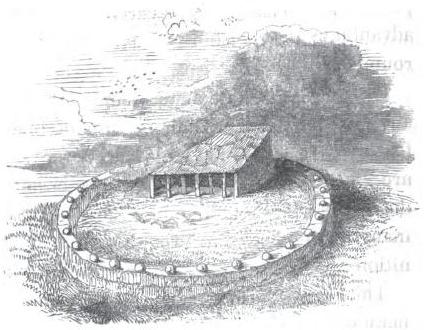
Wars are frequently carried on between the inhabitants of the different valleys, and, although the whole island had enjoyed profound peace for some time previous to our arrival, the people of Vaitahu kept a nightly watch on their hills, to guard against a surprise from the warriors of Abatoni. This latter valley is the most powerful rival to Vaitahu; and Eutiti invariably requests the masters of ships, visiting his port, to supply the residents on that part of the coast with as few and bad muskets as possible. In conducting their warfare, they prefer skirmish, ambush, and surprise. Pitched battles are generally fought on the hills intervening between the valleys. The tribes are summoned to arms by the sound of a conch-shell, smaller |
than that used at funerals, and giving a shriller clangour. The natives of Tahuata admit that their forefathers were accustomed to devour their prisoners of war, but stoutly deny that the same cannibal propensity exists among themselves. Fire-arms, bayonets fixed on poles, whaling-spades, and cutlasses, have, in a great measure, superseded the use of their primitive weapons, as spears, clubs, and slings; and if the opinion be tenable, that wars become less frequent in proportion to the deadly nature of the weapons employed in them, (and which certainly appears to be the case amongst the semi-civilized and well-armed nations of Polynesia,) it is to be hoped that the number of sanguinary feuds will be diminished by the exchange. Should Eutiti retain his present superiority over the other chiefs, and continue to be advised by our missionaries, war may be long avoided through his influence. Singing and dancing are the only recreations in which these islanders indulge. The only musical instrument we observed amongst them was the drum, a hollow wooden cylinder, covered at each end with shark's skin, and provided with braces of cocoa-nut cinnet, which are tightened or relaxed by shifting rolls of cloth placed beneath |
them. The drums used on ceremonial occasions are of vast size, and produce a very loud tone; others are smaller – do not exceed four feet in length, and are chiefly employed as an accompaniment to the voice. In each valley there is a space of ground surrounded by a circle of loose stones, and set apart for musical exercises. Here a party of natives often assemble, and sing to the sound of the drums, placed on the ground, and beaten upon with the hands. Their mode of singing is peculiar. Seated on the ground in a circle, or in rows facing each other, they perform in unison a slow mournful chant, accompanied at intervals by a simultaneous clapping of the hands. Some of their songs are varied, by a certain number of the performers producing a clacking sound with the tongue, or a report caused by forcibly striking one arm with the opposite hand; by a rapid motion of the fingers, the arms being stretched forwards; or by the introduction of a ludicrous falsetto voice. A group of singers, seated on the ground, would occasionally be attended by a row of other performers, who remained standing, and merely clapped their hands in the manner of a chorus. Some etiquette appeared to obtain with respect to the rank of those natives who sang together; |
and it is not customary for men and women to combine their voices. One of our missionary friends, who was present with us at a concert of this description, took the opportunity to represent to the performers, how much better their time might be employed than in thus producing wild harmony. The music ceased when he addressed them; and, for some minutes, its place was supplied by a shrewd discourse from the leaders of the band, to the effect that their work was done, and that they considered their present recreation to be as rational and innocent as the enjoyment of a violin, which was occasionally played by the reverend gentleman. The Marquesan language affords a link between the Tahitian and Hawaiian dialects, and has also some striking peculiarities. It differs from the Tahitian, in being deficient in the letter r, and in the letter k being prominently employed; and from the Hawaiian, in possessing the letter f, as well as in the deficiency of the r. In common with both the above dialects, however, it has no sibilants; and is also destitute of the letter g, and most other harsh consonants. The strict sound of the letter r, as in the English words rove or around, is never heard in the Marquesan tongue; but only that |
which it bears in the words car or afar; and this arises from the letter a having the broad and French sound usually assigned to it in all the Polynesian dialects. The Tahitian words taro, the cocos-root; repo, dirt; raau, wood are pronounced by this people as ta'o, 'epo, and kaau. Although the majority of words in the Marquesan vocabulary accord well with those in use amongst the Society and Sandwich Islanders, some few are totally dissimilar, as will be seen in the following examples
* The ancient term. |
Although Santa Christina has no commerce, it is capable of producing many of the more valuable exports of tropical countries. The wild cotton, growing in great abundance on the stony hills, is superior to the cultivated cotton of many islands: the wool gushing from the pods to the length of six or eight inches, by three or four in breadth. The sugar-cane, cultivated by the natives, is also abundant, large in growth, and of excellent quality. Much cocoa-nut oil and arrow-root might be produced from the materials the soil affords; but the Marquesans are not acquainted with the mode of preparing either of these commodities. Their principal manufactures are mats and bark-cloth. The former are neither large or neat, and the latter is very inferior to the cloth of the Society and Sandwich Islands, and seldom possesses other hues than white or yellow. The extreme care they take of their cloth – the high price they place upon it in barter – and the circumstance of their importing much of it from La Dominica – would imply that this commodity is scarce amongst them. It is true that the paper-mulberry shrub (from which their cloth is prepared) is rare on this island; but since the bark of the bread-fruit tree can be |
obtained in any quantity, I suspect that the principal cause of the dearth of tapa is indolence, as we never saw the natives occupied in making it. They receive the mats of the Sandwich Islands, and the cloth of Tahiti, as very valuable presents. Their fishing-nets and lines, as well as scoop-nets, (used for taking the smaller fry,) are made with a strong and neat twine, prepared from the bark of the hibiscus tree, or fau. At the time of our visit the people of Vaitahu were occupied in making a public fishing-net, of large dimensions. Men only were engaged in the task; and they worked in an open shed, surrounded by a low stone wall, on the summit of which were placed the globular stones, whitened with coral lime, and rods, bearing strips of white tapa, which denoted that the spot was tabooed – and this appeared to be a very excusable superstition, considering the variable fortunes of fishermen. Their canoes are few in number, small, and not at all adapted for naval warfare, or for an aggressive descent upon foreign lands. Some of them have an ornamental appearance, their sides being decorated with stained bark and feathers; while others, of a larger class, display at their prow an erect wooden frame, to which are fixed idol-images and streamers of cloth. |
But few ports in the Pacific offer greater facilities for the refreshment of ships than Resolution Bay. Supplies of hogs, poultry, and vegetables, are abundant, of excellent quality, and may be obtained on very easy terms. Wood and water are equally available; and, as long as the present good understanding exists between the natives and Europeans, the latter may ramble over the island without apprehension. In exchange for their commodities, the people alone require and value muskets and ammunition, hardware, tobacco, and Sperm Whales' teeth; though the value of the last-named article of traffic has been much diminished by the increased number of South-Seamen visiting this island. At the ordinary rate of barter, seven fine hogs may be obtained for a musket; (valued at about fifteen shillings in England;) a few small bags of gunpowder purchase a ship's supply of fire-wood, cut by the natives, or a stock of sweet-potatoes; two gun-flints, or a piece of tobacco, is the price of a large fowl; and fruits are equally cheap. No port-charges are made; but, by a late regulation, the chief of Vaitahu receives a musket from every ship that takes water from his territory. The treacherous disposition of these, in common with all other Marquesan Islanders, makes |
it imperative upon every commander visiting their ports, to have his ship well armed, to keep a good night-watch, to clear his vessel of natives at sun-set, and, above all, to maintain fair dealing in his commercial transactions with the people. A reflecting crew is also essential to the success of his precautions; for it has occurred, that while the commander has felt secure in his preparations, his every cannon has been secretly unloaded by the sailors, and their charges expended in traffic with the natives: the first intimation the captain received of the fact, being through the satirical remarks of the Marquesans themselves. The more barbarous islanders of this group will often trepan the master or officers of a ship, and keep them captive in their mountain fastnesses until a sufficient ransom is offered. This insidious outrage is much dreaded by navigators, and makes them cautious in their social intercourse with all the islands. The natives will sometimes capture small vessels, at anchor off their shores, by approaching them in the dead of the night and making a large quantity of cordage fast to their hawser, when, the latter being cut, the islanders by their united force draw the vessel upon the beach and wreck her. A similar stratagem is also practised, |
when a boat is lying off the beach, in deep water, to trade with the natives: the latter, always expert in the water, will dive off, secretly fasten a rope to some part of the boat, and draw it suddenly on shore; when the crew, surprised and placed in a defenceless position, fall an easy sacrifice. A few years ago, two boats from the English South-Seaman Coquette, sent ashore to procure supplies from La Dominica, were seized by the natives of that island, and their crews (with the exception of two individuals) massacred. A British ship-of-war was sent to revenge this outrage, but, upon her arrival at La Dominica, found no fields to fight or forts to storm: the natives had retired to the interior; and after much expenditure of ammunition,the return of killed and wounded amounted to little more than a few cocoa-nut trees and some native huts; while upon the subsequent visits of South-Seamen, the islanders came off in their canoes to offer for barter the iron shot the cannon of the Dauntless had deposited on their soil; shrewdly judging, that they would prove of more value to their foreign visiters than to themselves. It cannot be denied, that the conduct of some few reckless or unprincipled masters of ships has often permitted the Marquesans to extenuate their treachery under the name of retaliation; |
and this is the more to be regretted, as the innocent often suffer for the guilty – the untutored savage regarding all white men as inhabitants of the same island, united in a common interest, and consequently responsible for each others actions. The only white residents at Santa Christina (excepting the missionaries) were three English and American sailors, who lived contentedly amongst the natives, and cultivated some land. One of them had so far adapted himself to the customs of his adopted country as to have his face profusely tatooed in the native manner. In the valley of Abatoni we saw a little girl, who was a half-caste between the British and Marquesan nations; her complexion was fair, and her features peculiarly delicate and interesting. The natural productions of Tahuata are much the same as those of the Society Islands. The hogs still exhibit, in great purity, the gaunt form, acute snout, arched back, high tail, pricked ears, and small deer-like feet, of the aboriginal Polynesian breed. Their prevailing colour is black, or greyish-black; their bristles are long and shaggy, and the skin beneath has a thick covering of short crisped hair, closely resembling wool. The old boars have tusks of vast size, (which they use to rend asunder the cocoa-nuts,) and a skin of extraordinary thickness. Some of |
these hogs are partially domesticated; while others run wild on the hills, and can only be captured by hard hunting, or by setting fire to the thickets in which they lurk. Goats and cats, the latter called potu by the natives, are the only exotic quadrupeds. Domestic fowls are numerous and excellent. They are seldom eaten by the natives, although no superstition prohibits the using them as food. The greater number live in a free state, amongst the groves; but some few are kept in cages, and much petted by their owners. Amongst the amphibious birds of the coast, we noticed a species of booby, of an uniform white colour. We left on the island a pair of Moscovy ducks, from the Sandwich group, and it is to be hoped they will prove the origin of a numerous race of this useful and prolific bird. The only fish on the coast which we had not noticed at the Society and Sandwich Islands, was a species of Caesio, in size and form resembling a herring, and delicately coloured pink and blue, with a yellow lateral line. They are taken in great numbers, and eaten by the natives. The insects we found here were the spectre-mantis; (Phasma;) a purple butterfly, common also to the Society Islands; a gigantic centipede; cockroaches; domestic flies, tikaue of the natives; ants; and a few mosquitos, nono. |
The cockroaches, kokaha, which infest the native huts, are of a kind that I have seen in no other country. They are small, of a dark-chesnut colour, and have wing-cases as perfect and dense in structure as those of coleopterous insects; their odour is powerful, but less fetid than that of the more common species of Blatta. The vegetation of Tahuata includes all the edible kinds indigenous to the Society Islands, with the single exception of the vi. (Spondias dulcis.) The Tahitian name of this fruit-tree, however, is applied by these islanders to the exotic Papaw. Fruit-trees, as the cocoa-nut, bread-fruit, Eugenia, and South-Sea chesnut, cover such extensive tracts of land, as rather to merit the title of forests than that of groves. Certainly, in no part of the world can a spot be found, of similar extent to one of the valleys of this island, capable of producing, spontaneously, a more abundant supply of human food of the most wholesome and agreeable description-a state of fertility which is not peculiar to any one, but common to all the valleys.* Sugar-cane, * A laudable custom obtains with this people of planting fruit-trees (and more especially the bread-fruit) upon the birth of children, to ensure their future subsistence: hence it is probable, that the garden-like aspect of each valley is not a greater proof of the fertility of the soil than of the prudent policy of the inhabitants. |
kava, paper-mulberry tree, and turmeric, are confined to plantations. The turmeric, hena, in particular, being considered too valuable from its use in the toilette, to remain a wildling, as at other of the Polynesian isles. The mountain- and marsh-taro grow wild and neglected; the only root the natives cultivate for food being the sweet-potatoe. The exotic esculents are oranges; (which are as yet scarce;) papaws; pumpkins, superior in size and flavour to any we elsewhere obtained; and capsicums, called by the natives neva. The castor-oil plant (Ricinus) grows vigorously on all parts of the island, and its exotic origin is questionable. We introduced to the garden of the missionaries, the water-melon of the Sandwich Islands. The sheltered hills are densely clothed with verdure, including the gloomy foliage of the Casuarina tree, and the elegant form of the mountain-plantain. The more arid and exposed highlands are covered with a low and sturdy tree-fern, (Gleichenia polypodioides) or with thickets of tall reeds; (Saccharum spontaneum;) whilst occasional topes of the Fan-palm, vahana, (which occurs at this island, although a stranger to the Society and Sandwich groups,) are conspicuous above all other vegetation for the beautiful and truly oriental character of their foliage. |
CHAPTER XI.
Leaving Santa Christina on the 4th of March, we stood to the N. W.; and on the following day hove to off Port Jarvis, on the western side of the island of Roapoa. This latter is one of the Marquesas, and situated in lat. 9° 30' S., |
long. 140° W. It is about the same size as Tahuata, and equally elevated, rocky, and bold. The land extends in a direction nearly north and south; the summits of many of its mountains presenting conspicuous columns, spires, or pinnacles of rock. Its S.E. extremity is remarkable for a table-mountain, topped on each side by a lofty spire; on its south side there are three islets of volcanic rock, which have been named, from their respective forms, "Church-island," "Gunner's-quoin," and "Sugar-loaf." The western side of the land abounds in populous villages, and affords several convenient anchorages, which have been visited by a few South-Seamen, though the island is generally but little known or frequented. One of the two most convenient anchorages is situated off a village on the S.W. coast; the other is Port Jarvis, above-mentioned, a small bay, affording anchorage in eighteen fathoms, with convenient supplies of wood and water. No island we had yet seen appeared to us so perfectly beautiful as Roapoa, when viewed from the ocean on its western side. Its valleys, opening upon the sea as smiling amphitheatres, covered with a luxuriant vegetation, have a tranquil, picturesque, and very inviting aspect; while the hills in their rear, seen in perspective, are lightly timbered with the Casuarina and other |
trees, well adapted to the character of the soil they occupy. From this coast, the island of Nuuhiva is distinctly visible, thirty miles distant; and the islands La Dominica and Santa Christina, sixty miles distant, may be more faintly discerned. If it appears remarkable, that Mendana, in his discovery of the Marquesas, should have left Captain Cook to discover Hood's Island, which is so close to La Dominica, it is yet more remarkable that Cook should have failed to discover Roapoa, which, on a serene day, may be seen with the naked eye from the beach at Resolution Bay, Santa Christina. Many natives of this island came off to us in their canoes, and expressed much disappointment that we would not anchor and trade with them. They appeared to be a handsome race of people. Several, who came on board, wore no other covering than a girdle of bark-rope, well adapted to withstand the action of seawater. The principal. man amongst them, named Tenua, brought with him a written list of the ships that had visited the island, as well as a chart of the coast; which last, although roughly sketched, was correct, and might be found serviceable in guiding shipping to the anchorages and villages. We could not ascertain who was the author of these manuscripts. We presented our Marquesan passengers with |
some gifts that were valuable in their esteem, and landed them at Port Jarvis. They had met with several friends and relatives amongst the natives who boarded us, but, beyond the ceremony of the honi, or touching noses, no particular marks of recognition passed between them. Wivau was the most noticed by his countrymen, who called upon his name, with joy, as they paddled their canoes towards the vessel. This chief was anxious to delay the ship until he could send us some hogs, as a token of his gratitude; but his offer was declined, and after a few hours' detention we made sail from the island. Light airs and calms kept us in sight of the various islands of this group until the 10th of March, when winds from N.E. and N.W. enabled us to continue our cruise in the direction of the Society Islands. On the 18th of March we again anchored off the settlement of Utumaoro, island of Raiatea. Upon communicating with the land, we heard, with regret, that our late fellow-voyager, Mr. Loxton, whom we had left here usefully employed as a missionary, had perished from an attack of dysentery, four months after our last departure from the island. His widow, with a posthumous infant, had sailed for England, and |
Raiatea was again destitute of any European pastor. We were painfully impressed with the unfavourable change that had taken place in the state of this settlement since our visit of the preceding year – an air of gloom pervaded the spot – the few natives who visited the ship betrayed in their haggard countenances and slovenly dress the worst effects of debauchery – the cultivation of their lands had been neglected; and the scanty supplies they offered for sale bore exorbitant prices. The settlement itself bore the aspect of a deserted village: its finest huts were in ruins, and many of them deserted by their owners. The chief, Tamatoa, was literally keeping "open house" – the wattle and plaster walls of his dwelling affording many more apertures for entrance than the architect had designed. The former inhabitants of the settlement, no longer induced by the presence of a missionary to congregate in one spot, had for the most part dispersed over the island, for the convenience of residing on their own estates; leaving in Utumaoro none but the dissolute, the diseased, or those who were retained there by public duties, or by their engagements with foreign shipping. The remote occasion of this lamentable |
change was the want of a missionary to advise and control the people; but the immediate cause was the extent to which the abuse of ardent spirits prevailed amongst the natives at this time. Many American whalers had recently visited the island, and given the natives rum, in exchange for their supplies; and during our stay, a French schooner lay at anchor off the settlement, freighted with spirit, to barter with the islanders for cocoa-nut oil. Of the conduct of royalty, under these unpleasant circumstances, I feel reluctant to speak; but candour compels me to say, that for more than the first fortnight of our stay at this port it was rarely that either Tamatoa or his consort were in a state of perfect sobriety. The health of the royal chief had suffered materially from his intemperate mode of life, and he applied to me for medical aid. I represented to him the inefficiency of medicine to effect his cure, unless he discontinued his present system of dissipation, when, partly influenced by my advice, but more by the opportune expenditure of a keg of spirit, which he had obtained from a "temperate" ship, he immediately adopted a rigorous abstinence, of which his former habits would have declared him incapable, and in a short time was perfectly recovered. |
The natives often spoke to us of some natural curiosities which were to be seen in the interior of this island: one, they told us, was a deep pit, at the summit of a high mountain; the other a precipice, near the same spot, and where, if a cloth or other light substance was thrown over the brink, it would be returned by the upward pressure of the air; but their description of these two phenomena was so vague, as to lead Europeans, who trusted only to their accounts, to believe that the two were identical; and that it was the pit which emitted the violent wind.* On the 20th of March I set out, in company with two native guides, to explore this region of wonders. After emerging from the entangled forests of the lowlands we ascended a succession of steep hills, which conducted to a lofty range of mountain, occupying the centre of the island and extending in a direction nearly north and south. In an early part of this ascent, we * This erroneous view of the subject has been adopted by Mr. Williams, in his "Missionary Enterprises in the South Seas," and reasoned upon accordingly. It is to he regretted that this gentleman (who was for many years a resident at Raiatea) did not ascend the mountain and investigate its phenomena for himself. His knowledge of the natives' character should, at least, have led him to receive all their statements cum grano salis. |
passed the pari, or precipice, so much lauded by the natives for the beauty of its scenery; its back, or eastern aspect, is a steep and verdant hill; its verge a ridge of rock, rising a few feet above the brow of the hill; while its face is a precipice several hundred feet in depth, its slope and ledges covered with underwood and trees. It commands a very extensive and romantic view of the neighbouring lands and ocean, but is, on the whole, very inferior in scenic attractions to the pari of Anuanu, at the island of Oahu. On a more elevated spot, named Buero, I was shown a capacious cavern, to which the natives attached the legend, that it was at one time occupied by a kind of ogre, who was accustomed to issue forth and kill and devour the people who passed near the haunted spot. Here, as also at the pari, the rocks were covered with the names and initials of natives, who had thus recorded their visit to the respective places. As we continued to ascend in a southerly direction, the scenery commanded from our elevated position became truly magnificent. Vegetation, though abundant, differed essentially in its character from that of the lower lands: tree-ferns were particularly numerous; and in the ravines, groves of the mountain-plantain flourished vigorously. The tempera- |
ture of the atmosphere was also materially changed – the warm and balmy breeze of the lowlands being exchanged for cold and eddying gusts of wind. After a journey of six hours, we attained the summit of the loftiest mountain in the centre of this island. Its elevation is about 2000 feet above the level of the sea; its summit is a capacious level plain, mantled with clouds, of bleak and dreary appearance, spread with numerous swamps, and streams of water passing over a red rock, and destitute of all vegetation, excepting a short grass and moss. On the western declivity of this mountain, a short distance below its summit, and on a spot named Tamahari, I was shown the natural excavation in the soil of which we had before heard. It is called by the natives Apoiuta; is of circular form; and resembles a large well, artificially sunk in the rock. Its depth is about forty feet, its circumference thirty-five; and the bottom is formed by a vast accumulation of loose stones. A solitary Pandanus-tree, growing in a rocky ledge within its orifice, is called by the natives tuheine fara, or sister Pandanus, from the circumstance of a second, or brother shrub, having formerly grown in its society. Two furrows of naked red rock extend from the entrance of the pit for some |
yards down the mountain's slope. They run parallel to each other, at a short distance apart, like the ruts of a waggon, and each has on its surface eminences and depressions, which, to an active imagination, might appear as the impress of footsteps. To these my guides attached the legend, that two men, fishing in the pit, had each caught a large fish; when, walking up to its orifice, in pulling in their lines, they secured the latter to the twin Pandanus shrubs above mentioned, one of which corresponded to the commencement of each rocky furrow. The general appearance of this pit led me to believe that it was a small volcanic crater, or chimney, very few of which are known to exist in the Society Isles. My guides informed me that a second and similar excavation is to be seen on the same mountain, but we had not time to visit it. From the excavation at Tamahari, a short and abrupt descent brought us to the verge of a perpendicular precipice, whence a lofty cascade of great beauty emptied itself into a ravine below. This spot is named Wainia. The description the natives had given us of an upward current of air, and which we had associated with the pit, applied only to this place. The face of the precipice bore an eastern aspect, and the |
strong trade-winds, rushing through the narrow ravine, acquired sufficient power to cast back a portion of the cascade in the form of a shower, as well as to return any light garment thrown over the steep. It is remarkable, that in the streams flowing over this elevated mountain and supplying the cascade, we found eels, and several other varieties of fish. A great extent of the soil around Wainia is covered with low bushes of Lobelia arborea, bearing large white flowers. The latter are much valued as ear-ornaments by the native females, who call them the mountain tiiri, in contradistinction to the common tiiri, or Cape Jassamine, of the lowlands. On the 2nd of April I visited Tahaa. This island lies due north of Raiatea, from which it is separated by a navigable channel, not exceeding two miles in breadth. The coral barrier-reef, common to both islands, is somewhat indented at the point where the latter approach each other; and that portion of it which surrounds Tahaa permits free navigation for ships round the tranquil water it encloses. There are two good harbours: the one on the south-east and the other on the west side of the island; but neither of them are frequented by foreign shipping. Tahaa is mountainous, though smaller and less |
elevated than Raiatea. Many small coral islets, covered with cocoa-nut palms, spangle the sea off its north coast, and present a very picturesque appearance. The principal settlement is on the S.E. side of the island. It possesses a missionary residence and a church. The latter, which is built in a very primitive style, is based upon a square platform of coral blocks, erected in the midst of the shallow water of the shore-reef, and communicates with the village by two causeways, also constructed-of coral stone. The inhabitants are not numerous, and chiefly consist of Raiateans and Borabora people. No missionary has resided amongst them since the departure of Mr. Smith, who was landed here from the Tuscan, about the year 1830, and who resigned his office after the lapse of a few months. At the distance of about a hundred yards from the shore, off the southern extremity of this settlement, there is an islet of black rock, which affords a remarkable example of a volcanic structure raised in the midst of an extensive coral reef. A similar, but much loftier volcanic rock, which must also rise from a coral bed, occupies nearly the centre of the strait between this island and Raiatea, and, at a distance, bears so close a resemblance to a ship under sail that |
a very near approach is required to destroy the illusion. The mountains in the interior of this island possess, also, some rocks of strange form to one of these the natives assign the name and semblance of a red dog; a second they call a fish-hook, and tell us, in their legends, that it was employed in fishing by their heathen god Hiro – a long spit of coral reef, projecting from the coast into the sea, having served as his fishing-line. We left Raiatea at noon on the 14th of April, and at sunset on the same day hove to off the island of Maurua, or Maupiti. On the following morning two boats were sent ashore to trade with the natives for a supply of yams. On approaching the land, we found that the barrier-reef, which encircles it, afforded but one narrow entrance; and even this was occupied by powerful and rapid rollers, which were anything but inviting. A canoe, fishing in the offing, enabled us to obtain a pilot; when, taking advantage of a tranquil interval, we pushed through the swell, and passed, by an abrupt transition, into the vast expanse of lagoon water that intervenes between the reef and the main land. It is impossible to imagine a scene more perfectly beautiful than the one presented to our view as we glided through this placid sea, and |
towards the land, which rose towering, rocky, and isolated, at the distance of about three miles ahead of us. On every side, a broad sheet of sleeping water, mapped out in various hues, corresponding with its depth, contrasted strongly with the turbulence of the ocean outside the reef; while the bosom of the lagoon was strewn with many coral islets, level, circular, and often of great extent; their shores girded by a sandy beach of dazzling whiteness; and their soil covered with cocoa-nut palms, Pandanus and Casuarina trees, as well as with a short and verdant pasturage, unencumbered by any other underwood than a few bushes of Cape Jassamine. Here and there a solitary hut appeared amidst the foliage of these motus; and some small goats (probably left here by a ship,) ceased to browse on our approach, and followed the boats along the beach, bleating forth a plaintive recognition. The serenity of the morning, and the sweet odour of Pandanus flowers, combined to increase the attractions of this enchanting spot, and to convey to us an impression on which memory yet dwells with extreme pleasure. Upon landing at the principal village on the coast, we were received by a crowd of natives, and conducted to the royal chief of the island, |
to whom we explained the object of our visit. The people soon after brought the produce of their lands to a large shed, set apart for transacting public business; and although traffic was at first impeded by the exorbitant price they set upon their commodities, this difficulty was soon removed, and we obtained the supplies we required on very reasonable terms. Maurua is situated about forty miles to the N.W. of Raiatea, and is distinctly visible with the naked eye from the coast hills of the latter island. It is small, comparatively elevated, and about six miles in circumference. It is completely surrounded by a barrier-reef of coral, at the distance of three miles from the shore, but the corresponding lagoon-sea is too shallow to admit vessels of a greater burden than one hundred and fifty tons. The interior of the land is almost entirely composed of hills, wooded to their summits, and occasionally crested with cocoa-nut trees; while the sea-coast presents numerous rugged and mural cliffs. One cliff, on the S.W. side, opposite to the opening in the reef, rises to the height of several hundred feet, resembles the ruins of a gigantic castle, and divides the island into two nearly equal portions. The bird's eye view commanded from the hills |
is exceedingly pleasing: in addition to much romantic mountain scenery, it includes the blue ocean in the distance, the barrier-reef marked as a ring of lofty. surf, and the verdant islets and tranquil surface of the basin around the coast – the shallower waters being white with coral sand on which they rest; while the deeper are mapped out in the form of channels or bays, of a green colour, with many black and rugged coral rocks rising above their surface in strong relief. The population of Maurua is small, and would be overrated at 1000 persons – the result of a census made by the missionaries in 1828. The dwellings of the natives are, for the most part, cleaner and better constructed than those at either Tahiti or Raiatea. Some of them are erected upon a stone platform, about two feet high, after the manner of the Marquesan huts; others are partitioned into apartments; and a few are surrounded by cultivated lands, neatly enclosed. Tairo, (who bears also the baptismal name of Noah,) the principal chief of the island, is a tall and robust young man, with agreeable features. He visited the Tuscan in his canoe, and passed one night on board. We were much impressed in his favour – his manner was bland, sedate, |
and courteous; he seemed to possess great influence with his people; and his conduct towards us was highly hospitable. He has one child by a former wife, but no family by his present consort, Taiuri Pea-pea, a Tahitian female. The spiritual charge of these islanders is entrusted to the English missionary at Borabora, who pays them occasional visits to superintend their religious affairs, while an ora medua, or native teacher, officiates as his deputy at the Christian church of the settlement. The abuse of ardent spirits is here rigorously interdicted; but the primitive dances to the music of the hoe, or reeds, were much practised during our stay, and were probably got up for our amusement. The females were bold in their amours; and the people generally were more prone to petty larceny than was altogether creditable to their morals. It was unfortunate that, notwithstanding the confidence I always placed in Polynesian natives, it was only amongst these people that I ever experienced a loss by theft. The political interests of Maurua would appear to be blended with those of Borabora; the latter island having received assistance from the former during its late conflict with Raiatea. It was with surprise that we found amongst the na- |
tives of this secluded, and apparently peaceful island, a considerable demand for muskets and ammunition. The comparatively low elevation and small size of Maurua deprive it of those mountain streams which are so numerous in most other islands of the Society group. A few rocky excavations filled with rain-water obtain in the highlands, and on the coast there are some pools supplied by springs; yet, on the whole, fresh water is even less abundant here than at Pitcairn's Island. The natural productions are nearly the same as at other of the Society Isles. Amongst the littoral vegetation, the Barringtonia and Tunina (Ricinus mappa) trees are peculiarly prominent. The guava-shrub has been introduced, and the dryness of the soil does not permit its too rapid increase. The mountain-plantain is rare, and confined to a few plants which have been imported from other islands. We noticed a small quantity of the ape, or mountain-taro, under cultivation; but, owing to the absence of swampy lands, the aquatic species is not found here. The same dry and hilly soil, however, that opposes the cultivation of the taro, and limits the supply of bread-fruit, encourages the natives to cultivate yams and pumpkins; and |
thus confers an inestimable boon upon ships navigating these seas. The motus, or coral islets, afford a greater extent of level soil than is to be found on the main-land, and from the cocoa-nuts and Tacca plants they produce, the islanders prepare vast quantities of oil and arrow-root, which are taken away by small vessels, calling here for that purpose.* It is said that primitive rocks obtain at Maurua; but we did not observe any, and such is not, certainly, the prevailing geological character of the country; like other of the Society Isles, it is composed of volcanic rock; and lavas, tufa, and slag, are plentifully strewn over its surface. A basaltic stone, found chiefly in the elevated lands, is much prized by the natives of all the Society Islands for the manufacture of the penus, or pestles, with which they prepare their food; its principal recommendations for this use being compactness and weight, a jetty blackness, and a capacity for taking a lively polish. Two days were spent in obtaining our supplies; and on the evening of the 16th of April we sailed from this island in company with two canoes, which had taken advantage of a westerly * Until the arrival of the Tuscan, no large vessel had visited this island for more than two years. |
wind to proceed to Raiatea and Borabora. When at the distance of thirty miles N.E. of Maurua, we passed close to Tubai, or Motu-iti, a small, rocky, and uninhabited island, remarkable for little more than its being the northernmost land of the Society group, and as having been formerly a kind of preserve, whence the royal chiefs of Tahiti obtained their supplies of the tail feathers of the tropic-bird. When winds permitted, we shaped a course to the northward, upon the parallel of about 150° W. long. At night, on the 22nd of April, many shoal-birds came about the ship, greeting us with their hoarse cries, so prophetic of the vicinity of land; and at daybreak, on the following morning, Caroline Island* was seen from the mast-head, bearing N.W., distant 10 miles. It had the appearance of a very low strip of land, extending north and south, covered with verdure, and encircled by a beach of white sand. We lowered two boats and effected a landing * A low and uninhabited coral formation, discovered by Lieut. Broughton, and named by him in honour, of the eldest daughter of the then first lord of the Admiralty. He gives its position 9° 57' S. lat., 150° 25' W. long., and which appeared to us to be correct. It lies due north of the island of Eimeo, Society group, from which it is distant about three days' sail. |
upon its western side. The entire island does not exceed five miles in circumference, and is composed of several small circular peninsulas, arranged in a crescentic, and nearly circular form, and each connected to the other by a low isthmus of sand, shingle, or dry reef, which, judging from its appearance, might at one time have given passage to the sea. A capacious lagoon, belted by a sandy beach, occupies the centre of the land, and is protected on its eastern or weather side by a barrier coral reef, against. which a heavy surf breaks constantly. 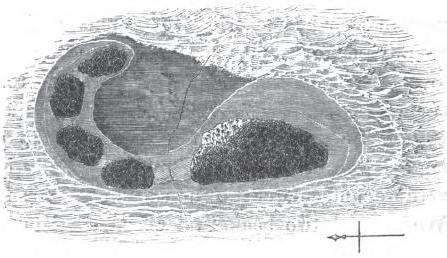
The peninsula that forms the southern extremity of the land is much larger than any of the others; and it was on the broad and sandy isthmus which connects this to the adjoining peninsula that we landed. The boat was borne by her crew across this sandy tract, and launched |
upon the lagoon, for the purpose of ascertaining if there was any navigable communication between its waters and the ocean. No trace of such a convenience was visible, however, excepting at the barrier-reef, where we discovered an aperture which was sufficiently broad to permit the boat to pass into the open sea and to return without difficulty, although a surf of extreme grandeur and impetuosity broke on the rocks within two oars' length on either side. The lagoon-sea is for the most part very shallow, though there are some narrow channels in which it is several fathoms deep. It sleeps in the embrace of the land, unruffled by the slightest wave, and is nearly surrounded by vegetation. Its shallower waters contained myriads of small fish; and in its greater depths, many species of large size, gaudy colours, and often of very strange forms, could be seen moving slowly through dense groves of tree-coral. On its shoal reefs, beche-de-mer, star-fish, sepiae, and many varieties of shell-fish, were scattered in great profusion. But few objects in nature present a more interesting and animated picture than a coral reef in tranquil water, and no reefs we had seen could compete with those of Caroline Island for novelty and beauty. The structure of this island offers no mate- |
rial but coral, in all its various forms. Its elevation no where exceeds five feet; while its shelving shores, and coral rocks, arranged as terraces each above the other, denote the gradual recession of the ocean from the land it had so materially assisted to raise. The interior of the island is a surface of sand, mingled with coral debris, as well as with decayed vegetable and animal matters, which give it an increasing fertility. Each peninsula is covered with vegetation of a highly verdant and pleasing character, some of the loftier trees attaining the height of twenty feet. No collection of fresh water is to be found here; though, doubtless, as in many other of the low coral islands, much of good quality may be procured by excavating the sands. The coast is continuous with an extensive reef of compact coral rock, stretching into the sea to a considerable distance, and thus increasing greatly the actual compass of the island, while it protects the central lands from inundation. At low water a large extent of this reef is left dry; but when the tide is at its height, a boat may, with care, be floated to the verge of the wooded land. From the single observation made during our stay, it would appear to be low water on this coast at 9 A.M., and high water at 2 1/2 or 3 P.M. |
This island is very seldom visited, although it is usually "sighted" by South-Seamen, when on their way from the Society Islands to the North Pacific. About seven years previous to our visit, Captain Stavers had landed on its shores and left some hogs, but no traces of the present existence of those animals were visible to us. That some ship had lately touched here was evident, however, from several of the cocoa-nut trees having been recently cut down to obtain their fruit – a practice often dangerous when these trees afford important land-marks to navigators, and one at all times selfish and mischievous, and more particularly so here, where cocoa-nut palms although increasing in number are as yet but few. The only quadrupeds we saw here were rats of a red-brown colour. Amphibious birds were exceedingly numerous. Myriads of frigate-birds, engaged in fishing at a short distance from the coast, followed our boat, and hovered as a dark cloud over the island. Their curiosity (and no creatures could better express that feeling by their actions) induced them to approach us very closely, wheeling round our heads with enquiring attitudes which plainly demanded who we were? and what was our business on their domain? One of them, knocked down by a boat- |
hook, after struggling a few minutes in the sea again rose and renewed its fligbt, notwithstanding the prevalent opinion amongst nautical men, that these birds are equally incapable of rising from the surface of the water as from level land. Small white terns (Sterna nivea) were also as numerous and familiar as the former birds, and flew so close to us that we captured them with ease. Their appearance is delicate and beautiful. They are rather larger than a snipe; their plumage snow-white; their eyes dark and full; their beak and legs of a light-blue colour; their cry is shrill, short, and frequently repeated.* The greater number of trees on the island were occupied by boobies, engaged in building * In appearance and habits, this snowy-tern corresponds in a remarkable manner with the bird pictured by Byron in his sublime description of the shipwreck, in Don Juan, – a scene which, as is well known, is more indebted to facts than poetic imagery for its concentrated horrors. I refer to the 94th stanza, when the forlorn boat is approaching land as yet unseen: –
|
their nests or in hatching their eggs. In plumage and paint these birds are peculiar. Their garment is dull-gray, darker on the back and wing-coverts than on the abdomen; the tail and rump are perfectly white. Their beak is blue, and encircled at its base with a rose-coloured paint; the naked skin of the cheeks is also blue, while that below the lower mandible is black; the legs are brick-red. We obtained examples of both sexes, but could observe no appreciable difference in their appearance. Their nest consisted of a circular layer of dried herbage. Some trees had six or eight nests on their branches; but to build in republics is not the invariable practice of this bird, since a few trees had each only a solitary nest. Most of the nests contained a single egg, of a greenish-white colour, and about a third smaller than that of the domestic hen. We found no newly-hatched birds, although all the eggs we examined were far advanced in incubation. The boobies employed in building their nests were much more shy than I had anticipated, flying away on the slightest alarm; but those that were "setting hard," as the schoolboys say, erected their crest, screamed and threatened on our approach, and remained firmly on their nests until removed by force, when they went off to sea much dis- |
contented. The other birds of the coast were a kind resembling a coot, curlews, and a species of Totanus, similar to that we found at Raiatea, with the exception that its legs are lemon-colour, while in the Raiatean species they are blue. They frequent the reefs and feed upon small crabs. The inland thickets contained a great number of small pigeons, with white head and neck, and the rest of their plumage of a rich brown colour. Fish are abundant around the coast, and also in the lagoon. One example, (a species of Sparus,) taken in the lagoon, weighed upwards of seventy pounds. Sharks were exceedingly numerous, and differed in appearance from any we had elsewhere observed: they are of a light-gray colour, each of the fins being tipped with black, and the black apex of the dorsal fin having a broad white band at its inferior border. They proved very annoying to our boats' crew, for, not contented with gorging the hook baited for other and more savoury prey, they eagerly grasped the fish that were hooked, and devoured them before the fisherman could secure his prize. Eels without pectoral fins, (Gymnothorax,) of immense size, and speckled black and white, basked in the pools of the reefs; and when disturbed, displayed so much fierceness as rather to resemble serpents than fish. |
We observed no lizards or other land amphibia; nor any insects, beyond two species of butterfly; the one of small size and white, the other resembling the purple papilio of Tahiti. The entire island was covered with hermit-crabs, or "land-lobsters," (Coenobita Sp.,) occupying the shells of Turbo argynostoma. They bore a general resemblance to the largest species of Pagurus we found in the reef waters of the Society Isles, but differed essentially from it in generic character, as well as in possessing terrestrial habits. The anterior and crustaceous portion of the animal (or that usually protruded from its tenement) is bright red, while the posterior and covered part of the body is flaccid, and of a yellow colour. The left forceps claw is larger than the right, though both are shorter than the first pair of legs; the eyes (ophthalmic peduncles) are long, and admirably adapted to afford a wide range of vision when the Coenobita is closely retracted within the shell it inhabits. Their odour is peculiar and disagreeable. They were for the most part assembled in dense crowds,beneath bushes, or in shallow excavations at the roots of trees; though some of them, notwithstanding the cumbrous shells they carried, were clustered on the branches or in the crevices of trees. It was evident that, with |
the assistance of their forceps claws, they could climb a perpendicular height with great facility. It is a curious fact, that the most unique and elegant univalve sea-shell in my collection was gathered from the branch of a tree, whither it had been conveyed by one of these creatures. When alarmed they retreated, bearing their shells with them; but if touched, they shrunk into the cavity of their dwelling and remained motionless. They sometimes, though very rarely, used their forceps in self-defence. When irritated they produce a shrill croak, alternating with a rapid succession of sipping sounds. We preserved several of them alive for many weeks. They ate both animal and vegetable substances, as fish, land-crabs, yams, and cocoa-nut. It was amusing to see them feed, nipping off, with much nicety, a portion of the food with their forceps, and carrying it to their mouth, where it was received by the two small appendages in front of that organ. Night was their most busy time. When removed from their borrowed tenements they easily regained them, and resumed their former position; while the vast number of empty shells strewn over the land, indicated how frequently they changed their habitation during their progress to a mature growth. |
Amongst the many interesting shells strewn over the reefs and beach, we noticed the wingshell, (Pinna,) and a few imperfect specimens of that rare and valuable species, the orange-cowrie. The deepest parts of the lagoon contained some pearl-shells; and beche-de-mer, of the black variety, was scattered in great profusion upon the reefs. We attempted to capture a large cuttle-fish, which we found imprisoned in a pool of sea water, but the instant it was approached, the animal obscured the water by emitting an inky fluid, and retreated beneath a block of coral, to which it adhered so firmly by the suckers on its arms that all our attempts to dislodge it were vain. The vegetation of this island is surprisingly luxuriant, when compared with the arid soil it covers. It is chiefly of a littoral character, and clothes the peninsulas with verdure, almost to the water's edge. The Society Islanders we had on board recognised, in all its examples, plants familiar to their own shores. Cocoa-nut trees obtain only on the southern side of the land, on the verge of the lagoon: they are of dwarf stature; and although the quantity of fruit they produce is great, the nuts are small, and the fluid they contain has often a brackish taste. On other parts of the island, as yet unoccupied |
by these useful trees, we noticed several ripe cocoa-nuts cast on the beach, and already beginning to germinate; while amidst the original groves, the number of vigorous seedlings fully confirmed Capt. Stavers' statement, that these palms had increased greatly since his last visit to the spot. The woodlands are chiefly composed of two species of Tournefortia. These shrubs were twelve or fourteen feet high, and covered with clusters of white flowers, emitting a fragrance which was perceptible at some distance from the lee side of the island. Pandanus trees also were somewhat numerous. In some of the inhabited low coral formations, the fruit of this tree constitutes almost the only vegetable food of the people. The other plants that came under our observation here, were Morinda citrifolia; Heliotropium curassavicum, bearing white odoriferous flowers, and spread as a dense carpet over a great extent of sandy soil; Boerhavia hirsuta; a species of Urtica, of very ornamental appearance, the deep green of its leaves contrasting pleasingly with the scarlet hue of its stalks and flowers; Portulaca lutea; a Lepidium of luxuriant growth; and a solitary fern, the Polypodium polymatodes. |
We planted on the soil the sweet-potatoe, Polynesian arrow-root, and South-Sea chesnut; though the unfriendly character of the soil, and the number of land-crabs that infest it, gave us but little hope of the experiment succeeding. Having loaded our boats with cocoa-nuts, we proceeded to leave the lagoon by the passage we had discovered in the barrier-reef. Here, however, our reception was very different from that which we had experienced in the morning: heavy squalls had increased the turbulence of the ocean; the tide had passed its flood, and very gigantic billows occupied the reef aperture. It was determined, nevertheless, that we should attempt the passage; and to pass or swim became the only alternative. The boat rode over the first bursts of the swell with surprising ease, but her loaded condition, and a strong current setting from the lagoon, did not permit her to rise sufficiently quick to bow the rapid succession of rollers; heavy seas washed over her and filled her to the thwarts; some of the crew were obliged to leave their oars to bale; others to cast into the sea a part of our cargo of nuts; and while we were in this helpless condition, the sluice of tide, rushing from the lagoon entrance, carried us through the rollers into the open sea, and relieved us from a very critical situation. After |
reflection taught us, that an accident to our boat at this particular time would have been attended with more hazard than a mere wetting the power of the surf, and the impetuous current setting from the reef aperture, would have prevented the strongest swimmer from regaining the land – no aid could be expected from the ship or our consort-boat, both of which were out of sight to leeward of the island and unacquainted with our proceedings – while in perspective, the crowds of hungry sharks we had noticed around the coast might be seen coming in for their share of the adventure. On the whole, therefore, we had reason to be satisfied, and to believe that "all that is, is right." In the evening we reached the ship and, leaving the land, renewed our course to the northward. |
CHAPTER XII.
On the 2nd of May we crossed the Equator in long. 154° W., and again entered the North Pacific Ocean. On the afternoon of the 6th, Christmas Island was in sight, bearing from S. by E. to W.N.W., and distant eight miles. The day being far advanced, we tacked and hove to off the land; many amphibious birds of nocturnal habits (and called by seamen, from their indications and habits, "shoal-birds," and "wide-awakes") surrounding the ship during the entire night, screaming with incessant clamour. |
On the following day we explored the S.W. side of this island in search of a landing place, though unsuccessfully. The boats employed on this service captured plenty of fine fish, however, on the surf-beaten reef that bounds the coast. We again hove to at night; and on the morning of the 8th stood to the northward, rounded the western extremity of the land, (a projecting point, rendered pleasingly conspicuous by a grove of cocoa-nut trees,) and hove to off the N.W. coast, in a deep bay which affords good anchorage in from 18 to 30 fathoms water within a mile of the shore. Here a lagoon-sea, occupying the centre of the island, is bounded on this its western aspect by a long and narrow islet, extending N. and S., and presenting at each extremity a channel, through which boats may pass to the lagoon within. We pulled through the southernmost of these passages, and effecting a landing upon a sandy beach on the S.W. border of the lagoon, filled two boats with cocoa-nuts, from a grove at a short distance from the sea side. Christmas Island was discovered by Captain Cook, on the 24th of December, 1777, when on his way to the N.W. coast of America; and but a short time before his important discovery of the Sandwich group. The ships Resolution and |
Discovery cast anchor off the N.W. side of the land, in the bay above mentioned, and where they remained several days, to enable the voyagers to observe an approaching eclipse of the sun; while the Christmas festival, occurring in the interim, suggested an appropriate name for the spot. The situation of the islet at the entrance of the lagoon is fixed by Cook, in lat. 1° 59' N., long. 202° 30' E. (157° 30'W.), Since its first discovery Christmas Island has seldom been visited, excepting by a few South-Seamen, which touch there to obtain turtle, fish, and cocoa-nuts. This island offers an example of a low coral formation upon a very extensive scale. We sailed round more than two thirds of its coast, and had reason to believe that its circumference is much more than sixty miles, as estimated by Captain Cook – its form, also, instead of being crescentic, (as delineated in a chart in Cook's third voyage,) is triangular, with its base to the N.W. – the longest diameter of the land extending N. and S. The deceitful appearance of the coast, and the extensive projections, or spits, it sends out, destitute of vegetation, and nearly level with the sea, render this land peculiarly dangerous to navigators who may form too low an estimate of the extent of ocean it occupies. |
In structure and elevation it corresponds with Caroline Island. It is not, however, divided into peninsulas, like the latter, and its interior is much less cheerfully vegetated. The lagoon in its centre is of vast size, and approaches to a circular form. Its waters (which are for the most part shallow) were much ruffled by the wind, and broke as a low surf on the surrounding shore. No fresh water obtains here, nor is it probable that the deficiency can be supplied by excavating the soil, as many extensive tracts, remote from the coast, are occupied by swamps of sea water evaporated to a strong brine, and which would, doubtless, in some places, afford large collections of fossil salt. A tide of great superficial extent washes the coast; and the general appearance of the land indicates an occasional rise of the sea far above the ordinary highwater mark. We landed on the islet at the entrance of the lagoon, where Captain Cook planted his observatory. It is a narrow strip of sandy soil, about a mile and a half in length, and destitute of vegetation, beyond a few littoral herbs and two or three groups of stunted trees. On its coast there is sufficient depth of water to permit a boat to sail round it. The yams, melons, and cocoa-nuts, which Cook planted on this spot, |
have all disappeared; as well as the bottle, containing an inscription, which he left to commemorate his discovery. No quadrupeds were visible to us on any part of the island; and the instinctive security with which the birds built their nests on the ground, would lead to the opinion that even rats do not exist here. Porpoises (Dolphin) were very numerous in the lagoon-sea, and their skeletons, as well as those of Black-fish, were scattered in great profusion on the surrounding beach. The land and amphibious birds offered several varieties. They were not so tame as might be expected, but yet sufficiently bold to be captured without much difficulty, especially when solicitude for their offspring neutralised their self-conservative instinct. The boobies are of a kind peculiar to this island. In size and colour they bear a close resemblance to gannets. Their plumage is white, with the exception of the primary and secondary feathers of the wings, inferior portion of the scapulas, and rectrices, or tail feathers, all of which are black. The naked skin of the cheeks and chin is black; the beak yellow-blue; the legs blue. Their nests were circular heaps of sand, raised upon the open plains. In one nest we found a single egg, re- |
sembling that of the common booby; in another there were two. The mother birds would not leave their nests on our approach, but screamed loudly, and allowed themselves to be captured. Their white plumage, however, corresponded so well with the hue of the coral sands that a brooding hen might be easily passed unnoticed, did not her impotent barking noise betray her. The male birds (which do not differ in plumage from the females) were usually seated near the nests, but took to flight on the remotest appearance of danger. We found many red-tailed tropic-birds (Phaeton phoenicurus) also engaged in incubation. Their nests were mere circular excavations in the sand, beneath the shade of some tall bushes. They each contained a solitary egg, rather larger and rounder than that of the domestic hen, and covered with minute lilac spots on a white ground. The females made no attempts to escape from their nests on our approach, whether they had or had not the charge of eggs, consequently we captured several of them. The snowy-terns, so conspicuous on Caroline Island, were equally numerous here, and afforded us many examples of their eggs. It is a remarkable feature in the economy of this bird, that it does not even pretend to construct a nest, but |
simply deposits its solitary egg upon the bough of a tree; selecting for this purpose shrubs destitute of foliage, and a branch of horizontal growth. Notwithstanding the exposed situation of these eggs, they are in fact very difficult to find; and it was not until long after the solicitude of the parent birds informed us that their spot of incubation was near, that we could solve the mystery which attended their nursery. Each egg is the size of a pigeon's, and marked with chocolate-coloured spots. Considering the slenderness of the branches on which they are deposited, it is remarkable that the eggs (which appear to be at the mercy of every passing breeze) should retain their extraordinary position during incubation, while what may be the habits of the newly hatched birds we had no opportunity of learning, as none of the latter came under our observation. Small "reef-birds" (terns) skimmed the waters of the coast with an erratic, rapid flight, like that of the stormy petrel; and at night assembled in vast numbers on the lagoon islet, to roost on the trees. They are about the size of a jack-snipe, and elegantly formed. The prevailing hue of their plumage is slate-colour; the secondary feathers of the wings are white; and a narrow white zone surrounds each eye. Their legs and feet are |
blue, with white webs. Curlews are also numerous on this coast. The land birds are quails; and a small bird, the size and colour of a sparrow. Lizards, differing in no respect from those common to the Society Islands, infest the herbage and coral debris in great numbers. Fishes are abundant on the coast; and include sharks, possessing the same characters as those we noticed at Caroline Island. The lagoon-reefs afford but little beace-de-mer, and have, on the whole, a very inanimate appearance, owing probably to the turbulence of the sea that covers them. "Land-lobsters," (Coenobita,) identical with the Caroline Island species, and occupying the same turbinated shells, were scattered over the island in incredible numbers; and in the evening, literally covered the sandy beach of the lagoon islet, where they remained motionless within a few feet of the water, as if awaiting some event – their object was possibly to obtain some favourite food, or to change their borrowed tenements. Cocoa-nut palms, and one species of Tournefortia, were the only trees we noticed on the island. The thickets are chiefly composed of the Erithalis polygama, a tall bush, growing in circular and isolated plots; its branches covered |
profusely with a parasitic plant, a species of Cassyta. Sida rotundifolia, (which does not obtain at Caroline Island,) Heliotropium curassavicum, Boerhavia hirsuta, and Portulaca lutea, grow luxuriantly on the sandy plains; and here and there we find some small patches of a short and rigid grass. Several extensive groves of cocoa-nut trees grow on the west side of the island, but owing to the inaccessible character of that coast, ships can derive advantage only from one tope, situated in the vicinity of the entrance to the lagoon. We found more than fifty of these palms laid prostrate by fire and axe – the mischievous work of some visitors, who (apparently to commemorate their philanthropic exertions) had left their names engraved on the trunks of the surviving trees. Nevertheless, when we compared the present number of cocoa-nut trees on this island with Cook's record, that no more than thirty existed at the period of his visit, we could not but feel convinced that their increase within the last few years must have been astonishingly great. We planted here the seeds of celery, pumpkin, and orange; as well as arrow-root, sweet-potatoes, and turmeric-root; which last, from its having been kept twelve months in a close box, and yet germinating strongly, ap- |
peared an eligible candidate for a soil so arid as this. From Christmas Island we continued our cruise to the southward and westward. On the 13th of May, when three days' sail from the last-named island, and by our calculations, 228 miles S.W. of it, in lat. 0° 20' S., long. 160° 31' W., (measured from Raiatea,) we fell in with a low and narrow island, extending east and west; from three to four miles in length; composed entirely of coral; and destitute of vegetation. The centre of the land was somewhat raised by a confused assemblage of coral-rocks, blackened by decay; its coast was formed by a beach of white sand, and surrounded by a heavy surf. Admitting a discrepancy of forty-five miles of longitude, it is probable that this island is identical with the one discovered by Captain Browne, of the English ship Eliza Francis, in August, 1821, and fixed by that navigator, in lat. 00° 23' S., long. 159° 46' W., where it appears in Arrowsmith's chart of the Pacific, 1832, under the name of Jervis' Island. It is a very dangerous shoal for ships, and cannot be too cautiously guarded against, since even by day it presents, at a short distance, merely an indistinct white line on the surface of the ocean – no vegetation raises its height – and |
the birds around its shores are not sufficiently remarkable in number or character to excite particular attention. A few years ago the Mary, English South-Seaman, ran ashore on Jervis' Island and was lost, her crew residing on the sterile land until rescued by a passing ship. On the 6th of June we recrossed the equator in long. 167° W., on our way to the Japan cruising ground. From lat. 12° N., long 168° W., the task of navigating the ship to the northward became one of extreme anxiety: "rocks," "shoals," "banks," and "islands," crowding the charts in fearful array on our line of route, most of them bearing the names of South-Seamen or merchant-ships, and the position of but few being determined by any sufficient authority. To avoid danger, we were compelled to wear ship every night, and stand to the S.E. for a sufficient time to enable us to advance to the northward at daybreak on the following morning. Nevertheless, we saw no sign of land, beyond that afforded by the presence of myriads of amphibious birds. It is much to be lamented that the position of these, as well as of many other dangerous or uncertain lands, laid down in our charts of the Pacific, should not be determined by some competent authority. It is a point in which Great |
Britain and the United States of America are principally interested; since their shipping traverse this ocean in every direction, bearing valuable lives and property to a very considerable amount. It might reasonably be expected, that much of this region would be explored by the several ships-of-war cruising on the South American or Indian stations: to them the service would appear to be appropriate – would be unattended by any additional expense to their nation – and would enable many talented naval officers to distinguish themselves, by conferring a most important favour upon the commerce of their country. At noon on the 20th of June,when we were only sixteen miles to the south of the sun, that planet exhibited the usual phenomena attendant on its nearly vertical position, namely, appearing to rise with great rapidity – being visible, with the quadrant, over a very extended line of the horizon – casting a very limited shadow from a perpendicular object – appearing to pass rapidly to the westward, and to fall as quickly as it arose. Notwithstanding our vicinity to the sun, the temperature (both sensible and thermometrical) was much lower than we had experienced it when we were more than twenty degrees to the north of that planet; and we had now (as on |
some former occasions) reason to believe that, ceteris paribus, a vertical sun is no criterion of a high temperature. In lat. 27° N., long. 169° W., Sperm Whales were seen almost daily, and were pursued by our boats with considerable success, as we cruised slowly to the eastward. The surface of the sea afforded, at the same time, some transparent flat-fish, vast numbers of a small species of trunk-fish, (ostracion,) a kind of Lopltius, shoals of small dolphin, bonita, and several examples of Argonauta rufa, Carinaria, and Cleodora. On the morning of the 29th of June, the pursuit of a school of Sperm Whales carried our boats out of sight from the ship for some time, and terminated in the capture of four Cachalots. One of the latter was a small female calf, which was taken on board entire. It measured sixteen feet in length, by seven in girth – a size but little larger than that of the foetus* which we had, on a former occasion, removed from the abdomen of its mother. In this affair the whales displayed a great disposition to assist each other. One of the boats, while engaged in killing her victim, was attacked by a loose Cachalot, which flung its flukes so close to the head of the officer in * See Illustrations of Natural History, – Sperm Whale. |
command as to strike his hat from his head. A remarkably fine whale, also, made his escape, spouting blood, after having bitten asunder the thick iron-wood pole of an harpoon, fixed in the body of one of his companions. On the 25th, breaches were seen from the mast-head, and on approaching the spot, the ship was surrounded by a very large body of Sperm Whales – fifty would be a very low computation of their number, visible to us at one time. The boats pursued them with success, and amongst the prizes brought to the ship was an adult male, fifty-eight feet long, and which produced seventy barrels of oil. The head of this individual was marked with numerous long white scratches, inflicted by the teeth of his companions. While we were engaged in "cutting in" the dead whales, the ship was surrounded by brown and blue sharks, as well as by Mollymaux, and the nondescript brown birds, of the albatross family, we had before noticed in the more northern parts of the Pacific. It was considered unusual to meet with the latter species so far to the southward, at this season; and their presence seemed to indicate a late northern summer. It was highly amusing to see these birds swimming on the surface of the sea, and the sharks floundering beneath them, each suspicious of the other, yet |
both anxious to appropriate the tempting morsel of blubber that floated between them. Curlews and frigate-birds came about us also in great numbers, and, notwithstanding our distance from the tropics, tropic-birds were very numerous. Extending our cruise a short distance to the northward and eastward brought us in communication with an American South-Seaman. This ship had experienced average success amongst whales, but, in the words of her mate, "was not so dreadful well off." She was attended by vast numbers of albacore, and by passing across her stern we carried away a large proportion of her itinerant fishery – thus supplying ourselves with a long-expected and delicious addition to our sea fare. A fifty barrel whale, brought to the ship on the 16th of August, was captured in a remarkable manner. The creature had liberated another Cachalot by biting asunder the harpoon-line, but in doing so became entangled in the line, and was himself retained by the boat, and killed with the lance, without having been harpooned. This victim to friendship was not destroyed, however, without difficulty and danger. One blow from his flukes took effect upon the head of a boat, assisting in his destruction, nearly separated the stem from the planks, and upset |
her, casting the crew into the sea. The fast boat was under the necessity of receiving the crew and apparatus of the wreck; but it fortunately occurred, that during the time occupied in conveying the shattered boat and her crew to the ship, the whale lay motionless on the surface of the water, spouting blood, and, upon being again attacked by the boats, ran rapidly for a short distance, went into his flurry, and died. On the 21st of the same month our boats captured five adult Cachalots: a number greater than is usually obtained at one lowering, and which we did not exceed at any other period of the voyage. On the morning of the 24th a solitary Sperm Whale, of large size, was seen to spout at some distance from the ship. Before the boats could approach him he descended, and continued under water twenty-five minutes. At the end of that time he rose to the surface, but after a few spoutings again dived, and fifty minutes elapsed before his next appearance, when, rising in the close vicinity of the boats, he was almost immediately harpooned. The monster proved both active and mischievous: at a very early period of the attack he severely shattered one boat with his flukes, and, subsequently, endangered the crew of a second, by keeping his lower jaw suspended for some moments over |
their heads. He was destroyed, however, in less than three hours; and after two days no vestige of the creature remained in the ship, beyond eighty barrels of oil, and a lower-jaw, fourteen-and-a-half feet in length, which, together with the teeth, was preserved for the manufacture of ornamental implements. At the end of September we terminated a very successful cruise, and made sail to the S.E., for the Sandwich Islands. For more than the two previous months, albacore had constantly attended the ship in incredible numbers, and our crew, in anticipation of a traffic with the Sandwich Islanders, had preserved a large quantity of them in casks of brine. When thus preserved they appeared so excellent that, on one occasion, the sailors were tempted to eat them; but all who partook suffered for their imprudence. A few hours after their repast they complained of head-ache and fever, their skin was covered with a scarlet rash, and they exhibited all the other symptoms usually attendant upon eating poisonous fish. As we had sufficient and daily proofs that albacore were always wholesome in their fresh state, the ill effects they now produced could only be attributed to some decomposition, not perceptible to the senses, which they had |
undergone in the process of salting. It is an opinion common amongst sailors, that fish acquire a poisonous quality by being exposed for a night to the rays of the moon. A knowledge, however, of the early period at which fish becomes tainted in a tropical climate should lead us to admit, that a few hours, much more a night's keeping, is sufficient to produce that effect, independent of planetary influence. And some regard should be had to this point, when we consider the numerous accounts of poisonous fish, and the conflicting opinions which often exist respecting the wholesomeness of the same species. On the 4th of October we made the island of Oahu, and cast anchor outside the reef at Honoruru. Strong winds from N. E. kept us in this roadstead until the expiration of nine days, when a shift of wind to the eastward enabled the pilot to carry the ship through the reef entrance, and anchor her in the "inner harbour," at less than a quarter of a mile from the shore. Since our last visit to this island, the Princess Tabu Nahienaena, sister to the king, had married the son of Kareimoku, (a chief known to foreigners by the name of "Billy Pitt," from his ministerial influence with the late monarch |
of these islands.) A great disparity in years was apparent in the newly-married couple; the husband being a mere youth, while the lady was far advanced in her autumn; but the union was on the whole desirable, inasmuch as it tended to retrieve the moral reputation of the blood-royal, and to set it right in the opinion of foreigners. By a recent enactment, the Hawaiian government had levied a poll-tax upon the entire population, to the amount of a dollar annually for each adult, and a less sum in proportion to the youth of the subject – age being determined by stature, and the latter by a graduated staff, borne by the collector. The first payment of this new tax was now due; and the natives, (who had received the law with their usual submission to the will of their chiefs,) for the most part, paid promptly; while others, who had no worldly goods, were tranquilly marched off to be imprisoned in the fort. The resident foreigners, on the other hand, canvassed the question more freely, and doubting their liability to the tax, demurred at its payment; the Americans, in particular, fortified themselves with their privilege as citizens of the United States, and which they considered was violated by this demand. Nevertheless, both British and |
Americans, according to the custom of their respective nations, enjoyed their growl, and paid. October 19. Paid a visit to the salt-pond of Mouna-roa, which may be regarded as the principal natural curiosity this island affords. Its situation is at a short distance from the coast, about five miles to the westward of Honoruru, and on a spot abounding in wild and arid hills. The pond itself occupies the centre of a vale, or hollow, within a circle of continuous hills; has a circular form; and, including the ooze that surrounds it and marks its occasional increase, may be estimated at one-and-a-half or two miles in circumference. The water it contains is intrinsically clear and transparent, but as it rests in the pond, has a clouded or muddy appearance. It is a saturated solution of common salt, and covers a dense bed of the same substance in the crystallized state. Its depth does not usually exceed two or three feet, over the principal extent of the pond; but it is said, that there are some pits in which the water is several fathoms deep. Some springs open upon it, and are of course briny; but the chief supply of water is derived from heavy rains. For some time previous to my visit to this spot the weather had been unusually dry; the sheet of water was consequently much di- |
minished in size, and displayed above its surface rocks ornamentally covered with saline crystals and blocks, or large slabs of salt, rivalling in whiteness the purest marble. It is very uncommon for the pond to be thus diminished; and the more superstitious natives spoke of the circumstance as ominous of some impending misfortune to the chiefs of the island. It would appear that the salt deposit is confined to the extent of soil occupied by the pond; for at, one extremity of the same valley there are two other and smaller sheets of water, one of which is only a little brackish, while the second is perfectly fresh, contains fish, and is surrounded by a luxuriant vegetation that obtains in no other part of the valley, and which here appears as an oasis in the midst of a desert literally sown with salt, the only plants on the margin of the salt-lake being a few of those low and succulent kinds peculiar to seashores. The plain that intervenes between the surrounding hills and the pond is a black and stiff soil, covered abundantly with volcanic stones, tufa, and breccia, the debris of the neighbouring cliffs.* * The breccia rocks, or cliffs, are composed of a strange combination of small particles of volcanic stone, tufa, crystals of olivine, and fossil shells. |
The precise origin of this bed of fossil salt is not very evident: a considerable tract of land separates it from the sea; and were this distance abridged, the complete cordon of elevated hills that encircles it would effectually debar the direct ingress of the sea to the valley within neither did I notice any marine objects, (with the exception of coral detritus,) either on the soil around or in the vast quantities of salt which had been removed from the centre of the lake. This pond is the property of the Hawaiian government, and is worked under the superintendence of the chiefess, Kinau, and her husband, Tuanoa. A great number of natives are occasionally employed in collecting the salt it produces, and in bearing it, in calabashes and bags, to the declivities of the hills, where it is piled in mounds, or stacks, until otherwise disposed of. I counted more than forty men engaged in the pond alone; whilst others, hurrying over the hills, bearing their saline burdens to the various distant depots, presented a scattered multitude, which in hue and occupation bore some resemblance to the denizens of a well-colonized ant hill. The appearance of the valley and pond – the large piles of salt, of dazzling whiteness, spangling the dark surface of the barren hills – the picturesque groups of natives, and their pri- |
mitive huts – afforded, on the whole, a novel and striking scene, when viewed from the commanding heights in their vicinity. The salt obtained from this source is packed in mat-bags, and conveyed by sloops to different parts of the coast. Much of it is exported to the N.W. coast of America, where it is applied to the purpose of curing fur-skins or fish; while the remainder finds a ready consumption at this, and the neighbouring islands of the group; the natives of which display a more decided partiality for salted provisions than is usual with most Polynesian nations. On the afternoon of the 21st of October, the wind being S.E., a deep and general blackness overcast the heavens to seaward, and, approaching the island, poured down sheets of water, rather than rain, during the entire night, deluging the lee coast. Such a heavy descent of rain is regarded as a novelty here, and the natives ran in crowds from their huts to enjoy the natural shower-bath it afforded them. Upwards of twenty sail, chiefly British and American whale-ships,* anchored in the port of * Some South American monkeys, landed for the benefit of their health from one of these ships, exhibited all the most prominent symptoms of scurvy, as usually manifested in the human race. |
Honoruru while we continued there. One of them was a fine brig, the property of an American merchant, resident at this island. She was engaged in the fur-trade on the N.W. coast of America, was commanded by Capt. Bancroft, an Englishman, and carried, as part of her crew, twenty-three North-West Indians, who had been engaged to shoot the sea-otter. The latter people are found to be tractable when on distant seas, although prone to treachery when on their own coast. They were paid, by the owner of the vessel, the market price of each fur-skin they obtained, or, more commonly, to the same amount in such European commodities as they required; namely, blankets, knives, tobacco and spirits. Since our last visit to this group, a brig, the property of native chiefs, had been chartered by foreign merchants and fitted out from the port of Oahu for the Sperm-fishery; but many months had now elapsed since any tidings of her had been received, and it was the general opinion that she was lost.
END OF VOL. I.
London: J. B. Nichols and Son, Printers, 25, Parliament Street.
|
Frederick Debell Bennett
|
Source.
Last updated by Tom Tyler, Denver, CO, USA, September 18, 2018.
|