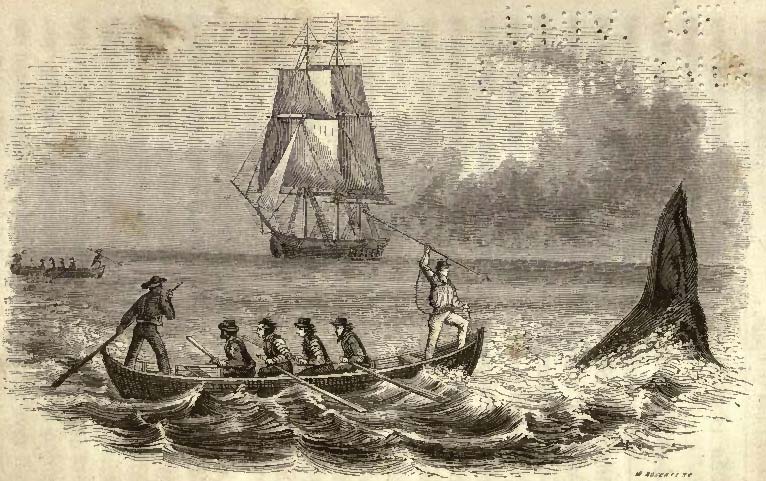
|
|
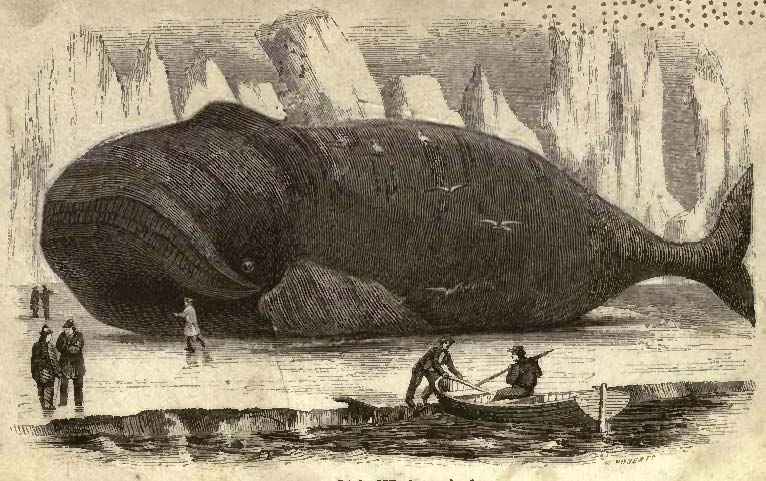 A Polar Right Whale on the Ice.
|
THE WHALE AND HIS CAPTORS;
OR,
THE WHALEMEN'S ADVENTURES,
AND
THE WHALE'S BIOGRAPHY,
AS GATHERED ON THE HOMEWARD CRUISE
OF THE "COMMODORE PREBLE."
BY REV. HENRY T. CHEEVER
With Engravings
Oh, the rare old Whale, mid storm and gale,
In his ocean home will be
A Giant in might, where might is right,
And King of the boundless Sea.
|
NEW YORK:
HARPER & BROTHERS, PUBLISHERS,
92 CLIFF STREET,
1850.
|
|
Entered, according to Act of Congress, in the year one thousand
eight hundred and forty-nine, by
HARPER & BROTHERS,
in the Clerk's Office of the District Court of the Southern District
of New York.
|
PREFACE.
This book is simply what its title indicates, the mind of the author pretending to be only the camera obscura through which the rays from Nature and Nature's living scenes have passed uncolored to the canvass. It may be that some who were with the writer, and others too, experienced and old in whaling life, may like to glance through this gallery of Daguerreotypes, and by their help recall to mind scenes of which, if they can not say, like many in this vocation, Quaeque ipse miserrima vidi, yet with equal truth, Quorum pars magna fui.
To them, the author is sure it will be pleasurable to review life-passages that were fraught with no ordinary interest in passing, and to compare the glimpses and sun-paintings found here with their more subtle images in the brain, which memory loves to be retracing in the downhill of life.
|
|
And if it be true, what the philosophic Latin poet Lucretius touches so beautifully,
Suave mari magno, turbantibus aequora ventis,
E terra, magnum alterius spectare laborem –
|
It is a view of delight to stand or walk upon the shore side, and to see a ship tossed upon the sea; or to be in a fortified tower, and to see two battles join upon a plain; or it is sweet, from a post of safety, to review the labors of other men beyond the seas – if there be truth in this, the writer may hope his book will not be barren of interest to many, who, having never experienced the reality of the life which is here delineated, may now behold it safely from afar off.
Hoping also that there are moral hints and lessons herewith interwoven, that will catch the eye and touch the heart of the casual reader, like sober threads of green in tapestry of gold, this book is honestly commended to the purchase and perusal of all classes, by the
AUTHOR.
|
TABLE OF CONTENTS.
| Origin and Localities of the Whale Fishery – Biscayan and Dutch Whalemen – New England Bay Whaling – First Sperm Whale in the Deep Sea – Statistics of History, Growth, and Value of the Whale Fishery – Sources of Information – Whaling Literature and Whaling Life |
Page 21 |
| Tropic Island of Rimatara – Letter from the Natives-Landing through the Surf – Characteristics of the People – King Temaeva – Walk into the Interior – Island Metropolis – Foot-prints of Christianity – Native Hospitality – Regretful Good-by – Contrast between a People with the Book and without – A Cut-off and a Recovery – A Shipwreck and a Rescue – Reasoning of a South Sea Islander – Tahitian Theology |
32 |
| Whalemen's Electrifier – Pursuit and Capture of the first New Zealand Whale – A Post-mortem Survey of the Carcass – Process of Securing and Cutting-in the Blubber – Lure of Birds and Sharks – Firing up at the Try-works – Poetry and Prose of the Leviathan |
52 |
|
| Physiology of the Right Whale – Points of Difference in the Sperm – Mammoth Dimensions – Clinical Notes – Providential Peculiarities of Structure – Right-whale Feed – Polar Pasture-ground and Greenland Medusae – Disastrous Losses by Sinking – How to be obviated – Different Expedients. |
66 |
| Minute Description from Nature of the Balaena Mysticetus – Manner of the Whale in Feeding – Blubber Boiling – Oily Plight of the Ship and Crew – Sea Soap and Sand Scrubbing – Raising more Whales – Chase, Fight, and Capture – Return to the Ship with a Prize – The Galvanism for weary Muscles. |
79 |
A Whaleman's Autobiography in Rhyme – Different Kinds of Whale in the Nomenclature of Whalers – Razor-back and Fin-back described – Resorts of the Right Whale – Great Harvest Field of the Northwest – Vast Havoc of Game there – Prowess and Sagacity of the Kamtschatka Whale – Beginning and Progress of Northwest Whaling – New Arctic Cruising-ground – Probable Duration of this Whaling – Maury's Attempt to reduce the Whale's Times and Seasons to a System – Fact and Speculation – A Problem for Posterity
95
|
|
Amicable Temper of the Right Whale – Wisdom of the Creator – Whale's maternal Affection and Boldness in Defense of its Young – A Sperm Whale feeding – A Sperm Whale dying – A Sperm Whale Sick and wanting Physic – Ambergris – Its Origin and Uses – Deformities and Wars of Bull Whales – Probable Age of the Dam and Size of the Whale Calf – The Whale's Enemies – Terrific Combats with Killers, Thrashers, Sword Fish, and Sea Serpent – Doubtful Morality of the Whale Fishery – The Sabbath a Whaleman's Right
110
A Day and Night off Cape Horn – Capture of a Calf and Escape of a Cow – Harpooning of a Sun-fish – Metamorphosis into a Chowder – Sinking one Thousand Dollars in a Right Whale – Making Twenty-five Hundred in a Sperm – Lodging Harpoons in a Third – Whales Reading Lectures to Men
128
Stirring Adventure amid a Gam of Whales – Captain Overboard with a tangled Tow-line – Sensations while being drawn down with the Sounding Whale – Providential Rescue – Boat-race with a Team of Whales – A Monster in his Flurry pitching downward and Dying without Rising – One Whale Falling bodily upon a Boat fast to another – Limbs broken and Lives lost – Reflections of the Rescued – The Heart under the Pea Jacket.
136
|
|
Off the Rio de la Plata – Gauge and Dimensions of a conquered Sperm Whale – Cavity of the Cranium a Shop for the Phrenologist – Way of disposing the vast Bulk of the Head – Surfeit of Birds and Capers of Sharks – Hazards and Toil of Whalemen little known by those whose Lamps they are lighting at Home – Oily Processes – Sperm Candle Manufactories – Avenues and Limits of New England Enterprise.
154
Contrasted Lights and Shadows, Good and Evil, in the Life of a Whaleman – Boats gone and Man Overboard – Dread Thoughts and Prospects – Phantasms of the Darkness – Return of the Boats and Loss of poor Berry – Horrible Discovery by a Whaler in the Seas of Greenland – A Charnel Ship – An awful Warning – Rime of the Ancient Mariner
164
An old Man's Yarn Spun out of the Recollections of Whaling Life in Youth – Boat tapped by a Whale – Lancing Deep – Captain and Boat-steerer plunged into the Brine – Way to mend a stoven Boat in an Emergency – Reward of Courage and Patience – Dead Spermaceti Whale – A Windfall to the Cremona – Exciting Chase for a Whale between Ships of four Nations – Romance of Rival Whaling – Victory to the American.
182
|
|
Whaleman's Contribution for an Appendix to Webster's Dictionary – A Treatise on Gamming – Savory Comparisons – Appalling Forms of Danger encountered by Whalemen – Singular Exploit of a Bull Whale – Difference between rational Conjecture and melancholy Fact – Effect produced by Familiarity with Danger.
203
Facts from which to estimate the prodigious Speed and Strength of the Whale – Terrible Destruction of the Essex by being run upon by a Sperm Whale – Sufferings and Fate of the Crew – Similar Catastrophe to the Union and a Merchant Brig – Remarkable Adventures and Escape – A lone Boat demolished by a Whale fifteen Miles from the Ship – Prayer of the doomed Mariners – Unexpected Deliverance – A Whale-boat driven into a Whale's Mouth – The Leap and the Rescue – A hard Life and the Characters it forms – The Virtues that are found growing in a Whale Ship – The Life to live.
211
A flagrant Abuse of the Lord's Day – Estimated Number of Persons employed in the Whale Fishery – Sabbath-breaking Usages to which they are subjected on Board Ship – Sundry common Excuses in its Defense – Ten Propositions in Reply – Opposite Instances of Sabbath Breakers – The Godliness Satan is pleased with – Schoolcraft on the Sabbath – Zest after Rest – Charge to the Sabbath Keeper.
|
|
The two Buttresses of Sabbath Whaling – Owners' Greediness of Gain – Lucre Stronger than Law – Testimony of an American Foreign Missionary – Silence of the Clergy in Whaling Ports – Inconsistency of Religious Revivals sending forth Sabbath-breaking Converts – Christianity giving Shelter to, and getting a Name from Sin – The Puritan's Praises oftener heard than the Puritan's Morals exemplified – Supposed Remonstrance of a Delegation of Pilgrims – Sabbath-keeping Experience of Captain Scoresby – Expostulation with Owners, Ship-masters, Seamen, and Others – A good Time coming.
244
Hopes and Fears on coming Home after being long away – Thickening Dangers at the Close of a Voyage – Pilgrim Land Light-house – The last Sermon on Shipboard – Evening Prayer-meeting – Pearl-findilg – Lesson from a Captain in Sounding – Spiritual Analogies – Fruits of the Voyage.
265
Wrecks met with in the Gulf Stream like the Wrecks of old Opinions – Lesson learned from the Ship's Behavior in a Gale – Illustration of Faith from the Experience of a young Ship-master – Promises of God's Word like the Mariner's Life-lines – Analogy between the Albatross on a Ship's Deck and the Christian in Trial – Magnetism and Workings of Faith Illustrated by the Oscillations of the Mariner's Needle – Instruction from taking a Pilot – Painful Intelligence of the Doings of Death – Tribute to a departed Brother.
276
|
|
Scenes in the Pacific – Former Fate of shipwrecked Mariners – A Ship with the Scurvy – How entertained, and why – The Change made by Missionaries – Reflections and Rememnbrances of a Boat-steerer – Boat's Crew lost in a Fog – The Loss and Recovery of three Boats on the Line belonging to the Harriet – Rights, and Wrongs, and Disabilities of common Whalemen – Sabbath-keeping Experience in the Whale Fishery of Rev. William Scoresby – Evidences of the Blessing of Providence upon the Observance of the Sabbath – Obvious physical Benefits as well as spiritual – Question considered whether a Whaling Captain should himself go in the Boats – The Danger and Inexpediency of it illustrated by Facts – Sufferings of Captain Hosmer and Boat's Crew of the Bark Janet – Narrative of the Destruction of the Ann Alexander by a Sperm Whale – Escape of the Pocahontas – Encounter of a Bull Whale with the Bark Parker Cooke.
291
Leaves from the Log of a Practiced Whaleman – The Outfit for a Raw Hand – First Whaling Voyage – A Chapter on Whale-ology – Domestic Discipline of a Whale Ship – Death in the Forecastle – Incidents of a Calm – The Attack, the Flight, the Flurry – Adventure with a Blasted Whale – Game Lost and Game Found – Whalemen Ashore and Homeward Bound – Wants of Seamen.
321
|
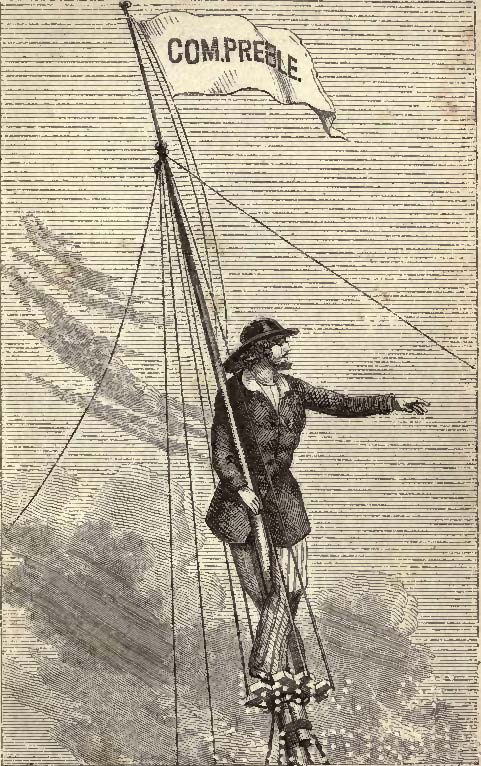 There she blows! There she blows!
Man the boats! For nothing stay!
Such a prize we must not lose!
Lay to your oars! Away! away!
|
LIST OF ENGRAVINGS
| A Polar Right Whale on the Ice. | Vignette. |
| Look-out in the Crow's Nest. | 17 |
| The Commodore Preble taking Supplies at Rimatara. | 34 |
| View of a Whale Ship in the Process of Cutting-in. | 55 |
| Whaling Implements. | 61 |
| Perpendicular and side Views of the Slabs of Whalebone. | 81 |
| View of the Harpooner and Whale in close Quarters. | 92 |
| View of a Right Whale overturning a Boat. | 102 |
| Combat between a Whale and the Sea Serpent. | 123 |
| View of a Whale-boat crushed by a Whale. | 149 |
| Boat returning from the Search for poor Berry. | 170 |
| Exploit of an American Harpooner in Delego Bay. | 200 |
| Whale dragging the Boats of the Bounty. | 213 |
| View of a Whale staving a Boat. | 221 |
| Picture of a Whale-boat thrown into a Whale's Mouth.. | 226 |
| View of a Sabbath-keeping Whale Ship. | 260 |
| Picture of the Commodore Preble homeward bound. | 271 |
|
THE WHALE AND HIS CAPTORS;
|
|
| Primitive Whalemen. | Exploits of Old Ochter. |
|
THE WHALE AND HIS CAPTORS.
CHAPTER I.
INTRODUCTION.
The mighty whale doth in those harbors lye,
Whose oyle the careful merchant deare will buy.
|
| Old English Poem.
|
From very early times it is probable that Northwest Indians, Esquimaux, and Norwegians were in the habit of capturing whales in their rude way, in order to supply themselves with fat and food. There is a curious tradition extant of one Ochter, a Norwegian, who, as long ago as King Alfred's time, "was one of six that had killed sixty whales in two days, of which some were forty-eight, some fifty yards long." But the Biscayans are believed to have been the first people who prosecuted the whale fishery as a commercial pursuit, so far back as the twelfth century. In the north of Europe and all around the Bay of Biscay
|
|
| Different Whale Catchers. | Dutch Whale Diggings. |
|
whale's tongues were among the table delicacies of the Middle Ages.
When this branch of industry failed with them, by reason of whales ceasing to visit the Bay of Biscay, the English and Dutch, taught by the Biscayans,'who were best experienced in that facultie of whale-striking,' took it up in the Northern Seas, where the gigantic game was then every where found in vast numbers by navigators in search of the northern passage to the Indies. By the middle of the seventeenth century, the Dutch had built the considerable village of Smeerenburg, on the Isle of Amsterdam, along the northern shore of Spitzbergen, within only eleven degrees of the North Pole, where the unbroken night is from September to March, and the day from March to September. This was the great rendezvous of Dutch whale ships, and it being their practice to boil the blubber on shore, it was amply provided with boilers, tanks, and all the apparatus then used for preparing the oil and bone.
This fishing colony of the frozen zone, an incidental fruit of those daring adventures after a northeast route to India, was founded nearly at the same time with Batavia in the East, and
|
|
| Arctic Whaling Colony. | First Nantucket Whale Killing. |
|
it was for a considerable time doubtful which of the two would be most important to the mother country. When in its most flourishing state, near 1680, the Dutch whale fishery employed two hundred and sixty ships and fourteen thousand seamen. This singular village and Bay of Smeerenburg, where there were seen at one time by the Dutch navigator Zorgdrager no less than one hundred and eightyeight vessels, afford, perhaps, the most remarkable instance on record of what commerce can do against unyielding laws of Nature, and over obstructions which it would seem impossible to surmount. But how soon does Nature, if ever temporarily displaced, resume her sway. Now that the whales have long since deserted those parts, even the site of the old Arctic colony is hardly discernible, and the English branch of the Greenland whale fishery is all that is prosecuted in those seas, and that with very moderate success.
The first person that is recorded to have killed a whale among the people of New England was one William Hamilton, somewhere between 1660 and 1670. In the town records of Nantucket, there is a copy of an agreement entered
|
|
| Yankee Whale Fixings. | Cape Cod Enterprise. |
|
into in the year 1672, between one James Lopar and the settlers there, "to carry on a design of whale fishing." But whether the first proper whaling harpoon used in America was wrought there or on Cape Cod can not be ascertained. From this time onward, whenever whales were descried in the bay or offing from the rude look-outs constructed along shore, notice was instantly spread, and they were attacked by boats then manned mostly by the Indians, who early evinced an aptitude and fondness for this business. Shore-whaling seems to have reached its height by 1726, during which year eighty-six whales were taken, eleven in one day. It was continued with declining success up to 1760, and for seventy years preceding that date not a single white man is known to have lost his life in the hazardous pursuit.
As early as 1700, they began to fit out vessels from Cape Cod and Nantucket to "whale out in the deep for sperm whales." These gradually crept along, emboldened by experience, north to the Labradors and south to the Bahamas, where New Providence became famous as a whale-fishing station, through the skill and daring of New England enterprise, while, as
|
|
| Atlantic Whale Fishery. | French Whaling Fleet. |
|
Burke said, but in the gristle, and not yet hardened into the bone of manhood.
By the year 1771, New England, through her adventurous whale fishery, was both in the North and South Atlantic Oceans, commanding the admiration of the world, and eulogized by the highest eloquence of the British Parliament From the year 1771 to 1775, Massachusetts alone employed in it annually three hundred and four vessels, of twenty-seven thousand eight hundred and forty-six tons burden. The quantity of oil brought into Nantucket yearly at the time of the breaking out of the Revolutionary war, was thirty thousand barrels.
Stimulated by their success, both France and Great Britain now entered anew into this lucrative enterprise; Louis XVI. himself fitting out six ships from Dunkirk on his own account, in 1784, which were furnished with experienced harpooners and able seamen from Nantucket. In 1790, France had about forty ships employed in the fishery, but the wars consequent upon the French Revolution at once swept them all, and the whaling fleet of Holland also; as did the War for Independence likewise suspend this lucrative branch of the commerce of New
|
|
| Whaling Losses. | Whaling Crosses. |
|
England. By reason of it, no less than one hundred and fifty of her vessels were either captured or lost at sea, and great numbers of her seamen perished.
In 1788 Great Britain had the honor of opening the Pacific to the sperm whale fishery, through the Amelia, Captain Shields, fitted out at vast expense by Mr. Enderby, of London. Her unprecedented success started numbers on her track both from New England and Old, and by 1820 the whole South Pacific and Indian Oceans were traversed by intrepid whalemen; and in the seas of China and on the coasts of Japan they were drawing the line and striking the harpoon into those mammoth denizens of the deep.
Prostrated, however, by the Revolutionary war, the New England branch of the whale fishery had hardly recovered its former prosperity, when the last war with Great Britain, from 1812 to 1815, again broke it up. But upon the restoration of peace its recovery was rapid; so that by 1821 there were owned in Nantucket alone (which had lost during the war twentyseven ships), seventy-eight whale ships, and six whaling brigs. In 1844, the entire American
|
|
|
Whaling Progress.
|
Whaling Profits.
|
|
whaling fleet amounted to six hundred and fifty ships, barks, brigs, and schooners, tonnaging two hundred thousand tons; and they were manned by seventeen thousand five hundred officers and seamen. At the same time, the English whale fishery, which in 1821 employed three hundred and twenty-three ships, was reduced to only eighty-five. But the New Holland branch of the English whale fishery was rapidly growing, the proximity of those whaling ports of Australia to some of the most productive cruising grounds enabling the ships fitted out there to perform three voyages while the English and Americans are performing two. The number of whale ships from French, German, and Danish ports, at the same time, was between sixty and seventy.
The estimated annual consumption of the American whaling fleet was $3,845,500. Value of the annual import of oil and whalebone in a crude state $7,000,000, increased by manufacturing to $9,000,000. The number of vessels in the American whale fishery the present year, 1849, as gathered from the "Whaleman's Shipping List," is estimated at six hundred and ten, or one hundred and ninety-six
|
|
|
Whaling Capital.
|
Whaling Products.
|
|
thousand one hundred and thirteen tons, nearly one tenth of the navigation of the Union. Receipts of sperm oil the last year, 1848, one hundred and seven thousand nine hundred and seventy-six barrels, at an import value of $3,455,232. Receipts of right-whale oil in the same time, two hundred and eighty thousand six hundred and fifty-six barrels, at an import value of $3,429,494. Whalebone, two million three thousand six hundred pounds, worth $508,762. Crude value of the whale fishery in 1848, $7,393,488.
The average yearly quantity of sperm oil taken for nine years has been one hundred and forty-two thousand two hundred and forty-two barrels; of right-whale oil, two hundred and fifty-five thousand four hundred and fifty-six barrels; of bone, two million three hundred and twenty-four thousand five hundred and seventy-eight pounds. Average yearly value for nine years, $8,098,360. There was a falling off in 1848, from the previous year, of thirteen thousand barrels of sperm, thirty-three thousand barrels of right whale, and one million pounds of bone. Eighteen years ago it was estimated, by taking into account all the investments con-
|
|
|
Whaling Ports.
|
Whaling Grounds.
|
|
nected with the American whale fishery, that property to the amount of $70,000,000 was involved in it, and that seventy thousand persons derived from it their chief subsistence; a valuation which should be much augmented rather than diminished at the present time.
The New Bedford district now supplies to the whale fishery one hundred and two thousand three hundred and five tons. All other ports, including sixty-six ships, or twenty-three thousand tons from Nantucket, give ninety-three thousand eight hundred and eight, in all one hundred and ninety-six thousand one hundred and thirteen tons. The -exports of oil to foreign ports, in 1848, from New Bedford, were seventeen thousand and ninety-three barrels.
To those who are in quest of definite information concerning the various cruising grounds and the times of finding whales there, the closing chapter of the Annals of the United States Exploring Squadron is the most satisfactory of any thing to be found. It should be printed in pamphlet form, and kept in the chart-box of every whaler. Other interesting matter, of a miscellaneous character, pertaining to the whale fishery, is to be found in the appendix to a work
|
|
|
Whaling Literature.
|
Whaling Life.
|
|
of J. R. Browne, called "Etchings of a Whaling Cruise," and in a volume entitled "Incidents of a Whaling Voyage, by F. A. Olmsted."
Without superseding or conflicting with either of those entertaining books, the course pursued in the present volume is an independent one, whereby it is aimed to finish the complement of whaling literature, and supply what was wanting, in order to put the reading public in possession of a full-length portraiture of the whaleman as seen in the actual pursuit and garb of his perilous occupation. Personal narrative and incident, other than what bears directly upon this, are therefore omitted, together with those minute descriptions of whaling implements, outfits, modes, customs, and seausages to be found elsewhere. Neither does it enter into our purpose to portray a sailor's life and manners in the forecastle or before the mast, alow or aloft, for this is a department of marine literature in which books are so numerous, both in the form of the novel and the sea journal, that little remains to be told. In adventures, however, almost every whaleman's voyage is an original, certainly so to himself. We begin, therefore, at once, with the peculiar
|
|
|
Homeward Ho!
|
Propitious Omens.
|
|
lights and shadows of a homeward cruise in the Pacific and Atlantic, from the Sandwich Islands to Boston, in the good ship Commodore Preble, Captain Lafayette Ludlow.
In a voyage of two hundred and thirty-six days there will always be lights and shadows, good and evil, pleasures and displeasures, interlocking one another. To the author the comforts of this long voyage far exceeded its discomforts, by the constant blessing of Providence, making it eminently conducive to the recovery of health, and through the personal kindness of a skillful captain and esteemed friend. Would that every wanderer in quest of health could be cheerfully returning homeward under circumstances as favorable!
Now, little book, with prosperous tide and gale,
I'll pledge thee to a voyage round the world.
Buoyant and bounding like the polar whale,
That takes his pastime, every joyful sail
Here to the freedom of the wind unfurl,
While right and left the parted surges curl!
|
|
|
|
South Sea Coral Island.
|
Lonely Rimatara.
|
|
CHAPTER II.
CORAL ISLAND OF RIMATARA.
Happy they were, and without a care,
Who had made their home forever there;
Happy they were, and calm and free,
Living upon their island-home,
Whose beach was girt with a silvery sea,
That sprinkled it ever with starry foam.
Their life was a moving melody,
Their season a long serenity.-Story.
|
The first view we have of the Commodore Preble is as she is lying off and on the lone island of Rimatara, in quest of the fresh supplies which whalemen covet in order to keep at bay the scurvy. This is one of those fascinating South Sea Islands, which, on their first discovery by Europeans in the latter part of the last century, quite turned the heads of many, and at once started so much speculative nonsense and sentimentality about primeval in. nocence and bliss embosomed in the Pacific.
A coral rock, by gentle Nature made
Verdant and beautiful, through tropic sun,
And fertilizing rain, and grateful shade;
Placed far amid the melancholy main.
|
|
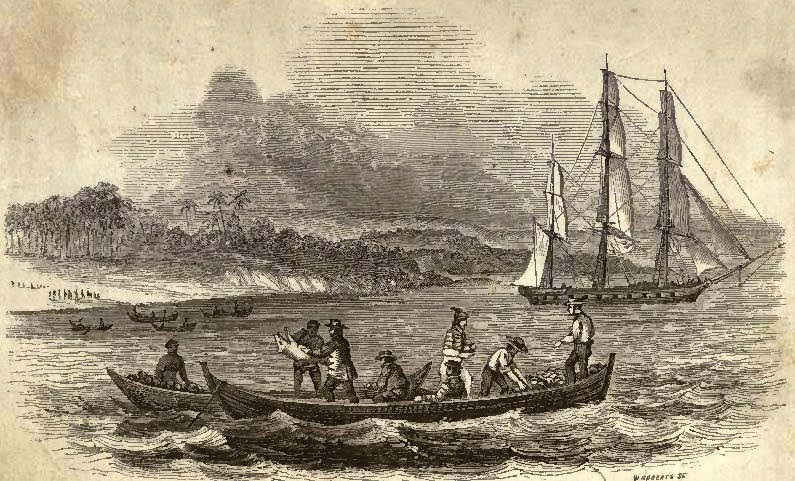
The Commodore Preble taking Supplies at Rimatara.
|
|
|
Sign-post of Christianity.
|
Night Tack.
|
|
It is about seven miles long, one and a half or two wide, and lies in 152º west longitude, and 22º 45' south latitude; about five hundred miles southwest from Tahiti. It is properly, perhaps, one of the Society Island group, being a mere pile of corallite and wave-washed coral sand. We came in sight of it on Tuesday afternoon, a blue hummock on the bosom of the ocean, and ran on until we discovered, to our great delight, what could not be mistaken for a meeting-house and a white flag flying on a post near by, to indicate the friendliness of the natives, and induce us to stop for trade.
The sea broke so high upon the northeast and southwest points of the island, and, indeed, all along shore, that our captain did not deem it prudent to attempt landing that night. We therefore stood off until twelve o'clock midnight, and then tacking, were up with it again by ten o'clock next morning, on the leeward side.
The island presented a beautiful appearance, being thickly wooded to the water's edge, and elevated in some parts into gentle hills, crowned with all the various and luxuriant growth of the tropics. Canoes soon launched out through the boisterous surf, and came alongside of us,
|
|
|
Trade with the Natives.
|
Letter from Tentino.
|
|
having two or three lads and men in each, much fairer-skinned and better looking than the majority of Hawaiians.
The captain's boat anchored off the reef, while the natives brought their articles of trade in their pigmy canoes. By four in the afternoon he had procured a boat-load of pigs and cocoanuts, with which returning to the ship, we stood off again until next morning, when the captain gave orders for two boats.
One of our sailors by the name of Johnson, that had lived on Tahiti,,and could talk a little in their tongue, had told the natives the day before that there was on board a missionary, or a missionary's friend, from Hawaii, and there was accordingly sent off through him, on a slip of paper, very legibly written by the native teacher, a Rimatara letter, of which the following is a literal translation:
"Dear Friend and Father, –
"May you be saved by the true God. This is our communication to you. Come thou hither upon the shore, that we may see you in respect to all the words of God which are right with you. It is our desire that you come to-day.
"From Teutino and his brethren."
|
|
|
Landing through the Surf.
|
Characteristics of the People.
|
|
Eager to know something more of a people from whom came so cordial an aloha, and
My very heart athirst
To look on Nature in her robe of green,
|
I made ready to go ashore. The breakers were not formidable enough, though beating with fearful violence, to make me forego the novelty of setting foot on a coral South Pacific island, and the pleasure of a stroll among the trees after seven weeks at sea. Taking, therefore, a life-preserver, I ventured into one of the little canoes that came alongside the boat, and was paddled and handed by a narrow cleft, through roaring breakers and ragged rocks that threatened instant destruction, among which a common boat could hardly live a moment. Those frail canoes, however, only nine and eleven feet long, carried safely through, one by one, all that ventured ashore.
Immediately on our landing, the natives gathered around and formed a ring, naturally curious, like savages every where, to notice every thing, and I not less so to observe their own eager attitudes, expressive gestures, and fine looks. The women have an uncommonly pleasing aspect of countenance, clear skin, but
|
|
|
Maiden Beauty.
|
Island King Temaeva.
|
|
a shade or two darker than a dark brunette, black eyes, hair, and eyebrows, and a captivating beauty of form, and bashful turning away when looked at, that is not a little attractive. Their nostrils are not so negro-like, nor their lips so thick as those of the Hawaiians, but still they bear to them a close resemblance. Many of the little girls and maidens were truly beautiful, and would be deemed paragons, even in the artificial state where beauty is not left so much to itself, but has to be busked, bustled, and corseted by omnipotent fashion.
I soon made my way to the island king, Temaeva, who sat apart from others upon a block of coral, and leaning on a staff, his only dress being a shirt and kihei (mantle). He was a benevolent-looking, well-made man, having the port and presence of a king, and, if that were all,
With Atlantean shoulders fit to bear
The weight of mightiest monarchies.
|
He offered me his hand with much apparent cordiality, and immediately led the way to his house in the interior. The path was at first rugged as the volcanic clinkers of Hawaii, over heaps and swells of broken and sharp coral, overgrown with huge roots of the Kamani and
|
|
|
Stroll into the Interior.
|
Island Metropolis.
|
|
Koa trees, in the borrowed terms of Wordsworth,
A growth
Of intertwisted fibres serpentine,
Up-coiling, and inveterately convolved.
|
This barrier passed, there was a subsidence and inclining of the island inward, and the path went through a meadow of bulrushes, in time of rain flooded. The soil was a rich black loam. Next came beds of wet kalo (Arum esculentum), very luxuriant and large, beyond which were the houses of the king and native missionary teachers, the chapel, school-house, and principal settlement. These were prettily-made buildings of kamanu posts, wattled between, lined on both sides with a good coat of whitewashed plaster, and thatched on the roof with grass. Being clustered tastefully together, they make a very pleasing appearance outside.
The chapel and house of the king were furnished with flooring and settees. In the former was a round pulpit, very much like those seen in popish cathedrals, wherever is seen at all what popery is by no means fond of-the pulpit. They had been built eleven years, it being more than twenty, we were told, since the isl-
|
|
|
Footsteps of Christianny.
|
Mission Premises.
|
|
and was first Christianized by native missionaries from Tahiti. They were all surrounded by a low paling of posts driven slightly into the ground, merely to keep out hogs; while cocoanut trees and giant bananas were dropping their fruits all around. The whole scene, in every feature, was most pleasingly corroborative of the representations quoted by Harris in "The Great Commission," to show the temporal utility of missionary exertions in the South Seas. "Instead of their little, contemptible huts along the sea-beach, there will be seen a neat settlement, with a large chapel in the center, capable of containing one or two thousand people; a schoolhouse on the one side, and a chief's or the missionary's house on the other; and a range of white cottages a mile or two long, peeping at you from under the splendid banana-trees or the bread-fruit groves. So that their comfort is increased and their character elevated."
Soon after reaching this little metropolis of the island, the king had baked pig and delicious kalo placed upon a massive rude table, and plates of English crockery, with knives and forks. A blessing was asked by the native teacher, and I was invited to eat. It was, in their view, an im-
|
|
|
A King's Banquet.
|
Eden Cream.
|
Novel Nectar.
|
|
portant piece of courtesy, which a recent breakfast rather unfitted me for; yet I ate, with compliments, of the mealy kalo, and tasted of the pig, while the king was taking huge morsels that would almost sink a common man.
The wine of this feast was the delicious milk of young cocoa-nuts just from the tree; and I will venture to say that Hebe never poured such nectar into the goblets of the gods. It was more like that which Eve made ready once in Eden, as the poet tells, wherewith to entertain their angel guest:
With inoffensive must and meathes,
From many a berry and from sweet kernels pressed,
She tempers dulcet creams; nor them to hold
Wants her fit vessels pure; then strews the ground
With rose and odors from the shrub unfumed.
|
This entertainment over, we repaired to the teacher's, where again was served up the same. with the addition of banana made into a poi, of which the king ate freely. I was here presented with a couple of rolls of white kapa by the good woman of the house. After surveying the premises, getting a specimen of the king and teacher's handwriting, and giving them a card to certify any other chance ship of their hospitality, I returned to the shore by another path,
|
|
|
Tropical Fruit-trees.
|
Kingship and Democracy.
|
|
through a dense wood, coming out of it on the windward side of the island, by the old church and grave-yard, where Temaeva pointed out the tomb of a former wife, having the date of her death rudely cut in a coral slab.
The cocoa-nuts passed were numberless, shedding their fruit by thousands; also lofty and straight pandanuses, kukuis, and milo trees. Following round the shore to the point at which we had struck off into the woods, we found the captain there busy trading. I pleased myself a while with looking at those mixed and motley groups, and trying to communicate with the harmless Arimatarians, and then went off to the boat through the outrageous surf, inly wishing I could leave with them some substantial and enduring testimony of good will.
The king and his wife, together with the captain, came, one by one, soon after, and we all pulled off to the ship, where the king seemed highly gratified with his entertainment and presents. He is manifestly king but in name, having to promise a recompense even to the men that brought him off to the boat in their canoe. The Gospel has abolished all tyranny, and, as the sailor interpreted it, all there are for them-
|
|
|
Progress in the Arts.
|
Tahitian Teachers.
|
|
selves, and without distinctions. They are four hundred all told, and live, according to their own telling, in much peace, being visited two or three times a year by whale ships for recruits, whose trade just keeps them (the adults) with a single cloth garment, or kihei a piece.
A roughly-made schooner, of kamanu wood (much like our mahogany), was on the stocks, for which they were very anxious to get tar, oakum, and a compass. No white missionary, we were told, has ever resided upon the island, but all their imperfect Christianization and acquaintance with the arts have been effected by native teachers from Tahiti. White men have stopped on the island occasionally, but they say they do not want them, unless they know the language and have some trade.
I could not leave this secluded and lovely isl. and, though but the stopping-place of a day, and ere long, I hope, to mingle with humanity in a wider and more populous field, without a feeling of sadness, I hardly know why. But so it is in the voyage of life, especially in that of a traveler, sailing down the stream of time, we hail a friendly bark, or touch here and there at a pleasant landing-place upon its banks, pluck
|
|
|
ThoughtS at Leaving.
|
Seed Dropping.
|
|
a few fruits and flowers, exchange good wishes and kind words with the friends of a day, truly love and are loved by some congenial hearts, both drop and take some seeds of good and evil, to spring up when we are in our graves, and then we are away; the places that now know us know us no more forever, and the faces that now smile upon us we never see again. Who can help sighing as he thinks of it, and wishing to leave, wherever he goes, some durable evidence that an immortal spirit has passed that way!
Oh, at what time soever thou
(Unknown to me) the heavens wilt bow,
And, with thy angels in the van,
Descend to judge poor careless man,
Grant I may not like puddle lie,
In a corrupt security,
Where, if a traveler water crave,
He finds it dead, and in a grave;
But as the clear running spring
All day and night doth flow and sing;
And though here born, yet is acquainted
Elsewhere, and, flowing, keeps untainted
So let me all my busy age
In thy free services engage.
And though (while here) of force I must
Have commerce sometimes with poor dust,
Yet let my course, my aim, my love,
And chief acquaintance be above;
So when that day and hour shall come
In which thyself will be the sun,
Thou'lt find me dressed and on my way,
Watching the break of thy great day.
|
|
|
|
A Cut off.
|
A Rescue.
|
An Escape.
| |
How different now our reception here by Islanders that had been blessed with the Bible, from that which a whale ship had while sailing along in this same Pacific in the year 1835, from barbarians that had never received the Gospel. A large number of natives came off, as to us, for purposes of trade. No treachery was suspected, and all for a while went on amicably. But, upon a signal from a chief, the natives sprang for the harpoons, whale-spades, and other deadly weapons at hand, and a desperate contest immediately ensued. The captain was killed by a single stroke of a whale-spade; the first mate also, soon after. The second mate jumped overboard and was killed in the water, and four of the seamen lost their lives. A part of the crew ran up the rigging for security, and the rest into the forecastle.
Among these last was a young man, the third mate, by the name of Jones, the only surviving officer. By his cool intrepidity and judgment, after a dreadful encounter, the ship was cleared of the savages, the chief killed, and many of his companions, both of those on board and those who came alongside to aid in securing the ship.
Jones now became the captain, buried the
|
|
|
A Voyage Broken.
|
Difference made by Christianity.
|
|
dead, dressed the wounded, put the ship in order, and made sail for the Christianized Sandwich Islands with the surviving crew. With a skill and self-possession worthy of the man that could accomplish such a rescue, and with a favoring Providence, he navigated the bereaved whaler to Oahu, where the survivors were hospitably entertained. The ship, however, had to be sent home, the voyage being completely broken up for want of the necessary officers, and thousands of dollars lost to owners and underwriters.
I remember once to have listened to the narrative of a captain who was wrecked in the Pacific on a sunken rock, and for fourteen days and nights himself and crew, twenty-two in number, were exposed in their boats, and had quite given up hope of ever again reaching the land. But on the morning of the fifteenth day after the loss of their ship, they found their boats nearing an unknown island. They were almost spent, and saw the shore, which was guarded by a reef, lined with natives, whether cannibals or Christianized they could not tell.
While their lives were in doubt, and they were questioning whether a worse death by
|
|
|
Treatment of Mariners.
|
Reason Why.
|
|
savage violence did not await them than if they had perished at sea, one of the natives came out toward them through the surf, hold. ing in his hand a book, and cried, with a loud voice, "Missionary! missionary!" An answering shout of recognition and beckoning from the poor mariners immediately brought the natives, through the waves, to their aid, by whom they were carried on shore in their arms, supplied with food, and generously entertained with more than human, with Christian kindness.
It so happened, according to the captain's statement, that this was an island whose inhabitants had been first brought to the knowledge of Christianity by the brother of this captain, who had been some years before cast away on this very island, and, with one other of the ship's company, was saved. They were taken by the natives to be offered up as a sacrifice to their gods. But while on their way to the place where human victims used to be sacrificed, they remembered the tradition that a god should come to them from the sea.
Overruled, doubtless, by a divine impulse, they now entertained the white man as a god, and he instructed them concerning the only
|
|
|
Power of the Gospel.
|
The Sailor's Debt.
|
|
true God and Savior. They invited the missionary from another island, and in Heaven's blessing upon his instructions was read the secret of all their after-kindness to the white men who visited or were cast upon their shores. All whalemen may see in this contrast, as we have to our joy in the Commodore Preble, what a difference there is between islands that have, and that have not the "BOOK."
It is THE BOOK which has brought it to pass that the adventurous, weary whaleman can now traverse the entire Pacific, and land with impunity at most of its lovely islands, and be supplied on terms of equity with all he needs. Let, then, those that owe to it the most, be loudest in their praises, and warmest in their love, and most careful in their obedience to the BOOK OF BOOKS.
It was the reasoning of one of this great family of South Sea Islanders (with whom our ship has just had such pleasant intercourse), soon after he came into possession of the BIBLE:
When I look at myself, I find that I have hinges all over my body. I have got hinges to my legs, my jaws, my feet, my hands. If I want to lay hold of any thing, there are hinges
|
|
|
An Islander's Reasoning.
|
The Great Hinge Maker.
|
|
to my hands, and even to my fingers, to do it with. If my heart thinks, and I want to make others think with me, I use the hinges to my jaws, and they help me to talk. I could neither walk nor sit down if I had not hinges to my legs and feet. All this is wonderful. None of the strange things that men have brought from England in their big ships are at all to be compared to my body. He who made my body has made all those clever people, who made the strange things which they bring in the ships; and he is God, whom I worship.
But I should not know much more about him than as a great hinge-maker, if men in their ships had not brought the book which they call the Bible. That tells me of God, who makes the skill and the heart of man likewise. And when I hear how the Bible tells of the old heart with its corruption, and the new heart, and a right spirit, which God alone can create and give, I feel that his work in my body and his work in my heart fit each other exactly. I am sure, then, that the Bible, which tells me of these things, was made by him who made the hinges to my body. I believe the Bible to be the word of God.
|
|
|
Naturel Logic.
|
Tahitian theology.
|
Its Conclusion.
| |
The men on the other side of the great sea used their skill and their bodies to make ships and to print Bibles. They came in ships, and brought iron hoops, knives, nails, hatchets, cloth, and needles, which are very good. They also brought rum and whisky, which are very evil. They moved the hinges of the jaws, and told lies and curses, which are abominable. At last some came and brought the Bible. They used the hinges of their bodies to turn over its leaves and to explain God's blessed word. That was better than iron-ware and stuff for clothing. They were the servants of the living God, and my heart opened to their words as if it had hinges too, like as my mouth opens to take food when I am hungry. And my heart feels satisfied now. It was hungry, God nourished it; it was thirsty, God has refreshed it. Blessed be God, who gave his word, and sent it across the sea to bring me light and salvation!
Now we say that this unsophisticated native thinker, working thus all by himself at the great theological argument from evidences of design; could hardly have done better had he been going to school to Calvin or Chalmers all his days. He might have written in his Poly-
|
|
|
The two Bibles.
|
Verse from Byron's.
|
|
nesian Bible the lines which are said to have been found on the blank leaf of a copy of the Scriptures belonging to a great English poet. And, ah! how much better had it been for the world if Byron had loved his Bible as there is reason to believe the unknown Tahitian did his.
Within this awful volume lies
The mystery of mysteries:
And bless'd, forever bless'd are they
Who read to hope, and read to pray.
But better had he ne'er been born,
Who reads to doubt, or reads to scorn.
|
|
|
|
There she Blows.
|
Where Away?
|
|
CHAPTER III.
RAISING AND CUTTING-IN WHALES.
Here leviathan,
Hugest of living creatures, on the deep
Stretch'd like a promontory, sleeps or swims,
And seems a moving land; and at his gills
Draws in, and at his trunk spouts out, a sea. – Milton.
|
For the first time in our now ten weeks' passage from the Hawaiian Islands, on this New Zealand Cruising Ground, we heard, day before yesterday, that life-kindling sound to a weary whaleman, THERE SHE BLOWS! The usual questions and orders from the deck quickly followed. "Where away?" "Two points on the weather bow!" "How far off?" "A mile and a half!" "Keep your eye on her!" "Sing out when we head right!" It turned out that three whales were descried from aloft in different parts, and in a short time, when we were deemed near enough, the captain gave or. ders to "Stand by and lower" for one a little more than half a mile to windward.
|
|
|
Boats in Chase.
|
Oars A-peak.
|
One Boat Fast.
| |
Three boats' crews pulled merrily away, glad of something to stir their blood, and with eager hope to obtain the oily material wherewith to fill their ship and make good their "lay." The whale was going leisurely to windward, blowing every now and again two or three times, then "turning tail," "up flukes," and sinking. The boats "headed" after him, keeping a distance of nearly one quarter of a mile from each other, to scatter (as it is called) their chances.
Fortunately, as the oarsmen were "hove up," that is, had their oars a-peak, about the place where they expected the whale would next appear, the huge creature rose hard by the captain's boat, and all the harpooner in the bow had to do was to plunge his two keen cold irons, which are always secured to one tow-line, into the monster's blubber-sides. This he did so well as to hit the "fish's life" at once, and make him spout blood forthwith. It was the first notice the poor fellow had of the proximity of his powerful captors, and the sudden piercing of the barbed harpoons to his very vitals made him caper and run most furiously.
The boat spun after him with almost the swiftness of a top, now diving through the seas
|
|
|
The Lance.
|
The Flurry.
|
The Prize.
| |
and tossing the spray, and then lying still while the whale sounded; anon in swift motion again when the game rose, for the space of an hour. During this time another boat "got fast" to him with its harpoons, and the captain's cruel lance had several times struck his vitals. He was killed, as whalemen call it, that is, mortally wounded, an hour before he went into "his flurry," and was really dead or turned up on his back.
The loose boat then came to the ship for a hawser to fasten round his flukes; which being done, the captain left his irons in the carcass and pulled for the ship, in order to beat to windward, and, after getting alongside, to "cut him in." This done, and the mammoth carcass secured to the ship by a chain round the bitts, they proceeded to reeve the huge blocks that are always made fast for the purpose to the fore and main mast head, and to fasten the cutting-in tackle. The captain and two mates then went over the sides on steps well secured, and having each a breast-rope to steady them and lean upon. The cooper then passed them the long-handled spades, which he was all the time grinding and whetting, and they fell lustily to work chopping off the blubber.
|
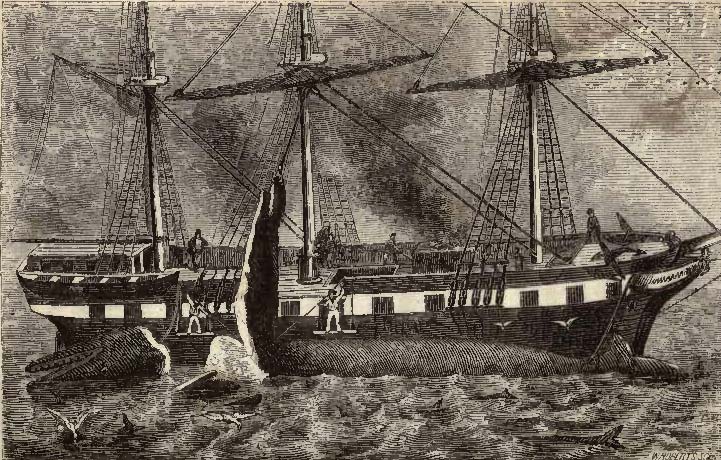 View of a Whale Ship in the Process of "Cutting in."
|
|
|
The Lip.
|
The Fin.
|
The Bonnet.
| |
First came one of the huge lips, which, after they had nearly severed close to the creature's eye, was hooked into by what they call a blubber hook, stripped off, and hoisted on board by the windlass. It was very compact and dense, and covered with barnacles like Brobdignag lice.
Next came one of the fore-fins; after that the other lip, and then the upper jaw along with all that peculiar substance called whalebone, through which the animal strains his food. It is all fringed with coarse hair that detains the little shrimps and small fry on which the creature feeds. The bones, or, rather, slabs of whalebone radiate in leaves that lie edgewise to the mouth, from each side of what may be called the ridge-pole of the mouth's roof, forming a house almost big enough for a man to stand up in. Outside it is crowned with what they call a bonnet, being a crest or comb where there burrow legions of barnacles and crabs like rabbits in a warren, or insects in the shaggy bark of an old tree.
Next came the lower jaw and throat, together with the tongue, which latter alone must have weighed fifteen hundred or two thousand pounds; an enormous mass of fat, not, however, so firm and tough as the blubber. Whalers
|
|
|
The Tongue.
|
The Flensing.
|
The Blubber-room.
| |
often have to lose it, especially from the northwest whale, it being impossible to get it up on deck detached and alone, because it would not hold, and it is generally too large and heavy to raise along with the throat.
After this was hoisted in, the rest of the way was plane sailing, the blubber of the body being cut and peeled off, in huge unbroken strips, as the carcass rolled over and over, being heaved on by the windlass, then hooked into by the blubber hooks, and hoisted in by the men all the time heaving at the windlass.
As often as a piece, nearly reaching to the top of the main mast, was got over the deck, they would attack it with great boarding-knives, and cutting a hole in it at a place nearly even with the deck, thrust in the strap and toggel of the "cutting blocks," that they might still have a purchase on the carcass below. Then they would sever the huge piece from the rest, and lower it down into "the blubber-room" between decks, where two men had as much as they could do to cut it into six or eight pound pieces and stow it away. It was from nine to eleven inches thick, and looked like very large fat pork slightly colored with salt-petre.
|
|
|
Albatrosses.
|
Blubber-birds.
|
Sharks.
| |
The magnificent, swan-like albatrosses were round us by hundreds, eagerly seizing and fighting for every bit and fragment that fell off into the water, swallowing it with the most carnivorous avidity, and a low, avaricious greed of delight, that detracted considerably from one's admiration of this most superb of birds, just as your veneration for one whom the coloring of a youthful imagination has made a little more than human, is not a little abated by finding him subject to the necessities and passions of poor human nature. Gonies, stinkards, horsebirds, haglets, gulls, pigeons, and petrels, had all many a good morsel of blubber. For at any time in these seas, though eight hundred or a thousand miles from shore, the capture of a whale will allure thousands of sea-birds from far and near. Sharks, too, appeared to claim their share; but it was not until after a man had been down twice on the wave-washed carcass, to get a rope fast to a hole in the whale's head, or I should have trembled for his legs.
Before the blubber was all off, the huge entrails of the whale burst out like barrels, at the wounds made by the spades and lances. I hoped the peeled carcass would float for the
|
|
|
Friendly Congratulations.
|
Trying out.
|
|
benefit of the gonies and other birds. But no sooner was the last fold of blubber off, the flukes hoisted in, and the great chain detached, than it sank plumb down. About the same time two ships bore down to speak us, the Henry of Sag Harbor, and the Lowell of New London. Their captains came on board to congratulate us on our success, and "learn the news." They had just arrived on the ground, and had not yet taken any whales.
Soon after we had finished cutting in, about eight o'clock in the evening, the wind increased almost to a gale, making it impossible to try out that night. But to-day, while the ship is lying to, the business has begun in good earnest; the blubber-men cutting up in the blubberroom; others pitching it on deck; others forking it over to the side of the "try-works;" two men standing by a "horse" with a mincing knife to cleave the pieces into many parts for the more easy trying out, as the rind of a joint of pork is cut by the cook for roasting: the boatsteerers and one of the mates are pitching it into the kettles, feeding the fires with the scraps, and bailing the boiling fluid into copper tanks, from which it is the duty of another to dip into casks.
|
Whaling Implements.
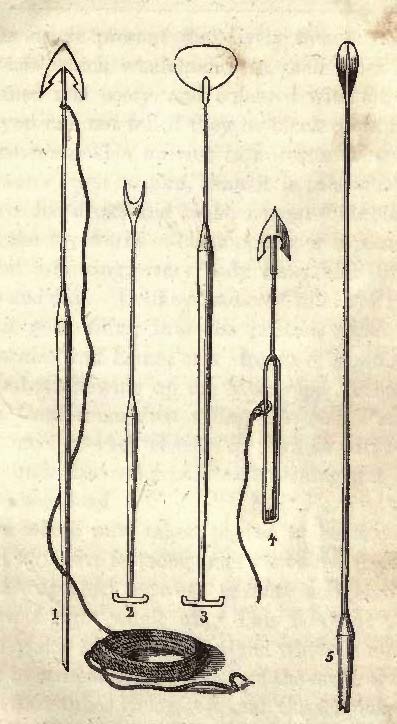
1. Hand Harpoon. 2. Pricker. 3. Blubber Spade.
4. Gun Harpoon. 5. Lance.
|
|
|
A Whale-ship in its Glory.
|
Present yield of Oil.
|
|
The decks present that lively though dirty spectacle which whalemen love, their faces all begrimed and sooty, and smeared with oil, so that you can not tell if they be black or white. A farmer's golden harvest in autumn is not a pleasanter sight to him, than it is to a whaler to have his decks and blubber-room "blubberlog," the try-works a-blazing, cooper a-pounding, oil a-flowing, every body busy and dirty night and day. Donkey-loads of Chilian or Peruvian gold, filing into the custom-house at Valparaiso and Lima, or a stream of Benton's yellow-boys flowing up the Mississippi, or bags of the Californian dust riding into San Francisco, have no such charms for him as cuttingin a hundred-barrel whale and turning out oil by the hogshead.
The whale now taken proves to be a cow whale, forty-five feet long and twenty-five round, and it will yield between seventy and eighty barrels of right whale oil. This is about the ordinary size of the New Zealand whale, a mere dwarf in comparison with that of the northwest, which sometimes yields, it is said, three hundred barrels, ordinarily one hundred and fifty, or one hundred and eighty.
|
|
|
The Whale in Prose.
|
The Whale in Poetry.
|
|
Though so huge a creature, a very small part of its bulk appears out of water, and that bending with the undulations of the waves; nor do you have so fair a view of this immense mass of organized matter, as of a ship afloat in comparison to one on the stocks. To have a just idea of its greatness, it should be seen on dry land. As is usually the case, the observed reality of this mammoth animal, prodigious as it is, hardly comes up to the preconceived vague idea of it, still less to the poetic notion of
That sea-beast
Leviathan, which God of all his works
Created hugest, that swim the ocean stream.
Him haply slumbering on the Norway foam,
The pilot of some small night-foundered skiff,
Deeming some island, oft, as seamen tell,
With fixed anchor in his scaly rind,
Moors by his side under the lee, while night
Invests the sea and wished morn delays.
|
They used to tell some big "fish stories" in Milton's day, and I have no doubt they had something to do in his mind with the creation of that image of Satan on the burning lake.
With head uplift above the wave, and eyes
That sparkling blazed; his other parts beside,
Prone on the flood, extended long and large,
Lay floating many a rood; in bulk as huge
As whom the fables name of monstrous size,
Titanian or earth-born, that warred on Jove:
|
|
|
|
Imagery of Milton.
|
Whence Derived.
|
|
Forthwith upright he rears from oft the pool
His mighty stature: on each hand the flames,
Driven backward, slope their pointing spires, and rolled
In billows, leave in the midst a horrid vale.
Then, with expanded wings, he takes his flight
Aloft incumbent on the dusky air,
That felt unusual weight.
|
|
|
|
Physiology of the Right Whale.
|
Not a Fish.
|
|
CHAPTER IV.
NEW ZEALAND CRUISING GROUND.
Oh, the whale is free, of the boundless sea;
He lives for a thousand years;
He sinks to rest on the billow's breast,
Nor the roughest tempest fears.
The howling blast, as it rushes past,
Is music to lull him to sleep:
And he scatters the spray in his boisterous play,
As he dashes – the King of the deep. – Sea Song.
|
The recent capture of one right whale, getting fast to another, and pursuit of several more, and the sight of them blowing all around, close at hand and at a distance, naturally puts one upon inquiring into the habits and resorts of this great sea-monster. It is of the class mammalia, order cetacea, warm-blooded, bringing forth its young alive, generally one at a time, and giving them suck. It is not, therefore, a fish, is without scales, breathes the air through enormous lungs, not gills, and respires by what is called its spout or blow-holes, a kind of nostrils, or, in other words, two apertures
|
|
|
Points of Difference between the Right and Sperm Whale. |
|
situated on the after part of its head and neck, through which is forcibly expelled all the water taken into the mouth in the act of feeding and breathing, and all the warm air and vapor of the lungs.
The form of the spout serves to distinguish at a distance the kind of whale, whether right whale (Baluena mysticetus) or sperm (makrocephalus). The right whale, having two large orifices on the top of the back part of its head as it lies along in the water, the spout of vapor and water ejected is forced up perpendicularly till its power is spent, and it begins to fall over on both sides, looking then, at a distance, in shape like a Gothic elm parted into two branches. This can be easily perceived when the whale is either coming directly toward or going directly off from the ship, the jets d'eau being sometimes thirty or even fifty feet high. The sperm whale, on the other hand, has but one blowhole, and that a little on one side or corner of its head, from which the ejected stream of breath issues a little obliquely, and not straight up, as in the right whale. Being only the confined air of the lungs, and condensed into a white mist, it vanishes instantly.
|
|
|
Propellers and Instruments of Defense.
|
Measurements.
|
|
Its propellers and means of defense are two fins, planted a little behind the head on each side, and the flukes of its tail, also, with which it sculls and attempts to strike its enemy. The juncture of these flukes with the main body of the whale is comparatively small, and a skillful whaler always tries to cut the tendons, like a hamstring, with his spade when the whale is violent. If successful in this, the flukes will be still, and the danger of approaching the whale greatly diminished. The natural working of them on their joints by the waves, after the animal is dead, will always carry the carcass directly to windward.
Of one that I have measured, the fins were five feet long each, and the flukes twelve feet across, horizontally. Of another the body was thirty-nine feet long and nineteen feet round, the head seven feet from its tip to the spout holes, three feet wide just behind the same, and three feet from the upper outside superficies to the roof of the mouth inside, making its entire head, with the mouth closed, seven feet in diameter, or twenty-one feet round. The length of another, which I have exactly measured, a sperm whale, was fifty-nine feet, and thirty round.
|
|
|
The Ear. |
The Eye. |
The Lips. |
The Food. |
|
The ear of the whale is extremely small, and so hidden, like a mole's, that you would not find it without diligent search. Still the creature is thought by seamen to be quick of hearing as well as sharp of sight. The organ for the latter sense is about as large as the eye of an ox. The head of a right whale, when his mouth is open in feeding, or when he breaches, as I have sometimes seen him do quite out of water, is a most uncouth and formidable sight. It looks at a little distance like the black, rugged mouth of one of those lava caverns a traveler meets with on the Island of Hawaii. The huge lips close from below upward, and shut in, when the monster has got a mouthful, upon his immense whalebone cheeks, like the great valve of a mammoth bellows, or the water gates of a canal lock.
The sole living of this vast animal is thought to be upon a substance which I hear universally called by whalemen "right whale feed" (medusae). It appears in the water like little red seeds of the size of mustard, which is intrapped by the hair that fringes the leaves of whalebone, as the whale swims along with mouth open. It is, in fact, a little red shrimp,
|
|
|
Bunyan and the Whale.
|
Economy of Providence.
|
|
sometimes seen floating on the surface in these seas alive, oftener dead, when it has the appearance at a distance of clots of blood, only yellower. I have seen it in both states, and as entangled in the hair of dead whales. The quantity necessary for the animal's support must be prodigious.
I can doubly appreciate now that amusing passage in the Holy War, where Bunyan says, "Silly Mansoul did not stick nor boggle at a monstrous oath that she would not desert Diabolus, but swallowed it without chewing, as if it had been a sprat in the mouth of a whale." This feed is supposed to lie generally rather deep under water in these seas, as whales are often taken in greatest numbers where none of it is to be seen on the surface. In the Greenland and Arctic Seas it often covers miles and miles in extent, thick enough, it is said, to impede the course of a ship; and perhaps, in the economy of Providence, whales as well as sharks are but the scavengers of the great deep, to consume what would otherwise putrefy and decay.
A volume of the Family Library, on "Polar Seas and Regions," which I have been reading with great interest on shipboard, says, that the
|
|
|
Greenland Mendusae.
|
Scoresby's Arithmetic.
|
|
basis of subsistence for the numerous tribes of the Arctic world is found in the genus medusa, which the sailors graphically describe as seablubber. The medusa is a soft, elastic, gelatinous substance, specimens of which may be seen lying on our own shores, exhibiting no signs of life, except that of shrinking when touched. Beyond the Arctic Circle it increases in an extraordinary degree, and is eagerly devoured by the finny tribes of all shapes and sizes. By far the most numerous, however, of the medusan races are of dimensions too small to be discovered without the aid of the microscope, the application of which instrument shows them to be the cause of a peculiar color, which tinges a great extent of the Greenland Sea. This color is olive-green, and the water is opaque compared to that which bears the common cerulean hue.
"These olive waters occupy about a fourth of the Greenland Sea, or above twenty thousand square miles, and hence the number of medusan animalcula which they contain is far beyond calculation. Mr. Scoresby estimates that two square miles contain 23,888,000,000,000,000; and as this number is beyond the range of hu-
|
|
|
Polar Pastures. |
Crabs. |
Shrimps. |
Dissectors. |
|
man words and conceptions, he illustrates it by observing, that eighty thousand persons would have been employed since the creation in counting it. This green sea may be considered as the Polar pasture ground, where whales are always seen in greatest numbers. These prodigious animals can not derive any direct subsistence from such small invisible particles; but these form the food of other minute creatures, which then support others, till at length animals are produced of such size as to afford a morsel for their mighty devourers.
"The genus cancer, larger in size than the medusa, appears to rank second in number and importance. It presents itself under the various species of the crab, and, above all, of the shrimp, whose multitudes rival those of the medusa, and which in all quarters feed and are fed upon. So carnivorous are the propensities of the northern shrimps, that joints of meat hung out by Captain Parry's crew from the sides of the ship were in a few nights picked to the very bone, and nothing could be placed within their reach except bodies of which it was desired to obtain the skeleton. Many of the zoophytical and molluscous orders, particularly Ac
|
|
|
Novel Clinque.
|
Relative Anatomy.
|
|
tinia sepia, and several species of marine worms, are also employed in devouring and affording food to various other animals."
We learn, then, that the law of mutual consumption holds throughout the wide domain of the deep. And Byron was literally correct when saying, in his apostrophe to the Ocean,
Even from out thy slime
The monsters of the deep are made.
|
The internal anatomy of a whale is to me a subject of great curiosity, and I wish it were in my power to report a full and accurate, leisurely post-mortem of the subjects we have discussed. But a few clinical notes, roughly taken by the bed-side, as the whalemen have been operating between wind and water with their professional spades and lances of dissection, are all I have to exhibit. From the barrel-like size of the protruding intestine of the last we have dissected, or more properly peeled, it is reasonable to infer by the law of relative proportions on which Agassiz constructs a fish from a single scale, that the great aorta of one of the largest kind of whales can be but little less in diameter than the bore of the main pipe of the Croton water-works; and the water roaring in
|
|
|
Arterial Circulation.
|
Wise Provision of the Creator.
|
|
its passage through that pipe must be inferior in impetus and velocity to the blood gushing from the whale's great heart, when his pulse beats high in the conflict with his captors.
In Dr. Hunter's account to the Philosophical Society of the dissection of a small whale cast upon the coast of Yorkshire, this aorta measured a foot in diameter. In that case, fifteen or twenty gallons of living blood are ordinarily thrown out of the heart of a large whale at a stroke, with an immense velocity, through the great bore of a blood-vessel, or rather blood aqueduct, a foot or two in diameter.
How it is, then, that, with such a prodigious current of blood constantly flowing and needing, oxygenization by the air, the whale can remain under water so long, respiration suspended (sometimes, in the case of a sperm whale, an hour and a half), it was difficult to conceive, until dissection discovered that in the cetaceous animals, the arterial blood, instead of passing into the venous circulation, the ordinary way, has interposed, by the Creator's providence, a structure which is nothing less than a grand reservoir for the reception of a great quantity of arterial blood, which, as occasion requires, is
|
|
|
A natural Suggestion.
|
Exterminating Warfare.
|
|
emptied into the general circulation, and thus for a time supersedes the necessity of respiration. It may be that the accidental piercing, now and then, of the walls of this great penstock of arterial blood, by the harpoon or lance, has something to do with the whale's occasional sinking after being killed, a phenomenon not yet satisfactorily explained.
Until within a few years this gigantic game has been every where so abundant that whalemen have used no means to keep their rich prizes from sinking; but when one has gone down worth $1500 or $2000, or even $3000, they have taken it as a whaleman's fortune, and have gone to capturing others instead. In some voyages they say more whales have been sunk than have been saved. The useless devastation thus caused among these huge denizens of the deep has been very great. One practical whaleran calculates the number of whales killed in one season on the northwest coast and Kamtschatka at 12,000.
Would whalemen go provided with Indiarubber or bladder buoys, ready to be bent on to harpoons and darted into a whale's carcass as soon as "turned up," or when he is perceived
|
|
|
Expedients of the Indian Whalemen of Oregon and Cape Cod.
|
|
to be going into "his flurry," we are persuaded that many thousands of barrels of oil might be saved, and not a few poor voyages would be made good ones. According to Commander Wilkes's Narrative of the United States Exploring Squadron, the Indians of the northwest coast take quite a number of whales annually, by having their rude fish spears fastened to inflated seal-skin floats, four feet long and one and a half or two feet broad, that keep the whale on the top of the water, and allow him to fall a comparatively easy prey. The same thing used to be effected by the Indians of Cape Cod, having their fish spears fastened to blocks of wood, in lieu of which sperm whalemen now use what is called a "drag." Now that whales are getting scarce, we think it impossible but that Yankee sense and forehandedness will soon see to this, and go prepared against such disheartening catastrophes as losing their game by its sinking, after unsurpassed skill and daring have made it fairly their own.
If owners knew how much might be saved by it, they would never let a ship go from port without buoys to hold up dead whales, and long hawsers to lay-to with by them in gales of wind.
|
|
|
Losses by Sinking.
|
Means of Prevention.
|
|
The Commodore Preble has lost, in the course of this voyage, seven by sinking after they were "turned up," and three from alongside in rugged weather, because without a long and strong hawser to secure them by to windward while lying-to. Six of our boats were stove in one season on the northwest coast, some of the crew were badly hurt, and the men got so afraid of a whale, that some of them would hide away when the order was given to lower.
The only cause I have ever heard assigned for the right whale's sinking so often, is having the air-vessel which Nature is thought to provide this animal with, pierced by the lance or harpoon. Any one can see that a few buoys fastened to them would counterweigh this tendency to sink. I have even heard of their being hauled up when out of sight by four boat's crews pulling upon the tow-lines that were fast to the harpoons buried in the sinking carcass.
Till we know more of the natural history of the whale than we yet do, its sinking so apparently without law can not be certainly accounted for. One whaleman says that he has known a whale of the largest size, which, in cutting him in, proved to be a dry-skin, that is,
|
|
|
A Frenchman's Ingenuity and End.
|
Hint to Legislators.
|
|
the blubber containing a milky fluid instead of oil, and yet the whale floated as light as a cork. Again, he has killed a whale with a single lance, and he sunk like a stone, and another has sunk after lancing a hundred times.
An ingenious Frenchman, I am told, in these seas, once rigged swivels in the heads of his boats, and had bladders and other gear to float dead whales; but he succeeded with it all so poorly, that, in mortification and despair, when he put into one of the ports of New Zealand, he went out into the woods and shot himself with a brace of pistols through both his eyes. I think some quick-witted Yankee would do better to give his attention to experimenting in this line; and, even if the whales would not be killed or floated, he would not be such a fool as to blow his own brains out. It is a true saying of Massinger:
Who kills himself t' avoid misery, fears it,
And at the best shows a bastard valor;
|
Which, forasmuch as the crime is becoming popular nowadays, it would not be amiss to put a stop to, by enacting a law, as they once did in ancient Rome, to expose the body of every suicide naked in the market-place after death.
|
|
|
Notes in Physiology.
|
The Right Whale's Head.
|
|
CHAPTER V.
THE WHALE'S PHYSIOLOGY AND NATURAL HISTORY.
Spout! spout! spout!
The waves are purling all about,
Every billow on its head
Strangely wears a crest of red.
See her lash the foaming main
In her flurry and her pain.
Take good heed, my hearts of oak.
Lest her flukes, as she lies,
Swiftly hurl you to the skies.
But lo! her giant strength is broke.
Slow she turns, as a mass of lead;
The mighty mountain whale is dead. – Whaler's Song.
|
There are some points in the whale's physiology, and in the way of disposing of the blubber, not noted in previous chapters, which are so well described in parts of a sailor's yarn that I have found in a loose number of the Sailor's Magazine, of which most excellent periodical we have several on board, that I will take from it here and there, with corrections, what may be wanting to complete the integrity of our description. Although it is difficult to describe the head of a right whale without the
|
|
|
The Jaw Bone.
|
Nantucket Gate-posts.
|
|
assistance of a drawing, yet a tolerably correct idea may be obtained of it, by comparison with known shapes and objects, and by accurate dimensions.
It is curiously adapted to the habits of the animal, and is unlike any other head in nature. Its general shape is not unlike a flat-soled, round-toed shoe, the sides being straight, and the widest part, or heel, joining the body. The lower jaw is, say, eight or ten feet wide, where it joins the body, and grows narrower toward the nose, so that when the jaw-bones are cleaned from the flesh they form a bluntly-pointed arch, and are often preserved and used as gateposts; many of them may be seen, about New Bedford and Nantucket, applied to this use. The skull or crown bone (for there is no upper jaw) is a single bone, rounded on its roof or top, about four or five feet wide at the neck, and gradually lessening to the nostrils or blow-holes, which are at its outward extremity. To this bone is attached the whalebone of commerce, which is in slabs averaging about a quarter of an inch thick. The longest are nearest the body, and are eight or ten inches wide where they join the skull, and are in a large whale six
|
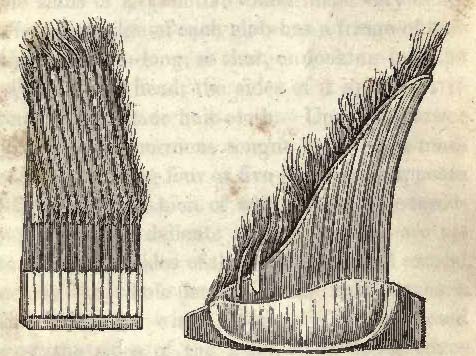 Perpendicular View of the Whalebone. Side View of the Whalebone.
|
|
|
Whalebone in the Rough.
|
A Satin Cushion.
|
|
or eight feet long, narrowing to a point as they approach the lower jaw.
They hang perpendicularly from the crown to the jaw, with their thickest edges out; they are set about half an inch apart, something like the slabs of a Venetian blind made very close. The inner edge of each slab has a fringe of hair about an inch long, so that, on looking into the cavity of the head, the sides of it appear as if lined with felt or hair-cloth. Upon the lower jaw lies the enormous tongue, which is a mass of fat containing four or five barrels: it appears like a large cushion of white satin, so exceedingly soft and delicate is it. The lips are attached to the sides of the lower jaw, and extend nearly the whole length of the head on each side. Except when feeding, they are closed over the sides of the head, their upper edges fitting to the skull or crown, and the whole head appears as a solid mass; but when it takes its food, the whale unfolds the lips, and they drop upon the surface of the water.
The food of this whale, as we have already observed, is a species of shrimp, of a blood-red color. Some of them are very minute, and few are found more than half an inch long;
|
|
|
The Whale at Breakfast.
|
The Whale Adrift.
|
|
these float in immense shoals on the surface of the ocean, and sometimes color the water for miles. When the whale is disposed to break his fast, he rushes through a field of shrimps with open mouth, until he has received myriads of the little animals; then, with the lips thrown open, the water is forced out between the slabs which I have described, leaving the shrimps attached to the hairy strainer within; by means of the tongue they are collected, and the delicate mouthful is conveyed to his capacious stomach.
When "cutting in a whale," as the carcass rolls over by the power of the windlass, the lips, which are composed entirely of hard blubber, are cut off and hoisted on board as they present themselves. The crown bone is also disjointed from the body, and is hoisted in with the whalebone attached to it. A very large head produces a thousand pounds. The tongue and the fins are also saved; so that when the carcass is turned adrift, after being properly stripped, very little oily matter falls to the share of the birds, who make a terrible clamor, however, in quarreling for that little.
The "blubber-room" is a space under the
|
|
|
The Blubber-room.
|
The Oily Blubber-boys.
|
|
main hatch, between decks, capable of receiving the blubber of two or three whales; into this every piece is lowered as it comes from the whale: these are called "blanket pieces," and some of them weigh one or two tons. As they are piled one on another, the pressure of their own weight, with the motion of the ship, which is never at rest, causes the oil soon to exude, and, mixing with the blood, more or less of which comes in with each piece, the blubber-room soon presents an indescribable mess.
Into this odorous retreat it is the duty of one man immediately to descend with a cuttingspade, to commence cutting the "blanket pieces" into "horse pieces;" these are about a foot square, and by means of a pike or fork, are pitched up on deck for mincing, and taken to the "mincing horse," a small table secured to the rail of the ship, where a boy, with a shorthandled hook, holds the piece to keep it from sliding, while the mincer, with a two-handled knife, slashes it nearly through into thin slices, which just hang together; the piece then becomes a "book," and is pitched into a large tub ready for boiling.
A fire is now kindled in the arches under the
|
|
|
The Try Pots.
|
The Fires.
|
Fire Accidents.
| |
pots, which are two or three in number, firmly set in brick work, and each will contain a hogshead of oil. A small quantity of oil is first put in each, and, soon as it becomes heated, fresh. blubber is added, until the pots are full, when a portion from each is bailed out with a large ladle into a copper cooler, from whence it is received into casks and stowed below. The operation of boiling continues day and night until the whole is finished, and sometimes, when whales are plenty, the fires are not put out until the ship is filled.
With such an intense fire over a wooden deck and frame for weeks together, and with tarred cordage and canvass above, both of which would burn like tinder, it may seem strange that so few ships take fire. Close attention and untiring vigilance can alone prevent it. If the "pen" under the works, which should be kept full of water, happen to spring aleak in the night without being observed, a short time only would be sufficient to envelop the ship in flames. Sometimes, too, a pot full of boiling oil will burst, without any apparent cause, and let its contents into the fire beneath. Several ships have been lost by such an accident.
|
|
|
Color of the Oil.
|
Quantity.
|
Density.
| |
Frequently the oil in a pot rises at once and boils over, communicating fire to the others: this is generally checked by means of covers which are at hand to smother the flame; but, though not an uncommon occurrence, it is attended with considerable danger. The color of the oil depends much upon the mode of boiling it. Unless the pots are kept perfectly clean, and no sediment permitted to adhere to the bottom, the oil will be dark and of inferior value. It is necessary, therefore, that one man be constantly employed in stirring the mass, while it is the duty of another to skim out the scraps as fast as they are "done:" these are used for fuel, no wood being necessary after the fire is started.
The blubber on a fat whale is sometimes, in its thickest parts, from fifteen to twenty inches thick, though seldom more than a foot; it is of a coarser texture and much harder than fat pork. So very full of oil is it, that a cask closely packed with the clean raw fat of the whale will not contain the oil boiled from it, and the scraps are left beside: this has been frequently proved by experiment.
Both the sperm and right whale are usually
|
|
|
The Whale's Skin.
|
His Robe of Silk.
|
|
of a jet black color, but not unfrequently the right whale is found with irregular spots of a milky whiteness, very like those on a pied horse. The skin of both kinds is similar. Outside of the sensible skin, which has no peculiarity, there is a coat of something resembling fur, very close and compact, and the fibres united by a glutinous matter, so as to render it about as hard as the rind of a new cheese: this is termed the "black skin," and is about half an inch thick. Still outside of this is a very thin and delicate skin, which, when first detached from the body, whence it is easily stripped, very nearly resembles a glossy black silk; and when the whale basks in the sunbeams on the surface of the water, its smooth outer covering glistens as if it were from the looms of France or Italy, so much is it like the shining silk.
Soon as the business of the voyage is fairly commenced by taking the first whale, the appearance of the ship and her crew wofully changes for the worse. The decks, which have hitherto been kept scrupulously clean, are now covered with oil, and it is only by keeping a thick coat of sand scattered over them that the crew are enabled to get about without slipping.
|
|
|
Oily Cosmetic.
|
Whale Ship in the Suds.
|
|
The smoke from the try-works blackens every face, so that the watch on deck resembles a party of colliers. Each rope, too, exposed to its influence, is coated with lamp-black, and the clothing of the men saturated with oil. Even the sails, which on the passage were of a snowy whiteness, receive their share of defilement; for, as they are handed every night, the men, as they spring aloft from the try-works with besmeared hands and clothes, can not furl them without leaving a mark wherever they touch.
Your ship, perhaps, has been thoroughly scrubbed and cleansed, crew cleared of "gurry," and all again is ship-shape and tidy, when, just after dinner, as all hands are on deck, the welcome cry is raised, "There she blows!" "Where away?" says the captain, hailing the man aloft. "About two points on the lee bow, sir." There she blows! There she blows! is shouted again, and echoed back by a dozen voices all agog. The mate, if lively, is soon aloft. "What do you make them, Mr. ____?" says the captain, mounted on a thwart in the quarter boat, and scanning the horizon with the most eager interest. "I can't make'em out
|
|
|
There goes Flukes!
|
Stand by and Lower.
|
|
yet, sir. There's three or four of'em; and they're going quick to windward."
Presently there sings out one from the foretop-gallant yard, "There goes flu-u-u-kesflukes." This is always decisive, for the right whale, after breathing or blowing a few moments on the surface, pitches down head foremost into the deep, and as the head descends, the tail or flukes rise with a graceful curve above the water, and for a moment are seen in nearly a vertical position, and then slowly disappear. All now in your ship is eagerness and engrossment in the motions of your game, and every man is intent at his station. The tubs of lines have just been put into the boat; the harpoons and lances adjusted in their proper places, ready for action.
"Lower away!" at length cries the mate, and every boat is instantly resting on the water, manned by their respective crews. "Give way, my lads!" is the next you hear, and the boats are leaping as if alive toward the point where the whale was last seen. All orders are now given in a low tone; every man is doing his utmost, and the boats are springing over the smooth swells, each striving to be headmost in
|
Launch the harpoon! Laugh at fear!
Plunge it deep, the barbed spear!
Strike the lance in swift career!
Give her line! Give her line!
Down she goes through the foaming brine.
|
|
|
|
Breaking Water.
|
The Chase.
|
The Dart.
| |
the chase. "Now we rested, with our oars apeak," says a sailor, narrating an actual scene like this, "for the whales, who had gone down, to break water again. Presently they were up and blowing all around, and very much scattered, being alarmed by the boats, so that it was impossible to get near enough for a dart. But at one time five of the monsters rose close to our boats. The mate motioned us all to be silent, when we could have fastened to one, and the only reason, as we supposed, why he did not, was because he was so frightened.
"The whale now ran to the southward, and every boat was in chase as fast as we could spring to our oars. The first mate's boat was headmost in the chase, ours next, and the captain's about half a mile astern. The foremost now came up with and fastened to a large whale. We were soon on the battle ground, and saw him struggling to free himself from the barbed harpoon, which had gone deep into his huge carcass. We pulled upon the monster, and our boat-steerer darted another harpoon into him. "Stern all!" shouted the mate. "Stern all, for your lives!" We steered out of the reach of danger, and peaked our oars.
|
|
|
The Race.
|
The Agony.
|
In at the Death.
| |
"The whale now ran, and took the line out of the boat with such swiftness that we were obliged to throw water on it to prevent its taking fire by friction around the loggerhead. Then he stopped, and blindly thrashed and rolled about in great agony, so that it seemed madness to approach him. By this time, however, the captain came up and boldly darted another harpoon into his writhing body. The enraged whale raised his head above the water, snapped his horrid jaws together, and in his senseless fury lashed the sea into foam with his flukes. The mate now, in his turn, approached near enough to bury a lance deep in his vitals, and shouted again, at the top of his voice, "Stern all!" A thick stream of blood, instead of water, was soon issuing from his spout-holes. Another lance was buried; he was thrown into dying convulsions, and ran around in a circle; but his flurry was soon over; he turned upon his left side, and floated dead. We gave three hearty cheers, and took him in tow for the ship, which was now about fifteen miles off."
This towing of captured whales is no boy's play; although it is one of the pleasantest parts of a whaleman's duty, it is also often the most
|
|
|
Towing a dead Whale.
|
The Galvanism for weary Muscles.
|
|
laborious, and fraught, too, with danger when the ship is distant and nightfall at hand. Under a fierce equatorial sun, to row for hours, perhaps right to windward or in a dead calm, with a carcass of seventy tons' weight dragging astern, will blister the hands and strain the muscles of the hardiest whaleman, and wearied nature will sometimes give out. But it is cheerfully endured for the end in view, of cutting in, and trying out, and stowing down a "hundred barreler," that will net to the ship three thousand or fifteen hundred dollars, according as it is a sperm or a right whale. If money makes the mare go, so does oil the crew of a "blubber hunter," from the green cabinboy to the sable doctor.
|
|
|
Rhymes of an Ancient Mariner.
|
|
CHAPTER VI.
DIFFERENT CRUISING GROUNDS AND NORTHWEST WHALING.
Thou didst, O Lord! create the mighty whale,
That wondrous monster of prodigious length:
Vast are his head and body, vast his tail;
Beyond conception his unmeasured strength.
When he the surface of the sea hath broke,
Arising from the dark abyss below,
His breath appears a lofty stream of smoke,
The circling waves like glittering banks of snow. – Anon.
|
It will be readily surmised that none but a genuine son of the sea, a veritable Cape Horner, "homeward bound," in the great South Pacific, could make these characteristio rhymes, and many other rude but expressive ones, which there is not room to transcribe here. The sailor that made them says of himself, in the course of some doggerel staves of autobiography,
I twice into the dark abyss was cast,
Straining and struggling to retain my breath;
Thy waves and billows over me were past;
Thou didst, O Lord I deliver me from death.
|
Different practised whalemen tell me of
|
|
|
Different Whales Enumerated.
|
The Razor-back.
|
|
twelve or fourteen different species of this great sea monster: right, sperm, black-fish, humpback, razor-back, fin-back, grampus, sulphurbottom, killer, cow-fish, porpoise, nar whale, scrag whale, and elephant whale.. In the attempt to capture one of the latter kind, a New London ship, not long since, lost eleven men, including the first mate. The first four of this catalogue only are much sought after for their oil; now and then some of the others are taken by chance. The razor-back is sometimes one hundred and five feet long, but not so large round as the right whale, bearing about the same comparison to the latter that a razor-faced fellow you now and then meet with among men does to a fair, round alderman. The porpoise, as every one knows, is harpooned from a ship's bow, hauled on board, and its carcass eaten by the name of "sea beef." Its oil, like the ship's slush, is a perquisite of the cook's.
The fin-back, so called from a large fin on the ridge of its back, looking just like the gnomon of a dial, is a large whale found all over the ocean, and, could it be taken, would add greatly to the productiveness of the whale fishery. It often comes near a ship with a ringing
|
|
|
Gambols of the Fin-back.
|
How to be Caught.
|
|
noise, in spouting, like the sound of bell-metal, but it can seldom be so closely approached by a boat as to dart a harpoon; and when it is struck, it is said to run with such amazing swiftness as to part the line before it can be let out, or compel to cut it loose. Its spout at a distance, especially near the Falkland Islands, where I have seen them in great numbers, flashes up from the ocean just like smoke from the breech of a gun fired in a frosty morning. I have seen the horizon thus, for an extent of many miles, all smoking with them, and the ocean all alive with their gambols. It is not a thing beyond the reach of probability that this hitherto unmolested sea-rover may yet be brought within the all-powerful grasp of predatory man by swivels or air-guns, that shall fire harpoons into him, or poisoned arrows from a distance.
The places where the right whale is now most sought by the adventurous American whaleman are, in the Atlantic Ocean, what are called Main and False Banks, between Africa and Brazil, the parts around the Falkland Islands and Patagonia, and the region of ocean in mid-Atlantic, in the vicinity of the Island of
|
|
|
Various Resorts of the Whale.
|
Successful Seasons.
|
|
Tristan d'Acunha; in the Southern Ocean, south of the Cape of Good Hope, there are the uninhabited Crozettes Islands, St. Paul's, and other parts of the Indian Ocean; in the Pacific Ocean, there are the New Zealand cruising ground, the New Holland, Chili, and the Northwest, from the coast of America clear over to Kamtschatka.
This last is now the great harvest-field of American whalers from May to October; and it will be likely to last longer than any other, because they are prohibited by the Russians from bay whaling, which destroys the cows about the time of calving. Almost all ships fill up there. Some have even thrown overboard provisions to make way for oil. The havoc they make of whales is immense. There are ships that took, during the last season, twenty-five to even thirty-three hundred barrels in a few months. I have heard of one ship that sunk twenty-six whales after she had killed them; of another that killed nine before she saved one; of another that killed six in one day, and all of them sunk; of another that had three boats stove and all the men pitched into the sea, without any one's being lost. This
|
|
|
A Huge Northwester.
|
A Veteran Whaler.
|
|
forced trial of hydropathy is, indeed, so common an occurrence, that whalemen make nothing of it.
Those huge northwest whales are more vicious, and less easily approached after they are struck, than the whales of other latitudes. It is considered no disgrace to be run away with by one of those jet-black fellows, found in fortyfive or fifty degrees north; and many an old whaler, who has made his boast that never yet did a whale run off with him, has been compelled to give in beat when fast to one of these "Northwest Tartars."
One captain says he has seen instances of the most wonderful strength and activity in these whales, greater than he ever saw before in either right or sperm. He was once fast to a large cow whale, which was in company with a small one, a full-grown calf. They kept together, and after a time the captain hauled his boat up between them. When they were both within reach, he shoved his lance "into the life" of the cow, at which she threw her flukes and the small part of her body completely over the head of the boat without touching it (although they were half drowned with the water
|
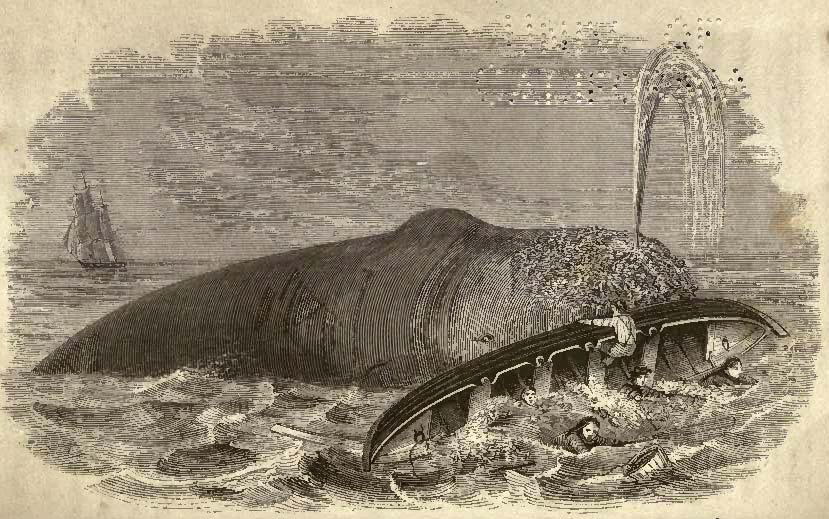 He came up alongside of the Boat and turned it over with his Nose as a Hog would his Eating-trough.
|
|
|
Missing the Mark.
|
Astride of the Flukes.
|
|
she scooped up), and the full weight of the blow, intended for the boat, fell upon the back of the other whale. He sunk immediately, going down bent nearly double, and, the captain thinks, must have been killed by the blow. The same person has seen a stout hickory pole, three inches in diameter and six feet long, broken into four pieces by a blow from a whale's tail, and the pieces sent flying twenty feet in the air, and that, too, when no other resistance was offered than that of the water upon which it floated.
The first whale this man struck there turned him over in two different boats, and afterward "knocked them into kindling wood," while spouting blood in thick clots, and yet this whale lived four hours after, showing its great tenacity of life. He came up alongside the boat, and turned it over with his nose, as a hog would his eating-trough, and then with his flukes deliberately broke it up. Of course the crew had to take to Nature's oars, and they all marvelously escaped unhurt, although one of them was carried sitting upon the whale's flukes several rods, till he slid off unharmed from his strange sea-chariot. This man could say, in
|
|
|
History of Northwest Whaling.
|
|
one of the sailor's rude rhymes whom we have already quoted,
Although he furiously doth us assail,
Thou dost preserve us from all danger free
He cuts our boat in pieces with his tail,
And spills us all at once into the sea.
|
This northwest cruising ground was first visited in the spring of 1836 by two or three of the Chili whalers, who saw, indeed, numerous whales, but gave it as their opinion that the fishery could never be prosecuted there with any success, by reason of constant and dense fogs. The following year several more of the Chili fleet started to the northward, "between seasons," and, looking further to the north and westward, found better weather, and made a good cruise. During the three years following few ships were found there; but upon the almost entire failure of the southern whale fishery, the right whalemen were forced to turn their prows to those inhospitable seas, and the northwest, as all men know, became a very El Dorado to the intrepid American whalers. This cruising ground extends properly from the thirty-fourth to the fifty-ninth degree of north latitude, and from the coast of America, in west longitude say one hundred and thirty, to the
|
|
|
The Whaleman's El Dorado.
|
News from the Arctic.
|
|
meridian of one hundred and seventy east longitude, or about fifty degrees. The largest whales are said to have been found between fifty and sixty degrees north latitude, and from one hundred and forty-five to one hundred and eighty degrees west longitude. At the Fox Islands, in latitude fifty-two degrees north, sperm whales of the largest size have been found as well as right, and near the peninsula of Alaska they are very numerous.
Intelligence from the northern whaling ground of latest date shows that the Arctic Ocean has been entered at Behring's Straits by our intrepid American whalemen. Captain Roys, of the bark Superior, from Sag Harbor, is thus reported in the Sandwich Island Honolulu Friend: "I entered the Arctic Ocean about the middle of July, and cruised from continent to continent, going as high as latitude seventy, and saw whales wherever I went, cutting in my last whale on the 23d of August, and returning, through Behring's Straits, on the 28th of the same month. On account of powerful currents, thick fogs, the near vicinity of land and ice, combined with the imperfection of charts and want of information respecting this region, I
|
|
|
Midnight Whaling.
|
Giant Polar Whale.
|
|
found it both difficult and dangerous to get oil, although there were plenty of whales. Hereafter, doubtless, many ships will go there, and I think there ought to be some provision made to save the lives of those who go there, should they be cast away."
During the entire period of his cruise no ice was seen, and the weather was ordinarily pleasant, so that the men could work in light clothing. In most parts of the ocean there was good anchorage, from fourteen to thirty-five fathoms, and a part of the time the vessel lay at anchor. The first whale was taken at twelve o'clock at night. It was not difficult to whale the whole twenty-four hours, it being so light that it was easy to read in the cabin at midnight. The whales were quite tame, but different from any Captain Roys had ever before taken. He captured three different species, one of the largest yielding two hundred barrels of oil. The first species much resembled the Greenland whale, affording one hundred and sixty or seventy barrels. The second was a species called Polar whale, a few of which have been taken before on the Northwest Coast; and the third was a small whale peculiar to
|
|
|
Maury's Theory.
|
Probable Duration of Northwest Whaling.
|
|
that ocean. The last three whales which were taken yielded together over six hundred barrels.
It is the opinion of Lieutenant Maury, of the United States National Observatory, that all the whales in the Pacific Ocean have particular resorts at certain seasons of the year, where the whalers may generally expect to find them, just as the shad, salmon, herring, and other fish are periodically found. He is endeavoring to work out this conclusion, and to fix the localities of whales' resorts by a comparison of the logs of a vast number of whalers. It is easy to see that, if he should succeed, it will be of great importance to the whaling interest, as it will reduce the expense of outfits by shortening the time of voyages, and making their results more sure and speedy.
If we inquire into the probable duration of this Northwest whaling, including this Arctic opening, there seems good reason to believe, from the extent of ocean it embraces. greater than all the other cruising grounds together, that it will continue good at least twenty or twenty-five years from its commencement. An experienced captain thinks that as there is not, nor is likely to be, any bay whaling on this
|
|
|
A Bill of Mortality.
|
Yearly Destruction.
|
|
cruising ground, the whales will be less constantly hunted, and nearly all the calves born will arrive at an age when they can take care of themselves before the old whales are encountered in the summer season by their sworn enemy, man. He estimates that by three hundred ships capturing or mortally wounding forty whales each, twelve thousand whales are killed in a season; and as many of these, perhaps full half, are cows with calf, the number of whales to be born and arrive at maturity, in order to make up for this sweeping destruction among them, must be not less than eighteen thousand. He thinks, therefore, that the poor whale, chased from sea to sea, and from haunt to haunt, is doomed to utter extermination, or so near it, that too few will remain to tempt the cupidity of man.
The history of the sperm whale fishery, from the first, when only five and six months were necessary to complete a cargo upon the Brazil ground, and fifteen upon that of Chili, to its present almost entire abandonment as a separate business, confirms this calculation. Before the end of the present century, therefore, judging from the past, is it likely that the hunt-
|
|
|
Fact and Speculation.
|
A Problem for Posterity.
|
|
ing of whales on the sea will be any more prosecuted as a business than the hunting of deer on the land? In one part of the world they have been driven to the deepest recesses of Baffin's Bay, and in another to the very confines of the Pacific, and off to the icebergs of the antarctic zone. "Whether their mammoth bones in some distant century shall indicate to the untaught natives of the shores they now frequent that such an animal was, or whether, lurking in the inaccessible and undisturbed waters north of Asia and America, the race shall be preserved, is almost a problem."
They roamed, they fed, they slept, they died, and left
Race after race to roam, feed, sleep, then die,
And leave their like through endless generations:
So HE ordained, whose way is in the sea,
His path amid great waters, and his steps
Unknown!
|
|
|
|
The Whale's Peace Principles.
|
Gentleness of Temper.
|
|
CHAPTER VII.
THE WHALERS BIOGRAPHY AND INCIDENTS IN THE CAPTURE.
The whale he shall still be dear to me,
When the midnight lamp grows dim;
For the student's book, and his favorite nook,
Are illumined by aid of him.
From none of his tribe could we e'er imbibe
So useful, so blessed a thing.
Then hand in hand we'll go on the land,
To hail him the Ocean King. – Sailor's Song.
|
In continuing our inquiries into the peculiarities of whales and incidents of whaling, it is to be remarked of the great right whale (Balena Mysticetus), that, like the hugest of all land animals, its disposition is mild and inoffensive. It never shows fight except when wounded, and then in an awkward and blind way, that proves it is not used to war either offensive or defensive. Its immediate recourse is to flight, except when it has young to look out for, and then it is bold as a lion, and manifests an affection which is itself truly affecting. It grazes quietly through the great deep, never
|
|
|
The Creator's Wisdom.
|
Care for their Young.
|
|
using its prodigious strength to seize or lord it over other inhabitants of the seas, but strains its insect-like food through its admirably contrived apparatus of bone and hair, that strikingly evinces His beneficence and wise design,
Whose creating hand
Nothing imperfect or deficient left
Of all that he created.
|
It makes one think of the couplet we used to read, when boys, in the New England Primer:
Whales in the sea
God's voice obey.
Even the mute fish that swim the flood,
Leap up, and mean the praise of God.
|
I have heard of one of these whales with a cub, when driven into shoal water, being seen to swim around its young, and sometimes to embrace it with her fins, and roll over with it in the waves, evincing the tenderest maternal solicitude. Then, as if aware of the impending peril of her inexperienced offspring, as the boat drew near, she would run round her calf in decreasing circles, and try to decoy it seaward, showing the utmost uneasiness and anxiety. Reckoning well that, the calf once struck, the dam would never desert it, the only care of the harpooner was to get near enough to bury
|
|
|
An Affecting Instance of Maternal Solicitude in a Whale.
|
|
his tremendous weapon deep in its ribs, which was no sooner done than the poor animal darted away with its anxious dam, taking out a hundred fathoms of line. It was but a little time, however, before, being checked, and the barb lacerating its vitals, it turned on its back, and, displaying its white belly on the surface of the water, it floated a motionless corpse.
The huge dam, with an affecting maternal instinct more powerful than reason, never quitted the body till a cruel harpoon entered her own sides; then, with a single tap of her tail, she cut in two one of the boats, and took to flight, but returned soon, exhausted with loss of blood, to die by her calf, evidently, in her last moments, more occupied with the preservation of her young than of herself.
The habits and living of the sperm whale are quite as different from those of the right as is its structure. Its head is enormously large and unshapely, and furnished with an immense under jaw, that is armed with two rows of mammoth teeth, forty-eight and fifty-four in number. It seizes its prey with these teeth, having no whalebone sieve or strainer, like what has been already described in the right whale,
|
|
|
Sperm Whale Disgorging.
|
Sperm Whale Feeding.
|
|
and it is supported principally by the squid, otherwise called cuttle-fish, or Sepia Octopus, of which one sperm whale that we have lately captured disgorged pieces as long as the whale boat, before going into its flurry.
From what I have observed myself and have been told by others, it appears that when this whale is inclined to feed, he goes to a certain depth below the surface, and there remains in an oblique position, as quiet as possible, opening his vast elongated mouth like a great bagnet, until the lower jaw hangs down perpendicularly, or at right angles with the body. The roof of his mouth, the tongue, and especially the teeth, being of a glistening white color, must of course present a remarkable appearance, which seems to be that which attracts his prey. When a sufficient number of other fish, or quantity of the squid, as the case may be, are within the mouth, he rapidly closes his jaw and swallows the contents.
When this creature is fatally struck or killed while in the act of feeding, the whalemen will soon know the items of its last bill of fare; for, while the waters around are purpled with its gore, and a crimson tide is flowing from its
|
|
|
Sperm Whale in Pain.
|
Sperm Whale Dying.
|
|
spiracles, portions of its lance-lacerated lungs and the contents of its capacious stomach also are being vomited at the mouth. The sea, too, will be lashed by its mighty tail with a sound that may be heard in calm weather for miles like thunder.
It is painful to witness the death-agony of any creature, even the smallest that God has given life to, much more that of one in which life is so lively and tenacious, and animating so vast a bulk. And though it be true what the dramatic poet said,
The sense of death is most in apprehension,
And the poor beetle that we tread upon,
In corporal sufferance feels a pang
As great as when a giant dies,
|
Yet I am not one that can coolly observe the last agony of so mighty an organized creature as the whale with as little emotion as some persons feel at the crushing of a reptile or the writhing of a worm; nor do I believe that the suffering in the one case is as great as that in the other. But it is painful enough to see any thing forcibly bereft of the boon of life, the gift of Him that made us all,
Who gives its luster to the insect's wing,
And wheels his throne upon the rolling worlds.
|
|
|
|
Sperm Whale sick.
|
Sperm Whale wanting Physic.
|
|
Cowper's principle in regard to animals and insects is the right one:
The sum is this: if man's convenience, health,
Or safety interfere, his rights and claims
Are paramount, and must extinguish theirs.
Else they are all-the meanest things that are
As free to live, and to enjoy that life,
As God was free to form them at the first,
Who in his sovereign wisdom made them all
|
The substance called ambergris, and highly prized in perfumery, is obtained from the sperm whale, being formed, it is thought, in that state of the system which calls for a cathartic. A peck of Morrison's or Brandreth's pills, or the homeopathic dose of a pound of calomel and jalap, would probably remove obstructions in the creature's abdominal viscera, and prevent the formation of ambergris concretions, with undoubted benefit to the whale's corporation from the drastic operation, though it might be a loss to the perfumer and the Asiatic gastronomer, inasmuch as we learn from the Materia Medica that in Asia and parts of Africa ambergris is not only used as a medicine and a perfume, but considerable use also is made of it in cooking, by adding it to several dishes as a spice. A great quantity of it also is constantly brought by the pilgrims who travel to
|
|
|
Ambergris for the Perfumer.
|
Whence Derived.
|
|
Mecca, probably to offer it there in fumigations, like as frankincense in the worship of the Church of Rome.
A costive whale, when struck by the harpoon, will often throw up or discharge this substance, and it will be found floating about him. It is said to have been a Nantucket whaler that thus accidentally ascertained the origin of a substance which had been known before vaguely as an unaccountable product of the sea. Pieces have been picked up by sailors about a dying whale worth twenty dollars; and masses of it have been found of from sixty to two hundred and twenty-five pounds' weight, floating on the surface of the ocean, in regions much frequented by the sperm whale. We have not been so fortunate as to light upon any. It is a pity that nine tenths of the mineral drugs in use could not be employed to purge the ambergris out of the huge intestines of sick whales, rather than to turn the stomachs, and irritate the bowels, and loosen the teeth, and produce caries in the bones of men.
If the gigantic denizens of the deep were as much physicked, doubtless there would be full as much sickness among them as among the
|
|
|
Disorders and Deformities of Whales.
|
Their Wars.
|
|
human mammalia on the land. As it is, it is quite clear that they are subject both to disease and deformity, some having been taken that were entirely blind, both eyes being completely disorganized, and the orbits occupied by fungous masses protruding considerably; rendering it certain that the whale must have been deprived of vision for a considerable space of time, yet not so as to incapacitate him for feeding, blind whales being found as fat as the seeing ones.
The deformity referred to is a crookedness of the lower jaw, which old whalers say is caused by fighting. Sperm whales have been seen to fight by rushing, head first, one upon the other, their mouths at the same time wide open, their object appearing to be to seize their opponent by the lower jaw. For this purpose they frequently turn themselves on the side, and become, as it were, locked together, their jaws crossing each other, and in this manner they strive vehemently for the mastery, with a force compared to which not even Milton's wars of the angels
Could merit more than that small infantry
Warred on by cranes; though all the giant brood
Of Phlegra with the heroic race were joined
|
|
|
|
Term of Life.
|
The Size and Weight of a Youngling.
|
|
That fought at Thebes and Ilium, on each side
Mixed with auxiliar gods; and what resounds
In fable or romance, of Uther's son,
Begirt with British and Armoric knights.
|
The size of a sixty foot right whale, which is, perhaps, that of the average, can be somewhat clearly apprehended by Captain Scoresby's estimate of its weight at seventy tons, or the weight of three hundred fat oxen, of which the oil in a fat subject will be nearly thirty tons. Some whalemen judge it does not attain its full size until twenty-five years, by certain notches which they think they can observe in the slabs of whalebone. But this can not be clearly ascertained. The natural life of the animal is undoubtedly much longer. Analogy would lead to the inference that it might be as long lived as the elephant, to which it bears a resemblance in certain other particulars besides its size.
The calf of a large right whale at birth is about fourteen feet long, and weighs a ton. The milk of the cow is then very abundant. I have heard those who have seen it say, that when the mammae of a nursing cow whale are cut, the flow of milk will whiten the ocean. The ascertained fact that it brings forth its young only one at a time, or at most two, and probably
|
|
|
Time of Gestation.
|
Natural Enemies of the Whale.
|
|
once a year, or after a period of nine or ten months' gestation, together with the rapid decrease of their numbers by slaughter on every cruising ground in the ocean where whalers have found them, to the number often of hundreds at once, would seem to be evidence of its slow growth and long life.
The only natural enemies it is known to have are the sword-fish, thrasher, and killer. This latter is itself a species of whale that has sharp teeth, and is exceedingly swift in the water, and will bite and worry a whale until quite dead. When one of them gets among a gam or school of whales, he spreads great consternation, and the timid creatures fly every way like deer chased by the hounds, and fall an easy prey to whale-boats that may be near to avail themselves of the opportunity. I have heard a captain detail with great interest a scene of this kind, in which the killers and harpooners were together against the poor whales, and the killers actually succeeded in pulling under and making off with one prize which the whalemen thought themselves sure of.
In the United States exploring squadron, on board the Peacock, as we learn from the nar-
|
|
|
Fight with a Killer.
|
Terrible Conflict.
|
|
rative of Commander Wilkes, they witnessed a sea-fight between a whale and one of these enemies. The sea was quite smooth, and offered the best possible view of the combat. First, at a distance from the ship, a whale was seen floundering in a most extraordinary way, lashing the smooth sea into perfect foam, and endeavoring apparently to extricate himself from some annoyance. As he approached the ship, the struggle continuing and becoming more violent, it was perceived that a fish, about twenty feet long, held him by the jaw, his spoutings, contortions, and throes all betokening the agony of the huge monster.
The whale now threw himself at full length upon the water, with open mouth, his pursuer still hanging to his under jaw, the blood issuing from the wound, and dyeing the sea for a long distance around. But all his flounderings were of no avail; his pertinacious enemy still maintained his hold, and was evidently getting the advantage of him. Much alarm seemed to be felt by the many other whales about. These "killers" are of a brownish color on the back, and white on the belly, with a long dorsal fin. Such was the turbulence with which they pass-
|
|
|
Sword-fish and Thrasher united against the Whale.
|
|
ed, that a good view could not be had of them to make out more nearly the description. These fish attack a whale in the same way that a dog baits a bull, and worry him to death. They are endowed with immense strength, armed with strong, sharp teeth, and generally seize the whale by the lower jaw. It is said the only part they eat of them is the tongue.
The sword-fish and thrasher have been also seen to attack the whale together, the swordfish driving his tremendous- weapon into the belly of the whale from beneath upward, and the thrasher fastened to his back, and giving him terrific blows with his flail. The thrasher not having any power to strike through the water, it has been observed by all who have witnessed these strange combats, that it seems to be the instinctive war policy of the sword-fish to make his attack from below, thus causing the whale to rise above the surface, which, under the prick of the cruel sword of his enemy, he has been known to do to a great height, the unrelenting thrasher meanwhile holding on like a leech, and dealing his blows unsparingly through the air with all the force of his lengthy frame, sometimes twenty feet.
|
|
|
A Combat Witnesaed between the Sea Serpent and Whale.
|
|
From a statement made by a Kennebec shipmaster in 1818, and sworn to before a justice of the peace in Kennebec county, Maine, it would seem that the notable sea serpent and whale are sometimes found in conflict. At six o'clock in the afternoon of June 21st, in the packet Delia, plying between Boston and Hallowell, when Cape Ann bore west southwest about two miles, steering north northeast, Captain Shubael West, and fifteen others on board with him, saw an object directly ahead which he had no doubt was the sea serpent, or the creature so often described under that name, engaged in fight with a large hump-back whale that was endeavoring to elude the attack.
The serpent threw up his tail from twentyfive to thirty feet in a perpendicular direction, striking the whale by it with tremendous blows rapidly repeated, which were distinctly heard and very loud for two or three minutes. They then both disappeared, moving in a west southwest direction, but after a few minutes reappeared in shore of the packet, and about under the sun, the reflection of which was so strong as to prevent their seeing so distinctly as at first, when the serpent's fearful blows with his
|
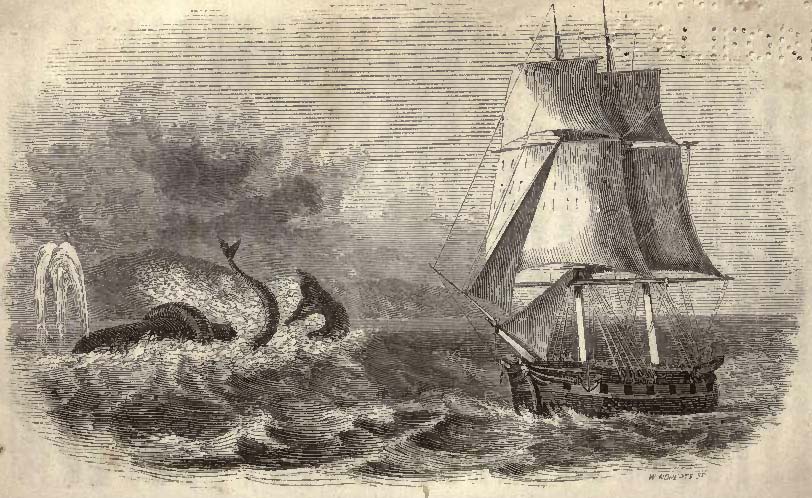 Combat between a Whale and the Sea Serpent.
|
|
|
His Power is in his Tail.
|
The Whale Beat.
|
|
tail were repeated and clearly heard as before.
They again went down for a short time, and then came up to the surface under the packet's larboard quarter, the whale appearing first and the serpent in pursuit, who was again seen to shoot up his tail as before, which he held out of water some time, waving it in the air before striking, and at the same time, while his tail remained in this position, he raised his head fifteen or twenty feet, as if taking a view of the surface of the sea. After being seen in this position a few minutes, the serpent and whale again sunk and disappeared, and neither were seen after by any on board. It was Captain West's opinion that the whale was trying to escape, as he spouted but once at a time on coming to the surface, and the last time he appeared he went down before the serpent came up.
Between all these natural foes and its predatory human enemy, the great mammoth of ocean seems doomed to extinction. But I have no scruple at confessing that, since I have become closely acquainted with the habits of the great right whale, how quietly it grazes through the great pasture-ground which God has or-
|
|
|
A Doubt Started.
|
Opinion of an Old Salt.
|
|
dained for it and fitted so well to be its home, and since I have observed the hazards that have to be encountered and the perils to be surmounted in its capture by men, and have coupled with this the consideration of the various other sources from which the human family can now be supplied with oil, whether for burning or the arts, I begin to be somewhat doubtful about the lawfulness and expediency of the whale fishery. As an old whaleman once said in his own way, "Whales has feelings as well as any body. They don't like to be stuck in the gizzards, and hauled alongside, and cut in, and tried out in them'ere boilers no more than I do."
This may seem foolish, and let it go for what it is worth. But if the business can not be successfully pursued without the flagrant violation of the Sabbath now caused by it, and the consequent disastrous effect upon the moral and religious characters of those engaged in it, no well-grounded Christian will be in doubt as to its unlawfulness and immorality. Whale ships, almost without exception, desecrate the Lord's day by taking their game and making way with it just as on any common day. They
|
|
|
Sabbath Desecration.
|
A Sailor's Right.
|
|
pay no practical regard whatever to the great law of the Sabbath, seeming utterly to forget the combined prophecy and principle,
Who resteth not one day in seven,
That soul shall never rest in heaven!
|
But of this more hereafter. Meanwhile, let me say to any seamen that may chance to read these pages, hold fast to the Sabbath; claim it of your employers as a right; stipulate beforehand that it shall be yours for rest, religious reflection, and worship, and refuse on principle to desecrate it by any other labor than may be necessary for the safety and proper working of the ship.
Wanderers on the dark blue sea!
As your bark rides gallantly,
Prayer and praise become ye well,
Though ye hear no temple bell.
The Sabbath hours which God has given,
Give ye to worship, rest, and heaven!
|
|
|
|
Notable Cape Horn.
|
Propitious Weather.
|
|
CHAPTER VIII.
ATLANTIC OCEAN MAMMOTHS AND MONSTERS.
In the free element beneath me swam,
Flounder'd, and dived, in play, in chase, in battle,
Fishes of every color, form, and kind;
Which language can not paint, and mariner
Had never seen; from dread Leviathan
To insect millions peopling every wave:
Gather'd in shoals immense, like floating islands,
Led by mysterious instinct through that waste
And trackless region, though on every side
Assaulted by voracious enemies,
Whales, sharks, and monsters, arm'd in front or jaw,
With swords, saws, spiral horns, or hooked fangs.
|
|
World before the Flood.
|
False Banks, Atlantic Ocean, lat. 36º S., Lon. 46º W.
Since doubling Cape Horn, Providence has been propitious in the offer of whales. We lowered off the notable Cape itself, when in sight of the islands called Diego Ramirez. Although so near to that formidable out-jutting barrier of Nature, between two great oceans, which the reports of weather-beaten mariners have made the abiding-place of storms, it was the loveliest day we had known since leaving the southern
|
|
|
Nocturnal Heavens.
|
A School of Sperm Whales.
|
|
tropic; the sky cloudless, the sun genially warm, its place in the heavens away off to the north of us, and the ocean nearly calm. The short night, too, was one of surpassing splendor, the whole southern hemisphere lit up with all the glorious lamps, never seen by those who dwell at the north, the Magellanic clouds, and the sightly constellation of the southern cross, and a brilliant though small comet visible in the southwest, its tail pointing upward to the zenith, and about twice as long as the belt of Orion.
In the afternoon a school of sperm whales passed us, making for the Pacific with all the speed of flukes and fins. They showed themselves a few minutes about a quarter of a mile off, and three boats were soon lowered in pursuit; but they never let us see them again, it being the habit of the sperm whale to stay under water much longer than the right whale. Poor fellows! they will find keen human enemies enough where they were going, and not unlikely the blubber sides of one or more of them are already headed up in the hold of some ship, and biding their time to fill honorable lamps with light ten thousand miles off.
|
|
|
Up in the Mizzen Rigging.
|
Capture of a Calf.
|
|
We have felt the cold this side the American continent, in the rude Atlantic, more than ever in that other ocean, which does not belie its name, or even than at the pitch of the Cape, in sixty degrees south. A few days ago, just after breakfast, I had the pleasure of climbing the mizzen rigging to witness the capture of our first Atlantic whale. The ocean was in its stillest, loveliest mood, its breast heaving only like a sleeping infant's; the morning sun most glorious; the sky without a cloud, and that glimmer of reflection from the molten steel mirror beneath, which I remember being so much struck with the first time I ever saw the sublime sight when a boy.
The two whales proved, as was thought, to be a cow and a yearling calf, perhaps a steer of the second year. They were putting their heads together as in love, or to rub off the crablice and barnacles that adhere by millions to the top and sides of their heads. The calf was soon struck, and made little ado of being killed, not going into a flurry, or sounding long, or making the water foam, fly, or splintering the cedar with strokes of his tail, and "spilling the men," as they sometimes do.
|
|
|
Dimensions of a Cub.
|
A Marine Wonder.
|
|
The one thought to be the dam prudently made off a mile and a half to windward, while we got the cub alongside the ship about eleven o'clock. His proportions were respectable for a youngling-thirty-nine feet long and nineteen feet round; his head seven feet from its tip to the spout-holes, and three feet wide just behind the same, and three feet thick to the inside roof. The thickest of the blubber was eight inches. His fins were each five feet long, and he was six feet across the throat. They rifled him of his blubber and bone in the way already described, and some time before evening the refuse scrap-matter of his blubber was burning brightly under the try-works, and affording all the fuel for trying out.
Just after sundown that evening, while we were lying to, and the try-works were blazing, there was seen going slowly by the ship, a rod or two off, a large sun-fish. The captain cautiously lowered his boat, and, paddling lightly, was up with him, and had effectually darted his cruel iron before danger was suspected. Finding it impossible to hoist him into the boat or warp him along, they made fast another iron, and came to the ship with the tow-line,
|
|
|
Sun-fish Described.
|
Chowder Fore and Aft.
|
|
which the men at once reeved round a block, and soon merrily hauled him in, singing the while a sailor's song.
We found our prize a singular-looking ichthyological wonder as ever was seen. His form is that of an ellipse, or like an elliptical shield, about four and a half feet in the longest diameter, three feet across, and one foot thick. His mouth is small and round, like a sea-porcupine's, and sucking constantly with great force like a sucker. His eye is large as a bullock's, and very prominent. He has two curious fins to scull with-one on his belly, or one rim of the ellipse, the other on his back, or the other rim of the ellipse-and a sort of steering oar in the middle of one of the sides. He moves edgewise through the water. He is covered to the depth of three or four inches on both sides with a white elastic case, like the meat of a cocoanut, and very much resembling the sturgeon's nose that boys put into balls to make them bounce well.
Under this case lies some excellent white meat, which has been dug out and served up into very fine chowder, and has supplied all hands, fore and aft, with several excellent meals,
|
|
|
Losing a Right Whale.
|
Taking and Saving a Sperm.
|
|
that relish nobody can tell how that has not been as long at sea without any thing fresh. The liver of this sun-fish contains a large quantity of yellow oil, which is thought to be excellent as an external unguent or embrocation for the rheumatism.
The next morning our captain made fast to another much larger right whale, turned him up dead about half past ten, after a hard fight, and in less than twenty minutes the huge carcass sunk bodily, with all the irons in it-a dead loss of more than a thousand dollars, which could easily have been prevented, had there been buoys or floats to have bent on to harpoons, and darted into him as soon as dead.
A few days after this mortifying event, we had much better success in the capture of a large bull whale, of the sperm kind, worth to the ship at least twenty-five hundred dollars. The captain's boat was also fast to another, that ran off very swiftly upon being struck, along with the rest of the school, making the deep to boil like a pot, and terrifying all his comrades by the extravagant and mad antics which the prickings of those cruel irons naturally goaded him to They would have been
|
|
|
Sperm Whale Lanced.
|
Sperm Whale Left.
|
|
glad enough, I have no doubt, to help their brother whale in his pilikia, and as it was they greatly endangered the lives of all his pursuers. But after being lanced several times, and dragging the lone boat quite out of sight from the mast-head, and tiring them all out, he was cut loose from, and left with two harpoons buried in his blubber sides. They will probably prove the death of him in a few days, and waste his oil upon the ocean like thousands before.
I was feeling not a little anxiety for the captain and boat's crew, pursuing thus alone and out of sight, amid a horde of infuriated and frightened whales, all the time fastened to one of them by those great harpoons, and momently liable to be struck and upset. It was a pleasurable relief to hear them announced from the masthead as returning, though I could not help pitying that they should have to come back with only their labor for their pains; and, when seemingly in the very arms of victory, after all the hazard and toil of the chase, to be compelled to abandon the lawful prize, which perhaps an hour's longer holding to would have mae.e all their own. But such, time and again, is a whaleman's fortune. To him, emphatically,
|
|
|
Concord of Whales.
|
A Lesson for Man.
|
|
There's many a slip
'Tween the cup and the lip.
|
From the conduct of those whales, from what I have before observed, and from what others that know tell me, it is evident that the societies of these great sea monsters seldom go to war, but live together in cordial and happy amity, and render each other all the help in their power when in distress. They read to predatory and contentious man the same lesson that Milton derives from the concord of the fallen angels:
O shame to men! devil with devil damn'd
Firm concord holds; men only disagree
Of creatures rational, though under hope
Of heavenly grace; and, God proclaiming peace,
Yet live in hatred, enmity, and strife
Among themselves, and levy cruel wars,
Wasting the earth, each other to destroy:
As if (which might induce us to accord)
Man had not hellish foes enow besides,
That, day and night, for his destruction wait.
|
|
|
|
Misery finds Company.
|
Getting into a Gam.
|
|
CHAPTER IX.
EPISODES IN THE FORTUNES OF WHALEMEN.
There she lies! there she lies!
Like an isle on ocean's breast;
"Where away?" west southwest,
Where the billows meet the skies.
Port the helm! trim the sail!
Let us chase this mighty whale. – Whaler's Song.
|
The mortifying event referred to in the last chapter of losing our whale by sinking, after all the toil and hazard incurred in its capture, is paralleled only by a like occurrence in the fortunes of another whaleship on these very False Banks some two or three years ago, which I will give, partly in the words of one who was himself an actor in the scene described, being one of the hands in the captain's boat.
Upon getting into a "gam" of whales, this boat, together with that of one of the mates, pulled for a single whale that was seen at a distance from the others, and succeeded in getting square up to their victim unperceived. In
|
|
|
Grounding on a Whale's Back.
|
A Round Turn.
|
|
a twinkling the boat-steerer sprang to his feet, and, as he darted his second harpoon, the bow of the boat grounded on the body of the whale, but was instantly "sterned off," and before the whale had sufficiently recovered from his surprise to show fight, the "cedar" was out of the reach of his flukes.
The captain, who now took his place in the bow of the boat, seized his lance, and the oarsmen again shot the boat ahead, but before he could plunge the lance the whale pitched down and disappeared. The line attached to the harpoon, being of great length, is coiled very carefully and compactly in a large tub in the centre of the boat; from thence it passes to the stern, and around a post called the loggerhead, firmly secured to the frame of the boat; and it is used for checking the line by friction as it runs out, a "round turn" being taken for that purpose. From the loggerhead the line passes along the whole length of the boat between the men, and leads out through a notch in the bow to the harpoons, two of which are always attached to the line's end.
Soon as the whale disappeared, the line commenced running through the tub so rapidly,
|
|
|
Sparks from Loggerhead.
|
Line Foul.
|
Captain Overboard.
| |
that, as it rubbed around the loggerhead, sparks of fire flew from it in a stream. As the different coils run from the tub, they sometimes, when not well laid down, get "foul" or tangled, in which case there is great danger, for, in attempting to clear it, a turn will get by accident around an arm or a leg. As any one can see, there is little hope for the unhappy man thus entangled, for, unless the line be cut instantly, either the limb is lost or the man goes overboard.
A few years since, one of the most active and energetic of our whaling captains was thus taken overboard by the line, and had the singular good fortune to survive to tell the story. The whale was sounding very swiftly when the line became entangled. The boat-steerer, who was at his post in the stern of the boat, tending the line, instantly threw the turn off the loggerhead, and the tangled part ran forward and caught in the bow. The captain was seen to stoop to clear it, and then at once disappeared. The boat-steerer seized the hatchet, which is always at hand, and chopped the line, with the faint hope that when it slackened the captain could extricate himself.
|
|
|
Body Recovered.
|
Animation Restored.
|
|
The accident being so sudden and dreadful as almost to stupify the amazed crew, neither of them spake a word, but each eye was fixed upon the sea with fearful interest. Several minutes had elapsed, and the last hope was expiring, when an object was seen to rise to the surface a short ways from the boat, which, though exhibiting no sign of animation, was speedily reached, and the body of the captain, apparently lifeless, was lifted into the boat. It was evident that vitality was not extinct, and, to the joy of the little crew, symptoms of consciousness became visible in a few minutes, and the oars were lustily plied to reach the ship. By means of the usual remedies, the resuscitated captain was in a few days, in his own words, "as good as new."
In giving an account of the accident and his singular escape, he said that, as soon as he discovered the line had caught in the bow of the boat, he stooped to clear it, and attempted to throw it out from the "chock," so that it might run free. In doing this he must have caught a turn round his left wrist, and felt himself dragged overboard. He was perfectly conscious while he was rushing down, down, with un-
|
|
|
The Captain's Story.
|
How Released.
|
|
known force and swiftness; and it appeared to him that his arm would be torn from his body, so great was the resistance of the water. He was well aware of his perilous condition, and that his only chance for life was to cut the line. But he could not remove his right arm from his side, to which it was pressed by the force of the element through which he was drawn.
When he first opened his eyes, it appeared as if a stream of fire was passing before them; but as he descended it grew dark, and he felt a terrible pressure on his brain, and a roaring as of thunder in his ears. Yet he was conscious of his situation, and made several efforts to reach the knife that was in his belt. At last, as he felt his strength failing and his brain reeling, the line for an instant slackened; he reached his knife, and instantly that the line again became taut, its edge was upon it, and by a desperate effort of his exhausted energies he freed himself. After this he only remembered a feeling of suffocation, a gurgling spasm, and all was over, until he awoke to an agonizing sense of pain in the boat.
But to come back from this digression, the whale to which our hero's boat was now fast
|
|
|
A Common Disaster.
|
Boat-line Afoul.
|
|
took out a large portion of the line with great rapidity before it was deemed prudent to check it; then an extra turn was taken around the loggerhead, and the strain upon it became very great; for the whale, continuing to descend, would bring the bow of the boat down till the water was just about to rush over the gunwale and fill it, when the line would be "surged," or slacked out.
Sometimes, when the line is nearly spent, and there is great danger of losing the whale by having it all run out, the disposition to hold on has been fatally indulged too far, and the boat taken down. I have heard of one boat being thus lost on the "False Banks," and her whole crew drowned. And very lately the whaling bark Janet, of Westport, lost her captain and a boat's crew of five men, they being all carried down and drowned by the boat-line getting foul while they were fast to a whale.
In the present instance, before taking all their line, the whale began to ascend, and as it became slackened, the line was hauled in, "hand over hand," by the boat's crew, and coiled away by the boat-steerer. The moment the whale came to the surface, "he went smok-
|
|
|
Novel Mode of Travel.
|
The Beast seeks Company.
|
|
ing off like a locomotive with an express." They held manfully to the line, and with oars peaked, ready to be seized in a moment, they dashed along in the track of the whale. Had they been fast yoked to a team of wild horses on a plank road, their rate of traveling could hardly have been quicker. Mile-stones, trees, and rails were all one in their Gilpin race; and, Mazeppa-like, as they dashed along at the heels of the monster, they could only see one white bank of foam, which rolled up before them higher than the bow of the boat, as if it would momently rush aboard.
The whale, in this instance, decided that their ride should not be altogether barren of variety, for they soon found themselves rushing into the midst of loose whales, who, having been disturbed by the other boats, were merrily fluking and snorting all around, and playing their mad antics and gambols. The other boats had also fastened, and as their whale, too, seemed to have a fondness for company, they were all in a muss together.
At length, as the first whale slackened his speed, they hauled up to him, and the captain darted his lance adroitly, which took effect.
|
|
|
Finds an Enemy.
|
The Flurry.
|
The Death Leap.
| |
The second mate, who had kept as near as possible during the chase, now fastened with his barbed irons, and whichsoever way the harassed whale turned, he met an enemy. Weakened with the loss of blood, that was now jetted forth from his huge nostrils in torrents, the subdued monster soon became passive, and his captors lay off at safe distance to wait the last struggle. This was speedily over; for, after a few moments of convulsive writhing, there came the final spasm, which is always terrible to see. The surrounding waters were lashed into foam, and all previous exhibitions of power were as nothing compared with the incredible strength put forth in the flurry.
At last, leaping almost clear from the water, the whale pitched down head foremost, and as their lines tautened, they commenced hauling in hand over hand, expecting that he would die under water, and that the body would rise direbtly; but in this they were deceived. The strain upon the lines soon indicated that the whale was sinking, and it was all in vain they endeavored to check its downward tendency. It would sink like lead in spite of all their efforts, and they were obliged at last to cut
|
|
|
The Disappointment.
|
No Anomaly.
|
|
the lines in order to keep the boats from going down with it. Thus they lost not only the fruits of many hours of severe toil, but a large quantity of line and the valuable harpoons also, besides the incalculable moral detriment and loss'of spirits from such a disappointment.
Bad as this luck was, it was not attended with loss of life like the following I have met with in fragments of a sailor's journal, being a contribution to "The Sheet Anchor:" We were cruising, he says, somewhere between the latitude of thirty-six and thirty-seven degrees south, and the longitude of sixty-eight degrees east, in search of right whales. It was in the afternoon, and the ship was moving along under her top-gallant sails at the rate of about five knots the hour. The most hardened grumbler could not find fault with the day. At the fore and main top-gallant cross-trees were two men on the look-out for whales. It was now nearly four o'clock, when the man at the main sung out, "There she blows!" He repeated the cry regularly five or six times. All was now excitement among the officers and men. Every one was anxious to know if it was the kind of whale we wanted. The mate hailed
|
|
|
Call all Hands.
|
Stand by and Lower.
|
|
the man at the mast-head, "Where away is that whale? What do you call her?"
"Right whale, sir, on the lee beam, two miles off; look out sharp for her!"
"Sing out when the ship heads for her!"
"Ay, ay, sir."
"Keep her away!" said the captain to the man at the helm. "Boy, hand me the spyglass." "Steady!" sung out the man at the mast-head. "Steady it is!" answered the wheel. The captain then started to go aloft. "Mr. A. (to the mate), you may square in the after yards, and then call all hands."
"Forward, there!" shouted the mate. "Haul the main-sail up and square the yards! Bill!" (to an old sailor). "Sir?" "Call all hands!" "Ay, ay, sir. All hands, ahoy!" shouted old Bill, in a voice like a tempest. "Stand by the boats!" In less than no time the deck was alive with men.
"Boat-steerers, get your boats ready!" In a moment, as it were, the boats were in readiness, the tubs put in, the lines bent on to the harpoons, and the crews standing by, ready to follow the boats down to the water, when the word came from the captain to lower away.
|
|
|
Blood up in the Chase.
|
A Tight Pull.
|
|
"There she blows!" sung out the man at the fore; "not half a mile off."
"Down helm!" shouted the captain. "Mr. A., brace up the mizzen top-sail. Hoist and swing the boats! Lower away!" Down went the boats, and down followed the crews. As the boats struck the water, every man was on his thwart, with his hand on the loom of his oar, and all at once the three boats were cutting their way through the water in the direction of the whale.
It was my duty to steer the mate's boat, and she happened to be the fastest puller, so that, although we all left the ship together, and for a few rods kept nearly head and head with each other, still we knew well enough that, as soon as the word came from the mate to "give way," we should drop the others in a moment. So we did not fret ourselves, but kept cool for a tight pull when the whale should show himself on the.surface of the water again, which he did the moment after.
"Here she is!" cried the mate; "and not over ten rods from the boat. Now, my dear fellows, lay back hard! Spring hard, I tell you! There she blows! Only give way, my
|
|
|
Harpoons in.
|
Stern all!
|
Takes to Sounding.
| |
boys, and she is ours!" The boat bounded forward like a thing of life. "Spring like tigers!" said the mate, his voice sinking almost to a whisper. I looked over my shoulder to see what kind of a chance I was about to have, at the same time pulling at my own oar with all my might. We were going on her starboard quarter; just the chance I liked to fasten to a whale.
"Stand up!" shouted the mate; and in a moment I was on my feet, and in the next moment I had two harpoons to the hitches into her. "Stern! stern all!" sung out the mate, as he saw the irons in the whale. "Come here, my boy!" said he to me. We shifted ends; he to the head, and I to the stern of the boat. The whale started off like lightning.
"Hold on, line!" said the mate; and away we shot after her, like an arrow from the bow. The mate by this time had his lance ready.'' Haul me on to that whale!" he shouted; and all hands turned to hauling line, while I coiled it away in the stern-sheets. We had got nearly up to the whale when she took to sounding, taking the line right up and down from the head of the boat. I had two turns of the line
|
|
|
Something not looked for.
|
The sudden Catastrophe.
|
|
round the loggerhead, and was holding on as much as the boat would bear, when, all at once, another large whale, that we knew nothing about, shot up out of the water nearly her whole length, in a slanting position, hanging directly over the boat. I threw off the turns from the loggerhead, and shouted to the men to "stern." But it was of no use; she fell the whole length of her body on the boat.
I heard a crash! and, as I went down, I felt a pressure of water directly over my head, caused, as I thought, by the whale's flukes as she struck. How long I was under water I know not; but I remember that all looked dark above me, and that I tried very hard to shove my head through in order to breathe. At last I succeeded; but what a sight was that on which I gazed when I found myself on the surface of the water! About a rod off was the whale that we were fast to, thrashing the water into a foam with his flukes, the ocean red with blood, and the crimson streams pouring from the wounds in the whale's sides made by the harpoons. In another direction I could see pieces of the boat floating around. At the distance of two or three miles, I could occasional-
|
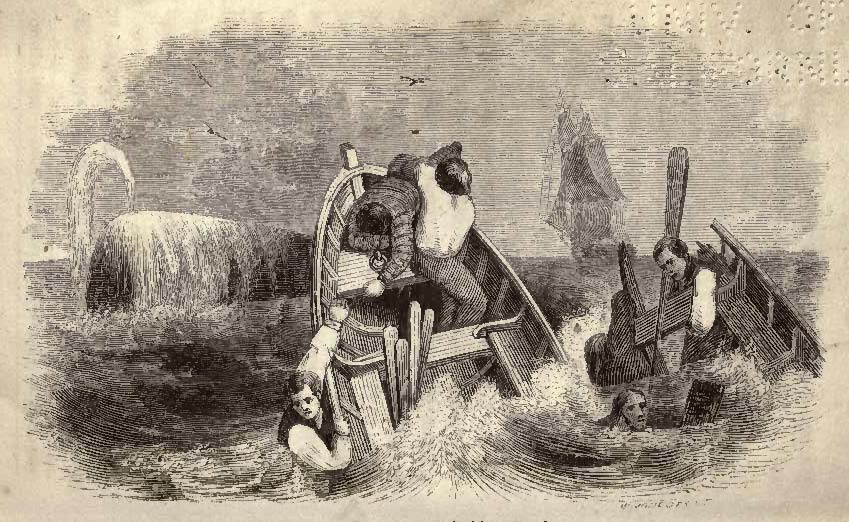 View of a Whale-boat crushed by a Whale.
|
|
|
Every Man for Himself.
|
Limbs Broken.
|
Man Missing.
| |
ly get a glimpse of the ship as I rode on the top of a swell, and not a human being in sight.
Not losing heart or hope, I struck out for a piece of the stern of our once beautiful boat a few rods distant. The crew came up one after another, catching at any thing they could see to help keep them afloat. One poor fellow came paddling along with two or three oars under him, crying out that his back was broken. Another of the crew and myself got him on a piece of the boat that we had hold of. His thigh was broken, and he could not move his legs at all.
The second mate soon after picked us up in his boat, and so much had we been engaged in looking out for ourselves, that we did not perceive one of our number was missing. But alas! it was too soon found out. He was a young man, about seventeen years old, and did not belong to the boat, but went in the place of the midship oarsman, who was sick at the time. The whale fell directly over him, and probably killed him in a moment.
With what feelings we pulled around and around the spot where the boat was stoven, unwilling to believe, even after we knew there
|
|
|
Feelings of the Survivors.
|
The Heart under the Pea Jacket.
|
|
was no hope, that our shipmate was gone, never more to return! How silently we glided, alongside of the ship, and hoisted in our other poor shipmate, now lamed for life!
"Ah, that some of those people who look upon sailors as little better than brutes, and who know little or nothing of the kind feelings and strong affections that are hid under their rough outside, could have seen what I saw on board that ship. Even their hearts would melt; and they would find it is not always the polished and educated, the smooth-faced and handsome man, that has the warmest heart or the most generous feelings."
How true is all this, and how often has it been proved in my own intercourse with seamen.. Under many a rough, pea-jacket bosom there beats a heart, which you will be feeling long for, and be slow in finding under the purple, and silks, and satins of fashion and frivolity. The poet Burns knew it when he sang so sweetly:
The heart aye's the part, ay,
That makes us right or wrang:
Nae treasures, nor pleasures,
Could make us happy lang.
It's no in titles nor in rank;
It's no in wealth like Lon'on bank.
|
|
|
|
Truth to Nature and Philosophy in the Poet Burns.
|
|
To purchase peace and rest:
It's no in making muckle mair,
It's no in books; its no in lear,
To make us truly bless'd.
If happiness hae not her seat
And center in the breast,
We may be wise, or rich, or great,
But never can be bless'd.
|
|
|
|
Carcass of a Spermaceti.
|
Dental Equipments.
|
|
CHAPTER X.
CONQUEST AND DISPOSAL OF A BULL WHALE.
Ye gentlemen of England, that live at home at ease,
Ah, little do ye think upon the dangers of the seas!
Ocean Song.
|
I love thee – when I see thee stand,
The Hope of every other land:
A sea-mark in the tide of Time,
Rearing to heaven thy brows sublime.
I love thee – when I contemplate
The full-orb'd grandeur of thy state:
Thy laws and liberties, that rise,
Man's noblest works beneath the skies;
To which the Pyramids are tame,
And Grecian temples bow their fame. – Montgomery.
|
Brazil Banks, Atlantic Ocean, off the Rio de la Plata.
We are just now at work upon the carcass of a bull whale lately captured, a genuine makrocephalus, which I have found by measurement to be sixty feet long and thirty feet round. His lower jaw-bone is sixteen feet long, and it has forty-eight large teeth, some of them a foot long, three of which are broken off, and others much worn. There are also several
|
|
|
Scars from the Wars.
|
Battering Ram of the Head.
|
|
very large scars on the outside of the jaw, and sundry other marks upon his person, that show him to have been in the wars. All these things, and the way in which he slued his flukes whenever the boat came near, were thought by his captors to prove him an old cruiser in these seas, and to have known a whale-boat, and, not unlikely, to have had a taste of cold iron before. It would seem, indeed, as if there could be very few sperm whales in the ocean of age, that have not been some time or other chased by a whaler, and their numbers are getting so greatly reduced that the sperm whale-fishing alone will not be much longer attempted.
What goes under the name of the sperm whale's head is nearly one third of the monster's length. It is customary to sever this entirely at first, and let it tow astern, while the rest of the carcass is being stripped of its very valuable blubber. Utterly unlike the right whale, which has no teeth, the head of a sperm whale is square, the end of it something like the largest mill-log ever seen, sawed off straight. It is truly a prodigious mass of organized, compact matter, with which this animal has been known sometimes to butt like a ram against
|
|
|
A Study for the Phrenologist.
|
The Whale's Craniology.
|
|
the sides of a ship and break it to pieces. They often go in this way "head on" to boats, but are generally pricked off and turned with a lance, or dexterously avoided.
From what may be called the top of the forehead to the roof of the mouth of this squarefaced sui generis monster, it measured nine feet in a straight line, and there was a corresponding breadth and depth of forehead, so that, with its prodigious volume of brain (head matter), and so large a facial angle, the bust of this creature is most favorably commended to the fingers of phrenologists. Is it not a little surprising, that in the researches of comparative phrenology the cranium of the great sperm whale should be overlooked?
For the matter of room, a phrenologist might keep shop in it, and light it up, if he chose, with its own brains, and there point out to visitors by the lamp-light the places in the walls and ceiling where the different organs lay. It would be like a painter at Rome who should open his studio in the Parthenon; the celestial gods would be eying him from the ceiling; deified men and the infernals would be looking on him from all around. And if the aforesaid phrenol-
|
|
|
Jaw. |
Junk. |
Case. |
White Horse. |
|
ogist and the favored artist should not alike become masters, under circumstances so imposing, it would be nobody's fault but their own.
But to finish the disposal of our present prize: the lower jaw, with the teeth all in it, was first separated by the sharp spades, in the hands of the officers, from the head, and hoisted in upon deck; then the upper jaw was separated from the mass of crown, forehead, and brains; then what whalers call the junk, or the mighty mass of blubber, separated from the case, which is the name they give to the brain-pan, white horse, integuments, and flesh of the head. The junk was hoisted in on deck, weighing I will not say how many thousand pounds. The former captain of this ship on another voyage found a large barnacle in the center of a sperm whale's junk, that must have got there in the same way that stones, and deers' horns, and toads get into the solid heart of trees, by being lodged in the bark and then overgrown by it.
When old Captain Bunker, of New Bedford, of whom almost every body has heard, was on a cruise in the ship Howard, in north latitude thirty degrees thirty minutes, and east longitude one hundred and fifty-four degrees, he
|
|
|
Captain Bunker's lost Harpoon.
|
Where Lodged.
|
|
threw a harpoon into a large whale. But the whale was not captured, and the harpoon of course lost. It was about five years afterward, that, being precisely in the same latitude, and east longitude one hundred and forty, he made fast to a noble whale, and after a hard struggle succeeded in getting him alongside. And lo! when cutting him up, a harpoon, rusted off at the shank, was found fast anchored in the old fellow's "cut-water." "Hallo!" said Captain Bunker, jesting, "here is my missing old iron." What he said in joke proved to be very truth, for the blubber-kept harpoon was the identical one he had lost five years before, having on it the ship's name and his own private mark.
But to come back to our great subject of dissection now in hand, the case was raised partially out of water, so as to keep the waves from washing into it, and an incision was then made through the membrane of one of the ventricles of the head, into which they are now letting down great buckets as into a well, dipping them full of pure sperm, and whipping it up into hogsheads. It has a slight rose tint, and looks like ice cream or white butter half churned. There will be about fifteen barrels of these brains(?)
|
|
|
Bailing the Brain.
|
Banquet for Birds and Sharks.
|
|
alone (it turned out sixteen), and ninety or ninety-five barrels of oil in all. The sea has been all white on that side the ship with the spermaceti and blubber that have escaped. Thousands of albatrosses, gulls, and haglets have more than got their fill, so that they fly heavily and with difficulty, and will probably have to spend three or four days, if not weeks, in digestion, like the sloth. Sperm whalers are provided with large scoops, by which, in good weather, they save a great deal of what we are losing, some of the boys being out in a boat to dip it up.
The boat-steerers have been down upon the carcass four times to secure hooks and hawsers into the great holes they cut in the blubber from above. Eight or ten sharks are prowling round, of the picked-nose kind, some of them eight and nine feet long. They will come right up on to the whale's body with a wave, bite out great pieces of flesh, turn over on to their bellies, and roll off. Several of them have been harpooned, and two have gone off with irons in their backs, that do not seem to annoy them any more than a little splinter in the thumb of a wood sawyer.
The tenacity with which the shark holds to
|
|
|
Tenacity of Life in the Shark.
|
Credible Tales of Sailors.
|
|
life, or, rather, life to the shark, is astonishing, and hardly to be credited by one who has not himself observed it. We have caught a number on this passage for their skin, which, cleansed and dry, is an excellent substitute for sand-paper, much used in whale ships to smooth and polish the various things they make up out of whale's bone and teeth. One that we hauled upon deck, after it was cut open, and the heart and all the internal viscera were removed, would still flap and thrash with its tail, and try to bite it off. The heart was contracting for twenty minutes after it was taken out and pierced with the knife. And, from what I have myself seen, I could not ridicule or deny a story that one has told me of a shark's being known to swim off, upon being thrown overboard, after it was opened, gutted, and had its tail chopped off. Sailors don't like them a bit, but kill them whenever they can; and there is little wonder, considering they are so likely to be themselves eaten by this greedy ranger through the paths of the sea.
To have done with our whale, it remains to finish bailing the case, and to cut out the blubber of the junk from the part of it called "white
|
|
|
Labor and Painstaking of Whalemen.
|
Oily Processes.
|
|
horse," which is a tough, stringy, and slightly elastic substance interposed with it, that contains little or no oil, and is as good as a cotton bale to shield a sperm whale's head from blows. Then follows the trying out, stowing down, overhauling, and coopering again the hogsheads of this valuable fluid, which they on land, who are turning night into day by means of its clear light, little know the hazard and labor of American whalemen in procuring. At the completion of the voyage this oil will be drawn from the casks, and, after a process of boiling and cooling, will be put into vats with a strainer which detains the spermaceti mixed with oil.
It is then a yellow viscous substance, which is afterward put into strong canvass bags, and subjected to a screw press, and next to the pressure of the hydraulic engine, whereby the oily matter is all expelled, leaving the spermaceti in hard, concrete masses. This, after boiling with potash and purifying, is molded into those beautiful oilless candles which are sold under the name of spermaceti.
The first manufactory of sperm candles in America was started in Rhode Island in 1750, by one Benjamin Crab, an Englishman. By
|
|
|
Sperm Candle Manufactories.
|
American Industry.
|
|
the year 1761 there were eight in New England and one in Philadelphia. Owing to the increased influx of sperm, by reason of the energetic and widely-extended prosecution of the sperm whale fishery, the number of spermaceti candle manufactories is now greatly increased. In 1834 it was estimated that there were sixty of them constantly in operation, and the quantity of sperm candles then made was three millions of pounds.
For the well-deserved commendation of this branch of American industry, all persons in any way connected with it will be as pleased as we in the Commodore Preble have been at the way in which New England enterprise was toasted at the New England Society's last dinner in New York. There is an account of the Anniversary of the Pilgrims' Landing, and the festivities of the occasion, in a paper to which we have been treated from an outward-bound whale ship just fallen in with. How greedily we have devoured it, none but a news-hungry whaleman knows. "New England enterprise: It grapples with the monsters of the Pacific to illuminate our dwellings, and with the problems of science to enlighten our minds."
|
|
|
New England Enterprise.
|
Hopeful Future.
|
|
Now if the lines of commercial enterprise can be only kept from parting with the rectilinear of moral propriety and the law of God, our career of greatness as a nation is clear and glorious. The great future is before us, full of hope, if old Puritan principles be only at the head with modern New England enterprise.
Far, like the comet's way through infinite space,
Stretches the long, untraveled path of light
Into the depth of ages: we may trace, afar,
The brightening glories of its flight,
Till the receding rays are lost to human sight.
|
I love thee; next to Heaven above,
Land of my fathers! thee I love;
And rail thy slanderers as they will,
With all thy faults, I love thee still.
I love thee when I hear thy voice
Bid a despairing world rejoice,
And loud from shore to shore proclaim,
In every tongue, Messiah's name;
That name at which, from sea to sea,
All nations yet shall bow the knee.
|
|
|
|
The other Side.
|
A moving Incident.
|
|
CHAPTER XI.
AUTHENTIC TRAGEDIES AND PERILS OF THE WHALING SERVICE.
At length his comrades, who before
Had heard his voice in every blast,
Could catch the sound no more.
For then, by toil subdued, he drank
The stifling wave, and then he sank.
And he, they knew, nor ship nor shore,
Whate'er they did, should visit more.
|
|
Cowper's Castaway.
|
In this Daguerreotype gallery of Life and Adventures in a Whale Ship, it is but fair that our late experience of the bright side of whalemen's fortune, in the safe capture and stowing down of a noble hundred-barrel spermaceti, as told in the last chapter, should be set off by incidents of another character that are equally common. A writer in the London Quarterly, a few years ago, described an adventure in the pursuit of a whale, which, given here for substance with some additions, will be read with deed interest bv all who are anywise familiar
|
|
|
A School of young Bulls.
|
Harpoon in the Hump.
|
|
with the "hair-breadth'scapes and moving accidents" in the ordinary career of whalemen.
One of a ship's company or officers in the North Pacific, near the close of a day that had been rather stormy, says that a school of young bull whales made their appearance close to the ship, and the weather having cleared up a little, the captain immediately ordered the mate to lower his boat, while he did the same with his own, in order to go in pursuit of them.
The two boats were instantly lowered, for they were unable to send more, having had two others "stove" the day before. They soon got near the whales, but were unfortunately seen by them before they could dart the harpoon with any chance of success, and the consequence was, that the school of whales separated, and went off with great swiftness in different directions. One, however, after making several turns, came at length right toward the captain's boat, which he observing, waited in silence for his approach, without moving an oar, so that the "young bull" came close by his boat, and received the blow of the harpoon some distance behind his "hump," and so near to the ship as to be seen by all on board.
|
|
|
Dragging to Windward.
|
The Bull Ambushed.
|
|
The whale appeared quite terror-struck for a few seconds, and then suddenly recovering itself, darted off like the wind, and spun the boat so quickly round, when the tug came upon the line, that she was within a miracle of being upset. But away they went, "dead to windward," at the rate of twelve or fifteen miles an hour, right against a "head sea," which flew against and over the bows of the boat with uncommon force, so that she at times appeared to be plowing through it, making a high bank of surf on each side.
The second mate, having observed the course of the whale and boat, managed to waylay them; and when they came near to him, which they speedily did, "a short warp" was thrown, and both boats were soon towed at nearly the same rate as the captain's boat had been before.
The captain was now seen darting the lance at the whale, as it almost flew along, but he did not seem to do so with any kind of effect, as the speed of the whale did not appear in the least diminished, and in a very short time they all disappeared together, being at too great a distance to be seen with the naked eye from
|
|
|
Boats out of Sight.
|
An ugly Night.
|
|
the deck. The officer ran aloft, and by the aid of a telescope could just discern from the masthead the three objects, like specks upon the surface of the ocean. At an alarming distance, he could just observe the two boats, with the whale's head occasionally darting out before them, with a good deal of "white water" or foam, which convinced him that the whale was still running. He watched with the glass until he could no longer trace them, even in the most indistinct manner, and then called to those on deck that they might take the bearing, by the compass, of the direction in which he had lost sight of them, so that they might continue to "beat" the ship up to that quarter.
It was now, says the story, within half an hour of sunset, and there was every appearance of the coming on of an "ugly night;" indeed, the wind began to freshen every moment, and an "awkward bubble' of a sea soon to make. I remained aloft until I saw the sun dip, angry and red, below the troubled horizon, and was just about to descend, when I was dreadfully shocked at hearing the loud cry of "a man overboard!"-from all upon deck. I looked astern, and saw with horror one of our men, by
|
|
|
Poor Berry Overboard.
|
The Kanacker after him.
|
|
the name of Berry, grappling with the waves, and calling loudly for help.
The ship was soon brought round, but in doing so she unavoidably passed a long way from the poor fellow, who still supported himself by beating the water with his hands, although he was quite unacquainted with the proper art of swimming. Several oars were thrown overboard the moment after he fell, but he could not reach them, though they were near to him; and directly the ship brought up, a Sandwich Islander, who formed one of the crew, leaped overboard and swam toward him, while at the same time the people on deck were lowering a spare boat, which is always kept for such emergencies. I could be of no service, except to urge their expedition by many calls, for it was only the work of a few minutes.
The good Sandwich Islander struck out most bravely at first, but, finding that he was some distance from the ship, and being unable to see Berry on account of the agitated surface of the sea, actually turned back through fear-finding, as he said, that the "sea caps" went over his head. The men in the boat now plied their
|
 Boat returning from the Search for Berry.
|
|
|
The Effort. |
The Doubt. |
The Fear. |
The Fate. |
|
oars with all their strength, and were making rapidly toward the drowning young man, who now and then disappeared entirely from view under the seas which were beginning to roll. A sickening anxiety pervaded me, as my thoughts seemed to press the boat onward to the spot where the poor fellow still grappled, but convulsively, with the yielding waters.
The boat, urged by man's utmost strength, sprang over the boisterous waves with considerable speed, but they arrived half a minute too late to save our poor shipmate from his watery grave. I saw him struggle with the waves until the last, when the foam of a broken sea roared over him, and caused him to disappear forever! The boat was rowed round and round the fatal spot again and again, until night fell, and then she was slowly and reluctantly pulled to the ship by her melancholy crew. As they returned, the turbulent waves tossed them about as if in sport, making the boat rebound from the beating and dashing waters which flew against her bow.
The moment the unfortunate seaman disappeared, a large bird of the albatross kind came careering along, and alighted on the water at
|
|
|
The hovering Albatross.
|
Painful Anxiety.
|
|
the very spot where the poor fellow was last seen. It was a curious circumstance, and only served to heighten our horror, when we saw the carnivorous bird set itself proudly over the head of our companion; and which also served to remind us of the number of sharks that we had so frequently seen of late, and of the horrible propensities of which we could not dare to think.
By the time we had hoisted in the boat it was quite dark; the wind, too, had increased to half a gale, with heavy squalls at times, so that we were obliged to double reef our topsails. We had lost one of our men who had sailed with us from England, the bare thought of which, in our circumstances, aroused a crowd of heartrending ideas. Our captain and second mate, with ten of the crew, had disappeared, and were by that time all lost or likely to be so, in the stormy night which had set in: being, too, several hundred miles away from land. We, however, kept beating the ship to windward constantly, carrying all the sail she could bear, making "short boards," or putting about every twenty minutes. We had also, since night fell, continued to burn lights, and we had likewise
|
|
|
Melancholy Fancies.
|
Yearnings for Home.
|
|
a large vessel, containing oil and unraveled rope, burning over the stern rail of the ship as a beacon for them, which threw out great light.
But, although all eyes were employed in every direction, searching for the boats, no vestige of them could be seen; and, therefore, when half past nine P.M. came, we made up our minds they were all lost; and, as the wind howled hoarsely through the rigging, and the waves beat savagely against our ship, some of us thought we could hear the shrieks of poor Berry above the roaring storm; others imagined, in their melancholy, that they could occasionally hear the captain's voice ordering to "bear up;" while the boats had been seen more than fifteen times by anxious spirits, who had strained their eyes through the gloom until fancy robbed them of their true speculation, and left her phantasmagoria in exchange.
There were not many on board who did not think of home on that dreadful night; there were not many among us who did not curse the sea and all the sea-going avocations, while with the same breath they blessed the cheerful fireside of their parents, which, at that moment, they would have given all they possessed to but
|
|
|
Joy out of Despair.
|
Light in the Darkness.
|
|
see. But at the moment despair was firmly settling upon us, a man from aloft cried out that he could see a light right ahead of the ship, just as we were "going about," by which we should have gone from it.
We all looked in that direction, and in a few minutes we could plainly perceive it; in a short time we were close up with it, when, to our great joy, we found the captain and all the men in the boats, lying to the leeward of the dead whale, which had in some measure saved them from the violence of the sea. They had only. just been able to procure a light, having unfortunately upset all their tinder through the violent motion of the boats, by which it became wet, but which they succeeded in igniting after immense application of the flint and steel, or their lantern would have been suspended from an oar directly after sunset, which is the usual practice when boats are placed under such circumstances.
After securing the whale alongside, which it was feared they would lose during the night, from the roughness of the weather, they all came on board, when the sudden end of poor Berry was spoken of with sorrow from all hands,
|
|
|
Requiem for the Dead.
|
Becalmed among Icebergs.
|
|
while their own deliverance served to throw a ray of light amid the gloom.
They thought of his worth, but no words found birth,
To tell of the love they bore him;
But the sea-bird's wail, and the stormy gale,
And the roar of the ocean wave,
Sung deep and long the funeral song
O'er the seaman's traceless grave.
|
In this connection, it is not unsuitable to give place to what an accredited writer in the Westminster Review relates of an incident, or, rather, a dread tragedy in the Greenland whale-fishery, which is almost too appalling and unparalleled, not to say impossible, to be believed:
One serene evening in the middle of August, 1775, Captain Warrens, the master of a Greenland whale ship, found himself becalmed among an immense number of icebergs, in about seventy-seven degrees of north latitude. On one side and within a mile of his vessel, these were of immense height, and closely wedged together, and a succession of snow-covered peaks appeared behind each other as far as the eye could reach, showing that the ocean was completely blocked up in that quarter, and that it had probably been so for a long period of time. Captain Warrens did not feel altogether satisfied
|
|
|
Changes to a Gale.
|
Ice-broken Barriers.
|
|
with his situation; but, there being no wind, he could not move one way or the other, and he therefore kept a strict watch, knowing that he would be safe as long as the icebergs continued in their respective places. About midnight the wind rose to a gale, accompanied by thick showers of snow, while a succession of thundering, grinding, and crashing noises gave fearful evidence that the ice was in motion.
The vessel received violent shocks every moment, for the haziness of the atmosphere prevented those on board from discovering in what direction the open water lay, or if there actually was any at all on either side of them. The night was spent in tacking as often as any case of danger happened to present itself, and in the morning the storm abated, and Captain Warrens found, to his great joy, that his ship had not sustained any serious injury. He remarked with surprise that the accumulated icebergs, which had the preceding evening formed an impenetrable barrier, had been separated and disengaged by the wind, and that in one place a canal of open sea wound its course among them as far as the eye could discern.
It was two miles beyond the entrance of this
|
|
|
Curiosity excited.
|
An appalling Discovery.
|
|
canal that a ship made its appearance about noon. The sun shone brightly at the time, and a gentle breeze blew from the north. At first some intervening icebergs prevented Captain Warrens from distinctly seeing any thing but her mast; but he was struck with the strange manner in which her sails were disposed, and with the dismantled aspect of her yards and rigging. She continued to go before the wind for a few furlongs, and then, grounding upon the low icebergs, remained motionless. Captain Warrens's curiosity was so much excited that he immediately leaped into his boat with several seamen and rowed toward her.
On approaching, he observed that her hull was miserably weather-beaten, and not a soul appeared on the deck, which was covered with snow to a considerable depth. He hailed her crew several times, but no answer was returned. Previous to stepping on, board, an open port-hole near the main chains caught his eye, and on looking into it, he perceived a man reclining back in a chair, with writing materials on a table before him, but the feebleness of the light made every thing very indistinct. The party went upon deck, and having removed the
|
|
|
The Living Dead.
|
Horrible Disclosure.
|
|
hatchway, which they found closed, they descended to the cabin.
They first came to the apartment which Captain Warrens viewed through the port-hole. A tremor seized him as he entered it. Its inmate retained its former position, and seemed to be insensible to strangers. He was found to be a corpse, and a green damp mold had covered his cheeks and forehead, and veiled his eye-balls. He had a pen in his hand, and a log-book lay before him, the last sentence in whose unfinished page ran thus: "November 11th, 1762. We have now been inclosed in the ice seventeen days. The fire went out yesterday, and our master has been trying ever since to kindle it again without success. His wife died this morning. There is no relief."
Captain Warrens and his seamen hurried from the spot without uttering a word. On entering the principal cabin, the first object that attracted their attention was the dead body of a female, reclining on a bed in an attitude of deep interest and attention. Her countenance retained the freshness of life, and a contraction of the limbs alone showed that her form was inanimate. Seated on the floor was the corpse of an
|
|
|
A Charnel Ship.
|
An awful Warning.
|
|
apparently young man, holding a steel in one hand and a flint in the other, as if in the act of striking fire upon some tinder which lay beside him. In the fore part of the vessel several sailors were found lying dead in their berths, and the body of a boy was crouched at the bottom of the gangway stairs.
Neither provisions nor fuel could be discovered any where; but Captain Warrens was prevented, by the superstitious prejudices of his seamen, from examining the vessel as minutely as he wished to have done. He therefore carried away the log-book already mentioned, and returning to his own ship, immediately steered to the southward, deeply impressed with the awful example which he had just witnessed of the danger of navigating the polar seas in high northern latitudes.
On returning to England, he made various inquiries respecting vessels that had disappeared in an unknown way, and by comparing these results with the information which was afforded by the written documents in his possession, he ascertained the name and history of the imprisoned ship and of her unfortunate master, and found that she had been frozen in thirteen
|
|
|
Fact the Ground of Fancy.
|
Not an Improbability.
|
|
years previous to the time of his discovering her imprisoned in the ice.
If this strange tale be true, we see that Coleridge's wonderful Rime of the Ancient Mariner may not be all fancy, but may have a substantial basis of fact. Witness the following verses, eliminated from it here and there:
And now there came both mist and snow,
And it grew wondrous cold;
And ice, mast high, came floating by,
As green as emerald.
And through the drifts the snowy clifts
Did send a dismal sheen;
Nor shapes of men nor beasts we ken –
The ice was all between.
The ice was here, the ice was there,
The ice was all around;
It cracked and growled, and roared and howled,
Like noises in a swound!
Alone, alone, all, all alone,
Alone on a wide, wide sea!
And never a saint took pity on
My soul in agony.
I closed my lips, and kept them close,
And the balls like pulses beat;
For the sky and the sea, and the sea and the sky,
Lay like a load on my weary eye,
And the dead were at my feet.
The cold sweat melted from their limbs,
Nor rot nor reck did they;
The look with which they looked on me
Had never passed away.
|
|
|
|
Coleridge'a Magic Rime of the Ancient Mariner.
|
|
All stood together on the deck,
For a charnel dungeon fitter;
All fixed on me their stony eyes,
That in the moon did glitter.
But soon I heard the dash of oars,
I heard the pilot's cheer;
My head was turned perforce away,
And I saw a boat appear.
The pilot and the pilot's boy,
I heard them coming fast!
Dear Lord in Heaven f it was a joy
The dead men could not blast.
The boat came closer to the ship,
But I nor spake nor stirred;
The boat came close beneath the ship,
And straight a sound was heard.
Stunned by that loud and dreadful sound,
Which sky and ocean smote,
Like one that hath been seven days drown'd
My body lay afloat,
But swift as dreams, myself I found
Within the pilot's boat.
O wedding guest! this soul hath been
Alone on a wide, wide sea:
So lonely'twas, that God himself
Scarce seemed there to be.
Farewell, farewell! but this I tell
To thee, thou wedding guest I
He prayeth well who loveth well
Both man, and bird, and beast.
He prayeth best who lovsth best
All things both great and small;
For the dear God who loveth us,
He made and loveth all.
|
|
|
|
Brazil Banks.
|
A Barnacled Whale Ship.
|
|
CHAPTER XII.
YARNS FROM THE EXPERIENCE OF OLD WHALEMEN.
Row! row! row!
In our vessel she must go,
Over the broad Pacific's swall,
Round Cape Horn, where tempests dwell;
Many a night and many a day,
Hence with us she must away,
Till we joyful hail once more
Old Nantucket's treeless shore. – Whaler's Song.
|
Brazil Banks, latitude 24º S., longitude 40º W.
Some few years ago, in the same region of ocean where we are now cruising, and about the same month of the year, an old weather-worn and barnacled whale ship was working slowly along on a wind, homeward bound, or after another sperm whale, if one should heave in sight. Her try-works were sending up a smoke black as night in huge volumes, for they were trying out an eighty-barreler not long taken.
The deck was lined with casks, and the main hatches off, men engaged in the blubber-room
|
|
|
In working Dress.
|
Ready for a Run.
|
|
cutting up the blanket pieces into horse pieces, ready for mincing; others piking the pieces from one tub to another, ready for the mincers; some tending the fires, some filling up casks with hot oil from the cooler; every man busy, and each at his place, but the decks confusedly strown with barrels, and tubs, and whaling gear, like a street with goods in it after a fire.
All at once, says an old whaler, in a yarn of random recollections of his youth, all at once, a voice clear as the lark, and to the ear of the whaleman far sweeter, rang through the ship, THERE SHE BLOWS! Again and again it is repeated, at regular intervals. Now the captain hails the mast head. "Where away is that whale, and what do you call her?"
"Sperm whale, sir, three points on the weather bow, not over two miles off."
"Get your boats ready; slack down the fires; and stand by to lower away!"
The boats' crews each stand by their own boat, some of the men help put in the tub of line, others lay down the boat-tackle falls in such a way that they will run clear. The boatsteerer bends on his harpoons, the gripes are cast clear of the boats, and now comes the word,
|
|
|
Lower away!
|
Flukes Peaked.
|
Game up.
| |
"Hoist and swing!" In a moment the boats are hanging by their tackles, and clear of the cranes, ready for the word "Lower away!" The mates, in the mean time, were aloft, watching the movements of the whale, in order to judge how to pull for her.
Now comes the word, "Lower away!" In a moment all the boats are off, and in chase at a good speed, in order to see who will be up with the whale first. However, at this time, it did not make so much difference which boat pulled the best, as the whale peaked her flukes and went down before any boat came up with her. Now each boat-header uses his own judgment as to where the whale will come up next, for a sperm whale is almost always going some when she is down or under water. The whale was gone an hour, when we caught sight of the signal at the main, which said plainly that the whale was up. All eyes gaze eagerly around in all directions for the whale.
"There she is," cries one of the men, "not twenty rods from the chief mate's boat! There, he sees her!"
"Down to your oars, lads!" said the captain, in whose boat I was. "Give way hard!" Now,
|
|
|
Captain's Soliloguy.
|
An old Chap.
|
|
then, the little boat jumps again, sending the spray in rainbows from the bow. "L Spring hard, my dear fellows; if she blows a dozen times more, the mate will fasten. There she blows! Oh, she's a beauty! a regular old sog! a hundred-barreler! There she lays like a log! Oh, what a hump! There she blows! Stand up, David! (the name of the mate's boat-steerer.) There goes one iron into her, and there he gives her the second one; he is fast solid. Now, then, my boys, let us be up among the suds. Stand up!" shouted the captain to me, as he laid his boat square on to her. In goes two more harpoons, and our boat is fast.
I thought I had seen large sperm whales, but this old chap beat them all; he cut and thrashed with his flukes a while, but did not take to sounding or running, as some whales do. The mate pulled up to lance him; but, let him go on as he would, the whale would head for his boat, and prevent his getting a chance at her with his lance. "Now, then, Mr._____," said the captain to me, "you must kill that whale." The captain steered me this day, as he had done several times before, as we were short of a boat-steerer.
|
|
|
Lancing Deep.
|
Rising Quick.
|
Sudden Expulsion.
| |
We pulled up to her, and I set my lance into her life, as I thought, the whole length; she spouted a little thin blood. You are not low enough," said the captain; "set your lance lower down; this fellow is deep, and you must lance lower."
The whale settled away under water after she felt the lance, and I kept a look-out for her, expecting she would break water near the head of the boat. Pretty soon I saw her whiten under water, and got my lance ready as soon as she should come to the surface; the next moment I was flying in the air, and a moment after was several fathoms under water. The whale came up head foremost, hitting the boat a tremendous knock under my feet, sending me all flying. The captain at the same time grabbed his steering oar, and overboard he went also.
Fortunately, I could swim well, and soon came up to blow; but I had hardly time to spout, before I found that I was in a very disagreeable situation. Putting out my arm to swim, I hit the whale on his head, and at the same time saw the boat three or four rods from me. I confess I did not feel exactly right; but
|
|
|
Liable to be Left.
|
Hard Swimming.
|
Mending Holes.
| |
it was no use for me to lay still, and be picked up like a squid; so I made a regular shove off with my feet against the whale's head, and struck out for the boat. I saw that all was confusion in the boat, and that the men did not notice me at all. I had on thick clothes, and found it hard swimming. Finally one of the men saw me, and stopped the boat, which some of them were steering away from me as fast as they could.
As I got in at the bow, I saw the captain come over the stern. "Hallo!" said he, "where have you been to?" "After the whale," said I. "And I have been after you," said the captain. We had a good laugh, wrung our hair, and started for the whale again. She lay still, with her jaws open, and head toward the boat; the rest of her body was under water, so that she gave no chance to kill. We lay still, watching her motions. All at once she let her jaws fly back, striking the boat in the bow, and smashing a hole through her. The boat began to fill; but, fortunately, we had a jacket ready, and stopped the hole up, and so we kept from filling, and pulled up to the whale again.
This time she headed the mate, and lay her
|
|
|
Fin out.
|
Prize measured.
|
Yield of Oil.
| |
whole length broadside toward us. We had nothing to do but to pull up and in lance, the whale laying perfectly still all the time. In twenty minutes she went into her flurry, and soon after lay fin out. We took her alongside the ship, and commenced cutting her in; but it took all the next day to get her all in. She measured over seventy-five feet in length, and between fifty and sixty feet round the largest part of the body; her jaw was seventeen and a half feet long, and her flukes seventeen feet broad. She stowed us down one hundred and twenty-five barrels of sperm oil.
In the vicissitudes of whaling fortune, a prize like this now and then offers itself to a ship, in the form of a dead whale afloat. Such a fortunate wind-fall once came to the Cremona, of New Bedford, in 1839, while cruising on the coast of Peru, in the latitude of three degrees south. Her master there fell in with two whaling ships belonging to the same port. Being old acquaintances, they were happy to see each other – compared notes – talked of old times; and whales being in sight all around, although rather shy, they agreed to keep company for the night, hoping for good luck on the morrow.
|
|
|
Three Whalers in a Gam.
|
Indian Look-out.
|
|
At early dawn the mast heads were manned, and the horizon carefully scanned in every direction; and the survey increased in interest and care as the hour of sunrise drew nigh. But no whales were in sight.
The wind was light, and they packed on all sail, steering to the northward, in company with the ships they had fallen in with the day before-the Orion being about five miles distant, broad off on the weather bow, and the Lupin about three points under the lee-not more than two or three miles off. Being in the northeast trade winds, and standing along to the northward, they all, of course, had the starboard tacks on board.
On board the Cremona, said her captain, in giving this account, we had our mast heads doubly manned; and at the main-top-gallanthead was stationed Webquish, a smart, active Gay Head Indian, who was a faithful sentinel on such occasions, with a restless eye, and a keenness of vision seldom surpassed by any of his race All hands were on deck, and expectation was exhibited in the grave demeanor and semismiling countenances of the crew.
It was about nine o'clock in the forenoon that
|
|
|
Something in the Wind.
|
A notable Discovery.
|
|
Webquish, the Indian, who had been looking steadily in one direction for some minutes, called out that he saw some object afloat away to windward. It was bobbing up and down, and looked something like a boat, but he could not tell what it was.
This excited the curiosity of every man on board; and, as is usual in such cases, all made a spring into the rigging, with a view to run aloft, and get a squint at the mysterious object reported by Webquish. But I ordered them to remain on deck, and sent up my first mate-a man of good judgment and sharp eyes-with a spy-glass, to the fore-top-mast-head. He soon got sight of the object, and immediately reported that it was a large dead spermaceti whale.
This was an event, the announcement of which created quite a sensation on board the Cremona; and the question asked of each other was, whether we could secure it for ourselves? In order to do this, it was necessary not only to see it first, but to get fast to it first! From the favorable position of the Orion, being to windward, it was clear that the whale would inevitably fall a prize to her, if it should be seen by the look-out before it could be reached by
|
|
|
Needs Contrivance.
|
Throwing Dust in the Eyes.
|
|
our boats. It was a matter which required a little management.
I directed my mate, Mr. Hopkins, to come down to leeward, and keep the mast between him and the Orion, that he might not be seen from that ship, which might excite suspicions that something was in the wind; and, in the same manner, I went myself aloft to take a look at the object to windward – an object of much interest to us, as it was probably of great value.
The other ships quietly kept on their course. The Lupin, being to leeward, could not possibly see the whale; and on board the Orion, the look-out aloft seemed to be taking a nap, for no indications were given that the whale was seen from the ship. This gave us hopes that we might secure the prize; and all was animation on board the Cremona. The mate's boat. being the fastest, was got in readiness, and a good coat of tallow was applied to her bottom – a set of the best oars was selected – and all due preparation made for a race.
For nearly an hour we kept on our course, occasionally going a little to windward, but not in a manner to excite observation. By this time the dead whale was abaft the weather
|
|
|
Boat under Way.
|
A sleepy Look-out.
|
|
beam. And now, without heaving to or altering the ship's course, the boat was lowered to leeward. Mr. Hopkins and his stalwart and eager crew stepped into it, seized their oarsthe word was given-and hurrah, whiz! away they darted toward the whale with the swiftness of, an arrow.
We watched the boat with much interest and no little anxiety; for even now, i the prize should be discovered from the Orion, that ship would be filled away, and, running down before the wind, would be able to reach it before Mr. Hopkins could get fast to it with his harpoon. And this reflection seemed to add vigor to the arms of the boat's crew, for they pulled away heartily-with a right good willand forced the boat merrily through the water. But their fears were groundless. For nearly half an hour they pulled with a degree of strength and skill seldom equaled, and were close on board the whale, and still neither the whale nor the boat was seen by the sleepy look-out on board the Orion!
Under these circumstances, I considered that maneuvering was no longer necessary, and gave the orders to tack ship, which enabled us
|
|
|
Mask thrown off.
|
A worthy Windfall.
|
|
to steer almost directly for the whale! This opened the eyes of the Orion; for our yards were hardly trimmed before that ship squared her yards, and came running down directly across our track, and in a few minutes the Lupin hauled her wind, and came creeping up to windward.
But it was of no use. The Orion was just in time to see Mr. Hopkins strike his harpoon into the whale, and take possession of the prize in the name of the good ship Cremona, of New Bedford! And it was not long before we had the whale alongside, and forthwith commenced "cutting in" upon this noble specimen of the class Mammalia, which proved to be an eightybarrel whale, and was worth to us twenty-four hundred dollars. By the time we had made fast to our prize, the Orion was within speaking distance. Evidently chagrined at the success of our maneuver, she lavished no compliments upon our enterprise, and soon resumed her former course. In about an hour or so the Lupin came up to inquire the news, but soon made sail after the Orion; and before night, both were out of sight to the leeward, and our oil was mostly boiled out and cooling, to stow away below.
|
|
|
Why found Dead.
|
Recovery of sunk Whales on Soundings.
|
|
The fortunate captain of the Cremona thinks that in this instance, and others like it, the whale, having been harpooned and deprived of life, sunk, we know not why, and remained below the surface until its specific gravity had diminished, by the generation of gases within the animal tissues, to such a degree that it rose from indefinite depths below.
Multitudes of the right whale sink immediately after capture, as we have already learned, and are a dead loss; but this is seldom the case with the sperm; and the Cremona's lucky prize in this instance may have been a sperm whale that had to be abandoned by some other ship, after being mortally wounded and dying on the surface, without ever sinking.
In what is called shore whaling, where there are soundings, they fasten buoys, like as to an anchor, to the sinking right whales, and then watch the spot or the bu! - till the dead animal rises after the expiration two or three days. It is probable that old ag reducing the whale to leanness, and any other cause that diminishes the animal's adipose or oily matter, tends to increase his specific gravity, and, consequently, the tendency to sink when killed.
|
|
|
Rival Whalemen of four Nations in chase of the same Whale.
|
|
A chase similar to that described above, but for a living whale, once came off in the South Pacific between four ships of different nations, becalmed together within the neighborhood of a mile, English, French, Portuguese, and American. The officers of the American ship were making preparation to visit their English neighbors. The men were amusing themselves below, or loitering about the decks, when the lookout on the mast head gave intelligence of a whale by the exciting and familiar cry of "There she blows!" "There she blows!" "Oh, she's a beauty!" "There she blows again!"
"Where away?" hailed the officer of the deck.
"West of south, heading east."
"How far, and what is she?"
"Three miles – a real sperm," was the reply.
The men of the American had not been idle during this dialogue. As soon as the first "There she blows" was heard, each man had sprung to his station in the boat. Stopping for a moment to have a keg of water placed in the stern sheets, the boat-steerer, who gives the account, sprung into the boat, and, casting all clear, they were soon under weigh. "Our
|
|
|
Steering and Rowing at once.
|
Portuguese left in the Rear.
|
|
neighbors also had been on the alert. A wellmanned boat from each ship was in the chase.
"These ships laying somewhat in advance, we found they had the advantage of from fifteen to forty rods the start of us. Speaking a few words of encouragement to the men, we were soon passing over the water with a velocity which is hardly conceivable to a landsman. The American whaleman is the only man who never turns his head to look while in the chase of a whale – that part belongs to the boat-steerer. They are thus enabled to give their whole energy to the oar, laying themselves to the work with a hearty good will. Placing the palm of my left hand under the abaft oar, while with my right I guided the boat, and at each stroke threw a part of my weight against it, our boat would'skim the water like a thing of life.'
"A few moments from the start brought us up with the Portuguese. The crews of the different ships witnessing the chase, the excitement was tremendous. Our shipmates cheered us as we came up with the first boat, and as we passed, the whale again made its appearance. Singing out to the men,'There she
|
|
|
Greek meets Greek.
|
John Bull and Brother Jonathan.
|
|
blows! She's an eighty-barrel-right ahead. Give way, my boys!' &c., we were soon alongside the Frenchman. The Frenchman was too polite to oppose us, and we passed him with ease.
"The English boat was now about ten rods in advance, and the whale about one and three fourths of a mile. Now came the trial. The English boat was manned by the same number of stout, active hands as our own, and, seeing us pass the other boats, their whole strength and force were put to the oar. We gained on them but slowly; and such was the excitement of the race, that we were in danger of passing over where the whale had last'blowed.' At this moment the English boat-steerer noticed the manner in which I had placed my left hand and weight against the oar. Instantly laying hold of his own in like manner, his first effort broke it short at the lock. Thus disabled, he gave us a hearty curse, and we shot past him like a meteor.
"We had been so excited with the race that we had lost sight of the whale. As luck would have it, at this instant she'blowed' but a few rods ahead. In a moment we were fast, and
|
|
|
Whose is the Prize?
|
Romance of rival Whaling.
|
|
all hands stern.' Soon she was in a' flurry,' and in the course of an hour we were slowly returning to our ship. That whale stowed us down eighty-five barrels of oil, and shortened our voyage two months."
It is easy to see that there must be a thrilling excitement in the adventurous chase of game like this, that has a tinge of the romantic to young and eager minds. There was romance surely, as well as reality, in a whaling feat I have read of, that came off in Delego Bay, South Africa, a smooth nook of ocean much frequented a few years ago by whalers and ships from different nations. A mammoth whale rose and was observed in those still waters at the same moment, and about equidistant from an American and an English ship. From both the boats were lowered, manned, and off in an instant with the speed of the wind.
The English, at first ahead, perceiving their rivals gaining on them, wisely bore wide off from their common game, in order to keep the Americans out of reach of the whale. But when the two boats were nearly abreast, the English of course inside, one of the American sailors sprang from his seat, and with extraordinary
|
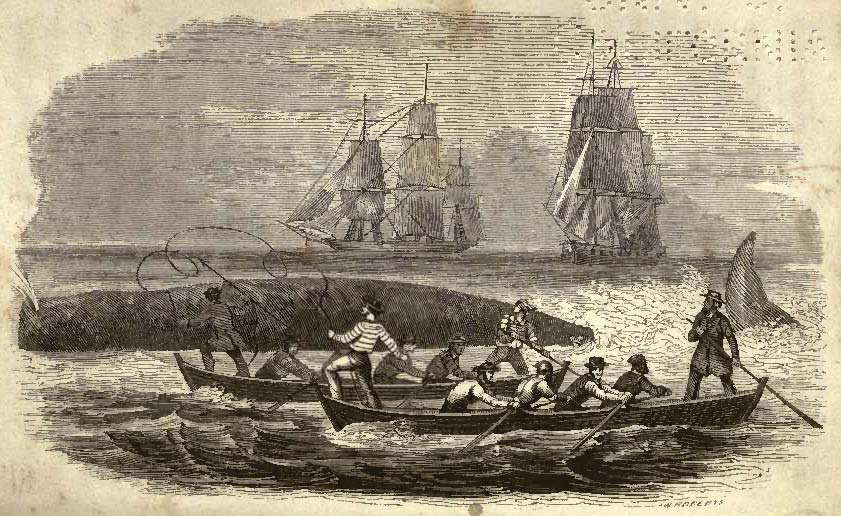 Exploit of an American Harpooner in Delego Bay.
|
|
|
Extraordinary Daring of a Yankee.
|
What it wrought.
|
|
agility hurled his ponderous harpoon right over the English boat. Thrown with unwonted force and precision, it struck the monster in a vital part, and was buried to the socket.
The English boat, thus strangely intercepted and balked of its prize, shrunk back under the warp of its Yankee rival. The waves were soon crimsoned with blood, and the daring American took possession of the mastered Leviathan, while Delego Bay echoed and re-echoed with shouts of applause.
All honor to whalemen, bold and brave! We will sing for them, in passing, Park Benjamin's song:
How cheery are the mariners
Those lovers of the sea!
Their hearts are like its yesty waves,
As bounding and as free.
They whistle when the storm-bird wheels
In circles round the mast;
And sing when, deep in foam, the ship
Plows onward to the blast.
What care the mariners for gales?
There's music in their roar,
When wide the berth along the lee,
And leagues of room before.
Let billows toss to mountain heights,
Or sink to chasms low,
The vessel stout will ride it out,
Nor reel beneath the blow.
|
|
|
|
Park Benjamin's Song for the cheery Mariner.
|
|
GOD keep those cheery mariners!
And temper all the gales
That sweep against the rocky coast
To their storm-shattered sails;
And men on shore will bless the ship
That cold so guided be,
Safe in the hollow of His hand,
To brave the mighty sea!
|
|
|
|
The Pickle a Whaleman most loves to have his Ship in.
|
|
CHAPTER XIII.
PECULIAR VOCABULARY AND HAZARDS OF WHALEMEN.
A perilous life, and hard as life may be,
Hath the brave whaleman on the lonely sea;
On the wide water laboring, far from home,
For a bleak pittance still compelled to roam;
Few friends to cheer him through his dangerous life,
Or strong to aid him in the stormy strife;
Companion of the Sea and silent air,
The hardy whaleman has no envied fare. – Anon.
|
Midway between the False and Main Banks, Atlantic Ocean, lat. 34º 30' S., lon. 47º V4. Homeward Bound.
I like the eagerness and activity, and can very well put up with the smell and dirt which having dead whales alongside makes in a whale ship. We are having enough of it just now. Though not myself head and ears over in blubber-juice like all the rest, nor in for any share of the profits, I am taking, perhaps, as curious and eager an interest in the process going on as any one on board. All the ordinary muxing and skimshander with which active ones keep themselves busy on board whale ships when
|
|
|
Matter for the Dictionary.
|
Divers kinds of Muxing.
|
|
there is no work to do, are laid aside now. The cooper's driver is merry a-going on the great oil casks; the decks are cluttered, and full of gurry and dirt; and every body and every thing is besmeared with oil, and will be so until a strong ley they make from the ashes of the scraps has washed all clean.
It is almost worth taking one cruise in a whale ship to see how they capture and dispose of their gigantic game, and to learn some odd things a man can never know otherwise. Had Noah Webster ever gone a whaling, he would have been able to add some five or six notable and genuine English words to his Dictionary, which may never be known off salt water unless we record them here.
Mux and skimshander are the general names by which they express the ways in which whalemen busy themselves when making passages, and in the intervals of taking whales, in working up sperm whales' jaws and teeth and right whale bone into boxes, swifts, reels, canes, whips, folders, stamps, and all sorts of things, according to their ingenuity.
Gurry is the term by which they call the combined water, oil, and dirt that "cutting in"
|
|
|
New Material for Illustration.
|
Savory Comparisons.
|
|
a whale leaves on deck and below. The yellowish stuff
|
That creams and mantles on a standing pool,
|
and affords such a favorite, nice comparison, ready to hand, and hackneyed, for writers that want to express the odiousness of moral putrescence and stagnation, is nothing to this sui generis composition elaborated in the hold of a whale ship. Hereafter, if any one should wish to illustrate morals by physicals in a way par. ticularly new and original, let him say that the filth and foulness of Mr. So-and-so's mind, or the daily scum and dregs of Mr. Slabbering Editor Such a One, or the hebdomadal black vomit of this and that member of the "Satanic Press," look and smell like gurry.
Gally, or Gallow, as it is found in Shakspeare, is the term by which they express a whale's being frightened. Thus you often hear "that whale's gallied," as they pronounce it.
Gam is the word by which they designate the meeting, exchanging visits, and keeping company of two or more whale ships, or a sociable family of whales. Thus we gammed two days on the New Zealand whaling ground with the Niantic of Sag Harbor. One day the
|
|
|
A Treatise on Gamming.
|
Sequel of a Gam.
|
|
captain of the Niantic spent with us, the next our captain spent on board the Niantic, the boats' crews gamming together at the same time in the forecastle, and the mates of the ships meeting and having a gam in the ship that was left of her captain.
These gams are very pleasant interludes in a whaleman's life, when abroad upon the desert ocean, without change of society or scene, a thousand miles from land. It is peculiarly grateful for a rusty and barnacled old ship, that has been absent thirty or more months, to have a gam of a day with a fresh competitor just arrived out with all the news from home. Such a gam gives matter of talk and old newspaper reading for a month, and nobody can tell how pleasant it is but one that has experienced it. A shipmaster has a chance to exchange counsel, and tell stories, and let himself be familiar with somebody that's new, and he is always the milder, and better pleased with himself and all about him, for some days after such a gam.
The use of these words is not a little amusing at first to a stranger; but I have come to believe them as good and veritable English, and to have as fair a claim to be placed in our
|
|
|
Appalling Forms of Danger to be encountered by Whalemen.
|
|
dictionaries as a thousand words that are spoken oftener in ears polite. I like to talk with old whalemen upon the hair-breadth escapes and perilous adventures of their hazardous warfare upon the monsters of the deep. It is a marvel that death, in its most appalling forms, is not oftener met with. Whalers, I think, have to look danger more full and steadily in the face than any other class of men except soldiers.
Danger, whose limbs of giant mold,
What mortal eye can fix'd behold?
|
Besides the multifarious ordinary perils of the sea, there is that incurred in lowering boats so often; then the risk of being run under and swamped in the lightning-like speed and evolutions of a seventy-foot whale immediately upon being struck; then the danger from a whale's flukes and fins, as the monster slues and slats them round, and makes the deep boil like a pot, to the slightest tap of which a whale-boat is hardly more than a bubble. Sometimes the mammoth brute comes up from the depths right under the boat, and takes it, with all on board, transversely into his huge mouth, that can be opened sixteen and twenty feet. To be
|
|
|
A Bull-whale getting the Head-ache.
|
The fatal Tap of a Fin.
|
|
sure, the monster does not swallow it, but he crushes it to pieces as if it were an egg-shell, and, not unfrequently, some of its crew at the same time, and this is always to be apprehended.
Sometimes a sperm whale will drive "head on" to his captors with such a speed and force that they can neither prick him off with the lance nor have time to sheer away. A blow that would beat in the oak ribs of a man-of-war would hardly, I suppose, give a bull-whale the headache. There are two cases I have heard of, one in the Atlantic and one in the Pacific, in which an enormous sperm whale, with malice aforethought, did thus run three several times full tilt against a whale ship, until his butting had battered in her sides, and the men had to abandon the ships a thousand miles from land. But three or four survived the peril in each case and got safe to land. One of them, then a boy, is now master of a whale ship, still grappling with dangers, and successfully proseor'ting this adventurous trade.
I have known of one captain who was killed instantly in the bow of his boat, by the tap of a whale's fin upon his skull, when no one else was at all injured. To have legs and arms broken,
|
|
|
But a Step between the Whaleman and Death.
|
What then?
|
|
ribs knocked in, and a whole crew scrabbling together in the water, is, as we have already learned, very common. There are few that have been long in the service but have been banged and broken in some way, and snatched often from the gaping jaws of destruction. They can tell of marvelous escapes and providential deliverances from the very throat of death, that make you think a whaler, of all men, ought to be living with his will made, and ready for a sudden summons.
We should naturally think so, and that a man's constant exposedness to sudden death would give a serious turn to his mind, and induce a cast of reflection and thoughtful regard to his latter end. But it is now a long time that the practical observation of men has taught me, that familiarity with danger and death seldom produces a softening, monitory effect, except upon the mind of a Christian, but rather induces a moral hardness and effrontery that steels the mind against lessons of mortalty, and sheds an ominous gloom upon the prospects of the soul. I have talked with a good many whalernen and common sailors, and have observed the conduct of irreligious men in times
|
|
|
Difference between Rational Conjecture and Melancholy Fact.
|
|
of fatal epidemics and more than ordinary dan. gers, but I never yet have met with one permanently reformed and brought to repentance by seeing others drowned and die before his eyes, and by what would seem to be the nat. ural consideration of danger in his own case.
So true it is, in the words of the preacher, The heart of the sons of men is full of evil; madness is in their hearts while they live, and after that they go to the dead. As the fishes that are taken in an evil net, and as the birds that are caught in the snare, so are the sons of men snared in an evil time, when it cometh suddenly upon them. As an old poet hath it,
Such is the state of every mortal wight'
In health our glories and our lusts we show;
We fill ourselves with every vain delight,
And will least think of that which may ensue.
But let us learn to heed as well as know,
That spring doth pass, that summer steals away,
And that the flower which makes the fairest show,
Ere many weeks may wither and decay.
The stoutest form that walks the earth to-day,
To-morrow with the dead may senseless lay!
|
|
|
|
Experienee of the Royal Bounty.
|
Chronic Chase of a Whale.
|
|
CHAPTER XIV.
REMARKABLE EVENTS IN THE ANNALS OF WHALING.
O'er the deep! o'er the deep!
Where the whale, and the shark, and the sword-fish sleep:
On the craggy ice, in the frozen air,
Heedless of dangers if game be but there,
Encountering all the great whale to snare. – Anon.
|
The prodigious speed and strength of the gigantic whale, and the resulting danger to his captors referred to, in general terms, in the last chapter, are practically illustrated by two remarkable incidents, occurring, the one in the English, and the other in the American whale fishery.
On the 28th of May, 1817, the Royal Bounty, an English ship, fell in with a great number of whales in seventy degrees twenty-five minutes north latitude, and longitude five de. grees east. There was neither ice nor land in sight. The boats were manned and sent in pursuit, and after a chase of five hours, one of them, which had rowed out of sight of the ship,
|
|
|
Incredible Brute Strength.
|
Harnessing it to the Ship.
|
|
struck one of the whales. This was about four o'clock in the morning. The captain directed the course of the ship to the point where he had last seen the boats, and about eight o'clock got sight of one, which displayed the signal of being fast. Soon after, another boat approached the first, and struck a second harpoon; and by midday two more harpoons were made fast.
But such was the astonishing vigor of this whale, that although it constantly dragged through the water from four to six boats, together with sixteen hundred fathoms of line, yet it pursued its flight nearly as fast as a boat could row, and whenever one passed beyond its tail it would dive. All endeavors to lance it were therefore vain, and the crews of the loose boats moored to those that were fast, the whale all the time steadily towing them on.
At eight o'clock in the evening a line was taken to the ship, with a view of retarding its flight, and topsails were lowered, but the tiarpoon drew. In three hours another line was taken on board, which immediately snapped. At four in the afternoon of the next day, thirtysix hours after the whale was first struck, two of the fast lines were taken on board the ship.
|
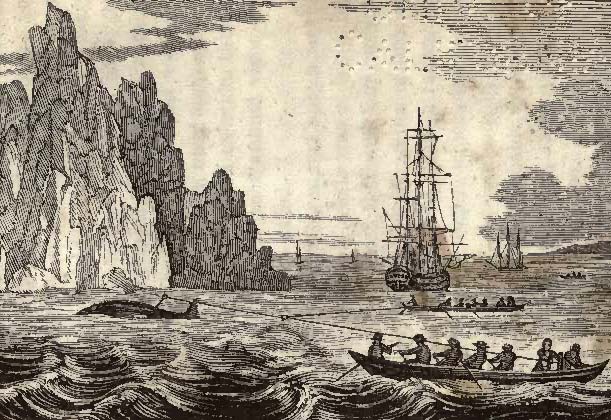 Polar Whale dragging the Boats of the Bounty.
|
|
|
Forty Hours' Drag.
|
Six Miles of Line.
|
|
The wind blowing a moderately brisk breeze, the top-gallant-sails were taken in, the courses hauled up, and the top-sails clewed down; yet in this situation she was towed directly to windward, for an hour and a half, with the velocity of one and a half to two knots an hour, the whale all the while beating the water with its fins and tail, so that the sea around was in a continual foam. At length, near eight o'clock, after forty hours of incessant exertion, this tenacious assertor of his vast animal vigor and territorial rights was killed.
There is an instance given by Captain Scoresby where a Greenland whale was at last killed who had drawn out ten thousand four hundred and forty yards, or about six miles of line, attached to fifteen harpoons, besides taking one boat entirely under water, which disappeared and was never seen, the harpoons by which it was held to the whale probably drawing out under the immense pressure, and leaving it to sink, or to rise under the ice.
But the most dreadful display of the whale's strength and prowess yet authentically record. ed was that made upon the American whale ship Essex, Captain Pollard, which sailed from
|
|
|
Accident to the Essex.
|
A strange and fatal Collision.
|
|
Nantucket for the Pacific Ocean in August, 1819. Late in the fall of the same year, when in latitude forty of the South Pacific, a school of sperm whales were discovered, and three boats were manned and sent in pursuit. The mate's boat was struck by one of them, and he was obliged to return to the ship in order to repair the damage.
While he was engaged in that work, a sperm whale, judged to be eighty-five feet long, broke water about twenty rods from the ship, on her weather bow. He was going at the rate of about three knots an hour, and the ship at nearly the same rate, when he struck the bows of the vessel just forward of her chains.
At the shock produced by the collision of two such mighty masses of matter in motion, the ship shook like a leaf. The seemingly malicious whale dove and passed under the ship, grazing her keel, and then appeared at about the distance of a ship's length, lashing the sea with fins and tail, as if suffering the most horrible agony. He was evidently hurt by the collision, and blindly frantic with instinctive rage.
In a few minutes he seemed to recover him-
|
|
|
Ship Settling.
|
Malice aforethought.
|
Fate of Survivors.
| |
self, and started with great speed directly across the vessel's course to the windward. Mean time the hands on board discovered the ship to be gradually settling down at the bows, and the pumps were to be rigged. While working at them, one of the men cried out, "God have mercy! he comes again!"
The whale had turned at about one hundred rods from the ship, and was making for her with double his former speed, his pathway white with foam. Rushing head on, he struck her again at the bow, and the tremendous blow stove her in. The whale dived under again and disappeared, and the ship foundered in ten minutes from the first collision.
After incredible hardships and sufferings in their open boats, on the 20th of December the survivors of this catastrophe reached the low island called Ducies, in latitude twenty-four degrees forty minutes south, longitude one hundred and twenty-four degrees forty minutes west. It was a mere sand-bank, nearly barren, which supplied them only with water and sea-fowl. On this uninhabited island, dreary as it was, three of the men chose to remain, rather than again commit themselves to the
|
|
|
Protracted Sufferings.
|
A strange, eventful Story.
|
|
uncertainties of the sea. They have never since been heard from, the island being seldom visited.
On the 27th of December, the three boats, with the remainder of the men, put away together for the Island of Juan Fernandez, at a distance of two thousand miles. The mate's boat was taken up by the Indian, of London, on the 19th of February, ninety-three days from the time of the catastrophe, with only three living survivors.
The captain's boat was fallen in with by the Dauphin, of Nantucket, on the 23d of the same month, having only two men living, whose lives had been eked out only through that last resort of hunger in the wretched, which words shudder to relate! Out of a crew of twenty, five only survived to make the ear of the world tingle at their strange, eventful story.
There is one other instance of the immediate shipwreck of a whaler by the shock of those mighty leviathans, that of the Union, of Nantucket, Captain Gardner, which was totally lost, in the year 1807, between Nantucket and the Azores, by a similar concussion. A merchant brig, plying between Panama and one of
|
|
|
Others like it.
|
Tempted Temerity of a Whaling Captain.
|
|
the ports of Western Mexico, has lately met with the same disaster, but without loss of life, the passengers and crew being all rescued by an American whale ship.
Another form of the perils of whaling is illustrated in the following incidents, taken from an authentic communication in one of the religious newspapers of the day, which we insert here in order to complete this Daguerreotype Gallery of Life and Adventures in a Whale Ship.
A few years ago, the captain of a whale ship was on a cruise in the Pacific Ocean. There were three boats attached to the ship. Early one morning a whale appeared. Two boats were sent to capture it. They fastened to the whale, and were soon drawn by this monster of the deep out of sight of the ship. An hour or two passed along, when, suddenly, another whale rose in the water, but a few rods from the vessel. The temptation to attempt its capture was too strong to be resisted. The captain ordered the remaining boat to be lowered, and, leaving but one man and two boys to take care of the ship, sprang into the boat with the rest of the crew.
Soon the harpoon was plunged into the
|
|
|
Unequal Contest.
|
The Mammoth wins the Day.
|
|
whale, and they were carried, with almost the speed of the wind, about fifteen miles from the ship. Then the whale plunged perpendicularly down into the depths of the ocean. It was not long ere they saw him, fathoms deep in the crystal waters, rushing up, with open jaws, to destroy the boat. By skillfully sheering the boat, the whale missed his aim, and, thrusting his mammoth head some fifteen or twenty feet into the air, he fell over upon his side, and again disappeared in the fathomless sea. Soon he reappeared in the almost transparent abyss, again rushing upward to attack the boat. Again he was foiled.
The third time he descended, and as he arose, with invigorated fury, he struck the boat in the center of the keel, threw it some fifteen feet into the air, and, scattering the crew and fragments of the boat over the waves, again plunged into the deep and disappeared. The captain and the crew were now in the water, clinging to the pieces of the demolished boat. They were fifteen miles from the ship, and could not be seen from its deck. The other boats were gone, they knew not where. Apparently, every chance of rescue was cut off,
|
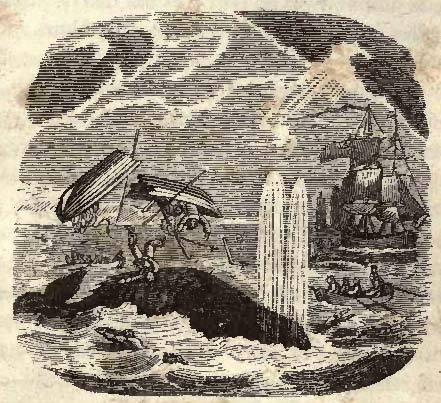 Right Whale staving a Boat.
|
|
|
Dismal State and Prospects.
|
Prayers of the Despairing.
|
|
and nothing awaited them but a watery grave. It was twelve o'clock at noon. The hours of one, two, three, four, five, and six passed slowly away, and still they were floating, almost exhausted, upon the heaving billows of the Pacific. When the ship rose on the swelling seas, they could just catch a glimpse of her rolling spars.
"Oh! how fervently I prayed," said one of these mariners, when afterward relating the scene, "that God would in some way providentially interpose and save our lives! I thought of my wife, of my little children, of my prayerless life, of the awful account I had to render at the bar of God for grieving the Spirit and neglecting the Savior. All the horrors of this dreadful death were forgotten in the thought, that in one short hour I was to render up an account to God for years of ingratitude and disobedience. Oh! thought I, if I were only a Christian, what a solace would it be to me as I sink into this watery grave!"
The sun had now disappeared behind the distant waves, and the darkening shades of a dreary night were settling down over the ocean. Just then they descried, dim in the dusky distance,
|
|
|
A Gleam of Hope.
|
They Shout for dear Life – are heard.
|
|
one of the absent boats returning to the ship. It was, however, far off, apparently beyond the reach of their loudest outcries. Impelled by the energies of despair, they simultaneously raised a shout, which blended with the wash of the waves and sighing of the breeze, and the boat continued on its way. Again they raised another shout, and it was also unavailing.
The shades of the night were deepening, the boat rapidly passing by them. Almost frenzied at their terrible condition, they raised another cry. The sound of that distant shriek fell faintly upon the ears of the boatmen, and they rested on their oars. Another shout, which almost lacerated their throats, was raised, and the boat turned in pursuit. They were taken from the water, and carried almost lifeless to the ship.
In another authentic instance, when a boat was chasing a whale, he suddenly turned to windward, and made directly for his pursuers, who were so excited by the chase as to be blind to danger. On, therefore, they madly rushed, without trying to avoid the infuriated monster, so eager were they to plunge into him their irons, till the boat struck with such force upon the whale's head as to throw the oarsmen from
|
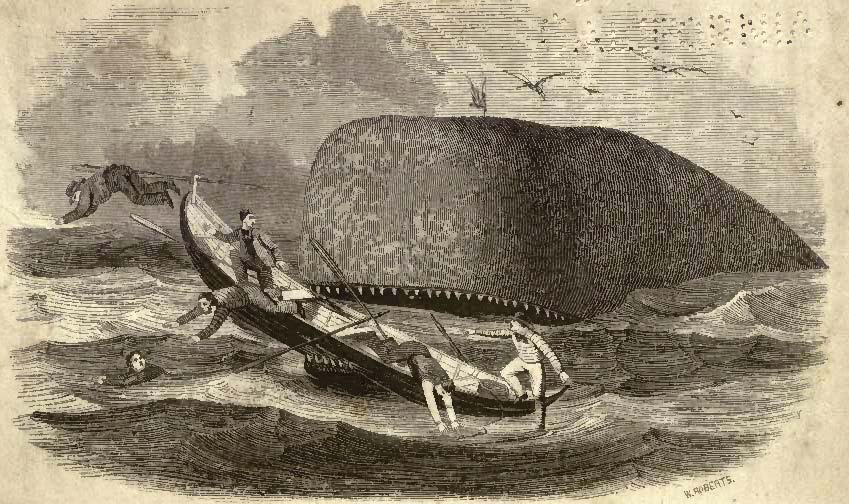 Picture of a Whale-boat thrown into a Whale's Mouth.
|
|
|
Perilous Hunt.
|
A Boat thrown into a Whale's Mouth.
|
|
their thwarts. At the same moment, the boatsteerer let fly his two harpoons into the mammoth body, which rolled over on its back; and before the boat could get clear of danger, being to the windward, a heavy sea struck it and threw them directly into the whale's mouth! All, of course, sprang for their lives, and they had barely time to throw themselves clear of the boat before it was crushed to pieces by those ponderous jaws, and its ejected crew were providentially all picked up by another boat.
Such are the dangers which are continually incurred in the whale fishery, equal almost to those of the field of battle. We often wonder that so many escape with their lives from a battle field; and we equally wonder that, comparatively, so few perish in this most hazardous pursuit. A boat, almost as frail as a bubble, approaches the side of a whale, slumbering upon the ocean, sixty or eighty feet in length, and a harpoon is plunged into his body. His efforts to destroy his tormentors or escape from them, as we have again and again learned, are terrific. The ocean is lashed into foam by blows from his enormous flukes, which would almost dash in the ribs of a man-of-war. Often he rushes at
|
|
|
The Game majestic.
|
The Whaleman's Lot hard.
|
|
the boat with lightning speed and with open jaws, and it is crushed like an egg-shell in his mouth.
In this frightful warfare many are maimed, and many lives are annually lost. But some whales are worth between two and three thousand dollars, and this is majestic game to hunt. He, however, who earns his bread through the perils and hardships of this pursuit, has truly a hard lot in life. He is but a transient visitor at his home. Amid the solitude of the ocean he passes the greater portion of his days; and if he survives the perils of his adventurous pursuit, the storms of the ocean, and the pestilence of different climes, he usually finds that the friends of his youth are all gone, and that he is almost a stranger at his own fireside. And yet this mode of life has its own joys and emoluments, for, if ordinarily successful, in the course of fifteen or twenty years a whaleman will lay up a moderate competence for the rest of his days, and meanwhile, notwithstanding the unfavorable influences which are often at work in the whale ship, many are forming noble characters.
Although it is no genial soil, yet virtue, hu-
|
|
|
Who that knows it would go to Sea?
|
The Life to live.
|
|
manity, true nobility, and the fear of God, can live and grow in a whale ship, both fore and aft. I have met them on this present voyage, and in some signal instances elsewhere, which it would be base ingratitude and a denying of God's grace not to acknowledge and give credit for. But who that knows it as I do, would choose a life in a whale ship, or life any where at sea! Who does not rather say, with one that knew whereof he spake,
Eternal ocean I old majestic sea!
Ever I love from shore to look on thee
And sometimes on thy billowy back to ride,
And sometimes o'er thy summer breast to glide;
But let me live on land, where rivers run,
Where shady trees may screen me from the sun
Where I may feel, secure, the fragrant air;
Where, whate'er toil or wearying pains I bear,
Those Eyes which look away all human ill,
May shed on me their still, sweet, constant light,
And the hearts I love may, day and night.
Be found beside me safe and clustering still.
|
|
|
|
Sabbath for a Whale Ship.
|
A Whale Ship for the Sabbath.
|
|
CHAPTER XV.
CLAIMS AND ADVANTAGES OF THE SABBATH IN A WHALE SHIP.
When the Sabbath's peaceful ray
O'er the ocean's breast doth play,
Though no throngs assemble there,
No sweet church-bells call to prayer,
Spirit! let thy presence be
Sabbath to the mustering sea. – Mrs. Sigourney.
|
Atlantic Ocean, Commodore Preble, latitude 32º N., longitude 64iº W. Off the Bermudas.
A prime end in the preceding sketches of whaling life has been to prepare the way and secure attention for certain considerations upon the wholesale violation of the Sabbath in this business. By the Whaleman's Shipping List, at the commencement of 1844 or thereabouts, there were employed in the whale fishery, from the ports of the United States, six hundred and seventy-four vessels, five hundred and ninety-three of them then at sea, chiefly from New Bedford, Nantucket, Sag Harbor, New London, Stonington, and Newport.
|
|
|
Estimate of Men in the Whale Fishery.
|
Whence derived.
|
|
Allowing for the average thirty souls to a ship, which is a moderate computation, there were then more than twenty thousand persons prosecuting this trade. The number has not diminished since, but has rather increased, until the present year, and it is an estimate much within bounds, that there are now actually employed in this business, from the ports of the United States, eighteen or twenty thousand men. Among them are men of divers trades and nations, but a large majority are citizens of the United States from remote inland and sea-port towns.
Their characters and relative degrees of intelligence and moral worth are different, as are their origin and education. Some are of vicious, low stock, vicious education, and an incurable addictedness to vice. Others are of good families, from religious communities, sons of Christians, and have been taught to fear God and keep his commandments. A few of them profess godliness. All of them are alike in this, that they are rational, accountable men, under obligation to keep God's law, and having man's natural right to and need of the Sabbath for rest and religious worship.
|
|
|
The Whale-ship Law.
|
Whale-ship Sabbath breaking.
|
|
But what is the law to which they are all alike subjected in whale ships? With very few exceptions, to be stated in their place, it is a law that acknowledges no Sabbath, but compels them to labor alike on the seventh day and all days, in order to capture whales and fill their ship. I repeat it, for the information of those whom it may concern, there is no Sabbath known in the whale fishery.
As generally conducted, it makes eighteen or twenty thousand habitual Sabbath-breakers. Men are kept at the fore and main mast heads, boats are lowered, whales are taken and "cut in," and all the work incident thereto is done on the Sabbath just as much as on any day, and this without the pretence of a plea of necessity, as in working a ship, but solely in order to "fill up" as soon as possible, and return to port with a cargo, taken as it comes, it matters not how, whether in those sacred hours which the easy owner ashore has been spending at church, or in the busy week days which he devotes to the counting-room, or farm, or workshop.
Owners, too, know this when their ships go from port, are generally willing it should be so,
|
|
|
How to be stopped.
|
Where lies the Guilt?
|
|
are averse to have it otherwise. Owners, captains, officers, and men are alike the willing participators in this gross violation of the Lord's day, for the sake of the gain they think it brings them; else either of these parties, by asserting their right to the Sabbath, and refusing to own or sail in ships that violate it, could easily prevent it.
But while there is an individual participation in this sin, the guilt of it rests especially upon owners and captains, and it is they who are chargeable with it, and who are to be arraigned at the bar of public opinion, as they will be at the tribunal of Almighty God. It is they whom we charge with being at the bottom of a systematic and most gross violation of one of the plainest commands of the Decalogue, and with willfully involving a great many others, willingly or not, in the same sin.
The only pretexts of reason we have ever heard urged to defend it are, This is the business by which I get a livelihood for myself and family. If I neglect to take whales when God offers them, my family and employers will be likely to suffer for it. I am necessarily absent a long time from home, and I ought to use ev-
|
|
|
Pretexts for Sabbath Whaling.
|
Replies of Reason.
|
|
ery means in my power to shorten that time, and secure a voyage for myself and owners. If I do not lower for whales when they are in sight, the Sabbath will be more desecrated by the men's grumbling than it would be by cheerful labor in taking whales. The business of whaling is of such a precarious nature, that, unless all chances are seized, successful voyages will not be made; therefore it is necessary also to use the Sabbath in this work when Providence presents the game. No one regards the Sabbath more than I do when ashore, but my business exempts me from the obligation of such a strict observance of it at sea.
Now to all these specious efforts at self-justification, which we have heard put forth at different times and by different persons, and to every other of a similar sort, it is enough to reply, first, that there is no lawful worldly calling, except that whose immediate end is to relieve human suffering, or minister instruction and comfort to the soul, which it is right to pursue on the Sabbath. Six days shalt thou labor and do all thy work. But the seventh is the Sabbath of the Lord thy God: in it thou shalt not do any work, thou, nor thy son,
|
|
|
Made for Man as a Worker.
|
Law of the Sabbath universal.
|
|
nor thy daughter, thy man-servant, nor thy maidservant, nor thy cattle, nor thy stranger that is within thy gates. For in six dvs the Lord made heaven and earth, nd all thatf-in them is, and rested the seventh day: wherefore the Lord blessed the Sabbath day, and hallowed it.
2. God has revealed no indulgence in favor of Sabbath whaling, any more than to Sabbathbreaking railroad companies, steamboat, canal, or stage lines, or Sunday manufactories. Show us a single Divine statute of limitation yielding the privilege of Sabbath violation in but one clear case, and we will yield the argument.
3. The assertion, that if the Sabbath is not improved for getting whales, the voyage will be likely to prove a failure, is a mere assumption, for prosperous voyages have been and may be made, and ships filled, without a whale being struck on the Lord's day. What has proved true in one instance, other things being equal, there is reason to believe would prove true in all.
4. The obligation of the Sabbath is universal, and extends to all men alike, on the sea and land. The Sabbath was made for man universally, as a worker, under all circumstances. By
|
|
|
A good Conscience is better than Sabbath Gains.
|
|
man, therefore, it is to be always kept. It was given to the race by God for rest and holy worship, and every individual of the human race, to whom the law comes, is bound so to use it.
5. The man who conscientiously takes care to have the Sabbath sanctified by himself, and family, and dependents, will be likely to have his family blessed and taken care of by the Sabbath's almighty Lord. Godliness is profitable for all things, having promise of the life that now is and of that which is to come. In keeping God's commandments there is exceeding great reward.
6. It is better to obey God and please HIM, than to attempt to please men and get the favor of owners by taking oil for them on the Sabbath, in direct violation of a positive law of God, made for the good of all men, and in harmony with the human constitution.
7. It were better, if need be, to have a voyage prolonged, and then come back with a clear conscience and God's blessing, than to return sooner a Sabbath breaker, with the ill-gotten gains of Sabbath whaling, and a conscience defiled or seared by sin.
8. If men grumble, and swear, and sin be-
|
|
|
A groundlees Presumption.
|
A Fact of Experience.
|
|
cause I do not order boats to be lowered on the Sabbath day, it is their look-out and blame. If I have boats lowered, it is mine, and God will not hold me guiltless.
9. It is an unfounded presumption that a steady and well-grounded refusal to have nothing to do with Sabbath whaling will produce discontent among the men. Experience has proved that they like the rest of the Sabbath as well as any other men, and are glad enough to have it theirs for a constancy, though they would like now and then to improve any rare chance offered on that day as well as on any other.
10. If no look-out is kept for whales on the Sabbath, but the day is devoted to rest, they will not often be seen that day, so as to be an occasion of discontent. These two last propositions are drawn from the experience of this ship, the Commodore Preble, during its present Sabbath-keeping voyage, and will, I am well convinced, be found true of every ship that shall try the experiment. The captain became persuaded at the Sandwich Islands that he would be wrong and without excuse to whale any more on the Sabbath, and with a new heart he resolved to do so no more.
|
|
|
Misfortunes no Argument against honoring the Sabbath.
|
|
He took one season afterward on the Northwest, but, for reasons which it were easy to mention, not the least of which was not being well officered or manned for Northwest whaling, the ship did not succeed so well as many others. Several boats were stove early in the season, some of the men got upset and frightened, towlines parted, and many things went ill; but, so far from repenting of his purpose to keep the Sabbath, he is more strong in it than ever, well persuaded and well content that, if God do not pay him in oil here, durable riches and righteousness are his in heaven.
It should be mentioned, in passing, to the honor of Lynn, that the only two whale ships, of which this is one, that hail from that port, now keep the Sabbath. The heaviest owner in them is a religious man, who says he does not want any oil taken on the Sabbath. There is another from New London, the Nantasket, Captain Smith, and others, it is to be supposed, with which the writer is not acquainted.
It is painful to have to record the pitifully different course of another captain from New Bedford, a professor of religion and esteemed a good man. He was convinced and felt that
|
|
|
Pitiable Story of a New Bedford Captain and Church Member.
|
|
it was wrong to whale on the Sabbath, and when he last went from the Sandwich Islands to the Northwest Coast, he proposed in his mind not to. For two Sabbaths he held out, and on one of them saw whales. By the time the next Sabbath came round they had done but little; he felt uneasy, could not stay below or on deck with any comfort, his mind running upon whales.
At length, to get relief, instead of betaking himself more earnestly to prayer and the Word of God, he ordered his mate to send a couple of men aloft, and when they sang out for whales, he lowered his boats and his purpose to keep the Sabbath at the same time. Blubber came in in abundance, and with it came occupation and content, purchased, I need not say, how poorly. He soon filled up and went home, even throwing overboard some provisions to give place to oil.
This story of his experience he told himself, while all the time acknowledging it was not right, his principle and conscience not being strong enough to carry out his convictions of duty, and keep him from acknowledged sin. On the other hand, a pious sailor, recently re-
|
|
|
Experience of a pious Sailor.
|
Godliness the Devil wants.
|
|
turned from a two years' voyage, says that thirty whales were taken by his ship's crew during their absence. Three of these, to his sorrow, were taken on the Sabbath. But in taking these three, five boats were destroyed and five men were seriously wounded, two having their limbs broken, and one his skull fractured. In taking the remaining twenty-seven whales on the other days of the week, only four boats were injured, and one man slightly hurt.
Now it needs not that we say positively of so easy a professor and loose a conscience as that of the New Bedford captain just now referred to, that such a man can not be a Christian, or to deny that he may be saved so as by fire. But certain it is, it were a pity for the world if the goodness in it, and fear of God, and practical regard to principle and duty, were no stronger than this man's. The devil might keep it for all such Christians a thousand years longer, and we don't know that he would want any better agents than such pliable professors, that seem to take gain for godliness, and make a "gospel of their maw."
Such men will do well to read and ponder the following extract from the Narrative of an
|
|
|
Schoolcraft's Testimony as to the benefit of Sabbath Keeping.
|
|
Expedition to the Sources of the Mississippi, by Henry Schoolcraft: "No Sabbath day was employed in traveling. It was laid down as a principle to rest on that day, and whenever it overtook us, whether on land or on water, the men knew that their labor would cease, and that the day would be given them for rest. Such of them as felt an inclination, had the further privilege of hearing a portion of the Scriptures read or expounded, or uniting in other devotional rites. There were but a few hours of a single morning and a few hours of a single evening, of separate Sabbaths, at distant points, which were necessarily employed in reaching particular places; and the use of these appeared to be unavoidable, under the peculiar circumstances of our local position.
"It may, perhaps, be thought, that the giving up one seventh part of the whole time employed on a public expedition, in a very remote region, and with many men to subsist, must have, in this ratio, increased the time devoted to the route. But the result was far otherwise. The time devoted to recruit the men not only gave the surgeon of the party an opportunity to heal up the bruises and chafings they complain-
|
|
|
Zest after Rest.
|
A Word to the Sabbath Keeper.
|
|
ed of, but it replenished them with strength; they commenced the week's labor with renewed zest, and this zest was in a measure kept up by the reflection that the ensuing Sabbath would be a day of rest. It was found, by computing the whole route, and comparing the time employed with that which had been devoted on similar routes in this part of the world, that an equal space had been gone over in less time than it had ever been knoiun to be performed by loaded canoes or (as the fact is) by light canoes before. And the whole expedition – its incidents and results – has been of a character furnishing strong reasons for uniting in ascriptions of praise to that Eternal Power who hath been our shield from the pestilence that walketh in darkness, and from the destruction that wasteth at noon day." – We have become acquainted with the names or persons of nine men belonging to the Church, masters of whale ships, and but three of these keep the Sabbath. Some of the reasons for this desecration of the Lord's day by whale ships, or the causes of it, we will endeavor to give in another chapter; and we close this with a voice of good cheer to upright Sabbath-keep-
|
|
|
The Poet to the Mariner.
|
Good Angels lead Thee!
|
|
ing whalemen, as heard in the stirring Mariner's Hymn by Mrs. Southey:
Launch thy bark, mariner!
Christian, GOD speed thee!
Let loose the rudder bands –
Good angels lead thee!
Set thy sails warily,
Tempests will come;
Steer thy course steadily,
Christian, steer home!
Slacken not sail yet
At inlet or island;
Straight for the beacon steer,
Straight for the highland:
Crowd all the canvass on,
Cut through the foam –
Christian! cast anchor now –
Heaven is thy home!
|
|
|
|
Main reason for Sabbath Whaling.
|
Lucre above Law.
|
|
CHAPTER XVI.
A PLEA IN BEHALF OF THE SABBATH FOR WHALEMEN.
What says the prophet? let that day be bless'd
With holiness and consecrated rest.
Pastime and business both it should exclude,
And bar the door the moment they intrude;
Nobly distinguished above all the six,
By deeds in which the world must never mix.
Hear him again! he calls it a delight,
A day of luxury, observed aright;
When the glad soul, made heaven's own willing guest,
Sits banqueting, and God provides the feast. – Cowper.
|
The all-inclusive cause which perpetuates and lies at the bottom of Sabbath whaling, is that which upholds and furnishes the stimulus to almost all other forms of Sabbath breaking, the odious slave-trade, &c. – I mean the lust of lucre, that deified greedy Devil of gain that in the end troubleth his own house. Whaling captains and owners are seldom willing, for the honor of GOD or regard to his law, to forego the profits which they think accrue from Sabbath whaling; and therefore, once at sea on whaling ground, they are unwilling to stop and take breath for a long Lord's day.
|
|
|
What Sabbath Breakers think.
|
What they do not think.
|
|
Oil got on the Sabbath burns as well, sells as well, and, they think, spends as well as oil got lawfully on week days. Not to use the Sabbath in their gainful business, they think, would be losing one seventh part of their time, neglecting one seventh of their chances, keeping them one seventh longer out, consuming one seventh more provisions, exhausting one seventh more of patience and spirits, and perhaps, in the end, leaving them with one seventh less of oil than ships that use all days alike, and one seventh less of every thing but a good conscience and the favor of God.
To balance these, we have only to offer, without swelling the list, as might easily be done, with other items, that keeping the Sabbath would be likely to make whalers three sevenths better and more respectable men, three sevenths more easy and peaceful in their minds, and one seventh the longer lived than those who persist in profaning God's holy day; and it would make owners at home all the better Christians, or more likely subjects of the grace of God here, and with less to answer for at the great bar of judgment hereafter.
At present it is said by many whaling cap-
|
|
|
Religions Owners of irreligious Ships.
|
A Yankee's Guess.
|
|
tains, that their owners absolutely require whaling on the Sabbath, as one of the conditions on which they give them command of their ships. It is also said that many of these ship-owners are members of evangelical churches in Nantucket, New Bedford, Fair Haven, Sag Harbor, New London, Warren, Newport, Stonington, and other places. Some owners say nothing to their captains on the subject; but if their ships do but return full, no inquiries are made how or on what days the oil was obtained.
Now and then a shrewd Yankee captain guesses that his pious owners have no objections to his taking oil when he can get it. A full ship fills the heart with joy, and lights up the countenance with an approving and benignant smile; while a half-filled ship often clouds the brow, deranges the spleen, obstructs the biliary ducts, and stops the joyful and generous action of the heart. Especially would this be so had the crew of the half-filled ship been permitted to rest one day in the seven, according to the commandment.
Occasionally a master, an officer, or a sailoi hints that he would be glad to rest on the Sab. bath, according to the dictates of his conscience;
|
|
|
Protest of a Missionary.
|
Proper Subject of Rebuke.
|
|
but this he may not do, except at the risk of losing his ship and being thrown out of employment, and he will therefore conclude that Sabbath whaling with him, at least, is a work of necessity.
Rev. Titus Coan, an honored missionary at the Sandwich Islands, who has had much to do practically with whalemen, says, with not less truth than with a justifiable irony, that there are some captains "who will consent to be very pious and hold religious meetings on the Sabbath when there are no whales. Of course, they always keep a man at 'mast head,' on the 'lookout' for the oil of joy to the whalemen, while the rest look up for 'an unction from the Holy One;' or, in other words, one man looks out for worldly, while the rest look up for heavenly good. Now should it so happen that the prayer of this MAST-HEAD MINISTER should be first granted, by raising a whale during divine service, and should he, from his lofty pulpit, cry out,' There she blows!' then what a thrill of joy electrifies all his hearers! How soon the lesser desire yields to the greater! How quick and how thrilling the response from the quarter-deck,' WHERE AWAY? LOWER THE BOATS! BEAR AHAND, BOYS!'
|
|
|
Very fervent Whale-ward.
|
Very dull God-ward.
|
|
"Now the scene changes. Devotion does not cease, but it is turned into another channel. Prayer, reading, sacred melody, exhortation, all give place to the weightier matter of pursuing this MOVING SEA-GOD! The object of devotion thus changed, interest, zeal, fervor, energy, are all quickened and strongly developed. "True, most irreligious men ridicule this kind of piety, and heartily despise its selfishness and inconsistency; and Lord's-day whalemen often complain that it is hard to maintain religion, and especially so to keep up divine service at sea. No doubt it is hard, and perhaps it is impossible, to exercise true religion in connection with Sabbath breaking.* The two can
|
|
|
An old Salt's opinion of Sabbath Whaling.
|
|
not be reconciled. No man can serve two masters. Ye can not serve God and mammon."
Another reason why the taking of whales is prosecuted so generally on the Sabbath as well as other days is, the neglect of ministers in whaling ports to apply God's law to Sabbath whaling. Captains at the Sandwich Islands, who have been remonstrated with by faithful ministers there, have said, "We never heard our ministers at home preach so against Sab-
|
|
|
True in Fact, but poor for Excuse.
|
Silence of Ministers.
|
|
bath whaling." And it has even been intimated that a clergyman, who should be faithful in reproving for this sin, would not be endured long in any of our whaling ports.
Now, though a poor excuse, this, we believe, is in fact true. Whether, by reason of mere apathy or inattention, this form of Sabbath breaking not being before their eyes; or, holding, as some do, that we are only to preach principles, and let them apply themselves; or, as fearing to offend wealthy parishioners, whose support the Church can not well spare from one or all of these reasons combined, ministers in whaling ports (unless we have been greatly misinformed) have had little or nothing to say upon the sin of Sabbath whaling; and their parishioners have, consequently, kept on owning and sailing in Sabbath-breaking ships, kept in countenance by their own minister's silence, which has (emphatically to them) spoken consent.
It can hardly help reflecting upon the fidelity of clergymen at whaling ports, in some of which there have been of late years powerful revivals of religion, that ship-masters, officers, and men, converted in those very revivals, have gone out upon the high seas organized compa-
|
|
|
Wrong Names and right Names.
|
Protest of Christianity.
|
|
nies of Sabbath breakers. Surely, if there be the least propriety in speaking of a slave-holding Christianity, this may as well be called a Sabbath-breaking Christianity. But no! there is no propriety in either, when we call things by their right names. There can be such a strange anomaly as slave-holding, Sabbath-breaking Christians, but there is no slaveholding or Sabbath-breaking Christianity. She alike eschews both, as utterly at war with her doctrines and requisitions. They are both alike an incubus upon her, not her offspring.
At the best, they are but temporary moles and blemishes upon her fair person, which time, together with her own internal purity and energy of constitution, will soon wash off and make to disappear. They are deforming excrescences upon the noble tree of the American Church, which, unless they be soon cut off, may produce the vegetable gangrene or dry rot. But never call them her limbs or leaves, for she indignantly denies the parentage, and asserts that they have fastened on her like leeches, but are not of her; and she protests that it would be as unfair to call the monarch oak by some parasitical vine that now and then coils over it, as
|
|
|
How she deals with Parasites, Warts, and Carbuncles.
|
|
to give herself epithets from the heresies and misdeeds that have so struck their roots into her bark as to be nourished by her juices.
Rather let it be our business to pull off the unnatural growth, or purge it with the physic of truth till it dies and drops away of itself, than to derive epithets to Christianity from slave-holders or Sabbath breakers, or any other class of sinners that contrive to shelter themselves under its lea. It is the duty especially of ministers in the ports where whalers are fitted out, to bring the law of God to bear upon this form of Sabbath breaking; to apply it pointedly and plainly to this sin, and to preach and pray against it till it shall cease to be allowed by owners in their congregations, or committed by persons going forth from their communities.
Let them, as the constituted expounders of tne law of God, and the guardians of public morals and religion, boldly attack this sin, and show its contrariety to the Divine law and the Gospel of Christ. Let ministerial associations and societies, formed to promote the better observance of the Lord's day, pass resolutions expressing their sense of this sin. Let fathers,
|
|
|
Appeal to Fathers, Ship-owners, Captains, Seamen, &c.
|
|
whose sons go down upon the sea in ships, protest against a practice by which those sons are rendered Sabbath breakers, and the high, homebred estimate in which they have been taught to hold that sacred day obliterated, and the way opened for any and all degrees of moral depravation to which that sin is the natural initiation.
Let ship-owners, as they fear God and have a regard to the judgment, separate themselves from this iniquity by positively instructing their agents not to whale on the Sabbath day. We call upon captains and officers to exercise the manly independence and regard for their rights to say that they will not sail except in Sabbathkeeping ships; and we call upon the men to stipulate beforehand that they shall be allowed the rest of the Sabbath. We call upon the editors of respectable journals, in whaling ports and elsewhere, to discuss the propriety of this practice. We ask religious men and good citizens there to express, in the intercourse of private life, their sense of the wrongfulness of so plain a desecration of the Christian Sabbath.
It is every where popular, at this day, to praise our Puritan ancestry, and, under God, to as-
|
|
|
Common to praise a Puritan Ancestry.
|
Puritan Morals.
|
|
cribe our liberty, and every thing that is dear to us, to their high principles and their conscientious practical regard to right. But with how many, it is to be feared, is it like the Jews building the sepulchres of the prophets, or like the base Athenians giving the hemlock to the virtuous living Socrates, and decreeing a statue and panegyric to upright Phocion, whom they had themselves put to death.
For it has come to pass that an institution which our fathers held in highest reverence and kept with strictest care, is now, both by precept and political statute and example, sadly desecrated, and that, too, with a boldness and publicity that prove how wide and general is our departure, both from their stern principles and severe Christian morals. A noble New England ancestry is justly a nation's boast; nor can the praise of our pious forefathers ever become too popular, or their memory be held in too high regard; but we would like better to witness a revival of their grave manners, and to see a holier regard paid to that sacred institution which they prized and guarded above all others, and therefore have we endeavored to draw attention to one form of its desecration, that is doing not
|
|
|
Supposed Remontrance of a Delegation of Puritans.
|
|
a little to vitiate public morals, and impair that high sense of the Sabbath's sacredness which it is of vital importance to have maintained.
If the spirits of some of those upright old Puritans were now again to come among us, and see the whale ships of New England unscrupulously profaning God's holy day, steamboats and locomotives running, and stagecoaches carrying the Sabbath mail, would they not be likely to reproach us in accommodated language like this? In vain we made ourselves exiles, for conscience and the love of God, from the servile kingdoms of Europe. In vain we crossed the boisterous ocean, found a new world, and prepared it for the happy residence of civil and religious liberty. In vain we toiled; we bled in vain, if you, our offspring, thus need principle and purpose to maintain inviolate the sanctity of the Sabbath, and to defend the observance of that hallowed institution, which we kept so strictly, against the encroachments of hurrying worldliness and greedy gain. The blessed institutions we transmitted you can not long survive the desecration of that holy day, when, too, the penitentiaries and pauper-houses of Europe are disgorging upon your fair domain.
|
|
|
Scoresby's Experience of Sabbath Keeping in a Whale Sbip.
|
|
Up, and rescue it from profanation, or your precious patrimony of liberty is gone!
The veteran Captain Scoresby, who, by age, and experience, and judgment, is entitled to speak on this subject with authority (having gone through twenty-eight of those perilous voyages successfully, and killed four hundred and ninety-eight whales), says that, in the Greenland whale fishery, much more perplexing, and more subject to sudden embarrassments and dangers than the voyages commonly pursued, "I have known public worship to be carried on so regularly that never a Sabbath passed over, for several years together, without one or more full services being performed. During these voyages severe gales have commenced on the Sunday; dangers from rocks, ice, and lee shores have threatened; fre. quent embarrassments from thick weather have occurred; yet time and opportunity were always found for the worship of God. The success of the voyage often seemed to be in the way, duty to the owners of the ship seemed to forbid, yet we persevered in waiting upon God, and certain I am that we found his blessing.
"At three bells (half past nine A.M.) every
|
|
|
Church Rigged.
|
Option of the Men to Watch or to Pray.
|
|
Sabbath morning, the hands were'turned up' to prepare themselves for the forenoon service; then, according to the state of the weather, or the accommodations we had in the ship, the church was either' rigged' upon deck, or arrangements made for divine worship below. At eleven the service commenced, and generally concluded a few minutes after twelve. From the calling of all hands until this time, every man was on Sabbath-day duty; and, although no man was made to join in the prayers against his will, yet he had only this option, either to watch or to pray.
"Before each of our services, whenever the weather was at all unsettled, the ship was put under a somewhat snug sail, and, the deck being left to the charge of the proper officer of the watch, with the assistance of the helmsman, all the rest of the crew, or nearly all, could generally be spared to join the public prayers. When, indeed, there was any probability of squalls, or of any change being requisite in the sails, some few of the proper watch were placed within observation of the officer on deck, so as to be easily called up without disturbing their comrades. But, if circum-
|
|
|
Make ready for Sabbath on Saturday.
|
A noble Example.
|
|
stances required,. though for several years no such case occurred, the officer had orders to call up all hands to assist him.
"To the end of furthering the important object of sanctifying the Sabbath, it is good to remember it before it arrives. Prepare for the day of rest, as far as you can, on the Saturday. Let your men have time on Saturday evening for those needful acts of personal cleanliness which are better performed then than in the morning, so that the Lord's day be not unnecessarily broken in upon by these preparations. In every nautical duty which requires attention on Sunday morning, bear in mind the hours fixed for divine worship, that every work which can possibly be anticipated may be completed. If your flying sails be taken in, your retirement will be more comfortable and secure, and you will seldom or never find the loss in your voyage. The Lord's blessing will abundantly recompense this and every sacrifice made for his sake.
"Then call your men together, as far as possible, at the appointed hour, either in the cabin or on the deck, as may be most corpfortable. Again, in the afternoon, let your crew and pas-
|
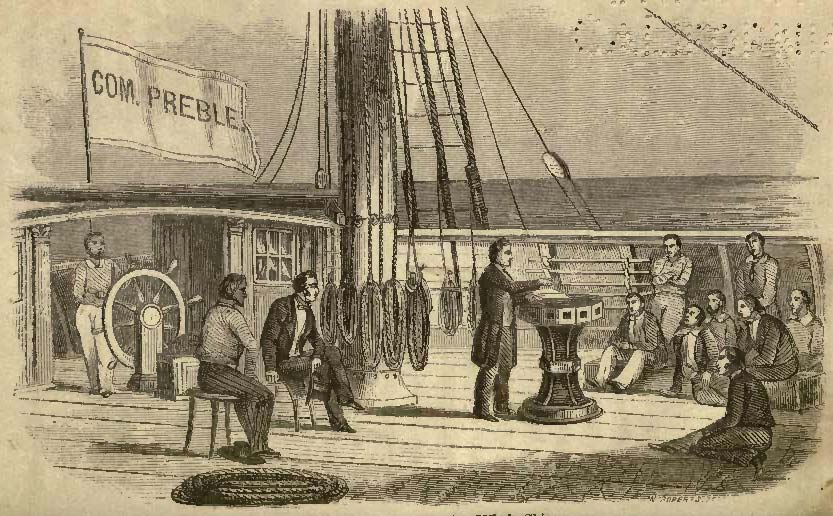 View of a Sabbath-keeping Whale Ship.
|
|
|
Benefits of the Lord's Day.
|
Verification of God's Word.
|
|
sengers, if any, have the opportunity of worshiping the Most High God, who made the heavens, the earth, and the wide sea; and, whether it be convenient to have any other service for the benefit of your apprentices or not, you will find it a good thing thus to wait upon the Lord. You will experience a benefit temporally as well as spiritually; your people will be more orderly and respectful, and Almighty God will be your shield and your exceeding great reward. Yea, if thou acquaint thyself with him and return unto him, the Almighty shall be thy defense; for then shalt thou delight thyself in the Almighty, and shalt lift up thy face unto God; and thou shalt make thy prayer unto him, and he shall hear thee."
Now what rational subject of Almighty God can doubt this, having for it His own WORD! And what ship-master or common mariner will turn a leaden ear to this testimony and expostulation of one of their own craft, to whom a long and varied experience gives a right to be heard and regarded. Considerations like these, we fully believe, will yet have their weight upon owners, officers, and men. The sea shall
|
|
|
A good Time coming.
|
Commerce shall be Religious.
|
|
yet have its Sabbath; the holy Lord's day shall be rescued from profanation by the great whaling and merchant fleets; the abundance of the seas shall be converted to God, and to the observance especially of this great ordinance of creation's Lord, THOU SHALT REMEMBER THE SABBATH DAY TO KEEP IT HOLY.
There's a good time coming for seamen, and that, we trust, not far. We thankfully recognize the law of progress and reform as true of them, and already remarkably developed in this day. We gladly share in the cheering faith of Dr. Bushnell, that the time is at hand when all that pertains to commerce is to be sanctified by virtue and religion, as of right it should be; "when commerce itself shall become religious, and religion commercial; when the mariners will be blended with all the other worshipers on shore, in the exercise of common privileges, and as members of a common brotherhood; when the ships will have their Sabbath, and become temples of praise on the deep; when habits of temperance and banks for saving will secuie them in thrift, and assist to give them character; when they will no more live an unconnected, isolated, and therefore reckless life,
|
|
|
Mariners to be Missionaries.
|
How to be brought about.
|
|
but will have their wives and children vested here and there, in some neat cottage among the hills, to be to them, when abroad, the anchor of their affections, and the security of their virtue; when they will go forth also to distant climes and barbarous shores, with all their noble and generous traits sanctified by religion, to represent the beauty of Christ to men, and become examples of all that is good and beneficent in his Gospel. Be it ours to aid a purpose so desirable, theirs to realize it in their conduct and character."
Realized, we believe, it will be in the world's cheering progress, and that ere long, when MARINERS shall be missionaries from shore to shore, from the river to the ends of the earth; when the isles shall wait God's law at their hands, and continents, long wrapped in the darkness of paganism, shall be thrown wide open to messengers of salvation, borne and backed by those that go down to the sea in ships, and do business in the great waters!
Lord! for those days we wait; those days
Are in thy word foretold.
Fly swifter, sun and stars, and bring
This promised age of gold.
|
|
|
|
Mariner's Millennium through the Telescope of Poetry.
|
|
Peace, with her olive crown, shall stretch
Her wings from shore to shore;
The nations of the earth shall hear
The sound of war no more.
Beneath the influence of HIS grace,
The barren waste shall rise,
With sudden green and fruits array'd –
A blooming Paradise.
Then shall bless'd seamen sing and tell
Of all Emanuel's love!
AND SEA AND LAND, IN SABBATH LIGHT,
SHALL SHINE LIKE HEAVEN ABOVE!
|
|
|
|
Hopes and Fears of a Wanderer in coming Home.
|
|
CHAPTER XVII.
NEARING HOME AND ANALOGIES FROM THE SEA.
When one returneth from a distant land,
Where he hath been in pilgrimage afar,
And seeks once more, his wanderings done, to stand
Beneath the brightness of his country's star,
It is with beating heart and joyful eyes
He views the long-remember'd scenes again,
The mountains far, ascending to the skies,
The verdant hills more near, the flowering plain,
The willow-shaded stream, the fields of golden grain.
|
|
T. C. U.
|
Inside Nantucket Shoals.
If a man be coming off a long voyage, or from a lengthened absence in any foreign land, without having been so fixed as to allow of a frequent interchange of letters with those that are dear to him, he must be singularly stupid not to have throng thick into his mind many thoughts, hopes, and fears, imaginations and apprehensions, as he nears his native shores. There are few so alone in the world as not to have some dear friends to love and be anxious about; and two or three years will often make
|
|
|
Blended Anxiety and Joy.
|
E'en in the Haven'a Mouth.
|
|
sad ravages in even the smallest circles. All this every one that has had much experience of life's realities thinks about, and hopes, and fears; and the flutter of blended anxiety and joy increases the nearer one gets to his fatherland.
Moreover, it is true, as matter of fact, that dangers actually multiply as you make the land; and you think how many events may step yet between you and home; and you remember how many that have braved the dangers of foreign travel, and remote, inhospitable seas, have been lost in returning, on the rocks and breakers of their own rude coast. You call to mind those lines of Dante:
For I have seen the bark, that all day long
Sail'd straight and steady, perish at last,
Even in the haven's mouth
|
I There is not a captain out of Massachusetts Bay, coming in from the southward and eastward, from a long voyage, a little in doubt, perhaps, about his chronometer, that does not dread to cross that fog-covered George's Bank, between Scylla on one side and Charybdis on the other, the George's Shoal on the right, and that fatal Nantucket South Shoal on the left.
|
|
|
Between Scylla and Charybdis.
|
Edge of the Gulf Stream.
|
|
We suddenly emerged from the warm water of the Gulf Stream right into the mist and cold of George's Bank, and a heavy northeast gale, in which we had to lay to during a most tempestuous night, and were drifted a long ways to leeward, so as to be in no little danger, uncertain as we needs must be of our whereabouts, and our sails being so old and rotten that it would have been impossible to beat off a lee shore. (Another ship and two schooners were wrecked upon the shoal in this same gale.) Day before yesterday there were occasional glimpses of the sun, just enough to give us doubtful observations, as his disk could be caught behind the dense flying scud,
Dim through the horizontal misty air,
Shorn of his beams.
|
But there has been blue sky visible only once since getting out of the Gulf. It was a dense Scotch mist, or else a downright rain all the time, and quite as cold here in May as off Cape Horn in January.
Sabbath night, however, after a day of almost entire calm,
|
Sounding on our dim and perilous way,
|
Through fog and cold, a favorable breeze sprang
|
|
|
Clear and Cold.
|
Land ho!
|
Cape Cod Light.
| |
up at eight in the evening, by favor of which we passed safely those dangerous shoals when we could not see them, trusting only to lead and line. From our position at that time we steered first northeast, then north-northeast, then north, then north-northwest, then northwest, so rounding those obscure and formidable dangers, sounding every hour.
This morning the light broke clear and cold, and it has been a glorious day. We made the dear land of New England about three in the afternoon. Not long after we discovered Chatham light-house all as we desired, and have been gladly running up Pilgrim land ever since, until now, at nine o'clock, the noble, large, and steady light of Cape Cod bears about west.
The weary, weather-worn company in the May Flower, we have just been saying, had no such friendly beacons as this to shed light on their way when they came as pilgrims to a rock-bound and rude land. It is spring, too, with us, but we remember,
That through her chafed and moaning shrouds December's breezes wailed.
Yet on that icy deck, behold I a meek but dauntless band,
Who, for the right to worship God, have left their native land,
And to a dreary wilderness this glorious boon they bring,
A CHURCH WITHOUT A BISHOP, AND A STATE WITHOUT A KING.
|
|
|
Last Cabin Meetings.
|
Better than Spermaceti.
|
|
I preached for the last time, it is likely, at sea, yesterday afternoon. This evening we have had a very happy prayer-meeting, and probably our final one on shipboard. The captain, a boatsteerer, one of the fore-mast hands, and myself, led each successively in fervent supplication and thanks to the throne of grace. The two first have been converted during this absence from home, and they return evidently regenerated by the grace of God. Would that every professing ship-master gave as good evidence of possessing the reality of religion as ours.
When, lately, we were in the midst of a herd of sperm whales, it was my inward earnest prayer that God would give him good success in their capture, in order that he might yet realize a profitable voyage for his owners at its close, and enter port with a full ship, after all its first losses and misfortunes. Through no fault of his, however, this was not so to be. But the voyage has been productive to him, personally, of a better portion than many ship-loads all of spermaceti, for he has found during the course of it, and partly through the very discipline of disappointment, the pearl of great price, which he would not now part with for the wealth of
|
|
|
A Pearl of great Price.
|
Thankful Acknowledgments.
|
|
the Indies or all California's gold. May he only keep it always, and find it to yield him a constant revenue of peace and joy!
We have prayed and labored long in hope of a work of grace in the forecastle; but the power and mercy of God have not been shown that way, and there the men remain, and officers too, dead in trespasses and sins; hardened, I fear, by the very means of grace they have slighted, and the invitations and pleadings they have scorned. Alas! it is they only that will be the sufferers, as it is they only who are to blame for neglecting so great salvation!
We are trusting now, in God's good providence, to hail Boston Light by to-morrow evening, rejoicing and thankful to say once more,
|
This is my own, my native land!
|
To God be our grateful acknowledgments for all the mercies of this pleasant voyage, two hundred and thirty-six days to-morrow from the Sandwich Islands, eighty from Rio de Janeiro, where we put in for supplies.
The engrossing earnestness with which our captain, for a few days past, has studied the chart and watched the soundings, in order to
|
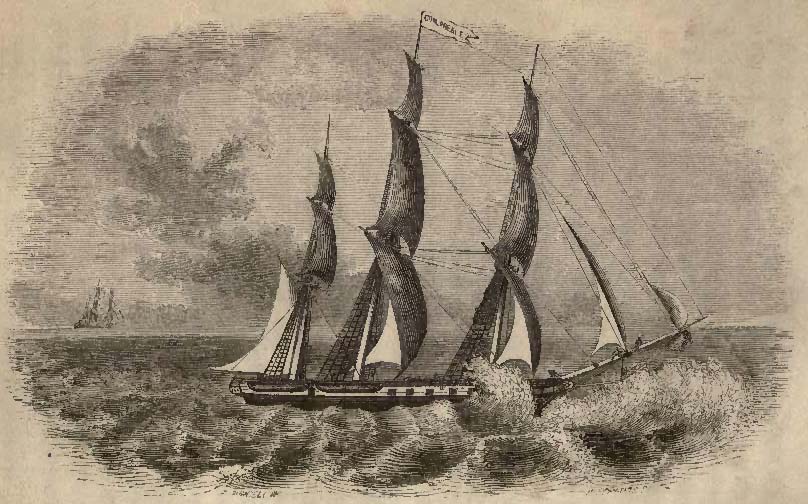 Picture of the Com. Preble Homeward Bound.
|
|
|
The Captain Sounding.
|
Spiritual Lesson learned.
|
|
make his way safely to port, may teach a lesson, I have thought, of the way in which we should all study and watch the answers of God's word and prayer as we prosecute the voyage of life, having to steer by a thousand rocks, and shoals, and quicksands before we can make the port of peace. He would himself carefully put the tallow or soap into the hollowed end of the lead, then heave it himself, or hold the line, and carefully ascertain when it reached the bottom; then he would scrutinize it closely when hauled up, to see what report it brought from the bottom, whether it were sand, or gravel, or mud, or ooze adhering to the end, or whether it were dented, as if it had fallen on rocks.
Then he would go and sit down to his chart, with compass, and slate, and slide, to compare what he had found with what he was told there, in order to fix, if possible, upon his position on the great shoal, and shape his course accordingly for the next hour. Then he would lay down on the transom, in his great watch-coat, to catch half an hour's sleep, with the chart unrolled before him on the cabin table, and a lantern swinging over it with a sperm candle, a thing we had not had before for the voyage.
|
|
|
Navigating for Eternity.
|
Chart of the Word of God.
|
|
Now with the same carefulness, it has seemed to me, should we all ponder the Word of God, that we may be shaping our course aright over the tempestuous sea of life, where
Dangers of every shape and name
Attend the followers of the Lamb.
|
Yea, not only when we are exceedingly tossed with a tempest, and neither sun nor stars for many days do appear, but in the clearest weather and the best of times, how seldom is it, in our navigation for eternity, that we are not in peril from some out-jutting reef, or shoal, or sunken rock, or moving quicksand; to avoid which we must heave the lead and watch our soundings, and study well the Chart, and trim our sails, and keep a good look-out. I thank God that our captain, Lafayette Ludlow, has done both on the present voyage.
With the same steadiness and absorption that he now studied his chart, and worked and reworked his observations, and compared and reviewed his results, he used to study and pray over the divine Word till God showed him the way of salvation by faith in Christ, and he got his anchor on the promises, that proved good holding ground. I trust he will keep fast to
|
|
|
Anchored on the Promises.
|
The Heart's Prayer.
|
|
them for life, be buoyed up by them in death, and afterward be received up unto glory, where faith is met with fruition, and the ransomed of the Lord return and come to Zion with songs of everlasting joy. May he and I, and those who are dear to me, and many that have followed us, it may be with interest, through this gallery of Daguerreotypes, be found in that blessed company when the voyage of life is up!
When, soon or late, we reach that coast,
O'er life's rough ocean driven,
May we rejoice, no wanderer lost,
BLESS'D WORSHIPERS IN HEAVEN!
|
|
|
|
Melencholy Wreck discovered in the Gulf Stream.
|
|
CHAPTER XVIII.
KNITTING UP THE LESSONS OF THE VOYAGE AT ITS CLOSE.
I saw a wreck upon the ocean flood.
How sad and desolate! No man was there;
No living thing was on it. There it stood;
Its sails all gone; its masts were standing bare:
Toss'd on the wide, the boundless, howling sea!
The very sea-birds scream'd, and pass'd it by.
And as I look'd, the ocean seem'd to be
A sign and figure of Eternity.
THE WRECK AN EMBLEM SEEM'D of those that sail
Without the pilot, Jesus, on its tide.
Thus, thought I, when the final storms prevail,
Shall rope, and sail, and mast be scatter'd wide!
And they, with helm and anchor lost, be driven,
In endless exile sad, far from the port of Heaven!
|
|
T. C. Upham.
|
Rounding Cape Cod, Massachusetts Bay.
In all probability, this beautiful sonnet must have been written somewhere at sea, just after passing such a wreck as we met with a few days ago in the Gulf Stream. Such sad things (and they are melancholy objects, indeed, to behold at sea) are often fallen in with there. Perhaps more wrecks are made within, and at
|
|
|
The Wrecks of Opinions in Philosophy and Religion.
|
|
the edges of the Gulf Stream, than in any other part of the ocean; squalls are so violent there, the lightning so terrific, and the wind and current so often opposed, as to raise an ugly, chopping, "head-beat" sea, that, if long continued, will beat to pieces, or start dangerous leaks in the very best of ships.
Wrecks, too, once made there, and ships abandoned without foundering, will stay for a long time in the course of the stream, being carried along and kept within it by the force of the current. Some captains think that the same wreck may sometimes go the whole round of the stream, being kept along in it to where it is lost, or turns southward by the Western Islands, then taken by the current from the north, and borne to the south and west by the northeast trades, until it falls into the identical Gulf Stream again, or a current sitting into it off the Windward Islands of the West Indies.
Just so in the political, religious, and philosophical world, you will see the wrecks of certain errors and fallacies exploded, dismasted, waterlogged, or quite foundered in one age, reappear in another on the revolving current of opinion.
|
|
|
Safer to scud before a Tempeat of Sorrow than to lie to.
|
|
After having floated off into obscurity, and been quite lost sight of for a time, they will come round again, and perhaps be taken up and towed into port by some political novice or demagogue, or transcendental speculator, pretending to great originality of genius, or by some novelty-hunter in religion; by them re-ribbed, calked, and coppered, perhaps razeed, and set afloat anew upon the tide of speculation, with a great boast of newness and a mighty press of canvass.
As I happen to be in the mood for illustrations, I can not help writing out one that occurred to me lately while observing the behavior and management of our ship in the last severe gale. The conclusion we all came to was, that a ship in a storm or heavy sea must have sail enough on to run away from the waves and surmount them, or she will be buried by them, broaching to and being boarded by a disastrous wave.
So with the religious mind in the great waves of affliction, when the waters roar and are troubled-mens' hearts failing them for fear and for looking after those things which are coming, it is often not so well and safe to lie to and wait for
|
|
|
Faith illustrated by the Experience of a Young Ship-master.
|
|
a lull, brooding meanwhile upon one's trouble, and anxiously casting eyes over what seems to be a great, heaving waste of impending adversity, as to keep busy, if possible, with carrying sail, and trying to scud before the gale.
I have learned, too, in the course of this voyage, that a ship's sails or rigging wear out more in a calm than in a gale. So the mind wears out faster in indolence or inglorious rest, than in well-braced nervous activity and productiveness.
Here also is an illustration of the workings of faith gathered from the experience of a young shipmaster. In first navigating a ship by chronometer and lunars, until he has learned to live by faith in his observations, and the few figures he makes daily on his slate, with the tables of the Nautical Almanac, he is uneasy, doubtful, anxious, and will work his longitude over and over again, though sure there is no mistake, so hard is it practically to live on faith-that which is unseen, and for which we have no evidence of the senses, until a habit is formed: so strange is it to be steering one's way straight over the trackless ocean, without any way-marks, or sign-posts, or mile-stones, or any thing by which
|
|
|
Life Lines to Mariners what the Promises are to Christians.
|
|
we can see that we are right or wrong. It is not until a captain has made three or four good land-falls, at wide intervals, and just according to his calculations, that living by faith in his chronometer and observations, and the results upon his slate begins to come easy.
Even so, I have thought, in the very nature of things, it is the experienced Christian only that can live perfectly the life of faith. Use must have practically convinced him of the reliability of things unseen and eternal, before it can become the habit of his mind to navigate confidently the ocean of life, independent of sense.
While thinking much, lately, of life as a voyage, and every Christian the voyager that will soon be as close to the port of heaven as, I trust, we now are to our desired haven in Massachusetts Bay, it has seemed to my mind that the promises are to the Christian voyager what "life-lines" are to the sailor, for him to hold by to the yard when reefing or taking in sail, and to keep him from falling off. Yet, strange to say, many ships' yards are left without this protection for the exposed sailor, by reason of which many a poor fellow in a storm is shaken
|
|
|
All must cling to them.
|
The Albatross and the Christian.
|
|
off that might have clung to the "life-line" had it been in its place at hand.
So Christians sometimes attempt the course of a Christian, and go to sailing over the troubled sea of life without being provided with the promises, without having learned how, or having them at hand, hidden in their hearts, to use and cling to in a storm. In good weather and ordinary times they get along without them, and do not feel the want; but let a storm arise, the wind blow fiercely, the sails be flapping, then it is they want the "life-lines," and are distressed and lost without them. Yea, it is not possible for the oldest and most experienced Christian to live without a constant clinging to the promises, still less is it for younger and more recent pilgrims: like a young sailor-boy, they must hold fast to the life-line of God's word, or they are sure to fall.
Sometimes there happens, even to praying, faithful Christians, what is true of large seabirds. When in the Pacific, we used sometimes, by hook and line thrown astern, to catch that most majestic and beautiful of all birds on the wing, the superb white-winged albatross, I observed that of itself it could never rise from
|
|
|
Taking Wing.
|
Pinions of Faith.
|
Night-mare of Doubt.
| |
the even surface of the deck and soar aloft, though unconfined and at liberty; but we must toss the noble bird overboard, and lift him quite clear of the ship's rail, before he could use his glorious pinions and mount aloft into the air. Then he would stretch those ample wings, and sail away through the ocean of space as easily as one breathes, and as if the elastic element of air and the bird were one, making the gazer wonder, and fairly long to be taking the same aerial flight.
Even so is it, in the economy of grace, now and then, with the real Christian. He is brought by Providence into straits and perplexities whence he can not rise and extricate himself alone; where the wings of faith and love seem to be of no avail to him, until a friendly hand lifts him up, and throws him out upon the deep, where he must say, with Peter, Lord, save; I perish. Then he loses despair; he surmounts the difficulty; he breaks his prison; he mounts up as on eagle's wings; the pinions of faith and love sustain him, and bear him away aloft; and he wonders now at the nightmare of doubt and fear that kept him from using them before.
|
|
|
Trembling of the Compass Needle in the beginning of a Storm.
|
|
He is ashamed of the wrong thoughts of God that had begun to gather and darken in his mind like gloomy clouds. He sees that God was infinitely wise and good in appointing the discipline to which he has been subjected; and those unuttered, perhaps, but felt murmurs against the dispensations of Providence, now fill him with sorrow and shame. Peculiar and trying' as his case may have been, he now discovers many blessings and beneficial consequences to flow from it, which he could not see before. How happy the man whose sight is thus cleared, and his heart enlarged to trace the manifold wisdom and mercy of God in dispensations that once seemed dark and unaccountable!
We noticed in the late gale, and it is often observed by mariners in the beginning of bad weather, before the storm is fairly set in and fixed in its course, that the needle in the compass-box was considerably affected, and there was unusual oscillation, probably through the changing or disturbance of the atmosphere's electric forces; but after the gale was fairly formed or at its height, the needle became true again to its polarity.
|
|
|
Magnetism of Faith.
|
The Christian's Centre of Attraction.
|
|
There is an analogy to this in the mind of a Christian under a storm of trial-a mind that has been once thoroughly magnetized by the grace of God, and stamped with the law of DIVINE POLARITY, making it to turn always to that POLE-STAR OF BETHLEHEM, the great magnet of the regenerated soul. Though ordinarily true to his pole, yet in sudden emergencies, on the first storm-burst of trouble, it is seldom or never that the Christian can at once repress the flutter and agitation of nature, control or understand its deviations, collect his energies, and repose calmly on God.
It is rare that Faith, taken by surprise, does at once steady the soul, and lift a man in a moment clear above hostile infirmities and fears. Be it true that, when once magnetized by the love of Christ, the soul does always point upward by kindred strong attraction, as the compass-needle to the north, yet, like that same needle, suddenly acted upon by a disturbing force, you must give it time to recover its balance, and, its oscillations done, to fasten upon the central point of rest.
I have sometimes known God's own dear children, when calamities came suddenly in
|
|
|
Disturbing Forces.
|
Oscillations Over.
|
|
prospect, when huge billows seemed ready to go over them, and a black cloud of sorrows was about to burst upon their heads, at first trembling and anxious, swinging a little with trepidation to this side and that of the central point of rest; but as the trial became more distinctly defined, the cloud's lightning began to flash, and its big drops to fall, the palpitating heart would be still, the vibrations of the will would cease, faith gather strength, and the eye of the soul be upturned and fastened on a faithful God, and its hand grasp firmly the promises, which neither death nor life, nor angels, nor principalities, nor powers, nor things present, nor things to come, nor height, nor depth, nor any other creature, can ever loosen.
With an extract, now, from the old poet George Chapman, lately met with in my seareading, somewhat accommodated and made pertinent to our present estate on shipboard, on the look-out for a pilot, these chapters of experience and observation in a whale ship must come to an end. The composition of them in the leaves of my journal has been a fitting employment for some of the hours of a long but every way profitable voyage. May they prove
|
|
|
The End at hand.
|
Christ the Christian's Pilot.
|
|
to have ministered a portion of entertaining knowledge and pleasure to some on the land, whom neither duty nor decaying health shall ever reduce to a like necessity with the writer, of being an exile so long from country and home. But if such a necessity do exist in the general prostration of health, without organic disease, I know of no means so feasible and hopeful for its restoration as a cruise in a whale ship, under as favorable circumstances as those with which I have tried it.
Man is a torch borne in the wind; a dream
But of a shadow, summ'd with all his substance;
And as great seamen, using all their wealth
And skills in Neptune's deep invisible paths,
In tall ships richly built and ribb'd with brass,
To put a girdle round about the world,
When they have done it (coming near their haven),
Are fain to give a warning-piece, and call
A poor stayed fisherman, that never pass'd
His country's sight, to waft and guide them in:
So, when we wander farthest through the waves
Of glassy glory, and the gulfs of state,
Topp'd with all titles, spreading all our reaches,
As if each private arm would sphere the earth,
WE MUST TO JESUS FOR HIS GUIDE RESORT,
OR WE SHALL SHIPWRECK IN OUR SAFEST PORT.
|
* * * * *
* * * * *
I did not think to have added more, but the
|
|
|
News that awaits the returning Voyager little known.
|
|
news that awaited me in Boston of Death's visit to one inexpressibly dear, and that, too, on the very ocean which I had passed over in peace, and with greatly renovated health,
|
Through the dear might of HIM that walk'd the waves,
|
Induces me to venture a word upon the natural and Christian graces of that beloved brother, whose mortal remains now lie treasured in the deep, till the sea give up its dead.
His was a lovely soul, formed to be blessed and bless. He struggled long, even from early boyhood, with sickness and pain, but all the while patiently, even cheerfully, such was the buoyant energy of his natural temper, and so early was his trial sanctified by the grace of Christ.
0, precious grace! that made him wise,
And proved affliction, rightly used,
Was mercy in disguise!
|
His disposition was so innately cheerful and lively, so irrepressibly buoyant and genial, that no weight of either maladies or misfortunes could keep him under. But still would he carry his head above the waves, and keep his eye cheerfully aloft in the saddest times, when the spirits of others were fainting. If, now and then, his cheerfulness seemed to suffer a tem-
|
|
|
Natural Tribute of Affection to a departed Brother.
|
|
porary eclipse, it was only like the sun drifting through vapors that scattered as fast as they gathered, and it was but a moment before we would see again, through some open cloud-rift, the clear beams of his sunny face.
If a sweet social temper, gushing love
For kindred and for kind, spirits forever
Sparkling and buoyant as a spring's light bubbles:
Mirth, candor, frankness, and a love to give
Pleasure to friends, and good to every one;
And, more than all, true love for Christ and souls –
If these be traits that make a blessing man,
Beloved and form'd to bless, through God's rich grace,
OUR CHERISH'D BROTHER WAS THAT HAPPY MAN.
No more the tender offices of love
We pay him here on earth, but all his virtues
Still will we cherish; and that radiant face,
From its calm sphere within the spirit world,
Like a bright star shall still look down and cheer
Our life's sojournings, till at length we come
Where he the promises, through patient faith,
Inherits, and enjoys the rest of heaven!
|
It is all well with him now; and though I had fondly hoped to have seen him yet once more in the flesh, and to have knelt again in prayer with that blessed brother, and it would have been so comforting, if God's will, to have ministered to him in his last hours, I would not have it otherwise now. Through the mercy of Christ, may we soon bow in praise around the throne of God! Some of the birth-day lines ad-
|
|
|
Thoughts for the Birth-days of Eternity.
|
|
dressed to him years ago by his elder brother, are, with a slight accommodation, equally appropriate now that he has passed the solemn threshold and BIRTH-DAY of a BLESSED ETERNITY!
How recollection paints anew
The times when, in our own dear home,
We talk of mercies past, and view
The heavenly life to come!
'Tis just in heaven, thy happy dawn –
But ah I how full the mingled scene
On memory's pictured tablets drawn –
Calm now, and all serene:
Serene because a blessed faith
Throws o'er each melancholy line
That marks affliction's rugged path,
The gleam of love divine.
Through all it sees thy Father's form,
His gracious, guiding hand beholds;
And in the gloomiest of the storm
Some bright design unfolds.
Amid the sufferings of years,
Thou seest thou didst not walk alone;
Where all was agony and tears,
There most His mercy shone.
'Twas thus he drew thy buoyant heart
Up to a holier world above,
And bade thee choose that better part,
A Savior's wondrous love.
For this our fervent thanks we raise,
That HE, whose love is wisdom too,
Made thee partaker of his grace,
By trials here below.
|
|
|
|
Christ Loved in Life a Rock and Refuge in Death.
|
|
CHRIST held thee* in his powerful hand;
Now, every foe and fear subdued,
THY FEET DO PRESS THE SHINING LAND
BEYOND DEATH'S NARROW FLOOD!
|
|
NOTES.
A, p. 48.
When the islands of the Pacific Ocean were first discovered by Europeans, some of the natives were found very timid and friendly, while others were fierce, treacherous, and warlike. For many years after their discovery, these islands were visited only by those who were on voyages of discovery, or who were in the pursuit of gain. The natives were treated with great inhumanity; and drunken seamen, rioting through their villages and trampling upon all laws of right doing, soon introduced all the vices of civilized life to be added to those of the savage state. The natives generally became exasperated, and were ever watching for opportunities to cut off the ships and massacre the seamen. A Nantucket whale ship was at one time wrecked upon one of the Feejee Islands. The crew escaped, in their boats, to the shore, and before they were discovered by the natives, succeeded in constructing a fort for their defense. The natives, however, soon found them; and after a long and bloody battle, all of the sailors were slain except two little boys, whose lives were spared. One, after the lapse of many years, escaped on board a whale ship which stopped at the island. The other has never been heard from.
Such was the condition of these islands when the English missionaries, taking their lives in their hands, went among them to Christianize the inhabitants. The missionaries were ridiculed, opposed, and traduced by thousands at home, and they endured every species of privation and hardship from the habitations of cruelty, in the midst of which they took up
|
|
their abode. God smiled, however, upon their exertions, and soon these wild men and women turned from their idols and their sins, and cultivated the arts of peace.
A few years after the missionaries had commenced their labors, an American whale ship came in sight of an unknown island in the Pacific Ocean. They had been for six months cruising in search of their gigantic game without having seen any land. Scurvy, that terrible scourge of seamen, had seized one after another of the crew, till there were not enough left in health to navigate the vessel in safety. Scurvy is a disease caused by living a long time upon salted provisions, without any vegetables; and the sufferers are almost immediately restored to health when they can breathe the fresh air of the land and eat freely of fruits and herbs. Here was this ship, several thousand miles from the South American coast. The crew were emaciated and dying.
Before them rose, in all the beauty of tropical luxuriance, one of those islands of the ocean, which appeared to the mariner, weary with gazing for months upon the wide waste of waters, like the Garden of Eden. But they dared not approach those shores. A foe, more treacherous and dreadful than disease, they apprehended there. The club of the savage, and the demoniacal revels of the cannibals dancing and shouting around their roasting victims, were more to be dreaded than death by slow and lingering approaches in the ship. They dared not draw near the shore, for they were too feeble to prevent the natives, should they come out in large numbers in their canoes, from climbing up the sides and taking possession of the ship. But with the glass they could distinctly see the clear streams of water foaming down their channels in the mountains. Meadows faded away in the distance, enchanting the eye with their shady groves and their rich verdure. The cocoa-nut tree reared its graceful head upon the beach, laden with its precious and its life-giving treasures; and forests rich with tropical fruits, juicy and luscious, were every where spread around.
|
|
These emaciated and dying men crawled from their berths and gazed with wistful eyes upon this tantalizing scene. Slowly they were borne along by a gentle breeze, and forestcrowned head-lands, and luxuriant valleys and groves, bending beneath the burden of fruit, glided by, like the changes of a kaleidoscope, and still no canoe pushed out from the shore, and no huts of the natives were to be seen. They began to cherish the hope that the island might be uninhabited, and cautiously approached it. But ere long they saw canoes upon the beach, and smoke here and there ascending from the cocoa-nut groves; and still, to their astonishment, no natives made their appearance, and no sound of human voices reached them from the shore.
As they rounded a promontory, which opened before them a quiet and lovely bay, a thickly clustered village of the natives burst upon their view, and in the center of it was reared a Christian church. A simultaneous shout of joy rang through the ship as the cry passed from stem to stern, The missionaries are here! It was the Sabbath, and the natives had learned the Divine command, "Remember the Sabbath day, and keep it holy." And the temptation of a ship entering the bay did not lure a single canoe to leave the shore. The crew were almost crazed with joy at this sudden change in their prospects. They speedily cast anchor, furled their sails, and, entering the ship's boats, went on shore. As soon as the natives were informed of their sick and suffering condition, they received them with the utmost hospitality, and supplied them with all the fresh fruit and vegetables they could need.
The next day the natives aided the emaciated crew in taking a sail from the ship, and spreading a large tent upon the green grass on the banks of a mountain stream. And here the crew reposed in inexpressible luxury. They bathed their limbs in the pure water, and quaffed it, in its coolness and its freshness, like Elysian nectar. They rolled with childish glee upon the green grass. Cocoa-nuts and bananas, and lemons
|
|
and oranges, and other luscious fruits of the tropics, were brought to them in great abundance by the friendly natives. In a few days, the disease which had brought so many of them to the verge of the grave began to disappear. The missionaries, from their little stock of medicines, administered to their wants, and treated them with fraternal kindness.
In the course of two or three weeks, all were restored to health and vigor. They filled their casks with fresh water; laid in stores of vegetables; supplied themselves with pigs and poultry, and then, with invigorated bodies and rejoicing spirits, they raised their anchors and unfurled their sails, and departed on their adventurous way.
Thus is fulfilled the declaration of Scripture, that "godliness is profitable unto all things, having promise of the life that now is and of that which is to come." The labors of these missionaries were not only instrumental in promoting the moral elevation, and, we hope, the final salvation of these uncivilized men, but they also saved the lives of these seamen, and secured the success of the voyage upon which they had embarked.
What a different world would this be, could the spirit of Christian brotherhood pervade the hearts of all the inhabitants! Could woe, oppression, and injustice cease, and every man look upon his fellow-man as a friend, the larger portion of the sorrows of humanity would disappear forever. And none are doing more to hasten the advent of this happy day than those who are aiding by their personal influence and their purse to extend throughout the world the religion of Jesus Christ.
Ye disciples of Voltaire and of Paine, can you show us such a triumph as this? You profess to be humane men, to love your brethren, to desire to promote their happiness here and hereafter. Can you show us an instance in which the adoption of the principles of infidelity has been promotive of the moral or the physical welfare of an individual, or of a village, or of a nation? Have you ever known a young man to be-
|
|
come more dissolute by becoming a Christian? Have you ever known a village to become less thrifty and prosperous in consequence of the observance by its inhabitants of the precepts of the Bible? Is there, on the surface of this globe, a more intelligent, virtuous, prosperous, and happy community than is to be found in the dwellings of New England, and is there any other portion of earth's inhabitants over whom the religion of Jesus Christ has greater supremacy? Give, then, your influence to aid this cause, and your fellowmen shall bless you, and conscience shall reward you, and your heavenly Father shall welcome you as his co-workers and his sons. – N. Y. Evangelist.
B, p. 152.
A boat-steerer in an American whaler, a man of more than ordinary thoughtfulness and intelligence, addressed an inter esting communication to the Honolulu Seaman's Friend, while the author of these sketches was at the Sandwich Islands. It is feared that he has since been lost, it being a very long time since his ship was heard from. The communication referred to, being a slice of a sailor's autobiography, will be a good comment on the text that there's many a heart under the rough pea jacket.
When I look back (he says) upon my past life, with all its various scenes and occurrences, both by sea and land, it is on my lips to say, what hair-breadth escapes from death, what deliverance from threatening dangers have I experienced, even from my childhood. Surely goodness and mercy have followed me all the days of my life.
When a man is placed in a situation where no danger is apparent, where all is cheerful and happy, how apt he is to think and talk lightly of death; but let him be placed in the midst of the ocean, in a solitary bark, at the mercy of the winds and waves; let the tempest arise, and the wild waters
|
|
be tossed by the howling winds, and we will suppose that the ship is trimmed for the storm, her sails furled, her top-gallant-masts are sent down, and when he casts his eye aloft, the naked spars and rigging strike a sort of chill – an unusual sensation to his heart. He looks to windward and to leeward, ahead and astern; there is nothing to be seen save the foamclad billows in wild commotion.
Night comes, and no moon-not even a solitary star visible to cheer his sight; the land is hundreds of miles distant; he casts his eye upward to the heavens, the sky looks black; he leans over the bulwarks and peers away into the awful gloom around, nothing is to be seen, nothing is to be heard save the howling blast, the surging waters, and the creaking of the vessel. Wave succeeds wave, dashing with violence against the ship's side, the darkness is almost palpable, he can not distinguish a shipmate at the distance of a few feet, the ship labors heavily, and seems to struggle with the angry element as if conscious of the dread hour.
Then a man will think, ay, and his conscience will sometimes speak; strange thoughts, like unbidden guests, will at such times intrude themselves into his mind, whether welcome or not. He goes to his hammock and tries to sleep, but from the pitching and rolling of the ship it is almost impossible to rest; the night passes slowly and uneasily away in broken dreams and fearful fancies, and-at length, when daylight comes, he discovers that the storm has increased in violence. Few words pass among his shipmates; perhaps a loud oath from some would-be reckless companion salutes his ear, which, if uttered at other times, would pass unheeded, but now, for some reason that he is at a loss to explain, sounds strangely out of place. The cheeks of some of the hardiest turn pale, and the restless glances of others betray the uneasy feelings within.
He will at such times reflect on the past, the present, and the future; what would have been the consequence if, on the previous night, some other vessel, imperceptible in the dark-
|
|
ness, had come in collision with his; he shudders at the thought, and perhaps, at that moment, the idea will suggest itself that there is an overruling Providence who watches over and protects the poor mariner.
Well do I recollect my own feelings on several occasions of this nature, one of which happened on the coast of California. We were sailing in company with another whale ship, when a gale of wind came on which was favorable for the course we were steering toward Cape St. Lucas: both ships were kept before the wind during the day, but after sunset our captain thought it advisable to heave to, after which, from the position of our ship, it appeared probable that the other vessel, which was still kept on her course, would pass quite close to us, and a good look-out was therefore ordered to be kept to windward. In a short time it was very dark, the sea running "mountains high," and the gale blowing very hard, so that it was impossible to see any distance to windward.
When the other ship was last visible, she appeared to be heading right for us; and well do I remember with what anxiety I waited until I thought sufficient time had elapsed for her to pass. I know not why, but the thought seemed at that time to press very heavily on me, what the consequence would be should the other ship run into ours; very probably we should have all gone to the bottom; and my feelings were the more acute by the circumstance that the ship in question belonged to the same owners as ours, and had on board several young men who had often been my companions in pleasant parties.
At another time, while employed in trying out, on the coast of Kamtschatka, one very dark night the watch was busily employed on deck; we were boiling our last whale, and carlying more sail than is usual while boiling, for the purpose of making a port, when another vessel approached to leeward unseen by us; at this time, as it was blowing fresh, and the ship had a considerable heel, the officer of the deck ordered the helm to be put up to keep the ship before the wind, and
|
|
consequently on an even keel, while the watch rolled a very large cask of oil away from the cooler. While running off for this purpose, we were suddenly hailed by a strange voice from the surrounding gloom, apparently close aboard of us; at first we thought the sound came from under the ship's bows, but fortunately it was not exactly there, and it turned out afterward, that while running off in the manner described, we had unconsciously (but for being hailed) passed quite close to another ship.
At such times as these, most men will think, and that seriously; but, alas! it soon passes away; with the recollection of such dangerous occurrences vanishes, I may say, the recollection of the superintending care of an Almighty God. Who can tell how many unseen dangers are passed through by a ship during a three years' voyage?
If there be any class of men who ought, more than others, to feel grateful to God, I think that class is sailors, of whom many may well exclaim, "Surely goodness and mercy have followed me all the days of my life."
C, p. 227.
An instance has come to the knowledge of the writer of a ship in the North Pacific, from which there was lost a boat and crew of six men, under the following circumstances. They had been lowered to take a whale, and had succeeded in plunging the harpoon into the monster's side, but he had rushed with them, at rail-road speed, out of the sight of the ship, which was making after them at what rate they could. Suddenly a fog began to rise, and enveloped both the ship and her lone boat, and to spread over the whole expanse of the )cean, involving a danger of very frequent occurrence to whalemen in high latitudes.
It was impossible to see any object at the distance of a ship's length; and there was an open whale boat, with six
|
|
men in it, perhaps fifteen miles from the ship, with food and water for but a few hour's consumption, and utterly bewildered in the dense fog. The darkness of night soon came on; the wind began to rise, and the billows to swell. Every effort was made, by firing guns and showing lights, to attract the lost boat. The long hours of the night rolled away, a stormy morning dawned, and still no boat appeared.
For several days they sailed in circles around the spot, but all in vain. The boat was either dashed by the whale, or swamped by the billows of the stormy night, or, as it floated day after day upon the desert waste of the Pacific, one after another of the crew, emaciated with thirst and famine, dropped down and died.
Another, a sperm whaler, the bark Harriet, of Freetown, Captain Durfee, when cruising on the line, lowered her boats one day for sperm whales. The first and third mates had each secured a whale and made them fast alongside, when they returned to assist the second mate, who was fast to another. They came up with him about nine o'clock at night, and succeeded in killing the whale.' They could then see the ship; but it soon began to blow, and they were obliged to lay by the whale all night. In the morning the ship was not in sight, it still blowing a gale and raining hard. They lay by the whale three days, when they ventured to stand off to the westward, in hopes of falling in with some ship. On the seventh day they caught a shark, which they ate with a good relish. They were then standing for the King's Mill Group of islands; but a new gale coming on, they were obliged to reef down and stand to the eastward, and finally to heave to, where they lay for thirty-six hours, in a gale unusual for those latitudes. On the morning of the tenth day they again stood to the west. On the eleventh they discovered a sail, and stood for her, which proved to be the bark Hanseat, of Hamburg. They were taken on board and treated with great kindness, having had nothing to eat during the eleven days excepting the shark they had caught and one or two flying-
|
|
fish, and no water except what they had caught in the linetubs. Some of them had lain down to die two days before they saw the ship, and all of them were so weak that they could scarcely support their weight. Captain Durfee, after cruising for several days in the vicinity, was making the best of his way to Oahu with the remnant of his crew, having given up all hopes of ever seeing any of his officers or crew again, when the bark Hanseat spoke him, January 20th. He was not more surprised than delighted to find his men all safe, and receiving all attention possible, as the third mate was a brother.
D, p. 231.
Of the twenty thousand men who go in jeopardy of their lives under every accessible line of latitude and longitude, upon the great highway of nations; who, on an average, are exiles from home and country, from the social delights and most of the comforts of life for three or four years at a time, on purpose to bring back the means of enriching the owners of the whale ships, and of adding to the comforts and embellishments of the millions who are spared these privations, what can be said? what shall be done for them?
Very encouraging it is that, of late, some attention is given to this class of men. The fact that they are human beings begins to be recognized; nor are they altogether forgotten, as some notices of their condition and wants clearly prove. It could not be expected that our stately and dignified quarterlies would notice, except in the most general and gingerly manner, the worst features of the whaleman's case. You, however, who are fully committed to the work of philanthropic and Christian reforms, who do not fear to speak out plainly and boldly, who care more for the groans and degradation of humanity than for the frowns of its oppressors, who love to plead for the dumb, and whose honest boast it is that
|
|
you faithfully hold up the mirror to reflect the evils which require to be repented of and reformed, as well as the good in which we may exult, surely of you and in your columns may be expected the full unmasking of whatever abuses and perversions have been allowed to spring up, and for a long time have been tolerated in silence.
From one whose position gives him ample facilities for unmistaking knowledge of the facts in this case, who has not, by a long course of familiar observation of flagrant abuses, become indurated to a sense of their turpitude; who, on the one hand, has no interests prompting to concealment, or glossing over frightful evils, nor, on the other, any feelings of goading retaliation for personal injuries, real or supposed, to cause an exaggerated picture, surely, from such a one, you ought to be able to rely on the simple truth. The former position, the subsequent tendencies, and the present state of the whalemen, in their physical and intellectual, their moral and religious condition, shall pass in brief review; and certain it is, that in more capable hands, it could not fail, in a surpassing degree, to awaken the deepest concern of the wise and good.
Only two or three generations since-at the very time when Burke poured forth, in the British Parliament, his splendid eulogium on the exploits of this class of men-they were, for the most part, the sturdy, intelligent, and comparatively virtuous yeomanry of New England. Not only the officers, but the crews of whale ships were of this character. But such is not the case now. Whether the deterioration of character in the crews especially has resulted from the hardships of the service, inducing all but the mentally imbecile to prefer some other branch of marine adventure, or whether the falling off has been occasioned by the grinding conditions as to remuneration which the ship-owner imposes, who is chiefly anxious to enrich himself, or perhaps some favorite officer in his employ, while the poor seamen are left to endure privations, and expose themselves to hazards of life and limbs in bootless disinterestedness; or whether the rapid extension of
|
|
this enterprise has called for men faster than the good and worthy could be furnished; or, perhaps, from the joint influence of all these causes combined, it must be conceded that a lamentable deterioration of character in the crews of whaleships has been witnessed.
They are now made up to a great degree, and, of course, with some honorable exceptions, of the very refuse of humanity, gathered from every quarter, escaped from poor-houses and prisons, or gleaned from the receptacle of vagrancy and lazarhouse corruption, with a large admixture of foreigners of all languages, complexions, and character.
Such constitute the exprienced portions of the crew. To them you may add one third or one quarter part more of land lubbers, or raw hands, made up of very heterogeneous materials. Here will be found the young, roving adventurer, who pants for opportunity to see the world; he has heard marvelous stories of the facilities of foreign observation furnished in this service, while, at the same time, visions of easily-acquired wealth, golden harvests to be here reaped, have filled his mind, and he hurried from the interior to ship himself on board a whaleman. The reckless and impatient, who spurn all salutary control, are also here, thinking this is just the place to indulge unbounded license.
Here, also, you will find the spoiled sons of over-indulgent parents, who, having made themselves intolerable by their vicious propensities, and constantly in danger of bringing disgrace on themselves and their connections also, by their intemperance, their fits of passion, or unbridled licentiousness, are sent on a whaling voyage as a school of reform! To each of these a small advance of cash is made, on signing the shipping papers, for the ostensible purpose of paying their traveling expenses to the port of embarkation, or their board a few weeks or days before they are ready to sail, or for their partial outfit; the real object is to tie the poor renegade as firmly as possible to his new engagement.
With two thirds of the required number of men of the
|
|
above description, the ship sails, relying on making up her complement in Portuguese sailors at the Western Islands or in Kanakas from the Sandwich or other islands of the Pacific Ocean. Both these classes are usually as filthy and disgusting specimens of humanity as can well be conceived, having this difference, however, that the former are perfectly incorrigible, while the latter do sometimes improve.
This motley crew are at length mustered on board, drunk or sober, though far less intemperance now prevails than in former years, thanks to the praiseworthy endeavor of reformers in one much-needed department of their endeavors. Sullen and sad, orjovial and light-hearted as they may seem, they are now in their quarters for several years. What a home! Look around for its facilities for comfort and improvement.
In that repulsive hole called the forecastle, of scarce twelve feet square capacity, not high enough to allow a tall man to stand upright, with little or no light or ventilation but what comes down the narrow hatchway (and even this must be closed in rough weather), here some twenty or five-and-twenty men are to eat, and sleep, and live, if such a state can be called living; here, in sickness and in health, by day and by night, without fire in the rigors of the polar regions, or cooling appliances under the equator, these men, with their chests and hammocks, or bunks, are to find stowage. After again and again examining this feature of their arrangements, and comparing it with thq cells prepared for and enjoyed by the felons in all our principal prisons in more than half the states of our Union which I have visited, the latter would be pronounced princely, enviable even in all the requisites of roominess, light, ventilation, and facility for seclusion.
Here, with no possibility of classification and separate quarters, with few or no books, or opportunity to use them if they were possessed, with the constant din of roystering disorder, superabundant profanity, and teeming lasciviousness of conversation and songs, with no Sabbath, no prayer, no words and efforts by superiors to win them to something better and
|
|
worthier, three fourths of their forty months' absence are passed. When they are on shore, or lying in port to refit, corruptions, by libidinous intercourse with impure women, intemperance, and other abominations, vary, while they by no means improve, their condition. – Christian Reflector.
E, p. 253.
The Sabbath-keeping experience of Rev. William Scoresby, who, as well as the father, was for many years employed in the Greenland whale fishery, is of great practical value. In a volume entitled "Memorials of the Sea," he gives the following results of a strict and conscientious observance of the Sabbath at sea:
It was in the last four voyages, wherein my personal in terest in the fishing was the greatest, that the providential testimonies to Sabbath observance were the most striking. During this period, the pecuniary interest to myself alone, in the capture of a large whale, was not unfrequently near ~300, while a single day's successful fishing might afford a personal advantage, as in one instance or more it did, of upward of ~800. Consequently every motive of self-interest was in favor of unceasing exertions, during the whole seven days of the week, for promoting the success of our undertaking. The practice, morever, almost universally is, to pursue the fishery equally on the Lord's day, as at any other time, whenever whales were astir.
Works connected with the fishery, indeed, but considered of less importance, were, for the most part, suspended in honor of the Sabbath; but the capture of whales, if opportunity offered, was considered as such a kind of necessity as to justify that departure from the ordinary rest of the day; for it was argued, and that with reason, that the whales which were seen on the Sabbath might not remain till another day; and, therefore, it was inferred, though by no means with the same strictness of truth, that it was a necessary duty
|
|
to pursue the objects of the fishery whenever they were within reach.
Through the goodness of God, however, I felt the line of duty to be otherwise. The strict command concerning the Sabbath, rendered, in my apprehension, the duty imperative – to refrain from laboring in a worldly calling for worldly advantage on that holy day; and this, for several of the most recent voyages in which I was engaged, became our undeviating line of conduct.
On the 13th of July, blowing hard, with rain or sleet, we moored to a large and heavy floe (a sheet of ice about three or four miles in diameter), in order the more commodiously to enjoy the Sabbath day's repose. A ship from Peterhead, which had for some days been accompanying us, followed our example, and a considerable number of her officers and crew joined us in our usual Sabbath devotions. An evening service, designed chiefly for the instruction and benefit of the apprentices, had been concluded, the sacred day of the Lord was drawing to a close, and our visitors were preparing to return to their ship, when a large whale was descried by one of our own seamen in a situation very inviting for attempting its capture.
No doubt it was contemplated by many with an ardent and longing gaze; but the orders for sanctifying the Sabbath being quite peremptory, no attempt, on the part of any of our people, was made to pursue the tempting object. Our fellow-worshipers, however, being less scrupulous, instantly manned the boat which had brought them on board of the Baffin, and set forth, along with some others from their own ship, in eager pursuit. Nor were their ardent hopes disappointed; for in a short time, the usual quietness of the day, with us, was broken in upon by the shout of success from the pursuing boats, followed by vehement respondings from the contiguous ship. The attack, being followed up with the wonted vigor, proved successful, and the prize was fully secured by the middle of the night.
|
|
That such a result should not be exceedingly trying to the feelings of our people, who saw that their competitors had won the prize which we had first declined, was more than could be expected. Nevertheless, both the trial of their obedience and the exercise of their patience were so sustained as to be at once satisfactory to me and creditable to themselves. Their minds, in general, seemed disposed to admit the principle on which we acted; for, in addition to the religious sanctions, their repeated experiences had testified that the principle was acknowledged by heaven.
It was my intention to have "cast off;" the morning of Monday, to explore the navigable spaces of the ice to the westward with a view to the furtherance of our voyage; but the day being still stormy, with constant thick weather from snow, sleet, or rain, we found it expedient to remain in somewhat anxious idleness, while our successful comrades were joyously and usefully occupied in flensing the valuable fish obtained almost under our stern. This was doubtless an additional trial of the good feelings of our crew; but whatever might be the regrets of any in yielding up, for conscience' sake, our chance of so fine a prize, I heard of no other dissatisfaction than the mere expression of a natural anxiety to be under weigh, that we might find a fish for ourselves.
The state of the weather, however, induced us to continue at our moorings till forced off by the movements of the contiguous ices, which threatened the safety of the ship. Soon afterward we set forward on our object; and having made a stretch to the westward, all hands were speedily called into exhilarating action by the discovery of several whales. The eagerness of the men, indeed, was, in the first instance, against us; more than one of the objects of their anxiety being unnecessarily scared, for want of that wise and considerate prudence which, under the circumstances, was peculiarly needed to temper and direct their excited zeal. At length, however, after a variety of mortifying failures, a harpoon was ably struck; and though the boat received a desperate heave,
|
|
and some of its oars were projected high into the air, happily no accident ensued.
The excess of ardor among the men was now in full demand, being appropriately drawn off by the vigor with which the wounded monster struggled for its liberty and life. Outstripping the utmost speed of its pursuers, in the beginning of the chase, it obtained shelter amid the compact accumulation of numerous masses of ice where it was most difficult to reach, and from whence it seemed next to impracticable to be dislodged. After encountering, however, a variety of little adventures, as well as some very threatening obstacles, we succeeded in subduing the powerful animal; and no sooner was it clear of the lines, and in a condition to be removed, than the compact aggregation of ices by which it was enveloped began to relax, so that with little further embarrassment a channel was cleared out, and the prize effectually secured. Thus, before the very first day available for the fishery after the Sabbath had come to a close, all our anxieties were relieved, our forbearance compensated, and our efforts crowned with the desired success.
After a careful examination of the journals of my four last voyages in the whale fishery, being the same to which the foregoing records chiefly refer, I can only discover three instances wherein, after resisting the pursuit of whales seen on the Sabbath, we were not successful in the fishery of the ensuing week.
As to those who may yet question the result of our argument – that the statements here presented afford decisive evidence of a providential blessing on the endeavor to keep the Lord's day holy – we would claim, at least, this fair and candid admission, that our refraining from Sabbath violation, when urged to it by the prospect of worldly gain, was not the occasion of either loss or disadvantage, in the ultimate result of our labors. Could, however, the conviction of those who accompanied me in the voyages referred to, consisting, probably, of one hundred and fifty different men, be convey-
|
|
ed to their minds, an impression of a much more decisive and satisfactory character, methinks, would naturally and generally follow; for, on occasions when we refrained from fishing on the Sunday, while others were successfully engaged in that object, our subsequent labors, as has been seen, often succeeded under circumstances so peculiarly striking, that there was scarcely a man in the amount of our crew who did not seem to consider it as the effect of the Divine blessing!
Independently, indeed, of the positive duty of sanctifying the Sabbath, and of the blessing of Providence connected therewith, we ofttimes realize the wisdom of the institution, in the mere physical benefits resulting from its observance; for when the preceding week happened to have been laboriously employed, the day of rest became sweetly welcome, obviously beneficial, in its restoring influence upon the ener gies of the people, fitting them for a renewal of their arduous duties, while the temporary restraint thus put upon the ardor of the seamen, operated, no doubt, with no small measure of advantage, by stimulating to additional energy in their subsequent labors; so that, in every point of view, and in every relation to the well-being of man, spiritual and temporal, this sacred appointment stands commended both for wisdom and goodness.
F, p. 269.
The writer has had many thoughts and conversations with others on the question whether the captain of a whale ship ought himself to go in the boats or always keep by the ship, and the opinion I have formed is (let it pass for what it is worth), that the commander, on whom so much depends, and whose safety should ever, therefore, be a prime consideration, not for his own sake merely, but for that of the ship and crew under him, should never leave the ship himself to engage in whaling.
|
|
This opinion is confirmed by the reflections had on one occasion, when our captain of the Commodore Preble was dragged out of our sight by an enormous sperm whale, to which he was fast, and had at last to cut loose from, lest he should be lost. Numerous melancholy facts in the annals of whaling confirm our estimate, then formed, of the danger and inexpediency of the captain's going in the boats, and naturally suggest to owners the propriety of instructing their captains to stay by the ship. Witness the recent narrative, from the New Bedford Mercury, of the sufferings of Captain Hosmer and a boat's crew, of the whaling bark Janet, who were separated from their vessel while on the coast of Peru. The account, furnished by the captain, is substantially as follows:
On the coast of Peru, 23d June, 1849, in latitude 30º N., longitude 104º W., while cruising for whales, a shoal of sperm whales appeared in sight from the Janet, and three boats lowered in pursuit. Captain Hosmer's boat's crew consisted of himself, Francis Hawkins, third mate, Edward H. Charles, Joseph Cortez, Daniel Thompson, and James Fairman, seamen. It blowing fresh at the time, the boats soon separated, each having made fast to a whale. After Captain Hosmer had succeeded in l turning up" his whale, and was towing him to the ship, from some inadvertence on the part of the third mate in putting about, the boat capsized, with loss of boat-keg, lantern-keg, boat-bucket, compass, paddles, &c. The crew succeeded in righting the boat, and lashed the oars to the thwarts across the boat, to prevent her from overturning, she being filled with water, and the sea continually breaking over her.
Two waifs, or flags, were immediately set as a signal of distress, the other two boats being in sight, at a distance of about one and a half miles. Captain Hosmer saw the other two boats take their whales alongside of the bark, which was then kept off in the direction for his boat; but, to his surprise and horror, when within about one mile of him, they kept off on another course until sundown. The crew of the captain's
|
|
boat then got upon the whale alongside, and tried to bail the boat, but could not succeed. They then cut the line attached to the whale, and succeeded in setting some pieces of the boat-sail, and steered toward the bark, then about three miles distant.
During the night they saw a light at intervals, but in the morning the bark was at about the same distance off. Every expedient was resorted to, by making signals, to attract the attention of those on board the bark, but in vain. They saw them cutting in the whales, and apparently indifferent to the fate of their comrades. In this perilous condition, the unfortunate boat's crew made another attempt to bail the water from the boat, but, owing to their consternation, they did not succeed. They then continued on their course as above, hoping to regain the bark, but soon found that she receded from them, and it was then determined to put about to the wind and remain, whatever the consequence might be.
On the second morning, the weather being more favorable, all the whale craft was thrown overboard, and another attempt was made to bail the boat, which resulted in the loss of one man, without accomplishing the purpose. The effort was again renewed in the afternoon, the weather being yet more favorable, and they finally succeeded in freeing the boat from water, but with the loss of another of her crew, all on board having been up to their arms in the water during the last forty-eight hours. Two of the survivors were seized with delirium, all of them having been without a morsel of food or drink, and suffering painfully from thirst.
Thus disabled, no one on board being able to ply at the oars, and with only a small fragment of the boat's sail remaining, it was determined to make for Cocus Island, on the Peruvian coast, a distance of about one thousand miles, as the nearest land. Accordingly, the piece of the sail was used to the best advantage, and the ceiling of the boat was torn up, and also employed as a wind-propeller, and steering in a northeasterly direction.
|
|
Captain Hosmer says nothing occurred worthy of remark until the seventh day, the crew having, in the mean time, been without a particle of food or drink, and not a drop of rain having fallen. In this dreadful state of suffering, it was mutually agreed to cast lots as to which of the number should be sacrificed to prolong the lives of his companions; and the unfortunate victim upon whom the lot fell met his fate with perfect resignation and willingness. At the close of the day, a shower of rain proved a very grateful additional relief.
Being without compass or instruments of any kind, Captain Hosmer was compelled to rely entirely upon his judgment respecting the course, aided only by an occasional glimpse of the north star and the rolling swell of the sea from the south. On the eighth day another of the number died from exhaustion. It was found necessary to pursue a more northerly course in hope of rain, none having fallen during the last four days.
On the next day they were favored with another shower, and this benefaction was followed up by the remarkable circumstance of a dolphin leaping from among its finny companions directly into the boat. Several birds, also, approached so near to the boat as to fall a prey to the necessities of the crew, administering greatly to their relief. On the 13th of July land was discovered in an easterly direction, which proved to be Cocus Island (uninhabited),-lying in latitude 5º 27' N. longitude 87º 15'.
Captain Hosmer and the other survivors succeeded in reaching it, but in an almost helpless condition. They, however, secured a pig, and drank its blood, which revived their exhausted strength, and also obtained a plentiful supply of birds and fresh water. After remaining two days upon the island, they were overjoyed by seeing the approach of a boat, which proved to belong to the ship Leonidas (whaler), Captain Swift, of this port, then lying in Chatham Bay, for the purpose of procuring wood and water, and were relieved from their dreadful sufferings by being taken on board the
|
|
ship and treated with every possible attention and kindness.
The names of those who perished on board the boat are, Francis Hawkins, third mate, of Augusta, Maine; James Fairman, seaman, of Ohio; Henry Thompson, seaman, of Philadelphia, Pennsylvania; Edward Henry Charles, place of residence unknown.
The mate of the Janet explained his apparent neglect of the captain, in a letter to his owners, as follows. After mentioning the fact of three boats putting off for whales, as stated above, he adds:
At three P.M. I had my whale alongside, and soon the ship came to me; and when I got on board there was but one boat in sight, and that was five miles to the leeward of the ship. I went down to it with the ship, and found that it was the second mate's boat. He had seen Captain Hosmer two hours previously, fast to a whale, and went to the leeward of him when last seen from the boat.
We proceeded in the direction in which the captain's boat had been last seen, and lay to all night, with all sails set, and with all our lights fixed. In the morning saw nothing of the boat. We cruised three days, but, unfortunately, without meeting any trace of her. In the mean time, four of our hands were sick from fatigue, and we were under the necessity of making the best of our way to this port (Payta).
We had taken 100 barrels of oil for the last ten days previously, and lost 200 barrels during the same time by losing lines. I expect the captain's boat was taken down by a foul line, as he had a new line in his boat, coiled two days previous to the accident; we saved one whale the day the accident happened, and lost another that night.
The End.
|
Henry T. Cheever, 1814-1897
CHEEVER, HENRY T[HEODORE]. (1814-1897). Editor of the New York Evangelist (1849-1852), Henry T. Cheever was born and educated in Maine. In the early 1840s he voyaged as a passenger on the whaleship Commodore Preble and in late 1849 or early 1850 published The Whale and His Captors, a major source for Herman Melville's Moby-Dick* (1851).
Like Richard Henry Dana, Jr., Cheever began his book of maritime experience with a reference to Virgil's Aeneid and claimed daguerreotypical realism for his work. Cheever did not hesitate to weave "moral hints" into his work, and thus The Whale and His Captors became exactly the kind of work the brothers Harper sought as they attempted to provide the country with inspirational reading. The book was instantly reprinted in England as The Whaleman's Adventures (part of the American subtitie) with an introduction by William Scoresby the younger, Melville's "Captain Sleet."
Cheever's book was advertised in The Literary World when Melville returned from England early in 1850. Howard Vincent's observations in The Trying-out of Moby-Dick (1949) do not suggest that Melville turned to the work for any structural guidance: instead, he seems to have gleaned from the work metaphors, definitions, and occasional bursts of nationalism or piety that Melville would rework late in the process of composition. Perhaps Cheever's diction was more important to Melville than his subject matter. But except for J. Ross Browne's Etchings of a Whaling Cruise (1846), which Melville alreadv owned, Cheever's book may have been the most readily available of Melville's major sources. From Cheever's preface onward Melville would have read of the delights of sea meditations, Matthew Fontaine Maury's study of whale migration, Samuel Taylor Coleridge's "Rime of the Ancient Mariner" (1798), and the piety of the younger William Scoresby, who had himself at one tine served as the chaplain of the mariners' church at Liverpool. Even Cheever's running heads read like the chapter titles of Moby-Dick.
Cheever also publishcd Life in the Sandwich Islands (1851) and edited the travel books of Chaplain Walter Cotton of the U.S. Navy. He died in Worcester, Massachusetts.
R. D. Madison
Note: This biographical note has been taken from: Jill B. Gidmark, Editor, Encyclopedia of American Literature of the Sea and Great Lakes, Westport, Conn. : Greenwood Publishing Group, 2001. p.77
|
Source
Henry T. Cheever, 1814-1897.
The whale and his captors; or, The whalemen's adventures, and the whale's biography as gathered on the homeward cruise of the "Commodore Preble," By Rev. Henry T. Cheever.
New York, Harper & Brothers, 1850.
xiii, [21]-314 p. incl. plates. 17 1/2cm.
Last updated by Tom Tyler, Denver, CO, USA, September 21, 2018.
|

|