|
Contents –– Illustrations –– J. Ross Browne, (1817-1875) –– Notes –– Source |
The Plough Boy JournalsThe Journals and Associated Documents The Plough Boy AnthologyImage Gallery from the Plough Boy Anthology of 19th Century American Whaling. The Collected Works of William Hussey Macy Dictionaries & Glossaries |
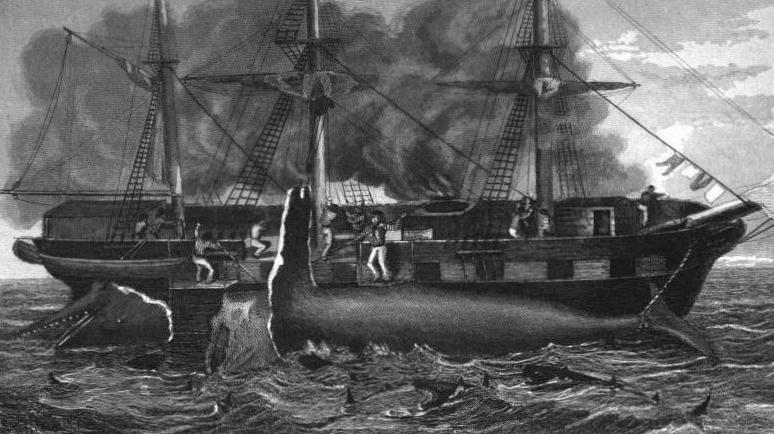
CUTTING IN & TRYING OUT. |
|
Entered, according to Act of Congress, in the year 1846
By HARPER & BROTHERS, In the Clerk's Office of the Southern District of New York |
gratify malice, can not, therefore, be justly attributed to me. My design is simply to present to the public a faithful delineation of the life of a whaleman. In doing this, I deem it necessary that I should aim rather at the truth itself than at mere polish of style. A due regard to fidelity induces me to present the incidents and facts very nearly in their original rude garb. I have no faith in softening or polishing stern realities. Let them go before the world with all the force of truthfulness; and if they can effect nothing, the blame will not rest upon the narrator. I claim no higher credit than that of being an accurate reporter of passing events, with the privilege of commending what is right, and dissenting from what is wrong. I have suffered too much, not to feel the woes of others. Where reproof is merited, where injustice has been done, where human rights have been invated, I shall ever lift up a deprecating voice. It is one of the glorious prerogatives of a freeman to denounce tyranny and injustice; and no fear of exciting enmity shall deter me from exercising it. I have espoused the cause of seamen; I have shown the flagrant abuses to which they are subject; I have exposed the cupidity of owners and the tyranny of masters; and I do not expect to escape censure. No man ever enlisted in a good cause without making enemies. Truth is always offensive to those who have cause to fear it. If, therefore, there be any who may feel disposed to abuse me for exposing the wrongs of seamen, they may rest assured I prefer their censure to their praise. Mr. Richard H. Dana has given, in his "Two Years fefore the Mast." * a faithful and graphic delineation of life in the merchant service. The thanks of every just man are due to him for his noble exertions in behalf of the suffering mariner. Previous to the publication of his work, little was known of the real hardships encountered by the sail- * Harper's Family Library, No. 106. |
ors; and to Mr. Dana may be attributed the moral revolution which has since taken place in the merchant service. I should be very backward in presenting my narrative to the public, after the brilliant success of a work written under nearly the same circumstances, if it were not that each describes an entirely different service. The duties, treatment, mode of living, and every thing connected with the voyage of a whaleman, differ widely from those of the merchant sailor. I believe no one has yet attempted a full and continuous narrative of forecastle life in the whale fishery from actual experience as a hand before the mast. Having had no previous acquaintance with the topography of the islands visited in the course of our cruise, or the manners and customs of the inhabitants, and no books to which I could refer while at sea, I was obliged to rely chiefly upon my own observation; so that the little which I may have added to what is already known of those islands must be taken in connection with the circumstances under which I obtained my information. It should be borne in mind that this is not designed as a work of reference for geographers and naturalists. I claim no higher rank for it than that of a mere chronicle of incidents and adventures. The notes of a sojourn on the Island of Zanzibar will, I trust, derive some interest from the fact that very little is known of that island and its inhabitants. Since the embassy to the courts of Siam and Muscat in 1832-3, but more especially since the visit of a vessel belonging to the Imaum of Muscat to this country a few years since, it has become customary to laud this Arabian potentate in the most extravagant terms of admiration. I have no disposition to detract from his high reputation; but, at the same time, I must say, no living sovereign has been more universally misrepresented, both as regards character and power. I enjoyed, perhaps, a better opportunity of becoming ac- |
quainted with the true character of the Imaum of Muscat, the extent of his dominions, and the condition of his subjects, than any of those writers who have described, in such glowing terms, the splendor of his court, his munificence toward the American government, and his unlimited power over the islands near the eastern coast of Africa. I take pleasure in acknowledging my indebtedness to Mr. A. A. von Schmidt, the talented artist who has so admirably executed the drawings. An intimate personal acquaintance with this gentleman for many years past induced me to show him my rough sketches taken during the voyage; and, through his skill and kindness, I am now enabled to present them to the reader in a more perfect state, but with all the spirit and freshness of sketches from life. I am happy to perceive that his skillful pencil is not idle, having been called into requisition by the Honorable Edmund Burke, commissioner of patents. Though young in years, it has been my lot to encounter many of the vicissitudes of a wandering life. May I not be indulged, then, in the privilege of an adventurer – that of telling of dangers past in my own way? If I have dwelt at some length on the dark side of things, it will be admitted that I show a strong preference for the sunny side. It is no pleasure to me to harp upon the ordinary frailties of human nature. Indeed, I think I may be allowed to say, that "I own the good, while smarting with the ill, With these few remarks in the way of explanation, I submit my narrative to the indulgence of the public; and if it should be the means of directing attention to the unhappy happy condition of that class with whom I was for a brief period of my life associated, I shall consider myself repaid for the trials and hardships of the past.
J. R. B.
Washington, D. C., July, 1846. |
CONTENTS.CHAPTER I
CHAPTER II.
CHAPTER III.
CHAPTER IV.
CHAPTER V.
|
CHAPTER VI.
CHAPTER VII.
CHAPTER VIII.
CHAPTER IX.
CHAPTER X.
CHAPTER XI.
|
CHAPTER XII.
CHAPTER XIII.
CHAPTER XIV.
CHAPTER XV.
CHAPTER XVI.
|
CHAPTER XVII.
CHAPTER XVIII.
CHAPTER XIX.
CHAPTER XX.
CHAPTER XXI.
CHAPTER XXII.
|
CONCLUSION.
APPENDIX.
|
ETCHINGS OF A WHALING CRUISE,WITH NOTES OF ASOJOURN ON THE ISLAND OF ZANZIBAR, ETC. |
ILLUSTRATIONS.
|
ETCHINGS OF A WHALING CRUISE.CHAPTER I.
I Deem it but fair that the reader should know the circumstances under which I commenced my career of adventure. There is nothing uncommon in them – nothing that I have the slightest reason to conceal; and it is only because I believe the interest of a narrative of this kind depends, in a great measure, upon the previous pursuits and associations of the author, that I make any allusion to matters which would otherwise be of so little moment. When a man abandons all the enjoyments of civilized life, signs away his freedom, and voluntarily brings trouble upon his own head, it may naturally be presumed that he has wise motives for doing so. I am not sure that this was precisely my case. If I had any motives for so unaccountable a course, they were merged in the vague but absorbing desire inherent in me from early boyhood to see the world. |
I date the circumstances which led to my cruise as far back as 1838. In that year I performed a voyage in a trading-boat from Louisville to New Orleans. The incidents of a year's life on the Ohio and Mississippi Rivers gave me a thirst for adventure; and I resolved to gratify it with as little delay as possible. My design was somewhat ambitious. I was determined to travel as a gentleman of leisure; though, to accomplish this object, it was necessary I should have means. In racking my brain to find a panacea for empty pockets, I could think of no profession in which it was likely I should have so little competition to contend against as that of stenographer, from the fact that it requires more labor to become proficient in it than most other professions. Besides, I had a penchant for scribbling. I set to work at once, and studied Gurney's, Taylor's, and Gould's "hieroglyphics" with so much zeal, that at the expiration of about a year I was a mere hieroglyphic myself. In November, 1841 – then in my nineteenth year – I left Kentucky for Washington City. The prospect before me was quite inspiring. I was about to see the great men of the nation assembled in council; to hear, for the first time in my life, the thrilling eloquence of our great orators; to be the humble medium of preserving some of their flights for future ages to admire! What a glorious galaxy of intellectual light was soon to shed its rays upon my boyish mind! |
On my arrival in Washington, I was fortunate enough to procure a good situation as reporter in the Senate. A long session had just opened. According to the nicest calculation, I thought myself (prospectively) in possession of at least six or eight hundred dollars; and I spent my leisure hours laying out the plan of my grand tour. First, I intended visiting France. If I should find nothing very attractive in Havre or Paris, I would immediately proceed to Italy, see all the curiosities, and, after touching at various ports in the Mediterranean, cut across from Constantinople to Alexandria and Cairo, visit the Pyramids, take a flying trip across the Isthmus of Suez, and return by the Cape of Good Hope. All this I intended doing in an economical, though gentlemanly way. The prospect of being able to accomplish my wishes in so short a time encouraged me to diligent application. Not a moment of my time was misspent. I was really a model of industry. When my work was over, I hurried to the Library of Congress to study the history, geography, and literature of the places to be visited in my grand tour. In this way I passed many of my leisure hours with pleasure and profit. As the session advanced, much of my youthful enthusiasm began to wear away. A nearer acquaintance with the distinguished political leaders by no means increased my respect for them. At first, I could not approach a great man without trembling. |
I never felt my utter insignificance till, with uncovered head and downcast eyes, I stood in the presence of those renowned statesmen and orators whose names I had learned to revere. I was not so young, however, but that I could soon see into the hollowness of political distinction; the small trickery practiced in the struggle for power, the overbearing aristocracy of station, and the heartless and selfish intrigues by which public men maintain their influence. I became thoroughly disgusted with so much hypocrisy and bombast. It required no sage monitor to convince me that true patriotism does not prevail to a very astonishing extent in the hearts of those who make the most noise about it. The profession I had chosen enabled me to see behind the scenes and study well the great machinery of government, and I can not say that I saw a great deal to admire. Such life had no attractions for me. I looked forward with anxiety to the close of the session. There was one matter, about which I began to feel very uneasy – my contemplated visit to Europe. Where were the funds to come from? As yet, I had received from the sources upon which I had based my calculations barely enough to defray my expenses. Alas for my grand tour! "The best-laid plans of mice and men gang aft agley." Among my acquaintances was a young man from Ohio, who had temporary employment in the Treasury Department. Gifted with a fine intellect, and |
of most accomplished and engaging manners, he was just such a person as I had often wished to have as a companion. We first met at a social soiree; and in a very short time I found that he was a man after my own heart. A strong friendship sprang up between us. We visited together, disclosed our feelings and plans to each other, spent all our leisure hours in pleasant conversation, and resolved at length to travel together, if we could contrive some means to raise a sufficient sum. W––, unfortunately, was poor like myself. The summer was now well advanced, and we agreed it should not close before our departure, even if we should be reduced to the necessity of performing our grand tour on foot. The latter, it is true, was rather a rash determination, considering we were not gifted with the power of the Israelites, who walked across the Red Sea. For the purpose of enjoying our prospects without interruption, we spent every fine evening in the Capitol Garden, where, inspired by the moonlight, flowers, shrubberies, and murmuring fountains, we talked of the various surprising things we were going to do; how we would fall in with some extraordinary chances during our travels, make our fortunes, marry a couple of Arabian princesses, and return home to enjoy our good luck in peace, and excite the envy and admiration of mankind with accounts of our brilliant exploits. This was all very fine, and I hope it will not escape the reader's memory. |
Near the close of the session, finding my expenses and profits were nearly balanced, I resolved to remain no longer in Washington. My enthusiastic friend was ready to start with me at a moment's notice. Our minds were soon made up as to the route and means. We were to work our way to Europe, and, once there, depend upon our own wits for success in the pursuit of our object. We were very enthusiastic in the belief that energy and perseverance would overcome all the obstacles that poverty might throw in our path. I well remember the night previous to our departure. It was that of the 4th of July. After the usual ceremonies of the day, there was a grand exhibition of fire-works in the President's garden. A large concourse of citizens, visitors, members of Congress, and diplomatic characters, had assembled on the terrace of the Capitol to witness the brilliant and imposing scene. Some kind friend had circulated a report that we had received a commission from his excellency, Mr. Tyler, to arrange a matter of great national importance with the government of Portugal. The consequence was, that several of our distant acquaintances, who had formerly recognized us with a stiff nod, now crowded around us, and bid us good-by in the kindest manner imaginable, wishing us a most cordial reception at the court of Donna Maria. Having procured passports at the state Department, we took our departure in the cars early on the |
morning of the 5th of July, 1842. As it was not probable we could find a vessel in Baltimore bound for Europe immediately, we continued on to Philadelphia, where we spent a few days, and obtained some letters of introduction from a friend in the Custom-house to distinguished gentlemen in different parts of Europe. Finding no encouragement in Philadelphia for tourists with slender means, we proceeded to New York. Our joint purse on leaving Washington amounted to about forty dollars. Of course, we could not deny ourselves the gratification of` visiting the various places of public amusement; besides, being gentlemen up to that time, it was indispensable that we should patronize the best hotel, ride in an omnibus or hack whenever we did not feel disposed to walk, and be liberal with servants and porters. At the expiration of a few days, it alarmed us to find that we had but eight dollars left. Upon application for temporary employment, with a view to replenish our means, we learned that business was very dull, and young men were glad to avail themselves of the privilege of passing their time usefully in mercantile houses without remuneration; a species of amusement not particularly adapted to our circumstances. With due humiliation, let it be told; we were soon reduced to the necessity either of writing to our friends for a remittance, or of being insulted with an invitation to depend upon the charity of casual acquaintances. The first was out of |
the question; it would destroy ou diplomatic reputation; the last was too galling to our pride to be entertained for a moment. In this dilemma we strolled down to the shipping, and went on board a vessel bound for Bremen. The captain, a jolly-looking Dutchman, sat upon the companion way smoking his pipe, while he kept his eye upon some of the crew who were at work on the main deck. He received us very kindly, and gave us much information on the subject of seafaring life. It would be a difficult matter, he said, for two young men dressed as we were to procure employment on board a merchantman as light hands; but if we put off our "long togs," and went to work in a corn field for about three months, to give us a hardy look, we might succeed. Where there were upward of four thousand seamen idling about the wharves, it would be no easy matter for "green landsmen" to make a voyage. On the whole, he gave us rather an unfavorable idea of the life of a sailor, and advised us to try something else. He thought it a pity that young gentlemen of education should waste their time in a pursuit so little adapted to their physical strength. There were rough fellows enough in the world who could do that sort of work better than persons who had been delicately raised. The words of the kind-hearted old skipper made a deep impression upon our minds, and, if it were not for sheer shame, and the pressing nature of our |
circumstances, we would have abandoned our romantic notions at once. However, we felt that we were in for it, and it would not do to back out. W––, who was a printer by trade, had made several applications at the printing-offices for employment, but without success. Nothing, therefore, remained for us but the prospect of getting something to do on board a ship. It made no material difference to us in what capacity we went; all we desired then was to take leave of New York. The rest of that day and part of the next we spent in making inquiries at the ship agencies along the wharves; but our appearance, combined with our anxiety to become sailors, excited suspicion, and the answers were so unsatisfactory that we began to despond. I noticed that the old tars, who were lounging in groups about these offices, smoking their pipes, and chatting in a nautical style of language totally incomprehensible to us, eyed us slyly, and winked at each other as we passed. In the course of a few months we very well understood what they meant. There was something of novelty in being thrown upon our own resources in at large city, without a single friend to whom we could look for aid. still, as our money was spun out to a few dollars, it became necessary to leave off romancing, and bring our ideas down to the level of our circumstances. As we strolled along one of the wharves, casting wistful glances at the vessels close by, and now and |
then taking a peep into the shipping-offices, our attention was attracted by a slip of aper over a door bearing the following important intelligence: "WANTED IMMEDIATELY!!!
"Six able-bodied landsmen, to go on a whaling voyage from New Bedford. Apply up stairs before 5 o'clock P.M." This was somewhat encouging. Indeed, we thought it peculiarly lucky. It suited us exactly. We stopped and read the words over half a dozen times, in order to satisfy ourselves that we were not mistaken as to their import. But here was the difficulty: the notice said able-bodied landsmen. Were we of that description! We consulted the matter for some time, and at last came to the conclusion that light-bodied, active men, with a considerable share'of spunk, ought to succeed as well as heavy-built men. We accordingly entered the office with a bold, independent air, as much as to say, we knew what we were about. An excessively polite old gentleman of prepossessing appearance received us with every manifestation of cordiality. In answer to our inquiries concerning his notice, he replied: "Yes, gentlemen, I want a few more men. Do you think of shipping?" "Why, yes, we have some notion of it." "The very best thing you can do; sorry you are not a little stouter; but no matter, I think you'll answer the purpose. I just received a letter this morn- |
ing from Mr. ––, the whaling agent in New Bedford, requesting me to send on two light, handsome fellows. He don't care so much about their weight, if they're good-looking; wants them for a small vessel, you see, and likes to have a nice crew." "Well, you think we'll do?" "Oh!, no doubt about it. I'm willing to risk you, though I may lose something by it. Whaling, gentlemen, is tolerably hard at first, but it's the finest business in the world for enterprising young men. If you are determined to take a voyage, I'll put you in the way of shipping in a most elegant vessel, well fitted: that's the great thing, well fitted. Vigilance and activity will insure you rapid promotion. I haven't the least doubt but you'll come home boatsteerers. I sent off six college students a few days ago, and a poor fellow who had been flogged away from home by a vicious wife. A whaler, gentlemen," continued the agent, rising in eloquence, "a whaler is a place of refuge for the distressed and persecuted, a school for the dissipated, an asylum for the needy! There's nothing like it. You can see the world; you can see something of life!" The enthusiastic advocate of whalers then handed us a paper, which we immediately signed without reading, not wishing to give him time even to reflect upon his bargain. Promising to be at the office by half past four, we took leave of our worthy friend, and warmly congratulated each other upon having accidentally met with this benevolent old |
gentleman, who not only smiled upon the indiscretions of youth, but forwarded all our plans, and seemed ready to oblige us in every way. From a man whom we had never seen before, all this was certainly very gratifying. At five o'clock on the same evening we took a passage in the Cleopatra for Providence. In order that particular attention might be a paid to our comfort – as we supposed, but in reality to prevent our escape – we were consigned to an officer on board the boat. The agent also, to enhance our enjoyment, sent with us a couple of entertaining fellows, rather rough to be sure, and not very respectable in their appearance, bound on the same delightful mission. For all this we felt exceedingly grateful to our benevolent and venerable friend. It is true, we discovered after we got to sea that he had forwarded a bill of ten dollars to the New Bedford fitter, to be placed on our account with the owners. As we had sold one of our trunks, and some other unnecessary articles, the proceeds of which enabled us to pay our own expenses, we could not clearly see what this was for; but it occurred to us, after a great deal of deliberation, that it was a kind of bounty allowed by the city council to the agent for disposing of all vagrants who came within his reach, and that he had, through the force of habit, or in the confusion of his multifarious duties, mistaken us for persons of that description. On our passage to Providence, the steam-boat |
touched at Newport, where one of our whalemen, who had made a raise of three dollars from the New York agent – in remembrance, he said, of a whaling voyage on which the old gentlemen had sent him a few years previously – privately notified us of his intention to, "visit some of his friends up town." Not deeming the matter within our cognizance, we left him to pursue the bent of his inclination. We afterward had occasion to admire the sagacity, though not the moral obliquity of this fellow. Before parting from him, he gave us his experience as a whaleman, and advised us not to be gulled by fair promises. He said he knew a thing or two about it; that he would sooner be in the penitentiary any time; and, if we had any regard for ourselves, we ought to turn our backs upon New Bedford, for it was the sink-hole of iniquity; that the fitters were all blood-suckers, the owners cheats, and the captains tyrants. This was another damper. The warning made a deep impression upon us, and we often thought of it when at sea. We arrived in New Bedford without suffering more than the usual wear and tear to which all articles of traffick consigned from one sea-port town to another are subject. |
CHAPTER II.
I have not the conscience fo pass over in silence the disinterested generosity of the New Bedford fitter. His benevolence surpassed even that of the amiable old gentlemen in New York. When we first presented ourselves for inspection, he was a little bluff, to be sure, but that was only one of his good-natured peculiarities. "Why," said he, surveying us with professional deliberation, "you are not the men I wrote for. I want stout, hard-fisted fellows, who ain't afraid to work. Such slim chaps as you won't do at all!" "That's rather hard, sir; here we are without the means of getting back; and now, after the New York agent telling us you would take us, you say we won't do." What do I care about the New York agent?" replied the fitter. "It's his own look-out, and yours, if he don't send proper men. I'm not bound to take you at all; and I won't take you, if I don't like." "Well, you'll pay our expenses back, then?" At this the fitter laughed very heartily. |
"No, no, my good fellows; can't do that. I see you don't understand this business. What do you weigh?" We gave him our weight, but it did not seem to satisfy him exactly. He shook his head with a doubtful look, as much as to say he had no great respect for men who did not weigh considerably over our standard. He then punched us with his fist, shook us by the arms, and, after some farther experiments by way of testing our muscular powers, told us what there was of us was pretty good, "but there wasn't enough. Directing us next to walk up and down his long store-room, he planted himself against a pile of boxes, and watched our gait with the practiced eye of a jockey about to make a speculation in horse-flesh. Apparently satisfied, be ventured the opinion that we might do; at all events, he would exert his influence in our behalf with the owners. A clerk who sat in the counting-room, blowing his very soul through a cracked fife, was then directed to show us to old Captain R––'s boarding-house. Here we found a most jovial company; not very select, but remarkably free and easy. Among others, I recollect Red Sandy, Blue John, Long-legged Bill, Big-foot Jack, Chaw-o'-tobacco Jim, Handsome Tom, and one of our steam-boat acquaintances, who had already obtained the soubriquet of Bully Clincher; besides four lively house-maids, whom the sailors called Mag, Moll, Bet, and Peg, and with whom they seemed to be on the most friendly terms. |
Our fellow-boarders, when the fact became known that we were about to go to sea, entertained themselves with sundry jests at our expense, all of which we took with the utmost good humor. This completely disarmed them. We were shrewd enough to suspect their object, which, as we afterward learned, was to get us angry, and then, according to custom, give us a sound drubbing. Sailors have an inveterate dislike to young sprigs, who, when placed upon a level with them, assume airs of superiority. By guarding against this, we became great favorites. I must not omit, however, to mention one of the initiatory movements. While standing at the door, the first evening after our arrival, we overheard the comments made upon ourselves and our mission. "I say, Bill," said one, "there's a pair of bloody tars for you! They'll be slushin' down the t'gallant mast before long, or I'm out o' my reckoning." "Ay, ay, replied Bill; "better they never was weaned, than go driftin' round the world in a blubber hunter." "Never mind," added another, " they'll wish themselves in the watch-house before two months." With these and other remarks of the kind they amused themselves for some time, when one of the party, a regular old sea-dog, with a tremendous quid of tobacco in his cheek, waddled up to us, and, staring us in the face, exclaimed, "Well, cuss me if these ain't the lob-lolly boys wot sarved in one of my ships. I say, my lads, don't you |
know your old skipper? I'm Captain Bill Salt, wot used to larn you Lunars. Don't you know me?" "No; you must be mistaken. We have never been to sea." "Now I'm shivered if that ar'n't strange!" cried Captain Bill Salt; "if you ain't my lob-lolly boys, I never seed 'em." "Nevertheless, we are not. B–– is my name, and W–– is my friend's." "Well, just as good. You was both born to go to sea. Come, let's splice the main brace. Come along, shipmates! I'm agoin' to give these 'ere young gentlemen the first lesson in Lunars." Captain Bill Salt's manner was, to say the least of it, very friendly. We thought it best not to refuse his polite invitation. The sailors followed their comrade, who led the way to a chop-cellar a short distance from the boarding-house. "Come, all hands, what'll you take? Don't be shy. What d'ye say, shipmates," addressing W–– and myself; "close-reef or sea-breeze?" "Close-reef, said we, at a guess. "Bravo!" cried Captain Bill, grasping each of us by the hand; "you'll see the stars yet! If you ain't sailors, it's the 'fects of eddecation or s'ciety, wot's all the same. Come, here's a toast 'Be cheery, my lads! may your hearts never fail The toast was duly honored; and we discovered when we emptied our glasses, that "close-reef" |
was something very strong. Big-foot Jack, Chaw-o'-tobacco Jim, handsome Tom, Red Sandy, and the rest of our jolly friends, then seated themselves and called for cigars. Captain Bill Salt told us to do likewise; and, taking out his pipe, he soon enveloped himself in a comfortable cloud of smoke. Without waiting for the ceremony of an invitation, he gave vent to the following ditty, a copy of which I afterward procured from him: "PARTING MOMENTS.
"Farewell, my lovely Nancy, This song elicited the most rapturous applause. Captain Bill then spun us some tough yarns, while the company slipped out one by one. As we were about to leave, the bar-keeper called us aside, and |
politely requested my friend and myself to pay the reckoning, assuring us that it was customary, when young gentlemen were about to go on a voyage, to treat all hands. We accordingly gave him our last cent, and were not a little edified at the cool manner in which Captain Bill Salt witnessed the operation. Though our confidence in that eccentric individual was a little shaken, we took the whole proceeding as a very good joke, and laughed to think how cleverly we had been gulled. Thus ended our "first lesson in Lunars." Our friend, the fitter, was a most accommodating man. With a delicate appreciation of our pecuniary embarrassments, he paid our board, furnished us with every little luxury we wanted, lent us his pleasure-boat to sail in, told us he would make our expenses all right with the owners, and gave us a great deal of fatherly advice about our conduct at sea. In addition to all this kindness, he considerately provided us with chests and sea-clothes at a terrible sacrifice, being at least ten per cent. cheaper than we could get them elsewhere. Besides, the mere fact of his crediting total strangers seemed so generous, so confiding, so high-minded! The only vessel about to sail immediately was the barque styx, * of Fair Haven. Through the exertions of our excellent friend, the fitter, the owners, * Some of the incidents related in this narrative render it advisable that I should mention no real names, except where the parties can not take offense. |
apparently with great reluctance, areed to take us. They told us the vessel was well fitted; better, in fact, than any vessel we could find. One of them, an old Quaker, assured us no whaler had ever sailed from New Bedford or Fair Haven as well fitted; he had attended to it all himself and, we might depend upon it, we would live in style. The captain, we learned from them, was a young man, pretty strict in his discipline, but a fine, generous fellow. He would treat us well, and give us plenty to eat; and, if we made ourselves useful, he would he very kind to us. He was a first-rate whaleman, and no doubt we would make a good voyage, and come home in a year or a year and a half with lots of money due to us. The vessel was a hundred and forty-seven tons burden, and calculated to hold a thousand barrels of oil. We were to receive the ordinary lay of green hands, being, as we were told, the one hundred, and thirtieth part of the oil taken. There was provision enough on board to last for twenty-seven months, so that, if not successful, there was no danger of our starving. We were to have what clothes we needed out of the slop-chest at the New Bedford prices. The shipping articles were then presented to us, and we signed them without exhibiting any such ungentlemanly want of confidence in the representations of the owners as to read the contents; besides, we were afraid, as they had accepted us so reluctantly, some difficulty might arise by which we would be deprived of the pleas- |
ure of performing a voyage under such pleasant auspices. The signing of the articles we regarded as a sort of security. With sapguine hopes and enthusiastic dreams of adventure we bade good-by to our New Bedford friends, and, on the morning of July –, embarked. The styx lay in the middle of the Acoshnet River, opposite the town of New Bedford. At 2 P.M. all hands were called to the windlass, and we weighed anchor. A light breeze slowly wafted us out into Buzzard's Bay. The shipping at the New Bedford wharf became gradually indistinct, and the houses looked misty in the distance. It was a beautiful Sabbath afternoon. The church bells were tolling a melancholy farewell; and I shall never forget the look W –– gave me as he pointed to the receding shores, and observed, in a melancholy tone, "I have unhappy thoughts. It seems to me those familiar sounds call us back. But we are too late; it is useless to repent now." My feelings were touched; the whole past was before me in a moment: friends, brothers, sisters, all! I would have given all I ever hoped to possess to retrace a few hours of my life. "Too late – too late! how heavily that phrase |
CHAPTER III.
Toward evening he captain came on board in a pilot-boat, and took charge of the vessel. I had not seen him before, and of course felt a curiosity to know what sort of a looking man he was. The owners had spoken in such glowing terms of him that, I must confess, he did not altogether realize my expectations. His personal appearance was any thing but prepossessing. Picture to yourself a man apparently about thirty-five years of age, with a hooked nose, dark crop hair, large black whiskers, round shoulders, cold blue eyes, and a shrewd, repul- sive expression of countenance; of a lean and muscular figure, rather taller than the ordinary standard, with ill-made, wiry limbs, and you have a pretty correct idea of Captain A––. He wore a broad-brimmed Panama hat, turned up at the sides, a green roundabout, a pair of dirty duck pantaloons, very wide at the bottom, and slip-shod shoes, which had evidently done service for two or three voyages. He walked the quarter-deck with his hands in his pockets, his eyes down; and his lips firmly compressed. Altogether he had a sneaking, hang-dog |
look that was not very encouraging to those destined to be subject to his will during a year's cruise, or perhaps longer. When he gave orders, it was in a sharp, harsh voice, with a vulgar, nasal twang, and in such a manner as plainly betokened that he considered us all slaves of the lowest cast, unworthy of the least respect, and himself our august master. Night closed upon us with rough and cloudy weather. By morning we had a heavy, chopping sea, and began to experience all the horrors of seasickness. The mate, a stout, bluff-looking Englishman, with a bull neck, kept us in continual motion, and gave us plenty of hard work to do, clearing up the decks, bracing the yards, stowing down the loose rubbish, and otherwise making the vessel tidy and ship-shape. He bellowed forth his orders to the men in the rigging like a roaring lion, yelled and swore at the "green hands" in the most alarming manner, and pulled at the ropes as if determined to tear the whole vessel to pieces. The loungers or "sogers" had no chance at all with him; he actually made them jump as if suddenly galvanized. For the sea-sick he had no sympathy whatever. "stir yourselves; jump about pull, haul, work like vengeance!" he would say, in the bluff, hearty voice of a man who appeared to think sickness all folly; "that's the way to cure it. You'll never get well if you give up to it. Tumble about there! Work it off, as I do!" To the haggard, woe-begone landsmen, who stag- |
gered about groaning under their afflictions, this sounded very much like mockery. For my part, I thought the mate a great monster to talk about sickness, with a face as red as a turey-cock's snout. After a day of horrors such as I had never spent before, we were permitted to go below for the night. Our condition was not improved by the change. The forecastle was black and slimy with filth, very small, and as hot as an oven. It was filled with a compound of foul air, smoke, sea-chests, soap-kegs, greasy pans, tainted meat, Portuguese ruffians, and sea-sick Americans. The Portuguese were smoking, laughing, chattering, and cursing the green hands who were sick. With groans on one side, and yells, oaths, laughter and smoke on the other, it altogether did not impress W–– and myself as a very pleasant home for the next year or two. We were, indeed, sick and sorry enough, and heartily wished ourselves ashore. Nothing can be more bewildering to a youth, whose imagination naturally magnifies all the dangers of the deep, than to be roused up in the dead of night, when the ocean is lashed into a fury by a stiff gale, the vessel pitching and laboring, and the officers yelling at the men as if endeavoring to drown the roaring of the elements with loud, fierce imprecations, while thick darkness enshrouds all – darkness so dense, that, but for momentary flashes of lightning, one might fancy chaos had come again. Such was the novel and startling scene that burst |
upon us with all its wildness on the night of the 19th. "We were dead of sleep, Sea-sick and harassed after a hard day's work, we had gladly availed ourselves of a few hours' respite from duties so laborious. The mate came to the scuttle, and, with half a dozen tremendous raps, roared at us to bear a hand. "Tumble up, every mother's son of you, and take in sail. Out with you, green hands and all. We won't have any sick aboard here. You didn't come to sea to lay up. No groaning there, or I'll be down after you. D'ye hear the news down below? Tumble up! tumble up, my lively hearties!" There was no refusing so peremptory a command as this, little as we liked it. Without exactly tumbling up, we contrived, with some difficulty, to gain the deck, for the vessel pitched so violently that few of the green hands could keep their feet under them. I shall never forget the bewilderment with which I looked around me. We were in the Gulf stream, enshrouded in darkness and spray. The sea broke over our bows, and swept the decks with a tremendous roar. Momentary flashes of lightning added to the sublimity of the scene. When I looked over the bulwarks, it seemed to me that the horizon was |
flying up in the clouds and whirling round the vessel by turns, and the clouds, as if astonished at such wild pranks, appeared to be shaking their dark heads backward and forward over the horizon. I looked aloft, and there the sky was sweeping to and fro in a most unaccountable manner. The vessel went staggering along, creaking, groaning, and thumping its way through the heavy seas. I grasped the first rope I could get hold of, and held on with the tenacity of a drowning man. For a few moments I could do nothing but gasp for breath, and wipe the salt water out of my eyes with one hand while I held on with the other. The confusion of voices and objects around me, the tremendous seas sweeping over the decks, and the flapping of the sails, impressed me with the belief that we were all about to be lost. I kept my grasp on the rope, thinking it must be fast to something, and, if the ship foundered, I should at least be sure of a piece of the wreck. As for my comrade W–– , I supposed he was still on board, and called for him with all my might, but the wind drove my voice back in my throat. While standing in this unpleasant predicament, the mate came rushing by, shouting to the green hands to "tumble up aloft, and lay out on the yards!" Aloft such a night, and for the first time! Was the man mad? The very idea seemed preposterous. Presently he came dashing back, thundering forth his orders with the ferocity of a Bengal tiger. "Up with you'. Every man |
tumble up!' Don't stand gaping like a parcel of boobies! Aloft there, before the sails are blown to Halifax!" Knowing how useless it would be to remonstrate, and believing I might as well die one way as another, I sprang up on the weather bulwark and commenced the terrible ascent. The darkness was so dense that I could scarcely see the ratlins, and it was only by groping my way in the wake of those before me, that I could at all make out where I was going. A few accidental kicks in the face from an awkward fellow who was above me, and a punch or two from another below me, convinced me that I was in company, at all events. How I contrived to drag myself over the foretop, I do not well remember. By a desperate exertion, however, I succeeded, and holding on to every rope I could get hold of with extraordinary tenacity, I at length found myself on the foot-rope, leaning over the yard, and clinging to one of the reef-points, fully determined not to part company with that in spite of the captain, mate, or whole ship's company. "Haul out to leeward!" roared somebody to my right; "knot away!" This was all Greek to me. A sailor close by good-naturedly showed me what I was to do, and having knotted my reef-point, I looked down to see what was the prospect of getting on deck again. The barque was keeled over at an angle of forty-five degrees, plunging madly through the foam, and I could form no idea of the bearings of the deck. All I could see was a long dark object below, half hid- |
den in the raging brine. My right-hand neighbor gave me a hint to get in out of the way, which required no repetition, for I found my situation any thing but pleasant. By the time I reached the foretop my head was pretty well battered, and my hands were woefully skinned and bruised, the sailors having made free use of me to acelerate their downward progress. I found, on gaining the forecastle, that my friend W–– had passed throngh the ordeal in safety. We said nothing, but looked our unqualified disapprobation of such a life. Thee Portuguese, to make matters still worse, laughed heartily at the sorry figure we cut, and told us all this "was nothing to what we'd see yet." Next day the green hands, including my friend and myself, looked haggard enough. We were all dreadfully sea-sick. Our fare was by no means inviting under such circumstances. For breakfast we had an abominable compound of water, some molasses, and something dignified by the name of coffee, with hard biscuit and watery potatoes; for dinner pork, salt beef, and potatoes; and for supper, a repetition of the biscuit and potatoes, with boiled weeds and molasses as a substitute for tea and sugar. It was perfectly amazing the voracity with which the Portuguese devoured this fare. Had they whetted their appetites for months on raw corn they could not have swallowed such food as was now before them with more relish. I must confess, their digest- |
ive powers excited my envy as well as my astonishment. It made me despair to see them eat. I would have given all I expected to make during the voyage to possess their swinish relish for food. However, before the expiration of two months, I had reason to change my tune. I would have given twice as much to get rid of my appetite! We had on board a Yankee boy, who afforded much amusement to the crew. MacF––, or, as he was called for shortness, Mack, was a down-east chap from "away up Maine," somewhere in the neighborhood of sunrise. Had Nature been in her most whimsical mood, she could not have formed a greater curiosity than Mack, in every respect. He was an odd specimen of the "live Yankee." Imagine a gawky youth of nineteen, with arms reaching down to his knees, tremendous wrist bones and hands, a lank visage, shins like drum-sticks, and feet moulded for a giant, but placed by mistake under the aforesaid shins, and you have a fair representation of his outward man. Mack, notwithstanding these freaks of Nature, was a general favorite. Nothing could ruffle his good humor. His awkwardness and quaint wit were irresistible. I doubt if Yankee Hill or Dan Marble ever had a better model. Mack was woefully sea-sick. The poor fellow's face was the very picture of sorrow. His skin, naturally dark, had assumed a greenish hue, and his lank cheeks and protruded lips formed a most pathetic picture of rueful retrospection. Sick as I was my- |
self, I could not repress my risables, when, leaning over the monkey-rail, squaring accounts with old Nep, he paused every moment to exclaim, "There! durn it all, I know'd I was goin' to be sick. Oh, gosh! oh, gosh!" Poor Mack! From the bottom of my heart I sympathized with him as he groaned, "Dod burn the thing! I wouldn't grudge twenty dollars if I was at hum milkin' the keows." "Why, Mack," I inquired, "you are not tired of whaling already, are' you?" "Well, I can't say, exacly; but I guess this child won't be caught in such a snap agin; not soon he won't. Oh, gosh! gosh! Dod blame the luck! 'Tain't no use to try; folks says salt water helps it some, but, durn the thing, I've swallered a bucketful, an' I feel a devilish sight worse an' ever." "Maybe you haven't swallowed enough, Mack," said the cook; "try another bucketful, and, likely as not, it'll cure you." "No, I won't!" retorted Mack; " cause, durn the stuff, 'twarn't never made for nothin' in human shape. I wish I hadn't never seen a drop on't. Salt water! Ugh! Oh, gosh! oh, gosh!" "What induced you to ship on a whaling voyage?" I asked, forgetting my own folly. "Why didn't you stay at home, Mack, where you were better off?" "Well, I don't know. I came because I was a dod-burned fool; an' I s'pose you hadn't no better |
reason. Nobody hadn't oughter leave hum. Folks that be hum can't do better than stay thar." I made no farther attempts to be witty at Mack's expense on this occasion. CHAPTER IV.
Among the foremast hands was a man from Charleston, South Carolina, by the name of Smith. According to his own representation, he had served as steward in some of the schooners running from Charleston to New York. He professed to be well acquainted with ship duties, and his name was down on the papers as ordinary seaman. A boy from Fall River, who had shipped as steward, was so sea-sick as to be unable to do duty. The captain sent the mate forward to procure a temporary substitute from among the crew. Smith was selected, and ordered aft to act as steward until the recovery of the boy. He resolutely refused to act in that capacity, stating that he had shipped as an ordinary seaman, and would remain before the mast. The mate, upon reporting his refusal, was sent forward to make him turn out at all hazards. Smith was very ill at the |
time, and the mate, not wishing to be hard with him, did not resort to force. No threats, however, had any effect upon him. He steadily refused to act as steward, and stated, moreove that he was unable to do duty of any kind, and would not be forced on deck until sufficiently recovered from his illness. The captain then came forward to the scuttle, and called upon him, in a peremptory voice, to turn out. "I'm sick; I'll not go on deck!" said Smith. "Won't you? I'll soon make you!" shouted the captain. "I'll see whether you will or not!" Springing down the ladder, he then grasped Smith by the shirt-collar, and dragged him out of his berth. "Up with you, now, and not another word from you!" "No, sir, I'll not go on deck," said Smith, making a show of resistance. "You'd better mind how you handle me! I'm a Charleston man, myself! Let me go; let me go, sir!" "Are you, hey?" thundered the captain; "a Charleston man? I'll let you know what I am; I'll let you know that I'm captain of this ship!" With these words the captain dragged him up the ladder by main force, and, jerking him through the scuttle, collared him against the foremast. Faint and haggard with sickness, the offender commenced pleading for mercy. "Don't choke me, captain; don't choke me!" "Yes, I'll choke the stubbornness out of you; I'll choke obedience into you!" roared the captain, shaking him by the throat. |
Great God! you'll kill me," groaned the man, nearly black in the face. "Do your duty, then." "I will, sir, I will. Don't kill me." "Go aft, then, and act as steward till I think proper to get one in your place; and remember, if you show any more of your stubbornness, I'll flog it out of you with a rope's end." Smith staggered aft, rubbing his throat, and crying with pain. From that time forth he was the officers' dog. He had earned a bad name for himself, and he kept it during the remainder of his stay on board the vessel. This was the commencement of trouble. It was deemed an appropriate occasion to "lay down the law." All hands were called aft. The captain deliberately stalked the quarter-deck, exulting in the "pomp and circumstance" of his high and responsible position. Every step he took be spoke the internal workings of a man swelling with authority. The proud glance of his eye; the severe frown-of his heavy eyebrows; the haughty curl of his lip; even the peculiar twist of his long, nasal protuberance seemed to say, "Behold, and wonder! I stand before you arrayed in a halo of glory. I am commander of the great barque styx! Authority is mine! Look upon me, all ye who have eyes to see, and tremble, all ye who have ears to hear!" With his hands stuck in his breeches pockets, he then approached the break of the quarter-deck, and, strad- |
dling out his legs to guard against lee-lurches, asked if all hands were present. One of the officers replied in the affirmative. The scene was at once grotesque and impressive. Fourteen men, comprising he whole crew, were huddled together in the waist, at the starboard gangway. Of these four were Portuguese, two Irish, and eight Americans; and certainly a more uncouth-looking set, including my friend and myself, never met in one group. The Portuguese wore sennet hats with sugar-loaf crowns, striped bed-ticking pantaloons patched with duck, blue shirts, and knives and belts. They were all barefooted, and their hands and faces smeared with tar. On their chins they wore black, matted beards, which had apparently never been combed. The color of their skin was a dark, greenish-brown, if the reader can imagine such a color, and was calculated to create the impression that they never made use of soap and water. The variety of dress in which the rest of the crew were habited was fully as striking as that of the Portuguese. Some wore Scotch caps, duck trowsers, red shirts, and big horse-leather boots; others, tarpaulin hats, Guernsey frocks, tight-fitting cloth pantaloons, and red neckerchiefs. Several were bareheaded and barefooted; having lost, their hats and shoes in the late gale. All the green hands, which included most of the Americans and the two Irishmen, were still cadaverous and ghastly after their sea-sickness, and not more than two had yet entirely "squared ac- |
counts with old Nep." Altogether we were the most extraordinary looking set of half-sailor nondescripts possible to conceive. Thus situated, and thus equipped for sea life, we stood gaping at the captain in silent admiration. The mates and boat-steerers, consisting of the chief mate, an Englishman, the second mate, an American, two Portuguese boat-steerers, and an American of the same grade, stood near the mainmast, looking on with the air of men who were used to such things, and took no particular interest in them. The captain, after considerable deliberation, and a great show of contempt toward every body within range of his visual rays, then addressed is in a sharp nasal voice, fixing his eyes upon each man alternately. I had listened to many speeches, but never to one more pointed than this. No doubt he will be surprised to find it literally reported: "I suppose you all know what you came a whaling for? If you don't, I'll tell you. You came to make a voyage, and I intend you shall make one. You didn't come to play; no, you came for oil; you came to work." [Here he took a turn on the quarter-deck, and while concentrating his ideas for another burst of eloquence, amused himself in an undertone, partly addressed to himself individually, and partly to the mate, by letting us know that it should be "a greasy voyage, and a monstrous greasy one too."] "You must do as the officers tell you, and work when there's work to be done. We didn't ship you |
to be idle here. No, no, that ain't what we shipped you for, by a grand sight. If you think it is, you'll find yourselves mistaken. You will that – some, I guess." [Here he lost the idea, or, to use a more expressive phrase, "got stumpef."] "I allow no fighting aboard this ship. Come aft to me when you have any quarrels, and I'll settle 'em. I'll do the quarreling for you – I will." [Another turn on the quarter-deck.] "If there's any fighting to be done, I want to have a hand in it. Any of you that I catch at it, 'll have to FIGHT ME!" [A frightful doubling up of the fists, and a most ferocious gnashing of the teeth.] "I'11 have no swearing, neither. I don't want to hear nobody swear. It's a bad practice – an infernal bad one. It breeds ill will, and don't do no kind o' good. If I catch any one at it, damme, I'll flog him, that's all." [A nod of the head, as much as to say he meant to be as good as his word.] "When it's your watch below, you can stay below or for'ed, just as you please. When it's your watch on deck, you must stay on deck, and work, if there's work to be done. I won't have no skulking. If I see sogers here, I'll soger 'em with a rope's end. Any of you that I catch below, except in cases of sickness, or when it's your watch below; shall stay on deck and work till I think proper to stop you." [A stride or two aft, and a glance to windward.] "You shall have good grub to eat, and plenty of it. I'll give you vittles if you work; if you don't work, you may starve. Don't grumble |
about your grub neither. You'd better not, I reckon." [A mysterious shake of the head, which implied a vast deal of terrific meaning.] "If you don't get enough, come aft and apply to me. I'm the man to apply to; I'm the captain." [Here he surveyed himself with a look of exultation, which seemed to say that he was not only the captain – the very man to whom he had special reference, but that it was a source of infinite satisfaction to him to be the captain.] "Now, the sooner you get a cargo of oil, the sooner you'll get home. You'll find it to your interest to pay attention to what I say. Do your duty, and act well your part toward me, and I'll treat you well; but if you show any obstinacy or cut up any extras, I'll be d––d if it won't be worse for you! Look out! I ain't a man that's going to be trifled with. No, I ain't – not myself, I ain't! The officers will all treat you well, and I intend you shall do as they order you. If you don't, I'll see about it." [Three or four strides to and fro on the quarter-deck, and a portentous silence of five minutes.] "That's all. Go for'ed, where you belong!" Had the captain made good all his promises, we would have had no just cause for complaint; but we soon discovered that his speech was merely designed to intimidate us. From that time forth we had the poorest fare, and in the scantiest quantities. The owners had given us positive assurance that there never had sailed from that port a vessel better fitted in every respect. For their misrepresentations, we |
heartily wished them a berth in their own barque, believing that the severest punishment that could be inflicted upon them. A month's trial at it would make them exercise more humanity toward their fellow-creatures. Next in the routine of business was the choosing of watches. We were all called to the waist that evening, and examined like a parcel of bullocks about to be butchered. The mate and second mate made the selections. Among others, I was chosen for the larboard or mate's watch, and my friend for the starboard or second mate's watch. The watch on deck was then set to work on the whaling gear. Our duties from that time till we arrived on the western whaling ground were, working ship, grinding harpoons, spades, lances, boarding knives, &c., making deck brooms, washing decks every morning, clearing the rubbish away every afternoon, stowing away loose casks, steering and standing mast-heads. Whenever the weather was fine we lowered the boats and practiced at pulling, backing, and all the maneuvers necessary in the capture of a whale. All this severe labor was very hard upon those who had not been accustomed to great physical exertion. |
CHAPTER V.
Nothing of interest transpired after the difficulty with Smith, till July 27th. – I had afternoon watch below, and had turned in to forget my troubles in sleep. About two o'clock I was roused by the steward, who informed me that W–– had suddenly fallen upon the deck in a fit of convulsions. I immediately sprang up the ladder and ran aft. Language can not depict, the shocking spectacle that met my eyes. There was my bosom friend, sitting up against one of the scuttle-butts, his shirt open, his hat lying on the deck, and his eyes ready to start from their sockets. The captain stood by him, holding him by the hand. I felt sick and giddy, when W–– stared at me with the vacant gaze of an idiot. Bursting into a wild laugh, he attempted to spring up. It was a fearful laugh – a laugh that rang like a death-knell in my ears. I grasped him by the hand; the terrible thought struck me that he had gone mad! His voice was wild and unnatural, and his whole appearance awful in the extreme. Gazing vacantly in my face, he burst into tears, and sobbed as if his heart would break. I called him by name; I implored |
him to speak to me. Without noticing my appeals, he turned to the captain and inquired my name. Upon receiving an answer, he begged me, in the most piteous tones, to convey a message home to his mother, that he never should see her again. "Before another hour," he said, "I shall be food for the sharks. 0 God, must I die so soon? Am I never to see home again? I have kind, good parents; tell them I died thinking of them. It is horrible – horrible to be thrown overboard in a sack!" No effort to console him had the slightest effect. The fearful idea that he was about to be devoured by the sharks seemed to drive him mad. He raved of strange things which he had seen at the masthead; talked incoherently of birds with beautiful plumage, curiously-formed fishes, and called upon us wildly to save him from the sharks. It was a scene of horror that I shall never forget. When he became somewhat composed, one of the hands, assisted by myself, carried him forward to the forecastle, and laid him in his berth. For three hours he lay in a trance, with his eyes wide open, not moving a muscle. He looked like one that was dead. It appeared, from the statements of the watch on deck, that he had just come down from the masthead, where the rays of the sun poured down with an intense heat. On reaching the deck, he walked aft toward the captain, who was parading the quarter-deck. After passing the break of the deck he |
stood still, and while in the act of addressing the captain, fell down in convulsions. From all these circumstances, and from the fact that he was not subject to fits, it was quite evident that it was a sunstroke. He had suffered severely from sea-sickness, and was greatly debilitated. A burning sun beating down upon his head for two hours could very easily have produced the terrible effects described. I thought it very hard that a man, really suffering from illness, should be compelled by the captain to stand two hours a day at the mast-head. It was, in this case at least, little better than murder. W–– never recovered from the effects of this fearful affliction. Better, far better would it have been for him, had he fallen from his post and found a watery grave. There are things connected with this event that weigh heavily upon my heart; things not rudely to be touched – affections tried and hearts broken. It is needless to dwell upon his sufferings during the remainder of his stay on board the ship. The Portuguese were mere brutes, and, with two or three exceptions, the rest of the crew were little better. Sympathy for the sick was a weakness unknown to them. No temptation mould induce them to refrain from smoking, swearing, and blackguarding. I attempted to purchase peace by giving them my clothes, but my exertions were of no avail. I saw that it was useless to expostulate, and finding that the noise increased W––'s malady, I appealed to the captain to exert his influence over them. His |
reply was characteristic, and just such as I might have expected had I known him better. "He had nothing to do with the forecastle. The Portuguese, as well as the Americans, were at liberty to do as they pleased in it. He had no control over them after they went below. W–– had no business coming to sea to get sick, and be a trouble to all on board. He had seen such fellows before, and would not put himself out of his way to pamper to their wants. Now that he was in a scrape, let him make the best of it, and not trouble folks with his complaints. If he wanted medicine, he might have it, and that was all that could be done for him." Where such an example was set by the captain, I could not expect the crew to do otherwise than follow it. For FIFTY-TWO days W–– lay in the forecastle, suffering such tortures of body and mind as can not be described. The captain gave him to understand that he should not leave the vessel the whole voyage; he might die in the forecastle, for what he cared. During all this time, my unfortunate comrade had nothing to eat but hard biscuit, and occasionally, a piece of butter about the size of a dollar; so reduced was he that nothing else allowed the crew would remain on his stomach. The hot, close atmosphere of the forecastle, rendered still more suffocating by the fumes of old pipes and bad cigars, was not very well calculated to promote his recovery. It would be difficult to give any idea of our fore- |
castle. In wet weather, when most of the hands were below, cursing, smoking, singing, and spinning yarns, it was a perfect Bedlam. Think of three or four Portuguese, a couple of Irishmen, and five or six rough Americans, in a hole about sixteen feet wide, and as many, perhaps, from the bulk-heads to the fore-peak; so low that a full-grown person could not stand upright in it, and so wedged up with rubbish as to leave scarcely room for a foothold. It contained twelve small berths, and with fourteen chests in the little area around the ladder, seldom admitted of being cleaned. In warm weather it was insufferably close. It would seem like exaggeration to say, that I have seen in Kentucky pig-sties not half so filthy, and in every respect preferable to this miserable hole: such, however, is the fact. In this loathsome den, the Portuguese were in their element, revelling in filth, beating harsh discord on an old viola, jabbering in their native language, smoking, cursing, and blackguarding. Their chief recreation, however, was quarreling, at which they were incessantly engaged. Nor was it confined to week-days, for not the slightest regard was paid to the Sabbath. The most horrible profanity was indulged in, and to an excess that was truly revolting. They did not seem aware even of the existence of a Supreme Being. And yet these Christians chattered a paternoster over their beads every night! What mockery! I asked Enos, the most intelligent of them, if he had ever read a book called the Bible. |
"No," said he, "I don't sabe how to read." "Did you ever hear of it?" "I don't know." "Do the people on the Western Islands pay any regard to Sunday?" "Oh yes. When Sunday come, dey go to chapel. In de morning dey pray, in the evening dey dance and play cards; dey have fandango. Old padre say dat bad; we say, here ten cent. Den padre laugh and say no more 'bout it." Here the Portuguese all set up a laugh, and commenced singing, in whining voices, "Dominus vobiseo;" &c. As soon as we arrived on the western whaling ground, boat watches were set. In a small vessel like the styx, with three boats, besides a spare boat aft, there are usually three watches, consisting of the larboard, starboard, and waist boat's crew. Each watch is under the command of a boat-steerer after sail is shortened, which is generally about sundown. In our watches there were four men, and the boat-steerer. The mate and second mate sleep all night, and remain on duty all day. The alternate hours of duty and rest with the crew are arranged thus: Say the larboard and starboard boat's crews go below after sail is taken- in; the waist boat's crew remains on deck till ten o'clock, when it is relieved by the larboard boat's crew, and turns in till the hands are called in the morning. The watch then on deck is relieved at one by the starboard boat's crew, which |
remains on deck till all below are called in the morning. The starboard watch then has forenoon watch below, the larboard the afternoon, and the waist boat's crew all day on deck. In making a passage, there are but two watches, the larboard and starboard, which are headed by the first and second mate, who take the same hours of rest allowed the crew. So much of my time was taken up at the helm and mast-head, that I had but few hours every day to devote to my unfortunate friend, who could look to me alone for aid. Each day he became more exhausted from want of proper nourishment and care. August 3d. – We had now prepared all the whaling gear, and were daily on the look-out for whales. August 5th. – The boats were lowered for black-fish. I took my place, for the first time, at the aft oar in the waist boat. After rowing about two miles, we came up with the school.* It was an unusually large one, but the day was so calm that they were very shy. We made several unsuccessful attempts to get a dart at them, and continued the chase for six or eight hours under a burning sun. I was pretty well tired of my oar by the time we turned toward the vessel. The Portuguese consoled me with the remark, that I bad not begun to see "a hard pull yet," and enjoyed my cadaverous looks with great satisfaction. * The term generally used by whalemen when speaking of a gang or company of whales or smaller fish. |
From seven till nine o'clock we usually spent on deck, amusing ourselves at the various pastimes common among sailors. When the weather permitted, we had dancing, singing, and spinning yarns. The Portuguese had a guitar, or viola, as they called it, with wire strings, upon which they produced two or three melancholy minors, accompanying their performance with a harsh, unmusical chant. Four of them formed couples, and while one of the by-standers played the guitar, those forming the set moved backward and forward like hyenas in a cage, pawing the deck with their feet, and using their fingers by way of castanets; all chanting, in a whining tone, two or three monotonous notes, which they repeated till it became fairly distracting. While the Portuguese amused themselves in this way, the American portion of the crew had songs, yarns, and dances after their own fashion. As all human enjoyments are comparative, so many an hour of real pleasure was thus passed on board the styx by myself and others, who had seen worse times since we had left New Bedford. |
CHAPTER VI.
I alluded, in the preceding chapter, to the difficulty with Smith as the beginning of trouble on board. Soon after that a disease of long standing attacked him, and confined him to the forecastle for some time. He was abused by the Portuguese, and hazed by the officers for not getting well. The captain, disappointed in procuring oil, became so morose that, for days in succession, he spoke not a kind word to any of the crew. He swore, one morning, that if Smith would not come on deck and go to work, he'd drag him out of the forecastle. Between the abuse of the Portuguese on the one hand, and threats on the other, Smith thought it best to attempt to go on duty; and the same evening he crawled up the ladder, and staggered aft, so weak that he could scarcely walk. In all vessels the invalids, who are able to do any thing, take the helm, which was the duty assigned to this man. The captain was sitting on the gunwale of the larboard boat, close by. It should be remarked that he had an inveterate ill will against Smith ever since the |
morning of the difficulty; and on several occasions observed, that he "might rot in the forecastle, and be d––d, before any trouble should be taken about such a worthless rascal!" I was in the waist at work grinding irons, when I was attracted by the harsh voice of the captain ordering him to "luff." Ignorant of the custom which requires the helmsman to repeat the order (for it appeared that he had never been to sea before), Smith put the wheel to leeward, supposing that to obey was sufficient. "Luff, I tell you, luff!" roared the captain, in a savage voice. "Do you hear, there?" Weak and nervous from the effects of his disease, the poor fellow continued to luff, muttering that she was coming up. "Luff! will you luff?" was the reply. Without any answer, Smith put the wheel hard down. "You scoundrel, luff!" thundered the captain, frantic with rage. "Do you hear me? you sheep-head, do you hear me?" "Yes, sir, I hear," said the man, quietly; and, indeed, it would have been difficult to avoid hearing, for the captain's voice was like the braying of an ass. "The devil take you, then, why don't you answer?" "I answered once, sir." "No, you didn't; don't tell me that! don't tell me that, I say. Now, I tell you to meet her." |
Smith obeyed, but made no reply. "Curse you! I'll teach you to answer! I'll flog the stubbornness out of you! You hear well enough; but it's your stubbornness!" With that the captain sprang down on deck, and, rushing upon Smith, struck him several times across the face with his open hand. Haggard and faint, the poor wretch clung to the wheel to avoid falling. "I'll whale the stubbornness out of you! I'll have you answer me when I speak to you. Now, when I tell you to do a thing, you'll do it;" and, with other polished expressions of the kind, he walked to and fro on the quarter-deck, chafing with rage. "How does she head?" next came, in a gruff voice. "East, sir." "You lie! you lie!" There was no answering such an accusation as this; for, if the captain says black is white, it must be so. "How does she head?" (louder and fiercer.) "East." "You lie! I tell you, you lie! Don't you lie to me! If I catch you lying, I'll warm you!" "She heads so, according to the compass." "Don't tell me that; I know better. You'll be larning me the compass next! Look sharp, there! I'll warm your back!" No doubt this treatment was intended to impress the man at the wheel as well as the spectators with |
a sense of awe toward the captain, and a proper respect for his authority and personal dignity. To me, however, there was something horribly brutal in it. I vowed in my heart he should be sorry for such cowardly conduct toward one who was unable to resent it. The time, I hoped, would come when I would have it in my power to show him that even a foremast hand may have feeling, and is not to be abused with impunity. This was but an everyday incident, after all. It may be that I have wasted time in describing it. I know there are some whose nicer feelings will revolt at such scenes. It should be borne in mind, however, that incidents of this kind form a great part of a sailor's life. To some readers, who derive their ideas of things aboard ship from sea novels, in which the valor of the heroes consists in a heroic contempt of all authority, and a superabundance of impertinence, it may seem that to submit tamely to the over-bearing bullying of a brute, without retort or resentment, shows a want of manly spirit. I would ask, what is to be done in such cases? A man has no right to strike his commander, however well justified he may be in so doing, according to our notions of right and wrong. Nor must he use language that can be termed insolent or mutinous. This might do ashore, where one man can meet another upon equal terms; but it can not be carried out at sea. If the captain can not manage Jack, the officers are ready to lend their aid; and, to my thinking, it would be |
poor satisfaction to be seized up by main force and flogged like a negro. Until masters are taught, by the severest punishment, that their little brief authority does not justify them in acts of tyranny and cruelty, poor Jack must quietly submit to all his woes! August 16th. – Chased a school of whales all day. At 6 o'clock P.M. their spouts were seen about two miles off the lee bow. The larboard and starboard boats, headed by the captain and the mate, were lowered. At 10 P.M. the boats came alongside with a twenty-barrel whale in tow. All hands set to work rigging up the cutting tackle, and getting the try-works ready. The appearance of this, our first whale, was hailed by a general cheer. After the watches were set, and the decks cleared, I had an opportunity of examining our prize. It was about thirty-five feet in length, of a rather light color, and had a strong, disagreeable smell of oil. Though considered a very small whale, its proportions seemed gigantic enough to me. It was surrounded by sharks eagerly awaiting their prey. No correct. idea can be formed of the process of capturing whales and trying out their blubber, without some knowledge of the instruments employed. I shall take pains to make my information on this subject as intelligible as possible to the "unlearned" landsman, taking it for granted he is not versed in the mysteries of the craft. |
First in importance is the harpoon. This instru- 
ment, called, in whaling parlance, an "iron," is generally between three and four feet long, with a bearded head, and a shaft or handle of hickory, oak, or dog-wood, about a foot longer than the iron, pointed at the end so as to fit in the socket of the harpoon. A strap, or piece of tarred rope, fastened to the pole and firmly woven over the socket, keeps them together, and forms a loop to which the tub-line is attached. The harpoon is the first instrument made use of in the capture of a whale. Instances, however, have occurred, in which whales have been taken by the skillful thrusts of a lance. In ordinary cases, only one harpoon is made use of, but should it "draw," or the whale prove difficult to manage, it is not unusual to dart three or four. Each boat is provided with that number. The head of the harpoon, when not in immediate use, is preserved from rust by a wooden cover, the inside of which is formed to fit it closely. It is the province of the boat-steerer to keep the whaling gear in good order, and he takes particular pride in the sharpness and polish of his "irons." The name of the vessel or captain is usually stamped on the thick part of the harpoon so that, in case of a dispute between two captains in relation to their right to a whale struck by both, the matter may be determined by reference to the |
brand. The first fast harpoon, if still attached to the line in the boat, forms an indisputable right to the whole whale; but if the line be cut or broken, and the last save the loose whale, then the oil is equally shared, or the claimant yields his right by courtesy, or for a suitable consideration. The lance is somewhat longer than the harpoon, 
without beards, and shaped at the head not unlike a spoon, but convex on both sides, and very sharp on the edges and at the point. The handle is perfectly straight and handsomely rounded, and varies from five to seven feet in length. A small line, about the thickness of a ratlin, is attached to it, for the purpose of drawing it back to the boat after a "dart" The lance is made use of to dispatch the whale, after having first secured him with the harpoon. When the whale becomes sufficiently quiet from exhaustion caused by exertion or loss of blood, the boat from which the harpoon has been darted draws up by the line, and the chief officer in command exchanges places with the harpooneer, being of a higher grade, and presumed to be more experienced in the business, and begins the responsible task of lancing. This is the most dangerous part of the contest. It is often difficult to get the boat in a favorable position, and a slight error of judgment, or a want of skill in the officer, may occasion the loss of the whole boat's crew. Two or three skillful darts |
will bring the life-blood in a few minutes, and I have known cases in which, by a single well-directed dart, the whale was almost instantly killed. To strike a whale in the "life," or vitals, the first dart, is the ambition of all good whalemen. This cut represents the form of the spade. It is 
an instrument much used in the process of whaling. Each boat is provided with a spade, though it does not immediately come into requisition. It is employed to cut holes in the blubber after the capture of the whale, in which to fasten the tow-rope, or to plant the "whift," or small flag, by which the position of the dead whale may be ascertained, in case the boat puts off after others in the school. When the lines of two or more boats become entangled out of the reach of the hatchet, the spade is sometimes used to cut away. It is also convenient in case the sharks become troublesome. On board the ship it is made use of to cut the blubber from the carcass of the whale; and, in the hold blubber-room, spades (having short shafts). are the instruments employed to cut the large sheets of blubber called "blanket pieces" into blocks or "horse pieces" for the mincing knife. The boarding knife requires no explanation. The 
above cut gives a correct representation of it. In |
"cutting in" it is used to make holes in the blanket pieces for the blubber hook, and to cut them off when they have been drawn up to the blocks by the tackle attached to the windlass. Blubber knives are similar to the common knives 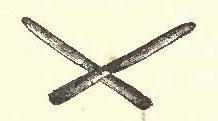
used by butchers. In detaching the meat from the blubber, or making "lippers" to clean the decks, they come in play. The mincing knife slices the horse pieces for the 
try-works. It is thought that the thinner the blub- 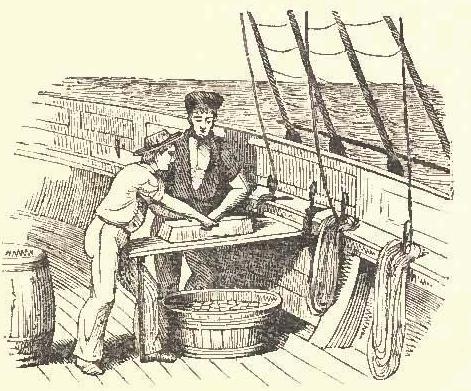
ber is sliced the more oil it will yield. Mincers consider themselves perfect in their branch of the busi- |
ness when they can make "Bible leaves." In connection with the mincing knife should be mentioned the "mincing horse," which is simply a board about three feet long and ten inches wide, fastened to the bulwarks, and supported by a leg; upon this "horse" the blubber is laid for the knife. A large tub in front of the mincer, and under the horse, receives the minced blubber. When this` tub is full, the minced pieces are thrown into another tub close by the try-works, from which they are thrown into the boilers with a large fork, which is represented in the following cut. The fork is also used to stir up the blubber in the 
try-pots; and when the pieces become sufficiently crisp, they are thrown into a large wooden vessel for fuel, by means of a copper strainer. The strainer which this cut represents, drains 
the oil from the crisped pieces, or "scraps," and sometimes serves as a cooking utensil for the sailors. The dipper is used to bail the oil out of the try- 
pots into the copper cooler by the side of the try- works. |
This cut represents the pike, a sharp, curved iron, 
to which is attached a long oak or hickory handle, used to pass the horse piece from the hold, and push the heavy pieces of "lean" overboard. The "drag" is a piece of board about fifteen 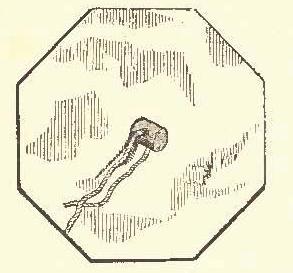
inches in diameter, of an octagonal form, with a block of wood passing through the center, to which a line is attached, and which is prevented from slipping through by shoulders on the other side. After the whale has been fastened to by the harpoon, the drug is thrown overboard, secured to the whale-line, so as to impede his progress and tire him down. I give a view of the "tub," merely for the purpose 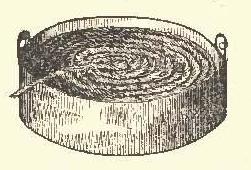
of showing the careful manner in which it is necessary to coil up the line. The slightest tangle or |
knot in a whale-line would endanger the lives of the whole boat's crew, from the great velocity with which it runs out. Great care is, therefore, observed in making each layer perfectly smooth, so that it may have a free run. These are the principal implements employed in the process of capturing, cutting in, and trying out the sperm whale. It is hardly necessary to go into dry details at greater length; for were I to undertake a description of every thing pertaining to whaling, there is no telling where it would end. I was much amused at the remarks of the "downeaster," suggested by the novel appearance of our first whale. I observed him, as he leaned over the monkey-rail, gazing steadfastly at the whale, while he muttered something to himself which I could not hear. "Well, Mack," said I, "what's your opinion of whales?" "Why, I was jest a thinkin' it's a considerable sort of a fish. They ain't got fish like that up the Kennebeck." "I guess not. still it is nothing like so large as the whale Jonah swallowed." "By gosh!" shouted Mack, laughing, "if his'n was bigger than that, I'll be darned if the flukes didn't tickle his throat, if he was as sea-sick as I was a spell ago." "Do you think whales are fish?" said I, rather balked in my attempt to quiz him. |
"Why, some folks says whales isn't fish at all. I rayther calculate they are, myself. Whales has fins, so has fish; whales has slick skins, so has fish; whales has tails, so has fish; whales ain't got scales on 'em, neither has catfish, nor eels, nor tadpoles, nor frogs, nor horse-leeches. I conclude, then, whales is fish. Every body had oughter call 'em so. Nine out of ten doos call 'em fish. If whales live on small fish, they'd drive a smashin' business up the Kennebeck. I never see none up thar'. If I was a whale, I'd try them diggins. There ain't better fodder for whales no whar'. This may be a good place, for all I know; but it looks dreadful blue and lonesome. I'd want to be in fresh water, if I was a whale; and then, if I wanted to season the vittles Natur' gave me, I'd pile the salt on rayther more moderate. I'd salt 'em to suit me. I don't like to be forced to eat salt vittles now, and I ain't a whale. Whales is cannibals. I've a bad opinion of 'em myself. I don't like the looks of 'em, no how. Gosh! what a jaw! I'd rayther let 'em be, and do business on a smaller scale. Folks that doos business on a small scale ain't so likely to git bu'st. Fishin's a fishin'. I like fishin' as well as any body; but catchin' of whales is a leetle too extensive. It's orfully alarmin' work. I don't want to be swallered jest yet; not in the whalin' line, I don't!" At daylight next morning all hands were called, and set to work upon the whale. A brief description of the process of procuring the oil may not be |
uninteresting. The blubber varies from four to ten inches in thickness. It is cut from the whale in layers about three feet wide, which run from the head to the flukes, in a spiral form. After the blubber and flukes are hoisted on board with a large tackle attached to a pendant in the main-top, the boat-steerers cut them in sizes sufficiently small to fit snugly in the blubber-room, an, apartment in the main hold. The try-works are then cleaned out, and got in readiness for boiling. Two or three hands are stationed in the blubber-room with short spades, whose duty it is to cut up the large pieces of blubber called blanket pieces into blocks or pieces about a foot and a half long and six inches wide. The blubber is then minced into thin slices, and cast into the boilers; a fire started, and the first batch of oil obtained: the crisped pieces of blubber are used for fuel. The hot oil is strained into a large copper cooler, where it is permitted to settle till the boilers are again ready to be emptied. It is then strained into casks, and kept on deck till quite cool, when it is stowed down in the casks in the hold by means of a hose. A "trying out" scene is the most stirring part of the whaling business, and certainly the most disagreeable. The try-works are usually situated between the fore-mast and the main hatch. In small vessels they contain two or three large pots, imbedded in brick. A few barrels of oil from the whale's case, or head, are bailed into the pots before com- |
mencing upon the blubber. Two men are standing by the mincing horse, one slicing up the blubber, and the other passing horse pieces from a tub, into which they are thrown by a third hand, who receives them from the hold. One of the boat-steerers stands in front of the lee pot, pitching the minced blubber into the pots with a fork. Another is stirring up the oil, and throwing the scraps into a wooden strainer. We will now imagine the works in full operation at night. Dense clouds of lurid smoke are curling up to the tops, shrouding the rigging from the view. The oil is hissing in the try-pots. Half a dozen of the crew are sitting on the windlass, their rough, 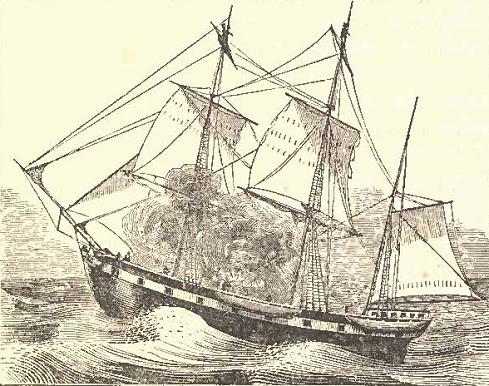
weather-beaten faces shining in the red glare of the fires, all clothed in greasy duck, and forming about |
as savage a looking group as ever was sketched by the pencil of Salvator Rosa. The cooper and one of the mates are raking up the fires with long bars of wood or iron. The decks, bulwarks, railing, try-works, and windlass are covered with oil and slime of black-skin, glistering with the red glare from the try-works. Slowly and doggedly the vessel is pitching her way through the rough seas, looking as if en- veloped in flames. "More horse pieces!" cries the mincer's attendant. "Horse pieces!" echoes the man in the waist. "Scraps!" growls a boat-steerer. By-and-by the captain comes up from the cabin to see how things are progressing. He peeps into the pots, and observes, in a discontented tone, "Why don't you keep that 'ere oil stirred? It's all getting black." Then he takes a look into the mincer's tub: "That won't do! Make Bible leaves of 'em." Then he looks at the men on the windlass: "Hey! all idle? Give these fellows something to do. We can't have idlers about now." Having delivered himself of these sentiments, he goes back to his snug nest in the cabin. The idlers resume their places, and entertain themselves spinning yarns, singing songs, &c., and calculating the time by the moon. About the middle of the watch they get up the bread kid, and, after dipping a few biscuit in salt water, heave them into a strainer, and boil them in the oil. It is difficult to form any idea |
of the luxury of this delicious mode of cooking on a long night-watch. Sometimes, when on friendly terms with the steward, they make fritters of the brains of the whale mixed with flour, and cook them in the oil. These are considered a most sumptuous delicacy. Certain portions of the whale's flesh are also eaten with relish, though, to my thinking, not a very great luxury, being coarse and strong. Mixed with potatoes, however, like "porpoise balls," they answer very well for variety. A good appetite makes almost any kind of food palatable. I have eaten whale-flesh at sea with as much relish as I ever ate roast-beef ashore. A trying-out scene has something peculiarly wild and savage in it; a kind of indescribable uncouthness, which renders it difficult to describe with any thing like accuracy. There is a murderous appearance about the blood-stained decks, and the huge masses of flesh and blubber lying here and there, and a ferocity in the looks of the men, heightened by the red, fierce glare of the fires, which inspire in the mind of the novice feelings of mingled disgust and awe. But one soon becomes accustomed to such scenes, and regards them with the indifference of a veteran in the field of battle. I know of nothing to which this part of the whaling business can be more appropriately compared than to Dante's pictures of the infernal regions. It requires but little stretch of the imagination to suppose the smoke, the hissing boilers, the savage-looking crew, and the waves of flame that |
burst now and then from the flues of the furnace, part of the paraphernalia of a scene in the lower regions. Our "down-easter," who always had something characteristic to say of every thing that fell under his observation, very sagely remarked on one occasion, when nearly suffocated with smoke, that "if this warn't h–l on a small scale, he didn't know what to call it." Of the unpleasant effects of the smoke I scarcely know how any idea can be formed, unless the curious inquirer choose to hold his nose over the smoking wick of a sperm oil lamp, and fancy the disagreeable experiment magnified a hundred thousand fold. Such is the romance of life in the whale fishery. I have thus endeavored to describe a trying-out scene; and I hope, with the aid of a drawing taken on the spot, my hasty sketch will not be altogether unintelligible. We saw, during our cruise on the western ground, great numbers of black-fish, grampus, porpoises, and jumpers; and caught in abundance dolphins, albacore, bonitos, and skip-jacks, which are all dry, and not to be compared with bay-fish. September 5th. – Killed a black-fish, which yielded three barrels of oil. September 10th. – At sunrise this morning the man at the mast-head saluted us with the cry of "Land ho!" All hands were on deck in an instant. The land proved to be the Peak of Pico, one of the Azores, or Western Islands, distant sixty miles. |
During the day it became more distinct, and toward evening could be seen from the deck, bearing west-northwest. Pico, at this distance, has much the appearance of Teneriffe. The naked eye could scarcely distinguish the peak from the clouds on the horizon at so great a distance; but I was told that Pico could be seen, on a clear day, at the distance of a hundred and twenty miles. It resembles, when first in sight, a dark blue cloud, the top of which is distinctly marked, while the base is lost in clouds of a lighter cast, mingling with the haze on the horizon. Fayal, another of the Azores, lying to the northward of Pico, within about seven miles, was not visible at so great a distance. On Sunday, 11th of September, we made the island of Terceira, the largest of the Azores. The wind being light, we did not approach near enough to see the houses and farms until next day, when we ran under the lee coast to avoid an impending gale. Terceira is a remarkably picturesque island, beautifully laid out in farms, which, at this season of the year, have a rich golden hue that bespeaks abundant crops. The coast is broken and rugged, and in many places so steep as to preclude the possibility of ascent. Part of the island seems to have been ingulfed by an earthquake, which accounts for the rugged appearance of the coast. It is visited at certain seasons of the year by heavy gales and rains, especially in October and November, when there is |
frequently danger in approaching it. While we lay off and on, awaiting a suitable opportunity of running in, we had hard, shifting winds, and it rained almost incessantly. Mount Brazil, and other elevated portions of the island, were covered most of the time with white, misty clouds. September 13th. – At eight P.M. the waist-boat was lowered. As I belonged to this boat, I was permitted to go ashore. We had a hard pull of about six miles before we made the beach. After running along for a mile or two in search of a good landing, we entered a small cove, forming a safe harbor for boats, where we found an excellent landing among the fish-boats belonging to that portion of the inhabitants who follow fishing as well as farming for a livelihood. In less than an hour, the governor and a large posse of ragged officers came down, loaded with baskets of potatoes, onions, and fruit. We had provided ourselves with a barrel of black-fish oil for purposes of traffic, that being a commodity greatly in demand on these islands. A circle was immediately formed around our captain, who, with two Portuguese interpreters, dealt out the oil at the rate of a quart for a bushel of fine potatoes or a large bunch of onions. It took us at this rate but a very short time to fill the boat, the inhabitants supplying us much more rapidly than the oil could be measured out. The scene was one of great novelty and interest to me. I had charge of the boat, so that I could |
look on at my leisure. A fleet of storm-beaten fish- boats, with crews of sunburned fishermen, lay in the cove at anchor. Other boats were constantly coming in from the offing or going out; and several crazy vessels of a larger size were drawn up on the rocks, apparently basking in the sun for want of something better to do. The shore at this place is very rugged and rocky, running up abruptly about a hundred yards, where it is joined by the base of a large bank of sand and rock, interspersed with cane and briers. A pathway leads up through the defiles between the rocks to the foot of this bank, winding thence circuitously to the summit, which is half a mile from the water. Close by the boat-landing there is a large cavern, in which the fishermen take shelter from the inclement weather so prevalent on the shores. The inhabi- tants residing in the neighborhood procure water from a small spring gushing from the rocks immediately under the brow of this cave. Altogether it forms one of the most useful and romantic features in the scene. Before our boat had left the shore, news of its arrival had spread all over the island, and crowds of the peasantry, of both sexes and of every age, came flocking down, laden with baskets of fruit, potatoes, onions, melons, and other refreshments calculated to tempt the crew of a whaler. The dress of the females, though of coarse material, struck me as being rather picturesque. A white |
handkerchief tastefully arranged on the head, a loose spenser of blue cotton extending to the waist, and a short frock with a fringe of blue or pink, and a pair of light shoes, form the simple costume of most of these "ladies." Those between fifteen and eighteen years are very pretty and well-formed; and, indeed, I saw many whose jet-black hair, bright eyes, and rich complexion would be regarded as beautiful by connoisseurs fond of the brunet style. Few of the older females are even passable. The rarest specimens of hags and leather-skinned witches are to be found among the ancient dames of the island, who, with an activity undiminished by age, skip about from rock to rock shrieking at the juveniles. The different classes of males can not be distinguished by any fixed style of dress, most of them wearing such ragged apparel as can be purchased from the crews of whalers. In this particular each individual seemed to consult his own taste, rather than follow any particular fashion. Round jackets, loose frocks, small cloth caps, all covered with patches of a hundred different colors, are the articles in most general use. The men and boys usually carry long poles or staffs to assist them in climbing the rocky parts of the shore. About noon we returned to the vessel for a farther supply of oil, having bartered all we had carried ashore for a boat-load of refreshments. On our return to the island, great numbers of new-comers stood on the rocks awaiting our approach. Some of the governor's officers from Angra had also come |
down to prevent the importation of tobacco without the usual exorbitant duty. Notwithstanding their vigilance, however, I was beckoned aside by two or three young islanders, who had baskets of apples and figs for barter. Their eagerness to be understood, and my gesticulations to assure them that the vociferous rapidity with which they spoke Portuguese did not make it a jot more intelligible to me, were very amusing. After a variety of attempts to make them- selves intelligible, one of them cried out, pointing to his basket of figs, "Present me tobac, I present you fig." "I have no tobacco." "Yes, tobac here," feeling my pockets. "No, there is no tobacco there." "What! you no got tobac chew?" "No." "No tobac smoke?" "No." "Tobac chew, smoke, snuff, no got?" I assured him that I had none of any kind; but, still doubtful, he endeavored to insinuate his hand into my pocket. This liberty I rather unceremoniously repulsed. Not at all displeased, he continued to petition me for "tobac." Finding me unable or unwilling to accommodate him, he began to persecute me for a knife. "Present me knife, signor?" "I have no knife to trade." "Present you fig, present you apple, me." |
"I can't trade today. To-morrow I'll buy your figs." "Suppose you show me knife?" "No knife to sell." "Ah, me feel!" putting his hands on my pocket. As he still remained unsatisfied, I handed him a jack-knife to look at. "star bon!" said he, eagerly grasping the treasure, and thrusting it into his pocket; "bon! bon! star bon knife!" The knife belonged to one of my shipmates, and I was unwilling to lose it. "No bon for you!" said I, catching him by the collar. "Oh, yes, bon for me." "Oh, no bon for you. Hand it out, my friend, or I'll show you a Kentucky trick. Do you know any thing about gouging here?" "Me like knife much!" shouted the rogue; laughing. Finding me resolute, however, he very unwillingly complied with my demand. By this time about fifty ragged urchins, a few superannuated beldames, and a number of shaggy-faced fishermen had gathered around me, vociferating loudly for "tobac." They were thrusting toward me all kinds of fruits produced on the island, eagerly demanding in return "tobac chew! tobac smoke! knife!" which are the only articles of trade they seem to stand in need of. The boys went so far as to tempt me with large pieces of greasy and half-nibbled corn bread, shriek- |
ing, like a gang of young devils, "Tobac smoke! tobac! tobac!" Captain A–– and a Portuguese interpreter, assisted by the second mate, were mean time busily engaged dealing out black-fish oil to the islanders for onions and potatoes, under the superintendence of the governor, who stood by to see fair play on both sides. The boat, as soon as it was laden, was once more manned, and, with no very favorable impression respecting the character of the natives, I left for the vessel. Next day the waist-boat was again lowered. This time I provided myself with knives and tobacco, in order to secure a supply of fruit and other luxuries preparatory to our long cruise. The captain, on landing, finding that the islanders were not ready with their recruits, gave us an hour's liberty. This was the only opportunity I had of seeing the interior of the island. After some hard climbing, I ascended the precipitous bank of rock and sand to which allusion has been made. Following close in the wake of two Portuguese belonging to the barque, I soon found myself on a road which runs circuitously round the island. At the junction of the road and the pathway leading from the boat-landing stands a little stone chapel, surmounted by a cross. A stair-way of rough stone leads from the chapel down to the road, at which point are stationed two sentinels. The first object of interest that struck my eye on |
entering the road was a singular vehicle, in which sat a lady of rank, as I learned from the sailors. It was a rough cart, with wooden wheels, constructed of solid block, and was driven by two men, one at each side of a yoke of oxen. The aristocratic belle held a blue cotton umbrella over her head, and sat quite contentedly on a bundle of straw, leaning back with as much dignity as if she were a duchess in the most magnificent carriage. A dark little urchin, ten or twelve years of age, protected ,her from the flies with a green branch. Her dress was of blue, fringed with some sort of red material. On her head she wore a handkerchief of snowy whiteness, as is customary with the females of all ranks on the island of Terceira. Her long, black hair fell over her shoulders with a graceful and coquetish wave. The drivers stopped, in order to satisfy the curiosity of their fair charge; and as the desire to see was mutual, and, on her part, natural, the fair damsel stared at me and I at her, till, stared out of countenance, I pursued my journey up the road, leaving her to make such comments on my appearance as she thought proper. My Portuguese cicerones were some distance ahead of me. I had a long run before I caught up with them. Wishing to purchase some apples, I inquired of Manuel, a cross-grained fellow, the name of apples in his language. "Calabooca loco!" said he, making use of an exclamation of contempt, which I mistook for the desired information, but which I |
afterward learned meant "Hold your tongue, you fool." a remark very common among these people. Ignorant of my mistake, I walked on, repeating the words over, till I came to a cottage, at the door of which stood an elderly woman of respectable appearance. Peeping over her shoulders were three or four girls, endeavoring to get a look at the stranger. "Com estha, signora," said I, mustering up all my Portuguese. "Have you any calabooca loco?" "Qui?" cried the woman, staring at me. "Calabooca loco!" shouted I, hoping to make myself understood by the loudness of my voice and my very marked emphasis. Much to my astonishment, the girls ran back from the door, laughing in the most unaccountable manner. Presuming they had misunderstood me, from some defect in the pronunciation, I clearly and distinctly repeated the words. At this there was a renewed burst of laughter from the girls, and a furious tirade, no doubt made up of all the slang in the Portuguese vocabulary, from the worthy mistress of the cottage. "Confound it!" said I, impatient at not making my Portuguese intelligible, "you don't understand your own language. Calabooca loco! Don't you know what that is, signora?" pointing to my mouth. Upon this she stepped back into the cottage, and presently reappeared with a large slice of bread. I was glad enough to get a piece of "soft Tommy," so I did not complain of the mistake. As she was going away she said something in Portuguese, which, |
of course, I did not understand. However, I mechanically repeated the words, "Calabooca loco!" hoping she might accidentally guess my meaning. "Santa Maria!" shrieked the woman, shaking her doubled fist at me, amid the roars of laughter from the group behind her; " caiso? caiso?" and uttering a complicated anathema, she shut the door in my face. All this time my comrades were standing up the road at a short distance, holding their sides with laughter. We passed several neat cottages about a mile inland, at which point the mountains commence. There is a gradual slope thence for about two miles up the sides of the mountains, where the ascent becomes abrupt, and the land too barren and rocky for cultivation. Pursuing our way along the road half a mile farther, we arrived at the door of a cottage on the summit of a pleasant hill, affording a beautiful and extensive prospect. Immediately in the rear is Mount Brazil, which ascends gradually till the summit is hidden from the eye in ranges of clouds. On either side the country is undulating and picturesque. Cottages peeping out from clusters of grape-vines, fig-trees, vineyards, corn-fields, and green meadows, form some of the pleasing features in the scene. A large ravine, extending to the coast, affords a fine view of the ocean, which even in calm weather dashes in upon the rocks, and shoots up the spray in misty clouds. The little fish-boats belonging to the |
islanders may be seen constantly dashing about among the rocks, guided by the daring fishermen. I was aroused from the reflections inspired by this romantic scene, before I had entered into the full enjoyment of its beauties, by the voices of half a dozen of the cottagers, vociferating "Tobac! tobac, signor!" The patriarch of the flock, a venerable padre, with long, sleek hair, kindly invited me in, and offered me a chair at a table upon which was spread a light repast. As the invitation was made with eager gesticulations, apparently springing from the most hospitable motives, I did not decline it. The sight of vegetables, and fresh bread, however coarse, was peculiarly tempting to one who had been two months whetting his appetite on salt junk. The old lady of the house brought forth sundry additional rarities from her larder, while a boy was dispatched for wine. To all of these I need scarcely say I did ample justice. My hour's liberty was by this time pretty well extended. I presented each of my entertainers with a plug of "tobac," and left the cottage. Before I had proceeded more than a dozen yards, the whole family came running after me, hallooing and gesticulating in a most unintelligible manner. "More tobac! more tobac! no bon! damn tief!" were the only words I could understand. The Portuguese sailors informed me that I had not paid for my dinner. This, thought I, is hospitality of a new description! I gave them all the tobacco I had, and, satisfied that I had well remunerated them, |
I hurried on, amid renewed cries of "More tobac! no bon! damn tief!" Late in the afternoon, having obtained a good supply of fruit and vegetables, we started for the barque, which lay becalmed about three miles off A slow current setting in upon the rocks compelled us, soon after stowing away our load, to take to the boats and tow. There was not a breath of air to fill the sails. By sundown the vessel had drifted within a few cables' lengths of the rocks, and would inevitably have struck, in defiance of our efforts, had not a light breeze sprung up, and afforded us its assistance. In half an hour more we were bearing away under all sail. CHAPTER VII.
In a journal of this kind, containing miscellaneous gatherings of every description, I can not well omit a sketch of what, in nautical phraseology, is termed "a gam." When two whalers meet on any of the whaling grounds, it is usual to have "a gam," or mutual visit, for the purpose of interchanging the latest news, comparing reckoning, discussing the prospect of whales, and enjoying a general chit-chat. |
While our barque lay off Terceira, we one evening spoke a brother whaler. About four o'clock, when the decks were cleared up, the waist-boat was lowered, and we went on board with the captain. A crew from the stranger returned to the barque with our boat. After supper we had a social smoke. The musician of the ship was then called upon for a song. Seating himself comfortably on the fore-hatches, he cleared his throat, and gave us to understand, by way of a prelude, that he was a very indifferent singer. "He used to know some bang-up songs, but, some how, he had forgotten them all." This, of course, only served to whet our curiosity, and draw forth renewed calls for a song. "Tom was a first-rate singer. Every body knew Tom could sing. It was no use to deny it; Tom must sing!" Pressed on all sides, Tom stuck his pipe in the galley, and scratched his head to rub up the musical organs. He then assured us that he once knew a great many songs. "Come, Tom!" cried a chorus of voices, "give us 'Captain Bunker." "Well, if I must; I must; here goes for 'Captain Bunker.'" Tom then gave us the following whaling ditty. As it is a good specimen of sea-spun poetry, I give it without alteration: "CAPTAIN BUNKER.
"Our captain stood upon the deck, |
Get your tubs in your boats, my boys, "'Overhaul, overhaul! 'Our first mate he struck, Great applause was awarded Tom for the creditable manner in which he had acquitted himself. But singing was not altogether Tom's forte. According to the representations of his shipmates, he was "death on the fiddle!" The unanimous requests of the party were not to be resisted. The fiddler was compelled to play; and, while the two high functionaries aft were discussing matters of grave and momentous import, we entertained ourselves dancing "shindys" to the lively notes of Tom's fiddle. Those who could strike their heels together in the best time, go |
the double-shuffle with the greatest activity, and tire down their comrades, were of course the best dancers. We next had the game of thimble, and enjoyed some rare sport when it came to the part in which the pawns were disposed of. A master of the ceremonies, provided with a piece of ratlin, was stationed at the windlass. For every pawn, the unlucky wight who claimed it was compelled to receive a sharp cut on that part politely denominated the "seat of honor." These lively amusements lasted till after dark, when we began to experience a desire for something more sober. Among the crew of the stranger, I noticed an intelligent-looking, middle-aged man, of rather a serious cast of countenance. When our mirth had somewhat subsided, it was suggested that we should have a "yarn." All eyes were immediately turned toward the man whose appearance had attracted my attention. "Now you're in for it, Ned;" "That's a fine fellow, Ned;" "Nobody can spin a yarn like Ned Harrison;" Come, shipmate, give us something about ghosts!" were the eager remarks on all sides. Ned replied to the appeal by modestly stating that he had spun all his yarns but one, and that was a mere matter-of-fact history of an old shipmate, which he didn't think would interest any body. "Never mind; let's have it," cried all in a breath; "I'll warrant you it's a first-rate yarn; Ned never spun a bad yarn yet." |
"Why," said Ned, "as to that, I've always done my best to amuse you; and if you feel disposed to listen to an account of my first voyage to sea, and the murder of a poor fellow –" "Oh, go ahead! any thing about murder. Let's have it. Come, Ned, that's a good fellow!" "As I was going to say," continued Ned, "I wouldn't mind boring you for half an hour or so; but, for my part, I'd rather hear a good song." "No, no! the yarn! the yarn about that murder! Well, how did it happen?" "If I must tell it, I suppose there's no getting out of it," said Ned, with the air of a martyr; "but I want you to understand it's no common ghost story." "To be sure; we know that. All right! Go ahead!" Ned then seated himself on the hatch by the cook's galley, and, surrounded by an attentive audience, gave us
"BOB GRIMSLEY'S GHOST.
"I am about to spin you a tough yarn; rather hard to believe, but true for all that. The good old times when ghosts didn't care a sou-markee when or how they appeared, are gone, and I'm sorry for it. I have a natural fondness for ghosts; I was raised with them, and feel as if they were my best companions. Somehow, whenever a ghost appears nowadays, there's a reason for it. In old times people didn't want a reason for their appearance; it was |
enough that they paid their visits and went away like regular, well-behaved ghosts as they were. "My first voyage to sea was in a Cape Horn whaler. I was then about eighteen years of age, full of fun and frolic, fond of yarns, and a devout believ- er in supernatural appearances. "There were only three aboard the ship who require any special notice. The rest were just the sort of officers and men usually found in whalers. One of those to whom I allude was Mr. Rockford, the mate. "Though severe and exacting in his discipline, this officer was not disliked by the crew, for he was attentive to their comfort, and as good a whaleman as ever walked the planks of a Cape Horner. I can never forget this man's looks. There was something peculiar about him, which kept us all at a civil distance. He was a tall, spare-made man, about thirty years of age, and of a sallow complexion. His features were strongly marked, indicating great determination of character. There was nothing repulsive in the expression of his countenance, though, as an index to his character, it bespoke a man of strong passions. It was his eye, however, that distinguished him from all men I had ever seen. Of a piercing gray, stern, calm, melancholy, it'penetrated the inmost recesses of one's heart, and whoever felt its influence once was glad enough to avoid it forever after. "Mr. Rockford was a man of few words. He |
kept aloof from every body, so far as his duty permitted him, and was never known to join in a joke, or exhibit any levity in his intercourse with the other officers. As a natural consequence, he was left to the enjoyment of his moody thoughts. No one spoke to him or associated with him, except on matters of ship-duty; not, as I have already stated, from any dislike to him, but from the coldness of his manners, and his apparent desire to be left alone. "I come now to my shipmate, Bob Grimsley, quite a different man from Mr. Rockford. If I mention him with partiality, it is because he was a brave, generous, and manly fellow; one who had often proved himself my best friend, and whose melancholy fate revives old feelings. A better sailor never put his weight on a brace. Active and energetic, he was esteemed the very best man, in any sudden emergency, on board the ship. Jovial in his dispo- sition, free, cheerful, and intelligent, he was the life and soul of the whole crew. But there was one man who hated him from the bottom of his heart – whose enmity toward him seemed insatiable; that man was Mr. Rockford. Grimsley was aware of this; he well knew the cause. They had lived in the same town, and were rival suitors for the hand of a fair girl, to whom both were passionately attached. Accident had thrown them together on this voyage. Grimsley had no cause to return the hatred of the mate, for he was the favored lover, and on the eve of his departure had received assurances |
of a reciprocal regard from the object of his attachment. "The mate treated him with marked fairness, never taking advantage of his authority to gratify his animosity. still it was evident he regarded him with the most deadly hatred. "We were cruising off the Fejee Islands. The weather had been for some days rough and squally. As was customary in such cases, the mate headed the larboard watch. We had not been successful during the whole cruise. At the period I speak of, Mr. Rockford was more strict and stern than ever. Something appeared to weigh heavily upon his mind, the nature of which none of us could fathom. In our watch, there were, besides Grimsley and myself, four green hands, and a Spaniard who had shipped as an able seaman. We all agreed pretty well except the Spaniard, who was morose and sullen, and seldom spoke to any body. This man seemed to be the special favorite of the mate. It was impossible to conjecture the precise character of the fellowship which existed between them, for they never talked to each other within hearing of others; but on many occasions we saw them, in the dead of night, engaged in low and earnest conversation, when they thought the watch asleep. Otherwise they held no communication calculated to excite suspicion. Their looks – and looks are enough in such a little world as a ship, where the least thing that can not be accounted for has a mys- |
tery connected with it – were not such as commonly pass between an officer and one of the crew. What this mystery tended to, or what the nature of their secret understanding was, puzzled us to divine. "One night, the darkest and gloomiest we had had for a week, I lay in my bunk, in an uneasy sleep. I had worked too hard that day, and rested badly. Perhaps it was owing to this that I was troubled with horrible dreams. Gradually they became centered in one, and this had a startling reality about it that I shall never forget. "I saw in my dream a crowd. The figures were dark and shadowy. They proceeded, with a measured, noiseless tread, toward a church. I followed the sable procession, and, when we entered the church, I was shocked to find it hung with mourning dripping with blood. Dressed in black, Grimsley stood at the altar, supporting his bride, a young woman with a pale face and weeping eyes. There were ghostly figures moving to and fro with haggard looks. A horrid gloom pervaded the whole scene. When the ceremony was over, Grimsley turned toward me; his face was that of a corpse! With a cry of horror, I awoke. "Had I been, as I am now, a fatalist, I might have known how useless it was to speak to Grimsley. However, I then thought he could be saved, and I conjured him not to go on deck that night. He scoffed at my fears, and ridiculed my superstition. still I begged, I implored him to send some excuse to the mate. To that he would not listen. |
"We had middle watch on deck. Grimsley had the first trick at the helm. I relieved him in two hours, and conjured him, as he left me, to be careful, for my dream boded him no good. He again chided me for my fears, and went forward, laughing at the solemnity of my manner. "I had not been long at the helm, when a heavy squall came on. The green hands were sent aloft to take in the light sail, and Grimsley and the Spaniard went out to furl the jib. Mr. Rockford was on the forecastle, giving orders. The roaring of the wind smothered their voices. Whenever it lulled for a moment, I thought I could hear the mate shouting to the men out on the jibhoom. At length a wild cry was borne aft on the squall. My blood ran cold with horror. It was Grimsley's voice. In doubt as to what had happened, I waited a few moments in dreadful suspense. The startling words resounded from the foretop, which one of the green hands had just reached on his way down, 'A man overboard!' The mate came running aft, with a wildness in his looks that thrilled through me. "'Hard down your wheel!' he roared; 'down! down with the wheel, quick! Haul aback the main yard! Call all hands!' The crew came rushing up from the forecastle, half naked and horror-stricken. In another moment the captain was on deck, calling upon the crew to man the boats. He then addressed a few words to them, desiring them to be calm and determined. The boats were lowered, |
and manned by the brave and generous shipmates of the unfortunate Grimsley. After a long and anxious search, in momentary danger of their lives, they were reluctantly compelled to give up all hope of finding the body. We lay aback all night. Next morning the search was renewed, but finding it useless to delay any longer, we again made sail. "There was a deep gloom throughout the ship. Poor Grimsley was gone! He was no more among us to cheer us in the hour of trial, and entertain us in the hour of enjoyment. I need not dwell upon our grief. It is only at sea that the death of a comrade can be felt with all its poignancy; and that you must know, even if you have never experienced it; for you may readily imagine what it is to lose your best friend, when his place can not be supplied. "The Spaniard said that Grimsley had fallen from the foot-rope while furling the jib. Mr. Rockford corroborated his statement, and nothing farther was said on the subject. still I had a suspicion that there had been foul play. Knowing, if I disclosed it, justice would in all probability be defeated, I kept it to myself, resolved to watch both the mate and the Spaniard. "In Mr. Rockford I soon observed a change. His sallow complexion became more ghastly than ever; his form wasted away from day. to day; his step became hasty and uncertain; his eye restless and haggard. There was a settled gloom upon his features that increased their sternness. In walking the quar- |
ter-deck he frequently stopped, cast his eyes down, and muttered incoherent words to himself; then, as if fearful that he had been observed, he would start and look anxiously around him. Toward the other officers he was more reserved than ever. He never spoke, except in the discharge of his duty, and then the tones of his voice were deep and stern. It was observed by the crew that, in the weary night-watches, he would often stand gazing toward the horizon without moving. From the night of the fatal event he was never known to smile. "There was little alteration in the conduct of the Spaniard. At the best of times he was a dogged, discontented man; and these disagreeable traits in his character were now more apparent than ever. When below, at night, he would frequently jump up before the watch was called, and go on deck, uttering imprecations upon his hard fate. With these exceptions, scarcely any change had taken place in his conduct. "Nearly a month after the loss of Grimsley, I was sitting between the man-ropes keeping a look-out. It was a fine moonlight night. The starboard watch was below. All who were on deck, except myself and Mr. Rockford, were asleep under the bulwarks, ready for a call. This was not generally allowed; but the mate, who was pacing the quarter-deck in moody silence, did not appear to notice it. I was reflecting upon the fate of poor Grimsley, and thinking over the suspicious circumstances connected with |
it, when I saw the figure of a man, in a dark winding-sheet, slowly steal up from the forecastle. His tread was noiseless and stealthy. A cold tremor ran through my blood. I could see him stride aft like a dim shadow toward the weather side of the quarter-deck, where the mate stood. The dreadful thought flashed upon me that it was the spirit of my deceased comrade. Faint with horror, and possessed by an unaccountable desire to see the face of the ghostly figure, I followed it aft. When I reached the quarter-deck, a sight more fearful than the dead itself met my view. The man at the helm was clinging to the wheel, haggard with fright. Mr. Rockford stood with his face toward the taffrail, motionless, as if transfixed to the spot. His eyes were strained till they seemed bursting from their sockets; his cheeks were livid and bloodless; his teeth firmly set. The cold, pale rays of the moon glanced upon his features, increasing their ghastliness. It was a spectacle of appalling wildness. I felt the blood freeze in my veins as I gazed upon him: so great was my horror, that I clung to a rope to support myself. Gaunt, stiff; speechless, he stood before me. "'See, see! it moves!" he suddenly exclaimed. 'There! See it! Oh, my God!' And, with a deep groan, be staggered back against the bulwarks. "I immediately ran to his assistance. He was cold and inanimate. I awoke the men on deck, and we carried him below. The captain, by chafing his temples, brought him to his senses. That night he |
remained in the cabin without uttering a word. No explanation of what he had seen could be obtained from him. The man at the wheel stated that a figure in a loose dark robe had brushed past him, but he was so frightened he could not recollect its height, or the direction in which it went. "In a few days Mr. Rockford was again on duty. There was a frightful change in his appearance. He walked the decks a living skeleton. His eyes were sunken, though they still retained their unearthly, melancholy expression. More silent, more thoughtful than ever, he now seemed to care very little about the affairs of the ship. For hours he would stand leaning against the bulwarks buried in revery. No one chose to disturb him; few even spoke to him. The care of the ship devolved principally on the captain, who vainly endeavored to prevail on Mr. Rockford to go below. "Nothing occurred to change this state of things for several days. The mate continued under the same fearful depression of mind. An unnatural gloom hung over the whole ship's crew. "One evening the second mate got into an altercation with a fore-mast hand named Watkins, who was considered a good boxer. The officer attempted to rope's-end him. Watkins knocked him down. This was too heinous an offense to be passed over. The offender was handcuffed, and confined in the run. "In the middle of the night the captain, and all |
who slept in the cabin, were startled by a loud hammering under the cabin-deck. These noises were followed by groans, and then the half-smothered voice of Watkins, who had his mouth to the run-hatch, was heard crying, 'Take me out of this hole; for God's sake, take me out before I'm murdered!' "The hatch was lifted off, and Watkins, though no coward, crept out, shaking as if he had an ague. "What's the matter?' demanded the captain, angrily. "'Oh, sir, don't put me in the run again. I'll be murdered if you do. I saw him – saw something horrible!' "'What did you see?' cried the captain, turning pale. "'A dead man!' replied Watkins, and his teeth chattered with fear. "'Fetch a light here,' said the captain, in a voice of deep solemnity. "The light was handed to him, and, accompanied by the steward, be descended into the run. After a thorough search, without seeing any thing of the apparition, he came up, cursing the cowardly fears of Watkins. Mean time, while all this was going on, Mr. Rockford stood leaning against the ladder, awaiting the result of the search with haggard looks. "'Mr. Rockford,' said the captain, 'go down there, and try if you can see what this fool is raving about.' "' I'd rather not, sir,' replied the mate, with a shudder. |
"'What! are you afraid too?' "'No,' replied the mate, gloomily, 'I'm not afraid; but I have a horror of that place;' and his agitation increased. A cold perspiration stood upon his forehead. "'Mr. Rockford,' said the captain, sternly, 'will you set such an example of cowardice to the crew?' "The mate made no reply, but seemed buried in thought. At length he determined to go down into the run alone. He took the light in his hand, and, forbidding any one to follow him, descended. Half an hour elapsed. The captain grew impatient. Three quarters of an hour passed, and the smothered sounds of voices and blows, as if two men were engaged in a desperate struggle, issued from the hatchway. The light was suddenly blown out, there was a heavy fall, a groan, and all was silent! "'A light! another light!' cried the captain, trembling with horror; 'quick! Good God! what's the matter? Mr. Rockford, speak! answer!' "'He's dead! he's killed, sir!' exclaimed Watkins, who had been peering down through the hatchway. "Another light was quickly produced, and the captain, followed by several of the affrighted men, who were afraid to remain alone in the cabin, descended into the run. The feeble rays of the lamp fell upon an object that struck the boldest aghast. "Mr. Rockford, stretched on his back, his hands convulsively clinched, his features horribly distorted, |
lay bleeding in the bottom of the run. There was a fearful gash across his forehead, from which the blood streamed down, disfiguring his face and dyeing his clothes. Upon attempting to remove him, he fell into a phrensy, shrieking. "'Take him away! take him away! He wants to kill me. Save me! save me!' "As soon as this dreadful paroxysm was over he was carried up and placed in his berth. In the course of the night he recovered his senses, but seemed to have lost the faculty of speech. "For upward of a week he was confined to the cabin, nor could he be prevailed upon by entreaties or by threats to utter a single word in relation to what he had seen, or by whom the wound in his forehead had been inflicted. "I now thought it time to disclose what I knew of Grimsley's death. The utmost surprise was manifested throughout the ship. So great was the indignation of the crew, that it required the severest exercise of the captain's authority to restrain them from taking summary vengeance on the supposed murderers of their comrade. "On the strength of my evidence the Spaniard was arrested and put in irons. Mr. Rockford was left at liberty in the cabin, but peremptorily forbidden to go on deck. Watkins was released, with a severe reprimand to behave himself better in future. "We continued our. cruise without any thing farther occurring for nearly a month. The events |
which had created such commotion among us had almost ceased to be topics of conversation, and we began to look forward to the end of our cruise and the comforts of home. This state of tranquillity was suddenly interrupted by the disappearance of the mate. In a fit of insanity he had noiselessly let himself down from one of the cabin ports by a rope. Several hours elapsed before he was missed. A search was made, and all that was discovered was the rope as he had left it. "On the same night the Spaniard, who was confined in the run, awoke the captain and officers by his groans. He was taken out in a pitiable condition. Reduced to a skeleton by confinement and an evil conscience, his face was now blanched with fear, and his eyes sunken and restless. When asked what had occurred, he replied, that, in turning over in his sleep, he had touched something cold, which he took to be the head of a corpse, clammy with blood. His groans brought the officers to his relief. "It was not long before this new alarm was circulated throughout the ship. Every one believed she was haunted by the ghost of poor Grimsley. The crew, driven to madness by the horrible sights which had been witnessed, assembled in a body, and refused to do duty until a thorough search should be made. "All the next day we were engaged in breaking out the casks and ship's stores from the fore-peak to the run. The strictest search was made. In the run we discovered a few blood stains, and the marks |
of a bloody hand all along the lower tier of casks from the run to the forecastle. "You may be sure these mysterious marks did not quiet our fears. Men were afraid to be alone for a single moment. There was nothin talked of but the mysterious visits of Grimsley, and the blood stains, with narrations of deeds committed on the lonely deep in the dead of night. The darkest tragedies possessed a peculiar interest now. The more fearful they were the better they suited the excited listeners, who in groups around the forecastle passed away the long night-watches dwelling upon deeds of blood. By keeping together in this way, and occupying our minds with marvelous tales of the tragic and the supernatural, we contrived, in some measure, to quiet each other's fears. "While things were in this state the Spaniard was taken ill of a fever. Apprehensive that he was about to die, he made a confession of his crimes. His narrative was brief, but thrilling. "He had commenced his career of villany in a Portuguese slaver at Mozambique. The vessel and her living cargo were taken by a man-of-war on the coast of Brazil, and among others punished for their part in the illegal traffic, he was sentenced to serve seven years in one of the government frigates. In a few months after he made his escape, and joined a Spanish pirate. For three years he served in her, among the West India Islands, and joined in the most atrocious deeds of bloodshed and rapine. He |
eventually robbed the captain, and made his escape, in an American whaler, to the Spanish Main. Here he gambled away his ill-gotten gains. Reduced to the last extremity, he worked his passage to the United States in a merchantman. still apprehensive of arrest, he shipped in the whaler in which he now narrated his crimes. "Soon after she left port he was sounded by the mate, Mr. Rockford, who, finding him willing to commit any crime, however foul, entered into a compact with him to murder Grimsley, promising him a suitable reward. An opportunity occurred on the night of the squall. Grimsley was out on the foot-rope with him, furling the jib. The Spaniard stabbed his victim in the back, and the subsequent cry of 'a man overboard' was the result. Had the body of the murdered man been found, the perpetrator of the deed could have been discovered at once. "Fearing, from the change in the conduct of the mate, that he was about to confess the crime, and thus expose him, the Spaniard determined to murder him also. In pursuance of this design, he one night disguised himself in a Spanish cloak which he had in his chest, and while he thought the crew all asleep, walked aft. As he was about to accomplish his purpose, he became alarmed lest the man at the helm should recognize him, and rushing past both the officer and the affrighted man, concealed himself in the stern-boat. During the confusion that followed he regained the forecastle unobserved, hid |
his cloak, and appeared among the crew. The subsequent occurrences in the run were occasioned by a plan which he had devised to frighten the captain and crew, in the hope of making them abandon the vessel, or put into port at some, neighboring island. He had effected an entrance trough the bulk-heads separating the forecastle from the main hold, and, by dint of hard exertion, worked his way between the tiers of casks to the run. All the mysterious appearances that followed were easily accounted for. In his struggle with the mate, he inflicted the gash which had occasioned so much horror and surmise. The marks of blood on the casks were made as he crept back to the forecastle. "On the night of his confession the Spaniard died. He was buried without the customary ceremonies. "Our cruise was soon over. The gloom which pervaded the ship did not pass away until we were once more surrounded by the pleasures of home. "It is now many years since these events transpired; but the tragical incidents of my first voyage are still vivid in my memory. I have spun my yarn. You have seen that the mysterious visitor was no ghost, after all, and if you do not choose to believe a matter-of-fact narrative of actual events, you are welcome to your doubts. So much for 'BOB GRIMSLEY'S GHOST.'" During the recital of this tragical story the crew had huddled up close to the narrator, and it was |
amusing to witness the apprehensive looks with which they started when the least noise was made behind them. I can not say that Ned Harrison's yarn, take it all in all, had a very cheering effect upon any of us. The fun of the evening was over. A damper was thrown over the spirits of the company, and the men talked to each other in low and earnest voices, as if fearful that Bob Grimsley's ghost would suddenly make its appearance. At this moment, when we were all deeply involved in the blues, our boat arrived from the barque, and the captain's order to "man the waist-boat" put an end to the "gam." A few days after our departure from Terceira we passed St. George's and Gratiosa, and entered the channel between Pico and Fayal. The Island of Pico, on a nearer view, increases in picturesque beauty. The shores, generally, are barren and rocky. Higher up are farms and cottages, and the still more elevated grounds are covered with vine- yards, forming a pleasing contrast to the wilder portions of the scene. Fayal, the chief commercial island of the Azores, lies in a northwardly direction from Pico. The Villa Orta, or principal town, is situated in a beautiful little harbor, formed by two points, called Ponta Esplamanca, and Nostra Signora de Guia, on that side of the island opposite Pico. It derives quite a respectable appearance, in a commercial point of view, from the number of vessels lying at anchor at this season of the year. A British |
steam-frigate, an American steamer, a Portuguese man-of-war, several whaling vessels, and merchantmen were in port when our barque visited this island. The wharf presents a spectacle rather novel to one who views such scenes for the first time. Fish-boats, lighters, and bum-boats may be sen at all times of the day buffeting the surf; and hundreds of bare-legged Portuguese rushing into the water to discharge freight, or load them, give animation and liveliness to the scene. Our list of sick had by this time extended to four, three of whom it was found necessary to land. Among these was an Irishman, who, during our cruise, had made himself conspicuous for his stupidity and laziness. I was sorry, however, that he was about to leave us, for his bulls afforded us all great amusement. I recollect a dialogue between him and the captain, which would have delighted poor Power. "Paddy," said the captain, "what countryman are you? You are down on the papers as an American; but you must be an Englishman, I guess." "Be gor, sir! I'm no Englishman; divil a bit. I'm an Amirican." "Whereabouts in America were you born?" "Wasn't I born at saa, sir? To be sure I was; and bad 'scess to the dhrop of English blood have I in me." "Oh, then, you've been to sea before? Did you ever cross the line?" "Cross the line! An' it's myself that did. |
Haven't I been two voyages to the Wist Indies from Philadelphia?" "What line did you cross going from Philadelphia?" "The equathur, be gor!" "None of your lies, Paddy! You've never been across the equator." "Be the hoky-poker, I have, sir! Divil a lie am I tellin' ye!" "Why, how could you cross the equator in a passage from the northward to the West India Islands?" "Arrah! how should I know, sir? barrin' the captain made a little bit of a misthake!" Paddy often reminded me of the man who had seen a horse eighteen feet high; for whatever he said, no matter how marvelous, he would boldly adhere to. During our stay at the Island of Terceira, Smith, who had been off duty nearly the whole of our cruise up to that date, asked permission to go ashore. It was well understood by the captain and officers that he intended to desert, for he made no secret of it; and even went so far as to tie up a bundle of clothes in his handkerchief, and carry it aft under his arm. Thinking this a good opportunity to get rid of him, without the expense of putting him ashore at the Villa Orta, which would not be less than forty dollars, the captain willingly gave him permission, telling him, as a matter of form, to be down at the boat-landing by sundown. Smith bid us all good-by, and |
was taken ashore in the waist-boat. The last I saw of him at that time, he was slowly dragging his emaciated limbs up the rocks. On our arrival at the Villa Orta a week after, I was surprised to find Smith down at the landing, shaking hands with his old shipmates. It appeared that the vice-consul at Angra, to whom he had appealed, finding him in a destitute condition, had sent him over to Fayal in a fishing-smack, where he arrived a few days in advance of the styx. There he made his complaint to the consul, who, of course, as is customary with consuls who have dealings with the masters of vessels, would have nothing to do with him. Some of the Portuguese took pity on him, and gave him lodgings. He was in a wretched condition when I saw him. The mate, by order of the captain, told me to advise him to make himself scarce without delay, or he would be taken on board again, and punished as a deserter. I did so, believing his sufferings, under any circumstances, could not be worse on the island than they would be if he should again be taken on board the barque. I never saw him again. My comrade, W––, of whose sufferings during our cruise I have spoken at some length, being entirely too unwell to resume duty, was one of the number about to be left ashore. We had commenced the voyage with visionary dreams of romance and adventure. For many weeks past we had conversed together over the unfortunate step we had taken, and |
anxiously looked forward for a change; many weary nights had I watched by the side of my suffering friend; and, however poorly I had discharged my duty, I had the pleasure of knowing that every little attention was most gratefully felt. I was now about to part with my only friend in a foreign land, and among strangers, where a friend can best be appreciated. I need not say that the parting was a painful one. We gazed at each other with full eyes and throbbing hearts as he was about to be borne to the boat, but could not utter a word. Poor W–– had not spoken the whole morning. There was a deep, touching melancholy in his looks, far more eloquent than words. All his bright hopes of recovery seemed to vanish at the thought of our separation. That I might conceal every appearance of a weakness which is looked upon by sailors as unmanly, I busied myself about the decks, knowing, too, that it was useless to repine. At ten o'clock the order was given to "Man the waist-boat!" I; was glad enough that the boat to which I belonged was chosen, as it afforded me an opportunity of going ashore. The barque lay off and on, outside the harbor. We had a hard pull against a head wind before we reached the pier, which is close by the Portuguese fort. Here we were hailed by one of the government officers, who inquired the number of sick on board, and the nature of their complaints, stating that they would not be allowed ashore if afflicted with any contagious disease. Af- |
ter waiting about an hour to see the American consul, Mr. Dabney, we returned to the barque, and put the invalids in the boat. On approaching within a few hundred yards of the pier, we were hailed by a government boat bearing the national flag. It contained two or three officers, and the health doctor, a pompous and self-sufficient quack, who went through a burlesque examination of the sick men, and then gave a permit, allowing them to be carried ashore. Here they were given up to the consul, who provided them with suitable accommodations. The charges at Fayal for landing, &c., if I was correctly informed, are as fol- lows: Fee to the health doctor, four dollars; boat charges, ten dollars; for each sick man, thirty-six dollars, to be paid to the consul. I must here mention that it was with the utmost difficulty W–– had prevailed upon the captain to let him go at all. Being part owner in the barque, he was unwilling to lose any thing in the way of fees or government charges; and ever, till we arrived in sight of the Azores, had steadily answered all W––'s petitions by the remark, "He might rot in the forecastle!" I did not know at this period that the captain had his eye upon a fine gold watch, which W–– had treasured for years past as a sacred token of affection from a dear relative. This watch had been committed to the captain's keeping soon after we left New Bedford. Fearing he could not get off on any other conditions, W–– offered it to |
him to let him go ashore. In order to keep up some show of honesty, the captain replied "that he would keep the watch, but W–– could have it, after the voyage, by writing for it, and enclosing payment for his outfit and passage home!" Owing to the illness of my friend, I could devote but little time to examining the town of Orta. still, I had an opportunity of seeing many things that interested me. The costume of the females struck me as being very uncouth. The lower classes wear hats made of straw; and I saw several with coarse overcoats and round jackets. The elite, or fashionable ladies, conceal their faces in bonnets of such ample dimensions as to cover both head and shoulders. I spent the chief part of the day in attending upon the sick. The captain procured them a passage to the United States in a small American brig bound for Bangor, Maine. While at Fayal, the captain shipped three Portuguese and two American seamen in place of the sick. Late in the evening I bade a final good-by to my friend W––, and returned to the barque much depressed in spirits. Before daylight next morning the light-house had faded from our sight, and, when the sun rose, it was with difficulty that we could discern on the horizon the Peak of Pico. I can not describe the feeling of utter loneliness that stole over me when once more on the bosom of the boundless ocean. Surrounded by a crew of brutal and illiterate Portuguese, I felt that I was indeed alone. When I |
thought of the many happy hours I had spent in W––'s society; when I looked around me, and saw objects that reminded me of him, I felt that "Othello's occupation was gone!"
The prospect before me was anything but cheering. I dreaded to think of the long voyage; a voyage which we had scarcely yet commenced. CHAPTER VIII.
A man like our captain, whose whole soul was wrapped up in dollars and cents, could not bear with much patience a continued run of bad luck. We had killed but one whale; that disappointment alone was sufficient to render him cross-grained and ill-natured. The expense of landing the sick men was considerable; and so grievously did it prey upon his mind, that for weeks after I seldom knew him to smile. Before we had reached the Azores, he had quarreled several times with the mate. These quarrels now became more frequent and violent than ever. There was a sailor-like boldness about brutality of the mate which the captain did not like. With |
the one, meanness was the prevailing trait; with the other, a devIl-may-care roughness, in which he was open and above board. One calm day a hen flew overboard. Enos, a Portuguese, was on the main-topsail yard splicing an earing. Being a very expert swimmer, and glad of the excuse to take a dive, he jumped over after the unlucky hen. We were fanning along about a knot and a half an hour. The captain, hearing our shouts of laughter as we hauled Enos in with a rope, came rushing up the companion way, roaring at the mate to "lower away a boat!" We all knew he would as soon lose his best man as a hen, and we joked Enos (loud enough to be heard aft) about being guilty of such a fowl piece of folly as to jump overboard after a hen. There was nothing that the captain could take hold of in this; but it irritated him. It happened that the mate was at work in the waist. Now, when captain and mate are not on the best terms, the latter generally has to bear the blame of every thing that goe's wrong, and, of course, is the legitimate object of all the surplus ill humor of his sovereign master. "Mr. D––, why didn't you lower a boat after that hen? I should think you'd have had sense enough to do that without waiting for me to tell you." "I received no orders to lower a boat, sir. The man jumped overboard without asking me, and if he's fool enough to risk his life for a hen, I can't help it. You'd better talk to him about it." |
"No, I'll talk to you!" cried the captain, very much enraged. "It was your duty to lower away a boat. Any man with an ounce of sense might know enough for that." This of course raised the mate's "pluck," and, turning from his work, he bold1y faced the captain. "Do you suppose I'd take the responsibility to lower a boat for a cursed old hen? No, I'll be hanged if I would. You'd he the first to flare up at it yourself. Now, sir, since you've begun a jaw, I'll just tell you how we stand, Captain A––. There has been too much of this fault-finding lately. I've done my best to suit you; but, it appears to me, the more a man does to please you, the more you grumble. I've stood this long enough; so I think it's about time for us to come to an understanding about it. The amount of it is, I'll be d––d if I'll suffer it any longer!" This was pretty determined language. It was such as the captain had not been used to; for, according to his own account, his former mates would lick the planks he walked on; and he had never had one to give him a back answer. He now began to draw in his horns. "When did I find fault, Mr. D––? Tell me a single instance." "You're always finding fault; that's enough. If we can't get along easier, the sooner we part the better. I know my place, sir, and I intend to do my |
duty; but I'll show you that I'm not to be browbeat and insulted!" Some more words of a like nature passed between them, which I did not hear. There was no damage done; however. Both captain and mate remained on the worst possible terms from that time forth. They seldom spoke, except on business matters, or upon subjects connected with the voyage. After a short cruise on the eastern ground we returned to Fayal to land another sick man. It was found necessary, when we formerly touched at the port of Orta, to ship five new hands, two of whom were Americans, two Portuguese, and an Englishman. We found them a very quarrelsome and disorderly set; but the captain had a partiality for outcast foreigners. We only remained in port a few hours, and I was not permitted to go ashore. I had the pleasure, however, of hearing that my friend W–– was rapidly improving in health. An addition to the number in the forecastle was made this time in the place of the man who was left ashore, which made the crew consist of eight Portuguese, an Englishman, and four Americans. In the early part of our voyage we had for cook a mulatto man, who had served as a ward-room steward on board the Peacock during the United States Exploring Expedition. Whether he had acquired the habit of grumbling from his man-of-war comrades, or whether it was natural to him, I can not say; but a greater grumbler, or a more disagreeable |
animal, I never had the misfortune to meet. In addition to this, he had a most villanous and tyrannical temper, which continually developed itself in acts of injustice toward the crew. I had been too long living in slave states to bear very quietly the insolence of a negro, and on several occasions we came to pretty close quarters. I candidly confess, nothing but fear of the consequences prevented me from heaving the wretch overboard the first good chance. It was a source of continual annoyance to be thrown in this man's way, and particularly galling to my feelings to be compelled to live in the forecastle with a brutal negro, who, conscious that he was upon an equality with the sailors, presumed upon his equality to a degree that was insufferable. Finding I would not succumb to his insolence, as the other hands did, he took a most inveterate hatred to me, and did all in his power to render my situation unpleasant, by instilling into the minds of my comrades that I was a "broken-down dandy," who would lord it over them, if they would suffer me. As I had always made it a point never to evince the least symptom of superiority, or pretend to any thing more than those around me, he failed to effect his object in this particular; for I had the good fortune to be a general favorite. He next had recourse to another and a far more effective expedient. Our fare at the best of times was bad enough, and always scanty. When I had watch at the mast-head, or when it was my trick at the helm, he always managed to jilt me out |
of my allowance, or give me the offal of the crew. I had heard too many complaints made to the captain to hope for any thing from him in the way of redress. Many a night, after a hard day's work, have I turned in hungry enough to eat with relish, had it been within my reach, the common dog-meat, upon which the pampered canine gentry of the cities luxuriate. The life I had led since I had shipped produced such a change in me as made me a mere animal. When I got any thing fit to eat, which was very rarely, I devoured it with the avidity of a starving wolf I seldom dreamed of any thing at night but good Kentucky roast beef, peaches and cream, pumpkin pies, and all the luxuries of western life. Trifling as such things as these may appear to those who live ashore, where the poorest can by industry obtain abundance of the good things of life, they are not so trifling on board a whaler. I had seen the time when my fastidious taste revolted at a piece of good wholesome bread without butter, and many a time had I lost a meal by discovering a fly on my plate. I was now glad enough to get a hard biscuit and a piece of greasy pork; and it did not at all affect my appetite to see the mangled bodies of divers well-fed cockroaches in my molasses; indeed, I sometimes thought they gave it a rich flavor. On leaving Fayal the second time, this villanous cook; who had made such murderous attempts to starve me, was promoted steward, and a Portuguese |
mulatto, belonging to the Cape de Verdes, was made cook. I need scarcely say that I heartily rejoiced in the change; for I knew, let what would come, it could not be for the worse. We were now fairly under weigh for the Indian Ocean, each day making to the southward as fast as a clumsy barque, which never sailed more than six knots an hour, except in a gale, could carry us. The monotony of a long passage is known to every body who has ever read of the sea. Seldom is it relieved, except by a squall, a calm, a sail in sight, or some trifling adventure. Time hung very heavily on our hands, though we contrived various means to pass it away as pleasantly as possible. The chief resources I had for driving dull care away were reading, drawing, writing in my journal, eating whenever I could get any thing to eat, and sleeping whenever the Portuguese would give me a chance. As to reading, I was necessarily compelled to read whatever I could get. Unfortunately, I had brought neither books nor papers with me, so that I had to depend entirely upon the officers, none of whom were troubled with a literary taste. Mr. D––, the first mate, who was very friendly toward me, had a bundle of old Philadelphia weeklies, which I read over a dozen times, advertisements and all. The cooper, a young man from New Bedford, was by far the most intelligent man aft. His stock of literature consisted of a temperance book, a few Mormon tracts, and Lady Dacre's Diary of a Chaperon. I read these till I al- |
most had them by heart. The captain himself was an illiterate man, "wise in his own conceit." He had the reputation at home of being a pious man; and, as some evidence of this, I procured from one of the officers a work belonging to him of a religious character. I can not say, however, that his conduct was in strict conformity with the reputation he had gained as a man of piety. One of my shipmates had a Bible; another, the first volume of Cooper's Pilot; a third, the Songster's own Book; a fourth, the Complete Letter Writer; and a fifth claimed, as his total literary stock, a copy of the Flash newspaper, published in New York, in which he cut a conspicuous figure as the "Lady's Fancy Man." I read and reread all these. Every week I was obliged to commence on the stale reading, placing the latest read away till I systematically arrived at them again, when they were pretty fresh, considering the number of times they had been overhauled. When I became thoroughly satiated with the fresh and stale, I had recourse to drawing, at which I considered myself somewhat of an amateur. My stock of implements consisted of a short stump brush, a few ounces of black-lead, a piece of Indian ink, and a pen. Some of my shipmates, who had never seen any drawings in the mezzotinto style, took a great fancy to my little productions, and insisted upon having specimens for their sweethearts. By humoring them to the best of my ability, I so far gained their, goodwill that they reciprocated my attempts by doing all |
my patching and mending, which was a very acceptable return, for I was not an expert hand at the needle. In the evening, after the decks were swept, I generally sat for an hour or two on the jib-boom playing the flute, or humming over favorite airs, many of which conjured up associations which were "pleasant, yet mournful to the soul." After one of the watches went below, we usually had a little gathering on the forecastle, and each of us told something of his past life. In this way I learned the history of all in the watch to which I belonged. Rum and love had done signal service in the way of driving them to sea. October 8th. – At 10 P.M. we made Ferro, one of the Canary Isles, distant thirty miles off the lee bow. In the evening three of the Canaries were visible: Palma, Gomerra, and Ferro. Our course was south-southeast, and lay twenty miles from the nearest, at which distance it had a blue, indistinct, and rugged outline. While in the vicinity of these islands we were visited by great numbers of birds, resembling in appearance the American swallow. Several Canary birds also flew on board, some of which we succeeded in catching. October 12th. – Entered the horse latitudes. This part of the Atlantic, I was told, derived its name from the fact, that vessels on their passage from Arabia, with Arabian horses on board, had frequently been reduced to the necessity of throwing them overboard, |
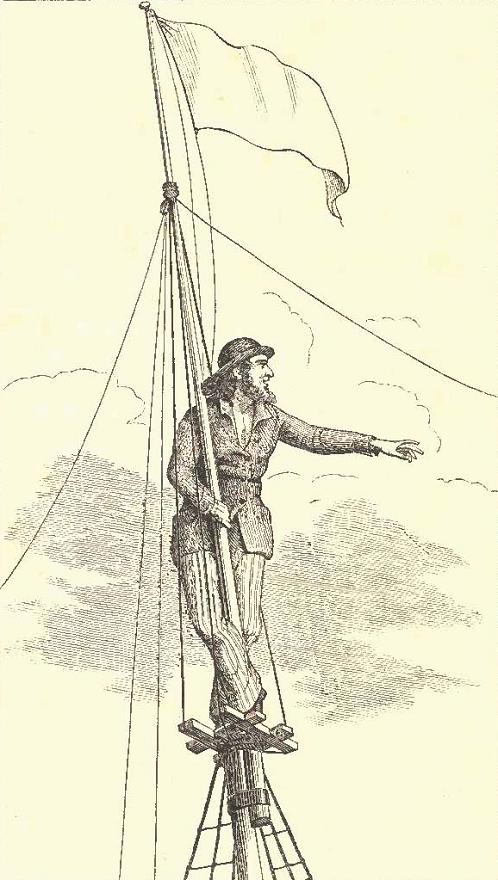
|
owing to the scarcity of water, produced by long and continued calms. October 13th. – "There she blows!" was sung out from the mast-head. "Where away?" demanded the captain. "Three points off the lee bow, sir." "Raise up your wheel. steady!" "steady, sir." "Mast-head ahoy! Do you see that whale now? "Ay, ay, sir! A school of sperm whales! There she blows! There she breaches!" "Sing out! Sing out every time!" "Ay, ay, sir! There she blows! There – there – thar' she blows – bowes – bo-o-o-s!" "How far off!" "Two miles and a half!" "Thunder and lightning! so near! Call all hands! Clew up the fore-t'gallant-sail – there! belay! Hard down" your wheel! Haul aback the main yard! Get your tubs in your boats. Bear a hand! Clear your falls! stand by all to lower! All ready?" "All ready, sir!" "Lower away!" Down went the boats with a splash. Each boat's crew sprang over the rail, and in an instant the larboard, starboard, and waist boats were manned. There was great rivalry in getting the start. The waist-boat got off in pretty good time; and away went all three, dashing the water high over their bows. Nothing could be more exciting than the |
chase. The larboard boat, commanded by the mate, and the waist-boat, by the second mate, were head and head. "Give way, my lads, give way!" shouted P––, our headsman; "we gain on them; give way! A long, steady stroke! That's the way to tell it!" "Ay, ay!" cried Tabor, our boat-steerer. "What d'ye say, boys? Shall we lick 'em?" "Pull! pull like vengeance!" 'echoed the crew; and we danced over the waves, scarcely seeming to touch them. 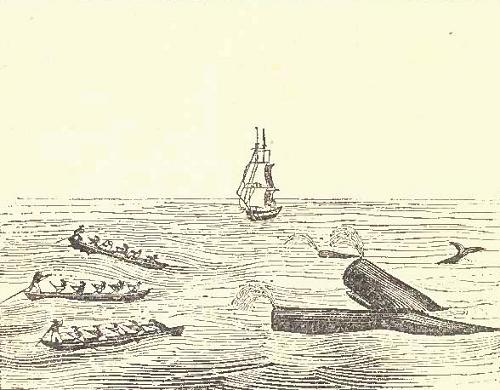
The chase was now truly soul-stirring. Some-times the larboard, then the starboard, then the waist-boat took the lead. It was a severe trial of skill and muscle. After we had run two miles at this |
rate, the whales turned flukes, going dead to wind- ward. "Now for it, my lads!" cried P––. "We'll have them the next rising. Now pile it on! a long, steady pull! That's it! that's the way! Those whales belong to us. Don't give out! Half an hour more, and they're our whales!" The other boats had veered off at either side of us, and continued the chase with renewed ardor. In about half an hour we lay on our oars to look round for the whales. "There she blows! right ahead!" shouted Tabor, fairly dancing with delight. "There she blows! There she blows!" "Oh, Lord, boys, spring!" cried P––. "Spring it is! What d'ye say, now, chummies? Shall we take those whales?" To this general appeal every man replied by putting his weight on his oar, and exerting his utmost strength. The boat flew through the water with incredible swiftness, scarcely rising to the waves. A large bull whale lay about a quarter of a mile ahead of us, lazily rolling in the trough of the sea. The larboard and starboard boats were far to leeward of us, tugging hard to get a chance at the other whales, which were now blowing in every direction. "Give way! give way, my hearties!" cried P––, putting his weight against the aft oar. "Do you love gin? A bottle of gin to the best man! Oh, pile it on while you have breath! pile it on!" |
"On with the beef, chummies! Smash every oar! double 'em up, or break 'em!" "Every devil's imp of you, pull! No talking; lay back to it; now or never!" way through the rough sea as if the briny element were blue smoke. The whale, however, turned flukes before we could reach him. When he appeared again above the surface of the water, it was evident that he had milled while down, by which manoeuver he gained on us nearly a mile. The chase was now almost hopeless, as he was making to windward rapidly. A heavy, black cloud was on the horizon, portending an approaching squall, and the barque was fast fading from sight. still we were not to be baffled by discouraging circumstances of this kind, and we braced our sinews for a grand and final effort. "Never give up, my lads!" said the headsman, in a cheering voice. "Mark my words, we'll have that whale yet. Only think he's ours, and there's no mistake about it, he will be ours. Now for a hard, steady pull! Give way!" "Give way, sir! Give way, all!" "There she blows! Oh, pull, my lively lads! Only a mile off! There she blows!" The wind had by this time increased almost to a gale, and the heavy black clouds were scattering over us far and wide. Part of the squall had passed off to leeward, and entirely concealed the barque. Our situation was rather unpleasant: in a rough sea, |
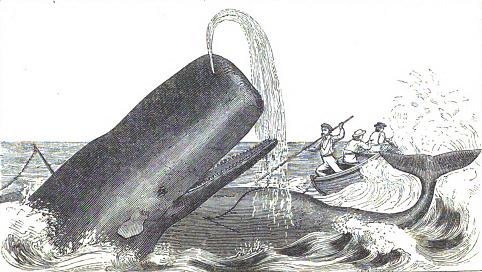
LANCING A WHALE. |
the other boats out of sight, and each moment the wind increasing. We continued to strain every muscle till we were hard upon the whale. Tabor sprang to the bow, and stood by with the harpoon. "Softly, softly, my lads," said the headsman. "Ay, ay, sir!" "Hush-h-h! softly. Now's your time, Tabor!" Tabor let fly the harpoon, and buried the iron. "Give him another!" "Ay, ay! stern all!" "stern all!" thundered P––. "stern all!" And, as we rapidly backed from the whale, he flung his tremendous flukes high in the air, covering us with a cloud of spray. He then sounded, making the line whiz as it passed through the chocks. When he rose to the surface again, we hauled up, and the second mate stood ready in the bow to dispatch him with lances.' "Spouting blood!" said Tabor. "He's a dead whale! He won't need much lancing." It was true enough; for, before the officer could get within dart of him, he commenced his dying struggles. The sea was crimsoned with his blood. By the time we had reached him, he was belly up. We lay upon our oars a moment to witness his last throes, and, when he had turned his head toward the sun, a loud, simultaneous cheer burst from every lip. |
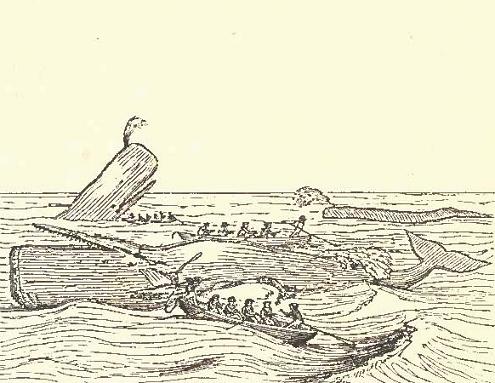
A low, rumbling sound, like the roar of a distant waterfall, now reached our ears. Each moment it grew louder. The whole expansive arch of the heavens became dark with clouds tossing, flying, swelling, and whirling over and over, like the surges of an angry sea. A white cloud, gleaming against the black mass behind it, came sweeping toward us, stretching forth its long, white arms, as if to grasp us in its fatal embrace. Louder and still louder it growled; yet the air was still and heavy around us. Now the white cloud spread, whirled over, and lost its hoary head; now it wore the mane and fore feet of a lion; now the heads of a dragon, with their tremendous jaws extended. Writhing, hissing, roaring, it swept toward us. The demon of wrath could not have assumed a more frightful form. The whole |
face of the ocean was hidden in utter darkness, save within a circle of a few hundred yards. Our little boat floated on a sea almost unruffled by a breath of wind. The heavy swell rolled lazily past us; yet a death-like calmness reigned in the air. Beyond the circle all was strife; within, all peace. We gazed anxiously in each other's faces; but not a word was spoken. Even the veteran harpooneer looked upon the clouds with a face of unusual solemnity, as we lay upon our oars, awed to silence by the sublimity of the scene. The ominous stillness of every thing within the circle became painful. For many long minutes the surface of the water remained nearly smooth. We dreaded, but longed for a change. This state of suspense was growing intolerable. I could bear the deep, long-drawn respirations of those around me; I saw the quick, anxious glances they turned to windward; and I almost fancied I could read every thought that passed within their breasts. Suddenly a white streak of foam appeared within a hundred yards. Scarcely had we unshipped our oars, when the squall burst upon us with, a stunning violence. The weather side of the boat was raised high out of the water, and the rush ing foam dashed over the gunwale in torrents. We soon trimmed her, however, and, by hard bailing, got her clear of water. It is utterly impossible to conceive the violence of the wind. Small as the surface exposed to the squall was, we flew through the foaming seas, dragging the dead body of the whale |
after us with incredible velocity. Thus situated, entirely at the mercy of the wind, and sea, we continued every moment to increase our distance from the barque. When the squall abated, we came to under the lee of the whale, and looked to leeward for the barque. Not a speck could be seen on the horizon! Night was rapidly approaching, and we were alone upon the broad, angry ocean! "Ship your oars," said the headsman; "we'll not part company with old Blubber yet. If we can't make the barque, we can make land somewhere." "Ay, ay," said Tabor, with a sly leer, "and live on roast-beef and turkey while we're making it." With heavy hearts and many misgivings we shipped our oars, heartily wishing the whale in the devil's try-pots; for we thought it rather hard that our lives should be risked for a few barrels of oil. For two hours we pulled a long, lazy, dogged stroke, without a sign of relief. At last Tabor stood up on the bow to look out, and we lay on our oars. "Well, Tabor, what d'ye see?" was the general inquiry. "Why," said Tabor, coolly rolling the quid from his weather to his lee cheek, "I see a cussed old barque that looks like Granny Howland's wash-tub, with a few broom-sticks rigged up in the middle of it." "Pull, you devils!" cried P––; " there's duff in the cook's coppers." |
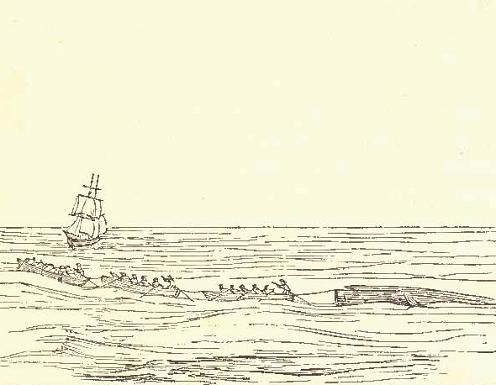
"Yes! I think I smell it," said Tabor. It was nearly dark when we arrived alongside of the barque with our prize; but what was our surprise to find that the starboard and larboard boats had killed five whales between them!. They were all of a small size, and did not average more than fifteen barrels each. That night not a breath of air ruffled the clear, broad ocean as it swelled beneath and around us, forming a multitude of mirrors that reflected all the beauties of the splendid canopy above. The moon arose with unusual brilliancy. It was a night for the winged spirits of the air. I enjoyed a melancholy pleasure in walking the decks beneath the soft moon-beams, thinking of past times. Silence reigned over |
the deep. The calm, broad ocean presented a beautiful simile of repose, and the light, shadowy clouds floated motionless in the air, as if in awe of the mighty wilderness of waters beneath them. A clear, silvery light beamed over the glassy swell; and far away the moon's rays, casting thr soft and delicate glow over the whole scene, gradually vanished in a dreamy haze upon the horizon. I gazed with pensive feelings upon this scene; so calm, so heavenly, so unrivalled in its loveliness; and I thought, with a sigh, of the coming day: the fiery, tropical sun; the loud, harsh voices of the officers giving orders; the heat and smoke of the try-works; and all the realities of a whaleman's life. I have heard of the solitude of the desert; but what can compare with that of the ocean at such a time as this? Never had the sea looked more beautiful than it did that night. It was a source of pleasure to feel that, notwithstanding the wretched life I led, there were still left a few of the better feelings of my nature. A passage in the "Vision of Don Roderic" occurred to me as singularly expressive of the checkered fortunes of a sea-farer. Well might I hope the light cloud which occasionally obscured the moon's brightness might proe a happy omen of my future fate: "Melting, as a wreath of snow it hangs At daylight next morning all hands were called, |
and set to work getting up the cutting tackle, and making other preparations for cutting in. As this process of "cutting in" seems to be but imperfectly understood by those who have not been engaged in the business, it would perhaps be well enough to devote a page or two of description to it in this place. When the whale has been towed alongside by the boats, it is firmly secured by a large rope attached to the "small" by a running noose. There is not a little ingenuity in the manner in which the fluke rope is first passed under the body of the-whale. A small line, to which a lead is fastened, with a block of wood at the extremity, several fathoms from the lead, is thrown over between the whale and the ship's side. From the impetus given to the lead, it sinks in a diagonal direction, drawing the block down after it. One end of the lead line is fastened to the end of the fluke rope on board, and the block attached to the other rises at the off side of the whale. It is then hauled on board by means of a wire hook fastened to a long pole, and, in hauling it in, the fluke rope passes round under the body of the whale, till the end arrives on board, when it is passed through the loop in the other extremity, and thus a running noose is formed, which is easily slipped down to the small. The fluke rope is then made fast on the forecastle, and the flukes are hauled up to the bow, or as near as they will reach, leaving the head pointed aft. Of course, the size of the vessel and the length of the whale make a great differ- |
ence; but in general the head reaches to the quarter. To prevent concussion, the whale is always on the weather side. The progress of the vessel, which is usually under easy sail during the time of cutting in, keeps the whale from drifting out at right angles from the side; though, in most cases, the head is kept in its appropriate position by a small rope made fast aft. The cutting tackle is attached to a powerful strap, or pendant, passing round the mast in the main-top by two large blocks. There are, in fact, two tackles, the falls of which pass round the windlass. To each of these tackles is attached a large blubber hook, which, upon being made fast to the blubber, are hauled up by the windlass, one only being in operation at a time, so that when the first strip of blubber, or "blanket piece," reaches the stationary block on the pendant, the other can be made fast by a strap and bolt of wood to a hole cut below the point at which that blanket piece is to be cut off. I have endeavored to give some idea of this part of the process in the frontispiece accompanying the work. The blanket pieces are stripped off in a spiral direction, running down toward the flukes; the whale turning, at every heave of the windlass, till the whole covering of blubber is stripped off to the flukes, which are hoisted on board, and those parts containing oil cut away, and the remainder thrown overboard. The head having, in the first place, been cut off and secured to the stern, is now hauled up, with the nose |
down, if too large to be taken on board, and hoisted as far out of the water as may be found convenient, and the oil or liquid spermaceti bailed out with a vessel attached to a long pole, and thus taken in and saved. As there is no little risk attending this mode of getting the spermaceti, and a great deal of waste, the head is always taken on board, when not too large or heavy. The "case," which is the name given by whalers to the head, sometimes contains from ten to fifteen barrels of oil and spermaceti. A single "blanket piece" not unfrequently weighs a ton or upward. In hauling it up by the tackles, it careens the vessel over frequently to an angle of fifteen or twenty degrees, owing to its own great weight, combined with that of the whale, the upper surface of which it raises several feet out of the water. When the blanket piece has reached the stationary block in the top, it is cut off by a boat-steerer, who stands by with a boarding knife, having first, however, been secured below by the other blubber hook, which is hauled taught, to prevent it from breaking away by too sudden a jerk. The upper piece then swings in, and, when it ceases its pendulating . motion, is dropped down into the hold or blubber-room, where it is cut up into blocks of a foot and a half or two feet in length, and eight or ten inches in width. These blocks are called "horse pieces." The white, hard blocks, containing but little oil, and which are found near the small, and at the flukes, are called |
"white horse." The carcass of the whale, when stripped of its blubber, is cast loose, and soon sinks from the want of its buoyant covering. I have seen it float astern, however, some distance without sinking. Breakfast over, all hands were called to cut in. Six or eight men were stationed at the windlass, two in the blubber-room, and the boat-steerers in the waist. The first and second mates took their station on a couple of stages, or platforms, rigged out at the gangway, each provided with a spade. One of the boat-steerers, whose turn it was to fasten the blubber hook, went down over the side on the whale's back, and, after several unsuccessful attempts, and rather an uncomfortable ducking, performed his task. While yet on the whale's back, a large, hungry-looking shark, which had been eyeing him for some time very anxiously, was washed up behind him by a heavy sea, and apparently loath to lose so good an opportunity of making a meal, began to work his way along the slimy surface till within a foot or two of the boat-steerer's heels. The officers happened at the moment to be looking up at the pendant block, and in all probability the man would have been seriously injured, if not carried off bodily, but for the timely alarm of one of the crew. The mate immediately turned to see what was the matter, and perceiving the critical position of the boat-steerer, brought his spade to bear upon the shark, and at a single dart chopped off his tail. |
Strange to say, the greedy monster did not appear to be particularly concerned at this indignity, but, sliding back into his native element, very leisurely swam off, to the great apparent amusement of his comrades, who pursued him with every variety of gyrations. It surprised me to see with what cool indifference the boat-steerer witnessed the whole transaction. I do not remem- ber that he said a word about it. The various duties being apportioned to the men without favor or choice, it fell to my lot to sit on the weather side of the quarter-deck and turn the grindstone; a tiresome and monotonous task. The cooper attended to the sharpening of the spades, boarding knives, and other implements used in "cutting in." I am not sure that I had the hardest of the work to do, but it certainly was the most unpleasant; for I could not prevail upon any of the hands to change places with me, even for a brief period. My appearance at this time would have been somewhat striking to some of my friends in Washington. With my duck frock all black with whale-gurry, my trowsers torn and smeared with rough work, my red Scotch cap half-way over my eyes, and my face oily and sunburned, I certainly looked as little like my original self as one can well imagine. There I turned that grindstone, and turned on hour after hour, and turned the palm of my- right hand into a great blister, and turned the palm of my left into another; turned both my arms into a personified pain; turned every remnant of romance out of my head; turned and turned |
till my grand tour seemed to have turned into a grindstone; round and round I turned that stone till I began to think I was a piece of the handle, and turned with it; and my head appeared to turn, and my feet to turn, and the game-legged cooper to turn, and the ship to turn, and the sea, and the whale, and the sharks, and the clouds, and all creation seemed to be turning with myself and that grindstone! Having at last contrived to get a sufficient number of spades sharpened ahead of the mates, I peeped over the quarter-rail to see how they were getting on. The sharks had by this time gathered around the vessel in immense numbers, and eight or ten were fighting just under the quarter for a piece of the whale's carcass which had been cut away. Watching my opportunity, I snatched up a spade, slipped it over while the captain was forward, and began a terrible onslaught among the sharks. With five or six thrusts I killed four of the greedy monsters, by striking them on the back of the head, and cutting the principal artery. This was quite a refreshing little episode in my business of turning; and my success in the destruction of sharks induced me to believe that I had a greater natural turn for sport than the monotonous turning of a grindstone. But my amusement was of short duration. The eagle eye of the captain espied me before I could get in the long pole of the spade. "Ha! what are you at there?" cried his highness directly behind me, at the very moment when I sup- |
posed he was on the forecastle giving orders to the men. "What are you at, hey?" "Keeping off the sharks, sir." "Who told you to keep 'em off?" "Nobody, sir." "Haul in that spade directly!" "Ay, ay, sir!" "And, look'ee, if I catch you keepin' off any more sharks, I'll wipe you down with a rope's end!" "Ay, ay, sir!" "Cooper, hain't you got no work for this fellow? "Not just now, sir." "Go to the windlass, then, and rest yourself on a handspike!" "Ay, ay, sir!" I had reason to consider my shark-killing a poor speculation. The heaving and surging at the windlass was but a questionable improvement upon my old business of turning the grindstone. At the word, "Heave away!" somebody struck up an extemporaneous song, which, to the best of my recollection, had no particular claims to poetical merit, but ran somewhat thus: "Heave him up! O he yo! |
Now I don't. O he yo! a At the conclusion of this medley, the captain, who had seated himself in the starboard quarter boat to inspect the cutting, began to criticise the mate's style of cutting rather severely. Now the mate, be it known, was really a very skillful whaleman, and handled the spade with an unerring hand. The "old man's" comments, thus lowering him in the eyes of the crew, by no means pleased him. "I say, Mr. D––," persisted the captain, "that's not the way to cut in a whale. I don't want no such work as that about me." "It's my way, sir," replied the mate, getting very red in the face. "Well, I never see a whale cut that way. I ain't used to it; I won't have it." "You haven't seen every thing yet, sir. I've always cut whales this way, and always mean to do it." "No you won't; not here you won't. You can just cut as I tell you." "I reckon I know my own business; Captain A––. Now, sir, I'm not a going to be dictated to in this manner. If you think you can cut a whale better than I can, you'd better take my place." After some more angry words, during which both the captain and mate became much excited, and |
threatened to whip each other, the quarrel ceased, and the "old man" went below in high dudgeon. This was all "nuts" for me. I was rejoiced to see somebody among the privileged few talk up to him as he deserved. Indeed, I was itching to express my own personal opinion on the subject, but had no particular fancy for the mode of "wiping down" hinted at a short time previously. Cutting in, trying out, and clearing up the decks, occupied us for the next six days. We had an average of five hours' sleep out of the twenty-four. Working incessantly in oil, which penetrated to the skin, and kept us in a most uncomfortable condition, besides being continually saturated with salt water, produced a very disagreeable effect upon those who were not accustomed to such things, by chafing the skin, and causing painful tumors to break out over the whole body. Before I had half finished my share of the labor, I heartily wished myself in the meanest dog-kennel ashore, or, to borrow an old idea, I should have considered myself in an enviable situation had some enemy been kicking me down Pennsylvania Avenue. Tabor, the oldest whaleman on board, who laughed at hardships, and took all the disagreeable parts of his duty with the utmost good- humor, frequently joked me on my "grand tour to Europe. "What do you think of whaling now, B––? Is it equal to traveling in Italy?" "I think not, Tabor." |
"Tain't writing short-hand neither, is it? I think you'd as lief be in Washington, with them thar big members of Congress, as blubber-hunting. Cutting figures with the pen ain't cutting blubber, by a considerable sight, is it?" I freely acknowledged that, of the two sorts of cutting, I preferred cutting figures with the pen; at which Tabor laughed most heartily, assuring me that "it was nothing when I'd get used to it. By'm-by I'd see what whaling was. This wasn't a circumstance. I'd smell smoke yet. I'd begin to find out what some folks was at while others was riding about in chaises." We had an extra supply of meat on this occasion, with about a quarter of a pound of rancid butter, which was to be divided among all hands. This unusual liberality on the part of the captain astonished us all, and filled our hearts with gratitude. We took the saucer containing the precious morsel, and, seating ourselves in a circle round it, enjoyed our good fortune by various amusing comments upon the captain's unparalleled liberality. Of all things in the world, sailors despise most a stingy, thin-skinned captain. They will excuse cruelty, unnecessary hardship, or coarse and brutal language, for they become accustomed to it; but any thing like stinginess or meanness they heartily detest. Bill Mann growled like a sick bear, protesting, in his own peculiar style, that it was "the blamdest thing he ever saw done aboard any ship. He wished his soul might |
everlastin'ly stick fast in purgatory, if he wouldn't tell the counsel of it." Mack wanted to carry it back to him with the thanks of the crew, "hopin' he wouldn't rob himself, for the men was afraid to eat it, bein' as they had never seen any thing like it since they'd follered the sea." This proposition was negatived, and we at last agreed to mix the butter up with a pan of dirty bread and heave it overboard. The captain, who was sitting in the stern boat, chanced to spy the bread as it floated toward him, and seizing a pole with a small net attached to it, which he always kept in the boat, he hooked up every morsel of it. Owing to the round-house concealing him from our view, we knew nothing about this, till he came forward about fifteen minutes after, with a plate in his hand, containing what we supposed to be an additional treat for all hands. There was a fiendish smile of triumph visible about his lips, however, and a ferocity in his eyes that boded us no good. Holding the plate out toward us, he pointed with his forefinger at the startling apparition of the resuscitated bread, and demanded, in a deep, distinct voice, "Which on ye did that, hey? Look at it, every one o' ye; examine it well. Did ye never see it,before, hey? Taste it; it's got salt water in it, but it's good, hey? A nice set of darned rascals! Don't get enough to eat, hey? I starve you, do I, hey! You don't like butter; oh no, you can't eat it! Nice |
stomachs, I'll swan! Whose work is this? Don't all answer at once! Who did it?" No one answered. We all felt that we were guilty, and it is not to be wondered at that, taken aback so suddenly, we could account for the unexpected reappearance of the bread and butter, which we had supposed was food for the sharks, in no other way than by presuming old Skinflint was in league with the devil. "Oh, you didn't do it, none on ye!" shouted the captain, letting loose his wrath. "It grew in salt water! It wasn't hove overboard at all! Well! take and eat it now; and, mark my words, the first man I catch heavin' good vittals overboard, I'll heave him overboard!" With that he flung it down before us and walked aft, grieving over our depravity and his probable loss. From that time forth he used to sit in the stern boat for hours every day, dodging his net in the water at every thing that looked like biscuit or meat. Sometimes he would catch up what he didn't bargain for, and his low, half-smothered comments, audible only to the man at the wheel, would afford us infinite amusement. Patience and perseverance finally rewarded him with success. He had been at his post regularly three times every day for about a month, fishing up whatever attracted his insatiate eye, when one day he made a haul of a fine fat piece of pork. He jerked it in, chuckling over his good fortune, and muttering, "Aha! I've caught you at last. you infernal scoundrels! I'll |
give you fat pork to throw away in a hurry again!" Calling to the steward to pass up a fork, he spitted it handsomely, and carried it forward for our inspection. Looking each of us hard in the face by turns, he demanded, in a voice of thunder, " Who hove the pork overboard?" No answer. "Won't you tell me, you sheepheads?" No answer yet. "You won't, eh It's your work, M'F––?" "No, sir, taint. Pork's scarce about these diggins. I don't throw away a good chunk when I get hold on't." "It's you then, Vernon. I'll skin you for it. I'll show you how to waste good meat, you worthless bullet-head. You don't earn your salt." "Twasn't I, sir. I was down in the forecastle." "Then you know who did it?" "No, sir, I don't." "What the devil do you know?" "I know I hadn't enough o' meat for dinner." "You hadn't, eh? Well, I'll see to it. You're a parcel of hogs, that's what you are! Cook, from this time forth cut these men's meat up in small pieces, and just give 'em as many pieces as'll go round." "Ay, ay, sir." "Now I'll know when meat's wasted again, and why" So saying, he walked aft, satisfied at least that half a pound lost was a barrel gained. Wheth- |
er the piece which he picked up had been thrown over purposely, or had fallen from the top of the caboose accidentally, I never could find out; but this much I know, our share of meat soon resembled the Irishman's dinner of "potatoes and point," barrin' the potatoes. It is customary, in most vessels, to give the watches their meals alternately, the, watch below being served first. This prevents confusion and quarreling. The watch on deck, when relieved, can then enjoy their meals at their leisure. Sailors generally, though any thing but deficient in appetite, have great respect for the decencies of civilized life on such occasions as these. I have never seen selfishness or greediness on board well-disciplined ships during meal times. On the contrary, it is surprising to find a very delicate sense of propriety among men who have had so few opportunities of cultivating the refinements of social intercourse. I have often seen a well-behaved and orderly crew seated around the forecastle, eating their meals in peace and good-humor, and each one neglecting no opportunity of extending a courtesy to his shipmate. This is almost invariably the case where they are well treated by the captain and officers. Like children, they can be moulded to almost any thing; and where a bad example is set aft, the best of them will be sure to follow it. No one who has never been to sea and witnessed such scenes, can conceive the importance of these little forms of politeness, and their happy |
effects upon the crew. Where there is a kindly feeling on the part of every man toward his neighbors, the worst fare can be eaten with relish. How different it was with us! We had been so accustomed to see quarreling between the captain and his officers, and so much discontent manifested by the latter about their meals, that it would have been a miracle if we had not imbibed the prevailing spirit. But we had our frailties too, and were not proof against the example of these high authorities. There was some excuse for us, however; we really had something to be discontented about. The captain had shipped a gang of voracious and filthy Portuguese, whose condition had never been better than that of swine, and with these uncultivated brutes we were compelled in self-defense to do the best we could for ourselves. It was degrading to the pride of those who were burdened with that inconvenient commodity to be obliged to rush like hungry wolves for a mouthful of meat at meal-times; but there was no help for it. We either had to join in the struggle, or lose our allowance; for it was seldom there was enough before us to satisfy half our number. Although it was no joke to be starved, I always found food for merriment when I could get nothing of a more substantial nature. The cook, in order to see fair play, generally watched his opportunity, and, when the hands were scattered around the forecastle, he would pitch the meat kid down on the deck, and sing out, at the top of his voice, "Meat! meat! |
fall to, all hands!" This startling intelligence never required repetition. Those who were nearest would jump up and run toward the smoking morsel as if simultaneously stung by a score of wasps. Those who, unfortunately, happened to be at a distance, had no resource but to dart after their leaders in the rush, and, by dint of hard struggling, secure a place by the meat kid. There was something indescribably ludicrous in the earnestness with which we all entered into the contest. It was not exactly a struggle involving "life or death," but it was of scarcely less importance; for "Meat, or no meat?" was the grand question. Nor did we hesitate to resort to the most cunning expedients to obtain our fair proportion of the salt junk. When hard pressed, it was not unusual to pick up a rival and carry him back ten or twelve paces, and, before he could regain his legs, take advantage of his absence, and get in six feet ahead of him. Some had been shouldered away so often in this manner by those who were larger and stouter, that hunger taught them a new expedient; and they secured their share on several occasions by working in like eels under the legs of those who were ahead of them. Big John, the Portuguese, having the advantage of us all in size and strength, would sometimes make a clean sweep with his arms, and lay half a dozen of us sprawling on the deck; but, being less greedy than the rest of the Portuguese, he never took more than his share, and only exerted his powers in this way for the sake of amusement. The |
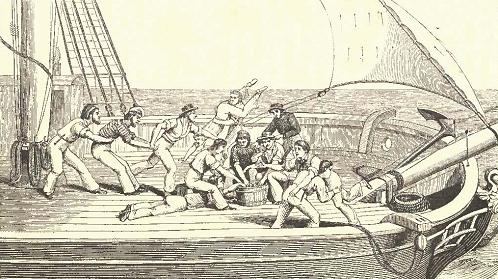
A SCRAMBLE FOR SALT JUNK. |
"down-easter," with characteristic sagacity, always managed to be in good time; for, when a little behind, he would grab hold of somebody in advance of him, and, by hard pulling, keep him back till each had a fair start. He was not unfrequently served the same trick himself; and I have seen as many as three or four in a row endeavoring to drag each other back. Bill Mann, our chief grumbler, in a fit of indignation at such swinish proceedings, would look on, and protest, "If ever he got into port, he'd let the counsel know how things was carried on. He didn't care a bloody cent if he never got a bit to eat." It was a curious fact, however, that Bill never came to the latter conclusion until the superior activity of his comrades had deprived him of the last chance. There was some fun, but a great deal more earnestness than fun, in these scrambles for food. To the landsman, and, indeed, to every sea-farer who has not been in a vessel of the same description, all this must look exaggerated and improbable; for it is hard to conceive how men could become so utterly degraded as to conduct themselves with so little regard to the decencies of life. All I have to say is, that what I have endeavored to describe was induced by the laws of nature, and the description, if any thing, falls short of reality. I have shown that the captain paid no regard to our appeals. He invariably favored the Portuguese, because they cringed to him; and our complaints to him of their beastliness produced no effect. We had too often tried the |
experiment of "going aft." There was nothing to be gained by appeals of that kind. It was useless to remonstrate with the Portuguese; and, indeed, I can not say that many of the Americans were superior to them in point of breeding Under such circumstances, what were those who were inclined to be civilized to do? It would be unreasonable to suppose that they could quietly,suffer themselves to be starved. Hunger does not pay much regard to conventional rules, especially at sea. The worst of it was, that it was only through cupidity we were denied our just rights. There was no scarcity of provision of a bad quality on board the vessel; yet, bad as it was, we were unable to obtain enough of it. The law allows a certain proportion of wholesome food to each man. It must not be supposed, however, that there is any law at sea but the captain's word; for, notwithstanding cases sometimes occur, in which seamen bring suit against the masters of vessels for refusing them their legal allowance, it is but rarely they can sustain their complaints by adequate proof. There is almost invariably some loop through which men of influence and wealth can escape. Besides, even should a suit of this kind be successful, what is there in a paltry fine to recompense a crew for two or three years starvation? The fact is, the law, so far as it regards abuses like this, is a mere burlesque; and the only sure way of obtaining redress is, for the crew to take the matter into their own hands, and compel the captain to give |
them their proper allowance, or refuse duty altogether. This, unfortunately, is but poor satisfaction, after all; for the laws against mutiny are not so easily evaded. I should be far from advising such a course; though I believe it is the only one which will ever produce any effect. Put men to trouble and expense – touch their pockets, and they will begin to listen to reason and justice. CHAPTER IX.
October 26th. – Made the Isle of Sal, one of the Cape de Verdes, distant thirty miles. The peak is of very considerable height, and bears some resemblance to the Peak of Pico. We ran down along the shore, which has a beautiful and fertile appearance, and had a fine view of the principal ha,,.or and town. There were several vessels in port, taking in cargoes of salt for South America. Lay to all night, and next morning at daylight made sail for Bonavista. Learning there that there was an American vessel in port at the Isle of May, we hauled off |
and ran down for that island, the captain being desirous to send home the oil we had on board. A little incident occurred during the day which afforded us all much amusement. D––, the cooper, was in the habit of "raising whales," when nobody else on board could see teem; and as there was a bounty up for the first whale yielding fifty barrels, he was always on the alert. While we were standing by the braces; waiting for orders, we heard him singing out from the mast-head with all his might, "Thar' she breaches! Thar' she breaches!" "Where away?" said the captain. "A point off the weather bow, sir. Thar' she breaches!" "How far off?" "Ten miles. Thar' she breaches! Thar' she breaches!" "Don't she blow at all?" "No, sir; there's no spout; nothing but breaches – very large breaches. Thar' she breaches!" "Luff up to the wind. Do you hear, at the wheel? Cooper, are those breaches in sight now?" "Yes, sir; I see them all the time. She don't stop breaching at all – large breaches! It must be a very large sperm whale. Thar' she breaches! Thar' she breaches!" "What the deuse! don't the breaches stop at all?" "No, sir. Thar' she breaches! thar' –" "Sing out every time. Get your boats ready, and call all hands" |
Thar' – thar' – thar' she breaches!" shouted the cooper, from the mast-head. For upward of fifteen minutes he strained his lungs in this way, when he suddenly became silent. "Where's the whale now?" said the captain. "I don't believe it's a whale, sir," replied the cooper, in a tone of disappointment. "What in the nation do you call it, then?" "Why, I don't know exactly. It looked very much like a whale at first." "How now? Don't you know a whale when you see one? What is it?" "Well, I don't know, sir. It ain't a whale, that's certain." "You don't know, you infernal sheephead! steward, pass up my spyglass!" and, taking a steady look from the main-top in the direction indicated by the cooper, he suddenly exclaimed, " Why, h––ll and d––n––n! that's Leton's Rock!" We all enjoyed a hearty laugh at the cooper for his mistake. The old Portuguese cook, who was something of a wag, rallied him most unmercifully. For weeks after, when the hands would gather in the waist for a dance, old Slush, grinning from ear to ear, would gaze toward the horizon with eyes like saucers. This was a signal for some of the crew to sing out, "Halloo, Slush, what d'ye see?" "Large sperm whale, sare! Dar' she breach! Ten miles off, sare! dar she breach! She breach all de time, sare! Dar' she breach! Big whale, sare |
– dat big whale! He, he, he! yaw, yaw, yaw! Dar' she breach! Cooper, you sabe big rock!" In spite of the bursts of laughter which invariably followed this sally of wit, the cooper maintained the utmost good-humor, and always joined in the fun. Arrived at Mayo, the main-yard was hauled aback, and the larboard boat went ashore with the captain. There was a vessel there bound to the United States, from which we procured late American papers. As the two captains could not agree upon terms for the freight of the oil home, we made no stay. From Mayo we continued on to Bonavista, another of the group, which derives its name from the beautiful and picturesque appearance which it presents from the sea. The shores, along which we steered as near as was considered safe, are interspersed with patches of white sand and meadows of deep green. Proceeding on, without meeting with any thing to attract particular attention, we arrived, on the evening of October 28th, at Porto Praya, the chief town and harbor of the Island of St. Iago. The larboard boat was lowered, and sent ashore for oranges and bananas, which are produced abundantly on this island. The only vessel in port was a Danish brig. I saw but little to interest me at Porto Praya. The town is filthy and dilapidated, and the inhabitants a race of poor, half-starved, mulatto Portuguese, living under an oppressive form of government. An American consul is stationed at this place; and the most |
pleasing sight I saw during our short visit was the flag of the United States waving gallantly in the breeze. There are associations of no ordinary interest connected with Porto Praya, as the theater of a naval engagement celebrated in the annals of our naval history. I regretted that I had not stored my mind more fully with the particulars of that affair previous to visiting the Island of St. Iago; but during our subsequent cruise I procured a book entitled "Naval Battles," in which there was an animated description of it; and of course it rendered the description extremely vivid to have visited the spot, and become familiar with the scene of the engagement. The boat returned in the evening well laden with fruit, and all hands "three sheets in the wind." The most uproarious of the crew was Bully, so called from his pugnacious propensities, who had figured conspicuously in the New York "Flash" as a "Lady's Fancy Man;" next to him in liveliness was Bill Mann, a fore-mast hand, who had officiated in his younger days as a gas-lighter in the Bowery Theater. Bill, to use his own words, was more than half "slewed;" and the rest of the crew, three Portuguese, were jabbering about the sights they had seen at a most unintelligible rate. I must here state that Bill Mann was a very distinguished character on board the styx. In person he was large and unwieldy, and possessed of great strength. He wore a pair of tremendous black whis- |
kers, which he regarded as the greatest ornament to the human face divine; and altogether had the regular "damn-my-eyes" look of an old salt. Bill was unquestionably a hero, if great deeds entitle any man to that distinction. According to his own account, he had killed more whales, broken more girls' hearts, whipped more men, been drunk oftener, and pushed his way through more perils, frolics, pleasures, pains, and general vicissitudes of fortune than any man in the known world. Nevertheless, Bill was a great grumbler. He had the happy knack of seeing through every thing at a glance, and making evil omens out of the smallest trifles. If a cloud appeared on the horizon, we were going to have "tough weather, and, like as not, the blamed old spars wouldn't stand it, and we'd fetch up in Davy Jones's locker." He always "knew what he was about." If he fell over a handspike and bruised his shins, he "knew what he was about." Nay, for that matter, he could foretell every accident about to happen; but, unfortunately, seldom made particular reference to any special accident until after it did happen. Whenever any of the crew broke a looking-glass, he had fifty tragical stories to relate in proof of his position that it was a sure omen of bad luck. He was always "growling;" from morning till night he had something to growl at. If he had to do a job on the rigging, he went at it growling; be growled his way aloft twice a day; growled at the wheel; growled in the forecastle; growled in his sleep; and, although he could tell |
some amusing stories, he invariably wound up with a growl. Bill was every thing under the sun: a sailor; an actor, a musician, a pugilist; and, in short, considered himself an adept in seamanship, literature, politics, law, and every other pursuit that engages the attention of man. In all forecastle disputes touching questions in art; science, or literature, Bill was the great Sir Oracle, and clinched every argument by the assertion, that "there was nothing green in the corner of his eye; he knew what he was about." His songs – for he could sing too – were never less than sixteen or eighteen verses. Every thing he did bore the peculiar stamp of his genius. Nothing pleased him; nothing went as he had seen things go. His last voyage was pleasant and prosperous; the last ship was a good sailer; the last crew were fine, clever fellows; the last forecastle wasn't a hog-pen. He was continually cursing his "top-lights" if it wouldn't be a source of infinite satisfaction to him if this crazy old tub of a barque would sink, spars, tackling, try-works, and all, and go crock to the bottom. He had seen salt water before; nobody could tell him about salt water; he knew what a sailor's life was as well as any man; but he had never seen such doings aboard any other ship. He'd be blowed if he wouldn't like to see the studding-sails dragging overboard, the top-masts swinging by the rigging, the yards braced to Halifax, and the whole bloody ship's crew drifting on to a lee shore in the cook's galley. Divers and sundry afflictions might befall him if he |
wouldn't sooner be rammed and jammed into the fore-peak of purgatory than in such a ditty, lubberly, tub-sided blubber hunter as the barque styx. This sort of grumbling proceeded, no doubt, more from habit than real discontent; nevertheless, such is the force of example, Bill had scarcely been a month on board when all hands were grumbling. But I had almost forgotten the larboard-boat and its crew in my anxiety to give some idea of Bill Mann. It appeared that in the course of the day, while the hands were frolicking about town, Bill contrived to sell every thing be had about him for rum. Now, I presume, it is pretty generally known that if a man partakes very freely of any kind of strong liquor, it sometimes will find its way to his head, and even has been known to affect the knees. At all events, it produced something of this kind on Bill, who, believing, perhaps, that "Shallow draughts intoxicate the brain, was finally reduced to the necessity: of borrowing a pair of drawers from Bully, for the purpose of bartering for a fresh supply. The consequence was, that they both got down to the landing pretty extensively "disguised." When the boat came alongside, the cooper and two or three others attempted to hoist Bill on board, but, with some show of indignation, he rejected their assistance. "Bless my soul! I know what I'm about. You must think I'm drunk!" |
"Oh no," replied the cooper; "we don't think so." "Well, then," said Bill, scrambling over the rail, "what d'ye mean? My name is Bill Mann. I'm son of old Ed. Mann, sail-maker, New York." "No doubt of it, Bill." "You doubt it? By the bloody wars, sir, do you doubt my word? I allow nobody to doubt my word. Do you doubt it?" "Not at all." "Because, if you do, I'll just let you know that I'm Bill Mann, son of old Ed. Mann, sail-maker, New York. Boy, get out of my way!" This last remark was addressed to Bully, who, while staggering along the deck, chanced to run foul of "Bill Mann, son of old Ed. Mann, sail-maker, New York." A quarrel ensued, and the story of the drawers was brought up; which so offended Bill's delicacy of feeling, that he hauled off his inexpressibles and flung them at Bully, shouting, "Take them! take my blasted breeches! Don't say I ain't able to pay you! Don't tell me about what I borrowed from you! Take them, or, by the bloody wars, I'll lick you!" Upon this, Bully, in a state of lively excitement, ran to the deck-pot, and picked up a billet of wood, with which he attempted to knock Bill down. The "old salt," however, was too much for him, and, wresting the stick from Bully's hands, he chased the "fancy man" around the decks, seemingly unconscious of his comical appear- |
ance, minus his ducks. The mate, seeing the fight, ran between the combatants and put a stop to it. "What disturbance is this?" cried Captain A–– from the quarter-deck. "What's all this about?" "He called me a boy, sir," replied Bully. "And he is a boy, captain; I could lick fifty like him," suggested Bill, who had by this time hauled up in the waist, under "bare poles," and stood balancing himself in front of the captain. "Go forward! You're both drunk." "Captain, he hurt my feelin's," blubbered Bully, wiping the tears from his eyes with the back of his hand. "He did r'ally hurt my feelin's, captain." "Go forward, I tell you!" "Yes, sir, I'll go forward," said Bill; "but, captain, bless my soul and body, sir, I'm not drunk!" "You are drunk." "No, sir, I'm only a little in liquor. It's all owing to that blamed rotgut I drank ashore." "Go forward, I tell you." "Captain, my name is Bill Mann. I'm son of old Ed. Mann, sail-maker, New York." "I want no parley with you. Go forward, and I'll talk to you about your name when you get sober." "But, captain, upon my conscience, sir, I'm not drunk." "You are drunk." "Put me in irons – put me in irons, then. I'm Bill Mann, son of old Ed. Mann, sail-maker, New York. Put me in irons, Captain A––!" |
"I won't put you in irons. I'll put you in the rigging, though, and keep you there till morning, if you don't behave yourself." "Captain, I want to be put in irons. Will you put me in irons? Will you do me the favor, sir, to put me in irons?" "I tell you once for all, GO FORRARD!" "Oh yes, sir; yes, by all means, captain. I know what I'm about, sir. Nobody can tell me my duty. I've smelt salt water afore to-day. But the fact is, sir, I don't like to be hurried, d'ye see. Old Ed. Mann used to say to me, 'Billy, my son, don't you never hurry yourself; the more hurry the worse speed, Billy.' There's no mistake, captain, but what he was a rum old codger. It's surprisin' you don't know him. He used to work down by the South Wharf, and you couldn't but tell him by his pigtail; that 'ere pigtail was half a fathom long. I'm blowed if I don't believe you know him. Say, captain, don't you, sir?" "Silence!" thundered the captain, perfectly aghast at Bill's audacity. "If you don't mind me when I speak to you, I'll skin your back!" "No you won't, sir," growled Bill. "I ain't a man wot's a goin' to be skinned, no how. I won't suffer no captain to skin me as long as my name's Bill Mann, son of old Ed. –" "Not another word!" roared the captain. Bill evidently began to get alarmed, and, muttering something about being " skinned," he staggered |
along to the forecastle, where, with some difficulty, we lowered him down the ladder. By this time the rum began to do its work in earnest; he was raving like a madman. Four or five of the Portuguese had to hold him down on a chest. His old theatrical recollections coming upon him, he fancied he was Julius Caesar, about to be murdered in the senate. "I'm a Roman, damn my `eyes if I ain't! Give me a knife! I'll cut my throat! I'll die like a Roman! Nobody ain't a goin' to skin me. I'm Julius Caesar! Bloody my eyes, I'm Julius Caesar!" "You Bill! Bill Mann," cried Charlie, "are you crazy? What the devil are you raving about?" "Halloo! is that you, Metellus? You in this bloody conspiracy too? strike, my boy, strike! I'll die like a Roman! I told Califorina so ashore, and she turned black in the face. strike! stick your knife into my windpipe! "'Cowards die many times before their deaths; Ugh! Oh, that Portugee liquor!" "Come, come, Bill," said one of the Portuguese, catching him in his arms, and endeavoring to thrust him into his bunk, "turn in; you're out of your senses." "Is that you, Cimber? Give me a knife, Brutus!" roared Bill, in a phrensy. "Let me go, I say! |
"'I must prevent thee, Cimber. but, –––! if you don't come out of the little end of the horn if you fool with me [hiccough]. "'I spurn thee like a fice dog! get out of my way! I'm Julius Caesar, son of old Ed. Mann, sail-maker, New York. I'm a Roman, second lamp-lighter in the Bowery Theater. Don't you lay a hand on me – not one of you. I know what I'm about. Hurrah! I'm Julius Caesar!" "No, Bill," said one of the Portuguese, "you no July Sneezer." "I am! Don't slack jaw me, you base-born hind. Oh, Brutus, Brutus, will you let 'em murder me? Give me a knife! I'll die like a Roman, "'Of whose true fixed and resting quality, And with this Bill rolled over, and lay motionless on his chest. Several of the stoutest in the forecastle now got hold of him, and attempted to roll him into his bunk. "Avast, there!" 'grunted Bill; "hands off, you bloody harpies! "'Hence! wilt thou lift up Olympus!' I'll settle your hash if you don't let me be. 'Who's got a knife? I'll kill you all single-handed! I'll cut my throat, I will!" All this time I was an unconcerned spectator of |
Bill's little peculiarities; but, as he began to wax rather desperate, I advised him to turn in. He stared at me a moment as if he could not believe his eyes; then, bursting into a theatrical fit of despair, exclaimed, "Et to Brute? Well, I'm blowed if I ever thought that of you! Fall, Caesar, fall! Gentlemen and ladies, Caesar's dead! please consider him defunct from this moment! I'll cut my throat! I'm nobody! No! I ain't – nobody at all! I am Julius Caesar – a regular-built Julius Caesar! A bloody old Roman, chock up to the royals, blast my top-lights if I ain't!" It was useless to argue with Bill on the subject of his illustrious blood; so I turned in, and endeavored to get asleep. I had scarcely entered the land of dreams, when I was awakened by a noise like the growling of a bear; and, upon listening attentively, I heard Bill's voice, half-smothered under the blanket, endeavoring to articulate, "Who says I ain't a Roman? Who says I ain't Julius Caesar? Damme, sir, that's the rub! Who says I ain't Julius Caesar?" "Nobody, Bill; go to sleep," growled a voice from the opposite side of the forecastle. "Me sleep!" retorted Bill, attempting to rise. "Who says I ain't Julius Caesar? You've waked up the wrong passenger, old fellow! I'm a tee-total, everlasting, bloody Roman myself, I am!" As there was no possible way of convincing Bill |
that he was not a Roman, we left him to the enjoyment of his private personal opinion, with the general suggestion that, being a Roman, he should magnanimously suffer his fellow-countrymen to sleep. At 9 P.M. we were steering south-southeast under fore-topmast and lower studding-sails for the Indian Ocean. It is usual in whalers to get up a bounty, by way of encouragement to the look-outs aloft. This bounty is sometimes at the expense of the owners, who offer it with a view to promote vigilance on the part of the crew, that the voyage may be as short and profitable as possible. Five or ten dollars reward for a whale to be "raised" by any given time sharpens the sight of the men at the mast-head amazingly. Whalemen, however prodigal of their earnings ashore, are very different at sea. The desire to make a good voyage seems to be the mainspring of all their actions. With what reckless liberality the proceeds of their industry are spent when they arrive in port I need not say, for the open-hearted character of Jack ashore is known all over the world. From the close calculations which they make at sea, one would think they were the most penurious race of men in existence; but such is far from being the case. In lieu of any bounty from the captain or owners, the crew frequently get up a system of reward on their own account. This plan is often followed by the best results. It inspires a spirit of emulation |
among them that gives rise to great activity and vigilance. I present as a specimen a copy of a paper signed by the crew: "The undersigned, hands befoe the mast, agree to pay the sum affixed to our respective names, on every barrel of oil raised by a subscriber, to said subscriber; the oil to be measured as stowed down." This may require a few explanatory remarks. In the first place, to "raise oil" is an expression peculiar to whalemen. The man at the mast-head, who is the first to discover a whale, "raises oil" provided the whale be taken. If a subscriber raise a hundred barrels of all, according to the agreement (two cents a barrel being the sum affixed to each signature), he is entitled to two dollars from each of the other subscribers, which, allowing that there are ten subscribers besides himself, makes twenty dollars. By this arrangement he may earn sufficient for spending money during the voyage. The chances are equal. The most vigilant subscriber makes the most money, and the most careless loses most. It is customary to make the sums affixed to each signature proportionate to the lay of the subscriber: a green hand paying a cent on every barrel, an ordinary seaman a cent and a half, and an able seaman two cents, or whatever rate may be agreed upon. Those who do not choose to subscribe have, of course, nothing to do with it; but it is generally the case that this class is composed of the most worthless of the crew. |
Consequently, there is a constant competition among the vigilant portion of the crew; and if there is little success, it is not owing to carelessness or neglect of duty on their part. Those who are desirous of promotion can not better evince their claims than by activity and vigilance in this branch of the business; for as it is a primary object in whaling to see whales when they appear above the surface of the water, so it is the chief qualification of a good whaleman to understand thoroughly the different species of whales, and how to distinguish them. November 2d. – Since we entered the tropics I have frequently enjoyed the beauties of a sunrise at sea, which I think are more gorgeous in these latitudes than farther north or south. I never saw any thing to compare with the splendors of the scene which I witnessed this morning. We appeared to float in an immense arena, encircled by ranges of hills of the most magnificent and brilliant colors. The sea was perfectly calm; and as the sun burst through from the east, gilding the edges of this mighty inclosure with the richest hues, such a combination of lights and shades was visible as to form a world of visionary splendor rather than any thing earthly: the clouds ever changing into the most fantastic and beautiful forms; sometimes assuming the appearance of a group of fairy islands, resplendent with cities and palaces of gold, and at others bearing a strong resemblance to a bold, rugged chain of mountains capped with snow, glancing brilliantly in |
the sunbeams. But such sights as this are not to be described; they must be seen. "Sail ho!" was the cheering cry from the man at the mast-head. This was the first vessel we had seen for eight or ten days. She proved to be a large English barque, and continued to near us, with a very light breeze, till tqward evening, when we lowered a boat and boarded her. A band of musicians, seated on a platform in the waist, welcomed us by striking up a lively air. The stranger was a convict vessel, bound for Van Diemen's Land, with a great number of convicts and emigrants on board. Some of the prisoners were chained on deck, others standing in platoons under a strong guard. I never saw such a gang of ill-looking, miserable beings in my life as these poor fellows. Here and there I thought I could distinguish a prisoner less hardened in guilt than his comrades; some poor wretch who had seen better times, but now banished from the home of his childhood; an outcast, driven from civilized society, doomed to atone for his offense by years of exile and servitude in a land of vagrants and criminals. What a fate! It was sickening to see so many human beings chained together like dogs, and white men too! What a school of reformation for children of twelve or fourteen years of age! I saw boys chained in groups, who really did not seem old enough to know what they were punished for; and yet these children, who, perhaps, had been driven by the cravings of nature to commit the |
acts for which they were now to make so awful an atonement, were to be lost forever! The sun was just setting as we took our departure. I felt, after what I had seen, that my situation was not so bad as theirs, after all; and when I looked upon our crazy little barque, rough and unsightly as she was in comparison with the splendid specimen of naval architecture I had just seen, I really felt something akin to a kindly esteem for her. CHAPTER X.
The reader will now imagine us in the vicinity of the equator, with little to relieve the monotony of our voyage. To enter into a detail of every calm, squall, rain, or sunrise, would be tedious and uninteresting. I deem this, therefore, a suitable place to give a sketch of our crew, and to enter more fully into our domestic economy on board the styx. I have alluded already to Tabor, the harpooneersman of the waist boat, as an experienced whaleman; but I must now speak of him as a man "whose like I ne'er shall look upon again." John Tabor, of the old Tabor family, celebrated |
for their daring enterprise and success in the whale fishery, was a hardy, stout-built little fellow, who had spent twenty years of his life at sea, and had seen a great deal of the world, and experienced many hard rubs in the whaling business. There was scarcely an island in the Pacific Ocean that he had not visited; and few there were whose minds were better stored with plain, matter-of-fact knowledge than John's. He had sailed with all sorts of captains, and witnessed many scenes of cruelty and tyranny. He had endured every species of hardship, and he bore upon his face and body scars which he had received in various encounters. Withal, Tabor was a very primitive character. He had all the noble generosity and daring of a real sailor – all those blunt, manly qualities which characterize the genuine son of Neptune – with the credulity and simplicity of a child. His voyages had all been successful enough, but he had been cheated out of his hard earnings by crafty and designing owners; and when he did chance to receive his earnings after a long-voyage, there were land-sharks enough ready to pounce upon them. I was told of an instance of Tabor's generosity, which I think deserves to be recorded. He had been on a long and disagreeable voyage, with a captain who had maltreated and abused the whole crew. When the vessel arrived at the port from which she had sailed, he was paid off and discharged. The total amount of his earnings, after subtraction for his outfit, was a hundred and fifty dollars. With this |
he set off in search of adventure, on "a cruize up town." It is not to be wondered at that he soon came to an anchor in one of those dens of infamy where sailors generally dispose of their earnings. Here he met with a young girl who was apparently a novice in the ways of vice. Upon inquiry into her history, he learned that she was from a distant part of the country, where her parents resided, and that she had been seduced by the base schemes of a villain in the garb of a gentleman. She told the tale of her downfall with a simplicity and pathos that melted the heart of the rough sailor. He inquired why she did not return to the roof of her parents. Alas! she was not able. It was now too late: the mistress of the house took all she got from her; and though she was willing to return, and knew she would be received with open arms, she could not think of writing home. They were ignorant there of all her guilt. Tabor dashed a tear from his eyes, and hauling out the sum he had so well earned, exclaimed, "I'm plowed if you shan't go home! Go now, and be a good girl!" and without waiting to hear her expressions of gratitude, he left the house a pennyless wanderer. This act of genuine benevolence compelled him to ship immediately on another voyage. He never heard of the girl after that; and from that day to this he bears the reputation, among his circle of acquaintances at home, of being a worthless spend-thrift, who could foolishly throw away all his earnings in a few days in a house of ill fame. |
Every man has his failing: John Tabor had his. It assumed the shape of a large bottle of rum the day he sailed from New Bedford. There was no difficulty in smuggling it aboard; but how to get at it when he succeeded in that, was the main question. It was impossible to "take a swig" in the cabin without attracting the vigilant eyes of the captain and officers; so Tabor marked it "camphor," and committed it to the safe-keeping of a friend in the forecastle. Tabor's sly visits to the forecastle for several days after we left port were noticed by the officers, who, upon making inquiries, were given to understand that he was afflicted with an "internal commotion" which required constant doses of "camphor," a medicine pronounced indispensable by his physician. The fact was, Tabor had been on a long spree previous to signing the ship's articles; and he had provided himself with the aforesaid bottle of strong medicine that he might gradually taper off to a perfect state of sobriety. Unfortunately, he tapered on instead of off; and for three or four days he could hardly stand an hour on deck without rolling into the lee scuppers. The captain did not suspect the cause; so it remained unknown except in the forecastle, where Tabor was a general favorite. In due course of time, when his bottle of rum, and another which he had purchased from one of the crew, gave out, there was a most extraordinary change in his face. It became nearly twice its original length, and looked very "pale about the gills," as some of the crew fa- |
cetiously observed. His nose, however, retained its fiery and conspicuous appearance, and there grew upon the extremity of it a great variety of luminous carbuncles, resembling a choice nosegay of highly colored flowers. About this period, too, it was observed that he rolled to leeward less frequently than formerly; but he peeped from behind his extensive whiskers, with a solemn and cadaverous look that told a tale of woe. There was no denying that he had the horrors! the blue horrors first, and then the black horrors, and, lastly, the concentrated essence of both, which is decidedly a very unpleasant and alarming species of complaint. While in this state, he was continually beset by the vision of an old man with a long white beard, who seemed to entertain various murderous designs upon his person. The first time this interesting individual attempted to accomplish his purpose, Tabor was in his bunk in the cabin. It was my trick at the wheel; and I had been for some time enjoying a melancholy meditation, when I was startled by the apparition of a tremendous pair of whiskers, just visible over the companion-way. Then came the body and legs in a state of utter nudity. I soon discovered that it was Tabor. His eyes were starting from their sockets and his mouth wide open. For a few moments he stood gazing wildly toward the taffrail. "What's the matter, Tabor?" said I. "Matter enough," replied Tabor, rubbing his eyes as if he had just been aroused from a disagreeable |
sleep; and seating himself on a coil of rope by the wheel, he gave me a very amusing narrative of his acquaintance with the spectral individual who caused him so much uneasiness. JOHN TABOR'S RIDE. "I was cruising some years ago," he began, "on the southern coast of Africa. The vessel in which I was at the time had been out for a long time, and many of the crew were on the sick-list. I had smuggled on board a large quantity of liquor, which I had made use of pretty freely while it lasted. Finding the crew in so helpless a condition, the captain put into Algoa Bay, where we had a temporary hospital erected for the benefit of the sick. I saw that they led a very easy life, and soon managed to get on the sick-list myself. As soon as I got ashore I procured a fresh supply of liquor from some of the English settlers there, and in about a week I was laid up with a fever in consequence of my deep potations. One night, while I lay in the hospital burning with this dreadful disease, I felt an unusual sensation steal over me. My blood danced through my veins. I sprang up from my catanda as strong as a lion. I thought I never was better in my life, and I wondered how it was I had so long been deceived as to my disease. A thrilling desire to exert myself came over me. I would have given worlds to contend with some giant. It seemed to me I could tear him to pieces, as a wolf would tear a lamb. Elated with the |
idea of my infinite power, I rushed out and ran toward the beach, hoping to meet a stray elephant or hippopotamus on the way, that I might pitch him into the sea; but, very fortunately, I saw none. It was a calm, still night. There was scarcely a ripple on the bay. I put my ear to the sand to listen; for I thought I heard the breaches of a whale. I waited for a repetition of the sounds, scarcely daring to breathe, lest I should miss them. Not a murmur, except the low heaving of the swell upon the beach, broke the stillness of the night. I was suddenly startled by a voice close behind me, shouting, 'There she breaches!' and jumping up, I saw, standing within a few yards of me, such a figure as I shall never forget, even if not occasionally reminded of its existence, as I was to-night. The first thing I could discern was a beard, hanging down from the chin of the owner in strings like rope yarns. It had probably once been white, but now it was discolored with whale-gurry and tar. The old fellow was not more than five feet high. He carried a hump on his shoulders of prodigious dimensions; but, notwithstanding his apparent great age, which must have been over a hundred years, he seemed as spry and active as a mokak. His dress consisted, of a tremendous sou-wester, a greasy duck jacket, and a pair of well-tarred trowsers, something the worse for the wear. In one hand he carried a harpoon; in the other a coil of short warp. I felt very odd, I assure you, at the sudden apparition of such a venerable |
whaleman. As I gazed upon him, he raised his finger in a mysterious and solemn manner, and pointed toward the offing. I looked, and saw a large whale sporting on the surface of the water. The boats were lying upon the beach. He turned his eyes meaningly toward the nearest. I trembled all over; for I never experienced such strange sensations as I did then. "'Shall we go? said he. "'As you say,' I replied. "'You are a good whaleman, I suppose? Have you ever killed your whale at a fifteen-fathom dart?' "I replied in the affirmative. "'Very well,' said he, 'you'll do.' "And without more delay, we lanched the boat and pushed off. It was a wild whale-chase, that! We pulled and tugged for upward of an hour. At last we came upon the whale, just as he rose for the second time. I sprang to the bow, for I wanted to have the first iron into him. "'Back from that!' said the old whaleman, sternly. "'It's my chance,' I replied. "'Back, I tell you! I'll strike that whale!' "There was something in his voice that inspired me with awe, and I gave way to him. The whale was four good darts off; but the old man's strength was supernatural, and his aim unerring. The harpoon struck exactly where it was pointed, just back of the head. "'Now for a ride!' cried the old man; and his |
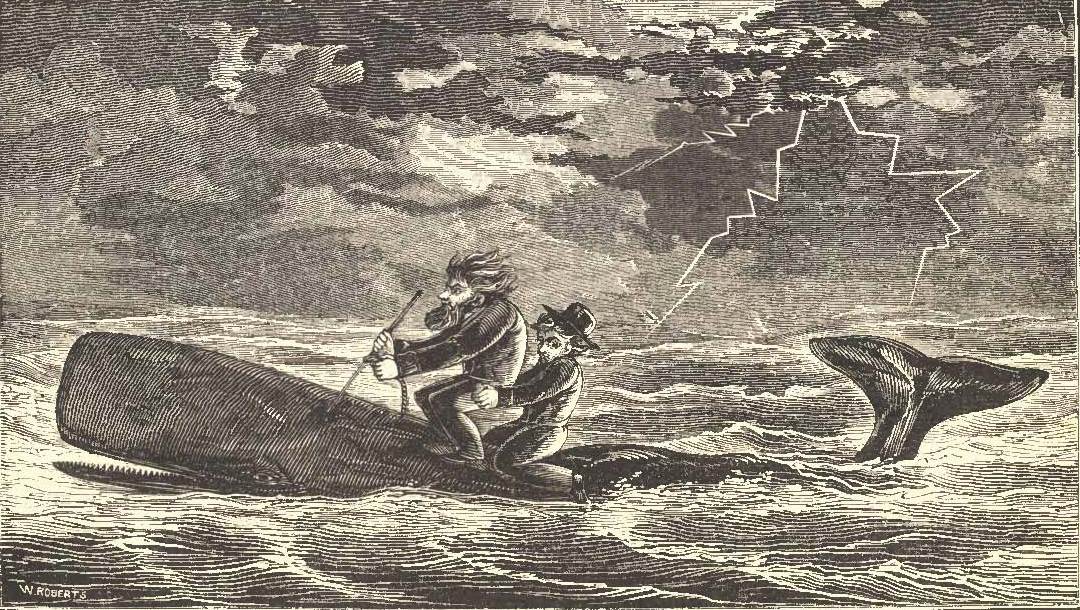
JOHN TABOR'S RIDE. |
features brightened up, and-his eyes glared strangely. 'Jump on, John Tabor, jump on!' said he. "'How do you mean?' said I; for although I had killed whales, and eat of them too, such an idea as that of riding a whale-back never before entered my mind. "'Jump on, I say, jump on, John Tabor!' he repeated, sternly. "'Damme if I do!' said I, and my hair began to stand on end. "'You must!' shouted the old whaleman. "'But I won't!' said I, resolutely. "'Won't you?' and with that he seized me in his arms, and, making a desperate spring, reached the whale's back and drove the boat adrift. He then set me down, and bade me hold on to the seat of his ducks, while he made sure his own fastening by a good grip of the iron pole. With the other hand be drew from his pocket a quid of tobacco and rammed it into his mouth; after which he began to hum an old song. Feeling something rather uncommon on his back, the whale set of with the speed of lightning, whizzing along as if all the whalers in the Pacific were after him. "'Go it!' said the old man, and his eyes flashed with a supernatural brilliancy. 'Hold fast, John Tabor! stick on like grim Death!' "'What the devil kind of a wild-goose chase is this?' said I, shivering with fear and cold; for the spray came dashing over us in oceans. |
"'Patience!' rejoined the old Man; 'you'll see presently.' Away we went, leaving a wake behind us for miles. The land became more and more indistinct. We lost sight of it entirely. We were on the broad ocean. "'On! on! stick to me, John Tabor!' shouted the old man, with a grin; of infernal ecstasy. "'But where are you bound?' said I. 'Damme if this don't beat all the crafts I ever shipped in!' and my teeth chattered as if I had an ague. "'Belay your jaw-tackle, John Tabor! Keep your main hatch closed, and bold on. Go it! go it, old sperm!' "Away we dashed, bounding from wave to wave like a streak of pigtail lightning. Whiz! whiz! we flew through the sea. I never saw the like. At this rate we traveled till daylight, when the old man sang out, 'Land ho!' "'Where away?' said I, for I had no more idea of our latitude and longitude than if I had been dropped down out of the clouds. 'Off our weather eye?' "'That's the Cape of Good Hope!' "Ne'er went John Gilpin faster than we rounded the cape. "'Hard down your flukes!' shouted my companion, and in five minutes Table Mountain looked blue in the distance. The sun had just risen above the horizon, when an island appeared ahead. "'Land ho!' cried the old man. |
"'Why, you bloody old popinjay,' said I, peering through the clouds of spray that rose up before us, 'where are you steering?' "'That's St. Helena!' 'The devil you say!' and before the words were well out of my mouth we shot past the island and left it galloping astern. "'stick on! stick on, John Tabor!' cried old greasy-beard; and I tightened my grasp on the seat of his ducks. The sea was growing rough. We flew onward like wildfire. "'Land ho!' shouted the old man again. "'Where's that?' said I, holding on with all my might. "'That's Cape Hatteras!' "Our speed now increased to such a degree that my hat flew off, and the wind whistled through my hair, for it stood bolt upright the whole time, so fearful was I of losing my passage. I had traveled in steam-boats, stages, and locomotives, but I had never experienced or imagined any thing like this. I couldn't contain myself any longer; so I made bold to tell the old chap with the beard what I thought about it. "'Shiver me!' said I, 'if this isn't the most outlandish, hell-bent voyage I ever went. If you don't come to pretty soon, you and I'll part company.' "'Land ho!' roared the old man. "'In the devil's name,' said I, `what d'ye call that?' "'Nantucket,' replied my comrade. |
"We passed it in the winking of an eye, and away we went up Buzzard's Bay. The coast was lined with old whaling shippers, spying us with glasses; for certainly so strange a sight was never seen before or since. "'There she breaches!' cried some. "'There she blows!' cried others; but it was all one to them. We were out of sight in a jiffy. "The coast of Massachusetts was right ahead. On, on we flew. Taborstown, the general receptacle for Tabors, stood before us. High and dry we landed on the beach. still onward went the whale, blowing; and pitching, and tearing up the sand with his flukes. "'My eyes!' said I, scarcely able to see a dart ahead, 'look out, or you'll be foul of the town pump!' "'Go it! Never say die! Hold fast, John Tabor!' shouted the old chap; and helter-skelter we flew down Main-street, scattering children, and women, and horses, and all manner of live stock and domestic animals, on each side. The old Cape Horn and plum-pudding captains rushed to their doors at a sight so rare. "'There she breaches! There she breaches!' resounded through the town fore and aft; and with the ruling passion strong even in old age, they came hobbling after us, armed with lances, harpoons, and a variety of old rusty whale-gear, the hindmost singing out, "'Don't you strike that whale, Captain Tabor!' |
and the foremost shouting to those behind, 'This is my chance, Captain Tabor!' while the old man with the long beard, just ahead of me, kept roaring, "`stick fast, John Tabor! hang on like grim Death, John Tabor!' "And I did hang on. As I had predicted, we fetched up against the town pump; and so great was the shock, that the old fellow flew head foremost over it, leaving in my firm grasp the entire seat of his ducks. I fell myself; but being farther aft, didn't go quite so far as my comrade. However, I held on to the stern-sheets. As the old man righted up, he presented a comical spectacle to the good citizens of Taborstown. The youngsters, seeing such an odd fish floundering about, got their miniature lances and harpoons to bear upon him, in a manner that didn't tickle his fancy much. "The whale at length got under weigh again, and onward we went, with about twenty irons dangling at each side. I grasped the old man by the collar of his jacket this time. A shout of laughter followed us. "'You've lost your whale, Captain Tabor!' cried one. "'The devil's in the whale, Captain Tabor!' cried another. "'As long as I've been Captain Tabor,' said a third, I never saw such a whale.' "'As sure as I'm Captain Tabor, he's bewitched,' observed a fourth. |
"'Captain Tabor, Captain Tabor! I've lost my irons!' shouted a fifth. "'Who's that aboard, Captain Tabor?' asked a sixth. That's John Tabor!' replied a seventh. "'John Tabor, John Tabor, hold fast!' roared the old man, and away we went as if possessed of the devil, sure enough. Over hills and dales, and through towns and villages flew we, till the Alleghanies hove in sight. We cleared them in no time, and came down with a glorious breach right into the Alleghany River. Down the river we dashed through steam-boats, flat-boats, and all manner of small craft, till we entered the Ohio. Right ahead went we, upsetting every thing in our way, and astonishing the natives, who never saw any thing in such shape go at this rate before. We entered the Mississippi, dashed across all the bends through swamp and canebrake, and at last found ourselves in the Gulf of Mexico, going like wildfire through a fleet of whalers. Nothing daunted, the whale dashed ahead; the coast of South America hove in sight. Over the Andes went we – into the Pacific – past the Sandwich Islands – on to China – past Borneo – up the straits of Malacca – through the Seychelles Islands – down the Mozambique Channel, and at last we fetched up in Algon Bay. We ran ashore with such headway that I was pitched head foremost into the sand, and there I fastened as firm as the stump of a tree. You may be sure, out of breath as I was, I soon began to |
smother. This feeling of suffocation became so intolerable, that I struggled with the desperation of a man determined not to give up the ghost. A confusion of ideas came upon me all at once, and I found myself sitting upright in my catanda in the old hospital –" Here Tabor paused. "Then it was all a dream?" said I, somewhat disappointed. He shook his head, and was mysteriously silent for a while. "I could easily have supposed it was all a dream," he replied, at length, "only for what followed. The old man, with the same supernatural glare in his eye, the same long beard, stood by me. I tried to persuade myself my eyes deceived me. I shut them and opened them again. still he was there. I spoke to him; but he was silent. I sprang from the bed, and endeavored to get hold of him. As I advanced he receded. I followed him out on the beach. When I ran he ran. He always kept the same distance from me. I returned to the hospital, and he followed me. The moment I entered, I shut the door in his face. It was all in vain. He passed through it without an effort. For more than a week I was haunted in this manner." "I suppose it was some illusion produced by the fever?" "No; for long after that, when I was as well as ever, I saw him again. He always appears to me, as a kind of punishment for my sins, when I indulge |
in liquor. He troubles me after every spree. I don't know what to think of it. To-night, as I was lying in my berth, I saw him come up out of the run as plainly as I see you. He stood glaring at me a while, and then approached me. I shuddered, for I had the black horrors. "'D'ye want to get clear of me?' be hissed. "''Fore God, I do,' said I. "'Swear, then, this night, that you'll never taste another drop of grog.' "Would you believe it? I hadn't the resolution to take the oath. With a wild laugh he darted out of the cabin. I followed him. The rest you know." There was a mixture of the comic and the serious in Tabor's account of his troubles that interested me exceedingly. He was not a superstitious man, and he very naturally doubted the reality of the vision, though the evidence was such as to stagger his reason. That night he made a solemn vow to abstain from rum. Want of firmness was not one of his failings, and I have reason to believe that his vow has never been broken. At all events, he saw no more of the "old man with the long beard." In the forecastle we had a great variety of singular characters, among whom, next to Bill Mann, "son of old Ed. Mann, sail-maker, New York," was a young Englishman, who went by the name of Jack Smith. This fellow had more of the conflicting elements of human nature in his character |
than any one man I ever knew. He was full of the noblest impulses: free, generous, and fearless to a fault; but, at the same time, a most unprincipled scoundrel. Lying had become second nature with him. He actually seemed incapable of telling the truth, so inveterate a liar was he, and so natural did it come to him to distort facts. When he entered his name upon the ship's papers at Fayal, it was Jack Smith. Soon after, he avowed most solemnly that it was John Post. When he had succeeded in making every body believe that, he protested on his sacred word that it was James Provost, and that he was an illegitimate son of Sir John Provost; but, in a week or two after that, he offered to kiss the Bible, and swear that it was neither Smith, nor Post, nor Provost, but a name which should go to the grave with him unknown to a human being. This threw an air of mystery over Jack's personal history that was very interesting to the crew generally. I learned from him, confidentially, some of the particulars of his life, which, had they been true, would have been truly astonishing. According to his own account, he was nearly as old as Methuselah, though in appearance not more than twenty-one. Jack assured me, with many oaths, that he commenced the sea-faring life at the tender age of five, at which interesting period he could knot a reef-point equal to any man on board. He was nine years before the mast in the merchant service. Tired of sea-faring, be bound himself apprentice to a baker; spent six |
months with his employer; then apprenticed himself to a sail-maker, with whom he remained two or three years. He next acted in the capacity of a butcher's boy for a year or two more; but not liking the business as well as he had expected, he bound himself to a carpenter. After a year at this trade he went to shoe-making; but shoe-making was too sedentary a trade to suit his wandering disposition, and, after spending eighteen months at it, be hired himself to a black-smith, with whom he remained two years. The business became dull, and having an ardent desire to go to sea again, he shipped in a merchant vessel bound to Antwerp. He was twenty-eight months in this vessel. When he left her, he entered the navy of the United States, and went to Florida on an Indian-hunting expedition. He spent a year in the swamps chasing the Indians, and another in the West Indies, where he received a flogging, and deserted; a reward for his toils which he looked upon as ungrateful, to say the least of it. He there shipped in another man-of-war. When his time was out he went to New York to ship again, but was taken up as a deserter, and was put in prison for six months. At the expiration of that period, he shipped at Newport, Rhode Island, in a whaler. He was flogged for stealing soon after she left port, and deserted on the first island she touched at. He soon shipped again, however, and went on a voyage of three years; then another of four years. Altogether he was in the whale fishery about nine years, during |
which time he had been frequently wrecked, and maimed on various occasions by whales. I will not vouch for the truth of Jack's narrative, particularly as he was not in reality more than twenty-one years of age, and bore no traces upon his person of the dreadful catastrophes which had befallen him, with the exception of the floggings he had received, and they were manifold, if I might judge by the fanciful manner in which his back was striped. As to the numerous trades he had learned, it was very evident that he had a natural talent for every thing under the sun, for there was not a man on board the barque so expert at all sorts of handicraft: shoe-making, black-smithing, butchering, tailoring, sail-making, or any thing necessary to be done on board ship. He was the most active sailor, and the most worthless one, I ever saw. This fellow had acquired, not only the habit of telling the most marvelous lies, but that of pilfering every thing he could lay his hands upon. He commenced his career of petty larceny by robbing us all of our vinegar and molasses. When we discovered the thief, he swore he intended to knock off stealing; that it was a d––d ungentlemanly way of appropriating the property of another to one's own uses; and he would never touch any thing belonging to us, if we said nothing of his past offenses. The very next week he stole a pair of shoes and a jack-knife from me. Unfortunately, though well assured that he was 'the thief, I could adduce no positive |
proof of the fact at that time, and I was obliged to make the best of my loss. Lying and stealing actually seemed to be part of his nature, which he could no more resist than eating and drinking. When accused of any misdemeanor of this kind, he would fly into a furious passion, protesting with the most awful oaths that he was badly treated and much abused, and intended to whip all hands the first chance he got ashore. "He wouldn't be imposed upon because he was a bloody Englishman." The next moment he would ask a favor of his most inveterate enemy; for there was one good trait about him: he never entertained the least ill-will toward any one, however much he quarreled or caused enmity to exist against himself. Jack was generous too; he would rob his best friend, nay, according to his own confession, he had robbed the dead, and it was a common trick for him to steal from his parents; but the first person he fancied he would bestow all he had upon, even to the shirt he wore. He was a most awful blasphemer. I have heard oaths from him that made my blood curdle. He was second only to Bill Mann in the art of "growling." Jack had quarrels to settle with every body; and, what was most amusing, he would sit down with his mortal foe and talk over the approaching fight in the most good-natured and friendly manner. He was always in trouble with the captain and officers, and occasioned more care and anxiety on their part than all the rest of the hands. So much for Jack Smith, our bully young Englishman. |
Barzilla MacF––, the "down-easter," was another singular character. I have already given some idea of his dry humor in his remarks upon our first whale. With rather a muddy intellect, he had naturally an under-current of original humor, which was a source of great amusement to us all. Mack was very dull at learning any thing connected with sea-craft, and made rather a clumsy sailor. The captain disliked him on this account, and continually hazed him for his awkwardness; but Mack took every hard rub with the utmost good humor. A more inoffensive, kind-hearted fellow never existed. He was always generous and attentive to the sick. Whenever a chance of going ashore occurred, he was ever ready to yield his place to any one who seemed anxious to go; or, if we went on a "gam," he always offered to take care of the boat alongside. I really felt a strong attachment to this poor, friendless, uncouth fellow, maltreated and abused as he was by the captain and officers. Mack always had something amusing to say whenever the crew were in an ill humor about the miserable fare we had. On one occasion, as we were all sitting around the empty meat kid, growling at the "old man" for his stinginess, the "down-easter" commenced as usual: "I say, folks, what's the use of talkin' about it? If ye'll jest listen to me, I'll tell you how to fix it. Our molasses is so tarnation sour, we can sweeten it with vinegar; it's so thin, a little water will thicken it. The tea is pesky nasty sort o' stuff. Can't |
we improve it by washin' down the hog-pen with it before it's served out? It won't be nastier, and it won't be nicer. It'll be considerable cleaner, any how. I don't know how we'll git enough of meat. Let's turn the kid upside down, a#d all hands lick away at the bottom. The bread's monstrous dirty. Why not scrub it down with one of the deck-brooms? You're always a jawin' about the duffs. Let's save 'em up for six weeks, and then we can have enough for a meal, While we're waitin', we can play marbles with 'em. Very well, as we ain't got our allowance of rice, we can dig away at vinegar and vacancy; and, when the old man sings out arter us to man the boats, we'll jest turn edgewise, and say, 'Old Skinflint, you needn't holler; we ain't to be found in no particular place.'" Mack had some lines of his own composition, which he often repeated for our benefit and edification on occasions like this. His mock-tragic manner was always sure to produce a general roar of laughter. I think, as a literary curiosity, the lines ought to be preserved: "Dear youth, let this a solemn warnin' be, |
Oh! nobody – nobody knows I never saw Mack in an ill humor. Under every circumstance he was the same singular, awkward, good-natured oddity. The horrible and brutal manner in which he was treated toward the latter part of the cruise will form the subject of some future remarks, in which I shall give a fair exposition of the dastardly conduct of a wretch whose name deserves to be branded with infamy. Of all the crew my favorite was Charley Clifford, a little fellow from Connecticut, belonging to the waist boat. In every respect Charley was the best specimen of a Yankee tar I ever met with: active, energetic, and fearless; and possessed of all the frankness and generosity of a genuine sailor. He had received some education, which, combined with a very strong, keen mind, rendered him a pleasant companion for a long night-watch. For graphic descriptions of incidents ashore and at sea I never saw his equal, except Tabor. His fund of wit and anecdote was inexhaustible. When I first saw Charley, I was struck by his personal appearance. In height he was about five feet five, very compact, and well-built. He wore his hair in long ringlets, reaching down over his shoulders, and had his tarpaulin jauntily cocked on one side, with a fathom of rib-bon to set it off. His trowsers were wide, white ducks, cut in the pink of nautical fashion. Altogether he was the handsomest and most sailor-like little fellow on board. |
The next in the forecastle of any note was Tom Vernon, a youth from Philadelphia, who had run away from home to test the charms of a "life on the ocean wave." There was nothing uncommon in his history. He had been a clerk in a hardware store, and had fallen out with his employers, which was the original cause of his troubles. He was well educated, and wrote an excellent hand; but Nature had never intended him for a sailor. The captain and mate held a taught rein upon poor Tom, and treated him with great severity and harshness. The surest way to render a man worthless and indifferent to the success of the voyage is to haze him, and find fault with him when he does his duty to the best of his ability. It never makes a smarter or a better man of him; and it often, by degrading him in the eyes of his comrades, makes him reckless of all his obligations. It was so with Tom. At first he used every exertion in his power to please; but finding he was still treated badly, he became sullen and morose, and did as little as he possibly could. This inflamed the mate with a deadly animosity against him. The unfortunate lad led the life of a dog. There are various ways on board a ship of gratifying malice of this kind: such as giving a man the most disagreeable jobs, hazing him about, cursing him at the helm, and taunting him for his awkwardness. The usual manner in which Tom was addressed was, " You d––d soger! you blasted sheephead! you infernal liar!" &c. The melancholy fate of this poor fellow, |
at a subsequent period, formed a tragic termination to the system of heartless and brutal tyranny with which he was treated on board the styx. By far the noisiest man in the forecastle was John Blair, a stone-cutter, from New York, commonly called Bully. Had every by-alley and den of infamy in that city been searched, there could not have been found a more abandoned ruffian than this fellow. He made it a boast that he was the most conspicuous man in New York among the sisters of the pave, and rejoiced in the cognomen of the "Ladies' Fancy Man." He was continually boasting of the deeds of rascality he had committed, and took no small pride in the fact that he had been driven to sea in order to escape punishment for a most infamous and atrocious act of violence upon the person of a respectable girl. There was a low cunning and a total want of every manly principle about him that rendered him detestable to every one on board. The remainder of the crew consisted of Portuguese from the Western Islands, who may be described in a few words. A more ignorant, heartless, treacherous, beastly set of men, I think, never existed; and, with two exceptions, I would rather live among the most degraded of the savage tribes. They were all blustering and cowardly, except John and George, the only decent Portuguese in the vessel. George was a quiet, harmless nonentity; active enough as a sailor, but with the intellect of a child. John, the largest man on board, was a fine specimen |
of corporeal strength and mental imbecility. He was over six feet in height, of tremendous breadth across the shoulders, and active as a cat. It was almost impossible to get him angry; but, when once aroused, he was a perfect demon. John was liked and feared by the whole crew; for, while he gave offense to none, he was able, if imposed upon, to flog any four men in the forecastle. With these men I had cast my lot; and, such as they were, made up of good and evil, I felt that, for my own comfort, it was necessary to be on friendly terms with all, and to associate with them as equals. Our routine of duty on a passage was as follows: Each man had his two hours at the mast-head and two hours at the wheel every day. The watches, instead of boat's crews, as we had them on the whaling ground, were divided into two, the larboard and starboard. The mate had charge of the first, and the second mate of the last. There were alternate hours of duty, four on deck and four below, except during the "dog watches," from four o'clock in the afternoon to supper time, when all hands were on deck. This gave us an average of nine hours below out of the twenty-four. All that was required of us at night in fine weather was to be on deck, and take turns at keeping a look-out. There were six men in each watch: one at the helm, one on the night-heads, and the rest at liberty, unless called upon to brace the yards, to pass away their watch on deck as they best could, spinning yarns, or taking a sly |
nap under the weather rail. Being able to get an average of two hours sleep every night in this way, and six below, we had about four hours every day to ourselves, which we usually spent mending our clothes, talking, smoking, or reading. I found my two hours a day, and four every alternate day, at the mast-head very tedious at first. It was not until we left the Western Islands that I could stand them without experiencing anew all the disagreeable symptoms of sea-sickness; and in this misfortune I was not alone; for few of the green hands could stand at the mast-head in rough weather without becoming sea-sick. still it was not unpleasant to be occasionally removed from the noise and confusion of the forecastle. The mast-head was a little world of peace and seclusion, where I could think over past times without interruption. There was much around me to inspire vague and visionary fancies: the ocean, a trackless waste of waters; the arched sky spread over it like a variegated curtain; the sea-birds wheeling in the air; and the myriads of albacore cleaving their way through the clear, blue waves, were all calculated to create novel emotions in the mind of a landsman. It was here I could cast a retrospective glance at my past life. Here it was I could think of my home in the west, where I had spent years of unalloyed happiness, with none to tyrannize over me, but where all was social harmony. How bright and beautiful seemed the past! How I longed once more to see the familiar faces |
of friends and kindred! Hour after hour have I thought of by-gone scenes and happier days; "My very heart athirst Whenever I became so wrapped up in these visionary dreams as to forget that I was not placed at the mast-head for that special purpose, the loud, harsh voice of the captain would arouse me, with a friendly hint to "keep a sharp lookout for whales, or he'd wake me up with a rope's end." To be suddenly startled from a delicious revery, abounding in those ethereal and refined fancies which Rousseau has so beautifully described as part of the inspiration derived from an elevated atmosphere; to have one's happiest dreams of home dissipated by an allusion to "rope's ends," suggesting thoughts of the mode in which they are usually applied, is not so romantic as one might suppose. The only time I experienced any thing akin to real pleasure was during my night-watches, when the weather was fine. I could then find a comfortable seat, and spend a few hours in agreeable conversation with Tabor and Clifford, the only two on board who really had any idea of the pleasures of social intercourse. With a strong passion for all the romance and superstitions of sea-life, I often listened for hours to their reminiscences of adventure and legendary lore; and such was the natural and graphic force of their descriptions that it was difficult to separate the real from the fictitious. In their |
own homely and energetic language they could conjure up scenes of startling reality – scenes invested with all the charms of romance. Tabor, in particular – though he never made use of a poetical word; though he had never read a line of real poetry – had a thorough appreciation, unknown to himself, of the poetry of incident, and could throw the true poetic mantle over the most ordinary narrations by the very simplicity and natural energy of his language. I often thought that, could he have received the benefits of education, without impairing the original vigor of his mind – could he have preserved the freshness of his language with the addition of a cultivated intellect, few men would have ranked higher in the literary world. Tabor was one of those poets "who have never penned their inspiration." These night-watches were not always devoid of other pleasures. When it is borne in mind that the most trifling event on a long and monotonous passage constitutes an epoch in sea-life, I think I shall be pardoned for introducing one of the few little incidents which occurred soon after we had left the Cape de Verde Islands. A quiet, beautiful moonlight night had succeeded a week's rough weather. My watch on deck was nearly over. The sky looked so calm, and the vessel was so still, that I could not sleep; for when one becomes accustomed to the lullaby of the storm it is difficult to dispense with it. I stretched myself |
on the windlass, and amused myself looking up at the stars, and wondering whether the inhabitants carried on the whaling business. If so, was it not probable they had their duff-days and their banyan-days, their tricks at the helm, their mast-heads, their look-outs, their watches on deck and their watches below? and then, pursuing this train of reflection, I naturally bestowed upon my lunar brethren a great deal of unnecessary sympathy. While under the influence of these pleasant cogitations, a deep groan, apparently close by, startled me. There was no illusion about it. I could not be mistaken. It was a groan – a real groan. I looked around, and saw the watch asleep under the bulwarks. It evidently proceeded from nobody there. In a few moments it was repeated, half smothered, and horribly sepulchral. Supposing some of the crew were attempting to play a trick upon me, I pretended to take no notice of it. Again the awful groan was repeated, with low, smothered exclamations: "Oh, great Jee-hovah! oh! um! ah! wrugh! good jee-meny! oh! oh!" muttered the voice. "Oh cracky! oh gosh! I'm catched – catched at last! I'll give in. Oh!" It was Mack's voice; there was no doubt about that. I, of course, thought he was at some of his tricks, and quietly awaited the issue. About five minutes elapsed, when the most awful and heart-rending groans issued from some place not very distant from me, accompanied by words pronounced in |
a sepulchral voice. "Tabor! Tabor!" muttered the sufferer in a beseeching tone, " don't stick that 'ere fork in me!" A pause; another groan. "Oh, I'm brilin'! I'm roastin'! Pull me out! help, somebody! Tom, pull me out!" The cries of distress startled the men who were asleep under the bulwarks. Two or three of them lazily raised up their heads, and rubbed their eyes. I immediately jumped up, and, assisted by the watch, commenced a search. While we were looking around in search of Mack, the groan was repeated close by the try-works. Upon removing a pile of wood and an old tarpaulin cover from the deck-pot, we found him coiled up in the smallest possible space, covered with oil and dirt, and presenting altogether a most hideous appearance. Big John, the Portuguese, caught him by the hair, and lifting him out with one hand, placed him upon his legs. Mack looked around him perfectly bewildered. His face was black with dirty oil, his eyes were wide open, and there he stood, gasping for breath, like the impersonation of a nightmare. "What's the matter, Mack?" cried every body at once. "Oh gosh! oh gosh!" was all the reply Mack could make. "Are you sick?" "No, no! Oh, great Jew-pitter! oh jee-meny!" gasped Mack. - - - As soon as he could speak, he gave us a charac- |
teristic explanation of the whole affair. It appeared that, in looking around him for a comfortable nest in which he could pass the night's watch – having no trick at the helm, or look-out – he was struck with the inviting appearance of the deck-pot. To protect himself from the night-dew and provide against rain, should either feel disposed to attack him, he left the wood on the tarpaulin cover, and creeping in under it, coiled himself up. It may very naturally be presumed that the weight of the wood, combined with his cramped position, did not pro- duce the most agreeable soporific effects. He had dreams – every variety of horrible dreams; but the only one he could recollect was the last, which he gave us, seated on the forecastle scuttle, surrounded by a group of gaping listeners. It was an original and a wonderful dream, of which no idea can be formed unless I give it in his own language.
THE DOWN-EASTER'S DREAM.
"I dreamp," said Mack, with the air of a man who is conscious of the importance of certain mysteries into which he is about to admit his hearers, "I dreamp I WAS A WHALE!" "A whale!" burst from every lip. "Yes, a WHALE," said Mack, bringing his fist down upon the scuttle with an emphasizing thump; "a sperm whale! I was cruisin' all around in search of fodder, not thinkin' o' no kinder harm, when what should I see but a barque right ahead. 'Well,' says |
I to myself, 'old feller, you'd better be makin' tracks;' and, with that, I blowed up all the salt water I had in me, and turned flukes. I hadn't been down very long when I began to smother; so I had to come up and blow agin. Just as I riz to the top o' the water, what should I hear but old Tabor, singin' out with all his might, 'Thar' she blows! right ahead!' Sure enough, I felt myself a blowin' away, and not a stare could I move till I blowed all the water out'n my insides. While I was blowin' away like a steam-engine, the boat fetched hard up agin me, and before I knowed what he was about, Tabor stuck an iron chock into my gizzard. 'stern all!' says somebody, and the boat flew away from me in the winkin' of an eye. Well, I began to pitch, and blow, and wriggle like mad. By'mby I felt myself a givin' out, so I hollers, 'I'm catched! I'll give in!' but twarn't no sort o' use. The boat comes up agin, and the second mate he began to stick a lance right through my head. It was all up with me. I spouted blood in less than no time. At last I kicked the bucket, and thar' I lay on my back, and the boat towin' me alongside the barque. Arter a while they hauled up, and lashed me to the night-heads by the flukes, and to save my life I couldn't move. But I hadn't felt no kind o' pain till they got to cuttin' me in. Then, by gosh! how they did rip the hide off'n me, and how the sharks did pick at me, and how they minced me all up! I knowed it warn't no use to holler, so I jest kept as quiet as I could, till they got |
me in the tub all minced up. I couldn't keep in no longer, when I seed Tabor with a great long fork, stickin' it in me as hard as he could drive. I tell you what it is, that 'ere fork looked mighty ugly. 'Tabor,' says I, 'don't stick that 'ere fork in me;' but he wouldn't mind me no more 'an if I had no feelin's no how. Well, the next place I found myself was right in the try-pots, roastin', and boilin', and fryin' like fury. You never seed such a steam as I sent up. I jumped, and tore, and pushed, and turned, to get out, but thar' I was. My eyes! how the fat worked out'n me – how it fizzed in the pots! And every time I popped up I seed Tom, and Bully, and Charlie, and Bill, and a half dozen more, sittin' on the windlass, laughin' at me fit to kill. Onc't I cotched fire, and blazed chock up to the topsail-yards. The cooper and Tabor kept stirrin' me up with their bloody forks and spads, and now and agin the capting he comes along and gives me a poke, and says, 'That 'ere oil won't do; stir it up; he ain't brown yit.' Well, such a stirrin' up and broilin' as I got bangs all creation. But that warn't the wust on't. As soon as pieces o' me was well done, they sticks a fork in 'em, and pokes 'em right into the fire. My gosh! how I fried thar'! At last I got red hot; I couldn't stand it no longer. My dander was riz. So I hollers to somebody to pull me out, thinkin' the minute I''d get out I'd give all hands the darndest kind of a lickin'. But I'm blowed if they'd help me, dod burn the bit. The fust thing I knowed arter |
that, was somebody jerkin' me by the ha'r, and all at onc't I was half awake; but I didn't know no more whar' I was than if I was nobody at all. "Now here I am, and I'll give you my opinion about it. I've come to the conclusion it's a solemn warnin' aginst the catchin' of whales. Whales has feelin's as well as any body. They don't like to be stuck in the gizzards, and hauled alongside, and cut in, and tryed out in them 'ere boilers no more than I do; and if I live to get away from this bloody old blubber hunter, you won't see me in no sich un-Christian business while my name's Barzy M'F––; not this child, you won't." We all agreed that Barzy's dream capped the climax of all the dreams we had ever heard, and in five minutes more we were dreaming ourselves. We always, in fine weather, spent our dog-watches on deck. This was a time of general relaxation. While the crew amused themselves dancing, singing, and spinning yarn's, the mate, the cooper, and Tabor discussed Mormonism in the waist. D––, the cooper, was a tall, gaunt man, lame of one leg, and very singular in his general appearance. He was a strong advocate of the Mormon doctrine, and was continually endeavoring to make converts to his religion. The mate was an infidel, who deemed all religion a humbug. Tabor was a Methodist, but not very strict in observing the codes of his Church. These long arguments were very amusing, inasmuch |
as they generally resulted in an angry dispute. Tabor, who was not a patient reasoner, whenever he found the argument turn against him, would conclude by striking up, in a voice broken by exposure and hard service at the mast-head, "Come, holy Spirit, heavenly Dove, or sometimes, for the sake of variety, "Sing, all ye nations, to the Lord! "I'm blowed if you know any thing about Mor- monism. It's all a bloody humbug. Come, cooper, let's all join and have a hime of the good old fire- and-brimstone school." The cooper, easily pacified, and the mate, caring little what he did, would then join and sing hymns; and, being at a loss for suitable airs, they were no-way particular whether it was "Hail Columbia," "Rousseau's Dream," or "Yankee Doodle." These little revivals and devotional exercises were carried on in a manner perfectly harmless, though not with all the gravity adapted to subjects of a solemn nature. The captain being altogether too high and dignified a character to associate with people of ordinary mold, spent most of his time in the cabin, or pacing the quarter-deck with his hands in his pockets, and his head down, in profound thought upon the magnitude, importance, and responsibility of his situation as master of a whaling barque of a hundred and forty-seven tons burden! We often speculated upon |
the cause of the old man's single blessedness at his time of life. It was generally admitted that he was "granny" enough without a wife; but his stinginess was evidently the true cause. I found in a copy of Bowditch's Navigation, which I borrowed from him, a kiss-verse carefully preserved between the leaves, which explained his sentiments upon matrimony, to the great amusement of us all: "Single I am, and so resolved to be, Mack, the "down-easter," made a large capital of fun out of this. Whenever the captain walked the quarter-deck with an air of more than usual profundity of thought, Mack nodded his head knowingly, and muttered, "Single I am, and so resolved to be, I have thus endeavored to give a fair sketch of our crew and officers. I have no feelings of personal animosity against any of them to gratify. Those who deserve it will meet the punishment of their own guilt, and it is not for me to pronounce judgment upon them. I give the result of my own observation freely and without prejudice. The last subject to which I shall here allude is that of ship-keeping. In whalers there is a ship-keeper, or a man who attends to the ship when the boats are lowered. He is either chosen from among the fore-mast hands, or shipped at the port from which the vessel sails. The duty of the ship-keeper |
is by no means unimportant. The safety of the boats frequently depends upon his vigilance and knowledge of sea-craft; and, in cases of accident, the lives of the boat's crew are often dependant upon him. It is the duty of a ship-keeper to keep the run of the whales when the boats are lowered, and to make the various signals necessary to indicate their situation to the boats. Our signals were arranged in the following order: Whales up. Signal at the main top-gallant-mast. Whales on the weather bow. Weather clew of the fore-top-gallant-sail or fore-top-sail up. Whales on the lee bow. Lee clew up. Whales on the weather beam. Weather clew of the fore-top-gallant-sail or fore-top-sail up, and waif pointed to windward. Whales on the lee beam. Lee clew and waif. Whales ahead. Jib down. Whales between the boats and ship. Colors at the fore and main top-gallant-masts. Boat stove. Colors at the fore and mizzen. Come aboard. Colors at the peak. In small vessels the ship-keeper is allowed two hands to assist him in working the ship; but the number depends more upon the state of the weather than the size of the vessel. |
CHAPTER XI.
November 14th. – CROSSED the equator at two o'clock P.M., in longitude 23° west. We experienced heavy squalls and much rain on our passage to the southward. November 25th. – Made Martin Vas Rocks and the Isle of Trinidad. Martin Vas Rocks are three in number, and present a very singular appearance at the distance of a few leagues. They are entirely barren. When first visible they resemble three large vessels under full sail, but, on a nearer approach, they are found to be jagged rocks jutting abruptly out of the sea, with continual clouds of spray dashing up from the bases, and numbers of sea-birds wheeling around their summits. The starboard boat was lowered, and the captain and a crew of Portuguese went into a little cove in the main rock to fish. We hauled off on the larboard tack about three leagues, and then returned. The boat came aboard well laden with rock-fish. |
TRINIDAD is a small island, about six miles in circumference, distant twenty miles from Martin Vas Rocks. It is uninhabited, owing to the scarcity or bad quality of the water. Whalers and other vessels short of wood sometimes put in here for a supply. Bill Mann, alias Julius Caesar, had visited the Isle of Trinidad before, and had a great many curious stories to tell about it. Among others, he gave me an account of a wild man whom the vessel to which he belonged had picked up there under the following circumstances. The Champion (the name of the vessel) sent a boat ashore for wood. On the return of the boat, after putting to sea, a fire was discovered on the highest peak of the island, which excited some curiosity. The Champion stood in for the land again, and sent a boat ashore to discover the cause of the fire. She was hailed by a man on the beach, who was taken in and carried aboard. As soon as he recovered the effects of his unexpected delivery, he gave the following narrative of his adventure: He had shipped a few months previously in a Boston whaler, and was very badly treated by the captain and his officers. This determined him to desert on the first opportunity. The vessel touched at Trinidad, and sent her boats ashore for wood. Having succeeded in getting ashore, he made his escape to the interior of the island, and there concealed himself in a ravine till the departure of the vessel. For six weeks he subsisted on shell-fish, turtles, and craw-fish, which he picked up on the beach. |
He had provided himself with a box of tinder and some matches, which he found of great use, as he was compelled to light a fire every night to keep the wild hogs, his only companions on the island, from devouring him. At the time of the arrival of the Champion he chanced to be on the opposite side of the island. Soon after her departure, he discovered her from an eminence. His disappointment, upon finding that he had missed the only opportunity be should perhaps live to meet with of escaping the fate that threatened him, may readily be conceived. The distance being too great to attract her attention, he was compelled to wait till dark. He then built a large fire on an elevated rock, which she perceived. He was soon on board, rejoicing in his happy delivery. Bill described this modern Crusoe as a wild, uncouth-looking fellow, with a long beard, and the eye of a maniac. His sufferings had made him as ferocious as a wild beast. The crew humorously gave him the soubriquet of "Governor Trinidad," in commemoration of the six weeks he had reigned supreme ruler over the Isle of Trinidad. At four P.M. we set sail from Martin Vas Rocks, steering east-southeast, the weather rough and hazy. December 19th. – In the latitude of the Cape of Good Hope we caught, with a hook and line, an albatross, measuring twelve feet between the tips of the wings. The mate set him adrift with a tally round his neck, dated, and marked with the name of the vessel. |
We passed during the day the carcasses of two whales, surrounded for a circuit of several miles by Cape pigeons, gulls, Cape hens, and albatrosses. December 21st. – Just as the larboard watch was called (at twelve M.), the man at the mast-head sung out, "There she blows!" I had turned out, and was about to go on deck, when I heard the word given to lower away the mate's boat. During our watch below, the waist boat had lowered sfter a school of finback whales. She was now about five miles off, in the midst of the school. The watch on deck manned the larboard boat, leaving six or eight hands to take care of the ship. Scarcely had she touched the water, when the whale rose within a few yards of our lee bow; It was perfectly calm; the surface of the water was of glassy smoothness. The whale was distinctly visible as he rose to blow. "That's a right whale!" said the captain, who had ascended the mizzen shrouds to watch the movements of the boats. "Give him a dart! Don't stave your boat!" The boat was close upon him in an instant. Hitherto he seemed unconscious of the noise and confusion around him, or of his proximity to the ship. As the words were echoed back from the boat, and the splash of the oars, as she backed away, fell upon his ear, he seemed to be a little alarmed, and turned flukes, going lazily downward in a diagonal direction. Antone, the boat-steerer, let fly his iron, but the distance was too great, and it took no effect. |
"Oh the devil!" shouted the captain, in a tone of disappointment; "I'd have given five dollars for that chance. You ain't worth your salt, you two-pence head!" While Antone was hauling in the iron, and grumbling at his bad luck, the whale took a little circuit. He was visible at a great depth through the transparent water. The man at the mast-head continually indicated his position, being enabled to see him at the depth of fifteen or twenty fathoms. He rose, at length, within a few feet of the waist, and commenced blowing. "Pull ahead! pull all! now's your time!" cried the mate. "Pull all!" was echoed back by the crew, and the boat was within dart of him in three or four strokes. Antone was so eager to make up for his first failure that he overshot the mark this time. The iron slightly pricked the whale. Plunging down again, the huge creature milled round the stern. The boat followed close in his wake; but his evolutions were so sudden that it was difficult to get within dart of him. In about ten minutes he rose directly under the jib-boom. Antone stood ready with his iron. Watching his opportunity, he darted as soon as the boat came bow across the head. A tremendous hollow roar, like that of an infuriated bull, issued from the wounded monster. The blood spouted in torrents from his wound. Lashing the water with |
his flukes, he plunged down, covering the boat's crew with clouds of blood and spray. "You've killed him! that whale's a fool!" cried the captain. "He's dead! he's dead!" shouted Antone, greatly excited; "I've fixed him!" "Dead be d––d! Clear your line!" thundered the mate. "Hold fast now! pull two oars! back three! Pull all, now! Mind what you're about there, Mack. D'ye want to get stove? Take a reef in your eyes, and keep 'em aft here." The moment the line was made fast, the boat dashed right under our stern with fearful velocity. The whale sheered off barely in time to avoid dashing the boat to atoms against the lee quarter. As he rose within a few fathoms of the ship, he uttered another frightful roar, and the blood streamed from him in torrents, discoloring the water entirely around the vessel, so that she actually appeared to float in a gory sea. It was evident, however, that no vital part had yet been touched. The mate now sprang to the bow of the boat, shouting, "Pull, my lads, pull!" Before the crew could stop her headway, the whale's head rose about six feet out of the water, within half a dart of the boat. Shooting out his lance, the mate gave him a gentle prick on the nose; and dashing down with a hollow groan, the goaded monster made straight for the ship, towing the boat, with incredible swiftness, toward the weather beam. For a moment I thought nothing could save her. |
Her bow was not more than six feet from the vessel, when, the whale suddenly milled, and thus saved her, and perhaps the lives of some of the crew. "Stand by to lower the starboard boat!" cried the captain. "I'll have that whale. I'll see whether he can be killed or not. I'll not lose a good chance. He won't have a fool to deal with if I get within dart of him. Stand by all! Man the dant tackles, and lower away!" A moment more, and the starboard boat was in hot pursuit. Bill Mann and I were left to take care of the ship this time: a circumstance which I did not regret, as the sun was pouring down with a burning intensity. I went to the mast-head, that I might enjoy a better view of the chase. It was now truly exciting. We hoisted a signal for the waist boat, then about three miles from the scene of action. The mate's boat ploughed the water at the rate of ten knots an hour, and increased in speed as pain gave fresh impulse to the whale. In about an hour the three boats were in a line, running to the leeward at a brisk rate. The larboard boat was head-and-head with the whale at his next rising, and the waist boat rapidly bearing down upon him in an opposite direction. Ere the lances of either could be made use of, he rolled over in his agony, and parted the iron of the fast boat with a furious struggle. He then sounded, leaving the three boats in a whirlpool of blood and foam. When next seen, he was spouting blood a mile off; but it was so late in |
the evening that the captain gave up the chase, and ordered the boats to return. Thus ended our first right whale chase. 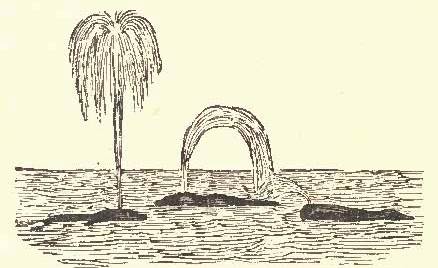
1. Finback. 2. Right whale. 3. Sperm whale. December 25th. – This was a day of general starvation and discontent. I had never spent such a Christmas before, and I devoutly trust I never shall again. At sunrise I went to the mast-head. The weather was raw and boisterous, and the sea very rough. I had three hours aloft, after which I was relieved by one of the Portuguese, and went down to enjoy the luxuries of a cold pot of coffee and some hard biscuit. At dinner-time there was no meat for us fit to eat, and the cook had spoiled the "duff." Some of the crew went aft to the captain, and complained that, as it was Christmas-day, we ought to have something to eat; but the captain did not seem to consider any such luxury as eating and drinking at all due to the crew of a whaler; so we were compelled to take a reef in our belts and wait patiently till supper-time. We fared little better then, being short of meat, and having tea unfit for use. |
December 29th. – About two P.M. we crossed the meridional line which divides the Atlantic from the Indian Ocean, in lat. 37° 19' south. From five P.M. till three A.M. we lay becalmed. January 8th, 1843.-For the first time since the beginning of the year, I am enabled to pen a line in my journal. On the first of January, a severe gale arose from the southwest. The weather had been extremely cold for several days previously, and the threatening aspect of the clouds gave us due warning of the gale. We were obliged to take down the top-gallant-masts before night. At nine P.M., furled the spanker and gib, close-reefed the top-sails, and soon after furled the fore-sail and main-sail. The gale continued to increase every hour. At midnight all hands were called to take in the waist boat. This was a very difficult job, as the sea broke over the vessel with such tremendous force as to render it almost impossible to hoist her off the cranes without staving her to atoms against the bulwarks. After an hour's hard labor, we got her bottom up on the try-works, where she was securely lashed. Next evening we took in the larboard and starboard boats, and lashed them to the ringbolts on the quarter-deck. On the morning of the third the sea raged with all its fury, washing the decks fore and aft. Every stitch of sail except the main spencer and fore-top-mast stay-sail was taken in. The condition of the ship at this time baffles description. Every sea dashed through the scuttle |
and drenched the forecastle, flooding our beds, and tearing our chests from their cleets. For four days we knew nothing of the comfort of a dry bed, a change of clothes, or a regular hour's rest. Eating a comfortable meal was a species of enjoyment pleasant enough to reflect upon, but with us a thing of by-gone days. The barque rolled so violently in the trough of the sea, that it was difficult to sit down without being pitched headlong from one side of the forecastle to the other. Pots, pans, spoons, and kids flew through the air like hail; and occasionally a dirty piece of pork, a scrap of hard biscuit, or a pot of muddy coffee, might be seen making a desperate attempt to escape the extended jaws of half a dozen hungry Portuguese. We all ate below; and if ever there .was a miniature representation of the Black Hole of Calcutta, it was the forecastle of the styx. The scuttle was made as close as possible, to keep out the heavy seas, but it also excluded the light and fresh air. Some of us lay sprawling on the floor, gasping for a breath of pure air; others lay in their bunks, braced up with logs of wood at each side to keep them from rolling out. The Portuguese chattered at the highest pitch of their shrill voices, drowning even the roaring of the gale. Bill Mann growled worse than ever. "He'd be everlastin'ly shivered from clew to earing, if it wasn't the cussedest old tub he ever sailed in. Shiver his top-lights if he wouldn't like to see her sink. He'd seen vessels before – yes, he had, all sorts; and he had sailed in all |
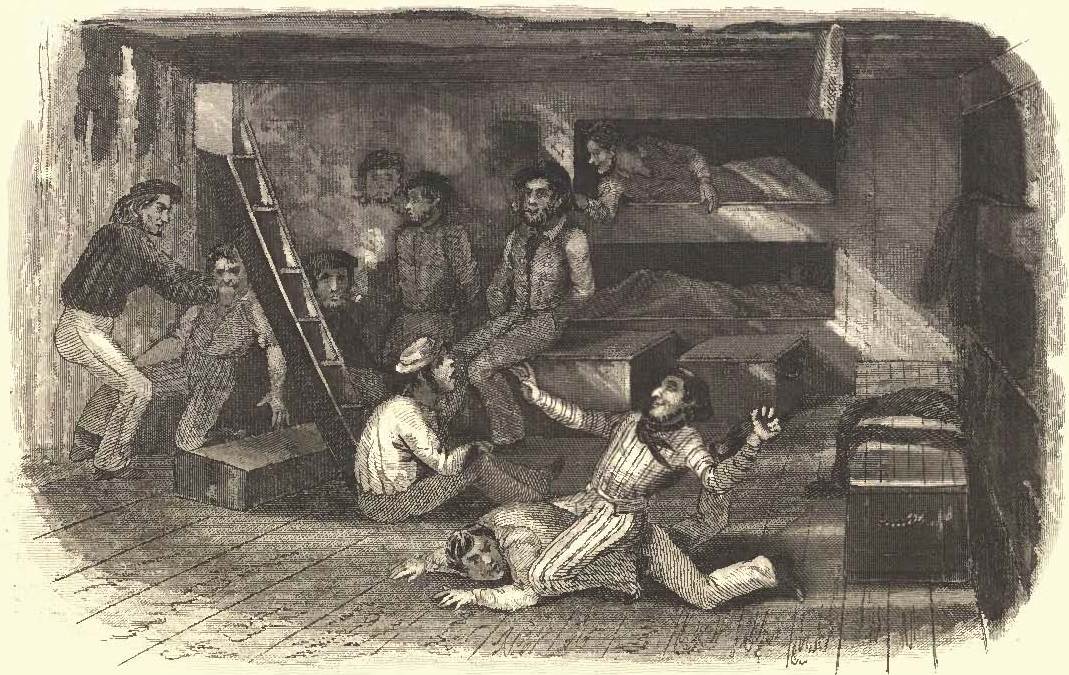
LIFE IN THE FORECASTLE
|
sorts, and he had taken it rough and tumble in all sorts of weather, but a bloody old blubber hunter beat all, partic'larly when men got nothing to eat, and lived on hard work, and hadn't a forecastle fit for a hog to waller in. That was the way to tell it. Yes, and he'd let the counsel know how things was done, at the first port; and if he didn't see a counsel there, he'd let the President of the United States know it, when he got home, if he ever should get home, in such a dirty, lubberly, crazy, rotten old craft." It was really interesting to witness the effects of continual annoyances, privations, and hardships upon the different characters in the forecastle at a time like this. Jack Smith, the rolicking, boisterous young Englishman, told the most marvelous stories of the perils he had undergone on divers occasions, and swore, with a torrent of the most awful oaths, that for nineteen days he lay on his back once, upon a plank in the middle of the sea, without any thing to eat or drink. Barzy M'F–– seemed to look upon all the dangers and hardships of a gale as something highly pleasant and amusing, but "he didn't know as he'd ever seed any thing like it up the Kennebec." Bully employed himself quarreling with the Portuguese part of his time, and part yelling at the top of his voice snatches of obscene songs or watch-house ditties. Charley smoked his pipe and mended his clothes. Tom Vernon sat with his face buried in his hands, meditating upon past times, |
and apparently unconscious of every thing around him. I pitied the poor lad from the bottom of my heart, for my feelings were in unison with his. On the evening of the sixth, the gale fell off to a good steady breeze. Next day we got up the top-gallant yards, and set the studding sails. Very little worthy of record occurred on our passage from the Cape of Good Hope to Madagascar. The weather was generally rough, and I had few opportunities of writing or reading. I commenced the study of navigation, however, soon after we entered the Indian Ocean. Mr. P––, the second mate, who had all along been a very kind friend to me, lent me a copy of Bowditch's Navigator, and allowed me the use of his instruments. Aided by a little instruction from him, I soon mastered the elementary branches of navigation, a science with which every sea-farer ought to make himself acquainted, whether before the mast or aft. My watches below were divided between this study and patching my clothes, which had suffered considerable wear and tear in the late gales. Toward the latter part of January, while steering for Fort Dauphin, Madagascar, under lower and top-mast studding sails, the man at the top-gallant cross- trees saw a spout two miles off the weather-bow. The studding sails were hauled in, the main-top-sail hauled aback, and the three boats lowered. Our boat got the start, but came upon the whale's eye as he rose the second time. The starboard boat lay |
off, and took him head and head, so that she was ready to strike the moment he appeared, and succeeded in making fast with one iron. The mate's boat came up next; then ours. We gave him two irons, but, in backing off the line, got foul of the starboard boat, and were obliged to cut away. We hauled up by the other line, and gave him a lance or two, which dispatched him in a few minutes. Owing to the roughness of the sea, we had much difficulty in getting our prize alongside. This whale yielded forty-five barrels of oil, which is considered a medium size. The largest sperm whale I ever heard of yielded a hundred and twenty barrels. In the Indian Ocean whales of that size are not so common as in the Pacific. January 28th. – While trying out our last whale we made Madagascar, in the vicinity of Fort Dauphin. The coast here is high, and, in parts, bold and mountainous. At the distance of forty miles the land was covered with hazy clouds, giving it a very beautiful appearance. We cruised off and on for a few days in search of whales; but although we saw several schools, they were making a rapid passage for the bays on the coast of Africa, and gave us no chance for a chase. February 2d. – Rounded Cape St. Mary, the most southerly point of Madagascar. The coast here is very low. Running down the eastern side of the cape, we approached within fifteen miles of the shore, at which distance we could discern the huts of the |
natives scattered along the beach, and occasionally a canoe. February 9th. – After a short cruise in Mozambique Channel, ran down for Madagascar, which we made a few leagues to the southward of St. Augustine's Bay. At ten A.M. made Sandy Island, or Nos Vey, a low sand-bar, covered with a small growth of trees, lying seven miles off the mouth of the bay. A coral reef, lying near the entrance of the bay, is seen from the eastward of Nos Vey. We passed close along this little island with the intention of anchoring; but finding no vessels in port, the captain deemed it prudent not to trust to the friendly invitations of the natives, who crowded down to the shores in great numbers; and hundreds of whom were rapidly pulling toward us in a large flotilla of canoes. The Sacklaves, a tribe of the Malegashy inhabiting this part of the island, are described as a race of blood-thirsty and treacherous people, very friendly when a large number of vessels are in port, but not to be trusted alone or without being well armed. Mr. P––, our second mate, had spent nearly a month in St. Augustine's Bay. He was well acquainted with the character of the natives, and had seen a shipmate of his murdered by a gang of them for attempting to recover some stolen property. At four P.M. we hauled off, and continued our passage up the Mozambique Channel. It was expressly laid down in the code of laws which the captain gave us a few days after we left |
New Bedford, that any fighting that was to be done would be promptly attended to by himself. Up to the time we touched at Fayal the forecastle was tolerably peaceful. Bully had raised a few fights with the Portuguese, but they ended without much personal damage to the belligerents. When Jack Smith, the young Englishman, was shipped, our trouble commenced in reality. Jack and Bully were sworn friends the moment they met. They went shares in every thing. Whatever was Bully's was Jack's, and whatever was Jack's belonged to all hands in general, and Bully in particular. For the first two or three days it was truly an interesting study to watch the progress of a spontaneous friendship between these two affectionate youths. They made presents to each other, spun yarns to each other, sang together, and bunked together. Their friendship was so sudden and violent that I very much feared it would be of short duration. A week realized all my solicitude. They quarreled, cursed each other, parted the bond of fellowship, and became bitter enemies. In a few days they made up again, and were more devoted in their friendship than ever. Their next quarrel was more violent than the first, and they did not speak a word to each other for a week. However, they made up again, and thus continued, quarreling and making up, daring each other to fight, and backing out when it came to the pinch. These quarrels kept the forecastle in a perfect ferment. There was no peace, from one week's end to another. Being |
well matched in size and strength, neither wished to be the aggressor. At length an accident gave them a fair opportunity to test their pugilistic powers. One morning, while we were cruising in the Mozambique Channel, after the word was passed for breakfast, Jack started to run down the ladder with a pot of hot coffee. Bully had just turned out, and was running up. The two heroes came in contact. Bully got scalded, and, under the influence of the pain, struck Jack. Upon this both parties closed, and a desperate fight ensued. They had it up and down the forecastle, right and left, here and there, for about ten minutes; when Jack took a foul hold on Bully. "Let me go!" roared Bully. "Cry enough!" said Jack. "I won't! let me go!" rejoined Bully. "Blow me if I do!" retorted Jack; and there was another scuffle for five or ten minutes. At length Bully got clear, and clinched Jack by the shirt collar. Pressing his knuckles hard upon Jack's neck, he continued to tighten his grasp till Jack's face turned purple. "Cry enough!" shouted Bully. "Give me a chance!" replied Jack, gasping for breath. "Are you licked?" demanded Bully. "Not yet!" said Jack. "Give me a knife, somebody, or cut my shirt open. Cut! cut! I'm choking!" |
"Choke and be d––d!" said Bully. The advantage was rather on Bully's side, when the mate came up to the scene of action, and knocked him down. "Now take that for a foul hold!" said the mate. "Mr. D––, if there's law in America, I'll have it!" said Bully. "Don't law me, you infernal scoundrel!" "You'll pay for this when you get home, sir!" "None of your jaw!" "I'll have revenge for that blow!" "You will, will you?" shouted the mate, rushing upon him again. Bully dodged, and made his escape. As soon as the mate went aft, Bully and Jack went to the waist to wash the blood off their faces. The captain perceiving what had occurred, called then aft, and, without any comment, ordered them to sit one on each side of the companion way. When breakfast was over in the cabin, the captain came on deck, and sang out for the mate. "Mr. D––, call all hands aft. Come down from the mast-head, every body." It was my trick at the helm, so that I had an excellent opportunity of witnessing the whole scene. The hands being ranged at the break of the quarter-deck, and the boat-steerers by the main-mast, the two belligerents were called up to give an account of themselves. "Blair, what have you been fighting for?" demanded the captain. |
Here Bully gave his statement of the difficulty. "Jack, what have you been fighting for?" Jack stated the case very fairly. "Now," said the captain, "you've been fighting, and I'll flog you both. Mr. D––, seize those men up!" Jack's wrists were lashed to a ratlin on the starboard side, and Bully's to a ratlin on the larboard. The captain then provided himself with a piece of tarred ratlin, and, striding up to Bully, bared the man's back. "Remember, now, this is for fighting." "Oh, for God's sake, don't flog me, captain!" said Bully, sensible of the degradation of the punishment about to be inflicted on him. "Not a word!" said the captain, whose blood was boiling with passion. Take that! and that! and that! Do you feel it? Will you fight again?" Poor Bully groaned and writhed with agony. Each stripe of the ratlin raised a blood-red mark on his back. "I'll show you how to fight!" roared the captain, swinging the ratlin over his shoulder, and raising the stripes with every blow. "I'll make an example of you! Take warning, all of you. You see what you get for fighting. If that ain't enough, I'll lay it on heavier next time. I'll skin your back worse than that! Cut him down now! See if he'll behave himself!" Jack's turn came next. At the first stroke he yelled with all his might. |
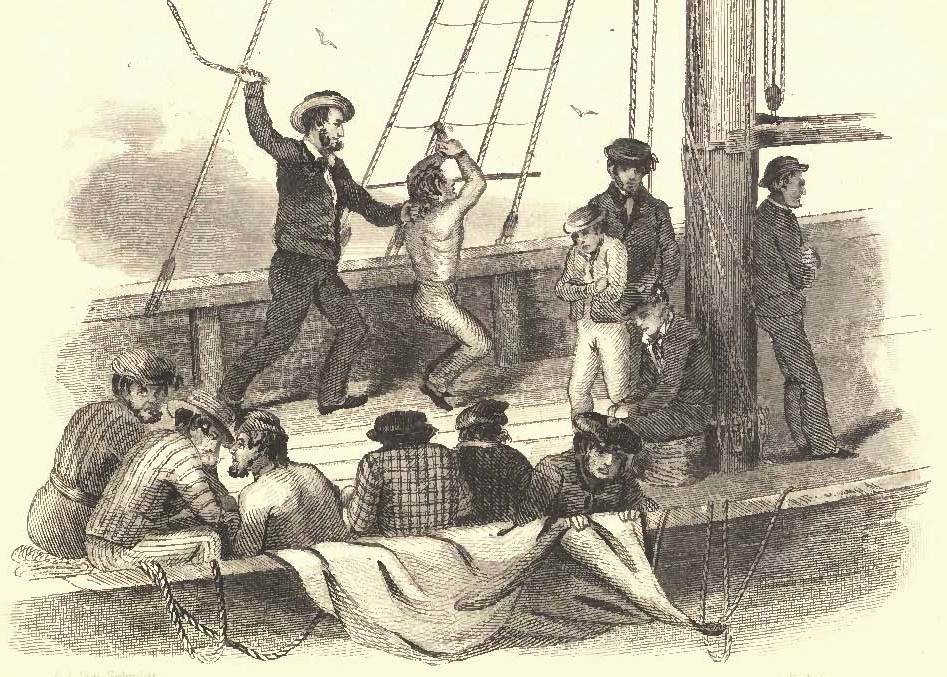
A PICTURE FOR PHILANTHROPISTS.
|
"Oh Lord, captain! Oh, for God's sake! Oh, don't flog me! I'll never fight again." "I'll take care you won't. If you do, I'll lay you up for a month. Your back's been itching for a flogging. Now take it! Take that! take that! Yes, you feel it, don't you! Cut him down, Mr. D––." The mate having cut both the men down, gave them a hint to go forward, which they did, limping along the decks, scarcely able to walk. "That's what you'll all get," said the captain, addressing the crew, "if there's any more quarreling. I told you so in the beginning. Any of you that fight, I'll flog. Go forward now, where you belong." I was much astonished, upon going forward, after being relieved at the helm, to find Jack sitting on the windlass eating his breakfast with the utmost good humor. "Well, B––," said he, looking up and laughing, "I've got a licking, but I'm used to it. I don't care a tinker's d––n about lickin's now. I served my apprenticeship to 'em in a man-o'-war." Not so with Bully, who for several days was gloomy and silent. The Portuguese, with a heartlessness and want of delicacy, so unlike the generous regard which the true American sailor has for another's feelings under such circumstances, continually ridiculed and taunted him, mocking his groans, and crying out every time he went below to his meals, "Oh, capitan, for God's sake, no flog so |
hard!" Jack took their ridicule with perfect indifference; but it cut Bully to the quick. There was something diabolical and fiendish in this conduct of the Portuguese. Bully was so complelely crest-fallen that he could not retort upon them; from the day he received the flogging his spirit was broken. CHAPTER XII.
March 6th. – Made Makumba, a small island lying within four or five leagues of the main island of Madagascar. As it was uncertain how soon we should reach Bembatooka Bay, and being entirely out of wood, we were compelled to run the risk of falling into the hands of the natives here, who frequent this island as a piratical rendezvous, where they can intercept small craft bound to Bembatooka Bay. The waist-boat's crew had watch below; and it being the rule for those who were off duty to go ashore, or on any expedition like the present, I was lucky enough to be among the number chosen for this adventure. |
The larboard boat was lowered, and manned by Tabor, Jack Smith, myself, and three or four Portuguese, with the captain to ornament the stern sheets. The island did not appear to be more than two leagues off when we started; but, after pulling hard for about an hour, it seemed quite as far from us as when we were on the deck of the barque. Whether this fact was owing to a head wind or an ebb tide, I could not say. It reminded me of an island I had read of in a beautiful lake presenting a thousand attractions, but always receding from those who attempted to reach its favored shores. Sometimes I fancied I could see the pebbles on the beach; the next moment it seemed as far away as ever. In addition to the fatigue of rowing under a burning sun, we had a still greater difficulty to contend with. Our water keg was nearly empty. Captain A–– recommended us to be very sparing of what we had, as there was no water on the island. In about three hours from the time of starting, we hauled the boat up on a white sand beach. The captain cautioned us not to lose sight of the boat, and then ordered us to take our axes and start off in search of wood. I must confess, when I got out of the "old man's" sight, I thought very little about the savages or the wood. The novelty and excitement of exercising my limbs once more on land, after being cooped up for several months in a small barque, were so great that I ran up the cliffs like a wild Indian, leaving my |
comrades behind me, and shouting for pure joy. In my ramble I soon lost sight of the boat. The shade of the trees in the interior of the island; the tall, luxuriant grass; the extreme richness of the vegetation, and the grateful perfume of the wild flowers, were all indescribably refreshing. I grasped up bunches of weeds to enjoy their fragrance, for all the vegetable creation then seemed fragrant to me. Eager to see every, thing on the island, and perceiving no traces of habitation, I ascended the peak, or highest part, from which a splendid view may be had of the whole island, and the adjacent parts of the coast of Madagascar. There is a savage wildness in the prospect peculiarly striking to one who had never gazed upon any save the familiar scenery of civilized countries. The boat's crew appeared like little black specks upon the beach; and their voices, mingled with the roaring of the surf, were the only sounds that reached my ear. Far away on the horizon floated our little barque, which had drifted from land till her hull was barely visible. Clouds piled upon clouds, with bright, silvery outlines, hung over the distant horizon in the most gorgeous array. I was lost in the magnitude and sublimity of the scene. I thought that even the untutored Sacklaves must gaze with admiration upon such a manifestation of the might and power of the Great Spirit. My enthusiastic flights of imagination were suddenly dissipated by the harsh voice of the captain, shouting, |
"You B––, where the devil are you?" "Here, sir." "Go, down, then, and help to get the wood in the boat." This soon convinced me that I had been day-dreaming, and the thought that I was still a slave was depressing enough at such a moment. I envied the freedom of the sea-gulls as they wheeled past me in their sportive flights; but such thoughts were unavailing, and I sprang down the cliffs with my axe on my shoulder, to aid my comrades in chopping the wood and putting it into the boat. The sun shone upon the beach with a heat so intense as to blister my feet through my shoes. Parched with thirst, I made my way to the boat, where I barely squeezed enough of water out of the keg to wet my lips. The rest of the crew suffered dreadfully from thirst. Tabor, as usual, in a good humor, told us to "grin and bear it," and he'd insure us a drink of switchel when we got aboard. After we had procured a sufficient supply of wood to last us to Bembatooka Bay, we sat down on the beach and ate some salt pork and bread, which the cook had stowed away in the boat. I picked up several shells and pieces of coral before we pushed off, as relics of my visit to Makumba. When we pulled ashore we had the land breeze to contend with; now we had the sea breeze against us. This was very provoking. We were all tired of our day's work, and parched with thirst. |
The barque bore down for the island as soon as she took the sea breeze, and was rapidly nearing us, when the wind died away again, and left her to drift away on the current. I found that the salt pork, instead of strengthening me, aggravated my thirst to such a degree that I actually thought my end was approaching. The heat of the sun, upon losing the breeze, became excruciating in its intensity. How I got over the horrors of that evening I can hardly tell. I held out, and pulled my oar as long as it was possible to endure the heat and thirst; for I would not be outdone by any of my comrades while I had the breath of life in my body, or strength to lift the oar. At this crisis a light breeze again sprang up, and we lay on our oars till the vessel reached us. I think I never sprang aboard with more joy than I did when we hauled up alongside, after all the sufferings of that day. I felt an undisguised affection for every old rope, shovel, broom, and handspike aboard; and even the smell of the try-works was agreeable to me. Tabor, true to his word, had us a bucket of switchel made. I verily believe I drank half a gallon of it before my thirst was slaked. I had read in Mungo Park's travels, and in the narratives of Denham and Clapperton, of the horrors of thirst in the deserts of Africa; but I never really sympathized with those adventurers till my visit to Makumba had given me some idea of their sufferings. March 8th. – Anchored off the mouth of Bemba |
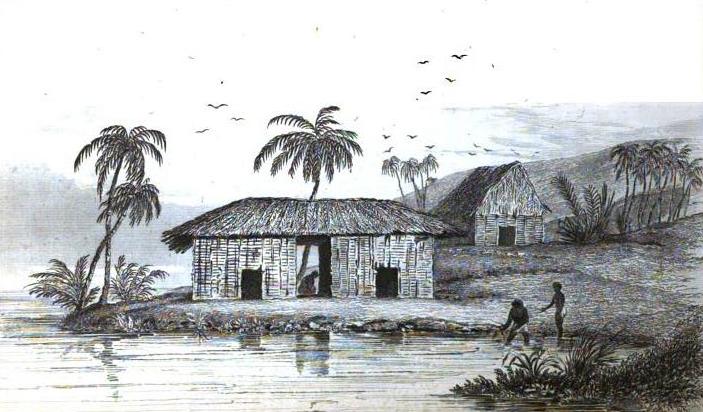
MAJUNGA HOUSES, BEMBATOOKA BAY.
|
tooka Bay, and lowered the larboard boat. After an hour's hard pull against an ebb tide and head wind, we rounded Majunga Point, opposite which we stopped to take soundings. In half an hour more we sounded a long sand-spit, just above the town of Majunga. Crowds of the inhabitants came running along the beach, inviting us to land. They wore turbans of all colors, and long flowing robes of white cotton, having a very picturesque appearance. The moment we hauled up on the beach we were greeted by a "good-morning" from the natives, who stood there awaiting our approach. The captain went up in search of two American traders, who, he understood, had been left at Majunga to procure cargoes of hides for Salem vessels. I was quite surprised to hear English so well spoken by a race of people represented by travelers as rude barbarians. Several of the small boys seemed to be so proud of the few words they had learned from the sailors, that they made the most ludicrous mistakes in their attempts to make themselves understood. I was continually addressed by little urchins, not more than nine or ten years of age, in the following strain: "Me speakee bon goot Engleesh. Me sabe plenty goot much. How you do dees morning? Very well, tank you; me much worse better no goot go hell Got tam! Hein? Hein? You Tink me no sabe plenty Engleesh?" Those who could speak the most intelligible English told me they were from Johanna. |
Mf––, who, like myself, had never been in a savage country before, was very anxious to see what the natives looked like, and how they were off for "fodder." Taking advantage of the captain's absence from the boat, we walked down along the beach to the outskirts of the town, where we would not be within hailing distance in case we were immediately called; being in no hurry to go on board again, and hoping the captain, in his anger, would leave us ashore till his return in the evening. On reaching the lower part of the town, we saw at a short distance a snug-looking bamboo hut, surrounded by banana plants and a few straggling cocoa-nut trees. At the door stood two or three of the better class of the natives, who beckoned us to approach. We did not altogether like the looks of one of the party, however, a tall, ferocious-looking Ambolambo, whom I took to be a chief, from the warlike manner in which be was equipped. He was of a dark bronze color, naked to the middle, with the exception of a loose robe thrown over his left shoulder, and with a most extraordinary head of hair frizzed out like rope-yarns, and fantastically ornamented with feathers. The remainder of his costume consisted of a clouty round the waist, and a striped under-garment of native manufacture. In his left hand he held a long spear, the pole of which rested on the ground. His comrades wore turbans, and were apparently of a different tribe or caste. Knowing nothing of the character of these people, I |
was somewnat backward about trusting myself in their power, so far away from the boat, and consulted Mack as to the prudence of going any nearer. "Never mind," said the " down-easter;" "lay low and keep dark. I'll talk to that 'ere feller. You keep close in my wake, though, for I don't like the looks on 'em much better than you do." I did not altogether like the proposition of my comrade, but finding him resolute, I thought it would not do to let him go alone. The savage chief continued making signs to us to approach. Mack accordingly hitched up his breeches, and started for the hut, I keeping close by his side. A tall cocoa-nut tree a few steps in front of the chief served as a sort of mark for a truce ground, in case of hostility. Doffing his hat, Mack stepped up, and with an expression of mingled apprehension and curiosity, gazed in the face of the warlike savage, without uttering a word. At length, apparently satisfied that there was no danger of an attack, he addressed him in the most polite manner imaginable: "Good-morning, mister! how d'ye dew, sir?" "Ra kaka chee tooka whocha!" growled the savage (or something that sounded very much like this, for I do not pretend to give his remarks literally). "What the nation does the feller mean?" inquired the "down-easter," somewhat puzzled. "Say that again, sir." "Crak koo wanee tee cha booz!" |
"Well, if that ain't the darndest lingo I ever heerd! I say, old hoss,can't you talk American?" "Merikkaan? num whak chee taka-whee." "No, no; not that thar' outlandish nigger talk. American." "Merikkaan, si-mairre! si-mairre!" rejoined the savage, with a friendly grin. "Goot, goot, mans!" "That's it," said Mack. "I know'd you could talk it if you'd only hold your corn-trap straight. Now, old feller, suppose you stand treat? I'll bet you've got some liquor in thar' in that little crib o' yourn! What d'ye say?" "Goot, goot, mans!" "Well, then, let's have it, hoss." "Merikkaan!" "I say," exclaimed Mack, a little out of patience, "tain't no use to be a foolin'. If you've got the liquor, let's have it; and if you haven't, say so at once. Maybe you have some oranges or cocoa-nuts?" "Orangee? cokko? chee whoop ee!" "She'll whip me? Oh, now I know what he's at. He's afraid his wife'll whip him if he lets us have any thing. Well, we may's well slope. This feller don't know beans from porridge, no how." "Naka whozchee koo!" "Oh, you needn't try to mend it. You're nothin' but a dod-burned nigger, or you wouldn't be so mean." Hereupon we started to return to the boat, when the chief, advancing, took Mack by the arm, and |
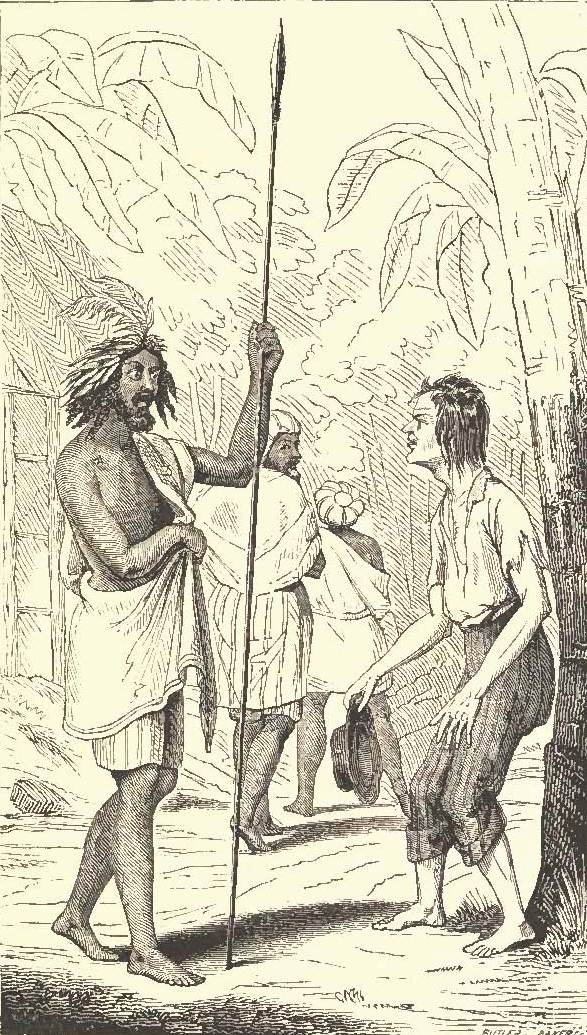
BARZY AND THE MADAGASCAR CHIEF. |
in a very friendly manner began to search his pockets. "Oh ho! that's your game, is it? You'll not find much thar', I tell you." "Goot, goot, mans!" exclaimed the savage, pulling out a jack-knife. "Well, what'll you give for it? Come, mister, I'm ready for a trade." "Whaka boo whoo! Goot, goot, mans!" "You can't come it that way, no how you can fix it. If you want to trade, I'll give you the knife for a dozen good oranges; and if you don't, jest hand it back. I ain't a goin' to be fooled, no way." "Merikkaan goot!" "Dod burn you, give me my knife!" shouted Mack. "Goot!" "To h––l with your 'goot!' I want my knife." "Merikkaan –' "Look here, nigger!" roared Mack, flinging down his hat in a great passion, "that won't do, no how. If you don't give me my knife in tolerable short order, I'll be into you about as quick as a streak of lightnin'!" "Trokkoo saab kakakee," replied the chief, coolly thrusting the knife in his clouty. "Well, sir," said the Yankee, picking up his hat, "I'll leet you off this time. You don't know no better. But I'll tell you what it is, if I catch you down any whar' nigh the boat, I'll give you one of the |
darndest maulins you ever had. If I don't mash your ugly figure-head so you won't know whose it is, there'll be a most almighty fight, any how. Look out for it! I ain't agoin' to be cheated by any dod-burned black-faced nigger no way you can fix it, I ain't." On our way down to the boat, Mack let his wrath loose in a manner so entirely original that I could not forbear quizzing him about the loss of his knife. This made him very angry, and he protested, if I would only go back with him to see fair play, "he'd give that nigger a lickin' that would astonish me. He'd whale his soul-case till it wouldn't look like any thing I'd ever set my eyes on before." I need hardly say I declined the banter. The captain had not yet arrived at the boat. Jack, in whose charge we had left it, was seated in the bow, surrounded by a crowd of the,natives, with whom he was carrying on a rambling conversation in broken English. More fortunate than Mack or myself, he had sgcceeded in bartering his knife for a basket of oranges, which he generously shared with us; and we spent half an hour entertaining him with a history of our adventure with the chief. "I wish I'd ha' been there," said Jack; " I'll warrant you he wouldn't ha' got off so easy. I wouldn't ask better fun than to knock the bloody lights out of him!" I had a good deal of curiosity to see the American traders, having been nearly five months without see- |
ing a civilized being, except on board the barque; and there were none there particularly civilized. I expected a hearty reception from these two fellow-adventurers, believing that the sound of a new voice to them in their native tongue would be somewhat agreeable, after living for a length of time cut off from the civilized world. Charley and myself went up to the town, leaving Jack, with a crowd of natives around him, to take care of the boat. We found the captain and the two traders seated under the portico of a stone house, surrounded by great numbers of the natives, and an armed posse of the governor's soldiers. One of the Americans was a young man of genteel appearance; the other an elderly man, whom I took to be an Englishman, but I was afterward informed he was a citizen of Salem, Massachusetts. They both regarded us with a cold look of indifference, not deigning to favor us with a word. I had forgotten that I was dressed in a greasy whaling suit of duck; and for a moment I could scarcely realize the idea of American citizens meeting in a strange land without the least indication of that courtesy and civility which are the proverbial characteristics of the true American. That they were neither Virginians nor Kentuckians was very evident; and, besides, had I reflected upon the fact that they were accustomed to keep company with captains and other officers, I might have known that poor Jack could not reasonably expect any token of recognition from them. Still, I thought, as we were |
a little removed from the discipline of the ship, they ought not to have suffered the natives to outdo them in good feeling and courtesy toward strangers. After the captain had obtained some information relative to the town, and the best anchorage, we pulled aboard. "Man the windlass!" was the first order after dinner. We got under weigh about two o'clock, and, having a fair wind, ran straight into the bay, and dropped anchor in a favorable position for procuring wood and water. During the afternoon we were busily employed in breaking out from the hold, hoisting water casks on deck, and coopering and battening them for a raft. Anchor watches were chosen for the night, and the rest of us went below to enjoy the first uninterrupted night's sleep we had had for nearly eight months. Next morning after breakfast the mate came forward, and sang out, "D'ye hear the news there? Get ready to go ashore, the starboard watch." There was great commotion in the forecastle on hearing this: red shirts, white ducks, and tarpaulins were the order of the day. Two of the larboard watch, Jack and I, pulled the other watch ashore. On our return to the vessel, a raft of casks was ready, which we pulled ashore, and rolled upon the beach. We then went back for the rest of the watch. By sundown we had filled the casks, towed them alongside, and hoisted them aboard with a Spanish burden. In the larboard watch there were D––, the |
cooper, Antoine, Enos, Frank, and the cook, Portuguese, and Jack Smith, Bill Mann, and myself. It was our liberty day ashore next. Early after breakfast we went aft in our best sea-rig for calico and cotton handkerchiefs, about a dollar's worth of which was allowed each of the crew to barter with the natives. At the suggestion of some of the watch, I put my flute in my pocket. I was afterward very glad of it, as it procured me a kind reception wherever I went. The Portuguese went off to a grog-shop, kept by a native, who understood a little English; and Jack hauled up at the first hut where there were women. Accompanied by my friend D–– the cooper, I started off on a ramble to see the town. The houses are built of bamboo, and thatched with the leaves of the cocoa-nut tree. There is little furniture in them, except mats to sit upon, and a catanda or bamboo bedstead. The doors are about three feet high, so that the occupants, are obliged to crawl in on all fours. Majunga has a population at this time of about six thousand; but during the reign of the great warrior Radama, it, was much larger, having been burned down several times since. As D–– and I strolled along the principal street, we were hailed in good English by a black fellow sitting at the door of one of the huts, who proved, upon a nearer approach, to be Davy, a native, who had been several times aboard our ship. He had visited America in a whaler, and understood the |
English language very well. Davy invited us into the hut, where we found Mr. D–– and Bill Mann very agreeably situated between two copper-colored girls. Not wishing to disturb them, we hastened out as soon as possible, and made our way to the house of Mamoousa, one of the governor's officers, who had given us a very cordial invitation, when on board, to call upon him. It was a neat bamboo hut, situated near the market square, and formed quite a pleasant retreat from the heat of the sun. While seated upon a mat, enjoying a refreshing draught of air, I observed, sitting outside the back door, the most remarkable specimen of the human species I had ever seen – a living skeleton. The poor creature was seated with his back against the house, under the full blaze of a noonday sun. There was not a particle of flesh visible on his bones. As he wore no clothing, with the exception of a rag around his waist, the extreme emaciation of his form was entirely exposed. In many parts the naked bones were visible. Mamoousa informed me that this poor fellow had received a wound in the wars with the Sacklaves with a poisoned arrow, which wasted him away to his present pitiable condition. Our hospitable friend treated us to some cocoa-nuts and bananas, and introduced us to a couple of his wives, who, he gave us to understand, were at our service. D–– had always been lecturing us on board the vessel for all the carnal vices of our nature, and especially the lusts of the flesh, which, |
he maintained, were not only in conflict with the Mormon doctrine, but with every moral principle which ought to guide us in our way through life. He had also maintained, by repeated quotations from the codes of his church, that all illicit indulgences were most heinous and flagrant violations of the Mormon religion; a religion which, if embraced by mankind in general, would insure them a happy resting-place beyond the skies. Moreover, D–– never swore, or heard the sailors make use of obscene language, without giving them a great deal of wholesome advice. With such a companion, therefore, I would have felt perfectly secure from temptation had Mamoousa's ladies been much more attractive than they were; but they were sufficiently disgusting in themselves to keep me at a safe distance from them. Not so with my pious friend; for, while I was conversing with Mamoousa, D–– was engaged in a very suspicious pantomimic conversation with one of the dusky dames. I presume his object was merely to give her a lecture upon the great beauties and benefits of the Mormon doctrine; at all events, it would be uncharitable to put any other construction upon his mysterious proceedings. In about an hour, the mate and Davy called by for us to go to a dinner, which was ready up at Davy's house. We gladly accepted the invitation, and made all possible haste to the hut of our good friend. The dinner consisted of beef, soup, rice, boiled maize, and melons, which was something new to |
us, at least. We made a hearty meal, and remunerated Davy for his kindness by presenting him with a few yards of calico and a red flannel shirt. On our return toward the market-place, a melancholy object attracted my attention. In the middle of the ruins of a stone building, without a roof, sat a poor negro chained to a rock, and so covered with stripes and sores as to bear the appearance rather of a putrefied corpse than of a living being. I was told by one of the natives that this poor wretch was a native of Mozambique, who had wounded one of the governor's subjects with an axe. The governor had sent an account of the affair to the queen, who ordered the prisoner to be kept in irons till the decease or recovery of the wounded man should decide his fate. He had been in the situation in which we saw him for two months, and had entirely lost his hearing and the use of his limbs from the heavy night dews, and the cruelties inflicted upon him by his keepers. As he sat with his back against the rock, groaning in agony, and loaded with chains, I thought there could not be a more pitiable object upon the face of the earth. We gave him a few plugs of tobacco and passed on. D–– and I, determined to see every thing curious about town, struck out through a labyrinth of by-streets and alleys. We had reached the outskirts of the town, and were pushing our way through an avenue of bushes, when a voice from a shantee, or hut, at a little distance hailed us: "Hello, |
whar' you goin'? Come dis way; dis de place for white man." We went to the door of the hut, which was clouded with smoke issuing from within. I thought at first that the whole concern was on fire. Peering through the smoke, however, we recognized the dusky face of our friend Davy, who, grinning from ear to ear, invited us to walk in and take a smoke. This was what the natives call a smoke-house, where they pay so much a week to enjoy a gossip over the pipe. There were five or six Ambolambos squatted around a small fire, one of whom, the proprietor of the establishment, was employed in filling a large earthen pipe, the lower part of which contained water. This he passed round, giving each of the company a few puffs. Davy told us that it was a favorite substitute for rum, producing all the excitement of strong liquor without the evil effects. When carried to excess, it excites the system like exhilarating gas. The savage energy with which the natives in the hut went to work was really amusing. The smoke rolled up in dense volumes, and the perspiration teemed in streams from their dusky faces. Davy requested us to keep a sharp look-out, and he would show us how to enjoy a smoke. Stripping himself stark naked, he braced himself firmly against the wall, and took hold of the pipe. For several minutes he sucked with all his might as rapidly as he could gain breath. With excited features and distended breast he continued at |
this till entirely enveloped in smoke, when he paused from sheer exhaustion. The dense clouds around him clearing away, he again became visible, the perspiration teeming down his face, his eyes closed, and his whole countenance betokening great comfort and satisfaction. This operation he repeated frequently till entirely drunk. We left the hut highly entertained with the exhibition we had seen. In the course of our peregrinations we found our way to the public market-place, where new objects of curiosity attracted our attention. The butchers were squatted down under bamboo sheds, engaged in cutting up beef, weighing small pieces of silver, which form the currency of Majunga, and stowing away rice and other commodities, which they receive in exchange for meat. Scattered along through the market-place are several grog-shops or drinking-houses. Any one who is rich enough to buy a barrel of rum from a vessel trading between Majunga and the Isle of France can set up an establishment of this sort; the entire stock necessary being a barrel of rum and a gourd or cup. Besides beef and rice, the only articles we saw offered for sale were straw baskets, honey, plums, mangoes, lemons, melons, oranges, bananas, queen's ware, and a kind of cloth manufactured by the natives from the bark of the cocoa-nut tree. A stranger, ignorant of the actual value of such things, is charged double price for them. The currency is silver. Dollars are cut up into various-sized pieces, |
from the value of a cent up to ninety-nine cents. To prevent imposition, all who have considerable dealing to do keep small scales, with which they weigh the money. It is not an uncommon thing to see brokers' offices even in this savage land. A desk containing weights, pieces of silver, and a pair of scales, constitutes all that is necessary for an establishment of this description. The Madagascan bullock is not unlike the buffalo in appearance, but of a lighter and more active build. It has the hump on the shoulder, the thin flanks, and deep chest. The hair is short and sleek, and the legs formed for fleetness. As they run wild about the island in large herds, their flesh is tough and muscular, and, of course, not to be compared with our domestic cattle. The hides are purchased from the natives in large quantities by the traders stationed at Majunga for that purpose. Nothing can be more cruel and disgusting than the manner in which cattle are butchered here. The victim is made fast to four stakes firmly driven in the ground, so that he can not move, and in that situation is at-tacked by a gang of boys and men, armed with knives and axes, who chop and hew at him till his limbs are cut away, and he falls to the ground, bellowing with pain. I saw a bullock butchered in this way, which, to prolong the sport, was suffered to run around the market square for nearly an hour on three legs, with a gang of boys after him, yelling and laughing at the attempts of the poor animal to escape. |
While examining every object of curiosity in the market-place, the mate came along and invited us to accompany him to the fort and the governor's palace. A pleasant walk of about half a mile brought us to the top of a hill upon which the fort stood, directly in front of the governor's residence. The gate was guarded by a number of soldiers, armed with spears and muskets. We sat down on a low stone wall in front, not being allowed to enter the premises of his sable mightiness, Hoy Audrimaro, without a permit from himself or his chief officers. Within the inclosure is a tall staff with a white flag bearing the name of the queen in large black letters: RANARALO MANJAKO. The captains of vessels are allowed to visit the governor at any time; but sailors and subordinates are treated with a dignified contempt by this important functionary. Bearing in mind that "music hath charms," &c., I drew out my flute, and, as a number of the soldiers had already seen it in the town, they gathered around me in crowds to hear me play: I struck up "O dolce concento," with variations. At the end of each variation they clapped their hands, and cried out, "Maivre! maivre!" signifying Good! good!" accompanying this exclamation with a grunt of astonishment. They had apparently never seen a flute. I found that fiddles and banjoes were quite familiar to them, and many of them had instruments of this kind rudely constructed by themselves. They use an instrument made of reed, somewhat like a |
flute, and a "bambooa," or large bamboo, about two feet long, with strings peeled from the bark, under which are placed pieces of wood, forming a rude imitation of the guitar, and not unlike it in sound. While I was entertaining the soldiers with my flute, the governor's secretary, Ami Selamica, a small, dark man, habited in a light cotton robe, and armed with a spear, came to the gate and listened with great attention until I had concluded, when he expressed his satisfaction in good English, and requested me to play a waltz. Wishing to know if he really had any idea of the difference between the time of one tune and another, I asked him to whistle the waltz he wished me to play. To my great surprise, he gave me with great accuracy the Queen of Prussia's waltz. I had much curiosity to get a better view of the governor's palace than we had from the outside of the gate, and I told Selamica if he wished me to play I must go in, as the crowd was too great outside. Eying me very keenly, he observed, "Governor no allow sailor in. Are you sailor?" Knowing that sailors were not admitted, I replied, "Why do you take me to be a sailor?" "You wear blue shirt." "True, but any body can wear a blue shirt. You don't know whether I'm a sailor or not. Perhaps I'm the captain's son." "Capitan's son? Oh well, suppose you capitan's son, I go see the governor. Stay there. Presently Selamica return;" and, so saying, the secretary went off full speed to see the governor. |
D–– and the mate were highly amused at the trick about to be played upon Selamica and the governor; but my scheme was frustrated by the fact that his sable highness was taking a nap and could not be disturbed. The secretary, however, shook hands with me as I was going away, and invited me to call again, promising to speak to Hoy Audrimaro of my musical powers, and obtain leave to admit me. The mate, D––, and myself, spent the remainder of the evening walking over the hills, and enjoying the refreshing sea breeze. The scenery in the vicinity of Majunga is not very prepossessing, being barren and rocky, and the vegetation crisped by the burning rays of a tropical sun. The beach is in many places of snowy whiteness, which renders it very painful to the eyes at particular periods of the day when it reflects the sun's rays. Within range of the eye are the opposite shores of Bembatooka Bay, presenting a dreary waste of inhospitable rocks and inland, and a succession of hills and barren land, with scarcely a patch under cultivation. On the margin of the bay, near the lower part of the town, are a few plantations very indifferently cultivated. It was nearly sundown when we reached the landing. The waist boat was already waiting for us, and, as soon as the stray liberty men could be gathered together, we went on board, having thus spent our first liberty day. The captain and mate were still on very bad |
terms. Nothing went right; nothing suited the "old man." He was continually snapping at the officers, and particularly at the mate, against whom he entertained the most inveterate feelings of enmity. As a natural consequence, there was a general relaxation of discipline, and all hands did pretty much as they pleased when out of the captain's sight. He annoyed the mate in every possible way, and the mate retaliated by abusing him before the men; so that, to use his own language, "the barque was going to the devil as fast as she could." During the middle watch one night, while we lay at Majunga, a squall came on. We began to drag anchor. The mate was unwell, and the man on deck called the captain. When he came on deck, be found a pile of casks on the chain of the starboard anchor. In a furious passion, he called upon the mate to turn out. As soon as Mr. D–– made his appearance, the captain turned fiercely upon him, and addressed him in the most violent language, part of which was drowned by the roaring of the squall. I could just hear the conclusion of his harangue: "Mr. D––, you lied to me. You told me a d––d lie. You said the chains were clear before I turned in." "And so they were, sir. I left them clear." "Do you call these clear? Mind what you say. Don't lie to me! don't lie to me! I'll larn you better! I'll show you how to lie to me, d––n you!" "Captain A––, I'm not used to such language |
from any man. You can believe:what I tell you or not; but don't tell me I lie, sir. I'll not stand it!" "I'll tell you what, then, if you can't pay more attention to your duty, I'll do your duty. I'll do it for you. Take warning, now. I've talked to you before." "I've always done my duty, Captain A––." "You have not! Do you mean to tell me I lie?" "Take it as you like, sir; you're determined not to be pleased with any thing I do; and, to tell you the truth, Captain A––, I don't care a curse whether you're pleased or not. My heart's blood wouldn't satisfy you. I've tried to satisfy you, but all h––l wouldn't do it." "None of your slack jaw! I've always seen mates obey orders without a word." "I've always seen captains attend to their own business. You interfere too much for your own good." "I'll make you attend to yours as long as you're mate of this ship. I've had enough of your insolence; I'll make you know your place hereafter." "You can begin now, if you like, Captain A––. I'm ready for you at any moment – in any shape. If you don't like what I say, you can help yourself. Come ahead, if you want satisfaction. I'm the man for you!" Like all bullies, the captain was a coward at heart; and the moment he thought there was some danger of a collision, he walked aft, muttering, |
"I wish to God you were out of the ship." "I wish I was!" retorted the mate; "and the sooner the better. Put me out just as soon as you please." The squall above and the squall below ended at the same time. As soon as we got the chain clear we went below, highly edified with the rhetorical exhibition we had just enjoyed. I spent my next day's liberty even more agreeably than the first. My friend D–– and I had received an invitation on board the barque to dine with a native of Johanna, Mohammed Desharee, reputed to be a man of wealth and distinction. We had given him numerous presents, and treated him with much civility and attention, so that we looked for quite a blow-out on our liberty day. When we got ashore, we were met by Mohammed on the beach, ready to conduct us to his house. He invited the whole watch to partake of the entertainment. We found Mohammed's house quite a palace in comparison with the generality of houses in Majunga. It was a large bamboo building, thatched with palmetto, and whitewashed outside. The interior was fitted up in the most curious and fantastic style. The walls were covered with Chinese plates, American looking-glasses, Arabian fans, flags of different-nations, Chinese pictures, old copper plates with inscriptions, Egyptian relics and charms, and various other curiosities. Iu the sitting-room were two sofas, with silk cushions, ornamented with gaudy |
fringe-work. Mohammed informed us, with a look of pride and exultation, that "this house was his; all this property was his; he had, four wives, two hundred slaves, five hundred head of cattle, two plantations near Majunga, and one in Johanna – all his." Notwithstanding his riches, he wanted payment for the dinner we were about to get, and that, too, before we ate it. We offered him a new shirt and several fathoms of calico; but he refused them with disdain, saying, "Give me more; I can no give you dinner for dis." Cursing the fellow for his meanness, we started off in high dudgeon to dine aboard the ship. He called D–– and me back, protesting that he did not intend to offend us; but that we had hurt his feelings by offering him any thing at all. After a long harangue, he wound up by asking us two to dine with him "as brothers," assuring us that he loved us "all de same as himself." The rest of the crew were mean time hull-down; and having no desire to go aboard, D–– and myself remained, determined at least to be even with him for his meanness in some way. By-and-by a table was carried in about two feet long, and a foot and a half wide. I now began to suspect the true cause of his treating our watch so cavalierly. He had boasted extensively of his great wealth; but the fact was, he neither had a table large enough to accommodate us all, nor more than three or four whole plates; and his vanity was too great to bear the humiliation of making a confession of the |
actual state of his household affairs. Dinner was served with all the pomp and display of a public banquet at one of the best hotels. The word was passed, a back door was thrown open, and six or eight slaves, each bearing something, entered in Indian file. After all the ceremony of setting the table, we had nothing to eat but a few hard-boiled eggs, a plate of rice, another of fish, and a panful of rice batter cakes. The table being too small to contain all, we were obliged to set some of the dishes on the chairs, and, so situated, my friend and myself sat down; Mohammed, seeing us look round apparently in want of something (which was true enough, as there were no knives or spoons visible), told us to "eat plenty much." Seeing no other resource, I took out a small pen-knife, which I fortunately had in my pocket. D–– was better off, having a jack-knife, and a fork with two prongs. I made some laughable attempts to devour the rice with my pen-knife. It was too slow a process, however, for a half-famished whaleman, and I commenced attacking the dishes with my hands. Mohammed seeing the difficulty, called to one of his slaves, who brought me a spoon. With this I got along well enough. We ate a hearty meal, such as it was; after which we took possession of the sofas, lighted a couple of cigars, and lay smoking like nabobs for an hour or two. Mohammed talked incessantly of his immense possessions, giving us to understand that he was the richest and most distinguished man in Majunga. |
When we were done smoking, he asked us to walk out to his plantation, which was about a mile below the town. We gladly agreed to the proposal; and off we started through groves of upderwood, brakes, and lagoons. In half an hour we arrived at the plantation, which was indeed a very pleasant place. The wide-spreading mangroves afforded us a cool and delightful shade, while the tall cocoa-nut trees, freighted with fruit, promised us something refreshing to the palate. Mohammed called a little boy, and ordered him to climb one of the trees for cocoa-nuts. With the aid of a piece of kyaa rope, which he placed in niches cut in the tree, the boy soon reached the top, and threw down the cocoa-nuts in abundance. This delicious fruit can only be enjoyed in perfection when eaten green, and directly from the tree. The milk is then rich and sweet; the pulp delicious, resembling white jelly or blanc-mange in appearance. We sat for about an hour under the refreshing shade of the trees, highly amused by the egotism of Mohammed Desharee. "These groves," said he, "of cocoa-nut trees, man-groves, oranges, plums; these fields of rice, maize, and plantains; these houses, and all the slaves you see, are mine – all mine." With this and other remarks of the kind he amused us, until the sun warned us to return to the boat landing. The boat not having arrived, we wound up the |
pleasures of the day at the market-place. I shall never forget the fun we had that evening. The sun had set, and the whole square was occupied by Mohammedan grandees, squatted on the ground, enjoying the cool of the evening, and chatting over the affairs of the day. I was hailed by a general cry of "Music, music." Drawing out my flute, I struck up " Clar de Kitchen," upon which an old man with a long white beard jumped up, clapping his hands and dancing about in great glee. He was followed by others, who crowded around me, till I presently found myself surrounded by the whole group of grave old Mussulmans, all dancing and shouting as if possessed of the devil. "Well done, Jack! play on! Maivre! maivre!" was sung out at the end of every tune. Others, seeing the fun, came running from all quarters, and in less than ten minutes I verily believe there were over two hundred men and boys, from eighty to five years of age, all shouting and capering around me. A gang of lads with drums came up and joined me; and such a confusion of sounds I never heard as was made that evening. I received the thanks and cordial good wishes of the whole company, with invitations to call at their houses and dine with them my next liberty day. The boat having by this time arrived, we went on board to pay for our frolic by hard work next day. Whenever I went ashore after the spree at the market-place, I was hailed from all quarters for "music." |
Majunga is situated on the northeast side of Madagascar. The inhabitants are mixed races, but chiefly of the Ambolamboe tribe, the most powerful of the Malegash. The wealthiest residents are descendants of the Arabs, from Johanna, Zanzibar, and the coast of Africa. The population of the town is composed of the Malegash, Sowhelians, a race between the Arab and the African, natives of Zanzibar and the Cormoro Islands, Africans, Hindoos, and Jews from the East-Indies. Beef, rice, fish, maize, potatoes, cassada root, yams, and fruit, are the principal articles of provision. The governor, Hoy Audrimaro, who derives his office from the queen, has great power, and is very much feared by the lower classes. His residence is situated on the top of a hill, about half a mile back of the town. An avenue, hedged in with bushes, and shaded with cocoa-nut, mangrove, and orange trees, leads up to the large massive wooden gate, which I have already alluded to as situated at the entrance of the square in which the palace stands. This gate is usually guarded by a corps of Ambolamboes armed with spears and muskets. The northern part of Madagascar is now under the dominion of a queen, whose name is RANAVALO MANJAKO. This is the most civilized part of the island. It is inhabited by Ambolamboes and straggling parties of the Sacklave tribe. The two great tribes are the Ambolamboes and the Sacklaves – one |
occupying the northern, and the other the southern parts of Madagascar. There is also a powerful tribe, inhabiting the central and mountainous parts of the island, called the Orahs. The Sacklaves and Ambolamboes have been engaged in a sanguinary war for upward of thirty years, and there is yet no prospect of its termination. I saw more cripples in Majunga than I had ever seen in any place of its size. Most of them had been wounded in the war with the Sacklaves, who use poisoned spears, the slightest wound of which is fatal, producing a sore that gradually destroys the whole body. The Ambolamboes are a fine race of men; tall, athletic, and well formed. Their simple costume displays their fine proportions and muscular limbs to great advantage. They are an indolent people, and, perhaps, owing to the fact that they do but little work, their hands are remarkably small. Constant exercise with the spear and war-club develops the muscles of the arms and chest, and renders them extremely powerful antagonists. I noticed but little distinction between the Ambolamboes and Sacklaves, except that of wearing the hair. The Ambolamboes leave it in its natural bushy state, sometimes ornamented with beads. The Sacklaves all wear their hair braided. Over the forehead are two wide braids covering the temples, and curiously drawn across the eyebrows, giving the countenance a stern cast, which is increased by a short mustache, and a |
tuft of beard on the chin. With their highly-polished spears and flowing robes thrown gracefully over the left shoulder, they are decidedly as warlike and fine-looking a tribe as one could wish to see. Those of the Sacklaves residing at Majunga are subjects of the queen, who had been taken prisoners in the war. If they attempt to make their escape or take up arms against the queen, they are instantly beheaded. Music and dancing are favorite pastimes with the Malegash. The young Ambolamboes in Majunga have a pole erected in the market-place, with niches in it, upon which they hang half a dozen drums every evening, and beat upon these and dance around them half the night. We could scarcely sleep on hoard the vessel in consequence of the uproar kept up at night by these drummers and dancers. There are several mosques in the town, in which the Mohammedans perform their devotions. Their manner of calling together their congregations is somewhat singular. Within a few yards of the well from which we procured our water stands one of these mosques. The back entrance faces the well. I saw numbers of natives performing their ablutions in a large trough of water, but paid little attention to what was going on. Presently my ears were stunned by a voice at the door of the mosque, shouting, in a wild, melancholy key, "Alla-ak-ba! Alla-ak-ba!" Casting my eye around to see whence the sounds proceeded, I saw standing at the mosque door a tall, |
powerful man, dressed in white, with a turban on his head, shouting at the highest pitch of his voice, "Alla-ak-ba!" followed by a long rigmarole not very intelligible to me. His hands were placed against his ears, as if to shut out his own wailing cry. About every five minutes he turned toward the pulpit and muttered a short prayer, and then resumed his dismal "Alla-ak-ba!" Gambling is a favorite pursuit of the people of Majunga. Seated at the doors of the houses may be seen at all times of the day groups of gamblers playing the exciting game. On Saturday the captain dined with the governor. In return, the governor was invited to dine on board the barque. Mamoousa was desired to explain that it was not customary for his excellency to visit vessels belonging to foreign countries, but that a deputation of the officers of the palace would be sent to represent him. On Monday, at twelve o'clock, we prepared ourselves to receive our distinguished visitors. They came alongside in a large canoe, highly decorated with ornamental fringe-work. In entering the cabin, the following was the order observed: General Merimaro, chief commanding officer. Melanzoone, captain of the fort. Mamoousa, captain of the body guards. Ami Salamica, secretary to the governor. Risalvo, first officer of the port. Rinejaro, treasurer, followed by several subordinate officers. |
These distinguished gentry were habited in various costumes, betokening their different ranks. General Merimaro was as black as the ace of spades, and looked for all the world like a servant in livery. Mamoousa wore an English dress, which seemed to sit very awkwardly on him. The rest of the company were dressed in the native costume of the Ambolamboes, which is decidedly the most appropriate and picturesque dress they wear. The dinner surpassed, in abundance and grandeur, any thing ever before given by our captain. It was, indeed, quite a matter of speculation for us, who looked at the proceedings with utter amazement, actually believing something had operated upon the captain's bowels of liberality. Two of the hands, Bully and Enos, were called aft to wait upon the darkies; an honor which had been tendered to me, but which I most respectfully declined, notwithstanding the tempting prospect of stray crumbs from the table. There was one pie, a real chicken pie; not very large, to be sure, for twelve or fifteen persons; but it was a chicken pie! and there was a piece of fresh beef, and a piece of salt beef, and a piece of fat pork! These were the substantials, particularly the pork, which, it was very well known, the natives would not eat. Then there was for dessert one bottle of wine, some molasses and water, and a kid of ship-bread! Oh! it was "a sadly touching sight" to stand by the cook's galley and witness the disappearance, one after another, of all these rarities; |
to be regaled with odoriferous fumes from the passing dishes; to see the steward dive down the companion-way to that "bourne whence no morsel returneth;" and yet, with whetted appetites, and a perfect appreciation of all that is savory, palatable, and refreshing, to be compelled to make a miserable meal of the remnants of dirty bread in the forecastle, sour molasses, and a few scraps of old horse. We lay about the forecastle deck smoking and talking, while the captain was entertaining his company. From the uproarious noises which we occasionally heard, it was quite evident that the sable gentry and their generous host were enjoying themselves to their entire satisfaction. Dinner over, the captain took out his calicoes, and, favored by the good-humor of his company, commenced trading with them. They knew too well the value of goods to be cheated; and none of them would submit to his extortions, when they could purchase goods from the trader ashore, of a better quality, for half the price. The result was that there was a general war of words, and the entertainment broke up with ill feeling on both sides. I went aft to the scuttle-butt to hear what was going on. Mamoousa, as he was about to jump over into the canoe, whispered in my ear, "You got one mean capitan. He no like American man!" The whole procession moved toward the gangway in disorder and confusion, and jumped over into the canoe, vociferating sundry benedictions on the barque Styx. |
Our recruit at Bambatooka Bay consisted of a very stingy supply of fresh meat and fruit, which lasted us about two weeks. Some of the officers procured a couple of mokaks and a Madagascar pup. The pup was called Mamoousa, and of course was a good Mohammedan. It was very amusing to see the effect produced upon him by the sight of a litter of pigs which we had on board. Whenever they got him into a tight corner, they were sure to give him a thrashing; but, being a good Mohammedan, he could not be forced to defile his teeth with the filthy swine. Rajapoot, a native, who had agreed to furnish us with wood, brought a large canoe alongside in the evening, containing about a whale-boat load, which was what he contracted to furnish. After we got it on board, the captain refused to pay the sum agreed upon. Rajapoot argued that he had fulfilled his contract, and was entitled to be honestly paid for his wood; but if the captain wished he would take it back again, he would do so. The captain would neither give it up, nor pay for it. Rajapoot went off in high dudgeon, swearing he would raise men enough ashore to take the vessel. As soon as he was gone, we were set to work clearing away the casks in the blubber-room, and stowing away the wood under hatches, it being the design to pay all dues "with the fore-top-sail." We were ordered to go to work very silently, in order that we might not alarm the natives by any symptoms of preparation to put to sea. That |
they might suspect nothing unusual, I was told to go out on the jib-boom and "blaze away" on my flute. I thought it rather a hard case to be obliged to participate in cheating poor Rajapoot, light as the duty assigned to me was; but this was not a matter of taste. The American portion of the crew all grumbled at the meanness of this trickery; and the mate said, "if he could raise three dollars, he'd pay for the wood himself, sooner than such an act of low, stealthy, contemptible meanness should be attributed to a ves- sel bearing the flag of the United States." We held a private consultation about raising a subscription to pay the bil; but, upon examining our effects, we were not able to scrape up even two dollars' worth of property; all our clothing consisting of a few miserable rags, for which we felt much indebted to the outfitter. It is treatment like this that renders the natives treacherous and hostile. There has been more done to destroy the friendly feelings of the inhabitants of islands in the Indian and Pacific Oceans toward Americans, by the meanness and rascality of whaling captains, than all the missionaries and embassies from the United States can ever atone for. "Pay them with the fore-top-sail!" is a mode of cheating the natives as common in practice as in theory. Such examples will invariably be followed; for where the vices of civilized life are sown, there they will grow. Watches were kept all night on the bow, but no |
attack was made. Next morning a strong ebb tide was setting out. At daylight all hands were called to weigh anchor. The wind died away before we doubled the sand-spit, and the tide drifted us ashore. We got out two whale lines, attached to a small kedge anchor, with which we warped her off the bar. A violent rain storm came on during our exertions to get off, which drenched us thoroughly, and by main force blew us off the bar. After we had gained the middle of the bay, the starboard anchor was dropped, and, for the first time since we left New Bedford, all hands were called aft to "splice the main brace!' We left Bembatooka Bay in the evening with a Hindoo passenger on board for Johanna. CHAPTER XIII.
In the course of a few days several of the crew were laid up from indulging too freely in fruit and vegetables ashore; and, owing to the number unable to do duty, we could lower but two boats after whales. "There she blows!" was sung out one morning; |
"a large school of whales!" The larboard and starboard boats were lowered. D––, Tom, Charlie, and myself remained on board to work ship. Frank, a raw Portuguese lad from the Western Islands, was put at the helm, being very unwell, and unable to do active duty. Captain A–– was, as usual when any of the crew were sick, in a savage humor. Having no person upon whom he could so well vent his ferocity as upon Frank, he roared at him to perform so many impossibilities with the wheel that the poor fellow became confused. The sea was very rough, and it was impossible to keep the head of the vessel to the wind. "Steady!" thundered the captain. "Can no keep her steady," said Frank. "Steady, blast you!" "She no stay steady!" The captain darted furiously upon him, and struck him a severe blow on the head. Pale and terrified, and totally ignorant of what he was punished for, the poor lad hung down his head to avoid the blows. "You dumb animal," shouted the captain, "didn't I tell you to put your wheel down? Answer me – answer me, I say! None of your whining! I'll flog the senses into you, if you don't understand me! That scuttle-butt knows more than you do! You're worse, a devilish sight, than the old sow. Won't you speak – won't you?" "No savey, sare," replied Frank, who, in reality, did not understand a dozen words of English. |
"You no savey, heh! I'll make you savey, you blasted two-pence head! I'll whale English into you! I'll see that you understand me when I speak to you:" so saying, the captain grasped a rope, and with all his might struck the boy across the face five or six times. "Oh capitan, me no savey!" cried Frank, staggering back, stupefied and almost blind. "Oh Christ, you kill me! What for you strike me?" "I'll make you savey! You've been long enough aboard to learn English. If you don't learn, it's your own fault. I'll hammer it into you. Now you know what you're flogged for, don't you? Answer me! Speak, blast you! Say something, you dumb beast! Grunt, if you will be a hog! grunt, I say!" Ignorant of what was said, and writhing with pain – for his face was swollen with blows – Frank only endeavored to suppress his cries of agony, as the captain shook him by the hair, and repeated the blows with the rope. If ever there was the impersonation of a demon, the captain was one. His cheeks were pale with rage, and his mouth foaming. "Why don't you answer me?" he yelled, in a voice husky with passion. "Have you no tongue? Are you speechless? If you can't speak, I tell you to grunt. Won't you do it? Grunt, you infernal blockhead! Grunt, you stupid ass! Bray, if you can't grunt. Bray, now, or I'll make a zebra of you! I'll stripe your back!" Still Frank made no reply. |
"You shall make some sort of noise, I swear!" said the captain; and, swinging back his arm, he struck Frank with all his strength several violent blows on the head and face with the rope's end. Antoine, a boat-steerer, who was standing in the waist, believing the boy was about to be murdered, ran up and interfered. This man, the captain well knew, had a violent temper when excited, and could stir up a mutiny among the Portuguese at any moment. Fearing that such would be the result of his cruelty, he endeavored to turn it into a joke, by ex- claiming, "Antoine! Frank all de same as scuttle-butt. He no got plenty sense all de same as hog. Hog can grunt; Frank can no grunt!" No one laughed at his joke, however; and Antoine, disdaining to make a reply, merely addressed a few words in Portuguese to Frank, and walked forward to the forecastle. Soon after this the captain was attacked with the jungle fever, which prostrated him almost to the verge of the grave. Four or five of the crew were also in a very low state. I can not describe the horrors of our situation, without incurring the charge of exaggeration; yet they were too real to need the aid of fiction. The Portuguese, conscious of superior numbers, and driven to desperation by hard fare and bad treatment, became insolent and mutinous. The very elements seemed to combine against us. Day after day we drifted about in strong currents, |
and beset by gales and heavy rains. If ever there was a hell afloat, the Styx was one. Things were in this condition when we made the Comoro Islands, on March, 20th. – The Peak of`Mayotta was visible distant twenty leagues. In the evening we made Mohilla, another of the Comoro Islands. March 24th. – Anchored in the Bay of Johanna. We found in port a British East Indiaman, and the whaler Bogota, of New Bedford, Captain F––. The Bogota had been out ten months, and had not heard from home since she left. March 26th. – At an early hour this morning we were visited by the secretary and suite of his highness the sheik of Johanna. Housein, the secretary, gave us to understand that it was customary for vessels, before coming to an anchor, to present Syed Mohammed, the sheik, with two kegs of powder, and as many pieces of calico as the captain might feel disposed to part with. The sheik professedly receives no port charges, but generally manages to extort presents of this kind to the amount of eighty or a hundred dollars from every vessel anchoring in the Bay of Johanna for refreshments or commercial purposes. As he has unlimited control over the natives, and can make a monopoly of the sale of all their articles, this system of fraud is carried on entirely for his own emolument. The waist and larboard boats were sent ashore for fruit and vegetables. I belonged to the waist boat, |
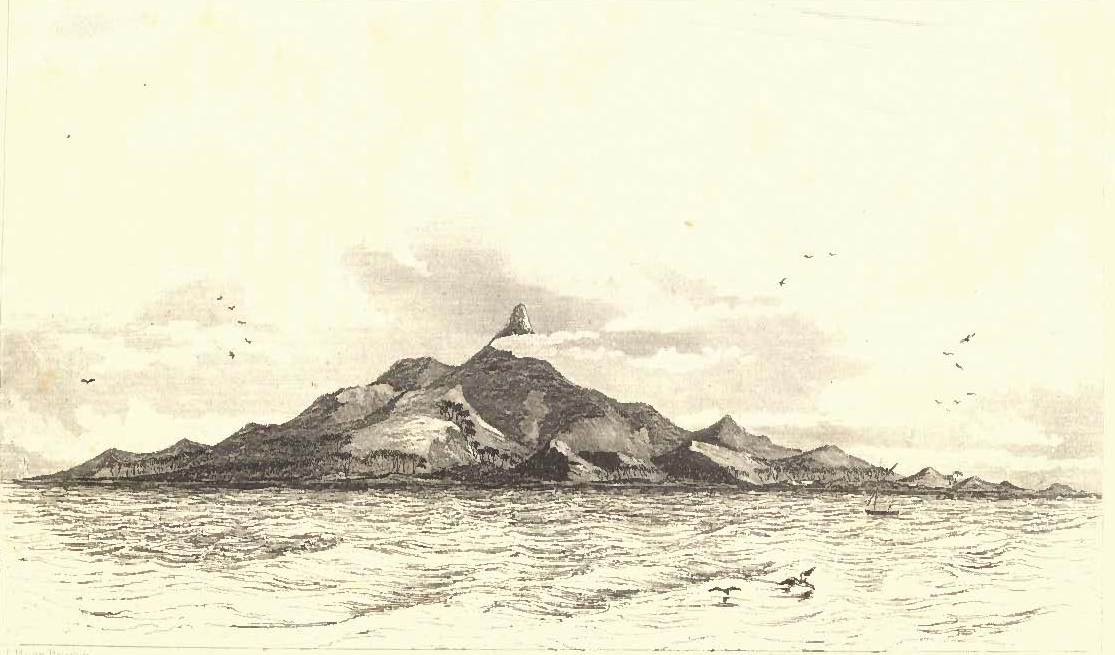
ISLAND OF JOHANNA.
|
which was commanded by the second mate, a friend of mine, and had a fine opportunity of seeing the town of Johanna. We spent the day ashore, waiting for the natives to carry down the recruit. Abdilla's slaves were to bring us eight or ten baskets of potatoes and fruit, which our friend, the Hindoo, had promised us for his passage from Majunga. I had nothing with me but a few plugs of tobacco, with which to purchase curiosities. Bembatooka Bay had left me pretty low in regard to my worldly affairs. I had bartered away all my trifles there; and, unless I pawned or sold my clothes, I couldn't make "a raise." We were all in debt: and money is too scarce on board a whaler to he loaned to a beggarly crew. The boat-landing at Johanna is rocky, and consequently very dangerous in rough weather. Artificial coves, constructed of rocks, protect the boats from the general swell of the sea, but form rather an indifferent barrier at high tide, or during the gales on the changes of the monsoons. Near the shore is a bed of white coral, extending a considerable distance into the bay. The sea is so clear over this bed of coral that bottom can be seen at a depth of ten or twelve fathoms. One can almost fancy himself floating in the air over magnificent hills and valleys of coral, so remarkably transparent is the water. It gives some idea of the enchanted worlds in the Arabian Nights. Thousands of fish, of rich and varied colors, sported beneath us; and in many places our eyes were charmed with beautiful shells of different species. |
We had a steady pull of about three leagues before we maDe the landing. The abruptness of the shore and the height of the mountains render the distance very deceptive. The cocoa-nut trees and orange groves were distinctly visible from the ship, and we naturally concluded she was not more than four or five miles off; but, after a pull of two hours, under a scorching sun, we all, agreed it was fully three leagues. The town of Johanna, called by the natives Henzooanee, stands on an inclined plane at the foot of a mountain. From the bay nothing is seen but a pile of roofs, commencing apparently at the water's edge, and, rising gradually, it reaches the base of the mountain. Upon a nearer approach, a barrier of rude stone walls is perceptible. This incloses the whole front of the town, and forms a sort of semicircle, the ends of which are blocked up against an immense pile of rocks. Entering by a dilapidated gateway, we struck into a by-alley; but, following it up, we found that it was intersected by numerous alleys of the same description, and, in fact, found it impossible to get out of it without entering other alleys still narrower and more filthy. I inquired of a native the way into the town, and was told that we were just in the middle of it. The streets, if such they may be called, are nearly all alike, none of them being over five or six feet wide. Most of the houses are built of stone; and, owing to the narrowness of the streets, a continual draught of air passing |
between them renders the whole town cool even in that tropical climate. We were stopped by every passerby craving a piece of tobacco. What we had about us we gave away, but this did not prevent the natives from persecuting us. Some feigned a toothache; others, a pain in the jaw. We offered them medical advice; such, at least, as we were capable of giving; but tobacco is the only remedy they profess to know any thing about. The principal object that attracts the attention of a stranger in Johanna is the fort, which is situated on the top of a high rock back of the town. The ascent is made by rough stone steps, now in a ruinous condition. I was told that the British East India Company took possession of this fort, and made use of it, during the days of their commercial prosperity, to protect their shipping in the Bay of Johanna. It commands every point of the bay, and is difficult of access to an enemy. Having nothing better to do, I ascended the steps leading to the gates of the fort, where, for a trifling consideration, I hired a guide to show me the fortifications. Around the fort is a wall, which incloses a little village of bamboo huts, containing, at a rough guess, about a hundred inhabitants. Both the village and fort are crumbling to ruin. The guns are lying scattered about the place, rusty, and unfit for use. Immense masses of abutments hang gaping over the town. A volcanic eruption in the neigh- |
boring mountains would evidently precipitate them on the houses. In various places the walls are mere piles of ruins, covered with grass and moss. Commanding, as it does, a view of the whole town and bay, the fort of Johanna forms quite a picturesque ruin, and a few hours may be very pleasantly spent in rambling about the premises. On my way back through the town I met a light-complexioned lad, who spoke to me in English, and invited me to his house. He said he was the son of an Arab, and that his name was Hozain. He made a living by trading, and furnishing the officers and crews of vessels with dinners. I found his house a clean and, cool retreat, after having spent two or three hours under a burning sun. A cloth was spread before me by some slaves, and plates were brought in containing oranges, bananas, poppies, &c.; and a Chinese bowl was set before me full of the most delicious lemonade I ever drank. While I was paying my addresses to the refreshmeats, Hozain brought me a pocket-book containing certificates and recommendations from masters and crews of vessels who had favored him with their custom. All the natives who transact business with the shipping have papers of this kind. The following will serve as specimens: "This is to certify that Hozain, a native of Johanna, is an intelligent and accommodating lad. I have, on various occasions, hired him to transact business for me, and have always found him industrious and |
honest. I recommend any of my countrymen who visit Johanna to call at his house, if they wish a good dinner on reasonable terms. ________ __________, Captain
of Barque __________
__________, 1842." The next is rather an amusing specimen, and may be preserved as a literary curiosity: "We the undersined do hereby sertify that jack America is a good washewoman and a fus rate help aboard ship we got him to wash for us while at ancor hear which was 2 weaks more or less and can say to all Americans that he is an honest feller having stole but 2 shirts from us the hole time which is sayen a grate dele as the nagers will all steal whin they git a chanse jack does all kinds of jobs on reasonable terms for tobacco or old close which is sometimes very convenient for saillers. "Signed, ________ __________,
" ________ __________,
"Foremast hans."
At the earnest request of Hozain, I gave him an additional recommendation. He refused payment for the refreshments (I had nothing to give him if he had asked payment). Few of the natives will take any thing for fruit or lemonade, when they invite a stranger into their houses. They will accept any quantity of tobacco, but in a case of this kind it must be given to them as a present. |
I met my friend D–– soon after leaving Hozain's. Determined to see what the Johanna ladies were made of, we set out on a cruise, having been ashore the best part of the day without catching a glimpse of the dusky beauties of the town. The Mohammedans of Johanna strictly adhere to the old rule of keeping the women under lock and key when strangers are about, especially sailors, whose proverbial gallantry to the sex they look upon as dangerous. We received several invitations to walk into the houses, but the women were always warned of our approach by the shrill "Hoad! hoad! hoad!" of the master. We frequently asked why this extreme jealousy existed, and the invariable answer was, "'Tis de fashon in Johanna!" "What are you afraid of?" I asked an old Arab. He shook his head, and, shrugging his shoulders, replied, "'Tis de fashon. Mohammed do so. No good for Christian to look at Mohammedan's women." "No," said I. "Your women are ugly. You're ashamed to let us see them. Our American ladies are much better looking, no doubt. We have the prettiest ladies in the world. No wonder you're ashamed to let us see your women." This made him very angry, and he began a fiery harangue in broken English: "What for de devil you want to see our women 'Tis no de fashon here. Johanna man no like dis. Mohammed find it out, what he say den?" |
"I presume he'd say you are becoming more civilized." "Got damn! de devil you, sir! We great people; we all de same as English. Syed Mohammed all de same as King George. Suppose I go to your country, I no talk so. I no want to see your d––d women! If it de fashon of de country, very good; I like to see, very well. If it no de fashon, what for I want to see your women?" A sailor let loose from a ship is no better than a wild man. He is free; he feels what it is to be free. For a little while, at least, he is no dog to be cursed and ordered about by a ruffianly master. It is like an escape from bondage. D–– and I felt what it was to be at liberty, and our exuberance of spirits was beyond all bounds. The first adventure we had came near getting us into a difficulty. Passing a house, we saw, peeping from behind the door, three or four females, with bright, laughing eyes. Before they could guess our intention, we burst in upon them. Such a scene of confusion as we made baffles description. Shrieking and laughing, they attempted to make their escape through a back passage, but we were too fast for them. D–– closed upon them on one side, and I on the other, so that, by a well-managed manoeuver, we soon caught a good armful of these wild damsels. Five or six of the natives, hearing the noise, came running up, abusing us, and using all kinds of violent and threatening gestures. It was a thing that had |
never been done before. They raved, swore, flourished their spears, and finally, after cooling down a little, threatened to tell the sheik. A fierce-looking fellow with mustaches seemed in favor of Lynching us after the fashion of the Arabs, which is simply a dexterous thrust of the khunger. We took advantage of a pause in the row, and, to use an expressive phrase, made ourselves scarce. A little before sundown we reached the boat-landing, where we found Hossein, the sheik's secretary, Seidi Rahma, Ahamet Baas, and other distinguished characters. Abdilla and his slaves had brought down the fruit and potatoes. Every thing being ready, we pushed off for the barque, which we reached after a hard pull of three hours. Captain A–– was so much worse during the night that it was deemed advisable to run in and anchor. We got up the larboard and starboard chains by noon. At two o'clock P.M. we dropped anchor a little above the town, and went on board the British East Indiaman for the doctors. Canoes, laden with shells, bananas, cocoa-nuts, popois, melons, guaras, &c., crowded round the ship in great numbers during the evening. The natives, when the sheik does not prohibit trading, sell fruit very cheap. A large bunch of bananas may be purchased for a plug of tobacco, a hundred cocoa-nuts for half a pound, and other tropical fruits at the same rate. Among the products of the island are rice, maize, |
cassada, mangoes, pine-apples, chalottes, pumpkins, sweet potatoes, limes, lemons, and such fruit as I have already mentioned. Bullocks of a small breed, goats, sheep, poultry, and pigeons are plenty in Johanna, and may be had of the natives at reasonable prices. Besides the various products of the island, the natives enjoy other luxuries. They carry on a considerable trade in dans and chelingas with Bombay, Mauritius, Madagascar, Mozambique, Delagoa Bay, and other places in the Indian Ocean. American and English whalers find Johanna a very convenient stopping-place after a long cruise. Its fertility is not so great as that of Zanzibar; but the climate is better, and ships' crews are less subject to fevers than at Zanzibar. The natives have some knowledge of the arts, and even profess the sciences. Silver-smiths, tailors, painters, chirographers, and astrologers are numerous. The men are too indolent to attain any high degree of proficiency in these or other pursuits, and, consequently, the chief part of the labor devolves upon the females, who do all the drudgery, manufacture cloths, mats, baskets, &c. The lower classes of women are considered no better than beasts of burden. They appear to be quite indifferent about their degraded condition. We had liberty ashore every day while we lay at anchor. I saw a great deal to interest me; also, a great deal to disgust me. The strictness with which the Mohammedans ad- |
here to the codes of their church would do honor to more civilized people. Still there are customs prevalent among them which, to Christians, seem open violations of every law, moral and divine. The steps of their mosques are places of pubic resort, where the citizens assemble every evening to gamble. Groups of incorrigible gamesters may be seen amusing themselves in this way while the devout leader of the flock is reading the Koran to the congregation within. Even the venerable priest occasionally relaxes his mind by taking part in the games. To gain admittance into the mosque, application must be made to him. If the visitor chooses to pay two shillings for the benefit of the Prophet, or a few plugs of tobacco to cure an incurable toothache with which the Prophet's servant is afflicted, he can go in; but, if he is not disposed to be charitable, he can sit down on the steps at the mosque door, and entertain himself at cards or checkers while listening to the reading of the Koran! Mr. P–– and I visited one evening the sheik's mosque, a conspicuous edifice, which may be known by its steeple. We had nothing to give the priest but an old jack-knife, which he condescended to accept after a good deal of grumbling. Abda Selim, a lad whom we had hired as a guide and interpreter, informed us that we could not go in without first having our feet washed. We assured him that, as we had just enjoyed the pleasure of a ducking down at the boat-landing, we were unexceptionably clean. |
This would not do; our feet must be washed. A speck of dirt would defile the carpet, and eternally damn the mosque. Furthermore, our mouths were scrupulously examined, lest tobacco or any other foul and nauseous weed, unsightly in the eyes of the Prophet, might be therein concealed from the vigilance of sublunary mortals. These preparatory ceremonies being over, Selim told us to enter, cautioning us, with great solemnity, not to spit upon the carpets or speak above a whisper, if we would avoid the wrath of the Prophet. The floor of the sheik's mosque is covered with mats of rich and beautiful colors, and on these the congregation kneel. Around the altar, or that part of the mosque where the priest stands when reading the Koran, the floor is covered with splendid Persian rugs of the richest texture and color. On the walls, at each side of the altar, are curiously-designed maps or charts, which, from all I could gather from Selim, show the latitude and longi- tude of the seven heavens, the true bearings of the infernal regions, the rocks, shoals, and sand-bars to be avoided by a soul bound heavenward; all ornamented with pious mottoes from the Koran, to be perused by departing sinners. The building itself is very plain within, and not more than sixty feet by forty in size. Externally there are some rude attempts made at architectural ornament. There is a clumsiness and want of system in the buildings of the Arabs which all their filigree-work can not disguise. |
It was now sundown. Having spent an hour very agreeably in the mosque, we took our leave of the priest; and, accompanied by our guide Selim, once more made our way through the labyrinth of narrow streets to the boat-landing. One fine afternoon, while rambling about the town, I met a native named Jezzarine, with whom I had formed a slight acquaintance. At his request, I followed him to a certain part of the town, where, he informed me, I would see "much fine thing." We stopped at the door of a large whitewashed house, highly ornamented with Arabian filigree-work. Under a piazza was seated a remarkably handsome young Arab, surrounded by a group of richly-dressed retainers, who seemed to regard him with unusual deference. From his general appearance, I took him to be some distinguished chieftain. His costume was exceedingly striking and graceful. The upper part of his dress consisted of a kind of spencer of rich green cloth, beautifully decorated with gold and silver ornaments; a gaudy silk vest, fringed with tassel-work; and a loose white robe, thrown gracefully over the left shoulder. His sash was of the most delicate Persian silk; and his khunger, or dagger, was highly ornamented with jewels. The remainder of his dress consisted of loose white pantaloons, exquisitely embroidered, and a pair of sandals, in which were worked symbols and devices from the Koran. His turban was singularly rich and becoming. In complexion he was lighter than the common order |
of Arabs; perhaps owing to less exposure. I think I never saw a more perfect face. His forehead was high and expansive, his nose a true Grecian, his eyes brilliant as diamonds, and his mouth and chin ex- quisitely chiseled. I saluted him with my most polite bow, which he returned by a slight inclination of the head, and a smile of welcome. Jezzarine, who stood behind me, pinched my elbow, and whispered in my ear, "Takee off hat!" I did as he desired, and patiently awaited farther orders. The chief, after carefully examining me, to ascertain if I had any tobacco, put his hand in my pocket and drew out my flute, which I joined together. He attempted to play upon it, but was unable to produce a sound. Nettled at his failure, he handed it to me rather impatiently, and by a motion expressed his desire to hear me play. I did so, and had the good fortune to throw him into a very good humor. He enjoyed the music as well as I could wish; and, when I had done playing, expressed his satisfaction by clapping his hands three times. I thought this was intended for applause; but I soon discovered that the applause was of a more substantial nature. A slave quickly made his appearance. The chief spoke a few words to him, and he went back into the house. Presently he returned, bearing in his hands a round table with pewter plates upon it, containing oranges, bananas, dates, mangoes, and other tropical delicacies; also glasses containing sherbet and lemonade. I ate and drank heartily of what |
was set before me; but the Arabs would not join me. However, I cared little about that; the refreshments tasted quite as well as if they had assisted me. I played several more tunes before I left; laughed, talked, and danced for the amusement of the chief, and, altogether, made myself quite at home. On parting, I shook hands with the crowd all round. Jezzarine pinched me several times when he thought I was going ahead rather too unceremoniously; but I paid no attention to his hints. After we had turned a corner, and were entirely out of the hearing of the chief and his followers, Jezzarine stopped, and, with horror and consternation depicted in his looks, whispered, "You savey who dat?" "No," said I; " who is it?" "What!" he exclaimed, in utter amazement, "you no savey who you play for?" "No; I never saw him before." "Oh, you do bad ting; you play, you dance, you laugh all de same he me! He bery mad. Suppose ship no here, he kill you!" "But who is he?" "Who? What for you no savey HIS HIGHNESS SYED MOHAMMED, GRAND BIG SULTAN?" Finding this neither alarmed nor astonished me as the expected, Jezzarine, disgusted at my stolidity, started to leave me, expecting, of course, that, being in the densely-populated part of the town, I would be compelled to call him back to guide me out. Af- |
ter following me for two or three squares, dodging from corner to corner to avoid letting me see him, he thought proper at length to overtake me. "Well, I no leave you," said he; "I good friend to you. All de same you brother. Me bad tooth-ache! oh! me bery bad toothache! Tobac little bit? Hein?" CHAPTER XIV.
In the course of my rambles next day about Henzooanee, the town of Johanna, I fell in with a native of Mauritius, who spoke good French. A slight knowledge of this language enabled me to carry on a conversation with him. I found him very intelligent and obliging; and I was much indebted to him for his hospitality. The evening being fine, he asked me to take a walk with him up the Motoni, a beautiful little rivulet, which runs. through the upper part of the town. I gladly accepted his services as a cicerone. We followed the course of the stream for about a mile, where it comes, foaming down between the mount- |
ains, forming a succession of picturesque cascades. The banks on our way were covered with rich green foliage and a small growth of trees, under the shade of which is a pathway. The sides of the mountains are interspersed with groves of cocoa-nut and orange trees, laden with fruit. Above them, reaching two thirds of the way to the peaks, are pastures of short grass, upon which the cattle feed. The luxuriance of the vegetation gives the mountains a rich and beautiful appearance. Nothing can be more gorgeous than their verdure during the summer months. When the fleecy clouds which generally envelop the peaks are blown away by a stiff breeze, immense masses of burned clay and lava are exposed to the eye. The whole scene taken at a glance is at once bold, rugged, rich, and gorgeous. Thousands of canoes are seen paddling about the bay; and here and there a large dan, with its picturesque sail, sweeps across with a life-like grace of motion. Indescribably delightful to a sea-farer, who, for many long months, sees nothing but the broad ocean, is an hour's enjoyment in the glens of Johanna, where he is surrounded by all that is soothing and refreshing: nbsp; "The warbling woodland, the resounding shore, We were pushing our way through the brushwood, when my guide, who took the lead, beckoned me to stop, at the same time pointing up the ravine. |
Following the direction of his finger, I perceived an aged Mohammedan at prayer. The ceremonies through which this devout follower of the Prophet went had something singularly solemn and striking in them. He stood upon a rock surrounded by the rippling current, his head bowed down in earnest devotion. For upward of five minutes he maintained the same position, motionless as a statue. He then raised up his head, and gazed for a few moments in the heavens, when he took a string of beads, and, laying them at his feet, bowed down to them, and kissed them with an expression of sincere humility. This ceremony he performed three times in succession. Crossing his hands on his breast, he then hung down his head, and continued in that attitude for several minutes, motionless as the rock upon which he stood. I was struck with the deep humility and devotion with which he offered up his prayers. Though in my mind the victim of a religious delusion, the true spirit of adoration dwelt within him. His was no ostentatious display of piety. He stood alone, unconscious of the presence of a human being. Surrounded by grand and imposing scenery, in the deep solitude, "Where heavenly contemplation dwells," he offered up to his God and his Prophet the genuine devotion of a true heart. Certainly there never was a spot more suitable for worship. Secluded from the busy haunts of man, the solitude of the |
glen, and the beauties of the scenery, were well calculated to inspire religious thoughts,and feelings. In about an hour numbers of Mohammedans came down from the town to perform their ablutions in the stream. My new acquaintance told me, in French, that great alarm had been excited, among the natives on the previous evening, by the appearance of a legion of devils in this little glen. I smiled at the idea of such characters making their appearance in public; but he solemnly assured me it was a fact, as he had seen them himself. The boats were ashore constantly while we lay at Johanna, and I had many opportunities of seeing the town. I must not forget to mention a little adventure we had previous to our visit to the mosque. Our barque being a considerable distance off shore, we were invited to dine aboard the Bogota. Those who were down at the landing in time took off the boats, so that D––, Bill, Charley, and myself were obliged to hire a canoe from one of the natives. The only one we could procure was in a very unsafe condition. It was rather a frail craft for four of us, besides the owner, to make the attempt in; but the greater the danger, the better the sport. D––, although he could not swim, was determined not to be left behind. Having stowed away all our "shells and oranges in the bottom, we shoved off. The canoe, unfortunately, had but one out-rigger, and it had been baking so long in the sun that the cracks lay |
gaping under us; and the water poured in much faster than we could bale it out. We expected, however, to reach the ship before she filled. As we were pulling and bailing with all our might, a tremendous sea struck us broadside and pitched us all over, the canoe uppermost. I took care, the moment we were upset, to climb up astride of the canoe. I could not contain my risibles, when I looked around me, and saw D–– clinging to the out-rigger, while he spluttered and blew the salt water up like a porpoise. Bill and Charley swam for shore. The old Arab, who did not at all relish the ducking, and the loss of a few plugs of tobacco which we had given to him, commenced cursing us with angry vociferations for upseting his canoe; and, to complete the fun, the little urchins ashore yelled and danced with delight. We lost no time in running the canoe ashore. If we had lost a fortune each, instead of our shells, we would not have laughed less heartily at the catastrophe. To make amends for lost time, we hurried back to the boat-landing, and there hired a larger and safer canoe, in which we went aboard the Bogota without farther accident. The brig's crew and our own shipmates were all done dinner. However, we made a hearty meal, of what was left, and joined in the general laugh which our account of the upset occasioned. I was present one evening at a favorite entertainment of the natives, which they frequently have for the amusement of crews ashore on liberty. The in- |
habitants of the interior of the island, all crowded down to the town to witness a grand bull-fight. The bull had just been brought down from the mountains, where the cattle are suffered to run wild. He was of a small, but active and fiery breed, with a hump on the shoulders, similar to the Madagascar cattle. The arena into which he was led was a large square back of a ruinous old fort, and was surrounded by high walls, with steps built of stone in different places, for the spectators to sit upon. A large concourse of people had already assembled, and were eagerly awaiting the commencement of the fight. I got up on the steps of the fort, where I found some of our crew, and several of the Bogota's. The entrance into the arena was directly under our feet. We were just at an agreeable distance from the scene of action. Suddenly there was a universal shout, and those who were in the way ran toward the gates as fast as possible to make their escape. A moment more, and the trampling of the bull's hoofs was heard. The champions sprang down from their seats, and stood ready to receive him. Foaming and panting, he rushed in, his eyes flashing, his flanks reeking with sweat, and his nostrils distended. I expected to see a sanguinary strife, but was disappointed. The fight was entirely on the defensive. The bull rushed upon his foes with great fury, upon which the one attacked jumped nimbly aside, and flung out a red scarf. Thus every attack was ended. By means of a rope fastened to his horns, the bull was |
hauled back by fifty or a hundred of the natives, and a second and third onset followed. I began to think this way of fighting a bull rather a dull business, when an incident occurred that gave rise to a good deal of fun. Our "down-easter," M'F––, had stationed himself on an abutment in the arena, with three or four steps leading up to the top, where he could have a good view of the entertainment, and, at the same time, enjoy a comfortable degree of personal security. He seemed highly edified with the sport, and occasionally gave vent to his satisfaction by shouts of laughter and cries of "Well done, old critter! Look out, you darned niggers, or you'll get stuck! My gosh! ain't he savage now!" Mack wore a red shirt, which now and then attracted the attention of the worried animal. The natives having wrought it to a state of madness, began to show signs of fear, and made their escape through a small aperture in the wall. Mack rolled up his sleeves, and let his courage boil over in the most warlike strain. Squaring himself in a pugilistic attitude, he shouted at the top of his voice, "Come on, if you want a lickin'! I'll give you a Yankee touch, old feller! I'll ornament your ugly picter with a pair of black eyes! Come on, sir! come on!" The infuriated bull, not at all relishing the insults of the man with the red shirt, turned short round, and made for the steps. "Come on!" roared Mack; "come up here, you |
blamed ugly-looking critter! Durn your orful visage, I'll show you a thing or two! I'll spoil your nose for you! I'll do you bodily damage!" Snorting and pawing the ground with rage, the bull bellowed and shook his horns but seemed rather dubious about attacking a live Yankee. Mack capered about like a madman, and made sundry scientific passes within a few feet of the animal's head, to the great amusement of the natives, who cheered and roared with laughter. "Why don't you lay into me?" said Mack, kicking at him. "Don't you savey my lingo, you bloody Aarah?" At this there was such an uproar that the bull, driven to desperation, rushed madly up the steps, bellowing frightfully. "Don't you come so nigh!" roared Mack, retreating a little, and stretching forth his long, bony arms and clinched fists. "Don't you come here, I say; don't you! don't you!" The last words were scarcely out of his mouth, when the furious animal had mounted the abutment. Fearing that the battle might not be fairly conducted in so dangerous a situation, Mack suddenly turned to run, and, yelling at the top of his voice, "Hold on, darn you! Don't you come here! don't you!" he attempted to escape. The bull assisted his progress, by picking him up by the nether extremities and pitching him headlong over into the arena. "Oh gosh! oh gosh!" groaned Mack, flounder- |
ing about on the ground like a gigged dolphin, and endeavoring to get away before another such onset; "oh jeminy gosh! I'm spoilt! I'm dead as a whistle!" Some of the natives rushed in at this critical juncture, and rescued him from the farther violence of his rough adversary. We were all enjoying a hearty laugh at Mack's expense, when he came limping up to where we stood, rubbing his bones, and looking rather used up after his encounter. Unable to resist our cachinnations, he joined in the laugh, and asked us what was the fun. "Why," said some of the crew, "ain't you dead yet?" "Dead, gentlemen!" cried Mack; "not yet I ain't. I've only been takin' a horn. Dead, indeed! Why, ain't I the man 'wot fit the bull? Ain't I the man 'wot pushed the bull off the bridge?'" Mack's wit was irresistible. We suffered nearly as much from laughter as he did from his encounter. For many weeks after this adventure, he was called "the man wot pushed the bull off the bridge." About the fifth of April we weighed anchor, and set sail from Johanna on another cruise. April 8th, 1843. – We were running down for the Aldabra Islands with a fine, steady breeze. The morning was bright and clear, and the water of that peculiar color which whalemen regard as the favorite resort for whales. I had forenoon watch |
below, and was just congratulating myself upon getting through with my "double altitudes," when the loud, clear voice of a man at the mast-head came ringing down the forecastle. "There she blows!" was the thrilling cry. 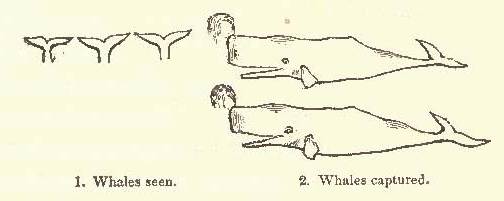
"That's once!" shouted the captain. "There she blows!" "That's twice, by jingo!" "There she blows!" "Three times! Where away, Tabor?" "Off the weather bow, sir, two points." "How far?" "A mile and a half. There she blows!" "Sperm whale! Call all hands!" There was a rush on deck, each man trying to get to the scuttle first. Then came half a dozen loud knocks, and a hoarse voice, shouting, "Larboard watch ahoy! Turn out, my lads! Sperm whale in sight! Heave out! heave out! Lash and carry! Rise and chime! Bear a hand, my lively hearties!" Those who were "turned in" rolled out as soon as possible, and buckled on their ducks, and in less than two minutes we were all on deck, ready for or- |
ders. The tubs were put in the boats, and the main yard hauled aback. We all now perched ourselves in the rigging, and kept a sharp lookout on every side for the whale's next rising. Twenty minutes elapsed since the spout was first seen; twenty-five passed, and the captain began to get into a state of nervous anxiety. We strained our eyes in all directions to "make a spout." Half an hour flew by, and no spout was seen. It began to look like a hopeless case, when Tabor, whose visual organs appeared to have the power of ubiquity, sang out, "There she blows! there she blows!" "Where now?" roared the captain. "Off the weather quarter! Two large sperm whales, sir. Go it, boots!" "Clear away the boats! Come down from the mast-head, all you that don't belong there! Bear a hand! we'll take them this rising!" shouted the captain, in a fierce, sharp voice. "All ready, sir." "Lower away, then!" The waist and larboard boats were instantly down, ready to "bend on." Captain A–– and some of his boat's crew being too ill to man the other boat, we struck off for the whales without them. I pulled the aft oar, as usual; and as, by this time, I was as tough and muscular as my comrades, the boat danced along the water in fine style. Although the larboard boat was much easier pulled, and had the oldest and stoutest of the whole crew, we contrived, by |
unusual exertions, to keep ahead of Her, till the real "tug of war" came. Then was our mettle put to the test! One of the whales was leisurely making to windward not more than half a mile off. "Lay back, my lads!" cried P––, pale with excitement. "Keep the larboard bOAt astern! Never say die! That's our whale! Oh, do spring – do spring! No noise! steady and soft's the word." We replied to this appeal by "piling up the agony" on the oars. Away sprang our boat, trembling and quivering as she darted through the waves. She really seemed to imbibe the general excitement as she parted the clear, blue water, and dashed it foaming from her bows. Onward we flew! The larboard boat was hard upon our stern; the whale rolling lazily in the trough of the sea, a few darts ahead. "Oh, lay back! lay back!" whispered P–– trembling with eagerness not to be outdone by the mate. "Do spring, my boys, if you love gin! Now's your time! now or never! Oh, see him! see him! how quiet he lies! Put the beef on your oars, every mother's son of you! Pile it on! pile it on! That's the way to tell it! Our whale this time!" The moment of intense excitement now arrived. We pulled as if for life or death. Not a word was spoken, and scarcely a sound was heard from our oars. "Stand up, Tabor!" cried P––, in a low voice. Peaking his oar, Tabor sprang to his feet, and grasped a harpoon. |
"Shall I give him two irons?" "Yes; he may be wild." Another stroke or two, and we were hard upon him. Tabor, with unerring aim, let fly his irons, and buried them to the sockets in the huge carcass of the whale. "Stern all!" thundered P––. "Stern all!" echoed the crew; but it was too late. Our bows were high and dry on the whale's head! Infuriated with the pain produced by the harpoons, and doubtless much astonished to find his head so roughly used, he rolled half over, lashing the sea with his flukes, and in his struggles dashing in two of the upper planks. "Boat stove! boat stove!" was the general cry. "Silence!" thundered the second mate, as he sprang to the bow, and exchanged places with Tabor. "All safe, my hearties! stern hard! stern! stern! before he gets his flukes to bear upon us." "Stern all!" shouted we, and in a moment more we were out of danger. The whale now "turned flukes," and dashed off to windward with the speed of a locomotive, towing us after him at a glorious rate. We occasionally slacked line in order to give him a plenty of play. A stiff breeze had sprung up, causing a rough, chopping sea; and we leaked badly in the bow planks. It fell to my lot to keep the water bailed out and the line clear as the others hauled in: a ticklish job, the last; for, as the second mate said, a single turn would whip off a shin "as slick as-goose-grease." |
Notwithstanding the roughness: of the sea, we shot ahead with incredible swiftness; and the way we "walked" past the larboard boat, whose crew were tugging and laboring with all their might, was surprising. "Hoora for the waist boat!" burst from every lip. Three hearty cheers followed, much to the annoyance of the other boat's crew and mate. We exultingly took off our hats and waved them a polite "good-by," requesting them, if they had any news to send to the windward ports, to be quick about it, as it was inconvenient for us to stop just then. I believe Solomon says it is not good to be vain-glorious. At all events, while we were skimming along so gallantly; the whale suddenly milled, and pitched the boat on her beam ends. Every one who could grasp a thwart hung on to it, and we were all fortunate enough to keep our seats. For as much as a ship's length the boat flew through the water on her gunwale, foaming and whizzing as she dashed onward. It was a matter of doubt as to which side would turn uppermost, until Tabor slacked out the line, when she righted. To have a boat, with all her irons, lances, gear, and oars, piled on one's head in such a sea was rather a startling prospect to the best swimmer. Meantime the whale rose to the surface to spout. The change in his course had enabled the mate's boat to come up; and we lay on our oars in order that Mr. D–– might lance him. He struck him in |
the "life" the first dart, as was evident from the whale's furious dying struggles; nevertheless, in order to make sure, we hauled up and churned a lance back of his head. I an not conceive any thing more strikingly awful than the butchery of this tremendous leviathan of the deep. Foaming and breaching, he plunged from wave to wave; flinging high in the air torrents of blood and spray. The sea around was literally a sea of blood. At one moment his head was poised in the air; the next, he buried himself in the gory sea, carrying down in his vast wake a whirlpool of foam and slime. But this respite was short. He rose again, rushing furiously upon his enemies; but a slight prick of a lance drove him back with mingled fury and terror. Whichever way he turned, the barbed irons goaded him to desperation. Now and again intensity of agony would cause him to lash the waters with his huge flukes, till the very ocean appeared to heave and tremble at his power. Tossing, struggling, dashing over and over in his agony, he spouted up the last of his heart's blood. Half an hour before he was free as the wave, sporting in all the pride of gigantic strength and unrivaled power. He now lay a lifeless mass: his head 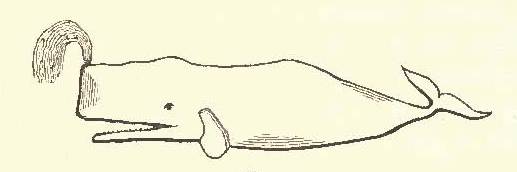
|
toward the sun, his tremendous body heaving to the swell, and his destroyers proudly cheering over their victory! Shortly after we left Johanna, two of the foremast hands were chosen to stand watches below with the captain, whose illness increased every day. He was so ferocious and ill-natured, however, that nobody could stand it more than a day or two. He finally sent forward for me, and I was promoted doctor. My situation was very unpleasant. On the one hand, I had to bear all the ill usage which the captain chose to inflict upon me, and, on the other, the crew, ever ready to growl, complained that a preference was shown to me in giving me the lightest duty – a duty which they had refused themselves. None of the officers would have any thing to do with the old man. The whole care of attending to him devolved upon me. I felt that to desert him when he was deserted by his own officers would be ungenerous; and for many days and nights I stood by him, subjected incessantly to the most brutal and insulting language. One of the boat-steerers, a Portuguese, came down one day, and told him that the mate was in the habit of rope's-ending Frank, and that, if he did not put a stop to it, there would be a mutiny among the Portuguese. After supper, the officers were all called down, and the cabin cleared of listeners. There was a general row below, the result of which was, that I was called down as soon as the |
trial was over, and accused of being the instigator of the mischief. "B––, what have you been telling the officers?" demanded the captain, in a savage voice. The question surprised me, for I had never told the officers any thing that had transpired in the cabin. I had enough to do to attend to my own difficulties, much less to meddle between the captain and officers. My reply was that I told them nothing. "You lie! You have been retailing all I said to you about them." "I have not," said I. "Don't tell me that – don't lie to me!" shouted the captain, impotent with rage, and with a face of ghastly paleness. "You are mistaken, sir; and if you think I could be guilty of any thing so mean, the sooner I go back to the forecastle the better." "Well, go; I want no tell-tales about me." I thought this was a rather ungenerous return for all the care I had bestowed upon him; and I answered by reminding him that it was at his own solicitation I had come to attend him; that I had never courted his confidence, or encouraged any allusions to the officers; and that, if he chose to forget himself so far as to make a confidant of a fore-mast hand, he need not be surprised if mischief should arise out of it, but that he ought to be sure of the fact first, before he accused me of being the instigator of the mischief. |
I then went forward, heartily glad of my release from a duty so irksome. At two P.M. the captain sent for me. He had learned the true source of the disturbance during my absence from the cabin. The mate had overheard some of his remarks, and had told him of it, to remove the imputation from me. As I went below, I thought, of course, I was about to receive the amende honorable. "Well, B––, are you going to desert me?" said the old man, in a whining voice. "You drove me away yourself, sir." "Very well, go forward. My officers won't do any thing for me, and the crew have all deserted me. I can die, I guess. I don't want you to stay with me against your will." I could not but pity the poor wretch, little as he deserved it. "Sir, you have brought this on yourself. You accuse me of things of which I am not guilty. I think, therefore, I had better stay where I shipped to stay." "Go, then; you'll be sick yourself some of these days; and mark me, if you rot in the forecastle, don't call on me!" This was his apology for the wrong done me. I might have known what to expect, had I reflected a little. Certainly it was natural enough to look for decent treatment after the close attention I had bestowed upon him during his painful illness, though I had only discharged my duty as a fellow-creature. May 6th. – Made the Island of Zanzibar, bearing |
S.S.W., distant twenty miles. We spent two days in a vain attempt to make the southern point of the island, and finally had to put to sea again, being driven as far as the Island of Pemba by strong southerly currents. May 20th. – After two weeks of great hardship and suffering, owing to continual exposure to strong shifting winds and rains, the watch on deck made land. At daylight we ran down for it, and discovered that it was the coast of Africa to the northward of Monfea. By an observation at noon we found that we were in the latitude of 7° 10' S. During the day we passed a great number of reefs and islands a few leagues from the main land. At night, anchored about three miles off shore. May 21st. – All hands were called at daylight. Weighed anchor and stood along the coast, passing a great number of beautiful little islands, some of which were inhabited. About noon we made Zanzibar at Ras Kizimbas, the southern point. Stood along shore till dark, and cast anchor in eight fathoms of water, about two leagues from N'Googa, the town. May 22d. – Anchor watches were set, and we enjoyed a comfortable night's rest after the fatiguing duties of the last three weeks. At daylight the hands were called, and the larboard boat lowered to make soundings toward the town. After breakfast we weighed anchor and made sail. At ten A.M. came to an anchcor about half a mile off the town, below the sultan's frigate, Sha-Halm. |
We found our old friend, the Bogota, ashore, wrecked – her fore-top-mast gone, and'her rigging in great disorder. Captain F–– and three or four of his men were living ashore in a bamboo hut. We learned from them that the Bogota had struck upon a coral reef about the latitude of 11° S., and her top-mast went overboard. She leaked so badly that the greater part of her crew abandoned her, and started in two boats, under the command of the mate, for the coast. Captain F–– remained, with three or four hands, on board until the tide rose, when he succeeded in getting her off. He then ran down for the Island of Zanzibar, and when off the eastern side, sent ashore for assistance. The sultan sent a number of slaves to aid him in getting round to the anchorage. One of his men had already died from exposure to the night dews, and two others were prostrated with a high fever. The cargo, with the exception of about twenty barrels of oil, was saved. May 23d. – The starboard watch had liberty ashore. It was a preconcerted plan that several of the crew were to desert upon the first opportunity. Drawn together by a common understanding, we had assembled in the forecastle every evening since we made land, to concert measures for ridding ourselves of the many grievances under which we labored. We were now a reckless and desperate gang. We had been driven almost to the verge of a mutiny by the harsh and brutal manner in which |
we were treated, and the hard fare upon which we were compelled to live. The more we dwelt upon these things, the more excited became our passions. Bitter wrongs; the cruelties and oppressions to which we were subjected; the necessity for some change, were discussed with fierce imprecations upon the head of the tyrant. The men looked up to me as an adviser, and although I preached moderation, I did not feel it. I showed them the necessity of keeping cool till a suitable opportunity occurred of presenting their wrongs before the American consul; but those of them who had been to sea before knew too well that consuls are, in many instances, but the aiders and abettors of the cruelties of captains. I knew that it was useless to go aft and make an appeal to the captain, but I also knew that any thing like mutiny would be severely punished. I therefore advis- ed them to keep quiet till a proper opportunity occurred, and then rid themselves of their troubles by staying ashore. Fearing, from some treachery of the Portuguese, that it was the intention of some of the crew to desert, the captain called us all aft, before the starboard watch went ashore, and thus addressed us: "Now you're going ashore. Before you go, let me tell you what to expect. The natives will murder you if you go outside the town. You'd better keep in sight of the ship, and not trust 'em. You hear me, don't you? The consul says he'll put you |
in the fort if you stay ashore after dark. I'11 send a boat for you at sundown, and if you ain't on the beach, look out! that's all." When the boat came alongside that evening two of the watch were missing – Bully and Tom Vernon. This was only a beginning. The captain was in a perfect fury, and walked the quarter-deck, speaking aloud, "Yes, they're gone; an' I suppose you'll all be tryin' it next. You'd better not! I'll catch 'em, and, d––n their souls, I'll warm their backs. I'll see whether my crew will leave me or not! You'll not have watch ashore another one of you. It 'ill stop here; I'll not lose any more men, if I can help it!" In order to carry out his threat, the officers received orders to keep all hands on board. Strict watches of the boat-steerers were set at night to prevent us from deserting. The captain hired four natives to row him ashore; and for six days we remained on board in a perfect state of despair, only allowed ashore occasionally to work hard under the eyes of officers. Notwithstanding the vigilance of the watches set over us, the cook made his escape on the night of the 28th. While the officer was aft, he slipped down over the head; with his bundle of clothes on his back, and swam ashore. The captain was rowed ashore next morning by his black crew. After he had left the vessel, there was quite an entertaining adventure occurred to re- |
lieve the monotony of our prison life. The Portuguese, who had become very insolent and impatient under the restraints imposed upon them, determined that, as there was nothing to do on board, and no liberty allowed them, they would have it in defiance of orders. Enos, George, Manuel, and Jose entered into an agreement to swim ashore, and the rest of the Portuguese agreed, if called upon by the mate to man the boat, that they would be so slow about it as to afford the deserters a chance to reach the beach. Manuel and Jose, after a good deal of talk, backed out, being afraid of the mate. The other two, Enos and George, slipped down by the cat-heads, and struck out boldly for the beach. They had proceeded about two hundred yards, when the mate, happening to cast his eye in that direction, discovered them. "Lower away a boat!" he roared. "Jump in, Tabor! Stand by the davit-tackles, B––! Blast your souls, where are you all?" The Portuguese came up out of the forecastle, apparently somewhat astonished, and inquired if there was a sperm whale in sight. After a volley of oaths from the mate, four of the crew, among whom was myself, were gathered together, and the boat was lowered. The tackles were all foul, and it took us some ten minutes to get them clear. A good deal of delay occurred also in shipping our oars; but we finally arranged every thing, and started off in pursuit of the fugitives. As we were not pulling for |
whales, the oars were in no danger of being broken by any vigorous exertions on our part. Seeing the boat in chase of them, the deserters came to a halt, and we picked them up within a few cable lengths of the shore. As soon as we got on board and hoisted the boat upon the cranes, the mate came forward and addressed us in a very pithy and forcible speech. "Now," said he, puffing and blowing, after the adventure, "what the nation d'y'e all mean by this? I'll let some of you know who I am, if I catch you at such tricks again. You want to get me into trouble – that's it. None of your Portuguese lingo on deck! I'll see if I can't keep you on board. I've received orders to seize you up in the main rigging if I catch any of you attempting to desert. If you wan't liberty ashore, talk to the captain; he's the boss. If I had my way, you'd all be ashore, and in Halifax, for what I care. You're a gang of bloody cowards, or you'd speak to the captain. If you think to impose on me because I'm easy, you're damnably mistaken. You'll see what I can be, if you carry things too far." When Captain A–– came on board, the two delinquents were called aft, and confined in the cabin. Mr. D–– was then called to an account for what the captain termed negligence in suffering these men to get away from the vessel. A quarrel ensued. The mate denied that it was owing to any negligence on his part. The captain called him a liar. |
"Yes," said he, hoarse with passion, "it's a d––d lie! If you had been attending to your business, it wouldn't have occurred." "Captain A––, I have given you to understand that I won't suffer any such language from you or any other man. Now I tell you stop it in time." "What! do you threaten me?" "I tell you for your own good. Stop it, sir – that's all!" And with a meaning shake of the head the mate went below. Next day Bill Mann got ashore, and made an exchange with Captain F––'s cook, a negro, who, for a trifling sum to boot, took Bill's place on board the Styx. There were now in the forecastle, besides the Portuguese, only M'F––, Charley, and myself. It was a perfect bedlam. The Portuguese had become so brutal and overbearing, that it was worse than death to live among them. The captain had, during the whole voyage, sided with them, and showed a strong preference for them over the Amer- icans, so that they were countenanced in all their brutality. |
CHAPTER XV.
Things were now in the worst possible condition. Three men had deserted; others had threatened to desert. The captain was terribly out of humor. The mate chuckled in his sleeve, and would have rejoiced had all hands followed the example of the deserters. All this trouble was nuts to him. To weigh anchor for another cruise without our full complement of men was out of the question. We had all sufficiently tested the hardship of whaling with two boats. It was not probable the deserters would be retaken, and there were no men to be had ashore except the natives. still it seemed hardly fair that, with the prospect of a week or two in port, and little to do, our liberty should be stopped for an offense of which others were guilty. May 25th. – I went below, as usual, after supper. The Portuguese were in earnest conversation. M'F–– and Charley were also talking over some deeply interesting subject. There was a sudden cessation of the conversation the moment I entered |
the forecastle. It was evident something profoundly mysterious was going on. I inquired what was afloat, but received only an evasive answer, which tended to increase my suspicion. Shortly after I had turned in, Charley came to my bunk, and whispered, "We have all agreed to refuse duty. What do you think of it? Will you go on deck in the morning, or stay below?" "Why, what's the matter?" said I. "Matter enough. We don't want to be slaves any longer. We are determined to have liberty ashore, or weigh anchor and put to sea at once." The Portuguese overheard us, and joined with Charley, protesting with oaths that they'd go to sea or have liberty ashore, one or the other, and that I'd better join them, if I didn't want to get myself into trouble. I remarked that the trouble would most probably be on their side, and warned them of the consequences which might ensue from a revolt of this kind. They were all in a high state of excitement, however, and would not listen to argument or reason. For my part, I said I would go on deck when called. I was as anxious as any of them to have liberty ashore, but had no particular desire to be put in the fort. "Then," cried several voices, "you are a coward! If you had any spirit, you'd join us; but you're afraid of the captain." I observed; in reply, that none of them could justly |
accuse me of cowardice. I had never flinched from real danger; and I considered it no proof of courage to commit an act of folly, which would only bring additional trouble upon my own head. "Then you'll sleep on deck to-night! We won't have you here, by G–d!" cried Manuel, the bully of the Portuguese. Juan, Jose, Frank, and some of the others, joined in threatening to put me on deck. I made no answer, but lay still, expecting an assault. Charley and M'F––, I believed, would not countenance such an outrage; yet I knew that, when excited, the Portuguese would stop at nothing, how-ever brutal or cowardly, to gratify their animosity; and, even if the two Americans joined me, we could make but a feeble resistance against eight overgrown ruffians, all armed with knives. After the Portuguese had chattered a while in their own language, they again addressed me: "You had better go on deck. If you don't, look out to-night!" To this I replied, that I knew them too well to be intimidated by their threats. "Then, if you sleep in the forecastle, you sha'n't go on deck in the morning; You can have your choice: go on deck now, or stay below in the morning." My answer was, "I shall do neither. I have as much right to sleep in the forecastle as you have. Your refusing to do duty is a matter that concerns yourselves. I shall not be driven into trouble by any of you." |
These cowardly dogs, who could be so bold on an occasion like this, when they only had but one to contend against, one whom they had every reason to suppose would not fight – for I had never taken any notice of their insults – now began to make demonstrations of an assault. All my past hatred for them seemed to be centered in a single moment. I felt as if suddenly inspired with supernatural strength. My blood boiled with indignation and contempt. To use a western phrase, I was, for the first time in my life, really wolfish. In the bitterness of intense and loathing hatred I cursed them, taunted them, dared them to lay a hand on me. Now, let it not be supposed that I intend this for bravado; I knew my men. I knew that nothing but a bold front could save me the disgrace of being severely thrashed. Besides, I despised them with the most unfeigned cordiality, and it relieved me to let off a little of my exuberant valor. The effect was magical. Not one of them touched me! Charley and M'F–– lay in their bunks chuckling over the fun; nor did their mirth surprise me, for the whole scene had something supremely ludicrous in it. As I turned over to go to sleep, after this bloodless fracas, I overheard Manuel say "he had a sharp knife, and I'd feel it before I knew where I was." About midnight I was awakened by low voices in conversation. To tell the truth, I had not slept very soundly. There was something, in spite of all the bravado of the Portuguese, by no means pleasant in |
my situation. By listening attentively, I found that Hankley and Antoine, the two Portuguese boat-steerers, were below discussing the topics of discontent. A smattering of their language enabled me to make out the substance of their conversation. It appeared that they apprehended Enos and George would be flogged for attempting to desert. They were resolved the punishment should not take place; and the doubtful point seemed to be, whether, if all the Portuguese united in a revolt to prevent the punishment, Charley, M'F––, and myself would join them. I heard my name mentioned very often, accompanied by epithets of no flattering character; and, indeed, felt rather uneasy till the boat-steerers went on deck. At daylight next morning the watch came to the scuttle as usual, and called all hands. I had not undressed, so that before any attempt could be made to keep me below, I was on deck. In the course of ten or fifteen minutes the mate came forward, and asked the reason of the delay. Finding how matters stood, he went aft, with an ill-concealed chuckle, to convey the information to the captain. No notice was taken of the revolt till after breakfast, when all hands were called aft. The captain appeared to take matters pretty coolly, considering the indignity offered to his authority. Had this affair happened at sea, he would have pursued a different course. There was a consul ashore, however, and he was evidently anxious to avoid having |
any investigation of the ship's economy before that officer. "Now," said the captain, very deliberately, thrust- ing his hands in his pockets, and taking his stand by the main-mast, "you that belong to that 'ere crowd, stay where you are; and you that don't, step over to leeward." No one stepped over to leeward but myself. "Well," continued the captain, fixing his cold, dead eyes on the Portuguese, "what's the matter? Why don't you go to work?" There was no answer, till Charley stepped forward and said, "We want liberty ashore, sir." "You sha'n't have it!" was the reply. Then, sir, we want to put to sea, and get over the voyage as soon as we can. We didn't ship to lay up in port without liberty." "I'll put to sea whenever I think proper," said the captain. "Will that suit you? What have you to say, M'F––?" "I want to go ashore, sir, or go to sea." "You sha'n't go ashore, nor to sea till it suits my convenience. What next?" "We'll not work, then, that's all." "Go forward, all of you. I'll soon find a way to make you work. Cook, see that those men have nothing to eat till I give you orders to the contrary! I'll starve this obstinacy out of you." The mutineers then went forward, and took up their quarters for the day in the forecastle. As it |
happened, the bread-kid had been replenished that morning, so that they suffered no inconvenience from starvation that day. It was perfectly apparent that, unless they resorted to forcible measures to procure a supply of provisions, they would soon be compelled to yield. Finding the captain resolute in his determination to give them nothing to eat till they went to work, the Portuguese next day came into measures. Charley and M'F––, who were left in a small minority, apparently yielded; but it was with the mutual understanding that they would desert on the first favorable opportunity, and, if no such opportunity offered, they would swim ashore the night previous to the sailing of the vessel. Thus ended the revolt. To my great surprise, I learned, when it was all over, that the captain suspected me of being the originator of all the mischief, and regarded the course I had taken as a mere ruse to avoid punishment! My situation was now more unpleasant than ever. On the one hand, reproached and taunted by the crew for refusing to join them in their revolt, and, on the other, suspected by the captain as the real instigator of all the mischief, I had no peace either on deck or below. The prospect of being compelled to spend a year or fifteen months longer on board the barque, with all the horrors of the past increased tenfold, drove me to the verge of despair. I thought of the parting words of the man who had made his escape from the steam-boat at Newport, |
Rhode Island; I reflected with many bitter thoughts upon my indiscretion in not following his advice; I called to mind the unhappy fate of my friend, left sick and destitute in a foreign land; and, so help me God! sooner than drag out another such year of misery, I would gladly have exchanged my place with that of the most abject slave in Mississippi; nay, so desperate did my prospect seem, that, had the offer been made me to serve a year in one of the state penitentiaries, I believe, from the bottom of my heart, I would have accepted it in preference to the life I now led. In a state of mind bordering on madness, I resolved to take a bold step, which, if successful, might procure me my release, but, if not, might be the means of my disgrace during the remainder of the voyage. I had no confidence in the captain's humanity. I knew very well, if I attempted to desert and did not succeed, I should be seized up and flogged like a dumb brute. The degradation of such a mode of punishment I had not yet experienced, and I was anxious to avoid it, if possible; for it was my firm determination, from the moment I first wit- nessed it, to take a more summary method of avenging the wrong, should it ever be inflicted upon me, than that of the law. My intention was first to make an appeal to the United States consul, lay the facts before him, and, if unsuccessful, to desert and suffer the consequences. I knew the fact of my appearing anxious to leave the vessel would be a suffi- |
cient cause, in the eyes of the captain, to treat me with increased barbarity in case I remained on board; so that if I failed, I might as well desert, and run the risk of being retaken and flogged. There were but two Americans left, M'F–– and Clifford. I had no reason to rejoice in the prospect of having, in addition to eight Portuguese, three or four beastly negroes to share the forecastle with us. I remained on deck till a late hour, reflecting upon my condition. About midnight, finding all the watch asleep, I stole softly down into the forecastle, and, by the flickering rays of the lamp, commenced my work. Seated on a soap-keg, I made use of one of the chests as a desk, and wrote a long letter to the American consul, setting forth the particulars of my unpleasant situation, and the hardships which I had endured, together with the dreadful alternative before me, of remaining on board the vessel another year, if he should not exercise his influence to procure my discharge. I appealed to his humanity – his sense of justice as an officer of the American government. I called upon him, with all the eloquence I was master of, to save me from the horrors of such a life. It occurred to me that the letter might fall into the hands of the captain, or some of his officers, and, to guard against any unpleasant consequences that might arise from such miscarriage, I made no complaint against them; though I could have said a good deal that would have placed them in no enviable light. This letter I sealed, and, putting it under my |
pillow, turned in to dream of home and happier times. Next morning, perceiving that M'F–– was about to go ashore, in the mate's boat for wood, I slipped the letter into his pocket, and begged him, if an opportunity should occur, to hand it with due secrecy to the consul. Mack was the very man whom I would have chosen, had I any choice in the matter, for this delicate commission. Honest and kind-hearted, he had my most implicit confidence. I felt quite sure he would spare no exertion to do me a service. How can I depict the tortures of suspense that I suffered that day? My mind was racked with alternate hopes and doubts. Would the consul receive my letter? What would be its effect? Would he demand my instant discharge, or pay no attention whatever to my appeal? These were but a few of the conflicting questions upon which my mind dwelt during the absence of my shipmate. Hour after hour I watched the boat with eager eyes and a throbbing heart. At length I saw the crew get in and push off. I felt faint with expectation. After a tedious pull they hauled up alongside. Mack's face beamed with good nature. I read in its expression the success of my mission. He had delivered the letter. The consul had read it, but made no comment upon its contents, except that he would be glad to see me the first time I went ashore. The question then was, would I have an oppor- |
tunity of going ashore before the vessel weighed anchor? All that day and part of the next I remained in the same miserable state of suspense. At length the mate sang out, "Man the waist-boat!" Every one was anxious to get ashore, and all hands rushed for the davit-tackles. I did not even wait till the boat was lowered, but, with one spring over the bulwarks, made good my place. It fortunately happened that the key of the wood-yard was up at the consul's. While the mate was thinking how he would get it, I volunteered my services to run for it; and the answer had scarcely escaped his lips, when I was off. The consul chanced to be standing at the door. I approached him with awe and trembling; for he it was who was to decide my fate. Having first delivered my message, and procured the key of the wood-yard, I hesitated whether to address him, or leave the matter entirely to himself. While considering what course I should pursue, he called me, and said, "Are you the young man who sent me this letter?" "Yes, sir," said I. "Well, when will you be ashore again?" "I can't say, sir; the captain allows us no more liberty." "Call upon me to-morrow, and I'll talk this matter over with you; I shall see the captain about giving you permission." |
Elated with the hope of a speedy release, I hurried down to the wood-yard, and went to work with a zeal that I had not felt for many months. Permission was given me to go ashore next day with one of the boat-steerers, who, as good fortune would have it, was no other than my worthy friend Tabor. I communicated to him the object of my mission. He said he was sorry to think of parting with me; but, for my own good, wished me success. I lost no time in calling upon the consul after leaving the kind-hearted boat-steerer. On my arrival at the consular residence, I was shown up stairs, where Mr. W–– attended to private matters. "I see," said he, "you are not pleased with the whaling business. You find it, no doubt, different from what you expected. It is a severe lesson to you, and I hope you will profit by it. I am willing to aid you so far as I have the power, but have no authority to demand your discharge from the vessel. If you can procure a hand to take your place, it is probable the captain will consent to an exchange. In that way you may succeed, but I know of no other." "That, I fear, can not be done," said I; "the captain would keep me, if for no other reason than because I wish to procure my discharge; besides, I owe him thirty dollars." "I am sorry for it; the whole matter rests with him." "Then, sir, I shall be compelled to desert. I can not remain on board the vessel another year." |
"That would be unwise. We have no other alternative here than to put deserters in the fort, and there you would soon take the fever." "Well, death is preferable to my present condition." "If you think it would be of any avail," replied the consul, "you may tell the captain that I will pay your bill; and, to show you that I am willing to do all I can for you, I give you liberty to offer ten, fifteen, or twenty dollars to any of Captain F––'s crew who will take your place." This was certainly as much as I could have expected from any American. Thanking the consul for his kindness, I set out for Captain F––'s hut, and there made the proposition to those of the Bogota's crew who were not prostrated with the fever. It was like offering fire to a burned man. Not one of them would listen to my proposition. They had experienced too many of the hardships of a whaling voyage within a month or two past to be tempted by any pecuniary inducements. Sadly disappointed, I went off in search of a substitute among the natives. The sun was intensely hot, and the streets were like long, dirty ovens. After a harassing ramble of two hours from hut to hut – seldom meeting any one who could speak English – I fell in with a couple of young blacks, who had been to sea before, and could speak English with tolerable fluency. They both seemed anxious to ship, and agreed to take my place if I could make an arrangement of that kind with the captain. |
I returned to the consul's, and gave him the result of my search. The only difficulty, he said, in taking natives of the island, would be the consequences it might lead to in case the vessel should fall in with a man-of-war. So many blacks on board would excite the suspicion that she was a slaver, and much embarrassment might result from it. If the captain was willing to take one of them, however, he thought the matter could be arranged. Without any delay, I proceeded down to the beach, and, finding the boat ready to start, went on board. It was nearly sundown. The work of the day was over, and I found the crew lounging about the forecastle, smoking and chatting as usual. Learning from Clifford that the captain had given orders to the mate to weigh anchor early in the morning, for the purpose of dropping down opposite the imaum's palace to procure a supply of water from the Motoney, preparatory to making immediate sail on another cruise, I became alarmed about my prospect of effecting the exchange. Not an hour was to be lost. As yet I had not broached the subject to the captain. Plucking up all my courage, I walked aft to the larboard boat, in which he was sitting, and, taking off my hat, respectfully asked his attention for a few moments. "Well, what do you want?" said he, staring at me as if he had never seen me before. "What's the matter now?" |
"I wish, sir," said striving hard to suppress my agitation, "to procure somebody in my place. This business does not suit me; I should like to have my discharge." "What! Discharge, hey? Why, I thought you were very well satisfied. I havn't heard you say you wanted to leave the vessel till now!" replied the captain, with unfeigned astonishment. "Because I thought it would be useless. Now, sir, if I procure a hand in my place, will you let me go? I have no peace with those Portuguese, and would rather take my chance of dying of the fever than remain on board." "Oh ho! that's it, hey? If that's all, you may rest easy. I intend putting you, and Clifford, and M'F–– in the aft-hold as soon as we get to sea." This was a "stumper." I could only reply that, under any circumstances, I would prefer having my discharge, adding, that the consul had promised to pay my bill, and I would engage to furnish a first-rate hand in my place. I was then dismissed, with the remark that "he'd see about it." At five o'clock next morning we weighed anchor and dropped down to the Motoney. Immediately after breakfast, while the men were battening the casks for a raft, I renewed my application. The captain was not at all pleased at the dissatisfaction manifested lately by his crew. He thought he had treated us well, and wanted to know the reason we were all so anxious to leave the ship. It would tell |
badly for him with the owners, if he went home with but two or three of his original crew. This was the first time he ever condescended to argue the point, and I could not but feel surprised at his wonderful benevolence. However, a little reflection enabled me to see through it. He thought it highly probable I would desert, and preferred having a man in my place, while, at the same time, he would leave a good impression. After some quibbling about having so many negroes on board, he agreed to take one of the natives to whom I had alluded. No opportunity to go ashore occurred till in the afternoon, when the consul's boat came alongside with a clerk, who had business with the captain. I was permitted to accompany him back to the town. In about an hour the captain came ashore for his papers, having concluded to put to sea before officers and all left the vessel. When I produced my substitute, who was a fine, stout young negro, the captain, without assigning any reason, peremptorily refused to take him, and ordered me on board again. I had no alternative but to obey. The barque was all ready for sea next morning, and I felt sure, if I went on board again, I should lose the last opportunity of making my escape, having no doubt strict watches would be set that night. On my way down to the boat, I met one of Captain F––'s men, to whom I had proposed an exchange on a previous occasion. I again broached the subject, and, knowing him to be a reckless fellow, to whom whaling was as agree- |
able as any other pursuit, I had no qualms of conscience in offering him every inducement. He was a rough, stout-built quadroon from South Carolina, and had been drifting about the world for eight or ten years past. With an iron constitution and a happy disposition, he never troubled himself with any of the niceties of feeling or thought, and I sincerely believed he was much better adapted for the situation than I was. I offered him ten dollars in cash, and all my clothes, together with my sea-chest, and whatever else I had on board, if be would take my place. Such an offer was hard to resist. He said he would not agree to take my place, but would ship as boat-steerer, in which capacity he had served on board the Bogota, at the fiftieth lay, provided I would give him the ten dollars and the clothes. It made no difference to me, of course, in what capacity he shipped, if I could procure my discharge by an exchange. I had but little time to talk, however, as the boat was waiting; and, telling him I would consult the captain, and that he must be down about the beach before dark, pushed off once more for the hated barque. It was decided that we were to weigh anchor and put to sea at daylight next morning. I had but two or three hours to spare; the captain might not come on board till dark, and then it would be too late to make the arrangement which I so ardently desired. I did not know, even, whether he would take my substitute, having already, without cause, refused the man whom he had promised to take. |
In the most racking state of suspense I awaited the arrival of his boat. I must have looked like a madman, for the crew made comments upon my unnatural wildness. I was, indeed, somewhat bereft of my senses, and had difficulty in controlling my feelings. A long, weary hour of torture elapsed before the captain made his appearance. With mingled feelings of hope and despair I approached him, and told him the particulars of my interview with the quadroon. It fortunately happened that this was a man to whom the captain had himself applied some days previously, and whose services he was most anxious to secure. The only difficulty was about the lay. However, sooner than not have him, he consented to go ashore with me and talk to the man, and if they could agree upon the terms, he would give me my discharge. I need hardly say I sprang into the boat half frantic with delight. So overpowered, indeed, did I feel with joy at the prospect of my release, uncertain as it was, that I could scarcely refrain from telling the captain I considered him a pretty clever fellow, after all. To make a long story short, the matter was arranged to my entire satisfaction, and we went up to the consul's to sign the papers and settle accounts. I did not feel sure of my release till I held the written discharge in my own hand; then, for the first time in my life, I felt what it really was to be FREE! I am sure I must have made myself very ridiculous. |
I hardly know what I said or did, for I was delirious with joy. In the phrensy of my delight I shook hands with the captain, and wished him a pleasant and prosperous voyage; well knowing, even then, that for half a dollar he would have sold my liberty for life had it been in his power. Once more I returned to the vessel to bid good-by to my old comrades. The cooper, Tabor, the mate, Charley, and M'F–– shook me cordially by the hand, and wished me all success and happiness. I really felt sorry at parting from friends to whom I had become so warmly attached, more particularly Tabor and the poor Yankee boy, for both of whom I entertained the strongest regard. Poor Mack! I had been his warmest friend, and the tears stood in his eyes as he bid me good-by. I would have given the savings of ten years to come to have had him share my good fortune. Nor was it without emotion that I parted with the Portuguese. We had lived many months together; we had endured the same hardships, faced the same dangers, suffered together, and stood night-watches together; and, although I did not regret that the tie of our fellowship was broken, I sincerely wished them well, and was deeply impressed with the thought that, as our paths through life lay in different directions, those faces so familiar to me, I should, in all likelihood, never see again. From the bottom of my heart I forgave them all I ever had against them. They had enjoyed but few of the blessings of social life; their career from |
childhood had been one of labor and hardship. I saw more in them to pity than to blame, and I felt sorry for every harsh word I had spoken to them during our unhappy voyage. The transition from the filthy forecastle of a whaler to a large and commodious stone house, furnished, in European style, and to the society of a little circle of educated New Englanders, was so unexpected and so difficult to realize, that for many days I could hardly avoid thinking it a delightful dream. How my blood thrilled through my veins and how my heart bounded with joy, when I saw around me objects that brought to mind home, friends, civilization, and all the blessings and comforts of social life! Above all, how entrancing, how indescribably delightful, was my long-wished-for FREEDOM! how happy the thought that I was no longer subject to the whims and caprices of a tyrant! So great was my horror of the life I had led dur- ing the past year, that in my sleep, for weeks after my release, I struggled with imaginary foes, whom my morbid fancy pictured in the act of dragging me on board again; and often, when I awoke and looked around me, I wondered what had become of the rusty forecastle lamp with its dim, flickering rays. Where were the haggard faces of the sick, the groans, the curses, the gurgling of the water, the roar of the gale, the hoarse voices calling the watch! I learned from one of the natives who was on board the Styx when she weighed anchor, that, early |
on the night previous to her departure, my unfortunate comrades, Charley and M'F––, had attempted to escape by swimming ashore. A boat was lowered after them before they succeeded in reaching the beach, and they were taken on board and put in irons, to be flogged as soon as the vessel got to sea. Let it be borne in mind that these were AMERICAN CITIZENS – that they had committed no crime in following the dictates of nature! CHAPTER XVI.
Zanzibar, the present seat of government of Syed Syed Bin Soultan, imaum of Muscat, is situated in the Indian Ocean, within four leagues of the eastern coast of Africa, between the latitude of 5° and 7° south, and longitude 39° and 41° east. It is forty-five miles in length, and varies from fifteen to twenty miles in breadth. N'Googa, the town of Zanzibar, is situated nearly midway between the northern and southern points of the island, in latitude 6° 10' south, and longitude 39° 41' east. From the bay it has quite a flourish- |
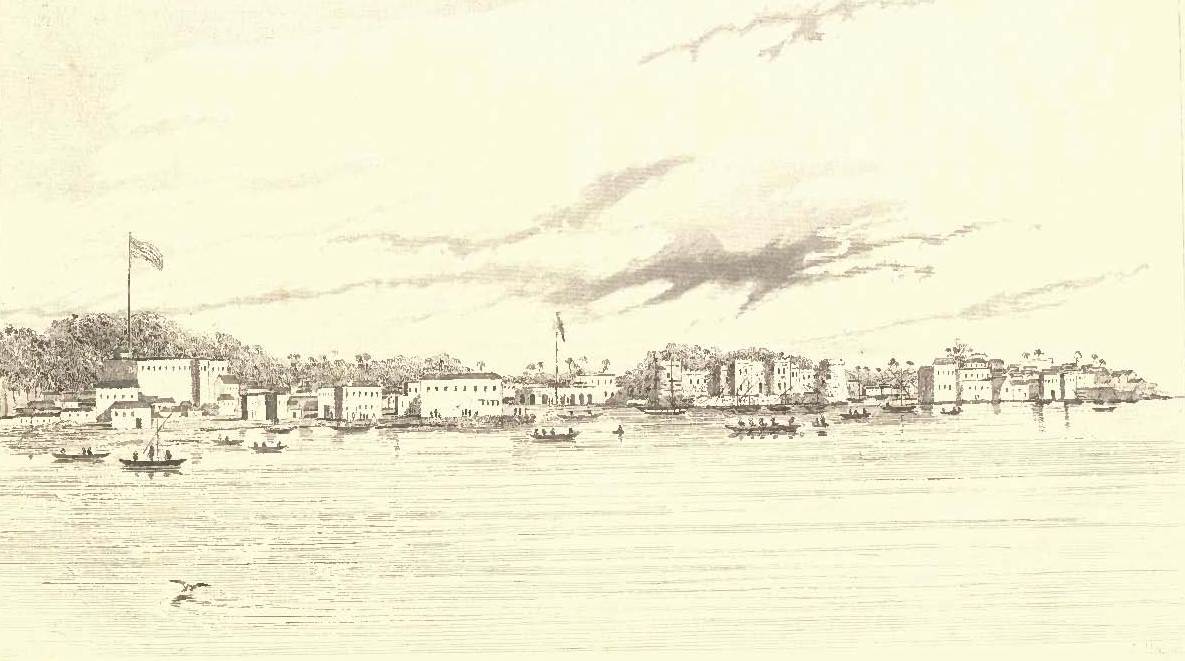
ZANZIBAR.
|
ing appearance. Many of the buildings along the beach are large stone edifices, which are white-washed, and present a very pleasing appearance to the eye. The imaum's harem, or town residence, occupies a prominent position near the water's edge, and is a regular, thougH not a handsome building, of a larger size than any other fronting the bay. Before the door is a tall staff, bearing the blood-red flag of Arabia. The custom-house, now rented from the imaum by a Banyan merchant, Jeram Bin Seeva, at the sum of $150,000 a year (from which a rough estimate of the trade may be formed), is a low bamboo hut, thatched with palmetto leaves, and like any thing but a custom-house, according to our notions of the importance of such an edifice. Perhaps the most interesting specimen of architecture in the place is the castle and its fortifications. It is supposed by the English consul, Captain Hamilton, a very intelligent gentleman well versed in these matters, that this castle was erected by the Portuguese soon after they got possession of the island; and from a comparison of the style of architecture with that of the Brazilians and Western Islanders, I am strongly inclined to the same opinion. It is a large, massive structure, about three hundred feet long and a hundred and fifty wide, with a tower at each corner, and a spacious terrace in front of it, the outer part of which is fortified by a battery, or row of heavy stone abutments for the protection of the soldiers and the gunnery. It is evident, even to an inexperienced |
observer, that the castle and its fortifications, well provided as they are with soldiers and guns, would stand but a slender chance before a broadside from an English or American frigate. At this time the entire building is in a ruinous condition, and there is nothing about it to show that it was ever a good specimen of architectural skill. A volume might be written on the eventful history of the old cannons lying in front of the castle; and yet I am not aware that they have ever been mentioned by travelers who have visited Zanzibar. There is a rare and valuable work in possession of the English consul, entitled, "Curious and Entertaining Voyages, undertaken either for Discovery, Conquest, or the Benefit of Trade, by Portuguese Navigators, from the earliest Voyages under the Auspices of Prince Henry of Portugal, down to the seventeenth Century." In this work there is an account given of the voyages and discoveries of Albuquerque, and his conquests in the Indian Ocean, Persian Gulf, and Red Sea. The cannons to which I allude have certain inscriptions in Portuguese and Arabic, which were translated to me by Captain Hamilton, proving beyond a doubt that they were cast by a follower of Albuquerque. In the narrative of his exploits, it appears that he brought with him several founders, for the purpose of manufacturing arms in distant countries. In his negotiations with Coje Attar, governor, or wallee, of Harmoaz and Bundrabus, Attar corrupted the followers of the Portuguese navigator with brilliant of- |
fers of gold, and prevailed upon five seamen, one of them a founder, to desert. This founder, by the direction or the governor, cast, between the years 1507 and 1509, at Harmoaz, an island near the en- trance of the Persian Gulf, about three leagues from Gambaroon (the ancient Dutch name of an important port in Arabia), in the 915th and 917th Al Hagari, or Mohammedan year, a number of cannons far Coje Attar, which, together with some brass cannons taken from Albuquerque, were taken possession of by Almed, sultan of Muscat, previous to the reign of Syed Syed Bin Soultan. Syed afterward murdered his uncle Almed, and became the ruler of Muscat. Extending his conquests from the island of Socotara, he fought several battles with these cannons on the eastern coast of Arabia, took possession of Mombas, Pembo, and Zanzibar, and eventually extended his dominion as far south as Mozambique. Such is an outline of the probable history of these guns. The lower or northern part of the town of N'Googa consists almost exclusively of huts and shanties, rudely constructed of bamboo and cocoa-nut leaves, and is occupied chiefly by the slaves and poorer classes. The southern part is occupied by wealthy Banyan, Hindoo, and Muscat merchants. Many of these merchants have acquired splendid fortunes in the ivory and gum-copal trade, and in commercial transactions with agents in the East Indies. So great is their passion for money, that they seldom re- |
turn to their native country while they can amass wealth more rapidly elsewhere; and they are now building large and commodious residences in Zanzibar. The principal part of N'Googa, however, is at best but the ruin of a town. Like the Peruvian cities lately discovered, it is a relic o the past; but there is nothing in its clumsy architectural remains to prove that it was ever inhabited by an enlightened race of men, or had at any time splendid edifices or institutions of learning. The Portuguese did not improve it while it was in their possession; nor are the Arabs of Oman a race of people to build fine cities. The present Arabian population of Zanzibar, the subjects of Syed Syed Bin Soultan, differ little from their forefathers in their peculiarities of manner, habits, or religion; and it is but a natural presumption that they have not reformed in point of indolence. It has been estimated by resident merchants, whose opportunities of acquiring an accurate knowledge of the town and its resources entitle their opinion to respect, that the entire population within the limits of the town is between fifty and sixty thousand souls. This, from the size of the town, would at first appear greatly exaggerated; but when we reflect that some of the wealthy Arabs have over a thousand slaves, who are crowded into small huts, and that there are as many houses on one acre of ground as there are in America on six, the estimate does not appear unreasonable; the population of the whole island is about a hundred and fifty thousand. |
The mosques, of which there are eight or ten in the town, are ordinary stone buildings, plastered and whitewashed. With their small barred windows and dingy walls (the original whitewash being covered with slime and filth), they look more like jails than temples of devotion. Their doors are public loafing places for all the idlers in town. The Arabs are second to no people in the world in the art of loafing. A worthless scoundrel, who has gambled away all his property, and who is too lazy to work, will saunter up to the mosque with the air of a sultan, and join in the topic of discussion with as much nonchalance as if he were the millionaire of the place. He can swindle, at the same time, with the ease and grace of an accomplished London sharper. Poor, indeed, is the Arab who can not appear with a flashy turban, a gold-mounted jambea, and a jeweled sword; and dull is he who can not live by his wits. In all their poverty, these people have a haughty air. There is nothing like sprightliness or vivacity about them, and never a want of self-confidence. Their motions are slow, measured, and dignified. Nothing startles, nothing astonishes them. They pride themselves, like the North American Indians, on their power of concealing every emotion, good and bad. A physiognomist would be puzzled to read any thing in their stolid features. In this respect, Miss Pardoe's admirable description of the Turks would apply quite as appropriately to them; and, indeed, I often fancied myself, when in the midst of a group |
of these proud vagabonds, breathing the atmosphere of the "City of the Sultan." The imaum's harem, to which I have already briefly alluded, is a large, plain edifice, with a red tile roof, and whitewashed walls. From the bay, where the most favorable view of it is to be had, it might easily be mistaken for a large mercantile establish- ment. The back part of it, or that part which faces the town, is perfectly plain, without even a window. A row of windows, occasionally ornamented with the greasy faces of the sultan's concubines, fronts the bay. I had heard, previous to my visit to Zanzibar, that this harem contained some beautiful women. As I could never find any white person who had been within its sacred precincts, I am led to doubt the truth of this assertion from my own limited observation. There were several Arabian girls peeping out of the beach windows one morning before his highness had arrived from his palace, who were pointed out to me as fair specimens. I must admit that they were in good condition, being very fat and sleek, but, to my taste, they were any thing ut beautiful. From personal observation, on various occasions after that, I have arrived at the conclusion that the "lights" of this harem would be eclipsed by an ordinary American quadroon, or even a mulatto girl. There are females of this description in New Orleans, who, if placed in a harem, and taught to lisp "Alhumdilla robilla andamene malikeo midene," or any |
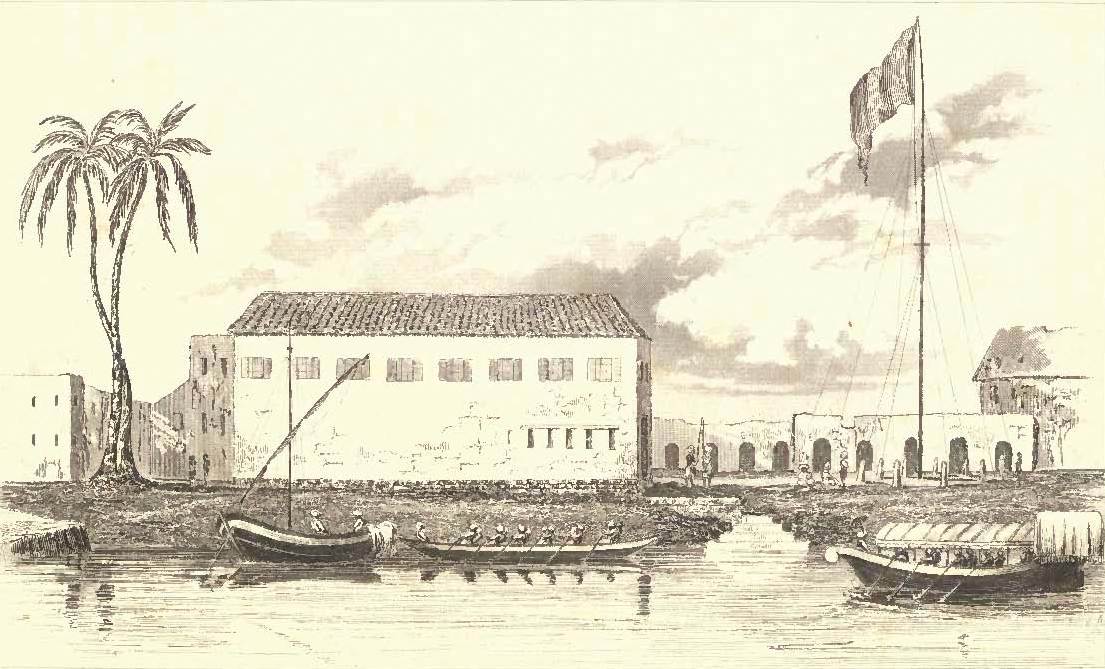
IMAUM'S HAREM, ZANZIBAR
|
other cant phrase from the Koran, would, with the addition of a graceful turban and a Persian robe, be deemed by some of our enthusiastic travelers houris, "Too rich for use; for earth too dear;" fit only for the inspired pen of the poet, or the ad-miring eyes of Platonic lovers. The disgusting sensuality of the sultan's ladies, notwithstanding the vigilance of the old eunuchs, destroys all the sentimental twaddle that has ever been penned about their spirituality and refinement. The inhabitants are of various races, from the light-complexioned Hindoo to the darkest African: Banyans, Parsees, Malays, Bedouin Arabs, Oman Arabs, Sowhelians, Africans, &c. The Sowhelian language is the most generally spoken. This is a corruption of the Arabic with the African, partaking of the characteristics of both. It derives its name from a mixed race, called Sowhylese, who were the original settlers of Zanzibar. The Sowhelians, of whom a large proportion of the population consists, are a gay, light-hearted people, fond of amusement, and little influenced by the formal rules of etiquette laid down by their Arab brethren. In complexion they closely resemble the red Indians of North America. Their features are good, though not handsome, being a medium between the Arab and the African; less regular and comely than the first, and partaking more of the characteristics of the Circassian than the last. A writer of |
considerable celebrity speaks of them as a highly intelligent and poetical people. After three months' constant intercourse with them, I must say I never discovered any thing like intelligence or a poetic spirit among them. They are a lively, harmless, good-natured race, of a happy disposition, but entirely ignorant of the world, and few of them acquainted with letters. Perhaps I should not pronounce them decidedly an unpoeiic people. There is always something in the temperament of the Eastern people alive to poetic feelings, even in the savage; and, from a want of absolute terms, such as belong to all cultivated languages, they make great use of figures and similes. This figurative style of language has, I imagine, been mistaken, in more than one instance, for the true spirit of poetry. Politeness among the Sowhylese is carried to excess in their mode of salutation. It is quite common to hear two of them, when they meet, pass the compliments of the day in the following high-flown strain: Question. Yambo? Are you well? Answer. Yambo. I am well. Q. Yambo Saana? Are you very well? A. Saana. Very. Q. Cana looloo? Like pearl? A. Cana. All the same. |
Q. Cana marijan? Like coral? A. Cana. All the time. Q. Cana fether? Like silver A. Cana. All the same. Q. Cana tha-hah? Like gold? A. Cana. All the same. Quaharee! Good-by! Quaharee! Good-by! On meeting they shake hands, after which each kisses his own hand. This ceremony they repeat on parting. The above translation, though literal, does not, perhaps, clearly convey their meaning; but, upon repeated inquiry, I could find no other meaning attached to the words, which the natives explain by saying that a man is like pearl when he looks clear and bright; like coral when his cheeks are red; like silver and gold when his worldly affairs are all in a flourishing condition. These similies are quite common among the Sowhylese in all their dialogues. Like all barbarous, or even savage nations, they frequently chant their words in a species of irregular measure, corresponding to the tone of voice in which they are uttered; but it is with few gleams of imagination. The following is the touching lament of a broken-hearted man grieving over the grave of conjugal bliss, and will, no doubt, be peculiarly edifying to the ladies: "Coona nene? Coona nene? |
This, rendered into English, literally means, "What's the matter? What's the matter? Syed Syed Bin Soultan Bin Almed, imaum of Muscat, is supreme chief, or sultan, of Zanzibar. Syed Sulemin, the former governor of the island, derives his office from the imaum, and carries on the government during the absence of Syed Syed, who performs a voyage to Muscat to superintend his dominions there every year. The imaum has, within the last five or six years, made Zanzibar his place of residence in preference to the sultry heights of Muscat, generally known as the hottest place in the world. His palace is situated about a mile and a half below the town, near a river called the Motoney. It is an old, but picturesque building, beautifully ornamented in the Oriental style, and partially hidden in a grove of cinnamon, orange, clove, and mango trees. The luxuriant and shady clove trees, the fragrant cinnamon, the magnificent mangrove, and all the opulence of Eastern vegetation, are peculiarly refreshing to the eye and grateful to the senses in this tropical climate. A stream of water from the Motoney is conducted through the palace, and empties into the bay in front. The richly-colored cupo- |
las, and the extreme beauty and freshness of the groves, give you some idea of an Oriental scene. The imaum visits the town twice a week either in his pleasure-boat or on horseback. He is justly proud of his beautiful stud of Arabian horses (specimens of which, it will be recollected, he sent as a present to the President of the United States* a few years since), and of the state and magnificence of his retinue. Trained to perfection, and richly caparisoned, the Arabian horse, celebrated as the finest in the world, is here seen to great advantage. He has all the pride and stateliness of royalty, with the grace and ease of the wild horse of the desert. His highness the imaum rides a spirited charger of the purest breed, and, though upward of sixty years of age, sits in his saddle with the easy grace of an accomplished equestrian. His long, white beard, and serene gravity of countenance, give him a truly venerable appearance; and the occasional flash of his fine eye * Our form of government prohibits the President of the United States from receiving presents from any foreign power; consequently, as these horses became the property of the government, they were at its disposal; and not being able to preserve them in the "National Institute," Congress passed an act authorizing their sale by auction. The following additional item I find in a Washington paper of the 23d of August, 1845: "Sale of Arabian Horses. – The two Arabian horses received, as a present to Mr. Tyler, by the United States Consul at Zanzibar, from the Imaum of Muscat, were sold, pursuant to an act of Congress, on the 15th. They were light gray, mettled. One, seven years old, brought $450, and was purchased by a gentleman from Louisiana; and the other, eight years old, brought but $190, and was purchased by Dr. John Baldwin." |
speaks of one who has fought battles and who rules nations. The long line of turbaned officers forming his retinue are richly and tastefully dressed, and, with their flowing costumes and splendid steeds, present a royal pageant strikingly picturesque. The great advantages which the Island of Zanzibar has over islands in the Indian Ocean to the southward of the equator are not yet sufficiently known to be justly appreciated. It is undoubtedly the best and most convenient stopping-place for vessels bound through the Mozambique Channel to the Red Sea, the Persian Gulf, and India, on this side the Cape of Good Hope. The British East India Company's vessels formerly procured refreshments, on their voyage from England to Bombay and Madras, at Johanna. Few merchantmen of any description now touch there, owing to the exorbitant demands of the sheik for port-charges, and the dishonesty of the natives. It is principally frequented by whalers, though not so much so now as it was some years ago. The want of a responsible consular agent is scarcely counterbalanced by the extreme fertility of the island and the cheapness of refreshments. The Portuguese settlements on the coast, in Mozambique, are the worst places, perhaps, between the Cape and India to touch at for refreshments. Exclusive of the unhealthiness of the climate, and the degraded character of the Portuguese, nothing can be had of any value but stagnant rainwater, which, though better than none, is always in- |
jurious to a ship's crew. What little fruit the country affords is consumed by the settlers. For some of the common necessaries of life they are dependent upon Majunga and other ports in Madagascar. The Seyschelles Islands are too far to the eastward for vessels bound up the Red Sea or Persian Gulf. In fact, there is no place in the Indian Ocean so con- veniently situated for that purpose as the Island of Zanzibar. With the exception of Pemba (a small island to the northward of Zanzibar, also under the dominion of the Imaum of Muscat), it is the most fertile island on the eastern coast of Africa. Fruit and vegetables of the greatest possible variety can be had at the town of N'Googa cheaper than at any other seaport in the Indian Ocean where it would be at all prudent to stop. Horsburg's assertion that the governor "makes a monopoly of the sale of these articles," and that "the inhabitants, when permitted, sell their productions on more reasonable terms," is not now applicable to the island. The late accounts given of this island by Ruschenberger, Roberts, Taylor, and others, are all expressive of surprise at the cheapness of fruit and vegetables! Besides, the imaum himself is now at the head of the government, and will not permit or make a monopoly of the sale of any of the native products. Prince Syed Carlid, one of the imaum's sons, who has jurisdiction over the commercial transactions of the natives, has no power himself to create a monopoly. It is doubtful whether even the sultan could do it, so little re- |
spect have the natives for his authority when it conflicts with their interests. At all events, they dispose of the products of their shambas, or plantation, without restraint, at their own prices. No sickness need be apprehended, if proper precautions are taken; but, at the same time, it would be to the interest of vessels to remain in port no longer than is actually necessary to procure refreshments. It is not a climate which can be tampered with. I have shown in another chapter the cause of its fatality among sea-faring men. I propose in some future chapter to offer a few hints in regard to the means by which sickness might be avoided. The resources of Zanzibar, as a place of trade, are now considered of some importance in the commercial world. So far as relates to the slave trade, it may be seen, by reference to the existing treaties between the sovereign of Muscat and the British and American powers, that it is now confined to nations which do not come under the denomination of "Christian." On the tenth of September, 1822, a treaty was entered into by Great Britain with his highness the Imaum of Muscat, for the perpetual abolition of the slave trade between the dominions of his highness and all Christian nations. This treaty was recorded and confirmed in a more formal manner in August, 1839, by Robert Cogan, Esq., plenipotentiary on the part of her majesty, Victoria, and Hassan Bin Ibrahim and Mahamet Ali Bin Nasir, on behalf of the imaum. There was also a con- |
vention of commerce entered into at Zanzibar regulating the trade between British subjects and the subjects of the imaum, granting free intercourse between the merchants of both nations, and affording them every facility in their commercial pursuits. It also limited the duty on British and East India merchandise, and regulated the collecting of the customs. The laws governing residents, and the powers of consuls and resident agents, were more strictly defined. This treaty was concluded at Zanzibar on the 31st of May, 1839, and ratifications were ex- changed on the 22d of July, 1840. It had its origin, no doubt, in our own treaty of commerce, negotiated and concluded in the years 1833-34,* which gave us many commercial advantages. The necessity for our treaty had sprung out of the increasing importance of the Island of Zanzibar, which character the indomitable energy and enterprise of the Salem merchants had given it by the extensive trade they had opened with it in exchanging American manufactures for gum copal, ivory teeth, ebony, goatskins, hides, &c. * The treaty of amity and commerce between his highness the Imaum of Muscat and the government of the United States was presented and concluded at Muscat by Edmund Roberts, Esq., envoy to the courts of Siam and Muscat, on the 21st of September, 1833. It went into operation on the 30th of June, 1834. Ratifications were exchanged on the 30th of September, 1835. This treaty was translated into the Arabic by Syed Bin Calfaun, the sultan's interpreter, and present United States consular agent at Muscat. The convention of commerce between the imaum and the government of Great Britain is similar to our treaty in most of its provisions. |
The value of a practical education is here duly appreciated. Schools for the young are numerous. A knowledge of the rudiments of arithmetic and the art of writing is considered essential in all business pursuits. When the pupil can cipher sufficiently well to be qualified for the office of cranee, or clerk, write the Arabic, Sowhelian, and Hindoo, and read the Koran throughout, he has an education which fits him for all the pursuits of Oriental life. Many of the young men have visited England and America, where the colleges and seminaries have struck them with wonder, and shown them how much they have yet to learn. A voyage to Europe or America is a matter of pride to them during life, and causes them to be looked upon as persons of consequence. I was particularly struck with the aristocratic bearing of Ahamet Bin Hamees, secretary to the imaum, who had visited England, and received an excellent education under the auspices of some of the nobility. He has certainly something to boast of; for, although as black as the ace of spades (and darkness of complexion has its disadvantages as well in Zan- zibar as elsewhere), and of low descent, he got himself into notice by his own natural talent and his perseverance. He is extremely polite to white people, but looks down upon his own caste with all the contempt springing from conscious superiority in education and intellect. I conversed with him on the subject of the patronage he had received in England, and was greatly amused at the sang froid with |
which he spoke of having, on various occasions, dined with the queen, and the tone of familiar freedom with which be alluded to his friends Lord ––, the Duke of ––, Sir Thomas or Sir John ––, &c. His pronunciation of the English language is painfully precise, and altogether according to Walker and Johnson. When parting with him after my first interview, he politely tendered me his card, which was neatly printed in English letters,
"MR. AHAMET BIN HAMEES,
"Secretary to His Highness the Imaum of Muscat." Rajab, a young Arab, whose acquaintance I made during my sojourn, had been to Salem, Massachusetts, in a merchantman. Speaking of the houses in Salem and Boston, he said, "Oh, very fine! Big! too big! Grand! Zanzibar nothing at all! Bombay nothing at all!" He was quite enthusiastic in his encomiums on the Salem ladies, whose charms he dwelt upon with all the raptures of a young amoroso. "His highness (the sultan) no sabby women all de same as Salem ladies! Skin white, all de same as paper! Teeth like bright pearl! Hair long, fine, too fine! Eyes! Bismilla! when dey look at me I feel all ober drunk; I no sabby nothing!" I spent my evenings strolling about town, gathering up what information I could respecting the manners and customs of the inhabitants. I was greatly indebted, in my inquiries, to two young Americans, clerks in the employ of the United States consul, |
who spoke the Sowhelian language. There are so few white residents in the place, and they are so familiar to the citizens, that my appearance as a temporary resident created quite a sensation. With all that curiosity attributed to Yankees, they inquired of my friends where I was from, where going, what I followed, how I came to Zanibar, when I was going away, &c. No vessel had been in port for some time except the Styx, and the consul having improved my appearance considerably, they could scarcely believe I came out of a whaler, having a pious aversion to any craft engaged in the shedding of blood, and the business of preserving grease. On being informed that I had actually been in a whaler, they congratulated me on my release, and heartily welcomed to their island the "Manoomagee!" in their own figurative language, the "Child of the Ocean!" As yet, neither the resources nor the physical characteristics of Zanzibar have been accurately described. This fact I attribute, not to a want of per- ception on the part of those writers who have attempted to give some idea of the island, but to the fact that few, if any of them, have enjoyed the opportunity of acquiring strict knowledge on the subject. Officers of American and English vessels of war have spent a few days in making hasty researches, and, after gathering sufficient material from their casual and limited observation to cram into a general journal, without the slightest opportunity of |
ascertaining whether they are correct in their views or not, have published to the world the result of their investigations. It is quite natural that these accounts, distorted and exaggerated as they are by the enthusiastic imagination of the writers, should be very erroneous. The prevailing misrepresentations respecting this island, however, have not been altogether promulgated by modern writers. In the translation of the old Portuguese work, to which reference has already been made, descriptive of the voyages of Vasco de Gama, Albuquerque, and other naviga- tors, there is an account of a grand victory achieved by the Portuguese over the natives of this island. The description of this achievement is quite as exaggerated as Marco Polo's narrative of the magnificent court of Kubla Khan. Impossibilities are advanced as facts, redounding to the everlasting glory of the Portuguese. We are told in one passage that the natives, frantic with fear, and panic-stricken at the bravery of the Portuguese, fled in a body to the mountains! Now, this was certainly one of the most extraordinary feats on record; especially when we take into consideration that there is not a mountain, and scarcely a hill of any considerable height on the whole island! Kizimbane, the site of the sultan's shamba, is, I believe, the highest part of Zanzibar; and no effort of the imagination can make any thing but a hill of it. From the ocean, the entire island has the appearance of a dead level; and, indeed, so low is it, that the slight undulations on its |
surface can scarcely be seen at the distance of a few leagues. The unhealthiness of the climate is owing, in a great measure, to its flat surface, which retains the rain, and thus abounds in marshes. In a tropical climate, from the extreme luxuriance of the vegetation, these marshy flats are peculiarly destructive to the health. The exhalations and noxious vapors arising from them are fatal to European constitutions. The principle of law here is "an eye for an eye, and a tooth for a tooth." Mr. Fabeus told me of several instances which had come under his observation of prompt and despotic punishment. A native from the coast stabbed a subject of the sultan. He was carried to the public bazar, and the citizens were summoned to witness his execution. The sultan in person was present with his guard of soldiers. The prisoner was bound hand and foot, and thrown upon his back. At a given signal, the executioner, a soldier, armed with a long knife, approached him, and, slowly removing his scarf, placed the point of the knife against his breast. Not a word was spoken; all was done silently and quietly. The prisoner calmly gazed in the face of his executioner, without betraying the least symptom of fear. Another signal was given, and the soldier, kneeling upon his breast, slowly and deliberately thrust the knife into his heart. A convulsive shudder passed through the frame of the wretched murderer; the crimson blood spouted from his wound; |
and, when they lifted him up to bear him away, he was dead! The body was taken to the receptacle for executed criminals (a sterile part of the shore, about two miles to the southward of the town), and there thrown upon the rocks to be devoured by wild dogs and birds of prey. I saw myself one of the victims of the sultan's barbarity. It was a very aggravated case on both sides; but I hardly think it justified so much cruelty. A poor wretch, horribly maimed, had frequently solicited alms from me in the streets. He had neither hands nor feet, and was entirely naked. I inquired of Hassan Ben Ibrahim what had mutilated him; and learned that the object of my pity was an incorrigible thief, who, for the first offense, had his middle fingers cut off; for the next, his left hand. The desire to appropriate to his own use the property of others was not yet satiated. He committed theft again, and his right hand was cut off. His propensity for stealing was stronger than his fear of punishment; and, before the wounds had healed, he stole again and again, till he lost both his feet. It was in that miserable condition I saw him. Hassan said he had no doubt the fellow would steal till both his arms and legs were cut off. Although this was the only man I saw who had lost his hands and feet, I met every day persons who had their fingers, toes, hands, or ears cut off for petty crimes. It has become fashionable in the United States to |
speak of the Imaum of Muscat in the most extravagant terms of admiration, as a hero, a patriot, a law-giver, and a miracle of honor, humanity, and generosity. During my stay at Zanzibar I had, perhaps, a better opportunity of becoming acquainted with his real character than most of the visitors to that island who had preceded me; and my observation leads me to believe that these opinions are too hastily formed. The sultan's principles of honor, honesty, and humanity may be in accordance with the ideas of captains and officers, and quite creditable to an Arab; but they will hardly accord with the customs of civilized nations. A subject of his highness; belonging to Mombas, sold a "dow" (what we would call a fishing-smack) to another subject living at Zanzibar, who, having taken possession of the property, refused or evaded payment. The owner of the dow stated his griev- ance to the sultan. The defaulter was taken up, the dow taken from him and sold at auction, and the proceeds safely deposited in his highness's coffers. The man to whom the money rightfully belonged did not receive a cent. He made application to an English merchant residing at Zanzibar, with the hope of obtaining redress from the British government; but the merchant refused to interfere in the matter. Mohammed Abdelkada, one of the sultan's chief officers, had a fine plantation in the neighborhood of his highness's palace at Montoney. He had ac- |
quired it after years of industry, and lived upon it with his family. The sultan thought it would make an excellent addition to his shamba, and without ceremony ejected Mohammed, and made him no recompense whatever. Various other instances have occurred to show that he is no respecter of private property. He cares very little about the rights of his subjects, if they interfere with his own interests. His power has been greatly magnified. It is stated by Dr. Ruschenberger that he has control over all the ports in East Africa, the coast of Arabia, and Abyssinia. Where this information was obtained I am unable to say; perhaps it was from the sultan, or Hassan Ben Ibrahim. This much is certain, that the statement is altogether fallacious. Captain Hamilton, who has traveled over every part of the sultan's dominions, and who has spent twenty years of his life in the service of the British government as a political agent, assured me that the sultan could not name a port or island, except Muscat, Socotara, Zanzibar, Pemba, Mombas, and perhaps a few places of minor consequence on the coast, that he could call his own. In Arabia his power is only acknowledged from Kalhaut to Ras al Head. Even at Ras al Head, almost within gunshot of Muscat, his influence is very slight. Still, for an Arab chief, his dominion is considerable, and altogether peculiar. Other barbarian potentates of the Arabian and African coasts exercise their authority in some single section of the desert, |
larger or smaller; places contiguous or separate, at small distances. The imaum, occupying originally the port of Muscat, so situated between Arabia and India as to fall within the course of European intercourse, has gradually acquired some European ideas; and possessing himself of a few vessels, has extended his power down the coast of Africa to points very distant from each other. Muscat lies on the coast of that part of the Indian Ocean called the Arabian Sea, not more than two hundred miles from the Persian Gulf. Socotara is an island of some importance, eight or nine hundred miles south, near the coast of Africa, and on the direct route from the Red Sea to Ceylon; and from this to the port of Mombas, and the islands of Pemba and Zanzibar, it is not less than fifteen to seventeen hundred miles southward, toward Madagascar and the Cape of Good Hope. The diplomatic intercourse between the English and American governments and his sultanic highness has been of a character sufficiently curious. I learned from Captain Hamilton that among the various costly presents sent to the Sultan of Muscat from England was a splendid yacht, called the Prince Regent. It was built and fitted by order of George the Fourth. The basso-relievo work in the cabin did not suit his highness, and he took umbrage at it. The king offered to repair or alter it in any manner that the sultan might suggest. Syed Syed, however, would not accept it under any other terms than that he should be allowed to dispose of it as he pleased. |
Permission being granted him, he sold the yacht to the residency at Bombay, and, while laughing in his sleeve at the simplicity of his English friend, deposited the gold in his coffers. A magnificent set of silver plate was also sent out from England to his highness. After keeping them a sufficient length of time to elude suspicion, the sultan disposed of them to his neighbors and officers. Some, who were able to purchase them, got the silver spoons; others, the plate; and an old Arab in Muscat was fortunate enough to obtain possession of one of the immense head-dishes, which he now uses for his paddee. Queen Victoria sent him a splendid carriage, and with it a letter, stating that, as his highness would perceive, it was a very superior article, constructed precisely on the model of her own carriage of state; and she had no doubt his highness would appreciate it all the better, when she informed him that it was constructed by her own artisan, and was peculiarly adapted, in ease of motion, to the smooth and beautiful roads of Zanzibar. She hoped his highness's footmen and drivers would display it to the best advantage, and she enjoyed the belief that his highness would ride out often in his delightful parks. The whips, harness, cushions, trimmings, &c., were of the finest workmanship and most costly material. The whole affair was built at the expense of $9000. When the sultan received this present he was in raptures; but he very soon had the richest of the |
ornaments taken off to convert into money. Her majesty's knowledge of the dominions of his highness being altogether drawn from works of an imaginative character, she was of course quite excusable for not knowing that there is no such thing as a carriage road in the jungles of Zanzibar, or on the sun-burned heights of Muscat. The idea of presenting a splendid carriage to the sultan, when he could make no earthly use of it as it was designed to be used, was about as ridiculous as addressing him in verse. I saw this carriage myself; and it grieved me to think how pearls were thrown before swine. It is now boxed up, after having been defaced by the natives, the beautiful ornamental work all destroyed, and the whole affair rendered unfit for use, even if there were roads. The moths and vermin have destroyed all the embroidery and inside trimmings, and the wood-work is ruined by worms. As it stands now, it is not worth fifty dollars. The articles presented to the sultan by the government of the United States fared no better. He received by the Peacock, as is stated by Ruschenberger, a sword and altagar with gold scabbards and mountings, Tanner's Map of the United States, a set of American coins, several rifles, a number of cut-glass lamps, a quantity of American Nankin, known as Forsyth's Nankin, &c. Now, the merchants who have resided at Zanzibar for years, and who know exactly every thing said and done by the sultan in relation to our government, say that his highness |
treated these gifts with perfect contempt, however well pleased he may have expressed himself to the commander and officers of the Peacock. The intrinsic value of a present, not the friendly feelings with which it is given, has its influence with him. It was certainly a very small business to send a set of trifles of this kind to a foreign sovereign; but it was not very honorable in the sultan to sell the greatest part of them to his subjects, for it is well known in Zanzibar he did so. I was witness myself to a transaction of this kind. It is very generally known that a splendid boat, worth $3000, was sent out to the sultan by our government. His highness, with his suite of officers, met with an accident the day it was first tried at Zanzibar. Owing to the awkwardness of the boatmen, it upset in the bay, and completely ducked the royal party. The sultan, attaching the blame to the boat rather than to the awkwardness of the men, had it carried on board his frigate, the Sha-Halm, where it remained neglected and unused till the trimmings were totally ruined, and the fine mountings stolen or sold by the sultan's officers. His highness offered it as a present to the American consul, who of course was bound to decline the gift. He then tried to sell it to some of his subjects, but they preferred their native craft. Finally, he made a bargain with the British consul (which I witnessed personally) to this effect: The consul had a common six-oared boat, worth about two hundred dollars, which the sultan |
received in exchange for his three thousand dollar present. By his oath of office, the British consul is bound neither to transact business on his own account with the sultan, nor to receive any present or presents. The difficulty was thus obviated on both sides: The sultan wished to get rid of his fine boat, because through awkwardness it had once been upset; and the British consul quieted his own conscience, in violating the spirit of his obligations to his government, by receiving it as a mere matter of exchange – an accommodation which politeness required him to extend to the sultan! So much for making presents to an Arab potentate. I would suggest, in consideration of these facts, that, when it is conceived this government is indebted to the Sultan of Muscat, instead of sending him flimsy toys, trumpery, enameled and silver-mounted boats, &c., the proper course would be to present him with a few mulatto ladies for his harem, or send over for his use some white slaves out of the whale fishery or navy. In case he should object to these, it would be but honest to hand him over the cash, which, after all, is the most acceptable commodity that can be presented to him. |
CHAPTER XVII.
Zanzibar, July, 1843.
A very remarkable peculiarity in all Arabian towns is the narrowness of the streets. Those of Henzooanee, the capital of Johanna, are not more than five or six feet wide; and at Muscat, where it might naturally be supposed the intense heat of the climate would render room a matter of great importance, they seldom exceed ten feet in width. Majunga, on the margin of Bembatooka Bay, Madagascar, though not built by the Arabs, partakes strongly of this characteristic. The houses, which are chiefly composed of bamboo, thatched with palmetto-leaves, are huddled so closely together as to leave scarcely room to pass between them. This is where the population is dense. Immediately along the beach they are scattering, and built without any regard to order or regularity. Aden resembles very closely the town of N'Googa, being for the most part composed of bamboo huts, interspersed with mosques and other stone buildings. Mocha has many stone houses in it of considerable size, but the |
streets are so narrow and filthy as to render it a very undesirable place of residence for Europeans or Americans. Captain Webb, of Salem, who spent some time there in the capacity of a mercantile agent, gave me a very unfavorable description of the town. The natives he described as an indolent, superstitious, and degraded race, extremely treacherous, and possessing no taste whatever for the refinements of civilized life. In their manner of living they are little better than mere brutes; and so hostile are they to any invasions upon their established customs, that they openly oppose every attempt to improve their moral and social condition. The climate is insufferably warm. At times the showers of red sand which come sweeping down from the deserts are suffocating, and the only means of avoiding their baneful effects are refuge and close confinement in the houses. Momlas, as described by Boteler, Owens, and others connected with the surveying expedition under the auspices of the British Admiralty, differs in no respect from the generality of Arabian towns. The houses are built of stone, bamboo, and the leaves of the coaco-nut tree; and the streets barely admit of two persons walking abreast. The same may be said of Brava, Quilau, Tangate, and, in fact, all the Arabian towns on this side of the African and Asiatic continents. N'Googa extends about a mile along the beach, and is situated in a bend formed by two points of the island, distant from each other about two leagues. |
The bay derives its chief safety from its situation being that side of the island, which is protected from heavy gales from the west by the coast of Africa, from the east by the entire stretch of land embraced between the northern and southern points, and by the small islands of Pemba and a small group near Ras Kizimbas, which protect it from strong northern and southern gales. The bay itself, being very open, would otherwise afford but an indifferent protection to the shipping. It is only on the changes of the monsoons that Zanzibar is visited at all by gales of any consequence. During the remainder of the year a steady breeze prevails, the weather is regular, and the wind seldom shifts more than two or three points of the compass. There are several small islands at the outer extremity of the bay, which prevent the strong currents of air arising in the interior of Zanzibar, and passing from that part of the continent over the space of water that intervenes, from acquiring material force before reaching the shipping opposite the town. In this way Nature has made up the deficiencies, which, if situated as Johanna, the Seyschelles Islands, Mauritius, or Bourbon are, unprotected by a continent, would render Zanzibar a very unsafe place of resort. There is no convenient or secure harbor on the eastern side of the island; and, without considering this fact, it would seem rather singular that the town should have been located at a point so difficult of access at certain periods of the year. A strong northerly current, com- |
bined with a northeastern monsoon, frequently compels vessels to put to sea after many attempts to haul up from the southward; and the only way of reaching the town in such cases is to make a long tack to the eastward, and come in to the northward of Pemba, there being no safe passage for vessels between Zanzibar and Pemba by which the intervening distance might be cut off. It requires skill and care to drop down through the channel formed by these two islands and the main-land, owing to the number of bars and small islands which obstruct its navigation. N'Googa is divided into several sections, inhabited mainly by distinct classes. The name of each section denotes some peculiarity in the inhabitants or the articles of trade. A considerable portion of the town to the south is called Boo-boo-boo, from a sanguinary battle which was once fought there by two factions of the natives. The Soco-Mohogo derives its name from the fact that it is the principle place for the traffic of mohogo, or cassada root. Of the other sections, to each of which is attached some meaning indicative of its character, the most important are Melinda, Shonganee, Bunganee, Guzzeega, and Hindostan. Melinda is the northern part of the town, containing a large portion of the Sowhelian and African population, and consists chiefly of huts. Shonganee is a section in the rear, inhabited by Arabs and their slaves. Bunganee is situated on the beach to the southward, and embraces the residence |
of the English consul, Captain Webb, Mr. Norsunthy, the store-house of the American consul, and other stone buildings of very respectable magnitude. The population is mixed, consisting of Parsees, Arabs, and Sowhelese. Guzzeega is the back part of the town to the north, and is inhabited by Comoro Arabs, natives of Madagascar, Delagoans, and various classes of the poor population of Zanzibar. Hindostan is about midway between the northern and southern extremities of the town, some two or three hundred yards back from the range of buildings on the beach, and is by far the most respectable part of N'Googa. Several of the streets are occupied by industrious Hindoo merchants, or, as they are called in Zanzibar by way of contradistinction from the Banyans, Indmen. They have numerous shops, with goods and wares exposed for sale, such as Persian rugs, Madras cloths, combs, beads, queensware, spoons, knives, coffee, spices, and every thing required by the mass of the citizens. The Banyans occupy separate streets; and are large dealers in gum copal, ivory teeth, honey, sugar, and other articles of commerce. As citizens, they are very industrious and useful, compared with other Oriental tribes. To the narrowness of the streets, and the vitiated state of the atmosphere from the want of a free circulation, is to be attributed, in a great measure, the frightful extent to which fevers prevail in this place. In the interior of the island, the wonderful density of the vegetation is a prolific source of disease. |
Take the climate generally, its deleterious effects are much more fatal than the few white residents in Zanzibar will admit. Short as my stay has been, I have witnessed many melancholy proofs of its dreadful fatality. In some of the preceding pages I have given an account of the shipwreck of the brig Bogota, of New Bedford, commanded by Captain F––, which occurred on a coral reef near the Island of Monfia. The captain, with three or four hands, brought the vessel, with its damaged cargo, into the port of Zanzibar. Ten of the crew, under the command of the chief mate, abandoned her on the reef, and made their escape, with the whale boats and several nautical instruments, to the coast. It was more than ten days after the arrival of the Bogota before we heard from them, and the natural conclusion was that they had all been massacred by the natives. About the 5th of June, however, a dow came in containing eight of the crew and the mate, one of their number having died on the coast. They had landed in several places near Monfia, but were so barbarously treated by the natives that they were compelled to keep off shore. In this way they coasted down for three or four days, till they arrived at a settlement where there happened to be two Banyans, agents for Jeram Bin Seeva, who kindly provided them with a dow to reach Zanzibar. Six of them were prostrated with fever, and the remaining two were quite emaciated. Within a week or two the whole of the Bogota's crew – the stout and hearty |
as well as the sick – with the exception of one who had come from the coast, and two who had assisted in getting the vessel into port, were buried on the little island in the bay! Day after day I saw these brave fellows struggle in the agonies of death. A gasp, a convulsive shudder, a hurried word of remembrance to those at home, and all was over – their race was run. Their bodies were sewn up in a coarse shroud of cotton cloth, and carried over to the receptable for foreigners, where they were hastily thrown into a sand-hole, and covered. I had seen these unfortunate men but a few months before at Johanna, in all the strength and vigor of manhood. Scarcely an hour in the day passes that I do not hear the wild, mournful funeral wail of the natives. Of the white residents who have become acclimated, about two thirds are laboring under slow fevers, which gradually consume their vitals. A boat's crew of six men, who deserted from a whaler at Johanna, and arrived here in perfect health about a week ago, are prostrated to a man. The Hindoos, Banyans, and Parsees, though accustomed to a warm climate, are carried off in great numbers. Out of fifty who take up their residence in Zanzibar, not more than twenty live to return to their native country; and yet it is stated by writers who have visited the island that it is by no means an unhealthy place. At this time the S.W. monsoon prevails, and it is considered the healthiest part of the year. I certainly |
can not regard a climate as healthy, when, at such a favorable season of the year, out of thirty or forty white persons, transient visitors and residents, more than half of them were carried off by fevers within a few weeks, and not more than eight or ten free of fever. It is certain death to a white person to sleep a single night in the open air, or even under the shelter of a bamboo house at one of the shambas, or interior plantations. This has been tested by sad experience. How many vessels have lost the best portion of their crews by suffering them to sleep a single night on shore it is impossible to compute, but the number is enormous. A melancholy instance of the fatality of the climate is deeply engraved upon my memory. An American whaler had hauled into port to repair her keel, which had sustained some damage on a coral reef off the southern point of Johanna. She was stranded on the beach opposite the English consul's during the first spring-tide, and the men were obliged to turn out in the night to work upon her. One of the crew, a Scotchman, was kicked by the captain for not obeying the call with sufficient promptness. The same night, or the next, this man, with two of his shipmates, who had been severely treated during the voyage, escaped from the vessel, and concealed themselves in the town. In a few days the two last mentioned returned to duty. After the vessel sailed the Scotchman came from his hiding-place. Day after day I saw him wandering about the streets sick |
and destitute, without the power to relieve him. Far from feeling any sympathy for him, the white traders turned him from their doors with threats of imprisonment in the fort. The natives, fearing the displeasure of the sultan if they did not follow the humane example of the whites, kicked him out of their houses; and for more than two weeks he had neither shelter nor medical aid, nor, as far as I could learn, any food, except what he could beg from the female slaves when their masters were absent, or occasionally a scrap of bread from Captain F––'s men, who had been wrecked, and were themselves in great distress. My own situation was so precarious that it was only by stealth I dared to speak to him; for I knew the penalty of being caught aiding or befriending a deserter; nor was it in my power to relieve his distress, even if this were not the case. Early one morning I heard that a man was found dead on the beach, and that he still lay there. I went down, and was shocked to see the body of the poor Scotchman stretched upon the sand, with his face down, and his eyes and nostrils covered with sand. A more heart- rending sight I never witnessed. Such a death! far away from his native land, with no kind mother's hand to press his fevered brow, nor sister to pass the cup to his burning lips; no brother to whisper words of encouragement; no
"Silent tears to weep, |
to rob death of its horrors, and soothe his last hours. The tide had swept up partially over him, and his light hair was matted with sea-weeds and water. His muscles were frightfully distorted, as if in all the agonies of a miserable death. A crowd of natives stood around the body, jeering at the barbarity of Christians. I did not understand sufficient of the langpage to gather the meaning of all they said; but Mr. Fabeus, the consul's clerk, kindly acted as interpreter, and from him I learned that the general inquiry was: "Is this the way Christians do in your country? When a man does wrong, do they suffer him to die in the streets? Do they drive him from their own doors to beg from people of another caste? And when he dies, do they pitch him into the sand, as the white people do here, and say no prayer over him? Better be Mohammedan than Christian, if Christians do so. You say yours is the only good and true religion. Where is the good? We see all bad. Mohammed teaches us to be good to other men of our caste; you do evil. Better have no religion at all, if it teach you to do evil. First you treat men of your own caste like dogs, let them die like dogs, and then bury them like dogs. When you die, where will you go?" This was unanswerable. It is perfectly useless to tell Mohammedans that in America these disgraceful proceedings are not quite so common. They naturally believe what they see, and form their opinions from it, in preference to giving credence to what they are told. |
The unfortunate sailor, after such a miserable death, might at least have been decently buried; for it is not an uncommon feature in civilization to be very kind when it is too late to benefit the object. But how was this poor fellow buried? After a comfortable breakfast, the whites tumbled him into a brig's launch, and had him taken over to a little island in the bay by a set of half-naked slaves, without a soul to see him properly laid in the ground; and God knows whether they buried him at all or not. Of one thing I am certain, and can prove it by the captain who lent the launch, that they robbed the body of the few rags that covered it! If this be introducing civilization into savage lands, I trust I shall remain uncivilized all the days of my life; for I protest against being considered one of that class who could, while professing Christianity, shamefully neglect a fellow-creature while living, and treat him as a brute when dead. With sickness and death staring me in the face wherever I went, and the consciousness of having a constitution less strong than any of those whom I had seen carried off by fever, it was not strange that I should feel depressed in mind. The fate of those who had fallen victims to this dreadful disease; the prospect of being the next to be buried on a desert island,* ten thousand miles from home, a stranger, * The Mohammedans will not suffer white people to be buried on the Island of Zanzibar. All who die in port are carried over to a lit- tle sand island in the bay. |
and uncared for, threw a gloom our my spirits that at times bordered on despair. The fact that the entire crew of the Bogota, the brig which had been wrecked near Monfia, and the three men who had deserted from the Styx, the boat's crew from Johanna, and all who had been more than two weeks ashore, had been stricken down with the fever, left me but little hope of escape; and I knew too well the horrors of death in a place where a man who has had the misfortune to be a common seafarer is considered no better, living or dead, than a dog! There are few means of beguiling one's time in Zanzibar. From nine o'clock in the morning till four or five in the evening the heat of the sun is in- tense. Exposure to its rays is fatal. Consequently, all that time must be spent in the house. Those ceremonies and peculiarities of character and costume, which at first interest a stranger, soon become monotonous. The streets are too narrow and dirty to be pleasant places of resort; the bazar is generally crowded with Sowhelian slaves and their sluggish Arab masters, trading, quarreling, or gambling; the beach, from Bunganee to Melinda, is a place of public deposit for all the filth of the town, and is often strewn with the dead bodies of slaves in the last stage of corruption. Go where you will within the limits of the town, and a sickening stench from decayed vegetable and animal matter, rendered peculiarly offensive from the intense heat of the climate, fills the |
atmosphere. The gaunt forms of men rotting with fever, leprosy, and ulcers, are seen staggering from street to street, begging a morsel of food to prolong their sufferings; slaves crawling about on their knees and hands, in the condition, and bearing the appearance, of brutes; half-naked skeletons tottering about with sunken eyes, maimed by the cruelty of their owners, and unsightly from disease. The most disgusting part of the town is Banyan-street, where the Banyans chiefly reside. From day- light in the morning till breakfast-time the Banyans may be seen squatted down at their doors, with their long, black pigtails streaming over their shoulders, and their clothes wrapped around them in a slovenly manner, busily engaged brushing their teeth with pieces of wood, which they dip in their snuffboxes, and make use of as brushes. The whole street is a complete puddle of saliva, and, of course, is very offensive. As there are no canoes convenient, it behoves the passer-by to keep in soundings, or, like a fly in a glue-pot, he may find swimming rather a violent exercise in so substantial an element. Although remarkably clean in their persons, the Banyans are an extremely disgusting people in some of their customs. No doubt the indolent habits of the natives, their filthiness of person, their sensual indulgences, and the piles of decayed vegetable matter in the streets, tend as much to the production of disease as the climate. That disease prevails, however, and to a |
fearful extent, admits of no question; but from the very nature of the country, low, flat, abounding in marshes, within a few leagues of the deadly coast of Africa, and under a scorching tropical sun, it could not be otherwise than unhealthy. Foreigners have resided at Zanzibar for years without experiencing much apparent inconvenience, after becoming acclimated; yet this has been rather the result of increased care than the good effects of the climate. Every white person with whom I became acquainted while there had suffered attacks of the fever, which required much care, and rendered him more susceptible of fevers, from exposure to the sun, or from cold, than he originally was. It is a singular-fact, that I never knew a man who would acknowledge a sickly climate affected his constitution, though his sunken eye and sallow complexion proved the presence of disease. Every man seems to consider himself, by a special law of nature, exempt from the ills of the flesh which befall his fellow-creatures. The few who reside at Zanzibar will not allow that the climate is at all deleterious, but attribute the fatality attending those who visit the island entirely to imprudence. That in many, perhaps in most cases, imprudence is the chief cause of disease, can not be denied. Imprudence, generally the result of ignorance of the climate, can hardly be attributed to those who have resided there any length of time and experienced its baneful effects; and I think the assertion, in regard to its healthiness, is sufficient- |
ly contradicted by their pallid faces and broken constitutions. One of the most inhuman practices that ever fell under my observation is that of imprisoning sailors in the fort. In such a climate as that of Zanzibar it is positive murder, and that, too, of the most cruel and nefarious character. The external appearance of the fort is that of a ruin, patched up by unskillful architects. Like nearly all the buildings in Zanzibar, its prominent characteristic is a loathsome smell. The walls are actually piles of filth, being thoroughly saturated with the drawings of dirt-buckets from the port-boles and windows. Unsightly as it is externally, the interior is still more disgusting. In the large square, formed by the four great walls and the towers at each corner, are a few miserable sheds, built of bamboo, and thatched with leaves of the cocoa-nut tree. These sheds emit an insufferable smell from their extreme squalor and filth, and abound with vermin. The lazy sentinels, who have charge of the castle, never think of cleansing their own disgusting persons, much less the place they lie in. There is no other shelter for prisoners than these miserable sheds, and they are so poorly constructed as to admit the night-dews, which are even more fatal than rains or the burning rays of the sun. As a protection against the inclemency of the weather, they amount to nothing at all. With nothing to keep the inmates from the damp earth, not a single article of furniture being allowed them, and no comfort what- |
ever to preserve health, these sheds ahswer but one purpose – to hurry the unfortunate wretch who is immured in them out of existence. Dead men occasion but little trouble. It is a sure and expeditious way to get rid of sailors, slaves, and others of that class, to immure them in his highness's castle. A week will do for a man of ordinary constitution – tougher ones require two or three. Some, in a healthy season, have stood it a month; but these were mutinous sailors; who had a great deal of presumption, and deserved severe punishment for not dying immediately, according to the established rules of the place, as all docile and well-disposed sailors should do. It is a piece of unpardonable audacity for a sailor to hold out a month. Prisoners of this class are not aware of the trouble they give their superior authorities by such conduct. I would suggest, as an improvement to the accommodations of the fort, the propriety of erecting a whipping-post in the middle of the square. Sailors who have the presumption to live after the usual time allotted to them could then be brought to a due sense of their ingratitude and moral depravity. A sound flogging every morning for a week would no doubt effect the main object of their imprisonment – the gratification of arbitrary power, and the glorious pleasures of triumph over stupidity and obstinacy. There are some flagrant instances of this moral depravity, on the part of sailors, recorded in the log-books of vessels which have visited Zanzibar. I shall only mention one, for |
I dislike exceedingly to impugn the characteristic "benevolence" of whaling captains. In 1838 (if I am not mistaken), a whaler came into port under the command of Captain N––, with the crew in a mutinous state. The cause, as I learned it, was this: During the voyage the men had taken up all that was due to them in slops, at the usual exorbitant prices. The consequence was, when there should have been a handsome sum coming to them for their labor, they were either in debt or had nothing. This naturally caused them to take less interest in the success of the voyage than they would have taken had their earnings been withheld till the proper time, and what clothing they actually needed sold them at an honest price. The captain was a drunkard, quarreled with his officers, and made a practice of using profane language to the men, and flogging them without the slightest justification. This created discontent. When they arrived at Zanzibar, nine of them refused duty, and complained of the brutal manner in which they had been treated. Consuls seem to consider that there is but one course for them to pursue in cases of this kind – to have a trial, hear all the captain says, turn a deaf ear to all complaints from the men, and put them in prison. This may be the law – I will not dispute it. Captain N––'s men were sent in irons to his highness's fort, and the vessel proceeded on a short cruise. In a few weeks she returned. Meantime, several of the men, who doubtless felt too grate- |
ful for the treatment they had received to violate the established laws of nature, were sufficiently sensible of their obligations to die in great agony of body and distress of mind. The others took the fever. Whether they eventually recovered or not, I was unable to learn. However, they were taken on duty again, to enter upon another hard year's cruise, for the benefit of their owners: a piece of magnanimity unparalleled in the archives of this fort. I do not adduce this to reflect upon the conduct of Captain N––. Every consul and ship-owner in the country will admit that he did his duty. The crew refused duty; they were tried, found guilty, and put in prison. A number of them happened to die. Whose fault was it? The fault of the fort and the climate, of course! I merely relate it as a singular and striking instance of stubbornness on the part of sailors. I have it from the best authority that two thirds of the white men imprisoned in this fort fall victims to the fever. Whether the offenses of which they are presumed to be guilty are in all cases criminal or not, or whether the offenders deserve death for every breach of duty, it is not my province to determine; but I must be permitted to say, I am not aware of any law, English or American, which provides that seamen shall, for offenses of any kind whatever, be immured in a prison where death is inevitable. As I am but little versed in law, however, it may be that, upon certain legal principles unknown to me, this particular species of murder is justifiable. |
If so, I devoutly trust that, as Christianity progresses in our country – as the march of improvement teaches us expedition, our government will see fit, in its magnanimity, to transmute the punishment for all these petty infringements of marine law to immediate death. By practicing at rifle-shooting, our agents or consuls would soon become expert enough to shoot sailors down scientifically the moment one of these imposing trials is over. This will save a vast deal of vexation and trouble on their part, and be much more humane than the present plan of subjecting the poor wretches to death by torture. I would not be understood as casting reflections upon either the British or American consul now at Zanzibar. In justice to our consul, Mr. Waters, I should state that he invariably represents to seamen the condition of the fort, when it devolves upon him to imprison them, and urges them to return to duty.* The laws of their country, or the customary rules in foreign countries, are conceived imperatively to compel them to make use of the fort. It is the only prison the place at present affords, and it is, no doubt, in their conception of their duty that this detestable practice * I should be sorry to be understood as imputing to the American consul dereliction of duty toward our seamen. He has certain powers vested in him as an agent of the government, and can not transcend them. Mr. Waters, the present incumbent, very humanely assisted me in my endeavors to procure my discharge from the Styx, and, during my sojourn on the island, treated me with great kindness and hospitality. My strictures are intended to apply to the system, not to the persons. |
is pursued. But what law can require or justify inhumanity so disgraceful, crime so foul, barbarity so fiendish? I ask for information. I do not dispute the existence of such a law. I have been told the duties of consuls are strictly defined in this particular; that they do not transcend them in punishing mutinous seamen by imprisoning them in the best prison the place affords. Vessels of war, from England and America, have visited Zanzibar. Its resources have been described – its advantages as a place of commercial resort descanted upon. If, then, with the knowledge of such an evil, this system of murder is officially sanctioned, humanity should prompt the ruling power to vest in its representative, or agent, the privilege of shortening, in any convenient manner, the cruel tortures to which these prisoners are now subjected. Let it not be said, at this enlightened period, that a new inquisition has sprung up. Let it not be said, that while we are sending out missionaries to civilize barbarous nations, we are exhibiting a most detestable barbarism ourselves. The remark of Eymerie, the Dominican, that it is a great consolation to suffer justly for a crime, is very probably true. Apply it to the present case. Would it not be rather too late for a man to call upon his country, after dying of a fever, to state that his accommodations were bad while in prison, and that, by some slight error of judgment as to the culpable party, he had suffered unjustly? I am inclined to think redress would avail him but little then. The |
punishment of death, in my opinion, should not he left at the discretion of captains or consuls. Even where the life at stake is only that of a sailor, he ought, according to the principles of our Constitution, to be entitled to equal privileges with the landsman. The sultan, in the plenitude of his generosity toward America and England, had a fine house built for the accommodation of mariners. It was to be furnished in the European style, and to answer all the purposes of a sailor's home. His highness intended having an American physician attached to the establishment, to take charge of the sick and disabled, at his own expense. The whole design was excellent; nothing could be better; but his highness has omitted one important feature in the plan – to put it in execution. One of his sons, Syed Hallal, occupies the house. Whether it will ever be made use of as a hospital or sailor's home it is impossible to say. In most parts of the world where consuls are stationed, accommodations are provided for the sick and destitute mariners who are cast upon their hands. Here the greatest misfortune a shipwrecked mariner can sustain is to be rescued from the perils of the sea. A fate far less preferable awaits him. There are no accommodations fit for a white man to be had. He must, in many instances, find such shelter as an old store-house, or such lodgings as the natives may feel disposed to let him have. Indifferent lodg- |
ings, in such a climate, are the most productive causes of fever. It is no wonder that disease soon fastens upon him. What is his condition then? There is no hospital where he can find rest and care; no physician in the place; no medicine to be had, unless some of his kind countrymen choose to spare him a little; and, above all, he is destitute of those necessaries, and that care and attention which tend to promote recovery as much as medicine or professional skill. The result is, that, in perhaps five cases out of six, these shipwrecked and distressed mariners, who, by misfortune, are cast ashore on the Island of Zanzibar, fall victims to disease. I have seen so much barbarity toward the sick here; so brutal a disregard for human life; so much selfishness and cupidity, that my blood runs cold to think of the number of valuable lives that have been willfully and purposely sacrificed to avoid trouble and expense. Great God! are such evils to be countenanced by American freemen! Must men who, from choice or necessity, follow sea-faring for a livelihood, who minister to all our luxuries and comforts at home by their daring intrepidity, be treated like dumb brutes? Must a poor sailor,, who has had the misfortune to be cast ashore, be browbeat, scorned, and neglected when sickness and destitution come upon him, and for no other reason than because he is a sailor, who can not make any direct return for the trouble and expense? Americans! will you suffer this? I have pointed out the evil; apply the remedy. |
For the benefit of seamen, I shall say a word or two on the best means of avoiding fevers and other diseases which prevail on the island. Previous to entering port, the stomach should be cleansed by an emetic, and the blood cooled by some gentle aperient, such as salts. Undue exposure to the sun is fatal. Too much sleep in this climate enervates and relaxes the muscular system, and renders the stomach more susceptible of fevers. Seven hours out of the twenty-four are amply sufficient. All exciting liquors and strong food should be avoided. The French are less subject to fevers in this climate than the Americans or English, because they make use of lighter food, and their mode of cooking is better adapted to health. In our vessels, a large quantity of grease is used in almost every mess for the men. This is calculated to promote bile, and assist in the production of fever. Horsburgh cautions mariners against drinking the water fresh from the Motoney, and recommends them to make use of that which has been in the casks on board the ship for some time in preference to any other. I have known a very fatal form of dysentery to be brought on by using this water. The stream is supplied, in a great measure, by the heavy dews in the interior of the island. These dews are formed by noxious exhalations from vegetable matter, and contain a large amount of poison. The poisonous particles settle down or adhere to the cask, after letting the water stand a sufficient length of time, which accounts for the fact that it becomes quite wholesome in a few weeks. |
Curry, a favorite article of food with the Arabs, is considered by physicians very wholesome, and when properly prepared with chicken, or fowl of any kind, it is an extremely palatable dish. When prepared for use it resembles mustard, and has a pungent taste, without the exciting properties of that seed. It is most frequently used with rice. From my own experience, I regard it as the best food that can be used, being light, nutritious, and easily digested. Fruits should be very sparingly eaten. In a tropical climate, there is perhaps no cause of fever so productive as an imprudent indulgence in this article of food. The cheapness and abundance of the most delicious tropical fruits are almost irresistible temptations to the sea-farer who for months has whetted his appetite on hard biscuit and salt junk; but it should be borne in mind that sickness and death are too often the penalties of indulgence. The pine-apple is the most dangerous of all tropical fruits. I have known two or three cases in which valuable lives were lost by even a moderate use of the pine-apple, in consequence of drinking the juice of cocoa-nut after it; and several cases of death caused by the pine-apple alone. It possesses dangerous chemical properties, which, by contact with certain acids in the stomach, produce the most baneful results. A mixture of the pine-apple with the milk of the cocoa-nut is almost invariably fatal. This fact is so little known, that in many cases death seizes the victim without any apparent cause. The cocoa-nut is also |
a fruit that should be avoided. Travelers have enthusiastically described it as a most wholesome and nutritious fruit; but this is fiction. It is not only indigestible, but, from its strong, oily properties, peculiarly calculated to vitiate the blood and promote fevers. The chief cause of the disgusting cutaneous eruptions, ulcers, cancers, sores, &c., so prevalent among the natives, is the free use which they make of the cocoa-nut. Plantains and bananas, when eaten sparingly, are easily digested, and may be used without any serious consequences. Undue indulgence in them, however, is apt to produce acidity in the stomach, dysentery, and fevers. Oranges are less objectionable than any of the tropical fruits yet mentioned. Care should be taken to avoid eating the small species called the China orange. It is very unwholesome. The danger is perhaps more in the quantity of oranges eaten than the quality. Chalottes, melons, guavas, and mangoes are not unwholesome when prudently eaten, but, as a general rule, it is better to avoid them entirely than run the risk of being tempted to over-indulgence, The same rule may be applied to all tropical fruits. In the United States, where these fruits are dear, and are only eaten in small quantities, they seldom produce fatal consequences; but here they are within reach of all, and in the greatest abundance, and, being peculiarly delicious from their freshness, are eaten with less moderation. Besides, many articles of food may be made use of in a temperate climate with impunity, |
which are almost absolute poison in a very warm climate. Febrile action is promoted by the heat, which enervates, and renders the body more susceptible of disease. The digestive powers are less vigorous, and the muscular system relaxed. Disease is more easily engendered. It word be better, therefore, to avoid fruit of every kind, where there is any fear of yielding to over-indulgence. Cassada, a vegetable much esteemed by the Brazilians, who use it very frequently for bread, is produced in great abundance on the Island of Zanzibar. When well boiled, it is glutinous, and in taste somewhat resembles the potato. It is generally made use of as a substitute for potatoes. It is extremely nutritious, and forms a valuable addition to a ship's recruit. The yam, above all vegetables produced on the island, should have the preference as a wholesome article of food. It is far preferable to the sweet potato, the only species of potato produced on the island. I do not consider the latter very wholesome. The yam, however, need not be feared. It is light, porous, and nutritious, and I have never known it to occasion sickness. Rice is too well known to need recommendation. Its excellent qualities are so well appreciated by the white residents at Zanzibar, that they use it almost exclusively. The natives make a sort of bread by mixing rice and cocoa-nut, but it is very heavy and indigestible. It is necessary in all climates, and indispensably so between the tropics, for the preservation of health, |
to keep the skin clean, so that the refuse matter may have a free passage through the pores. Bathing, therefore, can not be too strongly recommended. Salt water is preferable to fresh. The crews of vessels should avoid bathing too far from the beach, as the bay abounds in sharks. It is injurious to bathe in the heat of the day. By attention to these directions, which I give from experience, much sickness may be avoided. While ships' crews were dying around me every day, I escaped a day's sickness by prudence in the use of fruit, light diet, moderate exercise, and frequent immersions in water. I will not guaranty exemption from sickness in every case. The climate, notwithstanding every precaution, affects the health unfavorably in all cases by producing languor, depression of mind, and general debility. These effects are felt, in a greater or less degree, by all who visit the island and spend any considerable length of time there. But the fatal fevers may, in many instances, be avoided by strict attention to cleanliness and diet. The night dews contain large quantities of poisonous matter exhaled from vegetables, which, either absorbed by the skin, or taken into the lungs, materially affect the health, and exposure to them for a single night is absolutely fatal. It would therefore be advisable, not only to avoid staying out later than eight o'clock, but to keep within the limits of the town even till that hour, the dew being lighter and less injurious where there are few shrubs or trees |
than where vegetation is dense. Those who sleep on board vessels out in the bay; are less subject to fevers than those who sleep ashore, owing to the fact that the dews are not so heavy, and that the plank decks are less damp than the earth, and do not emit poisonous exhalations. When it is necessary to sleep ashore, a stone house, well roofed, and with a second story, should be chosen in preference to a bamboo hut. CHAPTER XVIII.
Superstitions. – Hassan, a Banyan, had a paralytic stroke not long since, which twisted his nose to one side, and drew up the corners of his mouth. It was impossible to convince him that this was not all through the special agency of the devil. Describing the manner in which his affliction originated, Hassan said, "I was sitting at the door of my house. The devil came and struck me on the face. Presently, when I thought he was gone, I put my hand up, and |
found my mouth and nose all on one side. I called in the doctors and necromancers, and they said it was all the devil's work. He is in my head. I felt him enter my nostrils. He is trying to get out now, but another devil down in my throat has him by the leg." Perfectly satisfied that the two devils were waging war in his head and throat, Hassan procured an old woman, a celebrated necromancer from the Red Sea, to watch for the evil spirit, which, according to the prophecy of the woman, was to come out of his mouth within eight days. Meantime, he was com- pelled to sit in a chair in the middle of the room, with strict injunctions not to leave it night or day; and, as an additional inducement to the evil spirits to leave, he was obliged to give the charmer large sums of money. Neither argument nor ridicule would convince him that this idea, which had taken such a hold upon him, was unfounded. When a Banyan is taken sick, he is immediately surrounded by a host of conjurers, who prescribe the most absurd remedies for him. It is confidently believed that a cure may be effected by the use of charms. The Arabs take passages from the Koran, and drink them in tumblers of water, or wear them next the part affected in a silk or cotton envelope. I have often seen these charms hung up over their doors to keep out the evil spirits. One morning I met Captain Hassan Bin Ibrihim, the commander-in-chief of the sultan's naval forces, |
at the custom-house. I had been reading Ruschenberger's Sketches of Zanzibar, in which the captain is described at full length, and highly eulogized. After we had exchanged the customary salutations, I alluded to the complimentary Manner in which he had been noticed. His countenance immediately brightened up. "Oh yes," said he, "the doctor has written a work. I have heard of it, but I have not read it. I very well remember the time when the Peacock was here. Commodore Kennedy is my friend. The commodore is a very fine man. I like him much." "Well, Hassan," said I, "it appears that you and Dr. Ruschenberger were quite intimate. He gives an account of a visit to Kizimbane, and speaks of you as if he knew you well, for he intimates as much as that you are 'a gentleman and a scholar. This little compliment tickled old Hassan's vanity so much that he grasped my hand, and his eyes sparkled as he repeated my words. "Indeed! 'Pon my word! And so my friend has put me in print. And he calls me a gentleman and a scholar – all the same as plenty sense here" (tapping his forehead). "I should like very much to read his book; but, although I can speak English like American man, I can't catch idea in books." "Is it true, Hassan, that one of the party at his highness's shamba examined your head?" "Oh yes, I recollect. What you call man who feel the head all over in this fashion?" |
"A phrenologist. Is that what you mean?" "That's it; a phrenologist. Well, that is strange business. I'no understand it exactly." I soon explained to Captain Hassan the elementary principles of phrenology; and it quite surprised me to find him comprehend them so readily. Jeram Bin Seeva, the keeper of the custom-house, who had been listening to our conversation, shook his head doubtfully, and remarked, "Ah, dis no very good business. Phrenologist man put plenty devil in people's head. I tink it more better he do something else." "But, Jeram," said I, "you are not aware of all the advantages of this science. Is it not a very good way to find out a man's character? Suppose his highness wishes to buy a slave – would it not be a great advantage to him to be able to tell by the shape of the man's head whether he was a good man or a bad one?" "Dat may be; but I no like. Suppose he put bad ting in people's head; what good den? Ah, all dis ting bad, very bad. I tink phrenologist no better dan devil. I no let him feel my head." "Why, Jeram, you are entirely mistaken. It is a very harmless science, if not a useful one. But have you ever heard of a Mesmerist?" Mesmeris? What dat? More bad ting, I know." As this was something new to him, I undertook to explain the phenomena of animal magnetism. He |
seemed to comprehend what I meant very readily. I then told him some of the wonders of neurology. The superstitious awe with which the Banyan listened to my recital heartily amused Captain Hassan, who, being better educated, was less superstitious. When I had concluded, he observed, "I think it very good plan. Suppose you put Mesmerism in Jeram's leg, and make it stiff all the same as a log of wood. Then you say to Jeram, 'My friend, you very rich, man: if you give me ten thousand dollars, I take devil out of your leg. Suppose you no give, I make it stay stiff all the days of your life. Then you must walk on one leg all the same as dervish.'" All present laughed heartily but Jeram, who seemed to be seriously frightened. Shaking his head gravely, he muttered, "No good business. I tink all dese kind people go to bad place." "Not at all, Jeram," said I; "it is a very useful science. Now, for instance, if you wish to see your friends and relatives in Cutch, and to know how they are, what they are doing, how they look, and all about them, all I have to do is to put you to sleep in this way. Keep still, now, one minute," and I made some of the Mesmeric passes down before his face, keeping my eyes steadily fixed upon his. He twisted and turned in his seat, opened his eyes in horror, and exhibited every symptom of uneasiness. "Keep still, Jeram; you'll see your friends pres- |
ently. Now don't move. There! there! Don't you see any thing?" and, gazing in his eyes with a mysterious eagerness, I continued to make the passes. This was too much for the superstitious Banyan. "No good! no good!" he shrieked, starting up from his seat, with the utmost consternation depicted in his looks. "You put devil in me. I no like dis. Very bad business dis. Go way! go way! I call my men." Captain Hassan laughed heartily at the consternation of Jeram; but told me, after we had left the custom-house, that I must be careful, or I would get the reputation of being connected with evil spirits, in which case he would not answer for the consequences. Mr. Fabeus told me of an amusing occurrence illustrative of the superstition of the Arabs. Traveling along the beach one day, he was accosted by the sultan's secretary, Ahamet Bin Hamees. "Well, you catch news to-day?" "No; what news?" "Oh, great things going to happen. A big devil came down from the clouds this morning. The people are all in confusion. He made a terrible noise. His highness says this is a bad sign. What shall we do?" "What did this devil look like?" "He came down in the shape of a big snake. His head was in the water; his tail reached clear up |
to the clouds. I was frightened to death. I think he will swallow up Zanzibar." This devil in the shape of a snake, which produced such consternation, proved to be nothing less than a water-spout, which had passed across the bay. The sultan firmly adhered to his first assertion, that it was a devil, and boded destruction to Zanzibar; nor could ridicule or reason convince him of his error. The Banyans are extremely punctilious in their religious forms. They have a holy horror of blood, and will never willingly sacrifice the life of an animal. Among their deities the cow is particularly revered. They treat this animal with great tenderness and affection: providing shelter for her in their own houses, feeding her with their own hands, and caressing her on all occasions. They seldom pass one without complimenting her with a reverential salaam. Their bigotry is almost incredible. So implicitly do they rely on the truth of their own doctrines, that they firmly believe no one who sheds the blood, knowingly and willfully, even of the meanest creeping thing, can enter the future state, but must become forever extinct after death. When an accident befalls any of them, it is attributed to the devil, who, they imagine, takes up his quarters in their bodies, and plays those pranks upon them for his own special amusement. They use no animal food whatever. Milk and rice constitute their chief food. So much has been written respecting the |
idolatries of these people, that I fear I can hardly add any thing new. It is almost universally known that they believe in the transmigration of souls. Their doctrine is, that if they were to kill a cow, or a goat, or any other domestic animal, it would be destroying the soul of some deceased relative. Hence their aversion to the shedding of blood. The Banyans, notwithstanding their superstitions and idolatries, are an extremely quiet and inoffensive people, and, from their knowledge of commercial transactions, make very useful citizens. It is not improbable that, if it were not for the industry and good example of the Banyans, the Arabs would never enjoy any of those luxuries which are now so common at Zanzibar. The Sowhelians are no less superstitious than the Banyans. In their funeral processions they exhibit this trait very strongly. The mourners, or relatives of the deceased, take the lead, and march through the town with torches, wailing for the deceased. When they arrive at the beach, they are taken by their friends, and, after some ceremony like baptism, immersed in the surf. After this, the body of a goat is thrown in where the immersion took place, and they return to their homes with all their griefs washed away. It is unnecessary for them to exhibit any signs of grief thenceforth. The funeral wail is singularly wild and mournful, and accompanies the following words: |
(Solo) Seela boola yama h ilo! (Echo) Yama hilo. (Chorus) Hilo. This is merely a dirge, expressive of the grief of the mourners, and signifies, in substance, the virtues of the deceased, who is now free from the cares and anxieties of life. While at anchor in the bay, the Styx was visited by great numbers of the natives, who brought off shells in their canoes to trade with us. Among these visitors was a tall young Arab of pleasing address, to whom I have already alluded as having been to America. He understood English very well, and spoke it quite fluently. I found him very communicative and intelligent, and became such a favorite with him that he made me several little presents of shells. In return for his friendly intentions, I invited him one day to share my dinner in the forecastle, with the design of making him some presents afterward. My accommodations were not very good, but I contrived a seat for him alongside my chest. We seated ourselves on a couple of soap-kegs very socially. I bor- rowed a tin pot and pan from one of my shipmates, and, having a jack-knife, two Majungha spoons, and an old fork, our table made something of a show. Unfortunately, it happened to be what the sailors call banyan day, so that I could get nothing for him but beef, pork, potatoes, and bread. He manifested so much disgust at the sight of the pork that I removed it, though he had the delicacy to avoid saying any |
thing. The beef, which had been taken from the same kid, was quite as offensive, and the potatoes, having come in contact with the meat, were equally unpalatable. Here I was, in a pretty predicament! An Arab to dine with me, with every desire to extend the rights of hospitality to him, and yet with nothing to give him to eat! Seeing him nibble away on a dry biscuit, I got out my keg of molasses, and made him some switchel. This, with some broken bread, he dispatched with great relish. Curious to learn the extent of his religious scruples, I asked him if he had ever eaten pork. "Me eat pork!" he exclaimed, with looks of disgust; "better I eat poison! Pork all the same as dirt. Sooner than eat pork, I cut my throat. Mohammedan, if he touch pork, wash himself all over. Me touch it, it make me sick; me eat it, I die." "And have you never even tasted of it?" "Never. Me taste it? ugh!" "How do you know, then, whether it's good or bad? Try a piece, and I'll engage you'll find it very good. It won't do you the least harm." "You want me to die – go to bad place?" said Rajah, looking gravely in my face. "No, Rajah; I don'tknow that pork ever sent any body to the bad place." Mohammedans think so. Suppose I break the rules of my religion, what am I? Nobody speak to me; my mother turn me out of doors; nobody give me food; nobody trade with me; slaves spit upon |
me, and beat me with sticks as I walk along the streets; I no better than a dog." In this way I learned much from him concerning the most interesting parts of his creed. As soon as he found that my object was only to gain information, he answered all my questions with great candor and good humor. Captain F––, of the brig Bogota, had a Portuguese boy, whose tricks were the occasion of much merriment among the Bogota's crew. He was a bright-eyed, happy little fellow, and his melancholy fate gives more than ordinary interest to his memory. I first met him at Johanna, where his ingenuous countenance and pleasant disposition, so strongly contrasting with the characteristic traits of the Portuguese, attracted my attention. His extreme youth, the wild life he led, the great distance that separated him from his parents, and the intellectual beauty of his countenance, interested me. He had been eight months from St. Michael's, where his parents resided, and, although he had never been before from his mountain home in the Azores, he could speak very good English. Captain F–– was much annoyed by the natives, who were continually lounging about his house, watching an opportunity to steal. Little Sam contrived a plan to get rid of them. As it was completely successful, I shall mention it for the benefit of others who may be placed in the same situation. With a large piece of pork, which he procured from the cook, he baited a line attached to a long |
pole, and hid himself behind a bamboo wall, where he could reach the intruders without being seen. When any of them came within the premises, down went the pork on their heads, and away they flew, yelling as if pursued by a legion of devils. Springing from his station, Sam would then pursue them at full speed with his defiling instrument. I have seen the poor creatures actually go into convulsions if touched on the mouth with the pork. Poor little Sam, one day, ate a piece of pine-apple, and drank some sherbet. Four days after, I saw him stretched on a catanda in the agonies of death. He died on the fifth day, in the most excruciating pain. His delicate limbs were contracted with torture, and that fair countenance, which I had often looked upon with so much pleasure, animated with boyish glee, was ghastly and distorted. Captain F–– mourned his loss with deep sincerity. He had the unfortunate boy decently buried on the little island in the bay, and erected a cross, with a Portuguese inscription, over his grave. The Arabs place great reliance on the power of conjurers, and subject themselves, by their credulity, to the most glaring deceptions. Such is the influence of superstition over them, that they will sooner part with all their wealth and effects than gainsay one of these conjurers. It is a common practice for this class of impostors to persuade their dupes that the evil spirits have taken up their habitation in the head, or certain parts of the body, and thus obtain large |
sums of money for working charms to drive these imps out. An Arab who imagines himself to be afflicted in this way, will surrender himself completely to the disposal of conjurers, who, by acting in concert, and increasing his superstitious fears, often contrive to fleece him of all his money. This does not impair his belief in the wisdom and power of the conjurers. The misfortune is attributed to his bad luck, and they go free from suspicion, to practice their deceptions on another dupe. At the bidding of these impostors, an Arab will shut himself up for weeks, with scarcely food enough to sustain life. When informed that the evil spirits have taken their departure, he opens his doors once more, sufficiently glad to get clear of the unwelcome intruders not to grieve over the cost. CEREMONIES, &c. – The marriage ceremony among the Coolies is strikingly characteristic of savage life. It usually lasts from three to five days, according to the circumstances of the parties. I witnessed a grand ceremony in honor of the marriage of one of the Akedars (head Coolies), who was joined in holy wedlock to a Sowhelian beauty. It was on a larger scale than the ordinary marriage ceremonies, and lasted a week. The bridal couple, after arranging all the preliminaries in the presence of their friends and relatives, sallied forth, followed by a long procession. From eighty to a hundred girls, friends of the happy pair, preceded by all the Coolies in the town, and sur- |
rounded by crowds of citizens of every caste, composed the most singular part of the procession. These damsels were all fat and sleek; for, unlike our standard of beauty, a belle at Zanzibar must weigh at least two hundred. Her cheeks must project like gourds, and the quintessence of beauty is a bright, greasy skin. The belle who can scarcely carry her surplus fat, and waddles along like a duck, captivates all hearts. Their style of costume in these processions is by no means unbecoming, though characteristic of the love of show evinced by all savage nations. It is composed of Persian silks, or shawls from Aden, of the most striking and beauti- ful colors, thrown gracefully over the shoulders and breasts, and hanging in loose folds to the feet. A simple robe of Zanzibar fabric, made from the bark of the cocoa-nut, wrapped around the body, and secured by strings, forms the remainder of this picturesque costume. No turban is worn; but frequently the head is ornamented with a great profusion of beads, and the hair combed out at full length, resembling very strongly a mop, or what is sometimes called a pope's head, such as chambermaids use for brushing down cobwebs. Fashion here, as well as elsewhere, commits her fantastic freaks. Sandals are seldom worn by the females. The ankles are fancifully bedecked with brass rings, silver or gilt clasps and beads, and rudely-carved ebony; and the ears and various parts of the person ornamented with a profusion of trinkets. A horse's tail, or the |
skin of a mokak, not unfrequently forms the head- dress. It has a very singular appearance dangling down over the back of the neck. Their faces are daubed in a frightful manner with yellow, red, or black paint. The eyebrows are painted from temple to temple, and a large circle round the eyes traced with black paint is considered the chef-d'oeuvre of elegance. At a short distance it gives them the appearance of owls. The men are naked to the waist, and wear noth- ing but white turbans and a cotton clouty fastened round the hips and reaching down to the calf of the leg. They present a very formidable appearance with their painted faces, necklaces of sharks' teeth, and glittering khungars (knives). In the procession of the Akedar, they took the lead of the musicians. Their arms consisted of swords, spears, khungars, bows and arrows, and war-clubs, which they flourished with the most ferocious and threatening gestures. When the procession reached any street where the leaders desired to have a dance, the main body came to a halt. Six or eight of the active performers ran forward in advance of the procession, and gave notice of the entertainment by yelling at the top of their voices, and going through various curious manoeuvers. Each man was provided with a sword, the blade of which was so thin, that, by holding it in a vertical position and striking his wrist with the hilt, a vibratory motion was produced, which is considered a feat of great skill. Some- |
times one of the party has a bow and a quiver of arrows, another a spear, and a third a javelin. In this case the man with the bow and arrows goes through his exercise by running stealthily along, as if stealing upon an enemy. He then crouches upon the ground, creeps a few yards on his hands and knees, and draws upon his foe. The arrow is supposed to have reached the heart of his victim. The warrior springs up with a savage yell, and dances about in a paroxysm of delight, his eyes flashing, and his countenance indicative of savage triumph. The spear and javelin exercise follows this, and is precisely similar. There is also a mountebank attached to all these processions, and the part he plays is very conspicuous. His dress is composed of a clouty, a few bunches of kya rope dangling from his head, tattered rags round his wrists and ankles, and a civit-skin hanging over each shoulder by way of ornament. His face is striped with red and black paint, and his body fantastically ornamented with yellow ochre, or copal dust. This important functionary, like the clown at a circus, is full of tricks, and acts well his part if he can raise a laugh by his grimaces or ridiculous antics. He yells louder than any one in the party, cuts the most extraordinary monkey capers, dances, wriggles his body into unnatural positions, and frightens the little children with the horrible contortions of his face. In short, he is quite an indispensable personage, and attracts great attention. |
Meantime, while these manoeuvers were going on, the main body formed themselves into two lines, one at each side of the street, leaving a space between of four or five feet. The musicians stood between these lines, and struck up their wild, singular airs on zoomaras (somewhat like our clarinets) bambooas, banjos, and drums, creating a most deafening din. In the midst of them stood three boys bearing a platform, upon which was a large copper dish, which a fourth performed upon by hammering it with a cudgel, causing a sound not unlike a dozen cymbals struck at once. The females maintain their position, one row opposite the other, and move slowly along in military file, bowing their bodies over in time to the music. They beat the time on rhinoceros horns with a solid piece of wood. This barbarous din they accompany with their voices, singing a sort of chant, much in the monotnous manner of the Portuguese. Nothing can be more characteristic of savage life than their gestures, which are beastly and lascivious. If this would not sicken the sentimentalist who eulogizes the grace and beauty of these wenches, there is a certain odor that fills the atmosphere, especially in very warm weather, which I think would tend to destroy all romantic allusions. Occasionally an amateur from the crowd springs into the opening between the two files, and dances from one end to the other, reminding me forcibly of our own country reels. Thousands of idlers and vagabond Arabs follow the procession, and join in the clamor. |
Preceding the procession is a mammoth representation of a horse, carried by four men, whose bodies are concealed. The body of this immense animal is composed of a cloth cast over a frame, and a wooden head, highly ornamented with red silks and other fanciful decorations. Moving along slowly with an undulating motion, and the legs of the four men giving it the appearance of some extraordinary animal with double legs, it is certainly one of the most startling objects I ever saw, and I think it would strike a panic among a regiment of soldiers, if they suddenly came upon it without knowing the secret of its structure. There is a stated period – three days, as I was told by a Sowhelian – after the performance of the marriage ceremony, during which the bridegroom can not enjoy any of the privileges of conjugal life; but this delay is no great deprivation, as, in nine cases out of ten, those privileges have been enjoyed before-hand. Marriage with the Sowhelese is a mere theatrical farce, or, at best, but a jubilee for the entertainment of the bridegroom's friends. It is no sweeping assertion to say that the females, from the age of twelve, are at the service of the public. Of all the shameless libertines I ever saw, the Arabs are pre-eminent. Although very zealous that the virtue of women of all castes should be in their own hands, they evince by all their actions that it could not be in worse. I have read in some work – the title of which I |
can not call to mind – that infidelity, in regard to the marriage tie, is extremely rare among the Mohammedans. It was one of the laws of Mohammed himself, as is stated in Sale's translation of the Koran, that no female could be convicted of adultery without the testimony of four resonsible witnesses. This originated in consequence of a charge made against his favorite wife, in whose chastity he had great confidence. She had the misfortune to lose her way one evening; next morning she was gallanted home by a handsome youth. Her character was assailed by the envious of her sex, and Mohammed, believing her to be innocent, enacted a law to save her reputation, as well as to apply to all cases of a similar nature. That this law has ever been carried into execution under the government of the Imaum of Muscat, seems to me a matter of doubt; and the assertion that infidelity is of rare occurrence among the Mohammedans is altogether fallacious; for the Sowhelese and Arab females are, with scarcely an exception, singularly liberal of their favors before marriage, and it is not at all probable that the mere mockery of a ceremony could produce the magical effect of making them virtuous. Several cases of infidelity occurred within my knowledge. The females were Arabs, the offenders Sowhelese. It did not require four witnesses to prove the offense. In each case one witness was quite sufficient. Nor was there any trial afterward. The only law executed in such |
cases is what we would term Lynch law. Like all the laws by which the Arabs are governed, it is the law of passion, unguided either by reason or a desire for strict justice. The offenders were beaten through the streets with clubs and sticks. Every passer-by who had a weapon of this kind amused himself by tapping the poor wretches on the head; and one who passed the consular residence, as I sat at the window one forenoon, was covered with blood and stripes. Dancing is a favorite pastime with the natives of Zanzibar. The Sowhelese are so devoted to this amusement, that groups of them may be seen in the streets, enjoying themselves to the tune of a dozen drums under a burning sun, and where the ground is hot enough to bake bread. The females dance in separate sets from the men; and although, to a cultivated taste, their style of dancing has nothing attractive or graceful in it, yet no doubt they have their Ellslers, Augustas, and Celestes. The first time I saw a regular dance, I was strolling down through that part of the town called Melina, where the poorer classes reside. My attention was attracted by a crowd at the door of a miserable-looking hut, and a deafening din of drums, tamborines, zoomaras, and bambooas from within. Having a great curiosity to see what was going on, I stepped up to the door and made my salaam to the crowd, with the usual compliments, "Yambo – yambo saana – cana loolo?" They very politely made way for the Manoomaigee, and I took my stand on the threshold of the door, |
for the suffocating closeness of the atmosphere within was more than I could bear. There were six or eight damsels of a very dusky hue on the floor, performing their part with great energy and perseverance; indeed, they looked more like poor wretches hard at work than Sowhelian ladies enjoying a favorite amusement. If there was any pleasure in it, they certainly earned it by the "sweat of their brow;" and although I was aware of nothing of a pathetic nature that had occurred, they were all in a melting mood. The dusky beauties have all the vanity of their sex in civilized lands, and since it is not the custom to break hearts and captivate the beaux with starch, rouge, and jewels, they make themselves formidable by dyeing their lips, ornamenting their hair with horses' tails, and wearing a bewitching profusion of sharks' teeth round their necks. What a spectacle! A belle of the first water with a necklace of sharks' teeth, and a horse's tail in her hair! So much for fashion. They are quite as captivating, no doubt, to the Sowhelian beaux as all the fascinating gew-gaws of our ball-room coquettes are to the bandbox gentry with white kids. These Sowhelian "aggravators," as the elder Mr. Weller would call them, in- creased their natural charms by decorating themselves with prodigious earrings, weighing not less than half a pound each, and brass and iron bracelets on their wrists and ankles of corresponding dimensions. Such a sight in America would be looked upon as a satire upon vanity, and doubtless one of our belles |
would smile with sovereign contempt at such an ex- hibition; but is it more ridiculous than vanity in the higher walks of life? Women are the same all over the world. I have discovered that fact, at least, and that much information has been added to my stock of knowledge. The musicians were squatted in a corner of the hut, drumming and blowing like madmen. They seemed to me to have a savage grudge against their instruments, so furiously did they perform on them. It was laughable to see their earnestness. Their faces were fixed in one position; their eyes rolling hither and thither; the muscles of their faces work- ing, as if undergoing a galvanic process; their necks stretched stock stiff; and their teeth clinched, as if in a desperate attempt to elicit something electrifying from the instruments. The music, if such it could be called, was the most diabolical concatenation of harsh discords I ever heard. It was simply a repetition of three or four notes on the zoomara, accompanied by the bambooa and banjo, and the thundering applause of the drum. I was soon tired of the horrible din and confusion of the whole exhibition, and I left them to the enjoyment of their sport, fully impressed with the conviction, that every species of human pleasure is simply the result of our ideas of pleasure; for what was fun to the Sowhelians would have been hard labor to me. The Coolies, or slaves, who carry burdens, are by far the best dancers I have seen. Constant exercise |
gives them a grace of motion and freedom in their muscular action not possessed by any other class of natives on the island. From fifty to a hundred of them form setts every week in one of the public squares, and sometimes keep up the dance all night to the music of the zoomara and the roar of a dozen drums. They are stout, athletic, and well formed, and excel in feats of muscular activity. Their dances are carried on with great spirit, and consist of a variety of manoeuvers, not unlike the Portuguese and Spanish country dances. Superstition, indolence, and bigotry have prevented the Arabs from arriving at any high degree of proficiency in the arts and sciences. Since the reign of Mohammed, they have dwindled down into comparative insignificance. I speak of the Arabs of the present age; far different are they from their forefathers, whose thirst for knowledge led them to make some of the most valuable discoveries on record. They have fallen low indeed, and are now little better than semi-barbarians. Other nations have come into existence, grown powerful, and attained the highest degree of civilization; but the Arabs, under the influence of their religious prejudices, prohibiting all the powers of reason; turning a deaf ear to all argument; excluding the views and opinions of every other nation on earth; and treating all human wisdom as an innovation upon their doctrines, have slowly retrograded, till they now stand beyond the pale of civilization. Nature has not been sparing |
of her gifts to them. They are comely in form and feature, and possess naturally strong intellectual capacities. It is to be regretted that they are so blind to their own powers. I have associated with many of them who possessed quick perceptive powers, a keen relish for information, and strong reasoning faculties combined with quiet humor. With a suitable education, deprived of their fanaticism, convinced of their religious errors, and with some powerful incentive to energy and action, the Arabs are capable of arriving at a high state of perfection in literature and science. JUNGLE Dogs. – A very singular circumstance occurred shortly after I took up my quarters at the consul's. It made an impression on my mind that has not since been effaced. I slept in a large room in the front part of the house. On a fine moonlight night I was awakened by a low, dismal howl under one of the windows. Startling me from a sound sleep, it had something unearthly in it. I had hardly been well roused, when another howl, low and wild – entirely different from any canine sound I had ever heard before – broke upon the stillness of the night. Slowly and mournfully it died away. I listened for a moment; and it was repeated. Scarcely had the last faint echo died away, when there burst upon the night air a loud, full chorus of howls like a funeral wail, but so wild, sepulchral, and death-like, that I sprang from my catanda in affright, and ran to the window to see the cause of my |
alarm. Much to my surprise, I discovered that a pack of jungle dogs, forty or fifty in number, had assembled in the street to serenade the consular residence. They were lean, ghostly-looking gentry with long ears, fierce eyes, and smooth brown coats. Unaccompanied as their voices were by instrumental music, and being rather uncultivated, the startling novelty of the serenade was easily accounted for. After favoring us with a few more airs of a similar plaintive nature, they quietly betook themselves to their homes in the jungle. I thought but little of this at the time, and had it then ended I should not, perhaps, have deemed it worth mentioning. Next morning, however, we discussed the matter at the breakfast-table. The consul spoke of it as something quite as new to him as to me. He had never known the jungle dogs to come in a body, and act in this extraordinary manner before. That day I asked Sedeek, the consul's steward, what he thought was the cause of their mysterious visit. "Ah," said he, "somebody die soon. Dis always so, when man goin' to die. Dog come from jungle to tell him, so he be ready. Dog know plenty much. Arab man all tink dis true sign. You find it so." Precisely at the same hour the next night, and for three nights in succession, these dogs set up their unearthly wail. One of the clerks, having no taste for such music, fired a pistol at them during their last serenade, and dispersed them, after which they did not return. |
Though no believer in omens, nor superstitions, in the general sense of the term, I must confess the sequel to these nocturnal visits produced the most melancholy feelings. I walked down next morning to the house where Captain F––'s men had died, and where two of the deserters from the Styx had for a week past been lying ill of a fever. In a sketch of the crew, I alluded to the tyrannical and brutal manner in which Thomas Vernon, a young man from Philadelphia, was treated. Driven, by the cold-blooded system of oppression invariably pursued by the captain, to desert, he was attacked by a fever soon after the Styx sailed, and, after dragging himself from place to place, he at length found rest in the untenanted house which had been left vacant by the hand of death. The other deserter, Blair, was but slightly ill. I visited these men every day, and gave them all the medical advice I was capable of giving. Bill Mann took up his quarters with them, and attended to them with great kindness; and I had supposed their disease had taken a favorable turn, when, on the morning to which I refer, my hopes were disappointed. On entering the room which Bill made use of as a kitchen, I found the rough old tar sitting on a chest, with his arms crossed, and the tears streaming down his sunburned face. I knew too well the cause of his grief. I walked silently into Tom's room, and sat down on the Catanda. The body was covered. Removing the blanket, I gazed upon the face that but yesterday |
had beamed with hope. It was pale, ghastly, and motionless. Poor Tom was no more. I learned from Bill, that previous to his death he had a presentiment that he would never again see home, and he begged him to convey a message to his mother. Bill watched by him till he fell asleep, and then left him. Early in the morning, on entering the room, he found him lying with his face down, and one hand firmly grasped around his throat, while with the other the unfortunate young man had strangled himself. Thus died a victim of heartless tyranny. It may be a source of satisfaction to the captain of the Styx to know that Vernon spoke of the wrongs which had caused him to desert in a kind and forgiving spirit. He died in a strange land, far away from all who were dear to him. He was buried on the little island in front of the town, with no prayer but the natural offering of the few hearts that felt and regretted his untimely death. One word to the captain of the Styx; and should this ever meet his eye, he will hardly pass it over. Look at the miserable death of a youth, who never offended and who freely forgave. He sleeps in peace after all your tyranny. Should you ever, in the course of your wanderings over the world, visit the desolate little island upon which he is buried, ponder over his solitary grave, and ask your heart, is it free from guilt! Think of his wrongs; his sufferings; his yearnings for home, when there was no ministering angel to lend a helping hand; his death, in the very morning of life – think of these; but |
"Let not the vision of the murdered dead, Go your way through life, spreading sorrow and desolation around you; and, when your last hour has arrived, pray that God may be as forgiving to you as your victims have been; pray that he may show more mercy to you than you have ever shown to others. Is it strange that, after this melancholy occurrence, depressed in mind, enervated in body, the death scenes I had witnessed from day to day fresh in my memory, I should feel a superstitious dread of impending evil? Not that death is an evil, but it was with horror I thought of such deaths as I had seen: the raging fevers, the agonies, the momentary calm, and the passionate yearnings for the faces of beloved parents, sisters, or brothers. These circumstances, combined with the night-wailing of the jungle dogs, made me very gloomy and unhappy; and I longed for the appearance of a vessel in which I might work my passage to some more civilized land, less fraught with scenes of distress and death. PRACTICING MEDICINE. – It is characteristic of all semi-barbarous nations, and has often been noticed by European and American travelers, that the superiority in education and intellect of white people causes them to be looked up to as possessing great powers over disease. At Madagascar and Johanna, I was beset by crowds of cripples, who, in piteous accents, begged me to relieve their sufferings. It |
was the same in Zanzibar. Scaroely a day passed that I was not called upon to administer some remedy for a fever or wound. One case that came under my observation was rather amusing, and I think a brief account of it will interest the reader. I had but a short time to spare, the brig Rolla being expected very soon from the Persian Gulf; and I wished to procure all the curiosities I could in that time. From my acquaintance with Rajab, I knew him to be a faithful guide. I therefore stated my wants to him, and he readily agreed to conduct me through the town in search of curiosities. We first went to the shop of Aloo, a shell-merchant, where we spent an hour ransacking a large stock of shells. They were in a putrid state, and the smell was very offensive. I purchased a small collection of the most valuable, and then went in search of a spear. Rajab informed me that one of his neighbors had a very handsome one, and, if I would accompany him home, be would engage to get it. A long walk through the dirtiest part of the town brought us to the door of a neat whitewashed house, upon which was written, in large letters, "Rajab, No. 1." Upon entering the front room, I was quite struck with the neatness and taste with which it was furnished. A rich carpet, a polished table, and the usual number of chairs, looking-glasses, &c., which make up the furniture of a snug Western log-cabin, evinced something of the civilized notions which Rajab had acquired in Salem. |
As I had often heard that Rajab had a very pretty sister, I was in no particular hurry to get the spear. My young host entertained me with an account of his reception in America; his impressions on first seeing steam-boats and locomotives under way; the curiosities he had seen in Boston; and other topics of wonder which might be supposed to attract the attention of an Arab. He informed me, among other interesting items, that Mr. Sheppard, an artist of Salem, had painted his portrait, and made him a present of it. On his return to Zanzibar he brought it home with him. His mother asked him what it was. "Dis me, modder," said Rajab; "dis all de same as my face." She looked at the portrait, and fell into a terrible rage; abusing the artist in no measured terms for having transplanted part of her son's flesh and blood to the canvas. Rajab insisted that it was only paint. "No Rajab, sure 'nuff." But the old woman denounced the artist as a dealer in evil sciences, and protested her son could only regain the lost flesh, and whatever of his soul he had lost with it, by destroying the painting. This she forced him to do, much to his mortification; for he was not a little vain of his appearance on canvas. I was heartily amused at the young Arab's account of his mother's superstition. "You sabbe medicine?" asked Rajab, after a pause. "Yes, I savey a little." "You sabbe how to cure sore foot?" |
"What sort of foot? and whose is it?" "It belong to my modder." "Well, I'll try, Rajab. Have you any sisters?" "Yes, me got one sister here." "Is she married?" "No; suppose you look at my modder's foot, an' you 'fraid of my sister, I tell her go way." "Oh, no!" said I, laughing; "don't trouble yourself about that, Rajab. I think I can stand it. I'll go in; lead the way!" I had seen so few of the Arab females who merited the praises bestowed upon them by travelers, that I was very anxious to have an opportunity of passing my judgment upon this belle. Following Rajab, he led me through several rooms to the piazza at the back part of the house. Seated on a low catanda were the old dame and her daughter, busily employed making colored mats. I made my salaam to them, not with the grace of a Chesterfield, I confess, for my professional character was rather too new to sit comfortably upon me. My patient was all aback at the sudden apparition of a white man, and the daughter blushed with embarrassment. She was really a modest, pretty girl, about eighteen years of age, with piercing black eyes, finely-rounded limbs, tapering arms, and hands that might be envied, for grace and delicacy of shape, by many a belle in our own land of beauty. Not wishing to increase her embarrassment by staring at her, I pretended to be very busily occupied with the old woman's foot; but, I confess, |
my eyes wandered slyly from time to time in the other direction. I explained to Rajab the nature of the wound, which was simply occasioned by a splinter, and gave him a verbal recipe for a poultice, with suitable directions for applying it. My patient was profuse in her expressions of gratitude, which were all Greek, or, rather, Arabic to me, till Rajab Anglicized them. There was no plausible reason why I should prolong my stay; still, when I looked upon the dark, expressive eyes of the Arab beauty, I could not help thinking how charming it would be to hear her sing "Go not yet, go not yet; And when one anxiously wishes for little complimentary notices of this kind, how easy it is to persuade himself that they are expressed by the eyes, if not by the tongue. I made up my mind that the expression of my charmer's eyes was peculiarly affectionate, and I "lingered a moment more." Rajab spoke to his sister, and she brought me a little stool about four inches high, upon which I attempted, without looking very particularly at it, to seat myself. Deceived as to its height, I had the misfortune to turn a back somerset down a little slope in the yard, which occasioned a hearty laugh on all sides at my expense. Whether it was chagrin at my own awkwardness, or a sort of malicious criti- |
cism, I was decidedly of opinion at that moment that young Arab ladies who chew betel-nut should not laugh; it exposes the teeth, and shows the pernicious effects of the juice. When the merriment of the fair damsel had subsided, she bounded away, and after a short absence returned with a plate of China oranges, dates, and bananas, doubtless to make amends for her unkindness in laughing at me. I ate sparingly of the fruits, and, having no excuse to remain any longer, took my leave. I did not fail to call twice or three times after this to see how my patient progressed, and to give Rajah professional instructions in the art of making poultices. Whether the old lady suspected that there were other attractions than her lame foot, or that the remedy was so scientific and intricate as to require the most skllilful preparation, I had no opportunity of learning. At all events, I found her house so attractive, that, in order to avoid becoming a Mohammedan, I was obliged to discontinue my visits. June 14th, 1843. – AN AUCTION. At the public bazar almost everything is sold by auction. The principal traffic carried on between the natives is done in this way. An auction among the Arabs! What a burlesque upon auctions! Those who know the temperament of this race of people can form the best idea of the expedition with which such a sale is carried on here. The wreck of the brig Bogota was yesterday sold |
at auction to Mohammed Abdelkada for $1530, with all her spars, tackling, &c. Her provisions were sold in the same manner; and her oil was stowed away at the consul's warehouse, to be sent home in the Rolla. Imagine a heterogeneous crowd of dusky merchants of every nation from this side of the Cape to China, gathered around a shriveled old Arab, the dallal, or auctioneer, who is flourishing a ratan, and shouting, in a mixture of Arabic and English, "How mucha? How mucha you gib for dis? Very fine cask! plenty good new! Hein? hein? Realle humpsa (five dollars) – realle humpsa! realle humpsa!" "Sitta!" grunts a bidder, in a guttural voice; but the dallal is, unfortunately, deaf. "Sitta – six!" roars the bidder in the ear of the dallal, who continues, at the highest pitch of his voice, "Realle humpsa! realle humpsa! humpsa!" and he raises his ratan. "Sitta!" shrieks the agonized bidder; upon which, finding he is not heard, he gives the dallal a thrust with his cane. "Hein? hein? Realle sitta! sitta! sitta!" While he is edifying the crowd with his eloquence on this bid, the Banyans assemble behind some shed in the neighborhood and consult. A group of Arabs may be seen whispering together in another quarter; then they pray a while; then all go off and talk in pairs. Presently a few stragglers return, and somebody sings out, "Sebba!" (seven.) |
"Realle sitta! realle sitta! sitta! sitta!" continues the dallal, drowning in his sharp cries every voice except his own. "Themama!" shouts a new bidder, before the last has been heard. "Tessa!" cries the other, forgetting, in the slow progress of thought, that the incorrigible dallal is still shrieking, "Realle sitta! realle sitta!" Presently somebody gives the auctioneer a thump under the fifth rib. "Hein? hein? he cries, as if startled from a trance; "who dat?" and then all is confusion. The Banyans all come up; the Arabs join; the Sowhelese mingle in the crowd, and they all talk together. One has bid seven dollars; he is now singing out, with all his might, "Asharra!" (ten). Another has just bid eight dollars; a third has bid nine; and it is not known precisely who bid, or what was bid. Then there is a grand clamor, a confusion of tongues, and a commingling of Mohammedan blessings and curses unparalleled. Mean time the dallal is busily engaged caning in the most unmerciful manner the article up for sale, said performance signifying that it is "knocked down." When asked how much he got for it, and who was the highest bidder, he is completely puzzled. Nobody knows, and in many cases it has to be sold over two or three times before there can be a thorough understanding of the matter. |
CHAPTER XIX.
Show me a community in which gambling of some description does not prevail, and I will show you a singular anomaly in human nature. I had really hoped, when we crossed the meridional line which divides the Atlantic from the Indian Ocean, that I had seen the last of the vices of civilized lands. It was some consolation to look forward to the primitive simplicity of a people untarnished with the inordinate love of gain – content with the rewards of labor, and virtuous even in their rudeness and ignorance. But such hopes were not destined to be realized. At Madagascar I found bankers, brokers, sharpers, speculators, and gamblers in every possible variety. At Johanna or Anzuan, an island inhabited by a race still farther removed from the contamination of the world, I found this class still more numerous. And now, after a sojourn of three months on the Island of Zanzibar, I am persuaded that the most inveterate gamblers upon the face of the earth are those of barbarous and demi-civilized nations. The passion of the Arabs for betting and horse-racing is without bounds. The highest offi- |
cers of his highness the Sultan of Muscat are gamblers and jockeys. I had often kpown men to gamble away in a single night all their property, but although I had read of such things, I never knew before that a people existed who made a practice of betting away their wives and families. This extra-ordinary vice prevails to an incredible extent on the Island of Zanzibar. Gambling in all its forms is the ruling passion of the inhabitants. At any hour in the day groups of Arabs may be seen seated an their door-steps playing cards, dice, or other customary games. Every Friday afternoon there is a general turn-out for the Nazee Moya, or race ground, where the Arabs, Hindoos, and Persians have their horse-races. Here a stranger may enjoy an excellent opportunity of seeing the different castes assembled in their various costumes. Accompanied by a friend, I walked out to this place one evening to witness a grand trial of speed between two Arabian and two Cutch horses. The principal part of the way, on leaving the town, is through a succession of Mohammedan grave-yards, making a curious contrast. Thousands of the inhabitants, of every caste and grade, from the opulent Hindoo to the degraded African, were hurrying through the avenues between the tombs, toward the scene of excitement. On the one hand was life, with all its restlessness and parade; on the other, with its moldering monuments, death, the end of all upon earth. |
It struck me as something singular, that although these races take place week after week, and year after year, there is no abatement to the eager interest with which they are carried on. So frequent a repetition of the same amusement would seem monotonous; but gambling or racing can never become monotonous with the Arabs. The passion for the sudden acquirement of wealth without labor is insatiable. On our arrival at the ground, we found the whole green, extending over an area of several miles, covered with an immense concourse of people. I estimated the number present at six or seven thousand. All were anxiously awaiting the commencement of the races. Groups of the various Indian castes were scattered over the side of a green slope in earnest conversation. The Banyans, with their tall red turbans; the Hindoos, with their loose pantaloons and long black beards; the Parsees, with their square calico hats and tight coats; the Persians, few in number, but conspicuous, with their rich flowery costumes and flashy silk turbans; and here and there a dusky Belooche, gave a picturesque and animated appearance to the scene. For the most part, however, this heterogeneous concourse of people consisted of different tribes of Arabs, from the sultan and his officers down to the darkest Sowhelian or half-breed. Ahamet Bin Hamees, the sultan's secretary, with his suite of soldiers in red coats, was the observed of all observers. Next in order were the |
officers of the court, the castle guard, the eunuchs in their plain brown gowns, and Arab merchants and tradesmen. By way of variety, there were Bedouin Arabs in their native costumes, Neguzzeyans, or natives of the Comora Islands, Malegash, Sowhelians, and Coolies of every variety. And last in the list were the miserable African slaves, contrasting strangely with the pomp and display of their masters. The race-course is upon a clear strand formed by the rising and falling of the tide. At high tide N'Googa (the town and its environs) becomes an island, the neck, or isthmus, being cut off from the main island by the sea. A channel is thus formed varying from fifty to a hundred yards in breadth and about a mile in length. The course is upon the margin of this, and is a fine hard strand admirably adapted for the purpose. The spectators stand upon a beautiful green slope, studded with shrubs and cocoa-nut trees, which extends the whole length of the course. We took our stand on a little eminence about midway between the two extremities of this strand, a position which enabled us to see the horses under full speed. It also afforded us a grand bird's-eye view of the whole crowd and the neighboring scenery. About half an hour before sunset the races commenced. Four magnificent horses entered the lists – two of the Arabian, and two of the Cutch breed. They had not the polish of our best racers in America, but were finely modeled for fleetness, and of |
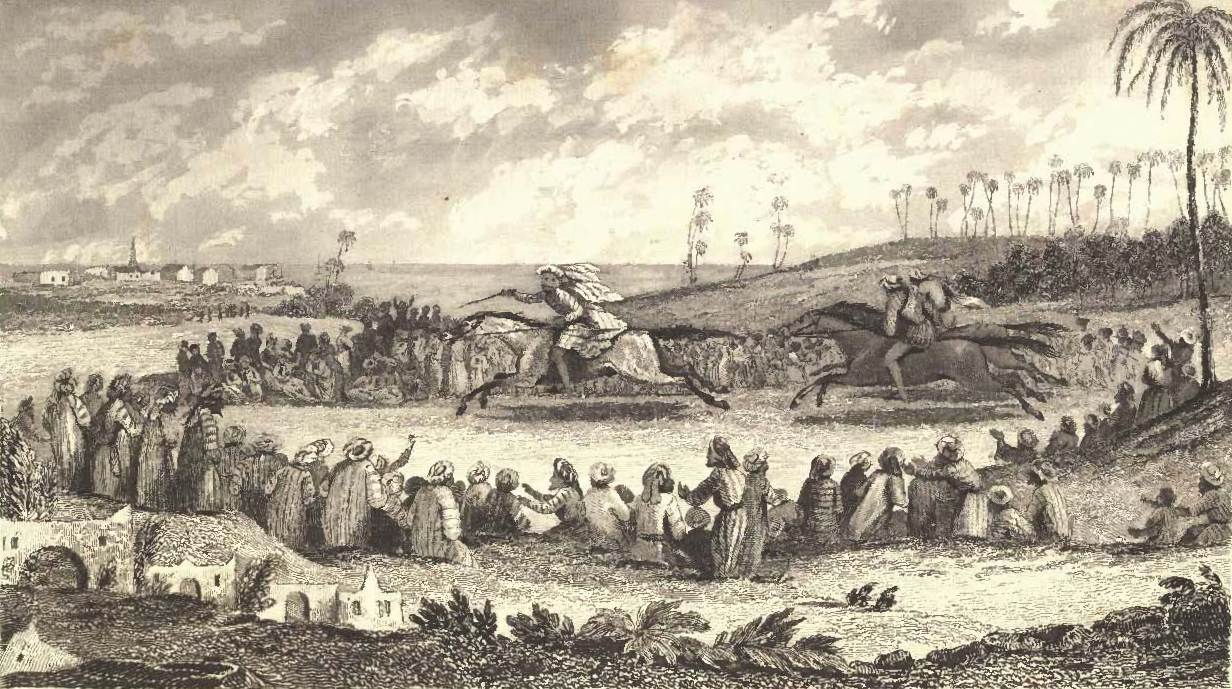
RACING ON THE NAZEE MOYA.
|
uncommon muscular powers. One of the Cutch horses belonged to the British consul, and was mounted by a Persian in the consul's service. A finer-looking rider I never saw. He was a tall, athletic man, beautifully formed; and with his long, jet-black beard, dark, flashing eyes, and superb costume, made a striking show on horseback. The horse was a spirited animal of the purest Cutch blood, and the caparisons were singularly rich and becoming. The other horses were also fine animals, ornamented with gaudy trappings, and mounted by Arabs in the richest Arabian costume. At a given signal, away flew the competitors with astonishing speed. Two of the Arab riders were locked in a close embrace: a custom that would lead the unlearned spectator to fear that if the horses were not equally swift, either rider must be dragged from his seat. This, however, though I saw the same feat performed several times in succession, did not take place. The horses were trained so perfectly as to understand precisely when they are racing in partnership. The Persian curbed in his steed till his competitors were twenty yards in advance, a manceuver evidently desighed to show his skill in horsemanship and the superior swiftness of the animal. At this moment he gave loose to the reins, applied his whip, and dashed like lightning after them. Now was the exciting crisis. They were within two hundred yards of the goal. On one side arose the deafening |
cheers of encouragement from the wavering concourse of Arabs; on the other, the exulting shouts of the Hindoos and Banyans. High bets were made on the success of the Arabian horses; others on their defeat, and the success of the Cutch racers. The conflicting shouts of the different tribes – Hindoos, Arabs, Sowhelese, and Africans – the waving mass of beings, heaving and swelling like an angry sea; and the aerial lightness with which the horses swept over the strand, with the gaudy robes of the riders streaming behind and flashing in the sunbeams, were all novel and exciting. I shouted with the rest, and felt all the enthusiasm of victory, when the Persian, applying his whip with renewed vigor, passed his competitors. The yells of disappointment and shouts of triumph were absolutely stun- ning when the Persian shot over the boundary line full three lengths ahead of the Arabs. It was worth a dozen races to see the proud, disdainful glance with which he regarded the dense crowd of Arabs along the course as he rode slowly back. There were several scrub-races, foot-races, and feats of activity after this, in all of which the Persian won new laurels. Toward dusk, as the crowd was about to disperse, we were all astonished by the sudden appearance of a buggy drawn by a white horse, and occu- pied by two gentlemen, who were amusing themselves by driving over the beach on the opposite side of the channel. Nothing could equal the cries |
of astonishment as this novel vehicle cut through the water and dashed in among the crowd. It proved to be a buggy and horse which had just been received by Jeram Bin Seeva as a present from Bombay, and not knowing how to manage it, he had submitted it for experiment to the American consul and Captain W––. Few of the natives had ever seen a vehicle of any description drawn by horses. Most of them scampered away, believing the island was in possession of the devil. Those who had been to Bombay remained, with loud cheers of admiration. Jeram himself, who stood close by me, shook his head and muttered, "No good dis; more better they send me something else. Plenty of devil come from dis." I returned to the consul's, highly amused at the various exhibitions I had seen. WARLIKE EXERCISES. – At stated periods throughout the year the natives have sham battles, which are carried on with great spirit, and not unfrequently with so much earnestness as to end in bloodshed. Some years ago, the Coolies, and lower classes of the citizens belonging to the different sections of the town, assembled at the appointed periods, under the names of the sections to which they belonged, such as Shonganeans, Bunganeans, Melindans, &c., and, armed with clubs, spears, and other weapons, fought in good earnest, sometimes slaying each other in great numbers. The nominal object of these meetings was to teach the youth of Tangila the use |
of warlike weapons, and by athletic and manly exercises to make them formidable in battle. When first permitted by the sultan, they were conducted with great harmony and fairness. Divisions, however, soon resulted from the victory of one side and the defeat of the other, or the superior skill of the natives of one part of the town over those of another. In the heat of these sham engagements accidental blows were given, which were revenged by the friends or relatives of such as were killed or seriously injured. Parties were formed, and party animosity prevailed to such a degree that every fight resulted in bloodshed. A civil war between the natives was rapidly springing into existence. So deadly and rancorous was their animosity against each other that they fought in the streets on every occasion. The sultan deemed the matter of sufficient importance to interfere, and lay down particular laws on the subject for their guidance. He also required the attendance of a guard of his soldiers at the place of engagement, to preserve order and see that the strife was fairly conducted. This had a salutary effect in the beginning. The natives fought with more moderation, and no deaths occurred ex- cept by accident. In this way the entertainment continued a considerable length of time. The guard was discontinued, and the laws became relaxed. Again jealousy and bloodshed were the results of every battle. The sultan came to the conclusion, that if people chose to slaughter each other, it would |
be ungenerous in him to deprive them of the enjoyment of their innocent propensities. Accidents were but excuses for murder and the gratification of revenge. A native or party of natives who, in the ordinary transactions of life, had sustained an injury, invariably found means to avenge all wrongs at these sham battles. The custom has continued so to the present time, with little modification. I witnessed several battle's of this kind which took place in the public squares; but as they were only preparatory to a grand exhibition of skill which was to come off in a few months, no deaths occurred. The contending parties meet in an open square, in any convenient part of the town agreed upon. A champion from each party, armed with a club, and naked to the waist, commences the engagement. After a trial of skill, in which some blows are given and parried off, much in the manner of the Irish fight with the shillelah, the combatants from each side rush in, and a general battle commences. Heads are broken, faces bruised, clubs dashed to pieces, and scores of the combatants stretched on the ground. Covered with dust and blood, and panting with ex- citement, they soon become a waving mass. Shouts and yells, the crash of clubs, and tramp of feet, are all that mark the fight. A cloud of dust covers the spot. Now a broken club whirzes past the specta- tor-now a defeated warrior staggers out of the crowd, reeking with sweat and besmeared with |
blood. Presently a deafening yell bursts upon the ear; dozens of the combatants come flying out of the circle pursued by the victors, who dash madly af- ter them, flourishing their clubs, and shouting in tones of triumph. The first grand onset' is over. Those who are most disabled retire a slidrt distance from the scene of strife, and refresh themselves for anoth- er bout. This is sport at Zanzibar. RELIGIOUS CUSTOMS. – If the ceremony of prayer be any evidence of piety, the Mohammedans are a truly pious race. At four o'clock every morning the Nazenee, or church-criers, station themselves on the roofs of the mosques, and in loud, shrill voices call the Mohammedans of the town to prayer. After this prayer they return to their beds and sleep till sunrise, when they have another at home preparatory to breakfast. Before dinner they pray again; before supper, the same; and once before they retire to bed – making in all five times. This is the invariable custom. A Mohammedan thinks it actually necessary to pray five times a day in order that his soul may reach Paradise. His conduct during the intervals has nothing to do with religion, provided he does not violate the laws of the Koran. Religion and morality are with him entirely distinct matters. Want of one will ruin him; want of the other is a matter of indifference. On this account he is extremely particular in the observance of the rules of his creed. Faith in them, and a strict regard to their performance, ease his conscience of all |
its burdens, and satisfy his mind in regard to the salvation of his soul. For an indolent people, addicted to vice, it is the most convenient and comfortable religion imaginable. The ceremonies are numerous and complicated. As a general rule, the Mohammedans remove their turbans, kneel with their faces toward Mecca, and bow their heads to the ground. This form of prayer they repeat at intervals of a few moments. They then stand, turn their faces toward the altar, and go through another portion of their prayer. All their motions are simultaneous. A row of fifty or sixty men with their bare heads to the ground has a singular appearance, and is rather calculated to excite mirth and ridicule, on the part of strangers, than feelings of reverence. Still they are quite as sensible as certain sects in our own country, whose religion consists in external pomp, and whose devotion is evinced rather by signs and ceremonies than charity of feeling, humility, and the natural and unostentatious offerings of the heart. June 18th, 1843. – Yesterday was a day of excitement and adventure, such as I have seldom enjoyed. The glowing descriptions given by many of my Arab friends, of the interior of the island, excited my curiosity in the highest degree. I had for some time anxiously desired an opportunity to go on an exploring ramble; but such were the feelings of animosity, on the part of the natives of the interior, toward the whites, occasioned by the murder of one |
of the Sowhelese by an English sailor not long before, that I deemed it prudent to go, if I could so arrange it, in company with some of the white residents. A party was at length made up, consisting of the United States consul, Mr. Tibbetts, Mr. Cloutman, and Mr. Jelly, three young gentlemen from Salem, Captain Webb, and myself, besides a number of trusty Arabs, and a retinue of Coolies to take care of our animals. Bright and beautiful was the morning of the seventeenth of June, the glorious anniversary of the Battle of Bunker's Hill. We were all up at the dawn of day, had an early breakfast, and were ready to start by sunrise. At the door of the United States consular residence was our caravan, consisting of four or five horses, and about twenty Muscat donkeys, richly caparisoned with splendid Persian saddles, highly ornamented bridles, and gaudy cushions, each attended by a Cooly. The air was cool and bracing, and the whole party was in fine spirits. Our Mohammedan friends were in a glorious humor, capering and curveting with their spirited Arabian steeds, and exhibiting every symptom of eagerness to dash off through the orange groves and shambas.* The donkeys, unlike our plodding, meditative, and matter-of-fact animals of that species, were full of mettle, and seemed to snuff the rich herbage of the jungle. It took us but a short time to mount; and, seated in the Arabian fashion, directly over the hind legs of our donkeys, away we * Plantations in the interior. |
dashed through the town, headed by the Mohammedans on their horses, and followed by crowds of boys. We soon passed through the Mohammedan grave-yards on the outskirts of the town and reached the race-course. The sun was rising in all his splendor as we passed the Nazee Moya,** gilding the dewy shrubs with a sparkling light, and shedding a golden flood over the plains to our left. The scenery was truly Oriental. To fhe right was a row of tall cocoa-nut trees, extending nearly a mile along the beach, affording barely a glimpse of the ocean; behind us was the town, with its mosques glancing brilliantly in the sunbeams, and the white houses reflecting the silvery rays; and toward the interior were grassy plains, interspersed with lagoons and jungles, bounded by a dense forest of cocoa-nut and orange groves. The air was deliciously fragrant with the perfume of wild flowers; and the whole scene forcibly brought to my mind Southey's exquisite picture: "What odors the voluptuous vale The gambols of a group of camels, as they started from the grass surprised at so early a visit; the picturesque costume of the Arabs; their imposing appearance on horseback as they swept over the * Last cocoa-nut tree – a name given to a sand plain near the last cocoa-nut tree of a range commencing near the town. |
Nazee Moya; the long train of donkeys, with their riders and gaudy caparisons; the half–naked Coolies trotting along by our sides; and the singular beauties of the scenery, all combined, had a peculiar effect upon my feelings. I was delirious with enthusiasm. Did I dream? Was I in reality in an Oriental land – the land of romance? How strange, how delightful! It was like the realization of the visions I had so often enjoyed while reading the Arabian Nights, or one of those enchanting pictures in Lalla Rookh. The beautiful princess was not there, but it required no stretch of imagination to find a Feramoez and a Fadladeean. After the miserable life I had led for nearly a year past, my heart was filled with pure joy, such as I had not experienced since I left the United States. It was with difficulty I realized so delightful a change. Applying the ratan to my donkey, I dashed on after the Arabs, soon leaving the main body of the party far behind. The animal, though small, was very ambitious, and his efforts not to he outdone by his rivals were rather amusing. In about twenty minutes we entered a path leading into the thickest part of the woods. Our course now lay through cocoa-nut groves and patches of jungle, still wet with the heavy night dews, and affording but a glimmer of the sun's rays. The density of the vegetation somewhat limited our equestrian feats, and the sharp, damp air began to reduce the temperature of our spirits, when, pushing through this labyrinth of trees and shrubs, we gained an |
opening, from which we enjoyed a most delightful prospect. The sun had burst through a mass of golden clouds, and a flood of dazzling light illuminated every object. Flowers, shrubs, and trees sparkled in its beams. Before us was a magnificent scenic panorama, consisting of wood-land, patches of meadow, lagoons, clove plantations, animated by groups of slaves with their turbans and curious costumes, driving herds of cattle from the jungles, and the joyous carol of the wood-land minstrels. Here, casting my eye in the rear, I perceived our caravan just emerging from the woods, and presently the merry shouts of our party came ringing over the copses. The singular and imposing appearance of the Mohammedans, who led the way, and the long procession of slaves, boys, donkeys, and riders, had a peculiarly romantic effect. An hour's ride over undulating paths, and through many varieties of trees, groves, and jungle, brought us to the shamba of Mohammed Abdelkada, a rich planter, whose farm is delightfully situated on the side of a gentle eminence about five miles from N'Googa. We were agreeably surprised to find a delicious repast already prepared for us, under the shade of two wide-spreading mangroves. Abdelkada's slaves had given their master warning of our approach, and every preparation for our reception that the time would permit was accordingly made. After our ride nothing could have been more appropriate and acceptable than Abdelkada's refreshing |
sherbet, the delicious oranges fresh from the tree, the chalottes, bananas, cooling water-melons, and incomparable lemonade. Our Arab host was all attention, hospitality, and talk, and each of us had no less than three or four slaves to keep the flies off, and pass round the refreshments. These shambas, or plantations, are, for the most part, owned by wealthy Arabs, who not unfrequently possess two or three hundred slaves. When it is taken into consideration that a slave here is not worth more than ten dollars, and can be purchased on the coast at a much lower price, this part of the property will not appear so imposing. In general, these slaves are treated with great kindness by their masters, and do less work, on an average, in a month than a Mississippi slave does in a week. Indolence on the part of the master begets indolence on that of the slave. Activity and energy are by no means characteristic traits of either master or slave. Still, Nature has been so bountiful in this part of the world as to leave man but little to do in the cultivation of the soil. Vegetation here flourishes to an extent that all the toil and labor bestowed upon less favored soils can not produce. It has been wisely ordained that where the climate is adverse to great physical exertion, the wants of man are more easily supplied than in other parts of the world differently circumstanced. In extremely cold regions it requires constant exertion to obtain the means of subsistence; but hu- |
man nature could not endure that fatigue in an unhealthy tropical climate. The natural indolence of the natives of Zanzibar, resulting from these causes, precludes them from the enjoyment of many comforts which have been thrown within their reach. A slight knowledge of the properties of the soil and the agricultural art would enable them, by very little exertion, to live in the enjoyment, not only of the comforts, but of the luxuries of life. Still, as their mode of living has always been different from ours, and their manners and customs are founded on peculiar religious notions, they no doubt enjoy what they conceive the greatest of all comforts and luxuries, in the gratification of their passions and undisturbed indolence. What we would consider an easy and ra- tional mode of bettering our condition and ministering to our social and moral enjoyments, they would regard as severe and unnecessary labor. I was naturally led to these reflections by all that fell under my observation at the shamba of Mohammed Abdelkada. With a plantation of the richest soil, and a sufficient number of slaves to cultivate it to the highest possible degree by three or four hours' labor a day under proper management, he lives in a dilapidated bamboo hut little better than those of his slaves, raises every year a small crop of mohogo-root, and a few piculs of cloves, and ekes out a monotonous existence, the sole enjoyment of which is eating, drinking, sleeping, and praying: such are the habits, and such is the life of an Arab. He has an unconquer- |
able aversion to physical exertion, and is never so contented as when idle. The soil of Zanzibar is not only rich; it is rank with vegetable aliment. In most parts of the island it is of a sandy quality. The nocturnal saturations of dew, impregnated with strong creative properties, which keep it continually moist, peculiarly adapt it to the vegetable products of the East. Orange groves, plantains, bananas, and other fruits, grow in abundance without any cultivation. The clove plantations, which somewhat resemble young peach orchards, the trees averaging from fifteen to eighteen feet in height, and being set out in regular rows, require but little care after the labor originally bestowed upon them in the planting. They yield abundant and profitable crops; and so well adapted is this climate to their development, that, I was assured by the American consul, Zanzibar is capable of supplying the whole world with this article of trade. The sugar-cane is raised on many of these shambas, and with very little labor the natives are enabled to supply themselves plentifully with an excellent quality of sugar. His highness, the imaum, has now in progress a sugar manufactory on his shamba, under the management of two English engineers, who have just arrived with the necessary materials for constructing the works. Coffee, of a medium quality, is also raised here. It can be imported so cheap, however, from other parts of the sultan's dominions, that little attention is bestowed upon its cultivation. Cassada and rice, being the |
chief articles of provision consumed by the slaves, are produced in large quantities. Ploughs are not used in the cultivation of the soil, and the only agricultural implements I saw were rude spades, pick-axes, and hoes. From their ignorance of the agricultural arts, twice as much labor is required to effect what could be done in half the time, and with less exertion. As I observed before, the slaves do not work hard. Little is required of them by their masters. Still, that little could be done more effect- ively, and with greater ease, if they had even a smat- tering of agricultural knowledge. I have seen slaves squatted on their haunches, planting cassada with old knives, by means of which they did about as much in a week as could be done in a day by a Kentucky negro. The climate and soil are admirably adapted to the growth of cotton. It is not a little singular that the Arabs will purchase cotton fabrics imported from the United States at an exorbitant advance on the cost, when, by importing a few Yankee mechanics and an overseer from our Southern plantations, they could soon raise and manufacture more than would be necessary for their own consumption at half what they now pay. I saw several specimens of cotton produced in small quantities for experiment, and they were certainly equal to any I had ever seen in Mis- sissippi or Louisiana. But what can be expected of a race who are degraded to the dust by superstition and religious intolerance? |
In general, the land is level – in part moderately undulating. There are several small springs scattered over the island, which supply some of the plantations. The chief dependence, however, is upon wells. Owing, perhaps, to the scarcity of rock, the water is in no part of the interior of a good quality. Chim-chim, the source of the creek called Metoney, affords the best. All the water I could get at the shambas was discolored with insects and vegetable matter, and it was only when compelled by sheer necessity that I drank it. Our worthy host, Mohammed Abdelkada, treated us to the best of every thing he had, and provided us with catandas, upon which we stretched ourselves, shaded from the sun's rays by the thick foliage of the mango trees, and enjoyed a refreshing siesta. We remained here, enjoying the courtesies of our hospitable friend, about two hours, when we again mounted and proceeded toward the shamba of Hadja Mouchad, a wealthy Arab merchant from Muscat. As we advanced still farther into the interior the vegetation became more dense, and in luxuriance surpassed any thing I had ever dreamed of, even in a tropical country. It did not surprise me that the malaria arising from a flat country rank with vegetation should be so fatal to the health. After a ride of about three miles through a tract of country differing only in this respect from what we passed through before we reached Mohammed Abdelkada's, we arrived at the fine plantation of Hadja Mouchad. |
In common with others who have performed a pilgrimage to Mecca and thrown stones at the devil,* our friend had earned for himself the distinguished title of one of the sacred Hadji, which he had prefixed to his name in commemoration of the event. He is a diminutive and shriveled old man, with scarcely breath enough left in him, from fevers and age, to sustain life. On important occasions he officiates in the town as dallal, or public auctioneer. He had received intimation of our contemplated visit, and hospitality being one of the cardinal virtues with the Arabs, our reception was as cordial as we could desire. Slaves were in attendance to assist the Coolies in taking care of our animals, and, on dismounting, we found a great variety of refreshments already prepared for us. Every thing was in the true Oriental style – fruits, sherbet, lemonade, and Mocha coffee in abundance. We found the refreshments extremely palatable after our ride, for the sun had now nearly reached its zenith, and its rays poured down through every opening in the woods with a scorching heat, raising the thermometer fifteen or twenty degrees in the shade in the course of a few hours. Mouchad's house was large, and superior in every respect to that of Mohammed Abdelkada's, and, indeed, he seemed to have some idea of the true principles of comfort. The main building was constructed of wooden stakes interwoven with cane, then * This is an important ceremony, which all pious pilgrims perform for the benefit of the Prophet. |
plastered and whitewashed. The roof was composed of cocoa-nut leaves closely matted, and formed quite a shelter from the sun, though in rainy weather it could not be of much avail. At the back of the house were several sheds, which were used as kitchens, and in front was an inclosure of several acres, delightfully shaded by large mango trees. A row of neat whitewashed cabins within twenty or thirty yards of the front door, at the edge of the inclosure, was occupied by slaves, who peeped from behind the door in ill-concealed amazement. The whole scene forcibly reminded me of an inferior negro quarter in Mississippi. Some attempts at ornaments were exhibited in the arrangements of the orange groves near the house. A glimmering of civilized taste was also to be seen in the cultivation of a garden, which contained a variety of beautiful tropical flowers, and had paths through it at regular intervals. The older portion of our party went under the shade of a piazza, and stretched themselves in a range of catandas (bamboo bedsteads) for a siesta, while Mr. Jelly, Mr. Tibbits, and myself rambled over toward a neighboring shamba to enjoy a smoke and a social talk out of the atmosphere of official discipline. Pushing our way through grove and jungle, we reached an opening distant about half a mile from Mouchad's shamba, interspersed with orange trees, plantain, and banana. The profusion of fruit here was beyond conception. The trees were actually bending with their golden-colored freight, and |
under them the ground was covered with the most delicious oranges of every species. So abundant were they, that for more than an hour we amused ourselves throwing them at the cocoa-nuts, which hung temptingly from the tall trees in every direction. Tired of our sport, we lay down under the cooling shade of a group of mango-trees, and smoked cigars, and talked of our sweethearts at home till we fell asleep. Our slumbers were soon disturbed by a loud voice shouting "Yahoo! yahoo! American man! Dinner ready! yahoo!" This important notice caused us to jump to our feet, and make all possible haste back to Mouchad's shamba. We received a reprimand from our friends on our arrival for keeping them waiting so long, and were duly repentant for our transgression. Presently Mouchad led the way into the house, telling us, "Dinner no very good; more better next time; but eat plenty much now, and he give us first-rate dinner when we come again." The excuses, however, were not necessary, for we found the dinner very creditable to the good,taste and hospitality of the venerable pilgrim. A long table was set in the middle of the room, with a white cloth, and knives, plates, and spoons arranged as near in the American style as could have been expected from an Arab. The table groaned with the profusion of meats, vegetables, and fruits, all prepared in the Arabian style with sweetmeats and richly-perfumed sauces. The incense arising from the dishes almost |
deprived me of my appetite; but s soon as I tasted the delicious curry, drank a glass of sherbet, and ate a few cassada, I found that I had a fair prospect of making a good dinner. The meats were cooked in sugar juice, and served up in a mixture of gravy and sirup; and mere taste quite satisfied me that this style of preparing flesh is not an improvement on ours. There was an abundance of rice, spices, pickles, cakes, and bread, which I relished highly; and we had wines of a very good quality. The Arabs, meantime, leaving us to the enjoyment of our dinner in our own way, ranged themselves under the piazza, and squatting down around a large dish of rice, ate their simple meal in theirs. Our sumptuous repast over, we sallied out to enjoy the shade of the mangroves. An agreeable surprise awaited us. Under the largest and most shady of the trees was a table containing a dessert of the choicest fruits, and a service of China cups and saucers for coffee. At a signal from Mouchad, a train of slaves appeared bearing various other refreshments. I had never tasted any thing to equal the coffee. It was the pure Mocha, boiled down to a rich essence, and was so strong that a single cup produced a sort of enchanting excitement, like the celestial dreams of the opium-eater; and no doubt would, if freely repeated, prove equally disastrous in its consequences. Mouchad entertained us with an account of his pilgrimage to Mecca, and when he had concluded we had several patriotic sentiments in commemoration |
of the battle of Bunker's Hill. It was not a little singular, that while we were thus celebrating that memorable event, our friends in the United States – equally enthusiastic in the cause of liberty – equally devoted to the memory of their forefathers – were dozing away in their beds, heedless of all the triumphs and glories of their country! One of the party, a wag, who had very gravely broached this fact, nearly incurred the displeasure of the rest of the company by his comments upon the want of patriotism in America, when he explained himself by reminding us that we were eight hours nearer sunrise than the people in the United States! Consequently, it was quite natural to presume that they were asleep while we were commemorating an important event in our national history. I shall not torture the reader by dwelling upon all the good things we enjoyed at the shamba of our kind entertainer. Such rarities, scenes, and adventures hardly admit of description. In the cool of the evening we bid adieu to our worthy friend Hadja Mouchad, and had a pleasant ride to the Nazee Moya. When we reached this place the sun was just setting, and if I were to live for centuries I could not forget the gorgeous splendor of the scene. Such a continuation of clouds, colors, and shades as hung over the western horizon, softly reflected in the ocean, can only be seen in an Oriental sky. A golden haze gave the dreamy appearance of a vision to the mosque steeples in the dis- |
tance, and beautifully illuminated the windows. The tall cocoa-nut trees on the summit of a little eminence that intervened added much to the scenic beauties of the view; and the white sand plains of the Nazee Moya before us, contrasting with the deep green shrubberies around the Mohammedan burial-grounds, had a magnificent effect. As we wended our way among the tombs, the wail of death arose upon the breeze. In a few minutes we met a long funeral procession, bearing the bier of a young Arab who had died that morning. The young girls were chanting a melancholy requiem, and an aged woman, who walked beside the bier, clapped her hands, and with frantic expressions of grief lamented the deceased. He was her only son! Oh, 'tis hard to lay into the earth CHAPTER XX.
Toward the latter part of July, the brig Rolla, of Salem, owned by the firm of Pingree & Co., and commanded by Captain P––, arrived from Muscat, whither the American consul had sent her two |
months previously to procure a portion of her cargo. The officers and crew were in good health, but had suffered severely by heavy gales to the northward, and had much difficulty in working down to Zanzibar in consequence of head winds. From Muscat they were compelled to run out as far east as the Laccadive and Maldive Islands, and then tack to the west. The chief part of the cargo procured at Muscat consisted of goat-skins and hides, which had been purchased from the natives by Syed Bin Calfaun, the commercial agent at the port of Muscat. The Rolla, on her arrival, commenced taking in the remainder of her cargo (gum copal and ivory teeth), and underwent some repairs. Arrangements were made to ship home the oil which had been saved from the wreck of the brig Bogota, and passages were provided for the survivors, now reduced to four; the rest having all died of fever, with the exception of the cook, who had shipped on board the Styx in place of Bill Mann. I was in a state of painful suspense about getting home in this vessel. Some of my friends said I would be allowed to go in her; others, that I would be kept until the next opportunity, which, very probably, would be in about six months. The consul said nothing on the subject, and I feared my prospects might be destroyed by any importunity on my part. In this unpleasant situation I remained two weeks, when, one morning, the consul told me the cargo of the Rolla was nearly all on board, and she would |
sail in a few days. He had made arrangements for my passage home. I was to assist in the ordinary work necessary to be done on board, stand regular watches, and have a bunk in the state-room with the second mate, with whom I was also to eat. A young man, named Cloutman, who had been in the employ of Captain Webb as a clerk, was to go home in the same way, and to have share of Captain F––'s state-room. This was entirely to my satisfaction; and so delightful was the idea of a pleasant passage home that I thought every day a week, and had many misgivings that my good luck was too rare to be realized. An opportunity of getting home, under any circumstances, I would have joyfully seized; but, with a party of lively and agreeable companions, it was beyond my most sanguine hopes. I had formed quite an attachment to young Cloutman. He was a brave and clever little fellow, who had spent several years at sea, and had passed through many dangerous adventures. His mind was stored with anecdotes of the sea, and the toughest kind of old sailor yarns; and these he could spin with an irresistible humor. In size, manner, and liveliness of disposition, he strongly resembled my favorite on board the Styx, Charley Clifford. It was, therefore, with no little joy I learned he was to be my fellow-passenger on a homeward voyage of three or four months. Captain F––, of the brig Bogota, the only other cabin passenger, was also a man well calculated to make the voyage pleasant. He was cer- |
tainly the best specimen of a whaling captain I ever knew, and in manner and personal appearance the greatest oddity. I first met him at Johanna, where he had a difficulty with the Portuguese on board the Bogota. Armed with a handspike, he sprung in among the mutineers, and in less than two minutes quelled the mutiny. The next time I met him was after the wreck of the Bogota. He had come into the consul's office to make arrangements for the sale of the hull. There were several persons in the room, among whom were the consul and his brother, Captain Webb, Captain Hamilton, and the commander of a merchantman from the Cape of Good Hope. The whaling skipper was a little abashed at this array of high characters, and, hardly knowing what to say, he turned to the consul, and observed, "Mister, do you know Joe Dunbar?" "Joe Dunbar! who is he? I never heard of him." "Why, Captain Joe Dunbar; I sailed with him." "You did? Well, sir, I don't know him." "Now, I'll swa'n, that's tarnal strange. You don't know old Joe Dunbar of New Bedford, the smartest whaleman that ever handled a lance? Well, I'll be darned! Gentlemen, don't none o' you know him?" "No, sir; never heard of him." "Well, by thunder! that beats all. I thought every body knew old Joe Dunbar." "Why, what of him?" "Oh, nothin'; only he made a fortune in the whaling business. He's a rich man now." |
The puzzled dignataries looked at each other, whether the captain was quizzing them, or deranged; but finding him perfectly serious, they said nothing. Taking advantage of their silence, he began a long yarn, in which be gate an account of "old Joe Dunbar's" voyages to the Northwest Coast, and was just entering upon a marvelous yarn in relation to the capture of a white whale, when the consul cut him short by saying, "We'll attend to that some other time. This is the place for business, not talk." "Oh, sir," said the disconcerted skipper, "I didn't mean to intrude. I just wanted to tell you about old Joe Dunbar; 'cos, if you don't know him, you had oughter know him. There ain't a chap in New Bedford knee high that don't know old Joe Dunbar." After this we invariably called the captain "Joe Dunbar," a name which he bore during the whole passage home. Captain F–– was a comical mixture of good nature, simplicity, natural smartness, and ignorance of the world. He had been in the whale fishery from the age of sixteen, and had been ship-wrecked times innumerable. In his personal appear- ance he was a perfect curiosity, being only five feet in height, built like a monkey, and with whiskers that covered his entire face, leaving only a couple of holes to peep through. He was very active, full of spunk and talk, and altogether the most amusing character I became acquainted with in the course |
of my wanderings. So much for my fellow-passengers. August 10th. – Light breezes from the S.S.W. Hove short at daylight, and at five o'clock A.M. beat out to the southward. At eight we were up with Choomba, and at ten Quallee bore due east. At twelve it fell calm, and so continued till dark, when a light breeze sprang up, and we set all sail. August 11th. – Beating down along the coast of Africa. Passed Hwala, Hoi-hoi, and a number of smaller islands, during the day. At dark, very squally to windward. August 12th. – A fresh southern breeze. still squally to windward. At four P.M. Zanzibar in sight from the top-sail-yard. Got the anchors in, and unbent the chains. In the evening, made a sail to leeward on the opposite tack. We continued to make good headway to the southward and eastward till August 21st, when the wind fell away. Toward noon a light breeze sprang up, when we tacked to the southward and westward. At daybreak a barque and ship were in sight, one on the lee beam and the other ahead. At ten A.M. we were boarded by a boat's crew, under the command of the chief mate, from the ship Fenelon, of New Bedford, Hathaway master, one year out. Learned from the mate that the boat's crew, who had arrived at Zanzibar about a month previously, had deserted from a whaler at |
Johanna, the commander of which had since had his leg broken by a whale. From this date to the 17th of September we had rough weather and head winds. In the early part of the month we were driven by strong currents and head winds into the Bay of Sofala, and had much difficulty in beating out again to the eastward. Off the Banks of Lagullas we hove to, and fished for cod, but without success. Found bottom at seventy fathoms. September 20th, made Table Mountain, Cape of Good Hope, distant four or five leagues. Here we took the S.E. trades, and in a few hours were "rolling down for St. Helena." CHAPTER XXI.
September 29th, 1843.
I passed a restless night, thinking of Napoleon and St. Helena. The long-wished-for time had nearly arrived when my ardent desire to visit the tomb of the exile was to be gratified. At the dawn of day I was on deck, peering through the gray atmosphere to get a glimpse of the island. There |
was a dark bank of clouds ahead, hanging over the horizon, toward which all eyes were directed. It was too vague and undefined, even through the spy-glass, for land; yet we knew that it enveloped the island. About sunrise the captain went to the mast-head, and in fifteen minutes the joyful cry of "Land ho!" saluted our ears. All hands were on deck in an instant. The clouds soon cleared away, and the rugged outline of St. Helena became visible. Nothing was talked of at breakfast but "going ashore," "rigging up," " the counsel's daughters," " a cruise up town," &c. Every one was on the tiptoe of expectation. The hands had some warm disputes about the watch that was to go ashore and the date of Napoleon's death. Old John, the Frenchman, was in ecstasies, jabbering French, dancing, and shouting "Vive l'empereur!" At ten A.M. the jagged rocks, and the deep ravines between them, could be seen off deck. By twelve we were close upon the southeastern part of the island, and in an hour more the valley of Jamestown began to open to our view. In passing the ravines between the high rocks we had some of those severe gusts against which Horsburg cautions mariners to be on the look-out. We were obliged, on two or three occasions, to drop the top-sails on the caps, and clew up the main and fore sail. The top-gallant-sails were furled, and the colors hoisted on the mizzen-peak and main-royal. At two P.M. we cast anchor a few cables' lengths off the pier. There were in port a Dutch merchant- |
man from Batavia, two slavers which had just been captured, and a vessel in quarantine. The United States consular agent, Mr. Carroll, accompanied by the colonial doctor, visited us immediately. Captain P––, Captain F––, and myself were politely invited to the consular resdence, which Mr. Carroll requested us to make our home during our stay. Having heard much of the beauty and accomplishments of his daughters, I was not at all backward in accepting the invitation, nor did the two skippers show any disinclination to take advantage of the proffered courtesy. Captain P–– very kindly provided me with some "go-ashore" clothes, which he called "long-togs," but I could not clearly see the appropriateness of the title; for the captain being a short, thick man, and I tall and slim, the idea occurred to me that "short-togs" would have been much nearer the mark. We all went ashore, with the consul and the doctor, in the brig's jolly- boat. An excellent dinner was prepared for us at the consul's, which, being unusually palatable to us from its novelty, we devoured with no ordinary relish. Nevertheless, I felt very awkward seated at a well-furnished table, with a knife and fork in my hand, and the bright eyes of several ladies upon me. In the course of the afternoon Captain F–– and I set out to explore the town. Strolling down the principal street, I spied a young lady seated at the window of a handsome private residence, very in- |
tently engaged with her needle. Any thing white, after my long cruise, was truly refreshing to my eyes; and I unconsciously gazed at her with an earnestness that she might have mistaken for rudeness, had she noticed it. She was really a most beautiful girl, with jet-black hair, a clear white skin, and a killing witchery in the exquisitely-rounded outline of her form. The captain, notwithstanding the hearty dinner he had just eaten, had been boring me for some time to go to a chop-house or bake-shop to help him to eat something. Wishing to stop his voice, for it might have been heard from the mast-head of a whaler, I begged him to notice what a lovely girl was at the window ogling him. By this time, attracted by our voices, she had raised her head, probably to ascertain the subject of our consultation. "Drot the girl! Let's get something to eat. I''m hungry as the devil!" replied the captain, in a loud voice. "But, captain, my dear sir, not so loud. She'll hear you," whispered I, very much alarmed. "Yes, I will. I'm hungry as a horse, I tell you. Come, B––, let's go to a bake-shop and get something to eat." I endeavored in vain to bring his voice within moderate bounds; for not only the young lady, whose beauty had captivated me, but the public in general, turned to see the hungry strangers. At this moment there was a dapper-looking negro passing up on the other side of the street. |
"Sail ho!" shouted the captain; "avast there, darkee! I say, moonshine, can't you show us where to find a bake-shop?" "What you call 'um, sare?" "A bake-shop; don't you savey, you Portuguese snow-ball?" "Oh yes, sare, I savey – beeg shop. Plenty beeg shop about here." "No, no, you dunce! A bake-shop, where they sell bread!" "Ah! dat w'at you want. Yes, sare, I direct you." "Be quick, then; for I'll be d––d if I've seen one since I've been in town. This is an infernal hole. There ain't nothin' in it. Why, at the Sandwich Islands, you can go to a poolfaree and get what you want; it don't make no odds what it is, from fried ham up to punkin pie. Come, B––, what the nation are you gallied at?" "Nothing; I'm not hungry, captain," said I, endeavoring to get him away as speedily as possible. However, he steadily refused to move an inch till he knew what I was "gallied" at. I insisted that I was by no means gallied, though I was considerably struck. "Od rot it!" shouted the captain, out of all patience at my want of taste in preferring the sight of a pretty girl to a good meal; "come along! Never mind that 'ere gal's skylights; they won't do you no good. My old doxy at home is a grand sight a |
snugger craft. Come, I want somethin' to eat. Oh Lord! if we only had a mess of baked clams!" This capped the climax. A half-suppressed laugh reached my ears, and, without waiting to hear any thing more, I started off at a brisk pace, with the captain blowing and puffing at my heels like a short-winded porpoise. After tea we had quite a musical party at Mr. Carroll's, composed of the family and several agreeable and fascinating young ladies of their acquaintance. It was indescribably delightful to an adventurer like myself, who had been over a year among Portuguese boors, during which time I had enjoyed no other change of company than the American consul's assistants at Zanzibar, and the Arabs and Africans at Madagascar and Johanna. We had duets on the piano, songs, conversational recreations, and all the pleasures of a social soiree. It was with mingled feelings of sadness and joy that I listened to the "songs I used to love." What delightful associations were conjured up that evening! I felt as if I lived over again the happiest part of my life. Times past, winter evenings, the luxuries and refinements of civilized life, the familiar faces of my friends, the happy smiles of brothers and sisters crowded upon me, and filled my heart to overflowing. I thought of these, and then I thought of the past year. It was like a dark cloud stealing over a region of enchantment, bringing with it visions of distress, suffering, and cruelty. Poor Clifford! how gloomy |
seemed the prospect before him, when all around me was joy and brightness. And M'F––, what a fate was his! Still the thoughts of home were too entrancing to be altogether dissipated by such reflections as these. The sweet tones of female voices speaking my own language in all its purity, the half-forgotten airs brought to mind again, the sound of the piano, the very furniture of the room, delighted and bewildered me. I could scarcely realize the idea that but a few hours before I was on the lonely deep, with nothing but the sky above, the sea around me, the tall spars of the vessel, its rigging, and the weather-beaten faces of the crew to relieve the eye. The past as well as the present was like a dream. I enjoyed myself more than I had since I had left Washington; for all this was a foretaste of home. It seemed to lessen the distance which we had yet to go. I found, too, that, after all the novelty of life in foreign countries, and the excitement of adventure, "There is an innate feeling clings Captain P––, and my whaling friend, Captain F––, spent most of the evening discussing wine and sea-faring matters in the next room with Mr. Carroll, having but little taste for the pleasures of the drawing-room. We slept that night in an apartment provided us by the kind hospitality of Mr. Carroll. Having |
previously bespoken horses, we were ready after breakfast next morning to ride out to Napoleon's tomb. Mr. Hamblet, our chief mate, and Mr. Cloutman, the young man from Zanzibar, joined us; and, with this accession, we had as jovial and sociable a party as could possibly be desired. We had scarcely half way ascended the mountain back of the town when we missed our jolly companion, Mr. Hamblet, who had very mysteriously disappeared from our ranks. Upon coming to a halt to ascertain what had befallen him, we discovered him some distance behind, clinging to his horse, minus his hat. We immediately rode up to his assistance, when we heard him delivering himself of a torrent of oaths, mingled with nautical observations on the difficulty of navigating a horse, an animal with which he was totally unacquainted. "Shiver me, if I've ever been athwart such a craft, shipmates. You're just in time. I've lost my main-top-gallant-sail, and hauled aback in distress. The lubberly-rigged thing wouldn't lay-to, so I had to fetch her short up, and run her off a point or two to leeward of her course; but she made so much lee-way that I had to haul her to port again. Then she wriggled like she'd shipped a heavy sea, and pitched me on my beam-ends. I righted up, I tell you, in pretty short order, and here I am with my main rigging hanging by the board, and my union-jack at the mizzen-peak." Without farther accident we reached the summit |
of the mountain. The road is walled up at the outer edge with rough stone, and winds up the sides of the mountain in zigzag meanders, so as to make the ascent gradual. From the peak, or highest eminence, the prospect surpasses in wildness and grandeur any thing I had ever seen: No effort of the imagination can conceive the natural wonders of the scene. Rocks piled upon rocks, till they actually seem to pierce the clouds with their rugged pinnacles; deep chasms edged with furz; ravines and valleys through which the sea gleams like a sheet of silver, and roads winding like serpents through the dark wood-land, form the background. To the left is the Valley of Jamestown, dotted with white houses, and the town dwindled to a mere speck. The vessels at anchor in the bay are perfect miniatures, reminding one of Coleridge's "Painted ships upon a painted sea." Beyond the town is Ladder Hill, an immense desolate rock, upon the highest pinnacle of which is a small observatory bearing the British flag. A row of steps, cut in the solid rock, reaches to the top of this wonderful pyramid. The precipice fronting the sea is almost perpendicular, and from its abruptness and great depth forms such a picture of danger as to make the boldest spectator shudder. In front and to the right the scene is still more desolate and expansive. Gleaming between the gray, rugged outline of the rocks is the vast Northern Atlantic, presenting to the eye a boundless waste of waters. I |
never felt the littleness of all things human so sensibly as when gazing with breathless interest on this mighty panorama. Turning our horses toward the interior, we soon came in sight of Longwood. Here new beauties entranced us. What associations the name conjures up! To see the far-famed residence of the hero – to be within an hour's ride of LONGWOOD, was worth years of suffering. It brought before me the spirit of the departed. The thousand objects I had so often read of – his favorite haunts; each hill and dell – all were familiar, though I now looked upon them for the first time. And there stood the cottage, half hidden in trees – an eloquent memento of the past. It brought to mind the exile, cold, pale, motionless, but proud even in the habiliments of death: "Earth's trembling monarchs there at bay On the road, Captain F–– and I, who were riding in front, were met by a gentleman returning from the tomb. "Hello, you sir!" shouted the captain, hauling up. "I say, sir, is this the way to Boney's tomb?" "Yes. You can scarcely miss the road if you keep on, and turn to the left where it branches." "Ay, ay, sir. How far d'ye call it?" "Two miles." "Two miles!" ejaculated the captain; "why, dang |
it, sir, 'twas only a mile an hour ago. It's strange sort of navigating in this here country. Thank you, sir. Good-by!" and while the stranger was gazing in silent astonishment on the shaggy face of my friend, the captain started on, muttering, "By thunder! this beats all the navigating I ever saw. A fellow had better take a reef in his eyes and sail t'other eend foremost, or shiver me if he won't make all his headway astern!" A pleasant ride of two miles brought us to the residence of Mrs. Talbot, the present superintendent of the tomb. This delightful little cottage is in a secluded glen, sheltered from the inclemency of the weather by towering mountains; and in neatness, beauty, and elegance evinces the refined and cultivated taste of its amiable occupant. Her servants took our horses, and she came to the door herself to invite us in. We spent half an hour in her cottage conversing with her about Napoleon, and listening to her reminiscences of his captivity. This excellent lady has been on the island upward of thirty years, and recollects perfectly well the ex-emperor's first appearance. Her reminiscences of his suite, especially of the Count and Madame Bertrand, the Count de Las Casas, and General and Madame Montholon, were peculiarly interesting to me, coming from one who knew them personally and who had enjoyed their confidence. We also amused ourselves examining the registers, on the pages of which were the names of all the |
strangers who for years past had visited the tomb. I found some good pieces of poetry, and a great deal of execrable doggerel in these books. Of the latter description there were some verses that could not but excite indignation in any man of feeling, containing jests and jeers on the dead body of the illustrious emperor. One in particular, written by an officer in the British navy, had something actually fiendish in it. The utter heartlessness and moral depravity of a wretch who could profane the memory of the dead by a burlesque description in verse of his removal from the tomb, and a satire on his fallen nose, should brand him with infamy. Having refreshed ourselves with an excellent lunch, we proceeded to the tomb. An old soldier, who says he has lived on the island for forty years, acted as our guide. The former guide, who had fought with Napoleon, and whose entertaining anecdotes delighted so many tourists, died some years ago. At a short distance from the cottage is the inclosure in which lies the sacred relic. A wooden fence of forty or fifty yards in length, and fifteen or twenty in breadth, encircles the tomb, if such it can be called. We entered by a gate, and found ourselves in a neat little garden, interspersed with shrubbery and willow-trees. In the center of this inclosure is a small square, formed by iron railing, over which was spread a tarpauling roof, somewhat in the manner of a military tent-cover. Of the tomb I have but little to say. It is now but a moldering relic of the |
past; a sad memento of by-gone days. The guide opened a little gate in the railing, and told us to descend. A flight of crumbling stone steps leads to the bottom of the vault. Here we found ourselves in the resting-place of the illustrious hero. A damp, noisome hole, sixteen or eighteen feet, walled up at the sides, and plastered, is now all that remains to be seen. The broken and dilapidated stair-way; the moldering walls, covered with inscriptions in various languages; the loneliness and seclusion of the spot; and the recollection of the magnificent victories numbered among the deeds of him who had so long tenanted this ruin, told an impressive tale of the emptiness of ambition, the insignificance of man, and the power of Death, the great conqueror of all. When I descended the steps, and stood upon the very spot where, for nineteen years, Napoleon had slept, I felt for a moment utterly lost in the confusion of thoughts and emotions occasioned by the novelty of my situation. I had pictured in my own mind all that I now saw; I had lingered with rapture over the pages of description; I had from early boyhood ardently cherished the hope of seeing what I had so long thought and read of; now, all my desires and aspirations were realized. It was no dream of fancy; no vision conjured up by youthful enthusiasm. I was in the grave of NAPOLEON! To be on ground thus famed in the world's history; to stand in the grave over which a nation had wept; to have the most ardent wish of my heart gratified beyond ex- |
pectation, was an epoch in my life too novel and impressive ever to be erased from my memory. The old soldier in attendance described the ex-emperor as he lay from the day of his death to that of his re- moval by the Prince de Joinville. It was extremely interesting to hear, from one who had known and loved him well, the most minute particulars of Napoleon's death; his last words; his looks when on the point of death; his funeral; his position in the coffin, and every circumstance connected with his removal; to have him, as it were, brought before our eyes as he had lived and as he died. The loquacity of the guide was really the most entertaining thing connected with our visit to the tomb. I presume he has told his story over a thousand times, with all his pardonable egotism; yet, as it evidently has the merit of being true, and contains much that can not be found in books – descriptions of incidents trifling in themselves, but characteristic of Napoleon; vivid reminiscences of scenes never sketched by the pen; anecdotes of the ex-emperor's peculiarities of habit and inclination, and interesting historical facts connected with his captivity – it is far from tiresome, and to every stranger it is new. A daughter of the guide, a fair, blue-eyed little girl of twelve or fourteen, presented us with several bouquets of flowers, gathered around the tomb, to take home with us as relics for our friends in the United States. The old man himself gave us leave to tear some pieces of plaster from the inside of the vault, and assisted us in getting |
sprigs of willow and cypress from the trees within the inclosure. Wishing to learn every thing connected with this celebrated spot, I gave the guide a rupee, which had the happy effect of making him still more communicative. We entered into a dialogue as we walked round the grounds, of which I give the substance. Referring to the presents we had received from him and his daughter, I inquired if he was troubled with many applications for relics of that kind. "Yes," said he; "so many that I am obliged to be very careful, or there would be nothing left about here. If I did not keep a vigilant eye on them, the French who visit the tomb would carry trees, railing, tomb, and all away with them. They are fanatics in their devotion to things of this kind connected with the memory of their emperor. Mrs. Talbot, who receives a pension from the Prince de Joinville for superintending the premises, wishes to preserve the few trees that remain from injury, and I am obliged to be rather sparing of my gifts." "Do you have as many visitors here as you had previous to Napoleon's removal?" "Yes; I am not aware that there is any diminution of the number. The officers, passengers, and crew of every vessel that comes into port, unless prevented by the most urgent circumstances, visit the tomb. When the body was here they could not do more; and this is rather too remote a part of the world to be visited by vessels expressly for that purpose." |
"The French seem to be devotedly attached to the memory of Napoleon?" "They are indeed – extravagantly so. I have known them to shed tears over his tomb, as if he had died but a day before. Some of them are so completely overpowered with grief as to give way to the most violent lamentations. Scarcely a French visitor leaves here without carrying away with him tufts of grass, lumps of the sod, or any rubbish he can find within the railing. A piece of plaster from the vault is a fortune to a Frenchman." "Where were Napoleon's favorite places of resort?" "Within this inclosure, and, in fact, throughout the valley, he spent most of his time. Napoleon was too proud a man to relish any want of confidence in him, and he disliked nothing so much as being continually under the vigilant eyes of the British guards. After prevailing upon Admiral Cockburn to station a cordon of sentinels at a stated distance around Longwood, he never went beyond the prescribed limits, although at liberty to do so with the attendance of a British officer. This is the spot where he used to sit and read. It was his favorite part of the island; and he said that, next to the banks of the Seine, he should choose this as his last resting-place." "Was he always unattended in his rambles here?" "He was generally alone; but he took great pleasure in the company of his favorites, the Count |
and Madame Bertrand, by whom he was frequently accompanied. He was sincerely attached to the count and his lady, whose romantic devotion to him he fully appreciated." "It appears, from the published accounts of his removal, that his body was in a good state of preservation when taken up?" "Yes; externally it was perfect. The least touch, however, made an indenture. His nose was the only part which did not retain its original fullness. It hung in upon the bone, and greatly disfigured his countenance. I saw him by torch-light, and a more ghastly object I never looked upon. The night was dark, and, when the lid of the coffin was raised, the glare of light shed upon his pale features gave them an additional ghastliness. His eyes were much sunken, and his lips slightly parted. There was nothing of sternness in the expression of his countenance. It was rather that of pain. He looked as if he had fallen into an uneasy sleep after a long fit of illness. His liver and heart, which were embalmed and placed upon his breast, were uninjured." By this time we had reached the spring, so celebrated for its excellent water. The little girl who had presented us with the geraniums, stood in front of it, with a pitcher and tumbler. "This," said the guide, "is the spring from which Napoleon drank during his captivity here. He considered the water excellent, and always used it in preference to any other beverage. Visitors to his |
tomb drink from this spring, in order that they may say, when they get home, that they drank from Napoleon's spring. The French, and, indeed, visitors of all nations, frequently take away with them bottles of the water, which they consider as valuable a relic as the place affords." Having satisfied our curiosity, we remunerated the old man for his trouble, and repaired to the cottage, where we partook of some refreshments, and had some farther conversation with Mrs. Talbot. Our horses being ready, we took our leave of these worthy cottagers, and started off, highly pleased with our visit, for Jamestown Valley. On the road we met several specimens of a very curious breed of asses, such as I had never seen before. They were of a rough, thick-set make, with hair, or, rather, wool, hanging almost to the ground, and forcibly reminded me of the off-hand sketches of Moreland. We reached Jamestown about two o'clock. The hostlers were standing in front of Mr. Carroll's house, ready to take charge of the horses. A more polite set of men I never saw. They will do any thing in the world for you; but you must pay them two or three times over, and you have the additional consolation of a vast increase in their number during your absence. I was much amused at the politeness and pertinacity of one of these knaves. I had given the hostler who had attended my horse in the morning a rupee. Captain F––, through kind- |
ness or mistake, had paid the same man, both for himself and me. Thinking the business all settled, I went on a ramble about town. To my great surprise, I was confronted at every corner by a man whom I had no recollection of having ever seen before. He was a well-dressed, bright-looking Yamstock, or native of the island, and kept bowing to me with the greatest politeness imaginable. I paid little attention to him at first, supposing it might possibly be the custom at St. Helena for strangers to be noticed in that flattering manner. At last, finding he followed me wherever I went, bobbing at me with his hat in his hand, I stopped short, and giving him a friendly nod in return, hoped he was well, and wished abundance of health and happiness to himself and family. "Yes, sir – thank you, sir – hope you are very well yourself, sir," said he, bowing and scraping in a perfect fever of politeness. "Quite well, thank you," said I. "Glad to hear it, sir. Hope you like St. Helena, sir. Very pretty place; think I saw you before, sir. I takes care of horses – yes, sir, I keeps 'em in good order." "You do? Well, I hope you find it a profitable business." "Thank you, sir; sometimes I do, when I meets with gentlemen like yourself." "Well, my friend, I am glad to hear it. I hope you'll prosper in your line of business. Good-by; I'm in a hurry just now." |
"One moment, sir; hope you'll remember old Pill Garlick." "Pill Garlick? Are you the original and unadulterated Pill?" "Yes, sir; I'm the very man." "Well, Pill, I'll remember you. I never saw you before, but if I ever meet you again, I think I shall know you. Good-morning!" "Mister! mister! I took good care of your horse, sir. Be happy to drink your health." "But I paid a man for taking care of the horse. How's that?" "Ah!" sighed Pill, with a grave shake of the head and a melancholy smile of commiseration, "you paid the wrong man! If you pay me, you can't mistake the person again, sir." Amused at the effrontery of the rogue, I gave him a shilling, and advised him never again to let the light of his countenance shine upon me, for both of which (the shilling and the advice) he thanked me very cordially, wished me a pleasant voyage home, and kept bowing at me, and scraping the pavement with his feet, till I lost sight of him, and, for all I know to the contrary, he may be bobbing away there in the same polite manner still. In the course of the afternoon I was favored with numerous anecdotes of what had occurred at the tomb of Napoleon within Mr. Carroll's recollection. I was particularly amused at an account of an irascible Frenchman, who conceived himself insulted by |
a Yankee. Though such an anecdote must lose in the repetition, I shall give it as nearly as possible in the language of the narrator. An Englishman some years since visited the tomb, and indited in the register a verse on the ex-emperor to this effect: "BONEY was a great man, This was not in very good taste, nor exactly such an allusion as an Englishman should be guilty of at the tomb of a conquered foe. Nevertheless, it contained indisputable truths. A Yankee visited the place a few days after. Determined to punish the braggart for so illiberal and unmanly an attack on the dead, he wrote, immediately under it, "But greater still, and braver far, The next visitor was a Frenchman, who, like all his countrymen, was deeply attached to the memory of Napoleon. When he read the first lines he exclaimed, with looks of horror and disgust, "Mon Dieu! Quel sacrilege! Sans douts, l'Anglais sont grands cochons!" The Yankee skipper's addition next attracted his eye. He started as he read; gasped, grinned, read the lines again; then, dashing his hands in his hair, danced about the room in a paroxysm of indignation, |
screaming "Sacre diable! Monsieur Bull is one grand brute, but le frere Jonathan is one savage horrible! Sacre! sacre! I challenge him! I shall cut him up in vera small pieces!" He called for his horse, rode post-haste to town, and sought the Yankee every where. Alas, the bird had flown! A ship had just sailed; the skipper was gone! Unappeased in his wrath, the Frenchman called upon the consul for redress, but was told redress could not be had there. Straightway went the enraged man with his complaint to the governor. His excellency reasoned with him, moralized, philoso- phized, but to no purpose. Nothing would satisfy the irascible Frenchman but the erasure of the offensive lines, which, by order of the governor, were stricken from the register. Jamestown is a pleasant little place, containing a population of about fifteen hundred. The houses are neat, and many of them even elegant. There is great variety in the population. Those born on the island are of the complexion of the Portuguese, and are called Yamstocks. The upper classes are very intelligent and polite, and the society is good. The number of children in Jamestown, from the ages of six to twelve, is almost incredible. From sunrise to sunset the streets are literally swarmed with them. I thought Terceira surpassed every other island in the Atlantic in that respect, but the fecundity of the women in St. Helena is beyond all competition. |
Within a few years, hundreds of children have been sent from St. Helena to the Cape of Good Hope. Still there seems to be a sufficient number left to people all the uninhabited portions of the globe in a few generations. I visited the market-house early on the morning after our arrival, and found much there to interest me. From the general descriptions I had read of the sterility of this island, I had supposed that it produced little or nothing in the way of vegetables. It quite surprised me to find that, so far from that, there was an abundance of very good vegetables in the market. I saw pumpkins and water-melons equal in size to any I had ever seen before. ` There were also small, round potatoes, middling-sized turnips, cabbage, greens, plums, and pears. The products of the island are sufficient for its population. Owing to the great demand for vegetables, caused by the number of vessels constantly stopping at St. Helena on their passage home from the Indian Seas, the prices are proportionably high. Captains of vessels are apt to deem these prices exorbitant; but they should recollect the great difficulty of raising crops on a pile of desolate rocks; besides, the natives have no other protection. It can not be expected that they should give the food out of their own mouths without receiving sufficient to compensate them for their deprivations. The water at St. Helena is the purest and best, perhaps, in the world. That which is made use of |
by vessels is procured from a spring near the pier, gushing from the solid rock. A ship's long-boat, with three or four casks, can run under this spring, and obtain a load without any trouble. Our stay was so short that I could learn but little in relation to the civil regulations of the place. The laws, I was told, are strict and severe. The British governor rules the colony with despotic sway. The present incumbent, however, is a man of good sense and humanity; and St. Helena being rather a military station than an ordinary settlement, strictness in the administration of the laws is absolutely indispensable. There is a formidable battery fronting the harbor, upon which the British soldiers may be seen parading at all hours of the day. The heavy guns cover every part of the anchorage, and leave no chance for the entrance of an enemy's vessels of war. The most striking feature in the fortifications of St. Helena is to be seen on approaching the harbor. In the highest rocks, which one would suppose to be inaccessible, are holes through which the muzzles of cannon protrude. What is most extraordinary, the rocks are so nearly perpendicular as to preclude the idea of getting those heavy weapons of defense up from the water and I could account for their appearance there in no other way than by supposing they were lowered from above by ropes. The labor that it required to dig these holes in solid rock must have been very great. Sentinels are stationed at |
each gun, who are relieved at regular periods during the day and night. The necessity for all this vigilance, since the removal of Napoleon's remains, I could not clearly see. St. Helena certainly is not an island of so attractive an aspect as to invite attack for the purpose of territorial acquisition. Captain P–– had procured all the necessary refreshments by evening; and having taken an affectionate leave of the consul and his family, we all went on board the Rolla. In fifteen minutes the anchor was up. The Dutch merchantman had already hove short, and by sundown we were steering in company for home, with all sail set. The bustle and confusion of departure over, the crew seated themselves on the scuttle, or lounged about the forecastle, talking of what they had seen. Old John, the Frenchman, leaned against the bulwark, and gazed silently at the receding rocks. I quietly approached him, and asked him what he thought of Napoleon and St. Helena. He turned his face toward me, and I could see the tears steal down his cheeks as he replied, "Ah, Mr. B––, it was a hard fate! I never knew how hard it was before. It reminds me of a song I learned when I was about your age.: "'Adieu, Patrie! adieu, Patrie!" Here John attempted to sing me the Exile's Lament on bidding adieu to his country; but, overpowered by emotion, he buried his face in his hands, and was silent. I respected his affection for the dead, and left him to the indulgence of his feelings. |
Slowly and mournfully the dark shadows of night were stealing over the island. I sat upon the taffrail and gazed upon it, as it grew more indistinct each moment. Now it was but a dark mass of rocks, with a rugged outline; now, an undefined object, half hidden in the darkening twilight; now the eye could scarcely recognize it in the depths of the gloom. Thoughts of the few happy hours I had spent there; of all I had seen and experienced within so short a period; the genuine hospitality of the warm-hearted strangers who had been so kind to me; the associations connected with this desolate spot, awoke within me many emotions of regret, and vague, melancholy reflections on the fleeting triumphs of ambition. That night, inspired by visions of the beauty of a young lady to whom I had been introduced on the island, I went below, and perpetrated, for the first time in my life, a desperate attempt at poetry. I have not been very hard upon the reader in this respect, and, regarding my narrative somewhat in the light of a confession, I claim indulgence for the following rash effort: Lines on Miss L––gg. To the sweet little valley of Jamestown I came, Long years in my heart this misfortune will rankle, |
CHAPTER XXII.
Captain P–– was the very antipodes of my old whaling skipper. Never had I met with a more generous and warm-hearted man, or a better friend in every respect. He was kind to his crew, respected their feelings, and did all in his power to promote their comfort. At the same time, he preserved discipline, and made every man know his place. A better sailor never walked a ship's planks. He understood his duty from beginning to end, kept within the bounds of his authority, and, while faithful to the interest of the owners, gave the crew their full complement of provisions, and encouraged them in all their enjoyments. The consequence was that they respected him, and made themselves active and useful. Brave, energetic, and liberal, he set an example that excited the emulation of all on board. No man flinched from danger, avoided work, or refused to share the best he had with his shipmates. I have said that the captain was fond of fun. It was, in fact, the chief ingredient in his nature. Our passenger, Captain F––, was the subject of his |
best jokes. The ex-whaleman had a superabundance of good-nature, but was too credulous for an old joker like, Captain P––. There was but one subject upon which he really disliked to be quizzed, and any allusion to that made him very angry – a paragraph in Mr. Dana's Narrative, which had a direct bearing upon his seamanship. Now a sea-captain is as sensitive about his seamanship as a poet is about his verses. Dana speaks of a whaler which he visited on the northwest coast, and describes the captain as a "slab-sided Quaker," the hands as an awkward set of backwoodsmen, and the whole cut and rig of the vessel as neither tidy nor shipshape. This, it happened, was the very vessel in which Captain F–– performed his first voyage as mate. The allusion to her untidiness was something he could not digest. Captain P–– and myself took particular pleasure in denouncing whalers, and always quoted this passage in support of our position. The fun we enjoyed in this way kept the whole ship alive. It soon found its way to the forecastle, and the ex-whaleman was quizzed on all sides. At last, unable to bear it any longer, he swore he would knock the first man down who alluded to the "villanous libel," and signified his intention of going to Boston as soon as the Rolla anchored in Salem harbor, hunting up Mr. Dana, and giving him a most terrible thrashing. It was impossible, however, to prevent some sly hints once in a while about the "slab-sided captain" and the "lubberly whaler." |
On our passage from St. Helena we amused ourselves making miniature ships, working lunars, pricking our progress on the charts, and talking of home during our leisure hours, and doing the usual small jobs about the vessel when on duty. There was one trait in Captain P––'s character for which I warmly esteemed him: his devotion to his wife and children. Not content with descanting upon their merits, he spent an hour every forenoon reading a package of letters written by his wife to entertain him during his long voyage; and every night he regularly wrote her an account of the proceedings of the day, signed and directed as if for the mail. This arrangement, dictated by affection, brought the devoted couple in mutual communion. While thus separated, the wife had all the letters of the preceding voyage to read, and the husband all those interesting little details of domestic life which had transpired during his previous absence, to make up for the deprivation of being separated from those he loved. Wafted along by pleasant trade-winds, nothing occurred to relieve the monotony of our passage till October 14th, when we crossed the line, in long. 35° 20' west. This is always an interesting epoch in sea life, and was none the less so to me from the fact that, once across the line, it seemed as if we were more in the neighborhood of home than even a few leagues to the southward. The rest of our passage may be summed up in a brief log. |
October 18th. – Lost the trades in lat. 7° north. From this date till the 23d we had light and baffling winds, heavy rains, squalls, and calms. In lat. 13°, took the N.E. trades, which continued till we reached lat. 30°. In 32° had N.W. gales. November llth. – Entered the Gulf stream, after much bad weather. In this dark and dreary nest of storms we had strong N., N. by W., N.N.W., and N.W. gales. Lay to three days under close-reefed main-top-sails and fore-top-mast stay-sail. Made our exit in 37° 30' north. November 16th. – Gulf astern, looking like a thick, dark bank of clouds. Some of the men on the bow descried a vessel ahead, three or four leagues distant, without sail, and apparently in distress. At two P.M. made sail for her, and at four came up and rounded to under her lee. She proved to be the schooner Mirror, of Newburyport, Rhode Island. Boarded her, and found her abandoned. Her sails hung in ribbons on her spars; the fore-yard was gone; the fore-top-sail yard swinging by the halliards, braces drifting overboard, and rigging in great disorder. There was no water in her hold, though she had apparently been abandoned but a few days, evidently in consequence of the loss of her sails. Her cargo was plaster of Paris. The cabin was lined with bird's-eye maple, and in good order, but without bedding or furniture, except the Chinaware, which was carefully stowed away in her lock- |
ers. There was also in one of the lockers the remnant of a meal recently cooked. We procured from the hold two barrels of good potatoes, a few blocks, some loose rigging, and whatever else we could conveniently carry away in the boat. November 17th. – Rain, and thick foggy weather. Got the anchors on the bow. At one A.M. sounded in forty-two fathoms, muddy bottom. "Land ho!" shouted the captain, who had been on deck most of the night anxiously looking out. "Land ho! you lubbers! What are you all about?" "Where away, sir?" cried several of the crew, running aft with joy in their faces. "We can't see it, sir." "What land?" asked the mate. "Land ho! land ho!" yelled the captain. "Where is it, sir?" demanded a chorus of voices. "Here in my hand, you boobies!" coolly rejoined the captain, holding up the lead. "This is land; smell it!" Of course every body laughed at the joke, and bore the disappointment with becoming good-humor. That night, however, we made Cape Cod light-house. There was no deception about this. All hands were frantic with delight, and nobody thought of turning in on so joyous an occasion. I can not describe the strange sensations I experienced when we passed Boston harbor, and saw all the ships and houses lining the shores. There was something novel in the civilized aspect of the whole scene, for |
I had become so accustomed to Arabian dows, canoes, bamboo huts, and cocoa-nut trees, that I was almost a stranger to every thing bearing the marks of civilization. The Salem pilot boarded us during the morning, and that afternoon, the 19th of November, we cast anchor in Salem harbor. I experienced no unusual sensations of pleasure in getting ashore. Regret at parting with the crew greatly predominated over every other feeling. I had become warmly attached to many of them, and it was sad to think I should most probably never see them again. Captain P–– insisted upon making me his guest for a few days, or as long as I wished to stay. I could not resist so kind an invitation, anxious as I was to start for home. The genuine hospitality of my sea-faring friend, the attention and kindness of his estimable lady, and their generosity in providing me with clothes and other necessaries, made an impression upon my heart which time can not erase. I enjoyed a week's unalloyed pleasure under their roof, and though, in the course of my life, I have met with many people who made a greater dash in the world, and a more imposing parade of their virtues, never has it been my fortune to know a more affectionate, generous, and deserving couple than this honest mariner and his wife. I can not bid adieu to Salem without acknowledging the disinterested kindness with which I was |
treated by every citizen of that place with whom I became acquainted, and, indeed, by many who were total strangers to me. I look back upon my short sojourn there with mingled feelings of pleasure and regret. In a single week I made more warm-hearted friends in Salem than I had ever made any where during twice the time. As to the ladies, bless their noble souls, I love them – every one! Is it not sad to part with friends and associations so dear to the way-faring pilgrim? On my arrival in New York I called upon an old family friend, who gave me the first news from home I had received since my departure from Washington, and communicated the melancholy intelligence of the death of a younger brother. The unhappy tidings, so unexpected, shocked me more than words can tell. I had left him in the enjoyment of health, and in the very morning of life. Scarcely a week had elapsed since I had sent a letter from Salem, containing an affectionate remembrance to him, and an allusion to some little presents which I hoped soon to hand him in person. Without making any stay in New York, I proceeded to Washington, and arrived there on the 28th of November, having been absent nearly seventeen months. I was extremely anxious to continue on to Louisville. It was my home. I was comparatively a stranger in Washington, and longed to be once more among friends and kindred. This pleasure was de- |
nied me. I had to give my last cent to a porter, and, after all the perils and hardships of the past year, the only resource left me was to set to work and earn money enough to carry me home! Congress was about to convene, and I was just in time to make an engagement for the session. At the expiration of seven months, during which time I worked hard at my business as a reporter, I set out for Kentucky, where I arrived after a pleasant trip across the mountains. Two years and a half had produced many changes in Louisville. My old acquaintances were grown out of my recollection, married, or scattered over the country. I met few who recognized me, and none who did so without difficulty. Forgetting that I had altered too, it mortified me to think I was so soon forgotten. Even the houses looked new and strange to me, and reminded me that I had been a wanderer. It was now more than a year since the death of my brother, and the natural gloom, caused by the circumstances under which I once more found myself a member of the family circle, soon passed away. Surrounded by old and well-tried friends, and the nearest and dearest of my kindred, who loved me all the better "for the dangers I had passed," I related my adventures. I need scarcely say I had an indulgent audience. The joy of such a reunion more than compensated for the perils and hardships of the past. Never before had I fully experienced all the pleasures of home. My pilgrimage was over. |
"I was once again CONCLUSION.Fate of my Comrades. – Narrative of the Sufferings of my Friend W––. – Unparalleled Case of Cruelty. – Account of the Yankee Boy. – The Mockery of the Law. – Injustice toward Seamen. – Review of the Voyage. – Reflections on the present Condition of the Whale Fishers. – Flogging, and its evil Effects. – Imperfections of the United States Consular System. – Life of a Whaleman. – Tyranny. – The End. IF I have succeeded in securing the attention of the reader so far, it is but reasonable to presume he feels an interest in the fate of my fellow-adventurers. I should deem my task but half performed were I to omit farther reference to the unfortunate young men whose sufferings I had shared, and with whom I had been so long and so intimately associated. My first inquiry on my return to Washington was touching the fate of my friend W––, whose melancholy history is given in the early part of this narrative. When I parted from him at Fayal I had little hope of ever seeing him again. He was then in such a state of health as almost to preclude the |
possibility of his recovery. It rejoiced me, however, to learn that he had returned to Ohio in safety during the autumn of the preceding year. I learned, also, that his family and friends attributed to me all his misfortunes. Not knowing how much blame he attached to me himself, I felt a delicacy, under these circumstances, in writing to him; convinced that, the moment he heard of my return to the United States, he would, if still friendly to me, explain how matters stood. Some time after my arrival in Washington, hearing nothing from him, I published an outline of my voyage, and sent him a paper containing it. In the course of a week or two I received a frank, cordial, and highly satisfactory letter, assuring me of the friendly regard of himself and family, and containing the following brief narrative of his adventures from the time he had parted from me at Fayal. After our separation he remained in the Villa Orta, confined to the hospital about two weeks, during which time his sufferings from illness and the unskillful treatment of the doctors surpassed even what he had endured on board the whaler. He at length succeeded in negotiating with the captain of a small schooner, about to sail for Boston, Massachusetts, for a passage to that port. Though too feeble to work, he was compelled to turn out at night and assist the hands in taking in sail, and in some other respects received the most heartless treatment from the captain, who had too little manliness to ap- |
preciate his unhappy situation. On the passage they encountered much rough weather, and it was not until the 29th of November that they came to anchor in Boston harbor – making the passage upward of six weeks. He lay confined to his bed, in a sail- or boarding-house, for several days before he had strength to write to his parents. An answer, containing a remittance, arrived in due time; but it was more than three weeks before he had sufficiently recovered to bear the fatigue of traveling. Immediately on regaining in some measure his health, he started for home, where he arrived in the course of a week, very much enfeebled. Unfortunately, the effects of the sun-stroke still remained, and he again fell sick, and continued throughout the winter in a state of great prostration of mind and body. In the summer of 1844, having received a cordial invitation to spend a few weeks with him, I passed through Ohio, on my return to Washington from Kentucky, and paid him a visit. Need I say our greeting was a warm one? We had both suffered, and we felt that past events had but strengthened the bond of friendship. Our joy was mutual, for our separation had been long and painful. I spent a few weeks with my esteemed shipmate, on the banks of the beautiful Scioto, in unreserved communion over the trials and hardships of our sea life. I was grieved, however, to find him still laboring under the effects of his maltreatment on board the whaler; and it is with deep regret I add that now, after the |
lapse of more than three years from that period, there is no abatement to his distressing malady. Where is the law for a deep and lasting injury like this? During the winter succeeding my visit to the West, I learned the following melancholy particulars in relation to the fate of my poor friend, Barzy M'F––, the "down-easter." I have already dwelt at some length upon the estimable character of this young man. I have shown that he possessed more than an ordinary share of the kindly and endearing feelings of our nature. Though rude in his exterior, and without education, he had a noble, manly, and generous heart – a heart alive to the sufferings of others, and ever prompting him to acts of kindness. I have shown that he was lively, inoffensive, and honest; and I now add, in testimony of his good qualities, that in all my intercourse with the world, I never met with a more upright and honorable young man, a kinder friend, or a better companion. But hear his fate, ponder over it, and, I venture to say, you can not find in the annals of dark and damning crime a deed more atrocious. Driven by cruelties which he could no longer endure to make his escape from the barque Styx, he took advantage of the first opportunity that occurred after she left Zanzibar, and deserted on an island in the Indian Ocean. He had been absent but twelve hours when he was retaken. Warned by the ill-treatment which he had previously received not to depend any longer upon the prospect of his condition being improved, he re- |
fused duty. To this determination he adhered with so much spirit and resolution, that the captain, with all his threats, could not compel him to yield. M'F–– had suffered too many outrages to remain in the slavish position he had occupied during the voyage. For thus maintaining his rights as a man and an American citizen, he was confined in the run, and kept there, on bread and water, from the 14th of February till the 11th of September, 1844 – nearly SEVEN MONTHS. Upon the arrival of the vessel in the United States (at the date of his liberation), he had the captain arraigned before the United States Commissioner in Boston on a charge of cruel and unusual punishment. It appeared from the testimony that his punishment was the result of his own determination not to do duty; that he had been repeatedly offered his liberty if he would resume his place before the mast, but had invariably returned the same positive answer. When liberated, he was a mere skeleton, and had evidently endured the most intense tortures of mind and body. In giving an account of the cruelties inflicted upon him, he betrayed no ill-will against the captain, but stated all the circumstances with marked fairness and honesty. Now I wish to call particular attention to the run in which this man was confined. Those acquainted with a ship's structure of course understand all this, but there may be some who will not deem a few words of explanation supererogatory. The run is the |
hole or apartment immediately under the cabin floor: In a vessel of a hundred and forty or fifty tons burden, it is rarely more than three or four feet from the deepest part of the run to the cabin floor, and not more than twelve or fourteen feet from the stern- post to the bulk-heads which separate it from the aft hold. The stench of the bilge-water in this noisome hole is almost suffocating. In addition to this, the run of the barque Styx was more than half filled with old kegs, cheese-boxes, rigging, and other rubbish, leaving scarcely room for a man to lie down at full length, and no room to stand, or even sit with comfort. Light being totally excluded, and no air admitted except what found its way through the aft hold, which contained the ship's provisions, the horrors of such a place of confinement may more readily be imagined than described. In this dark and noisome hole an unoffending and friendless young man dragged out a weary confinement of SEVEN MONTHS. I ask the reader to pause and reflect upop his sufferings. Can any thing more dreadful be conceived? Within limits scarcely larger than a coffin – thousands of miles from his native land – breathing the thick and fetid air of a dungeon; surrounded by dense and perpetual darkness, without the power of escape should the vessel suddenly founder; without a friend to whom he could appeal; goaded by the insults of a tyrant; mocked by offers, which, as a man not totally dead to all sense of the dignity of human nature, he felt |
bound to reject with disdain; days and weeks, and months dragging their slow length along without a change – what language can depict his sufferings! what heart is there that does not sympathize with him! Let no man say the age of inquisitorial cruelty has passed away! Is it possible to conceive any thing more fiendish than this? Can the imagination picture a more malicious, a more brutal act of despotism? But this is an enlightened age: of course, it is not to be supposed such deeds of villany are suffered to go unpunished. A crime more atrocious than the foulest murder certainly demanded an appropriate punishment. Was the perpetrator of this outrage hung, then? it is asked. No. Was he imprisoned in a penitentiary? No. Was he compelled to yield up the proceeds of his voyage in reparation of the cruel wrong? Oh, no! there is no such law for the poor and the friendless. Redress, in a civilized age, must always be meted out according to the influence and standing of the party arraigned; otherwise it would be a disgusting relic of barbarism, not to be tolerated in a more advanced state of civilization. Look to this, philanthropists! God forbid that I should attempt, by any crude suggestions of mine, to divert your attention from the consideration of those great causes for the amelioration of the condition of the human race, which so loudly appeal to your sympathies – which furnish themes for lectures and |
addresses – which agitate the whole country, and in which the public feel so profound an interest; but if you can conveniently spare a thought upon the slavish and degraded condition of a certain class of your white countrymen, to whose daring enterprise you are indebted for many of the luxuries of life, pray do so, and I have no doubt your condescension will be duly appreciated. They are but white men, it is true – men of no influence or standing in society; men who have been so degraded by the lash that respectable people spurn them; but so much the greater reason for the exercise of your magnanimity. It was not enough that M`F–– should receive no redress for the injuries inflicted upon him. To let a case of that kind pass without a word in support of tyranny would have been another relic of barbarism. An influential journal referred to it as a most extraordinary instance of "ignorance, or obstinacy, or both," on the part of an American seaman! I learned that the captain was held to bail in the sum of $800 to answer to the charge. Considering the nature of the testimony – which was of a very conflicting character, some of the witnesses having a wonderful affection for the captain – this was as much as could be expected of the court. But, regarding the facts as they really occurred, what a mockery upon justice do we find here! I have never been able to learn whether, at the final trial, any fine was imposed upon the captain; but if there was, it certainly could not have exceeded the amount of |
the bail, and the probability is, it was much less. Justice is certainly cheap, when such an outrage as this only costs the paltry sum of a few hundred dollars. The captain was also held to bail in the sum of $200 (another instance of cheap justice) for putting the mate, Mr. D––, ashore on one of the Seychelles Islands, contrary to the marine laws of the United States. But this was a justifiable case; the mate had refused to submit to the arbitrary and overbearing tyranny of a captain. Whether he obtained redress for the loss of his voyage and the expense of his passage home is a matter of no consequence. I should like to know the object of marine laws. That they protect the rights of the master is plain enough; but in my simplicity, I had supposed they were also designed to protect those of the seaman. Let us revert for a single moment to some of the flagrant abuses narrated in the preceding pages, and see whether it would not be expedient to enact some laws for the protection of seamen, and also to devise some means to have them administered. 1. In the case of Smith, who was dragged from a bed of sickness, and brutally assaulted for refusing to perform duties, which, by the articles of agreement, he was not bound to perform, was there not a direct violation of what is commonly supposed to be the law? When he was |
cruelly beaten at the helm because ignorant of his duty, was there not violation of the law without just provocation? When he was put ashore on the Island of Terceira without the consular fee, was there not violation of the law? When he was afterward left at Fayal, where he could have been recovered had it been supposed he had voluntarily deserted, was there not violation of the law? And what redress has he had for these grievous wrongs? None whatever. 2. In the case of flogging which occurred near St. Augustine's Bay, was the offense of sufficient magnitude to justify so cruel and degrading a punishment? What redress have the sufferers obtained for their degradation? None. 3. In that of the Portuguese boy, Frank, who was flogged with a rope's end at the helm for his ignorance of the English language, was there not a direct and flagrant violation of the law – an atrocious outrage upon a helpless and unoffending youth? What redress has the had? None. 4. In that of Vernon, who had been driven by ill usage to desert at Zanzibar, and who died miserably in a strange land in consequence of this ill usage, was there not a most shameful disregard of law and humanity? What redress has his bereaved family obtained for this outrage? None. 5. In that of the mate, who was left ashore ten thousand miles from home, was there not an open violation of the law? What redress has he had? The loss of his year's labor! 6. In that of M'F––, whose wrongs I have just narrated, was there not one of the most fiendish and |
disgraceful violations of law on record? And what redress has he had? The empty mockery of a trial, a paltry and miserable fine, perhaps, and the indignity of being stigmatized as ignorant and obstinate. 7. For a long series of abuses; for harsh and insulting language; for months of starvation; for unwholesome food; for every species of degradation that malice could devise, what redress have the whole crew had? The gratification of returning to the United States, after their privations and hardships, in debt for their outfits! Various subterfuges are constantly resorted to, for the purpose of escaping the just retribution of the law, by men who pervert their authority to gratify base and malicious passions. What respect can the poor seaman, who moves in an humble sphere, have for legal enactments, when men of wealth and influence are, with scarcely an exception, suffered to revel in every species of enormity? I once heard it contended, as an apology for an arbitrary act of despotism, by no means calculated to inspire barbarous nations with a very profound respect for our civilized institutions, that an American vessel of war, in a friendly port, and in a time of peace, could not with safety keep in custody three of her own crew! This plea was sustained by intelligent and respectable witnesses. Of course, after such a plea, the injured party could receive no other than mere nominal redress. Under such circumstan- |
ces, when a high tribunal gives countenance to tyranny and oppression because of the commanding influence of the party arraigned for trial, what hope can we have of seeing justice administered in an humble sphere of life? Certainly very little. Still, we should not be discouraged. It has been alleged that it is impossible to preserve discipline and prevent crime without extraordinary severity, where the crews of our vessels are composed of so great a proportion of foreign outcasts. This is one of the many arguments in support of tyranny, dictated by selfish and pecuniary interests. Why are the crews composed, for the most part, of foreign outcasts? Because they can be obtained at a lower rate of compensation than Americans; because they have never been accustomed to Republican institutions, and are willing to submit to oppressive and despotic treatment; because, having been all their lives suffering from hunger and want, they are easily satisfied with the poorest fare; because, in short, they are more easily cheated, more servile, more ignorant, and more depraved than the generality of Americans inveigled into the same service. I have particular reference to the Portuguese, shipped in such numbers from the Western Islands, and by whom our whaling fleet is in a large proportion manned. It is always easy to find excuses for oppression and tyranny where pecuniary interests and selfish passions are involved. The very arguments ad- vanced in support of the abuses existing in our entire |
naval, commercial, and whaling marine are refuted by the facts which have given rise to them. American freemen are unwilling to subject themselves to a system of brutal tyranny. Abolish all these abuses, and Americans will man our vessels. There are thousands of enterprising young men in this country who would be glad to find employment in the whale fishery, if they could do so without becoming slaves. I speak now of the better class; for I freely confess a large proportion of the Americans who continue to seek refuge in that service are not of the most reputable character. It is the existence of the very evils complained of that furnishes the excuse for oppression. Remove them, and the alleged necessity for this severity will be removed. While those greedy cormorants, who live, and gloat, and grow rich on the misery and degradation of their fellow-creatures, are suffered to carry on their nefarious system in the very face of our laws, so long will these abuses exist. It is a disgrace to the American flag that the barbarous system of flogging, now permitted in our vessels, has not long since been abolished. A glorious navy is ours; a glorious whaling fleet have we when such a system is suffered to exist. What a spectacle of Republican perfection we present to the world! Where the abuse of a privilege exceeds the benefits resulting from it; where it has never produced a change for the better, that privilege should be at once abolished. A sacred maxim, sanctioned by the |
dictates of humanity, and consecrated by ages, tells us it is better ninety-and-nine guilty men should escape than one innocent man suffer. But this maxim has been reversed. To such perfection has this system of flogging been carried of late years that, whether a man be innocent or guilty, if it is supposed it can in any way add to the dignity of the quarter-deck, he is seized up and flogged. This power was designed for useful purposes; but its abuse prevails to a far greater extent than could have been apprehended. It is the primary cause of mutiny and bloodshed on the high seas. Experience has taught us that a discretionary power of this kind, in the hands of rude and ignorant men, is ever subject to gross perversion. Its abuses far exceed, in their demoralizing tendency, the good done by its appro- priate and judicious exercise. In a majority of cases it is made the medium of gratifying the basest passions: malice of heart, cruelty, and a domineering and` arbitrary spirit. Would it be safe to abolish flogging? I answer, not only would it be safe to do so, but it would be the strongest bulwark against insubordination and mutiny. Let flogging in every form, and under all circumstances, be abolished, and there will no longer exist any occasion for so barbarous a custom. Give the masters of vessels no discretion in the matter. As a general rule, they are incapable of making a proper use of a discretionary power. Human nature can not always resist so great a temptation; and it is never expedient to give the |
strong, or those in whom authority is vested, the power to tyrannize over the weak. I am not prepared to deny that severity is sometimes necessary; but I deny that punishments of a degrading character are either necessary or expedient. What good has ever been effected by rendering men callous to all those moral obligations which distinguish them as responsible beings? Sailors are not so depraved as to be insensible to kindness and good treatment. Convinced of their errors, they would avail themselves of the benefits of moral persuasion in a far greater ratio than they improve by being degraded. Under the present disgraceful system of punishment, the laws of nature uphold them in throwing off the burden of unjustifiable oppression, and maintaining their rights against an arbitrary and iniquitous custom. The almost insurmountable difficulties under which they labor, in obtaining redress commensurate with their wrongs, has already taught them the absurdity of depending upon laws so loosely administered, and so liable to gross perversion. They have very little reason to rely upon the legal tribunals of their country for the maintenance of their rights. Granting the assumption, for the sake of argument, that flogging is necessary in extreme cases, and to what does it amount? Simply to this: that the master of a vessel; in his conception of the character of an offense, not in that of an impartial tribunal, may punish a seaman, and the seaman is bound to submit to the punishment; for, if he resist, and re- |
fuse duty, he is carried home in irons as a mutineer. It is true, the master is liable to prosecution for unjustifiable severity; but what redress does the sufferer receive? A fine, perhaps, of fifty, or a hundred, or five hundred dollars is imposed upon the defendant. Is this redress? Does this wipe out the stain? does this remove the degradation? Upon what principle can such a burlesque be denominated justice? There are few seamen, indeed, though I do not deny that there may be some, so utterly lost to self-respect, and to the respect of their fellow-creatures, as to conceive themselves compensated for a degradation so monstrous by a paltry sum of money. It is not a matter of surprise that those who are the most violent in their denunciations of the oppression and injustice of our Southern institutions are peculiarly sensitive about the freedom of the whole human race. Massachusetts being largely interested in the whale fishery, has constantly before her practical demonstrations of the horrors of slavery. The philanthropists of that state will, it is to be hoped, make some grand efforts in behalf of the seamen employed in their whaling fleet, as soon as they dispose of the African race. It may be asked, are these abuses the only sources of crime on the high seas? By no means. One of the objects which I have in view is to expose some enormities in a higher quarter. "As the sun disdains not to give light to the smallest worm," says Sir Philip Sidney, "so a virt- |
uous prince protects the life of his meanest subject." The remark may, with slight variation, be applied to those who administer this government. Our Constitution provides that they shall guard with a vigilant eye, not only the life, but the liberty, rights, and happiness, social and political of every citizen. Under our present consular system this great and comprehensive object is defeated. No nation upon earth is disgraced with such a miserable apology for a consular system. In that respect we are pre-eminent over all the rest of the world: we have the weakest and most ineffectual laws for the protection of our citizens abroad. In its incipient state, it was perhaps as good as could have been devised, considering the embarrassed condition of the treasury, and the difficulty of raising a sufficient revenue to meet the pressing expenses of the government. But the aspect of things has changed, and it now becomes us to maintain the dignity of the rank we have assumed in the scale of nations. How is this end best to be accomplished? By a due regard to the teachings of experience. The admonitions of the past have ever proved the best guide to the perfection of governments. No citizen of the United States who has ever visited a foreign country, and witnessed the operation of our consular system, will deny its imperfections, or its inferiority to those of other nations, based upon the policy of a definite and adequate remuneration for services rendered. When the prospect of emolument from commercial |
speculations is the only inducement held out to our representatives abroad, it is hardly to be expected that the business of the government will receive that constant and faithful attention which alone insures its efficient discharge. Private and pecuniary interests must inevitably alienate the feelings of our officers from the duties of their station. Men are not often so blind to their own advantages as to neglect the business upon which they depend for a subsistence, out of pure patriotism, or from any sense of duty to their fellow-citizens. There are very few ports at which our consuls, are stationed where the perquisites of the office are of sufficient importance to render the consulate any object, without the adventitious aid of private speculation.* No matter how much sagacity and discrimination may be exercised in the appointment of men, the duties of whose office are by the very laws of nature made secondary to their private interests, abuses must inevitably exist. The effects of such a system are the establishment of monopolies in commerce, and petty despotisms in foreign lands, where the voice of the suffering and injured is too distant to be heard. Justice and humanity are for- gotten in the selfish thirst for gain. Complaint is too often unavailing, for what redress can be had * It may not be fresh in the memory of the reader that the only consuls from this country who receive salaries are those stationed at London, Tangiers, Tunis, Tripoli, and Beirout, each of whom is paid $2000 per annum, except the last, who receives but $500. |
where party influence is in the balance! Ask the American citizen who has felt the sway of official insolence and perverted authority over his rights; ask the suffering mariner. Now it stands to reason that this deplorable state of things must exist so long as the system remains in its present condition. In most of the foreign ports where consuls are stationed, the commanders of whaling vessels, when they put in for refreshments, or for the purpose of refitting, are obliged to expend considerable sums of money, exclusive of the fee for depositing their papers, in the purchase of various stores necessary for another cruise. As the fees alone would not be any object, the consuls are obliged to depend upon their own private business. They keep on hand all articles required by vessels touching at the port, and sell them on such terms as the market will permit, or, if there be no competition, on their own terms. The captains finding it convenient to deal with the consuls – particularly when apprehensive that the crews will complain of cruel or unjust treatment – and the consuls being desirous of propitiating the friendly feelings of the captains, a mutual understanding is established which prohibits any thing like justice toward seamen. The consul understands perfectly well that if he interferes in behalf of the seamen, the captain will not deal with him; and the captain knows equally well that if he deals with the consul, that officer will have too much regard for his own purse to make use of his official |
power to the disadvantage of so good a customer. Consequently, it is all mockery to talk about the protection of the rights of seamen by an American consul. I venture to assert that a large proportion of the crimes committed on the high seas might be prevented by proper consular regulations. Can we blame men constituted like ourselves, deficient neither in pride nor feeling, possessed of warm hearts and strong passions, if, when they apply for a redress of their grievances to those whose duty it is to aid and protect them, and receive but contumely and injustice, they should take the law into their own hands – redress their own wrongs? They have no reason to look for justice at home. Experience has taught them how uncertain the laws of their own country are, and how tardy and partial are its awards. Oppressed by grievous wrongs, they rise and throw off the burden. This is mutiny – this is called crime. Be it so; but it is a species of crime which is inherent in every manly heart. When protection is denied our own citizens abroad under the pretended aegis of our laws, the worst results must be expected. Now I maintain that the whole system, whatever it may be in theory, is in point of fact anti-republican and despotic. "Whatever excellence, whatever freedom," says Mackintosh, "is discoverable in governments has been infused into them by the shock of a revolution, and their subsequent progress has been only the accumulation of abuse. It is hence |
that the most enlightened politicians have recognized the necessity of frequently recalling governments to their first principles." This is a truth of which the history of our own government has afforded a striking proof. We have now a naval aristocracy the most arrogant and despotic, perhaps, in the world. We have a whaling marine in which cruelty and despotism are fostered with special care. We have a consular system which, instead of protecting American citizens, is made the medium of private emolument, and sanctions the grossest oppressions. All this may be modern Republicanism; but I should greatly prefer a return to first principles – justice to all men, equal rights and equal protection to every citizen. There is no class of men in the world who are so unfairly dealt with, so oppressed, so degraded, as the seamen who man the vessels engaged in the American whale fishery. I do not speak from my own limited experience alone. The testimony of every unprejudiced seaman with whom I have conversed on the subject establishes the truth of the assertion. Instead of being a monument of our glory, the condition of this oppressed class is a reproach to our country – a disgrace to the age of civilization in which we live. At best, the life of a whaleman is fraught with dangers and hardships. His duties differ widely from those of the merchant seaman; his compensation is more uncertain; his enjoyments are fewer, |
and his risk of life greater. Many of the comforts of the one are denied the other. The merchant sailor has regular and steady employment, sure pay, good fare, and the protection of the law. He is seldom more than three or four months out from port to port. He knows that, however severe may be his treatment, there is a prospect of sure and speedy redress. But how is it with the whaleman? From the time he leaves port he is beyond the sphere of human rights: he is a slave till he returns. He sees little of the pleasures of shore life. He is frequently six or eight months on a cruise without seeing land. All this time he is subject to severe labor, the poorest and meanest fare, and such treatment as an ignorant and tyrannical master, standing in no fear of the law, chooses to inflict upon him. On the cruising ground he not unfrequently stands from four to six hours a day at the mast-head, under the scorching rays of a tropical sun, or exposed to the cutting blasts of a frigid zone. He has also his tricks at the helm night and day. At times, when there has been a run of luck, he is out in the boats, toiling with his oar from six to ten hours on a stretch, and for weeks he has but four or five hours' rest out of the twenty-four. Covered with oil, suffocating under the fumes of the try-works, in imminent and perpetual danger of life and limb, he thus toils on, conscious that the proceeds of his labor are not for him. Nominally he receives his proportion, but in point of fact it amounts to nothing. His out- |
fit costs him twice its real value, and if, after three years of incessant labor, he returns to the port from which he sailed with a few hundred dollars due him, he considers himself peculiarly fortunate. But how often does he return in debt of penniless! Worse than all, he is the slave of others, perhaps his inferiors in every manly attribute. He is flogged for the most trifling offense, cursed when he strives to please, trampled and spit upon, without the power to resent the indignities. Remonstrance is a course to which he dare not resort. The officers, eager after promotion, cringe to the captain, and are ever ready to win a word of approbation by bestowing upon their inferiors in rank the choicest epithets in the calendar of vulgarity and blasphemy, and to show by word and deed that they are qualified, by every heartless and brutal attribute, for the discharge of their duty. It is painful to trace his career to its close. With a crushed spirit, he finds himself once more in his native land. But he is penniless and degraded. Who is there to befriend him? Who to console him? He seeks oblivion in the rum-bottle – falls into the snares of a wary and designing set of agents, and is shipped again, to waste away his manhood in the service of others, who, seated in their easy arm-chairs, are gloating over their ill-gotten gains. Such is the life of a whaleman. But this, some may say, is a picture of extremes. Not so: it is a picture of ordinary life, which may be attested by their own observation. |
I am willing to admit that there are exceptions. Prejudice, springing from an innate detestation of oppression in all its forms, has not blinded me to justice. In many cases the agents and outfitters are imposed upon by a class of swindlers and fugitives from justice, who, in order to obtain a living on easy terms, procure money and clothing from them, and, as soon as an opportunity occurs, make their escape to another sea-port. There are, in other cases, humane and liberal owners, who know as little of the conduct of their captains toward the crews as is known by those who have no direct interest in the matter. Again, there are captains who treat their crews with kindness and humanity, and who deprecate cruelty with as much warmth and sincerity as the most ardent philanthropists in existence. Such men are, unhappily, not deemed the best fitted for the service; and for this reason they are scarce. Where the exceptions are so rare, they can hardly be said to affect the general rule. I know very well that sweeping assertion proves nothing; still I flatter myself the plain narrative of facts which I have given proves that what I have here advanced is not without foundation. Prudence dictates that disagreeable truths should be carefully told; and if I have not been guided by it in all respects, it is because my feelings are enlisted in the cause of the oppressed. I have a loathing contempt for the drivelling arguments which are constantly urged in support of tyranny. Away with all such miserable |
subterfuges! He who abuses his authority by perverting it to base purposes, tramples upon the rights and feelings of those over whom fortune has placed him, refuses to listen to remonstrance, and whose craven heart would wither wihin him but for the aid and support of the powerful, is the most despicable, the most contemptible of cowards. Nay, "He is a wretch, whom 'twere base flattery to call coward." I have thus discharged what I deemed to be a duty. If injustice has been done to any man or class of men, it has not been intentional. I may have erred in judgment, but I have not knowingly wronged even those whom I have censured. The press is the most powerful guardian of liberty and justice, and will not long suffer abuses, when they become known, to exist. I trust the day is at hand when the rights of seamen can not be invaded with impunity. |
APPENDIX. |
APPENDIX.It is hardly necessary for me to state that I make no pretensions to scientific attainments. At the time of writing the preceding narrative, I had never read a single work of any description relating to the whale fishery. Since my return from the Indian Ocean, the study of the natural history of the whale has engrossed no small share of my attention; but, wishing my journal to stand upon its own footing, I have not embraced in it the information which I might have obtained from the works of more experienced writers. As an offset, however, to a light and sketchy narrative of mere personal adventures, professing to be nothing more than a delineation of the life of a whaleman, I am induced to believe a compilation of more solid reading matter will not be altogether unacceptable. Having had access to the various works in the Library of Congress on the whale fishery, I flatter myself I shall be able to present to the reader some interesting and curious facts, not easily found elsewhere, and which may serve to satisfy his mind on many particulars not within the scope of my observation. I wish it to be borne in mind that, in making this compilation, I am indebted to the writings of others, and lay no claims to originality, being quite willing to rest my chances of approbation or censure on the foregoing narrative alone. Convinced that I can not improve what others, better versed in the subject, have bestowed so much labor upon, I shall, for the most part, give the extracts without addition or alteration. I have found it extremely difficult to obtain any definite and authentic facts in relation to the origin of the whale fishery. The works which I have before me, containing the earliest records on this subject, are of so conflicting a character, that, after wading through volumes embracing a great variety of other topics, I am puzzled upon which to place the most reliance. Instead, therefore, of attempting any consecutive arrangement of these records, I shall lay before the reader such extracts from works of an authentic character as will enable him to judge for himself; and this I shall endeavor to do with as much regard to order as the nature of the subject will permit. It is true, I present nothing new; but I find an apology for that in the fact that it took me many weeks to collate what I do present; and no compilation of the kind having yet been made, the inquirer will, at least, be saved the trouble of ransacking more than twenty voluminous works to find what is here embraced within the limits of a few dozen pages. I am confident the rare and interesting character of the extracts will amply repay a perusal, and my only regret is, that I am unable to give them in a more methodical form. |
[Historical Sketch of the Rise and Progress of the European and American Whale Fisheries]It is admitted, I believe, that the Norwegians were the first to engage in the capture of the whale, and that they carried on a fishery long before any other European nation. As early as 887, according to Anderson (in his Historical and Chronological Deduction of the Origin of Commerce), or, as Hakluyt thinks, about 890, "our excellent King Alfred received from one Octher, a Norwegian, an account of his discoveries northward on the Coast of Norway; a coast which seems to have been before very little, if at all, known to the Anglo-Saxons. There is one very remarkable thing in this account; for he tells King Alfred 'that he sailed along the Norway coast, so far north as commonly the whale-hunters used to travel;' which shows the great antiquity of whale fishing, though undoubtedly then, and long after, the use of what is usually called whalebone was not known; so that they fished for whales merely on account of their fat or oil." Macpherson, in his improved edition bf this work, in which many of the statements are corrected and valuable additions made, does not materially differ from Anderson. The following quotation from Henry's History of Great Britain, giving the particulars of Octher's narrative, will not be uninteresting: "In addition to all these [expeditions against the Danish pirates] and many other cares, Alfred encouraged foreigners that were in his service, and some of his own subjects, to undertake voyages for making discoveries, and opening new sources of trade, both toward the north and south; of which it will be proper to give some account. There is still extant a very curious relation of one of these voyages, undertaken by one Ochter, a Norwegian. This relation was given by the adventurer himself at his return, and written down from his mouth by King Alfred with his own hand. The style of this precious fragment of antiquity, is remarkably simple, and it seems to have been designed only as a memorandum for the king's own private use. This simplicity of style is imitated in the following translation from the original Saxon, of that part of it which it is thought necessary to lay before the reader. Ochter, after giving a very curious description of the country inhabited by the Finmans, proceeds to say, that 'he visited this country also with a view of catching horse-whales, which had bones of very great value for their teeth, of which he brought some to the king; that their skins were good for making ropes for ships. These whales are much less than other whales, being only five ells long. The best whales were catched in his own country, of which some were forty-eight, some fifty yards long. He said that he was one of six who had killed sixty in two days.'" These horse-whales, spoken of by Ochter, were what we call sea-horses, and the Dutch sea-cows, or morses. It is probable the length of the whales caught in his own country is greatly exaggerated. Beal quotes from many of the ancient writers instances of extraordinary exaggerations of this kind, and doubts whether any whales were ever seen of a greater length than eighty or ninety feet, even admitting that they were once found of a larger growth than any now seen or captured. The earliest authentic data that I have been able to find respecting the origin of the whale fishery, as a regular and permanent branch of trade, |
is that furnished by M'Culloch, in his Commercial Dictionary, which, although little more than a condensation from the works of Anderson, Macpherson, and others, is of a more reliable character than any similar compilation I have met with. It has often been asserted that the whale fishery had its origin on the North American coast, and that the inhabitants of Plymouth province were the first to engage in it as a systematic business. We can justly claim the honor of having done more to extend and render profitable this branch of trade, under very discouraging circumstances, than any nation upon earth, but not that of having commenced it before other nations. At the time the inhabitants of Massachusetts were making their first attempts in the capture of the whale (about 1650), the Biscayans had already extensively engaged in that business, the Dutch and the English had followed their example, the Russia Company had obtained an exclusive charter for it, and many other nations of Europe had directed their attention to the northern fisheries. "It is probably true, as has been sometimes contended," says M'Culloch, "that the Norwegians occasionally captured the whale before any other European nation engaged in so perilous an enterprise. But the early efforts of the Norwegians were not conducted on any systematic plan, and should be regarded only in the same point of view as the fishing expeditions of the Esquimaux. The Biscayans were certainly the first people who prosecuted the whale fishery as a regular commercial pursuit. They carried it on with great vigor and success in the 12th, 13th, and 14th centuries. In 1261, a tithe was laid upon the tongues of whales imported into Bayonne, they being there a highly-esteemed species of food. In 1388, Edward III. relinquished to Peter de Puayanne a duty of £6 sterling a whale, laid on those brought into the port of Biaritz, to indemnify him for the extraordinary expenses he had incurred in fitting out a fleet for the service of his majesty. This fact proves beyond dispute that the fishery carried on from Biaritz at the period referred to must have been very considerable indeed; and it was also prosecuted to a great extent from Cibourre, Vieux Boucan, and, subsequently, from Rochelle and other places. "The whales captured by the Biscayans were not so large as those that are taken in the Polar Seas, and are supposed to have been attracted southward in the pursuit of herrings. They were not very productive of oil, but their flesh was used as an article of food, and the whalebone was applied to a variety of useful purposes, and brought a very high price. "This branch of industry ceased long since, and from the same cause that has occasioned the cessation of the whale fishery in many other places – the want of fish. Whether it were that the whales, from a sense of the dangers to which they exposed themselves in coming southward, no longer left the Icy Sea, or that the breed had been nearly destroyed, certain it is that they gradually became less numerous In the Bay of Biscay, and at length ceased almost entirely to frequent that sea; and the fishers being obliged to pursue their prey upon the banks of Newfoundland and the coasts of Iceland, the French fishery rapidly fell off. |
"The voyages of the Dutch and English to the Northern Ocean, in order, if possible, to discover a passage through it to India, though they failed of their main object, laid open the haunts of the whale. The companions of Barentz, who discovered Spitzbergen in 1596, and of Hudson, who soon after explored the same seas, represented to their countrymen the amazing number of whales with which they were crowded. Vessels were in consequence fitted out for the Northern whale fishery by the English and Dutch, the harpooners and part of the crew being Biscayans. They did not, however, confine their efforts to a fair competition with each other as fishers. The Muscovy Company obtained a royal charter, prohibiting the ships of all other nations from fishing in the seas round Spitzbergen, on pretext of its having first been discovered by Sir Hugh Willoughby. There can, however, be no doubt that Barentz, and not Sir Hugh, was its original discoverer; though, supposing that the fact had been otherwise, the attempt to exclude other nations from the surrounding seas, on such a ground, was not one that could be tolerated. The Dutch, who were at that time prompt to embark in any commercial pursuit that gave any hopes of success, eagerly entered on this new career, and sent out ships fitted equally for the purposes of fishing, and of defense against the attacks of others. The Muscovy Company having attempted to vindicate its pretensions by force, several encounters took place between their ships and those of the Dutch. The conviction at length became general that there was room enough for all parties in the Northern Seas; and in order to avoid the chance of coming into collision with each other, they parcelled Spitzbergen and the adjacent ocean in districts, which were respectively assigped to the English, Dutch, Hamburghers, French, Danes, &c. "The Dutch, thus left to prosecute the fishery without having their attention diverted by hostile attacks, speedily acquired a decided superiority over all their competitors. "When the Europeans first began to prosecute the fishery on the coast of Spitzbergen, whales were every where found in vast numbers. Ignorant ut the strength and stratagems of the formidable foe by whom they were now assailed, instead of betraying any symptoms of fear, they surrounded the ships andcrowded all the bays: Their capture was, in consequence, a comparatively easy task, and many were killed which it was afterward necessary to abandon, from the ships being already full. "While fish were thus easily obtained, it was the practice to boil the blubber on shore in the North, and to fetch home only the oil and whalebone; and perhaps nothing can give a more vivid idea of the extent and importance of the Dutch fishery in the middle of the 17th century, than the fact that they constructed a considerable village, the houses of which were all previously prepared in Holland, on the Isle of Amsterdam, on the northern shore of Spitzbergen, to which they gave the appropriate name of Smeerenberg (front smeeren, to melt, and berg, a mountain). This was the grand rendezvous of the Dutch whale ships, and was amply provided with boilers, tanks, and every sort of apparatus required for pre- |
paring the oil and bone. But this was not all. The whale ships were attended with a number of provision ships, the cargoes of which were landed at Smeerenberg, which abounded during the busy season with well-furnished shops, good inns, &c.; so that many of the conveniences and enjoyments of Amsterdam were found within about eleven degrees of the pole! It is particularly mentioned that the sailors and others were every morning supplied with what a Dutchman regards as a very great luxury, hot rolls for breakfast. Batavia and Smeerenberg were founded nearly at the same period, and it was for a considerable time doubted whether the latter was not the more important establishment. – (De Reste, Histoire des Peuches, &c., tome i., p. 42.) "During the flourishing period of the Dutch fishery, the quantity of oil made in the North was so great that it could not be carried on by the whale ships; and every year vessels were sent out in ballast to assist in importing the produce of the fishery. "But the same cause which had destroyed the fishery of the Biscayans, ruined that which was carried on in the immediate neighborhood of Spitzbergen. Whales became gradually less common, and more and more difficult to catch. They retreated first to the open seas, and then to the great banks of ice on the eastern coast of Greenland. When the site of the fishery had been thus removed to a very great distance from Spitzbergen, it was found most economical to send the blubber direct to Holland. Smeerenberg was, in consequence, totally deserted, and its position is now with difficulty discernible." "When in the most flourishing state, toward 1680, the Dutch whale fishery employed about 260 ships and 14,000 sailors." This brings us nearly up to the period when the settlers in North America began to fit out vessels for this service. It will be seen, however, that they had been for some time previously engaged in the fishery near the shores, in boats and canoes. My attention was directed by the Hon. Mr. Grinnell, a gentleman better acquainted with the history of the whale fishery than perhaps any man in the United States, to a very curious and entertaining account of the rise and progress of the whale fishery, by an old resident of Nantucket, Mr. Ohed Macy,* a descendant of Thomas Macy, the first settler. From this work I glean the following facts in relation to the first at-tempts made by the inhabitants of Nantucket to capture the "great leviathan of the deep." Driven by religious persecution from his home in Massachusetts, whither he had emigrated from England in 1640, Thomas Macy removed with his family to the Island of Nantucket in the fall of 1659, where he established a settlement. The whaling business was not commenced till several years after the settlement of the island. In the interval, the people were occupied in * The History of Nantucket: being a compendious Account of the first Settlement of the Island by the English, together with the Rise and Progress of the Whale Fishery, and other historical Facts relative to said Island and its Inhabitante. By Obed Macy. 1835. |
farming, or in fishing near the shores. Fish were plenty, and easily caught. The Indians were instructed in the mode of fishing practiced by the whites, and, in return, the whites were assisted by the Indians in pursuing the business. Previous to their acquaintance with the English, the natives fished with a rude line of twisted grass, to which they attached a stone for a sinker, and a clumsy hook of bone. Some of the sinkers just mentioned remain to this day. They resemble a ship's block in form, and weigh two or three pounds. With this inconvenient apparatus, they caught but few fish compared with the number obtained by the better-adapted hook and line of the Europeans. "The first whaling expedition was undertaken by some of the original purchasers of the island, the circumstances of which are handed down by tradition. A whale, of the kind called 'scragg,' came into the harbor, and continued there three days. This excited the curiosity of the people, and led them to devise measures to prevent his return out of the harbor. They accordingly invented, and caused to be wrought for them, a harpoon, with which they attacked and killed the whale. This first success encouraged them to undertake whaling as a permanent business, whales being at that time numerous in the vicinity of the shores. In furtherance of their design, they made a contract with James Lopar to settle on the island and engage in the business." Lopar made a contract with some of the islanders, and a company was organized for the purpose of carrying on the business systematically. An agreement was drawn up and duly signed, allowing Lopar one third of the proceeds, and two thirds to those who embarked in the enterprise with him. "As it now appeared that there was a prospect of carrying the business of whaling into effect, the town, willing to give it every encouragement that it required, agreed with John Savage to remove thither with his family, and to serve them in the occupation of cooper; and, to induce his compliance, to give him ten acres of land, and commonage for three cows and one horse – nearly on the same conditions as those above mentioned in relation to Lopar. "How far this plan succeeded we are in a great measure unacquainted; the profits of the business, however, were sufficient to encourage its pursuit. Finding that the people of Cape Cod had made greater proficiency in the art of whale catching than themselves, the inhabitants, in 1690, sent thither and employed a man by the name of Ichabod Paddock, to instruct them in the best manner of killing whales and extracting their oil. The pursuit of whales commenced in boats from the shore, and increased from year to year till it became the principal branch of business with the islanders. The Indians, ever manifesting a disposition for fishing of every kind, readily joined with the whites in this new pursuit, and willingly submitted to any station assigned them. By their assistance the whites were enabled to fit out and man a far greater number of boats than they could have done of themselves. Nearly every boat was manned in part, many almost entirely, by natives: some of the most |
active of them were made steersmen, and some were allowed now to head the boats: thus encouraged, they soon became experienced whalemen, and capable of conducting any part of the business. "They sometimes, in pleasant days during the winter season, ventured off in their boats nearly out of sight of land. It has often been remarked by the aged, that the winters were not so windy and boisterous at that time as at present, though quite as cold; and that it would sometimes continue calm a week, or even a fortnight. "The process called saving the whales after they had been killed and towed ashore, was to use a crab, an instrument similar to a capstan, to heave and turn the blubber off as fast as it was cut. The blubber was then put into their carts and carried to their try-houses, which, at that early period, were placed near thee dwelling-houses, where the oil was boiled out and fitted for market. "To enable them to discover whales at a considerable distance from the land, a large spar was erected, and cleats fixed to it, by which the whalemen could climb to the top, and there keep a good look-out for their game. There was no perceptible decrease of the number of whales during the period of the first thirty or forty years from the commencement of the fishery. It appears that in 1726 they were very numerous, for eighty-six were taken in that year, a greater number than were obtained in any one year either before or since that date. The greatest number ever killed and brought to shore in one day was eleven. This mode of whaling continued until about the year 1760, when the whales became scarce, and it was by degrees discontinued. Since that date, whales have only occasionally been obtained by boats from the shore. "It is remarkable that, notwithstanding the people had to learn the business of whaling, and to carry it on under many hazardous circumstances, yet not a single white person was killed or drowned in the pursuit, in the course of seventy years preceding 1760. The whales hitherto caught near the shores were of the right species. "The first spermaceti whale known to the inhabitants was found dead, and ashore, on the southwest part of the island. It caused considerable excitement, some demanding a part of the prize under one pretence, some under another, and all were anxious to behold so strange an animal. There were so many claimants of the prize, that it was difficult to tell to whom it should belong. The natives claimed the whale because they found it; the whites, to whom the natives made known their discovery, claimed it by a right comprehended, as they affirmed, in the purchase of the island by the originl patent. An officer of the crown made his claim, and pretended to seize the fish in the name of his majesty as being property without any particular owner. After considerable discussion between these contending parties, it was finally settled that the white inhabitants who first found the whale should share the prize equally among themselves. The teeth, which were considered very valuable, had been extracted by a white man and an Indian before any others had any knowledge of the whale. All difficulty being now settled, a compa- |
ny was formed, who commenced cutting the whale in pieces convenient for transportation to their try-works. The sperm produced from the head was thought to be of great value for medica purposes. It was used both as an internal and an external application and such was the credulity of the people, that they considered it a certain cure for all diseases; it was sought with avidity, and, for a while, was esteemed to be worth its weight in silver. The whole quantity of oil obtained from this whale is not known. "Whales being plenty near the shores, people were led to conclude that they should find them still more numerous were they to pursue them with vessels into the deep. That the pursuit of whales into the ocean was early anticipated, we know by an anecdote related by one of our ancestors. In the year 1690, the same in which Ichabod Paddock was sent for from Cape Cod, as before related, some persons were on a high hill, afterward called Folly House Hill, observing the whales spouting and sporting with each other, when one observed, 'There,' pointing to the sea, 'is a green pasture where our children's grand-children will go for bread.' It was many years, however, before they began to whale with vessels, but at what precise time it happened we have no means of knowing. "Previous to whaling in vessels, it was necessary to determine where the harbor should be. It has already been mentioned that the one at Madacket was at first preferred; but this was afterward relinquished for the present harbor, which is larger, more land-locked, and in many other respects better adapted to the purposes of navigation than the first-mentioned. The south side of this harbor was first selected for the site of the town; the proprietors, therefore, laid out house lots, or homesteads, of one hundred rods in length, and three or four rods in width; but many inconveniences were afterward found to attend this location, and the present situation of the town was soon after selected. It being now determined where the town should be, it became necessary to give it a name, and it was accordingly called Sherburne, by order of Francis Lovelace, Esq., governor of the province of New York, in his written directions bearing date April 18th, 1673, "The first spermaceti whale taken by the Nantucket whalers was killed by Christopher Hussey. He was cruising near the shore for right whales, and was blown off some distance from the land by a strong northerly wind, where be fell in with a school of that species of whales, and killed one and brought it home. At what date this adventure took place is not fully ascertained, but it is supposed to be not far from 1712. This event gave new life to the business, for they immediately began with vessels of about thirty tons to whale out in the 'deep,' as it was then called; to distinguish it from shore whaling. They fitted out for cruises of about six weeks, carried a few hogsheads, enough, perhaps, to carry the blubbers of one whale, with which, after obtaining it, they returned home. The owners then took charge of the blubber, and tried out the oil, and immediately sent the vessel out again. At the commencement of this mode |
of whaling, it was found necessary to erect try-houses near the landing, and a number were built on the beach a little south of the wharves. North from these they erected small buildings, called warehouses, in which they put their whaling apparatus and other outfits. "In 1715, the number of vessels engaged in the whaling business was six, all sloops, from thirty to forty tons burden each, which produced £1100 sterling, or $4888 88 cents. "As the shipping increased, it was found indispensably necessary to have wharves. The first built is that now called straight Wharf, constructed in 1723. Previous to this, there had been places built off, called landing-places, which were but temporary, and were often broken up by winter storms. "The island was now in a flourishing condition. The inhabitants were fast increasing in number and wealth; the land was principally purchased of the natives; it was very productive when improved; the natives were cordially enlisted in the service of the whites; fish and fowls were plenty; the whaling had become a most profitable employment, and had promised business for all. What a prospect must this have been to a people like them, remarkable for their industry and prudence, never so well pleased as when they had as much business as they could perform. This being the general character of the inhabitants, they increased in wealth as fast as could be expected. This business, it is true, did not afford great profits – less, perhaps, than almost any other; but the people, being of a frugal disposition, required but little to keep them comfortable, and there were but few among them who aspired after great things. "As the whaling business was found to answer their expectations, they were encouraged to increase the number and size of their vessels. Sloops and schooners of from forty to fifty tons were put into the business. Vessels of this size being supposed to be best adapted to whaling near the coast, no larger ones were employed for many years. At length whales began to be scarce near the shore, and some enterprising persons procured larger vessels and sent them out to the southward, as it was called, where they cruised until about the first of the seventh month, when they came in and refitted, and went to the eastward of the Grand Bank, where they continued through the whaling season, unless they completed their lading sooner, which frequently happened. The vessels that went on these voyages were generally sloops of sixty or seventy tons; their crews were made up in part of Indians, there being usually from four to eight in each vessel. They were pleased with the business, and always ready to engage in it when called upon. "At the close of the whaling season, the vessels were mostly drawn on shore for the winter, being considered safer and less expensive in that situation than at the wharves. The boats were placed on the beach bottom upward, and tied together, to prevent disasters in gales of wind, and all the whaling gear was put into the warehouses." Having followed Mr. Macy thus far in his very interesting account of |
the origin of the whale fishery, I shall endeavor to preserve a sort of connection of the subject by introducing an outline of the rise and progress of this pursuit at other points of the American Continent, and in Europe. It does not appear that Mr. Macy claims for the early settlers of Nantucket the honor of having been the first people near the shores of this Continent to engage in the capture of the whale. This is a matter about which historians differ, and I believe it is conceded by all to be involved in much obscurity. The islanders, it appears, were encouraged, by their success in capturing a whale which had come into the harbor, to make a contract with one James Lopar, "to settle on the island and engage in the business." From this it is but reasonable to infe that Loper was not a resident of the island, and that he must have had some experience elsewhere in the catching of whales. Next it appears that the people of Cape Cod, having made "greater proficiency in the art of whale catching than themselves, the inhabitants in 1690 sent thither and employed a man by the name of Ichabod Paddock, to instruct them in the best manner of killing whales and extracting their oil." How long the people of Cape Cod had been engaged in the business, does not appear; and, indeed, after a careful investigation of the subject, I am constrained to believe this interesting point has never been recorded, and can not now be ascertained, otherwise than by tradition. The precise date at which the first whale was captured on the island of Nantucket is not known, though it appears that this event took place some time after the settlement by the original purchasers in 1660. Mr. Richard Norwood, who resided at the Bermudas, states, as will be seen from the extracts which I am about to introduce, that the whale fishery had been carried on in the bays of those islands for "two or three years" prior to 1667. Putting these statements together – "several years after the settlement of the island" (Nantucket, in 1660), and "two or three years" prior to 1667, at the Bermudas Islands, with the proficiency of the people of Cape Cod in 1690, and it is very difficult to decide to whom the honor is due. I am greatly aided in `my researches upon this point by the following compilation from the work of a distinguished English writer, who seems to have devoted more than ordinary attention to the history of the sperm whale. Having given a sketch ofthe rise and progress of the whale fishery on the island of Nantucket, it will be interesting to glance for a moment at the earliest records extant, touching the same subject, elsewhere. In the "Natural History of the Sperm Whale," a valuable scientific work by Thomas Beale, Esq, surgeon to the "Kent" and "Sarah Elizaleth," London whalers, and Demonstrator of Anatomy to the Eclectic Society, I find the following passages in reference to the early history of the whale fishery, and its progress in Europe. It will be seen that Dr. Beale gives us the credit of having been the first to engage in this business, though he claims for the mother country the honor of having been the first to open the sperm fishery in the Pacific. "The origin of the sperm whale fishery – that is, before it became organized as a branch of commerce – like the origin of other fisheries of the |
same nature, is involved in such deep mystery as almost altogether to defy the searching acumen of the historian. Without looking into the ancient, romancing, and classical histories with which most of the countries of Europe abound, and which contain wonderful stories of the appearance, death, or capture of the sperm whale, or other creatures of the same order, it may be sufficient for some of us to know, that during the early part of the last century, a few daring individuals, who inhabited the shores of the American Continent, fitted out their little crafts, furnished with weak and almost impotent weapons, to attack and destroy in its own element the mighty monarch of the ocean, in order to rob his immense carcass of the valuable commodity with which it is surrounded. But even as far back as the year 1667, we find a letter, published in the second vol- ume of the Philosophical Transactions, from Mr. Richard Norwood, who resided at the Bermudas, which states that the whale fishery had been carried on in the bays of those islands for 'two or three years,' evidently meaning the black whale fishery; for in other parts he says, 'I hear not that they have found any spermaceti in any of these whales;' but subsequently he states in the same letter, 'I have heard from credible persons that there is a kind of whale having great teeth, as have the spermaceti at Eleutheria, and others of the Bahama Islands. One of this place,' he continues, 'John Perinchief, found one there dead, driven upon an island, and though, I think, ignorant in the business, yet got a great quantity of spermaceti out of it.' "He says again: 'It seems they have not so much oil as ours (meaning the black whale), but the oil, I hear, is at first like spermaceti, but they clarify it, I think, by the fire.' But in vol. iii., Phil. Trans., in a letter from the same place, written a year or two afterward, we find something like a beginning of the sperm whale fishery threatened by a Mr. Richard Stafford, who informs us that he has killed several black whales himself, and who is represented as a very intelligent gentleman. He says, 'Great stores of whales make use of our coast;' but in another part he states, 'but here have been seen spermaceti whales driven upon the shore; these have divers teeth, about the bigness of a man's wrist. I have been,' says he, 'at the Bahama Islands, and there have seen this same sort of whale dead on the shore, with sperma all over their bodies. Myself, and about twenty others, have agreed to try whether we can master and kill them, for I could never hear of any of that sort that was killed by any man, such is their fierceness and swlftness.' He concludes by remarking, that 'one such whale would be worth many hundred pounds." A weighty reason for the establishment of the fishery, no doubt. The same writer, in another part of his letter, states, 'There is one island among the Bahamas, which some of our people are settled upon, and more are going thither. It is called New Providence, where many rare things might be discovered, if the people were but encouraged.' This same New Providence afterward became so famous as a whale-fishing station, by the exertions of our American descendants. "But even before these needy adventurers commenced their career of |
spermaceti hunting, we have had it proved to us that the Indians who inhabited the shores of America used to voyagd out to sea and attack this animal from their canoes, and pierce him with their lances of wood, or other instruments of the same material, which were barbed, and which, before they were plunged into his flesh, were fastened by a short warp, or piece of rope, to a large block of light wood, which was thrown overboard the moment the barbed instrument was thrust into its body, which, being repeated at every rising of the whale, or when they were so fortunate as to get near enough to do so, in a few instances, by a sort of worrying-to-death system, rewarded the enterprising savage with the lifeless body of his victim, but which, in most cases, was that of a very young one; and even this, when towed to the shore, it was impossible for them to turn over, so that they were obliged to content themselves with flinching the fat from one side of the body only. Few, indeed, must these instances have been, when we consider the means that were employed in the capture of so immense an animal, possessing such enormous strength, by which their barbed spears or lances of wood must have been frequently shivered to atoms, or drawn from the flesh of the whale, by the resistance the blocks of wood to which they were attached must have occasioned when the animal became frightened into its utmost speed; and when we know at the present time that by their powerful actions and convulsive movements the best tempered iron, of which our harpoons and lances are made, frequently becomes twisted to pieces, while the boats which are used in the chase are often thrown high into the air with the head, or broken to fragments by one blow of the tail of this enormous creature. "But although, as has been before stated, Mr.Richard Stafford had threatened to commence the sperm whale fishery at the Bahama Islands, it appears rather doubtful whether he did so or not, when we come to peruse the letter of the Hon Paul Dudley, F.R.S., published in 1724 (Phil. Trans., vol. xxxiil.), an extract of which states, 'I very lately received of one Mr. Atkins, an inhabitant of Boston, in New England, who used the Whale fishery for ten or twelve years (black whales), and was one of the first that went out a fishing for the spermaceti whales,, about the year 1720.' It also appears in this account that the fishery even then was very little understood, for Mr. Atkins himself says, 'He never saw, nor certainly heard of a spermaceti female being taken in his life;' for he states, 'the cows of that species of whale being much more timorous than the males, and almost impossible to come at, unless when haply found asleep upon the water, or detained by their calves.' "In another part of his letter the Hon. Paul Dudley states: 'Our people formerly used to kill the whale near the shore, but now they go off to sea in sloops and whale boats. Sometimes,' he says, 'the whale-is killed by a single stroke, and yet at other times she will hold the whalemen in play near half a day together with their lances, and sometimes they will get away after they have been lanced, and spouted thick blood, with irons in them and drags (drouges) fastened to them, which are thick boards about fourteen inches square.' |
"But even after the capture of the sperm whale had occasionally been carried on in ships by the descendants of the European settlers upon the American shores, who struck the whales with the harpoon, having a log of wood attached, after the Indian fashion, it was a considerable time before any great improvement manifested itself in their mode of fishing. Presumptuous indeed was he deemed who first proposed to chase and capture such huge beings in small boats, and by the aid of lines at the end of which was attached the harpoon, by which they could draw themselves to the harpooned whale whenever they wished to destroy it with the lance. "An American whaler, who had been bred from his boyhood in the service, informed me that his grand-father had been employed on a whaling expedition in a small vessel off the coast of America, and that,having experienced a great deal of ill success in consequence of their being unable to capture any whales by means of the log harpoon, the captain of their little barque wished them to make trial of the method of which they had just heard, by the boat and line; but to his irresolute seamen the idea seemed monstrous; the mere thought of having the boat they were in attached to an infuriated leviathan by a strong rope struck terror among the whole crew. 'What,' said they, 'shall we be dragged to the bottom of the sea? Shall we be towed with the velocity of lightning to the other side of the world? Shall we be torn to pieces by the jaws of the monstrous fish that we may be fastened to?' In vain did their captain explain to them the various means they could employ to avoid those anticipated dangers; he urged their reason to note the excellence of the plan, but his eloquence proved of no avail; so fearful were they of this dangerous innovation on their old method, that the very rope which the captain had prepared for the service was pointed through the ship's stern during the night, and allowed to run overboard.. But, nevertheless, others more daring undertook the trial soon afterward, in which they frequently came off victorious, so that the new method was established among them, and has since been much improved. "The fishery was thus carried on at first by a few individuals in America from their own shores; but, as their numbers increased, the quantity of whales diminished; so that, in a few years, they had not only destroyed great numbers of these useful animals, but had driven the remainder to find more secure retreats, in which they could follow their natural inclinations without being harassed by the chase or wounded by the harpoon. "But, about the year 1771, we find that the American navigators were engaged with extraordinary ardor in the whale fisheries which were carried on in the North and South Atlantic Oceans. From the year 1771 to 1776, Massachusetts alone employed annually 183 vessels, carrying 13,820 tons in the former, and 121 vessels, carrying 14,026 tons in the latter. "Mr. Burke, in his famous speech on American affairs in 1774, adverted to this wonderful display of daring enterprise in the following eloquent words: 'As to the wealth,' said he, 'which the colonists have drawn from the sea by their fisheries, you had all that matter fully opened at your bar. You surely thought these acquisitions of value, for they seemed |
to excite your envy; and yet the spirit by which that enterprising employment has been exercised, ought rather, in my opinion, to have raised your esteem and admiration. And pray, sir, what in the world is equal to it? Pass by the other parts, and look at the manner in which the New England people carry on the whale fishery. While we follow them among the trembling mountains of ice, and behold them penetrating into the deepest frozen recesses of Hudson's and Davis's straits – while we are looking for them beneath the Arctic circle, we hear that they have pierced into the opposite region of the polar cold – that they are at the antipodes, and engaged under the frozen serpent of the south. Falkland Island, which seems too remote for the grasp of national ambition, is but a stage and resting-place for their victorious industry. Nor is the equinoctial heat more discouraging to them than the accumulated winter of both poles. We learn that, while some of them draw the line or strike the harpoon on the coast of Africa, others run the longitude, and pursue their gigantic game along the coaat Of Brazil. No sea but what is vexed with their fisheries, no climate that is not witness of their toils. Neither the perseverance of Holland, nor the activity of France, nor the dexterous and firm sagacity of English enterprise, ever carried this most perilous mode of hardy industry to the extent to which it has been pursued by these recent people – a people who are still in the gristle, and not hardened into manhood.' "Whether this eloquent address had any effect or not upon the minds of our own merchants and ship-owners in stimulating them to fit out ships for the sperm and other whale fisheries, I am not aware, but it is certain that in the following year (1775) the first attempt was made to establish the sperm whale fishery from Britain; and we accordingly find, from pri- vate statements on which I can securely rely, that ships of from 100 to 109 tons burden were sent to South Greenland, the coast of Brazil, the Falkland Islands, and the Gulf of Guinea, for the purpose of procuring sperm and othee oils. The names of the ships which were thus employed in these distinct expeditions were the 'Union,' 'Neptune,' 'Rocking- ham,' 'America, 'Abigail,' 'Hanover,' 'Industry,' 'Dennis,' 'Beaver,' and 'Spatrow;' but the principal places of resort of the spermaceti whale not having been yet discovered, these vessels met with very trifling success. "In the following year, 1776, the government, with a view to stimulate all persons engaged in these fisheries, established a principle of reward for those ships which were most successful in their endeavors; in accordance with which, five different bounties or premiums were offered, forming a scale of prizes for those who were so fortunate as to prove the five gradations of success; the sum of five hundred pounds being the maximum, and that of one hundred being the minimum prize. "In 1781, four ships were fitted out for the River St. Lawrence, but after they had been out a considerable time, they returned with the discouraging announcement of having only procured six gallons of sperm oil among them during the whole time of their absence. |
"In 1784, France, which, it appears, had preceded the other nations of Europe in the whale fishery, but had for many years past, for some cause or other, hardly had any share in it, now endeavored to revive it, and with this view Louis XVI fitted out six ships from Dunkirk on his own account, which were furnished, at a great expense, with a number of experienced harpooners and able seamen from Nantucket. The adventure was more successful than could have been reasonably expected, considering the auspices under which it was carried on. Several private individuals followed the example of his majesty, according to Mr. M'Culloch, 'and in 1790 France had about forty ships employed in the fishery. The Revolutionary war destroyed every vestige of this rising trade. Since the peace, the government has made great efforts for its renewal, but hitherto without success; and it is singular that, with the exception of an American house at Dunkirk, hardly any one had thought of sending out a ship from France.' "In the year 1785, the English ship 'Masters' began to discover the haunts of the sperm whale, the principal object of pursuit; for we find that after they had been out about twelve months, many vessels returned with from twenty to eighty tons of sperm oil each; so that, in the year 1786, we find three hundrid and twenty-seven tons of sperm oil was brought to this country, which sold for £43 per ton; and the success which attended our whaling expeditions at this time was quite equal to that which the American whalers met with. "In 1786, the bounties were increased to £700 maximum and £300 minimum, which had the effect of increasing the perseverance and activity of our whalers, for we now discover them staying out eighteen and even twenty-eight months, and bringing home much larger quantities of sperm oil. During the year 1788, the ships that were sent,out were much increased in size, so that they were frequently of from 150 to 300 tons burden; and they still continued, like the Americans, to fish on this side of Cape Horn, taking the common black as well as the sperm whale at such places as the Gulf of Guinea, the coast of Brazil, the Falkland Islands, and, for sperm whales in particular, about the equinoctial line. But if the Americans had been the first to establish the fishery on their own shores, and even throughout the North and South Atlantic Oceans, it was the destiny of the mother country to enjoy the honor of opening the invaluable sperm fisheries of the two Pacifics the discovery of which formed an era in the commercial history of tbis country; for not only was the sperm whale fishery by this discovery prodigiously increased, but other commercial advantages rapidly accrued from the whalers who resorted to these seas, opening a trade with the people who inhabited the extensive shores which bound the enormous ocean. "'The importance of the southern whale fishery,' says a gentleman who is deeply conversant with the whole subject, 'has never been duly appreciated. It is not generally known,' he says, 'that it is to this important branch of trade and nursery for seamen that we owe the opening of commerce with South America, and which even caused the separation |
of the Spanish colonies in the Pacific Ocean from the parent state. So meanly jealous was Spain of the interference of foreigners with the trade of her American colonies, that it was with the greatest difficulty, on the opening of the sperm whale fishery in the Pacific, that we could obtain permission for our ships to cruise within a hundred Italian miles of their coasts; and it was only through a few of our ships at first claiming the right of wooding and watering in a friendly port, that a trade was first established, which spread in all directions the moment the great mutual advantages were felt. The enterprise of the ship-owners,' he continues, 'engaged in the whale fishery knew no bounds. They sent ships to all parts of the world – to places at which no merchant vessel would have had cause to venture, so that lands were visited upon which important colonies have been formed. What merchant vessel would have visited Van Diemen's Land, or even Australia? Having no object or prospect of gain, and lying, as they both did, out of the track of our merchantmen, it is not to be believed that they could have been much visited by them. But our whaling vessels cruising for whales examined their shores and brought home information respecting their value, and, what was still more important, they carried out people to reside upon them, and establish a regular communication between them and our own country, by which the wants of the primitive settlers could be supplied, and their persons protected, and which could not have been done by other ships except at a frightful expense; at a time, too, when the settlement of the above now valuable and flourishing colonies was a mere experiment, with many sneering at the project as an ignis fatuus, evidence inclines us to believe that these colonies would never have existed had it not been for whaling vessels approaching their shores. It is a fact, that the original settlers at Botany Bay were more than once saved from starvation by the timely arrival of some whaling vessels. "'But if our commerce has received benefit from our southern whaling expeditions, our intimate knowledge of the Polynesian islanders has also arisen from the same means; and if missionaries have gone to reside among these people, with the view of spreading among them a belief in the Christian faith, these messengers have been preceded by the whaler, who has opened a barter with the savage, and brought about a friendly regard toward us, by which he has secured a ready welcome to the missionaries; and they are doing so at the present hour at New Guinea, New Ireland, New Britain, and at hundreds of islands in the South Pacific. New Zealand has been succeeded with in the same way; and if it was not for these preliminary meetings, not a missionary would dare to step upon their shores.' In 1783, the grand mercantile speculation of sending ships round Cape Horn into the Pacific, in order to extend the sperm whale fishery, was reserved for the bold and enterprising mind of Mr. Enderby, a London merchant and ship-owner, who fitted out, at a vast expense, the ship 'Amelia,' Captain Shields, which sailed from England on the first of September, 1788, and returned on the 12th of March, 1790, making an |
absence of one year and seven months, but bringing home the enormous cargo of 139 tons of sperm oil! and likewise having the good fortune to receive £800 more by way of an increased bounty, in consequence of the peculiar nature of the expedition. The 'Amelia' having been the first ship of any country which had entered the Pacific in search of whales, her success gave an amazing impulse to all persons engaged in the fisheries, so that several ships, both from this country and America, immediately followed in her track; for on her return in 1790, many vessels were directly sent off, the crews of which continued the fishery along the coast of Chili and Peru with great advantage, so that in 1791 we had a great addition in the importation of sperm oil, amounting this year to 1258 tons, making an increase over the importation in the year 1786 of 931 tons. "In 1791 the bounties were again altered, but the alteration merely related to the time the ships should remain out. The ships which were at this time engaged in the fishery carried from twenty-two to thirty men each. This enterprising branch of commerce was carried on year after year with considerable success, subject to but slight variations in the annual and gradual increase in the importation of oil, giving employment to a vast number of persons, many of whom were enriched to an immense amount by the success which attended their exertions in this profitable pursuit. "In the year 1802, ships were sent to whale off the island of New Zealand, where they frequently met with considerable success. In 1803, many vessels were ploughing the China Seas, about the Molucca Islands, in search of the sperm whale, and with the same encouraging results. In passing over a lapse of sixteen years, we have nothing to remark, except that there was still a gradual increase in the importation of sperm oil, from a greater number of ships being employed this adventurous trade, to which every year added fresh experience, by which they became better fitted and manned, and, therefore, the more qualified to war with and capture the 'giant of the main.' "In 1819, another great impulse was given to the fishery by the indefatigable and enterprising Mr. Enderby, who had not only joined the government, in 1793, in the expense of fitting out a ship, commanded by Captain James Colnett, to undertake a voyage to the South Seas, with a view to extend the sperm whale fishery there, but in this year (1819) formed the scheme, and actually fitted out at his own expense a large ship of 500 tons burden, called the 'Siren,', commanded by Captain Coffin, with a crew of thirty-six seamen, for the purpose of sending her on an experimental voyage to the far distant sea of Japan, to prosecute the sperm whale fishery in that remote part of the world. "The 'Siren' sailed from England on the 3d of August, 1819, and arrived off the coast of Japan on the 5th of April, 1820, where she fell in with immense numbers of the spermaceti whale, which her crew gave chase to with excellent success; for they returned to their native land on the 21st of April, 1822, after an absence of about two years and eight months, during which time they had, by their industry, courage, and perseverance, |
gathered from the confines of the North Pacific Ocean no less than the enormous quantity of three hundred and forty-six tons of sperm oil, which was brought into the port of London in safety and triumph, showing a success unprecedented in the annals of whaling, and which astonished and stimulated to exertion all those engaged in the trade throughout Europe and America. The success which attended this expedition not only rewarded the seamen and others who composed her crew, but the spirited man who had sent them out also must have felt the solid and weighty considerations which he no doubt received in return for the great and successful enterprise to which he had given origin. "After the return of the 'Siren,' the Japan fishery was speedily established, and remains to this day the principal one of both Pacifics; and although it has been so much resorted to by ships of different nations ever since, which have carried off immense quantities of sperm oil, yet such is the boundless space of ocean throughout which it exists, that the whales scarcely appear to be reduced in number. But they are much more difficult to get near than they were some years back, on account of the frequent harassing they have met with from boats and ships; so that they have become now well aware of the reckless nature of their pursuers, and they evince great caution and instinct in avoiding them. Notwithstanding the great success which had attended the single-handed yet im- portant efforts of Mr. Enderby, in having been the means of establishing two great fisheries, by which numbers of persons were employed, as well as those who were engaged on shipboard, his enterprising mind still continued to be prompted by the laudable ambition of discovering others in a far different portion of the globe to either of the preceding. With this view he fitted out the 'Swan,' of 150 tons burden, commanded by Captain M'Clain, which sailed on the 3d of June, 1823, to undertake a voyage to the 'Seychelle Islands,' for the purpose of searching for the sperm whale; directing the captain, at the same time, to prosecute the fishery, if possible, at the entrance of the 'Red Sea' and Persian Gulf;' but although this third experimental expedition did not prove so beneficial to the crew and owner as the two former had done, still the voyage of the 'Swan' to those places had the effect of opening the new fishery of the 'Seychelles' to the great advantage of the commercial interests of this country, which was manifested by the number of ships which soon resorted to it for the purpose of whaling. For although the 'Swan' did not return until the 27th of April, 1825, and had only procured forty tons of sperm oil during all the time of her absence, yet her want of entire success was not owing to the absence of whales at the places to which they were sent, for the crew saw immense numbers, but from a series of misfortunes which befell them, and which rendered them incapable of prosecuting the fishery with all the energy and entire devotion which it requires to bring about a successful termination. The ship which resorted to the 'Seychelles' after the return of the 'Swan' had good reason to be well satisfied with the success which attended their efforts, not only from the number of whales which they found there, but from its being so |
much nearer home than the Japan fishery, by which much time was saved in the outward and homeward passages. "During the year 1821, the government, finding that the sperm whale fishery was fully established, thought proper to discontinue the system of the bounties, so that the crews of the various ships which resorted to the fisheries were made to depend altogether upon the success of their own exertions. "In 1823, the first introduction of sperm oil from the colonies took place, the principal part of which was brought from Sidney; and when, in 1826, the imperial measure was introduced, we find the enormous quantity of sperm oil altogether imported into London during that year amounted to 6083 tons! while the ships that were employed in the fishery were of from 300 to 400 tons. "In 1827, 5552 tons were imported; in 1828 there was a great decrease in the supply, as only 3731 tons arrived; but in 1829 the importation again increased to 5558 tons. "In the year 1830, from some cause, the supply was again greatly reduced, as only 4792 tons were imported; but in the following year of 1831, the importation rose suddenly to its maximum height, as the enormous quantity of 7605 imperial tons was introduced. In 1832 a slight decrease to 7165 tons took place, and in 1833 a still farther reduction to 6057 tons, but in 1834 it rallied again slightly, and 6731 tons were the importation. The ships engaged at this time in the fishery from this country were about ninety in number, and from 300 to 400 tons burden, the average duration of their voyages being three years and three months. "In the year 1836, 7001 tons were imported, by which we perceive scarcely any or no diminution in the proceeds of fishery, although it was not so great as in the successful maximum year of 1831, when the importation amounted to 7601 imperial tons: a success which stimulates the adventurer in this 'most perilous mode of hardy industry.'" Having thus given Beale's version of the origin of the whale fishery on the American Continent, and traced the progress of European nations in the extension of that pursuit almost to the present period, let us again revert to Mr. Macy's sketch of the rise and progress of our own fishery, omitting such portions as relate to the general history of the island. As the number of inhabitants (on the Island of Nantucket] increased, the whaling business was carried on more extensively. Larger vessels, and a greater number, were employed, requiring, consequently, a greater number of men. The island did not furnish seamen enough to man the fleet, and recourse was had to various parts of Cape Cod, and thence westward as far as Long Island. From these sources there was at that time a sufficient supply of men to render that part of the business not difficult." In the year 1745, they commenced the business of exporting their oil to England. |
"The whale fishery gradually increased, and as new countries and coasts were explored, the voyages necessarily became longer. The following schedule will show, as nearly as can ascertained, the times when the fishery commenced at some places, previous to the Revolutionary war, viz.: "The Island of Disco, in the mouth of Baffin's Bay, in the year 1751. "Gulf of St. Lawrence, in the year 1761. "Davis's straits, in the year 1746. "Coast of Guinea, in the year 1763. "Western Islands, in the year 1765. "Eastward of the Banks of Newfoundland, in the year 1765. "Coast of Brazil, in the year 1774. "The business was carried on in shorter voyages at the Grand Banks, Cape Verd Islands, various parts of the West Indies, in the Bay of Mexico, the Caribbean Sea, and on the coast of the Spanish Main, &c. The following table shows the number of vessels, and the quantity of oil obtained within the period of ten years:
"Between the years 1770 and 1775 the whaling business increased to an extent hitherto unparalleled. In 1770 there were little more than one hundred vessels engaged [125], and in 1775 the number exceeded 150, some of them large brigs." "Many branches of labor were conducted by those who were immediately interested in the voyages. The young men, with few exceptions, were brought up to some trade necessary to the business. The rope-maker, the cooper, the blacksmith, the carpenter – in fine, the workmen were either the ship-owners or of their household; so were the officers and men who navigated the vessels and killed the whales. While a ship was at sea, the owners at home were busily employed in the manufacture of casks, iron-work, cordage, blocks, and other articles for the succeeding voyage. Thus the profits of labor were enjoyed by those interested in the fishery, and voyages were rendered advantageous, even where the oil obtained was barely sufficient to pay the outfits, estimating the labor as a part thereof." "The first manufactory of sperm candles in this country was established in Rhode Island, a little previous to 1750, by Benjamin Crab, an Englishman." "In 1761 there were eight manufactories in New England and one in Philadelphia." "The following table, copied from a report to Congress by Thomas Jefferson, shows the state of the whale fishery in Massachusetts between the years 1771 and 1775." It is hardly necessary to give this table in full. The most interesting items embraced in it are as follow: |
From this period until the close of the Revolutionary war little was done in the whale fishery. During the greater part of the time it was entirely suspended, and the inhabitants of Nantucket were reduced to great distress. I must necessarily, from want of space, pass over this interesting period in the history of the whale fishery, merely quoting Mr. Macy's summary of the number of vessels lost and captured. "During the war, 15 vessels were lost at sea, and 134 were captured; total loss in tonnage, 12,467 tons, of which more than 10,000 tons fell into the hands of the enemy. It would be difficult at this period to make an estimate of the value of those vessels; many of them had on board valuable cargoes. They were navigated by the youth and manhood of the island. Of the crews, some perished miserably in prison ships, others lingered years in confinement; some entered the service of the country, others returned home destitute to destitute families. To these considerations, if we add losses by plunderers, the almost total stoppage of all business during the war, the insufficiency of soil to produce food for the inhabitants, the almost constant blockading of the harbor by the English or the Refugees, it will not be doubted that Nantucket paid as dearly for the independence of our country as any place in the Union." The Legislature of Massachusetts, in order to encourage the whale fishery throughout the state, which had been greatly depressed by the war, passed, in 1785, a resolve to the following effect: That the treasurer of the Commonwealth would pay, for every ton of white spermaceti oil, a bounty of five pounds; for every ton of brown or yellow spermaceti oil, sixty shillings; for every ton of whale oil (so called), forty shillings, taken by vessels owned and wholly manned by inhabitants of the Commonwealth. This bounty afforded but a temporary relief, and was soon withdrawn. It had the effect, however, of stimulating those engaged in the fishery to new enterprises, which, though not always profitable, finally resulted in the re-establishment of the business. The whaling business gradually increased from year to year, though it occasionally met with depressions which checked its progress and created considerable uneasiness. In 1792, the people of New Bedford turned their attention to it more particularly than heretofore. A number of vessels were put into the service there, and some from Boston and Long Island. The quantity of oil thus imported exceeded the consumption, and kept the price below the cost to importers. |
A few years previous to the Revolution in France, in 1792, a new market opened for whale oil in that country, table gave encouragement that it would eventually be the best place for the sale of the article that could be found." "The shipments which were made [after the Revolution began] did not meet with prices sufficient to pay costs." "In 1790, finding some of the people of England profitably engaged in the sealing business, the inhabitants of Nantucket turned their attention to that business, and fitted out a vessel for the coast of Africa. "In 1791, vessels first went from Nantucket into the Pacific Ocean in pursuit of whales. Some successful cruises had been made on the western coast of South America by vessels from England, which encouraged the people of Nantucket to engage in similar voyages. "In 1795, the name of the town was changed from Sherburne to Nantucket." It would be impossible, within the limited space of this Appendix, to follow the changes which took place in the whale fishery up to the period of the last war. "The immediate effects of the war were experienced in the 7th month of this year, 1812, in the capture and burning of a whaling schooner to the northward of the Gulf stream. The crew were made prisoners of war. This was the first capture of a Nantucket vessel after the commencement of hostilities. There were at this time belonging to the island 43 ships, 47 sloops, 7 brigs, 19 schooners; total, 116 vessels, whose tonnage amounted to nearly 11,000 tons." Then followed all the devastations of the war in quick succession: the capturing of whaling vessels, and the part taken by the hardy and enterprising whalemen belonging to the different ports in the United States, in the defense of their country, with which the public are familiar. The Island of Nantucket, which had suffered most, owing to her isolated and exposed situation, was, however, declared neutral by the contending powers, the inhabitants having, in consequence of their great distress, stipulated that they would take no part in the war. Subsequent difficulties arose, in consequence of the embarrassing position in which the people of the island were placed, but it does not come within the object of this compilation to enter into a detail of them. "In the year 1819 [the devastating effects of the war having in a great measure passed away], the number of ships and vessels belonging to the island had increased to 57 ships and 4 brigs in the whale fishery. In 1821 the number had increased to 78 ships and 6 brigs in the whale fishery." From that date to the present the inhabitants of Nantucket have pursued the business with the greatest zeal and perseverance. Prosperity has crowned their efforts, and many of them have become wealthy. [Statistical Tables,
|
value and extent of the entire whale fishery carried on in vessels belonging to the United States; thus giving a general view of its origin, progress, and present condition.
Estimated Value of 644 Vessels employed in the Whale Fishery belonging to the United States at the Time of sailing, and which were at Sea on the 1st of January, 1844.
Estimated Value of the 644 Vessels employed in the Whale Fishery, belonging to the United States, including Catchings at Sea, on the 1st of January, 1844.
N.B. The above estimates, I am informed by Mr. Grinnell, are considerably below the actual value of the vessels, fittings, and oil taken at this date, but he preferred making the calculation at the lowest point to which their value might descend.
Duties on a Whale Ship and Outfits.
The articles which pay duty, used by a whaler (the ship Charles Fenduck, burden 317 tons), are as follows:
|
Statement of the Number of Vessels employed the United States Whale Fishery on the 1st of January, 1846, their Tonnage, and the Places where they belong. – [From the Whaleman's Shipping List.]
Total. – Whole number of vessels employed in the fishery, Jan. 1, 1846, 680 ships and barques, 34 brigs, 21 schooners, 1 sloop; tonnage, 233,149. Whole number employed in the fishery, Jan. 1, 1845, 643 ships and barques, 35 brigs, 16 schooners, 1 sloop; tonnage, 218,655. Whole number employed in the fishery, Jan. 1, 1844, 595 ships and barques, 41 brigs, 8 schooners, and 1 sloop; tonnage, 200,147.
____________________
The annexed tables, taken from the Whaleman's Shipping List, published in New Bedford, show the imports and exports of oil and bone, average prices from 1838 to 1846, amount of oil on hand, average length of voyages, arrivals, &c. I think it will be conceded that they are of sufficient importance to be preserved in durable form. |
Imports of Sperm and Whale Oils and Whalebone into the United States, for 1845, made up, in most cases, from the Gauger's Report of the different cargoes.
Imports of Sperm and Whale Oil from January 1, 1838, to January 1,1844, and of Oil and Bone from January 1, 1844, to January 1, 1846.
We estimate the quantity of sperm oil to arrive in 1846 at 117,000 barrels. Of whale, it is impossible, as yet, to form no estimate with any degree of accuracy, owing to the meager accounts yet received from the Northwest Coast. |
Exports. – Quantity and Value of Whale Oil and Spermaceti exported from the Port of New Bedford, Year ending Jan. 1, 1846; furnished by Mr. James Freeman, Deputy Collector.
Exports of Whale Oil from New Bedford to Foreign Ports for the years
Statement of Oils and Whalebone on hand December 30, 1845.
The above statement includes all recent importations, and all crude oils in manufacturer's hands, in the ports named.
Amount of Oil on hand, January 1, 1845.
Sperm, 32,992 barrels; Whale, 12,950 barrels.
Average Voyages. – Table of Voyages made by Sperm and Right Whalers in the Years 1842 to 1845 inclusive, with average Time absent, and Quantity of Oils brought Home.
Arrivals in 1843.
|
Arrivals in 1844.
Arrivals in 1845.
Statement of the Prices of Sperm and Whale Oil and Whalebone on the 1st and 15th of each Month of the Year 1845, together with the averae Price for the Year, and the average Price per Year for six Years.
Arrivals at the Port of New Bedford in 1845.
We are indebted to the politeness of Mr. David Sylvester, boarding officer, United States' revenue department, New Bedford, for the following statement of arrivals in this port in 1845
From Foreign Ports.
Of which there were
| ||||||||||||||||||||||||||||||||||||||||||||||||||||||||||||||||||||||||||||||||||||||||||||||||||||||||||||||||||||||||||||||||||||||||||||||||||||||||||||||||||||||||||||||||||||||||||||||||||||||||||||||||||||||||||||||
Coastwise Arrivals in 1845.
Statement of some of the principal Articles used in fitting one of two hundred and forty-two Ships employed in the Sperm Whale Fishery from the United States, Jan. 1, 1844; average Length of Voyage, including Time in Port, forty-four Months; two Months allowed to each in Port.
| ||||||||||||||||||||||||||||||||||||||||||||||||||||||||||||||||||||||||||||||||||||||||||||||||||||||||||||||||||||||||||||||||||||||||||||||||||||||||||||||||||||||||||||||||||||||||||||||||||||||||||||||||||||||||||||||||||||||||||
[Extracts from the Speeches of Messrs. Grinnell, Rockwell, and Clayton, in reference to the present Condition of the American Whale Fishery.]The Hon. Mr. Grinnell, of New Bedford, Mass., made, during the last session of Congress (1844), the following statements in the House of Representatives: "I have prepared with great care a table from authentic sources, to show the consumption of domestic and foreign articles by our whaling fleet, now consisting of 650 ships, barques, brigs, and schooners, tonnaging 200,000 tons; cost at the time of sailing, $20,000,000; manned by 17,500 officers and seamen, one half of whom are green hands when the vessels sail. By this table, it will be seen that the annual consumption by this fleet is $3,845,500; only $400,000 is of foreign articles. This great source of wealth to the nation is dependent mainly on a home market for its products. The value of the annual import of oil and whale bone in a crude state is $7,000,000; when manufactured it probably is increased in value to $8,000,000 or $9,000,000. The whole amount of exports of oil, whalebone, and sperm candles is only $2,000,000; leaving $6,000,000 or $7,000,000 to be consumed in this country. * * * The duties on each whale ship and outfits of 300 tons, amount to $1700. "* * * This fleet of whaling ships is larger than ever pursued the business before. Commercial history furnishes no account of any parallel; our ships now outnumber those of all other nations combined, and the proceeds of its enterprise are in proportion, and diffused to every part of our country. The voyages of those engaged in the sperm fishery average three and a half years; they search every sea, and often cruise three or four months with a man at each mast-head on the look-out, without the cheering sight of a whale. This fleet is manned by 17,500 Americans. They are hardy, honest, and patriotic, and will, as they did in the last war, stand by their country when in danger; they will man our ships, and fight our battles on the ocean. Should we ever again be compelled to resort to war to maintain our rights, they, with the other seamen of our country, will be the right arm of our defense." Mr. Rockwell, of Connecticut, in a speech on the Oregon question, delivered in the House of Representatives of the United States, on the 16th of January, 1846, took occasion to pay the following handsome tribute to the hardy seamen engaged in our whale fishery: "And the very men who petitioned and protested against war and | ||||||||||||||||||||||||||||||||||||||||||
war measures, will be found, if war come, quite as faithful to their country as gentlemen who talk the loudest and declaim with most vehemence on this floor. Indeed, sir, I say, without fear of contradiction, that a more hardy, resolute, determined set of men, or who, in the hour of danger, are more to be relied on, are not to be found in this or any other country than those embarked in the whale fishery in my district. Intelligent, with industrious, frugal, and temperate habits, their whole life has been a course of discipline. The interest which every sailor, in common with the master, has in the result of the voyage, without interfering with the discipline of the ship, gives independence and energy to the character; and the constant personal dangers to which they are exposed render habitual that calm and resolute courage only to be relied upon in the hour of danger. But, sir, they have no courage to boast of, and they will not thank me for saying what I have, and for adding that they are almost as much to be relied upon, for rea1 service, for actual danger, as the most patriotic speaker and 'greatest thunderer' in the country." The following statement, from the speech off Mr. Clayton, of Delaware, on the Oregon question, delivered in the United States Senate, February 12th, 1846, shows the total tonnage of our commercial marine, including vessels embarked in the whale fishery, compared with that of England: "We have at this time a commerce of 2,417,000 tons of shipping. England has 2,420,000 tons; so that we are nearly – nay, it is my opinion we are completely – on a par with her. I doubt, sir, whether England has a greater commercial marine, or greater interests to protect than we; if so, I would like to know in what it consists. We have more than 700 whale ehips in the Pacific Ocean; we have an extensive Indian commerce, and a great and daily growing commerce with China." BOUNTIES.Mr. Davis, of Massachusetts, presented to the Senate of the United States, on the 24th of March, 1846, the memorial of three hundred and twelve shipowners and fishermen of the town of Marblehead, all engaged in tho cod fishery, with some remarks in favor of the prayer of the memorialiets, an extract from which I take from the published report of his speech. "They state that a bill is pending before the Senate providing for the repeal of the act granting bounties to vessels engaged in the cod fishery, and a drawback upon pickled fish: They allege, also, that they are threatened with the repeal of the duty upon imported dry fish; and in order that the Senate may understand their condition and comprehend their connection with this employment, they recur to their past history, and allege that this cod fishery has been their chief occupation ever since the settlement of the town; and for a period of more than two hundred years. That, while connected with the mother country, legislative protection was given; which so encouraged the business that they realized |
greater prosperity, acquired more wealth, and had a greater population before the Revolutionary war than they witnessed at any period since. They affirm that their population and wealth is less now than it was then." Mr. Benton, in the course of a reply, made the following remarks respecting the success of the whale fishery without the aid of the government: "This was one point of view; but there was another, and it was the small proportion which the tonnage employed in these fisheries bore to the tonnage employed in other branches of trade. They had but half the amount which the whalers possessed: those who double Cape Horn and go to a distance of 20,000 miles from any port that they can call their own, who make three years' voyages, and are all that time employed in killing the monsters of the deep. While he would admit a degree of merit in those engaged in the river and coast fisheries, in the mackerel and the cod fisheries, yet they were far below the whalers in point of numbers. "Mr. Benton stated the increase in the amount of tonnage employed in the various branches of commerce and the fisheries for a period of twelve years, commencing with 1833, showing a very disproportionate increase in all other branches over that of the cod and mackerel fisheries." Mr. Fairfield concluded the discussion as follows: "But it is objected to these bounties, by the senator from Missouri, that they go to the owners of the fishing vessels, and not to the fishermen themselves. In reply, he would say that in his view it was of no consequence to whom the bounty was, in the first instance, paid. It went eventually for the common benefit of all concerned in the voyage. The fishermen, it is well known, do not receive specific wages, as in mercantile voyages; but, instead thereof, have a certain share of the fish. This share is enlarged by the fact that the owner receives a portion of his profits of the voyage in the bounty received from the government. If the bounty was received, in the first place, by the fishermen, they would receive a smaller share of the fish. Again: the senator from Missouri alludes to the whaling business, and says that, though this business furnishes many and excellent seamen, those engaged in it neither ask nor receive any bounty. For this there was a very good reason, to wit, that none was needed. The business was highly lucrative, and on turning to New Bedford, Nantucket, and other ports at the north, we`may see that large fortunes have been accumulated in it. If it were otherwise – if it was necessary to bestow a bounty on those engaged in this business in order that it should be continued, he, for one, knowing how many good sailors it furnishes, and how dependent the country would be upon it in case of war, would cheerfully vote for such a bounty. But no such bounty is needed; and, indeed, the senator from Missouri has drawn a comparison between this and the cod fisheries, showing that the latter is in a declining condition. If this be so – and he was not disposed to deny it – it certainly furnished no reason why the scanty aid now furnished by the government should be withdrawn. On the contrary, it would seem to be a strong reason why the aid should be continued. The necessity for this |
aid is found in the fact alluded to by the senator from Massachusetts (Mr. Davis), that the English and French governments afford liberal aid and encouragement to their fisheries, enabling them thereby to go into the markets of the world with a clear advantage over American fishermen. But he did not intend to enlarge upon this subject. At another time, when the bill should come up for a repeal of the law, he perhaps might avail himself of the occasion to express his views more fully. "The petition was ordered to be printed, and laid on the table." EFFECTS OF THE TARIFF OF 1842 UPON THE WHALE FISHERY.Although I do not consider it within my province to offer any opinion of my own in reference to the effects of the present tariff laws upon the whaling interests, the reader will not, I think, find fault with me for giving him a few of the arguments which have been advanced in favor of and against the protective system. It is my desire to embrace within a small space all the useful and interesting matter touching this important branch of Commerce that can with propriety be introduced. None will deny that the tariff question is one which deeply concerns its welfare. I therefore select from what has been said on both sides such arguments as carry with them the greatest weight, as well from their practical character as the respectability of their source. In his speech of May, 1844, Mr. Grinnell says: "Although this interest is not directly protected by the tariff of 1842, as sperm oil, whale oil, and whalebone are cheaper in this country than any other, yet those interested in it are decidedly in favor of the protective policy. They have found by experience that when the manufacturers and mechanics of this country are actively employed, they could sell the products of the fishery at fair prices; but when the duties have been low, and almost without discrimination in favor of such articles as are made in this country, that it has been difficult to make sales; even at low prices. They are in favor of this policy; notwithstanding that the duties on each whale ship and outfits of 317 tons amount to $1700, they find themselves fully compensated by the home market." As an offset to this argument in favor of the protective system, I quote from a very able editorial article in a late number of the New York Evening Post, the following remarks on the other side of the question. The reader must draw his own conclusion. I wish it to be borne in mind that I express no opinion on the subject. "The whale fishery affords a most convincing illustration of the absurdity of the view which the friends of a protective tariff take of importations. "Those whose occupations have not led them to reflect on the subject, or whose place of residence has not forced the fact upon their notice, are generally not aware what an immense branch of the industry of |
this country consists in the extraction of riches from the ocean. We call the sea the highway of nations, but it is more than this; it is the patrimony and treasury of nations; and the sea-faring men bred on our sounds, and capes, and islands are among the most adventurous, diligent, and successful cultivators of this vast inheritance, which has not yet been subjected to the laws of property, and remains common and open to all mankind. "A fleet of more than three hundred sail take their departure to pursue the whale fishery on the Northwest Coast from the two ports of New Bedford and Fairhaven, situated on the same little inlet. Nantucket and New London send out more than seventy each, and the ports of the east end of Long Island, on the Sound, are the places of rendezvous for large numbers of vessels engaged in the whale fishery; sixty go out from Sag Harbor. The whole numberof whaling vessels belonging to the United States is seven hundred and thirty. "The outfit, as it is called, for these vessels, that is to say, the stores and apparatus which are taken on board for the purposes of the voyage, is estimated by experienced persons to amount to about fifteen thousand dollars for each vessel. This would give, in round numbers, a total of about ten millions of dollars for the outfit of the whole number of vessels. But as each vessel is absent about two years and a half, on an average, the annual outfit of our whaling vessels, taking the estimate we have already given as a basis, may be set down at four millions of dollars. "Now what is the reward of all this enterprise? What do the commanders of our whaling vessels bring back to the country from these long and toilsome voyages, for which such expensive preparations are made? The record of the contributions they make to the wealth of the country is found in the annual statements of our imports. "The value of the whalebone annually brought to this country by our vessels engaged in the whale fishery is about one million of dollars. The average of the importations of whale and sperm oil maybe computed at seven millions; the sperm oil making about two thirds of this value. Thus we have eight millions added yearly to the riches of the country, for the four millions annually outdrawn. "But, again, the four millions which go to make up the yearly outfit of our whaling vessels are not shipped as exports. No record of them appears in the returns of our commerce and navigation. They are cleared as stores or supplies and whaling apparatus. We have, therefore, an addition of eight millions to our importations, against which we cannot set off a dollar of exports." [Honolulu Friend – French, English, and American Whaling Intereats in the Pacific – Rules and Regulations respecting Seamen – Sandwich Islands.]I am indebted to a gentleman who recently returned to the United States from the East Indies, in the Brandywine, for a file of Honolulu papers, dated September, 1844, from which I glean the following information in relation to the whale fishery in the Pacific Ocean. Honolulu is the great rendezvous for whalers cruising to the westward and north- |
ward of Cape Horn, and any thing concerning the condition of our fishery, from a publication issued at that port, can not fail to be of particular interest. It is but seldom a Honolulu paper is found in the interior of the United States. The "Friend," a publication devoted to the cause of temperance and education, is quite a curiosity in this country; and a few extracts from it will show that the schoolmaster is "at home" in the Sandwich Islands. I find them in an interesting series of contributions written by Robert Crichton Wyllie, Esq., of Hazelbank, Scotland, who has been termed the "M'Culloch of the Sandwich Islands." "So far," says this writer, "as the number of whale ships touching at the Sandwich Islands affords an idea of the whale fishery of the Pacific, by far the greatest portion of it belongs to the United States, whose inhabitants first commenced it. This superiority is the more creditable to the Ameriegns, that they have maintained it from first to last without any legislative protection. "The average value of the hulk of each American whaler may be considered $22,000, and of the outfif $18,000. "The adventure is divided into lays, or shares, of which the captain's lay is generally one seventeenth of the whole; the first officer's, one twentieth; the second officer's, one forty-fifth; the third officer's, one sixtieth; the boat-steerer's, from one eightieth to 120th; and the common sailor's, from 120th to 150th. "Great Britain, during eleven years, from 1813 to 1824 inclusive, allowed the large sum of £82,700 in bounties to 490 ships, without fully establishing the fishery. This result is evident front the fact that in 1791 Great Britain had afloat 75 South Sea men; that the average yearly number for the above eleven years was only 44, and that during the last year of the eleven, namely, 1824, it was reduced to 31. "No bounty has been allowed since 1824, yet the number of British South Sea whalers is still about 30. "The French whalers in the Pacific are estimated at about 70, most of which belong to Havre. The government, from the 1st of March, 1842, to the 31st of December, 1850, allows the following bounties, viz.: "On departure, 40 francs per ton on ships, crews wholly French. "On departure, 29 francs per ton on ships, crews partly French. On return, 27 francs per ton on ships, crews wholly French. "On return, 14 1/2 francs per ton on ships, crews partly French. "The following farther allowances are made on French whalers in the Pacific which have been out 30 months and upward, and have taken their fish beyond the 28th degree of North latitude: "20 francs on every 200 pounds of oil and head matter up to the 31st of December, 1845. "15 francs on every 200 pounds of oil and head matter from the 1st of January, 1846, until the 31st of December, 1850. "The same ships often touch twice during the year. "It will be seen that ships of late years have not generally succeeded in obtaining as much sperm oil as they did twenty years ago. I have at- |
tempted to demonstrate the exact amount of the decrease, by selecting, as they occur in Mr. Reynolds's lists, six ships for each year out, respectively the same number of months. But as it is impossible to find the same number of ships for every year, out precisely the same time, blanks occur which can not be filled up, and hence the comparison is incomplete." For the purpose of encouraging whalers to visit Honolulu, the king has enacted laws which afford them facilities over every other class of vessels in obtaining refreshments and recruits. "All whalers are allowed to sell goods to the amount of $200 each, without paying any duty whatever." "The harbor dues at this port are the following, viz:: 20 cents per ton on merchant vessels; 6 cents per ton on whale ships and merchant vessels entering for the purpose of obtaining refreshments only." "The consumption of goods in the Sandwich Islands is not to be measured by the native population, numerically considered. Regard must be had to the foreign population, which is now very considerable, and the rates of whose consumption is much greater than that of the ill-clothed and poi-fed natives. Nor must we overlook the floating market arising from the immense fleet of whalers that touch yearly at these islands, during the seasons of the spring and fall. Each of these whalers is supposed to purchase vegetables, beef, and other produce of the islands, to the yearly amount of $200 on an average, and from $600 to $1300 in other articles bought from the stores. I take the whole range, because some old residents estimate the total consumption of each whaler at $800, while others estimate it as high as $1500. I have been assured that, when the English whalers frequented this port, the average consumption of each vessel used to be from £250 to £300. "But even were the consumption much less, it is obvious that the prosperity of these islands has depended, and does depend, mainly upon the whale ships that annually flock to their ports, many of them coming twice a year. Were the whale fishery to fall off, as seems in some measure to be the case, or were the vessels engaged in it to abandon these islands for some others in this ocean, or for ports on the Main, the ports in the Sandwich Islands would relapse into their primitive insignificance. The government seems to be aware of this, for I have shown in my notes that there are exceptions in favor of whalers both in the duties and port dues. My only doubt is whether these exceptions have been carried far enough. I incline to the belief that whale ships should be exempted from all port dues, and that the police regulations toward sailors should be the mildest that the maintenance of order will permit," These police regulations are something of a curiosity, as will be seen from the following abstract: "Hanging, as a murderer, for knowingly and maliciously violating those laws whereby a contagious disease is communicated on shore. $60 fine on any captain who leaves on shore any of his men without leave in writing from the governor. |
"$10 for coming on shore with a knife, sword, cane, or any other dangerous weapon. "$2 for every seaman seized on shore, after the firing of the second gun from the fort, at half past nine o'clock P.M. "$10 on every person who aids, secretes, or entertains a seaman on shore after that hour; and the same fine on every person who by force opposes the police in their search for such seaman. "$1 to $5 for hallooing or making a noise in the streets at night. "$6 for striking another in a quarrel. "$5 for racing or swift riding in the street or frequented roads. "$1 for desecrating the Sabbath for the first time. "$2 for desecrating the Sabbath for the second time; and then the fine is doubled for every repetition of the offense. "$6 for drunkenness. $5 for fornication. "$30 for adultery. "$50 for rape. "$10 for lewd, seductive, and lascivious conduct. "$6 reward for catching every deserters near to the harbor; $12 if ten miles off. "The port of Honolulu, Oahu, is in latitude 21° 18' N., and longitude 158° 1' west from Greenwich. The climate is subject to little variation, the thermometer ranging only from 71° to 83°. The religious institutions in Honolulu are in a flourishing condition, and the mishionaries stationed there are pursuing their labors with much zeal. I trust the great importance of this port as a rendezvous for our whaling fleet in the Pacific Ocean will be deemed a sufficient excuse for the length to which I have extended my quotations. There are a few more points, in relation to which very little is known in this country, so intimately associated with the interests of American whale ships, that I can not refrain from introducing them. "NATIVE SEAMEN. – I have never heard any captain of a vessel," says Wyllie, "who did not speak highly of the native seamen whom he had employed. They are eminently subordinate, docile, goood-natured, and trustworthy, and, with proper training, they become good, efficient seamen. Their extraordinary expertness in swimming renders them of great use where boats are employed in surfs. "It is very common for the young natives to engage themselves on board of whalers and other ships for long voyages. They can not now so embark without license from the governor of the island to which they belong; and the captain who takes them away is required to sign a bond of $200 for their return within three years from date, provided he be then alive. "The number of young men yearly taken off the islands as sailors was in former years so great as to be considered by many one of the causes of the depopulation of the islands. I do not believe that it deserved to |
be so considered to any great extent, for although some of the natives remained abroad, and were never afterward heard of, yet many of them returned, and those who did carried with them a degree of knowledge and civilization useful to their countrymen, and more than compensating for the loss of those who never came back. "All these traveled kanakas are readily distinguishable among the population, by their superior cleanliness, dress, and assimilation to foreigners in their manners and habits." The number of natives from the port of Honolulu alone, serving in whalers from January 1st, 1843, to June 1st, 1844, was forty-four. "At Mani [sic. - "Maui"?], and from other parts and ports of the islands, perhaps an equal number have been shipped during the same period." "The wages paid these men varies from $5 to $10 (per month), except where paid by 'lays' in whaling vessels; but taking $8 as a low average, and in the assumption that 550 is the number of native seamen so employed, their collective earnings will amount to $4400 yearly. There is little doubt that part of that sum, sooner or later, finds its way back to these islands, as happens with the migratory laborers of the Dutch, of Lucca, and of Ireland and the Highlands of Scotland. "The lays, or shares allowed in whalers, vary from a 120th to a 250th; though perhaps three fourths of the kanakas get a 140th or a 150th, the same as allowed to European or American seamen." It will be gratifying to the friends of temperance to learn that the abolition of all intoxicating liquors on board our whaling vessels has become general, indeed, I believe, universal. The Rev. F. C. Damon, editor of the Honolulu Friend, bears testimony to the cheering fact in the following extracts from an editorial article of December 2d, 1844: "It is with pleasure that we are able to report that the temperance reform is triumphantly advancing among whalemen in the Pacific Ocean." "Every ship has more or less tetotallers among its crew. We can not now call to mind a single exception in that portion of the whaling fleet that has visited Honolulu within the past season." A LIST OF THE CRUISING-GROUNDS FREQUENTED BY WHALERS.
[Beale's List of Cruising Grounds, with Observations.]
"Although the spermaceti whale," says Beale, "has been seen and even captured in almost every part ofthe ocean between the latitude of 60° south and 60° north, I am not aware that it has ever been seen in the Mediterranean Sea, and seldom or never at Greenland, by modern navigators, although several ancient authors agree in stating that it has been frequently seen there; for Cuvier has stated, from some authority, that the Greenlanders are remarkably fond of its flesh, which they consider a delicate viand when it is dried in smoke; they 'also feed,' says Cuvier, 'upon the fat entrails and skin.' And Sir Thomas Brown, in his work, published in 1686, after stating that many conceive the sperm whale to |
have been the fish which swallowed Jonah,' also says that 'Greenland inquirers seldom meet with a whale of this kind. "Whether this has been the case in former times or not, I will not presume to determine; I can only say that I have now made many inquiries among several captains of ships who have been engaged in the Greenland fisheries, and not one of them ever saw a sperm whale so far north as Greenland. They are seldom or never seen on 'soundings,' that is, where the bottom of the sea can be touched by the deepest sea line, or in the 'banks,' as they are termed by whalers, that exist in various parts of the ocean, as the 'Brazil banks,' which are only discolorations of water, caused by myriads of animalculae, which perhaps form the common black whale's food, and which consist of 'squillae' and other small animals. But the sperm whale has been sometimes taken near the borders of these 'submarine pastures,' particularly near those of Brazil. The favorite places of his resort at the present day appear in the following list: "New Guinea and parts adjacent. – On the north coast of New Guinea, from 140° to 146° east longitude. New Ireland, from Cape St. George to Cape St. Mary; from Squally Island to the northward; from St. George's Channel to the southward; on the east coast of New Britain; about the Islands of Bougainville, as far as the Green or Bentley's Islands; Solomon's Archipelago, as far to the northward as Howe's Group; Malanta, along the northeast and southwest parts, and in the straits, as far to the north as Gower's Island; and off the west points of New Hanover. "King's Mill Group. – Off any part of these islands, but more especially off the southwest parts of Roach's Island, distant from the land thirty or forty miles, and off the southwest portion of Byron's Island. "Equinoctial Line. – From the longitude of 168° to 175° east. "Ellis's Group. – Off the south aide, distant from the land three or four miles. "Rotuma. – Off the southeast side, distant from the land fifteen to thirty miles. "New Holland. – Off the eastern coast, from latitude 25° to 34°, and along the northwest coast. "New Zealand. – From the east cape to the north cape, the land dipping, and off the shoal to the northeastward, as far as Curtis's Island. "Tongataboo. – Off Middleburgh Island, and isles adjacent. "Navigator Islands. – Southwest side of Tootooillah. "From Fenning's to Christmas Island. – Situated on the line. "American Continent. Peru. – Off the shore, from longitude west 90° to 130°, in the latitude 5° south to the line. Coast of Peru, from the line to 16° south, off Paita Head, used to be very famous. "Gallipagos Islands. – Off the south head of Albemarle Island; Weather and Lee Bays, or Elizabeth and Banks's Bays. "Middle Ground. – Between the Continent and the Gallipagos Islands. "Molucca Islands. – Off the north point of Moratay, and off the east and west sides of Gillalo, and also off the adjacent isles. |
"Bonton. – Off the east side and in the straits. "Timor. – In the straits of Timor; off the south side of Omby; off the south aide of Panton, and off the south side of the adjacent islands, as far as Sandal-wood Island, to Java Head; and off the shore in latitude 12° to 16°, and longitude from 112° to 120°. "Mahee Island. – Off the eastern side; off Johanna Island, in the Mozambique Channel; off the Island of Aldabra; on the line, from 55° to 60°; off the Cape S. Marys, Madagascar. "Chili. – Off the island of Chiloe, to the northward, along the coast of Chili, and as far south as 37°, the land dipping. "California. – Off Cape St. Lucas, and off the Tres Maria Islands. "Japan. – Along the coast; Volcano Bay; Loo Choo Islands; off shore ground of Japan, from the latitude of 28° to 40°. "Bonin Islands. – All round them, within forty miles. "China Sea. "Red Sea. "Persian Gulf. "They are not unfrequently seen about the equinoctial line in the Atlantic Ocean." [Wilkes's Chapter on the Whale Fishery.]Although this list embraces in general terms the principal cruising grounds known to whalers, it is by no means as full as that given in the last chapter of Wilkes's Narrative, which comprises all the discoveries of new grounds recently made. It may seem supererogatory to introduce both; but, anxious to make this part of the Appendix as complete as possible, I quote them, at the risk of prolixity, because there is some difference in the statements of the two writers, and some of the information contained in the remarks of the first is not to be found in those of the last. Besides, Beale should have his full meed of the credit of having given, perhaps, the first extended list of the cruising-grounds resorted to by whalers. I have frequently heard it suggested that Wilkes's chapter on the whale fishery should be published in some cheap form, so that all who feel an interest in the subject may have access to it. There are many who can not afford to pay $60 for the best, or $25 for the cheapest edition of the whole narrative. The benefits of the information relating to the whale fishery are, therefore, almost exclusively confined to the wealthy, or those who are able to purchase the five volumes. Valuable knowledge of this kind ought to be disseminated among all classes. Two reasons induce me to believe it will be an acceptable addition to the present work: first, because it gives an authentic and satisfactory explanation of many things which I had no opportunity of observing with care; and, second, because it will complete a full, valuable, and, I hope, not uninteresting compilation, giving a view of the whale fishery, from its origin up to the present time, in such a form as will enable seamen as well as captains to, have access to it. "The whaling interest, taking into consideration the extent to which it has been carried by our countrymen, may be almost claimed as peculiarly American. There are few employments in which the enterprise |
and industry of our countrymen are so well developed as in this, or in which so much hardihood or so many resources are required to ensure success. "Our whaling fleet may be said at this very day to whiten the Pacific Ocean with its canvass, and the proceeds of this fishery give comfort and happiness to many thousands of our citizens. The ramifications of the business extend to all branches of trade, are spread through the whole Union, and its direct or secondary influence would seem to recommend it to the especial protection and fostering care of the government. "As it was among the first objects of the Exploring Expedition to render the dangerous path of these enterprising mariners more safe, I trust it will have been perceived that throughout the operations of the squadron this interest has never been lost sight of. In fact, it has always been my constant study to accomplish whatever could tend to its benefit. In the course of the various and devious voyages we have made, the greatest attention has been paid to the winds and currents; and from my investigations I hope to be able to point out the most feasible routes by which to gain the proper cruising grounds, and to define their localities more clearly than has hitherto been done. "Among other duties, we were called upon to administer chastisement for the murder of portions of the crews of whale ships, as well as of persons belonging to the squadron, which was done, not as a vindictive retaliation, but to convince the natives that their attacks on vessels bearing our flag can not pass with impunity. "In all places to foster a good feeling, to establish a system of fair dealing, to win confidence, and to act justly. The knowledge of the native character which I have obtained, and have recorded in the preceding pages, will, I hope, be of use in preserving a good understanding between them and those who follow us. Rules and regulations were agreed upon in many places with the chiefs, for the purpose of rendering the property and lives of our citizens more secure in their visits to the ports of the islands; and it is to be hoped that they will be strictly observed on the part of American vessels. "The Expedition has done much, by its surveys and explorations, to make the islands, their anchorages and harbors, better known; and very many doubtful shoals, reefs, and islands have been carefully searched for. Particular information respecting these dangers will be embraced in the hydrographical memoir. "Our whaling fleet now counts six hundred and seventy-five vessels, the greater part of which are ships of four hundred tons burden, amounting in all to two hundred thousand tons. The majority of these vessels cruise in the Pacific Ocean. Between fifteen and sixteen thousand of our countrymen are required to man these vessels, half of whom go to sea for the first time as 'green hands,' and return, after a voyage of fatigue and hazerd, transformed into sailors. "The value of the whale fleet is estimated at not less than twenty-five millions of dollars, yielding an annual return of five millions extracted |
from the ocean by hard toil, exposure, and danger. The estimated quantity of oil imported into the United States is about four hundred thousand barrels, nearly one half of which is sperm oil. "It might be said that the employment of so large a number of persons is not constant, because many of the vessels are always to be found in our harbors. But it is well known that the same number of hands are employed in port as at sea; and I believe, from my own observation and the statements of others, that, so far from falling below the estimate, the number of persons actually engaged in this business would greatly exceed the registry of the crews, as our ships are constantly in the practice of taking on board extra hands from the Azores, Cape de Verds, and South Sea Islands, which would probably amount to an eighth or a tenth more. "The number of those on shore to whom this branch of business gives employment will readily be admitted to be twice as great as that of the crews. When we add to this profitable occupation of so many persons, the value of the domestic products consumed by them, and the benefit that is thus conferred upon both our agricultural and manufacturing interests, the importance of this branch of business will appear greatly enhanced. By a large majority of persons it is believed that the whale fishery is a mere lottery, in which success is more owing to good luck than to good management. Those, however, who entertain such an opinion are in error. There is, perhaps, no employment on the ocean wherein a sound judgment is more necessary, and no business where success depends more upon the experience, enterprise, and industry of the commander than in that of whaling. "Voyages may indeed be made by incompetent persons, and by fortuitous circumstances success may be obtained; but those who are well acquainted with the business will almost certainly 'fill up' in the time allotted to a voyage, and frequently in a much shorter period. "There are two kinds of whales that are principally the object of search by our whalers. These are the sperm whale (Macrocephalus), and the right whale (Mysticetus). These two animals differ exceedingly, both in their form and in their habits. The first is furnished with teeth,the last with a collection of laminae; they are therefore adapted to different kinds of food: the former feeds on the large medusa of the ocean, termed by the whalers squid; the other on small crustacea, and small fish. Their feeding grounds are seldom in the same places; for, while the latter frequents the coasts and bays, the former is seldom found except in the deep sea, and generally far from the land. "Whales of the two different kinds are easily distinguished at a distanee by the experienced, from the volume of their spout, its direction and elevation, the number of times it is repeated, the manner in which they dive, the length of time they disappear, and the body they expose to view. "I shall now proceed to point out the cruising grounds, and explain the operations of the whalers, directing my attention first to the sperm |
whale fishery, not only because it is the most valuable, but because it depends more upon the skill and information of those engaged in it. "The master of a whale ship should be a good seaman and navigator, well acquainted with the winds and currents, as well as with the cruising grounds of his prey. When he is thoroughly acquainted with these, and possesses a good ship, with a spiiit of perseverance and energy, there is little fear of his returning home with a 'clean ship.' "The principal whaling grounds in the Pacific are shown on the map annexed to this chapter; they are confined particularly to spaces which have been known in the Pacific Ocean by names well understood among the whalers, such as the 'on shore ground' and the 'off shore ground,' 'middle ground,' &c. These spaces, however, have wide limits; thus, for instance, the 'on shore ground' embraces the whole extent of ocean along the coast of Chili and Peru, from the Island of Juan Fernandez to the Gallipagos Islands; and the 'off shore ground' the space between latitude 5° and 10° south, longitude 90° and 120' west. "The following embraces all the different grounds in the Pacific visited by our whalers: "1. The on shore ground. "2. The off shore ground. "3. In the neighborhood of the Hawaiian Islands. "4. In the neighborhood of the Society Islands. "5. In the neighborhood of the Samoan Group. "6. In the neighborhood of the Feejee Group. "7. In the neighborhood of the King's Mill Group. "8. Along and to the south of the equator, from the coast of South America to the King's Mill Group. "9. Across the South Pacific, between the parallels of 21° and 27° south. "10. Across the North Pacific, between the parallels of 27° and 35° north "11. In the neighborhood of the east coast of New Zealand. "12. The middle ground between New Holland and New Zealand. "13. The coast of Japan, and between it and the Benin [sic. "Bonin"] Islands. "14. The northwest coast of America. "15. Coast of California. "These, it will be seen, embrace a large field, and it might be supposed that a ship could hardly miss finding the animals. Such, however, is not the case. A vessel may visit all these places, and yet return home a 'clean ship,' if she happened to be out of season. It appears from experience that whales, in their migrations, congregate in the above named places at certain times of the year, and those who are acquainted with the business endeavor to be early on the cruising grounds I shall now point out the times, according to the best information, at which the whales visit the several grounds, and, although not a whaler, I hope to give such information as may be useful to this class of my countrymen. |
"For convenience of description, the cruising grounds may be considered as included within four sections or belts. "These belts are from twenty to twenty-five degrees of latitude in width. "The first of which I shall speak is that between the equator and the northern tropic; the second, between the tropic and 50° north; the third, between the equator and the southern tropic and latitude 50° south. "Within the tropics whales are almost always to be met with. There are, however, particular places within this zone where they chiefly congregate. Whales are found in the first belt on the north side of the equator, to the southward of the Sandwich Islands, and thence westward as far as the Mulgrave Islands, for the greater part of the year; but the only spot or space they are known to abound in at any particular season, within this belt, is to the westward of the Gallipagos; they pass and repass over the rest of this space in their migrations, and may generally be found near to or around the small islands. "In the second belt, they range from the coast of Japan to the northwest coast of America and California; this they frequent from May till November. In the month of July they are found off the Benin [sic. "Bonin"] Islands, and between them and the coast of Japan. They frequent the space lying to the northward of the Hawaiian Islands, and comprehended between the parallels of 28° and 35° north; and within the meridians of 145° and 156° west, from June to October; and resort to the northwest coast of America in August and September, and to that of California in November and January. "The third belt comprises the ocean from the coast of South America to the King's Mill Group, including the Marquesas, Society, and Friendly Islands, the Samoan and Feejee Groups. Within these are the spaces known as the 'on shore and off shore grounds.' The latter the whalers frequent from November to February, and along this belt they are found until the months of July and August, by which time they reach the King's Mill and Feejee Groups. There are, however, stragglers to be met with in this space during all seasons. "The fourth belt extends from the southern tropic up the latitude of 50° south. The most profitable time for cruising within it is in the months of March, April, and May, to the eastward of New Zealand. After that date, along and between the parallels of 22° and 28° south, from the coast of New Holland to that of South America. The portion of sea between New Holland and New Zealand is called the 'middle ground,' and is frequently found very profitable. "From an examination of the particular localities in which whales are found most at certain seasons, and connecting these with my own observations on currents, I am induced to believe the places of their resort will point more correctly to the neutral points, or spaces of no current, than any other data that we yet possess. "These must necessarily become the rendezvous, or feeding-places, of these animals. The determination of these points will, therefore, throw |
additional light on the system of currents in the ocean, by pointing out the neutral spaces. The chief resort of whales will be seen on the map at one view; and when these are connected with the currents shown to exist by the observations of the Expedition and others, they will be found to correspond in a remarkable manner with the neutral spaces. "I have myself paid much attention to acquiring information in relation to the position of these grounds from the masters of whale ships, but have usually found their reports at variance one with another, and they have sometimes differed as much as five degrees in assigning their limits. Their position, no doubt, varies much in different years; but even this will not explain all the discrepancies of the statements. "If we examine the seasons of the appearance of whales at certain islands, they will generally be found to be between the beginning and the end of the summer of the climate, during which time animal life is most prolific, and the food of the whale consequently abounds near the particular group. I have frequently been told, and it is generally believed, that whales are partial to warmth, and frequent few places outside the tropics. This, if true, would be singular enough; but the main reason for their frequenting the summer seas at particular seasons is the procurement of food, which is there to be found in greater abundance; and there appears to be little doubt that in migrating these animals move with the currents until they find their food in plenty, and then continue in such locality until it is exhausted. "A number of instances are known, as will be seen by referring to the Track Map which will be found in the Atlas to this volume, in which, at certain seasons, strong currents have been experienced in places where three months afterward they were found to have ceased altogether, or even to have changed their direction. I have now particular reference to the northwest coast. "Having pointed out the different belts in the Pacific, I will now refer to the localities in the Atlahtic and Indian Oceans, where the sperm whale fishery is most successful. These, in like manner, are found to correspond, and are connected with, the obstructions of the submarine currents, or the places where, from opposing currents, they become lost. "In the Atlantic Ocean: "1. Off the Azores, or Western Islands. "2. Off the Cape de Verdes. "3. North of the Bahama Banks. "4. Gulf of Mexico. "5. Caribbean Sea. "6. To the eastward of the Windward Islands. "7. North coast of Brazil. "8. South coast of Brazil. "9. Carrol Ground, or a space of ocean lying between St. Helena and Africa. "In the Indian Ocean: |
"1. Off the south end of Madagascar, and between it and Africa. "2. Off the north end of Madagascar. "3. The coast of Arabia. "4. West coast of Java. "5. Northwest coast of New Holland. "6. South coast of New Holland, and between it and Van Diemen's Land. "The periods of time allotted to these fisheries coincide with the times at which it might be expected that the food of the whale would be most plentiful if brought by the polar streams. "The Atlantic fishery is, for the most part, carried on in a smaller class of vessels than those used in the Pacific; the voyages are of less duration, and less capital is, therefore, required in this business than the other. In speaking of cruising grounds, I shall follow the order in which they are visited. "The first in point of time is that near the Azores. This ground does not extend more than two hundred miles from these islands, and lies principally to the southwest of them. Here whales are found during the summer months, and as late as October. These islands, it will be well to remark here, lie in the route of the great North Polar stream, and form an obstruction to its passage; consequently, the food is arrested in its progress, and is accumulated here. "The next ground visited is off Cape Blanco and the Cape de Verdes, and it is also searched by the outward-bound ships of the Pacific fleet. The whalers of the Atlantic next pass to the north coast of Brazil, in the months of October, November, and December, and thence to the Brazil Bank, and off the mouths of the Rio de la Plata, where they fish in January and February; after this they seek St. Helena and Carrol Ground, which lies from fifty to two hundred miles south of that island, toward the Cape of Good Hope. On the latter ground they remain during the months of March, April, and May; and thence they pass to the westward, along the South American coast, to the eastward of the Windward Islands; thence to the Bahama Banks, Cape Hatteras, and along the coast of the United States, home. "The smaller class of whalers seldom extend their oruisings to the south of the line, but after they have visited the first two whaling grounds they usually pass to the westward, toward the Islands of Fernando de Noronha, and thence along the South American coast, till they reach the Windward Islands. They frequent the Caribbean Sea in the months of January and February; and farther to the westward, off the Peninsula of Yucatan and Cuba, in April; after which time they proceed through the Gulf of Mexico, to cruise off the Bahama Banks and Cape Hatteras, in May. Thence they pass northward, on either side of the Gulf stream, to the eastern side of the Grand Banks. In the Indian Ocean, the south part of Madagascar, off Point Dauphin, is visited in March and April; in May, June, and July the ground off the southwest coast of Madagascar, in the Mozambique Channel, and upon |
both sides of that channel. The whalers usually recruit in St. Augustine's Bay, where supplies are to be had in abundance, and both wood and water are easily procured. After this they usually spend some time off Cape Corrientes, with the cape and headlands on either side, and visit the Comoro Isles. Sperm whales are frequently found in numbers among these islands, and ships usually do well in their vicinity. The African coast, from Mozambique to Zanzibar, is good ground, and the latter is also a good port for repairing. "Some ships extend their cruising during the northeast monsoon, from October to April, to the Arabian coast, but the African is generally preferred. The Chagos Archipelago at times affords some success, but it is very doubtful ground, and has not been often frequented. The proper season is during the southwest monsoon. "The most profitable ground in the Indian Ocean is the west and northwest coast of New Holland, as far eastward as the islands of Timor, Lomboch, and Angier, and westward to the Keeling Islands, including the coast of Java. "On reference to the map illustrative of the currents and whaling grounds before referred to, it will be perceived how nearly these grounds coincide with the places wherein, according to the views already stated, the polar streams are obstructed by land or islands, so as either to interrupt their course, or create such an impediment as to change it. "The Soolo Sea is the only place that remains to be noticed. American ships, however, have seldom gone thither; but English vessels are reported as having met with much success there. "There are two routes by which our whale ships can enter the Pacific: one by the Cape of Good Hope, and round New Holland; the other by Cape Horn. "To take the first route, they ought generally to time their departure so as to meet the season of New Zealand in March, and this is also the best course for ships sailing in the autumn from the United States. They will then reach their whaling ground at the earliest possible season, and place themselves at once in a situation to reach the harvest of which they are in search; and they would, in all probability, have time to refit and recruit after the outward voyage. This is much more important for insuring success in this employment than very many, either of the masters or owners, are aware. After a few days in port, and a supply of fresh vegetables, they would find both their ships and crews in a better condition to take the sea and keep it. After remaining six weeks or two months on the New Zealand ground, until the winter season and boisterous weather approach, the vessels should pass to the northward, toward Sunday Island, and thence cruise to the eastward, between the latitudes of 22° and 28° south, or even to a few degrees higher latitude. The lower latitudes are, however, found to be the most frequented by the whale. Along these parallels they proceed as far as the coast of South America, so as to arrive there in the course of the month of September, after passing part of the time to the westward of the islands of Juan Fernandez and Maasafuera. |
"Other vessels reach the Society Islands in June, and thence pass to the westward, in order to meet the season of the Samoan and Feejee Groups; thence, again, without the tropics, to the south, either on the 'middle ground' between New Holland and New Zealand, or to a higher south latitude, and again meet the season off New Zealand, at the end of the summer or in March. Those that reach the coast of Chili generally recruit in the Bay of Talcahuana, or in the port of Payta, in Peru, and are ready to take up the season on the 'off shore ground' in November. "Vessels leaving the United States In the beginning of summer would do better to take the route round Cape Horn, reaching Chili or Peru in time to recruit before the month of November, at which time they repair to the 'off shore ground,' where they remain for one, two, or three months; thence pass to the Marquesas Islands, and to the westward of them, and thence to the west, along the equator, as far as the Mulgrave Islands, and the coast of Japan. Returning, they proceed to the north-west coast of America, California, and, finally, reach the Sandwich Islands to recruit by the months of October and November. Other vessels pass directly from the 'off shore ground' to the neighborhood of the Sandwich Islands, where they spend the months of February, March, and a part of April; they then proceed to the latitude of 30°, and continue their cruising on each side of that parallel, between the meridians of 145° and 165° west, until October, when they repair to the Hawaiian Islands to recruit. "It will readily be seen that there is ample room for a vast fleet to operate in these numerous and extensive spaces without the vessels interfering with each other, and many more might be advantageously employed. An opinion has, indeed, gained ground within a few years, that the whales are diminishing in numbers; but this surmise, as far as I have learned from the numerous inquiries, does not appear to be well founded. "They have, indeed, become wilder, or, as some of the whalers express it, 'more scary,' and, in consequence, not so easy to capture; but if we consider the numbers that continue to be yearly taken, there will, I think, be no reason to suppose that any great decrease has occurred. On an average, it requires fifty whales to fill a ship, and it would therefore take about five thousand whales annually to supply the quantity of oil that is imported. This would appear but a small proportionate number, if these animals were as prolific as our herds on shore, when it is considered that they have a feeding ground of twenty millions of square miles. "The number of right whales captured is to the spermaceti in the proportion of about two to one. The former are principally found on the coasts, in the bays, and even in the harbors, and are far more numerous than the sperm whale. They are pursued to the greatest advantage in small vessels. They frequent the coast of Chili during the summer season, from October to March, and are to be found on the northwest coast of America and that of California during the northern summer, or from |
March to November. On both the east and west coast of New Holland, as well as on that of New Zealand, they are abundant from September to March, in the bays where they resort to calve. This, however, they no longer do without molestation, as the shores are now occupied by extensive establishments for taking them, well provided with boats. On the signal from the look-out the boats are launched, and soon in hot pursuit of the game, which, when killed, is towed into the bay, and dragged on shore, where it is cut up and 'tryed out.' "There are few places which surpass these, localities for the commission of all kinds of vice; and in saying this, I have reference as well to those of South and West Australia as to those of New Zealand, although the latter are most noted for their enormities. Some merchants, it is said, in Sydney, advance the capital and share the profits with those who undertake the business. The latter generally engage in their service a large number of natives and some of the lowest whites, whom they allow to indulge in every sort of vice, so long as they can make use of them. Quarrels often take place between the parties engaged in the same business, and the rivalry not unfrequently leads to sharp conflicts and bloodshed. "I am surprised that the British authorities have not taken cognizance of the outrageous acts that are constantly taking place within the limits where they claim authority. One of these acts was made known to me after my arrival at the Bay of Islands, and I regretted the impossibility of repairing to the spot to demand redress. The following is the statement of the master, officers, and crew: "'While the whale ship Adeline, Thomas Brown, master, was lying at Kapiti, on the 12th of December, 1839, for the purpose of refitting with wood and water, at about 2 P.M., as the third officer and five of the crew were employed in towing off a raft of water, being about one mile from the ship, they were boarded by a whale boat, having a crew of eight Europeans and one New Zealander, under one James Harrison, as heads-man, armed with pistols and knives (being a part of the persons employed by Raymond and Young), who forcibly took possession of the boat, and cut off the raft, threatening instant death to any one who should make resistance. Having thus captured the boat, they at once made sail, and ran for their establishment on the shore, about six miles distant. The captain, on perceiving the piratical act, at once followed with two boats, but did not succeed in overtaking them until they reached the shore and had hauled the captured boat upon the beach. While on his way he was pursued by another boat, which kept firing at him. The captured boat was surrounded on the beach by from thirty to forty desperate-looking wretches, more or less armed. Of these Harrison became the spokes-man, declaring that they had taken the boat and meant to keep it, at the risk of all the party's lives, to which they all signified their assent. Captain Brown repeatedly cautioned them against such acts of piracy; but his caution was received with curses and all kinds of abuse, and finally a pistol was presented, with the declaration that he, Harrison, would |
blow out the brains of Captain Brown if he attempted to rescue the boat.' "Such has been the indiscriminate manner in which the whales have been slaughtered, both old and young, that these haunts have of late years been less frequented by them. "The right whale is found of much larger size in high latitudes than in low, and not unfrequently yields, when taken in these latitudes, as much as one hundred and eighty barrels of oil. Besides the oil, the whalebone produces some profit. A large number of these whales were seen by us in the bays about Cape Horn, in the months of March and April; but the weather there is seldom favorable to the use of boats, and would, of course, preclude success in carrying on such a business. "On soundings and in shoal water, attempts have been made to capture a different species of whale, called the humpback (Gibbosa); but there is a great impediment to the securing of the spoils of this game; for, when killed, they immediately sink for thirty or forty hours. It therefore becomes necessary either to anchor a boat near by, to watch them, or leave a buoy, and then, not unfrequently, they may be swept off by the under current, or lost by bad weather. "Although the high latitudes offer great inducements, on account of the number and size of the whales, yet there are many difficulties existing that render it preferable to pursue the game in the low latitudes. The weather, even in the summer season, is often tempestuous, which makes it dangerous to lower the boats; and there are, even in the fine season, fogs, which not only tantalize, but prevent the chase from being extended to any distance from the ship, without the risk of losing both boats and crew. I have been told that it has frequently happened that the boats have been separated from the ship for several days; thus not only producing great anxiety, but often much distress from want of provisions and water. Our whalers feel that there is quite enough of adventure and peril in following their employment in the lower latitudes. "Notwithstanding these difficulties, the favorite and most successful ground for the right whale is between the fiftieth and fifty-fifth parallels of north latitude, where vast numbers have been recently taken in June and July, of great size; although the season is of short duration, yet large ships have obtained a full cargo before its close. "It is impossible to meet a whale ship on the ocean without being struck by her mere appearance. The vessel under short sail, with look-outs at the mast-head, eagerly scanning the wide expanse around them, has a totally different air from those engaged in a regular voyage." [Here follows a short description of the usual manner of capturing whales, cutting them in, and trying out their blubber. Having described this process very fully in the foregoing narrative, it is hardly necessary to quote any thing relating to the same subject.] "The profits of the whale fishery have been great, and show what industry and perseverance can yield when well directed. The small number of accidents in this large fleet is surprising; for the total losses for |
which the underwriters have to pay seldom exceed line per cent., and those from other accidents are not more than one half per cent. The insurance seldom exceeds two and a half per cent. by the year, and at this low premium the underwriters have derived good dividends. "Of late years there has been much fluctuation in the price of oil, which has caused those to make losing voyages who returned at the times of its depression; but at the steady prices of eighty-five cents per gallon for sperm oil, and thirty-five cents for whale oil, voyages would generally yield a handsome return. "It is estimated that about ten per cent. of the ships make losing voyages, as well from the incompetency of the masters as from accident and ill-luck. "The greater proportion of oil finds a market in Germany, Holland, and Prussia; consequently, the prices abroad control those at home. "I have stated the number of sperm whales that are taken at five thousand, and this may in some years be beyond the truth. From the best authorities, the whole of both species annually taken is about ten thousand, including those lost from accident, and those cut adrift, in consequence of bad weather or night. These losses may amount to eight or ten per cent. of those mortally wounded. It is said that an equal proportion of bull and cow whales are taken. It is, however, admitted that the latter are the most numerous; and the probable reason for the equality of the number taken may be, that the bull whale, being the largest, is most sought after. The bull whales yield, on an average, from thirty to one hundred barrels of oil, while the cows seldom exceed forty-five barrels, and at times yield no more than five barrels. Bull whales are never found together but in small numbers, while the cows are seen in large herds. "The right whales occupy the higher latitudes in both hemispheres, which are their feeding grounds. As the winter is setting in, the cows resort to the bays to bring forth their young, where they remain until the spring months, when they again resort to the feeding grounds to meet the bulls. It is not known where the latter go during the interval, but it is generally supposed to the high latitudes, where they find food in greater plenty. "While visiting the ports for the purpose of recruiting, the crews of whale ships are often found in a state of lax discipline; both captains and crew take this opportunity to lay their complaints before the consuls, who are much troubled with them, and frequently at a loss to understand and pass upon the merits of the case. The crews usually complain of bad provisions, short allowance, and bad usage; in some cases, I have heard them assert that they felt their lives in danger from the outrageous conduct of the captain; and in one instance even the officers joined in the complaint. The captain, on the other hand, believed that there was a conspiracy on foot to poison him. "Many Americans are found on the different islands, who have been turned ashore from whale ships, or left because they have broken their |
liberty a single time, near the end of the voyage. Such treatment leaves too much ground to believe that they are purposely left, in order to increase the profits of the shipmaster or owners. Several of these men were received, in a perfectly destitute condition, on board the Vincennes; others were taken out of prison, and all related many of the difficulties and troubles they had to encounter on board the ships to which they were attached; although I am not generally disposed to place much reliance on their statements, yet it can not but happen that out of so many cases there must be some in which the seamen are in the right. "It is difficult to suggest any remedy for this state of things by legislation. The law passed in 1837 has had a beneficial effect in protecting the crews against a short supply of provisions and in causing them to be furnished with wholesome food. But the quantity as well as the quality of the rations ought to be fixed by law, that any one who is restricted in food by his master may receive an equivalent in money. "The ration has hitherto been left to the master and owner, and although it is the true interest of the latter that the crew of his ship should be well fed, yet there are many who think and practice the contrary. I see no reason why there should not be a lawful ration fixed, as well in the merchant service as in the navy, and when it is not supplied in full, that the crew shall be entitled to be paid for the deficiency; it then could be no object for a master or owner to stint them. I have generally observed that by far the greater part of the complaints arise from this cause, and when the master is in part owner they are almost invariably made. "Another cause of complaint arises from the practice of issuing slops to the crews instead of money, and giving the supply of these to the master as a perquisite. I was not a little surprised when I learned that this perquisite had amounted to eighteen hundred dollars with a crew of about thirty men. It, in fact, sometimes reaches the amount of between two and three thousand dollars; and it will naturally excite some curiosity to know how so large a nett gain could accrue from sailors whose ordinary dress is but a pair of coarse blue trowsers and red flannel shirt. There is, however, no difficulty in the explanation. The crew, in the first place, get an outfit in clothing as an advance, which is charged to them at a profit of one hundred per cent.; they then, when allowed liberty on shore, are obliged to draw these goods or clothing in lieu of money, and can not exchange them on shore for more than one fourth of what they are charged for them. In his way a debt is accumulated against the 'lay' of the seamen, until he finds, before the end of the voyage, that the whole amount that ought to accrue to him is dissipated. This naturally leads to discontent against the persons whom he knows or believes to be the authors of his loss, and for whose gain all his labors have gone. This state of things unavoidably produces difficulties more or leas serious, according to the number of the crew who find themselves thus circumstanced. I am not prepared to say how this can be avoided, but I am well satisfied it would be for the interest of the owners to reserve this |
supply to themselves, and charge it to the crew at such an advance on the cost as will just secure themselves from loss. By doing this, they would find that the expenses caused by detention, and the many vexations and quarrels, would be saved. It is inconceivable how much time is lost in port by these difficulties between the master and crew. "Many difficulties would certainly be prevented by the government sending men-of-war to the ports at the time they are frequented by the whalers, not only to support the authority of the consuls and masters of whalers, but, at the same time, to protect the interests of the crews. I am well assured that the presence of our national vessels would, in a great measure, prevent many of the disturbances that are constantly occurring between the masters and crews, among the crews of different vessels, and between both these and the authorities on shore. "It is due to the large interest embarked in this extended fishery, that the government should protect its defenseless ships against savage attacks, and have a force at hand to preserve the property in case of accident or wreck. Two of out vessels of war, actively engaged, would suffice to afford ample protection to this business, by being kept cruising so as to reach the various ports at the proper seasons. In this way they might be the means of relieving many of our countrymen from distressing situations, and of restoring them to their homes in safety. A knowledge among the whaling fleet that their interests were watched over, even if they made no calls for aid, would give security and protect them from impositions, as well as prevent them from practicing fraud, or committing aggressions on the natives of the islands they visit. Such aggressions invariably lead to retaliations on the part of the chiefs, which they inflict on the first unsuspecting vessel that anchors in their ports. The capture of vessels and the massacre of their whole crews have frequently been owing to this cause. "It would also be the means of securing the owners against losses; for it scarcely need be stated, that, in the event of accidents that would be deemed elsewhere of a trivial nature, condemnation frequently ensues, and a total sacrifice of property. This is not to be ascribed to any want of vigilance, or to connivance on the part of our consuls or the public authorities; but it arises from the desire, on the part of the whole community, to derive profit out of accident. A visit of a man-of-war, or the feeling that one was or would be at hand to afford succor and relieve distress, would have a tendency to remove these evils. "The difficulties to which the whaling fleet is exposed are often aggravated by the position of our consuls; for if engaged in trade, as they almost always are, they lose that influence and standing with the authorities which they otherwise would have, whether civilized or savage, as well as with their own countrymen. The whole system is wrong; those appointed to such stations should not he suffered to engage in trade, but should receive a salary adequate to their support. This would place them in a situation to assert our rights, prevent the difficulties now of daily occurrence, and enable the |
consuls to maintain the high standing they ought to hold in foreign ports. "The crews of whale ships are much more prone to scurvy than I had any idea of. During our stay at Oahu several ships arrived more or less affected with this horrible disorder, which arose from various causes. My inquiries satisfied me it was in most cases to be imputed to the long period passed at sea, aggravated by the despondency arising from want of success. In one case in particular, the captain had stopped at some islands for fruit and provisions, of which he had received an ample supply, and, concluding that his crew would recover, he continued to cruise until he finally reached Oahu with no more than three men fit for duty. Several of his men had died, and the rest were in a very precarious state. This, in my mind, is a sufficient proof that it is absolutely necessary not only to give the crew occasional relaxation, but a change of employment, and additional hours of rest; it also shows that fresh provisions are not alone a sufficient preventive against, or cure for, the scurvy. A change of diet must be accompanied by a change of scene, and cleanliness. To a strict attention to these circumstances, and care in promoting cheerfulness, I impute the remarkable freedom from disease enjoyed in the squadron during the whole cruise. Feeling constantly that on the health and good condition of my men every thing depended, I lost no opportunity of encouraging amusements, and particularly of enjoining attention to cleanliness. "I would strongly urge upon the owners of whale ships the necessity of the assignment of a larger and more airy apartment to the crew. The usual accommodation in the forecastle of a ship is in every respect unfitted to preserve either cleanliness or comfort. There is, perhaps, more room for improvement in this respect than in any other that can engage the attention of the owners of ships. While they are lavishing every sort of expense on the cabins and saloons, and receiving the meed of praise from the civilized world for the costliness and beauty of the decorations, I would ask them to bestow some small attention and expenditure to increase the comforts of the common sailor, by whose aid alone their business can be carried on. "Among the masters of whale ships whom it has been my good fortune to fall in with were many intelligent persons, from whom I have derived much pleasure and information in my intercourse with them. As a class, they bear a high character; but there are some, I regret to say, whose actions only tend to bring disgrace on themselves and the pursuit they follow. I shall not dwell upon such a disagreeable topic, trusting that time and good example will meliorate the evil. "There is one entreaty I would urge upon all those who are engaged in the whale and biche de mer fishery: namely, that, in their intercourse with the natives of the South Seas, they would treat them with justice and honesty. By so doing, I am satisfied that, however much they may be exposed to dangers, they will escape without harm. I would not, however, he understood to say that they should relax any thing in watch- |
fulness against treachery; but while this is attended to, all harsh treatment to the natives should be avoided. "Above every thing, a strict morality should be preserved on board, both by precept and example, and none should believe themselves beyond the eye of those whose respect they value at home. I am well assured that under such auspices the arrival of a whale ship would be hailed with delight in the ports it may visit, instead of being often looked upon, as it now is, as a blight upon a dawning civilization. On no consideration should the debt to those pioneers of civilization, the missionaries, be forgotten; for they have already, in very many parts, by their example and instruction, been the means of saving many of our countrymen and shipmates from cruel captivity and horrible death. "Before closing this chapter, I would also say a word to the first planners and promoters of foreign missions in the South Seas, entreating them to turn their attention to the morals of those who follow the sea, and the improvement of their condition. Our ships might, by proper exertions at home, be soon made to carry on every breeze to the ports and islands of the Pacific; such an example as would promote the great cause of morality, religion, and temperance. Of one truth I am satisfied, that if one tenth of the sums and attention now expended in other ways were applied to improving the condition of sailors, elevating them in their circumstances, both at sea and on shore, it would produce in a short time the most desirable results; and instead of our 'tars' being considered, as they now frequently are, worthless reprobates, opposed to every thing that is sacred, they will be found a band of industrious advocates in the cause of civilization. Until this class of men is brought up to a respectable standing, the cause to which so much exertion has been applied, so much talent and perseverance have been sacrificed, and which now claims so much of the interest and attention of the civilized world, can never permanently prosper. "The field for improvement is wide, and those who first labor in it must reap a satisfactory harvest. To none does it more appertain to take the first step, and push earnestly onward, than the owners of our mercantile marine, and of our whaling fleet in particular." THE SPERM WHALE (Macrocephalus).[Anatomical and Physiological description of the Sperm Whale, its Habits, &c.]Beale gives the following description of the external form of this whale: "The head of the sperm whale presents in front a very thick, blunt extremity, called the snout, or nose, and constitutes about one third of the whole length of the animal; at its junction with the body is a large protuberance on the back, called by the whalers the 'bunch of the neck;' immediately behind this, or at what might be termed the shoulder, is the thickest part of the body, which from this point gradually tapers off to the tail, but it does not become much smaller for about another third of the whole length, when the 'small,' as it is called, or tail, commences; and |
on this point also, on the back, is a large prominence of a pyramidal form, called the 'hump,' from which a series of smaller processes run half way down the 'small,' or tail, constituting what is called by whalers the 'ridge.' The body then contracts so much as to become, finally, not thicker than the body of a man, and terminates by becoming expanded on the sides into the 'flukes,' or tail, properly speaking. The two flukes constitute a large triangular fin, resembling, in some respects, the tails of fishes, but differing in being placed horizontally. There is a slight notch or depression between the flukes posteriorly; they are about six or eight feet in length, and from twelve to fourteen in breadth in the largest males. The chest and belly are narrower than the broadest part of the back, and taper off evenly and beautifully toward the tail, giving what by sailors is termed a 'clear run.' The depth of the head and body is, in all parts except the tail, greater than the width. The head, viewed in front, presents a broad, somewhat flattened surface, rounded and contracted above, considerably expanded on the sides, and gradually contracted below, so as in some degree to resemble the cutwater of a ship. "At the angle formed by the anterior and superior surfaces, on the left side, is placed the single blowing hole or nostril, which in the dead animal presents the appearance of a slit or fissure, in form resembling an s, extending longitudinally, and about twelve inches in length. "This nostril, however, is surrounded by several muscles, which, in the living state, are for the purpose of modifying its shape and dimensions, according to the necessities of respiration, similar to those which act upon the nostrils of land animals. "In the right side of the nose and upper surface of the head is a large, almost triangular-shaped cavity, called by whalers the 'case,' which is lined with a beautiful glistening membrane and covered by a thick layer of muscular fibers and small tendons, running in various directions, and finally united by common integuments. This cavity is for the purpose of secreting and containing a small, oily fluid, which, after death, concretes into a granulated substance of a yellowish color, the spermaceti. The size of the case may be estimated when it is stated that, in a large whale, it not unfrequently contains a ton, or more than ten large barrels of spermaceti. "Beneath the case and nostril, and projecting beyond the lower jaw, is a thick mass of elastic substance called the 'junk;' it is formed of a dense cellular tissue, strengthened by numerous strong tendinous fibers, and infiltrated with very fine sperm oil and spermaceti. "The mouth extends nearly the whole length of the head. Both the jaws, but especially the lower, are in front contracted to a very narrow point, and when the mouth is closed the lower jaw is received within a sort of cartilaginous lip or projection of the upper one, but principally in front; for farther back, at the sides and toward the angle of the mouth, both jaws are furnished with tolerably well-developed lips. In the lower jaw are forty-two teeth of a formidable size, but conical shape; there are none, however, in the upper, which instead presents depressions cor- |
responding to, and for the reception of, the points of those in the lower jaw; sometimes, however, a few rudimentary teeth may be found situated in the upper jaw, but never projecting beyond the gums, and upon which those in the lower jaw strike when the mouth is closed. "The tongue is small, of a white color, and does not appear to possess the power of very extended motion. "The throat is capacious enough to give passage to the body of a man; in this respect presenting a strong contrast with the contracted gullet of the Greenland whale. "The mouth is lined throughout with a pearly white membrane, which becomes continuous at the lips and borders with the common integument, where it becomes of a dark brown or black color. "The eyes are small in comparison with the size of the animal, and are furnished with eyelids, the lower of which is the more movable: they are placed a little above and behind the angle of the mouth, at the widest part of the head. At a short distance behind the eyes are the external openings of the ear, of size sufficient to admit a small quill, and unprovided with any external auricular appendage. "Behind, and not far from the posterior angle of the mouth, are placed the swimming paws, or fins, which are analogous in their formation to the anterior extremities of other animals, or the arms of man; they are not much used as instruments of progression, but probably in giving a direction to that motion, in balancing the body in sinking suddenly, and occasionally in supporting their young. "In a full-grown male sperm whale of the largest size, or about eighty-four feet in length, the dimensions may be given as follows: depth of the head, from eight to nine feet; breadth, from five to six feet; depth of body seldom exceeds twelve or fourteen feet, so that the circumference of the largest sperm whale of eighty or eighty-four feet will seldom exceed thirty-six feet; the swimming paws, or fins, are about six feet long and three broad; the dimensions of the flukes, or tail, have been previously mentioned. "In reviewing this description of the external form and some of the organs of the sperm whale, it will, perhaps, not be uninteresting if some comparison is instituted between them and the corresponding points of the Greenland whale. In doing this, the remarkable adaptation of forms and parts to different habits, situation, and food, will not fail to strike every one with admiration. "One of the peculiarities of the sperm whale, which strikes at first sight every beholder, is the apparently disproportionate and unwieldy bulk of the head; but this,peculiarity, instead of being, as might be supposed, an impediment to the freedom of the animal's motion in his native element, is in fact, on the contrary, in some respects very conducive to his lightness and agility, if such a term can with propriety be applied to such an enormous creature; for a great part of the bulk of the head is made up of a large, thin, membranous case, containing during life a thin oil of much less specific gravity than water; below which, |
again, is the junk, which, although heavier than the spermaceti, is still lighter than the element in which the whale moves; consequently, the head, taken as a whole, is lighter specifically than any other part of the body, and will always have a tendency to rise at least so far above the surface as to elevate the nostril, or 'blow-hole,' sufficiently for all purposes of respiration; and more than this, a very slight effort on the part of the fish would only be necessary to raise the whole of the anterior flat surface of the nose out of the water; in case the animal should wish to increase his speed to the utmost, the narrow inferior surface, which has been before stated to bear some resemblance to the cutwater of a ship, and which would, in fact, answer the same purpose to the whale, would be the only part exposed to the pressure of the water in front, enabling him thus to pass with the greatest celerity and ease through the boundless track of his wide domain. "It is in this shape of the head that the sperm whale differs in the most remarkable degree from the Greenland whale, the shape of whose head more resembles that of the porpoise, and in it the nostril is situated much farther back, rendering it seldom or never necessary for the nose to be elevated above the surface of the water; and when swimming even at the greatest speed, the Greenland whale keeps nearly the whole of the head under it; but as his head tapers off evenly in front, this circumstance does not much impede his motion, the rate of which is, however, never equal to that of the greatest rate of the sperm whale. "It seems, indeed, in point of fact, that this purpose of rendering the head of light specific gravity is the only use of this mass of oil and spermaceti, although some have supposed, and not without some degree of probability, that the 'junk' especially may be serviceable in obviating the injurious effects of concussion, should the whale happen to meet with any obstacle when in full career. This supposition, however, would appear hardly tenable, when we consider the Greenland whale, although living among the rock-like icebergs of the Arctic Seas, has no such convenient provision, and with senses probably in all, and certainly in one respect less acute than those of the sperm whale, on which account it would seem requisite for him to possess this defense rather than the sperm whale, whose habitation is, for the most part, in the smiling latitude of the Southern Seas. Considering the habits and mode of feeding, and the superior activity and apparent intelligence of the sperm whale, we shall be prepared to expect that he must possess a corresponding superiority in external senses; and we accordingly find that he enjoys a more perfect organ of hearing, in having an external opening of considerable size for the purpose of conveying sounds to the internal ear more readily and acutely than could be done through the dense and thick integument which is continued over the auricular opening in the northern whale. "Although the eyes in both animals are very small in comparison with their bulk, yet it is remarked that they are tolerably quick-sighted. I am not aware that the sperm whale possesses, in this respect, any superiority. |
"Passing to the mouth, we again observe a very remarkable difference in the conformation of the two animals; as in place of the enormous plates of whalebone which are found attached to the upper jaw of the Greenland whale, we in the sperm whale only find depressions for the reception of the teeth of the lower jaw; organs which again are totally wanting in the other. Corresponding with these distinctions, which plainly point out that the food of the two whales must be very different, we find a remarkable difference in the size of the gullet. "The several lumps or ridges on the back of the sperm whale constitute another difference in their external aspect; these prominences are, however, not altogether peculiar to the sperm whale, as that which is called by whalers the 'humpback' possesses a prominence on the back not very dissimilar to that of the sperm whale, which has been noticed before, in the introductory remarks, and which induced Saccapede to divide the genus Balaena into those with a hump and those without; employing the name Balaena for the latter, and styling the others Balaenoptera. "I have before adverted to the sharp cutwater-like conformation of the under part of the head in the sperm whale, and it is worthy of remark that the same part of the Greenland whale is nearly, if not altogether flat. "The skin of the sperm whale, as of all other cetaceous animals, is without scales, smooth, but occasionally, in old whales, wrinkled and frequently marked on the sides by linear impressions, appearing as if rubbed against some angular body. The color of the skin, over the greatest part of its extent, is very dark; most so on the upper part of the head, the back, and on the flukes, in which situation it is, in fact, sometimes black; on the sides it gradually assumes a lighter tint, till on the breast it becomes silvery gray. "In different individuals there is, however, considerable variety of shade, and some are even piebald. Old 'bulls,' as full-grown whales are called by whalers, have generally a portion of gray on the nose, immediately above the fore part of the upper jaw, and they are then said to be 'gray-headed.' "In young whales, the black skin; as it is called, is about three eighths of an inch thick, but in old ones it is not more than one eighth. "Immediately beneath the black skin is the blubber or fat, which is contained in a cellular membrane, and which is much strengthened by numerous interlacements of ligamentous fibers, which has induced Professor Jacob to consider the whole thickness of the blubber to be the cutis vera, or true skin, infiltrated with oil or fatty matters. Its thickness on the breast of a large whale is about fourteen inches, and on most other parts of the body it measures-from eight to eleven inches. The head is not, however, supplied with this covering, having only the black skin, or cutis, which lies close to a layer of very dense cellular tissue, under which is seen a considerable thickness of numerous small tendons, intermixed with muscular fibers. "This is more especially observed on the top and upper third of the head surrounding the case, as lower down we find the black skin lying close to the peculiar structure of the junk. |
"This thick covering of skin, blubber, or fat, is called by South Sea whalers the 'blanket.' It is of a light yellowish color, and, when melted down, furnishes the sperm oil. It also serves two excellent purposes to the whale, in rendering it buoyant, and in furnishing it with a warm protection from thd coldness of the surrounding element; in this last respect answering well to the name bestowed upon it by the sailors." In addition to the above faithful description of the sperm whale, I give a single quotation more, which refers to a point upon which there seems to be a great diversity of opinion. Beale, with his usual sagacity, sees the error and corrects it. I am surprised that his work has never been republished in this country, for it certainly contains a great variety of useful and correct information concerning the whale tribe. "I can only say, when I find myself again in opposition to those old and received notions, that, out of the thousands of sperm whales which I have seen during my wanderings in the South and North Pacific Oceans, I have never observed one of them to eject a column of water from the nostril. I have seen them at a distance, and I have been within a few yards of several hundreds of them, and I never saw water pass from the spout-hole. But the column of thick and dense vapor which is certainly ejected is exceedingly likely to mislead the judgment of the casual observer in these matters; and this column does, indeed, appear very much like a jet of water, when seen at the distance of one or two miles, on a clear day, because of the condensation of the vapor which takes place the moment it escapes from the nostril, and its consequent opacity, which makes it appear of a white color, and which is not observed when the Whale is close to the spectator, and it then appears only like a jet of white steam; the only water in addition is the small quantity that may be lodged in the external fissure of the spout-hole, when the animal raises it above the surface to breathe, and which is blown up into the air with the spout, and may probably assist in condensing the vapor of which it is formed." "The humpbacked whale, which is well known to whalers, possesses, like the Greenland whale, the baleen, and spouts from the top of the head, yet has a hump not very dissimilar to that of the sperm whale." .. " So that they resemble each other in some respects, and differ so widely in other parts of their formation, and also in their habits, that they each necessarily belong to distinct classes of beings, and convince me that they can not properly be arranged in families, from the form or situation of their fins, humps, teeth, or baleen. "Food. – The food of the sperm whale consists almost wholly of an animal of the cuttle-fish kind, called by sailors the 'squid,' and by naturalists the 'sepia octopus.' This squid, or sepia, at least forms the principal part of his sustenance when at a distance from shore, or what is termed 'off shore ground;' but when met with nearer land, he has been known, when mortally or severely wounded, to eject from his stomach quantities of small fish, which are met with in great abundance in the bays and somewhat near the shore. These fish, it is supposed, are at- |
tracted into the whale's mouth by the white and glistening appearance of the roof and teeth; and when a sufficient number are within the mouth, he rapidly closes his jaws and swallows the contents. It seems to be well established that the whale does not pursue its prey. "The octopus (or squid), which was the animal denominated polypus by Aristotle, has eight arms of equal length and contains in its interior two very small rudimentary shells, formed by the inner surface of the mantle." Its texture is fibrous, and it has eight arms, with which it twines round objects of any shape. Its external appearance is pellucid, somewhat resembling jelly, and it is said to measure occasionally thirty feet between the most remote extremities, but there is a great difference in the size, some being very large, and others very minute and even microscopic. Touching this subject and its connection with the migratory habits of the sperm whale, Lieutenant Wilkes, of the United States Exploring Expedition, says: "It is well known to whalers that the favorite and appropriate food of the sperm whale is a gelatinous medusa; which, however, has not as yet received from naturalists much attention. It may, however, be advanced as certain that this molluscous animal most abounds in the higher latitudes of both hemispheres, which would therefore seem to be the places in which it is produced, and to which its habits are best adapted.* During our cruise in the higher southern latitudes, we saw vast numbers of these medusae, around and near the icebergs. The quantity was such as to prove conclusively that it was in the waters of the temperature caused by the vicinity of these masses of ice that they delight to dwell. Whales were also in abundance, and although principally of the fin-back species, sperm whales were not entirely wanting. "As regards the medusa, its powers of locomotion are feeble, and confined chiefly to the purpose of rising and sinking at pleasure. If polar currents exist, it must, therefore, be swept by them from the place of its nativity, and in its passage to lower latitudes will, by its locomotive power, seek strata in the water of the low temperature to which its constitution is best adapted. My attention was drawn to the habits of the whales here in particular, from the novel manner they exhibited of feeding near the surface, instead of diving lower down, as they are usually seen to do in lower latitudes: they were constantly in sight, instead of being only seen at intervals. "It will be readily admitted that the medusa, like other animals, has its appropriate seasons of procreation, and it will appear probable that the season at which we saw them in such numbers was that in which they are brought forth most abundantly. So, also, however low the temperature of the water in which they delight, there is little probability that their increase goes forward when the regions in which we met them are locked up in ice, and the genial light and warmth of the sun is denied them. "The food of the sperm whale will, therefore, be borne off to lower lat- * "Innumerable animalcules, the appropriate food of the right whale, are also found there, as has been seen from our own observations at the South, and those of Scoresby at the North." |
itudes by the polar streams in greater abundance at one season than another, and this former season corresponds with that in which these currents have their greatest force. The sperm whale, it must be expected, will leave the higher latitudes, and follow the currents which transport his food. "In conformity with this view, we find the habits of the sperm whale migratory. The polar currents, as has been seen, disappear from the surface in many cases, but do not cease to flow; and even when felt both at the surface and below, they will, in approaching lower latitudes, have their higher temperatures near the surface. The medusa; will, therefore, descend in either case to greater depths, and the whale must dive in quest of the food which, in higher latitudes, he could find at the surface. We have seen in what a decided manner the polar currents become or continue superficial at the southern promontories of the continents. A similar cause, operating to a less extent, raises them, if submarine, when they are interrupted or impeded by islands, and spreads water of low temperature over the surface. Here, then, at the proper season, the food of the whale will be not only accessible, but more abundant within a given space, in consequence of the check the velocity of the stream must experience. "So, also, in the zones of calms, we have seen that the matter borne by the polar currents in all probability finds a resting-place; and here, also, at fit seasons, the food of the whale must be abundant. Points possessing either of these characteristics I have distinguished, as before stated, by the name of nuclei. "However satisfactory this theory may be in explaining the causes of the migratory habits of the sperm whale, it is obvious that we do not know enough of the natural history of his favorite food, nor of the rate and course of all the submarine polar currents, to enable us to predict with certainty the seasons at which he will be found in particular parts of the ocean. This can be learned by observation alone, and long experience has taught those who are skillful in the whale fishery the position of the favorite haunts of their prey, and the times at which they are most likely to be met with there. Comparing these points and the nuclei of the currents, as observed and explained in the preceding pages, the coincidence will strike every one who will examine the subject; and when all the facts necessary to illustrate this subject shall be ascertained, theory may serve, in some degree, to shorten the apprenticeship which is now necessary in order to acquire game in this adventurous employment; the object, therefore, of the residue of this chapter will be devoted to whaling, and to point out the results which our own observations, with the information derived from others, has afforded." |
THE RIGHT WHALE (Great Mysticete).Shaw, is his Natural History, gives the following description of this whale: "It is the chief of the whale tribe, and, unless the krakan be not a fabulous existence, is the largest of all animals, either of land or sea. Before the northern fisheries had reduced the number of the species, it was no very uncommon circumstance to find specimens of a hundred feet in length, or even longer. Such, however, are now very rarely seen, and it is not often that they are found of more than sixty or seventy feet long. In its general appearance this animal is peculiarly uncouth, the head constituting nearly a third of the whole mass; the mouth is of prodigious amplitude; the tongue measuring eighteen or twenty feet in length; the eyes are most disproportionately small. In the upper jaw are a vast number of very long and broad horny laminae, disposed in regular series along each side; these are popularly known by the name of whalebone. On the top of the head is a double fistula, or spout-hole, through which the enormous animal discharges water at intervals, causing the appearance of a marine jet d'eau, ascending to a vast height in the air. Its common color is black above and white beneath, but in this circumstance it is known to vary. Its general residence is in the Northern Seas, where it has long constituted the principal trade of the whale or oil fishery. Its food is supposed to consist chiefly of different kinds of sepiae, medusae, and other marine molluscae." THE FIN-BACKED WHALE."This species is of a much more slender form than the preceding, which it equals in length; the head is rather narrow, the mouth very wide, and the lips are marked by a number of oblique wrinkles or plates, in such a manner as to resemble, in some degree, the appearance of a large twisted rope. The upper jaw is furnished with laminae of whalebone, on the same plan as in the great whale, but smaller and shorter in proportion, and generally of a bluish color. The general color of this species is a dark or blackish olive on the upper parts, and whitish beneath. Martens compares the color to that of a tench. On the lower part of the back is situated a small thick or fatty fin, of about three or four feet in length, and of a somewhat sharpened form. This animal swims with greater celerity and vigor than the great whale, and is considered as much more dangerous to attack, exerting such rapid and violent motions as to render the capture extremely difcult; and as the oil which it affords is much less plentiful than in the former species, it is, of course, less an object of pursuit. It is known to the fishers by the title of the fin fish, being easily distinguished by its back fin, as well as by its much more violent blowing and spouting. It inhabits the same seas with the great or common whale." – Shaw. |
[Species of Right Whale.]Of the Mysticete, or right whale species, Shaw mentions, in addition to the foregoing, the following: "Pike-headed Myeticete. – This species measures fifty feet or more in length, and is found both in the Northern and Southern Oceans. It is of moderately slender form, but somewhat thick on the fore parts, and its color is black above and white beneath: the upper part of the belly is marked by numerous longitudinal plaits or wrinkles, the insides of which are of a red color. It has a double spiracle or blow-pipe on the head, the holes of which are approximated, and which it can close in such a manner, by a common operculum, as to appear single. The head is moderately large, and of a gradually tapering form, yet ending in a somewhat broad or obtuse tip. It lives on a small species of salmon, called the Salmo arcticus, as well as on the Argonauta arctica and the Ammodytes Fobianus, or launce. It is a very timid animal. "Bunched Mysticete. – This species is a native of the Northern Seas, and is said to be of the same general form with the great whale, but of smaller size, and to have the back furnished with one or more tubercles. Their whalebone is said to be of a pale or whitish color. "Under-jawed Mysticete. – This is a native of the Northern Seas, and seems much allied to the pike-headed mysticete, but grows to a much larger size; having been found, it is said, of the length of seventy-eight feet, measuring thirty-five feet in girth. The laminae of whalebone are black, and short in proportion to the size of the animal, the longest not measuring more than three feet. In the year 1692 a specimen was taken on the coast of Scotland. "Rostrated Mysticete. – This is by far the smallest as well as the most elegant in its appearance of all the Mysticetes, or whalebone whales, being rarely known to attain the length of twenty feet. The head, upper part of the back, fins, and tail are of a dark or bluish-brown, but the sides and abdomen are of a beautiful white, with a very slight tinge of pale rose or flesh-color, and are marked for more than half the length of the animal by very numerous longitudinal plaits or furrows; the eyes are small, as is also the head, and the snout is much more elongated than in any other species, gradually tapering to the extremity, which is slightly pointed: the back fin is small, and situated at no great distance from the tail; the pectoral fins are small and narrow, and the tail is divided into two longish or pointed lobes. The whole animal has an elegant, fish-like form, and has none of that uncouth appearance which prevails in the larger species. [Hunter's Remarks on the Whale Tribe.]Hunter, speaking of the whale tribe, says: "The blood of this order is, I believe, similar to that of quadrupeds; but I have an idea that the red globules are in larger proportion." "It is certain that the quantity of blood in this tribe and in the seal is comparatively larger than in the quadruped, and therefore, probably, amounts to more than that of any other known animal." Whales "differ from |
fish in having the red blood carried to the extreme parts of the body, similar to the quadruped." "The substance of the brain is more visibly fibrous than I ever saw it in any other animal; the fibers passing from the ventricles as from a center to a circumference, which fibrous texture is also continued through the cortical substance. The whole brain in the piked whale weighed four pounds ten ounces." INVENTIONS FOR KILLING THE WHALE.Many expedients have been resorted to from time to time by the ingenious to overcome the hazards and increase the profits of the whaling business. It was thought, in the earlier stages of this pursuit, that a more safe and expeditious way of killing the whale than by the harpoon could be devised. Various inventive geniuses set to work, in consequence, and suggested innumerable methods, none of which were attended with such success as to insure the expediency of their adoption. There was, besides, a repugnance, on the part of old and experienced whalemen, to any infringement upon their established method of capturing the whale. Its hazards had no terrors for them; they had become accustomed to the harpoon and the lance, and preferred these instruments to all scientific contrivances. Among the experiments made, the most interesting were the gun for shooting harpoons, the bomb shell, and the use of prussic acid. I find an account of the first in Anderson's Historical and Chronological Deduction of the Origin of Commerce: "In the year 1731 the South Sea Company sent out their remaining twenty-two ships on the whale fishery, one of which was lost, and the other twenty-one ships brought home fourteen whales, which was far from being a saving voyage. At the Company's dock there had at this time been invented a new sort of gun for shooting with gunpowder the harpoons into the bodies of whales, at a greater distance than the harpoons could be thrown by hand; and the ships were accordingly provided with some of them, which were used both in this and the next year's fishery, with some success. They were chiefly adapted to a calm season, and were scarcely practicable in blowing weather, which mostly happens in the Greenland seas. And although the foreign harpooners could not easily be brought to use them, as being out of their usual method, yet in a ship fitted out by Mr. Elias Bird and partners, two years after, out of the three whales brought home, two of them were said to be killed by that new-invented gun." I learned while at sea that another experiment had been tried, but with even less success. This invention is not mentioned in any of the works which I have examined, and will, no doubt, be somewhat novel to the reader. It was proposed that a small swivel gun should be attached to the bow of the boat, with a bore of about an inch in diameter. A round and hollow piece of iron, charged with a combustible preparation, and |
sharp at one end, was to be shot from this gun into the body of the whale. By an ingenious contrivance, a match was so placed at the butt-end of this instrument, that the explosion would not take place till several minutes after it had entered the whale. The dart being heaviest at the sharp end, it could be shot a considerable distance with unerring aim. It was thought by many that this invention could not fail of success, and a vessel was sent out, fitted with a number of these swivel guns and bomb-shells. In one respect the apparatus succeeded admirably – whales were killed with amazing facility. All that the boats had to do was to pull up within shooting distance and fire away. A few moments after the attack the immense body of the whale was seen to explode with a grand report. But, unfortunately, before the prize could be secured it always sank beyond hope of recovery. The buoyant properties being destroyed by the explosion, the whalemen had the mortification of seeing all their game disappear beneath the clear blue waves. Thus, this invention proved a failure. The next improvement upon the ordinary method was the use of prussic acid. The head of the harpoon was made with a cavity capable of containing a sufficient quantity of this deadly poison to kill the whale almost instantly. When the iron penetrated the blubber, by a very simple contrivance the poison was forced out, and, as was expected, the whale was killed without farther trouble: so that one dart answered every purpose, thus avoiding exposure to its dying throes. This invention proved not only a failure, but was attended by the most disastrous consequences. Several of the crew were poisoned during the process of cutting and trying the blubber, which was found to be impregnated with the prussic acid, and two of them died in consequence of some slight wounds on their hands, having absorbed the poison. The use of prussic acid was, therefore, abolished at once. Experience has sufficiently proved that the old method is the best, after all. The dangers to which whalemen are exposed are great, but they have learned to regard them as inseparable from their calling. All these inventions may do very well in the way of experiment, for it is only by experiment that we can hope to arrive at perfection in any pursuit; but the probability is, the harpoon and lance, as they have been from time immemorial, will continue to be, in all future ages, the most effective instruments in the capture of the whale. SPECIMENS OF THE SOWHELIAN LANGUAGE.
|
|
| |||||||||||||||||||||||||||||||||||||||||||||||||||||||||||||||||||||||||||||||||||||||||||||||||||||||||||||||||||||||||||||||||||||||||||||||||||||||||||||||||||||||||||||||||
|
|
Numerals.N.B. No specimens of the Sowhelian or Ambolambo numerals have, I believe, ever before been published. The above list of words and phrases in common use among the Sowhelians is also the first that has yet appeared.
THE END
|
NOTES.In the process of transscribing this work some changes have been made to the original edition. The most significant of these are listed below. In only several instances was "sic" used to note very obvious errors of spelling that required such attention to allow for proper conveyance of J. Ross Browne's apparent intent. The list of illustrations which follows the table of contents in this edition did not appear in the original publication. Several of the illustrations that appeared in the original edition are reproduced here using images from a website which permits reproduction for non-commerical purposes. Following are the more significant changes made to the text:
|
J. ROSS BROWNE, (1817-1875).Browne, John Ross, traveller and author, born in Ireland in 1817 ; died in Oakland, California, 9 December, 1875. While he was a child his father immigrated to the United States and settled in Kentucky. In his eighteenth year the son descended the Ohio and Mississippi, from Louisville to New Orleans. He was employed for two or three years as a shorthand reporter in the senate. His passion for travel then impelled him to embark on a whaler, and on his return, after visiting a great part of the world, he published " Etchings of a Whaling-Cruise, with Notes of a Sojourn on the Island of Zanzibar" (New York, 1846). He next became private secretary to Robert J. Walker, secretary of the treasury, and in 1849 went to California as a government commissioner, and was employed in reporting the proceedings of the convention for framing the state constitution. In 1851 he went to Europe as a newspaper correspondent. A tour in Sicily and the Holy Land he described in " Yusef, or the Journey of the Fragi: a Crusade in the East " (New York, 1853). After his return to the United States he became an inspector of customs on the northern frontier and the Pacific coast. He wrote numerous magazine articles, one series of which was published in a volume entitled " Adventures in the Apache Country " (1869). In 1861 he went to Europe again, and, leaving his children in Frankfort to be educated, traveled through Algeria, Iceland, Russia, Poland, and other countries. Some of his excursions were described in the volumes entitled "The Land of Thor" (1866), and "Adventures of an American Family in Germany" (1867). His books of travel are illustrated with comical drawings from his own pencil. After his return home he was commissioned by the government to investigate the mineral resources of the region west of the Rocky Mountains. His report, descriptive of the mines, climate, agriculture, and commerce of that part of the country, was published under the title Resources of the Pacific Slope (1869). He published, also, "Crusoe's Island, with Sketches of Adventures in California and Washoe" (1864). On 11 March, 1868, he was appointed United States minister to China, but was recalled on 5 July, 1869. After his return he resided in Oakland. Source: Edited Appletons Encyclopedia, Copyright © 2001 VirtualologyTM |
SOURCE.
Last updated by Tom Tyler, Denver, CO, USA, September 20, 2018.
|