|
Contents –– Alexander Starbuck, 1841-1925 –– Notes –– Sources |
The Plough Boy JournalsThe Journals and Associated Documents The Plough Boy AnthologyImage Gallery from the Plough Boy Anthology of 19th Century American Whaling. The Collected Works of William Hussey Macy Dictionaries & Glossaries |
UNITED STATES COMMISSION OF FISH AND FISHERIES.PART IV.REPORTOFTHE COMMISSIONERFOR1875–1876.A – INQUIRY INTO THE DECREASE OF THE FOOD-FISHES.
|
HISTORYOF THEAMERICAN WHALE FISHERYFROMITS EARLIEST INCEPTION TO THE YEAR 1876.BYALEXANDER STARBUCK.PUBLISHED BY THE AUTHOR.Waltham, Mass.1878. |
TABLE OF CONTENTS
B. – ACCOUNT OF THE WHALE-FISHERY from 1600 to 1700:
|
C. – WHALE-FISHERY from 1700 to 1750:
|
D. – WHALE-FISHERY from 1750 TO 1784 – Continued.
|
D. – WHALE-FISHERY from 1750 TO 1784 – Continued.
* The latitude is misprinted in the note. |
E. – WHALE-FISHERY from 1784 TO 1816 – Continued.
|
E. – WHALE-FISHERY from 1784 TO 1816 – Continued.
F. – THE DANGERS OF THE WHALE FISHERY:
|
G. – MISCELLANEOUS – Continued.
H. – INTRODUCTORY TO RETURNS, 166. I. – RETURNS OF WHALING VESSELS from 1715 to 1784, 168.
Note: The tabular returns for whaling vessels have not been created for this transcription. Instead, links to the relevant pages in one of the Starbuck editions available via Google Books are found below.
Access to Starbuck's Tables Showing
|
M. – AGGREGATE YEARLY TONNAGE OF VESSELS ENGAGED IN THE WHALE-fishery from 1794 to 1816, and from 1818 to 1839, 702. N. – SPECIAL TABLE OF THE YEARLY TONNAGE OF VESSELS ENGAGED IN whaling from New Bedford and Fairhaven from 1820 to 1839, 702. INDEX TO VOYAGES BY VESSELS; names arranged alphabetically, and towns also in alphabetical order, 711. GENERAL ALPHABETICAL INDEX, 764.
ERRATA.
Page 322. Include both entries to Imogene of Provincetown in one. |
I. HISTORY OF THE AMERICAN WHALE FISHERY FROM ITS EARLIEST INCEPTION TO THE YEAR 1876 *By Alexander StarbuckA. – INTRODUCTION.Few interests have exerted a more marked influence upon the history of the United States than that of the fisheries. Aside from the value they have had in a commercial point of view, they have always been found to be the nurseries of a hardy, daring, and indefatigable race of seamen, such as scarcely any other pursuit could have trained. The pioneers of the sea, whalemen were the advance guard, the forlorn hope of civilization. Exploring expeditions followed after to glean where they had reaped. In the frozen seas of the north and the south, their keels plowed to the extreme limit of navigation, and between the tropics * More than fifty years ago (in 1815) Samuel'H. Jenks, esq., then editor of the Nantucket Inquirer, announced his intention to write the history of whaling, and advertised for material for that purpose, but so little encouragement did he meet, so little material came to hand, that he finally abandoned the design in despair of ever being able to satisfactorily complete it. In the preface to his admirable Report on the Fisheries, published in 1852, Hon. Loenzo Sabine says: " Most] than twenty years have elapsed since I formed the design of writing a work on the American fisheries, and commenced collecting materials for the purpose. My intention embraced the whale-fishery of our flag in distant seas. But increasing cares prevented the consummation of his plans. The difficulties in the way of collection of historical notes increase greatly with the lapse of years. Newspapers, which must always be considered, where they exist, invaluable aids in the prosecution of such matters, pass from the possession of the very few who, when living, treasured them, and fall into the hands of those who only value them at so many cents per pound. Those who were the actors in the scenes which it Is desired to describe die, and with them perishes the source of the information, which ultimately, in the form of tradition, becomes too distorted to be available. In the matter of the whale-fishery still another formidable difficulty is met with, in the absence or destruction of customs-records. During the Revolution many ports were under English control, and very often with the departure of the British also departed the customhouse papers. In other ports, notably Now Bedford and Nantucket, these records have been destroyed by fire. Still again in yet other ports, notably Sag Harbor, mildew and decay have obliterated the writing. About eighteen months ago Prof. Spencer F. Baird, United States Commissioner of Fish and Fisheries, requested the writer to prepare a historical sketch of this indus- |
they pursued their prey through regions never before traversed by the vessels of a civilized community. Holding their lives in their hands, as it were, whether they harpooned the leviathan in the deep, or put into some hitherto unknown port for supplies, no extreme of heat or cold could daunt them, no thought of danger hold them in check. Their lives have ever been one continual round of hair-breadth escapes, in which the risk was alike shared by officers and men. No shirk could find an opportunity to indulge his shirking, no coward a chance to display his cowardice, and in their hazardous life incompetents were speedily weeded out. Many a tale of danger and toil and suffering, startling, severe, and horrible, has illumined the pages of the history of this pursuit, and scarce any, even the humblest of these hardy mariners, but can, from his own experience, narrate truths stranger than fiction. In many ports, among hundreds of islands, on many seas the flag of the country from which they sailed was first displayed from the mast-head of a whale ship. Pursuing their avocation wherever a chance presented, the American flag was first unfurled in an English port from the deck of one American whaleman, and the ports of the western coast of South America first beheld the Stars and Stripes shown as the standard of another. It may be safely alleged that but for them the western try, so far as it related to our own country, and append to it, so far as was practicable, a record of every voyage which has been performed. Of the magnitude of this labor only those who have had similar experience can form any idea. In the one item of marine reports, it comprehended the examination of newspapers covering a period of one hundred and seventy years. The limited time allowed for the work performed is not mentioned l y the writer in any spirit of self -laudation, but as a statement due to himself for any possible errors of omission or commission that may have occurred. Fortunately in the collection of material for a work of an entirely different nature much bad been gathered which had a hearing upon this subject, and much that was absolutely necessary for use in this connection, and, fortunately, the kindness of many friends lightened still more the labor. Wherever the writer has been in search of material the utmost courtesy has been extended, and, with very rare exceptions, whenever application has been made, books and documents have been freely placed at his command. Especially is he under obligations to Charles Eldridge, esq., of Fairhaven; Dennis Wood, esq., the proprietor of the Shipping-List; and R. C. Ingraham, esq., of New Bedford; the late William R. Sleight, esq., of Sag Harbor, N. Y.; the late Hon. Henry P. Haven, and Haven, Williams & Co., of New London, Conn.; Benjamin F. Cook, esq., of Now York; Hon. Lorenzo Sabine, of Boston (who kindly placed all his papers on the subject at the author's disposal) ; F. C. Sanford, J. S. Barney, and W. H. Macy, esqrs., and Miss R. A. Gardner, of Nantucket ; Maj. S. B. Phinney, of Barnstable; R. L. Pease, esq., of Edgartown; Capt. Silas Jones, of Falmouth ; Capt. S. W. Macy, of Newport, R. I.; B. Furnald, esq., custodian of historical records of New York (see numerous quotations, the result mainly of his indefatigable researches); and the collectors and assistants of the ports of Boston and New Bedford. He also acknowledges courtesies from those in charge of the libraries of the Massachusetts Historical, Boston Athen:num, and American Antiquarian Societies. If in the search for facts the historical idols of others have been shattered, it may be a source of satisfaction to them to learn that the writer has been equally iconoclastic with many that he too has reverenced.
ALEXANDER STARBUCK.
Waltham, Mass., March 1, 1877. |
oceans would much longer have been comparatively unknown,* and with equal truth may it be said that whatever of honor or glory the United States may have won in its explorations of these oceans, the necessity for their explorations was a tribute wrung from the Government, though not without earnest and continued effort, to the interests of our mariners, who, for years before, had pursued the whale in these uncharted seas, and threaded their way with extremest care among these undescribed islands, reefs, and shoals. Into the field opened by them flowed the trade of the civilized world. In their footsteps followed Christianity. They introduced the missionary to new spheres of usefulness, and made his presence tenable. Says a writer in the London Quarterly Review: "The whale fishery first opened to Great Britain beneficial intercourse with the coast of Spanish America; IT LED IN THE SEQUEL TO THE INDEPENDENCE OF THE SPANISH COLONIES." * * * * * "But for our Whalers, we never might have founded our colonies in Van Dieman's Land and Australia – or if we had we could not have maintained them in their early stages of danger and privation. – Moreover, our intimacy with the Polynesians must be traced to the same source. The Whalers were the first that traded in that quarter – they PREPARED THE FIELD FOR THE MISSIONARIES; and the same thing is now in progress in New Ireland, New Britain, and New Zealand." All that the English fishery has done for Great Britain, the American fishery has done for the United States – and more. In war our Navy has drawn upon it for some of its sturdiest and bravest seamen, and in peace our commercial marine has found in it its choicest and most skilful officers. In connection with the cod-fishery it schooled the sons of America to a knowledge of their own strength, and in its protection developed and intensified that spirit of self-reliance, independence, and national power to which the conflict of from 1775 to 1783 was a natural and necessary resultant. The wars carried on between England and France from 1600 * The North American Review, in 1834, in an article on the Whale Fishery, says, "A few years since, two Russian discovery ships came in sight of a group of cold, inhospitable islands in the Antarctic Ocean. The commander imagined himself a discoverer, and doubtless was prepared with drawn sword and with the flag of his sovereign flying over his bead to take possession in the name of the Czar. At this time he was becalmed in a dense fog. Judge of his surprise, when the fog cleared away, to see a little sealing sloop from Connecticut as quietly riding between his ships as if lying in the waters of Long Island Sound. He learned from the captain that the islands were already well known, and that he had just returned from exploring the shores of a new land at the south ; upon which the Russian gave vent to an expression too hard to be repeated, but sufficiently significant of his opinion of American enterprise. After the captain of the sloop, be named the discovery 'Palmer's Land,' in which the American acquiesced, and by this name it appears to be designated on all the recently-published Russian and English charts." A similar experience awaited the English ship Caribou, Captain Cabins, who came in sight of Hurd's Island, and, like the Russian, thought it hitherto unknown land. The similarity was carried still further by the appearance of the schooner Oxford, of Fairhaven (tender to the Arab), the captain of which informed him that the island was discovered by them eighteen months before. |
oil and bone came daily alongside and played about the ship. The master and his mate, and others experienced in fishing, preferred it to the Greenland whale fishery, and asserted that were they provided with the proper implements, £300 or £400 worth of oil might be obtained?" 4th. The situation was healthy, secure, and defensible. 5th. It was in the depth of winter and inexpedient to look further.* Coming from England, as the vast majority of the early settlers did, where the value of the fisheries had already assumed considerable importance, it would have been strange if they had failed to have appreciated this important feature of their surroundings. At this time the whales were very numerous both along the coast and in deep water.† Their habits seem to have been somewhat migratory, as the boat-whaling season usually commenced very regularly early in November and ceased in March or April. According to some writers, the Indians, before the advent of the whites, were accustomed to pursue the whales in their canoes, and occasionally succeeded in harassing them to death. Their weapons consisted of a rude wooden harpoon, to which was attached a line with a wooden float at the end,‡ and the method of attack was to plunge their instruments of torture into the body of the whale whenever he came to the surface of the water to breathe. In Waymouth's journal of his voyage to America in 1605,§ in describing the Indians on the coast, he says: "One especial thing is their manner of killing the whale, which they call powdawe; and will describe his form; how he bloweth up the water; and that he is twelve fathoms long and that they go in company of their king with a multitude of their boats; and strike him with a bone made in fashion of a harping iron fastened to a rope, which they make great and strong of the bark of trees, which they veer out after him; then all their boats come about him as he riseth above water, with their arrows they shoot him to death; when they have killed him and dragged him to shore, they call all their chief lords together, and sing a song of joy: and those chief lords, whom they call sagamores, divide the spoil and give to every man a share, which pieces so distributed, they hang up about their houses for provisions; and when they boil them they blow off the fat and put to their pease, maize, and other pulse which they eat." Among the Indians of Rhode Island it was the custom when a whale was cast ashore or killed within their jurisdiction, to cut the flesh into pieces and send to the * Thatcher's list. of Plymouth, p. 21. † Capt. John Smith, in 1614, found whales so plentiful along the coast that he turned aside from the primary object of his voyage to pursue them. Richard Mather, who came over to the Massachusetts Bay in 1635, records in his journal of the voyage seeing near New England " mighty whales spewing up water in the air, like the smoke of a chimney, and making the sea about them white and hoary, as is said in Job, of such incredible bigness that I will never wonder that the body of Jonas could be in the belly of a whale." (Sabine's Report, p. 42.) ‡ "Etchings of a Whaling Cruise," Browne, p. 522. § Mass. Hist. Soc. Coll., iii series, viii vol., 156 p. |
neighboring tribes as a present of peculiar value.* Scammon says:† "It has been stated by several writers that the American colonists followed up the Indian mode of capturing the whale, by first striking it with a harpoon having a log of wood attached to it by a line, even as late as the commencement of the Sperm Whale fishery." It is quoted that the Hon. Paul Dudley stated: "Our people formerly used to kill the whale near the shore, but now they go off to sea in sloops and whale-boats. Sometimes the whale is killed by a single stroke, and yet at other times she will hold the whalemen in play near half a day together, with their lances; and sometimes they will get away after they have been lanced and spouted thick blood, with irons in them, and drags (droges) fastened to them, which are thick boards about fourteen inches square." * * * "We are of the opinion, however, that the colonial whalers did not follow the Indian mode of whale-fishing; for it is well known that the British whalers, as early as 1670, used the line attached to the boat, and, so far as the drags or 'droges' are concerned, they are used at the present day in cases of emergency.‡ As early as 1639, Massachusetts, with an eye to the importance of the fisheries, passed an act to encourage them. By its provisions all vessels employed in taking or transporting fish were exempted from all duties and taxes for the term of seven years, and all fishermen were exempted from military service during the fishing season. As important as the pursuit of whaling seemed to have been considered by the first settlers, many years seem to have elapsed before it was followed as a business, though probably something was attempted in that direction prior to any recorded account that we have. The subject of drift-whales appears to have attracted considerable importance both in the Plymouth and the Massachusetts Bay colonies. The colonial government claimed a portion, a portion was allowed to the town, and the finder, if no other * Arnold's Hist. R. I., i, p. 65. Among the Montauk Indians the most savory sacraflee to their deity was the tail or flu of the whale. (Hedge's Address, p. 35.) The Greenlander's idea of Heaven, according to Father Hcnnepin, was a place where there would be an immense cauldron continually boiling, and each could take as much seal blubber, ready cooked, as he wanted. † Marine Mammalia and American Whale Fishery, p. 204, note. ‡ It would appear from Purchas' account that lines were used to attach the boat to the whale as early as 1613. He writes: "I might hero recreate your wearied eyes with a hunting spectacle of the greatest chase which nature yieldeth; I mean the killing of a whale. When they espy him on the top of the water (which he is forced to for to take breath), they row toward him in a shallop, in which the harponcer stands ready with both his hands to dart his harping iron, to which is fastened a line of such length that the whale (which suddenly feeling himself hurt, sinketh to the bottom,) may carry it down with him, being before fitted that the shallop be not therewith endangered; coming up again, they strike him with lances made for that purpose, about twelve feet long, the iron eight thereof, and the blade eighteen inches-the harping iron principally serving to fasten hint to the shallop, and thus they hold him in such pursuit, till after streams of water, and next of blood, cast up into the air and water, (as angry with both elements, which have brought thither such weak hands for his destruction,) be at length yieldeth tip his slain carcass as weed to the conquerors." |
claimant appeared to dispute his title, might presume to claim the other third. Evidently at times some disposition to rebel was manifested, for in 1661, the general court of Plymouth Colony sent to Sandwich, Barnstable, Yarmouth, and Eastham the following proposition: "Oct. 1, 1661. – Loueing Frinds: Whereas the Generall Court was pleased to make some proposition to you respecting the drift fish or whales; in case you should refuse theire proffer, they impowered mee, though vnfitt, to farme out what should belonge vnto them on that account; and seeing the time is expired, and it fales into my hands to dispose of, I doe therefore, with the advice of the Court, in answare to your remonstrance, say, that if you will duely and trewly pay to the countrey for euery whale that shall come one hogshead of oyle att Boston, where I shall appoint, and that current and merchantable, without any charge or trouble to the countrey.* – I say, for peace and quietness sake you shall have it for this present season, leaueing you and the Election Court to settle it soe as it may bee to satisfaction on both sides; and in case you accept not of this tender, to send it within fourteen dayes after the date heerof and if I heare not from you, I shall take it for graunted that you will accept of it, and shall expect the accomplishment of the same. "Youers to vse, "CONSTANT SOUTHWORTH TREASU."†
The offer was accepted and indorsed as follows: "The sixt of the first month 61-62.
"Agreement to give 2 bbls of oyle from each whale according to proposition made for yeare past, to end all troubles.
"ANTHONY THACHER.
"ROBERT DENIS. "THOMAS BOARDMAN. "RICHARD TAYLER." Numerous instances of orders relating to drift-whales occur in the records of Plymouth, Massachusetts, and New York. In 1662, the town of Eastham voted that a part of every whale cast ashore should be appropriated for the support of the ministry.‡ Many were the disputes that the general court was called upon to adjust in regard to stranded whales, but the decisions seem to be, if not generally satisfactory, at least universally acquiesced in. The earliest account of whale-killing by the people of Cape Cod comes to us in the form of a tradition, and quite an unsatisfactory and improba- * By an order of court, June 6, 1654, whales cast up on lands of purchasers belonged to said proprietors. (Plym. Col. Rec. iii, p. 53.) This being much more satisfactory than the order compelling tribute to the government, probably caused ill-feeling when the general court preferred a claim. † Plym. Col. Rec., vol. iv, p. 6. ‡ Freeman's Hist. Cape Cod, ii, p. 362. |
ble tradition, too. It is to the effect that one William Hamilton was the first to kill these fish from that region, and be was obliged to remove from that section of country, as his fellow-citizens persecuted him for his skill, attributing his success to undue familiarity with evil spirits. Hamilton is said to have removed to Rhode Island, and from thence to Connecticut, where he died in 1746, aged 103 years. Several things militate against this story. Neither the annals of the Cape* nor genealogical registers contain any record of him. Naturally the courts would take some cognizance of an offense so heinous that the offender was openly persecuted, but we do not find him noted as a criminal. The people who settled on the Cape were too familiar with fishing to attribute success to aught but skill and natural causes, and the Cape was more an asylum for the persecuted than the source of persecution. It is far more probable that at the time of his birth, if he ever existed there, there were people familiar with this art in that region. It had certainly become a pursuit of much importance in other sections of the country long before he was old enough to handle a harpoon, and the product of this fishery had found its way to Boston while he was yet a young man. In 1683 Secretary Randolph writes home from Massachusetts: "New Plimouth Colony have great profit by whale killing. I believe it will be one of our best returnes, now beaver and peltry fayle us."† In March of the same year there was placed on the colonial records of Massachusetts Bay a memorandum embodying the universally recognized law of whalemen that "craft claims the whale." It specifies: "furst: if aney pursons shall find a Dead whael on the streem And have the opportunity to toss herr on shoure; then ye owners to alow them twenty shillings; 2ly: if thay cast hur out & secure ye blubber & bone then ye owners to pay them for it 30s (that is if ye whael ware lickly to be loast;) 3ly, if it proves a floate son not killed by men then ye Admirall to Doe thaire in as he shall please; — 4ly; that no persons shall presume to cut up any whael till she be vewed by toe persons not consarned; that so ye Right owners may not be Rongged of such whael or whaels; 5ly, that no whael shall be needlessly or fouellishly lansed behind ye vitall to avoid stroy; 6ly, that each companys harping Iron & lance be Distinckly marked on ye heads & socketts with a poblick mark: to ye prevention of strife; 7ly, that if a whale or whalls be found & no Iron in them: then thay that lay ye neerest claime to them by thaire strokes & ye natoral markes to haue them; 8ly, if 2 or 3 companyes lay equal claimes, then thay eqnelly to shear."‡ In November, 1690, the colony of New Plymouth appointed "Inspectors of Whale," in order to the "prevention of suits by whalers." The * It is scarcely probable that so careful a historian as Freeman would have omitted to make mention of Hamilton, if this story of him had any foundation in fact. † Hutchinson's Coll., p. 558. ‡ Mass. Col. MSS., Treasury, iii, p. 80. |
rules governing them were:" 1. All whales killed or wounded & left at sea the killers to repaire to the inspectors & give marks, time, place, which shall be recorded. 2. All whales brought or cast ashore to be viewed by inspector or deputy before being cut & marks & wounds recorded with time & place. 3. Any person cutting or defacing whale before being viewed unless necessary shall lose right to it, & pay 10£ to county, & fish to be seized by inspectors for owners' use. Inspectors to have power to make deputy and allow 6s. per whale. 4. Those finding whale a mile from shore not appearing to be killed by man shall be first to secure them, pay 1 hogshead of oyle to ye county for each whale."* In 1647 (May 25) at a meeting of the general court held at Hartford, Conn., the following resolve was passed: "Yf Mr. Whiting, wth any others shall make tryall and prsecute a designe for the takeing of whale wthin these libertyes, and if vppon tryall wthin the terme of two yeares, they shall like to goe on, noe others shalbe suffered to interrupt the, for the tearme of seauen yeares."† Whether Mr. Whiting, who seems to have been quite a prominent man and a merchant at Hartford, ever did "prosecute his designe," or not, we are left to conjecture; but so far as we at present know, this is the earliest official document showing any intention in that direction, and many years elapse before Connecticut again claims attention upon this subject. It is probably safe to assert that the first organized prosecution of the American whale-fishery was made along the shores of Long Island. The town of Southampton, which was settled in 1640 by an offshoot from the Massachusetts Colony at Lynn,‡ was quick to appreciate the value of this source of revenue. In March, 1644, the town ordered the town divided into four wards of eleven persons to each ward, to attend to the drift-whales cast ashore. When such an event took place two persons from each ward (selected by lot) were to be employed to cut it up. "And every Inhabitant with his child or servant that is above sixteen years of age shall have in the Division of the other part," (i. e. what remained after the cutters deducted the double share they were, ex officio, entitled to) "an equall proportion provided that such person when yt falls into his ward a sufficient man to be imployed aboute yt."§ Among the names of those delegated to each ward are many whose descendants became prominent in the business as masters or owners of vessels – the Coopers, the Sayres, Mulfords, Peirsons, Hedges, Howells, Posts, and others. A few years later the number of "squadrons" was increased to six. * Plym. Col. Rec. vi, pp. 252-3. † Conn. Col. Rec., i, p. 154. ‡ Southampton was settled under a patent from the Earl of Sterling, and the privileges accorded were essentially those of the Massachusetts Bay Colony. In 1664 the commissioners to adjust the colonial bounds decided this and the adjacent towns to be within the jurisdiction of the Duke of York. § Howell's Hist. of Southampton, p. 179. |
In February, 1645, the town ordered that if any whale was cast ashore within the limits of the town no man should take or carry away any part thereof without order from a magistrate, under penalty of twenty shillings. Whoever should find any whale or part of a whale, upon giving notice to a magistrate, should have allowed him five shillings, or if the portion found should not be worth five shillings the finder should have the whole. "And yt is further ordered that yf any shall finde a whale or any peece thereof upon the Lord's day then the aforesaid shillings shall not be due or payable."* "This last clause" says Howell, "appears to be a very shrewd thrust at 'mooning' on the beach on Sundays." It was customary a few years later to fit out expeditions of several boats each for whaling along the coast, the parties engaged camping out on shore during the night. These expeditions were usually gone about one or two weeks.† Indians were usually employed by the English, the whites furnishing all the necessary implements, and the Indians receiving a stipulated proportion of oil in payment. In Easthampton on the 6th of November, 1651, "It was Ordered that Goodman Mulford shall call out ye Town by succession to loke out for whale"‡ Easthampton, however, like every other town where whales were obtainable, seems to have had its little unpleasantnesses on the subject, for in 1653 the town "Ordered that the share of whale now in controversie between the Widow Talmage and Thomas Talmage" (alas for the old-time Chesterfieldian gallantry) "shall be divided among them as the lot is."§ In the early deeds of the town the Indian grantors were to be allowed the fins and tails of all drift-whales; and in the deed of Montauk Island and Point, the Indians and whites were to be equal sharers in these prizes.¡ In 1672 the towns of Easthampton, Southampton, and Southwold presented a memorial to the court at Whitehall "setting forth that they have spent much time and paines, and the greatest part of their Estates, in settling the trade of whale-fishing in the adjacent seas, having endeavoured it above these twenty yeares, but could not bring it to any perfection till within these 2 or 3 yeares last past. And it now being a hopefull trade at New Yorke, in America, the Governor and the Dutch there do require ye Petitioners to come under their patent, and lay very heavy taxes upon them beyond any of his Maties subjects in New England, and will not permit the petitioners to have any deputys in Court,¶ but being chiefe, do impose what Laws they please upon them, and insulting very much over the Petitioners threaten to cut down their timber which is but little they have to Casks for oyle, altho' the Petrs purchased their landes of the Lord Sterling's deputy, above 30 yeares since, and have till now under the Government and Pat- * Ibid., p. 184. † Ibid., p. 183. ‡ Bi-Centennial Address at Easthampton, 1850, by Henry P. Hedges, p. 8. § Ibid., p. 8. ¡ Ibid. ¶ In this petition is an early assertion of the twiuship of taxation and representation, for which Massachusetts and her offshoots were ever strenuous. |
ent of Mr. Winthrop, belonging to Conitycut Patent, which lyeth far more convenient for ye Petitioners assistance in the aforesaid Trade." They desire, therefore, either to continue under the Connecticut government, or to be made a free corporation. This petition was referred to the "Council on Foreign Plantations." This would make the commencement of this industry date back not far from the year 1650. In December, 1652, the directors of the Dutch West India Company write to Director General Peter Stuyvesant, of New York: "In regard to the whale fishery we understand that it might be taken in hand during some part of the year. If this could be done with advantage, it would be a very desirable matter, and make the trade there flourish and animate many people to try their good luck in that branch.*" In April, (4th,) 1656, the council of New York "received the request of Hans Jongh, soldier and tanner, asking for a ton of train-oil or some of the fat of the whale lately captured.† In April, 1669, Mr. Samuel Mavericke writes to Colonel Nicolls:‡ "On ye Eastend of Long Island there were 12 or 13 whales taken before ye end of March, and what since wee heare not; here are dayly some seen in the very harbour, sometimes within Nutt Island. Out of the Pinnace the other week they struck two, but lost both, the iron broke in one, the other broke the warpe.§ The Governor hath encouraged some to follow this designe. Two shallops made for itt, but as yett wee doe not heare of any they have gotten?' In 1672, the town of Southampton passed an order for the regulation of whaling, which, in the latter part of the year, received the following confirmation from Governor Lovelace: "Whereas there was an ordinance made at a Towne-Meeting in South Hampton upon the Second Day of May last relating to the Regulation of the Whale ffishing and Employment of the Indyans therein, wherein particularly it is mentioned. That whosoever shall Hire an Indyan to go a-Whaling, shall not give him for his Hire above one Trucking Cloath Coat, for each whale, hee and his Company shall Kill, or halfe the Blubber, without the Whale Bone under a Penalty therein exprest: Upon Considerac'on had thereupon, I have thought good to Allow of the said Order, And do hereby Confirm the same, untill some inconvenience therein shall bee made appeare, And do also Order that the like Rule shall bee followed at East Hampton and other Places if they shall finde it practicable amongst them. "Given under my hand in New Yorke, the 28th of November, 1672.
[Sign.] "FRAN: LOVELACE."¡
* N. Y. Col., MSS., vi, p. 75. † N. Y. Col., MSS., vi, p. 354. ‡ N. Y. Col., Rec. iii, p. 183. § It would seem by this that as early as 1669 American whaleman were accustomed to fasten to the whale with their line. ¡ N. Y. Col., MSS. |
Upon the same day that the people of Southampton passed the foregoing order, Governor Lovelace also issued an order citing that in consequence of great abuse to his Royal Highness in the matter of drift-whales upon Long Island, he had thought fit to appoint Mr. Wm. Osborne and Mr. John Smith, of Hempstead, to make strict inquiries of Indians and English in regard to the matter.* It was early found to be essential that all important contracts and agreements, especially "between the English and Indians relating to the killing of whales should be entered upon the town books, and signed by the parties in presence of the clerk and certified by him. Boat-whaling was so generally practiced and was considered of so much importance by the whole community, that every man of sufficient abilits in the town was obliged to take his turn in watching for whales from some elevated position on the beach, and to sound the alarm on one being seen near the coast."† In April, (2d,) 1668, an agreement was entered on the records of Easthampton, binding certain Indians of Montauket in the sum of £10 sterling to go to sea, whaling, on account of Jacobus Skallenger and others, of Easthampton, beginning on the 1st of November and ending on the 1st of the ensuing April, they engaging "to attend dilligently with all opportunitie for ye killing of whales or other fish, for ye sum of three shillings a day for every Indian: ye sayd Jacobus Skallenger and partners to furnish all necessarie craft and tackling convenient for ye designe." The laws governing these whaling-companies were based on justice rather than selfishness. Among the provisions was one passed January 4, 1669, whereby a member of one company finding a dead whale killed by the other company was obliged to notify the latter. A prudent proviso in the order was that the person bringing the tidings should be well rewarded. If the whale was found at sea, the killers and finders were to be equal sharers. If irons were found in the whale, they were to be restored to the owners.‡ In 1672, John Cooper desired leave to employ some "strange Indians" to assist him in whaling, which leave was granted;§ but these Indian allies required tender handling, and were quite apt to ignore their contracts when a fair excuse could be found, especially if their hands had already closed over the financial consideration. Two or three petitions relating to cases of this kind are on file at New York. One of them is from "Jacob Skallenger, Stephen Hand, James Loper and other adjoined with them in the Whale Designe at Easthampton," and was presented in 1675. It sets forth that they had associated together for the purpose of whaling, and agreed to hire twelve Indians and man two boats. Having seen the natives yearly employed both by neighbors and those in surrounding towns, they thought there could be no objec- * N. Y. Col., MSS., General Entries iv, p. 123, Francis Lovelace. † Howell's Southampton. ‡ This code was very similar to that afterward adopted in the Massachusetts Bay. § N. Y. Col. MSS.; General Entries, iv, p. 235. |
tion to their doing likewise. Accordingly, they agreed in June with twelve Indians to whale for them during the following season. "But it fell out soe that foure of the said Indians (competent & experienced men) belonged to Shelter-Island whoe with the rest received of your peticonrs in pt. of their hire or wages 25s. a peece in hand at the time of the contract, as the Indian Custome is and without which they would not engage themselves to goe to Sea as aforesaid for your Peticonrs." Soon after this there came an order from the governor requiring, in consequence of the troubles between the English and the aborigines, that all Indians should remain in their own quarters during the winter. "And some of the towne of Easthampton wanteing Indians to make up theire crue for whaleing they take advantage of your honrs sd Ordre thereby to hinder your peticonrs of the said foure Shelter-Island Indians. One of ye Overseers being of the Company that would soe hinder your peticonrs. And Mr. Barker warned yor peticonrs not to entertaine the said foure Indians without licence from your hour. And although some of your peticoners opposites in this matter of great weight to them seek to prevent yor peticonrs from haveing those foure Indians under pretence of zeal in fullfilling yr honrs order, yet it is more then apparent that they endeavor to break yor peticonrs Company in yt mater that soe they themselves may have opportunity out of the other eight Easthampton Indians to supply theire owue wants." After representing the loss liable to accrue to them from the failure of their design and the inability to hire Easthampton Indians, on account of their being already engaged by other companies, they ask relief in the premises,* which Governer Andross, in an order dated November 18, 1675, grants them, by allowing them to employ the aforesaid Shelter-Island Indians.† Another case is that of the widow of one Cooper, who in 1677 petitions Andross to compel some Indians who had been hired and paid their advance by her late husband to fulfill to her the contract made with him, they having been hiring out to other parties since his decease.‡ The trade in oil from Long Island early gravitated to Boston and Connecticut, and this was always a source of much uneasiness to the authorities at New York. The people inhabiting Easthampton, Southampton, and vicinity, settling under a patent with different guarantees from those allowed under the Duke of York, had little in sympathy with that government, and always turned toward Connecticut as their natural ally and Massachusetts as their foster mother. Scarcely had what they looked upon as the tyrannies of the New York governors reduced them to a sort of subjection when they were assailed by a fresh enemy. A sudden turn of the wheel of fortune brought them, in 1673, a second time under the control of the Dutch. During this interregnum, which lasted from July, 1673, to November, 1674, they were summoned, by their then * N. Y. Col. MSS., xxv, Sir Ed. Andross, p. 41. † Warrants, Orders, Passes, &c., 1674-1679, p. 161. ‡ N. Y. Col. MSS., xxvi, p. 153. |
conquerors, to send delegates to an assembly to be convened by the temporary rulers. In reply the inhabitants of Easthampton, Southampton, Southold, Seatoocook, and Huntington returned a memorial setting that up to 1664 they had lived quietly and prosperously under the government of Connecticut. Now, however, the Dutch had by force assumed control, and, understanding them to be well disposed, the people of those parts proffer a series of ten requests. The ninth is the particular one of interest in this connection, and is the only one not granted. In it they ask, "That there be ffree liberty granted ye 5 townes afresd for ye procuring from any of ye united Collonies (without molestation on either side:) warpes, irons or any other necessaries ffor ye comfortable carring on the whale design" To this reply is made that it "cannot in this conjunction of time be allowed." "Why," says Howell,* "the Council of Governor Colve chose thus to snub the English in these five towns in the matter of providing a few whale-irons and necessary tackle for capturing the whales that happened along the coast, is inconceivable;" but it must be remembered that the English and Dutch had long been rivals in this pursuit, even carrying their rivalry to the extreme of personal conflicts. The Dutch assumed to be, and practically were, the factors of Europe in this business at this period, and would naturally be slow to encourage any proficiency in whaling by people upon they probably realized that their lease of authority would be brief. Hence, although they were willing to grant them every other right in common with those of their own nationality, maritime jealousy made this one request impracticable. How the people of Long Island enjoyed this state of affairs is easy to infer from their petition of 1672. The oppressions alike of New York governors and Dutch conquerors could not fail to increase the alienation that difference of habits, associations, interests, and rights had implanted within them. Among other arbitrary laws was one compelling them to carry all the oil they desired to export to New York to be cleared, a measure which produced so much dissatisfaction and inconvenience that it was beyond a doubt "more honored in the breach than in the observance." At times some captain, more scrupulous than the rest, would obey the letter of the law or procure a remission of it. Thus, in April, 1678, Benjamin Alford, of Boston, in New England, merchant, petitioned Governor Brockholds for permission to clear with a considerable quantity of oil that he had bought at Southampton, directly from that port to London, he paying all duties required by law. This he desires to do in order to avoid the hazard of the voyage to New York and the extra danger of leakage thereby incurred. He was accordingly allowed to clear as he desired.† * Hist. of Southampton, p. 62. † N. Y. Col. MSS., xxvii, pp. 6i, 66. Accompanying the order is a blank clearance reading as follows: "Permitt & suffer the good ____ of ____ A. B. Commander, bound for the Port of London in Old England to passe from the Harbor at the North-Sea near Southton at the East End of Long Isl. with her loading of Whale Oyl & |
In 1684 an act for the "Encouragement of trade and Navigation" within the provinco of New York was passed, laying a duty of 10 per cent. on all oil and bone exported from New York to any other port or place except directly to England, Jamaica, Barbadoes, or some other of the Caribbean Islands. In May, 1688, the Duke of York instructs his agent, John Leven, to inquire into the number of whales killed during the past six years within the province of New York, the produce of oil and bone, and "about his share."* To this Leven makes reply that there has been no record kept, and that the oil and bone were shared by the companies killing the fish. To Leven's statement, Andross, who is in England defending his colonial government, asserts that all those whales that were driven ashore were killed and claimed by the whalers or Indians.† In August, 1688, we find the first record of an intention to obtain sperm oil. Among the records in the State archives at Boston is a petition from Timotheus Vanderuen, commander of the brigantine Happy Return, of New Yorke, to Governor Andross, praying for "Licence and Permission, with one Equipage Consisting in twelve mariners, twelve whalernen and six Diuers – from this Port, upon a fishing design about the Bohames Islands, And Cap florida, for sperma Coeti whales and Racks: And so to returne for this Port."‡ Whether this voyage was ever undertaken or not we have no means of knowing, but the petition is conclusive evidence that there were men in the country familiar even then with some of the haunts of the sperm whale and with his capture. Francis Nicholson, writing from Fort James, December, 1688, says: "Our whalers have had pretty good luck, killing about Graves End three large whales. On the Easte End aboute five or six small ones."§ During this same year the town of Easthampton being short of money, debtors were compelled to pay their obligations in produce, and in order to have some system of exchange the trustees of the town "being Legally met March 6, 1688-9 it was agreed that this year's Towne rate should be held to be good pay if it be paid as Follows:
Whalebone without any manner of Lett Hindrance or Molestation, shee having hectic cleared by order from the Custom house here & given security accordingly. Given under my hand in N. Y. this 20th day of April in the 30th yeare of his Maties raigne Ao Domini 1678. "To all his Maties Officrs whom this way Concerne." * N. Y. Col. Records, iii, p. 282. † Ibid., p. 311. ‡ Mass. Col. MSS., Usurpation, vi, p. 126. § Ibid., iv, p. 303. ¡ Bi-Centennial Address at Easthampton, p. 41. |
The first whaling expedition in Nantucket "was undertaken," says Macy,* "by some of the original purchasers of the island; the circumstances of which are handed down by tradition, and are as follows: A whale, of the kind called 'scragg,' came into the harbor and continued there three days. This excited the curiosity of the people, and led them to devise measures to prevent his return out of the harbor. They accordingly invented and caused to be wrought for them a harpoon, with which they attacked and killed the whale. This first success encouraged them to undertake whaling as a permanent business; whales being at that time numerous in the vicinity of the shores" In 1672 the islanders, evidently desirous of making further progress in this pursuit, recorded a memorandum of a proposed agreement with one James Loper, in which it is said that the said James >"doth Ingage to carrey on a Designe of Whale Catching on the Island of Nantucket that is to say James Ingages to be a third in all Respects, and som of the Town Ingages also to carrey on the other two thirds with him in like manner – the town doth also consent that first one company shall begin, and afterwards the rest of the freeholders or any of them have Liberty to set up another Company provided they make a tender to those freeholders that have no share in the first company and if any refuse the rest may go on themselves, and the town doth engage that no other Company shall be allowed hereafter; also, whoever kill any whales, of the Company or Companies aforesaid, they are to pay to the Town for every such whale five shillings and for the Incoragement of the said James Loper the Town doth grant him ten acres of Land in sume Convenant place that lie may chuse in (Wood Land Except) and also liberty for the commonage of three cows and Twenty sheep and one horse with necessary wood and water for his use, on Conditions that he follow the trade of whalling on this Island two years in all seasons thereof beginning the first of March next Insuing; also he is to build upon his Land and when he leaves Inhabiting upon this Island then he is first to offer his Land to the Town at a valuable price and if the Town do not buy it he may sell it to whom he please; the commonage is granted only for the time of his staying here."† At the same meeting John Savidge had a * Hist. Nantucket, p. 28. † There are most excellent reasons for concluding that Loper never went to Nantucket. When the parties to whom grants were made settled there, their lots were surveyed and laid out to them and the survey recorded. In Loper's case no after-mention occurs of him in any place or manner, and in the list of proprietors and their grants, made np in 1674, and forwarded to New York, his name is not mentioned. Notwithstanding the islanders, in, their desire to honor and perpetuate his name, called two of their ships after him, those who are best judges in the matter concede that be never had a residence there. One James Loper (or Looper) resided at Easthampton and carried on whaling from there prior to 1675 (see petition of Shallenger, Hand & Loper). Undoubtedly this is the man referred to in the Nantucket records. Up to the year 1678, however, be still owned property in Easthampton. In regard to the Loper mentioned by Felt (Annals of Salem, p. 223), and who has been supposed (see Savage's |
grant made to him, upon condition that lie took up his residence on the island for the space of three years, and also that he should "follow his trade of a cooper upon the island as the Town or whale Company have need to employ him." Loper beyond a doubt never improved this opportunity offered him of immortalizing himself, but Savidge did, and a perverse world has, against his own will, banded down to posterity the name of Loper, who did not come, while it has rather ignored that of Savidge, who did remove to that island. The history of whaling upon Nantucket from that time until 1690 is rather obscure. There is a tradition among the islanders that in this year several persons were standing upon what was afterward known as Folly House Hill, observing the whales spouting and sporting in the sea. One of these people, pointing to the ocean, said to the others: "There is a green pasture, where our children's grandchildren will go for bread."* It would be a matter of interest to know the name of the individual to whom this prophetic vision was revealed, but tradition is almost always lame somewhere. In 1690 the people of Nantucket, "finding that the people of Cape Cod had made greater proficiency in the art of whale-catching than themselves," sent thither and employed Ichabod Paddock to remove to the island and instruct them in the best method of killing whales and obtaining the oil.† Judging from subsequent events, he must have come and proved himself a good teacher and they most admirable pupils. The earliest mention of whales at Martha's Vineyard occurs in November, 1652, when Thomas Daggett and William Weeks were appointed "whale cutters for this year." The ensuing April it was "Ordered by the town that the whale is to be cut out freely, four men at one time, and four at another, and so every whale, beginning at the east end of the town." In 1690 Mr.‡ Sarson and William Vinson were appointed by "the proprietors of the whale" to oversee the cutting and sharing of all whales cast on shore within the bounds of Edgartown, "they to have as much for their care as one cutter." genealogical dictionary) to be the one spoken of, the petition (Mass. Col. MSS., Usurpation, ii, p. 136) gives his name as Jacobus Loper, and it is by this name alone be is known. Thus in 1686 the constable of Eastbam was ordered to attach Jacobus Loper to find sureties for good behavior and appearance at the next court, and at the October term Jacobus Loper was acquitted of a criminal charge. In no place does the Latin name undergo a change, and accompanying circumstances would scarcely seem to imply that the appellation was ever intended to be James. On the contrary the Nantucket document plainly says James, as also do the MSS. relating to Easthampton, and in no place is the Latinized form used. * Macy's Nantucket, p. 33. † Macy's Nantucket, pp. 29-30. No record exists of this save in the form of tradition, but many circumstances give it an appearance of far greater probability than the story concerning Loper. Among other things, it is related as an historical fact by Zaccheus Macy (Mass. Hist. Soc., Col. iii, p. 155), who died in 1797, aged 83 years, and hence was cotemporary with some of the men living in Paddock's time. He, however, makes no mention of Loper. ‡ Richard L. Pease, esq., in Vineyard Gazette. |
In 1692 came the inevitable dispute of proprietorship. A whale was cast on shore at Edgartown by the proprietors, "seized by Benjamin Smith and Mr. Joseph Norton in their behalf," which was also claimed by "John Steel, harpooner, on a whale design, as being killed by him." It was settled by placing the whale in the custody of Richard Sarson, esq., and Mr. Benjamin Smith, as agents of the proprietors, to save by trying out and securing the oil; "and that no distribution be made of the said whale, or effects, till after fifteen days are expired after the date hereof, that so such persons who may pretend an interest or claim, in the whale, may make their challenge; and in case such challenge appear sufficient to them, then they may deliver the said whale or oyl to the challenger; otherwise to give notice to the proprietors, who may do as the matter may require." Mr. Felt, in his History of Salem,* says that James Loper, of that town, in 1688, petitioned the colonial government of Massachusetts for a patent for making oil. In his petition Loper represents that he has been engaged in whale-fishing for twenty-two years. On the 12th of March, 1692, John Higginson and Timothy Lindall, of Salem, wrote to Nathaniel Thomas: "We have been jointly concerned in severall whale voyages at Cape Cod, and have sustained greate wrong and injury by the unjust dealing of the inhabitants of those parts, especially in two instances: ye first was when Woodbury and company, in our boates, in the winter of 1690, killed a large whale in Cape Cod harbour. She sank and after rose, went to sea with a harpoon, warp, etc. of ours, which have been in the hands of Nicholas Eldredge. The second case is this last winter, 169t. William Edds and company, in one of our boates, struck a whale, which came ashore dead, and by ye evidence of the people of Cape Cod was the very whale they killed. The whale was taken away by Thomas Smith, of Eastham, and unjustly detained."† Nor was the art of whaling unknown or unpracticed by our Canadian neighbors in these early years, for M. de Denonville writes to M. de Seignelay, in 1690, that the Canadians are adroit in whaling, and that the "last ships have brought to Quebec, from Bayonne, some harpooners for Sieur Riverin."‡ * Vol. ii, p. 224. † Ibid. ‡ Memoir on Acadia, &c., N. Y. Col. Rec., ix, pp. 444-5. Holmes, in his "American Annals" (vol. i, p. 133), says: "Other English ships went this year (1593) to Cape Breton. This is the first mention, that we find, of the whale-fishery by the English. Although they found no whales in this instance, yet they discovered on an island eight hundred whale fins where a Biscay ship bad been three years before; and this is the first account we have of whale fins or whale bone by the English." So it appears that for a long term of years Canadian waters were the whaleman's garden. |
C. – 1700 TO 1750.
|
encouragement they soon became experienced whalemen and conversant with all the details of the business.* The first sperm whale taken by Nantucket whalemen was captured by Christopher Hussey, about the year 1712, and the capture, destined to effect a radical change in the pursuit of this business, was the result of an accident. "He was cruising," says Macy,† "near the shore for Right whales, and was blown off some distance from the land by a strong northerly wind, where he fell in with a school of that species of whales, and killed one and brought it home. * * * * This event gave new life to the business, for they immediately began with vessels of about thirty tons to whale out in the 'deep,' as it was then called, to distinguish it from shore whaling. They fitted out for cruises of about six weeks, carried a few hogsheads, enough probably to contain the blubber of one whale, with which, after obtaining it, they returned home. The owners then took charge of the blubber, and tried out the oil, and immediately sent the vessels out again."‡ In 1715 Nantucket had six sloops engaged in this fishery, producing oil to the value of £1,100 sterling, the shore fishery being, in the mean time, still continued. There was no perceptible diminution in the number of whales taken from along the coast for quite a number of years after the establishment of the fishery. In 1720 the inhabitants of Nantucket made a small shipment of oil to London in the ship Hanover, of Boston, William Chadder, master.§ * Macy's Hist., p. 30. † Ibid., p. 36. ‡ The first sperm whale known to Nantucket "was found dead, and ashore, on the southwest part of the island. It caused considerable excitement, some demanding a part of the prize under one pretence, some under another, and all were anxious to behold so strange an animal. There were so many claimants of the prize, that it was difficult to determine to whom it should belong. The natives claimed the whale because they found it" (not a bad reason surely); "the whites, to whom the natives made known their discovery, claimed it by a light comprehended, as they affirmed, in the purchase of the island." (Ah! what lawyers they must have been!) "An officer of the crown" (here steps in the lion) "made his claim, and pretended to seize the fish in the name of His Majesty, as being property without any particular owner. " * * * It was finally settled that the white inhabitants who first found the whale, should share the prize equally amongst themselves." (Alas for royalty, and alas for the finders!). The teeth, considered very valuable, bad been prudently taken care of by a white man and an Indian before the discovery was made public. The decision iu regard to ownership certainly justified their precaution. This compromise made, the whale was cut up and the oil extracted. What the amount of it was is unknown. "The sperm procured from the head was thought to be of great value for medical purpose.s It was used both as an internal and an external application; and such was the credulity of the people, that they considered it a certain cure for all diseases; it was sought with avidity, and, for a while, was esteemed to be worth its weight in silver."-(Macy's Hist.) § [N. S.] "Shipped by the grace of God, in good order and well conditioned, by Paul Starbuck, in the good ship called the Hanover, whereof is master under God for thepresent voyage, William Chadder and now riding in the harbour of Boston, and by God's grace bound for London; to say: – six barrels of |
Whether this was the first adventure of this kind or not we have no means of ascertaining, and we are in a similar state of uncertainty in regard to its success. As the fishery became more important, and vessels were used, it became necessary to select the site where there was the best harbor, and the location where the town of Nantucket now stands was selected.* As the number of vessels increased it was also found necessary to replace the old landing-places, which at best were only temporary, and often destroyed by winter storms, with more subtantial wharves, and accordingly, in 1723, the "Straight" wharf was built.† At this time the usual custom in winter was to haul the vessels and boats up on shore, as being safer and less expensive than lying at the wharf. The boats were placed bottom upwards and lashed together to prevent accidents in gales of wind, and the whaling "craft" was carefully stored in the warehouses. In the early days of whaling each vessel carried two boats, one of which seems to have been held in reserve in case of accident to the one lowered for whales. In 1730 Nantucket employed in the fishery twenty-five vessels of from traine oyle, being on the proper account & risque of Nathaniel Starbuck, of Nantucket, and goes consigned to Richard Patridge merchant in London. [Prin. Paid.] Being marked & numbered as in the margin & to be delivered in like good order & well conditioned at the aforesaid port of London (The dangers of the sea only excepted) unto Richard Partridge aforesaid or to his assignees, He or they paying Freight for said goods, at the rate of fifty shillings per tonn, with primage & average accustomed. "In witness whereof the said Master or Purser of said Ship bath affirmed to Two Bills of Lading all of this Tener and date, one of which two Bills being Accomplished, the other to stand void. "And so God send the Good Ship to her desired Port in safety. Amen! "Articles & contents unknown to "(Signed)
WILLIAM CHADDER.
"Dated at Boston the 7th 4th me. 1720." (From original bill of lading in possession of F. C. Sanford, esq.) * The place first settled was at Maddeket, at the west end of the island. According to the records in the state-house at Boston, the following vessels were registered as belonging to Nantucket up to the year 1714: April 28, 1698, Richard Gardner, trader, registers sloop Mary, 25 tons, built in Boston, 1694; August 11, James Coffin, trader, registers sloop Dolphin, 25 tons, built in Boston, 1697; September 1, Richard Gardner, mariner, registers sloop Society, 15 tons, built in Salem, 1695; April 4, 1710, Peter Coffin, registers sloop Hope, 40 tons, built in Boston, 1709; April 24, 1711, Silvanus Hussey, sloop Eagle, 30 tons, built at Scituate, 1711; July 30, 1713, Silvanus Hussey, sloop Bristol, 14 tons, built at Tiverton, 1711; April 27, 1713, Abigail Howse, sloop Thomas, 12 tons, built at Newport, R. I., 1713; May 4, 1714, Ebenezer Coffin, sloop Nonsuch, 25 tons, built at Boston, 1714. (The Nonsuch is registered as of Boston; Coffin, however, was of Nantucket); 1714, Geo. Coffin, sloop Speedwell, 25 tons, built at Charlestown. This, then, was the character of their vessels up to 1715; among them the Hope, of 40 tons, was a very giant. In 1732, however, the size had very greatly increased, for by a petition (Mass. Col. MSS. Maritime, v, p. 510), it appears that Isaac Myrick built at Nantucket a snow of 118 tons. † Macy's Hist., p. 37. According to the Boston News Letter, European advicos of August 3, 1724, reported that the Emperor of Russia bad ordered the directors of the India Company 11 newly erected there" to get twelve vessels ready against the opening |
38 to 50 tons burden each, and the returns were about 3,700 barrels of oil, worth, at £7 per ten, £3,200. Holmes says:* "The whale-fishery on the North American coasts must, at this time" (1730), "have been very considerable; for there arrived in England from these coasts, about the month of July, 151 tons of train and whale oil, and 9,200 of whale bone." At this time there were nearly five hundred ships, manned by four thousand sailors, engaged in foreign traffic from Massachusetts.† The culminating point of shore-whaling at Nantucket was probably reached in 1726. During that year there were 86 whales taken by boats, and the Coffins and Gardners, the Folgers, the Husseys, the Swains and Paddacks, the progenitors of that race of men who carried the name and fame of the little island of Nantucket to every accessible port on the globe, are chief among those who gathered this harvest.‡ The first recorded loss of a whaling-vessel from the island occurred in 1724, when a sloop, of which Elisha Coffin was master, was lost at sea with all on board.§ The second loss was that of another sloop, Thomas of the spring, to sail for the Greenland whaling-ground, promising to them both protection and monopoly, "by which it will be prohibited, under severe penalties, to bring for the future any Oil or Whalebone into any Part of His Majesty's Dominions from Foreign Countries." Early in 1725 the directors of the English South Sea Company ordered 12 more ships for whaling in these seas. (The inference is that as early at least as the previous year, 1724, the company had vessels there.) Under date of London, July 24, 1725, the ships are reported all returned. The English ships took 25 whales, producing 1,000 puncheons of blubber and oil and 26 tons of fins, worth £450 per ton. In the Dutch fishery, the Hollanders, with 144 ships took 240 whales; the Hamburgbers with 43 ships took 463 whales; the Bremenese with 23 ships took 29 whales; the Bergenese with 2 ships took none, and two other ships returned empty. In the spring of 1726, Sweden also looked with longing eyes upon this pursuit, and designed sending twelve ships in the summer of that year to Greenland. * American Annals, i, p. 126. † Ibid. ‡ The names of the parties (probably captains of boats or vessels), with the number of whales taken by each, may be of interest in this connection: John Swain took 4, Andrew Gardner 4, Jonathan Coffin 4, Paul Paddack 4, Jas. Johnston 5, Clothier Pierce 3, Sylvanus Hussey 2, Nathan Coffin 4, Peter Gardner 4, Wm. Gardner 2, Abisbai Folger 6, Nathan Folger 4, John Bunker 1, Shaubael Folger 5, Shubael Coffin 3, Nath'l Allen 3, Edw'd Heath 4, Geo. Hussey 3, Benj. Gardner 3, Geo. Coffin 1, Rich'd Coffin 1, Nath'l Paddack 2, Jos. Gardner 1, Matthew Jenkins 3, Bartlett Coffin 4, Daniel Gould 1, Ebenezer Gardner 4, ______ Staples 1; total 86. The largest number of whales taken in one day was eleven. In the New England Weekly Journal of December 21,1730, appears an advertisement, informing the public that there has been "Just Reprinted, The Wonderful Providence of God, Exemplified in the Preservation of William Walling who was drove out to Sea from Sandy Hook near New York in a leaky Boat, and was taken up by a Whaling Sloop & brought to Nantucket after he bad floated on the Sea eight Days without Victuals or Drink." In 1732, according to a petition in the Mass. Col. MSS. (Maritime, iv, p. 510), a vessel of 118 tons burden was built at Nantucket, the ruling price being then £8 5s. per ton. § Zaccheus Macy, in a brief sketch of Nantucket, published in val. iii of the Mass. Hist. Soc.'s Coll., says (p. 157) that up to 1760 no man had been killed or drowned while whaling, and this error Obed Macy, in his History of Nantucket, perpetuates. It must have been intended by the former to include only shore-whaling, since prior to the |
Hathaway master, in 1731. These losses were a serious matter for a small whaling-port, where nearly all the inhabitants were related by birth or marriage. In the year 1742 still another sloop, commanded by Daniel Paddack, was lost while on a whaling-voyage, with all on board. An increase in the business brought with it an increase in the number and size of the vessels employed. Schooners were added, and the size of the vessels increased to between 40 and 50 tons. Whales began to grow scarce in the vicinity of the shore, and still larger vessels were put into the service and sent to the "southward" as it was termed, cruising on that ground till about the first of July, when they returned, refitted, and cruised to the eastward of the Grand Bank during the remainder of the whaling season, unless, as was often the case, they filled sooner. Vessels for this service were generally "sloops of 60 or 70 tons; their crews were made up, in part, of Indians,"* there being generally from four to eight natives to each vessel. But the time came when Nantucket did not furnish men enough to man the whaling-vessels which the islanders desired to fit out, and Cape Cod, and even Long Island, were called in to supply the deficiency of seamen. It naturally occurred that, with the limited colonial demand, the business became at times overdone, the market glutted, and what oil was sold was disposed of at too low a price to be as remunerative as the islanders thought it should be. The people began to think of another market. For a series of years they had made Boston their factor, selling there their oil and drawing from thence their supplies.† Probably period named at least nine vessels with their crews had been lost, and these facts must have been well known Whim. There is on file at the State-house in Boston (Domestic Relations, vol. 1, p. 181), a petition to the general court from Dinah Coffin, of Nantucket, setting forth that "her Husband, Elisha Coffin did on the Twenty `evcnth Day of April Annoq Dom: 1722 Sail from sd Island of Nantucket in a sloop: on a whaling trip intending to return in a month or six weeks at most, And Instantly a hard & dismall Storm followed; which in all probability Swallowed him and those with him up: for they were never heard of." She prays that she may now (1724) be allowed to marry again. * Zaccheus Macy writes (Mass. Hist. Soc. Coll., iii, p. 157), "It happened once, when there were about thirty boats about six miles from the shore, that the wind came round to the northward, and blew with great violence, attended with snow. The men all rowed hard, but made but little headway. In one of the boats were four Indians and two white men. An old Indian in the head of the boat, perceiving that the crew began to be disheartened, spake out load in his own tongue and said, "Momadich-chator auqua sarshkee sarnkee pinchee eynoo sememoochkee chaquanks wihchee pinches eynoo;' which in English is, 'Pull ahead with courage; do not be disheartened; we shall not be lost now; there are too many Englishmen to be lost now.' His speaking in this manner gave the crew new courage. They soon perceived that they made headway; and after long rowing they all got safe on shore." In 1744 a Nantucket Indian struck a blackfish, and was caught by a foul line and carried down and drowned. – (Boston News-Letter.) † It would be inferred that the shipment made in 1720 did not prove entirely satisfactory. The Boston News-Letter reports that Captain Churchman arrived at Portsmouth, Eng., December 8, 1729, from New England for London, with a cargo of log-wood and oil. |
had their oil commanded the price which they considered it should have brought, this state of affairs might long have continued, but such was not the case. "It was found," says Macy,* "that Nantucket had in many places become famed for whaling, and particularly so in England, where partial supplies of oil had been received through the medium of the Boston trade. The people, finding that merchants in Boston were making a good profit by first purchasing oil at Nantucket, then ordering it to Boston, and thence shipping it to London, determined to secure the advantages of the trade to themselves, by exporting their oil in their own vessels. They had good prospects of success in this undertaking, yet, it being a new one, they moved with great caution, for they knew that a small disappointment would lead to embarrassments that would, in the end, prove distressing. They, therefore, loaded and sent out one vessel, about the year 1745. The result of this small beginning proved profitable, and encouraged them to increase their shipments by sending out other vessels. They found, in addition to the profits on the sales, that the articles in return were such as their business required, viz, iron, hardware, hemp, sailcloth, and many other goods, and at a much cheaper rate than they had hitherto been subjected to." This naturally gave renewed life to the enterprise, and induced the fitting of new vessels and the development of new adventurers. The sky was not always fair, not every voyage proved remunerative, but the business as a whole steadily increased in importance and profit. At about this time (1746), according to Macy's History, whaling was commenced by our people in Davis's Straits.† The transfer of the trade of Long Island to Boston and Connecticut was a source of great uneasiness to the early governors of New York. They were repeatedly stirred up on the subject by the lords of trade in England, but with all their trouble and skill and efforts they were unable to alienate the sympathies of the Long Islanders from those who were their friends both by birth and association. They had but little in common with the New York government, which seemed to them only the symbol of wrong, injustice, and oppression. The governors of that * Page 51. The Boston News-Letter of October 5, 1738, reports from Nantucket that an Indian plot to fire the English houses and kill the inhabitants of the island, had been disclosed by a friendly Indian. In consequence of the warning the plot had been abandoned, but fears were entertained for the safety of several whaling-vessels which sailed in the spring, and of the crews, of which the natives formed an essential part. † Page 54. Davis's Straits were visited by whalemen as early as 1732, when a Captain Atkins, returning from a whaling voyage thence, brought a Greenland bear. Captain Atkins went as far as 66° north. Among the entries and clearances at the Boston custom-house as recorded in the Boston News-Letter as early as 1737 we find several to and from this locality. Beyond a doubt these vessels are whalemen, and in fact some of the names are common in the annals of this industry at Nantucket. The clearances were usually in March or April, and the arrivals from September to November, varying according to the degree of success, the season, &c. In July, 1737, Capt. Atherton Hough took a whale f° in the Straits," and in 1739, Under date of August 2, the Boston News-Letter says: "There is good Prospect of Success in the Whale Fishery to Greenland |
province were numerous and tyrannical, and the people had no redress. The boast of one of them that be would tax them so high that they would have no time to think of anything else but paying these duties, seemed to be resolved into a motto adopted by the majority, and the groanings and writhings of the people only seemed to serve as the excuse for another turn of the screws of executive tyranny. In June, 1703, Lord Conbury, in a letter to the lords of trade,* speaking of the difficulties the commerce of New York had to contend with from the position of some parts of its territory in relation to Connecticut and Massachusetts, writes that Connecticut fills that part of Long Island with European goods cheaper than New York can, since New York pays a duty which is not assessed by Connecticut; "nor will they" (the inhabitants of the east end of Long Island) "be subject to the Laws of Trade nor to the Acts of Navigation, by which means there has for some time been no Trade between the City of New Yorke and the East end of Long Island, from whence the greater quantity of Whale oyle comes." He adds that the people are full of New England principles, and would rather trade with Boston, Connecticut, and Rhode Island than with New York. In 1708, however, under Lord Cornbury, an act was passed for the "Encouragement of Whaling," in which it was provided, 1st, that any Indian, who was bound to go to sea whale-fishing, should not "at any time or times between the First Day of November and the Fifteenth Day of April following, yearly, be sued arrested, molested, detained or kept out of that Imployment by any person or persons whatsoever, pretending any Contract, Bargain Debt or Dues unto him or them except and only for or concerning any Contract, Debt or Bargain relating to the Undertaking and Design of the Whale-fishing and not otherwise under the penalty of paying treble Costs to the Master of any such Indian or Indians so to be sued, arrested, molested or detained." Section 2 provided that "if any person or persons shall purchase, take to pawn or anyways get or receive any Cloathing, Gun or other Necessaries that his Master shall let him, from any such Indian or Indians or suffer any such Indian to be drinking or drunk in or about their Houses, when they should be at Sea, or other business belonging to that this Year, for several vessels are come in already, deeply laden, and others expected." This is not mentioned as by any means an extraordinary circumstance, and when it is remembered that the English had already pursued the whale in those seas for fifteen years, and at that time had some forty or fifty ships tbore engaged in this pursuit, it would scarcely be likely to excite surprise. In 1744, a whale 40 feet long was found ashore on Nantucket, by three men, who, for lack of more proper instruments, killed it with their jack-knives. (News-Letter October 4.) * N. Y. Col. Rec. iv, p. 1058. An order was passed in the New York Council, March 2,1702, directing Thomas Clark and John Crosier, of Suffolk County, to secure three drift whales ashore in said county, they to have one-third of the oil and bone and to deliver the remaining two-thirds to the New York custom-house clear of charge. (Council Minutes, viii, p. 323.) |
Design of Whale-fishing or shall carry or cause to be carried any Drink to them, whereby such Indians are made incapable of doing their Labour and Duty in and about their Master's Service," within the date above named, shall be compelled to restore the articles taken, and forfeit to the master the sum of thirty shillings. This act was to be in force seven years after publication, but it did not finally become a law until June 10, 1710. It was renewed in 1716 for four years longer,* and again in 1720 for a further term of six years.† In July, 1708, Lord Cornbury writes again to the board of trade regarding New York affairs.‡ In his letter be says: "The quantity of Train Oyl made in Long Island is very uncertain, some years they have much more fish than others, for example last year they made four thousand Barrils of Oyl, and this last Season they have not made above Six hundred: About the middle of October they begin to look out for fish, the Season lasts all November, December, January, February, and part of March; a Yearling will make about forty Barils of Oyl, a Stunt or Whale two years old will make sometimes fifty, sometimes sixty Barrils of Oyl, and the largest whale that I have heard of in these Parts, yielded one hundred and ten barrels of Oyl, and twelve hundred Weight of Bone." In 1709 the fishery had attained such value on Long Island that some parties attempted to reduce it, so far as possible, to a monopoly, and grants of land previously made by Governor Fletcher and others, in a reckless and somewhat questionable manner were improved for personal benefit. Earl Bellomont, in commenting on these irregular practices, writes to the lords of trade, under date of July 2 of that year,§ citing, among others, one Colonel Smith, who, he states, "has got the beach on the sea shore for fourty miles together, after an odd manner as I have been told by some of the inhabitants * * * * * * having forced the town of Southampton to take a poore £10 for the greatest part of the said beach, which is not a valuable consideration in law, for Colonel Smith himself own'd to me that that beach was very profitable to him for whale fishing, and that one year he cleared £500, by whales taken there." In 1716, Samuel Mulford, of Easthampton, in a petition to the King, gave a sketch of the progress of this industry in that vicinity.¡ In the recital of the grievances of his neighbors and himself, he writes that a the inhabitants of the said Township and parts adjacent did from the first Establishment of the said Colony of New York enjoy the Privilege & Benefit of fishing for whale & applying ye same to their own use as their undoubted right and property."¶ By his petition it appears further that in 1664 Governor Nicolls and council directed that drift- * Laws of New York, Bradford, p. 71. † Ibid., pp. 131-198. ‡ N. Y. Col. Rec., v, p. 60. § N. Y. Col. Rec., iv, 535. ¡ N. Y. Col. Rec., v, p. 474. ¶ These are undoubtedly what the authorities were pleased to term " Massachusetts notions." |
whales should pay a duty of every sixteenth gallon of oil to the government, "exempting the whales that were killed at Sea by persons who went on that design from any duty or imposition." Governor Dongan also claimed duty on drift-whales, and be also exempted those killed at sea. "There was no pretence," under Dongan, "to seize such whales or to exact anything from the fishermen on that account, being their ancient right and property. Thus the inhabitants had the right of fishing preserved to them, and the Crown the benefit of all drift Whales, and everything seemed well established between the Crown and the People, who continued chearfully, and with success, to carry on the said fishing trade." This state of affairs continued until 1696, when Lord Cornbury (afterward Earl of Clarendon) became governor. It was then announced by those in authority that the whale was a "Royal Fish," and belonged to the Crown; consequently all whalers must be licensed "for that purpose which he was sure to make them pay for, and also contribute good part of the fruit of their labour; no less that a neat 14th part of the Oyle and Bone, when cut up, and to bring the same to New York an 100 miles distant from their habitation, an exaction so grievous, that few people did ever comply for it."* The result of this policy was to discourage the fishery, and its importance was sensibly decreased. In 1711 the New York authorities issued a writ to the sheriffs, directing them to seize all whales. This demand created much disturbance, but the people, knowing no remedy, submitted with what grace they could to what they felt was a grievous wrong, and an infringement upon their rights under the patent under which their settlement was founded. Since that time, Mulford continues, a formal prosecution had been commenced against him for hiring Indians to assist him in whaling. He concludes his petition with the assertion that, unless some relief was afforded, the fishery must be ruined, since "the person concerned will not be brought to the hardship of waiting out at sea many months, & the difficulty of bringing into New York the fish, and at last paying so great a share of their profit." Mulford, during the latter part of his life, was continually at loggerheads with the government at New York. A sturdy representative of that Puritan opposition to injustice and wrong with which the early settlers of Eastern Long Island were so thoroughly imbued, the declining years of his life were continual eras of contention against the tyrannies and exactions of governors, whose only interest seemed to be to suck the life-blood from the bodies of these unfortunate flies caught in their * It was these outrageously unjust laws that brought the government into the notorious disrepute it attained with its outlying dependencies from 1675 to 1720. In March, 1698, the council. of Lord Cornbury declared certain drift-whales the property of the Crown (which apparently meant a minimum amount to the King and a maximum share to the governor), " when the subject can make no just claim of having killed them." One Richard Floyd bavingoffered a reward to any parties bringing him information of such whales, the council ordered an inquiry into the matter in order to prevent such practices in the future. (Council Minutes, viii, p. 6.) |
spider's net, and cast the useless remains remorselessly away. He was one of the remonstrants against the annexation of the eastern towns to the New York government, and from 1700 to 1720 was the delegate from these towns to the assembly. In 1715 the opposition of the government to his constituency reached the point of a personal conflict with him. In a speech delivered in the assembly in this year, he boldly and unsparingly denounced the authorities as tyrannical, extravagant, and dishonest. He cited numerous instances of injustices from officers of the customs to the traders of and to his section. While grain was selling in Boston at 6s. per bushel, and only commanding one-half of that in New York, his people were compelled by existing laws to lose this difference in value. While the government was complaining of poverty and the lack of disposition on the part of the people to furnish means for its subsistence, the governor had received, says Mulford, during the past three years, three times the combined income of the governors of Massachusetts, Rhode Island, and Connecticut. In 1716 the assembly ordered this speech to be put into the hands of the speaker, but Mulford, without hesitation, caused it to be published and circulated.* From this time forth the war upon him was, so far as the government was concerned, a series of persecutions, but Mulford undauntedly braved them all and in the end was triumphant. Quite a number of letters passed between the governor and himself, and between them both and the lords of trade in London. As an earnest of the feeling his opposition had stirred up, the governor commenced a suit against him in the supreme court, the judges of which owed their appointment to the executive. Shortly after this, Governor Hunter, in a communication to the lords of trade regarding the state of affairs in the province,writes that he is informed that Mulford, who "has continually flown in face of government," and always disputed with the Crown the right of whaling, has gone to London to urge his case.† He states that "that poor, troublesome old man" is the only mutineer in a province otherwise quiet (an assertion that evidenced either a reckless disregard for truth, or a want * A copy of this speech is bound in an old volume of the Boston News-Letter, in the library of the Boston Athenaeum. † In the address of 11. P. Hedges at the Bi-Centennial celebration at Easthampton, in 1850, be says, when Mulford finally repaired to London to present the case to the king, be was obliged to conceal his intention. Leaving Southampton secretly, helanded at Newport, walked to Boston, and from thence embarked for London. Arrived there, be "presented his memorial, which it is said attracted much attention, and was read by him in the House of Commons." He returned home in triumph, having attained the desired end. At this time be was seventy-one years old. "Songs and rejoiciugs," says J. Lyon Gardiner (vide Hedges's Address, p. 21), "took place among the whalemen of Suffolk County upon his arrival, on account of his having succeeded in getting the King's share given up." It is related of him (Ibid., p. 68) that while at the court of St. James, being somewhat verdant, he was much annoyed by pickpockets. As a palliative, lie bad a tailor sew several fish-hooks on the inside of his pockets, and soon after one of the fraternity was caught. This incident being published at the time won for him an extensive notoriety. He. was representative from Easthampton from 1715 to 1720, and died in 1725, aged eighty years. |
of knowledge of affairs inexcusably culpable); that the case he pleads has been brought before the supreme court and decided against him, and Mulford is the only man who disputes the Crown's right, and the good governor charitably recommends their lordships to "bluff him."* Still later, Hunter states that it was the custom long before his arrival to take out whaling licenses. Many came voluntarily and did so. If whaling is "decayed," it was not for want of whalemen, for the number increases yearly; "but the truth of the matter is, that the Town of Boston is the Port of Trade of the People inhabiting that end of Long Island of late years, so that the exportation from hence of that commodity must in the Books be less than formerly." The perquisites arising from the sale of these licenses were of no account in themselves, but yielding in this matter would only open a gap for the disputation of ever perquisite of the government.† To this the lords of trade reply:‡ "You intimate in your letter to our Secretary of 22d November last that the Whale fishery is reserved to the Crown by your Patents: as we can find no such thing in your Commission, you will explain what you mean by it." Mulford is now in London, and desires dispatch in the decision in regard to this matter, pending which the lords desire to know whether dues have been paid by any one; if so, what amount has been paid, and to what purpose this revenue has been applied.§ They close their letter with the following sentence, which would hardly seem open to any danger of misconstruction: "Upon this occasion we must observe to you, that we hope you will give all due incouragement to that Trade." Evidently the case of Mulford vs. Hunter looks badly for the governor. Still, Hunter is loth to yield readily, and the discussion is further prolonged. It is now 1718. Governor Hunter, in his answer to the inquiries of their lordships,¡ says Commission was issued giving power, "Cognoscendi de Flotsam, Jetsom, Lagon, Deodandis, &c.," follows "et de Piscibus Regalibus Sturgeonibus, Balenis Coetis Porpetus Delphinis Reggis, &c." In regard to the income, he again writes that it is inconsiderable; that only the danger of being accused of giving up the Crown's right would have led him to write about it. In amount, it was not £20 per annum, (corroboratory of Mulford's assertion of its decline), and as the fish had left this coast, he should not further trouble them about it. Up to the present time all but Mulford had paid and contin- * N. Y. Col. Rec., v, 480. This assertion must be inexcusably inaccurate, for it was unquestionably on the ground of his sturdy defense of their rights that the people of Easthampton so steadily returned him to the assembly. † N. Y. Col. Rec., v, p. 484. This admission of Hunter's of the smallness of the revenue is indisputable evidence of his incompetence, and of the truth of Mulford's assertion of the ultimate ruin of the whale-fishery under such restrictions. ‡ N. Y. Col. Rec., v, p. 501. § Ibid. It looks very much as though Mulford himself was propounding these inquiries, and their lordships' were mere month pieces. ¡ N. Y. Col. Rec., v, p. 510. |
ued to pay. The subject appears to have been finally referred to the attorney-general, and the governor says (1719), waiting his opinion, he has surceased all demands till it comes. The question must have been left in a state of considerable mistiness, however, for in 1720 Governor Burnett informs the lords,08686 in a letter which indicates a satisfied feeling of compromise between official dignity and the requirements of the trade, that he remits the five per centum on the whale-fishery, but asserts the King's rights by still requiring licenses, though in "so doing he neglects his own profit," "and this," he adds, "has a good effect on the country." Under his administration the act for the encouragement of the whale-fishery was renewed. In 1706 some of the inhabitants of Eastham and parts adjacent (ineluding, as one of the names seems to indicate, Nantucket) presented to the general court a petition,08787 setting forth that the parties "whose names are hereunto subscribed, being Inhabitants of Eastham and other places thereunto adjoining, In regard all or most of us are concerned in fitting out Boats to Catch & take Whales when ye season of ye year Serves: and whereas when wee have taken any whale or whales, our Custom is to cutt them up, and to take away ye fatt and ye Bone of such Whales as are brought in, And afterwards to let ye Rest of ye Boddy of ye Lean of whales Lye on shoar in lowe water to be washt away by ye sea, being of noe vallue nor worth any Thing to us;" therefore they petition for an act of the court to permit Thomas Houghton, of Boston, or his assigns, to take and carry away all this waste, and endeavor, for the space of ten years, to put it to some profitable use, all other persons in New England to be in the mean time "forbidden, discharged, and restrained to make any further use of it than is now usually made, with a penalty on such as presume to doe it during yt time without ye Consent and allowance of ye said Thom: Houghton or his Assignes." With an eye to future commercial prosperity, they allege the following reasons why the patent, if granted, will inure to their benefit: "first ... It will cause more staves to be fetcht and brought in from other places as well as our own, and more Barrells made, and soe more Coopers will be sett at Work, with other hands to build houses for ye use of it. secondly. It will imploy our people to cutt it up, and to order it according to his direction, at such convenient houses and places as he appoints. Thirdly When tis ordered and prepared as hee or his Assignes would have it, it will implye our Sloopes to carry it to Boston, or to such places as hee or they direct, wich will be an advantage to us. * N. Y. Col. Rec., v, p. 579. There is some discrepancy between the dates of Governor Burnett's concessions, and the triumphant reception of Mulford on his return from England, mentioned by Hedges. " In 1719, February 24," says Hedges, "a whaleboat being alone, the men struck a whale, and she, coming up under ye boat, in part staved it, and the ye men were not bur, with the whale, yet, before any help came to them, four men were tired and chilled, and fell off yo boat and oars to which they hung and were drowned, viz: Henry Parsons, William Schellenger, junior, Lewis Mulford, Jeremiah Conkling, junior. † Mass. Col. MSS., Maritime, iv, pp. 72-3. |
Fourthly If any Improvement can be made of it for Exportation, it will not only be of great advantage to Boston, but to many of ye Inhabitants of New England." (This is signed by Simon, Nathll Coffin, John Jones.) To this is appended a postscript, stipulating that said Houghton employ the inhabitants of the whaling-towns as much as possible for his work; that he shall give the public the benefit of his discovery, if made, at the end of the ten years; and that he shall pay each whale-man "one shilling in money acknowledgment for their several shares in the Lean of the whale fishes that they shall take for the space of ten years." The postcript is signed "Samll Treat senr, David Mc. * * * * *, Jona sparrow, Samll Knowles, Samll freeman jr, Richard * * * * , Richard Godfree." The council granted the patent with the somewhat novel proviso: "That within the space of Four years he shew forth to the Satisfaction of the Governr Council & Assembly That his Projection will take effect, for the rayseing of Salt Petre to supply the province." During the years 1724 and 1725, in the prosecution of the wars between the Indians and the colonists, some of the friendly Indians from Cape Cod were enlisted, with the express understanding that they were to be discharged in time to take part in the fall and winter whale-fishery. Accordingly, in 1724 Lieutenant-Governor Dummer, of the Massachusetts Bay, writes to Colonel Westbrook: "Upon Sight hereof you must forthwith dismiss Cpt. Bournes Compy of Indians & send them hither in one of the Sloops, That so they may lose no Time for Following the Whale Fishery, wch is agreeable to my Promise made to them at Enlisting."08888 In a postscript he adds: "Let Capt Bourne come with them to see them safe return'd." And again, in 1725, the secretary writes: "His Honr Having promised the Indians enlisted by Cpt. Bourne (being all those of the County of Barnstable) to dismiss them in the Fall that so they attend their Whale Fishing; directs that you as soon as you have opportunity to send them up to Boston, in Order to their Return Home, & let none of them be detained on any Pretense whatsoever."08989 Under date of March 20, 1727, the Boston News-Letter says: "We bear from the Towns on the Cape that the Whale Fishery among them has failed much this Winter, as it has done for several Winters past, but having found out the way of going to Sea Upon that Business, and having had much Success in it, they are now fitting out several Vessels to sail with all Expedition upon that dangerous Design this Spring, more (its tho't) than have ever been sent out from among them." The same paper, in its issue of February 12, 1730,09090 contains the fol- * Mass. Col. MSS., Letters, ii, 52. † Mass. Col. MSS., Letters, ii, 297. ‡ On the 13th of January, 1728, says the News-Letter of February 1, there was a very severe storm at Provincetown. Several vessels were driven ashore; three or four whale boats were also destroyed, one being carried by the force of the wind up a "pretty large steep hill," and thrown upon the roof of a house on top of the hill. |
lowing extract from a letter from Chatham, dated "February 6, 1729-30:" "There has been a remarkable Providence in the awful death of some of my neighbors; On the day commonly called New Year's Day, a whaleboat's Crew (which Consists of a Stersman, an Harpineer, and Four Oarmen) coming home from a Place called Hog's-Back, where they had been on a Whaling design, the Boat was overset, and all the Men lost, on a reaf of Sand that lies out against Billingsgate. When the Boat was found bottom upward, and the Stern post broken off, there were two Chests found in it, which were wedged so fast under the Thwards that the water had not washed them out; in which were found the Pocket books of two of the Men, by which it plainly appears what Boat it was; but none of the Bodies are, as yet found, that I can hear of; tho they found an iron Pot which they had with them, upon the reaf, and discovered the Whaling Irons at the bottom of the Water, where it is about 8 feet deep. "P.S. – Before I had done writing I had News that two of their Bodies were found." In March, 1736, the inhabitants of Provincetown captured a large whale at sea, cut him up, and brought the blubber into that port. The estimated quantity of oil that this blubber would produce was 100 barrels.09191 In the News-Letter of May 27 of the same year a statement is published to the effect that on the 11th of May a whaling-sloop, of which Solomon Kenwick was master, arrived at Chatham, and reported that while on the voyage, "about forty leagues to the eastward of George's Banks, they struck and wounded two Whales, which then lay upon the Water seemingly in a dying Posture: but one of them suddenly rush'd with great Violence over the midst of one of their Boats, and sunk both the Boat and Men into the Sea; one Man was thereby kill'd outright, and two others much wounded: Tis a wonder they were not all destroy'd, for the Whale continued striking and raging in a most furious Manner in the midst of them (now in the Water) for some Time, but the other Boat came and took them all up (except the Man that was kill'd, who sunk immediately) and carried them safe to the Sloop." The season of 1737-8 must have been an unfortunate one at Provincetown, for up to January 5, 1738, the people of that town had only killed two small whales, and some of the inhabitants took into serious consideration a change of residence.09292 In July, 1738, Captain Anthony Haugh, master of a whaling-vessel, took "in the Straits" a large whale, and brought him to the vessel's side to cut in. In hoisting the blubber into the hold the runner of the block gave way, by which Benjamin Hamlin, of Eastham, was killed instantly.09393 In February, 1738, the Yarmouth * Boston News-Letter, April 1, 1736. † Boston News-Letter. According to the News-Letter of April 21, 1737, a dozen vessels were fitting that spring from Provincetown for the Davis's Straits whale-fishery, some of them of a hundred tons burden each. So many were going on these voyages continues the account, that not more than twelve or fourteen men would be left at home. ‡ Boston News-Letter, August 31. |
whalemen had killed but one large whale during the season; the bone of that one was from 8 to 9 feet long. Nor was the whaling-season of 1738-9 any more successful to the inhabitants of the cape. Up to the 15th of February, 1739 – the whaling-season being then over – there had been taken at Provincetown but six small and one large whale, and at Sandwich two more small ones. This was the extent of the catch.09494 As a result of two successive poor seasons, many of the people of Provincetown were in straitened circumstances and much distressed. Those depending upon the early spring whaling "returned as they went, only more in debt." Many of them were without money or provisions.09595 Early in 1741 the French and Spanish privateers commenced their depredations upon the English commerce. Naturally our whaling-vessels came in for their proportion of loss. In May a Spanish privateer, under Don. Francisco Lewis, captured a whaling-vessel from Barnstable, commanded by Capt. Solomon Sturgis, "dismissed the captain and eight Hands, carried away the Sloop and four Hands, and put in John Davis, Mate of said Sloop."09696 It The seasons still continued unfavorable for the coast-whaling on the cape,09797 but late in the summer and during the early fall of 1741 the inhabitants of that section were cheered by an unexpected success. Great numbers of porpoises and black fish came swarming into the bay, and the hardy fishermen lost no time in attacking them. By the close of October they had killed 150 porpoises and over 1,000 black fish, yielding them about 1,500 barrels of oil, for the most of which they found an immediate sale. "This unexpected Success so late in the Year, put new Life into Some who had spent all the former Season of the Year in Toil and Labour to little or no Purpose." 09898 The presence of privateers on the coast appears to have entirely prevented the prosecution of the Davis Strait whaling, for no departures to or arrivals from that region are reported for several years. Whalemen were liable to be overhauled anywhere, but it is to be presumed that the risk became greater as the distance from port increased. Occasionally these privateers would swoop down through Nantucket and Vineyard Sounds * Ibid., February 15. † Ibid., April 5. ‡ Ibid. The issue of the News-Letter for July 23, 1741, says: "Truro, July 14. On Saturday last Mr. Nath Harding an elderly Man of this Place, being at one of the Fry Houses boiling of Oil, he was taken with a fainting Fit, and 11611 into a large Vessell of boiling hot Oyl, and was scalded in a most miserable Manner." § Whales formerly, for many successive years, set in along shore by Cape Cod. There was good whaling in boats. Proper watchmen ashore, by signals, gave notice when a whale appeared. After some years they left this ground, and passed farther off upon the banks at some distance from the shore. The whalers then used sloops with whaleboats aboard, and this fishery turned to good account. At present (1748) the whales take their course in deep water, where upon a peace our whalers design to follow them. * * * * At present this business is by whaling sloops or schooners, with two whale-boats and 13 men."-(Felt, Salem, ii, 225-6.) ¡ Boston News-Letter. |
and bear off whatever came in their way that they were able to take care of. Such a raid was made in the middle of the summer of 1744. One Captain Roach, in a vessel from Cape Cod, arrived in Boston and reported that on the 24th of June, just before night, being in a sloop from Nantucket for Boston, with a cargo of 330 barrels of oil, the weather being calm and his vessel somewhat in advance of the others, another sloop came up showing but few men on deck and hoisting the English flag. Captain Roach, suspecting in spite of her appearance that she was an enemy, and being only about two miles from the shore, took out the most necessary things, and, putting them into his boat, escaped with his crew to the shore. As soon as the pursuer found the sloop was abandoned, he sent a boat of armed men to her, took possession of her, and carried her off. The same vessel, which proved to be a French privateer, took in September several coasting and merchant vessels and one Nantucket whaling-vessel, and landed many of her prisoners on the island of Nantucket.* The facts in regard to whaling at Salem and vicinity from 1700 to 1750 are very meager. Undoubtedly the business was carried on all through this section in the early part of 1700 in a small way. In 1700 John Higginson writes concerning the business there and at other portions of the coast: "We have a considerable quantitie of whale oil and bone for exportation."† Again, in 1706, he writes to a friend in Ipswich, as one concerned with others in boats engaged in whaling. Here, as elsewhere, there were drift-whales, and in 1722-'23 public‡ notices are given to claimants to prove in courts of admiralty their rights in two such cases.§ In August, 1723,a drift-whale is advertised in the Boston News-Letter as ashore at Marblehead, and the usual notice of court is appended. Whether Boston was at this period a participant in this pursuit is difficult to determine. Various reasons tended to make that port the factor of the colony in that regard. Vessels from the whole colony cleared from there to go to the northward whaling, while those from Nantucket, the Vineyard, and the south shore of the cape pursued their southern voyages along the edge of the Gulf Stream to the Leeward and Cape de Verde Islands under clearances from Newport, R. I. In the absence of the custom-house records of Boston prior to 1776,¡ it is impossible to determine which of the numerous clearances and entries are whaleman, and equally impossible to determine to what port they belonged. Referring to the files of the colonial gazettes of this period, * Boston News-Letter. † Felt's Salem, ii, p. 225. ‡ Ibid. § Ibid. ¡ The Boston papers of December 12, 1707, state that a whale 40 feet long entered that harbor and several whale-boats pursued and killed her near the back of Noddle's Island. The logical inference is that'they had whaling craft and boats ready for instant use and men skilled in handling them. |
we find in the News-Letter of September 3, 1722, an advertisement of a court of admiralty to be held to adjudicate on a drift-whale found floating near Brewster's, and towed ashore in August. It was much wasted and decayed, and in cutting it up a ball was found, indicating that it had been attacked by some party, and the advertisement notifies the public that "If any Persons can try any Claim to said Whale so as to make out a property," they should appear at the said court at Boston on the last Wednesday in the month.* On the 5th of December, 1723, "Mr. Peter Butler, of Boston," advertises for sale, "lately Imported from London, extraordinary good Whale Warps at 16d. a Pound, which are made of the finest Hemp, either by the Quoile or less Quantity."† In 1730 Samuel Torrey, currier, on Water street, Boston, advertises "Good Blubber by the Barrel or Tun, full Bound." In 1731 the Rhode Island assembly passed an act for the encouragement of the whale and cod fisheries, giving "a bounty of five shillings for every barrel of whale oil, one penny a pound for bone, and five shillings a quintal for codfish, caught by Rhode Island vessels and brought into this colony * * * to be paid from the interest accruing upon a new bank, or issue bills of credit to the amount of sixty thousand pounds."‡ The whale-fishery had, according to Arnold,§ long been. carried on in a small way within that colony, and whales had frequented Narragansett Bay and often been taken with boats. This bounty gave something of a stimulus to the business, and these colonists too began to "whale out into the deep," and in 1733 the first regularly equipped whaleman of which Rhode Island has any record arrived in Newport from her voyage, having on board 114 barrels of oil and 200 pounds of bone. This sloop was the Pelican, of Newport, Benjamin Thurston, owner, and she received the bounty according to the law.¡ By the inhabitants of Martha's Vineyard, in 1702-'3, there appear to have been several whales killed. The following entry occurs under that date in the court records: "The marks of the whales killed by John Butler and Thomas Lothrop. One whale lanced near or over the shoulder blade, near the left shoulder blade only; another killed with an iron forward in the left side, marked W; and upon the right side marked with a pocket-knife T. L.; and the other had an iron hole over * Whalebone is quoted in the News-Letter of April 18, 1723, as bringing from 3s. to 3s. 6d. in Philadelphia. † B. News-Letter. ‡ Arnold's Hist. of Rhode Island, ii, p. 103. § Ibid., p. 110. In point of fact deep-sea whaling had been pursued from Rhode Island some years prior to the time mentioned by Arnold. The News-Letter for May 23, 1723, records the entry of a vessel, commanded by William Bennett, from whaling, which brought the largest sperm whale ever seen, up to that time, in those parts. It produced 18 barrels of bead matter and from 40 to 50 barrels of oil, and one-thins more bead would have been saved had not the weather been stormy. "This spring," the account says, i0 our Vessels have brought in eight Whales into this port" (Newport). ¡ Arnold's R. I., ii, p. 110. |
the right shoulder-blade, with two lance holes in the same side, one in the belly. These whales were all killed about the middle of February last past; all great whales, betwixt six and seven and eight foot bone, which are all gone from us. A true account given by John Butler from us, and recorded Per me, Thomas Trapp, Clerk."* It is quite probable that deep-sea whaling did not commence at the Vineyard until about the year 1738. In that year Joseph Chase, of Nantucket, removed there, taking with him his sloop, the Diamond, of about 40 tons burden. He purchased a house and about 20 acres of land on the shores of Edgartown Harbor, erected a wharf with a try-house near, and commenced the fishery with his vessel. He followed this pursuit two or three years, till finally his ill success caused him to abandon it. The year succeeding Chase's immigration James Claghorn purchased a small sloop of 40 tons, called the Leopard, and fitted her for the business. Two or three years' experience served to give him a distaste for it, and he sold out and retired from the contest with a loss of about $500, a large sum for those days. In 1742 John Harper, of Nantucket, removed to the Vineyard, carrying with him the sloop Humbird, of about 45 tons. For several years he too followed whaling, in his sloop and in other vessels; but the same ill success that attended Chase and Clagborn visited also the standard of Harper, and finding himself running behind-hand year after year, he too sold out his shipping and withdrew. Undeterred by the misfortunes of the others, John Newman, with partners, in 1744 bought the sloop Susannah, of 55 tons, and they continued nearly one year. In the fall, the corn crop on the Vineyard proving insufficient, Samuel Finley was sent in command of her to the southward for a load of that grain, and on the return passage the vessel was cast away on the Carolina coast, and with her cargo totally lost. D. – 1750 TO 1784.NANTUCKET; MARTHA'S VINEYARD; CAPE COD; BOSTON; LONG ISLAND; RHODE ISLAND; NEW BEDFORD; WILLIAMSBURGH, &c.The period from 1750 to 1784 was the most eventful era to the whale-fishery that it has ever passed through. For a large proportion of the time the business was carried on under imminent risk of capture, first by the Spanish and French and after by the English. The colonial Davis Strait fishery seems to have been quite abandoned, and the vessels cruised mostly to the eastward of the Grand Banks, along the edge of the Gulf Stream and in the vicinity of the Bahamas. In 1748 the English Parliament had passed a second act to encourage this fishery. By it the premium on inspection of masts, yards, and bowsprits, tar, * For all the early information concerning Martha's Vineyard I am indebted to Richaid L. Pease, esq., of Edgartown. |
pitch, and turpentine, and on British-made sail-cloth were to continue, and the duties on foreign-made sail-cloth were remitted to vessels engaged in this pursuit. A bounty was also granted on all ships engaged in whaling during the then existing war; harpooners and others employed in the Greenland fishery were exempted from impressment. The commissioners of customs were, under the required certificate, to pay the second twenty shillings per ton bounty granted by Parliament over the first twenty previously granted.* The ships which had sailed during the previous March or April were to be equal sharers in this bounty with those whose sailing had been delayed. All ships built or fitted out for this pursuit from the American colonies conforming to this act were to be licensed to whale, and in order to receive the bounties must remain in Davis Straits or vicinity from May (sailing about May 1) until the 20th of August, unless sooner full or obliged to return by accident. Foreign Protestants serving in this fishery for two years, and qualifying themselves for its prosecution, were to be treated as though they were natives.† The cause of this concession to the colonies was a part of Lord Shirley's scheme to rid Acadia of the French. It was his desire that George II should cause them to be removed to some other English colony, and settle Nova Scotia with Protestants,‡ and to this end invitations were sent throughout Europe to induce Protestants to remove thither. "The Moravian Brethren were attracted by the promise of exemption from oaths and military service. The good will of New England was encouraged by care for its fisheries; and American whalemen, stimulated by the promise of enjoying an equal bounty with the British, learned to follow their game among the icebergs of the Greenland seas."§ "The New Englanders of this period," says Bancroft.¡ "were of homogeneous origin, nearly all tracing their descent to the English emigrants of the reigns of Charles the First and Charles the Second. They were a frugal and industrious race. Along the seaside, wherever there was a good harbor, fishermen, familiar with the ocean, gathered in hamlets; and each returning season saw them with an ever-increasing number of mariners and vessels, taking the cod and mackerel, and sometimes pursuing the whale into the icy labyrinths of the Northern seas; yet loving home, and dearly attached to their modest freeholds." Of this period Hutchinson says: ¶ "The increase of the consumption of oil by lamps as well as by divers manufactures in Europe has been no small encouragement to our whale-fishery. The flourishing state of the island of Nantucket must be attributed to it. The cod and whale * In 6th year of the reign of George II. † Mass. Col. MSS., Maritime, vi, p. 316. ‡ The carrying out of this scheme and the destruction of the colony of Acadiana justly receives execration. § Bancroft's Hist. U. S., v, p. 45. ¡ Ibid., iv, p. 149. ¶ Hist. of Massachusetts, ii, p. 400. |
fishery, being the principal source of our returns to Great Britain, are therefore worthy not only of provincial but national attention." A continual succession of foreign wars, in which the hardy fishermen and farmers of New England were constantly called to the aid of England, coupled with a continual succession of intolerant measures adopted by the mother country toward the plantations, which, in common with the colonists at large, they felt impelled to resist, was gradually preparing America for the eventful struggle which was to end in its independence. By the experience of the wars they learned their strength, through the pressure of the tyrannical acts they learned their rights. Pending the expedition for the reduction of Nova Scotia in 1755 an embargo was laid upon the "bank" fishermen, though the risk of capture was so great that it of itself must have quite effectively embargoed many of them.* In 1757 – the embargo being still continued upon the fishery in these waters – a petition was presented to the general court of Massachusetts from the people of Martha's Vineyard and Nantucket, representing that the memorialists "being Informed that your Honours think it not advisable to Permit the fishermen to Sail on their Voyages untill the time limited by the Embargo is Expired by Reason that their fishing banks where they Usually proceed on said Voyages lyes Eastward not far from Cape breton which may be a means of their falling into the hands of the french which may be of bad Consequence to the Common Cause. Your Memorialists would Humbly observe to Your Honours that that is not the Case with the whalemen their procedure oil their Voyages is Westward of the Cape of Virginia and southward of that untill the month of June from which Your Memorialists are of the mind their is nothing like the Danger of their falling into the hands of the Cape breton Privateers as would be If they went Eastward. Your Memorialists would further Observe that the whalemen have almost double the Number of hands that the fishermen Carry which makes Their Charge almost Double to that of fishermen and ye first part of the Whale season is Always Esteemed the Principal time for their making their Voyages which If they lose the greatest part of the People will have nothing to Purchase the Necessaries of life withal they haveing no other way which must make them in miserable Situation. "Your memorialists would therefore beg that yr Honours would take Our Miserable Situation under Consideration and grant our Whalemen liberty to Proceed on Our Voyages from this time If it be Consistent with your Great wisdom as in duty bound shall ever pray
"John Norton (for Martha's Vineyard)
"Abishai Folger† (for Nantucket) " * A duty was laid upon the colonists in 1756 to support a frigate on the Banks to defend the fishery. † Mass. Col., MSS., Maritime, vi, p. 371. From this petition it would appear that, having an unfavorable season at the southward, the whalemen would stand for the |
In compliance with the foregoing petition the Council passed this resolution (April S, 1758): "Inasmuch as the Inhabitants of Nantucket most of whom are Quakers are by Law exempted from Impresses for military Service. And their Livelihood intirely depends on the Whale fishery – Advised that his Excelly give permission for all whaling Vessels belong to sd Ild to pursue their Voyages, taking only the Inhts of sd Island in sd Vessells and that upon their taking any other persons whatsoever with them they be subject to all the Penalties of the law in like manner as if they had proceeded without Leave."* In 1761 the fishery of the Gulf of Saint Lawrence and the Straits of Bellisle was opened to our whalemen, and they speedily availed themselves of its wealth. This was the legitimate result of the conquest of Canada and the cession of territory made by France to England at the conclusion of the war, a result which the colonists had labored hard and spent lives and treasure unstintedly to attain, but of the benefit of which they were destined to be defrauded. A duty was levied on all oil and bone carried to England from the colonies, and by another oppressive act of Parliament they were not allowed to find for this product any other market. The discrimination between the plantations and the mother country was made the more marked since at this time the residents of Great Britain were allowed a bounty from which the provincials were debarred. Against these injustices the merchants of New England, and those of London engaged in colonial trade, respectfully petitioned. They represented that "in the Year 1761 The Province of Massachusetts Bay, fitted out from Boston & other ports† Ten Vessels of from Seventy to Ninety Tons Burden for this Purpose. That the Success of these was such as to encourage the Sending out of fifty Vessels in the Year 1762 for the same trade. That in the Year 1763 more than Eighty Vessels were imploy'd in the same manner.‡ That they Banks, hoping to fill there. If, however, a vessel got home early from the north, they frequently went on another voyage to the south and westward in the same year. * Mass. Col. MSS., Maritime, vi, p. 371. Martha's Vineyard appears to be ignored in the order. † As already explained, Boston was the port of entry for many of the Cape towns and its own immediate vicinity. ‡ According to the following doggerel there were seventy-five whaling captains sailing from Nantucket in 1763.
Whale-List, by Thomas Worth, M. 1763.
|
have already imported to London upwards of 40 Ton of Whale Finn: being the produce of the two first years. That upon Entring of the above Finn, a Duty was required and paid upon it, of thirty one Pound ten shillings [per]Ton. That the weight of this Duty was render'd much heavier by the great reduction made in the price of Dutch Bone since the commencement of this Trade from £500 to £330 [per] Ton." They represent further that the reason for the conferring of bounties upon vessels in this pursuit from Great Britain was to rival the Dutch,* but in spite of this encouragement there was not enough oil and bone brought into England by British vessels to supply the demand. They also reasoned that Parliament could not intentionally discriminate between the various subjects of the Crown, granting to one a bounty and requiring of another a duty for the same service. They however ask for no bounty – they are content that Great Britain should alone receive the benefit of that – but they simply desire that they should not be taxed with a duty on these imports.† The knowledge that the English fishery, even with its bounty, was still unable to fully cope with the Dutch, or even to supply its own home demand, as well as the desire of Earl Grenville to forward certain projects in his American policy, notably the odious stamp-tax, caused some attention to be paid to petitions similar to the foregoing, fortified somewhat by the presence of a special agent from Massachusetts to sustain the position and urge the claims there made. To various sections various tenders were to be made. "The boon that was to mollify New England," says Bancroft,‡ "was concerted with Israel Maudit, acting for his brother, the agent of Massachusetts, and was nothing less than the whale-fishery. Great Britain had sought to compete with the Dutch * The Dutch from 1759 to 1768 sent to the Greenland fishery 1,324 ships, which took 3,018 whales, producing 146,419 barrels of oil and 8,785,140 pounds of bone. (Scousby.) Great Britain in the same, time sent about one-third the number of ships. † Mass. Col. MSS., Maritime, vol. vii, p. 243. The concluding portion of this petition, including the signatures, is missing, a fact greatly to be regretted, as it would be extremely interesting to know who the prominent oil-merchants of that time were. The following is the statement of imports of oil and hone from the colonies into England and from Holland to the same country, which accompanied the petition:
Account of Finns & Oil from America to England & Duties from Christmas 1758 to Christmas 1763.
‡ Bancroft's United States, v, p. 184. | |||||||||||||||||||||||||||||||||||||||||||||||||||||||||||||||||||||||||||||||||||||||||||||||||||||||||||||||||||||||||||||||||||||||||||||||||||||||||||||||||||||||||||||
in that branch of industry; had fostered it by bounties; had relaxed even the act of navigation, so as to invite even the Dutch to engage in it from British ports in British shipping. But it was all in vain. Grenville gave up the unsuccessful attempt, and sought a rival for Holland in British America, which had hitherto lain under the double discouragement of being excluded from the benefit of a bounty,* and of having the products of its whale-fishing taxed unequally. He now adopted the plan of gradually giving up the bounty to the British whale-fishery, which would be a saving of £30,000 a year to the treasury, and of relieving the American fishery from the inequality of the discriminating duty, except the old subsidy, which was scarcely 1 per cent. This is the most liberal act of Grenville's administration, of which the merit is not diminished by the fact that the American whale-fishery was superseding the English under every discouragement. It required liberality to accept this result as inevitable, and to favor it. It was done, too, with a distinct conviction that 'the American whale-fishery, freed from its burden, would soon totally overpower the British.' So this valuable branch of trade, which produced annually three thousand pounds, and which would give employment to many shipwrights and other artificers, and to three thousand seamen, was resigned to America" With the people of Nantucket every foreign war meant a diminution of their whaling-fleet, for there is scarcely any risk that whalemen have not and will not run in pursuit of their prey. During the years 1755 and 1756, six of their vessels had been lost at sea and six more were taken by the French and burned, together with their cargoes, while the crews were carried away into captivity. In 1760 another vessel was captured by a French privateer of 12 guns and released after the commander of the privateer had put on board of her the crew of a sloop they had previously taken nearly full of oil and burned. The captain of the sloop, ______ Luce, had sailed with three others who were expected on the coast. The day after Luce was taken, the privateer engaged a Bermudian letter of marque and was beaten. During this engagement several whalemen in the vicinity made their escape. In the same month (June) another privateer of 14 guns took several whaling-vessels, one of which was ransomed for $400, all the prisoners put on board of her, and she landed them at Newport.† In 1762 another Nantucket sloop was taken by a privateer from the French West Indies, under one Mons. Palanqua, while she was cruising in the vicinity of the Leeward Islands. At Martha's Vineyard whaling did not seem to thrive so well as at the sister island of Nantucket. The very situation of Nantucket seemed favorable for the development of this and kindred pursuits; in fact, the situation made them necessities. While the Vineyard was quite fertile and of considerable extent, Nantucket was comparatively sterile and cir- * The bounty of 1748 had evidently been legislated out of existence. † These vessels were from several whaling ports. |
cumscribed. At the Vineyard a livelihood could be attained from tilling the earth, at Nantucket a large portion of that which sustained life must be wrested from the ocean. A constant struggle with nature, and a constant surmounting of those obstacles incident to their location and surroundings, developed within the Nantucketois a spirit of adventure which was carefully trained into channels of enterprise and usefulness. Hence, the early history of whaling on Martha's Vineyard was not that ultimate success that it was on Nantucket, and while the year 1775 found the latter with a fleet of 150 vessels with a burden of 15,000 tons, the former at the same period could count but 12 vessels and an aggregate of 720 tons. In 1752 Mr. John Newman and Timothy Coffin built a vessel of 75 tons, but she was also destined to a brief existence. On her second voyage whaling she was captured near the Grand Banks by the French, and Captain Coffin, her commander, lost his life, his vessel, and his cargo. In the same year (1752) John Norton, esq., with others, purchased a vessel of 55 tons for the carrying on of this business, and, like her contemporary, she failed to survive her second voyage, but was cast away on the coast of Carolina, Capt. Christopher Beetle being at the time in command. Mr. Norton immediately chartered a vessel to get his own off, but on their arrival on Carolina, his vessel was gone with her sails, rigging, and appurtenances, and he out of pocket a further sum of $500 to the wrecking party. Eight years later (1760), Esquire Norton, with others, built the sloop Polly, 65 tons burden. On her third whaling trip to the southward she too was lost, and by her destruction perished Nicholas Butler, her captain, and thirteen men. Repeated losses had reduced Norton to somewhat straitened circumstances, and, selling what property he had left, he removed to Connecticut, where he died. It is impossible to separate in the accounts of whaling at this time the share which Boston took in it from that taken by other ports. The reports which may be found in the current papers rarely gave the name of the port to which entering or clearing vessels belonged. In fact the majority of the reports are merely records of accidents, and it is very rarely indeed that the amount of oil taken by returning whalers is given. In 1762 a whaling-schooner commanded by Bickford was totally lost on Seil(?) Islands. The crew, fourteen in number, were taken off by a fishing-vessel.* * Boston News-Letter. It would afford an interesting study to trace the various fashions to their commencement and see if their rerurn is marked by particular eras, or whether it is altogether spasmodic. What particularly called this to mind was reading in the News-Letter some lines addressed to a young lady's wardrobe, of which poem these four lines are appropriate here, and may servo as an illustration of the rest:
|
Of the Long Island fishery the only record accessible is the meager one regarding Sag Harbor. Easthampton, Southampton, and their more immediate neighbors seem to have been supplanted by this younger town.* Probably prior to 1760 vessels had been fitted for whaling from this port; if so, their identification is impossible. In 1760, however, three sloops were fitted out by Joseph Conkling, John Foster, and others. They were named Goodluck, Dolphin, and Success, and their cruising ground was in the vicinity of 36° north latitude. The reports regarding Rhode Island are equally meager. Occasional reports are to be found of the arrivals of whaling-vessels, but no report of where they cruised or what success they met with, and no records exist at the custom-house to help clear up the historical mist. Warren comes into notice at this period as quite a thriving whaling-port. The Boston News-Letter of October 23, 1766, says: "Several Vessels employed in the Whale Fishery, from the industrious Town of Warren in Rhode Island Colony, have lately returned, having met with considerable success. One Vessel, which went as far as the Western Islands, brought home upwards of 300 Barrels of Oil. Some Vessels from Newport have also been tolerably successful. This Business, which seems to be carried on with Spirit, bids fair to be of great Utility to that Government." Wiliiamsburgh, Va., felt the stimulus caused by success in this business; and in the early spring of 1751 several gentlemen subscribed a sum of money and fitted out a small sloop, called the "Experiment," for whaling along the southern coast. On the 9th of May, 1751, she returned with a valuable whale. This was the first vessel ever fitted for this pursuit from Virginia, and whether she continued for any length of time in the business is unknown. The encouragement of the first success undoubtedly caused another venture. In the vicinity of New Bedford whaling probably commenced but little prior to 1760. In that year William Wood, of Dartmouth, sold to Elnathan Eldredge, of the same town, a certain tract of land, located within the present town of Fairhaven, and within three-quarters of a mile of the center of the town, on the banks of the Acushnet River, "Always Excepting and reserving * * * * * that part of the same where the Try house and Oyl shed now stands." How long these buildings had been standing at the date of this deed is unknown, but the fact of their being there then is indisputable, and, as it was not the habit in those days to put up useless buildings, they were undoubtedly applied to the purpose for which they were built. That they were considered valuable property is evident from the fact of their being reserved. In 1765, four sloops, the Nancy, Polly, Greyhound, and Hannah, owned by Joseph Russell, Caleb Russell, and William Tallman, and from 40 to 60 tons burden, were employed in the whale-fishery.† In Ricketson's * Sag Harbor was settled in 1730. † Ricketson's History of New Bedford, p. 58. Mr. Ricketson says: "To Joseph Russell, the founder of New Bedford, is also attributed the honor of being the pioneer of the |
"History of New Bedford" is published a portion of a log-book of the whaling-sloop Betsey, of Dartmouth, in 1761. The early portion is missing, the first date commencing July 27. These small vessels usually sailed in pairs, and, so long as they kept in company, the blubber of the captured whales was divided equally between them. Hence the reports, in which the captains' names are always given instead of the names of the vessels, which rarely occur, often return the vessels in pairs, with tho same quantity of oil to each. The following are a few extracts from this journal as published: "August 2d, 1761. Lat. 45.54, long. 53.57. Saw two sperm-whales; killed one. – Aug. 6th. Spoke with John Clasbery; he had got 105 bbls.; told us Seth Folger had got 150 bbls. Spoke with two Nantucket men; they had got one whale between them; they told us that Jenkins & Dunham had got four whales between them, and Allen & Pease had got 2 whales between them. Lat. 42.57. – Sunday, August 9th. Saw sperm-whales; struck two, and killed them between us, (naming their consort. – August 10th. Cut up our blubber into casks; filled 35 hhds.; our partner filled 33 hhds. Judged ourselves to be not far from the Banks. Finished stowing the hold. – August 20. Lat. 44 deg. 2 min. This morning spoke with Thomas Gibbs; had got 110 bbls; told us he had spoke with John Aikin, and Ephraim Delano, and Thomas Nye. They had got no oil at all. Sounded; got no bottom. Thomas Gibbs told us we were but two leagues off the Bank." The Betsey probably arrived home about the middle of September. In 1762 she apparently made another voyage, though the journal up to the 2d of September is missing. On that date they spoke "Shubel Bunker and Benjamin Paddock." On the 3d of September they "Knocked down try-works."* On the 15th they spoke Henry Folger and Nathan Coffin. About this time a new element entered into antagonism with colonial whaling in the Gulf of St. Lawrence and vicinity. Scarcely had the colonists aided to wrest this fishery from the French, when the English governors, in their turn, strove to keep our vessels from enjoying its benefits. In the News-Letter of August 8, 1765, is the following statement: "Tuesday one of the sloops which has been on the Whaling Business returned here. We hear that the Vessels employed in the Whale whale-fishery of New Bedford. It is well authenticated by the statements of several contemporaries, lately deceased, that Joseph Russell had pursued the business as early as the year 1755." From what particular portion of the then town of Dartmouth (which also included what is now known as New Bedford, and Fairhaven) he fitted out his vessels, is uncertain. At that time the land on which stands the city of New Bedford was uupopulated by the whites, and not a single house marked the spot where, within less than a century thereafter, stands the city from which was fitted out more whaling vessels than from all the other American ports combined. * In other words, took them down. From this it is evident that some vessels were prepared for trying out their oil on board. The News-Letter of July 26, 1764, states that one Jonathan Negers, of Dartmouths while whaling, was so injured by a whale's striking the boat that be died a few day, after. |
Fishery from this and the neighbouring Maritime Towns,* amounting to near 100 Sail, have been very successful this Season in the Gulph of St. Lawrence and Streights of Belle isle; having, tis said, already made upwards of 9,000 Barrels of Oil." But this rosy-colored report was speedily followed by another of a more somber hue. In August 22 the same paper says: "Accounts received from several of our Whaling Vessels on the Labrador Coast, are, that they meet with Difficulties in regard to their fishing, in Consequence of Orders from the Commanding Officers on that Station, a Copy of which are as follows: "Memorandum: In Pursuance of the Governor's Directions, all masters of Whaling Vessels, and others whom it may concern, are hereby most strictly required to observe the following Particulars, viz: "1. To carry the useless Parts of such Whales as they may catch to at least Three Leagues from the Shore, to prevent the Damage that the neighbouring Fishers for Cod and Seal sustain by their being left on the Shore. "2. Not to carry any Passengers from Newfoundland or the Labradore Coast to any Part of the Plantations. "3. To leave the Coast by the first of November at farthest. "4. Not to fish in any of the Ports or Coasts of Newfoundland lying between Point Richi and Cape Bonavista. "5. Not to carry on any Trade or have any Intercourse with the French on any Pretence. "6. In all your Dealings with the Indians, to treat them with the greatest Civility: observing not to Impose on their Ignorance, or to take Advantage of their Necessities. You are also on no Account to serve them with spirituous Liquors. "7. Not to fish for any other than Whale on this Coast. "Dated on board His Majesty's sloop Zephyr, at the Isle of Bois, on the Labradore Coast, the 21st July, 1765.
"JOHN HAMILTON."
The issue of November 18 reports that on account of this proclamation the vessels "are returning half loaded." It was the custom with many early whalemen, especially from the immediate vicinity of Boston, to go prepared for either cod or whale fishing, and in the event of the failure of the one to have recourse to the other. All restrictions which are sustained by an armed force are liable to be made especially obnoxious by the manner of the enforcement, and this was by no means a contrary case. It was not at all surprising then that the ensuing season's fishing was only a repetition of the failure of that of 1765. "Since our last," says the News-Letter, "several Vessels are returned from the Whaling Business, who have not only had very bad Success, but also have been ill-treated by some of the Cruisers on the Labradore Coast." * It is impossible to apportion the vessels among their proper ports. The vessels from Cape Cod and the northward cleared at Boston; those from the Vineyard, at Nantucket; those at Dartmouth, sometimes at Nantucket and sometimes at Newport. |
Two ships had been fitted out from London, the Pallisser and the Labradore, for the express purpose of trading, fishing, and whaling on the coast of Labrador and in the Straits of Belle-isle. Capt. Charles Penn, who came out in them as pilot, left the Straits on the 9th of July on his way to Newfoundland. On his passage he went on board quite a number of whaling-vessels, and reported that they had met with very poor success, had got only about twenty whales in the entire fleet. In consequence of this failure some of them had, according to the time-honored practice, gone to fishing for cod, but had been interrupted by an armed vessel and by the, "company's ships" (the Pallisser and Labradore), and their catch all taken away from them save what their actual necessities required. This was done under the pretence that the whole coast was patented to "the company," and by virtue of orders issued by Hugh Pallisser, "governor of Newfoundland, Anticosti, Magdalenes, and Labradore." Pallisser's proclamation, which bore date of April 3d, 1766, specified that all British subjects whaling in that vicinity should choose places on shore where they should land, cut up their blubber, and make oil as they arrived, but not to select any place which was used in the cod-fishery. Whalemen from the plantations might take whales on those coasts, but were only permitted to land on some unoccupied place within the Gulf of St. Lawrence to cut up and try out their blubber; and it was particularly specified that they were not to make use of any place which was used by the British fishermen for the same or a similar purpose. Complaint having been made of the provincial whilemen in regard to their waste interfering with the cod fishery, they were enjoined that they must carry the carcasses of the whales at least three leagues from the shore. No fishermen from the plantations were to be allowed to winter on Labrador. And then Capt. John Hamilton, "of H. M. sloop of war Merlin, Lieut. Gov. of Labradore," &c., issued his proclamation: "This is to give Notice to all Whalers from the Plantations, that they are allowed to fish for Whales only, on the Coast of Labradore, that if they are found to have any other Fish on Board, the Fish will be seized, and they excluded the Benefit of Whale-fishery this season: and on no Pretence to trade with the Indians; whatever they shall purchase will be confiscated, and after this Notice their Vessels liable to be seized," &c., &c. Capt. Hamilton's decree bore the date of June 25, 17 66. The result of these arbitrary measures was that the whalemen left those seas and went off the banks. The close of the season witnessed the return of the whaling fleet with but indifferent success.* Naturaliy those interested (and this included the wealthiest merchants and the * The Boston News-Letter mentions the arrival of Capt. Peter Wells at that port from whaling August 18, 1766. Under date of October 2, the News-Letter says: "Since our last a Number of Vessels have arrived from Whaling. They have not been successful generally. One of them viz: Capt. Clark on Thursday Morning last discoverlug a Spermaceti Whale near George's Banks, mann'd his Boat, and gave Chase to her, |
most skillful mechanics as well as the most indefatigable mariners) felt aggrieved. It seemed scarcely in consonance with the colonial ideas of justice, crude as those notions appeared to the English nobility, that the beneficial results of a conquest which they almost single-handed had made, and for defraying the expense, of which England had declined any remuneration, should be diverted to the sole benefit of those alone who were residents of the British Isles. Merchants in London, too, whose heaviest and most profitable trade was with the provinces, joined their voices in denouncing this wrong. During the early winter the report came that Palliser's regulations were suspended until the ministry and Parliament had time to consider the subject. The matter had already, late in the last whaling season, been brought to the attention of the governor of Newfoundland, and he issued the following supplementary edict, which appeared in the Boston papers of January, 1767:
"By His Excellency Hugh Palliser, Governor and Commander in Chief in and over the Island of Newfoundland, the Coast of Labradore and all the Territories dependent thereupon:
"Whereas a great many Vessels from His Majesty's Plantations employed in the Whale-Fishery resort to that Part of the Gulph of St. Lawrence and the Coast of Labradore which is within this Government and as I have been informed that some Apprehensions have arisen amongst them that by the Regulations made by me relating to the different Fisheries in those Parts, they are wholly precluded from that Coast: "Notice is hereby given, That the King's Officers stationed in those Parts have always had my Orders to protect, assist and encourage by every Means in their Power, all Vessels from the Plantations employed in the Whale-Fishery, coming within this Government; and, pursuant to his Majesty's Orders to me, all Vessels from the Plantations will be admitted to that Coast on the same Footing as they have ever been admitted in Newfoundland; the ancient Practices and Customs established in Newfoundland respecting the Cod Fishery, Under the Act of Parliament passed in the 10 and 11th Years of William IIId commonly called The Fishing Act, always to be observed.* "And by my Regulations for the Encouragement of the Whale Fishers, they are also under certain necessary Restrictions therein pre- & she coming up with her jaws against the Bow of the Boat struck it with such Violence that it throw a Son of the Captain; (who was forward ready with his Lance) a considerable Height from the Boat, and when he fell the Whale turned with her devouring Jaws opened, and caught him. He was heard to scream, when she closed her Jaws, and part of his Body was seen out of her Mouth, when she turned, and went off" * Duties on oil imported in British ships were remitted, the commander and one-third of each crew being British. Duties were also remitted on fat, furs and tusks of seal, bear, walrus or other marine animal taken in the Greenland Seas. By other acts the imported materials to be used in outfitting were made non-dutiable and bounties were established, amounting in the final aggregate to 40s. per ton. |
scribed, permitted to land and cut up their Whales in Labradore; this is a Liberty that has never been allowed them in Newfoundland, because of the Danger of prejudicing the Cod-Fishery carried on by our adventurers' Ships, and by Boat-Keepers from Britain, lawfully qualified with Fishing-Certificates according to the aforementioned Act, who are fitted out at a very great Risque and Expence in complying with said Act, therefore they must not be liable to have their Voyages overthrown, or rendered precarious by any Means, or by any other Vessels whatever. And "Whereas great Numbers of the Whaling Crews arriving from the Plantations on the Coast of Labradore early in the Spring considering it as a lawless Country are guilty of all Sorts of Outrages before the Arrival of the King's Ships, plundering whoever they find on the Coast too weak to resist them, obstructing our Ship Adventurers from Britain by sundry Ways, banking amongst their Boats along the Coast, which ruins the Coast-Fishery, and is contrary to the most ancient and most strictly observed Rule of the Fishery, and must not be suffered on any Account; also by destroying their Fishing-Works on Shore, stealing their Boats, Tackle and Utensils, firing the Woods all along the Coast, and hunting for and plundering, taking away or murdering the poor Indian Natives of the Country; by these Violences, Barbarities, and other notorious Crimes and Enormities, that Coast is in the utmost Confusion, and with Respect to the Indians is kept in a State of War. "For preventing these Practices in future Notice is hereby given, That the King's Officers stationed in those Parts, are authorized and strictly directed, to apprehend all such Offenders within this Government, and to bring them to me to be tried for the same at the General Assizes at this Place: And for the better Government of that Country, for regulating the Fisheries, and for protecting His Majesty's Subjects from Insults from the Indians, I have His Majesty's Commands to erect Block Houses, and establish Guards along that Coast. "This Notification is to be put in the Harbours in Labradore, within my Government, and through the Favour of His Excellency Governour Bernard, Copies thereof will be put up in the Ports within the Province of Massachusetts, where the Whalers mostly belong, for their Information before the next Fishing Season. "Given under my Hand at St. John's in Newfoundland, this First Day of August, 1766. "HUGH PALLISER.
"By Order of His Excellency, "Jno. Horsnaill." There can be scarcely a doubt but that the indiscretions of the whalemen were much magnified (if indeed they really existed) in this pronunciamento of Governor Palliser, for the sake of bolstering up the former one. The whalemen of those days were far from being the set of graceless scamps which he represents them to be. Probably there was here and there a renegade. It would be quite impossible to find in |
so large a number of men that all were strict observers of the laws. Self-preservation, if no more humane motive existed, militated against the acts of which he complained. The whalemen were accustomed to visit the coast for supplies, in many cases several times a year; usually on their arrival in those parts they stood in for some portion of the coast and "wooded;" and it is hardly credible that they should wantonly destroy the stores they so much needed, or make enemies on a coast where they might at any time be compelled to land. The colonial governors quite often made the resources under their control a source of revenue for themselves, and the fact of the modification of Palliser's first proclamation only under pressure of the King and Parliament would seem to indicate personal interest in keeping whalemen from the colonies away from the territory under his control. It is quite evident that even with this modification the colonial fishermen did not feel that confidence in the St. Lawrence and Belle Isle fishery that they felt when it was first opened to them; for a report from Charleston, S. C., dated June 19, 1767, states that on "the 22d ult. put in here, a sloop belonging to Rhode Island, from a Whaling Voyage in the Southern latitudes, having proved successful about 10 days before. The master informs us, that near 50 New England vessels have been on the whale fishery in the same latitudes, this season, by way of experiment."* Over the open sea fortune-seeking governors could exercise no control, and there our seamen probably felt they could pursue their game without let or hinderance. Whales at that time abounded along the edge of the Gulf Stream, and there they continued to be found for some years, shifting their ground gradually as their fierce captors encroached more and more upon them to the vicinity of the Western and Leeward Islands, the Cape de Verdes, the Brazil Banks, and beyond. Some few whalemen, in spite of the restrictions, still visited the newly-opened fishing-ground. The general results of the various voyages were on the whole good, and other places began to feel the stimulus of a desire to compete. Providence took part, and early in 1768 several vessels were fitted out from that port for this pursuit. New York, too, entered the lists, and Mr. Robert Murray and the Messrs. Franklin fitted a sloop for the same purpose, and she sailed on the 19th of April of that year.† The town of Newport manifested great activity. It was currently reported in the colonies, during the early part of 1767, that the irksome restrictions upon whaling were to be entirely removed; petitions to that effect had been presented to the home government, and a favorable result was hoped for, and early in 1768 the straits of Davis and Belle Isle were again vexed by the keels of our * Boston News-Letter. † There seems to be no accessible report of this vessel's return, and hence the degree of success or failure of her voyage is a matter of doubt. The people of Nantucket were reported to have made £70,000 in 1767. |
fishermen, as many as fifty or sixty anchoring in Canso harbor in April of that year, a few of them bound for the former locality, but the majority of them cruising in the vicinity of the Gulf of St. Lawrence and Newfoundland.* Two whaling-sloops from Nantucket, one commanded by ______ Coleman, and the other by _____ Coffin, were lost this season in the straits of Belle Isle, and the crews were saved by Captain Hamilton, of the Merlin sloop of war, who also aided them in saving the sails, rigging, and stores from the wrecks. The fishery in those parts was quite unsuccessful, many vessels, up to the last of August, having taken little or no oil.† In 1768 there sailed from Nantucket eighty sail of vessels of an average burden of 75 tons, and probably fully as many more from other ports – Cape Cod, Dartmouth, Boston, Providence, Newport, Warren, Falmouth, (Cape Cod,) and perhaps other ports being represented, and the voyages being undertaken to Davis Straits, Straits of Belle Isle, Grand Banks, Gulf of St. Lawrence, and Western Islands. Early in the season the Western Island fleet appears to have done little, but by the middle of September they had obtained an average of about 165 barrels. The northern fleet probably did nearly as well, as numerous instances occur of vessels spoken late in the summer and in the early fall with from 100 to 150 and even as high as 200 barrels. Assuming, then, that 140 vessels returned‡ with an average produce of 150 barrels (which * From a log-book kept by Isaiah Eldredge, of the sloop Tryall, of Dartmouth, which sailed April 25, 1768, for the straits of Belle Isle. She cleared from Nantucket, as Dartmouth was not then a port of entry. On Friday, April 29, she was at anchor in Canso Harbor, with 50 or 60 other whalemen. Saturday, May 7, left Crow Harbor and at night anchored in Man-of-War Cove, Canso Gut, "with about 60 sail of wailmen." The vessels were continually beset with ice, and on the 23d of May they cleared their decks of snow, which was "almost over shoes deep." They killed their first whale on the 22d of July. The larger number of vessels were spoken in pairs, which was the usual manner of cruising. The sloop returned to Dartmouth on the 5th of November. This log runs to 1775, and commences again in 1785, ending in 1797, with occasional breaks where leaves are cut out. † In October, 1767, a whaling-sloop, belonging to Nantucket, arrived at the bar off that port, on board of which were four Indians, who had had some dispute at sea and agreed to settle it on their return. As the vessel lay at anchor the officers and crew – except three white men and these Indians – went ashore. The whites being asleep in the cabin, the Indians went on deck, divided into two parties, and, arming themselves with whaling-lances, commenced the affray. The two on one side were killed immediately, the other two were unhurt. The white men, hearing the affray, rushed upon deck, and, seeing what was done, secured the murderers. In November of the same year some Newburyport fishermen were astounded at perceiving their vessel hurried through the water at an alarming rate without the aid of sails. Upon investigating the cause, it was found that the anchor was fast to a whale (or vice versa), and the cable was cut, relieving them of their unsolicited propelling power. – (Boston News-Letter.) ‡ Of the 80 vessels sailing from Nantucket but 70 returned, the other 10 being either captured by the French or lost at sea. The same ratio is assumed for the remainder of the fleet. In 1769 a Marblehead brig, the Pitt Packet, Capt. Thos. Power, was boarded by the Rose man-of-war, for the sake of impressing men. Four of the crew, arming themselves with harpoons, retreated to the fore-peak, resolved to resist to the |
was the actual average import at Nantucket)* and we have as the result of the season's fishing 21,000 barrels, worth, at £18 per ton, the ruling price, £47,200, or about $236,000. "Between the years 1770 and 1775," says Macy,† "the whaling business increased to an extent hitherto unparalleled. In 1770 there were a little more than one hundred vessels engaged; and in 1775 the number exceeded one hundred and fifty, some of them large brigs. The employment of so great and such an increasing capital may lead our readers to suppose that a corresponding profit was realized, but a careful examination of the circumstances under which the business was carried on will show the fallacy of such a conclusion. Many branches of labor were conducted by those who were immediately interested in the voyages.‡ The young men, with few exceptions, were brought up to some trade necessary to the business. The rope-maker, the cooper, the blacksmith, the carpenter – in fine, the workmen were either the ship-owners or of their household; so were often the officers and men who navigated the vessels and killed the whales. While a ship was at sea, the owners at home were busily employed in the manufactory of casks, iron-work, cordage, blocks, and other articles for the succeeding voyage. Thus the profits of the labor were enjoyed by those interested in the fishery, and voyages were rendered advantageous even when the oil ob- extent of their lives. In the melee the boarding lieutenant was killed. But three of the men, none of whom, says the News-Letter, were Americans, allowed themselves to become intoxicated, and all were captured. * Macy's Nantucket, p. 233. † Ibid., p. 68. In the spring of 1770 three whalemen fitted out from Middletown, Conn. They returned in October of the same year, having met with very poor success. ‡ The almost universal method of settling the voyages of American whalemen was by "lays," each officer and man being shipped to receive a certain proportion of the earnings as his pay. In this way each one was directly interested in the general result. For instance, in settling the voyage of the ship Lion, of Nantucket, in 1807, the account as stated in the Coll. of the Mass. Hist. Soc., ii ser., iii vol., p. 19, is thus:
Remainder, (coming to owners,) $24,252.74. Of the interest which those of Nantucket at home had in the success of the ship, Davis says, and with much of truth: "The cooper, while employed in making the casks, took care | |||||||||||||||||||||||||||||||||||||||||||||||||||||||||||||||
tained was barely sufficient to pay the outfits, estimating the labor as a part thereof. This mode of conducting the business was universal, and has continued to a very considerable extent to the present day.* Experience taught the people bow to take advantage of the different markets for their oil. Their spermaceti oil was mostly sent to England in its unseparated state, the head matter being generally mixed with the body oil,† for, in the early part of whaling it would bring no more when separated than when mixed. The whale-oil, which is the kind procured from the species called "right-whales," was shipped to Boston that they were of sound and seasoned wood, test they might leak his oil in the long voyage; the black-mith forged his choicest iron in the shank of the harpoon, which he knew, perhaps from actual experience, would be put to the severest test in wrenching and twisting, as the whale, in which he had a one hundredth interest, was secured; the rope-maker faithfully tested each yarn of the tow-line, to make certain that it would carry 200 pounds' strain, for he knew that one weak inch in his work might lose to him his share in a fighting monster." – (Nimrod of the Sea, pp. 48, 49.) * 1835. † The difference between "head" and "body" matter of the sperm whale can be best understood by reference to the following description of cutting in and diagram copied from Scammon's "Marine Mammalia:" "The first procedure after the animal is fastened to the ship, is to cut a hole through the blubber, between the eye and fin, at A, as seen in the accompanying outline sketch, then, after cutting the scarfs on each side and around the end of the first blanket-piece, a blubber-hook, attached to one of the cntting-tackles, is inserted into the hole at A, and the piece raised by means of the tackle until the whale is rolled on its side; then the line of separation between the upper jaw and junk is cut, as from L to C, and if a large whale, the line of separation is cut between the junk and case, as from B to E, and a cut is made across the root of the case from E to F; a scarf is also made around the root of the lower jaw, from near the corner of the month to G. A chain-strap is then put on the jaw near H and hooked or shackled to the second cutting-tackle, and raised by that purchase, while the other tackle attached to the piece is slackened off, if need be, so as to let the whale roll upon its back; when, by means of the tackle attached, and by cutting away the tongue and the adhering flesh, the jaw is wrenched from its socket and placed on deck. This being accomplished, the first tackle, which is attached to the piece, is hove up by means of the windlass, until the whale is rolled over to its opposite side, when the lines of separation are cut to correspond to those made opposite. Holes are then mortised through the head close to the upper jaw-bone, near I, at the end of the junk, near J, and at the root of the case, near K, and through these holes straps are rove, and lines are made fast to those of the junk and case. The second cutting-tackle is then hooked in the strap which is around the upper jaw at I; the fluke-chain is slackened off, and the first tackle fastened to the piece is lowered, when all hands heave on the head-tackle, forcing the whale down again, and thus bringing the creature's head up, and the body nearly to a vertical position. The officers upon the cutting-stage with their keen spades cat away between the bones and junk from L to C, and the enormous weight of the whole fatty mass of the head hanging down opens the gash between it and the skull-bone; then, cutting cross the end of the junk and root of the case, from E to F, completes the process of cutting off the head, which is temporarily made fast to the ship's quarter. The fluke-chain is then hauled in again, and the blubber is rolled from the body in the same manner as that of a baleen-whale, until coming to the region of the small, when it is uujointed just behind the vent, and the remaining posterior portion of the animal is hoisted on board in one mass. The head, as it is termed, is then hauled up to the gangway, and one of the tackles is hooked into the ,junk-strap at J, and by means of this cutting-tackle purchase, the head is taken in whole, if the |
or elsewhere in the colonies, and there sold for country consumption, or sent to the West Indies."* The seas continued to be infested with French and Spanish privateers and pirates,† and whalemen, especially those frequenting the ocean in the vicinity of the Western Islands, were, from the very nature of their employment, constantly liable to depredations from these corsairs, whether legalized or lawless. In March, 1771, the sloop Neptune, Captain Nixon, arrived in Newport from the mole, bringing with him portions of the crews of three Dartmouth whalemen, who had been taken on the south side of Hispaniola by a Spanish guarda coasta. These vessels were commanded by Captain Silas Butler, William Roberts, and Richard Welding. Another whaling vessel belonging to Martha's Vineyard, commanded by Ephraim Pease, was also taken at about the same time, but released in order to put on board of her the remaining prisoners. At this time Pease had taken 200 barrels of oil, and the Dart- whale is under forty barrels; but if over that size, it is raised suflieiently out of the water to cut the junk from the case, when it is hoisted on deck. The case is then secured by one or both tackles, hove up to the plank-sheer, and an opening is made at ts root, of a suitable size to admit the case-bucket, when the oil is bailed out, or the whole case is hove in on deck before being opened; which finishes the cutting-in of a sperm-whale." The "head" or case oil is, when bailed out, as clear and limpid as water, but after a short time thickens and hardens into a mass as purely white as the newly fallen snow. The body oil is of a coarser nature. For all practical purposes, the general principles of "cutting-in" the sperm-whale will apply to the same process in regard to the right or bone whale; and for a thorough description of these cetaceans, the implements used in their capture, and the saving of the oil, the work quoted above will be found an excellent authority. 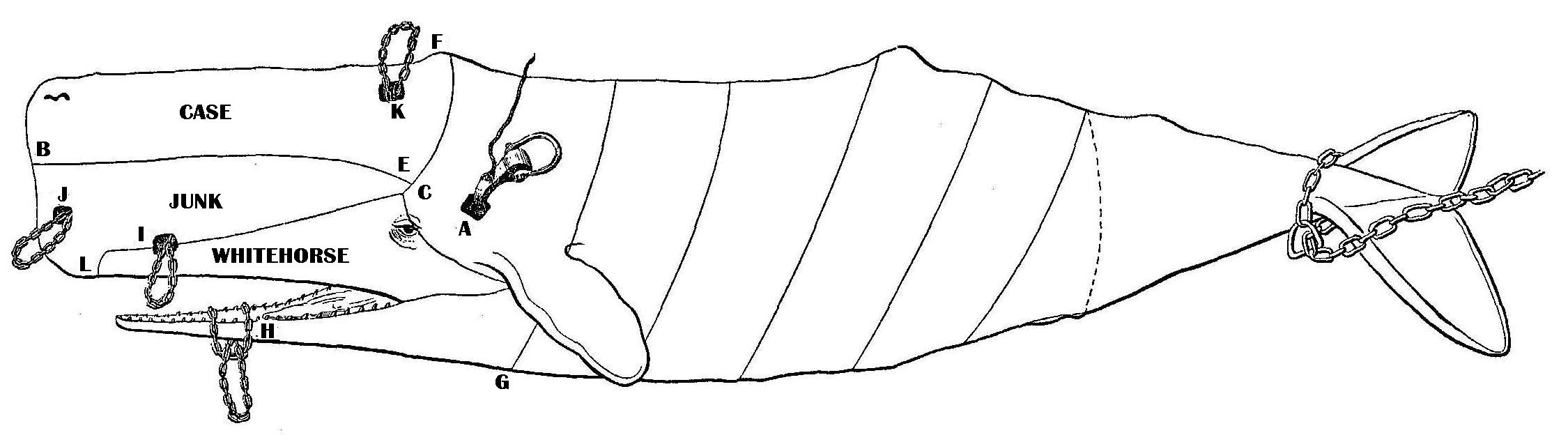
* Bancroft says (Hist. U. S., v, p. 265), in 1765 the colonists were not allowed to export the chief products of their industry, such as sugar, tobacco, cotton, wool, indigo, ginger, dyeing-woods, whalebone, &c., to any place but Great Britain – not even to Ireland. Save in the matter of salt, wines, victuals, horses, and servants, Great Britain was not only the sole market for the products of America, but the only store-house for its supplies. This stringency must, however, have been somewhat relaxed as regards oil, for the Boston News-Letter of September 8, 1768, gives the report from London, dated July 13, that the whale and cod fisheries of New England "this season promised to turn out extremely advantageous, many ships fully laden having already been sent to the Mediterranean markets." The success of the Americans seems to have again aroused the jealousy of their English brethren, for in this same year an effort was made in Parliament to revive the bounty to English whalemen, with the intent to weaken the American fishery. † The word "pirate" seems to have been in these days of a somewhat ambiguous signification, and was quite as likely to mean a privateer as a corsair. |
mouth vessels, which were carried into St. Domingo, 100 barrels. These captures were made on the 11th of February.* But it did not always happen that whalemen fell so easy a prey to predatory vessels. A little strategy sometimes availed them when a forcible resistance would have been out of the question, and it may be easily believed that men to whom danger and hairbreadth escapes were part of their every-day life would scarcely submit supinely when there was any chance in their favor. A notable instance of this kind occurred in April, 1771. Two Nantucket whaling-sloops, commanded respectively by Isaiah Chadwick and Obed Bunker, were lying at anchor in the harbor of Abaco, when a ship appeared off the mouth of the harbor with her signals set for assistance. With that readiness to aid distressed shipmates which has ever been a distinguishing trait of American whalemen, one of the captains with a boat's crew made up of men from each sloop hastened to render such help as was in their power. The vessel's side reached, the captain immediately boarded her to find what was desired, and much to his surprise had a pistol presented to his head by the officer in command with a peremptory demand that he should pilot the ship into the harbor. He assured the commander that he was a stranger there, but that there was a man in his boat who was acquainted with the port. The man was called and persuaded in the same manner in which the captain had been. The argument used to demonstrate the prudence of his compliance with the request being so entirely unanswerable the man performed the service, anchoring the ship where a point of land lay between her and the sloops. This being done the boat was dismissed and the men returned to their vessels. The Nantucket captains now held a consultation as to what course should be pursued. Those who had been on board the ship noticed that the men seemed to be all armed. They also observed, walking alone in the cabin, a man. The conclusion arrived at was that the ship was in the hands of pirates and that the man in the cabin was the former captain, and measures were immediately inaugurated to secure the vessel and crew. To this end an invitation was extended to the usurping captain, his officers and passengers to dine on board one of the sloops. The courtesy was accepted, and the pirate captain and his boatswain, with the displaced captain as representative of the passengers, repaired on board the sloop. After a short time he became uneasy and proposed to return to his own vessel, but he was seized by the whalemen and bound fast and his intentions frustrated. The actual captain now explained the situation, which was, that the ship sailed from Bristol (R. I.?) to the coast of Africa, from thence carried a cargo of slaves to the West Indies, and was on her return home with a cargo of sugar when the mutiny occurred, it being the intention of the mutineers to become pirates, a business at that time quite thrifty and promising. Our fishermen now told the boatswain that if he would go on board the ship and bring the former * The men who came home with Captain Nixon were Oliver Price, Pardon Slocum, and Philip Harkins. – (Boston News-Letter.) |
mate, who was in irons, and aid in recapturing the vessel, they would endeavor to have him cleared from the penalties of the law, and they prudently intimated to him that there was a man-of-war within two hours' sail from which they could obtain force enough to overpower his associates. As a further act of prudence they told him they would set a certain signal when they had secured help from the ship of war. The boatswain not returning according to the agreement made, one sloop weighed anchor and stood toward the pirate-ship as though to pass on one side of her. As she approached the mutineers shifted their guns over to the side which it seemed apparent she would pass and trained them so as to sink her as she sailed by. But those who navigated the sloop were fully alive to these purposes, and as she neared the ship her course was suddenly changed and she swept by on the other side and was out of range of the guns before the buccaneers could recover from their surprise and reshift and retrain their cannon. On the sloop stood upon her course till they were out of sight of the ship, then tacking, the signal agreed with the boatswain was set and she was steered boldly for the corsair. As she hove in sight, the pirates, recognizing the sign, and believing an armed force from the man-of-war was on board the whaling-vessel, fled precipitately to the shore, where they were speedily apprehended on their character being known. The whalemen immediately boarded their prize, released the mate, and carried the ship to New Providence, where a bounty of $3,500 was allowed them for the capture and where the chief of the mutineers was hanged.* About this time Dr. Benjamin Franklin, being in London, was questioned by the merchants there respecting the difference in time between the voyages of the merchantmen to Rhode Island and the English packets to New York. The variation, which was something like fourteen days, was a source of much annoyance to the English merchants, and believing the place of destination might have something to do with it, they seriously contemplated withdrawing the packets from New York and dispatching them to Rhode Island. In this dilemma they consulted Dr. Franklin. A Nantucket captain named Folger,† who was a relative of the doctor's, being then in London, Franklin sought his opinion. Captain Folger told him that the merchantmen were commanded by men from Rhode Island who were acquainted with the Gulf Stream and the effect of its currents, and in the passage to America made use of this knowledge. Of this the English captains were ignorant, not from lack of repeated warnings, for they had been often told that they were stemming a current which was running at the rate of three miles an hour, and that if the wind was light the stream would set them back faster than the breeze would send them ahead, but they were too wise to be advised by simple American fishermen, and so persevered in their own course at a loss of from two to three weeks on every trip. By * Boston News-Letter. † Works of Franklin, iii, p. 353. Probably Capt. Timothy Folger, a man who was prominent for many years in the history of Nantucket. |
Franklin's request Captain Folger made a sketch of the stream, with directions how to use or avoid its currents, and this sketch made over a century ago is substantially the same as is found on charts of the present day. "the Nantucket whalemen," says Franklin,* "being extremely well acquainted with the Gulph Stream, its course, strength, and extent, by their constant practice of whaling on the edges of it, from their island quite down to the Bahamas, this draft of that stream was obtained of one of them, Captain Folger, and caused to be engraved on the old chart in London for the benefit of navigators by B. Franklin." Notwithstanding this information so kindly volunteered to them, and notwithstanding the fact that the Falmouth captains were furnished with the new charts, they still persisted in sailing their old course. There is a point where perseverance degenerates into something more ignoble; it would seem as though at this date these self-sufficient captains had about attained that point. In 1772 two whaling sloops from Nantucket, with 150 barrels of oil each, were captured by a Spanish brig and sloop of Matanzas.† In December of the same year, the brig Leviathan, Lathrop, sailed from Rhode Island for the Brazil Banks on a whaling voyage. On the 25th of January they lowered for whales, and in the chase the mate's boat (Brotherton Daggett) lost sight of the brig, but the crew were picked up at sea and brought home by another vessel. In 1773 quite a fleet of American whalers were on the coast of Africa,‡ no less than 14 being reported as coming from that ground, and probably there were as many more of whom no report was made. One brig from Boston, while off the coast of Sierra Leone, sent a boat ashore with six men to procure water. The boat was seized and the crew all massacred by the natives. In the spring of the following year a sloop owned by Gideon Almy of Tiverton, and another belonging to Boston, * Works of Franklin, iii, p. 364. In a note Franklin says: "The Nantucket captains, who are acquainted with this stream, make their voyages from England to Boston in as short a time generally as others take in going from Boston to England, viz, from twenty to thirty days." Quite a number of Boston packets to and from England were at this time and for many years after commanded by Nantucket men. † In May, 1870, according to the Boston News-Letter, no less than 19 vessels cleared from Rhode Island, whaling. The Post-Boy for October 14, 1771, is responsible for the following: "We learn from Edgartown, that a vessel lately arrived there from a whaling voyage, and in her voyage, one Marshall Jenkins, with others, being in a boat which struck a whale, she turned and bit the boat in two, took Jenkins in her mouth, and went down with him; but on her rising threw him into one part of the boat, whence he was taken on board the vessel by the crew; being much bruised – and in a fortnight after, he perfectly recovered. This account we have from undoubted authority." ‡ According to Macy, (p. 54,) the following are the dates of the occupation of various fishing-grounds by Nantucket whalemen in addition to the Davis Strait fishery: Island of Disco, 1751; Gulf of Saint Lawrence, 1761; coast of Guinea, 1763; Western Islands, 1765; east of Banks of Newfoundland, 1765; coast of Brazil, 1774. According to a local tradition, the first Nantucket whaleman who "crossed the line," arrived home from his voyage on the day of the battle of Concord and Lexington. This was the brig Amazon, Uriah Bunker, commander. |
were seized, while watering at Hispaniola, by a French frigate, carried into Port-au-Prince and there condemned.* In 1774 a report came by the way of Fayal that a small American whaling brig was lying in the harbor of Rio Janeiro with only her captain and three men on board. It appears that, putting in there for refreshments,† in the summer of 1773, a portion of her crew were, "by fair or foul means," induced to ship on a Portuguese snow‡ for a three months' whaling voyage. The snow was provided with harpoons and other whaling craft, made after the English models, and was cruising for sperm whales, a business altogether new to the Portuguese, who had been, hitherto, ignorant of any but the right whale, and had never ventured even in the pursuit of them out of sight of land. The brig still lay there in October, 1773, waiting the return of her men.§ In 1774 the whale-fishery in the colonies must have been in the full tide of success. There were probably fitted out annually at this time no less than 360 vessels of various kinds, with an aggregate burden of nearly 33,000 tons, and employing directly about 4,700 men, and indirectly an immensely greater number. Despite the depredations of French and Spanish privateers the fishery continued to flourish. The annual production from 1771 to 1775 was probably at least 45,000 barrels of spermaceti oil, and 8,500 barrels of right whale oil, and of bone nearly or quite 75,000 pounds.¡ In the various seaport towns from * Boston News-Letter. † Some vessels never dropped anchor in a port from the day they sailed until their return; but scurvy was very apt to manifest itself where a crew was so long deprived of fresh provisions. ‡ "A snow is a vessel equipped with two masts resembling the main and foremast of a ship, and a third small mast, abaft the mainmast, carrying a trysail. These vessels were much used in the merchant service at the time of the Revolution." (Lossing's Field Book, ii, p. 846, note.) § Boston News-Letter. ¡ State of the whale-fishery in Massachusetts, 1771 to 1775.
These statistics are from Jefferson's report, and were gathered for him by governor of Massachusetts. | |||||||||||||||||||||||||||||||||||||||||||||||||||||||||||||||||||||||||||||||||||||||||||||||||||||||||||||||||||
which this pursuit was carried on, in Nantucket, Wellfleet, Dartmouth, Lynn, Martha's Vineyard, Barnstable, Boston, Falmouth, and Swanzey, in Massachusetts, in Newport, Providence, Warren, and Tiverton, in Rhode Island, in New London, Connecticut, Sag Harbor on Long Island, the merry din of the "yo heave ho" of the sailors was heard; the ring of the blacksmith's hammer and anvil made cheery music; the coopers, with their hammers and drivers, kept time to the tramp of their feet as round and round the casks they marched, tightening more and more the bands that bound together the vessels which should hold the precious oil; and the creaking of the blocks as the vessels unloaded their freight, or the riggers fitted them anew for fresh conquests, and the rattle of the hurrying teams as they carried off the product of the last voyage or brought the necessaries for the future one, lent their portion of animation to the scene. Everywhere was hurry and bustle; everywhere all were employed; none that thirsted for employment went away unsatisfied. If a vessel made a bad voyage, the owners, by no means dispirited, again fitted her out, trusting in the next one to retrieve the loss; if she made a profitable one, the proceeds were treasured up to offset a possible failure in some future cruise. On all sides were thrift and happiness. But a change was near. "A cloud, at first no bigger than a man's hand," was beginning to overshadow the whole heaven of their commercial prosperity. The colonies, driven to desperation by the heartless cruelty of the mother country, prepared to stay further aggression, and resent at the mouth of the cannon and the point of the bayonet the insults and injuries that for a decade of years had been heaped upon them; and the English ministry, against the earnest entreaty of British merchants on both sides of the Atlantic, prepared also to enforce its desires by a resort to arms.* The first industry to feel the shock of the approaching storm was the fisheries. Massachusetts, the center of this pursuit, was to the English ministers the very focus of the insurrectionary talk and action, and "the first step," says Bancroft, "toward inspiring terror was, to declare According to Pitkin, among the exports of the colonies, including Newfoundland, Bahamas, and Bermudas, were, for the year 1770:
Value sterling: Sperm candles, £23,688 4s. 6d.; whale-oil, £83,012 15s 9d.; bone, £19,121 7s. 6d. * The colonial trade had become to many English merchants and manufacturers a matter of great importance, and the loss of it would be a serious misfortune. One of the industries which would feel the deprivation most strongly was the manufacture of cordage, of which the Americans were by far the chiefest purchasers in the English market. |
Massachusetts in a state of rebellion, and to pledge the Parliament and the whole force of Great Britain to its reduction; the next, by prohibiting the American fisheries, to starve New England; the next, to excite a servile insurrection.* Accordingly on the 10th of February, 1775, the ministry introduced into Parliament a bill restricting the trade and commerce of Massachusetts Bay, New Hampshire, Connecticut, and Rhode Island to Great Britain, Ireland, and the British West Indies, and prohibiting the colonies from carrying on any fishery on the Banks of Newfoundland or any other part of the North American coast.† "The best shipbuilders in the world were at Boston, and their yards had been closed; the New England fishermen were now to be restrained from a toil in which they excelled the world. Thus the joint right to the fisheries was made a part of the great American struggle."‡ To this bill there was a small but active and determined opposition, both in the House of Lords and House of Commons. It was urged on the part of the ministry that the fisheries were the property of England, and it was with the English government to do as they pleased with them. To this opinion the minority strenuously demurred. "God and nature," said Johnston, "have given that fishery to New England and not to Old."§ It was also argued by the friends of America that if the American fishery was destroyed the occupation must inevitably fall into the hands of the natural rivals of Great Britain. Despite the efforts of the little band the bill was received by a vote of 261 to 85, and passed through its various stages. As each phase was reached the act was fought determinedly but uselessly and hopelessly. The merchants and traders of London petitioned against it, and the American merchants secured the services of David Barclay to conduct the examination of those who were called to testify by the friends and opponents of the bill.¡ "It was said, that the cruelty of the bill exceeded the examples of hostile rigour with avowed enemies; that * Bancroft's United States, vii, p. 222, February, 1775. † Eng. Annual Reg., 1775, p. 78 ‡ Bancroft's United States, vii, p. 239. § Ibid. ¡ Among the evidence given was much tending to show the importance of the colonial trade. It appeared that in 1764 New England employed in the fisheries 45,880 tons of shipping and 6,002 men, the product amounting to £322,220 16s. 3d. sterling in foreign markets; that all the materials used in the building and equipping of vessels, excepting salt and lumber, were drawn from England, and the net proceeds were also remitted to that country; that neither the whale nor cod fishery could be carried on so successfully from Newfoundland or Great Britain as from North America, for the natural advantages of America could neither be counteracted nor supplied; that, if the fishery was transferred to Nova Scotia or Quebec, government would have to furnish the capital, for tbey had neither vessels nor men, and these must come from New England; that it must take time to make the change, and the trade would inevitably be lost; and that American fishermen had such an aversion to the military government of Halifax, and "so invincible an aversion to the loose habits and manners of the people, that nothing could induce them to remove thither, even supposing them reduced to the necessity of emigration." – (Eng. Annual Reg.) |
in all the violence of our most dangerous wars it was an established rule in the marine service, to spare the coast-fishing craft of our declared enemies; always considering that we waged war with nations, and not with private individuals."* It was claimed that by the provisions of the bill much hardship must fall upon many people who were already at sea, and who from the very nature of their occupations must be innocent. "The case of the inhabitants of Nantucket was particularly hard. This extraordinary people, amounting to between five and six thousand in number, nine-tenths of whom are Quakers, inhabit a barren island, fifteen miles long by three broad, the products of which were scarcely capable of maintaining twenty families. From the only harbour which this sterile island contains, without natural products of any sort, the inhabitants, by an astonishing industry, keep an 140 vessels in constant employment. Of these, eight were employed in the importation of provisions for the island, and the rest in the whale-fishery." A petition was also presented from the English Quakers in behalf of their brethren at Nantucket, in which they stated the innocence of the inhabitants of that island, "their industry, the utility of their labours both to themselves and the community, the great hazards that attended their occupation, and the uncertainty of their gains; and shewed that if the bill passed into a law, they must in a little time be exposed to all the dreadful miseries of famine. The singular state and circumstances of these people, occasioned some attention to be paid to them. A gentleman on the side of the administration said, that on a principle of humanity he would move, that a clause should be added to the bill, to prevent the operation from extending to any whale-ships, which sailed before the 1st of March, and were at that time the property of the people of Nantucket."† "The bill," says a reviewer of the time, "was attacked on every ground of policy and government; and with the greatest strength of language and height of colouring. The minority made amends for the smallness of their numbers by their zeal and activity. * * * Evil principles," they contended, "were prolific; the Boston Port Bill begot this New England Bill; this will beget a Virginia Bill; and that again will become the progenitor of others, until, one by one, parliament has ruined all its colonies, and rooted up all its commerce; until the statute-book becomes nothing but a black and bloody roll of proscriptions; a frightful code of rigour and tyranny; a monstrous digest of acts of penalty and incapacity and general attainder; and that wherever it is opened it will present a title for destroying some trade or ruining some province."‡ It was during the debate upon this bill that Burke made that eloquent defense of the colonies which has rung in the ears of every boy born * Eng. Annual Reg., 1775, p. 80. † Eng. Annual Reg., 1775, p. 85. ‡ Ibid., p. 85. |
or bred in a seaport town since the day it was uttered. "For some time past, Mr. Speaker," said Burke, "has the Old World been fed from the New. The scarcity which you have felt would have been a desolating famine, if this child of your old age, – if America, – with a true filial piety, with a Roman charity, had not put the full breast of its youthful exuberance to the mouth of its exhausted parent. Turning from the agricultural resources of the Colonies, consider the wealth which they have drawn from the sea by their fisheries. The spirit in which that enterprising employment has been exercised ought to raise your esteem and admiration. Pray, Sir, what in the world is equal to it? Pass by the other parts, and look at the manner in which the People of New England have of late carried on the whale fishery. Whilst we follow them among the tumbling mountains of ice, and behold them penetrating into the deepest frozen recesses of Hudson's Bay and Davis' Straits, whilst we are looking for them beneath the Arctic Circle, we bear that they have pierced into the opposite region of Polar cold, that they are at the antipodes, and engaged under the frozen serpent of the South. Falkland Island, which seemed too remote and romantic an object for the grasp of national ambition, is but a stage and resting-place in the progress of their victorious industry.* Nor is the equinoctial beat more discouraging to them than the accumulated winter of both the Poles. We know that whilst some of them draw the line and strike the harpoon on the coast of Africa, others run the longitude, and pursue their gigantic game, along the coast of Brazil. No sea but what is vexed by their fisheries. No climate that is not a witness to their toils. Neither the perseverance of Holland, nor the activity of France, nor the dexterous and firm sagacity of English enterprise, ever carried this most peril ous mode of hardy industry to the extent to which it has been pushed by this recent People; a People who are still, as it were, but in the gristle, and not yet hardened into the bone, of manhood. When I contemplate these things, – when I know that the Colonies in general owe little or nothing to any care of ours, and that they are not squeezed into this happy form by the constraints of a watchful and suspicious Government, but that, through a wise and salutary neglect, a generous nature has been suffered to take her own way to perfection, – when I reflect upon these effects, when I see how profitable they have been to us, I feel all the pride of power sink, and all presumption in the wisdom of human contrivances melt, and die away within me. My rigor relents. I pardon something to the spirit of liberty." But eloquence, logic, arguments, facts availed nothing. The bill became a law. In the upper house of Parliament, where a minority fought * At this time the Falkland Islands were the subject of considerable acrimony between the English, Spanish, and Brazilian governments. According to Freeman (Hist. Cape Cod, ii, p. 539, note), the people of Truro were the first of our American whalemen to go to the Falklands. In 1774 Captains David Smith and Gamaliel Collins, at the suggestion of Admiral Montague, of the British navy, made voyages there on that pursuit, in which they were very successful. |
the bill as determinedly as the minor part of the Commons, fifteen lords entered a protest against it. The island of Nantucket was, for the reasons enumerated, relieved somewhat from its extremest features, a fact which did not escape the surveillance of the provincial authorities, who in their turn restricted the exportation of provisions from any portion of the colonies, save the Massachusetts Bay, to that island, and the Provincial Congress of Massachusetts further prohibited any exportation from that colony, save under certain regulations.* But, like the mother country, the colonies yielded to the behests of humanity and relaxed their stringency in regard to this island. At an early day after the formal opening of the issue of battle between England and the plantations, the general court of Massachusetts passed a resolve, directing "that from and after the fifteenth Day of August instant, no Ship or Vessell should sail out of any port in this Colony, on any whaling Voyage whatever, without leave first had and obtained from the Great and General Court of this Colony, or from some Committee or committees or persons they shall appoint to grant such leave;" and on the 24th of August, the day for adjournment of the court being near at hand, it was further resolved, in view of possible damage liable to accrue to parties for want of these permits, " that the Major part of the Council for this Colony be, and they accordingly are, hereby fully impowered to grant leave for any Vessell or Vessells to sail out of any port in this Colony, on any whaling Voyage whatever, as to them shall seem fit & reasonable for the Benefit of Individuals, and the Good of the Public, provided there be good & sufficient security given that the Oil & Bone, &c., obtained on said Voyage shall be brought into some Port in this Colony, except the port of Boston, & such Permits do not interfere with any Resolve or Recommendations of the Continental Congress: – The power herein given to continue only in the recess of the general court."† The bells that called the hardy yeomanry of New England to the defense of their imperiled liberties on the ever-memorable morning of the 19th of April rung the death knell of the whale-fishery, save that carried on from Nantucket; the rattle of musketry was the funeral volley over its grave.‡ Save from this solitary island, it was doomed to * Mass. Col. MSS., Provincial Congress, i, p.300. † Mass. Col. MSS. Rev. Council Papers, series i, vol ii, p. 17. ‡ The shipping of Nantucket rendered important ante-revolutionary aid to the colonists in the importation of powder, a service that was continued at intervals during the war. The Earl of Dartmouth, in a letter to Lieutenant-Governor Colden, dated 7th September, 1774, says: "My Information says that the Polly, Captn Benjamin Broadhelp, bound from Amsterdam to Nantucket, has among other Articles received on board, no less a quantity than three Hundred thousand pounds weight of Gunpowder, & I have great reason to believe that considerable quantities of that commodity, as well asother Military Stores, are introduced into the Colonies from Holland, through the Channel of St. Eustatia." (N. Y. Col. Rec., viii, p. 487.) St. Eustatia was captured by the English during the colonial war, the chief grounds of the capture being the alleged supply to the revolting colonies of contraband goods. |
annihilation. A few vessels were fitted out early in the war from other ports, but the risk was so great and the necessity so small that the business was soon abandoned. With Nantucket it was simply a case of desperation; the business must be carried on, or the island must be depopulated; starvation or removal were the only alternatives of inaction. The receipt of the news of the battle at Lexington and Concord, glorious as it was to the colonies at large, and glorious as it may have been to the islanders whose religious principles were not rigidly opposed to war in any form and under any circumstances, was to the majority of the inhabitants the announcement of ruined fortunes, annihilated commerce, misery, privation, and sutlering. Without the immediate circle of colonial assistance, knowing that they were cut off from aid in case they were attacked, open to and defenseless at all sides from the predatory raids of avowed enemies and treacherous, pretended friends, the only course left open to them to adopt was to be as void of offense as possible and strive to live through the desperate struggle just about to commence. Some of the people removed to New York and eventually established the whale-fishery there. Some removed to North Carolina and there formed a community remarkable for thrift and hospitality; but the vast majority preferred to link their fortunes with those of their island home, and with her sink or swim. Vessels from abroad turned their prows toward home and speeded on their way, hoping to attain their port before English armed vessels could intercept them; those already arrived were most of them stripped of their sails and rigging and moored to the crowded wharves or run high and dry ashore. The petitions of parties for permission to fit out their vessels for whaling were almost invariably complied with by the general court, bonds being given in about £2,000 that the cargo should be landed at some port in the colony, excepting Boston or Nantucket.* In 1776 the Continental Congress endeavored to induce France to en- * The following is the form of the bond: "Know all men by these presents that Nathaniel Macy & Richd Mitchell Jr both of Sherburn in the County of Nantucket, are holden & stand firmly bound unto Henry Gardner Esq of Stowe in the County of Middlesex Treasurer of the Colony of the Massachusetts Bay or his Successors in sd office in the Lawful & Just sum of Two thousand pounds to the which payment well & truly to be made we bind ourselves our Heirs Exec' or Administrators, firmly by these presents sealed wth our seal Dated this fourteenth day of September Anno Dom: 1775. "The Condition of this obligation is such that whereas the above-said Nathaniel Macy is about to Adventure to sea on a whale Voyage the schooner Dighton Silas Paddack Master-if then the sd Silas Paddack or any other person who may have the Command of sd schooner Dighton, during sd Voyage shall well & truly bring or Cause to be brought into some port or harbour of this Colony except the port of Boston or Nantucket all the oil & whale Bone that shall be taken by sd schooner Dighton in the Course of sd Voyage & produce a Certificate under the hands of the Selectmen of sd Town Adjoining to such port or harbour that ho there Landed ye same then the |
gage in war against England, but in the proposed negotiations the fisheries on the banks of Newfoundland and the various gulfs and bays of North America were to be, understood as not open to a question of division. Spain, too, was applied to. "The Colonies," says Bancroft, "were willing to assure to Spain freedom from molestation in its territories; they renounced in favor of France all eventual conquests in the West Indies; but they claimed the sole right of acquiring British Continental America and all adjacent islands, including the Bermudas, Cape Breton, and Newfoundland. It was America and not France which first applied the maxim of monopoly to the fisheries. The King of France might retain his exclusive rights on the banks of New Foundland, as recognized by England in the treaty of 1763, but his subjects were not to fish in the havens. bays, creeks, roads, coasts, or places,' which the United States were to win."* In the mean time how was England affected by her American policy? The colonial fishery being abolished, it became essential that something should be done to replace it, "and particularly to guard against the ruinous consequences of the foreign markets, either changing the course of consumption or falling into the bands of strangers, and those perhaps inimical to this country. The consumption of fish-oil as a substitute for tallow was now become so extensive as to render that also an object of great national concern; the city of London alone expending about £300,000 annually in that commodity."† The evidence taken on behalf of the ministry in support of their restraining bill, tending to show that there already existed sufficient capital in ships, men, and money for the immediate and safe transfer of the whale fishery to England, while well enough for partisan purposes, was not considered so reliable by the parties bringing it forward, and the government was not at all desirous or willing to risk a matter of such extreme importance upon the testimony there given. Measures were accordingly taken to give encouragement to this pursuit to the fishermen and capitalists of Great Britain and Ireland.‡ The committee having the subject in charge were of the opinion that a bounty should extend to the fisheries to the southward of Greenland above Obligation to be Void & of none Effect otherways to stand and remain in full force & virtue.
"NATal MACY,
"RICHd MITCHELL, Jr." "Signed, Sealed, & did in presence of us." C. (Mass. Col. MSS. Misc., iii, p. 64.) The colonial papers of March 28, 1776, mention that the English frigate Renown, on her passage to America, took ten sail of American whalemen, which were sent to England to avoid the danger of recapture. * Bancroft's U. S., ix, p. 132. † Eng. Annual Reg. 1775, p. 113. ‡ Speech of the Earl of Harcout to the Irish Parliament, October 10, 1775. |
and Davis Straits, and at the same time that the duties on oil, blubber, and bone, imported from Newfoundland, should be taken off. It was found that the restraining bill worked serious damage to the people of Newfoundland, and also to the fisheries from the British islands to that coast, as, in order to prevent absolute famine there, it was necessary that several ships should return light from that vicinity in order to carry cargoes of provisions from Ireland to the sufferers there.* The English fishery, even under the encouragement given, did not, however, answer the expectations or hopes of its friends. It was not so easily transferred as had been imagined. A few more vessels sailed from Great Britain, employing, of course, a few more men, but the extra supply was a mere trifle in comparison to the deficiency that the restraining bill had caused. The colonies, in turn, passed a bill cutting off supplies to the English fleet from the plantations,† a course entirely unforeseen by the sage adherents of the British bill. As a natural consequence, the fishery, which promised so well on paper, and upon which the majority in Parliament had founded so many hopes, failed to yield them the solace for the evil done to America that they so fondly anticipated. Many ships, instead of bearing to England supplies, only returned there for provisions to relieve the distress they found on the coast, both on the sea and the land. Indeed, it was estimated that the colonial restraining act caused a loss to England in the fishery in these parts alone of fully half a million of pounds sterling.>‡ To add to the calamities caused by man, the very elements seemed combined against them, for a terrible storm arose, and the center of its fury was the shores and banks of Newfoundland. "This awful wreck of nature," says a chronicler of the time, "was as singular in its circumstances as fatal in its effects. The sea is said to have risen 30 feet almost instantaneously. Above seven hundred boats, with their people, perished, and several ships, with their crews. Nor was the mischief much less on the land, the waves overpassing all mounds, and sweeping everything before them. The shores presented a shocking spectacle for some time after, and the fishing-nets were hauled up loaded with human bodies."§ These misfortunes the opposers of the bill attributed to the vengeance of an indignant Provideuce. But Parliament went further than this, and added to the atrocity of this measure another none the less barbarous. It was decreed that all those prisoners who should be taken on board of American vessels should be compelled, without distinction of rank, to serve as common * Annual Reg., 1776, p. 131. † The "Restraining" bill. ‡ Eng. Annual Reg., 1776, p. 49. § English Annual Reg., 1776, p. 43. There was also much distress at the Barbadoes. It was thought at one time to draw supplies for beleaguered Boston from these islands, but cut off as they were from supplies from the colonies, with 80,000 blacks. and 20,000 whites to feed, the project was deemed in the highest degree dangerous. |
sailors on British ships of war. This proposed measure was received with great indignation by those gentlemen in Parliament whom partisan asperity had not blinded to every feeling of justice to or compassion for the colonies. The clause in the bill which contained this provision was " marked by every possible stigma," and was described by the Lords, in their protest, as "a refinement in tyranny" which, "in a sentence worse than death, obliges the unhappy men who shall be made captives in this predatory war to bear arms against their families, kindred, friends, and country; and after being plundered themselves, to become accomplices in plundering their brethren."* And, by the articles of war, these very men were liable to be shot for desertion. By the action of this measure large numbers of Nantucket whaling captains with their crews and a few from other ports were captured by the English, and given their choice either to enter the service of the King in a man-of-war or sail from an English port in the same pursuit to which they had become accustomed.† In September (13th,) 1779, John Adams, writing from Braintree‡ to the council of Massachusetts, says: "May it please your Honours:§ While I resided at Paris I had an opportunity of procuring from London exact Information concerning the British Whale Fishery on the Coast of Brazil, which I beg Leave to communicate to your Honours, that if any advantage can be made of it the opportunity may not be lost. "The English, the last year and the year before, carried on, this Fishery to very great advantage, off of the River Plate, in South America in the Latitude Thirty five south and from thence to Forty, just on the edge of soundings, off and on, about the Longitude sixty five, from London. They had seventeen vessells in this Fishery, which all sailed from London, in the Months of September and October. All the officers and Men are Americans. "The Names of the Captains are, Aaron Sheffield of Newport, ______, Goldsmith¡ and Richard Holmes from Long Island, John Chadwick, Francis May,¶ Reuben May,** John Meader, Jonathan Meader, Elisha * Annual Reg., 1776, p. 118. † To his captors Capt. Nathan Coffin, of Nantucket, nobly said, "Hang me, if you will, to the yard-arm of your ship, but do not ask me to be a traitor to my country." – (Bancroft, ix, p. 313.) ‡ Adams, vii, p. 63. This is almost identical with the letter in Mass. Col. MSS., Resolves, vi, p. 216. § In 1778 the commissioners (Franklin and Adams) in France wrote to the President of Congress in nearly the same words, urging the destruction of the English whale-fishery on the coast of Brazil and the release of the Americans there, who were practically prisoners of war, compelled to aid in supporting the enemy. In the letter of the commissioners, dated Passy, ----, 1778, Messrs. Franklin and Adams write that three wbalemen have been taken by French men-of-war and carried into L'Orient. The crews of these whaling-vessels are Americans. (Works of John Adams, vii, p. 63.) ¡ William Goldsmith, who sailed from Nantucket for London with a cargo of oil in April, 1775. ¶ Francis Macy. ** Reuben Macy. |
Clark, Benjamin Clark, William Ray, Paul Pease, Bunker Fitch, Reuben Fitch, Zebbeedee Coffin* and another Coffin, —— Delano,† Andrew Swain, William Ray, all of Nantucket, John Lock, Cape Cod;‡ four or five of these vessels went to Greenland. The fleet sails to Greenland, yearly, the last of February or the Beginning of March. There was published, the year before last, in the English Newspapers, and the same Imposture was repeated last year, and no doubt will be renewed this, a Letter from the Lords of Admiralty to Mr. Dennis De Beralt, in Colman street, informing, him that a Convoy should be appointed to the Brazil Fleet. But this, I had certain Information, was a Forgery calcutelad[sic] mainly to deceive American Privateers, and that no Convoy was appointed, or did go with that Fleet, either last year, or the year before. "For the Destruction or Captivity of a Fishery so entirely defenceless, for riot one of the Vessells has any arms, a single Frigate or Privateer of Twenty-four, or even of Twenty guns, would be sufficient. The Beginning of December, would be the best Time to proceed from hence, because the Frigate would then find the Whaling Vessells nearly loaded. The Cargoes of these Vessells, consisting of Bone and Oyl, will be very valuable, and at least four hundred and fifty of the best kind of seamen would be taken out of the Hands of the English, and might be gained into the American service to act against the Enemy. Most of the officers and Men wish well to this Country, and would gladly be in its service if they could be delivered, from that they are engaged in. Whenever an English Man of war, or Privateer, has taken an American Vessell, they have given to the Whalemen among the Crew, by order of Government, their Choice, either to go on Board a Man of war, and fight against their Country or go into the Whale Fishery. Such Numbers have chosen the latter as have made up the Crews of these seventeen Vessells.§ "I thought it my Duty to communicate this Intelligence to your Honours, that if so profitable a Branch of Commerce, and so valuable a Nursery of Seamen, can be taken from the English it may be done. This State has a peculiar Right and Interest to undertake the Enterprise, as almost the whole fleet belongs to it. I have the Honour to be, with the highest Consideration, your Honours most obedient & most humble servant. "JOHN ADAMS"
This letter was referred to a committee who reported that a copy of it should be sent to the President of the Continental Congress, which report was adopted, and thus Massachusetts let slip through her fingers the identical golden opportunity which the General Government had neglected the year before. The suggestions of Mr. Adams, who of all our revolutionary statesmen seems most to have understood and appre- * Zebdiel Coffin. † Abisba Delano (probably.) ‡ From Nantucket. Twenty names are given in this list. § Not italicised in the original. |
ciated the importance of this industry, were practically disregarded.* It is difficult to calculate how much the American whale-fishery was affected by this failure to act on this suggestion of Mr. Adams. Many of these captains and men, and others captured at other times during the war, had at its close sailed so long from British ports that the extraordinary inducements held out by the English, and the depression in their business in the United States, immediately succeeding the close of the war, operated to transfer to that country their skill and, measurably, their capital. In the years 1778-'79 the English navy made several forays upon the sea-coast towns of New England, destroying much property at Warren, R. I., Dartmouth, Martha's Vineyard, and Nantucket in Massachusetts.† Indeed, these predatory raids were frequent throughout the war, and liable to occur at any time, consequently the unfortunate inhabitants were kept in a continual ferment. During the sat-no time the government of France was continually intriguing for the exclusive possession of the North American fisheries. On the 6th of February, 1778, a treaty of amity and commerce was arranged between France and the United States. Upon this point each side was to retain the exclusive right to its own. The Americans conceded to the French the rights reserved by the treaties of Utrecht‡ and Paris,§ even to the French interpretation of them, which were the right to fish upon the Banks, and the exclusive use of one-half the shores of Newfoundland upon which to dry their * An exception to the general apathy in this respect occurred late in the fall or early in the winter of 1776, when boats from the Alfred, man-of-war, were sent ashore at Canso and destroyed the whaling interest there, burning all the materials for that industry, together with all the oil stores with their contents. † Return of vessels and stores destroyed on Acushuet River the 5th of September, 1778: 8 sail of large vessels, from 200 to 300 tons, most of them prizes; 6 armed vessels, carrying from 10 to 16 guns; a number of sloops and schooners of inferior size, amounting in all to 70, besides whale-boats and others; amongst the prizes were three taken by Count D'Estaign's fleet; 26 store-houses at Bedford, several at McPherson's Wharf, Crane Mills, and Fairhaven; these were filled with very great quantities of rum, sugar, melasses, coffee, tobacco, cotton, tea, medicines, gunpowder, sail-cloth, cordage, &c.; two large rope-walks. "At Falmouth, in the Vineyard Sound, the 10th of Septembe , 1778: 2 sloops and a schooner taken by the galleys, 1 loaded with staves; 1 sloop burnt. "In Old Town harbour, Martha's Vineyard: 1 brig of 150 tons burden, burnt by the Scorpion; 1 schooner of 70 tons burden, burnt by ditto; 23 whale-boats taken or destroyed; a quantity of plank taken. "At Holmes's Hole, Martha's Vineyard: 4 vessels, with several boats, taken or destroyed; a salt-work destroyed, and a considerable quantity of salt takeu."-(Ricketson's Now Bedford, p. 282.) At Sag Harbor, L. I., property was taken or destroyed to a large amount; Newport suffered greatly; Nantucket lost twelve or fourteen vessels, oil, stores, &c., to the value of £4,000 sterling. Warren, R. I., suffered during the war to the extent of 1A90 tons of shipping, among them two vessels loaded with oil, and a large amount of other property. Sag Harbor also lost one or more vessels by capture. ‡ April 11, 1713. § February 10, 1763. |
fish.* In regard to what disposition should be made of that island in case it should be Captured, nothing was said; the sentiment of New England, however, upon that point was unmistakable. Later in the same year Samuel Adams, in a letter from Philadelphia, wrote: "I hope we shall secure to the United States, Canada, Nova Scotia, Florida too, and the fishery, by our arms or by treaty?" He writes further, and every year of the past century has borne witness to the soundness of his views: "We shall never be on a solid footing, till Great Britain cedes to us, or we wrest from her, what nature designs we should have.† France also sought the aid of Spain, and that power was given to understand that in the final treaty of peace between the United States and England, they, too, would necessarily have some voice. Vergennes, in October (1778) stated, as the only stipulations which France would require, that in the final negotiations the treaty of Utrecht must be either wholly continued or entirely annulled; that she must be allowed to restore the harbor of Dunkirk; and that she must be allowed "the coast of Newfoundland, from Cape Bonavista to Cape St. John, with the exclusive fishery from Cape Bonavista to Point Riche?"‡ By a treaty made with Spain, April 12, 1779, France bound herself to attempt the invasion of Great Britain or Ireland, and to share only with Spain the North American fisheries, in case she succeeded in driving the English from Newfoundland. These discussions (as to the terms to be embraced in the final treaty of peace) were necessary pending the question of an alliance with France and Spain against England. When the subject of frontiers was brought up, France, while yielding all claim to the provinces of Canada and Nova Scotia, which for years had been hers, joined heartily with Spain in opposing the manifest desire of the Americans to secure them. Two States persisted in the right and policy of acquiring them, but Congress, as a body, deferred to the French view of the subject. "With regard to the fisheries, of which the interruption formed one of the elements of the war, public law had not yet been settled. By the treaty of Utrecht, France agreed not to fish within thirty leagues of the coast of Nova Scotia; and by that of Paris, not to fish within fifteen leagues of Cape Breton. Moreover, New England at the beginning of the war had, by act of Parliament, been debarred from fishing on the banks of Newfoundland * * * *. "The fishery on the high seas," so Vergennes expounded the law of nations, "is as free as the sea itself, and it is superfluous to discuss the right of the Americans to it. But the coast-fisheries belong of right to the proprietary of the coast. Therefore the fisheries on the coasts of Newfoundland, of Nova Scotia, of Canada, belong exclusively to the English; and the Americans have no * Bancroft's U. S., ix, 481. The fact must be kept in mind that whaling and fishing for cod were both carried on on nearly the same waters and often by the same vessels. † Bancroft's U. S., x, 177. ‡ Bancroft's U. S., x, p.184. |
pretension whatever to share in them.'* In vain the United States urged that the colonies, almost exclusively, had improved the coast-fisheries, and considered that immemorial and sole improvement was practical acquisition. In vain they insisted that New England men, and New England money, and New England brains had effected the first conquest of Cape Breton, and were powerful aids to the subsequent conquest of Nova Scotia and Canada, and hence they had acquired at least a perpetual joint propriety. To their arguments Vergennes replied that the conquests were made not for the colonies but for the crown, and when New England dissolved its allegiance to that crown she renounced her right to the coast-fisheries. In the end the United States were obliged to succumb; they had asked aid from foreign powers, and they must yield so far as was practicable to the demands those powers made. These concessions were a portion of the price of independence. A committee† was appointed by Congress to definitely arrange upon what terms the future treaty of peace with England should be finally consummated, and in February, 1779, they reported that Spain manifested a disposition to form an alliance with the United States, hence independence was an eventual certainty. On the question of fishing they reported that the right should belong properly to the United States, France, and Great Britain in common. This portion of the report was long under discussion in Congress, and it was finally voted that the common right of the United States to fish "on the coasts, bays, and banks of Newfoundland and Gulf of St. Lawrence, the Straits of Labrador, and Belleisle should in no case be given up."‡ Under a vote to reconsider this subject on the 24th of March, Richard Henry Lee proposed that the United States should have the same rights which they enjoyed when subject to Great Britain, which proposition was carried by the votes of Pennsylvania, Delaware, and the four New England States, New York and the Southern States opposing. New York, under the leadership of Jay and Morris, peremptorily declined to insist on this right by treaty, and Morris moved that independence should be the sole condition of peace. This was declared out of order by the votes of the New England States, New Jersey, and Pennsylvania, against the unanimous vote of New York, Maryland, and North Carolina; Delaware, Virginia, and South Carolina being equally divided. But France had a vital interest in this matter, and the French minister interposed his influence, and on the 27th of May Congress returned to its original resolve, "that in no case, by any treaty of peace, should the common right of fishing be given up." On the 19th of June the equanimity of the French minister was suddenly and rudely disturbed by Elbridge Gerry, who, being from Marble- * Bancroft's U. S., x, pp. 210-11. † Gouverneur Morris, of New York; Burke, of North Carolina; Witherspoon, of New Jersey; Samuel Adams, of Massachusetts; and Smith, of Virginia. (Bancroft's U. S., x, p. 213.) ‡ Bancroft's U. S., x, p. 213. |
head, was the steady and persistent champion of the claims of New England, and who, in the prolonged discussions, always came to the front in defense of those rights. Entirely unexpectedly, Gerry, avoiding "a breach of the rules of Congress by a change in form, moved resolutions, that the United States have a common right with the English to the fisheries on the banks of Newfoundland, and the other fishing-banks and seas of North America. The demand was for no more than Vergennes confessed to belong to them by the law of nations; and Gerry insisted that unless the right received the guarantee of France, on the consent of Great Britain, the American minister should not sign any treaty of peace without first consulting Congress."* A most stormy and bitter debate ensued. The friends of France resisted strenuously. Four States declared if the resolution was adopted they should secede. The matter, however, was somewhat compromised and the common right of fishing on the Grand Banks affirmed; Congress asking for that right the guarantee of France by means of a supplementary article explanatory of former treaties. The French minister became alarmed, and sought an interview with the President of Congress and two other members known to be equally favorably disposed to the policy he represented. The vigor and zeal with which New England had pressed the matter had disposed them to concede to the desires of this section. He assured them "that disunion from the side of New England was not to be feared, for its people carried their love of independence even to delirium," and continued: "There would seem to be a wish to break the connection of France with Spain; but I think I can say that, if the Americans should have the audacity to force the King of France to choose between the two alliances, his decision would not be in favor of the United States; he will not certainly expose himself to consume the remaining resources of his kingdom for many years, only to secure an increase of fortune to a few shipmasters of New England. I shall greatly regret on account of the Americans, should Spain enter into war without a convention with them." Five hours of discussion failed to induce the members to undertake to change the views of Congress, and a new interview was held on the 12th of July, between Gerard and Congress, in a committee of the whole. As a final result the question was left to be settled, when a treaty of peace was formally arranged with Great Britain.† In the mean time how fared it with the whale-fishery? The people of Nantucket, with whom alone it was still encouraged, though in the face of the most terrible discouragements, were reduced to the severest straits. To live, they must eat; to eat, they must have provisions; to obtain provisions, they must give in exchange money or its equivalent; to obtain the exchangeable commodity, some business must be pursued. The whale-fishery was the only business available to them. Long prac- * Bancroft's U. S., x, pp. 216 to 219. † Bancroft's U. S., x, p. 219. |
tice had made them familiar with it, and a singleness of pursuit had kept them comparatively ignorant of any other occupation. But the great problem was how to carry it on, even in the limited way to which, by the destruction of their vessels, they were restricted. If they sailed under American protection, the English captured and destroyed their vessels and imprisoned their men; if they cleared with the sanction of English safeguards, the Americans performed for them the same kindly offices. Between the upper and the nether millstones of war they were quite ground to powder. In their extremity they learned that the English were inclined to be lenient toward them in the matter, and they had quite reliable assurance that the leading men of the American Government looked compassionately upon the distressed situation of the unfortunate islanders. Influenced by these considerations, the inhabitants sent Timothy Folger, esq., to New York, to represent the condition they were in, and solicit permission to carry on whaling without danger of capture from British cruisers. They asked permits for twenty fishing-boats to fish around the island, for four vessels to be employed in the whale-fishery, for ten small vessels to supply the inhabitants with wood, and for one to go to New York for some few supplies not obtainable elsewhere.* Their petition was not so successful as they had wished. In 1781 Admiral Digby succeeded Admiral Arbuthnot in the command of the English fleet in these waters, and permission to whale was asked of him,† and permits were issued for twenty-four vessels to pursue the business unmolested by English armed cruisers.‡ "This privi- * Macy, 113. † Mr. Macy gives us to understand that no permits were granted, but this must be an error; for Mr. Rotch (vide MS.), who was one of the committee the succeeding year to obtain grants from the English, mentions an accusation made by Commodore Affleck, of abuse of confidence in regard to the permits which were granted the year before, and that scarcely a vessel could be found but had one of these documents. To this Mr. Rotch replied: "Commodore Affleck, thou hast been greatly imposed upon in this matter. I defy Capt. ______ to make such a declaration to my face. Those Permits were put into my hands. I delivered them, taking receipts for each, to be returned to me at the end of the voyage, and an obligation that no transfer should be made or copies given. I received back all the Permits except two before I left home, and should probably have received those two on the day that I sailed. Now if any duplicity has been practiced, I am the person who is accountable, and I am here to take the punishment such perfidy deserves." Mr. Retch's character as a man and a merchant stood too high to be questioned, and the commodore, who a moment before was so violent, became more genial, and replied, "You deserve favor," and assisted Mr. Rotch to obtain it. The termination of this difficulty is but one example of the manner in which all these slanders, from both English and Americans, were disposed of when the accused could have an opportunity of confronting the accusers or those in authority. ‡ The following is a copy of one of these permits, from Macy, p. 115: "[L. S.] By Robert Digby, Esquire, Rear Admiral of the Red, and Commander-in-chief, &c., &c. "Permission is hereby given to the Dolphin brig, burthen sixty tons, Walter Folger owner, navigated by Gilbert Folger as master and the twelve seamen named in the |
lege," says Macy, "seemed to give new life to the people. It produced a considerable movement in business, but the resources of the island had so diminished, that but a small number of vessels could take the benefit of these permits. Those who had vessels, and were possessed of the means, fitted them out on short voyages, and, had there been no hinderance, it is probable that they would have done well; for the whales, having been unmolested for several years, had become numerous, and were pretty easily caught. To carry on the whale-fishery under permission of the government of Great Britain was a proceeding somewhat novel, and could not pass unnoticed. Although it was not publicly known, yet it was generally believed that some kind of indulgence had been shown by the enemy to the people of Nantucket. This caused some clamor on the continent; but our Government well knew the situation of the place, and its large participation in the calamities of the war, and was, consequently, rather inclined to favor than to condemn he acceptance of favors from the English. Although the Governmentt[sic] could not grant an exclusive privilege to any particular part of the Union, yet such encouragement was given by the leading men of the nation, in their individual capacity, as to warrant the proceeding. Several vessels whaling under these permits were taken by American privateers and carried into port, but in every instance they were soon liberated. Whenever it was found that the permits were used for no other purpose than that for which they had been granted, and that the vessels using them had not been engaged in illicit trade, there was no hesitation in releasing them." Nevertheless a great risk attended this mode of proceeding, and the islanders became satisfied that to make the business reasonably safe permits must be obtained from both contending powers and permission also to make use of each license against the other's vessels of war. Accordingly, a town meeting was convened on the 25th of September, 1782, and a memorial prepared and adopted which was sent to the general court of Massachusetts.* This petition recited the unfortunate situa-
"Dated at New York, the first day of December, 1781.
"ROBERT DIGBY.
"To the commissioners of his majesty's ships and vessels of war, as well as of all privateers and letters of marque. "By command of the Admiral:
"THOMAS M. PALMER."
* By a very disastrous fire at Nantucket, in 1846, the records both of the town and custom-house were destroyed, h3nee there arises much difficulty in getting many inter- |
tion the people were in, exposed to the inroads of English and Americans, with neither side able or willing to protect them against the other, and powerless, because of the defenseiess character of the island and the religious convictions of the vast majority of the inhabitants, to suitably guard their own firesides. They urged that people in continental towns, where the broad country opened to them a place for retreat, could have but faint ideas of the suffering of those who were constantly liable to hostile invasion and whose insular position precluded all thoughts of escape, and they indignantly resented the calumnies which had been spread broadcast through the State in regard to alleged actions of theirs. Regarding the prosecution of their business, they said: "We now beg leave to throw a few hints before you respecting the Whalefishery, as a matter of great importance to this Commonwealth. This place before the War, was the First in that branch of business, & employed more than One Hundred Sail of good Vessels therein, which furnished a support not only for Five Thousand Inhabitants here, but for Thousands elsewhere, no place so well adapted for the good of the Community at large as Nantucket, it being destitute of every material necessary in the Business, and the Inhabitants might be called Factors for the Continent rather than Principals; as the war encreased the Fishery ceased, until necessity obliged us to make trial the last Year, with about about seventeen sail of Vessels, Two of which were captured & carried to New York,* & one was burnt the others made saving voyages. The present Year we employed about Twenty Four sail in the same business, which have mostly compleated their Voyages, but with little success; & a great loss will ensue; this we apprehend is greatly owing to the circumscribed situation of the Fishery; we are now fully sensible that it can no longer be pursued by us, unless we have free liberty both from Great Britain & America to fish without interruption; As we now find One of our Vessels is captured & carried to New York, but without any Oil on board, and Two others have lately been taken & carried into Boston & Salem, under pretense of having double papers on board, (Nevertheless we presume the captors will not say that any of our Whalemen have gone into New York during the season as such a charge would have no foundation in Truth). And if due attention is not paid to this valuable branch, which if it was viewed in all its parts, perhaps would appear the most advantageous, of any possess'd by this Government, it will be intirely lost, if the War continues: We view it with regret & mention it with concern, & from the gloomy prospect now before us, we apprehend many of the Inhabitants must quit the Island, not being able even to provide necessaries for the approaching Winter: esting details. Many of the custom-records of New Bedford were destroyed by fire in 1825; the corresponding documents of Newport, prior to 1779, were carried away by the English, and the vessel containing them being sunk, they were, when recovered, in a very damaged condition; the similar records of Sag Harbor (the older ones) were stored in a damp place, and are mildewed and illegible. * New York, at this time, was in possession of the English. |
some will retreat to the Continent & set down in the Western Governments; and the most active in the Fishery will most probably go to distant Countries, where they can have every encouragement, by Nations who are eagerly wishing to embrace so favourable an opportunity to accomplish their desires; which will be a great loss to the Continent in general, but more to this Government in particular. "We beg leave to impress the consideration of this important subject, not as the judgment of an insignificant few, but of a Town which a few Years since stood the Third in Rank (if we mistake not) in bearing the Burthens of Government; It was then populous and abounded with plenty, it is yet populous but is covered with poverty. Your Memorialists have made choice of Samuel Starbuck, Josiah Barker, William Rotch, Stephen Hussey and Timothy Folger, as their Committee who can speak more fully to the several matters contain'd in this Memorial, or any other thing that may concern this County, to whom we desire to refer you. "Signed in behalf of the Town by "FREDERICK FOLGER,
"Town Clerk."
This memorial was referred to a committee consisting of George Cabot, esq., on behalf of the Senate, and General Ward and Colonel McCobb on the part of the House, which committee on the 29th of October made the following report: "That altho' the Facts set forth in said Memorial are true and the Memorialists deserve Relief in the premises, yet as no adequate Relief can be given them but by the United States in Congress assembled, therefore it, is the opinion of the Committee that the said Memorial be referr'd to the consideration of Congress, and the Delegates of this Commonwealth be required to use their Endeavours to impress Congress with just Ideas of the high worth & Importance of the Whale fishery to the United States in general, & this State in particular."* This report was accepted, and it was ordered * Mass. Col. MSS., Petitions, i, pp. 124-5-6-7-8-9. A memorandum accompanies this, which various circumstances seem to indicate is the work of Mr. Retch, and which says: "Perhaps some of those reports may have originated from this-a Committee of our Island in the fore part of the year 1781 applied to some of the Members of the General Court and spread before them the peculiar circumstances wherein the Island was involved, one whereof was that our Vessels whenever they passed in or out were perfectly under the controul of the Britons and it was therefore necessary that permits should be obtained from them for our Vessels to proceed on the Whale fishery-since which time some of them have been taken by the American Privateers for having such Permits-and we are thereby reduced to this difficulty that if we carry our Vessels over the bar without permits from the British Admiral they are made prize to the Britons-if they have such permits they are taken by our own Countrymen-and out harbour is therefore compleatly shut tip-arid all our prospects terminate in poverty and distress-what gives us great concern is that our people who understand the Whale fishery will be driven to foreign neutral Countries and many years must pass away before we shall again be enabled to pursue a branch of business which bath been in times past our support and bath yielded such large aids to the Commerce of this Country." |
that the delegates be furnished with a copy of the memorial, and be required to take the action indicated in the report. In addition to the action of the general court, the town also sent William Rotch and Samuel Starbuck to Philadelphia to intercede personally in the matter. After conferring with General Lincoln, Samuel Osgood, Nathaniel Gorham, Thomas Fitzsimmons, and James Madison, they approached one of the Massachusetts delegation who was a resident of Boston, and who was greatly prejudiced against Nantucket. After an interview of about two hours with no apparent relaxation of the bitterness of feeling on his part, Mr. Rotch questioned him as to whether the whale-fishery was "worth preserving to this country?" He replied, "Yes." "Can it be preserved in the present state of things by anyplace except Nantucket?" "No." "Can we preserve it unless you and the British will both give us permits?" "No." "Then, pray," continued Mr. Rotch, "where is the difficulty?" Thus this interview ended. Messrs. Rotch and Starbuck then drew up a memorial and presented it to the consideration of the above-named gentlemen, desiring them to review it, at the same time telling them of the conversation between Mr. Rotch and the delegate from Boston. By advice of these friends they waited again upon the member from Massachusetts, and he accepted the charge of bringing the subject before Congress, where, after deliberation, it was determined to grant permits for thirty-five vessels to sail on whaling voyages, and these were accordingly granted and delivered. The very next day a vessel arrived from Europe bringing the rumor of the signing of a provisional treaty of peace.* This was early in 1783.† The passage from the provisional to the definitive treaty was long, circuitous, and at times dark. One of the chief sources of difference was the settlement of the question of the fisheries, England with an apparent feeling of magnanimity conceding favors, and America with a sense of justice claiming rights. Against what the United States considered her just dues the diplomacy of the English, their late enemies, and the French, their recent allies, was arrayed, and nothing but firmness, sagacity, and skill on the part of the American commissioners saved the day. The English guarded their assumptions with all possible jealousy; the French sought a loose place in the armor to insert the diplomatic sword, and gain by treaty what they had been unable to sustain with force. The Americans were ever on the alert to overcome the prejudices of a power from whom they had conquered a peace, and to propitiate the supersensitiveness of a power which had rendered them so valuable assistance. They could not, however, depart from certain propositions. The articles which must be inviolate were those guaranteeing to America full and unconditional inde- * Memoranda of Wm. Rotch – unpublished. † On the 22d of March, 1783, an order was passed in Congress granting 35 licenses to Nantucket vessels to whale and to secure them from the penalty attachktd to double papers. (Madison Papers, p. 405.) |
pendence, and the withdrawal from the thirteen States of all British troops; the Mississippi as a western, and the Canadian line as it was prior to the Quebec act of 1774, for a northern boundary; and a freedom in the fishery off Newfoundland and elsewhere as it had been enjoyed prior to the commencement of hostilities. In vain Great Britain sought to evade the latter clause; the United States tenaciously, as in a vice, held her to it, and she yielded. E. – FROM 1784 TO 1816.But the announcement of peace came to a people whose commerce was sadly devastated. Save such of the interest as had been preserved by what Mr. Jefferson termed the Nantucketois, the business of whaling was practically ruined and required rebuilding. To Nantucket the war had, despite its holy necessity and its glorious conclusion, been a heavy burden. Of the little over 150 vessels owned there in 1775, 134 had fallen into the hands of the English and 15 more were lost by shipwreck; many of the young men had perished through the rigors of war;* in about 800 families on the island there were 202 widows and 343 orphan children; the direct money loss far exceeded $1,000,000 in times when a man's pay was 67 cents per day; one merchant alone lost over $60,000.† And as it was with Nantucket, so it was in a degree with all the whaling ports.‡ With an energy characteristically American, they sought, on the return of peace, to retrieve their losses. Scarcely had the echo of the hostile guns died away, scarcely had the joyful news of peace reached their ports, when the whalemen began to equip anew for their fishery. The Bedford, just returned to Nantucket from a voyage, was immediately loaded with oil and dispatched to London, arriving in the Downs on the 3d of February. Her appearance was thus chronicled by an English magazine of that day: "The ship Bedford, Captain Mooers,§ belonging to the Massachusetts, arrived in the Downs the 3d of February, passed Gravesend the 4th, & was reported at the Custom-House the 6th instant. She was not allowed regular entry until some consultation had taken place between the commissioners of the customs & the lords of council, on account of the many acts of parliament yet in force against the rebels in America. She is loaded with 487 butts of whale oil.; is American built;¡ manned wholly * It is estimated that no less than 1,200 seamen, mostly whalemen, were captured by the English or perished at their hands during the Revolution, from Nantucket alone! † William Rotch, esq. ‡ Warren, R. I., suffered a loss of 12 vessels (about 1,100 tons), of which at least two were whalemen. (Hist. of Warren, p. 101.) § Capt. William Mooers, who sailed for many years in the employ of Messrs. Rotch & Co. It is related that one of the crew of the vessel first showing the American flag in the Thames was hump-backed. One day a British sailor meeting him clapped his hand upon the American's shoulder, saying, "Hilloa, Jack, what have you got here?" "Bunker Hill and be d____d to you," replied the Yankee, "will you mount?" ¡ The Bedford was built in 1765, by Ichabod Thomas, at North River. She was built a brig. |
by American seamen; wears the rebel colors & belongs to the Island of Nantucket in Massachusetts. This is the first vessel which displayed the thirteen rebellious stripes of America in any British Port. The vessel lies at Horseley down a little below the Tower, and is intended immediately to return to New England?" Immediately after, almost simultaneously with her, arrived another ship from Nantucket – the Industry, Capt. John Chadwick, while the sloop Speedwell, James Whippey, master, was sent to Aux Cayes.* Those at Nantucket who had capital left resumed the whale-fishery with as many vessels as they could procure. Long comparative immunity from capture had caused the whaling-grounds to become repopulated, and the whales themselves had become less shy and hence more easily killed. Directly succeeding the war the products of the fishery commanded good prices, and soon other ports entered into competition. New London, Sag Harbor, Hudson, N. Y., Boston, Hingham, Wellfleet, Braintree,† Plymouth, Bristol, each sent out one or more whale-hunters. For a brief time the business promised much profit, but the fever was a fitful one. The excessive prices which the commodity commanded immediately after the war‡ rapidly became reduced; Great Britain, the only market for the sperm-oil, had, by an alien duty of £18 sterling per ton, practically precluded its shipment from America. Oil which before the war was worth £30, now scarcely brought £17, while to cover expenses and leave a reasonable margin for profit, £25 were required.§ The situation was indeed desperate – almost hopeless. ln the discussion of means for relief many of the people of Nantucket expressed tke opinion that if the island could be made neutral, commercial affairs might assume a more healthy tone. A memorial was finally sent to the legislature of Massachusetts praying relief, and the agents presenting it were instructed to have the subject of neutrality acted upon. As may be readily supposed, however, the invidious legislation that Nantucket was unable to obtain during the war, she would scarcely be likely to get on its conclusion, and the subject of neutrality was very properly dismissed. That the depression in the whaling business needed some alleviation was, however, too evident to require discussion, and in 1785 the legislature passed one following preamble and resolution: "Whereas this court, having a due sense of the high worth and importance of the whale fishery, are desirous of its preservation, not only to this State, but to the United States in general; therefore, "Resolved, That there be paid, out of the treasury of this commonwealth, the following bounties upon whale-oil, of the different qualities hereafter mentioned, viz: For every ton of white spermaceti oil, five pounds; for every ton of brown or yellow spermaceti oil, sixty shillings; for every ton of whale oil, (so called,) forty shillings, that may be taken or caught * Letter of William Rotch, esq. † One small schooner of 38 tons burden hailed from Braintree. ‡ Macy's Nantucket, 121. § See Mr. Rotch's MS. |
by any vessel or vessels, that are or may be owned and manned wholly by the inhabitants of this commonwealth, and landed within the same, from and after the first day of January next, until the further order of the general court." The selectmen of the various towns were further empowered to appoint sworn inspectors to inspect all oil so lauded, and mark on the head of each cask so inspected the initial letters of his name, and a description of the oil by the initials W. B., or Y. W. O., and deliver to the selectmen a sworn certificate thereof. To obtain the bounty, a certificate from the selectmen must be presented to the governor and council,* detailing the kind, quality, and amount of oil, and where landed To this certificate the owners were to make oath or affirmation. But, although the bounty seemed at first beneficial, the ultimate effect was not so good. The business became unduly stimulated and an overproduction prevented to a great degree the desired advance in profit. The demand was greatly limited. A long suspension in the use of oil had accustomed the people in general to the use of tallow candles, and but little oil was required either for towns or for light-houses. In the mean time, seeing no chance for any amelioration in their condition, unable to carry on a business at a prospective loss, and accustomed from early childhood only to this pursuit, hence unable and unwilling to adventure another, some of the prominent merchants of Nantucket resolved to transfer their business to some place where the demand for their products and the advantageous bounty offered would make it far more remunerative. Among these was William Rotch. On the 4th of July, 1785, Mr. Rotch sailed from Nantucket in the ship Maria, bound for London, arriving there on tha 27th. At as early a day as practicable he opened negotiations with the Chancellor of the Exchequer (William Pitt) for a transfer to England of such of the whale-fishery at Nantucket as he could control.† The subject was laid before the privy council, and Mr. Rotch waited four mouths for their summons. Finally, in deference to a request of his * Macy, 129. † Captain Alexander Coffin was of those who looked upon the whale-fishery as a peculiarly American pursuit, and who denounced any effort looking to a transfer of it to any foreign government. On the 8th of June, 1785, lie addressed from Nantucket a vigorous letter to the Hon. Samuel Adams. He wrote in severe terms against the measures being adopted to remove to England, and says Mr. Rotch "is now taking on board a double stock of materials, such as Cedar boards, (commonly called boat-boards,) of which they have none in England, a large quantity of cooper's stuff for casks, &c.neither does it stop here, the house of Rotch have been endeavoring to engage an acquaintance of mine to go to Bermudas to superintend the business at that place." In a postscript he adds, " Since writing the above I have been favored with the original scheuie of establishment of the Fishery at Bermudas, copies of which are here enclosed; one of the company is now at Kennebeck, contracting with some persons for an annual supply of hoops, staves, and other lumber necessary for the business." This letter was laid before the senate of Massachusetts, and the result was the passage of an act prohibiting the export to Bermudas of the articles enumerated, and the transfer in this direction was prevented. |
that some one be appointed to close the matter, he was referred to Lord Hawksbury, a gentleman not very favorably disposed toward America. Mr. Rotch gave him his estimate of the sum necessary to induce a removal, viz, "£100 sterling transportation for a family of five persons, and £100 settlement; £20,000 for a hundred families." Lord Hawksbury demurred to this as a large sum.* At a subsequent interview Mr. Rotch added to his previous position the demand to bring with him thirty American ships, which demand also met with remonstrance from Lord Hawksbury, who seemed to be of the "penny wise pound foolish" order of statesmen. Mr. Rotch finally took leave of Lord Hawksbury without obtaining any satisfaction, and embarking on board his vessel sailed for France.† Landing at Dunkirk, he drew up proposals to the French government and forwarded them to Paris. These proposals were eagerly entertained, and the preliminaries were speedily arranged for a transfer of the interest of Mr. Rotch and his family and * "And what," queried Lord Hawksbury, "do you propose to give us in return for this outlay of money?" "I will give you," returned Mr. Rotch proudly, "some of the best blood of the island of Nantucket." At this interview Hawksbury presented his own figures, where, says Mr. Rotch, (see MS.) "he had made his nice calculation of £87 10s. for transportation and settlement of a family," and, says he, "I am about a Fishery Bill, and I want to come to something that I may insert it, &c." My answer was, "Thy offer is no object, therefore go on with thy Fishery Bill without any regard to me." I was then taking leave and withdrawing. "Well, Mr. Rotch, You'll call on me again in two or three days." "I see no necessity for it." "But I desire you would." "If it is thy desire perhaps I may call." However, he let me rest but one day before he sent for me. He nad the old story over again, but I told him it was unnecessary to enter again into the subject. I then informed him that I had heard a rumor that Nantucket had agreed to furnish France with a quantity of Oil. He stepped to his Bureau, took out one of a file of papers, and pretended to read an entire contradiction, though I was satisfied there was not a line there on the subject. I said, "It was only a vague report that I had beard, and I cannot vouch for the truth of it, but we are like drowning men, catching at every straw that passes by; therefore I am now determined to go to France and see what it is. If there is any such contract, sufficient to retain us at Nantucket, neither you nor any other nation shall have us, and if it is insufficient, I will endeavor to enlarge it." "Ah," says he, "Quakers go to France?" "Yes," I replied, "but with regret." I then parted with Lord Hawksbury for the last time. (Rotch MS.) † His lordship sent once more for Mr. Rotch to call on him, but Mr. Rotch returned answer: " If Lord Hawksbury desires to see me he will find me on board my vessel up to the hour when she takes her anchor." When Mr. Rotch was once gone, Hawksbury became alarmed and sent to him by letter, informing him that he had made provision in the fishery bill for him, with liberty to bring forty ships instead of thirty, "he having forgotten the number;" but it was too late. This unexpected ending of his hopes was far from pleasing either to his lordship or the government. After the interview with the King of France, Mr. Rotch returned to England, and was importuned to remove to Great Britain. In his memoranda he says he was waited upon by one of the officials, who told him he was "authorized by Mr. Pitt to tell you that you shall make your own terms." "I told him," continues Mr. Rotch, "he was too late. I made very moderate proposals to you, but could obtain nothing worth my notice. I went to France, sent forward my proposals, which were doubly advantageous to what I had offered your Government; they considered them but a short time, and on my arrival in Paris were ready to act. I had a separate interview with all the Ministers of State necessary to the subject, five in number, who all agreed to & granted |
friends to Dunkirk, from which port, for several years, a very successful fishery was carried on. Contemporary with the negotiations with Mr. Rotch, a letter was dispatched to the people of Nantucket by Capt. Shubael Gardner, from L_____ Coffin, who resided at Dunkirk, stating that his sympathy for the people of that island had led him to apply to the French government in their behalf, and with excellent success. Every request he had made had been granted, and the unlimited freedom, the abundance and cheapness of provisions, the absence of customhouses, the small taxes, the regularity of the town, the manners and industry of the inhabitants, and its situation, rendered it, in his opinion, "the most eligible place in the universe for the people of Nantucket to remove to.* What effect this state of affairs may have had in the arrangement of treaties of commerce with Great Britain is somewhat uncertain, but the attempt to a consummation of this plan was intrusted to a man not only my demands. This was effected in five hours, when I had waited to be called by your Privy Council more than four months." All attempts on the part of the English government to re-open the subject were politely but firmly rejected by Mr. Rotch. "In the beginning of 1793," the account continues, "I became fully aware that war between England & France would soon take place, therefore it was time for me to leave the Country in order to save our vessels if captured by the English. I proceeded to England. Two of them were captured, full of oil, & condemned, but we recovered both by my being in England, where I arrived two weeks before the war took place. My going to France to pursue the whale-fishery so disappointed Lord Hawksbury that he undertook to be revenged on me for his own folly, and I have no doubt gave directions to the Cruisers to take any of our vessels that they met with going to France. When the Ospray was taken by a King's ship, the officer sent on board to examine her papers, called to the captain & said, "You'll take this vessel in sir, she belongs to Wm. Rotch" Mr. Rotch returned to the United States with several of his vessels in 1794, and after residing in Nantucket about a year removed to New Bedford, where he lived until his death, in May, 1828. * The following is a list of advantages secured to Nantucket whalemen by Mr. Coffin: " 1st. An entire free exercise of their religion or worship within themselves. "2d. The concession of a tract of ground to build their houses and stores. "3d. All the privileges, exemptions, and advantages promised by the king's declaration in 1662, confirmed by letters-patent of 1784, to all strangers who come to establish there, which are the same as those enjoyed by the natif subjects of his majisty. "4th. The importation into the kingdom, free from all duties whatever, of the oil proceeding from their fishery, and the same premiums and encouragement granted for the cod and other fisheries to natif subjects. "5th. A premium per ton on the bnrtben of the vessels that will carry on the whale fishery, which shall be determined in the course of the negotiation either with Mr. Rotch or with the select men of the island. "6th. All objects of provisions and victuals for their ships shall be exempted from all duties whatever. "7th. An additional and heavier duty shall be laid on all foreign oil, as a further encouragement to them, in order to facilitate the sale of their own. "8th. The expenses of removing those of the inhabitants, who are not capable of defraying themselves, shall be paid by the Government. "9th. A convenient dock shall be built to repair their ships. "10th. All trades-people, such as smiths, boat-builders, coopers, and others, shall be admitted to the free exercise of their trade without being liable to the forms and ex- |
thoroughly imbued with New England principles, but of sufficient statesmanship to realize of how much national importance this matter was. None knew better than John Adams that the secret of the commercial greatness which should be developed lay in the codevelopment of the fisheries; that herein was the nursery for seamen who would be a source of wealth in peace and of power in war. It was desirable to make duties and courtesies more reciprocal, and one of the first duties intrusted to Mr. Adams on his appointment to the Court of St. James in 1785, was the arrangement of some treaty which should be mutually satisfactory. Naturally one of the principal points was the importation of the products of our fishermen, since that industry perhaps more than any other was in danger of serious injury from the existing condition of things. In a letter to the Marquis of Carmarthen, dated July 29, 1785, Mr. Adams refers to the trouble accruing from the alien duties laid by England in these words: "The course of commerce, since the peace, between Great Britain and the United States of America, has been such as to have produced many inconveniences to the persons concerned in it on both sides, which become every day more and more sensible. The zeal of Americans to make remittances to British merchants, has been such as to raise the interest of money to double its usual standard, to increase the price of bills of exchange to 8 or 10 per ceutum above par, and to advance the price of the produce of the country to almost double the pense usually practised and paid by the natif subjects for their admittance to mastership. "11th. They shall have liberty to command their own vessels, and have the choice of their own people to navigate them. "12th. They shall be free from all military and naval service, as well in war as in peace, in the samo manner and extent as expressed by the king's ordinance of the 16th of February, 1759." (Macy, 257, 258.) These were probably essentially the same concessions made to Mr. Rotch in person. How many American captains pursued the fishery from the various British and French ports subsequently to the Revolution, it would be difficult to determine. Nantucket alone furnished 83 captains for the French and 149 captains for the English fishery; probably the bulk of the total number came from this one port, though in the course of the prosecution of whaling by these nations, New Bedford furnished a very considerable number. In a " Journal of a Voyage to Greenland" from Dunkirk in the ship Penelope, Capt. Tristram Gardner (a Nantucket man,) he records under the head of Friday, June 6, 1788, in latitude 700 north, "100 ships in sight." On the 22d of the same month be states, as a mere matter of fact not worthy of extended comment, "Wind at South; A Ruged sea; Plenty of Snow. Later Part Saw Ise to ye S. W. of us a 4 yo wind Shifted to ye Northward, but Still thick weather. Saw A Number of ships, but No whale. So ends this 24 hours. LA.79.02.11 And yet this is within about 175 miles of the highest northern point attained by any of our splendidly equipped expeditions undertaken with the express purpose of pushing as far north as possible in vessels armored and strengthened and equipped in the most complete manner, while the whaling voyages were pursued in small, not uncommonly strong ships, not even having the feeble protection of coppered bottoms. As early as 1753, a schooner was fitted from Boston for the discovery of the northwest passage. She sailed in the spring and returned in October of the same year. |
usual rate. Large sums of the circulating cash, and as much produce as could be purchased at almost any rate, have been remitted to England; but much of this produce lies in store here, because it will not fetch, by reason of the duties and restrictions on it, the price given for it in America. No political arrangements having been made, both the British and American merchants expected that the trade would have returned to its old channels, and nearly under the same regulations, found by long experience to be beneficial; but they have been disappointed. The former have made advances, and the latter contracted debts, both depending upon remittances in the usual articles, and upon the ancient terms, but both have found themselves mistaken, and it is much to be feared that the consequences will be numerous failures. Cash and bills have been chiefly remitted; neither rice, tobacco, pitch, tar, turpentine, ships, oil, nor many other articles, the great sources of remittances formerly, can now be sent as heretofore, because of restrictions and imports, which are new in this commerce, and destructive of it; and the trade with the British West India Islands, formerly a vast source of remittance, is at present obstructed. * * * * * * There is a literal impossibility, my lord, that the commerce between the two countries can continue long to the advantage of either upon the present footing."* He continues, that these evils will increase, and asserts that it is the desire of the United States to be on good terms commercially with England, and not be driven to other markets with their goods, and he closes by proposing the arrangement of a treaty of commerce between the two countries. It would be interesting, though not necessary in this connection, to follow the negotiations through each step; to see how the English administration felt compelled to cater to those who upheld the British navigation laws; to see how jealousy of our incipient naval power procrastinated the treaty which it was inevitable must come; to see how self-confident and secure the English felt that our trade must unavoidably come to them; to see, how, an attempt was made to throw the influence of Ireland against America by ostentatious concessions, and how the attempt failed; to see how, finally, the fear of American reciprocity in restrictions led to English reciprocity in concessions; but those things can be more satisfactorily learned from the diplomatic correspondence of the day.† On the 24th of August Mr. Adams had a conference with Mr. Pitt for the first time in this connection. Passing by the matter of the interview, so far as it relates to the other portions of the proposed treaty, we find that when the treaty of commerce was proposed, Mr. Pitt inquired what were the lowest terms that might be satisfactory to America. Mr. Adams replied that he might not think himself competent to decide that question; that, because of the rapidly increasing feeling in America, * Works of John Adams, viii, p. 288. † Works of John Adams, viii, p. 307. |
affairs had already culminated in Massachusetts in the passage of an act of navigation by that State, showing the tendency of the times, and that the action of England would have much to do in arresting that prejudice; that the five hundred ships employed in the commerce of the United States in 1784 might easily be compelled to become the property of American citizens and navigated wholly by American seamen; that the simple passage of an old English statute, "that none of the King's liege people should ship any merchandise out of, or into the realm, but only in ships of the King's liegance, on pain of forfeiture," modified to suit the American form of government, would effect this; that the nation had the legal right to govern its own commerce; that the ability of the Americans to build ships and the abundance of material they had for that purpose could not be doubted; and that whatever laws England might make, she would be glad to receive and consume considerable American produce, even though imported through France or Holland, and sell us as many of her manufactures as we could pay for, through the same channels. The conversation finally introduced the subject of ships and oil, and Mr. Pitt said to Mr. Adams the Americans "could not think hard of the English for encouraging their own shipwrights, their manufactures of ships, and their own whale-fishery." To which Mr. Adams replied, "By no means, but it appeared unaccountable to the people of America, that this country should sacrifice the general interests of the nation to the private interests of a few individuals interested in the manufacture of ships and in the whale-fishery, so far as to refuse these remittances from America in payment of debts, and for manufactures which would employ so many more people, augment the revenue so considerably, as well as the national wealth, which would, even in other ways, so much augment the shipping and seamen of the nation. It was looked upon in America as reconciling themselves to a diminution of their own shipping and seamen, in a great degree, for the sake of diminishing ours in a small one, besides keeping many of their manufacturers out of employ, who would otherwise have enough to do; and besides greatly diminishing the revenue, and, consequently, contrary to the maxim which he had just acknowledged, that one nation should not hurt itself for the sake of hurting another, nor take measures to deprive another of any advantage without benefitting itself."* From the questions of comparative gains or losses to either power, and the relations in which France would stand to both, Mr. Pitt led Mr. Adams into a lengthy and useless conversation on the whale-fisheries of the three countries, referring specially to the efforts of M. de Calonne to introduce this pursuit into France, asking suddenly the question "whether we had taken any measures to find a market for our oil anywhere but in France." To this Mr. Adams replied: "I believed we had, and I have been told that some of our oil had found a good market at Bremen; but there could * 5th Richard, ii, ch. 3. |
not be a doubt that spermaceti oil might find a market in most of the great cities in Europe which were illuminated in the night, as it is so much better and cheaper than the vegetable oil that is commonly used. The fat of the spermaceti-whale gives the clearest and most beautiful flame of any substance that is known in nature, and we are all surprised that you prefer darkness, and consequent robberies, burglaries, and murders in your streets, to the receiving, as a remittance, our spermaceti oil. The lamps around Grosvenor Square, I know, and in Downing Street, too, I suppose, are dim by midnight, and extinguished by two o'clock; whereas our oil would burn bright till 9 o'clock in the morning, and chase away, before the watchmen, all the villains, and save you the trouble and danger of introducing a new police into the city."* But despite the fact that Mr. Pitt appeared more favorable than was anticipated, Mr. Adams did not expect any immediate response to his propositions. The English ministers in their individual capacity seemed singularly timorous, and manifested much fear of committing themselves before joint cabinet action. Adams inclined to the opinion that nothing -short of the convincing eloquence of dire necessity would drive the English ministry from the position they had assumed in regard to the navigation act, and that an answer to his propositions, even at a late day, was doubtful, without Congress authorized similar acts with the United States, and these counter-irritants were actually put in force, to determine on which side the inconvenience was greatest. The great cry in the United Kingdom was: "Shall the United States be our ship-carpenters? Shall we depend upon a foreign nation for our navagation? In case of a war with them, shall we be without ships, or obliged to our enemies for them?" How much this nightmare of inability to cope with their late colonies in anything like a fair field was stimulated by the government is uncertain, but the authorities evidently used no efforts to allay it.† The effort to bring about the desired compromise continued, as Mr. Adams had judged it would, all the succeeding fall and winter. In January, 1786, Bowdoin wrote to Adams, in reply to a letter from him, that the navigation act of Massachusetts had been so modified as to be only operative against Great Britain, and copies of the repealing act had been sent to the executives of the other States in order to secure * Works of John Adams, viii, pp. 308-309. † In negotiation with the Portuguese ministers in November, 1785, Mr. Adams asked (viii, p. 340) if they did not want our sperm-oil. He replied that they bad olives and made oil from them; they had no use for their own sperm-oil and sold it to Spain. "They had now," he said, "a very pretty spermaceti-whale fishery, which they had learned of the New Englanders, and carried on upon the coast of Brazil.' According to the Boston News-Letter of April 21, 1774, the method of obtaining their knowledge was somewhat open to objections. (See p.57.) In 1805, the Portuguese attempted to carry on the whaling business from Mozambique, and Timothy Folger, Francis Paddack, William Hull, and John Hillman, of Nantucket, went there to take charge of the fishery; but. early in 1810 accounts were received at Nantucket stating that they had all beet. taken sick and died there. |
harmony of action upon this point. In regard to the effect the existing English laws would have upon the interest which is under consideration here, he wrote: "It is very true, their encouragement of their whale-fishery, by suffering the alien duty on oil to depress ours, will increase their shipping in this branch, increase their seamen, and, in several other ways, be advantageous to them. To a person that looks no farther, it would appear that this was good policy; and the goodness of it would be inferred from the advantages arising. But when he should extend his view, and see bow that stoppage of the American whale-fishery, by depriving the Americans of so much capital a means of paying for the woolen goods they used to take of Britain, must, at the same time, occasion the American demand to cease, or be proportionately diminished, not to mention the risk of a change or deviation of the trade from the old channel, he will calculate the national profit and loss that arises from that stoppage. "Three thousand tons of oil was the usual annual quantity produced by the whalemen at Nantucket; all of which was shipped to England, at an average price of £35 per ton, making about £105,500. The whole of which went to pay for and purchase a like amount of woolens and other British goods; nine-tenths of the value of which are computed to arise from the labor of the manufacturer, and to be so much clear gain to the nation. The other tenth, therefore, being deducted, gives the national gain arising from the industry of the Nantucket whalemen, and the capital employed in that business, namely £94,500, without the nation's paying a shilling for the risk of insurance, or any other risk whatever. "On the change of trade, pursuant to the new regulations, the British merchants must employ a large capital in the whale-fishery, whose products we will suppose equal to that of the Nantucket, £105,000. They will have made an exceeding good voyage, if the whole of that sum should be equal to one half of the cost of the outfits; though, from many of the vessels not meeting with fish, and from a variety of accidents to which such a voyage is subject, it probably would not be a quarter. The whole of the product goes towards payment of the outfits and charges of the voyage, and a large sum must be advanced for the second voyage, &c. "Now, although this mode of commerce would be productive of some national benefits, yet, considered in a comparative view with the benefits arising from the former mode, they would be found of little importance. A like comparison may be made with other branches of commerce, particularly the British West Indian, and the result will be found the same. For the sake, then, of gaining pence and farthings, Britain is sacrificing pounds by her new regulations of trade. She has a right to see for herself; but, unhappily, resentment and the consequent prejudices have so disordered her powers of vision, that it requires the skilful hand of a good political optician to remove the obstructing films. |
If she will not permit the application of your couching instruments, or, if applied, they can work no effect, the old lady must be left to her fate, and abandoned as incurable."* On the 21st of January, 1786, Mr. Adams, in a letter to Secretary Jay, writes: "It will take eighteen months more to settle all matters, exclusive of the treaty of commerce."† And thus it continued. Argument and persuasion had no effect. Convinced in spite of themselves, they still clung fondly, obstinately, perhaps foolishly, to their obnoxious laws. As late as November, 1787, Mr. Adams writes to Mr. Jay: "They are at present, both at court and in the nation at large, much more respectful to me, and much more tender of the United States, than they ever have been before; but, depend upon it, this will not last; they will aim at recovering back the western lands, at taking away our fisheries, and at the total ruin of our navigation, at least."‡ Mr. Adams's position at the court of St. James was terminated, by his urgent request, soon after this, and the question of commercial relations between the two countries was still unsettled.§ This state of affairs was scarcely such as would occasion the utmost harmony. The United States naturally resented this frigid manner of treating our overtures for friendship. In August, 1786, Mr. Jefferson, in a letter from Paris to Mr. Carmichael, writes: "But as to every other nation of Europe,¡ I am persuaded Congress will never offer a treaty. If any of them should desire one hereafter, I suppose they will make the first overtures." ¶ But while America was exerting herself so unsuccessfully to be allowed to live on terms of civility with England, the whale-fishery carried on from within her borders was languishing. Like the effect of the heat of the sun on the iceberg, so was the effect of foreign bounties upon the American fishery, dissolving it, breaking off a fragment here and a fragment there. Lured by the promise of English bounties, discouraged with the prospect in America, where the price for oil would scarely repay the cost of procuring it and where there was no * Adams, viii, 363-4, In his reply to Mr. Bowdoin, under date of May 9, 1786, Mr. Adams, after expressing surprise that such reasoning as his (Bowdoin's) has no effect on the English cabinet, writes: "Mr. Jenkinson, an old friend of the British empire, is still at his labors. Ho is about establishing a bounty upon fifteen ships to the southward, and upon two to double Cape Horn, for spermaceti whales. Americans are to take an oath that they mean to settle in England, before they are entitled to the bounty." In September, 1786, Mr. Adams writes to Mr. Jefferson from London, (viii, 414): "The whalemen, both at Greenland and the southward, have been unsuccessful, and the price of spermaceti-oil has risen above £50 per ton." † Adams, viii, 363-4,389. ‡ Ibid., 463. § Works of Jefferson, ii, 18. See also article on Jefferson, by Parton, in Atlantic Monthly for February, 1873. ¡ Referring to Russia, Portugal, Spain, France, Sweden, Tuscany, and the Netherlands. ¶ Jefferson, ii, 18. |
market for their chief staple, several of the people of Nantucket removed to the vicinity of Halifax, in Nova Scotia. There, in 1786 and 1787, they settled, building dwellings, wharves, stores, manufactories for sperm-candles and such other structures as were connected with their fishery, and calling their new settlement Dartmouth.* There they carried on the pursuit for several years prosperously, and gave promise of considerable commercial importance. But the disintegration which commenced at Nantucket continued at Dartmouth, and just as the settlement seemed about to become thrifty and important it began to become divided, pieces again split off, and the village, as a whaling port, soon became a thing of the past. Those who were the earliest to remove from Nantucket soon grew uneasy of their new location, and having greater inducements offered them if they removed to England, again migrated, and settled in Milford Haven, from whence for many years they carried on the business with very considerable success. The parent died in giving birth to the child; Milford Haven flourished, but at the expense of Dartmouth's existence. France did not view this transfer with indifference. The scheme for the building up of the fishery at Dunkirk by emigration from Nantucket having proven only partially successful,† it was desirable to inaugurate some other measures to prevent further increase of the business in England. A committee of gentlemen well informed in such matters was instructed to investigate and report on the subject of encouragement of a general commerce with the United States. It was evident that the American whalemen could not be induced to leave their native country if they could support themselves there. The natural inference was, if a market could be opened to their products which would replace the one closed, they would not emigrate. Accordingly upon this point the committee reported in favor of an immediate abatement of the duty upon oil and a promise of a further abatement after the year 1790. The letter of M. de Calonnes * "Works of Jefferson, ii, 518. Mr. Jefferson says, referring to a further hegira of the islanders: " A vessel was already arrived from Halifax to Nantucket, to take off some of those who proposed to remove; two families had gone on board, and others were going, when a letter was received there which had been written by Monsieur le Marquis de Lafayette to a gentleman in Boston, and transmitted by him to Nantucket. The purport of the letter was, to dissuade their accepting the British proposals, and to assure them that their friends in France would endeavor to do something for them. This instantly suspended their design; not another went on board, and the vessel returned to Halifax with only the families." In 1796 Wm. Rotch & Son petitioned Congress to remit the excess of duties and tonnage charged then on two whale-ships by the collector of New Bedford, in consequence of their not being provided with United States registers. These were ships which sailed from Nantucket in 1787 and 1789, under registers from the State of Massachusetts, and were used in the Dunkirk fishery, returning to the United States in 1794, some years after the National Government had been in operation. The committee which was appointed to consider the petition reported favorably upon it, and the prayer was granted. (State Papers, vii, p. 411.) † "Nine families only, of thirty-three persons in the whole, came to Dunkirk."(Jefferson, ii, 519.) |
(who was in treaty with the Nantucket whalemen), recommending this, was immediately sent to America, and after careful investigation of the subject, the arret of the 29th of December, 1787, ratifying the abatement and promising a further one if the French King found such a proceeding of mutual benefit, was passed. But the measure in this form had a contrary effect from what was intended. "The English," says Jefferson,* "had now begun to deluge the markets of France with their whale oils; and they were enabled by the great premiums given by their government, to undersell the French fisherman, aided by feebler premiums, and the American, aided by his poverty alone. Nor is it certain, that these speculations were not made at the risk of the British government, to suppress the French and American fishermen in their only market. Some remedy seemed necessary. Perhaps it would not have been a bad one, to subject, by a general law, the merchandise of every nation, and of every nature, to pay additional duties in the ports of France, exactly equal to the premiums and drawbacks given on the same merchandise, by their own government. This in ight not only counteract the effect of premiums in the instance of whale oils, but attack the whole British system of bounties and drawbacks, by the aid of which, they make London the centre of commerce for the whole earth. A less general remedy, but an effectual one, was, to prohibit the oils of all European nations; the treaty with England requiring only, that she should be treated as well as the most favored European nation. But the remedy adopted was to prohibit all oils, without exception."† And this on the 20th of September, 1788, only nine months from the passage of the former law.‡ Through the exertions of Jefferson this error, political as well as commercial, was remedied, and in December, 1788, the abatement of duties on oils was so arranged as to make the American and the French on the same footing, and cut off all danger of overstocking from European * Jefferson ii, 520. † Jefferson, ii, 521. "The annual consumption of France, as stated by a person who has good opportunities of knowing it, is as follows:
‡ Jefferson states (ii, 523) that before the war Great Britain had less than 100 vessels engaged' in whaling, while America employed 309. (Thrs does not take into account Sag Harbor, New York, nor the very important fishery from Newport, Providence, and Warren, in Rhode Island, which Mr. Jefferson seems to have overlooked in his report.) In 1788 these circumstances were reversed, America employing 80, and Great Britain 314. |
rivals, and in January, 1789, this arrangement received its legal ratification.* The revival of the business in the United States, and the growing scarcity of whales in the waters heretofore mostly frequented, made the equipping of larger vessels a necessity, and from the sloops and schooners which formerly composed the greater portion of the whaling fleet an advance was made to brigs and ships, and the field still farther extended.† The sperm-whale being of the most value, the effort to encompass his capture was greater; and he was pursued, as he fled from his old haunts, till the Pacific Ocean was attained.‡ At Nantucket the number of vessels soon increased to such an extent that it became necessary to go abroad for men to man them, and some Indians and a large number of negroes were brought from the mainland to aid in, filling the crew-lists. Ups and downs the business had then, as it ever has since. A presumed prosperity induced competition, the markets became glutted, and oil was sold at less than the cost of production. The price of whalebone became reduced to 10 cents per pound and less, instead of commanding a dollar as it did prior to the Revolution. The disturbances between England and France, and the internal commotions to which the latter country was subjected, effectually annulled the effect of the French arret of 1789. So disastrously did these things affect whaling that the quarrels of France and England forced many Nantucket men to sell their vessels, others to dismantle and lay theirs up, while a few still held on, some making a little profit, the majority suffering a severe loss. * Jefferson, ii, 539. When the Arret of 29th December, 1787, was drawn up, the first draught was so made as to exclude all European oils, but at the very moment of passing it, they struck out the word "European," so that our oils became involved. "This, I believe," says be, "was the effect of a single person in the ministry." † Sag Harbor re-entered the business in 1785; New Bedford in 1787 or 1788. (See Returns of the Fleets.) ‡ In the Pacific the Americans had been preceded by the Amelia, Captain Shields, an English fitted ship, manned by the Nantucket colony of whalemen; and sailing for that ocean from London in 1787, her first mate, Archelus Hammond, killing the first sperm whale known to have been taken in that ocean. In Jefferson's Report he enumerates three qualities of oil: 1, the sperm; 2, that from the ordinary right whales; 3, that from the right whales on the Brazil Banks, which was darker in color and of a more offensive odor when burned than from No. 2. In 1791 six ships sailed for the Pacific fishery from Nantucket and one from New Bedford. In the mean time ships from Dunkirk, among them the Falkland, Canton, and the Harmony, bad already performed their voyages, and in February, 1792, arrived at Dunkirk with full cargoes. It was the custom in those days to nearly fill with sperm, then return to the Atlantic. Ocean and complete their load on the coast of Patagonia or on Brazil Banks, commanders preferring to round Cape Horn with a snugly loaded ship. The brig Sea Horse, Captain Mayo, which arrived at Cape Ann' October 4, 1789, from a whaling voyage to Woolwich Bay, reported a very singular sinking of a point of land there, in sight of quite a large fleet both English and American, the water having a depth of six fathoms where just before was apparently solid land. |
In 1798* came the threats of disturbance between France and the United States. French privateers in the excess of their zeal preyed upon American commerce as well as upon that of the powers with whom they were in direct conflict. A large number of vessels fell victims to these depredators, and the friendly relations existing somewhat precariously between France and the United States became nearly supplanted by a state of actual warfare. The whaling interest, as usual, was among the earliest sufferers. Early in 1799 many parties in Nantucket sold their ships rather than fit them out at the risk of capture. News began to reach the island that vessels were already captured, and the business of the islanders both in fishing and trading almost ceased. Instead of fitting out a dozen ships for whaling but two or three were fitted, and sadness and gloom shrouded every face. The difficulties were finally adjusted and business resumed its old channels, but the losses which the unfortunate Nantucketers sustained by the unjustifiable, piratical depredations, though settled to the satisfaction of our Government and duly receipted for, with others, by the United States, have never been remunerated, while some of the unlucky owners, officers, and underwriters, in comfortable circumstances at the commencement of these troubles, lost their little property, the accumulations of years, and died in poverty.† These unauthorized captures were not * The Boston papers of 1796 reported that the Carisford frigate had arrived at the Cape of Good Hope from England with credentials constituting General Graig governor of the colony, the limits of which were to be so arranged as to cut off other nations from participation in the Delago Bay fishery. † The subject of the French spoliations is one to which the people of Nantucket have been particularly sensitive. Isolated communities are more liable to feel that the injustice done to one is an injustice to all; hence, although comparatively few of the islanders suffered from the depredations of the French, or rather from the apparent breach of faith on the part of a government bound to protect them and their interests, all felt that seeming injustice as a personal matter. In a letter to the Hon. George McDuffie, giving an account of the claims of Nantucket in this behalf, published in the Warder of May 20,1846, the following is described as the actual condition of the claimants and character of the demands: "Ship Joanna, Coffin, taken with 2,000 barrels of oil on board; value of ship and cargo $40,060; one of the original owners still living-seventy-five years old and poor; one of the crew also living, poor; the master and mate died recently, poor; children still surviving; claim never sold. Ship Minerva, Fitch, 1,500 barrels of oil on board; value $30,000; one of the original owners living, sixty-eight years old, poor; master still alive, seventy-eight years old, with small means and many dependants; one of the crew alive, poor; claims never sold. Ship Active, Gardner, 3,000 barrels of oil on board; value $50,000; same owners asMinerva with captain; Captain Gardner diedtwo years ago at the age of eighty-five, leaving a large family and grandchildren; claims never sold. Ship Ann, Coffin, (in merchant service); loss of ship $10,000; the captain left a large family in slender circumstances; one of the underwriters died a few years since, in the almshouse, who, at the time of the capture, stood high among Nantucket merchants; claims never sold." Speaking in the interest of the whale-fishery, it may be safely asserted that the people of Nantucket view with regret and disappointment what they consider the gross injustice showed to them (with others) in putting off, upon untenable pretexts, the settlement of these demands. The stern logic of poverty and the almshouse is keener |
confined exclusively to the French, for in 1800 the Spanish authorities at Valparaiso, emulating the hostility to a power ostensibly at peace with them, which the French had shown, seized and condemned the whale-ships Miantonomah, of Norwich, and Tryal, of Nantucket.* From this time till the opening of the second war with England, whaling was pursued with a gradually-augmenting fleet. And this in the face of the uncertainties which the increasingly critical state of affairs between the United States and England occasioned. In 1802 Nantucket added five ships to her fleet, and New London sent her first large vessel,‡ and in 1806 the quantity of oil imported into the country was considerably in excess of the consumption. The embargo act, of 1807, almost suspended the pursuit, not so much by actual proscription as because of the impossibility of effecting insurance upon the vessels, but it soon received another impetus on account of the prospect of a general peace throughout Europe. The commencement of the war of 1812 found a large portion of the whaling-fleet at sea. Trusting that the causes of contention between England and America would be removed without the necessity of a final appeal to arms, many owners had fitted out their ships. This was particularly the case at Nantucket, from which port a large proportion of the fleet had sailed for the Pacific Ocean on voyages varying from about two years to two years and a half.‡ With the reception of the news of the declaration of war a large portion of the vessels in the North and South Atlantic, and some of those in the Pacific, turned their prows homeward, hoping to make the home port before the seas swarmed with letters-of-marque and national vessels of war. Many of these vessels from Nantucket on arriving home sailed thence immediately for Boston, Newport, New Bedford, or some other fortified port, where they could ride out the storm of war in security. After the month of July, 1812, was ushered in, reports of the capture of whaling-vessels came thick and fast to Nantucket.§ First came the news of the taking and burning of the schooner Mount Hope, David Cottle master. In quick succession they learned of the capture of the Alligator, Hope, Manilla, than the sophistries of politicians. The Fox, of New Bedford, Captain Coffin Whippey, captured in 1796 with 1,500 whale and 500 sperm, was another case. In 1853 Captain Whippey-captured a second time in 1798-was living, but dependent upon charity. * The Miantonomah was a new ship, on her first voyage. † In 1794 the ship Commerce, of East Haddam, was fitted for a whaling voyage, and sailed from New Loudou on February 6 of that year. In 1770 Capt. Isaiah Eldridge, of the sloop Tryall, of Dartmouth, spoke, among other whalemen on the Davis' Strait ground, Thomas Wiccum, (Wiggin?) of New London. ‡ See Macy, 161-2-3. § When war seemed inevitable the ship-owners of Nantucket held a meeting to take into consideration the subject of how to best secure the fleet from capture. It was proposed to request the British minister at Washington to use his influence with his government to obtain from them immunity from capture of whale-ships belonging to the island. This plan was ultimately abandoned, the majority of the owners being of the opinion that "the prospect of success was too faint to warrant the attempt." (Macy, 165.) |
Ocean (brig), Ranger, Fame,* Rose, Renown,* Sterling, Edward, Gardner, Monticello, Chili, Rebecca, and others, and it may be easily imagined that the prospect for the islanders had but little in it that appeared encouraging. New Bedford, too, although at this time her interest in this business was far less than that of Nantucket, suffered from the capture of her whaling-vessels.† Again did war put an effectual stop to the pursuit of whaling from every port of the United States save Nantucket, and again were the inhabitants of that town, knowing no business except through their shipping, compelled to strive to carry their commercial marine through the tempest of fire as free from complete destruction as possible. A new source of danger presented itself. Prior to the declaration of war between Great Britain and America our whalemen on the coast of Peru‡ had often suffered from piratical acts of the Peruvian privateers, being continually plundered and cut out from Chilian ports whither they had gone to recruit. The chronic state of affairs on this coast being one of war, the Government of the United States had sent the Hon. Joel R. Poinsett, of South Carolina, to those parts to see that American commerce was suitably protected, but for several months his remonstrances had been worse than useless. The declaration of war between England and the United States gave the Peruvian corsairs a fresh pretext for the exercise of their plundering propensities. They claimed that they were the allies of England, and as such were entitled to capture the vessels of any power with which she was at war. An expedition was equipped by the authorities of Lima and sent on its marauding way. This army succeeded in capturing the towns of Conception and Talcahuano. In the latter port was a large number of American ships, many of them whalemen, who, having obtained their cargoes of oil, had put in to recruit with provisions and water before making the homeward voyage. Among these were the ships Criterion, Mary Ann, Monticello, Chili, John and James, Lima, Lion, Sukey, Gardner, President, Perseverance, and Atlas, of Nantucket. This was in April, 1813. These vessels were detained in the harbor by the Limian armament, which consisted of two men-of-war, with about * The Fame was used in the English fishery, and the Renown under the name of "Adam," while engaged in the same pursuit under the same flag, went ashore on Deal beach and bilged in 1824 or 1825. In 1812 the brig Nanina, Capt. Valentine Barnard, of New York, sailed to the Falkland Islands on a sealing and elephant-oil cruise. The British ship Isabella having become wrecked, her crew were rescued by the Nanina, and showed their gratitude to Captain Barnard by seizing his vessel and setting him, with Barzillai Pease, Andrew Hunter, and E. Pease, of his crew, ashore on New Island, one of the group. A protest signed by the four was published in the Hudson Bee, and also in the supplement of Niles' Register for 1814. † The ship Sally, Clark master, was captured while homeward bound with 1,200 barrels of sperm-oil on board. Value of vessel and cargo $40,000. The Triton also was eaptured, involving a loss of $16,000. ‡ These vessels belonged almost exclusively to New Bedford and Nantucket. |
1,500 troops. Having found a bag containing about $800 on board the President, they carried her captain, Solomon Folger, ashore under a guard and imprisoned the remaining officers and crew, excepting the mate, one boat-steerer, and the cook. Learning of this condition of affairs, Poinsett immediately joined the Chilian army and directed its movements. On the 15th of May a battle was fought between the contending forces near the town of San Carlos, but when the day had closed neither side could claim the victory. Taking advantage of the cover of the night, Poinsett put himself at the head of 400 picked men, with three pieces of light artillery, and, leaving the main body, marched directly to Talcahuano, whither the enemy had withdrawn. The town was immediately carried by storm and the detained whalemen were released.* Some of the ships having had their papers destroyed, Poinsett furnished them with consular certificates. The friendly regard for the United States which diplomatic address and persuasion had been unable to obtain, were secured in a much shorter time and probably far more efficaciously by force of arms, and Lima yielded to muskets and cannon the respect she had been unwilling to concede to the seal of the Department of State. Her depredations on American commerce did not, however, entirely cease until the advent of Captain Porter in those waters.† Soon after this the United States Government, realizing the defenseless condition of our commerce in the Pacific, dispatched Porter to that locality to protect our interests. Up to the time of the capture of his vessel he had not only done all in his power in this direction, but had effectually destroyed the English whale-fishery in those seas, and so turned the tables upon the enemy who had sent out his whale-ships well armed and manned to perform the same kindly office toward our whalemen.‡ Up to the latter part of the year 1813 the people of Nantucket had fished unmolested both for cod-fish and for humpback whales on the shoals at the eastward of the island, and by this means eked out a livelihood which was beginning to be quite precarious, but this resort was now taken from them. An English privateer, during the fall, appeared among * See Nantucket Inquirer, August 9, 1824; also Inquirer and Mirror, September 14, 1872. In the latter paper is an account of the affair written by Captain Nathaniel Fitzgerald, one of the crew on one of the detained whalers. † The Walker, of New Bedford, was captured by an English armed whale-ship, but recaptured by Porter. The Barclay, of New Bedford, also was captured by the Peruvians, and recaptured by Porter. ‡ So far as operations in the Pacific were concerned, the English went out to shear but "returned shorn." Wherever our sailors went ashore in foreign ports and met English seamen, a melee was a frequent occurrence. An amusing instance is related of the officer of a whaling-vessel incurring the displeasure of an English naval officer in one of the South American Pacific ports, by his zeal in behalf of his country. A challenge was the result. The American being the challneged party, had, of course, the right to a choice of weapons, and being most familiar with the harpoon, chose that. They met according to the preliminaries and took their positions. For a moment the English officer stood before the poised harpoon of our whaleman, then gave in, and the proposed combat was deferred. |
the fleet, capturing one Nantucket vessel, and driving away the remainder. In this dilemma a town-meeting was assembled and a petition prepared and forwarded to Congress representing the situation there, and praying that some arrangement might be entered into "whereby the fisheries may be prosecuted, without being subject to losses by war."* But no adequate relief was afforded, and the people found the history of their sufferings during the Revolution repeating itself with a distressing pertinacity and fidelity, and they bade fair to perish of starvation and cold. They eventually succeeded in obtaining permission to import provisions, but attempts to get leave to sail on whaling voyages, coupled with immunity from capture, were unsuccessful. The return of peace effected for them the protection that all negotiations had failed to secure. Early in February, 1815, news came to Nantucket that the war was over, and immediately all was hurry and bustle. The wharves, lately so deserted, teemed with life; the ships, lately dismantled, put on their new dress; the faces of the people, lately so disconsolate, were radiant with hope. In May two ships fitted and sailed on their voyages; by the last of June this number was increased to nine; by the 1st of August eighteen had gone, and by the 31st of December over thirty ships, brigs, schooners, and sloops were pursuing the leviathans in the North and South Atlantic, the Indian and Pacific Oceans. On the 9th of July, 1815, the first returning whaling-vessel arrived at Nantucket; in all probability this was the first arrival at any port in the United States after the war. This vessel was the sloop Mason's Daughter, which, after a six weeks' voyage, returned with 100 barrels of oil. From this period the business rapidly increased in extent. Nantucket, which, during the war of 1812, had had its fleet of whale-ships reduced from forty-six to twenty-three, by the last of December, 1820, possessed seventy-two whale-ships, (with an aggregate of 20,449 tons,) besides several brigs, schooners, and sloops.† The same success which had * November 26,1813. Macy, 177. In an official report Captain Porter gives the following list of his captures, chiefly vessels, as he says, engaged in the British spermwhale fishery:
† Journal of Obed Macy. See also Degrand's report. Degrand said: "When we consider the numerous other vessels engaged in the coasting and other commercial |
advanced Nantucket so rapidly served to stimulate other ports, and New York, Long Island, New London, Cape Cod, Boston, and more particularly New Bedford, entered more vigorously into competition,* and but a few years elapsed before the latter port, which was an offshoot, a child as it were of Nantucket, had far outstripped the extremest growth of the parent. In the mean time the same love of adventure, the same longing to explore new fields, the same yearning to more speedily return home with a full cargo, that sent our whalemen from home to the West Indies and the Cape de Verdes, from the Cape de Verdes to the shores of Africa and Brazil, to the Falklands and the coast of Patagonia, from Patagonia to the Pacific coast of South America, urged them still further.† In 1818 Capt. George W. Gardner, in the ship Globe of Nantucket, steering west from the old track, found, in latitude 5° to 10° south and longitude 105° to 125° west, a cruising ground where the objects of his search seemed to exist in almost countless numbers. This he termed the "Off-shore Ground," and, within two years, more than fifty ships were whaling in the same locality. The next cruising ground was off the coast of Japan. Having received word from Captain Winship, of Brighton, Mass., who had friends at Nantucket, that on a recent voyage from China to the Sandwich Islands be had seen large numbers of sperm-whales on that coast, Captain Joseph Allen, in the ship Maro, was dispatched there in the fall of 1819. In 1821 six or seven ships were cruising in this vicinity, and in the following year‡ more than thirty visited that field. The grouping of whalemen upon the various grounds as they were discovered soon caused the slaughter or dispersion of the whales, and as a necessary consequence new fields must be opened up to supply the demand that had become rapacious. Since the close of the war of 1812, not only had the number of vessels in the various recognized whaling ports become greatly augmented, but every year witnessed the creation of new ports from whence this crusade against the whale was relentlessly pursued. Our vessels spread in their courses rapidly to all parts of the Pacific, and hundreds of islands received their first visit from trade of the island; the small number of inhabitants it contains, and that the island itself is but a speck upon the bordering waters of our republic; and moreover, that almost the whole of their shipping was captured or destroyed so lately as the last war; we are struck with admiration at the invincible hardihood and industry of this little active, enterprising and friendly community, whose harpoons have penetrated with success every nook and corner of every ocean."-(Niles' Register, December 2, 1820.) * This competition was also entered into by France and England, more particularly by the latter. (Macy, 214.) † Capt. George Swain, 2d, of the ship Independence, which sailed from Nantucket in 1817, asserted, on the return from his voyage in 1819, that no ship would ever fill with sperm-oil again. A similar assertion had been made in 1789, when the ship Ranger, Captain William Swain, returned to Nantucket with a cargo of over 1,000 barrels of whale-oil. Her captain thought no other vessel would ever succeed in obtaining se large a cargo. ‡ The Maro returned in March, 1822, with 2,425 barrels of sperm-oil. |
white men from the adventurous captors of these cetaceans.* The navigation of those waters was then a far different thing from what it at present is. The sea was comparatively unknown; what charts there were in existence were full of inaccuracies, and the first intimation that many a vessel had that she was sailing on dangerous ground was the splash of the breakers close at hand, or the grinding of her keel upon the treacherous rocks. Nor were the dangers of the seas the only risks which they experienced. The natives of many of the numerous groups of islands, with which the Pacific is so thickly studded, were more relentless than the waves, more treacherous than the reefs, and after the first emotions of surprise and awe the firing of a gun caused among them were over, woe to the ill-fated crew which fell into their clutches. It must be acknowledged that, in far too many cases, their barbarities were perpetrated in revenge for injuries received at the hands of some preceding ship's crew,† but they were not punctillious as to whether the actual culprit was punished or one of his kind – they warred against the race and not individuals. Many vessels carried with them the various gewgaws which would please the savage eye for the purpose of trading among the islands, and these, in cases where the natives were not sadly overreached, served to excite their cupidity and invite attack. So large a portion of our fishing-fleet visited the Pacific that the United States was finally forced, when petition after petition had been sent to Congress, to send an exploring expedition to those seas, the ostensible purpose of which was to render the navigation of that ocean more secure as well in respect to the dangers of the land as in regard to those of the sea. In 1828 four ships were sent from Nantucket to the coast of Zanzibar * Hundreds of islands in the Pacific Ocean were first made known to civilization and first located upon charts by whalemen, and the captains of whale-ships were eagerly consulted when exploring expeditions to these seas were to be undertaken. Wilkes and Perry both were indebted to these hardy, adventurous mariners, and in the compilation of his great work on "Ocean Currents," Maury was in constant communication with them. That these favors reacted to the benefit of our whalemen is true; thus in December, 1858, Professor Agassiz, in a letter to the American Geographical Society, encouraged the Polar expedition then agitated in the following words: "I beg to add a word with regard to Dr. Hayes' Expedition,-I consider it as highly important, not only in a scientific point of view, but particularly so for the interests of the whale fisheries." Ile considered the habits of the whale as sure evidence of an open sea, "and the discovery of a passage into that open water which would render whale-fishing possible during the winter, would be one of the most important results for the improvement of whale-fishing." † Thus Davis mentions (Nimrod of the Sea, p. 343) speaking a ship from London which had put in to the Marquesas Islands. While there three of the crew deserted. The captain of the English ship demanded of the chief that he return the deserters under reprisal, which demand was refused. Thereupon the master of the whaleman double-shotted his nine-pound guns, fired a round into the midst of the crowded grass huts composing the village, and carried off three of the Marquesaus. "We Christians," continues Davis, "must not be unduly shocked when we bear of retaliation by |
for sperm whales, and they cruised in the vicinity of the Seychelle Islands, and off the mouth of the Red Sea. Indeed, such was the vigor with which the new haunts were sought for that one adventurous captain even invaded the Red Sea itself in the pursuit of his occupation.* In the year 1835 commenced that period of whaling which might be termed its Golden Age, for during the next decade the whale-fishery assumed its greatest importance and reached the zenith of its commercial value. In this year (1835) the ship Ganges of Nantucket, Barzillai T. Folger, master, took the first right whale ever taken on the Kodiak ground. This was the commencement of this fishery on the northwest coast. From this period the fleet rapidly augmented in size to the year 1846, when there belonged to the various ports of the United States 678 ships and barks, 35 brigs, and 22 schooners, with an aggregate capacity of 233,189 tons, and valued at $21,075,000.† In 1843, the first bow-head whales taken in the North Pacific were captured on the coast of Kamschatka by the ships Hercules, Captain Ricketson, and Janus, Captain Turner, both of New Bedford.‡ In 1848, Captain Royce, in the bark Superior, of Sag Harbor, passed through Behring's Straits, and performed a good season's work. Being the first whaler in those seas he found the whales comparatively tame and easy to strike. In this high latitude,§ at the season of his whaling the savages on the next ship's crew that falls into their power." And this atrocious treatment of the unoffendiug South Sea Islanders was by no means limited to English captains. Many seamen were eventually to be found upon these various Pacific islands who had deserted or been discharged from their ships. Some of them, scoundrels under any circumstances, became leaders of the natives in their attacks upon trading and whaling vessels; some of them became influential men upon the islands, both by means of their superior civilization and through marriage with dusky maidens – daughters of the chief men of the islanders. One of the most marked cases of this latter kind was that of David Whippey, who left a Nantucket whaling-vessel while at the Feejee Islands, about the year 1839, and, making himself friendly and useful to the chiefs, soon became a most important man among them. According to the custom there he acquired several wives, (albeit be is said to have left one behind him in Nantucket,) and became father of a numerous family. He was appointed one of the United States vice-consuls, and for many years was of great service to our Government. * The ship Columbus. (Scammon's Marine Mammalia, p. 212.) † The foreign whaling-fleet at this time numbered 230 vessels. (Scammon, 213.) ‡ Scammon, p. 213. Davis says (p. 388) the value of the " bow-bead" whale was not at first recognized. According to his account Capt. George A. Covill, of New Bedford, first learned their value, and his discovery was somewhat accidental. For lack of sperm whales they struck one of this species in the Ochotsk, and killed him with but little trouble. Before cutting in they judged be would make about seventy barrels of oil, but to their surprise he turned out one hundred and fifty, with bone in proportion. There is some question as to this priority of Captain Covill's. Capt. J. H. Swift credits the French ship Asia with being the first, and Captain Royce advances the salve claim for the American ship Huntsville. (See Scammon, note, p. 60.) § The following extract from the log of the Saratoga, of New Bedford, Capt. Harding, will serve to show to how high a northerly point whaling was pushed: "September 1, 1851, latitude 71° 40' N., longitude 15011401 W.; 71 N., the depth of water was 6 fathoms. |
there, the pursuit could be made at any hour of the twenty-four; in fact, the first whale taken was captured at 12 o'clock at night. The field thus opened was speedily vexed with the keels of our adventurous whalemen, and within the next three years two hundred and fifty ships had obtained cargoes of oil there. The season for Arctic whaling is short, and the pursuit of the whale at times extremely dangerous. Often, when struck, the wounded animal makes for the ice, and, unless killed before that barrier is gained, escapes with the harpoons and lines. Fogs are frequent and dense, and while these last the ringing of bells, firing of guns, blowing of horns, and pounding on empty casks, as the ships pierce through the mists, indicate their position. as well to avoid collision with each other as to recall the missing boats, if any are out. It frequently happens that the crew of such a boat will fail to find their own ship, and will meet with some other; in which case they have no hesitation in repairing on board the stranger, there to remain until the fog lifts and they can find their own vessel.* The fishery continued with varying success until the year 1847. Fluctuations in the business were constant, and with many ports the tide of success seemed to ebb and flow with quite as measured a rythm[sic] as the alternating rise and fall of old ocean. A few years of success overstimulated the business, new ships were added, and the natural result of overstocking the market and a fall in prices ensued. This was quite as much the case in 1830, when the imports of oil amounted Proceeding to the northward and eastward the depth of water gradually increased to thirty fathoms. Experienced here severe gales, with a beat of 15 miles between packed ice, to the northward and eastward. In the bite saw whales in great numbers, gradually working north." Captain Beechey, in the Blossom, in 1826 reached 70° 30', and explored with boats to 71° 25'. The Saratoga, therefore, went 15 miles farther north than the Blossom's boats. The following table taken from the Honolulu Friend of October 15, 1849, gives a record of thirteen Arctic whalers in the year, showing the amount of oil taken, the number of whales captured, the highest latitude attained, and the dates when the first and last whales were obtained:
* Scammon, p. 63. See, also, a very interesting series of articles by William H. Macy, esq., entitled "My Cruise in the Arctic," published in the Naut. Inq. and Mir., 1876. |
to 106,829 barrels of sperm and 86,274 barrels of whale, as in 1845, when 157,917 barrels of sperm and 272,730 barrels of whale were brought in.* Then came losses, and as whales became more scarce and voyages were more prolonged and far more expensive, these reverses became more and more serious, until individual owners dropped out of the corporations, corporations became extinct in the ports, and finally the ports themselves became disconnected with the business.† The war of the rebellion came with a suddenness that was entirely unexpected to the larger portion of the people of the North. The ignis fatuus of compromise beguiled them on with illusory hopes of peace, and when the storm finally burst it found them wholly unprepared. No special commercial interest was in a poorer state to withstand war than the whale-fishery. Ships were in various portions of the Pacific, on voyages averaging nearly four years, and were gone from port months at a time. If they were communicated with, the remedy was scarcely better than the disease. To go into port and there lay idle was quite as disastrous – even more so – to the owners than to continue their perilous calling at the hazard of capture by southern privateers. But whalemen in the Pacific continued for several years unmolested. Those engaged in rebellion were unable to fit out the throng of privateers which their disposition prompted them to do. The first vessels of * A similar and somewhat ludicrous case (as viewed in our present light) occurred in the early history of the cotton factory of the Boston Manufacturing Company. Not many years after its establishment, at one of the corporation dinners, a prominent director expressed great alarm arising from a dread that the mill at Waltham would prove an unfortunate speculation, because of its prospectively overstocking the market Then there were probably not half a dozen cotton factories in the country. The time is within the memory of people who are not yet what would be called old when the little town of Weston, in Massachusetts, could overstock the boot and shoe market of Boston. In 1849, the English made an effort to revive the southern whale-fishery. Some merchants were incorporated under the name of " The British Southern Whale Fishery Company," and an attempt was made to establish a colony at the Auckland Islands, having in this company its recognized head, but dissensions arose as to jurisdictions, and the design fell through. † In 1850, San Francisco became a whaling port. On the 13th of December of that year the Popmunnett (an old whaler) sailed from there on a whaling voyage to the Gallipagos Islands and coasts of Peru and Chili. The bark Sarah soon followed her on a sperm whaling voyage, intending to obtain a cargo and carry it to the Eastern States. In 1855, two stock companies were formed at Monterey and Crescent City for the prosecution of shore whaling. Boats were kept in constant readiness to put out in chase when a school of whales appeared. Quite a successful business was pursued in this way. In January, 1858, the freighter, John Gilpin, with a large cargo of oil, was wrecked and sunk off Cape Horn. On the 1st of. January, 1861, the Congress, of New Bedford, while cruising between Cape Leurwin and Bull Head, picked up a cask of oil, covered with barnacles, a relic of the wreck of the John Gilpin. In three years this cask had drifted east by north 7,780 miles. In February of the same year, 150 miles from New Holland, two other casks from the same cargo were picked up, having, in their three years of wandering, drifted from longitude 700 west to longitude 111° 15' east. |
the fleet to suffer from the depredations of such letters-of-marque as they were able to equip were three Atlantic whalers from Provincetown, the John Adams, Mermaid, and Parana, the first two schooners and the last a brig. They were captured when about 90 miles south of Balize, within the period of two hours, by the privateer Calhoun, formerly the tug-boat W. H. Webb, of New York. The vessels with their cargoes, about 215 barrels of sperm oil, were burned, and the sixty-three men composing their crews were taken to New Orleans and there left to shift for themselves.* Several rebel privateers were soon cruising on the Atlantic whalinggrounds, and in the track of outward and homeward bound Pacific whalers. They adopted a device to ensnare their victims, which can but be severely reprobated as inhuman. Capturing a vessel they waited until night had fallen upon the scene, and then, firing her, they pounced upon the unfortunates who, obeying the natural impulses of humanity, bore down for the burning craft to save the lives they believed to be endangered. In this way several whale-ships fell victims to this atrocious device.† Naturally, with these risks staring them in the face, the owners were in no haste to refit such of their returning vessels as evaded rebel cruisers. Ships were sold, transferred to the merchant service, or laid up to await a change in affairs. Some in the Pacific were put under the Hawaiian flag. Of those sold, forty were purchased by the United States and formed the larger portion of the two famous stone fleets, which, in 1861, were sunk off the harbors of Charleston and Savannah to prevent the entrance of blockade: runners and the ingress and escape of privateers.‡ * In 1861. † Thus were captured and burned by the Alabama the ships Benjamin Tucker, Osceola, Virginia, and Elisha Dunbar, of New Bedford, Ocean of Sandwich, Alert of New London, and schooners Altamaha of Sippican and Weather Gage of Provincetown, all of whom, attracted by the burning of the Ocean Rover of Mattapoisett, hastened to rescue the shipmates whose lives they believed to be imperilled. ‡ Among these vessels wore several famous China and European merchantmen. The Herald, formerly of Boston, was nearly one hundred years old. (F. C. S., in Boston Advertiser, December 20, 1871.) Another fauious ship was the Corea, which was formerly an armed store-ship belonging to the English navy, and came to this country during the Revolution loaded with stores. A storm arising, she sought shelter in Long Island Sound. This fact soon became known to our Yankee fishermen, and they determined to capture her, and accordingly about a hundred of them, well armed, left New Bedford in a small vessel for that purpose. Coming within sight of the Corea all hands, except four men and a boy, were sent below, the vessel soon reached the fishing-ground, and, to all appearance, the five on deck were soon engaged in innocent piscatorial employments. The Corea ran down toward them and fired a gun, at which summons our fishermen stood for the storesbip, and coining within hail were ordered alongside. Grumblingly they obeyed and were despoiled of their fish, while the Corea's crew crowded around curious to see the prize. At this juncture one of the captive fishermen threw some fish out of one of the ports upon the schooner's deck and at the signal the secreted men swarmed up from below. Before the astonished |
In 1865 the privateer steamer Shenandoah entered the Pacific Ocean, and on the 26th of June she captured and burned five ships and barks in Behring's Straits.* On the 27th of June the ship Brunswick, of New Bedford, having got jammed in the ice, those of the fleet that were near went to her assistance. The wind dying away, they anchored close to each other. The next morning the Shenandoah appeared upon the scene and captured and destroyed nine of them. Among these was the bark Favorite, of Fairhaven, Capt. Thos. G. Young, a man between sixty and seventy years of age, but full of courage and determination. It was no part of his creed to see his ship (in which he was part owner) given up without a struggle, however great the odds or however hopeless the resistance. Accordingly he loaded all his bomb-guns and firearms and took a position on the cabin roof. As the Shenandoah's boat came alongside he ordered her officer to "stand off," an order which, when he saw the look of mischief in the captain's eye, he prudently obeyed, and lost no time in returning to his vessel to report his lack of progress. The commander of the privateer had perceived the action of the boat, and ordered a gun trained upon the whaler and that his gunner should fire low. In the mean time the officers of the Favorite, deeming resistance as worse than useless, urged Captain Young to desist, assuring him that it was only a fruitless sacrifice of his life, to which the captain replied that he would die willingly if he could but shoot Waddell, who commanded the Shenandoah. Finding remonstrance useless, the officers secretly removed the caps from the loaded arms, removed the ammunition not already in the guns, and took to the boats, leaving the heroic old captain to defend the castle, in which his entire property was invested, alone. The gun from the Shenandoah was not discharged, as the returning boat was in range; and when it had reached the steamer Waddell had changed his mind, and ordered another boat to capture the obdurate skipper. As she came alongside, the officer in charge ordered Captain Young to haul down his colors. In language more forcible than polite Englishmen could recover their senses their vessel was a prize. She was taken to New Bedford and discharged, and sonic years after the war she was added to the whaling- fleet. The first ``stone fleet" consisted of the Archer, Courier, Cossack, Frances, Henrietta, Garland, Herald, Kensington, Leonidas, L. C. Richmond, Maria Theresa, and South America of Now Bedford, Amazon, Harvest, and Rebecca Sims of Fairhaven, Potomac of Nantucket, American of Edgartown, Corea, Fortune, Lewis, Phoenix, and Tenedos of New London, Meteor and Robin Hood of Mystic, and Timor of Sag Harbor. In the second fleet were the following whalers: America, Edward, India, Valparaiso, and Majestic of New Bedford, Monteznma, New England, and Dove of New London, Mechanic and William Lee, of Newport, Emerald and Noble of Sag Harbor, Messenger of Saloni, and Newburyport of Gloucester. Many of these. had been noted ships in their prime; some of them European packets, others in the China trade, &c. * The Isabella, Gypsey, Catharine, General Williams, and Wm. C. Nye. Those captured on the 27th were the Hillman, Isaac Howland, Nassau, Brunswick, Waverly, Martha 2d, Congress, Favorite, and Covington. |
he replied, "I'll see you d----d first." "If you don't," said the officer of the boat, "I'll shoot you." "Shoot and be d----d," returned the imperturbable Young. The crew of the boat were now ordered to board the Favorite; and as the captain pulled the trigger to his gun and in effectually endeavored to explode the charge, he saw the defenceless condition in which he had been left, and realized that he had nothing to do but to surrender. His inhuman captors, who were unable to appreciate bravery, put him in irons in the topgallant forecastle, and robbed him of his money, his watch, and even of his shirt-studs. Capt. Ebenezer F. Nye, of the ship Abigail, of New Bedford, which ship was also captured and burned in the Ochotsk Sea by the Shenandoah in June, manned two boats before his ship was in the privateer's possession, and started for the rest of the fleet to warn them of the impending danger. In all, the Shenandoah captured and burned thirty-four ships and barks, and captured and bonded the Milo, the General Pike, and the James Maury, of New Bedford, and the Nile, of New London. During the war for the maintenance of our national integrity, the seaport towns responded with the utmost alacrity to the calls for men and for money. Our gallant whalemen hastened to defend the flag, and enlisted in large numbers in the Navy as more congenial with their inclinations. A large portion of the officers in this branch of our service had gathered their experience on the deck of a whaler, and tested their courage in a whale-boat; and it is safe to assert that no braver men defended and no more experienced seamen navigated those castles of oak and of iron that sustained in these later years the renown our Navy won in the war of 1812.* The rebellion over, renewed activity took place in the whaling world. Ships that had been laid up were rigged and sent away, and new ships were again added to the fleet. The business was carried on with caution, for the inroads made upon the trade by the general use of coal-oils were becoming matters of serious consideration. In the fall of 1871 came news of a terrible disaster to the Arctic fleet, rivaling in its extent the depredations of the rebel cruiser. Off Point Belcher thirty-four vessels lay crushed and mangled in the ice; in Honolulu were over twelve hundred seamen who by this catastrophe were shipwrecked. Early in May the fleet arrived south of Cape Thaddeus, where they found the ice closely packed, and the wind blowing strong from the northeast.† This state of affairs continued during the most of the * A meeting of the whaling-agents in Payta was held, at which they offered both money and personal service in support of the Union. The whalemen were at this time advised to cruise in companies. † Harper's Weekly, December 2, 1871. The following table, copied from the New Bedford Shipping List, willl show the number of vessels in the North Pacific each year, and the rise and decline of the fishery in |
month. June came in with light and variable winds and foggy weather; but the ice opening somewhat, the ships pushed through in sight of Cape Navarine, where they took five or six whales, and for a short time heard many more spouting among the ice. About the middle of June the ice opened still more, and the fleet passed on through Anadir Sea, taking a few whales as they went. By the 30th of June the vessels had passed through Behring's Straits, preceded by the whales. Waiting the further breaking up of the ice, they commenced catching walruses, but with comparatively poor success. During the latter part of July, the ice disappearing from the east shore south of Cape Lisburne, the fleet pushed on to the eastward, following the ice, the principal portion of which was in latitude 69° 10'. A clear strip of water appearing on the east shore, leading along the land to the northeast, they worked along through it to within a few miles of Icy Cape. Here some of the vessels anchored, unable to proceed farther on account of the ice lying on Blossom Shoals. About the 6th of August the ice on the shoals started, and several ships got under way. In a few days most of the fleet was north of the shoals, and, aided by favorable weather, they worked to the northeast as far as Wainwright inlet, eight vessels reaching there on the 7th. Here the ships either anchored or made fast to the ice, which was very heavy and densely packed, and whaling was carried on briskly for several days, and every encouragement was given for a favorable catch. On the 11th of August a sudden change of wind set the ice inshore, catching a large number of boats which were cruising for whales in the open ice, and forcing the ships to get under way to avoid being crushed. The vessels worked inshore under the lee of the ground ice, and succeeded, despite the difficulties of the situation, in saving their boats by hauling them for long distances over the ice, some of them, however, being badly stoven. On the 13th the ice grounded, leaving a narrow strip of water along the land tip to Point Belcher. In this open water lay the fleet anchored or fast to the ice, waiting for the expected northeast wind that those seas. The locality includes the water between the Asiatic and American coasts north of 50° north latitude:
|
was to relieve them of their icy barrier, whaling constantly being carried on by the boats, though necessarily under many adversities. On the 15th of August the wind came around to the westward, driving the ice still closer to the shore and compelling the vessels to work close in to the land. The drift of the ice inland was so rapid that some of the vessels were compelled to slip their cables, there being no time to weigh anchor. By this event the fleet was driven into a narrow strip of water not over half a mile in width at its widest part. Here, seattered along the coast for 20 miles, they lay, the water from 14 to 24 feet deep, and ice as far as the lookouts at the mastheads could see. Whaling was still carried on with the boats off Sea-Horse Island and Point Franklin, although the men were obliged to cut up the whales on the ice and tow the blubber to the ships. On the 25th a strong northeast gale set in and drove the ice to a distance of from four to eight miles off shore, and renewed attention was given to the pursuit of the whale. Up to this time no immediate danger had been anticipated by the captains beyond that incidental to their usual sojourn in these seas. The Esquimaux, nevertheless, with the utmost friendliness, advised them to get away with all possible speed as the sea would not again open, but this was contrary to the Arctic experience of the whalemen, and they resolved to hold their position. On the 29th began the series of conflicting circumstances resulting in the destruction of the fleet. A southwest wind sprang up, light in the morning, but freshening so toward evening that the ice returned inshore with such rapidity as to catch some of the ships in the pack. The rest of the fleet retreated ahead of the ice, and anchored in from three to four fathoms of water, the ice still coming in and small ice packing around them. The heavy floe-ice grounded in shoal-water and between it and the shore lay the ships, with scarcely room to swing at their anchors. On the 2d of September the big[sic] Comet was caught by the heavy ice and completely crushed, her crew barely making their escape to the other vessels. She was pinched until her timbers all snapped and the stern was forced out, and hung suspended for three or four days, being in the mean time thoroughly wrecked by the other vessels; then the ice relaxed its iron grip and she sunk. Still our hardy whalemen hoped that the looked-for northeasterly gale would come, and felt greater uneasiness on account of the loss of time than because of their present peril. Their experience could not point to the time when the favoring gale had failed to assure their egress. Nothing but ice was visible offshore, however, the only clear water being where they lay, and that narrowed to a strip from 200 yards to half a mile in width, and extending from Point Belcher to two or three miles south of Wainright Inlet. The southeast and southwest winds still continued, light from the former and fresh from the latter direction, and every day the ice packed more and more closely around the doomed vessels. |
On the 7th of September the bark Roman, while cutting-in a whale, was caught between two immense floes of ice off Sea-Horse Islands, whence she had helplessly drifted, and crushed to atoms, the officers and crew escaping over the ice, saving scarcely anything but their lives. The next day beheld the bark Awashonks meet a similar fate, and a third fugitive crew was distributed among the remaining ships. The peril was now apparent to all; the season was rapidly approaching the end; the ice showed no signs of starting, but on the contrary the little clear water that remained was rapidly filling with ice and closing around them. Frequent and serious were the consultations held by the captains of the beleagured vessels. One thing at least was evident without discussion; if the vessels could not be extricated the crews must be got away before winter set in, or the scanty stock of provisions they had could only postpone an inevitable starvation. As a precautionary measure, pending a decision on the best course to adopt, men were set to work to build up the boats, that is, to raise the gunwales so as to enable them the better to surmount the waves. Shoes* were also put on them to prevent, as far as possible, injury from the ice. The brig Kohola was lightened in order to get her over the bar at Wainwright Inlet, upon which there were only 5 or 6 feet of water. Her oil and stores were transferred to the deck of the Charlotte, of San Francisco, but when discharged it was found that she still drew 9 feet of water, and the attempt to get her over the shoal water was abandoned.† An expedition of three boats, under the command of Capt. D. R. Frazer, was now sent down the coast to ascertain how far the ice extended; what chances there were of getting through the barrier; what vessels, if any, were outside, and what relief could be relied upon. Captain Frazer returned on the 12th, and reported that it was utterly impracticable to get any of the main body of the fleet out; that the Arctic and another vessel were in clear water below the field, which extended to the south of Blossom Shoals, 80 miles from the imprisoned crafts; and that five more vessels, then fast in the lower edge of the ice, were likely to get out soon. He also reported, what every man then probably took for granted, that these free vessels would lay by to aid their distressed comrades. It is a part of the whaleman's creed to stand by his mates. On hearing this reported, it was decided to abandon the fleet and make the best of their way, while they could, to the rescuing vessels. It was merely a question whether they should leave their ships and save their lives, or stand by their ships and perish with them. The morning of the 14th of September came, and a sad day it was to the crews of the ice-bound crafts. At noon the signals, flags at the mast-heads, union down, were set, which told them the time had come * A sheathing – in this case copper – being used. † The same experiment, with the same result, was tried by Captain Redfield, of the brig Victoria. The Kohola and Victoria are rated as barks in a succeeeding page. |
when they must sever themselves from their vessels.* As a stricken family feels when the devouring flames destroy the home which was their shelter, and with it the little souvenirs and priceless memorials which had been so carefully collected and so earnestly treasured, so feels the mariner when compelled to tear himself from the ship which seems to him at once parent, friend, and shelter. In these vessels lay the result of all the toil and danger encountered by them since leaving home. Their chests contained those little tokens received from or reserved for friends thousands of miles away, and nothing could be taken with them save certain prescribed and indispensable articles. With heavy hearts they entered their boats and pulled away, a mournful, almost funereal, flotilla, toward where the vessels lay that were to prove their salvation. Tender women and children were there who, by their presence, sought to relieve the tedium of a long voyage to their husbands and fathers, and the cold north wind blew pitilessly over the frozen sea, chilling to the marrow the unfortunate fugitives. The first night out the wanderers encamped on the beach behind the sand hills. A scanty supply of fire-wood they had with them and such drift-wood as they could collect sufficed to make a fire to protect them somewhat from the chilling frost. The sailors dragged boats over the hills, and by turning them bottom upward and covering them with * The following protest was written on the 12th of September, and signed by all the captains on the following day before abandoning their vessels:
"Point Belcher, Arctic Ocean, Sept. 12, 1871.
"Know all men by these presents, that we, the undersigned, masters of whale-ships now lying at Point Belcher, after holding a meeting concerning our dreadful situation, have all comp to the conclusion that our ships cannot be got out this year, and there being no harbor that we can get our vessels into, and not having provisions enough to feed our crews to exceed three months, and being in a barren country, where there is neither food nor fuel to be obtained, we feel ourselves under the painful necessity of abandoning our vessels, and trying to work our way south with our boats, and, if possible, get on board of ships that are south of the ice. We think it would not be prudent to leave a single soul to look after our vessels, as the first westerly gale will crowd the ice ashore, and either crush the ships or drive them high upon the beach. Three of the fleet have already been crushed, and two are now lying hove out, which have been crushed by the ice, and are leaking badly. We have now five wrecked crews distributed among us. We have barely room to swing at anchor between the pack of ice and the beach, and we are lying in three fathoms of water. Should we be cast on the beach it would be at least eleven months before we could look for assistance, and in all probability nine out of ten would (lie of starvation or scurvy before the opening of spring. "Therefore, we have arrived at these conclusions: After the return of our expedition under command of Capt. D. R. Frazer, of the Florida, he having with whale-boats worked to the southward as far as Blossom Shoals, and found that the ice pressed ashore the entire distance from our position to the shoals, leaving in several places only sufficient water for our boats to pass through, and this liable at any moment to be frozen over during the twenty-four hours, which would cut off our retreat, even by the boats, as Captain Frazer bad to work through a considerable quantity of young ice during his expedition, which cut up his boats badly." (Signed by the masters.) |
sails, made quite comfortable habitations for the women and children. The rest made themselves comfortable as best they could. "On the second day out." says Captain Prehle, "the boats reached Blossom Shoals, and there spied the refuge-vessels lying five miles out from shore, and behind a tongue of ice that stretched like a great peninsula ten miles farther down the coast, and around the point of which the weary crews were obliged to pull before they could get aboard. The weather here was very bad, the wind blowing fresh from the southwest, causing a sea that threatened the little craft with annihilation. Still the hazardous journey had to be performed, and there was no time to be lost in setting about it. * * * * All submitted to this new danger with becoming cheerfulness, and the little boats started on their almost hopeless voyage, even the women and children smothering their apprehensions as best they could. On the voyage along the inside of the icy point of the peninsula everything went moderately well; but on rounding it, they encountered the full force of a tremendous southwest gale and a sea that would have made the stoutest ship tremble. In this fearful sea the whale-boats were tossed about like pieces of cork. They shipped quantities of water from every wave which struck them, requiring the utmost diligence of all hands at bailing to keep them afloat. Everybody's clothing was thoroughly saturated with the freezing brine, while all the bread and flour in the boats was completely spoiled. The strength of the gale was such that the ship Arctic, after getting her portion of the refugees on board, parted her chain-cable and lost her port anchor, but brought up again with her starboard anchor, which held until the little fleet was ready to sail." By four o'clock in the afternoon of the second day all were distributed among the seven vessels that formed the remnant of the fleet that sailed for the Arctic Ocean the previous spring. Not a person was lost to add to the grief already felt or to increase the gloom of their situation. To the Europa was assigned 280; to the Arctic, 250; to the Progress, 221; to the Lagoda, 195; to the Daniel Webster, 113; to the Midas, 100; and to the Chance, 60: in all 1,219 souls in addition to their regular crews. On the 24th of October the larger portion of these vessels reached Honolulu, and the remaining ones of the seven speedily followed.* * The names of the beleaguered fleet were: from New Bedford, barks Awashonks, value, $58,000; Concordia, $75,000; Contest, $40,000; Elizabeth, $60,000; Emily Morgan, $60,000; Eugenia, $56,000; Fanny, $58,000; Gay Head, $40,000; George, $40,000; Henry Taber, $52,000; John Wells, $40,000; Massachusetts, $46,000; Minerva, $50,000; Navy, $48,000; Oliver Crocker, $48,000; Seneca, $70,000; William Rotch, $43,000; ships George Howland,$43,000; Reindeer, $40,000; Roman, $60,000; Thomas Dickason, $50,000. From New London, bark J. D. Thompson, value $45,000, and ship Monticello, $45,000. From San Francisco, barks Carlotta, value $52,000; Florida, $51,000; and Victoria, $30,000. From Edgartown, ships Champion, value $40,600, and Mary, $57,000. And froui Honolulu, Sandwich Islands, barks Paira Kohola, $W,000; Comet, $20,000; and Victoria 2d and ship Julian, $40,000. The Honolulu vessels had generally American owners, having been placed under the Hawaiian flag to protect them from rebel cruisers. Capt. William H. Kelley, who commanded the Gay Head, visited the locality the |
On the receipt of the news of this disaster, more particularly in New Bedford, great excitement was occasioned. The value of the wrecked vessels sailing from that port alone exceeded, with their cargoes, one million of dollars. But the owners of whaling-vessels were not the men to yield supinely to a single misfortune, however overpowering it might seem, and the ensuing year twenty-seven ships were busy in the Arctic, and in 1873 twenty-nine visited that precarious sea. Still whaling in general continued to decline. The sun of its destiny was moving toward its western horizon. Whether some modern Joshua shall command it to stand still, or whether it shall move still nearer its fall setting, is yet uncertain. Some oil will still be used until its perfect substitute is produced at so low a rate that the expenses of whaling will entirely absorb its profits. On the 1st of January, 1877, the entire fleet was reduced to 112 ships and barks, and 51 brigs and schooners, having a total capacity of 37,828 tons.* Before closing this chapter it would be well to see to what causes this decline is attributable. Many circumstances have operated to bring this about. The alternate stimulus and rebuff which the fishery received as a short supply and good prices led to additions to the fleet and an overstock and decline in values, were natural, and in themselves probably following year, and wrote home the condition of such of the vessels as still remained. The Minerva lay at the entrance to Wainwright Inlet, as good in hull as when abandoned. The T. Dickason lay on her beam-ends on the bank, bilged and full of water The Seneca was dragged by the ice up the coast some distance; her bowsprit was gone bulwarks stove, and rudder carried away, and she was frozen in solid. The Reindeer sank, and the Florida was ashore on Sea-Horse Islands, burned to the water's edge. The rest of the fleet were either carried away by the ice, crushed to pieces, or burned by the natives. The Gay Head and Concordia were burned where they lay. "The bark Massachusetts went around Point Barrow. There was one white man on board her who staid up here last winter. He made his escape over the ice this summer, and was five days getting back to the ships. He was about used up when they found him this summer. The natives set out to kill him, but the women saved him, and afterward the old chief took care of him. He saved a large quantity of bone, but the natives took it away from him, except a small quantity. He said $150,000 would not tempt him to try another winter in the Arctic. He said that four days after we left the ships last year the water froze over and the natives walked off to the ships; and fourteen days after there came on a heavy northeast gale and drove all but the groundice away, (that never moved.) Shortly after there blew another northeast gale, and he said that of all the butting and smashing be ever saw, the worst was among those ships driving into each other during those gales. Some were ground to atoms, and what the ice spared the natives soon destroyed, after pillaging them of everything they pleased." Since writing the account of the disaster of 1871, the reports have been received of another of less pecuniary extent but more appalling in its effect on human life. The fleet for 1876 consisted of twenty ships and barks. Of these, twelve are reported lost or abandoned in the Arctic. Much of the melancholy story seems a duplicate description of that of 1871. Again the fleet bad entered that fatal ocean early in August, and again commenced the season's whaling with prospect of fair success; again the ice com- * The lowest ebb was reached on the 1st of January, 1875, when the fleet consisted of 119 ships and barks, and 44 brigs and schooners, with a capacity of 37,733 tons. |
formed no positive impediment. The increase in population would have caused an increase in consumption beyond the power of the fishery to supply, for even at the necessarily high prices people would have had light. But other things occurred. The expense of procuring oil was yearly increasing when the oil-wells of Pennsylvania were opened, and a source of illumination opened at once plentiful, cheap, and good. Its dangerous qualities at first greatly checked its general use, but, these removed, it entered into active, relentless competition with whale-oil, and it proved the more powerful of the antagonistic forces. The length of voyages increased from two years for a cargo of sperm and from nine to fifteen months for a cargo of whale oil to four years to fill with the latter, while the former was practically abandoned as a separate business* after it became necessary to make voyages of four, five, and even six years, and then seldom return with a full cargo. As a matter of necessity the fitting of ships became far more expensive,† menced closing around them; again they cherished delusive hopes that a strong gale would drive it off shore and afford them a means of escape, and again these hopes were doomed to a bitter disappointment. Again the masters decided it was necessary to abandon their vessels, and again the abandonment was accomplished. Here the parallel ceases. Several men perished from exposure in journeying from one beleaguered vessel to another apparently more safe, and many died on the toilsome, perilous march and voyage to the rescuing ships. Many more preferred to stay by the ships and risk their chances of surviving during the terrible Arctic winter to assuming the nearer and, to them, apparently no less dangerous alternative of an immediate escape. These men are still there, and there seems no feasible way to communicate with them until the summer of 1877. Judging by the experience of Arctic navigators and by the condition of several of the former abandoned fleet when found in the ensuing season, their chance for a comfortable survival seems good, unless attacked by the avaricious natives. Provisions and fuel are reported amply sufficient for them, and with the first clear water of 1877 ready hands and willing hearts will hasten to their assistance. Fifty-three men remained, and three hundred made their escape. The names of the lost and abandoned vessels with their approximate values, not including cargoes, are as follows: (Of these the Arctic is reported lost; the others abandoned.) From New Bedford, the Acors Barns, $36,000; Camilla, $36,000; Cornelius Howland, $40,000; James Allen, $36,000; Java 2d, $26,000; Josephine, $40,000; Marengo, $40,000; Mount Wollaston, $32,000; Onward, $40,000; and St. George, $36,000. From San Francisco, the Clara Bell, $24,000. And from Honolulu, the Arctic, $32,000, and Desmond, $24,000. A total loss of $442,000. The estimated value of reported cargoes is about $375,000 more. * Always excepting, of course, Atlantic whalers. Sperm-whaling in the Atlantic has always been pursued by the bulk of the Provincetown vessels and by quite a fleet of schooners and brigs from other ports. There is an occasional revival of this pursuit in larger vessels at intervals of a few years, at present some of the most successful voyages being made by ships and barks cruising for sperm whales in this ocean. † The cost of fitting of late years has grown out of all proportion to the value of the return. Thus, in 1790, a ship carrying 1.900 barrels of oil would he fitted for a twoyears' sp3rm whaling voyage to the Pacific Ocean for $12,000, while in 1858, with a doubled capacity, the length of the average voyage was more than doubled, and the cost of fitting had increased to about $65,000. But few people have an idea of the amount and variety of occupations to which the fitter-out of a whale-ship pays tribute. In 1765 the schooner Lydia, of Edgartown, Capt. Peter Pease, used the following articles in fitting for her whaling-cruise: 5 barrels beef, 6 barrels pork, 1,200 pounds bread, 60 pounds butter, 3 small cheeses, 500 pump-nails, 2 wine-glasses, 600 board-nails, 1,500 shingle-nails, 24 deck-nails, 30 spikes, 1 mallet, 1 dipsy-lino, 2 scrapers, 1 adze, 2 |
a rivalry in the furnishing adding perhaps considerably to the outlay. Vessels were obliged to refit each season at the various islands in the Pacific, usually at the port of Honolulu when passing in its vicinity, and the bills drawn upon the owners on these occasions were so enor- axes, 5 spades, 1 tunnel, 4 barrels flour, 12 bushels corn, 14 bus5ols uueal, 100 pounds rice, 2 barrels rum, 55 gallons molasses, 20 pounds candles, 314 feet boards, 230 feet boat-boards, 600 fathoms tow-line, 130 fathoms main-warp, 28 guns, 12 lances, 3 codlines, 2 log-lines, 6 gimlets, 3 skeins twine, 6 bowls, 6 knives and forks, 6 plates, 4 pounds tea, 5 pounds chocolate, 15 pounds coffee, 100 pounds sugar, 50 pounds bog's-fat, 5 bushels beans, 1 platter, 2 brooms, 2 boor-glasses, 1 lantern, 50 pounds spun yarn, 4 pump-bolts, 3 pump-brakes, 6 upper boxes, 4 lower boxes, 1 pump-hook, 1 draw-bucket, 2 cedar pails, 1 hand-pump, 2 finishing-planes, 1 pound pepper, 1 speaking-trumpet, 2 half minute glasses, 1 punch-bowl, 6 tea-cups and saucers, 14 pounds powder and shot, 1 drawingknife, 1 candlestick, 3 skeins marling, 3 skeins housing, 8 spare blocks, 1 catblock, 40 fathoms spare rigging, 1 sounding-lead, 1 boat-hook, 12 sail-needles, 18 yards mending-cloth, 1 penknife, 1 jackknife, 10 pounds chalk, 1 hung-borer, 3 chisels, 1 handsaw, 1 large hammer, 1 pump-hammer. The ship Beaver, of Nantucket, which sailed for a Pacific sperm whaling voyage in 1791, cost, with her outfit, $10,212. She was a ship of 240 tons, carried 17 men, and required in outfitting, among other articles, 400 iron-hooped casks (this was before iron came into general use for this purpose, and the remainder of her casks, to the capacity of 1,400 barrels, were wooden-hooped), 40 barrels of salt provisions, 3J tons bread, 30 bushels beans and peas, 1,000 pounds of rice, 40 gallons molasses, 24 barrels of flour. All the additional provisions used were 200 pounds of bread. She made a seventeenmonths' voyage. – (Macy.) The whaling-fleet in 1431 consisted of about 290 ships and barks, (170 sperm and 120 right whalers.) This fleet required in outfitting, among other things, 36,000 barrels of flour, 30,000 barrels of beef and pork, 18,000 bolts of duck, 3,000 tons of hoop-iron, 6,000,000 staves, 2,000 tons cordage, besides large quantities of iron, (for harpoons, lances, spades, blubber-hooks, and camboose-grates,) molasses, rice, beans, peas, corn, tea, coffee, sugar, &c. The annual consumption of copper amounted to 700,000 pounds. It has been said, and probably with a very great degree of truth, that the " whalingfleet made Honolulu," and when one considers for how many years large fleets of whalemen (formerly English, French, and American, but latterly exclusively from the latter country,) rendezvoused there, the known prodigality of the sailor, and the increasingly heavy bills for refitting, of all of which Honolulu reaped the benefit, it is easy to believe the statement. Several merchants removed thence also from the United States and purchased and fitted whaling-vessels from that port, the first whaler belonging to Honolulu being fitted in 1832 by Henry A. Pierce, of New Bedford. The principal articles used in fitting out the whaling-fleet sailing from New Bedford alone in 1858,65 ships, amounted in gross to $1,950,000, and included 13,650 barrels flour, 260 of meal, 10,400 of beef, 7,150 of pork, 19,500 bushels of salt, 97,500 gallons molasses, 39,000 pounds rice, 1,300 bushels beans, 39,000 pounds dried apples, 78,000 of sugar, 78,000 of butter, 19,500 of cheese, 16,300 of ham, 32,500 of codfish, 18,000 of coffee, 14,300 of tea, 13,300 of raisins, 1,950 bushels corn, 2,600 of potatoes, 1,300 of onions, 400 barrels vinegar, 2,000 pounds sperm-candles, 32,500 barrels fresh water, 1,200 cords oak wood, 260 of pine, 1,000,000 staves, 2(10,000 feet heading, 1,000 tons iron hoops, 33,000 pounds rivets, 520,000 pounds sheathing-copper and yellow-metal, 15,000 of sheath-nails, 52.000 of coppering nails, 400 barrels tar, 739,000 pounds cordage, 450 whale-boats, 32,500 feet boat-boards, 65,000 feet pine boards, 36,000 feet oars, 8,500 iron poles, 22,500 pounds flags, 23,000 bricks, 200 casks lime, 205,000 yards canvas, 13,000 pounds cotton-twine, 234,000 yards assorted cotton-cloth, 130,000 pounds tobacco, 39,000 gallons white lead, 5,200 pounds linseed-oil, 400 gallons turpentine, 13,000 pounds paints, 2,600 gallons new ruin, 1,000 gallons other liquors, 120 casks powder, besides clothing, &c. The advance-wages alone amounted to $130,000. |
mous as to call forth loud and frequent complaints;* and in later years the only available western fishery was in the North Pacific and Arctic Oceans, where disasters were the rule and immunity from them the exception, thereby incurring, when the vessels were not lost, heavy bills for repairs, besides the ordinary ones of refitting. Again, during the later days of whaling, more particularly immediately after the discovery of the gold mines in California, desertions from the ships were numerous and often causeless, generally in such numbers as to seriously cripple the efficiency of the ship. In this way large numbers of voyages were broken up and hundreds of thousands of dollars were sunk by the owners. During a portion of the time many ships were fired by their refractory and mutinous crews, some of them completely destroyed, others damaged in amounts varying from a few hundred to several thousand dollars. Crews would apparently ship simply as a cheap manner of reaching the gold mines, and a ship's company often embraced among its number desperadoes from various nations, fit for any rascality which might best serve them to attain their end. They took no interest in the voyage, nor cared aught for the profit or loss that might accrue to the owners. In order to recruit, it became necessary, particularly during the ten years next succeeding the opening of the gold mines, to offer heavy advance-wages, and too often these were paid to a set of bounty jumpers, as such men were termed in the Army during the late war, who only waited the time when the ship made another port to clandestinely dissolve connection with her and hold themselves in readiness for the next ship. Unquestionably there were times when men were forced to desert to save their lives from the impositions and severity of brutal captains, but such cases were undoubtedly very rare. Formerly the crews were composed almost wholly of Americans, but latterly they were largely made up of Portuguese shipped at the Azores, a mongrel set shipped anywhere along the western coast of South America, and Kanakas shipped at the Pacific islands. There were times, when the California fever was at its highest, that the desertions did not stop with the men, but officers and even captains seem to vie with the crew in defrauding the men from whose hands they had received the property to hold in charge and increase in value. Another source of loss was, strangely enough, to be found in the * The increased cost of refitting has for years been a source of serious concern to ship-owners. A meeting of agents was held in New Bedford, in February, 1860, to take some action in regard to this evil. Among the things complained of, besides the enormous charges, were the extortions of consuls, the decisions of the courts of admiralty, the inducements offered to sailors to desert, &c. The Now London Star, in 1859, said that in order to make whaling profitable business must be done where the vessel is owned, not one-fourth in New London and three-fourths in Honolulu; however poorly a ship did in the aggregate, Honolulu fared just as well. "All the business must be done in the home port to make it profitable, and the sooner whaling-merchants withdraw their ships from the Sandwich Islands the better it will be for all concerned. The deluge of oil that is thrown into the eastern market by holding it at the islands until some freighter wants a cargo, and then sending it home, operates with great detriment to the holders of oil at the home ports." |
course of the consular agents sent out by our Government to protect the interests of our whalemen. Many and bitter were the complaints at the extortionate charges and percentages demanded by many of these men.* As another important source of the decline in this business must be regarded the scarcity and shyness of whales. Prior to the year 1830, a ship with a capacity for 2,000 barrels would cruise in the Pacific Ocean and return in two years with a cargo of sperm -oil. The, same ship might go to Delago or Woolwich Bay and fill with whale-oil in about fifteen months, or to the coast of Brazil and return in nine months full of the oil peculiar to the whales of those seas; but, as has been previously remarked, this has all changed, and the length of the voyage has become entirely disproportioned to the quantity of oil returned. Briefly, then, this is the case. Whaling as a business has declined; 1st, from the scarcity and shyness of whales, requiring longer and more expensive voyages; 2d, extravagance in fitting out and in refitting; 3d, the character of the men engaged; 4th, the introduction of coal-oils. Of late years sperm whaling in the Atlantic Ocean has been revived with some success, but the persistency with which any field is followed up, makes its yield at least but temporary. It may perhaps be a question worthy of serious consideration whether it is policy for the United States Government to introduce the use of coal-oils into its light-house and similar departments, to replace the sperm-oil now furnished from our whaling ports, and thus still further hasten the ultimate abandonment of a pursuit upon the resources of which it draws so heavily in the day of its trouble,† or whether this market – the only aid asked from the Government – may still continue at the expense of a few dollars more per year. * In many cases justice (t) seems to have been meted more in accordance with the requirements of the income of our representatives than with those of abstract right, and it has happened that the case of an arbitrary, cruel captain against some unfortunately weak and impecunious sailor has been decided on the time-honored (among barbarians) maxims that " might makes right," and "the king can do no wrong." † The London Mercantile Gazette, of October 22, 1852, said: "The Dumber of American ships engaged in the Southern whale-fishery alone would of themselves be nearly sufficient to man any ordinary fleet of ships-of-war which that country might require to send to sea." Instances are not wanting, indeed, where whalemen have undertaken yeoman's service for their country. Thus, in November, 1846, Captain Simmons, of the Magnolia, and Capt. John S. Barker, of the Edward, both of New Bedford, hearing that the garrison at San Josh, Lower California, was in imminent danger, landed their crews and marched to its relief. Nor were their good services toward foreign governments in peace less honorable to the country than in war, for when the government buildings at Honolulu were burning some years ago, and entire and disastrous destruction threatened, American whalemen rushed to the rescue and quenched the flames already beyond the control of the natives. During the rebellion, of 5,956 naval officers, Massachusetts furnished 1,226, Maine 449, Connecticut 264, New Hampshire 175, Rhode Island 102, and Vermont 81. |
F. – THE DANGERS OF THE WHALE-FISHERY.Notwithstanding the many perils encountered in this pursuit, perils arising from the necessary exploration of new fields to replenish the supply which constantly fails in the old, perils arising from the nature of the cruising-grounds themselves which include the stormiest, most labyrinthine, and most treacherous of seas, and those most subject to typhoons, perils arising too from the very nature of their calling to the men themselves, the casualties are no more at least than fall to the lot of those who follow the sea in other pursuits. Shipwrecks there are, dreary boat-voyages for hundreds of miles, with the terrible accompaniments of death from hunger and thirst, and men fall victims to the strength and ferocity of the gigantic object of their pursuit. Ships sail from port and are never heard of more, or if heard of, it is the casual report of some passing vessel, ships to which the beautiful language of Irving is most appropriate, that have too truly "gone down amidst the roar of the tempest; their bones lie whitening among the caverns of the deep. Silence, oblivion, like the waves, have closed over them and no one can tell the story of their end." But with a greater risk there seems to be no greater mortality than may be found in the lists of the merchant service. No nobler class of men, no more skillful navigators, ever trod any deck than those who have shipped upon our whalemen. Those in command are brave and daring without recklessness, quick to act in an emergency, but prudently guarding the lives of their men and the safety of their ship; self-reliant but self-possessed.* Every ship is fully manned, and discipline is intended to be fully enforced; hence when immediate action is required by the exigencies of the storm or other threatening circumstances, there is no lack of ready hands to execute any order which may issue from those in authority.† It is appropriate, however, in a work of this nature, to notice some of the many incidents and accidents which have occurred, and of which an account has been transmitted. Classifying these somewhat chronologically, one of the earliest re- * "The highest testimony to the seamanship of our whalemen is that the rate of insurance on the American is just one-half of that on the British vessels engaged in the service."-(Nimrod of the Sea, p. 56.) † Says the New York Journal of Commerce, in August, 1857: "There lives in affluence at Nantucket, in the eightieth year of his age, and in full possession of a sound intellect, and the enjoyment of all the respect and affection which a well-spent lifo commands, a retired whaling captain, the keel of whose ship never touched the bottom – who was never at sea a day without going aloft except in a gale of wind-who never lost a man by abandonment or otherwise, or had one off duty more than a week by sickness-who never lost but one spar, though distinguished for many abort passageswho never returned from a voyage without a full cargo of sperm-oil. He had sixteen apprentices, mostly uneducated boys from the lower walks of life, whom he instructed and trained to his own calling, and every one of these he has lived to see in respectable standing, and several of them holding high rank as shipmasters." |
corded accidents (not previously mentioned in this work) was the one which befel the ship Union, of Nantucket, Capt. Edmund Gardner, master, which sailed from Nantucket on the 19th of September, 1807, for Brazil Banks. When twelve days out, running along at the rate of about seven miles an hour, she struck on a sperm whale with sufficient force to break two timbers on the starboard bow.* The pumps were immediately manned, but the water came in through the break so rapidly that it became evident that the certain destruction of the ship was only being briefly postponed, and preparations were made by Captain Gardner, who was a young man and this his first voyage as commander, to leave her. The boats were lowered, and provisions, water, fireworks, books, and nautical instruments, whatever, in fact, they could safely carry, and which would be of use, were stowed away in them. By midnight – only two brief hours after the accident – the water was up between decks, and an immediate departure was inevitable. This was accomplished, though with much difficulty and danger, as a heavy swell was running. The crew, sixteen in number, left the ship in three boats, but the increased risk of separation led them to divide themselves between two boats and abandon the third. The course of the prevailing wind, which was northwest, and the lateness of the season, made it imperative upon them to steer, not for Newfoundland, which was perhaps the nearest, but for one of the Azores, which was the most easily accessible land. On the morning of the 2d of October the men rigged sails for the boats, and thus not only progressed with greater speed, but relieved themselves of the fatigue of rowing. During the nights of the 2d and 3d the wind blew a gale, and during a portion of the time they were compelled to lash the boats together and let them drift. By the 4th of October they were obliged to allowance themselves to three quarts of water and sixteen cakes for the whole company for twenty-four hours. * Quite a number of similar instances are upon record. Marco Paulo mentions, as long ago as 1298, that many of the Chinese junks have as many as thirteen compartments in the bold "to guard against accidents which may cause the vessel to leak, such as striking a rock, or being attacked by a whale. This last circumstance is not unusual; for during the night the motion of the ship through the waves raises a foam that invites the hungry animal, which, hoping to find food, rushes violently against the bull, and often forces out a part of the bottom." Sir William Monson also says the same kind of accident happened to the ship in which be was taken prisoner off the Burlings in 17917 a week before his capture, " the ship giving stem to a whale that lay asleep on her back above the water. The accident was so strange and rare that it amazed the company, who gave a sudden shriek, thinking the ship had foundered upon a rock; but looking overboard they beheld the sea all bloody, which comforted them, conceiving it to be, as they found it was, a stem upon a whale." He also mentions the foundering of a ship from the same cause. Winthrop (ii, p. 7) says, " One of the ships, which came this summer (1640), struck upon a whale with a full gale, which put the ship a stays; the whale struck the ship on her bow, with her tail a little above water, & brake the planks and six timbers and a beam, and staved two hogsheads of vinegar." In March, 1796, the ship Harmony, of Rochester, Capt. George Blankenship, ran upon a whale off the coast of Brazil, and was stove and sunk. The crew were saved, but |
When at length they landed, on the morning of October 9, on the island of Flores, their stock of water was already exhausted. They had been at sea seven days and eight nights, and in that time had rowed and sailed nearly 600 miles.* The accidents resulting from belligerent whales are numerous and well authenticated. At times it has happened that in their rage they have attacked even ships, apparently treating the boats as beneath their notice. Two of the most remarkable instances of this kind are the attacking and sinking of the ships Essex, of Nantucket, and Ann Alexander, of New Bedford. The former ship, under the command of Capt. George Pollard, jr., sailed from Nantucket on the 12th of August, 1819, for the Pacific Ocean. Nothing out of the ordinary course of events occurred until the 20th of November, 1819. On the morning of that day, the ship being in latitude 0° 40' south, longitude 119° west, whales were discovered, and all three boats were lowered in pursuit, the ship being brought to the wind and lying with her maintop sail hove aback waiting the issue of the contest. The mate's boat soon struck a whale, but a blow of his tail opening a bad hole in the boat, they were obliged to cut from him, and devote their entire attention to keeping afloat. By stuffing jackets into the hole, and keeping one man constantly bailing, they were enabled to check the flow of the water and reach the ship in safety. In the mean time the captain's and second mate's boats had fastened to another whale, and the mate, heading the ship for them, set about overhauling his boat preparatory to lowering again. While doing this he the vessel and cargo were lost. In March, 1855, the British schooner Waterloo was attacked and sunk by a whale in the North Sea. In 1859 the ship Herald of the Morning arrived at Hampton Roads leaking badly, having been struck by a large sperm-whale off Cape Horn. She was found to have started seven feet of her stem as far as the wood ends, and to have carried away both bobstays. The whale spouted a large quantity of blood. In 1865 the British schooner Forest Oak, on her passage from Boston to Yarmouth, N. S., struck a whale with such force as to nearly knock her foremast out. She was going at the time at the rate of seven knots an hour. In 1873 the three-masted schooner Watauga, of Washington, N. C., was wrecked on a reef off one of the West Indies. She was originally a side-wheel steamer, and was of 200 tons register. "While running along with a fire six or seven knot breeze, a sudden and heavy shock and jar was felt, and all supposed that the vessel bad scudded into a sea with violence. The next moment a pair of whales were seen close alongside to leeward. Ono of them seemed frisky enough, and made off rapidly, but the other seemed loggy, moved with apparent difficulty, and presently disclosed a huge gash in his side, from which the blood was issuing and coloring the sea about him. The Watauga passed on, and soon lost sight of the whale, when it was discovered that the false stem was torn off, her main stem split, and the wood ends started. The bobstay had, of course, parted, and the bowsprit was adrift. * * * She was with difficulty kept free until she had made Point Peter, where temporary repairs were made to enable her to reach home. Upon her arrival at Washington she was repaired, and the damage found to exceed $700."-(Preble's Notes on Whales and Whaling.) In 1860 the steamer Eastern City, en route for St. John, ran into a humpback whale 60 feet long, displacing her cutwater. * Macy, pp. 237 to 242. |
observed a large sperm-whale* break water about twenty rods from the ship. After lying there a few moments he disappeared, but immediately came up again about a ship's length off, and made directly for the vessel, going at a velocity of about three miles an hour, and the Essex advancing at about the same rate of speed. Scarcely had the mate ordered the boy at the helm to put it hard up, when the whale with a greatly accelerated speed struck the ship with his head just forward of the fore-chains. "The ship," says the mate, from whose account this is condensed, "brought up as suddenly and violently as if she had struck a rock, and trembled for a few seconds like a leaf." The whale passed under the vessel, scraping her keel as he went, came up on the leeward side of her, and lay on the surface of the water, apparently stunned, for about a moment; he then started suddenly off to leeward. Mr. Chase immediately had the pumps rigged and set going. At this time the vessel was beginning to settle at the head, and the whale, about 100 yards off, was thrashing the water violently with his tail, and opening and closing his jaws with great fury. Signals had been set for the return of the other boats, for the ship had already settled quite rapidly, and Mr. Chase had given her up as lost. "I, however," writes he, "ordered the pumps to be kept constantly going, and endeavored to collect my thoughts for the occasion. I turned to the boats, two of which we then had with the ship, with an intention of clearing them away, and getting all things ready to embark in them, if there should be no other resource left; and while my attention was thus engaged for a moment, I was aroused with the cry of a man at the hatchway, 'Here he is – he is making for us again.' I turned around and saw him about 100 rods directly ahead of us, coming down apparently with twice his ordinary speed, and to me at that moment it appeared with tenfold fury and vengeance in his aspect." A line of foam about a rod in width, made with his tail, which he continually thrashed from side to side, marked his oncoming. Mr. Chase hoped, by putting the helm hard up, the vessel might cross the line of the whale's approach, and the second shock be avoided, and instantly gave orders to that effect; but scarcely had the course of the ship, already somewhat waterlogged probably, been changed a single point, when the head of the whale crashed into her bows, staving them completely in directly under the cat-head. The speed of the whale at this time was about six miles an hour, the Essex moving at about one-half of that rate. After the second assault the whale passed under the ship as before, and out of sight to the leeward. Whatever was to be done now, must be done with the utmost dispatch. They were in mid ocean, more than a thousand miles from the nearest land, their ship rapidly settling beneath them, and nothing to save them but frail open boats, each of which must of necessity be heavily loaded. The lashings of the spare boat were cut, and she was * In the account given by the mate, Mr. Owen Chase, the length of this whale is estimated at about 85 feet, (p. 26.) |
carried from the quarter-deck to the waist; two quadrants, two practical navigators, and the captain's and mate's trunks had been hurriedly secured from below by the steward; and the mate had saved the two binnacle compasses. Then, as the ship fell over on her beam-ends, the boat, into which these articles had been placed, was launched. Not more than ten minutes had elapsed since the whale had first attacked the ship, and now she lay full of water, her deck scarcely above the surface of the waves, and her crew abroad on the ocean. As the captain and second mate came up in their boats, their amazement and horror on seeing the condition of their late home cannot be described. By order of Captain Pollard the masts were cut away and the decks were scuttled, and about 600 pounds of bread, some 200 gallons of water, a musket, a small canister of powder, two files, two rasps, two pounds of boat nails, and some turtle were secured. Each boat was fitted with two masts, and a flying jib and two sprit-sails constructed for each out of the lighter canvas of the ship. The boats were also strengthened and built up about 6 inches above the gunwales as an additional measure for safety. These preparations occupied the larger portion of three days. The ship was now rapidly breaking up, and the captain called a council of the officers to determine what should be done. By an observation taken at noon on the 22d of November they found they were in latitude 0° 13' north, longitude 120° west. The nearest land was the Marquesas Islands, next to them the Society Islands, but at this time the Pacific was but little explored, and these islands were presumably inhabited by savages than whom the very elements were more kind and hospitable. The final conclusion then was to make for the coast of Chili or Peru. The men were accordingly apportioned among the boats; the mate's boat being the weakest, having been stove several times and being old and patched, was assigned six, while the other two carried seven each. The record of the passage is full of melancholy interest, but too long for insertion here. It tells at length how, in spite of the utmost care, a portion of their miserable pittance of bread was damaged by the breaking of heavy seas into their boats; how their boats were damaged and leaking by the repeated blows of the water; how in the night of November the 28th Captain Pollard's boat was attacked by some kind of a fish and nearly wrecked; how thirst, consuming, raving thirst began its terrible assault; how on the 20th of December they landed on Ducie's Island;* how, unable to find subsistence there, they again set sail, after leaving three of their number, by their own desire, on the island, and commenced, on the 27th of December, to make the perilous voyage toward the island of Juan Fernandez, distant 2,500 miles. The sad recital tells us that on the 10th of January the second mate, Matthew P. Joy, died and was buried at sea, if indeed the simple launching of his body into the deep by his feeble, saddened companions could be called a burial; that on the night of the 12th of January the * Latitude 24° 40' south, longitude 124° 40' west. |
boats became separated; that one and then another of the mate's crew became enfeebled and died; that the body of the second unfortunate was dismembered, the flesh cut from his bones, and served out like that of an animal to his starving, raving comrades; that when the darkness of despair had settled upon their clouded, tottering minds the welcome cry of "A sail" was given, and the poor wrecks of humanity still surviving in the mate's boat were picked up, on the 17th of February, by the English brig Indian, Capt. William Crozier, and treated with a brotherly tenderness and humanity. The captain's and late second mate's boats kept together until the night of the 29th of January, 1820; during the interval between the separation from the mate and this time four men had died out of the two boats, and their bodies furnished their comrades with their only food. The captain's crew became at last reduced to the alternative of drawing lots to see which should be killed to furnish sustenance to the survivors. On the 23d of February, three months from the time when they left their shattered ship, Captain Pollard and Charles Ramsdale, the sole survivors of the boat's crew, were picked up by the ship Daughin[sic], of Nantucket, Capt. Zimri Coffin. The third boat was never heard from. The three men left on Ducie's Island were afterward rescued. The number surviving in the mate's boat was three.* The fate of the Ann Alexander, Capt. John S. Deblois, which belonged to and sailed from New Bedford June 1, 1850, was not less sudden than that of the Essex, and had her crew been as far from helping hands as was that of the latter ship, not even so favorable a record as the melancholy one of Captain Pollard and his men would have been left of them, and the Ann Alexander would have been set down as one of those missing ships the fate of which will be forever unknown. On the 20th of August Captain Deblois, having reached that whaling locality known as the "Off-shore Ground,"† discovered whales at about 9 o'clock in the morning. The boats were immediately lowered, and by noon the mate's boat was fast to one. The whale ran a short distance, and then turning rushed at the boat, seized it in his jaws, and in an instant had smashed it to fragments no larger than a common chair. Captain Deblois immediately hastened to the rescue, and took the mate's crew into his boat, which, this being done, contained eighteen men. In the mean time, the disaster having been observed from the ship, the waist-boat was dispatched to assist. When she arrived the crews were divided; the mate taking commahd of the waist and the captain continuing with his own (or the starboard) boat, and the attack was recom- * Captain Pollard never cared to allude to the terrible privations and sufferings undergone on this occasion, and would always avoid reference to it if possible. His next voyage was as captain of the ship Two Brothers, which was lost on a coral reef in the Pacific while under his command. For many years Captain Pollard was on the night police in Nantucket, having abandoned the sea. He was employed as a deck hand ou board Fulton's first steamboat on the Hudson, on some of its earliest trips. † Latitude 5° 50' eouth, longitude 102° west. |
menced, the mate's boat being in the advance. No sooner had the whale perceived this demonstration than he again turned upon the mate, and before anything could be done to avoid the assault the second boat had shared the fate of the first. Again Captain Deblois picked up the swimming crew, and ordered his men to pull for the ship. The situation had become exceedingly critical, for the whale still maintained his hostile demonstrations toward the now greatly overloaded boat. They had proceeded but little distance on their return when he was discovered, with jaws widely open, in hot pursuit. Situated as they were, six or seven miles from their ship, with an enraged whale in pursuit, and no rescuing boat at hand, destruction seemed inevitable, but, to their surprise and joy, the monster passed without harming them, and they soon regained their vessel. Again on board, a spare boat was sent to pick up the oars of the demolished ones, and on her return the attack was renewed upon the cetacean from the ship. As she passed him a lance was thrown into his head. This but served to still more infuriate him, and be again resumed the offensive, making for the ship. As he came near, the vessel was hauled on the wind, and the whale allowed to go past, after which Captain Deblois again advanced his ship to the attack, but when within about fifty rods of the whale it was discovered that he had settled some distance below the surface of the water. It being about sundown, the attack, so far as the sailors were concerned, was given up. Not so, however, with the whale. Captain Deblois had been standing on the knight-heads, iron in hand, ready to strike when the ship had got near enough, the vessel moving through the water at the rate of five knots per hour. Before time enough had elapsed for him to change his position he discovered the monster rushing toward the ship at a speed of fifteen knots, and in an instant he struck her a terrible blow about two feet from the keel and just abreast of the foremast, shaking her with as much violence as though she had struck a rock, and breaking a large hole through her bottom, through which the water poured in a rushing stream. As soon as the extent of the damage was discovered by Captain Deblois, he ordered the anchors cut away and the cables got overboard, that the ship might be lightened as much as possible. One anchor and cable was cleared, but the other chain, being made fast around the foremast, was not cast off. He also hastily secured his chronometer, sextant, and charts, though the water had invaded the cabin to a depth of three feet. The boats were cleared away, and such articles of necessity as it was possible to get were put into them. The captain made another, but ineffectual, attempt to get into the cabin, and then ordered the boats to shove off, he being the last man to leave the ship, which was already on her beam-ends, with her topgallant yards under water, and being obliged to throw himself into the water and swim to the nearest boat. When clear of the vessel, and beyond the influence that her sudden sinking would have on the surrounding water, an examination was made |
of their stores, which were found to consist of but three gallons of water, not a mouthful of provisions of any kind having been saved! Their boats each contained eleven men, and such was the condition of them that it required unremitting bailing to keep them afloat. The next morning at daylight, the vessel being still above water, the captain, who alone dared venture on board, succeeded in cutting away her masts with a hatchet. This being done, she righted. The crew then went on board, and, with the aid of their whale-spades, cut away the cable which still hung around the foremast, and when that went overboard the ship sat nearly upright. Holes were now cut in the decks, in the hope of saving some provisions, but all that could be got was five gallons of vinegar and twenty pounds of bread. It must have been with indescribably heavy hearts that these wrecked mariners set off from the so lately gallant ship that had been for many months their home, and to which they must have become attached, as every true sailor does to his vessel. On the wide waste of waters, in boats which, at their best, are but frail shells, but which now were in poor condition, and leaking, with but twelve quarts of water, and not one full day's stock of food, their situation was, indeed, appalling. The terrible alternative was forced upon them, that unless a speedy rescue could be effected, the time was near at hand when the life of one or more of their number must be sacrificed that the others might survive. With what horror must they have recalled the terrible tale of the loss of the Essex, and remembered how, one by one, her crew wasted away and died, or how, when the fearful lottery of death was drawn, a miserable wreck of a man, a merely animate mass of skin and bones, yielded up his life to prolong that of his comrades! Happily their story was to be no further the counterpart of that of Captain Pollard and his men. Steering northerly, hoping to reach a rainy latitude, and thereby prolong with water that life which they had no food to sustain, on the 22d of August they sighted a sail, signalled it, and to their indescribable joy were seen, and soon they trod the deck of the ship Nantucket, of Nantucket, Capt. Richard C. Gibbs.* * The Honolulu Friend, dated May 6, 1854, reports that about five months after this disaster, this pugnacious whale was taken by the Rebecca Simms, of New Bedford. Two of the Ann Alexander's harpoons were found in him, and his head had sustained serious injuries, pieces of the ships's timbers being embedded in it. Disease had robbed him of his propensity to resist attack or of any further" carrying of the war into Africa." He yielded to his captors from 70 to 80 barrels of oil. Among other cases of the attack by whales upon a ship may be mentioned one where the Pocahontas of Holmes's Hole was assailed. Two boats had been lowerd, and one bad fastened to a whale. In attempting to lance the whale, he turned upon the boat and crushed it to items. The other boat picked up the crew and returned to the vessel, which was run down toward the victor in the previous contest. When within two boat's length, the whale turned upon the ship, striking her bow with such violence as to start one or two planks and break one or two timbers on the starboard side. The Pocahontas was obliged to put into Rio Janeiro, leaking 250 strokes per hour. The merchant-ship Cuban, of and for Greenock, from Demerara, in 1857 was attacked by a whale, which struck her with such force as to completely stop |
How many instances of the destruction of ships by whales the catalogue of "missing" vessels may furnish can never be known, but it may be safely presumed that some of those ships from which widows, fatherless children, and sorrowing relatives have sought for some tidings or some memento in vain, would help to swell the list. A few brief days, and had not the crew of the Ann Alexander so providentially met a rescuer, their doom must have been sealed, and their vessel would have appeared on the marine lists simply as a "missing" ship. The landsman would glance casually at the expression, and think no more of it. The mariner and the relatives and friends of those who followed the sea would read the word with a shudder as they thought of the probable sufferings, privations, and possibly horrible, lingering death the unfortunate crew might have encountered. Those to whom the word meant far more than an empty sound would thick – "What sighs have been wafted after that ship! What prayers have been offered up at the deserted fireside of home! How often has the mistress, the wife, the mother pored over the daily news, to catch some casual intelligence of this rover of the deep! How has expectation darkened into anxiety, anxiety into dread, – and dread into despair! Alas, not one memento remains for love to cherish. All that shall ever be known is, that she sailed from her port and was never heard of more." But the pugnacity of the whale is rarely directed against the ships themselves, so rarely that when the account of the loss of the Essex reached England, some of the prominent British journals scouted the tale as preposterous. Scarcely a whaleman, however, but can tell some story of the attacking of boats by these monsters, and the attacks and parryings require on the part of those having charge of the boats the utmost nerve, adroitness and precision. A few instances of this kind it may be well to briefly mention. In October, 1832, the ship Hector, of New Bedford, Capt. John O. Morse, then ninety days from port, "raised" a whale, and lowered for him. But while the crews were proposing offensive operations, the whale himself took the initiative, and just as the harpoon struck him he struck the mate's boat, staving it badly. By drawing sails under her and bailing, the boat was kept afloat, and the attack resumed. In the mean time Captain Morse came to his assistance, and the mate warned him of the character of his antagonist, but Captain Morse told him he had a long lance and he wanted to try it. Accordingly the Captain advanced to the whale, which immediately turned, and, taking the Cap- her headway. As she was a ship of 500 tons, deeply laden, and running at the rate of nearly ten knots an hour, some idea can be gained of the tremendous momentum of her assailant.-(Ricketson's Hist. of New Bedford, p. 101.) The London Punch of December 6, 1851, contained a humorous description of the attack on the Ann Alexander. A similar, though not so disastrous an experience befel the Pocahontas, of Holme's Hole, in 1850. She was attacked by a large bull sperm whale, and put into Rio Janeiro for repairs, leaking 250 strokes per hour. |
tain's boat in his mouth,* held it on end and shook it in pieces in a moment. Not satisfied with this he chewed up the boat-kegs and whatever appurtenances to, or pieces of the boat came in his way. The mate now offered to pick a crew and boat, and renew the fight, to which suggestion the captain assented, and with the best and most experienced men of the crew, Mr. Norton again essayed to capture the wrecker of boats. As the mate's boat again approached, the whale again assumed the offensive, and the order was given to "stern all" for their lives. For half a mile or more the chase was continued, the crew striving, as only men in a desperate situation can strive, to keep clear of the enraged whale, which followed them so closely as several times to bring his jaws together within 6 or 8 inches of the head of the boat. By watching his chance, as the monster became exhausted and turned to spout, Mr. Norton succeeded in burying his lance in the whale's vitals, killing him almost instantly. On cutting him in, two irons were found belonging to the ship Barclay, and it was afterward ascertained that about three months before the first mate of the Barclay had lost his life in an encounter with him. He made ninety barrels of oil. Mr. (afterward captain) Norton mentioned this as the first instance within his knowledge where a whale attacked a boat before being struck. In 1850, Captain Cook, of the bark Parker Cook, of Provincetown, lowered two boats for a bull sperm whale. The nearest boat met him * In attacking a boat the sperm whale will sometimes turn upon his back, resuming his natural position to breathe. In 1859, Captain Pierce, of the Emerald of New Bedford, wrote home that he had had an encounter with a "digger" whale, and after nine hours of hard fighting, bad killed and sunk him. They bad had three boats stoves, lost five irons and seven bombs, and broken several oars in the melee, and in trying to haul the whale up, both lines had parted, and he had again gone down in forty fathoms of water. Captain Davis thus describes the whale-boat and its fittings. (See Nimrod of the Sea, p. 157): t° It is the fruit of a century's experience, and the sharpened sense and ingenuity of an inventive people, urged by the peril of the chase and the value of the prize. For lightness and form; for carrying capacity as compared with its weight and sea-going qualities; for speed and facility of movement at the word of command; for the placing of the men at the best advantage in the exercise of their power; by the nicest adaptation of the varying length of the oar, to its position in the boat; and lastly, for a simplicity of construction, which renders repairs practicable on board the ship, the whale-boat is simply as perfect as the combined skilll of the million men who have risked life and limb in service could make it. This paragon of a boat is 28 feet long, sharp, and clean cut as a dolphin, bow and stern swelling amidships to 6 feet, with a bottom round and buoyant. The gunwale amidships, 22 inches above the keel, rises with an accelerated curve to 37 inches at each end, and this rise of bow and stern, with the clipper-like upper form, gives it a duck-like capacity to top the oncoming waves, so that it will dryly ride where ordinary boats would fill. The gunwales and keel, of the best timber, are her heaviest parts, and gives stiffness to the whole; the timbers, sprung to shape, are a half-inch or three-quarters in depth, and the planking is half-inch white cedar. Her thwarts are inch pine, supported by knees of greater strength than the other timbers. The bow-oar thwart is pierced by a 3-inch hole, for the mast, and is double-kneed. Through the caddy-board projects a silk-hat-shaped |
head on, and, when abreast of the hump, the boat-steerer put two irons into him. Before the boat could be brought head on, the whale broached half out of water and capsized her, the line fouling the boat-steerer's leg, almost severing it from the body. With great presence of mind he cut the line, and the other boat picked up the upset crew, and returned to the bark. But the whale was not satisfied with his victory over the boat. Like his fellow-destroyers of the Essex and Ann Alexander, he aimed at a larger prey. Making for the bark, he struck her a tremendous blow, prostrating the men on deck and burying the cutwater and stern up to the planking in his head. A second time he struck the vessel, but with much less force. In the mean time Captain Cook got his bomb-lance ready and lowered another boat. Three times, within eight yards of him, the captain fired the lance into his body, and eventually made him spout blood, though with every piercing of the lance he rushed open-mouthed at the boat, requiring the utmost skill and coolness to avoid him. One hundred and three barrels of oil was loggerhead, for subbing and managing the running line; the stem of the boat is deeply grooved on top, the bottom of the groove being bashed with a block of l:+ad, or sometimes a bronze roller, and over this the line passes from the boat. Four feet of the length of the bow is covered in by a depressed box, in which the spear-line, attached to harpoons, lies in carefully adjusted coils. Immediately back of the box is a thick pine plank, in which the „ clumsy elect," or knee-brace, is cut. The gunwale is pierced at proper distances for those-pins, of wood, and all sound of the working oars is muffled by well-thrummed mats, kept carefully greased, so that we can steal on our prey silent as the cavalry of the poor badgered Lear. The planking is carefully smoothed with sand-paper, and painted. Here we have a boat which two men may lift, and which will make ten miles an hour in dead chase by the oars alone. "The equipment of the boat consists of a line-tub, in which are coiled 300 fathoms of hemp line, with every possible precaution against kinking in the outrun; a mast and sprit-sail; five oars; the harpoon and after-oar, 14 feet; the tub and bow-oar, 16 feet; and the midship, 18 feet long; so placed that the two shortest and one longest pull against the two 16 feet oars, which arrangement preserves the balance in the encounter, when the boat is worked by four oars, the harpoon-oar being apeak. The boat is steered by an oar 22 feet long, which works through a grummet on the sternpost. The gear of the boat consists of two live harpoons, or those in use, and two or three spare irons, i. e., harpoons secured to the side of the boat above the thwarts, and two or three lances, secured by cords in like position, the sharp beads of all these being guarded by well-fitted, soft wood sheaths. The harpoon is a barbed, triangular iron, very sharp on the edges, or it is a long, narrow piece of iron, sharpened only on one end, and affixed on the shank by a rivet, so placed that before use the cutting edge is on a line with the shank, but after penetrating the whale, and on being drawn back, the movable piece drops at right angles to the shank, and forms a square toggle about six inches across the narrow wound caused by its entrance. The porpoise iron is preferred among the Arctic whalemen, as, owing to the softness of their blubber, the fluked iron is apt to cut its way out. The upper end of a shank, 30 inches long, terminates in a socket, into which a heavy oak or hickory sapling polo 6 feet long is introduced. A short piece of whale-line with an eye-splice at one end is then wrapped twice around the shank below the socket and close spliced. This line is stretched with great strain, and secured to the pole with a slight seizing of rope-yarn, intended to pay away and loose the pole in a long fight. The tub-line is secured to the eye of the short line, after the boat is lowered. The lance is simply an oval-headed instrument, with a cutting edge, a shank 5 or 6 feet long, and a handle as long, |
the reward of the captors, who were obliged to put into Fayal for medical advice for the boat-steerer, and to repair their damaged vessel.* Captain Davis, in his "Nimrod of the Sea,"† mentions two instances of fighting whales. The first was encountered by Captain Huntting, off the river De la Plata, and was, as is usually the case with these aquatic warriors, a bull sperm. "When the monster was struck," says Captain Davis, "he did not attempt to escape, but turned at once on the boat with his jaw, cut her in two, and continued thrashing the wreck until it was completely broken up. One of the loose boats picked up the swimmers and took them to the ship; the other two boats went on, and each planted two irons in the irate animal. This aroused him, and he turned his full fury on them, crushing in their bottoms with the jaw, and not leaving them while a promising mouthful held together. Twelve demoralized men were in the water, anxious observers of his majestic anger. Two men who could not swim had, in their terror, climbed on his back, and seated themselves astride forward of the hump, as perhaps the safest place from that terrible ivory-mounted war-club which he had brandished with such awful effect. At one time another man was clinging to the hump with his hands. The boat which had gone to the ship with the crew of the first stove boat now returned and took the swimmers on board. The whale had now six harpoons in him, and to these were attached three tow-lines of 300 fathoms each. He manifested no disposition to escape, but sought to reduce still further the wreck about him. Boats, masts, and sails were entangled in his teeth; and if an oar or anything touched him, he struck madly at it with his jaw. This was entirely satisfactory to Captain Huntting, who was preparing other boats to renew the fight. At length two spare boats were rigged, and these, with the saved boat, put off again. The captain pulled on, but the whale saw the boat and tried his old trick of sweeping his jaw through the bottom of it. She was thrown out of his sweep, however, and the captain fired a bomb-lance, charged with six ounces of powder, which entered behind the fin and exploded in his vitals. Before the crew could get out of his way "he tore right through my boat like a hurricane, scattering all with a light warp to recover it. A hatchet and a sharp knife are placed in the bowbox, convenient for cutting the line, and a water-keg, fire apparatus, candles, lantern, compass, and bandages for wounds, with waif-flags on poles, a fluke-spade, a boat-hook, and a "drug," or dragging float, complete the equipment of a whale-boat. Among this crowd of dangerous lines and threatening cutting gear are six pair of legs, belonging to six skilled boatmen. Such a whale-boat is ours, as she floats two miles from the ship, each man in the crew watching under the blade of his peaked oar for the rising whale, and the captain and boat-steerer standing on the highest point, carefully sweeping the horizon with trained eye, to catch the first spout, and secure the chance of 'getting on.'" * Luckily the whale struck the Parker Cook directly on the stem. Had the blow been delivered on almost any other part of her hull, she undoubtedly would have shared the fate of the Essex. and Ann Alexander. † Pages 357-'8-'9, 385-'6-'7. |
hands right and left." So said Captain Huntting. Now four boats were utterly lost, some twelve hundred fathoms of line, and all the gear. The remaining two boats were hastily and poorly provided, the men were gallied,* the sun was going down, and the captain, when he was fished out, consented to give up the day and cry beat. All hands went to work to fit other boats. Through the night, under shortened sail, the ship lay near the scene of conflict, and while the weather was calm it was possible to keep track of the whale as he occasionally beat around. But the breaking day brought rough weather, and the captain proceeded to Buenos Ayres, as much to allow his men, who were mostly green, to run away, as for the purpose of refitting, as he knew they would be useless thereafter. In this design he was not thwarted. Most of them promptly deserted, having had enough of wrestling with "the fighting whale of the La Plata." The second instance mentioned by Captain Davis, is the more rare case of vicious pugnacity in the right whale. The name of the captain who was the chief actor in the scenes is not given, but after premising that he is not an old man, and his residence is upon Long Island, he plunges directly into the narration thus, using the language of his informant: "My second mate had fastened to a large whale that seemed disposed to be ugly; so I pulled up and fastened to her also. I went into the bow and darted my lance, but the whale rolled so that I missed the life and struck into the shoulder-blade. It pierced so deep into the bone (perhaps through it) that I could not draw it out; the whole body of the whale shivered and squirmed as though in great pain. Then, turning a little, she cut her flukes, taking the boat amidships.† The broadside was stove in, and the boat rolled over, the crew having jumped into the sea. I cut the line in the chocks at the same moment, to save being run under with a kink. The crew were soon safely housed on the bottom of the upturned boat, or swimming and clinging to the keel. The second mate wanted to cut his line and pick us up, but I foolishly told him to hold on and kill the whale; that we were doing quite as well as could be expected. But I had bragged too soon. Just then the whale came up on the full breach, and striking the boat, he went right through it, knocking men and wreck high in the air. Next the great bulk fell over sideways, like a small avalanche, right in our midst; and spitefully cut the corners of her flukes right and left. In the surge and confusion two * That is, frightened. † The tail is the chief weapon of the right whale, offensively and defensively, and such is the ability with which it can wield this terrific weapon that it can sweep an are from eye to eye clear of its foes. The sperm whale, on the contrary, relies mainly on its jaw. In the attack on these monsters, then, the tactics must be varied to avoid more particularly the flukes of the right and the equally formidable lower jaw of the spermaceti whale. Not that the opposite extremes of these brutes are by any means harmless, but they are secondary to these chief agents. When it is possible to haul alongside the running whale, the officer of the boat will sometimes with his fluke-spade succeed in "hamstringing" the brute by severing the tendons at the "small." |
poor fellows went down; we saw no sign of them afterward, and the water was so dark, stained with blood, that we could not see into it. "As the whale came feeling around with her nose, she passed close by me. I was afraid of the flukes, and got hold of the warp, or iron pole, or her small, or something, and towed a little way till she slacked speed a little. Then I dove under, so as to clear the flukes, and came up astern of them. I was in good time; for having felt the boat she turned over and threshed the spot with a number of blows in quick succession, pounding the wreck into splinters. She must have caught sight of me, for she came up on a half breach, and dropped her head on me, and drove me, half stunned, deep under water. Again I came up near the small, and again dove under the flukes. From this time she seemed to keep me in sight. Again and again – the mate told me afterward – she would run her head in the air and fall on my back, bruising and half drowning me as I was driven down in the water. "Sometimes I caught hold of the line, or something attached to the mad brute, and would hold until a sweep of the flukes would take my long legs and break my hold. The second mate's boat had cut long ago, and watched her chance to pick up the surviving crew, but had not been able to reach me; for when the whale's eye caught the boat, she would dash for it so wickedly that the whole crew became demoralized, owing to the loss of the two men, and the sight, to them more terrible than to me perhaps, of the peril the captain was in. To husband my strength, I gave over swimming, and, treading water, I faced the danger, and several times by sinking avoided the blow from her head. As a desperate resource, I strove with my pointed sheath-knife to prick her nose;* I did all a strong man was in duty bound to do to save his life. The cooper, who was ship-keeper, ran down with the ship, intending to cut between the whale and myself, but we were at too close quarters. He was afraid to run me down lest he might tear me with the ragged copper. Thus for three-quarters of an hour that whale and I were fighting; the act of breathing became labored and painful; my head and shoulders were sore from bruises, and my legs had been pounded by his flukes; but it was not until I found myself swimming with my arms * Says Captain Davis: "Had the right whale the habit of 'jawing back,' as the sperm whale has, it would be next to impossible to secure him by the present weapons and methods of our whalemen. * * * Read Scoresby, Jardin, and Beale, the fathers of whaling literature, and they will not reveal the secret of the weakness of the right whale. Whalemen and naturalists, they have failed to record the important fact, that on the tip of the upper jaw there is a spot of very limited extent, seemingly as sensitive in feeling as the antennas of an insect: as keenly alive to the prick of lance or harpoon as a gentleman's nose is to the tweak of finger and thumb. However swiftly a right whale may be advancing on the boat, a slight prick on this point will arrest his forward motion at once. I think it safe to say that he will not advance a single yard after the prick is given. He will either pitch his head, and round down, like a great wheel turning OR a fixed axis, or he will turn shortly to the right or left, according to the part of the nose which is pricked. Sometimes he will throw his enormous bead straight in the air, and settle backward tail first, by this motion exposing his |
alone and that my legs were hanging paralyzed, that I felt actually scared. Then it looked as if I couldn't hold out much longer; I had seen the ship close beside me, and the second mate's boat trying to get in to me, and throwing me lines, or something to float on, but I had failed to reach them. Now these things seemed very far off; that was the last I remembered until I came to on board the ship. "I was afterwards told that the first mate, in answer to a signal from the ship,* had come up, and seeing me feebly paddling with my hands and not answering to his hail, he put straight into the fight. The whale saw them coming and made for them. The men sprang to their oars, and the mate had only time to seize my collar, while they pulled their best to escape from the furious whale. They thus gained time to take me into the boat, seemingly a drowned man. The mate had true pluck. Leaving me to the care of the crew on board, he put back for the whale. As be afterwards said, "She was too dangerous a cuss to run at large in that pasture-field." Watching a chance, he got a "set" on her over the shoulder-blade, and sent the red flag into the air. This tamed her; she lagged around for a time, and settled away dead. The mate then whole throat to the thrust of the harpoon or lance; he may take any course, save the one directly forward. It seems almost as though this sensibility to touch was a, guard against the collision of parts so important to existence with other objects, and which are beyond the line of vision. And it is also endowed with a backing power which is simply marvelous, when we consider the enormous weight moving forward with great speed. This very marked peculiarity of the right whale is constantly taken advantage of by the whaleman, who, working about its head completely out of the reach of its active flukes, parries the charge of the enraged monster as deftly as the fencer glances the thrust of his antagonist's sword. If an advancing whale glides under the boat, and the back, or 'small,' touches the keel, then, quick as the lightning flash, the responsive flukes will whip up, and send boat and crew into the air, amidst a perilous tangle of kinking line, sharp harpoons, lances, spades, hatchets, knives, and boat-gear generally. An accursed attribute of such sharp company is to travel point or edge first, and form closer acquaintance than is agreeable" (Nimrod of the Sea, p. 376.) * Each whale-ship has a private code of signals for her absent boats to signify when to return, where to find whales, &c., so when two ships, not cruising in company, lower for whales, the men on board of one ship can recall the boats, change their course, or convey any other similar intelligence without the nature of the tidings being known to the crew of the rival vessel until it is too late to be available. Captain Preble, in his "Notes on Whales and Whaling" (No. 37), illustrates this fact by giving the following, which was the code used by Capt. Elisha Dexter, of the whaling brig William & Joseph: "Whales ahead-Down jib. Whales astern-Haul up spanker. Whales between the ship and boats-Flag half mast. Whales on the weather bow-Haul up the weather clew of the foresail. Whales on lee bow-Lee clew of foresail.. More whales and a better chance-Flags on the fore-top-gallant-mast head and peak of the spanker. Whales on the weather beam-Mizzen topsail aback. Whales on the lee beam-Keep the ship off and luff her up again. Whales too near to keep off Signal to come on board. This signal is made by standing on the top-gallant yards and holding flags in your hands." Signaling is sometimes done with the mast-head waif, which is a light pole 6 or 8 feet long, with a hoop fastened on the end and covered with canvas. (This is sometimes called a "yonder" by English whalemen.) Scammon, 230. |
came on board and reported sunk whale;* and I was put to bed, a mass of bruised flesh. It was several weeks before I was able to take my place in the head of my boat again."† In the early days of Pacific whaling, not only did our sailors have to seek and encounter their gigantic antagonist amid the dangers of hidden reefs and an unexplored and unknown ocean, but frequently, when putting into some of the numerous islands for supplies, they were compelled to fight the wily and treacherous savages inhabiting some of those groups. Many a vessel had been "cut out," and not a man survived to tell the story of the massacre. How far their brother whalemen had been instrumental in thus bringing upon their heads this vengeance for real or fancied wrongs it is difficult to determine. Beyond a question the natives in some localities, disposed to be peaceable at first, had been enraged by the thoughtless, contemptible, or villainous conduct of some of their white visitors, and upon the heads of the next unguarded comers descended the blow now aimed rather at a race than at any particular set of men. Instances are not wanting of cruel, dastardly, treacherous conduct on the part of sailors towards the inhabitants of these sunny islands, and, smarting under their wrongs, their spirit of revenge made no discriminating divisions between the innocent and the guilty; the only thing cared for was the fact that they were whites. An instance of this dangerous element in the whaleman's life occurred to the crew of the ship Awashonks, of Falmouth, Prince Coffin master. * Captain Davis says, (p. 238,) "A peculiar feature in right-whaling is the considerable number which sink on being killed. This rarely occurs with the sperm whale. With the bump-back it is the rule, and therefore this fishing is carried on in shallow sounds and bays. On putting the question, ' Why do right whales sink 3' scarcely two men will give the same reason in reply. Captain West, when master of the Adeline Gibbs, in conversation with two Arctic whalemen, at Maui, gave the following answer: 'To lance a right whale over the shoulder-blade, directing the lance downward, will kill it in the shortest time; but he will be almost certain to sink. Such a wound will be followed by a rushing escape of air, manifesting itself in large and continuous bubbles rising through the water. When this occurs the whale is certain to sink.' Therefore, he holds to the theory that whales are furnished with a sound, or air bladder, like fish, and that through no other cause than injury to this bladder could the whale settle instantly as it does. The two captains above mentioned stated that on their last cruises one bad taken nine whales, without one sinking. The other had sunk eight whales, and prided himself on the fatal thrust of his lance over the shoulder." Capt. S. P. Winegar, of the Julian, expressed himself in 1860 (see N. B. Shipping List) of a decidedly different opinion. He believed it was owing to the whales themselves and not to the manner of killing them. He further states that whales sink more often on some ground than on others, and some kinds on the same ground more than others. The right whale is more liable to sink than the bow-head, and bow-heads sink oftener in the Ochotsk than in the Arctic. He had whaled six seasons in the Arctic and never knew of whales sinking there. † Different captains have different opinions about the captain's place. Some of the most successful say they can do better by remaining on board the ship and directing the movements of the boats; others equally fortunate prefer to be "where the battle rages " strongest. |
On the 5th of October, 1835, the ship touched at Namarik Island* to recruit. The natives came on board the ship, as was usually their custom, but in no extraordinary numbers, and they manifested only the ordinary curiosity common to all these islanders in those days. At noon the captain, mate, and second mate went down to dinner, leaving the third mate, Silas Jones, in charge of the deck. Having finished, they returned, and Mr. (afterward Captain) Jones went below, coming back in about fifteen minutes. The ship's company at this time were scattered about the vessel; three of them were aloft on the lookout for whales, and one watch was below. Just after the return of Mr. Jones to the deck the attack commenced. The natives, who had, unnoticed, grouped themselves, suddenly made a rush for the whale-spades, which were in their accustomed places in the spade-rack under the spare boats. Captain Coffin was the first one to fall, being beheaded with a broad-edged spade, and almost simultaneously the man at the helm was killed. The first mate was butchered as he leaped down the fore hatch, while the second mate, who had run out on the jib-boom, was struck with some missile, and, falling, was clubbed to death by the savages. In the mean time the third mate had seized a spade, and after a struggle secured it. This he threw at a native, but, the wily savage dodging, it fastened firmly into the wood-work. Before Mr. Jones could loosen it, two natives had hold of the pole behind him. Unable to secure it, and the inequality of the conflict becoming each moment greater, Mr. Jones made a run for his life. At this time he was the only white man on deck abaft the try-works, and so closely was he beset that he was unable to escape until he reached the fore hatchway, down which he jumped. The deck was now in the possession of the natives, who proceeded to fasten down the hatches and close the companion-way so as to imprison the crew. The leader then took the wheel and headed the ship for the shore. The men who were aloft and were the horrified spectators of this butchery, feeling that their only safety lay in thwarting the plans of the savages, went as far down the rigging as they safely could and cut the braces. The yards now swinging freely the ship lost her steerage-way and slowly drifted toward open water. During this time the third mate and the remaining survivors of the ship's company were by no means idle. Knowing that in the cabin were the ship's muskets, and realizing that it was necessary to secure them before they fell into the hands of the natives, they worked their way aft, and managed to gain possession of them unseen by their foe. From this castle they fired upon the savages wherever a mark was offered, now at the faces as they peered through the skylights, now through the cabin windows at the assembling canoes. But now a new idea occurred to the prisoners. By order of the third mate a keg of powder was got up from the run, a quantity of it was placed on the upper step of the companion-way and a train laid to the cabin. Direct- * Latitude 5 1/2° north, longitude 168° east. One of the Marshall group. |
ing his men to be ready to rush on deck the instant the explosion had taken place, regardless of him if he was injured by it, he fired the train. The crash of the timbers and the screams and yells of the wounded and terrified savages told of the success of the plot. Rushing on deck the crew speedily drove overboard those natives who had not already found refuge there, and the terrible conflict was over. From first to last the fight occupied about an hour. The captain, mate, and second mate were killed, and four men had received fearful gashes from the murderous spades; one man died a few days afterward, the rest recovered. Mr. Jones took charge of the ship and brought her home.* One of the most fruitful sources of peril to the whaleman is the danger of his boat being taken down by the whale through the line fouling, or of being taken out of sight from the ship in his desire to hold to his whale to the last moment. Numerous cases have occurred where a boat's crew has been lost under one or the other of these circumstances, and though occasionally in the latter case they may have recovered their own ship, or have been rescued by another, the danger arising from this cause has always been formidable. Occasionally the boat * This account is gathered from that of the third mate, Captain Silas Jones, of Falmouth (who, with the characteristic modesty of whalemen, refers but little to his own actions in the struggle), and from that given by Captain Davis in the "Nimrod of the Sea." The annals of whaling afford many instances of a similar nature to this, both in the English and American South Sea fishery. In April, 1825, the ship Oeno, of Nantucket, struck on a reef near Turtle Island, one of the Fejee group, and speedily showed signs of breaking up. The crew, twenty-one in number, took to the boats and landed upon the island, lured thither by the friendly motions of the natives, but when ashore about two weeks a tribe from a larger island visited the one upon which they were, and finding them unarmed massacred all but one of them. He escaped by hiding until they returned to their own island, and subsequently got away from the island. In 1834, or '5, the brig Waverly, Capt. William Cathcart, of Woahoo, was cut off at Strong's Island and all on board massacred, and in 1842 the English whaler Harriet, of London, Capt. Charles Bunker, shared the same fate. In 1842 or '3, seventeen of the crew of the whale-ship Offly, of London, were massacred by the natives of Solomon Islands, in revenge for the murder of a thief by the mate of another vessel. In 1845 the captain, second mate, and two boats' crews of the French whaler Angeline were reported massacred at the Mulgrave Islands. In 1847 the ship Triton, of New Bedford, put into Sydenham's Island (one of the King's Mill group), to recruit. While the captain with his boat's crew were ashore purchasing a fluke-chain, the natives, incited by a renegade Spaniard, attacked and captured the ship, killing one of the mates and several of the crew. The second mate with his men escaped in a boat. The ship worked off shore and the natives left her. She was afterwards carried into Papiete, (one of the Society Islands). The United States and Alabama, both of Nantucket, touched at the King's Mill group and succeeded in rescuing the survivors. In all, five were killed and seven wounded. In 1852 the brig Inga was cut off at Pleasant Island, and all on board were murdered. One of the original crew, left on the island about a year before to recruit, was spared. These are only a few of numerous instances. The crews of English ship Syren, the Boy, of Warren, R. I., the Twilight, of New Bedford, and many others suffered at the hands of the natives of the Pacific and Indian Oceans. |
gains a rescuing ship or port only after intense suffering on the part of the crew. One of the most notable instances of this kind is recounted in "The Whale and his Captors"* of Captain Hosmer and his boat's crew from the bark Janet of Westport. While off the coast of Peru, on the 23d of June, 1849, three boats were lowered for a school of sperm whales. Each boat made fast; and Captain Hosmer soon "turned up" his. In putting about to tow him to the ship the boat was capsized, and boat-keg, lantern-keg, boat-bucket, compass, paddles, &c., were lost. She was righted and the oars lashed across her to prevent another overturn, as she was full of water, and the sea continually breaking over her. Signals of distress were set, the other boats being about a mile and a half off. Captain Hosmer saw the other boats take their whales alongside the bark, which was still heading toward his own, but to his amazement, when within about a mile, she stood off on another course and continued so until the coming on of night bid her from the anxious eyes of the horror-stricken crew. They now got up alongside the whale and tried unsuccessfully to free their boat of water. Relinquishing this hope they cut from the whale, and, rigging some pieces of the boat-sail, they steered toward the vessel's light, which at intervals became visible, but in the morning the distance had apparently not lessened. They could behold their shipmates cutting in their whales, but all efforts to attract their attention were unavailing. Again they made a futile attempt to bail the water from their boat. Finding it impossible to make their situation known to their comrades and the distance between them constantly increasing, they put about before the wind. On the second morning the wind, which from the time they lowered had blown freshly, being less strong, they threw overboard their whaling craft and a third time tried to bail their boat, but they lost one of their companions without accomplishing their purpose. Again in the afternoon they essayed, and this time they were successful, but another man was sacrificed in the attempt. For forty-eight hours they had been up to their arms in water, without a morsel of food or a drop of drink, and they were suffering painfully from thirst. Two of the survivors already were delirious. The nearest known land was Cocus Island, on the coast of Peru, a thousand miles away; not a man on board was capable of handling an oar, and their only means of propulsion was a small fragment of sail. For Cocus Island then it was determined to head, and tearing up the ceiling of the boat they fashioned from it a sort of wooden sail. Nothing out of the ordinary course of starvation, thirst, and a rapid decline of their energies, occurred until seven days had elapsed, during which time not a morsel of food nor a drop of water had lent them strength, nor a reviving shower fallen to aid in prolonging their existence. It was now agreed to cast the terrible lot to see which of their number should die that the rest might live, and the unfortunate man * Page 311. |
upon whom the choice fell met his fate without a murmur. Toward the close of the day a shower fell. Being without compass or other instrument to determine their course or situation Captain Hosmer was obliged to steer as best he could with such aid as was afforded by the north star and the rolling swell of the sea from the south. On the eighth day another of their number died from exhaustion, and it was deemed necessary to steer a more northerly course in hopes to again be blessed with rain. On the ninth day another shower fell, and this blessing was followed by the remarkable circumstance of a dolphin leaping directly into their boat. Several birds also approached so near as to be killed by the wanderers, and great relief was afforded them by these happy events. On the 13th of July, land was seen, which proved to be Cocus Island (uninhabited),* and this land the shattered remnant of a strong and hardy crew succeeded in reaching. They succeeded in catching a pig, and, drinking its blood, were reinvigorated. A plentiful supply of birds and fresh water aided their recuperation. On the second day after landing they were overjoyed to see a boat approach, which proved to belong to the Leonidas, Captain Swift, of New Bedford, a brother whaleman, then recruiting in Chatham Bay, and it is needless to say that all that could be done for the survivors was done.† Revolts among the crew, occasioned sometimes by the brutality of the officers, and fully as often by a spirit of lawlessness in a very small minority of the men, and spreading from them like an infection to their shipmates, are at times met with. Two of the most notable of these, coming entirely within the latter category, are given. Scarcely had the horrors of the loss of the Essex ceased to appal the minds of the people of Nantucket, when news of another and a more * Latitude 5° 27' north, longitude 87° 15' west. Of the crew of six, but two survived. † In a letter from the mate of the Janet to her owners he says that after his boat returned to the ship, he ran down for that of the second mate, the only one then in sight from the ship. They then proceeded in the direction in which the captain's boat was last seen going, and lay to all night with all sail set and lights burning. They cruised three days, but were unable to get any trace of the captain's boat and were forced to the melancholy conclusion that it had been carried down by a foul line, more particularly as be had a new line with him coiled but two days before. (See "The Whale and His Captors.") In January, 1860, the Massachusetts, of New Bedford, lowered four boats for a school of whales. One was killed and the mate was sent to bring the ship. She was not out of sight and the mate did not succeed in regaining her until 10 o'clock in the evening. The other three boats lay by the whale all night, and the next day, having seen nothing of the vessel, cut from him, and started for Brazil, 330 miles distant, reaching land in five days. Cheever, in "The Whale and His Captors," p. 219, instances another thrilling adventure of this kind. "Foul lines" have been the death of many a whaleman. A kink in the line, as it runs from the tub, catches an arm, or a leg, and in an instant the unfortunate man is overboard and too often never seen again alive. On page 138 of "The Whale and His Captors" may be found an example of this form of peril. |
shocking calamity was brought to the island. The most diabolical, cold-blooded mutiny ever perpetrated upon the deck of any whaleship was that on board the Globe, of Nantucket, in the month of January, 1824, and this it was that thrilled the minds of the islanders and eclipsed the terrible details of the loss of the Essex. The Globe, Thomas Worth commander, sailed from Nantucket in the latter part of December, 1822, and when she again entered that port in November, 1824, her decks were stained with the life-blood of her captain and her three mates. On the night of January 25, 1824, four of the crew, headed by Samuel B. Comstock, a boat-steerer, mutinied, and killing their superior officers, took the ship into the Mulgrave Islands, intending to destroy her. Arrived there, they proceeded to strip the vessel, and while doing so a quarrel arose among themselves, and it culminated in the death of Comstock. Soon after this, before the work of demolition had further progressed, six of the men, most of whom had taken no part in the mutiny, and simply remained quiet to avoid the fate that had overtaken the captain and mates, having been sent to guard the ship, cut the cable and escaped from the islands, arriving at Valparaiso after a long and boisterous passage. Here the vessel was taken in charge by the American consul, and the men confined pending their examination, after which they were restored to the Globe, which was put in charge of Captain ______ King and sent to Nantucket. Ten men had been left at the Mulgraves,* but repeated injuries to the natives on the part of Silas Payne (the second in command of the mutineers at the time of the outbreak, and the murderer of his associate conspirator, Comstock), so incensed them that one after another of the crew were slain, the innocent perishing with the guilty, until on the arrival of a United States vessel, which had been sent there to rescue the survivors, but two remained alive.† In an account of this sad affair, published by Messrs. Lay and Hussey immediately after their rescue, is related the following incident as showing the gross brutality of Comstock, the chief of the mutineers, and the miserably slight pretexts by which they justified to themselves their diabolical plot and its carrying out. Some time previously to the mutiny Comstock, who was a boat-steerer, had desired a friendly wrestle with the third mate, Nathaniel Fisher. Mr. Fisher, being the more athletic, handled him with so much ease that Comstock, enraged at Fisher's superiority, struck him, whereupon the third mate laid him on deck several times quite severely. Comstock at the time made threats of vengeance upon Mr. Fisher, to which he paid no attention. After murdering the captain and first mate, who were both asleep at the time of the assault, the mutineers proceeded to attack the second and third mates, who were in the cabin. Comstock had loaded two muskets, and on reaching the cabin-door he fired one of them in the * One man was hung by the mutineers. † William Lay, of New London, and Cyrus Hussey, of Nantucket. |
direction in which he judged the officers were, shooting Fisher in the mouth. "They now," continues the account, "opened the door, and Comstock making a pass at Mr. Lumbert (the second mate), missed him, and fell into the state-room. Mr. Lumbert collared him, but he escaped from his hands. Mr. Fisher had got the gun, and actually presented the bayonet to the monster's heart, but Comstock assuring him that his life should be spared if he gave it up, he did so; when Comstock immediately ran Mr. Lumbert through the body several times. He then turned to Mr. Fisher and told him there was no hope for him! 'You have got to die,' said he, and he alluded to the wrestling affair between them, and the full force of the threats made at the time became apparent to the mind of the unfortunate second mate. Finding his cruel enemy deaf to his remonstrances and entreaties, he said, 'If there is no hope, I will at least die like a man!' and having, by order of Comstock, turned back to, said in a firm voice, 'I am ready.' Comstock then put the muzzle of the gun to his head and fired, which instantly put an end to his existence." The body of the captain was brutally mutilated, and with those of the mates was thrown overboard, the first and second officers being, in spite of their terrible wounds, still alive. Similar in diabolical atrocity, both in the lack of provocation and in the carrying out of the plot, was the outbreak on the ship Junior, of New Bedford, in 1857. The ship sailed in July of that year on a voyage to the Indian and Pacific Oceans. Christmas came, the day of hallowed associations to the natives of civilized countries, whether their place of sojourning be on the land or on the sea. The day passed tranquilly on board the ship, Captain Mellen serving to each of the crew in the evening a small glass of spirits to commemorate the return of the Christian holiday. To all outward appearance, this kindly act on the part of the captain, an act which has a specially friendly significance to the mariner, was appreciated and reciprocated in sentiment by the crew. This being accomplished, Captain Mellen retired to his cabin, and soon he and his officers were calmly slumbering in their berths, little dreaming that hands that had but just received the token of hospitality and good-feeling from them would, ere another sun had dawned, be reeking with their blood. The major portion of the crew, who also had no suspicion of the cold-blooded schemes of their comrades, also "turned in" to their berths and slept. At about 1 o'clock in the morning of the 26th of December, the ringleader in the mutiny, Cyrus Plummer, with four of his associates, all armed with guns cocked and extra-loaded, entered the cabin, having first stationed five others outside to prevent aid reaching the officers in case they gave the alarm. With the muzzles of their guns almost touching the bodies of their victims, the conspirators, at the word from Plummer, fired. Three bullets pierced the body of the captain, who was almost instantly killed. The first mate, shot by six balls, survived, The third mate was killed with a whaling-spade or lance as he rose, |
wounded by the murderous muskets. Alarmed by the discharge of the fire-arms, the remainder of the crew rushed to the deck, where they were confronted by the whole force of the mutineers, those who had assaulted the officers hurrying up to aid those left on guard. In the confusion the first and second mate hid themselves from their would-be murderers. The loyal men of the crew, finding themselves completely in the power of the revolting ones, had no recourse but to submit. After the first burst of passion was over, the second mate made his appearance and his life was spared. The chief mate had secreted himself in the hold, where, in spite of the torture from his wounds, he remained for five days undiscovered, and when at last he was found, the mutineers required his services to navigate the vessel. When within about twenty miles of the coast of Australia, Plummer and his accomplices, taking two whale-boats and rifling the ship of everything they could find of value, left the vessel and landed upon those shores, where eight of them were subsequently captured.* With the opening of navigation in high latitudes came increased perils. Not sufficient were the dangers from their gigantic prey, or furious gales, or the losing sight of the ship; to these must be added the risk of being ground between two mighty ice-bergs, of being caught in some field of ice and forced ashore, of having the stout timbers of their vessel pierced by the glittering spear of some stray berg as it was driven by the force of the polar currents. The season in either northern sea lasts but two or three months, and the temptation to incur many risks for the sake of rapidly filling the ship is too great to be withstood. The life of the whale-hunter is a life of risks – this only adds a little more to his repertoire of exciting scenes. Captain Pease, of the ship Champion, of Edgartown, in a letter published in the New Bedford "Shipping List," of November 29, 1870, thus describes some of the incidents of Arctic whaling: "We made and entered the ice on the 17th day of May, about 40 miles South of Cape Navarin, weather thick and snowing; on the 20th the weather cleared up, showing about a dozen ships in the ice. The weather having every appearance of a gale, I worked out of the ice, and soon found myself surrounded by fifty ships. Saw but one whale in the ice. On the 23d, weather pleasant, two or three ships worked a short distance in the ice; the next day the fleet commenced following, and in a few hours fifty ships were on a race to Cape Thaddeus; it was oak against ice, and like all heavy moving bodies which come in collision, 'the weakest structure always gives way;' so with the ships, they all came out more or less damaged in copper and sheathing—-the Champion four days ahead to Cape Thaddeus, and in clear water. * In 1853 the crew of the brig William Penn, of San Francisco, consisting of five whites and fifteen natives of the Pacific Islands, mutinied, killing the captain, Isaac B. Hussey, and one man, and badly wounding the first and second mates and another man. The second man died a few days after the outbreak. |
"Unfortunately, for the first time since whaling, there were no whales, On the 13th of June, we lowered for a whale going quick into the ice, Cape Agchen bearing southwest 90 miles, and before getting the boats clear, the ice packed around us. From that time until the 26th, so close and heavy was the ice packed around us, that we found it impossible to move the ship. With our sails furled, we drifted with the ice about 12 miles per day toward Cape Agchen, the ship lying as quiet as in a dock, but on the 22d, when close under the cape, a gale set in from the southward, producing a heavy swell and causing the ship to strike heavily against the ice. We saved our rudder by hooking our blubber-books to it and heaving them well taut with hawsers to our quarters. Had the current not taken an easterly shore course, the ship must have gone on shore. The wind blowing on shore, which was distant less than half a mile, 5 to 6 fathoms of water under us, ship rolling and pounding heavily against the ice, weather so thick we could not see 50 yards, made it rather an anxious time. For 36 hours I was expecting some sharp-pointed rock would crash through her sides. On the 24th, finding only 4 1/2 fathoms water, little current, with the larger pieces of ice around, we let go an anchor and held her to a large floe of ice. Here we broke our sampson-post off in the deck. On the morning of the 25th the weather cleared up, showing our position to be at the head of a small bay about 15 miles east of Cape Agchen. Here for two days we lay becalmed and ice-bound. On the second day the ice loosened, when we took our anchor and by 18 hours' hard work succeeded in kedging about 4 miles seaward; a breeze then springing up from off shore, we spread sail and passed into clear water. We spent a short time in the straits, but saw nothing of the bowhead kind. Passed into the Arctic July --, and found most of the fleet catching walrus; about a dozen ships (this one among the number) went cruising along the northern ice for bowheads. After prospecting from Icy Cape to near Herald Island, and seeing not a whale, I returned to the walrus fleet. The first ship I saw was the Vineyard, with 175 walrus; since then I have not seen or heard from her. This walrusing is quite a new business, and ships which had engaged in it the previous season and came up prepared were very successful. While at it, we drove business as hard as the best of them, but soon became convinced that the ship's company (taken collectively) were much inferior to many others; they could not endure the cold and exposure expected of them. I have seen boats' crews that were properly rigged,, kill and strip a boatload of walrus in the same length of time another (not rigged) would be in killing one and hauling him on the ice. We took some 400, making about 230 barrels. About August 5, all the ships went in pursuit of bowheads, (most of them to Point Barrow). When off the Sea Horse Islands we saw a few whales working to the westward, just enough to detain us; we took two making 200 barrels; the weather cold, and a gale all the time. In September I worked up about 70 |
miles from Point Barrow; saw quite a show of small whales in the sea; took four which made about 100 barrels. As that was a fair sample, and not having the right boys to whale in that ice, where the thermometer stood only 8 above zero, I went back to the westward. Ships that had from 40 to 50 men, (clad in skins), and officers accustomed to that particular kind of whaling, did well. In going back, the fourth mate struck a whale which made about 70 barrels. From the 28th of September to the 4th of October we saw a good chance to get oil, had the weather been good and a well, hardy crew. We could not cut and whale at the same time. We took four whales which would have made 500 barrels had we had good weather to boil them. On the 4th of October we put away for the straits, in company with the Seneca, John Howland and John Wells – a gale from northeast, and snowing. On the evening of the 7th it blew almost a hurricane; hove the ship to south of Point Hope, with main-topsail furled; lost starboard bow boat, with davits – ship covered with ice and oil. On the 10th, entered the straits in a heavy gale; when about 8 miles south of the Diomedes, had to heave to under bare poles, blowing furiously, and the heaviest sea I ever saw; ship making bad weather of it; we had about 125 barrels of oil on deck, and all our fresh water; our blubber between decks in horse-pieces, and going from the forecastle to the mainmast every time she pitched, and impossible to stop it; ship covered with ice and oil; could only muster four men in a watch, decks flooded with water all the time; no fire to cook with or to warm by, made it the most anxious and miserable time I ever experienced in all my sea-service. During the night shipped a heavy sea, which took off bow and waist boats, davits, slide-boards, and everything attacked, staving about 20 barrels of oil. At daylight on the second day we found ourselves in 17 fathoms of water, and about 6 miles from the center cape of St. Lawrence Island. Fortunately the gale moderated a little, so that we got two close-reefed topsails and reefed courses on her, and by sundown were clear of the west end of the island. Had it not moderated as soon as it did, we should, by 10 a. m., have been shaking hands with our departed friends." Another difficulty of North Pacific navigation is mentioned in a letter from Capt. William H. Kelley, of the bark James Allen, of New Bedford, to the Hawaiian Gazette, in 1874.* He says: "One of the perplexities of the navigator cruising in the Arctic Ocean is the singular effect northerly and southerly winds seem to have upon the mariner's compass. Captains have noticed this singularity for years, and no solution of the matter, as far as I have learned, has yet been arrived at. Navigators have noticed that with a north or northeast wind they can tack in eight points, while with the wind south or southwest in from fourteen to sixteen points. All navigators know that for a square-rigged vessel to lie within four points of the wind is an utter impossibility, the * See New Bedford "Shipping List," January 5, 1875. |
average with square-rigged vessels being six points. This peculiar action of the compass renders the navigation of the Arctic difficult and at times dangerous, especially in thick, foggy weather. Navigators in these regions have proved to their satisfaction that on the American coast, north and east of Point Barrow, to steer a land course by the compass and allow the variations given by the chart, 44° 15' east, with the wind at north or northeast, would run the ship ashore, steering either east or west. * * * * Experience, therefore, has obliged navigators to ignore the variations marked upon the charts, and lay the ship's course by the compass alone to make a land-course safe in thick weather. * * * * With an east or west wind the effect on the compass is not so great as with other winds. I have said this much to show the working of the compass in the Arctic Ocean during different winds, not that I admit that the wind has any effect whatever upon the compass. I give the facts as they came under my observation, and corroborative testimony will be borne by any shipmaster who has cruised in the Arctic Ocean." Although in the earlier, and at times in the later years of Arctic whaling the yield of oil has been large, yet the extra expense of obtaining it has been a formidable element entering into the calculation on the profits of the voyage. The anchorage was found to be of that character that the ground-tackle in use in other oceans availed but little, and heavier anchors and cables had to be furnished to prevent the almost inevitable drifting upon a lee shore, which, in a heavy gale, lighter anchors and lighter cables could only postpone. Again, but few ships returned from these regions without showing heavy scars and wounds as the result of their contest with the ice, while many vessels laid their bones in these desolate seas and on the rock-bound coasts. The most memorable instance of loss from shipwreck in the Arctic is that of the season of 1871, when thirty-four vessels out of a fleet of forty-one were abandoned in the ice as hopelessly lost. More particular stress has been laid upon the North Pacific fishery because the bulk of the Arctic whaling was carried on on the western coast, but the pursuit was carried on in Hudson's Bay* and the surrounding seas with no less danger and with no less loss when we consider the number of vessels engaged. Scurvy, that dread of the sailor, was more to be feared in the North Atlantic than in the North Pacific Ocean.† Vessels usually fitted for shorter voyages, and the sudden closure of the ice around them, cutting them off from all communication with the outside world, attended as it was with a distressing uncertainty as to when their imprisonment would terminate, was an event that was positively appalling. The long catalogue of whale-ships crushed by the ice, which * Malte Brun says (v, p. 76, ed. 1826,) "All attempts at whaling in Hudson's Bay are unsuccessful." † The Ansel Gibbs, of New Bedford, was lost in the ice in Hudson's Bay, October 19, 1872. Fifteen of her crew died of scurvy before they were freed from their icy prison. |
is an accompaniment to the history of the English fishery in the Greenland seas, is ample attestation to the perils North Atlantic mariners were obliged to encounter, and ample testimony to the bravery and hardihood of those men, English, Dutch, and American, who pursued their prey amid so much of danger, privation, and suffering.* The American Greenland sea-fishery affords but few examples of these perils, simply because the fleet in these waters was of late years very small. Vessels have sailed on their voyages to Hudson's Bay and Davis Straits and never returned, and the fate of the gallant men who composed their crews has been and must ever remain a mystery. Mention has been made more particularly of those sources of disaster more peculiar to the business, but it must not be inferred that these are the only trials which beset the life of the whaleman. In common with, but probably not in proportion to, the merchant service, the scenes of shipwreck and suffering are alike the shadows darkening the sunshine of their lives; shipwrecks, resulting not from the nature of their avocation, but the result of gales, of fire, and of sudden calamity. On the 4th of March, 1854, the ship Canton, of New Bedford, was wrecked on a reef in the Pacific Ocean situated in 2° 45' south latitude, and 173° west longitude. The crew gained the shore of a small barren island, and there subsisted as best they could for four weeks. During this time, in the best procurable shade, the thermometer denoted a temperature of 135° by day and 94° by night. Long existence there was out of the question, since their only source of supplies was the wreck of their vessel, and it was determined to endeavor to reach the King's Mill group of islands, some eight hundred miles distant. Having procured a very limited stock of bread and water, they started in four boats, reducing themselves to an allowance of one-half a pint of water and half a biscuit per day to each man. During the night the boats * One of the most horrible tales of suffering in the annals of the whale-fishery is that of the English whaleship Diana, which left the Shetlands in 1866 for an Arctic (Davis Strait) voyage, with a crew of fifty officers and men. The time for her return came and passed, and nothing was heard of her whereabouts or fate. A premium was offered for tidings from the missing vessel, and at last she brought her own intelligence. On the 2d of April, 1867, the people living near Rona's Voe were startled by seeing the ghastly wreck of a ship sailing into the harbor. Battered, ice-crushed, her sails and cordage cut away and dismantled by the rigors of her terrible imprisonment, her boats and spars cut up to feed the fires which kept the wretched crew from freezing, her decks strewed with the dead and dying, the long lost Diana returned. The fifty who sailed were all brought back, but how? Ten bodies, one of them the captain's, lay on the deck carefully arranged for that burial which their comrades could not bring themselves to give to them. Thirty-five lay helplessly sick, some of them dying. Two still retained strength enough to go aloft, and three more were able to crawl around on deck. The man at the wheel fainted with excitement when help was at hand. One of the sick died in his berth after the rescuers had boarded the ship. The surgeon had worked untiringly, but cold, hunger, scurvy, and dysentery had done their work as unceasingly. The captain was the first to succumb, and one by one the others followed him. Another night and the ship which had been for all a common home would have proved to all a common tomb. |
were kept together, but in the day-time they separated as widely as was prudent, to increase their chances of seeing a sail. On their perilous voyage they encountered considerable severe weather, and passed the islands where they intended to stop. When at length, after a voyage of forty-five days, they landed at Sypan (one of the Ladrones), not one of their number was able to stand. Here they caught birds and fish, and obtained cocoanuts, but no water, and they again started, this time for Tinian, distant about thirty miles. Arrived off there, the commander refused to allow them to land, thinking they were pirates. He even ordered his soldiers to fire upon them, but they finally convinced him who they were, and he supplied them with bread and water. Four days after they landed at Guam, having sailed in their boats about thirty-five hundred miles. On the 21st October, 1851, the ship Junius, of New Bedford, was lost on a reef in Mozambique channel. The crew left the ship, unable to secure any provisions save four salt hams. All but one boat's crew landed at Saint Augustine Bay, about two hundred miles from the scene of their shipwreck, having been in their boats six days and nights without water and with no food except the hams, which to men in their situation were worse or but little better than no food. The missing ones were subsequently rescued. The ship Logan, of New Bedford, was lost January 26, 1855, on Sandy Island Reef. A boat-steerer and three men were drowned at the time. The survivors landed at the Feejee Islands after enduring much suffering. In 1846 the ship Lawrence, of ______, was lost off the coast of Japan, and of the entire crew only the second mate and seven men reached the shore alive. They were immediately seized by the Japanese and kept for seventeen months in the most rigorous and barbarous custody, in cages, dungeons, holds of junks, &c., and passed from port to port until they reached Nangaski. On their journey they were exposed to all sorts of ill-treatment, were threatened, insulted, and sometimes cruelly beaten. One poor fellow who endeavored to escape these brutal captors was cruelly put to death. At Nangaski the wretched remnant were compelled to go through the ceremony of trampling on the cross or a representation of it, in accordance with an edict adopted at the time of the expulsion of the Portuguese some two hundred years before.* At the * The ship Manhattan, Budd, of Sag Harbor, had visited Jeddo less than twelve months before to restore to their home 22 Japanese seamen whom they had rescued from a wreck. They had been hospitably received, but warned not to come there again. Vessels which have been classed as missing – as for instance the Lady Adams of Nantucket in 1823 – have been last seen off that coast. If dire necessity drove their crews upon that inhospitable shore, what scenes of barbarity may have been enacted in which they were the struggling and helpless victims! (NOTE. – Although these accounts of the Lawrence and Lagoda are current in the newspapers of the time and even remembered indistinctly by whalemen who were near Japan, it has been impossible to find these vessels among the whaling-lists before the alleged accidents. – The Author.) |
very time these atrocities were being perpetrated the squadron of Commodore Biddle lay in the harbor of Yeddo, and our Government fondly imagined that it had made a favorable impression on the people of those islands in respect to American dignity, moderation, and power. Similar to the experience of the Lawrence was that of the Lagoda, of New Bedford, also wrecked on these, then inhospitable, islands. Those of the crew who survived the wreck were so inhumanly treated by the Japanese into whose power they were so unfortunate as to fall that one of their number in sheer despair relieved himself of further torture by taking his own life.* Another class of accidents to which whalemen seem peculiarly liable, but which, because of the care and vigilance exercised by the officers and crew, is of rare occurrence, is destruction by fire.† When indeed this casualty does occur, it is usually the result of some circumstance which might occur in any vessel. The case of the Cassander, of Providence, R. I., Henry Winslow commander, was one of this kind, and its narration is given, not so much in illustration of perils incidental to this pursuit, as to record the sufferings of her crew on account of that disaster. Vessels in the merchant service have, as a general rule, a certain series of courses to steer. They usually make the shortest distance from port to port. Hence in case of accident to the vessel they are in, the crew have only to continue in their course in order to insure most speedy relief. Not so with the whaler. Her cruising ground maybe hundreds of miles from the tracks of merchantmen, and she may be a solitary cruiser on that station. Hence the destruction of the vessel involves far greater risk and possibly privation and suffering to the crew. The Cassander sailed from Providence on the 19th of November, 1847. Nothing worthy of special mention occurred until, on the morning of the 1st of May, 1848, between 4 and 5 o'clock, the cry of fire was raised.‡ The wind at the time was blowing a moderate gale from the northwest. All hands were instantly on deck, and search for the source and cause of the fire was made. It was found that it was raging most severely in the lower hold, apparently near the foremast, where four barrels of tar * Fifteen of the crew of the Lagoda reached the shore alive; one subsequently died, a victim to the barbarities of his captors; the thirteen survivors were rescued by the United States ship of war Preble in 1849. The Preble also took on board a sailor named Ronald MacDonald, formerly of the whale-ship Plymouth of Sag Harbor. MacDonald received his discharge and was given a whale-boat furnished with books, provisions, &c., and left the ship off Japan in June, 1848, with the expressly avowed purpose of visiting the Japanese islands. He landed upon one of them and was immediately captured, deprived of his books, and imprisoned. Having nothing to occupy his time he turned his attention to teaching his captors the English language, and soon had quite a class receiving instruction. But his presence was a thorn in the side of the Japanese, and they availed themselves of the first opportunity to get rid of him. † Incendiary fires, which became of disastrous frequencey in later years, are not meant when we speak of this immunity. ‡ This account is taken from that of the captain, published in the Baltimore Sun. |
were known to have been stored. Simultaneously with this discovery it was found that two of the crew – negroes from the coast of Africa – had jumped overboard. One of them, refusing to take the rope thrown to him by Captain Winslow, soon sank, the other was subsequently picked up by the second mate's boat.* Orders were given, and every exertion was made to save the ship, but the position of the fire, the rapidity with which it increased, and the density of the smoke, rendered all their efforts unavailing, and the means of escape became the chief consideration. Attempts were made to procure bread and water, but the smoke in the steerage was so dense that it was impossible to do so. This circumstance led to the belief that the ship had been fired at both ends. Three boats were now lowered, and in them were placed such stores as the crew could get at, the nautical instruments and some clothing, and the burning wreck was abandoned, the entire crew, save the drowned African, numbering in all 23 souls, escaping in safety. With the dawning of the day they took an inventory of their supplies and found them to consist of about ten gallons of water, fifteen pounds of bread, and a small amount of raw meat taken from the harness-cask. By the previous day's reckoning their position was found to be in latitude 34° 30' south, longitude 45° 50' west – 400 miles from the nearest land. The crew were immediately allowanced to one gill of water and a very small amount of bread per day. The weather was bad, and during the earlier portion of their voyage they were obliged to depend upon their oars to make progress against the head winds. Of course they soon became exhausted, and rowing had to be given up and the sails alone were used, the boats being kept as nearly as possible in the direction of land. At about 10 o'clock on the morning of the 5th of May, the boats being then in latitude 32°, longitude 47°, a sail was discovered. All hands immediately took to the oars, and after five hours of hard rowing, signals of distress being also repeatedly made, the mate's boat came up with the vessel and found her to be a Spanish brig, 100 days from Barcelona, bound to Montevideo. The captain of the brig made every effort to get away from the shipwrecked mariners, and when the mate's boat came up would not allow it alongside, but passed the crew a rope and towed them some distance astern. When Captain Winslow's boat came up he stated to the Spaniard, through an interpreter, their condition and circumstances, and asked permission for his officers and crew to go on board, but this was peremptorily refused. Equally futile were the endeavors to get him to take them to Montevideo or St. Catharine's, or even one or two days' sail toward land. The stony-hearted man, with a refinement of cruelty entirely foreign to maritime men, paid no heed * The rescued negro confessed that the ship had been fired by his drowned companion and himself. Their fears of being sold into slavery had been excited, and this desperate act was performed as a means of escaping, through death, that more miserable fate. Before leaping into the sea his companion had stabbed himself. |
to their entreaties, nor would he even permit them the solace they could derive from one night's rest and sleep on board his vessel, that they might the better withstand the further fatigues and hardships in store for them.. Against the express wishes of this monster, Captain Winslow sprang into the main chains and aboard of the vessel, but the aid which the unfortunates wanted the Spanish captain could not be induced to give, and the crews of toil-worn, famishing, abandoned men proceeded on their voyage. Who would not say that if the sea, which proved more hospitable than man, had swallowed up these miserable men, their blood would have been on the head of Captain Dominick, of the brig Alercidita?* The night of the 6th was the most perilous of their voyage, as the wind blew in a succession of heavy squalls. The boats were hove to by making a line fast to the oars and paying them out ahead. In this situation they lay until the dawn. From daylight until 11 o'clock they used their sails, but the wind blowing a heavy gale from a northeasterly direction they were again compelled to heave to. At about 4 o'clock in the afternoon the captain's boat was swamped, but the occupants were all rescued and divided between the other two boats. By this accident the water and the nautical instruments it contained were lost, and the two remaining boats were so loaded that their gunwales were not more than 6 or 8 inches out of water. "In this situation," says the captain, "we passed the night; nothing was heard save the awful roaring of the tempest and occasionally the voices of some of the officers and crew offering up a prayer to the Almighty Ruler of wind and wave for their safety. He heard our prayers. In the morning the wind moderated and the sea was beaten down by a heavy shower of rain." From this time they were favored with pleasant weather, and on the 10th of May they landed near Conventus, in the province of St. Catharine, in Brazil, without water and utterly exhausted. So much reduced had they become that a boat-steerer was drowned by the capsizing of the mate's boat, he being too weak to extricate himself from the surf. It would be easy to greatly extend the mournful lists, but those enumerated are types of each class of casualties. Still another class appears, however, and with this we will pass to the consideration of other subjects. Among the dangers encountered by our whalemen in the Pacific Ocean is the serious and insidious one of the attacks of boring-worms upon the bottoms of their ships. The least exposed place upon their planking where the copper may have become chafed off by contact with sunken rocks and reefs, without a thought of danger incurred or damage done presenting itself to the mariner, serves as a rallying point for the teredo, and soon the vicinity of the break becomes honey-combed with its habitations, and fortunate is it for the seamen if a warning leak drives them into some haven for repairs while yet the damage is repar- * On his arrival in port Captain Dominick reported that he had tendered them help, which they refused. As though drowning men ever refused substantial aid! |
able. This may be still another plausible solution of that terrible problem of "missing vessels." A noteworthy instance of the havoc made by these "toilers of the sea" occurred to the ship Minerva 2d, of New Bedford, Captain Swain, in 1857. In August, 1856, while off the King's Mill group, she touched on a reef, the water being at the time perfectly smooth and but little wind blowing. So trifling was the sensation of the contact that Captain Swain gave himself no thought that any damage was sustained, and the voyage was continued as usual until February, 1857, when, in a heavy gale, the vessel was found to leak 250 strokes per hour. She reached Norfolk Island on the 19th of March, but was blown off by heavy gales which continued for three days, the leak meanwhile increasing to 1,000 strokes, and Captain Swain bore away for Sydney. On the 29th of March she was leaking 2,400 strokes (or about 16 inches) per hour, and Captain Swain had the forehold cleared to examine for the cause of the trouble. Upon cutting through the ceiling several holes were found in the bottom through which the water rushed furiously. These the men, though standing in the water up to their middles, succeeded in plugging up and covering with canvas and blankets well tarred. Over these a stream-chain was coiled to prevent the plugs from bursting in from the force of the water, and the pumps were kept going day and night. The ship reached Sydney on the 7th of April and was taken upon the marine railway. Upon examination it was found that two sheets of copper had been rubbed off (probably while off the King's Mill Islands) about six feet from the keel, and a little abaft the bluff of the bow on the starboard side. When this place was laid bare the planks were completely eaten to a shell by the worms. No person not an eye-witness, said the captain, would have believed the planks would have held together, and it was certainly wonderful that in plugging the whole plank was not driven out, in which case every soul on board must have been drowned before the boats could have been lowered.* G. – A MISCELLANEOUS CHAPTER.While some vessels on their voyages have made but poor returns, even bringing, in numerous cases, positive and at times damaging loss to their owners, others have done extraordinarily well, and brought in fortunes to those investing in them. The ups and downs of the business made it alternately profitable and, if not positively losing, at least hazardous. This was the fact when no unusual accident occurred, but in case of a disaster it changed the beam of the balance from the speculative to the unmistakably negative side of the account. To illustrate the two phases of the owners' business experience, the following examples are given The Wilmington and Liverpool packet, Captain Richmond, sailed from * The new ship Niphon, of Nantucket, on her first voyage, sank at sea on her passage home, January 12, 1849, in consequence of the depredations of ship-worms. |
New Bedford in June, 1820, for the Pacific Ocean, returning on the 27th of December, 1823, with 2,600 barrels of sperm-oil-the largest amount procured by any one New Bedford ship to that date, and worth, at the average price of oil in 1823, about $65,000. The ship Uncas, of Falmouth, Capt. Henry C. Bunker, sailed in 1828 and returned in 1831, having been absent two years and eight months, bringing a cargo of 3,468 barrels of sperm-oil, worth about $88,000. The Loper, of Nantucket, Capt. Obed Starbuck, returned in September, 1830, after an absence of only fourteen months and fourteen days, with 2,280 barrels of sperm-oil, worth, at the average price of oil, $50,000. On her next voyage, under the command of John Cotton, she took 2,170 barrels of sperm-oil in less than eighteen months, and on the voyage immediately preceding that of 1829-'30, under the command of Captain Starbuck, she brought in 2,131 barrels of sperm-oil in less than seventeen months. In less than sixty-two months she had performed three Pacific Ocean voyages and landed 6,581 barrels of sperm-oil. The ship Sarah, of Nantucket, Capt. Frederick Arthur, sailed for the Pacific Ocean on the 26th of May, 1827, returning April 19, 1830, with 3,497 barrels of sperm-oil, valued at $89,000. This is the largest quantity of sperm-oil ever brought into Nantucket from a single voyage. In 1830 the ship America, Capt. Shubael Cottle, sailed from Hudson, N. Y., for the Pacific Ocean. She returned in 1823, after a voyage of thirty-one mouths, bringing 3,180 barrels of sperm-oil. The value of her cargo was about $80,000. The Magnolia, of New Bedford, Capt. George B. Worth, obtained a cargo of 3,451 barrels of sperm-oil on a voyage of forty-one mouths, the value of which was $85,000. In 1838 there arrived at New Bedford the ship William Hamilton, Capt. William Swain, with 4,060 barrels of sperm oil, having sent home from the Western Islands on her passage out 121 barrels more, making a total of 4,181 barrels, worth $109,269. In 1842 the America, Captain Fisher, brought into New Bedford 400 barrels of sperm and 4,300 barrels of whale oil, and 45,000 pounds of bone, after a voyage of 26 months, the entire cargo being worth $66,478. In the same year the Maria, of Nantucket, Capt. Elisha H. Fisher, returned from a 22 mouths' voyage with 2,413 barrels of sperm-oil, bringing to the owners the sum of $70,000. In 1843 the Silas Richards, of Sag Harbor, returned with 3,600 barrels of whale-oil, 220 of sperm, and 30,000 pounds of bone, having been gone 28 months. The value of her cargo was $54,722. In the same year the Bowditch, of Providence, carried into that port 3,500 barrels of whale-oil and $10,000 worth of bone, the value of which cargo was $47,485; she was gone 20 mouths. The schooner Cordelia of Provincetown, also returned in 1843 from a four days' voyage with 120 barrels of whale-oil and $100 of bone, worth $1,385 |
In 1845 the Lowell, Captain Benjamin, and the General Williams, Captain Holt, arrived at New London, the former having been gone 21 and the latter 22 months, each bringing about 4,500 barrels of whale-oil and 43,000 pounds of bone, each cargo being valued at about $61,400. The Lowell was said to have had alongside at one time sixteen whales. In 1849 the South America, of Providence, Capt. R. N. Sowle, returned from a voyage of 26 months, with 5,300 barrels of whale and 200 barrels of sperm oil, and 50,000 pounds of bone, worth $69,000. As she fitted at $40,000, it will be seen that she paid her cost and a dividend of about 125 per cent. The Russell, of New Bedford, Captain Morse, also brought to her investors, in the same year, a cargo valued at $92,000, (2,650 barrels of sperm-oil.) She was absent three years and four months. The cargo of the Plymouth, of Sag Harbor, Capt. L. B. Edwards, which also returned in 1849, was worth $71,000. She brought 4,873 barrels of whale-oil, and was gone 41 months. In 1850 the Coral, of New Bedford, Captain Seabury, returned from a three years' voyage with 3,350 barrels of sperm-oil, worth $126,630. Probably the most extraordinary voyage ever made was that of the Envoy, of New Bedford, which sailed in 1848. She returned to Providence in 1847 from a whaling voyage, and was there condemned and sold to William C. Brownell, esq., of New Bedford, to be broken up. Mr. Brownell, however, concluded to fit her for another voyage, and did so, sending her to sea under the command of Capt. W. T. Walker.* She sailed immediately to Wytootacke, and took on board 1,000 barrels of oil that Captain Walker had purchased from a wreck on a previous voyage at a merely nominal price,† and stored there; thence he proceeded to Manila and shipped this oil to London. From Manila he cruised in the North Pacific Ocean, and in fifty-five days took 2,800 barrels of whale-oil. Of this he shipped to London from Manila 1,800 barrels, and also 40,000 pounds of bone. Cruising again he took 2,500 barrels of whale-oil and 35,000 pounds of bone. Captain Walker now put into San Francisco, sold 25,000 gallons of oil at $1 per gallon, and the remainder (85,000 gallons) at 51 cents per gallon, and shipped $12,500 worth of bone to New Bedford. While at San Francisco an offer of $6,000 was made for the vessel. The gross amount of oil obtained was 5,300 barrels, and of bone 75,000 pounds. Summing up, then, the entire result of the voyage, we find:
* The underwriters declined to insure her. † Wrecked oil was sometimes purchased at from fifty cents to one dollar a barrel. |
The year after the cruise of the Superior in the Arctic, 154 ships were whaling in that sea. These vessels took during that season (1849) 206,850 barrels of right-whale oil and 2,481,600 pounds of whalebone. The value of the ships and outfits was $4,650,000, and the value of that season's catchings was $3,419,622. In 1853 the following more than ordinarily good voyages were reported at New Bedford: Bark Favorite, of Fairhaven, Captain Pierce, gone three years, with 300 barrels of sperm and 4,300 barrels of whale oil and 72,000 pounds of bone,* worth in the aggregate $116,000; ship Montreal, of New Bedford, Capt. Frederick Fish, absent 32 months and 15 days, with 195 barrels sperm, 3,823 barrels whale-oil, and 31,700 pounds of bone, worth $136,023.19; ship Sheffield, also of New Bedford, gone four years, with 7,000 barrels of whale-oil and 115,000 pounds of bone, worth $124,000. The Pioneer, of New London, Capt. Ebenezer Morgan, sailed from that port June 4, 1864, for the Davis Straits and Hudson's Bay fishery, valued, with her outfits, at $35,800. On the 18th of September, 1865, she returned with 1,391 barrels of whale-oil and 22,650 pounds of bone, worth, at the current prices, $150,060.† This voyage the people of New London claim to be the best ever made by an American whaler. But success has not been confined to large vessels or to expensive voyages. In addition to the cruise of the Cordelia, of Provincetown, there are reported as making extraordinary voyages the following small vessels: The schooner Admiral Blake, of Sippican, Capt. B. B. Handy, in a voyage of two mouths and nine days (in 1854) took 250 barrels of sperm and 10 barrels of blackfish oil, worth, in all, $11,000. The schooner Altamaha, of the same port, Capt. Consider Fisher, sailed in 1855, was gone six months and nine days, and returned with a cargo of 240 barrels of sperm and 8 barrels of blackfish oil, valued at $13,500. She was worth, with her outfits, $2,200, and after paying off her crew and refitting for another voyage the owners divided $8,000. The schooner James, also of Sippican, Capt. B. B. Handy, sailed in 1856, and in a cruise of three months and a half obtained $10,000 of oil (220 barrels sperm.) Occasionally some piece of good fortune, out of the ordinary course of whaling success, is met with. Thus, in September, 1857, the schooner Watchman, of Nantucket, Capt. Chas. W. Hussey, sailed for an Atlantic Ocean cruise. She returned in August, 1858, having obtained 41 barrels of sperm and 386 barrels of whale oil, and 4 barrels of ambergris.‡ This last was sold for $10,000, making the entire value of the voyage $19,125. So much for the cheering, sunny side of the picture. There is, however, a shadowy side, on which may be found heavy and disastrous * Prior to the commencement of Polar whaling, the amount of bone taken bore to the number of barrels of whale-oil the proportion of 8 or 10 to 1. A vessel taking 2,000 barrels of whale-oil would be reasonably supposed to bring home (when they saved it) from 16,000 to 20,000 pounds of bone. But Arctic whaling destroyed all these calculations, for the bone was larger and the proportion yielded much greater. † This was at a time when oil and bone commanded a good price. ‡ Ambergris is generally considered as a product of the rectum of a diseased whale. |
losses, and financial ruin for many a merchant. Thus, of the 81 whalets expected to arrive in 1837, 53 made paying voyages, 8 made saving ones, 11 lost money, and 9 involved their owners in severe losses. A mutiny among the crew of the Clifford Wayne, of Fairhaven, necessitating her return to port, occasioned a loss of $10,000 to those who invested in her. The brig Emeline, of New Bedford, Captain Wood, sailed from port on the 11th of July, 1841. The captain was killed by a whale in July, 1842, and in September, 1843, the brig returned, bringing home only 10 barrels of oil as the result of a 26 months' cruise. The Benjamin Rush, of Warren, Captain Munroe, sailed in October, 1852, for the Pacific Ocean. On the coast of Japan the captain and his boat's crew were lost by a whale. This, combined with the extremely poor success that had attended the vessel, had so discouraging an effect upon the crew that it was considered useless to prolong the voyage, and she returned to port under charge of the cooper in 1853, having obtained but 50 barrels of sperm-oil and 40 of whale. On her voyage she had circumnavigated the globe, and during the entire period sighted land but twice, the Cape de Verde Islands, outward-bound, and Trinidad on the passage home. Of the 68 whalers expected to arrive in New Bedford and Fairhaven in 1858, 44 were calculated as making losing voyages, and the same proportion would apply to other ports. The estimated loss to owners during this year was at least $1,000,000. The net loss on 12 whaling schooners of the Provincetown fleet, which arrived in 1870, was $36,000. These are cases taken somewhat at random. Almost every year witnessed some misfortune, saw some persons impoverished by an unsuccessful termination of the venture in which their little all was invested. Among the pursuits which grew out of the prosecution of the spermwhale fishery was the manufacture of candles, which was at one time an important industry both home and commercial. "The first manufactory of sperm candles in this country," says Macy,* "was established in Rhode Island, a little previous to 1750, by Benjamin Crabb, an Englishman. His candle-house was burnt in 1750 or 1751." In 1750 the general court of Massachusetts granted to Benjamin Crabb, of Rehoboth, the sole right to make sperm candles in that colony for a term of years, on the ground that he and no other person had aa knowledge of the art and he agreeing to instruct five of the inhabitants therein.† In 1753 Obadiah Brown built candle-works at Tockwotten, now * Macy's Hist. Nant., p. 69. Mr. Macy must, for reasons enumerated in the succeeding note, be slightly in error in this date. † Mass. Col. MSS., Manufactures, p. 369. The memorial does not seem to be on file. The documents relating to it are as follows: "Anno Regni Regis Georgii Secundi Vicessimo Quarto: An Act for Granting unto Benjamin Crabb the Sole priviledge of making Candles of Coarse Sperma Caeti Oyle: "Whereas Benjamin Crabb of Rehoboth in the County of Bristol has Represented |
known as India Point, in Providence, and engaged Crabb to superintend the business. Brown manufactured that year about 300 barrels of spermaceti, which was nearly all that was saved separately from the body-oil, and not sent to England. Crabb proved less capable than Brown supposed, and the secret of refining was only acquired by Brown as the result of his own experiments. In 1754 or '55, Moses Lopez engaged in the business in a small way, at Newport, followed soon after by Collins & Reveria, Aaron Lopez, John Maunsley & Co., Thomas Robinson, and others. In 1761 there were eight manufactories in New England and one in Philadelphia. These were: in Providence, Obadiah Brown & Co., the firm consisting of to this Court that he (A) has the Art of making Candles of Coarse Sperma Caeti Oyle and has been at Great Expense in providing himself with proper Implements therefor and s Willing on due encouragment to undertake and Carry on that Business here and to Teach and Instruct Some of the Inhabitants of this province his Art Aforesaid, and this Court being Willing to Encourage an undertaking so likely to prove Beneficial to the province: -- "Therefore Be it Enacted by the Lieut-Governour, Council And House of Representatives – That the said Benjamin Crabb and his Heirs shall and may have and enjoy the Sole use, Exercise and Benefit of making Candles of Course Sperma Caeti Oyle (B) Within, this province for Sale for the Term of Fourteen years next ensuing the publication of this Act provided he forthwith engage in and Carry on the Business Aforesaid within this province During that Term and Do Instruct Five of the Inhabitants of this province the Art Aforesaid Within Ten years after the publication of this Act – . "And be it further Enacted by the Authority Aforesaid that no person or persons saving such only as shall first obtaine the Consent of the said Crabb or his Heirs signified under his or their hands shall Sell Within this province or Export out of it any Candles made of the Oyle (C) Aforesaid daring the time the said Cobb And his Heirs are Entitled to the priviledge Aforesaid other than Such as are made by the said Crabb his Heirs or Assigns on pain of Forfeiting Ten pounds For each offence." This bill passed its three readings on January 25, 1750, and was sent to the council for concurrence. On the 6th of February the council returned it with these amendments, viz: "Insert at A: – And no other Person in the Province has the Art of pressing, fluxing & chrystalizing of Sperma Ceti & course Sperma Ceti Oyle, and of making Candles of the same as so prepared. Insert at B: – So prepared untill the 31 day of May which shall be in the year of our Lord 1759 Provided that He do forthwith engage in & carry on the business aforesaid within this Province: and shall some time before the 31 day of May 1752 remove to some place within seven Miles of the Town of Boston & there set up Works suitable for carrying on the said Business; and shall then & there manufacture all such quantities of Oyl as can be procured fit for the purpose; and shall likewise within five years from the publication of this Act well & fully instruct five of the Inhabitants of this Province (two of whom shall be appointed by General Court if they see cause) in the Art aforesaid. Insert at C: – prepared as." (The amendments A and B would strike out the words italicized.) The house concurred with amendment A, and returned the bill to the council, who, though first non-concurring, finally, on the 12th of Feb., 1750, agreed with the amended house bill. It will seem evident that this Benjamin Crabb and the one mentioned by Macy must be the same party, in which case he must have presented his petition late in 1749; and there is scarcely a chance that he was manufacturing in Rhode Island prior to 1750. There seems no means of knowing whether he ever pursued his occupation in Massachusetts or not. According to Macy it would appear that for some reason he did not accept the terms of the act. |
Obadiah, Nicholas, Joseph, John and Moses Brown.* In Boston,Josepb Palmer & Co., consisting of Thomas Fluekar, Nathaniel Gorham, Joseph Palmer, Richard Cranch, and William Belcher. In Newport, which monopolized by far the largest share of this pursuit, were Thomas Robinson & Co., (William, Thomas, and Joseph Robinson, and William Richardson), Riveria & Co., (Flenry Collins arid Jacob Rod Reveria), Isaac Stelle & Co., (John Marodsley,† Isaac Stelle and John Slocum), Naphthali Hart & Co., (Naphthali, Samuel, Abraham, and Isaac Hart), Aaron Lopez and Moses Lopez. There was also, besides the Philadelphia firm, the name of which is not now accessible, one more manufactory, that of Edward Langdon & Son, which was probably located in Boston.‡ In 1761 Richard Cranch & Co. endeavored to associate the manufacturers for mutual protection in regard to the purchase of "head-matter" and the sale of manufactured stock. Such was the success of the project that the union was formed and articles drawn up and signed by all the above parties save Moses Lopez and the Philadelphians. The signers formed a general association under the name of "United Company of Spermaceti Chandlers." It was agreed to give positive orders to their agents not to give for head matter more than £6 sterling per ton above the price of "common merchantable Spermaceti body brown oil," the price of the oil to be determined in all cases by the current prices paid by Boston merchants for the London market, and the members were debarred giving, either directly or indirectly, more than the above rate, or to receive any head-matter acknowledged by the seller to be preengaged. No commission exceeding 21 per cent. was to be allowed to any factor; and if the price of head-matter should continue above the agreed price of the association, the members of the company agreed to fit out at least twelve vessels for whaling, each house furnishing and owning in the fleet equally; the number of vessels was to be increased from time to time as occasion required. No house was to manufacture for any parties not belonging to the association, and new partners could only be admitted by unanimous consent. Candles were not to be sold in New England at a less price than 1s. 10 1/2d. sterling per pound, an additional shilling to be charged for each box made to contain 25 pounds. The quantity of head-matter brought into New England was found insufficient to supply the number of factories already at work; and each member of the company was under obligation to do all in his power by fair and honorable means to prevent any increase of competition. * The name of this firm was changed in 1763 to Nicholas Brown & Co. This account of the early sperm-candle factories is compiled from Macy's History of Nantucket, from a communication to the Providence Journal signed "M.," and from newspapers and memoranda of the time. † Probably the same name as Macy spells Mausley. ‡ "M." says: "We cannot give the locality of this house." It is judged by the writer, however, to be located in Boston, from the fact that a few years later (in 1769) one John Langdon carried on the sale of sperm oil and the manufacture of candles in that town "in Fleet street, near the Old North Meeting House." In the same year candles of this kind are advertised as made by Russell & Howard, of Boston, and Daniel Jenckes & Co., of Providence. |
Obadiah Brown & Co., with one or two others, were empowered to call a special meeting at Taunton if the influence of the whole company was required. Two general meetings were ordered, one for the first Tuesday in November, 1762, and the second for the first Tuesday in March, 1763. Expenses were to be apportioned pro rata, and at least one member from each firm was required to be present under a penalty of $8 for neglect to attend. The absentees were to be bound by the unanimous vote of the company's representatives, and the association could be dissolved upon evidence under the hand of one credible witness that one or more members of the copartnership had broken the agreement. At a meeting held in Providence on the 13th of April, 1763, some slight alterations were made in the agreement. Ten pounds sterling was the price to be paid for head matter, and the members agreed to receive it only of following parties who were appointed the factors of the company: John & William Rotch, Sylvanns Hussey & Co., Folger & Gardner, Robert & Josiah Barker, Obed Hussey, Richard Mitchell, and Jonathan Burnell, of Nantucket; Benjamin Mason, of Newport; George Jackson, of Providence; and Henry Lloyd, of Boston. All such matter was, after the date of these revised articles, to be common stock, whether obtained by the company's or other vessels, and to be divided in the following proportion of parts to the hundred: Nicholas Brown & Co., 20 barrels; Joseph Palmer & Co., 14; Thomas Robinson & Co., 13; Aaron Lope::, 11; Rivera & Co., 11; Isaac Stelle & Co., 9; Naphthali Hart & Co., 9; the Philadelphians, 7;* Edward Langdon & Son, 4; Moses Lopez, 2.* The factors were to divide their purchases according to the above rule, and dishonorable conduct by any member in endeavoring to obtain an advantage over his fellow-partners entailed a forfeiture of the whole share. John Slocum, Jacob Rod Rivera, Thomas Robinson, and Moses Brown were appointed to treat with the factors at Newport and Nantucket, John Brown with the one in Providence, and Joseph Palmer with the one in Boston. These gentlemen were to report to Nicholas Brown & Co., who were in turn to report to the other manufacturers. There is no means at hand of arriving at the results of the partnership and manufacture; those enumerated were by far the principal parties engaged, though there were subsequently many others in Newport, Nantucket, and other towns with a large aggregate capital. The expense, says ",M.,"† of a manufactory was trifling. The building was of wood, usually about 60 feet by 30 feet, one half formed with 14-feet posts and used as a work-room, the other half with 8 feet posts and used as a shed. Building and utensils cost about $1,000, and about 600 barrels of head matter would be used up each year in such a factory.‡ The process of manufacture was so carefully kept a secret that it was not until 1772 that the people of Nantucket acquired sufficient knowl- * By this agreement it would seem that the arrangement had become unanimous. † See New Bedford Shipping List, January 23, 1855. ‡ At the last report Newport did not have a candle factory worthy of the name. |
edge to enable them to carry on the business there. In that year one of the most enterprising men of the island obtained the desired information and established a manufactory there, acquiring in the pursuit a large property. Others experimented and succeeded, and the business finally became one of very considerable importance. In 1792 ten such factories were in existence on the island.* Probably the first candle-house in New Bedford was built very nearly cotemporaneously with that in Nantucket. According to Ricketson,† Joseph Russell erected the first one, previously to the Revolution, near the corner of Center and Front streets, employing one Captain Chaffee, who had engaged in the manufacture of spermaceti in Lisbon, to take charge of the establishment, at the extravagant salary (for the times) of $500. This building was destroyed by the British in their raid in September, 1778. Among the exports of the colonies, including Newfoundland, Bahama, and Bermudas, in 1770 were sperm candles to the extent, of 379,012 pounds, distributed as follows: To Great Britain, 4,865 pounds; to Ireland, 450 pounds; to the south of Europe, 14,167 pounds; to the West Indies, 351,625 pounds; and to Africa, 7,905 pounds. The total value of this branch of exports for that year was £23,688 4s. 6d., sterling. The following table from Pitkin's Statistics‡ will show the exports of sperm candles from the United States from 1791 to 1815:
* The New Bedford Medley has, under date of Nantucket, November 30, 1792, an item to the following effect: "This day was cut from the loom the first piece of sail-cloth manufactured at the new duck factory. It employs more hands than the five rope-walks and ten sperm-candle works,'which number there is here.'" The papers in January, 1793, reported canvas as being manufactured at Salem, Boston, and Nantucket, and another factory being about to be started at Newport, R. I. In the Mass. Col. MSS., Manufactures, pp. 295-6-7, are papers relating to the encouragement to be given by the general court to the manufacture of duck as carried on by John Powell of Boston (in 1727), and affidavits of captains of vessels the sails of which were made from canvas of Powell's make. † Hist. New Bedford, p. 77. ‡ Tables of Exports, Pitkin. § The falling off of exports occurs chiefly in those years when European wars or national troubles make shippers cautious. In 1797 Hudson, N. Y., possessed one or more sperm-candle factories. |
There are some incidents connected with this pursuit which may, perhaps, not inaptly be called the curiosities of whaling. Many of these are incorporated already in this work, and it may not be inappropriate to add a few more. The Honolulu Commercial Advertiser in December, 1870, contained an account of a harpoon which was found in a whale captured by the ship Cornelius Howland, of New Bedford, then cruising in the North Pacific Ocean. It is the custom among whalemen to have each iron stamped with initials designating the ship to which it belongs. This is done to prevent dispute in case it is necessary to waif the whale, or in case boats from two different ships lay claim to one which has been killed. While off Point Barrow the Cornelius Howland took a large polar whale, in the blubber of which was imbedded the head of a harpoon marked "A. G.," the wound made by it having healed over. This was presumed to have belonged to the bark Ansel Gibbs, also of New Bedford. But she was known to have been pursuing the fishery in Cumberland Inlet and its vicinity for some ten or eleven years previously. The obvious inference was that this whale must have found his way from ocean to ocean by some channel unknown to navigators, and that at some seasons of the year there must be an inter-ocean communication. The Advertiser adds, "We have heard before of instances where whales have been caught at Cumberland Inlet with harpoons in them, with which they have been struck in the Arctic Ocean, but we believe this is the first authenticated instance of a whale having been caught in the Arctic Ocean with a harpoon in it from the Davis Straits side." Quite a number of instances are on record where irons have been recovered, several years after they had been carried off by escaping whales, by parties who were in the ships to which the harpoons belonged. Thus Cheever mentions the case* of Captain Bunker, commanding the ship Howard, of New Bedford, who struck a large whale in latitude 30° 30' north, longitude 154° east. The whale escaped, taking the iron with him. About five years after, while in the same latitude, but 14° farther west, he made fast to and succeeded in securing a noble whale. Upon cutting him up, the identical iron lost five years before proved the whale also the same. A more singular case yet was one reported to the editors of the New Bedford Standard, in 1865, when they were shown the head of an iron thrown into a whale in the Pacific Ocean, in 1802, from a boat from the ship Lion, of Nantucket, Peter Paddack commander. In 1815, Captain Paddack, then in command of the Lady Adams, also of Nantucket, captured the same whale, and recovered his long-lost harpoon. The Milton, of New Bedford, in 1865 or 1866 took a whale that in spouting made a shrill sound like a steam-whistle. In cutting off the head the man who put his feet into the spout-holes got one of them cut. * The Whale and his Captors, p. 157. |
Upon examination it was found that a harpoon blade was run transversely through the breathing-holes, and the whistling sound was caused by the action of the escaping air against its edge. The iron was marked with the name of the Central America, which performed her last voyage fifteen years before the capture of this whale by the Milton.* The amount of oil obtained is not always in proportion to the size of the whale. The conditions of leanness or corpulence are quite as applicable to them as to land animals. Sperm whales which yield 100 barrels are considered very large, but this yield is occasionally exceeded. Captain Davis, in his "Nimrod of the Sea,"† says: "The largest whale we took made 107 barrels. Its length was 79 feet; from the nose to the bunch of the neck 26 feet; thence to the hump 29 feet; from hump to tail 17 feet; length of tail 7 feet; breadth of tail 16 feet 6 inches; height at forehead 11 feet; width 9 feet 6 inches; girt at fin 41 feet 6 inches; at junction of tail 7 feet 9 inches; lower jaw 16 feet long and 41 inches in circumference at thick part. It had 51 teeth, the heaviest weighing 25 ounces. Blubber on back 18 inches; on side 12 to 15 inches; and belly 9 to 10 inches. The hump was 2 feet above the level. The case made 19 barrels; body 73 1/2 barrels; junk 14 1/2 barrels. Captain Sullivan, of the James Arnold, of New Bedford, off New Zealand, took in one voyage 8 whales that made over 100 barrels each, the largest yielding 137 barrels. The head of this made 52 barrels, and the case baled 27 barrels. It was 90 feet long; the flukes 18 feet in length, jaw 18 feet, case 22 feet, and the forehead 13.1 feet high. During the same season and on the same ground, Captain Vincent, ship Oneida, of New Bedford, took ten sperm-whales, which stowed 1,140 barrels. Captain Norton, ship Mouka,‡ of New Bedford, took on the off-shore ground a sperm-whale that stowed 145 barrels." In 1853 it is said that the ship Harvest, of Nantucket, took a sperm whale which made 156 barrels of oil, exclusive of the jaw, which was lost by bad weather.§ In 1862 the Ocmulgee, of Edgartown, reported having taken a 130-barrel sperm whale, with a jaw measuring 28 feet in length. Captain Briggs, of the bark Wave, of New Bedford, reported that on the 2d of August, 1876, he took a sperm whale which made 162 barrels and 5 gallons of oil.¡ The right whale is often taken with a much larger yield of oil, though its length of body is considerably less than that of the sperm whale. Another valuable product obtained from the right whale is the lining of the jaw, or bone.¶ This, as it usually runs, will average from 8 to 10 * New Bedford Shipping List. Captain Hamblen, of the Andrew Hicks, of Westport, took, in 1871, from a sperm whale captured near the Gallipagos Islands an iron which belonged to the ship Catawba, of Nantucket, and had been lost 20 years previously. This was the second time Captain Hamblen bad recovered a harpoon lost from the same ship – the first time the interval between lass and recovery bring about 7 years. † Page 188. ‡ Menkar. § Now Bedford Shipping List, 1871. ¡ Ibid., October 10, 1876. ¶ The use of bone was unknown in 1578. At present its uses are multifarious. Mr. John K. Andrews, a whalebone-worker in Boston, kindly furnishes the following list |
pounds for each barrel of oil yielded. Thus, if a ship hails 3,000 barrels of right-whale oil, the probability is that she has also obtained from 25,000 to 30,000 pounds of bone. For quite a number of years the price of whalebone was so low that but few whalemen would encumber their vessels with it, the space being of much greater value to fill with oil. When brought home it was worth but about 6 cents per pound. But the price of this commodity has been greatly enhanced. So varied and important are the uses to which it is put that it is extremely sensitive to the fluctuations caused by abundance or scarcity. Thus in the latter part of July, 1876, the price quoted was $2.05 per pound. This was already high; but by the last of October news of disaster to the Arctic fleet sent the price up to $2.50, and by the 1st of December it was quoted at $3.* "Captain Sullivan and Captain Taber, both of New Bedford," says Davis, "speak of bone of the bow-head which measured 17 feet." As whales producing such length of bone yield usually about 3,000 pounds of it, besides their proportionate supply of oil, it is apparent that one such monster is a valuable prize. "I should like," says the author of The Nimrod of the Sea, a veteran whaleman, "to convey to the reader some idea of the dimensions of the creature from which such bone is taken. To do so is only possible by entering into the details of the various parts, with their sizes, and by comparison with objects familiar to the mind. The blubber, or blanket, of such a whale would carpet a room 22 yards long and 9 yards wide, averaging half a yard in thickness. * * * Set up a saw-log 2 feet in diameter and 20 feet in length for the ridge-pole of the room we propose to build; then raise it in the air 15 feet, and support it with pieces of timber 17 feet long, spread, say, 9 feet. This will make a room 9 feet of the principal purposes to which it is put, viz: in the manufacture of whips, parasols, umbrellas, dresses, corsets, supporters of various kinds, caps, bats, suspenders, neck-stocks, canes, rosettes, cushions to billiard-tables, fishing-rods, divining-rods, bows, husks, fore-arm bows, probangs, tongue-scrapers, pen-holders, paper folders and cutters, graining-combs for painters, boot-shanks, shoe-horns, brushes, mattresses, &c. * Page 380. Captain Davis, on p. 368, gives another description of the head of the right whale. The mouth, unlike that of his spermaceti relative, has no teeth, but instead is lined with some five or six hundred bprny plates (better known as whalebone) attached to the upper jaw and extending from the throat to the end of the narrow roof. These plates are parallel, running transversely with the sides, about onefourth of an inch apart, and terminating on the inner edge in a hairy fringe. It is these fringes that, interlacing, form the sieve or strainer through which the animal forces the water retaining within the meshes the minute food gathered as it swims along. The gullet is small; by some it is said to be too contracted to admit even a herring; but this statement Captain Davis, for obvious reasons, is not inclined to fully credit. The cavity of the mouth, when the lips are closed, exclusive of the tongue, is equal in capacity to 300 barrels, and the mass of the tongue may occupy 250 barrels, leaving about 50 barrels' capacity for a single mouthful of food-charged water. The ship Sarah Sheafe took a bow-head whale in 1857 that produced 100 barrels of oil and 3,000 pounds of bone; so it will be seen that the old formula of 10 pounds of bone to the barrel of oil does not apply to Arctic whaling. Small amounts of cut bone were sold in February, 1877, as high as $6 per pound. |
wide at the bottom, 2 feet wide at the peak, and 20 feet long, and will convey an idea of the upper jaw, the saw-log and slanting supports representing the bone. * * * These walls of bone are clasped by the white, blubbery lips, which at the bottom are 4 feet thick, tapering to a blunt edge, where they fit into a rebate sunk in the upper jaw. The throat is 4 feet thick, and is mainly blubber, interpenetrated by fibrous, muscular flesh. The lips and throat of a 250-barrel whale should yield 60 barrels of oil, and, with the supporting jaw-bones, will weigh as much as twenty-five oxen of 1,000 pounds each. Attached to the throat by a broad base is the enormous tongue,* the size of which can be better conceived by the fact that 25 barrels of oil have been taken from one. Such a tongue would equal in weight ten oxen. The spread of lips, as the whale plows through the fields of 'brit,'† is about 30 feet. Sometimes in feeding the whale turns on its side, so as to lay the longer axis of the cavity of the mouth horizontally. Keeping the lower lip closed, and the upper one thrown off, and standing perpendicularly, it scoops along just under, the surface, where the 'brit' is always most densely packed. After thus sifting a track of the sea 15 feet wide and a quarter of a mile in length, the water foaming through the slatted bone, and packing the mollusks upon the hair-sieve, the whale raises the lower jaw; but still keeping the lips apart, it forces the spongy tongue into the cavity of the sieve, driving the water with great force through the spaces between the bone. Then, closing the lips, it disposes of the catch, and repeats the operation until satiated. * * * The tail of such a whale is about 25 feet broad and 6 feet deep, and is considerably more forked than that of the spermaceti. The point of juncture with the body is about 4 feet in diameter, the vertebra about 15 inches; the remainder of the small being packed with rope-like tendons from the size of a finger to that of a man's leg. The great rounded joint at the base of the skull gleams like an ivory sphere, nearly as largo round as a carriage-wheel. Through the greatest blood-vessels, more than a foot in diameter, surges, at each pulsation of a heart as large as a hogshead, a torrent of barrels of blood heated to 104°. The respiratory canal is over 12'inches in diameter, through which the rush of air is as noisy as the exhaust-pipe of a thousand-horsepower steam-engine; and when the fatal wound is given, torrents of clotted blood are sputtered into the air over the nauseated hunters. In conclusion, the right whale has an eye scarcely larger than a cow's, and an ear that would scarcely admit a knitting-needle." * This tongue and throat afford the most vulnerable point of attack to the killer-whales and sharks. † This "brit" consists of little reddish, shrimp-shaped mednsm, which occur in prodigious numbers in various parts of the ocean, where they are carried by the currents. So numerous are they that Scoresby estimates that an area of two square miles contains 23,888,000,000,000,000 individuals. These being dependent upon the action of currents for their means of locomotion, Commodore Wilkes was led to locate upon his charts those places which would necessarily become the natural feeding-grounds of the whales, and hence the localities where they would be more certainly captured. |
The Boston News-Letter for March 18, 1736, mentions a whale that was "lately killed near Cape Cod," which would make its owners £1,500. This must be either a very remarkable whale, or an equally surprising inaccuracy, for it necessitates a yield of at least 2,500 pounds of bone, worth £800 per ton, and about 290 barrels of oil, worth £14 per ton. Now in 1730 oil was worth £7 per ton, and in 1748 £14 per ton, while about 1760 bone was worth in England £500 per ton. It would seem probable that the whale was very large, and that the price during that year must have run extraordinarily high, for the News-Letter appears to be usually careful in its statements.* Capt. John Howland, in a whaling-sloop from New Bedford, while cruising in the Straits of Belleisle just previously to the Revolution, took two whales which produced 400 barrels of oil, one of them producing 212 barrels. In 1861 the General Pike, of New Bedford, took a whale on the Kodiak ground which stowed down 274 barrels of oil. In 1855 the ship Adeline, of New Bedford, took a whale in the Ochotsk which produced 250 barrels; the result of that day's work was worth $5,000. Naturally such immense creatures are possessed of strength; they likewise are endowed with speed and endurance. When struck they have been known, according to the Rev. Dr. Scoresby,† to descend perpendicularly from 4,200 to 4,800 feet, or nearly a mile. Captain Royce, who commanded the Superior in her first voyage into the Arctic, states that be has known a whale to take out 6,300 feet of line in sounding. He does not, however, mean that the whale sounded to that depth, since the line continues to be drawn from the boat even while the whale is rising, so that two-thirds of this number of feet for the perpendicular descent would probably be making a liberal estimate. The time usually occupied by whales in sounding varies from about half an hour for the right to about an hour and a half for the sperm whale.‡ A frightened whale will, according to the judgment of old whalemen, go from 10 to 12 miles an hour; indeed, when first struck they frequently rush at the rate of from 20 to 25 miles an hour for a short time. Though often killed without extraordinary difficulty, yet their tenacity of life at times * In an editorial in the Nantucket Inquirer & Mirror of February 17, 1877, the difficulty of correctly ascertaining the yield of a single whale is commented on. In a busy season it is no uncommon thing for a ship to "boil out" a thousand or even two thousand barrels of oil without "cooling down," and unless the most extraordinary care was exercised it would be hard to tell where one whale's yield ended and another began. The Honolulu Friend, in 1849, reported a, whale taken by the Junior, of New Bedford, which produced 316 barrels of oil, and the same paper is the authority for the story of a whale seen by Captain Royce of the Superior, of Sag Harbor, that was so large they would not attempt his capture, because the strain on the mast in cutting in (if he was taken) would be so great. How well authenticated this story is, is not known, but unless the authority was above suspicion, the strain on one's imagination must be as disastrous as that on the mast would have been. † Notes on Whales and Whaling, xviii. ‡ Nimrod of the Sea, Appendix A. |
is surprising. Captain Malloy, of the bark Osceola, of New Bedford, mentions an instance,* where one of his boats struck a large spermwhale from the waist-boat. Soon after the starboard boat fastened to him and got stove; a bomb-lance was then fired into him from the waist-boat, whereupon he turned upon her and stove her, knocking the bottom completely out. The ship picked up the swimming crews, and was then steered for the whale. On seeing his new antagonist he rushed at her, striking her on the bow, knocking off the cut-water with his head, and tearing the copper and sheathing from the bow with his jaw. The ship was again put into position and run for him. As she ranged alongside two bomb and two whale lances were fired into him. A boat was then lowered and two more bomb-lances were discharged into him without effect. It was night by this time, so the boat was called aboard and arrangements were made to bold the position of the ship during the night. Occasionally the infuriated monster could be beard fighting the fragments of boats, oars, &c. "Thus through the night," continues the journal, "he held his ground, although he had two lines (600 fathoms) towing on to the harpoons, five bombs exploded in him, and other wounds from lances." The next morning the attack was renewed with bomb-lances, and thirty-one were fired into him before he was killed. Many similar anecdotes could be related.† A most singular trait of the sperm-whale is what is termed by whalemen "settling." At times when suddenly alarmed it will sink bodily in the water with the apparent rapidity of a lump of lead; so rapidly, in fact, that the mortified boat-steerer hauls in the harpoon which he has thrown but which failed to hit the object thrown at. This sudden sinking is unaccompanied by any change in the horizontal position, or any motion of the tail or fins, and seems to be adopted as a means of securing safety when there seems to be no time to round out and sound.‡ Another singular feature connected with the whale-fishery is the sudden coming and going of the objects of pursuit. According to Davis,§ their appearance and disappearance would seem somewhat periodical, as though perhaps certain phases of the moon were better than others for the prosecution of the fishery. At such times whales suddenly ap- * Ibid., p. 233. † Scoresby (ii, p. 276) relates an instance in the experience of the English wbaleship Resolution, where a whale was finally killed after a chase of nine miles, and after having carried off one boat (which was lost) and 10,440 yards or nearly six miles of line. ‡ P. 187. The thorough descriptions of whales, their habits, haunts, &c., given by Scammon and Davis, make extended comments unnecessary in this work. § P. 177. Schools of whales containing many individuals have, even within a comparatively late period, been seen and attacked in the Indian Ocean. The fishery there extends from Cape Leeurvin to Java Head, a distance of 1,600 miles. In 1838 the American and French whalemen took at one capture off Cape Leeurvin 10,000 barrels; in 1845 the Americans in one onslaught in Champion Bay took 6,000 barrels; in 1857 the American and French fleets, while off King George's Sound, took at one time 12,000 barrels. |
pear and are plenty, and this season will be followed by a period in which none will be in sight. In 1868 there appeared in the Flag of our Union a series of sketches entitled "Leaves from the Arethusa's Log," by William H. Macy, esq., a veteran whaleman. Among them was one detailing the "raising," pursuit, and capture of a sperm-whale.* Being a life-like description of this event as it ordinarily occurs, it is, with the author's permission, transferred to this work: "The next morning, having the first mast-head, I was in the foretopgallant cross-trees at sunrise, thinking, of course, of the five-dollars' bounty all the way up the rigging.† The him[sic] outline of the peak was still visible, and the topsails of the Pandora just in sight, astern, the wind still continuing moderate at west-northwest, both ships steering south by west. As I looked astern, when I first got my footing aloft I caught sight of something like a small puff of steam or white smoke, rising a little and blowing off on the water. Looking intently at the same spot, after a short interval another puff rose like the former, satisfying me, from the descriptions I had heard, that some sort of whale was there, and I instinctively shouted, 'There she blows!' "Where away?" hailed Mr. Johnson, who was just climbing the maintopmast rigging; "O, yes, I see him! sperm whale, I believe – hold on a bit till he blows again – yes – thar 'sh' blo-o-ows! large sperm whale! two points off the larboard! Blo-o-ows! headed to windward!" "How far off?" shouted Mr. Grafton from the deck. "Three miles! 'ere sh' blows!" By this time the old man‡ was on deck and ready for action. "Call all hands out, Mr. Grafton! Hard a starboard there! Stand by to brace round the yards. Cook! get your breakfast down as fast as you can. Keep the run of him, there, aloft! Maintop bowline, boat-steerers! Sure it's a sperm whale, eh, Mr. Johnson? Steward! give me up the glass – I must make a cleet in the gangway for that glass soon. Muster 'em all up, Mr. Grafton, and get the lines in as fast as you can (mounting the shearpole). Sing out when we head right, Mr. Johnson! Mr. Grafton, you'll have to brace sharp up, I guess (just going over the maintop). See the Pandora, there? O, yes, I see her (half-way up the topmast-rigging). Confound him! he's heading just right to see the whale, too! ("There goes flukes!" shouted the mulatto.) Yes! yes! I see him – just in time to see him (swinging his leg over the topmast cross-trees), a noble fan, too! a buster! Haul aboard that maintack! We must have that fellow, Mr. Johnson. Steady-y! Keep her along just full and by. We mustn't let the Pandora get him, either!" The Arethusa bent gracefully to the breeze, as, braced sharp on the port tack, she darted through the water as though instinctively snuffing * "The First Whale." The series is soon to be published in book-form. † It is sometimes the custom on whalemen for the captain to offer some reward to the man who first "raised" or discovered whales. ‡ The term applied by the sailors to the captain. |
her prey. The whale was one of those patriarchal old bulls, who are often found alone, and would probably stay down more than an hour before he would be seen again. Meantime, the two ships were rapidly nearing each other; and the Pandora's lookouts were not long in discovering that "something was up," as was evinced by her setting the main royal and foretopmast studding-sail, though they could not possibly have seen the whale yet. But the whale was apparently working slowly to windward, and the Pandora coming with a flowing sheet, all of which was much in her favor. The old man remained aloft, anxiously waiting the next rising, from time to time hailing the deck to know "what time it was?" and satisfying himself that the boats were in readiness, and breakfast served out to those who wanted it. As three-quarters of an hour passed, he grew more anxious and fidgety, shifting his legs about in the cross-trees and clutching the spy-glass in his nervous grasp. "Are you all ready, Mr. Grafton?" "Ay, ay, sir," answered the mate from the maintop, where he had mounted to get a look at the whale when he should rise again. "Let them hoist and swing the boats." "Ay, ay, sir." "I think f saw a ripple then," said the second mate, from the topsail yard directly beneath him. " Where?" demanded the captain. "Four points off the lee bow." "O! no, you didn't, he won't come there. He'll rise right ahead or a little on the weather bow. I don't think he'll go to windward – Good gracious! see that Pandora come down! She'll be right in the suds here directly! I think we've run far enough, eh, Mr. Grafton? Haul the mainsail up, then! and square the main-yard!" Silence for a few minutes after this evolution was performed. "He can't be far off when he comes up again. Look at the men old Worth has got aloft there, his cross-trees swarming, and every rattlin manned. Look sharp! all of ye! We must see that whale when be first breaks water. That helm eased down? Haul the foresail up! and let the jib-sheets flow a little more. It can't be possible that the whale has been up – no, we couldn't help seeing him, some of us – I know 'twas a sperm whale. I saw his fan; besides, there's Mr. Johnson – best eyes in the ship. What time is it there? An hour and ten minutes that whale has been down – a long-winded old dog! We shall have to wear around, I'm afraid we shall forge. Blo-o-ows! right ahead, not one mile off! Down, there, and lower away! Now, Mr. Grafton, work carefully – Mr. Dunham, too; if you don't strike this rising, spread your chances well, and don't crowd each other – but don't you let the Pandora get him!" The captain was by this time in the stern of his own boat. "All ready, Mr. Johnson? Where's Old Jeff.* at my midship oar? O, here you are, eh? * Every man has his place. |
You ain't turned white yet – lower away! Cooper! Where's Cooper?* As soon as we are clear, wear round – let run that davit fall! – wear round and make a short board – haul up your tackle, boy. Keep to windward all you can, Cooper! Pull a little off the weather bow, Mr. Grafton, and then set your sail! Haul in these gripes towing over the quarter. By thunder, there's Worth's boats all down! coming with a fair wind, too! Out oars, lads." The Pandora had luffed to, and dropped her boats a mile to windward, and they were coming down before the breeze, wing-and-wing, with their paddles flashing in the sunlight, and their immense jibs guyed out on the bow-oar as studding-sails, promising to stand about an equal chance for the whale with ourselves. The larboard boat, to which I belonged, proved the fastest of the three, and had a little the lead. After pulling a few quiet strokes to windward, Father Grafton set his sails, and, as he gave the order to "peak the oars and take the paddles," seemed as cool and calm as when engaged in the most ordinary duty on board. There was no confusion or bustle in his boat, but, with his practiced eye fixed upon the huge spermaceti, be kept encouraging us in a low, dry tone, as he conned the steering-oar with such skill that he seemed to do it without effort.† * Usually the cooper is also head ship-keeper while the boats are down, if the captain is in one. † Exciting scenes have often occurred where boats from rival ships contended for the prize, which by the law of whaling belongs to the first "fast" boat. Many years ago an English, a French, a Portuguese, and an American ship lay becalmed within a radius of a mile of each other in the South Pacific, when a whale was "raised." With a celerity peculiar to whaling, a boat from each ship was down and in pursuit. The American whaleman is the only man who attends exclusively to his own duty; the oarsmen leave it to their officers to watch the whale and only attend to getting the boat through the water. Says the boat-steerer of the American boat in his account of the race: "Placing the palm of my left hand under the abaft oar, while with my right I guided the boat, and at each stroke threw a part of my weight against it, our boat would 'skim the water like a thing of life.' A few moments from the start brought us up with the Portuguese. The crews of the different ships witnessing the chase, the excitement was tremendous. Our shipmates cheered us as we came up with the first boats and as we passed, the whale again made its appearance. Singing out to the men, 'There she blows! She's an eighty-barrel – right ahead. Give way, my boys!' &c., we were soon alongside the Frenchman. The Frenchman was too polite to oppose us, and we passed him with ease. The English boat was now about ten rods in advance, and the whale about one and three-fourths of a mile. Now came the trial. The English boat was manned by the same number of stout, active hands as our own, and, seeing us pass the other boats, their whole strength and force was put to the oar. We gained on them but slowly, and such was the excitement of the race that we were in danger of passing over where the whale had last 'blowed.' At this moment the English boat-steerer noticed the manner in which I had placed my left hand and weight against the oar. Instantly laying hold of his own in alike manner, his first effort broke it short at the lock. Thus disabled, he gave us a hearty curse as we shot past him like a meteor. We had been so excited with the race that we had lost sight of the whale. As luck would have it, at this instant she 'blowed' but a few rods ahead. In a moment we were fast, and 'all hands stern.' * * * That whale stowed us down |
"Now, lads, you face round to paddle, you can all see him. I declare, he's a noble fellow – ninety barrels under his hide if there's a drop. Bunker, do you see that fellow? he's got a back like a ten-acre lot – paddle hard, lads, – if you miss him, go right overboard yourself, and don't come up again – long and strong stroke, boys, on your paddles. See that boat coming – that's Ray, the second-mate of the Pandora – three or four more spouts, and we'll have him – he's ours, sure! they can't get here in time – scratch hard, boys! don't hit your paddles on the gunwale. Stand up, Bunker, and get your jib-tack clear! Don't let them gally* you, if they shout in that boat." "All right!" said his boat-steerer, with his eager hand resting on the iron pole, "Never fear, sir.' "Paddle hard, lads, a stroke or two. That's right, Bunker. Keep cool, my boy, keep cool, and make sure of him." A wild and prolonged shout rang on the air from six sturdy pairs of lungs in the Pandora's waist-boat, as Mr. Ray, seeing that he was baffled, let fly his sheets and rounded to, a ship's length to windward. It was too late, however. "All right," said Father Grafton, in the same dry, quiet tone, as before. "Hold your hand, Bunker. Hold your hand, boy, till you're past his hump – another shoot, lads – way enough, in paddles. Now, Bunker, give it to him. Down to your oars, the rest. Give him t'other one, boy! Well done! both irons to the hitches.† Hold water, all. Bear a hand, now, and roll up that sail. Wet line, Tom! wet line! Where's your bucket?t All ready with your sail, Bunker? Let her come, then – all right. Come aft here, now, and let me get a dig at him." The line was spinning round the loggerhead with a whizzing noise, and a smoking heat, as the huge leviathan, stung to the quick, darted down into the depths of the ocean. Bunker threw on the second round turn to check him, and jamming the bight of the line over the stern- eighty-five barrels of oil, and shortened our voyage two months." (See The Whale and his Captors, p. 196.) Another international race took place once in Delago Bay. A large whale was "raised" at the same moment by an English and an American ship, about equidistant from each, and immediately the boats were down. The English, having the lead, finding the American gaining, bore wide from the whale to throw their rivals on the outside. When, however, they both came, side by side, abreast of the whale, the English inside, of course, one of the American sailors sprang from his seat and darted his harpoon directly over the English boat, planting it clear to the socket in the whale's life, and the Englishmen, hastily releasing themselves from their perilous position, left the field to their American cousins, while the shores of Delago Bay echoed with the cheere of the comrades of the victors. (N. A. Review, 1834.) * Mr. Macy thinks this word may be a corruption of the obsolete verb gallow, to be found in old writers. Thus Shakespeare says, in King Lear, "The wrathful skies gallow the deep wanderers of the dark." † It sometimes happens that as the iron is thrown, the whale "bows," and the harpoon striking in the concave against what is called "slack blubber" fails to penetrate. (See Nimrod of the Sea, p. 378.) |
sheets, watched it carefully as it flew through his grasp; while the mate cleared his lance, and got ready to renew the attack. Every moment his anxiety increased as he kept turning his head, and looking at the tub of line, rapidly settling, as the whale ran it out, "I declare, I believe he'll take all my line. Blacksmith! pass along the drug!* Check him hard, Bunker!" then, seeing the other boats near at hand, he opened his throat, and, for the first time, we learned the power of Father Grafton's lungs. "Spring hard, Mr. Durham! I want your line! Cast off your craft, and stand by to throw your line to me! Spring hard! Do!" The ash sticks in the waist-boat were doing their best, as the loud "Ay, ay!" was borne back o'er the water from Dunham, while the old man could be seen in the rear of the picture wildly straining every nerve to be "in at the death," and heaving desperately at the after oar, with his hat off, his hair flying loosely in the breeze, and his whole frame writhing with eager excitement. Our line was going, going; already there was but one flake in the tub, when the waist-boat ranged up on our quarter, and Fisher, with the coil gathered in his hand, whirled it over his head, making ready for a cast.† At this instant his strain was suddenly relieved, and the line slacked up. "Never mind!" roared Mr. Grafton. "Hold on, Fisher. All right, he's coming. Never mind your line, Mr. Dunham, he's coming up! Pull ahead and get fast! Get a lance at him if you can! Haul line, us! Face round here all of ye, and haul line! Careful, Bunker, about coiling down.‡ He'll be up now, in a minute; haul lively!" The waist-boat had shot ahead under a fresh impulse of her own, and the captain came drawing up abreast of the fast boat. "Are you well fast, Mr. Grafton?" "Ay, ay, sir; both irons chock to the socket." "That's the talk. Got 'most all your line, hasn't he?" "Yes, sir." "Well, gather in as fast as you can. Spring bard, us! Spring! I want to grease a lance in that fish. There he is; up," he shouted, as the tortured monster broke water, showing his whole head out in his agony, and started to windward. Fisher had bent on his craft again, and was about two ship's lengths from the whale when he rose. "Haul quick, my lads," said the mate, "and get this stray line in. There's Mr. Dunham going on, and the old man will be with him in a minute. There he brings to!" as the whale suddenly stopped short in his mad career, and lay swashing up and down, as if rallying his strength for a fresh effort. * Drag. † In taking the second boat's line the upper end is made fast to the lower end of the line of the "fast" boat, which then becomes the "loose" one, and the second boat takes the place of the first. ‡ In hauling in the line from a fast whale it is not recoiled in the tub, but in the boat. The utmost care is, however, necessary in this coiling, for if occasion demands it must run out as freely the second time as from the tub. |
"There's 'stand up' in the waist-boat! There he darts! Hurrah! two boats fast. Haul lively, us, and get this line in!" His whaleship seemed staggered by this accumulation of cold iron in his system, and lay wallowing in the trough of the waves. It was a critical moment for him; for Mr. Dunham was getting his lance on the half-cock, ready for darting, and as the whale suddenly "milled short round" to pass across the head of his boat, the young man saw his advantage, and cried, "Pull ahead! Pull ahead,* and we'll get a'set' on him! Lay forward, Fisher! Lay forward hard, my lad! right on for his fill! Pull ahead! So, way enough – hold water, all;" and, driven by a strong arm, the sharp lance entered his "life," its bright shank disappearing till the pole brought it up. "Hold her so!" said the second mate. "Way enough! just hold her so till he "rises again!" as the whale hollowed his back under the sea, now crimsoned with his life-tide, and again rising, received the lance anew in his vitals; but the first "set" was enough, and the gush of clotted blood from his spiracle told how efiectually it had done its work. "There," said Father Grafton, who had just got his line gathered in and was ready to renew the assault, "there's the red flag flying at his nose. Blacksmith, we may as well put up our lance, we sha'n't want it to-day. Well done, Mr. Dunham. Thick as tar the first lance. Hold on line, Bunker! heave on a turn!" as the whale, making a dying effort, started up to windward, passing among the Pandora's boats within easy hail. "Give us your warp, Pitman, if you want a tow," said Bunker, in passing, to Mr. Ray's boat-steerer. "Every dog has his day," growled Pitman in reply. * It sometimes happens that it is desirable to draw up alongside the whale while fast to him, the more effectually to use the lance. This operation is thus described: "Having hauled as well forward as the position of the harpoon will admit, the boat-header reaches over the bows, and, taking hold of the line forward of the chocks, brings it around outside the boat, then giving it into the hands of the bow-oarsman, who has faced forward on his thwart. Now, as the man hauls on the line, the direction of strain is oblique, well back on the bow, and the course of the boat becomes parallel with that of the whale a few feet distance from him. The boat-header then has his chance to ply the lance with deadly effect. If the harpoon is well forward of the hump of the whale, the boat will run in comparative safety, as the strokes of the tail will be behind the boat, and the swing of the jaw in front. As long as the whale continues running in a straight course on the surface, the persistent boat will cling behind his fin as a bull-dog will to the nose of an ox. His only escape is to run deep, or, by suddenly milling or turning, to bring the boat in reach of jaws or flukes. The duty of the bow-oarsman is arduous when the whale is running fast, or there is a high sea. By his own strength he must keep the boat in its position, though drenched with the flying spray from the bow. Should the strain wrench the wet line through his burned hands, the blessings of the excited boat-header are poured oil his head with a vigor heard only in the rushing hiss of this "Nantucket sleigh-ride."' (Nimrod of the Sea, p. 142.) |
"Yes. Come aboard to-morrow; I'll give you a scrap for luck." The whale went in his flurry* and turned up nearly under the stern of the Pandora, as she luffed to for her boats; but Captain Worth could not afford to lose the breeze long, and, by the time the last boat was on the cranes, his helm was up and his mizzen-topsail shivering. The old ship fell off to her former course, and, setting her royal and studding sails, left her more fortunate consort "alone in her glory?" H. – INTRODUCTORY TO RETURNS.In making up these reports many difficulties occur. 1st. In the earlier years, in fact down to about the years 1844-'45, the reports of the amount of bone taken were only occasional. Most of that commodity was imported prior to 1840 in New London and Sag Harbor ships, its value being so low that captains of vessels from many of the other ports did not care to be encumbered with it. For this reason a large amount of bone was brought home which it is impossible to properly accredit. 2d. Oil and bone were frequently sold by vessels in foreign ports to pay for repairs, of which no account appears. 3d. Much oil and bone came home as freight which was not recorded in the shipping journals, and hence does not appear in the record. In many cases where it was recorded the return was made in the name of some shipping agent and not of the vessel. Where one man or one firm acted as agent for from two to ten ships proper credit was impossible. Again, many cases occur where two and occasional cases where even three vessels of the same name sail from the same port. Where a credit to them is made, it must be made, unless the vessel is carefully specified, according to the best judgment of the compiler. 4th. Oil is sent home in casks and bone in bundles, and in many cases is returned in that form. Now casks hold from two to eight barrels, and bundles of bone are of various sizes. The estimate in such cases has been founded on 4.1 barrels to the cask, and 90 pounds to the bundle. Abbreviations used: A.O. or Atl., Atlantic Ocean; C.G.H., Cape of Good Hope; P. or P.0., Pacific Ocean; Brazil, B.B., or B. Banks, Brazil Banks; Woolwich, Woolwich Bay; Falk., Falkland Islands; W.I., W. Ind. or West Ind., West Indies; Peru or Chili, coast of Peru or coast * The head rises and falls, and the flukes strike the surface in rapid succession. With great force it will rapidly swiiu in a large circle, sometimes passing two or three times around, and then closing the circuit by rolling on its side, dead. This is termed the "flurry," and the ending of the tragedy is "fin out." (Nimrod of the Sea, p. 177.) The food of the sperm whale consists principally of squid, and in the agonies of his "flurry" he often throws up immense pieces of undigested food, pieces half as large as a whale-boat are frequently seen, and these seem to be mere fragments of the immense marine monster to which they formerly belonged. Mr. Joseph Swain, of Nantucket, relates an instance where a piece of shark several feet long was similarly vomited up in the death-struggle of a sperm whale. |
of Chili; S.A. or S.At]., South Atlantic; Africa, coast of Africa; S.S. or S. Seas, South Seas; Pat., coast of Patagonia; South Coast, along the edge of the Gulf Stream; Delago, Delago Bay; W. Ilds., West. Ilds., or C. de V., Cape de Verdes or Western Islands; East coast or East shore, that part of the African coast; Shoals, Nantucket Shoals; Guinea or Japan, the coasts of those countries; N.W., Northwest coast of America; N.P., North Pacific; S.P., South Pacific; Ind., Indian Ocean; N.Z., New Zealand; Des., Desolation Islands; Cum. In., Cumberland Inlet; Hud. Bay, Hudson Bay. |
LIST OF ILLUSTRATIONS.
* The figures of whales and of apparatus used in the whale-fisheries are taken from the important and remarkably interesting volume entitled "The Marine Mammals of the Northwestern Coast of North America described and illustrated; together with an account of the American Whale-Fishery." By Charles M. Scammon, Captain United States Revenue Marine. San Francisco: John H. Carmany & Co. New York: G. P. Putnam & Sons. 1874. 4to. 27 plates. | |||||||||||||||||||||||||||||||||||||||||||||||||||||||||||||||||||||||||||||||||||||||||||||||||||||||||||||||||||||||||||||||||||||||
Plate I.
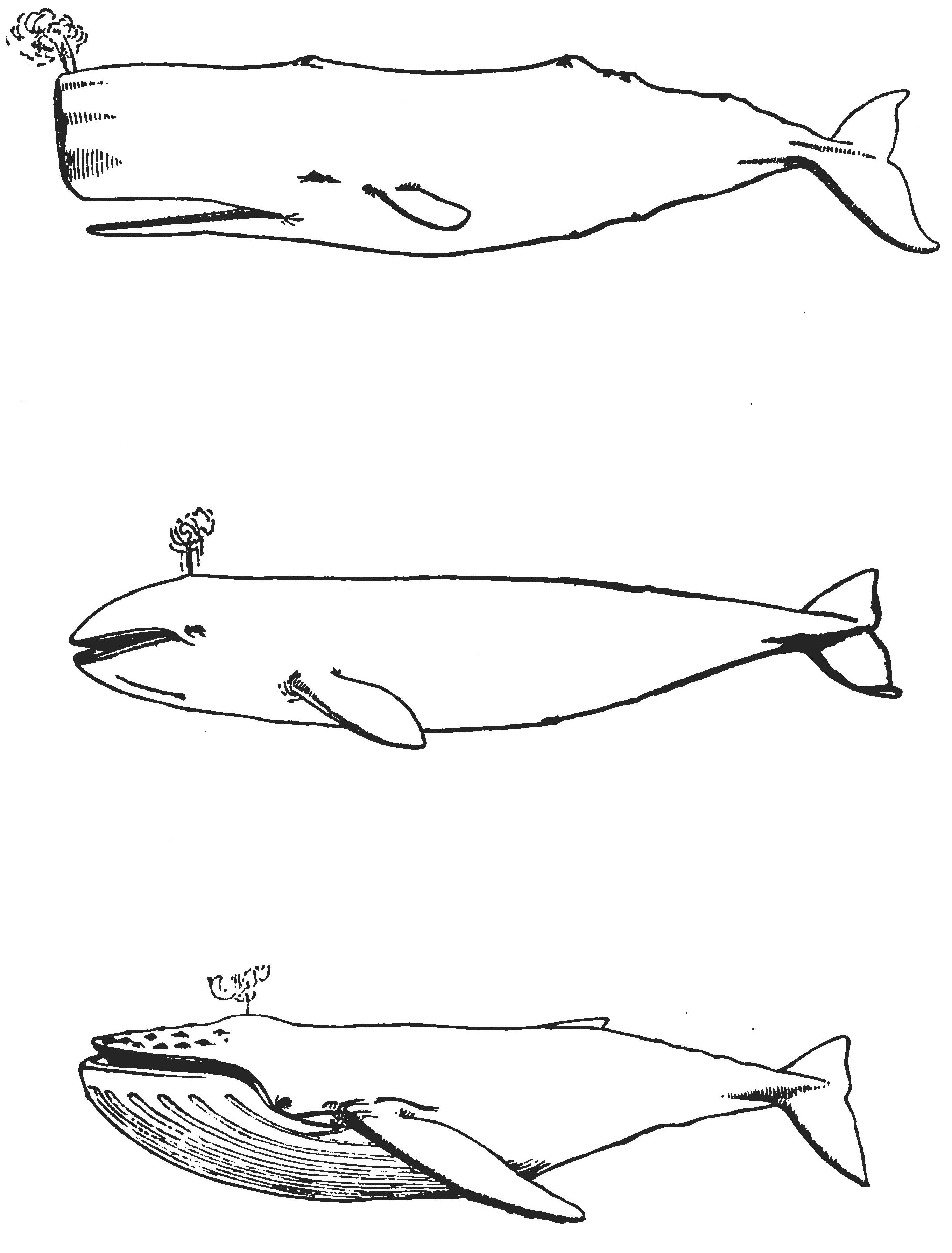
|
Plate II.
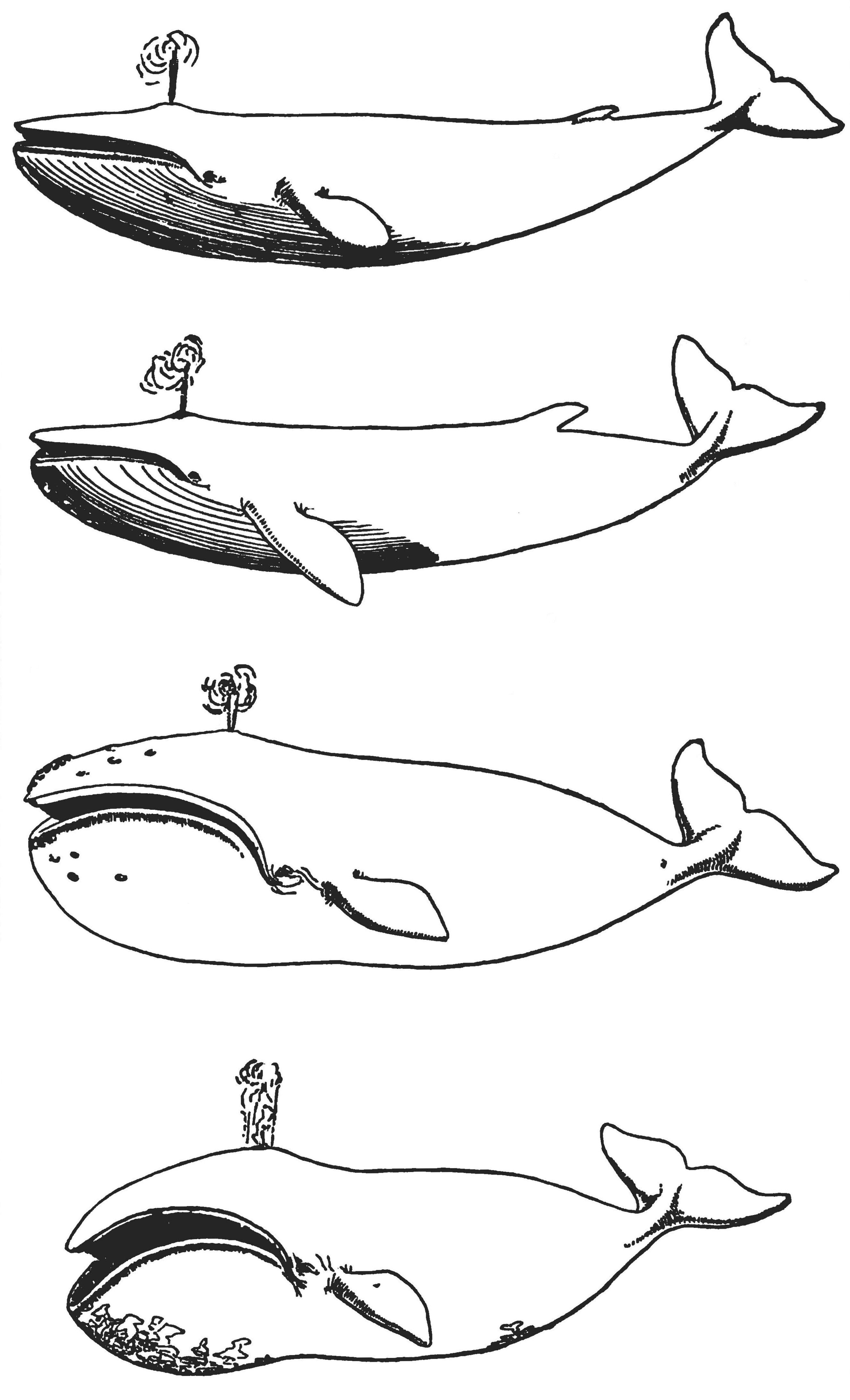
|
Plate III.
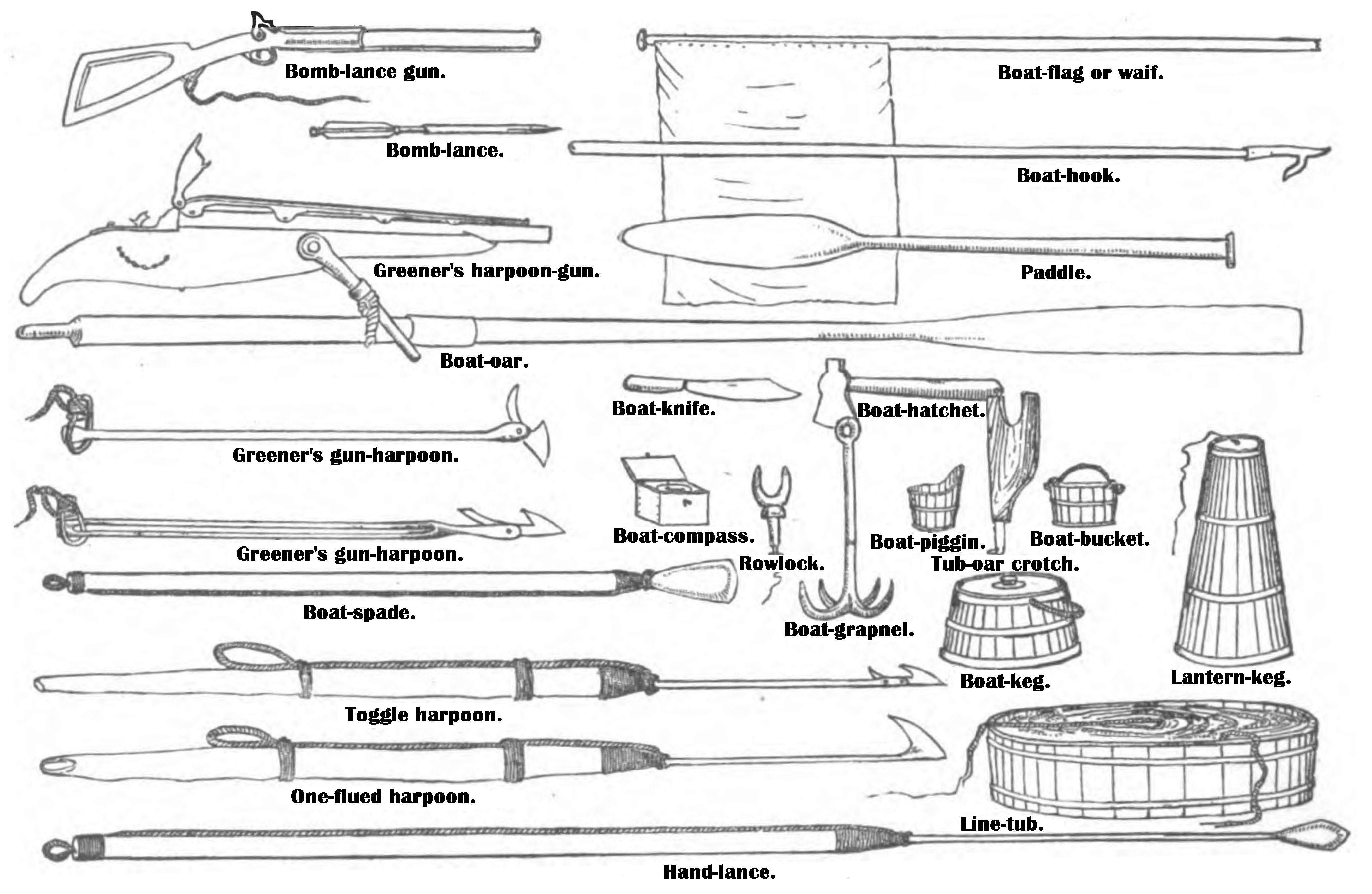
|
Plate IV.
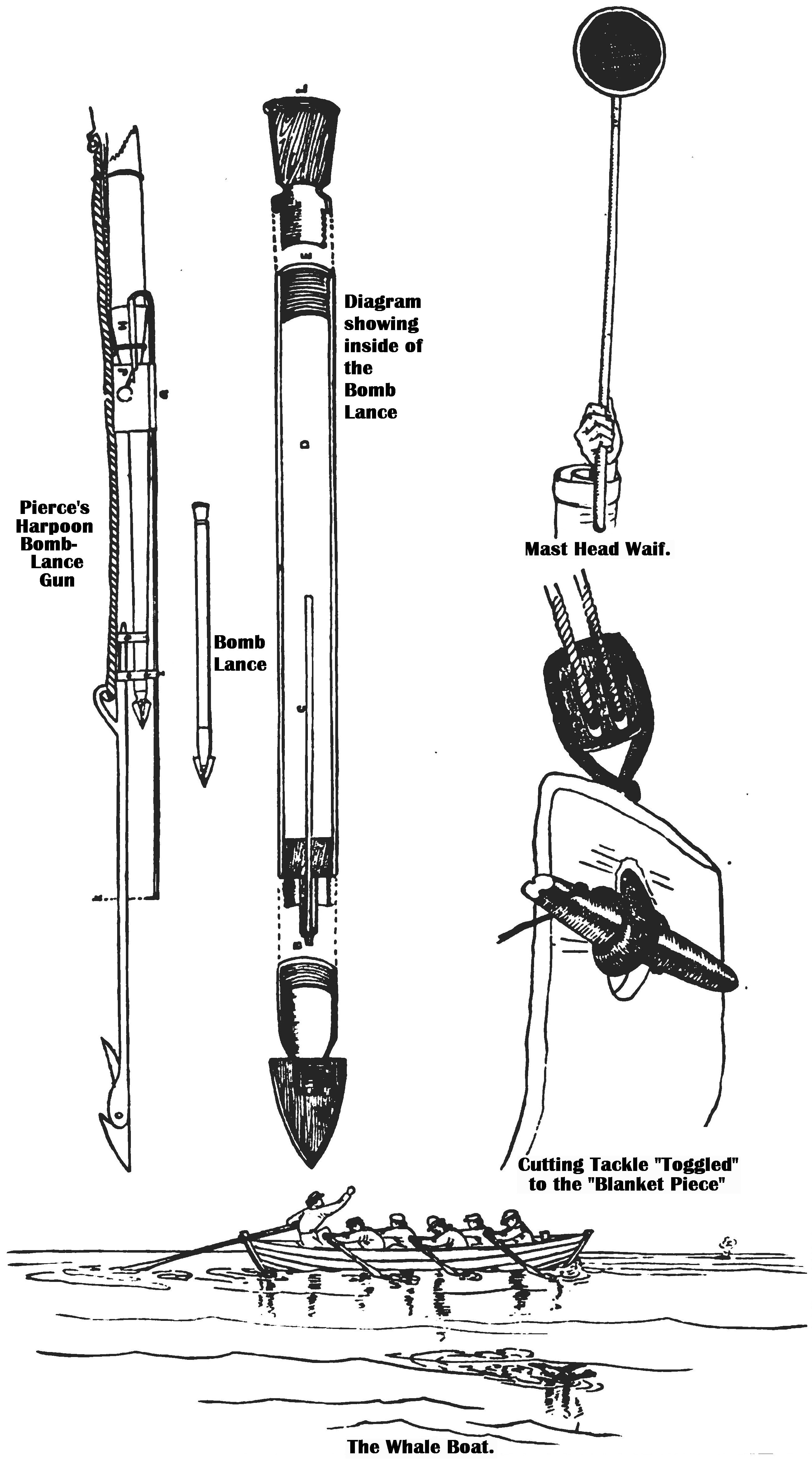
|
Plate V.
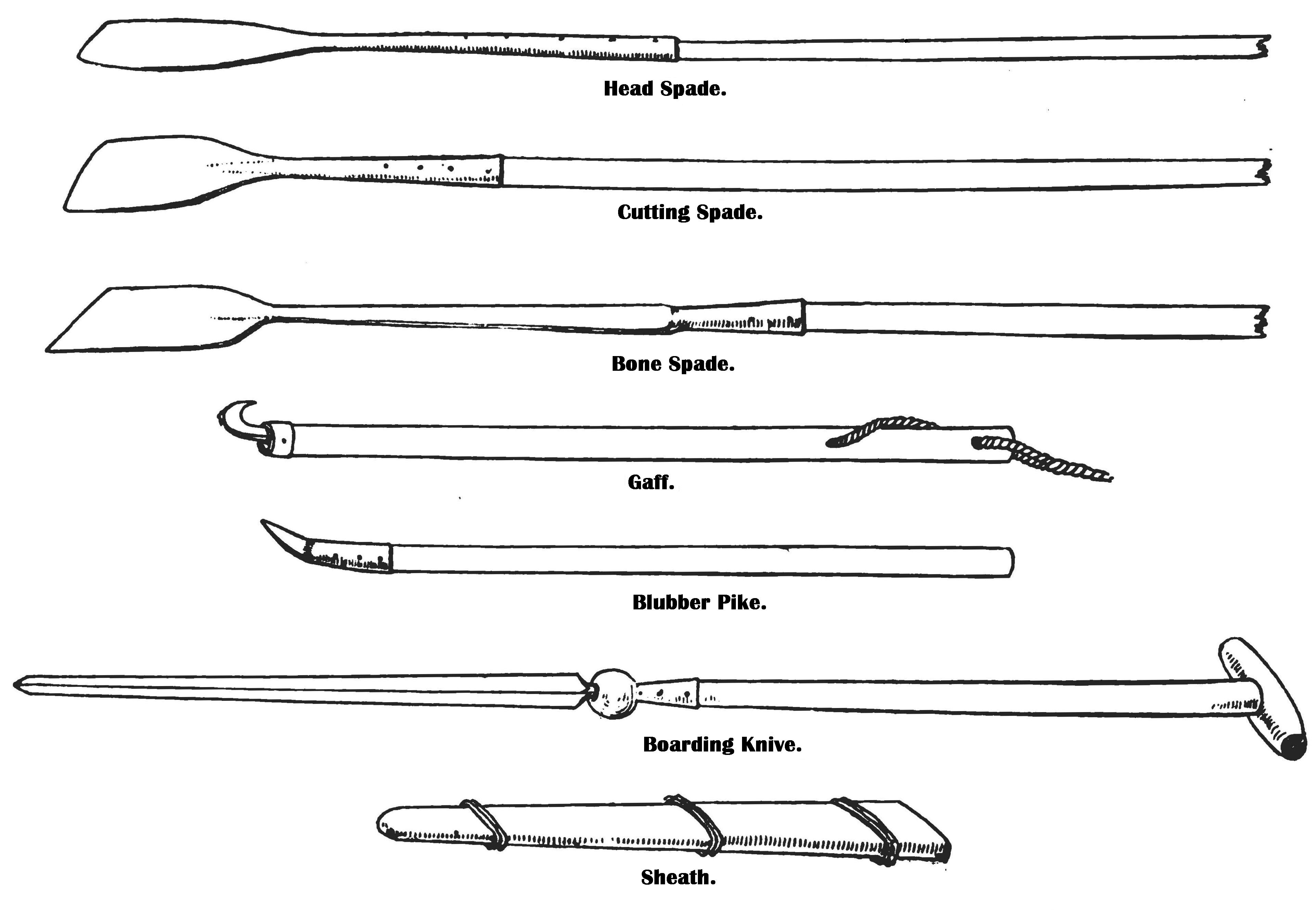
|
Plate VI.
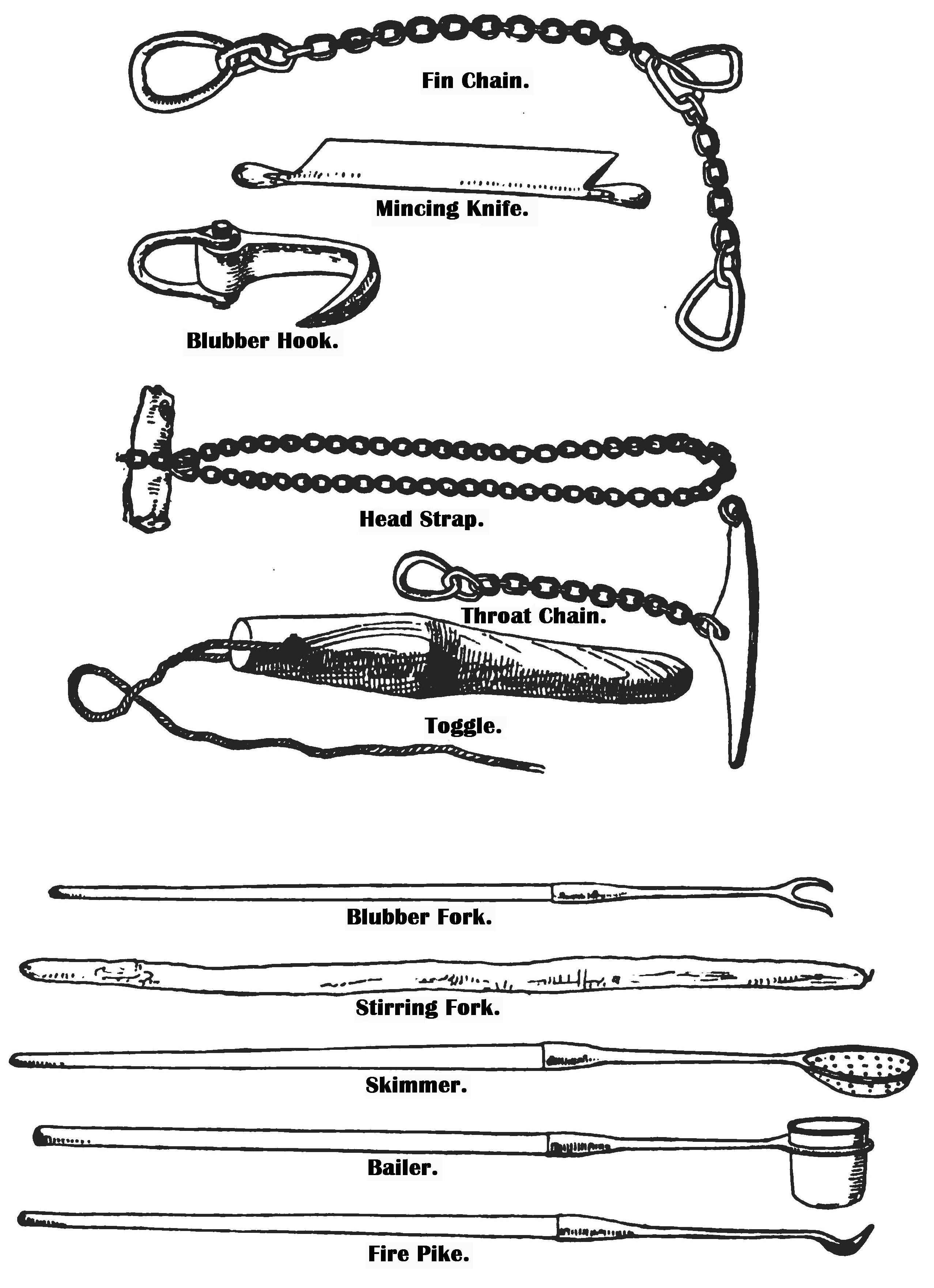
|
ALEXANDER STARBUCK*
| ||||
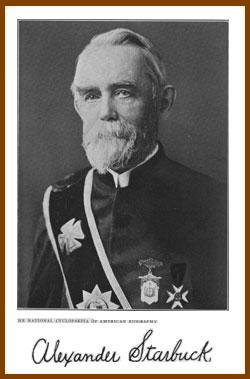 |
STARBUCK, Alexander, editor and author, was born in Nantucket, Mass., Nov. 6, 1841, son of Frederick Gayer and Chloe (Hatch) Starbuck, and a descendant of Edward Starbuck, who emigrated from Derbyshire, England, to Dover, N. H., about 1635 and was one of the original settlers of Nantucket Island. From Edward Starbuck the line is through his son Nathaniel, and his wife Mary Coffin; their son Jethro and his wife Dorcas Gayer; their son Thomas and his wife Rachel Allen; their son Silvanus and his wife Mary Howes, and their son David and his wife Phebe Cartwright, the grandparents of Alexander Starbuck.
|
|
After a public school education he became a clerk in a Nantucket store and in 1859 entered the employ of Andrew Warren, a watch-maker and jeweler at Waltham, Mass., with whom he was in partnership for thirteen years. During 1877-83 he was employed in the factory of the American Watch Co., Waltham, and later in the office of the American Watch Tool Co., Waltham. While engaged in the watch-making trade his natural aptitude for newspaper work found expression in numerous contributions to Waltham and Nantucket newspapers and in 1885 he became editor of the "Waltham Free Press," a weekly newspaper, which was converted into a daily in 1888. In 1897 it was consolidated with the "Waltham Tribune" as the "Daily Free Press-Tribune," of which he was editor until 1922, when he retired. Thereafter he served as a director of the Waltham Publishing Co., publishers of the "Daily Free Press-Tribune" and the "News-Tribune," until his death. While he had a long and successful career in the newspaper field, it was as a historian that he attained the greatest distinction. He was the author of "History of the American Whale Fishery" (1878); the Waltham section of Drake's "History of Middlesex County" (1880); "A Century of Free Masonry in Nantucket" (1903); "A History of Monitor Lodge, A.F. and A.M., of Waltham" (1921); and "History of Nantucket" (1925). He was not only a writer of history but was keenly interested in encouraging the study of historical works and in the preservation of historical records and places. He was one of the founders of the Waltham Historical Society and its first president, serving for three years; was president of the Nantucket Historical Association during 1903-22, and thereafter president emeritus; member of the Watertown (Mass.) Historical Society and the New England Historic-Genealogical Society, and corresponding member of the Wisconsin State Historical Society. While president of the Nantucket Historical Association, he was instrumental in effecting the erection of its concrete fire-proof building and the purchase by the society of the Friends' Meeting House and the Jethro Coffin House, built in 1686, the oldest house on Nantucket Island. He was alderman of Waltham for three years, a member of the sesqui-centennial committee of Waltham in 1888, president and recording secretary of the Suburban Press Association of New England, and president of the Massachusetts Press Association, and was prominent in Masonry. He attended the Universalist church. He was a man of untiring perseverance and energy, entertained the highest ideals of public duty and private virtue, and, as an editor, wrote with courage and conviction strongly influencing the course of public opinion in his community. He was married June 13, 1867, to Ella Maria, daughter of Jonathan L. Warren, a Waltham merchant, and they had two sons: Walter Fisher and George Franklin Starbuck. He died in Waltham, Mass., May 6, 1925.
| |
* This article, which may be protected by copyright, has been reproduced from: The National Cyclopaedia of American Biography (New York: James T. White & Company, 1929), Vol. 20, pp.249-250. The photograph appears in facing page 249 in this source.
NOTES.A transcription of the title page from Starbuck's privately printed edition has been added. In the orignal publication the Table of Contents appeared following section "M". Here it has been placed at the beginning of the work. Some modifications have been made in the display of footnotes. The "List of Illustrations" at page 768 will be found in this presentation following page 167. The plates follow. The following sections of Starbuck are not found in this transcription but are linked to Google Books:
|
SOURCES.Alexander Starbuck, , 1841-1925 Alexander Starbuck, , 1841-1925 Alexander Starbuck, , 1841-1925 Alexander Starbuck, , 1841-1925
Last updated by Tom Tyler, Denver, CO, USA, September 23, 2018.
|